Slashdot Mirror
Domain: seds.org
Stories and comments across the archive that link to seds.org.
Comments · 152
-
Re:Bzzzzzt, but thank you for playing.
The odds of humanity being wiped out by an asteroid (we're VERY resourceful, it would have to be a near planet-sized asteroid to kill us all) are on the same level as the odds of pink communist aliens landing here and making us their bitches. In other words, practically non-existant.
Not really, since we think that an asteroid may have done the same thing in the past. (Wiped out most land based life on earth). We don't think that pink communist aliens ever landed on earth, altough if they did it would explain the majority of people who post their political opinions on slashdot.
you want to worry about natural disasters hurting the US, you'd be better off worrying about hurricanes, earthquakes and giant tsunami's. Giant tsunami's are nearly guaranteed to happen (there is geological evidence for them). The most likely cause would be the partial collapsing into the ocean of the island of La Palma, which would result in a wave over 100 foot high that would destroy the coastline of florida up to 5 miles land-inwards. It would be the largest natural disaster in recorded history, and it's just a matter of time before it happens (though the predictions regarding the when range from 2005 to 7005, so...). The difference is that won't wipe out all of humanity, an astrological disaster has the potental. Say this Star goes super nova which it's expected to do at some point (could be tommorow, could be 10,000 years from now). It could effect us if it hypernova's we might be in trouble...or not.
Just because we don't understand or know how bad the problem might be doesn't mean we should stick our heads in the sand and pretend it doesn't exist. While the East Coast of the US getting wiped out by a tsunami would suck, (especially since I live there) humanity getting wiped out would suck worse. While some people might just "not care" if they are going to die, I'd much rather the human race go on after I'm gone. -
Re:Check the links, editorsThis depends on which images. The famous Hubble image of the Orion nebula was colour corrected by Professor O'Dell of Rice University to match what he saw visually a long time ago through a veyr large telescope (possibly the Palomar 100-inch, but I can't remember), back in the days when you could still look through large telescopes. (In order to see colour you need a lot of light, which means either a very bright object or a very large telescope.)
However, in general you are right, the colour corrections are arbitrary and don't match the "real" colours. Moreover, the brightness stretching and image processing often changes the colour in strange ways. There's a recent paper which discusses the problem and presents some solutions.
-
I call shenanigans.
The Crab Nebula is a remnant of a supernova less than 10,000 light-years away. Why didn't we all fry back in 1054?
-
the next big one primed & feisty
and here's the ticking time bomb within 10,000 lightyears that's going to finish us off. It may in fact already have supernovaed, and the gamma ray clam-bake coming at lightspeed! Oh, and recently revised estimates indicate no more than 20,000 years to the big pop. This will mess up your hard disk.
-
Re:Published in BYTE in 1980 or soOK, I looked up the article. It was by Tim Patterson (the creator of MS-DOS) in 1983, just as Microsoft wrote their own version of MS-DOS (2.0) that included support for subdirectories. It describes FAT as a fairly simple system.
However, (from the web) apparently the actual format is based both on CP/M (the 8.3 naming convention) and the FAT system used by Bill Gates and Marc McDonald in 1977 for Microsoft's Disk BASIC (NCR standalone version).
IIRC the C64 (1541) disk format by comparison uses linked lists and a bitmap of allocated sectors, rather than keeping the links in a centralised table.
-
How we supposed to pay for this?It's a nice idea, but does anyone remember how much it cost last time we did it? I'd be in favor of it, but I can't pay for it myself. NASA's budget during the Apollo program peaked at over 4% of the national GDP. Are we willing to commit that same kind of money now?
Sure, some parts of the program would be cheaper, but containing and steering 3000-degree gases is still just as hard as it was back then. We have no hardware that even comes close to being powerful enough to reach the moon, so everything has to be designed, built, and tested from scratch.
Where exactly are we going to come up with a few hundred billion bucks to pay for this? Apollo cost on the order of $70B, which inflates to over $350B now. Reduce that some for better CAD and cheaper control systems, and increase it for better reliability and doing something more than just sending 7 missions of less than a week duration. Assume we can do it in 10 years (compared to 8 years for Apollo), and we need $35B per year. Unevenly spread, of course, so the peak would be close to $100B for a couple years.
Maybe we could raise that with a bake sale or something.
-
matrix-esq
Did anyone else notice that the Wow Signal looks strangely like the Matrix?
That's plain creepy, if you ask me. -
Re:WWW != Internet
WebExplorer was already being used by IBM in OS/2.
-
Re:a new Sun?
Plunging into ever increasing pressure, no one knows for sure if this will cause a chain reaction, but the potential energy and temperatures are enormous.
Are you fucking nuts? Talk about "argument from ignorance"! "I don't understand the first bit of what I'm talking about, but I'm going to babble on anyhow!"
I will personally guarentee you that vast quantities of plutonium, and for that matter every other known element, already exist in Jupiter. Just because it's a "gas planet" doesn't mean it's made entirely of gas.
Moreover, if anything was going to "set Jupiter off" it would have been set off already! Remember Shoemaker-Levy 9 smacking in Jupiter? That's huge quantities of energy, large enough to roil up clouds larger then Earth itself! And that's nothing compared to what even Earth has seen in its history, let alone the King of Planets. (There's no way to know but personally I'd bet at least one moon-sized impact has hit Jupiter in the past. Your choice of "Jovian moon-sized" or "Earth moon-sized".)
The only "danger" from forty pounds of plutonium several light minutes away are the quantities of hot air it can still generate here back on earth. Get over your pathetic 1950's-era nuclear fears already. It's just matter, not black magic! -
The "Hypothetical Planets" are better
For an even more fun site, try Hypothetical Planets by Paul Schlyter. Vulcan, the Earth's second moon, it has it all...
-
Re:We *are* genetically engineered to be intellige
but the only new ingredient we add is time
If you add a grain or two of sand to your soup, you are unlikely to notice it.
Now add a handful of sand. You begin to notice the grittiness.
Now dump an entire beach of sand onto your dining room table.
Adding ingredients is relative, even if it is only one new one.
Now, I know you're a troll (even if you may not realize it), but go read this, take a look at the image it talks about, then have a little sit down and realize that this planet we're on (and all of your "intelligent designs") are more meaningless than one microscopic speck of silica in the entire ocean.
(Where's a Total Perspective Vortex when you need one....) -
A few interesting science sites
Here's a few sites that'll be maybe at the very limits of the kids' grasp and understanding. But that's good. They should be challenged to learn "the next step up", rather than being fed dumbed-down Barney crud. There's nothing in these pages that a parent can object to (unless they happen to be diehard creationists).
http://tolweb.org/tree/phylogeny.html
The Tree of Life is a collaborative web project, produced by biologists from around the world. On more than 2600 World Wide Web pages, the Tree of Life provides information about the diversity of organisms on Earth, their history, and characteristics.
http://whyfiles.org/
"Science behind the news"
http://www.seds.org/billa/tnp/
The Nine Planets is an overview of the history, mythology, and current scientific knowledge of each of the planets and moons in our solar system. Each page has text and images, some have sounds and movies, most provide references to additional related information.
http://parallel.park.org/Canada/Museum/extinctio n/ tablecont.html
Extinctions: Cycles of Life and Death Through Time (more than just the dinosaurs 65 million years ago)
-
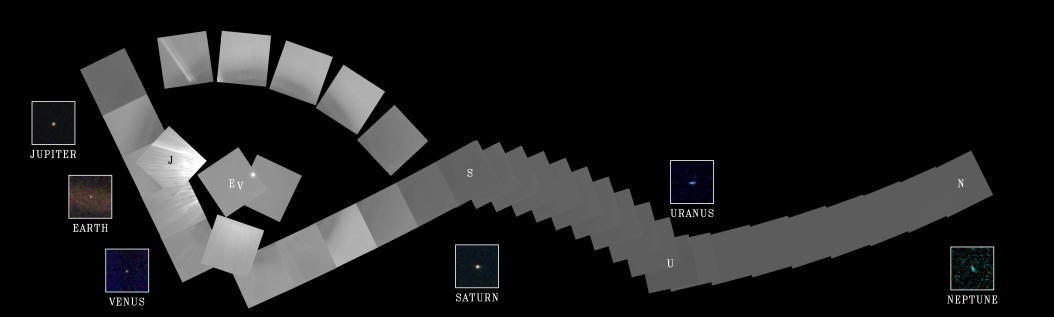
The late great Carl Sagan once wrotehttp://www.seds.org/billa/psc/pbd.html
We succeeded in taking that picture [from deep space], and, if you look at it, you see a dot. That's here. That's home. That's us. On it, everyone you ever heard of, every human being who ever lived, lived out their lives. The aggregate of all our joys and sufferings, thousands of confident religions, ideologies and economic doctrines, every hunter and forager, every hero and coward, every creator and destroyer of civilizations, every king and peasant, every young couple in love, every hopeful child, every mother and father, every inventor and explorer, every teacher of morals, every corrupt politician, every superstar, every supreme leader, every saint and sinner in the history of our species, lived there on a mote of dust, suspended in a sunbeam.
The earth is a very small stage in a vast cosmic arena. Think of the rivers of blood spilled by all those generals and emperors so that in glory and in triumph they could become the momentary masters of a fraction of a dot. Think of the endless cruelties visited by the inhabitants of one corner of the dot on scarcely distinguishable inhabitants of some other corner of the dot. How frequent their misunderstandings, how eager they are to kill one another, how fervent their hatreds. Our posturings, our imagined self-importance, the delusion that we have some privileged position in the universe, are challenged by this point of pale light.
Our planet is a lonely speck in the great enveloping cosmic dark. In our obscurity -- in all this vastness -- there is no hint that help will come from elsewhere to save us from ourselves. It is up to us. It's been said that astronomy is a humbling, and I might add, a character-building experience. To my mind, there is perhaps no better demonstration of the folly of human conceits than this distant image of our tiny world. To me, it underscores our responsibility to deal more kindly and compassionately with one another and to preserve and cherish that pale blue dot, the only home we've ever known.
-
Re:We dont' need a CHERYNOBL in space!
This mission should be shut down through peaceful protests before we all end up glowing green.
This concern is understandable, but uninformed. Refer to this page for a technical explanation of the problem and its solution. There is also a wealth of information here.
I, personally, am more concerned about nuclear-powered Cold War-era spy satellites still orbiting Earth than I am about a 21th-century-technology vehicle to be launched far, far away. -
Re:Anyone else run into this problem?
Asteroids are mode from rock, or coal or metals like iron and nicle. Some are made from iridium and gold and platin etc. Of course mixtures are happening as well.
You, sir, are an idiot who cannot spell.The "rock" (as you so blithely put it) usually contains Iron (Fe), Nickel (Ni) and/or Cobalt (Co). More information / spelling help; get cracking!
-
Remebering the Stromlo ObservatoryThe news is carrying details of the loss, devastation, and deaths related to one of Australia's worst bush fires in history. I'd like to focus on one small aspect of the disaster: the loss of the Mt Stromlo observatory facilities.
The loss of Mt. Stromlo Observatory facility is very great loss.
A number of the obvious sites related to Stromlo are down, due to the fire or due to the wide spread power outages in the area. I will make links to indirect and cached pages.
Established in 1924, the Commonwealth Observatory at Mount Stromlo, on the outskirts of Canberra. Commonwealth Observatory was recognized for its important research into the origin and future of the universe.
Astronomers at Mount Stromlo made outstanding contributions to astronomy. It would be difficult to list all of the important contributions to Astronomy made by the people working at Mt. Stromlo. Now, a few come to mind:
- Stromlo research in the 1950s provided the first clue that the Magellanic Clouds had evolved differently from our own galaxy. These results gave us important insights into galactic evolution.
- In the 1990's, astronomers from Stromlo and Sliding Springs (many km away from the fire area) showed that about 90% of disc galaxies (such as our own) are greatly influenced by ''dark matter'', in their galaxies' halos.
- They made important observations in the first hours after Supernova 1987A (the first naked eye supernova in several centuries of years) was discovered.
- Then there is the sort of work such as the Stromlo Abell Cluster Supernova Search
- The Massive Compact Halo Objects (Macho project that was the first to record many microlensing events in our Galaxy as well as in the LMC.
- Then there was all of that tedious, but vital work of spectral classification of southern stars.
- Many of the first parallax distances to Southern stars were first made at Stromlo.
- The list goes on and on
One of the principal instruments at Stromlo was the 74-inch (188-cm) reflecting telescope. The 74-inch telescope was erected in 1953, and until the completion in 1974 of the 3.9m Anglo-Australian Telescope at Siding Spring, this was the largest telescope in the Southern Hemisphere. In 1982, it was used to discover the fossil star CD-38245: a star so old that it is made almost purely of gases left over from the big bang.
It also was home scopes such as the robotic 50-inch (127-cm). It was an excellent example of how an older telescope could be outfitted with new controls and instruments to perform innovative work. The MACHO project was conducted on the 50 inch.
Two historical scopes come to mind, the Oddie, and the Yale-Columbia telescope:
The Oddie, was a wonderful 9-inch Newtonian telescope. The Victorian MP, James Oddie, presented this telescope to the Commonwealth government for use in the proposed Commonwealth Observatory. It was installed on the site at "Mt Strom" (as Stromlo was originally known) in September 1911. Over the years the Oddie telescope has made valuable contributions to Southern Hemisphere astronomy; it did some of the first measurements of the brightness, color and spectral classification of southern stars.
The Yale-Columbia telescope, 26-inch Grubb long-focus refractor was erected at this site for the determination of parallaxes of southern stars (it was the largest refractor in the southern hemisphere when first installed.
Moreover, there were other scopes as well
The Canberra Astronomical Society used the Stromlo lecture hall for their monthly meetings. During public nights, the public had access to a domed C14 scope, the Oddie, and a number of scopes brought to the site by members
I had the privilege of observing at Mt Stromlo several times and spoke at one of the CAS meetings. I still can recall flying down from the US to a CAS member's home to see SN1987, . I was there only 36 hours after the naked eye supernova was first observed. I still recall seeing the single star, at a distance of over 168,000 light-years, change in color and rightness over the course of an evening. I was one of the most important astronomical events I have had the honor to witness. I recall that every scope up at Mt Stromlo was all pointed at the Large Magellanic Could where SN 1987A was blazing away. The previous observing board schedule was cancelled as people raced to collect as much early critical data as they could in the early hours of the event.
I had the privilege of being with the members of the Canberra Astronomical Society on two of my several total solar eclipses: 1991 in Hawaii, US and most recently the 2001 eclipse in Ceduna, AU.
(Both trips count among my several successful viewings of solar totality. Although the 1991 Hawaii was a close call that was saved because my friend (the one who introduced me to the CAS) broke his arm a very short time before the Eclipse
I look forward to meeting with many of these same people when we go to Antarctica for the 2003 solar eclipse.My best wishes and heart felt sorrow go out to all of those people who worked so hard to make Mt. Stromlo such a wonderful place for the public to visit and who helped the observatory make many important contributions to Astronomy. Much of what was lost cannot be replaced. Still it is my hope that those who are left will be able to rebuild something anew out this tragedy.
-
Signal strenght?
Apart from all the moronic comments about sturdy computers (Nice going Irishman, trolling in the story), Isn't this a clue about the silence in space? You know, the Drake equation? How strong must a signal be, to be heard? Pioneer is only 2x orbit of Pluto away from the Sun, and already impossible to listen to. Nearest star is 4.2 light years away, and nearest galaxy is "just" 75,000 light years away. How strong signal would be needed to communicate these distances. I know the Pioneer signal is only a few milli (micro?) watts, but still...
J. -
Superior management... right!
Go on and read "No downlink" (review). As long as NASAs controlled by politicians, who basicly just worries about their votes (which means getting some heavy contracts for their homestate), we dont get to see a NASA controlled by logic and reason.
Real shame, that is... -
Re:Just abandon it for good
The whole space program - from Mercury to Apollo - cost only $25 billion
actually, it's much closer to $100 billion
and it did REAL science.
I would argue that much of what was achieved was engineering rather than science. -
Check your facts
Your numbers are way off base:
Cost of Skylab was about US$10 billion.
TOTAL (ie. not just the US) cost of the ISS is about $100 billion over 30 years (Reference)
The original US Share of this was about US$15 billion (for comparison, ESA's share was US$8 billion) when the plans were finalized in 1993 (I think?). NASA's cost overruns in January were revised to be a little under US$5 billion
For comparison, the American Manned Lunar Program (Mercury, Gemini, Apollo) cost about $100 billion (in 1994 currency terms). Reference
One of the reasons this option was not used is that NASA doesn't have any boosters that could be retrofitted. -
LMC? (Re:So where did it come from?)IANA Astrometrician, but I attempted to roll back time in the free software Celestia and sneaking up on the Earth and wagging it back and forth, it sure looks like it would have been coming from the Large Magellanic Cloud, a galaxy 180,000 light years away due south. The LMC made a big hit in the news for the stunning supernova discovered there in 1987.
Really there was no point in rolling back time at all, with the accuracy we're talking about it seems obvious that this ancient quark traveler would likely have been guided toward us by the graviational lens that is the mass of the LMC. That, or some unknown process in the LMC could conceivably have generated the strange stuff. Of course at a velocity of only
It seems pretty hard to say where it came from especially with this one piece of information, but we might very well be in for some surprises if we get enough seismic data in the future to plot against the COBE map!
Some interesting links here.
-
Multiple Impacts
I wouldn't be surprised if the dinosaurs died off as a result of a multiple-impact object, instead of a single crater. Something similar to what
Shoemaker-Levy 9 did to Jupiter. Are there any known examples of related impact sites on earth? I imagine that'd be hard to prove, but it would be a neat piece of trivia. -
Re:Jupiter's mass is the cause of the heating
It's this heat from the inside that makes Jupiter warm up.
This parses to "Jupiter is hot because it is hot."
You're correct that Jupiter's core is not hot enough for nuclear reactions (core temperature is about 20,000 K).
Just to clarify, Jupiter gives off more heat than it receives because it is still collapsing! Sounds incredible, but the "heavier" elements are still slowly settling out toward its core. As they do, they release gravitational potential energy in the form of heat. This settling process must be incredibly slow, since it's presumably been happening steadily for the past 4.6 Gyr; the fact that it still produces a significant amount of heat demonstrates how damn BIG Jupiter is.
See SEDS.org for more information (about halfway down the page, right after the section on the Great Red Spot). -
Re:It's amazing how it even works because...
Nah, I can't get three times 2,174,286 Newtons of thrust out of my Nokia... Stuff about engines
-
Re:Correcting some misinformation...
The liquid oxygen is the oxidizer for the fuel, which is liquid hydrogen. Both of these liquids are stored in the main fuel "tank", in separate compartments. This page has a picture showing the relative size of the H2 and the LOX tanks.
-
The search for Planet VulcanThe SEDS Nine Planets website has a nice review of the search for an intra-Mercurial planet (to be called, surprise surprise, Vulcan), back before Einstein explained away the discrepancies between Mercury's predicted and actual orbits.
-dexter "still looking for planet x" riley
-
The search for Planet VulcanThe SEDS Nine Planets website has a nice review of the search for an intra-Mercurial planet (to be called, surprise surprise, Vulcan), back before Einstein explained away the discrepancies between Mercury's predicted and actual orbits.
-dexter "still looking for planet x" riley
-
Not that I'm a cosmologist
But last I read, the Milky Way was thought to be a bared spiral.
This guy, these guys, and most convincingly, these guys, seem to all agree. -
Re:Distance is not a problem, PRICE is the problemEmigration rarely helps local population pressure, and I think its obvious that emigraion to Mars will not help the Earth's population reduce. The importance of being on Mars is to seed a new colony that will grow independantly so that humanity now lives in TWO baskets, not one.
15 year to terraform Mars? I think you are a wee bit optimistic. 300 years might be more reasonable. Important things take longer than "one quarter".
And yes, the Martian atmosphere is only about 1% as thick as the Earth's, and is 95% co2.
Mars facts are at: Nasa Mars Facts
More Mars Info -
Re:Pseudocolor
I've looked at several nebulas and galaxies through telescopes, and yes, they are all basically grey. I think there is value in enhancing even a visible-light image to highlight important structural details. For example, in the mostly green Hubble PR image of the Eagle Nebula, they assigned the orange hydrogen-alpha emission line to the green channel so it would be easier to distinguish from the red sulfur ion emission line. Since conventional images of this nebula are typically orange, I wondered what the color mapping was. I agree that they should generally do a better job of explaining it, but I don't mind that they did it. Through a telescope I can't see the nebula at all, only the star cluster.
-
Re:Better off?
-
Re:Better off?
-
Re:Better off?
-
Re:Multi-stage Launch
Ahh, Clipper Graham, how I miss yee... I may be getting a bit cynical, but I just don't believe NASA will ever assist in the devlopment of something that will make them obsolete, like a truly inexpensive, safe 1-stage reusable spacecraft. Common, Mr. Gates! actually do something for mankind! put the resources of your evil empire behind this problem! Just PLEASE don't run the flight control computers with XP.
-
Exactly
If I had moderator points that would definitely have got an "informative" but I guess there are a couple of points I can add to justify a response.
Firstly, it is rather sad that such a basic yet interesting fact as this angular momentum transfer seems to be completely missing from the standard education curriculum.
Secondly, I've been trying to get to first base in compiling some data on the energy storage and rate of use in major planet-wide systems (down to, say, the gravitational potential of elevated water and ice stores) but am stuggling to find clear data.
Even in such an obvious area as total solar radiation the ratio between what the Sun is claimed to radiate (386 billion billion megawatts) and what the Earth is claimed to receive (4.4 x 10¹⁶ watts) seems to fly in the face of simple geometry which seems to me should have the earth intercepting one part in 1.1 billion of the Sun's radiation.
Digging for data on other energy systems, there is a total mess of approaches and even units used by different specialties that are going to make even a basic comparison table hard work to draw together, unless of course I am willing to become a "Creation Scientist". -
I stand correctedgoogle found me this at this page
Until 1962 it was thought that Mercury's "day" was the same length as its "year" so as to keep that same face to the Sun much as the Moon does to the Earth. But this was shown to be false in 1965 by doppler radar observations. It is now known that Mercury rotates three times in two of its years. Mercury is the only body in the solar system known to have an orbital/rotational resonance with a ratio other than 1:1 (though many have no resonances at all).
-
alternate source
we already have a hydrogen source a mere 1AU away.
-
Re:Of all the billions of stars to choose...
It is possible to tie a particular supernova remnant (and this is the only way ultra-dense stellar remnants are created) to an event witnessed in the past; indeed this is often done. Supernovae occur so infrequently in our galaxy (one every 100 to 500 years or so) that it is often possible to do so. For instance, it is very well known that the Crab Nebula is the remnant of the supernova witnessed by Chinese astronomers in 1054 AD.
-
Bright enough for binoculars
NGC 1068 is also known as M 77. It's one of the nearest galaxies to us. You can see it faintly in 7x50 binoculars if you look in the right place.
-
Re:Tracking interplanetary objects?Here is some software which might help you out:
Links to seti@home area for sky maps.
Because any discussion of orbital mechanics will run into the pages I suggest you visit these sites:
if that doesn't help try these- More Orbits
- Way indepth, should give you enough - as long as you have a basic understanding of physics
- more equations than you can shake a stick at
If you make a open-source program, email it to me. I'd love to try it out. bill_dinger@N.O.S.P.A.M.yahoo.com -
distances sound wacked.500,000 light-years away
The Galactic core is closer than that, the last I checked. Andromeda is about 2 million LY away, if I recall right. Let's see.
CNN cites the Scorpius-Centaurus OB Association of stars which is actually about 470 light years away.
So CNN was off only by a factor of a thousand. Interesting theory, if they can get the facts right.
-
Globular Clusters!
Sounds like a sick snack, don't it.
here's a link to Globular Cluster NGC6397
Can you find the pulsar? *grin*
Photo taken from the Hubble, circa 1994. -
Re:Priorities.. Reflections on the project
I think a very good point is raised here. Considering the difficulty that even other humans have had deciphering the signal sent out by humans in Nov. 1974 (though I can't really take it as a serious attempt at communication - sent towards M13, so we oughtn't expect a hypothetical response for around 45,000 years, give or take), I wonder how difficult it will be to decipher a signal sent by anyone who is not like us, assuming we can actually FIND one (the ostensible goal of SETI@home).
In the mid 70s, a lot of science magazines created similar messages and had contests for the readers to try to figure them out (not a lot of people managed to - mainly mathematicians, as I recall). There were also a lot of articles about how scientists here on Earth tried to untangle the Arecibo message themselves - but failed (of course, I can't find much about it on the web - anyone got any good links on the subject? Most web searches now bring up the script for Contact...
For fun and edification, try the following: Take the entire binary sequence of the Aricebo message, and just lay it out as one long string. From there, forget all the exlpanations you've ever read about how it's been constructed. Also try to forget you're a member of the same species. Then take into account signal degradation over distance. Then try to forget that it's NOT just random noise from a big celestial event. Then try to figure it out! This ought to give you some idea about what we're looking at as far as actually getting a message. This site has a similar disclaimer, plus a link to the message itself (just scroll down and look for the big block o' binary). Some questions that come to my mind are, "What is it? Does it mean anything? Is it a 23x79 grid, or is it 79 23-bit words? 23 79-bit words? If it's a 23x79 grid, do the images I percieve mean anything? Am I looking at it upside down? Am I reading too much into random stellar noise? Did I even receive the whole message? 1679 bits seems not random, but what if I'm missing some of it?"
That said, I think that there is a lot to be said in favor of SETI@home. The first thing is (here's more of that subjective stuff again) - I think it's cool! I personally don't have much hope for it ever finding anything really interesting or useful, but it's a really neat project. I like to consider it the first really well-handled attempt at massively distributed computing. It is something of a pioneering project and has shown many of the pitfalls awaiting future distributed projects (like the bandwidth problem!).
In a more serious vein, without SETI@home, I don't think that distributed computing would have taken off like it has. By stimulating imaginations (despite the obvious problems involved in finding a signal at all, I think most of us are still REALLY intrigued by the concept - enough to participate in a frankly goofy project with miniscule chance of success in the hope that MAYBE something interesting will turn up), it provided a good vehicle for getting the whole notion that distributed computing can actually WORK into the world at large. I don't think it matters that the proof-of-concept was applied to SETI, rather it is simply sufficient that it was a good proof-of-concept.
In all, I believe that without SETI@home, we wouldn't have all the other interesting distributed computing projects going on to the extent that they are. I'd be willing to bet that other distributed computing project groups (especially the cash-poor ones) are watching to see how the SETI@home folks handle the bandwidth crunch (aside from throwing money that they really haven't got at it). Many of the resolutions proposed in these comments seem to have a lot of validity, and I'd hope that the SETI@home folks reading them can use the suggestions to come up with something that works - and that they can afford. I'd hope, though, that they can avoid using too many commercial partnerships - I think that the research end of it would best avoid the specter of undue influence. I've known several good research projects that lost legitimacy (and I think that the driving goal behind SETI@home needs to hold on to all the legitimacy it can!) simply by being associated with a commercial entity - even though there was NO influence on the direction of research. But that would be another topic altogether.
-
Re:11 microseconds per decade?
That's right. The length of the day increasing by 11us per decade is insignificant compared to the 2 milliseconds per century = 200us per decade increase due to the interaction with the Moon.
Also, cnn had the story 4 days ago. -
Re:extraterrestrial life from Mars, Europa, and
-
Polynesian ModelsI recall that a year or so ago objects were discovered way out well past pluto, maybe even out to half a light year or more. (30,000 AU?)(ah, here's the link) With a number of these conveniently placed, travel to the stars could be done via these distant places, in a manner very much like Island hopping used by the Polynesians. The Kuiper Belt becomes a launching pad, training ground, etc. But this may not be the case.
If convenient objects are just a quarter light year or so apart, then the journeys do not have to be so long.
Just make sure to bring along a whole lot of cheese doodles. we'll be sending GW with you. (smile)
Which brings up the question of who should we send as the the first people to travel?
-
Re:When did it happen?In response to a question about how long ago this event occurred, vtaluskie responded:
FYI this link lists the distance as 30-40 million light years.... so my vote would be for the it happened millions of years ago
Not to nitpick, but this has bothered me and left me in a state of confusion: doesn't a statement like this suggest some absolute standard of time? Wouldn't this (giving an age of an event) suggest the possibility of knowing that two events were indeed simultaneous? It was my understanding that no two events can be verified to be simultaneous, for the time at which an event occurs is based on the observer's frame of reference.
-
Re:The galaxy went dim?
The size of the telescope, the lenses used in the objective, atmospheric conditions, the different filters used, the CCD cameras used, the length of the exposure time, all play a huge factor in how the picture looks.
Because there are so many different variables involved, it's common to see variations like this. The galaxies do not "go dim".
More on M74 here. -
Re:When did it happen?
-
Moons
Depends, are kids just a subset of adults?
Some moons are fairly boring chunks of rock (like, say, The Moon), others tell a story of an extremely violent past (like, they've been blasted to bits and only just managed to stay as one entity, like Miranda).
Others have thick atmospheres containing weird-ass chemicals (like Titan), others have vulcanism driven by processes we barely understand (like Triton, or Io)
Some may have oceans, others are small chunks of rock we would barely notice if they weren't orbiting some other body (like Phobos).
The planets may be more interesting in some respects, but there are a lot more moons to look at