Slashdot Mirror
Domain: sfu.ca
Stories and comments across the archive that link to sfu.ca.
Comments · 260
-
Re: Or skeptics
What a pile of horsecock. Science uses adjustments to account for systemic error such as in measuring instruments the entire frigging time.
To give one example from another unrelated field:
https://www.sfu.ca/colloquium/...You people who think you know something about science. You really are pathetic.
-
Re:They might guarantee it...
It's highly doubtful that anyone can be consistently in Kohlberg's stage 5 (and certainly no one is in 6). It just runs counter to what we know from evolutionary psychology, as well as common sense. Often people try to make the argument that full-blown altruism exists and has been able to arise because evolution can happen on the scale of groups rather than just individuals (or, more precisely, individual genes), but these theories have never played out outside simplified computer models. The selection pressure even in as social species as humans is overwhelmingly biased towards individuals and closest relations, falling off very quickly with genealogical separation. While in modern society individuals have far more vast influences, potentially affecting much of the world, this has only been the case for a time multiple orders of magnitude shorter than what is needed to see any effect on our biology. Indeed, there remains a significant source of selection pressure against the top two of Kohlberg's levels: altruism leaves its adherents very vulnerable to exploit by selfish individuals (the flip side of this coin is that psychopathy is an effective strategy as long as the frequency of its occurrence is low enough, which explains the fairly consistent 1% rate; this is analogous to the sexual selection pressures that result in a minority of "alpha" males). A discussion about these issues in the context of Kohlberg's stages can be found at http://www.sfu.ca/psyc/faculty...
-
Earlier campaigns
-
Re:Work with cloned mice
And this is the trick: continuity is a core aspect of the experience of consciousness; otherwise, this scenario is identical to killing the original and "activating" the cloned mind.
One thing that could throw a kink into the scenario, however, is the possibility (albeit, IMHO, less than even) that some core aspects of consciousness are encoded as quantum information, in which case it cannot be cloned (by the no-cloning theorem). Some hints that this may be the case are to be found in recent experimental research: the most important result is http://www.researchgate.net/pu... but also see http://www.sciencedirect.com/s... and http://iopscience.iop.org/1742... as well as, for an overview of this area, http://journals.sfu.ca/jnonloc... -
Jane is Lonny Eachus is a pathological liar
I neither agree or disagree. I'm not even reading your entire comments. I have no reason to. I solved the problem we discussed using standard textbook radiative physics methods. I have ZERO reason to go back and try to do it the "Khayman80" way, which is not exactly what I would call "standard" methodology. The textbook way is fine by me and I'm sticking with it. [Jane Q. Public, 2015-03-23]
One thing Jane said is true. Jane's never read my entire comments, or the comments by any other physicist.
But everything else Jane said is sadly wrong. Jane solved the problem using his own incompetent misunderstanding of his own textbooks. That's why inserting the standard physics definition of the word "net" into Jane's equation reproduces the energy conservation equation Jane's still adamantly rejecting.
Another independent way Jane could see that he misunderstood the "textbook way" would be to learn about how to apply conservation of energy. Here are some introductions: example (backup), example (backup), example (backup).
If Jane would ever bother to read entire comments by physicists, or textbooks about basic physics, Jane would quickly learn that only power passing through a boundary is included in the energy conservation equation across that boundary.
It's just like crayons in a coloring book, Jane.
-
Jane/Lonny Eachus goes Sky Dragon Slayer
Jane, before you try to lecture people about orbital mechanics, you should first make sure you understand more fundamental concepts like "conservation of energy".
But net radiative power out of a boundary around the source = "radiative power out" minus "radiative power in", so the equation Jane just described also says:
NO!!!!! As I have explained to you innumerable times now, you can also consider your heat source, by itself, that "sphere". The only NET radiative power out comes from the electrical power in. Further, the cooler walls do not contribute any of that NET power out. That's what net means. [Jane Q. Public, 2014-12-16]
I've already pointed out that Jane's hopelessly confused about the word "net", but that's just one of the mistakes Jane packed into these few sentences.
Jane's also wrong to imply that energy conservation across one choice of boundary could somehow contradict energy conservation across another boundary choice. That's impossible. Many boundary choices are inconvenient but they all have to be consistent. Otherwise, how could we possibly tell which boundary choice was correct?
So Jane can't object to the simple energy conservation equation I derived by claiming that some other boundary choice would somehow contradict my equation. That's completely impossible, and if Jane doesn't understand that point then he should learn about conservation of energy: example (backup), example (backup), example (backup).
As you can tell after reading those introductions, here's how to apply conservation of energy. Draw a boundary around the heat source:
power in = electrical heating power + radiative power in from the chamber walls
power out = radiative power out from the heat sourceSince power in = power out through any boundary where nothing inside is changing:
electrical heating power + radiative power in from the chamber walls = radiative power out from the heat source
I put the boundary around the heat source so the boundary is in vacuum. That's because radiation can't travel through opaque solids like the heat source. So the only way to obtain an energy conservation equation with radiative terms is to place the boundary around the heat source.
For example, I calculated the enclosing shell's inner temperature by drawing the boundary within the enclosing shell. This boundary was inside aluminum, so heat transfer through it was by thermal conduction, not radiation. Notice that even this boundary choice leads to a conduction equation where electrical heating power depends on the cooler chamber wall temperature. That's because all boundary choices have to be consistent. The resulting equations can't contradict each other unless one of them is wrong.
After I asked Jane to explain exactly where his boundary would be drawn, Jane replied:
... You can draw the boundary right around the heat source. Electric power comes in, radiative power goes out.
-
Jane/Lonny Eachus goes Sky Dragon Slayer
Jane's "interest" in that NAS report evaporated after I showed that Jane had been fooled by "Steven Goddard" once again. So let's return to Jane's confusion about basic thermodynamics.
But net radiative power out of a boundary around the source = "radiative power out" minus "radiative power in", so the equation Jane just described also says:
NO!!!!! As I have explained to you innumerable times now, you can also consider your heat source, by itself, that "sphere". The only NET radiative power out comes from the electrical power in. Further, the cooler walls do not contribute any of that NET power out. That's what net means. [Jane Q. Public, 2014-12-16]
I've already pointed out that Jane's hopelessly confused about the word "net", but that's just one of the mistakes Jane packed into these few sentences.
Jane's also wrong to imply that energy conservation across one choice of boundary could somehow contradict energy conservation across another boundary choice. That's impossible. Many boundary choices are inconvenient but they all have to be consistent. Otherwise, how could we possibly tell which boundary choice was correct?
So Jane can't object to the simple energy conservation equation I derived by claiming that some other boundary choice would somehow contradict my equation. That's completely impossible, and if Jane doesn't understand that point then he should learn about conservation of energy: example (backup), example (backup), example (backup).
As you can tell after reading those introductions, here's how to apply conservation of energy. Draw a boundary around the heat source:
power in = electrical heating power + radiative power in from the chamber walls
power out = radiative power out from the heat sourceSince power in = power out through any boundary where nothing inside is changing:
electrical heating power + radiative power in from the chamber walls = radiative power out from the heat source
I put the boundary around the heat source so the boundary is in vacuum. That's because radiation can't travel through opaque solids like the heat source. So the only way to obtain an energy conservation equation with radiative terms is to place the boundary around the heat source.
For example, I calculated the enclosing shell's inner temperature by drawing the boundary within the enclosing shell. This boundary was inside aluminum, so heat transfer through it was by thermal conduction, not radiation. Notice that even this boundary choice leads to a conduction equation where electrical heating power depends on the cooler chamber wall temperature. That's because all boundary choices have to be consistent. They can't contradict each other unless one of them is wrong.
After I asked Jane to explain exactly where his boundary would be drawn, Jane replied:
-
Jane/Lonny Eachus goes Sky Dragon Slayer
Jane's "interest" in that NAS report evaporated after I showed that Jane had been fooled by "Steven Goddard" once again. So let's return to Jane's confusion about basic thermodynamics.
But net radiative power out of a boundary around the source = "radiative power out" minus "radiative power in", so the equation Jane just described also says:
NO!!!!! As I have explained to you innumerable times now, you can also consider your heat source, by itself, that "sphere". The only NET radiative power out comes from the electrical power in. Further, the cooler walls do not contribute any of that NET power out. That's what net means. [Jane Q. Public, 2014-12-16]
I've already pointed out that Jane's hopelessly confused about the word "net", but that's just one of the mistakes Jane packed into these few sentences.
Jane's also wrong to imply that energy conservation across one choice of boundary could somehow contradict energy conservation across another boundary choice. That's impossible. Many boundary choices are inconvenient but they all have to be consistent. Otherwise, how could we possibly tell which boundary choice was correct?
So Jane can't object to the simple energy conservation equation I derived by claiming that some other boundary choice would somehow contradict my equation. That's completely impossible, and if Jane doesn't understand that point then he should learn about conservation of energy: example (backup), example (backup), example (backup).
As you can tell after reading those introductions, here's how to apply conservation of energy. Draw a boundary around the heat source:
power in = electrical heating power + radiative power in from the chamber walls
power out = radiative power out from the heat sourceSince power in = power out through any boundary where nothing inside is changing:
electrical heating power + radiative power in from the chamber walls = radiative power out from the heat source
I put the boundary around the heat source so the boundary is in vacuum. That's because radiation can't travel through opaque solids like the heat source. So the only way to obtain an energy conservation equation with radiative terms is to place the boundary around the heat source.
For example, I calculated the enclosing shell's inner temperature by drawing the boundary within the enclosing shell. This boundary was inside aluminum, so heat transfer through it was by thermal conduction, not radiation. Notice that even this boundary choice leads to a conduction equation where electrical heating power depends on the cooler chamber wall temperature. That's because all boundary choices have to be consistent. They can't contradict each other unless one of them is wrong.
After I asked Jane to expl
-
Re:No one gets the oil!
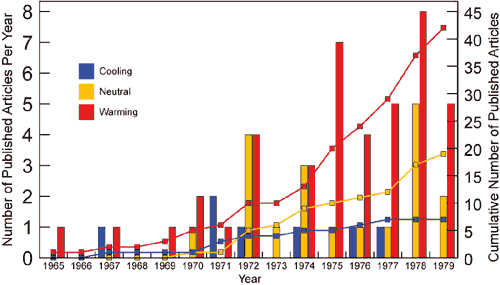
You're regurgitating complete nonsense. Once again, here’s figure 1 from Peterson et al. 2008. Notice that papers predicting warming vastly outnumbered those predicting cooling, even in the 1970s. Ironically:
- The term “global warming” was first used in a 1975 Science article by Wally Broecker called “Are we on the brink of a pronounced global warming?”.
- Sawyer 1972 estimated climate sensitivity as 2.4C, and Schneider 1975 gave a preliminary range of 1.5C to 3.0C.
- Manabe and Wetherald, 1975: “The Effects of Doubling the CO2 Concentration on the climate of a General Circulation Model.”
- In 1977, Freeman Dyson wrote that the “prevailing opinion is that the dangers [of the rise in CO2] greatly outweigh the benefits.”
- In 1977, Robert M. White, the head of the National Oceanic and Atmospheric Administration, wrote a report for the National Academy of Sciences that said “We now understand that industrial wastes, such as the carbon dioxide released in the burning of fossil fuels, can have consequences for climate that pose a considerable risk to future society.” [White, Robert, 1978, Oceans and Climate Introduction, Oceanus, 21:2-3]
- The 1979 JASON report “The long-term impact of atmospheric carbon dioxide on climate” estimated climate sensitivity as 2.4C to 2.8C.
- The National Academy of Science’s 1979 Charney report estimated climate sensitivity as 1.5C to 4.5C and said “If carbon dioxide continues to increase, [we] find no reason to doubt that climate changes will result, and no reason to believe that these changes will be negligible.”
While Jane is reading those papers, he should also consider addressing this issue with his basic thermodynamics:
Your own insistence that power in = power out (assuming perfect conversion and no entropic losses) belies this argument. You are arguing against yourself and you refuse to see that. If power in = power out (your own stipulation)
I'm not the only one insisting that power in = power out through any boundary where nothing inside is changing. Once again, that's a fundamental principle called "conservation of energy". Here are some introductions: example (backup), example (backup), example
-
Jane/Lonny Eachus goes Sky Dragon Slayer
If you have actual, direct evidence, why did you not link to THAT, rather than somebody else's claim? [Jane Q. Public, 2014-12-14]
I linked to reviews of actual, direct evidence by the U.S. National Academy of Sciences and The Royal Society (U.K.) in their joint publication (PDF), and another review of evidence by the American Association for the Advancement of Science, which publishes the journal Science.
While Jane is reading those reviews, he should also consider addressing this issue with his basic thermodynamics:
Your own insistence that power in = power out (assuming perfect conversion and no entropic losses) belies this argument. You are arguing against yourself and you refuse to see that. If power in = power out (your own stipulation)
I'm not the only one insisting that power in = power out through any boundary where nothing inside is changing. Once again, that's a fundamental principle called "conservation of energy". Here are some introductions: example (backup), example (backup), example (backup).
As you can tell, conservation of energy is a fundamental physics principle. Assumptions of "perfect conversion and no entropic losses" aren't applicable, and anyone who mistakenly thinks they are should read through those examples to learn about conservation of energy.
If power in = power out (your own stipulation), and the only NET power INTO a defined spherical region is electrical, and the only NET power OUT of that region is radiative, then net radiative power out at steady-state must therefore be equal to the net electrical power consumed. [Jane Q. Public, 2014-12-14]
Jane seems to be saying that at steady-state:
net electrical power consumed = net radiative power out
But net radiative power out of a boundary around the source = "radiative power out" minus "radiative power in", so the equation Jane just described also says:
net electrical power consumed = "radiative power out" minus "radiative power in"
However, this new equation doesn't match Jane's earlier equation:
My energy conservation equation is this: electrical power in = (epsilon * sigma) * T^4 * area = radiant power out [Jane Q. Public, 2014-10-08]
Notice that Jane's earlier equation doesn't describe net radiative power out, which is why it violates conservation of energy. Is Jane retracting his earlier incorrect equation, or does Jane dispute the definition of the word "net"?
-
Jane/Lonny Eachus goes Sky Dragon Slayer
Your own insistence that power in = power out (assuming perfect conversion and no entropic losses) belies this argument. You are arguing against yourself and you refuse to see that. If power in = power out (your own stipulation)
I'm not the only one insisting that power in = power out through any boundary where nothing inside is changing. Once again, that's a fundamental principle called "conservation of energy". Here are some introductions: example (backup), example (backup), example (backup).
As you can tell, conservation of energy is a fundamental physics principle. Assumptions of "perfect conversion and no entropic losses" aren't applicable, and anyone who mistakenly thinks they are should read through those examples to learn about conservation of energy.
If power in = power out (your own stipulation), and the only NET power INTO a defined spherical region is electrical, and the only NET power OUT of that region is radiative, then net radiative power out at steady-state must therefore be equal to the net electrical power consumed. [Jane Q. Public, 2014-12-14]
Jane seems to be saying that at steady-state:
net electrical power consumed = net radiative power out
But net radiative power out of a boundary around the source = "radiative power out" minus "radiative power in", so the equation Jane just described also says:
net electrical power consumed = "radiative power out" minus "radiative power in"
However, this new equation doesn't match Jane's earlier equation:
My energy conservation equation is this: electrical power in = (epsilon * sigma) * T^4 * area = radiant power out [Jane Q. Public, 2014-10-08]
Notice that Jane's earlier equation doesn't describe net radiative power out, which is why it violates conservation of energy. Is Jane retracting his earlier incorrect equation, or does Jane dispute the definition of the word "net"?
-
Re:What the fuck are you talking about?
Professor is an English word, albeit one with a Latin origin, and it has been an English word for about 700 years. Most English words do not get inflected by gender. It must be admitted that many occupation-words that can be used as pronouns are inflected (actor/actress, waiter/waitress, etc.), but professor is not among those words. Professora does not appear in any English dictionary I tried, such as dictionary.reference.com. Professor, emeritus, and emerita all appear in every dictionary I tried.
Furthermore, "Professors Emeriti/ae" is often used as the plural. The 's' plural demonstrates that "professor" is being used in its English-language form.
Surely if a student were to talk about their "professors", you would not lecture them on their ignorant use of plurals. Why, then, do you insist that the professor is "professor emeritus" is actually a different word in a different language and therefore subject to different inflections?
And if that isn't convincing, there's the fact that "Professor Emerita" is an officially-conferred title, and therefore it is correct by definition:
http://www.sfu.ca/policies/gaz... -- an example from Canada
http://www.ucc.ie/en/academics... -- an example from Ireland
http://www.vtnews.vt.edu/artic... -- an example from the United StatesWhat I find particulary fascinating though is the insecurity apparent in perhaps a large number of readers who prefer to defend and repeat a corrupt usage from someone who may not have known better, lest their own competency in English be considered.
The pot calling the kettle black.
-
Re:Simple is good
First all the unicode operators of scalaz have names as well.
Before I continue, I should note that ScalaZ is not a part of the core language and isn't really recommended by Odersky himself (I don't think he's against it either, it's just not where he would start from).
The problem with the operators is not that I might have to use them. The problem is that someone else can use them. Once you open up the Unicode can of worms there are many different characters which may look the same. At the simple level this is confusing - ScalaZ uses a symbol very like the + symbol for a different reason - but that's just the beginning. If a malicious programmer is trying to sneak something by then they can make code that looks like it does one thing but in fact has a completely different operator.
Second, just what language is the functional library scalaz written in? I'll b'et *that* would be a pretty good functional language to work with.
The subset of Scala which does not allow Unicode identifiers or operators is a good language. That is true. Even the whole of Scala, where you haven't actually used Unicode is pretty good. Allowing Unicode operators which look similar to other characters , even after requiring a library include, and not giving serious compiler warnings about it, is a misfeature. Not nearly as bad as trigraphs (C++), boilerplate (Java / C#), lack of default array bounds checking (C), almost unavoidable run time errors (Java / Python), making old code invalid (Scheme) and having millions of personal variants (Lisp) unmonkey patching and random changes to the meaninig of your code (Ruby) let alone many hundreds of other thing from older abandoned languages, however it's still a misfeature. Every language has misfeatures and it's good to acknowledge what they are.
-
Re: Flywheel spin and political spin
Try this one:
The main disadvantages of flywheels are the high-cost and the relatively high standing losses. Self-discharge rates for complete flywheel systems are high, with minimum rate of 20% of the stored capacity per hour. These high rates have the effect of deteriorating energy efficiency when cycling is not continuous, for example when energy is stored for a period between charge and discharge. Such high discharge rates reinforce the notion that flywheels are not an adequate device for long-term energy storage but only to provide reliable standby power.
Ref: Overview of current and future energy storage technologies for electric power applications (2008)
Ioannis Hadjipaschalis, Andreas Poullikkas, Venizelos Efthimiou -
Problem and possible alternatives
This is a real pity for the TM community. This is not the first chip with transactional memory support in hardware: The Sun Rock was announced to have hardware TM support, and the IBM Blue Gene/Q Compute chip also supports it. Unlike other proposals for unbounded transactional memory, all these systems employ Hybrid Transactional Memory (ref, ref, ref), in which restricted hardware transactions are designed to correctly coexist with unbounded software transactions, so a software transaction can be started in case a hardware transaction fails for some unavoidable issue (such as lack of cache size or associativity to hold speculative data from the transaction, not because of a conflict). Note that, in any case, very large transactions should arguably be very uncommon, since they would significantly reduce performance (similar to very large critical sections protected by locks).
The problem with the hardware implementation of transactional memory is that they are not simply a new set of instructions which are independent from the rest of the processor. HTM implies multiple aspects, including multiversioning caching for speculative data; allowing for the commit of speculative (transactional) instructions, which could be later rolled back (note that in any other speculative operation such as instructions after branch prediction, the speculation is always resolved before instruction commits because the branch commits earlier); a tight integration with the coherence protocol (see LogTM-SE for an alternative to this very last issue, but still...); a mechanism to support atomic commits in presence of coherence invalidations... From the point of view of processor verification, this is a complete nightmare because these new "extensions" basically impact the complete processor pipeline and coherence protocol, and verifying that every single instruction and data structure behaves as expected in isolation does not guarantee that they will operate correctly in presence of multiple transactions (and non-transactional conflicting code) in multiple cores. There are some formal studies such as this or this, and the IBM people discuss the verification of their Blue Gene TM system in this paper (paywalled).
As some others commented before, the nature of the "bug" has not been disclosed. However, since it seems to be easy to reproduce systematically, I would expect it to be related to incorrect speculative data handling in a single transaction (or something similar), rather than races between multiple transactions.
Regarding the alternatives, Intel cannot simply remove these instructions opcodes because previous code would fail. I assume that the patch will make all hardware transactions fail on startup, with an specific error (EAX bit 1 indicates if the transaction can succeed on a retry; setting this flag to 0 should trigger a software transaction). In such case, execution continues at the fallback routine indicated in the XBEGIN instruction, which should begin a software transaction. Effectively, this will be similar to a software TM (STM) with additional overheads (starting the hardware transaction and aborting it; detecting conflicts with nonexistent hardware transactions) that would make it slower than a pure STM implementation.
-
Problem and possible alternatives
This is a real pity for the TM community. This is not the first chip with transactional memory support in hardware: The Sun Rock was announced to have hardware TM support, and the IBM Blue Gene/Q Compute chip also supports it. Unlike other proposals for unbounded transactional memory, all these systems employ Hybrid Transactional Memory (ref, ref, ref), in which restricted hardware transactions are designed to correctly coexist with unbounded software transactions, so a software transaction can be started in case a hardware transaction fails for some unavoidable issue (such as lack of cache size or associativity to hold speculative data from the transaction, not because of a conflict). Note that, in any case, very large transactions should arguably be very uncommon, since they would significantly reduce performance (similar to very large critical sections protected by locks).
The problem with the hardware implementation of transactional memory is that they are not simply a new set of instructions which are independent from the rest of the processor. HTM implies multiple aspects, including multiversioning caching for speculative data; allowing for the commit of speculative (transactional) instructions, which could be later rolled back (note that in any other speculative operation such as instructions after branch prediction, the speculation is always resolved before instruction commits because the branch commits earlier); a tight integration with the coherence protocol (see LogTM-SE for an alternative to this very last issue, but still...); a mechanism to support atomic commits in presence of coherence invalidations... From the point of view of processor verification, this is a complete nightmare because these new "extensions" basically impact the complete processor pipeline and coherence protocol, and verifying that every single instruction and data structure behaves as expected in isolation does not guarantee that they will operate correctly in presence of multiple transactions (and non-transactional conflicting code) in multiple cores. There are some formal studies such as this or this, and the IBM people discuss the verification of their Blue Gene TM system in this paper (paywalled).
As some others commented before, the nature of the "bug" has not been disclosed. However, since it seems to be easy to reproduce systematically, I would expect it to be related to incorrect speculative data handling in a single transaction (or something similar), rather than races between multiple transactions.
Regarding the alternatives, Intel cannot simply remove these instructions opcodes because previous code would fail. I assume that the patch will make all hardware transactions fail on startup, with an specific error (EAX bit 1 indicates if the transaction can succeed on a retry; setting this flag to 0 should trigger a software transaction). In such case, execution continues at the fallback routine indicated in the XBEGIN instruction, which should begin a software transaction. Effectively, this will be similar to a software TM (STM) with additional overheads (starting the hardware transaction and aborting it; detecting conflicts with nonexistent hardware transactions) that would make it slower than a pure STM implementation.
-
Re:From the pdf...
Alcubierre generally works with 3+1 formalisms and numerical relativity. ("He wrote the book!") In particular, he is well known for finding software bugs in tools. The Alcubierre Drive exposes a couple of them and also a few problems in some popular 3+1 formalisms (BSSN and ADM in particular) that were easier to reason about than in one of his usual areas of application (corrections to Schwarzschild and Kerr black hole solutions).
The Alcubierre Drive thought experiment was that he could choose a "Final Value Surface", foliate a space-time in which there is a spacelike hypersurface corresponding with the FVS, and step backwards through the foliation and recover an initial value surface from one of the spacelike hypersurfaces closer to the early boundary of the model spacetime. This is roughly similar to demonstrating that a 3+1 formalism is time-symmetric. It turns out that with a careful foliation, ADM does allow for time symmetry in the Alcubierre metric, which was an interesting and useful result, the idea being that simulations involving black holes that are not eternal and which eventually evaporate. (Schwarzschild black holes are eternal; astrophysical ones form via gravitational collapse and are expected to evaporate due to Hawking radiation).
Additionally, the thought experiment when subjected to actual calculation exposed some issues in the process of recombining the foliated spacetime into a block universe. This now known to be a generic problem that 3+1 formalisms have to deal with.
There was never any idea that an Alcubierre Drive could actually be built -- Alcubierre did not propose any physical mechanism to generate the metric, he just drew a formal analogy between it and a collapsing shell of gas.
However, the metric is so simple that people have from time to time tried to grind out plausible mechanisms for generating it, and some of that isdescribed here:
http://www.sfu.ca/~adebened/fu...
Neat, and useful as a fun teaching tool, but absolutely a "gobbledygook" idea (see the last line of the link above).
-
Re:non-fiction
Formulas? You want Formulas?
http://people.math.sfu.ca/~cbm/aands/toc.htm
This version has the naughty bits:
http://apps.nrbook.com/abramowitz_and_stegun/index.html
And here's the Revised Standard Version:
http://dlmf.nist.gov/ -
Scholar of open access estimates up to 96% savings
If more of scholarship turned toward open access, libraries could shift money from paying for subscriptions to supporting journals or journal mirrors. They'd likely save considerable cash doing so.
Heather Morrison, a colleague of mine, researched this. She estimated savings as high as 96%. The details are in her dissertation, Freedom for scholarship in the internet age - which is, of course, open access. The cost estimates are on page 86 (the 98th page of the PDF).
-
Re:Why are journals *so* important?
Yes. Have journals be online, for example using free software for that purpose like Open Journal Systems, and have faculty members run them as part of their job description. Some successful and long running journals already operate this way.
-
Re:It's honestly slightly astonishing...
The Tulip chips gained a lot of their fame as being one of the fastest build a Beowulf cluster cards going back to August of 2000. 3c905B cards didn't work right under Linux until kernel 2.2.17 in September 2000. I believe the Tulip came out first, then the 3c905B, but it was very close in time. Exactly when the original 3c905 came out relative to those two is even harder to place.
In 2000 I could afford 3c905 cards but still preferred Tulip ones. Before Linksys started screwing up the market by releasing both Tulip and knock-off versions, the card to buy was the Kingston KNT40T or KNE100TX. Those were much cheaper than a 3c905, and on Linux they were faster and more reliable too. Eventually Netgear and Linksys replaced Kingston as the Tulip vendors of choice, and then they started racing toward lower quality/cost with clone chipsets.
-
Re:microseconds
Yes, the software you describe exists already - it's called OJS. I work in the library at the fourth-best-ranked Canadian University, and we run this software, hosting dozens of journals.
However, hosting an academic journal implies a lot of responsibility and most importantly, people. Who determines what papers are worth publishing? Running a website is trivial. Building a community supporting an academic journal is hard - it takes decades for a team of dedicated scholars to build a journal that is respected by their peers. Since there is almost always an incumbent journal in your field of study, you might understand that many researchers would rather spend their time and effort on *doing research*, than contributing unpaid time to what seems like a backwater effort on a new way of publishing.
-
Re:They are bad at naming things.
And who can forget Microsoft Services for Unix... with the offical abbriviation of SFU
What, like Simon Fraser University?
-
Re:Even rational models are unstable
Sorry, it's known as the American Question, not Problem.
http://www.sfu.ca/~allen/McCloskey.pdf -
Re:Best article
Better still:
- Sze's announcement (greater longevity version [possibly])
- Previous 1 quadrillionth (lone-)digit record
- New 5 trillion consecutive digits record (additional details
-
I've published academically . . .
Although it was in the legal field. The best advice I can give is to find a list of journals that publish content like yours. Then, read over some of the research papers. It will give you an idea of the kind of style they look for. (For example, what kind of citation methods do they use. Do they allow diagrams and charts and, if so, how must they be submitted. For that matter, what kind of submissions are allowed?)
A good resource for legal writing is Academic Legal Writing by Eugene Volokh. Some of the principles can apply to any area of academic writing. As for math/science research papers, there may be similar types of "guides."
You may want to check out Open Journal System's list of OJS journals. You can learn more here: http://pkp.sfu.ca/?q=ojs
This system allows for journals to accept submissions online. One of these journals might publish you.
Good luck with it. Sounds like an interesting subject. Also, see if you can contact academics at a local research University. They may have some suggestions as well.
-
You young wippersnappers...
...don't know how good you got it. The first computer I learned to boot was a PDP-8 with no boot rom. The only mass storage medium was punched paper tape. Booting consisted of setting the front panel switches so that the first few bytes of RAM contained a program that said "read the paper tape and execute it". Then you loaded the OS tape into the reader, prayed that it wouldn't jam or tear, pressed a button and waited a couple minutes.
-
Re:Right of free speech + right of association
Forgot to include a link:
-
Re:Money = Speech so they say
Hi there, I'm from Canada. You might remember us from previous political threads such as "Canada's healthcare isn't that bad." and "Dude, 1812 was almost 200 years ago. We have nukes now."
We have national funding for our political parties. In order to prevent, let's say, the "BSTFF (Beardo Should Totally get Federal Funding)" party from forming and pocketing a whack o' cash, you get a certain amount from every vote that's cast your way. I'm not going to bother looking it up, but it's about $1.50 per vote. So if you get a million votes, you'd get $1.5M. We had 13.8 million voters last election. 37%, or just over 5 million, voted for the Conservative party. (So that's about $7.5 million from Elections Canada.)
We also have campaign contributions and you can claim those on your income taxes. However, there are limits and those are enforced via jail time. Rather than cut-and-paste, here they are. In short, you can only contribute $1,100 per year and companies / corporations / trade unions / etc cannot make them.
Now, this is where it gets interesting, is that we have spending limits on campaigns. Third-party limits are just under $200k total, across all electoral districts. It's just under $4k for each district. The parties themselves can spend a total of about $20 million for the bigger parties. http://www.sfu.ca/~aheard/elections/laws.html
That's not all. Each party has a certain amount of media time alloted to it. It works out to 396 minutes per broadcaster in total, with allocations given out based on some formula locked in Ottawa somewhere.
http://www.sfu.ca/~aheard/elections/laws.htmlAll in all, our system works out reasonably well as long as you've got people in Parliament who are willing to work together. We don't right now, so government shut itself down for 2 months.
-
Re:Money = Speech so they say
Hi there, I'm from Canada. You might remember us from previous political threads such as "Canada's healthcare isn't that bad." and "Dude, 1812 was almost 200 years ago. We have nukes now."
We have national funding for our political parties. In order to prevent, let's say, the "BSTFF (Beardo Should Totally get Federal Funding)" party from forming and pocketing a whack o' cash, you get a certain amount from every vote that's cast your way. I'm not going to bother looking it up, but it's about $1.50 per vote. So if you get a million votes, you'd get $1.5M. We had 13.8 million voters last election. 37%, or just over 5 million, voted for the Conservative party. (So that's about $7.5 million from Elections Canada.)
We also have campaign contributions and you can claim those on your income taxes. However, there are limits and those are enforced via jail time. Rather than cut-and-paste, here they are. In short, you can only contribute $1,100 per year and companies / corporations / trade unions / etc cannot make them.
Now, this is where it gets interesting, is that we have spending limits on campaigns. Third-party limits are just under $200k total, across all electoral districts. It's just under $4k for each district. The parties themselves can spend a total of about $20 million for the bigger parties. http://www.sfu.ca/~aheard/elections/laws.html
That's not all. Each party has a certain amount of media time alloted to it. It works out to 396 minutes per broadcaster in total, with allocations given out based on some formula locked in Ottawa somewhere.
http://www.sfu.ca/~aheard/elections/laws.htmlAll in all, our system works out reasonably well as long as you've got people in Parliament who are willing to work together. We don't right now, so government shut itself down for 2 months.
-
Re:From a phsychological point of view...
-
Re:Seems to work just fine
Sometimes, in your calculations (in physics class especially for me), you come across what seem to be magical numbers, and later realize it's something like e^5 or something weird like that.
Try Inverse Symbolic Calculator. Entering 148.413159 returns 1484131591025766 = exp(5).
-
Re:Sounds like the Encyclopedia of Integer Sequenc
But this new thing is more like the Inverse Symbolic Calculator which has been useful (if obscure) for a long time.
-
Re:This is really stupid.
The context in which this kind of thing makes sense is mathematics (and the fields to which it has the most direct application). Many people have heard of The On-Line Encyclopedia of Integer Sequences where you can search for a particular sequence to find out more about what's known about it, but less well-known is the Inverse Symbolic Calculator where you can look up individual real numbers.
-
Re:I'm waiting for parallel libs for R
I've used snow a few times. Seems to work quite well for the stuff I'm doing, especially when I'm working on a computer with MPI.
-
Re:"Everyone's situation is different"
I'm saying that in the absence of a dedicated bike lane, radical differences between the fastest and slowest vehicles on the road are the most common root cause of accidents that don't involve some form of impairment.
#1, I thought you were talking about traffic jams -- which usually are not caused by accidents, at least not on the surface streets where bicycles are most common, and #2 your assertion is not true anyway. Overtaking accidents are rare (you can look it up), and the place where they are most common (last time I checked the stats) was in rural areas.
For example, see http://www.metroplanorlando.com/site/upload/documents/Bicyclist_Crash_Study_OrlandoArea.pdf , page 10. Out of 17 fatalities in the study, only one was an overtaking accident.
So I don't know what you're getting at. Interesting theory, but not based on facts.
In terms of "it's a car problem", you can get traffic jams with no bicycles at all, just from the sheer density of cars. This indicates to me that traffic jams are not caused by bicycles, and since they are caused by simply cramming too many cars onto one piece of pavement, that moving drivers out of cars and onto bicycles might just help.
I'm sure you know all this already since you comment with such authority, but two good sources of information are Effective Cycling ( byJohn Forester ) and a presentation by John Pucher on cycling in Northern Europe. Pucher is a fan of bike lanes, not because they are necessary to the free flow of auto traffic, but because they make cyclists feel safe enough to ride en masse. Forester is lukewarm on paths and downright anti-lane, but he makes the point rather well (with plenty of numbers) that there is nothing incompatible about bikes and cars on the same road. However, in terms of getting bikes on the road, he views it as a problem of education, which means his approach is doomed. (Step one: ignore your fear of overtaking vehicles. Lots of people never make it to step two.) -
Re:Enough acres in the US?
Or drive much smaller vehicles.
A cargo bike plus an electric assist will carry a load of groceries and/or a kid or two, and will do it with a daily range that is depressingly competitive with a lot of the e-cars being discussed nowadays (i.e., 40 miles -- 20 in a day on a human-powered cargo bike is a no-brainer). Wouldn't necessarily work in the boonies, but lots and lots of people drive in places that where 20-40 miles per day, most days, is enough.
One hopes that I won't hear the same tired excuses about rain, snow, dark, ice, and locusts; you're not supposed to bike naked (NSFW). That's why we have fenders, raincoats, gloves, and snow tires. What mostly lacks is a place that feels safe enough to ride; what we have now probably IS safe enough, but it seems unsafe, so that's the end of it for most people.
Or maybe the problem is that you think bicycles are slow.
Or maybe you think you'll miss taking your SUV off-roading. -
Re:r-project.org
there are tools to help parallelize code:
http://www.stats.uwo.ca/faculty/yu/Rmpi/
http://www.sfu.ca/~sblay/R/snow.html -
Re:r-project.org
With multi-core processors becoming more and more prevalent, R's developers should remedy this as soon as possible.
Already done. There's an R package called SNOW that allows you to handle code running in parallel.
-
Re:Vote Skew
Here is an interesting thought exercise. If you ignore Quebec (ie Quebec had separated), the Conservatives would have a majority government.
The current voting system is distorted because of a popular regional party (the Bloc), and it seems highly unlikely for any party to form a majority while the Bloc remains popular.
This is an oversimplification. What happened in Quebec was that the Conservatives had begun to position themselves as the alternative to the Liberals for federalists in Quebec. During the previous election (not the one just held), they were somewhat successful in this, and were certainly helped along by the sponsorship scandal. It seemed halfway through the campaign that they would be able to build on their previous success and were hoping to grab another 10-ish seats in Quebec, which would have put them over the top. However, a few blunders (the art funding and youth crime stuff) made those federalist voters remember that the Conservatives don't have the same socially progressive views of most Quebec -- so they went Liberal or BQ. The other interesting thing here is that the BQ aren't really seen as a "seperatist party" as much as they used to be, and so can grab federalist vote.
What is the upshot of this? Yes, the BQ distort Canadian politics -- but I think Quebec in general would lean more toward a strong Liberal party than a strong Conservative party. It's difficult to gauge in this election, since we had a strong Conservative party versus a weak Liberal party, and the BQ mopped up seats as you noted. However, to argue from this result that no party could form a majority anymore seems specious.
Also look at the low voter turnout -- no one wanted to vote in this election because we all knew the result would be another Conservative minority.
I doubt it. There has been a long term trend to lower voter turnout in Canada (and the US) for decades. I think the reason is much more complex than the current government. Personally, I blame MTV/MuchMusic and political correctness.
The trend in Canada has really only been the case since about '93 (see here for numbers and a decent discussion of the topic). I'll agree that it is more complicated than my characterization, but I think it is possible to make a distinction between factors influencing a long-term trend, and factors affecting this specific election: I maintain that there is a strong feeling that few voters actually wanted this election to happen, knowing that the outcome would be little change, and there were basically no issues (at least at the outset of the election) that warranted calling it.
(Sidebar: For something warranting a "much more complex" explanation, "MTV/MuchMusic and political correctness" is a pretty vast oversimplification.)
I don't know anyone happy with the result of this election or even the fact that we had it.
I think the NDP and the Greens are pretty happy.
Well, I'll agree that some people, including myself, are happy with the result in some ways. I'm glad that the Conservatives didn't get a majority and that more people are talking about voting reform as a result of the election. Obviously I was painting with a wide brush, but what I meant was that most people (not parties) wanted something between "no election in the first place" and "a different government", with I think a strong bias toward "no election in the first place".
-
Re:Puts me in mind of Age of Sail navies
There's been an argument that the British Navy was successful because of mechanisms for monitoring captains. Lieutenants, for example, kept their own logs which could be reviewed by the captain's superiors.
Barbara Tuchman's book, _The First Salute_, has lots of anecdotes of captains getting court-martialed for not following orders, even when the orders were internally contradictory.
-
Re:Chinese Government
Here's something that's worth reading, IMO :
http://www.cs.sfu.ca/~anoop/weblog/archives/000094.html
An excerpt :
"
The Chinese invasion of 1950 cannot be divorced from this history thirty-seven years before and the politics of the powers in the region: Chinese, Russian and British.
"
The British (of the time, at least) have a lot to answer for, IMO; and I say that as an Englishman myself. -
Re:I would sayI don't know anything about the canada process (beyond your post) so I really don't know if it's better or worse. Just that I wasn't convinced by the "we have had one less incident than you."
Here in Canada, we vote on paper ballots, which are hand-counted in the presence of party representatives.
http://www.sfu.ca/~aheard/elections/results.html
When all the judicial recounts are completed and the final appeals are disposed of, Elections Canada issues the "official results"; these results are usually published 2 or 3 months after election day.
the Florida results were still quicker (I think), even when having to go through a extended audit process.
That is a good system (in canada), until you get into the current position of the US. IE their is a growing distrust of the party's, so once you don't trust what is in a chosen political party's interest, then the hand count by the political party becomes meaningless. (ala a growing percentage of Ron Paul supporters general opinion of his chosen Republican party.)
So a system that works for Canada would do little to make the US system better today.controversy around our voting process ala Florida.
Since Canada's entire population, is lower than that of California. And California has also never had that kind of controversy either, we should copy their system instead... -
Re:Good time..There's compelling data suggesting otherwise (at least in children):
- Children tend to snack on nutritionally-unbalanced food when watching television, eat unconsciously and eat enough to skewtheir daily caloric intake.
- For some reason, children watching television burn fewer calories than they would at just about any other physical activity, including just idly sitting or lying down.
- Children who were forced to watch less television lost weight.
-
Mirror links
The site is already very slow, so posting the actual links.
http://www.sagemath.org
http://sage.math.washington.edu/sage
http://modular.fas.harvard.edu/sage
http://www.opensourcemath.org/sage/
http://www.cecm.sfu.ca/sage
http://sage.apcocoa.org
http://echidna.maths.usyd.edu.au/sage
http://sage.scipy.org/sage -
Re:However you have to remember the other side
CastrTroy at www.kibbee.ca wrote:
How many people really go into debt for $250,000 to go to university?
Just to give you some perspective on how much more expensive university can be in the US than in Canada, I am an American who went to SFU. My non-citizen tuition there was about the same price as in-state tuition at the University of Washington would have been. My roommate, who had Canadian citizenship, paid closer to what community college costs here in the US. -
Re:Society lost
You could start your own Journal with OJS or look around in the Public Knowledge Project though you'll probably find (again) that dismally few journals publish good free articles. The reasoning I heard was that the most prestigious journals are expensive and the prestige is tied to that cost. So the cc distributed papers aren't as well-regarded as those with a high price tag behind a firewall.
fwiw I did install OJS just to say I did it and I could've started publishing my own journal within a day if I had the stuff to publish, so joining the PKP shouldn't be that tough for interested institutions (and of course I'm available for consulting at reasonable rates -
Re:Society lost
You could start your own Journal with OJS or look around in the Public Knowledge Project though you'll probably find (again) that dismally few journals publish good free articles. The reasoning I heard was that the most prestigious journals are expensive and the prestige is tied to that cost. So the cc distributed papers aren't as well-regarded as those with a high price tag behind a firewall.
fwiw I did install OJS just to say I did it and I could've started publishing my own journal within a day if I had the stuff to publish, so joining the PKP shouldn't be that tough for interested institutions (and of course I'm available for consulting at reasonable rates -
Already being done in Canada
This is already implemented at my university, SFU. You can see that the per-credit cost for Engineering is about $15 more than for other courses, although not as much as the $50 differential for business students. I personally don't really mind this as I noticed the quality of our laboratory increased once the increased fees were put in to place. We managed to replace a lot of outdated scopes and other equipment, and I'm sure the fees were at least partially to thank for that. I can see how an Engineering degree could cost more compared to, for example, a liberal arts degree. Liberal arts majors don't require access to tens of thousands of dollars worth of electronics to get their education.
I'm still at a loss to explain the difference in the cost of business credit hours, I guess they're just milking those people because they can... -
Re:Cataloging CAPTCHA info
Wouldn't it be feasible to record and catalog the fonts and manipulations done by a particular site's CAPTCHA engine, and then script some type of automatic "OCR" to suit? Are these CAPTCHA's dynamically generated from an extended "character set" or are the distortions generated in real-time?
That's how CAPTCHAs are broken, although you don't have to use a general OCR program. If you're going to attack a single type of CAPTCHA, you could tailor your code to take advantage of known properties of that specific CAPTCHA such as: backgrounds, background colors, repeated markings, fonts, font colors, font size, font orientation, and direction of any image warping.
Most CAPTCHAs use images and random marks or dots in the background but those can be filtered out in a pre-processing step if you know they're drawn using a limited set of colors or don't use the same line thickness as the font. Photographic backgrounds will be limited so they could be filtered easily by detecting which background the CAPTCHA used for that session. Using an oversized background and shifting it by an offset would present difficulty, but Yahoo and Hotmail don't use background images. If backgrounds are rendered gradients, I think it's relatively easy to detect the font color by scanning for broken runs of a continuous single color. The gradient colors would deviate slightly, within a small percent change. If there is any repetitive pattern, which there is if it's a gradient, it only helps the filter breaking the CAPTCHA.
A lot of the easier to crack CAPTCHAs use only a single font and render all the letters in 90 degree angles. The smarter ones jumble and warp the letters by shifting the each letter by an offset and rotating by a small angle. If you could figure out the direction of the warp or rotation, by checking the background you could unwarp or untwist the letters before running OCR on it. Or, you could test each isolated character by rotating every few degrees of rotation and selecting the result that outputs the most number of OCR'd characters from the least amount of rotation.
Regardless, the algorithm doesn't have to be perfect. It could be right 5% of the time and still generate thousands of email accounts. It doesn't care about rejections, because it's got all day to keep trying.
FYI:
http://en.wikipedia.org/wiki/Captcha
http://www.cs.sfu.ca/~mori/research/gimpy/
By the way, some CAPTCHAS have been broken by not deleting sessions in the server, but I doubt Yahoo and Hotmail would be open to that bug.