Slashdot Mirror
Domain: sgi.com
Stories and comments across the archive that link to sgi.com.
Comments · 1,509
-
Wraparound displays
A complete circular one of these, completley surrounding me, it'd be like another world.
The technology for "wraparound displays" has been in development for some time. I've certainly seen demonstration models (not personally, alas, but in print and on-line) for 40+" monitors that basically fit on a desk and wrapped around so a user positioned at the desk could look at all parts of the screen without distortion. I think it was in one of the megacorps' "office of the future" concept shows, though it wouldn't surprise me at all if companies like SGI could set such things up for you today if you asked.
-
Re:Summary
Sorry to hear about your filesystems, but you shouldn't fault XFS for your inability to locate what you need. (Its been available in the Slackware 9 package, and probably Slackware 8.1. as well.)
-
Re:Browser Suggestion
What more can you want?
-
Re:Who cares.
This sgi.com wipes the floor with your so-called 'fastest hardware money can buy'. hell, even a 2-way opteron 248 kicks apple's butt speed wise. so stuff it.
-
Re:Would you buy the Fastest Computer?
I actually would buy one of these, even if it where just for the heck of it.
But *only* with SGI Linux on it. The box may look cool but that Irix GUI is easily the most crappy looking UI every concieved by a human or non-human mind. -
Re:A little more detail please
-
Re:Sun will be fineSorry - have you been smoking some of my crack? Sun hardware, especially the high-end stuff can *easily* be beat. Depending on the type of work you want you to do, you have basically two choices:
- For calculations that do not have inter-calculation dependencies, you can spend your millions on a blade-based infrastrucuture, running your choice of x32, x64, or Power based blades, all depending on the type of work you want to do. you will run Linux on these blades, and can mix and match architectures as your requirements dictate. This solution will give you greater flexibility, significantly higher price performance (that only increases as you deploy more) and will allow you to design the infrastrucutre to your applications' needs, rather then designing your application to your infrastrucuture.
- Alternatively, if you have higher NUMA or shared memory requirements, you can deploy a big-ass pc running Linux, also delivering you a higher price-performance then you can expect with Sun.
-
Prior Art Part XXXVSGI's Embedded Support Partner:
SGI(R) Embedded Support Partner (ESP) is a problem-detection and solution-generating software program that's built into the IRIX(R) operating system. This program monitors SGI machines to detect conditions that suggest potential system problems and notifies you if something is amiss. In the event a problem is discovered, ESP alerts both SGI and you, via the notification method you prefer (plain text or encrypted e-mail, pager, or console message). ESP can monitor a single system or group of systems for a variety of situations, including: * Unusual environmental conditions * Potential software and hardware failures * Performance metrics * Availability of systems * Configuration changes to the parts level You can also generate metrics reports in a standard report format. Learn how proactive support can save you money, time, and trouble in the ESP service brief (PDF 128K). The activation process for ESP and auto-call logging is easy. To quickly register and initiate the program, you should first access the most up-to-date steps for activation, available on Supportfolio.
-
SGI responsehttp://oss.sgi.com/letter_100103.txt
"SCO's references to XFS are completely misplaced. XFS is an innovative SGI- created work. It is not a derivative work of System V in any sense, and SGI has full rights to license it to whomever we choose and to contribute it to open source. It may be that SCO is taking the position that merely because XFS is also distributed along with IRIX it is somehow subject to the System V license. But if so, this is an absurd position, with no basis either in the license or in common sense. In fact, our UNIX license clearly provides that SGI retains ownership and all rights as to all code that was not part of AT&Ts UNIX System V."
-
clickability
-
Open letter from SGI
-
Re:Excuse me,... but how is SGI implicated in Linu
For one thing, SGI donated the XFS filesystem to Linux which is a vital part of some Linux enterprise level deployments.
To see further contributions by SGI you can go here:
http://oss.sgi.com/projects/ -
Re:Excuse me,... but how is SGI implicated in Linu
The XFS journalling filesystem was developed by them, for one thing.
Check out their OSS page for things they have their finger in. -
What a waste....
Should have just bought one of these: SGI SAN 3000 It would be easier and cheaper to manage, scales better, and you wouldn't have to spend the money to create and maintain the file system.
-
Use XFS as your filesystemXFS supports ACLs (specifically, some withdrawn POSIX ACL draft standard, IIRC). Samba (2.2 and up) supports the XFS ACLs. The mapping from NTFS-style ACLs to XFS-style ACLs works well enough for my home use - can't really comment on large-scale use or AD, though.
Oh, XFS is also journaled.
To anyone who has tried XFS/Samba on a large scale, would you care to comment?
-
Linux sorta Scales, but the hardware doesn't...
I'd love to see Linux being the best OS for multiple CPU scaling.
You do need a scalable OS to suport lots of processors, of course, but you also need hardware that scales too (clustering doesn't count). Example - SGI is using Linux with NUMAflex on the Altixes to cluster 64-processor system images, but that kind of hardware isn't commodity in any way, and isn't going to be anytime soon.
Anyway, Linux doesn't scale THAT well...as of 9/2000, SGI was using IRIX for a 1024-processor single-system-image supercomputer; I've heard they can go to 2048 now, but I don't have anything to back that up. Dunno about Solaris, but I imagine it's pretty scalable as well. -
Linux sorta Scales, but the hardware doesn't...
I'd love to see Linux being the best OS for multiple CPU scaling.
You do need a scalable OS to suport lots of processors, of course, but you also need hardware that scales too (clustering doesn't count). Example - SGI is using Linux with NUMAflex on the Altixes to cluster 64-processor system images, but that kind of hardware isn't commodity in any way, and isn't going to be anytime soon.
Anyway, Linux doesn't scale THAT well...as of 9/2000, SGI was using IRIX for a 1024-processor single-system-image supercomputer; I've heard they can go to 2048 now, but I don't have anything to back that up. Dunno about Solaris, but I imagine it's pretty scalable as well. -
No, this is newSmartpages.com is built around the same database they use to generate the classifed listings (Yellow Pages) in the phone book. Which makes each entry a kind of advertisement: you have to pay to get into the Yellow Pages in the first place, and you have to pay extra to get your web page linked in Smartpages.com.
For example, search for "books" in a particular area code. You get a bunch of YP categories. Drill down to a particular bookstore and you get the YP listing, plus the obligatory Yahoo map. Since the bookstore didn't pay for a link to their own web site Smartpages.com doesn't provide one.
Now do the same search on Google location. You get bunch of book-related links for the area, all nicely plotted on a map. What's really interesting is that many of the links are not for the home page of the business or entity being found, but for a more popular page that references it. (The abovementioned bookstore is represented by an entry on a publisher site.) I suppose that counts as a bug, since you usually want to go straight to someone's own web site. Still, it's terribly impressive that they can so consistently associate address with the correct adressee based on free-form information.
Google does so much neat stuff, I can almost forgive them for moving into the ugliest building in Silicon Valley.
-
Re:Wow!
-
Re:"I know this, it's UNIX"
Even crazier: I actually used the program once, a few years ago... =) It's here. (And there's also a reasonable clone of it for non-IRIX users.)
-
Re:3D GUIs?
-
Re:Another Linux 3D file manager
My site has been collecting 3D UIs for some time.
Here are links to some of the 3DUIs that are available today:
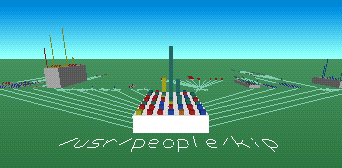
- FSN (pronounced "fusion") produces a cyberspace rendering of a file system. This was the original 3D file system navigator shown in Jurassic Park ("Hey, this is UNIX. I know this!").
[Screenshot] | [Download] (IRIX)
- FSV is modelled after FSN, but runs on Linux. FSV lays out files and directories in 3D, geometrically representing the file system hierarchy to allow visual overview and analysis.
[Screenshot] | [Download] (Linux)
- Xcruise lets you fly through a filesystem in 3D as if it were interplanetary space. Directories are represented as galaxies, files are represented as planets (whose mass is determined by the file size), and symbolic links are represented as wormholes.
[Screenshot] | [Download] (Linux)
- TDFSB is a 3D filesystem browser for Linux. Take a walk through your filesystem!
[Screenshot] | [Download] (Linux)
- Visual File System is a 3D file system visualizer for Windows. The tool scans a drive selected by the user, and then models the contents of the drive in 3D, based on the directories that are selected in a tree browser on the side of the display.
[Screenshot] | [Download] (Windows)
- 3Dtop is an extension for Windows that represents desktop icons in 3D, letting you to fly around your desktop. You can create coloured spotlights, background and floor textures, "paintings" (bitmaps), clocks, and "flags" that represent shortcuts.
[Screenshot] | [Download] (Windows)
- ROOMS turns a Windows desktop into a 3D world. You can see the world either through a first person perspective or with a map view, and you can populate the world with sounds, animated images, and 3D icons.
[Screenshot] | [Download] (Windows)
- CubicEye organizes windows into a navigable cube. Cubes can be arranged by thematic or functional subject matter, and can be explored either individually or collectively as part of a more comprehensive structure of multiple cubes representing various areas of interest.
[Screenshot] | [Download] (Windows)
- Vizible WorldViewer distributes windows across the exterior and interior surfaces of spheres, providing the means to visualize and navigate large numbers of web pages and data sources simultaneously.
[ -
Re:Another Linux 3D file manager
My site has been collecting 3D UIs for some time.
Here are links to some of the 3DUIs that are available today:
- FSN (pronounced "fusion") produces a cyberspace rendering of a file system. This was the original 3D file system navigator shown in Jurassic Park ("Hey, this is UNIX. I know this!").
[Screenshot] | [Download] (IRIX)
- FSV is modelled after FSN, but runs on Linux. FSV lays out files and directories in 3D, geometrically representing the file system hierarchy to allow visual overview and analysis.
[Screenshot] | [Download] (Linux)
- Xcruise lets you fly through a filesystem in 3D as if it were interplanetary space. Directories are represented as galaxies, files are represented as planets (whose mass is determined by the file size), and symbolic links are represented as wormholes.
[Screenshot] | [Download] (Linux)
- TDFSB is a 3D filesystem browser for Linux. Take a walk through your filesystem!
[Screenshot] | [Download] (Linux)
- Visual File System is a 3D file system visualizer for Windows. The tool scans a drive selected by the user, and then models the contents of the drive in 3D, based on the directories that are selected in a tree browser on the side of the display.
[Screenshot] | [Download] (Windows)
- 3Dtop is an extension for Windows that represents desktop icons in 3D, letting you to fly around your desktop. You can create coloured spotlights, background and floor textures, "paintings" (bitmaps), clocks, and "flags" that represent shortcuts.
[Screenshot] | [Download] (Windows)
- ROOMS turns a Windows desktop into a 3D world. You can see the world either through a first person perspective or with a map view, and you can populate the world with sounds, animated images, and 3D icons.
[Screenshot] | [Download] (Windows)
- CubicEye organizes windows into a navigable cube. Cubes can be arranged by thematic or functional subject matter, and can be explored either individually or collectively as part of a more comprehensive structure of multiple cubes representing various areas of interest.
[Screenshot] | [Download] (Windows)
- Vizible WorldViewer distributes windows across the exterior and interior surfaces of spheres, providing the means to visualize and navigate large numbers of web pages and data sources simultaneously.
[ -
Obligatory FSN/"Jurassic Park" reference and link
Check out FSN, an old 3D file navigator for IRIX.
(As paraphrased from "Jurassic Park": "I know this! This is a Unix system!".)
http://www.sgi.com/fun/freeware/3d_navigator.html -
Re:3D GUIs?The Jurassic Park Park GUI is actually a real filemanager for IRIX called FSN.
-
Re:While SCO can be foundhere
Hey man, got a dollar?
-
SGI's official response
is here.
-
Re:Case?
And the cool thing about that is then you have your own entropy source!
-
Re:What about latency?
I also went and looked at a website showing bandwidth/latency comparisons for various technologies. I am now enlightened... thanks! Link from sgi.com
-
Trollday today
Microsofts' Open(R) division released the latest build of it's v.d3d compatibility driver for it's Xml-v.d3d. Xml-v.d3d is licensed under M$/GNU meaning you cannot sell the binaries or it's source. The release brings the web standard for accelerated graphics up to par with the cineGL 3.5 version. This makes watching final fantasy 10th installment with direct 3d_cine 1.7 and cineGL in all of it's 36 sq. feet glory possible. Fixes also include the grav function give uniform Cine features gravity between the two suits.
Cine shorts made it's debut in the latter half of last year on the internet and popularized by animation shorts like Steven Spielburgs' "Doodle" and film students like [AK]Spenders' "Fixed" series. Taking advantage of features built into accelerated video card file sizes tend to remain small. AOL/Time Warner sexy news avitar
Microsoft began releasing the source code of some of it's discontinued products in the fourth quarter of 2004 claiming "in the interest of it's customers" which quickly gained support among amateur and professional enthusiast alike. In doing so, Microsoft brought independent programming to the masses providing education and income to millions around the world.
-
Re:I hate to say it, but the rebuttal article has
Subject: Re: XFS vs. JFS
Subject: Re[2]: XFS vs. JFS
See also Q1 on the JFS FAQ from IBM.Basically the original implementation was too tightly tied to specific AIX features. So a spec was written and given to the OS/2 team, who were completely separate from the AIX team, and they wrote a clean implementation avoiding such problems. This OS/2 implementation, then, was ported to both AIX and Linux. The original AIX implementation is dead, and has been for some time. All implementations in current use are based on the clean room work by the OS/2 team.
-
Re:I hate to say it, but the rebuttal article has
Subject: Re: XFS vs. JFS
Subject: Re[2]: XFS vs. JFS
See also Q1 on the JFS FAQ from IBM.Basically the original implementation was too tightly tied to specific AIX features. So a spec was written and given to the OS/2 team, who were completely separate from the AIX team, and they wrote a clean implementation avoiding such problems. This OS/2 implementation, then, was ported to both AIX and Linux. The original AIX implementation is dead, and has been for some time. All implementations in current use are based on the clean room work by the OS/2 team.
-
Re:Bad Conclusions
Yeah, I have to admit that I have no direct experience running Linux on 64-way boxes. However, if it's marketing hype then judging by the amount of it that either this is already a reality or it will be soon.
As far as hardware, how about Dolphin? I can think of many bits of hardware available for the OSX that don't either support Windows or Linux as well. Those that I can think of have direct replacements.
Myrinet is nice but improved interconnects are here or are coming -- Linux and Windows will be the first to get them. -
Re:A Funny Fortune...
Yes, she certainly is - I got a cheap SGI recently and one of the first things I did was put FSN on it - then check out the movie and verified it's the same. Not extremely useful, but it does make a filesystem tree you can fly over in 3D. I think it was something they whipped up for the moive - as opposed to a real tool.
-
It's all about documentaries
There are several Mars related documentaries available from the standard movie outlets.
"Mars - The Red Planet Collection" is one that I personally recommend. It has two programs, on one each side of the DVD, and is seemingly suitable for young children. My 12 year old daughter sat through both programs then immediately asked where my old telescope was. Speaking of which, a telescope is a great idea to enhance the Mars experience.
There's also the long forgotten Mars Pathfinder" site with fantastic photos of the surface. CD-ROM's may still be available of the site. The Planetary Society is another good online reference site.
Sure movies are entertaining, but this is an opportunity to educate your youngsters on a facinating subject.
This wouldn't be a proper comment about Mars reference materials without plugging The Case for Mars by Robert Zubrin. It's probably a bit too technical for a 10 year old, but still a facinating argument for settling Mars. -
Re:What I always wondered
Forgive my ignorance, but isn't that what GLU is for?
Correct: GLU provides high level facilities, including tesselators, mipmaps, quadrics, ( spheres, disks etc. ) NURBS ( a higher level interface to the evaluators in OpenGL ) as well as many other features.
if you want higher than that there is Open Inventor.
-
Re:OGL 1.5 - Legal Issues
-
Re:OGL 1.5 - Legal Issues
-
Real comparison?
-
Re:x-plane closed source
Nope, OpenGL is not covered by the GPL, it is covered by an X style license now and was covered by several commercial licenses from SGI in the past. See This
-
cut to the meat: silicon valley & san francis
aside from the typical california perks (weather, diversity, rad food, etc) this is where you can see lots of companies that make cool shit and museums that show cool shit. there are several hostels in the area, and public transportation is decent, although renting a car for a day or two might be advisable if you're trekking out to business park country. a quick google search turns up a decent article on geeky destinations around the valley, worth checking out for the list at the end. there are some guide sites out there tha cover lots of this stuff: let the big g be your friend.
you could do the super mega geeky thing, of course, and get pictures of yourself in front of company signs around they valley - we're riddled with them from san jose to san mateo. give corporate people a holler via email far enough ahead of time and you might even score a tour or the location of a museum. email SGI and ask if tours/demos are available for the Reality Center. visit fry's electronics for a geek-mecca epiphany (i suggest the cavenous san jose location); but beware, traveler, for to ask for help of a sales associate at fry's is to ask satan to take a little piece of your soul. this is also the time of your journey where you'll be asking "i wonder how much money i have, and how much it would cost to ship some hardware home..."
san francisco is beautiful and cool and yadda yadda; check out the museums, the parks and the nightlife. the exploratorium is big and WAY FREAKIN' COOL. make sure to get a good afternoon for just that and the nice area around it. check out the SFMOMA and the whole area around there - right across the street is the geeky-cool Sony Metreon with a sony store that has pretty much everything they carry in north america, plus big expensive video games and theaters. san francisco is also the terminal for many green tortoise bus tours that take you to beautiful parks around the west coast (quickly cementing your preference for it, trust me). they also have a hostel and buses that take you to seattle, portland and los angeles.
other things to do in california... rent a car and drive the coast on hwy 1 - if you can, from san francisco to los angeles! it is quite solidly some of the most beautiful coastline in the world, from smooth white beaches in the south to how-the-hell-did-they-wrap-a-road-around-that sharp rocks in the north. skip disneyland in southern california and go to six flags or universal studios. do all the usual touristy stuff, and check out venice beach, i'm sure you'll run into some crazy aussies there, plus there's a hostel nearby. visit a national park (do this on green tortoise, probably). get clam chowder at the jenner inn in jenner, ca. avoid the central valley (the "midwest" of the united states pretty much starts 60 miles inland california).
also, you'll be sorely disappointed to find that 99% of the country thinks that fosters is what all aussies drink. some well stocked british or hipster pubs might have VB, as well as the occasional aussie pub. bring your own marmite/vegemite/donteverconfuseitfornutellamite, because you australians are just freaky. no one knows what a "cone" is, we call them "bowls." if you're a crazy eastern aussie, like all the others i've met, people will probably love you and buy you drinks and tell you about the great fosters commercials you've been missing. the chicks (guys?) will dig you. if you're from the west... i don't know.
good luck!
-
cut to the meat: silicon valley & san francis
aside from the typical california perks (weather, diversity, rad food, etc) this is where you can see lots of companies that make cool shit and museums that show cool shit. there are several hostels in the area, and public transportation is decent, although renting a car for a day or two might be advisable if you're trekking out to business park country. a quick google search turns up a decent article on geeky destinations around the valley, worth checking out for the list at the end. there are some guide sites out there tha cover lots of this stuff: let the big g be your friend.
you could do the super mega geeky thing, of course, and get pictures of yourself in front of company signs around they valley - we're riddled with them from san jose to san mateo. give corporate people a holler via email far enough ahead of time and you might even score a tour or the location of a museum. email SGI and ask if tours/demos are available for the Reality Center. visit fry's electronics for a geek-mecca epiphany (i suggest the cavenous san jose location); but beware, traveler, for to ask for help of a sales associate at fry's is to ask satan to take a little piece of your soul. this is also the time of your journey where you'll be asking "i wonder how much money i have, and how much it would cost to ship some hardware home..."
san francisco is beautiful and cool and yadda yadda; check out the museums, the parks and the nightlife. the exploratorium is big and WAY FREAKIN' COOL. make sure to get a good afternoon for just that and the nice area around it. check out the SFMOMA and the whole area around there - right across the street is the geeky-cool Sony Metreon with a sony store that has pretty much everything they carry in north america, plus big expensive video games and theaters. san francisco is also the terminal for many green tortoise bus tours that take you to beautiful parks around the west coast (quickly cementing your preference for it, trust me). they also have a hostel and buses that take you to seattle, portland and los angeles.
other things to do in california... rent a car and drive the coast on hwy 1 - if you can, from san francisco to los angeles! it is quite solidly some of the most beautiful coastline in the world, from smooth white beaches in the south to how-the-hell-did-they-wrap-a-road-around-that sharp rocks in the north. skip disneyland in southern california and go to six flags or universal studios. do all the usual touristy stuff, and check out venice beach, i'm sure you'll run into some crazy aussies there, plus there's a hostel nearby. visit a national park (do this on green tortoise, probably). get clam chowder at the jenner inn in jenner, ca. avoid the central valley (the "midwest" of the united states pretty much starts 60 miles inland california).
also, you'll be sorely disappointed to find that 99% of the country thinks that fosters is what all aussies drink. some well stocked british or hipster pubs might have VB, as well as the occasional aussie pub. bring your own marmite/vegemite/donteverconfuseitfornutellamite, because you australians are just freaky. no one knows what a "cone" is, we call them "bowls." if you're a crazy eastern aussie, like all the others i've met, people will probably love you and buy you drinks and tell you about the great fosters commercials you've been missing. the chicks (guys?) will dig you. if you're from the west... i don't know.
good luck!
-
Re:ReiserFS rules.
This is not so. SGI's XFS is a very high performance filesystem (originally available on IRIX) as it would have to be considering SGI's market.
-
Re:ATI !!!
Tezro uses the SGI-engineered Vpro (tm...)V12 graphics - Tezro at a glance
The Onyx4 is the one using ATI graphics cards in parallel.
Maybe the Tezro2 will use ATI cards sometime next year, as the graphics engine changes filter down. It's roughly what's happened before (Octane replaced Indigo2, using I2 'Impact' graphics engine. Later VPro graphics system came in.)
-
Look here if you're wondering who buys SGI stuff
-
Re:Any bigger pictures of the Onyx 4?
It's just too hard to masturbate to these small images.
Of course! This is SGI we're talking about! How about a 7.5MB TIFF?
Have fun jacking off. -
Origin 300 or 3000 class host
MIPS R16000 @ 700 MHz
Onyx4, for the most part, is just another Origin 3xxx class brick. In this case, it's the new Graphics Brick. Plug as many as you want into your existing Origin.
As most Onyx4s will probably be using Origin 350s as their host, then my best guess is R16K/700 CPUs.
The CPU performance doesn't matter quite as much in an SGI as it would in a Mac or PC.
Most folks that use SGIs for number cruching have picked that platform based on its trememdous amount of memory and I/O. If their task was simply CPU bound or didn't need more than a few hundred MB/sec of IO, they'd just use a PC cluster.
Most folks that use SGIs for graphics do so because they either need tight integration with video (HD or SD, see Discreet Inferno or IFX Piranha using SGI's DM3 HD video I/O subsystem).... or because they need multiple displays running of the same system. (http://www.sgi.com/newsroom/press_releases/2003/j une/planetarium.html) Either each pipe running one or two displays or multiple pipes running in parallel.
Folks that use SGIs for both reasons typically require gobs of number crunching combined with some sort of display system that is able to plot the trillions of data points without bringing the machine to its knees. SGI has a lot of such cloak and dagger government / defense users.
There's also the growing Altix series of machines, which use Origin-class architecture with the Itanium processor family. There are rumors of a totally new MIPS processor coming soon as well.
The main point is that the new Onyx4 graphics are delievered in brick form, they're modular, and they will probably be eventually used on multiple SGI systems. And because SGI is leaving most of the 3D work to the ATI/NVIDIA pixel war, they can save some money and focus on other engineering aspects. -
It's not a bug!When I worked at SGI (1998) everything had weird color schemes, the walls, the furniture, everything. And strange architecture too. Though the strangest set of buildings just got subleased to Google. Which I guess is about getting away from their "Star Wars" image.
Which is they rebranded in 1998 to make the company logo the letters sgi with the bottoms cut off, as if they were appearing over the horizon. (New motto: "The Solution is in Sight!") But I guess that's even more obscure then the original logo, because now they just use the three letters.
And the original logo is very obscure. It's not a bug! It's the Chrome Cube! The whole point being that you need an SGI workstation to render the damn thing. But nobody ever got that. So sad!
-
Onyx and LOTRThey have an interesting page about the success stories of SGI graphics workstations.
A particularly interestingone about their role in the making of the LOTR:
The Wellington, New Zealand, company is using a full complement of IRIX OS-based Silicon Graphics® Octane® and Silicon Graphics® Onyx2® visual workstations, SGI® Origin® family servers, and SGI Linux OS-based visual workstations and servers to create and manage up to 100TB of data. Cool pictures too.
-
Onyx and LOTRThey have an interesting page about the success stories of SGI graphics workstations.
A particularly interestingone about their role in the making of the LOTR:
The Wellington, New Zealand, company is using a full complement of IRIX OS-based Silicon Graphics® Octane® and Silicon Graphics® Onyx2® visual workstations, SGI® Origin® family servers, and SGI Linux OS-based visual workstations and servers to create and manage up to 100TB of data. Cool pictures too.