Slashdot Mirror
Domain: sgi.com
Stories and comments across the archive that link to sgi.com.
Comments · 1,509
-
OT: Secure your SGI today...
1) Update your install of IRIX 6.5 to the most recent version available to you (6.5.16m for most people, 6.5.19 or 6.5.20 for those with a support contract). If you're unsure about updating, read about the IRIX Release Process as well as theIRIX Compatibility Mandate.
2) Install the security patches for your version of IRIX (note that IRIX releases previous to 6.5.15 will probably not have the most recent security patches available).
3) If you're a security newbie, run the "Improve System Security" application... it can be found under the Security and Access Control section of the System Manager.
4) Install IPFilter, be sure to learn how to use it.
5) Subscribe to SGI's security advisory mailing list.
6) Newbies outta read some of SGI's other sysadmin manuals as well:
Personal Sysadmin
IRIX Admin
7) Update your various freeware apps... be sure to read the seperate freeware security notice:
http://freeware.sgi.com -
OT: Secure your SGI today...
1) Update your install of IRIX 6.5 to the most recent version available to you (6.5.16m for most people, 6.5.19 or 6.5.20 for those with a support contract). If you're unsure about updating, read about the IRIX Release Process as well as theIRIX Compatibility Mandate.
2) Install the security patches for your version of IRIX (note that IRIX releases previous to 6.5.15 will probably not have the most recent security patches available).
3) If you're a security newbie, run the "Improve System Security" application... it can be found under the Security and Access Control section of the System Manager.
4) Install IPFilter, be sure to learn how to use it.
5) Subscribe to SGI's security advisory mailing list.
6) Newbies outta read some of SGI's other sysadmin manuals as well:
Personal Sysadmin
IRIX Admin
7) Update your various freeware apps... be sure to read the seperate freeware security notice:
http://freeware.sgi.com -
OT: Secure your SGI today...
1) Update your install of IRIX 6.5 to the most recent version available to you (6.5.16m for most people, 6.5.19 or 6.5.20 for those with a support contract). If you're unsure about updating, read about the IRIX Release Process as well as theIRIX Compatibility Mandate.
2) Install the security patches for your version of IRIX (note that IRIX releases previous to 6.5.15 will probably not have the most recent security patches available).
3) If you're a security newbie, run the "Improve System Security" application... it can be found under the Security and Access Control section of the System Manager.
4) Install IPFilter, be sure to learn how to use it.
5) Subscribe to SGI's security advisory mailing list.
6) Newbies outta read some of SGI's other sysadmin manuals as well:
Personal Sysadmin
IRIX Admin
7) Update your various freeware apps... be sure to read the seperate freeware security notice:
http://freeware.sgi.com -
OT: Secure your SGI today...
1) Update your install of IRIX 6.5 to the most recent version available to you (6.5.16m for most people, 6.5.19 or 6.5.20 for those with a support contract). If you're unsure about updating, read about the IRIX Release Process as well as theIRIX Compatibility Mandate.
2) Install the security patches for your version of IRIX (note that IRIX releases previous to 6.5.15 will probably not have the most recent security patches available).
3) If you're a security newbie, run the "Improve System Security" application... it can be found under the Security and Access Control section of the System Manager.
4) Install IPFilter, be sure to learn how to use it.
5) Subscribe to SGI's security advisory mailing list.
6) Newbies outta read some of SGI's other sysadmin manuals as well:
Personal Sysadmin
IRIX Admin
7) Update your various freeware apps... be sure to read the seperate freeware security notice:
http://freeware.sgi.com -
OT: Secure your SGI today...
1) Update your install of IRIX 6.5 to the most recent version available to you (6.5.16m for most people, 6.5.19 or 6.5.20 for those with a support contract). If you're unsure about updating, read about the IRIX Release Process as well as theIRIX Compatibility Mandate.
2) Install the security patches for your version of IRIX (note that IRIX releases previous to 6.5.15 will probably not have the most recent security patches available).
3) If you're a security newbie, run the "Improve System Security" application... it can be found under the Security and Access Control section of the System Manager.
4) Install IPFilter, be sure to learn how to use it.
5) Subscribe to SGI's security advisory mailing list.
6) Newbies outta read some of SGI's other sysadmin manuals as well:
Personal Sysadmin
IRIX Admin
7) Update your various freeware apps... be sure to read the seperate freeware security notice:
http://freeware.sgi.com -
OT: Secure your SGI today...
1) Update your install of IRIX 6.5 to the most recent version available to you (6.5.16m for most people, 6.5.19 or 6.5.20 for those with a support contract). If you're unsure about updating, read about the IRIX Release Process as well as theIRIX Compatibility Mandate.
2) Install the security patches for your version of IRIX (note that IRIX releases previous to 6.5.15 will probably not have the most recent security patches available).
3) If you're a security newbie, run the "Improve System Security" application... it can be found under the Security and Access Control section of the System Manager.
4) Install IPFilter, be sure to learn how to use it.
5) Subscribe to SGI's security advisory mailing list.
6) Newbies outta read some of SGI's other sysadmin manuals as well:
Personal Sysadmin
IRIX Admin
7) Update your various freeware apps... be sure to read the seperate freeware security notice:
http://freeware.sgi.com -
Re:GTA3, for one...
Heh. Back in the day, I spent about 8 hours playing multiplayer air combat with acm on an SGI Onyx system (a predecessor of the Onyx 3000), with its incredibly-realistic-for-the-time 3D rendering and physics.
On the drive home, I found myself needing to cross 4 lanes of traffic to make a light. Without thinking, I spotted a small opening, stepped on the gas, and floored it, squeezing through quite nicely. Then I realized what I had done.
Resolved: remember that I don't have bonus lives.
-
Re:Another nail in the SGI coffin
As anyone familiar with SGI's recent business strategy will tell you, they realized CGI was a dead horse and gave up on that market years ago.
SGI has been pushing high performance computing for engineering and science as of the last couple of years, and they have had a few high-profile sales in this arena.
NASA Ames (not too far from SGI BTW) has purchased a 1024 processor Origin. I saw the guy in charge of this lab at an HPC conference, and he was very gung-ho about the Origin's shared-memory architecture, and provided some extensive benchmarks to demonstrate his point.
They've also made several large sales into universities, as well as the currently booming aerospace and defense market.
And, lest you think it's all "government institutions" buying these Origins, I happened to have spotted Origins at a few different auto makers as well.
So, while I'm certain they'll miss the revenue from the entertainment industry, they have done well enough in the HPC market to compensate. -
Re:Work on desktop usability instead
-
Gotta love their chutzpah though
-
Re:A Lesser Form of UnixLinux struggles with more than 4 CPUs and more than 4G of memory;
Please, put it on comparable hardware. Or let's talk about the very same problems popping up on Solaris for x86.
And even if Linux could do this, it doesn't run on hardware than can be dynamically partitioned, unless it runs as a guest on z/OS, and in that case it's z/OS doing the work.
Like somebody is going to care if it's doing it all by itself, just for the sake of it?
Tight integration with the underlying hardware is another advantage for Sun; they know precisely every component in every system that Solaris runs on, because they designed and built it, so there are never compatibility issues
That's the dumbest thing you could say: it's like saying that a good reason to choose a certain car is because there are no suppliers of spare parts for it that sells directly to you (but instead you have necessarily to go through the car "manifacturer"). It's not like you are going to replace the engine with a third-party one, but what about the windshield-wipers or such? Please don't tell that since you are spending X grands this doesn't matter, otherwise nobody would ever consider using something like Linux in the industry.
Solaris' high-performance, high-reliability filesystems are proven, not just betas (yes XFS is also proven, but in IRIX not Linux).
Yes, but where high-performance is a concern (video), people are moving to Linux, not Solaris. SGI has been wise enough to port XFS, because it knows Irix has no long-term future within the video industry.
Solaris has ACLs, whereas Linux just has the relatively crude user-group model.
And thanks to the No Such Agency, SELinux provides mandatory access control policies on more than just files. And they actually use it.
-
Re:difference from a PC
Open your eyes buddy, times are a changing...hot-swap PCI on "PC" servers has existed for years and works quite reliably.
PCI buses on "PC" servers are far superior to anything from Sun today, max bandwidth from Sun is only 66Mhz/64-bit, most PC servers offer multiple PCI-X buses - 100Mhz/64-bit that are almost twice as fast. Proliant DL760
You can hot-swap memory on "PC" servers for the last year and a half IBM x440 with ChipKill (AKA Raid 1 Memory)...better than anyone else out there.
And scaleability goes to 32-way for 32-bit ES7000and 64-way for Intel Itanium Altix 3000
As for hot swapping CPUs...god luck on a Sun server, technically you could make it work...practically it's useless today. You have to stop your apps (that's great for HA isn't it?) shrink your domain (if it's bigger then 4 CPUs) isolate the faulty CPU, swap it, resize the domain...then (this is the critical part) restart all you apps so that they recognize the newly added CPU and memory...again technically it works, practically speaking just because the OS is still alive doesn't really matter...no 3rd party apps can cope with this fudging with their memory and CPUs...
The only systems out there that can truly cope with this type of activity are mainframes and Tandem / NonStop solutions... -
Re:Congratulations to the Linux Developers
Well they've done some of the same work with Linux, so maybe it's up to first grade? second grade?
-
Re:How about some SAN software?
Looks like SGI will be hooking them up.
-
SGI CXFS (SAN XFS) coming soon for OS X
While browsing around, I ran across this press release:
http://www.sgi.com/newsroom/press_releases/2003/ap ril/prod_san.html -
Re:It's ironic
Hhmmm... Well, Photoshop had already been ported to IRIX as far back as version 3. This didn't help them much, though, since the OS X version is a Carbon app (i.e., a whole lot like the Classic version).
-
Re:Absolutely one step closer!
"Calling" a library is not legally different to including the source code of the library in your program.
Whether it's legally different or not is not the question. (In fact, I suspect that it is very much different, but that's not the point here.) The fact is that calling a library is not the same as cutting-and-pasting, and that software that calls a library is not derived from that library. If I were to write a program that uses one of libcrypto's hash functions, my software would not be derived from libcrypto.
And yet the GPL would apply anyway, if libcrypto were GPL-licensed.
Try and link against any non-free library and argue in court that you are just "calling" their library and therefore don't need to arrange for licensing with the vendor. The judge won't just laugh at you; he'll fine you.
Given that the purpose of a software library is for other programs to call it, I doubt that very much. One does not need a license to use a standalone program; one merely has to have legally obtained a copy of that program. (Most vendors require users to agree to a license in order to be in legal possession of the program, but that's not a necessary part of it.) One uses a library by calling it from one's own program; therefore, there is no obvious justification for requiring a license to link when no license is required to use.
In other words, I'm pretty sure you're wrong about all of this.
Your continued insistence that licensing doesn't apply because you're just linking is unbelievable.
My what that what what? Please don't put words in my mouth; my position on this thread has been crystal-clear from the beginning: the GPL attaches itself to programs that link with libraries that are licensed under the GPL. Therefore, the GPL can be truthfully and accurately described as "viral." That's it.
Is the entire cause of your confusion simply your lack of experience with real-world licensing?
Yes, that must be it. Pfeh.
What amazes me is the way you, and others, seem to hold on to the fantasy that I'm making an argument that I simply haven't made. One guy upbraided me earlier today because I was wrong that Microsoft's licenses were any less restrictive than the GPL. The fact that I never said anything about that one way or the other seemed lost on him. Now you're telling me I'm arguing about proprietary libraries and their licenses. Astounding!
However, just to be clear on this, let's look at some of the licenses that apply to some of the libraries installed on my computer right now.
Let's look at Foundation.framework, shall we? The license for that should be... hm. Can't seem to find out. How odd. Okay, maybe that's a bad example.
Let's try the ImageVision Library instead, libil.so. That license says... hmm... "SGI will grant to you a personal, non-transferable and non-exclusive right to use and execute the Software, without right to sublicense the Software." What else? Um... "You may distribute copies of the Software to others, if you include copy of this license agreement with each of such copies." Oh, that must be it. If you distribute ImageVision, you have to... wait, no. I was going to say that you have to license your program under the ImageVision license, but that's not what it says.
(Wanna read it for yourself? A version of it is on the web. I just picked ImageVision at random as my first example. It's entirely typical, as you can see for yourself.)
Huh. How very strange. It seems to me, just from a cursory glance, that these licenses are fundamentally different from the GPL. It seems, just from looking at them, that they do not require me to assign any particular license to my programs that link to these libraries. Isn't that interesting?
In other words, my dear friend, it seems you're wrong. It seems that the GPL-- and possibly other licenses that exhibit the same behavior as the GPL with regard to linked works, as opposed to derived works-- is uniquely viral.
Which was, as it turns out, my only point all along. -
Even Later... !
-
Re:When are they going to make 2 cpu MBs?
I want 16cpu MB with 8MB cache per chip damnit!
Okay. -
Other 3D UIs: references and links.This is the kind of stuff that is regularly discussed on Nooface (a Slash site BTW).
Ripped straight off the side bar :
Will 3D user interfaces ever take off? With ever-growing 3D processing capabilities available on standard PC hardware, it seems only natural to pursue UI directions that take advantage of this awesome power. Moreover, the generation of users now emerging has had access to video games for as long as they could remember. As the line between video games and PCs becomes blurrier, the time may have come to think about how to apply 3D visualization techniques for more day-to-day computing tasks.
Here are links to some of the 3DUIs that are available today:
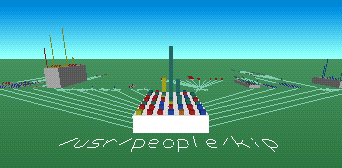
- FSN (pronounced "fusion") produces a cyberspace rendering of a file system. This was the original 3D file system navigator shown in Jurassic Park ("Hey, this is UNIX. I know this!").
[Screenshot] | [Download] (IRIX)
- FSV is modelled after FSN, but runs on Linux. FSV lays out files and directories in 3D, geometrically representing the file system hierarchy to allow visual overview and analysis.
[Screenshot] | [Download] (Linux)
- Xcruise lets you fly through a filesystem in 3D as if it were interplanetary space. Directories are represented as galaxies, files are represented as planets (whose mass is determined by the file size), and symbolic links are represented as wormholes.
[Screenshot] | [Download] (Linux)
- TDFSB is a 3D filesystem browser for Linux. Take a walk through your filesystem!
[Screenshot] | [Download] (Linux)
- Visual File System is a 3D file system visualizer for Windows. The tool scans a drive selected by the user, and then models the contents of the drive in 3D, based on the directories that are selected in a tree browser on the side of the display.
[Screenshot] | [Download] (Windows)
- 3Dtop is an extension for Windows that represents desktop icons in 3D, letting you to fly around your desktop. You can create coloured spotlights, background and floor textures, "paintings" (bitmaps), clocks, and "flags" that represent shortcuts.
[Screenshot] | [Download] (Windows)
- ROOMS turns a Windows desktop into a 3D world. You can see the world either through a first person perspective or with a map view, and you can populate the world with sounds, animated images, and 3D icons.
[Screenshot] | [Download] (Windows)
- CubicEye organizes windows into a navigable cube. Cubes can be arranged by thematic or functional subject matter, and can be explored either individually or collectively as part of a more comprehensive structure of multiple cubes representing various areas of interest.
[Screenshot] | [Download] (Windows)
- Vizible WorldViewer distributes windows across the exterior and interior surfaces of spheres, providing the means to visualize and navigate large numbers of web pages and data sources simultaneously.
[Screenshot] -
Other 3D UIs: references and links.This is the kind of stuff that is regularly discussed on Nooface (a Slash site BTW).
Ripped straight off the side bar :
Will 3D user interfaces ever take off? With ever-growing 3D processing capabilities available on standard PC hardware, it seems only natural to pursue UI directions that take advantage of this awesome power. Moreover, the generation of users now emerging has had access to video games for as long as they could remember. As the line between video games and PCs becomes blurrier, the time may have come to think about how to apply 3D visualization techniques for more day-to-day computing tasks.
Here are links to some of the 3DUIs that are available today:
- FSN (pronounced "fusion") produces a cyberspace rendering of a file system. This was the original 3D file system navigator shown in Jurassic Park ("Hey, this is UNIX. I know this!").
[Screenshot] | [Download] (IRIX)
- FSV is modelled after FSN, but runs on Linux. FSV lays out files and directories in 3D, geometrically representing the file system hierarchy to allow visual overview and analysis.
[Screenshot] | [Download] (Linux)
- Xcruise lets you fly through a filesystem in 3D as if it were interplanetary space. Directories are represented as galaxies, files are represented as planets (whose mass is determined by the file size), and symbolic links are represented as wormholes.
[Screenshot] | [Download] (Linux)
- TDFSB is a 3D filesystem browser for Linux. Take a walk through your filesystem!
[Screenshot] | [Download] (Linux)
- Visual File System is a 3D file system visualizer for Windows. The tool scans a drive selected by the user, and then models the contents of the drive in 3D, based on the directories that are selected in a tree browser on the side of the display.
[Screenshot] | [Download] (Windows)
- 3Dtop is an extension for Windows that represents desktop icons in 3D, letting you to fly around your desktop. You can create coloured spotlights, background and floor textures, "paintings" (bitmaps), clocks, and "flags" that represent shortcuts.
[Screenshot] | [Download] (Windows)
- ROOMS turns a Windows desktop into a 3D world. You can see the world either through a first person perspective or with a map view, and you can populate the world with sounds, animated images, and 3D icons.
[Screenshot] | [Download] (Windows)
- CubicEye organizes windows into a navigable cube. Cubes can be arranged by thematic or functional subject matter, and can be explored either individually or collectively as part of a more comprehensive structure of multiple cubes representing various areas of interest.
[Screenshot] | [Download] (Windows)
- Vizible WorldViewer distributes windows across the exterior and interior surfaces of spheres, providing the means to visualize and navigate large numbers of web pages and data sources simultaneously.
[Screenshot] -
linux scales
Try one of these.
-
Re:silliness
Following up myself ("Mercury was thought to be two planets"):
Mercury was believed by the Greeks to be two different stars. Mercury's appearance in the morning was called Apollo, and its evening appearance was referred to as Hermes. -
Re:Performance #'s?It would be interesting to see performance #'s on these things. They're "only" running at 500mhz, so how do they compare to other MIPS based cpu's? Basically, just how good is there engineering. It's nice for the Chinese to have a home grown cpu to use in their home grown machines, but so far it looks like a major yawn in relation to the overall cpu market.
Tell that to SGI. They're the ones that own MIPS Technologies. All SGI-machines that run IRIX runs on MIPS-processors and they do it damn well. The latest chip is a 600MHz, but those 600MHz can't be compared to Intel/AMD-MHz since the architecture is different.
Also these machines consume a fraction of the power that Intel/AMD does, I think the latest Pentium weighs in at about 130W and the latest (R14000 or R16000) at 16W, and in this case bigger is not better.
This means that You can put a lot of CPU's in one machine and get less powerconsumtion and less heat.
Combine this with SGI's kickass architecture with good interconnect and You've got a really good machine. SGI has no equal when it comes to fluid dynamics calculations as an example. No, linux doesn't come close (yet), although the Altrix looks promising.
And yes, I know, SGI is too expensive to justify the cost in most cases. Unfortunatly.
-
Re:Performance #'s?It would be interesting to see performance #'s on these things. They're "only" running at 500mhz, so how do they compare to other MIPS based cpu's? Basically, just how good is there engineering. It's nice for the Chinese to have a home grown cpu to use in their home grown machines, but so far it looks like a major yawn in relation to the overall cpu market.
Tell that to SGI. They're the ones that own MIPS Technologies. All SGI-machines that run IRIX runs on MIPS-processors and they do it damn well. The latest chip is a 600MHz, but those 600MHz can't be compared to Intel/AMD-MHz since the architecture is different.
Also these machines consume a fraction of the power that Intel/AMD does, I think the latest Pentium weighs in at about 130W and the latest (R14000 or R16000) at 16W, and in this case bigger is not better.
This means that You can put a lot of CPU's in one machine and get less powerconsumtion and less heat.
Combine this with SGI's kickass architecture with good interconnect and You've got a really good machine. SGI has no equal when it comes to fluid dynamics calculations as an example. No, linux doesn't come close (yet), although the Altrix looks promising.
And yes, I know, SGI is too expensive to justify the cost in most cases. Unfortunatly.
-
Re:Tape stuff for one
which SCSI commands? Is that really needed often?
Diagnostic, halt, start, inquiry and so on. Refer to this manual page for more information. And yes, it's really needed often.
As for resetting, do you really need that often?
Yes, especially when you deploy fibre channel. Sometimes an adapter reset is the only way to get your HBA to recognize new LUN's, short of a reboot. -
Re:Jur-Ass-Has-Had-It-Park!
Oh, you must mean this 3D filesystem viewer on IRIX (the page even says "as seen in Jurassic Park!").
Well, as it turns out, yes Linux has something like it available.
And, on top of that, what other UNIX allows you blast processes with various armaments?
-
Re:One thingA non-beta, standard, production quality journaling filesystem.
Here you are: not one, but two, both of them professional, industrial strength, quality software:- I have been running XFS for several months, faultlessly. -
Re:Scale over 4 CPUs
Over 4 CPUs ? Well at least SGI managed to run 64procs with a *very* reasonable scalability....
SGI Altix -
Re:One thing
-
Re:Are linux drivers ready?
-
Re:Linus too HarshYou may want to look at sgi. Sun also has 64 bit cad workstations but they have slower sparc processors but it may also fill your needs and they have a bigger marketshare.
SGI has been getting a bad rep recently during suns onslaught but these babies have already been 64 bit for years and have the necessary software. I do not know why slashdotters hate irix. It rocks.
I do not know how mature gcc is for the hammer so Linux and commercial graphics products may be a problem with it at first. Forget about WIndows. How long did it take them to write a 32-bit os after the 386 was released?
I recommend a risc unix box for these 2 reasons not to mention that this is sgi's core market. While AMD and Intel plan to go 64bit both sun and sgi have already been 64bit for a decade and support the large ram you need.I just bought a sgi on ebay and love it.
-
Re:I wish it was Unix
Who's lame? People who don't know what they're talking about but call other people lame.
Here's your link, lameo:
right here
And a close up screenshot
This comment ought to make the moderator's heads explode. Is it flamebait? Is it informative? Is it interesting? Probably all three. -
Re:Rackmount
Ah, well you my friend are in need of an SGI Onyx 3000, the infiniteperformance V-brick is a bit bigger than you asked for though, at 4U.
1-800-800-SGI1 (7441) all major credit cards accepted
-
Re:Rackmount
Ah, well you my friend are in need of an SGI Onyx 3000, the infiniteperformance V-brick is a bit bigger than you asked for though, at 4U.
1-800-800-SGI1 (7441) all major credit cards accepted
-
not quite the fastest - sgi has this beat
If you're willing to step away from a pc-architecture, you can one heck of a video card from sgi. Some cool features:
- drives up to 8 displays at once
- up to 80GB frame buffer, 8GB texture memory, 65 Megapixel resoultion, and 8 pipelines.
- 48 bit RGBA
- wicked fast with lots of hardware acceleration -
Re:Fastes Videocard? Yeah, shure...
http://www.sgi.com/visualization/onyx/3000/ip/ind
e x.html The article said that the price doesn't matter... -
Re:Most Accurate Portrayal of a Computer Award...
fsn stands for "file system navigator" - you can still get it from SGI here.
You need an old version of IRIX to run it (5.3) and I remember doing so back in the day. Basically you can "fly" through the filesystem hierarchy, and the vertical bars are the sizes of the files, colors are for age and the height of the base is the size of the directory.
Nothing you can't accomplish with du and ls, but great for impressing people in a movie
-
Sun is going down
_ALL_ Sun servers are very stable, but slow. SPARC speed is poor, take a look at SPEC CPU2000 Results. The memory bandwidthis _very_ low. In Linpack-top500 you won't see SUN in the 100 first places.
The Fujitsu SPARC64 V is better chip and 100% compatible with SUN solaris/SPARC. And better servers with 128 CPUs !!!!
LiNUX is a better alternative below 8 CPUs: Migrating Oracle9i - Based Sun Servers to Dell Servers Running Linux and Migrating Oracle9i - Based Sun Servers to Dell Servers Running Linux, Part 2. LiNUX+x86/ia64 , and soon AMD x86-64, is cheaper and faster than Solaris/SPARC
DEC/Compaq/HP have the best chip (Alpha EV7) and the best UNIX servers (ES47,ES80,GS1280) in RISC arch. It's a pity that Alpha is going to die to put intel ia64 instead.
And if you need NUMA machine, SGI Altix is for you.
Why do you need to buy a SUN server? -
High-end linux hardware
Another poster mentioned that oracle is pushing linux in a big way, so I assume that handles the software.
Here's the hardware: SGI's altix. Each linux OS image can scale to 64 processors and 512 Gigs of physical RAM. These images can then be clustered, to "span terabytes of global shared memory". Prices start at $70k for 4 CPUs and 36G RAM, and go to $1.2M for 64 CPUs.
Sun's hardware is about four times as expensive. -
High-end linux hardware
Another poster mentioned that oracle is pushing linux in a big way, so I assume that handles the software.
Here's the hardware: SGI's altix. Each linux OS image can scale to 64 processors and 512 Gigs of physical RAM. These images can then be clustered, to "span terabytes of global shared memory". Prices start at $70k for 4 CPUs and 36G RAM, and go to $1.2M for 64 CPUs.
Sun's hardware is about four times as expensive. -
Re:Won't fix Sun's biggest problem
_ALL_ Sun servers are very stable, but slow. SPARC speed is poor, take a look at SPEC CPU2000 Results. The memory bandwidth is _very_ low. In Linpack-top500 you won't see SUN in the 100 first places.
The Fujitsu SPARC64 V is better chip and 100% compatible with SUN solaris/SPARC. And better servers with 128 CPUs !!!!
LiNUX is a better alternative below 8 CPUs: Migrating Oracle9i - Based Sun Servers to Dell Servers Running Linux and Migrating Oracle9i - Based Sun Servers to Dell Servers Running Linux, Part 2. LiNUX+x86/ia64 , and soon AMD x86-64, is cheaper and faster than Solaris/SPARC
DEC/Compaq/HP have the best chip(Alpha EV7) and the best UNIX servers (ES47,ES80,GS1280) in RISC arch. It's a pity that Alpha is going to die to put intel ia64 instead.
And if you need NUMA machine, SGI Altix is for you.
Why do you need to buy a SUN server?
- because my programs _only_ run with solaris/sparc -
Apple vs. Sun, HP, Dell, IBM ...
Why didn't they bother to throw SGI into the mix?
-
Apple vs. Sun, HP, Dell, IBM ...
Why didn't they bother to throw SGI into the mix?
-
Re:5 years..
-
And how does this relate to SGI?
SGI has also integrated NUMA technology into the linux kernel to support their new Altix servers. How do these two efforts relate? Is SGI's code generic enough that it could also be considered for inclusion in the mainstream kernel? Or is it specific to SGI's NUMA architecture? Is IBM's code generic enough that it would work on an Altix? What functional characteristics distinguish the two?
-
And how does this relate to SGI?
SGI has also integrated NUMA technology into the linux kernel to support their new Altix servers. How do these two efforts relate? Is SGI's code generic enough that it could also be considered for inclusion in the mainstream kernel? Or is it specific to SGI's NUMA architecture? Is IBM's code generic enough that it would work on an Altix? What functional characteristics distinguish the two?
-
SGI must have added NUMA support as wellHi,
SGI must have added NUMA support for their Itanium-based Altix-servers as well. On their web-page it says: "Enhanced Operating System for High-Productivity Computing" [aka Linux] with "High-performance NUMA support".
Anyone ever seen a patch for this?
- jarman
-
SGI's systems (was Re:32/64)
-
SGI's systems (was Re:32/64)