Slashdot Mirror
Domain: sipri.org
Stories and comments across the archive that link to sipri.org.
Comments · 32
-
Re:Chicom company
You mean this ?
"As part of an international agreement on the Iranian nuclear programme, the Joint Comprehensive Plan of Action (JCPOA) of 14 July 2015, the UNSC adopted unanimously resolution 2231 on 20 July 2015. It stipulates it will change the UN sanctions on Iran as soon as the International Atomic Energy Agency (IAEA) provides a report to the UNSC which conforms that Iran has taken the actions related to its nuclear programme specified in the JCPOA. From the JCPOA Adoption Day, which occurred on 18 october 2015, the provisions related to restrictions on the export from and transfer to Iran of conventional weapons or related goods and services are no longer blanket embargoes.
Instead the Security Council decides on a case-by-case basis whether to permit the transfer of goods and technology that could contribute to the development of nuclear weapon delivery systems based on the inclusion of appropriate end-user guarantees and Iran committing not to use such items for nuclear weapon delivery systems. This provision will be lifted 8 years after the JCPOA Adoption Day, i.e. on 18 october 2023."
-
Re:also the biggest carbon emitter - yay!
Not that we'll eve know, but given a Division of US vs a Division or Russian soldiers on the same field, my bet would be on the Russians.
Generals McMaster and MacGregor have said as much, as well. The US brigades and divisions are too light on artillery IMO. Here's a good briefing on the subject: http://douglasmacgregor.com/RS...
But the Army never fights alone. The US relies very heavily on air power to shape the battlespace, and the argument of Russian air defenses vs USAF SEAD/PGMs is a very complex discussion.Not sure what you're on about here so you may need to provide some references.European military expenditure is still in the normal range
France, the UK, and Poland are spending 2% GDP. China, Australia, India = 1.9%. The global share of GDP is 2.3%. Most of Europe is closer to 1% (Germany 1.2%, Italy 1.3%, Spain 0.6%). https://www.sipri.org/database... http://books.sipri.org/files/F...
And it's hard to argue that the cost savings is materializing as any sort of persistent military efficiency, given that Europe has prosecuted two air campaigns in the past 10 years where they've had to borrow/buy munitions from the US in short order. http://foxtrotalpha.jalopnik.c... https://www.washingtonpost.com...
International R&D/procurement programs such as the Eurofighter Typhoon and A400M probably do yield cross-national economies of scale, but without a VERY robust commitment to command & control / administration / logistics / training & readiness, you can't run a multi-national combat force with any degree of integration and proficiency. http://www.military.com/daily-...
"The expert group comprising six defense officials, including former NATO chief Jaap de Hoop Scheffer, warned of "chronic underfunding" and "critical deficiencies" of the Alliance's member states, according to the report, as quoted by the Financial Times newspaper. The NATO report revealed that only 10 of 31 German Tiger helicopters and some three quarters of 406 Marder armored infantry vehicles were usable."
https://sputniknews.com/world/... -
Re:also the biggest carbon emitter - yay!
Not that we'll eve know, but given a Division of US vs a Division or Russian soldiers on the same field, my bet would be on the Russians.
Generals McMaster and MacGregor have said as much, as well. The US brigades and divisions are too light on artillery IMO. Here's a good briefing on the subject: http://douglasmacgregor.com/RS...
But the Army never fights alone. The US relies very heavily on air power to shape the battlespace, and the argument of Russian air defenses vs USAF SEAD/PGMs is a very complex discussion.Not sure what you're on about here so you may need to provide some references.European military expenditure is still in the normal range
France, the UK, and Poland are spending 2% GDP. China, Australia, India = 1.9%. The global share of GDP is 2.3%. Most of Europe is closer to 1% (Germany 1.2%, Italy 1.3%, Spain 0.6%). https://www.sipri.org/database... http://books.sipri.org/files/F...
And it's hard to argue that the cost savings is materializing as any sort of persistent military efficiency, given that Europe has prosecuted two air campaigns in the past 10 years where they've had to borrow/buy munitions from the US in short order. http://foxtrotalpha.jalopnik.c... https://www.washingtonpost.com...
International R&D/procurement programs such as the Eurofighter Typhoon and A400M probably do yield cross-national economies of scale, but without a VERY robust commitment to command & control / administration / logistics / training & readiness, you can't run a multi-national combat force with any degree of integration and proficiency. http://www.military.com/daily-...
"The expert group comprising six defense officials, including former NATO chief Jaap de Hoop Scheffer, warned of "chronic underfunding" and "critical deficiencies" of the Alliance's member states, according to the report, as quoted by the Financial Times newspaper. The NATO report revealed that only 10 of 31 German Tiger helicopters and some three quarters of 406 Marder armored infantry vehicles were usable."
https://sputniknews.com/world/... -
Re:Bad news
I refuse to support the N. Korean regime at any level. Any growth in their GDP will be redirected to their military. Purchasing the Manbang it tantamount to putting a down payment on a noose; one thread at a time.
I have some bad news for you.
That image made me wonder if there were any figures for expenditure vs. GNP and found the source, Stockholm International Peace Research Institute.
(Direct link to SIPRI Military Expenditure Database)Unfortunately, there aren't any reliable figures for North Korea.
-
Re:Bad news
I refuse to support the N. Korean regime at any level. Any growth in their GDP will be redirected to their military. Purchasing the Manbang it tantamount to putting a down payment on a noose; one thread at a time.
I have some bad news for you.
That image made me wonder if there were any figures for expenditure vs. GNP and found the source, Stockholm International Peace Research Institute.
(Direct link to SIPRI Military Expenditure Database)Unfortunately, there aren't any reliable figures for North Korea.
-
Re:I don't see why...
The sentiment is great, I agree with spending more on the things you mention and a little as possible on military. But your figures are way off, the US military budget is between 3 and 4 percent of GDB (depending on who's figures you believe) http://www.sipri.org/research/... which is fairly high I suppose (around 1.5 to 3 times higher than other NATO members).
-
So does that one
If the spy budget is like the Pentagon budget, the U.S. spends more than the rest of the world combined.
U.S. spending on defense is not that far off the world average if you compare against GDP, especially if you include Japan (whom the U.S. is bound to defend under the peace treaties ending WWII). Much ballyhoo is made about how much the U.S. spends on the military in gross dollars. But that is mostly a consequence of the U.S. economy being so huge (nearly 1/4 of the world's total). If you think about it, you'll realize comparing military spending in gross dollars is pretty stupid, kinda like comparing how much food each country eats in tons instead of per capita. The U.S. accounts for 37% of the world's military spending, while the U.S. + Japan account for 30% of the world's economy. (I'm deliberately not adding European GDP to account for U.S. bases there as part of NATO, since those really should have been scaled back with the end of the Cold War.)
If you normalize for size of economy by comparing military spending vs GDP, the U.S. military ends up 15th in the world at 3.8%, notably below Russia. If you include Japan's GDP, it drops to 2.9% putting it 27th. (This excludes a few countries with historically higher military spending as percent of GDP since there is no 2013 data available for them yet. Mainly, Syria, UAE, North Korea, and Sudan.)
So getting back to your point, if countries' spending on their spy agencies is anything like their military spending, then NSA funding should actually be pretty close to what other countries' spy agencies get in proportion to their economy. BTW, spy satellites fall under NRO, not NSA. -
Re:Not the leaks
*sigh*. Because defense, education, social security funding should always be pegged to GDP... facepalm.
"The share of gross domestic product (GDP) is a rough indicator of the proportion of national resources used for military activities, and therefore of the economic burden imposed on the national economy." It is hardly worth my time pointing this out to you... yet again. We understand why you continue - MIC shills with hat in hand begging for more money, on top of the 700 billion/year it already gets - to protect us of course, We get it.
Copied from s.petrys post above...
Our military organization today bears little relation to that known by any of my predecessors in peacetime, or indeed by the fighting men of World War II or Korea.
Until the latest of our world conflicts, the United States had no armaments industry. American makers of plowshares could, with time and as required, make swords as well. But now we can no longer risk emergency improvisation of national defense; we have been compelled to create a permanent armaments industry of vast proportions. Added to this, three and a half million men and women are directly engaged in the defense establishment. We annually spend on military security more than the net income of all United States corporations.
This conjunction of an immense military establishment and a large arms industry is new in the American experience. The total influence -- economic, political, even spiritual -- is felt in every city, every State house, every office of the Federal government. We recognize the imperative need for this development. Yet we must not fail to comprehend its grave implications. Our toil, resources and livelihood are all involved; so is the very structure of our society.
In the councils of government, we must guard against the acquisition of unwarranted influence, whether sought or unsought, by the militaryindustrial complex. The potential for the disastrous rise of misplaced power exists and will persist.
We must never let the weight of this combination endanger our liberties or democratic processes. We should take nothing for granted. Only an alert and knowledgeable citizenry can compel the proper meshing of the huge industrial and military machinery of defense with our peaceful methods and goals, so that security and liberty may prosper together.
Dwight D. Eisenhower, 1960
Today no war has been declared–and however fierce the struggle may be, it may never be declared in the traditional fashion. Our way of life is under attack. Those who make themselves our enemy are advancing around the globe. The survival of our friends is in danger. And yet no war has been declared, no borders have been crossed by marching troops, no missiles have been fired.
If the press is awaiting a declaration of war before it imposes the self-discipline of combat conditions, then I can only say that no war ever posed a greater threat to our security. If you are awaiting a finding of “clear and present danger,” then I can only say that the danger has never been more clear and its presence has never been more imminent.
It requires a change in outlook, a change in tactics, a change in missions–by the government, by the people, by every businessman or labor leader, and by every newspaper. For we are opposed around the world by a monolithic and ruthless conspiracy that relies primarily on covert means for expanding its sphere of influence–on infiltration instead of invasion, on subversion instead of elections, on intimidation instead of free choice, on guerrillas by night instead of armies by day. It is a system which has conscripted vast human and material resources into the building of a tightly knit, highl
-
Re:The sad thing is...
Wow, just wow. Here you are standing before us trying to argue that military spending, worldwide, should be increased to levels at least as high as they were at the hight of the cold war where there actually was a credible enemy capable of threatening our national security Vs today where terrorism does not even manage to be more threatening than your kitchen stool. This completely ignoring the fact that military spending is already a massive drain on the worlds resources and that Military spending, with few exceptions, is pretty much the definition of unproductivewe are quite literally paying people to blast holes in the ground.
-
Re:The sad thing is...
(With the MIC already down to 4-5% of GDP from 9.3% in 1962?)
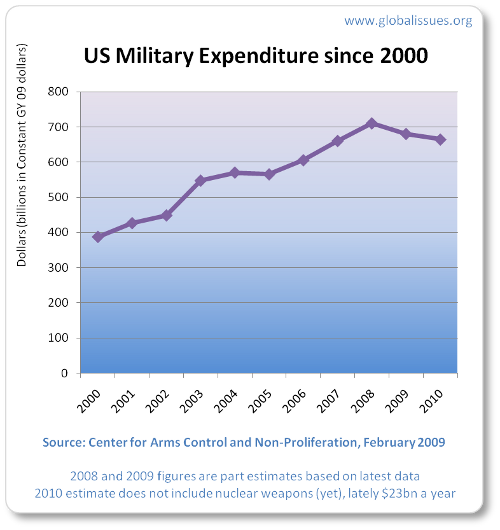
Defense spending has in no way been trending down, as your dishonestly trying to imply by comparing to GDP (yet again - like you have an agenda?)). I would draw your eye to the incredible graphic here from the well regarded Stockholm International Peace Research Institute. Just shy of an eye popping 700billion/year military spending by the US. Certainly off its historic highs during the good times high rolling 2008, but even the military could not live it up like it is pre-2008. Far more credible than your defense spending as % total budget outlays 1945–2013, which is like saying, "hey the overall budget is growing faster than our budget increases, so... [switch off cognitive functions], See!! The long term trend in defense spending is down!!". Muddled half-truths and nonsense indeed.
It is telling that you repeatedly reference the heritage foundation "an American conservative think tank based in Washington, D.C." whose shining moment was its "leading role in the conservative movement during the presidency of Ronald Reagan, whose policies drew significantly from Heritage's policy study".
-
Re:The dilema ...
Your reference is outright misleading to very very wrong. No surprise there, given that The Heritage Foundation "is an American conservative think tank based in Washington, D.C." whose shining moment was its "leading role in the conservative movement during the presidency of Ronald Reagan, whose policies drew significantly from Heritage's policy study". As an aside, could be a good chance we have found your handler there, Fjordy.
Here are some more credible figures to educate you (if that is your wish), from the well regarded Stockholm International Peace Research Institute. I would draw your eye to the incredible graphic here. Just shy of an eye popping 700billion/year military spending by the US. Certainly off its historic highs during the good times high rolling 2008, but even the military could not live it up like it is pre-2008. Far more credible than your defence spending as % total budget outlays 1945–2013, which is like saying, "hey the overall budget is growing faster than our budget increases, so... [switch off cognitive functions], See!! The long term trend in defence spending is down!!". Muddled half-truths and nonsense indeed.
@Cold Fjord and on a more personal note (as personal as you can get with shill accounts) - your writing style and propaganda level has changed of late. More blunt/crude - perhaps a new operator? I mean, using crass, flawed logic such as "If the so called military industrial complex were really that powerful, its share of spending would not have dropped as it has" to make your case was not the subtle half intelligent sounding Fjord we used to know. As always with your posts.
-
Re:Budget cuts
When you have armies of people who don't want to pay taxes this is what you get. Networking training is not cheap, understanding it is not cheap. Finding people with enough knowledge combined to work across these systems is difficult and comes with a price.
Oh blow it out your ass. The US spends over 698 Billion on it's military, more than 5 time as much as it's closest competitor: China Source. If they cannot find the training budget for network security then maybe they can hold a fucking bake sale like most school districts have to in order to afford supplies.
-
Re:Chicken Little
There are several suspected countries mentioned in this book:
http://books.sipri.org/files/books/SIPRI97AlBeWa/SIPRI97AlBeWa.pdf
However Muslim countries are targeted by west more than others because of political issues. -
Re:Military budget is...
I guess you went the TLDR route
I said 41.5%, which is considerably less than 'more than every other country combined', and only the last two figures from 2001 and 2003 are from the budget.
The source which your URL quotes ( http://www.sipri.org/yearbook/2009/05 ), says that most of the increases have been 'emergency' approved and fast-tracked outside of normal budgetary procedures.
And from http://www.commondreams.org/headlines05/0607-03.htm , "In 2003, U.S. spending stood at $405 billion, SIPRI said.". This chart, from your link, also bolsters that, since the amounts there are in 2009 dollars, and previous reports in 2003/2004 dollars. http://static.globalissues.org/i/military/us-spending-2000-2010.png That's an astounding difference of 9 billion dollars. 2%. Not as far off or irrelevant as you're implying.
-
Re:Ah, paranoia
I could argue that true America is slow to act to things. (aka, lazy?) We tend to like things simple and consistent and don't tend to "speak out" at every little thing. Sure, there are vocal aspects of our country, but I think those are fairly minor. I could also argue that Bush's tactics did in fact start the trend toward buying up more arms.
A quick search shows: 2003 noticed a 20% increase... and 60% over the years of 2002-2006. During the Bush administration.
-
Re:Retort
The US supported Iraq because Iraq threatened us? That exactly why the US shouldn't support Iraq. Perhaps you meant Iran threatened us. There's a problem with this though, the US did support a dictator before his overthrow.
Well, lets see, we were talking about the differences between Reagan and the first Bush's policies towards Iraq. So no, under Reagan, it was because Iran threatened us and when Bush SR. did his about face on sanctions and other policies, it was because Iraq threatened the US and Israel. I think the actual quotes were something along the lines of "to make fire burn half of Israel," with a "the binary chemical weapon". He made similar threat to our carriers in the Persian Gulf about a month before. This was in 1990 which is when Bush 1 did his 180 on policy.
Your talking about this stuff and I am severely surprised that you didn't know about that. Were you young at that time?
Also, I need to set something straight. The 1925 Geneva conventions apparently outlaws the use of poisonous and other gases. Iraq signed on with a statement to the treaty But the US and France didn't. It is and was considered international law "by civilized societies" at the time they used the chemical weapons but there was nothing addressing the development, storage, or transfer. Here is an interesting list of signing statements for it. But that doesn't change much on our attitude of tilting toward Iraq. Here is another Interesting list of Iraq and how he got his weapons. It appears that a lot more then the US was involved.Ok, here's more: bush taliban $43. Your CATO article is #5. I don't see the link I provided on the first page of results, instead my TFA I had saved years ago. Ah, adding "opium" to the search then my link is #5 and the CATO link is 7.
I looked, we weren't on the same page which explains some of the confusion.Ignoring Blowback isn't exactly smart either, it makes us look reckless as well.
There is always going to be a certain amount of blowback. I'm not sure if it was ignored or originally calculated as acceptable. I don't find fault in the logic though. It seems that if you don't have the hindsight capability to see what happened, it was sound policy until Saddam shifted and turned on us.Even the CATO article does not say anything about the Taliban getting any more money. Googling bush taliban $43 opium "down payment" returns no results saying the payment was a down payment to the Taliban.
This links says it. It isn't the one I originally remember but it covers the bases. Apparently is wasn't bush but Colin Powell who made the case as the start of more to come. It also appears that the original effort did include monitors, advisers and such to oversee the distribution of the funds.
As a side note, and some insight to what Saddam was thinking, here is a link to a CBS interview with George Piro, the agent who interrogated Saddam before his trial. It appears that Iraq didn't invade Kuwait because of slant drilling but because of a comment by a Kuwaiti official who made a comment referring to Iraqi women as 10 dollar whores. Who in their right mind would invade another country in the face of international pressure over a comment like that? The blow back you mentioned earlier might have been difficult to judge when one of the actors is actually insane. Here is a couple more links, Saddam thought we were bluffing on a few things. -
Re:I will never do such a thing.
Check out the new director of the Stockholm Internation Peace Research Institute: Dr. Bates Gill.
I guess we can safely conclude that Microsoft has infiltrated the SIPRI. -
Re:Saddam and WMD
There is no doubt that the US gave Saddam chemical and biological weapons to begin with, encouraged, and helped direct the use of, their use and is responsible for Iraq having chemical and biological weapons to begin with.
Here is a report that concludes through a chemical analysis of the CW that Iraq used against Iran that they could not have come from the US or the UK, and that they most likely came from the USSR. To quote:
"The absence in the sample analysed in Sweden and Switzerland of polysulphides and of more than a trace of sulphur indicates that it is not of past US-government manufacture, for all US mustard was made by the Levinstein process from ethylene and mixed sulphur chlorides.
The sources of supply might as well be indigenous as external to Iraq, given the technology implied. Involvement of the last three categories would, in some circles, implicate the USSR as supplier."
So that is some strong evidence that we didn't give Saddam chemical weapons. Where is your evidence that we did?BTW - Saying that 'everyone thought Iraq had WMD' is simply silly. You do, however, have republican talking points well embedded in your beliefs.
I didn't say that everyone "thought" that Iraq had WMD. I said that he did have WMD, and we know that because we saw him use them, so it is stupid to deny it. I also find it sad that apparently the only way that you can accept that somebody disagrees with you is if you assume that they are indoctrinated with some talking points from a worthless political party.Like Viet Nam, the US will eventually have to leave. The sacrifices and efforts the US has already made are already a total waste, but thousands more will die as the US (pResident Bush) will blindly try to 'fight on' as terrorists increase in number and effectiveness.
Of course we will eventually leave Iraq. Believe me- nobody wants to stay there any longer than necessary.
Our efforts there have not been a waste, and it is offensive for you to claim otherwise. Our military achieved an astounding victory, and that was followed by the drafting of a new constitution, wildly successful popular elections, and the formation of a new government-- all within the planned timeframe and on schedule. It is possible for us to win in Iraq (or more appropriately, maintain our victory there), and more importantly, we can't afford not to! -
Re:Keeping secretsOf course we supported Iraq in their war against Iran- it was a very logical and reasonable thing to do given what Iran had just done to the United States after the Iranian revolution. By the mid 1980's when it became clear that Iraq was not playing by the rules, the United States was the first to publicly condemn Iraq for their use of terrorism and violations of the Geneva protocols (which Iraq promptly denounced as "CIA lies").
I think you also have a misconception about exactly how much support we gave to Iraq during this timeframe. According to the Stockholm International Peace Research Institute, the United States accounted for less than 1% of Iraq's arms imports from 1970-1991. The vast majority of Iraq's arms came from the USSR (almost 50%), with France coming in at a close second. In fact, the only "arms" imports from the United States to Iraq during the 1980s were 4 different orders for lightweight helicopters (totalling about 120 helicopters) that were originally ordered for civilian use, but later taken over by the Iraqi Air Force. Thats hardly a damning amount of support.
On top of that, analysis of the chemical weapons that Saddam used in the 1980's proves that they did not come from the United States. To quote: The absence in the sample analysed in Sweden and Switzerland of polysulphides and of more than a trace of sulphur indicates that it is not of past US-government manufacture, for all US mustard was made by the Levinstein process from ethylene and mixed sulphur chlorides.
the sources of supply might as well be indigenous as external to Iraq, given the technology implied. Involvement of the last three categories would, in some circles, implicate the USSR as supplierSo if you are really looking to blame the actual supporters of Saddam's regime, it certainly isn't the United States. -
Re:Keeping secretsOf course we supported Iraq in their war against Iran- it was a very logical and reasonable thing to do given what Iran had just done to the United States after the Iranian revolution. By the mid 1980's when it became clear that Iraq was not playing by the rules, the United States was the first to publicly condemn Iraq for their use of terrorism and violations of the Geneva protocols (which Iraq promptly denounced as "CIA lies").
I think you also have a misconception about exactly how much support we gave to Iraq during this timeframe. According to the Stockholm International Peace Research Institute, the United States accounted for less than 1% of Iraq's arms imports from 1970-1991. The vast majority of Iraq's arms came from the USSR (almost 50%), with France coming in at a close second. In fact, the only "arms" imports from the United States to Iraq during the 1980s were 4 different orders for lightweight helicopters (totalling about 120 helicopters) that were originally ordered for civilian use, but later taken over by the Iraqi Air Force. Thats hardly a damning amount of support.
On top of that, analysis of the chemical weapons that Saddam used in the 1980's proves that they did not come from the United States. To quote: The absence in the sample analysed in Sweden and Switzerland of polysulphides and of more than a trace of sulphur indicates that it is not of past US-government manufacture, for all US mustard was made by the Levinstein process from ethylene and mixed sulphur chlorides.
the sources of supply might as well be indigenous as external to Iraq, given the technology implied. Involvement of the last three categories would, in some circles, implicate the USSR as supplierSo if you are really looking to blame the actual supporters of Saddam's regime, it certainly isn't the United States. -
Re:Saddam and WMD
Bull. The US never supplied Iraq with WMD, and did not turn a blind eye when Iraq used WMD. A comprehensive study performed on trace remnants of the WMD's used by Iraq found that Iraq used WMD from the USSR, Germany, and Japan, and completely ruled out the US or Britain as the source of the weapons. The US also publicly condemned Iraq's use of WMD, and enforced the exportation of dual-use materials to Iraq. That picture of Rumsfeld shaking Saddam's hand? He was visiting as a Presidential envoy trying to repair relations after our strong and public condemnation of their WMD usage, and to convince them not to use WMD any more.
Sure we threw some weight behind Iraq in the conflict, but considering what kind of enemy Iran had just become, that isn't a shocking revelation. -
Games don't kill, RPGs do.
> EU Considering Regulating Sale of Violent Games
WTF? They want to regulate games, while at the same time selling weapons willy nilly to anyone with the cash to pay for them (no questions asked)? The US and Russia leads the world arms trade, but runners up have suspiciously European-sounding country names:
http://www.dw-world.de/dw/article/0,2144,2605823,0 0.html
I think this is what we call a Cluster of Clusterbombers:
http://apps.sipri.org/milap/world_aprod_map.html
http://www.sipri.org/contents/milap/milex/aprod/si pridata.html
Some of these sales are self-defense, but a lot of it feeds third-world conflicts:
http://www.boston.com/news/world/articles/2006/11/ 13/us_is_top_purveyor_on_weapons_sales_list/ -
Games don't kill, RPGs do.
> EU Considering Regulating Sale of Violent Games
WTF? They want to regulate games, while at the same time selling weapons willy nilly to anyone with the cash to pay for them (no questions asked)? The US and Russia leads the world arms trade, but runners up have suspiciously European-sounding country names:
http://www.dw-world.de/dw/article/0,2144,2605823,0 0.html
I think this is what we call a Cluster of Clusterbombers:
http://apps.sipri.org/milap/world_aprod_map.html
http://www.sipri.org/contents/milap/milex/aprod/si pridata.html
Some of these sales are self-defense, but a lot of it feeds third-world conflicts:
http://www.boston.com/news/world/articles/2006/11/ 13/us_is_top_purveyor_on_weapons_sales_list/ -
Simply Untrue
Actually, France stopped selling weapons to Saddam way before the US.
SIPRI has data on weapon sales to Iraq. Note how long the list of French weapons sent to Iraq, and how it lasted after the U.S. stopped selling weapons.It is the US (Rumsfeld, in fact) that sold Saddam his chemical weapons to fight the Iranians in the 80's.
No that was home-built. Chemical weapons are unfortunately very simple and easy to create.In fact, they stopped selling them stuff partly because Iraq stopped paying. Iraq owed France loads of money before the invasion (they officially gave up on it since then).
Which explains their economic interest - they couldn't hope to collect the debts if Saddam fell. -
Simply Untrue
Actually, France stopped selling weapons to Saddam way before the US.
SIPRI has data on weapon sales to Iraq. Note how long the list of French weapons sent to Iraq, and how it lasted after the U.S. stopped selling weapons.It is the US (Rumsfeld, in fact) that sold Saddam his chemical weapons to fight the Iranians in the 80's.
No that was home-built. Chemical weapons are unfortunately very simple and easy to create.In fact, they stopped selling them stuff partly because Iraq stopped paying. Iraq owed France loads of money before the invasion (they officially gave up on it since then).
Which explains their economic interest - they couldn't hope to collect the debts if Saddam fell. -
Andy Rooney has tricky statisticsRegarding the "Ike was right.." and Andy Rooney comments... the stats good ole Andy provides http://www.informationclearinghouse.info/article1
0 504.htm are - shocker - a bit misleading. He says "No other Country spends the kind of money we spend on our military. Last year Japan spent $42 billion. Italy spent $28 billion, Russia spent only $19 billion. The United States spent $455 billion."Boy it sounds unbelievably bad - We are spending 10x what Japan spends and a shocking 24x what Russia spends! Well, I'm not saying it's not bad, but it certainly isn't THAT BAD. At least not when you think for a few seconds and realize the only way to sensibly approach this is to look at military expenditures as a % of GDP. (for source material check http://www.sipri.org/contents/milap/milex/mex_dat
a base1.html and http://www.cia.gov/cia/publications/factbook/.From that perspective things make a lot more sense - in 2004 the US spent between 3.2 and 3.9% of GDP (based on whose expediture estimates you use), while the UK and France spent about 2.6%. Germany, Japan, and Italy spent between 1.1 -1.7% of GDP - and Russia was about the same. To gain some perspective, South Korea spent about 1.7% while their unfriendly and incredibly poor neighbors to the North were able to scrape together a shocking 13% of their resources for military expenditures. Saudi Arabia came in at 6% while Israel came in at 7%. Iran is estimated as 3.3% by the CIA but I couldn't find any source material to back up that claim.
So Andy, it appears that other Countries ARE spending "the kind of money" the US is spending on military expenditures - some are spending relatively even more.
For more perspective I tried to find out how much of the US GDP is spent on IT - but all I could find was an estimate of 2.8% which appears to be for 1996. http://www.strassmann.com/pubs/datamation0297/.
-
Re:SIRPI would disagree with youAt no time time during the Iraq - Iran war did the sale of military weapons between USSR and Iraq stop or slow down. http://www.sipri.org/contents/armstrad/TIV_imp_IR
Q _70-04.pdfWhich makes me really wonder about this SIPRI report and its accuracy. USSR was backing Iran and not Iraq in the war. Saddam was loudly criticising USSR action in Afghanistan. etc. Soviet arms shipments to Iraq are known to have turned into a trickle by then. In the early 1980's some 3000 Soviet advisors went to Iran. Saddam and the USSR were no longer great buddies, but some Russian interests still remained, primarily in the oil sector.
-
SIRPI would disagree with you
At no time time during the Iraq - Iran war did the sale of military weapons between USSR and Iraq stop or slow down. http://www.sipri.org/contents/armstrad/TIV_imp_IR
Q _70-04.pdf -
Re:Poor IraqisYou conveniently forgot all of the European countries that made huge profits selling arms to Saddam Hussein. Hypocrite.
See http://www.sipri.org/contents/armstrad/TIV_imp_IR
Q _70-04.pdf for the truth. Notice where the US is on the list. -
Re:Detail left outAnd each year the military budget of US is around 500 billions so imagine 10 years of that budget used into space exploration.
Now imagine the world military expenditure (900 billion)used for the same goal of space exploration over 50 years. We colonize the whole fucking solar system in a couple of years and we use the change left to cure cancer, aids, Alzheimer's and a couple of other annoying plagues and we probably have many left to buy some beer.
But forget about this shit, their is to many crazy assholes in this world, in 50 years we will still continue to hit each other in the head claming that our god is the real god.
-
Re:Even Donald Rumsfeld.....
That report is about conventional weapons. This report from the same site says:
"Other countries, among them the UK and
the USA,33 were also accused of supporting the Iraqi CBW programme by the sale of
chemicals and technology. In the UK it was discovered that chemicals on the Australia
Group's control list had been sold to Iraq from 1988 to October 1990."
May be the same WMD that justified the war?
-
Re:I don't know about you
Your figure is quite wrong. According to People Daily. The military budget for 2002 is around 166.2 billion yuan, while their estimated GDP for 2002 is around 10.217 trillion yuan. Therefore China only spends around 1.62% GDP on military.
Actually your figure is quite wrong. It is the officially anounced figure, but that it is not an accurate measure of how much China is actually spending on its military forces. Estimates of actual spending vary from about 3.5% to 5% of GDP.