Slashdot Mirror
Domain: slashdot.org
Stories and comments across the archive that link to slashdot.org.
Stories · 37,380
-
Joomla! Web Security
Stephen Brandon writes "It used to be that to set up a database-backed web site required at least a server guy, a database administrator, a programmer, and a designer. Joomla! and other modern CMS systems have opened the door to allow non-administrators to be able to set up complete e-commerce or informational sites, using great free software and easy-to-find commercial hosting. What then of security? A new book by Tom Canavan, Joomla Web Security, aims to bridge the knowledge gap, introducing Joomla! admins to a set of security tools, and skills sometimes found lacking in the Joomla! community." Read on for the rest of Stephen's review. Joomla! Web Security author Tom Canavan pages 248 publisher Packt Publishing rating 7 reviewer Stephen Brandon ISBN 1847194885 and 978-1-847194-88-6 summary Useful but needs more Joomla! 1.5-specific content Joomla! Web Security is Packt Publishing’s eighth Joomla! title, and they are to be congratulated for providing much-needed documentation for Open Source projects. Written by Tom Canavan and published in October 2008, it can be found under ISBN 1847194885 and 978-1-847194-88-6.
According to the back cover, this book is written for “anyone seriously using Joomla! for any kind of business With this book they will be able to secure their sites, understand the attackers, and more, without the drudging task of looking up in forums, only to be flamed, or not even find the answers.” Prior knowledge of Joomla is assumed, but prior knowledge of securing websites is not.
Why bother with a book on Joomla! security? In my experience, many people come to Joomla! from a design and content perspective. They are not server gurus, just people who know enough about design to select a good-looking template, then organize suitable content to meet the informational and marketing needs of the organization or business for whom they work.
Template – content – web host – the new site is up and running in short order. The first time the site goes down or the site is hacked however, such a site designer/administrator may well be struggling as the back cover quote suggests.
Although this volume is the only current one that I could find concentrating on Joomla! security, the Joomla! team does have a dedicated Security Task Force, and a fair amount of security information starting from http://docs.joomla.org/. The information on joomla.org, while comprehensive, is not as in-depth as most of the information in Joomla! Web Security.
Written in the author’s chatty, easy-to-read style, chapter 1 covers a lot of basics of Joomla! security, from checking that the installation files have not been tampered with, to choosing hosting, some php and apache settings, permissions, and setting up security metrics.
Given that the choice of hosting is one of the most crucial decisions determining site security and uptime, the author chooses to concentrate on some unexpected angles. Granted, the checklist of physical security is comprehensive (“Is there water detection under this raised floor? Do you have a man-trap entrance to the building?”), but the target audience might be better served by a similarly comprehensive checklist of how to choose safer shared hosting. Notable by its absence was any mention of suPHP, PhpSuExec (see tutorial) or any similar scheme for running PHP files under the ownership of the account-holder rather than the standard httpd or nobody user. Without this, any other client on your shared hosting can read your database credentials and almost certainly gain read-write access to your database — with it, clients on shared hosting are much more efficiently segregated, making shared hosting a more viable option for less security-critical installations.
Absent too was mention of Joomla! 1.5’s FTP layer. Whilst in Joomla! 1.0 you needed to set 777 permissions in order to install extensions or upload images and files via Joomla!, the FTP layer allows Joomla! to FTP these files to itself, maintaining a tighter permissions structure in the absence of suPHP or PhpSuExec.
The section “Setting Up Security Metrics” however shows the author’s strengths. This, chapter 2 “Test and Development” and chapter 10, “Incident Management”, prescribe a methodical approach to security, ensuring that you are well-prepared for any eventuality. For the more mission-critical of the sites that I administer, this has prompted me to review my procedures, but I suspect that these are chapters that will be glossed over by a majority of the target audience.
It’s this sort of dichotomy that mars the book slightly for me. What I would like to give to the Joomla! webmasters that I support as part of my day-job is a book that clearly explains common issues in the installation and administration of Joomla!. Joomla! Web Security seems to promise this, but isn’t willing to provide all the detail required by the less-experienced (no mention of what numerical file permissions actually mean, nor how to obtain the MD5 checksum of a file you downloaded), and seems a little too eager to jump up to higher-level management issues, as worthy as these topics are. And why is there a mini-tutorial on how to use the software development management system Lighthouse, when there are barely any step by step instructions with screenshots on specifically Joomla! topics anywhere in the book?
On a positive note, chapter 3’s “Tools” introduced me to some previously-unknown packages as well as some old friends. Every Joomla! administrator should become familiar with these: HISA (J! 1.0 only), the Joomla! Tools Suite (J!1.5 only in legacy mode), Joomla! Diagnostics (some problems on J!1.5), JCheck (J!1.5 only works in cron mode). The obvious issue is that many of these don’t operate fully or at all for Joomla! 1.5. The sections on NMAP, Wireshark, Metasploit and Nessus however are well written and relevant.
If anyone needs convincing that the threats to a Joomla! site are real, point them to the central chapters of this book. Here Tom Canavan lays out “How the Bad Guys Do It”, and details the anatomy of attacks. This is a real eye-opener and should be required reading for any budding site administrator. It’s good to see a checklist of further topics for study (p. 144).
Finally we return to more specifically Joomla! topics. A section of recipes for .htaccess and php.ini files covers such useful topics as apache’s mod_redirect, password protection and access control. The “Log Files” chapter is pleasingly Joomla!-specific and also covers some logfile analysis tools.
Joomla! Web Security is rounded off with an appendix summarizing some of the key points of the book, and listing port numbers, apache status codes and TLD domain codes. The list of critical settings for .htaccess and php.ini is prescriptive and useful in this format.
While writing this review I noticed that the author has written a previous volume on a similar topic: Dodging the Bullets — A Disaster Preparation Guide for Joomla! Based Websites. Critical reviews of that book suggested that it was aimed towards the larger corporate user of Joomla!, and held little for the Joomla! administrator who simply needed to know and understand the settings and tools required for site security. This volume redresses the balance somewhat, with more hands-on advice, and I would recommend it over Dodging the Bullets for the average Joomla! administrator.
Though Joomla! Web Security is a worthwhile addition to a Joomla! bookshelf, my wish would still be for an even more practical guide, particularly one addressing J!1.5 developments and going into much more detail about selecting a hosting partner. Even without this, however, there is a ton of good information here and I recommend the book.
Availability: On the publisher’s web page for this book you will find the TOC, general introduction, a link to the sample chapter, code download, and facilities for on-line purchase. Various discounts and bundles (including Adobe e-book) are offered on the site; hard copies are also available through Barnes and Noble and other usual channels.
Stephen Brandon is author of the popular MetaMod Joomla! module and web manager for an international non-profit organization."
You can purchase Joomla! Web Security from amazon.com. Slashdot welcomes readers' book reviews -- to see your own review here, read the book review guidelines, then visit the submission page. -
A Real Bill Gates Rant
lou ibmix XI submitted an email written by Bill Gates a few years ago and turned over to the feds as part of the government's antitrust case. Great quotes like 'Someone decided to trash the one part of Windows that was usable?' and 'The lack of attention to usability represented by these experiences blows my mind.' We like to think of him as an abstract, but I think this is interesting stuff. Also, this might seem familiar. Oops. -
Security Review Summary of NIST SHA-3 Round 1
FormOfActionBanana writes "The security firm Fortify Software has undertaken an automated code review of the NIST SHA-3 round 1 contestants (previously Slashdotted) reference implementations. After a followup audit, the team is now reporting summary results. According to the blog entry, 'This just emphasizes what we already knew about C, even the most careful, security conscious developer messes up memory management.' Of particular interest, Professor Ron Rivest's (the "R" in RSA) MD6 team has already corrected a buffer overflow pointed out by the Fortify review. Bruce Schneier's Skein, also previously Slashdotted, came through defect-free." -
Security Review Summary of NIST SHA-3 Round 1
FormOfActionBanana writes "The security firm Fortify Software has undertaken an automated code review of the NIST SHA-3 round 1 contestants (previously Slashdotted) reference implementations. After a followup audit, the team is now reporting summary results. According to the blog entry, 'This just emphasizes what we already knew about C, even the most careful, security conscious developer messes up memory management.' Of particular interest, Professor Ron Rivest's (the "R" in RSA) MD6 team has already corrected a buffer overflow pointed out by the Fortify review. Bruce Schneier's Skein, also previously Slashdotted, came through defect-free." -
Obama Admin Fights Missing White House Email Lawsuit
DesScorp writes "The AP reports that the Obama administration has picked up where the Bush administration left off on the missing White House email issue by trying to have a lawsuit dismissed that would have kept investigating whether or not email was still missing. Two advocacy groups suing the Executive Office of the President expressed disappointment with the Obama administration's actions. Tom Blanton, director of the National Security Archive, noted that President Barack Obama on his first full day in office called for greater transparency in government. The Justice Department 'apparently never got the message' from Obama, Blanton said." -
Court Reinstates Proof-of-Age Requirement For Nude Ads
arbitraryaardvark writes "An Ohio swinger's magazine objects to keeping proof on file that its advertisers are over 18. I reported here in 2007 that the 6th circuit struck down U.S.C. Title 18, Section 2257 as a First Amendment violation. The full 6th circuit has now overturned that ruling. The case might continue to the Supreme Court. The Cleveland Plain Dealer reports." -
S3 Graphics Responds About Linux Support
V!NCENT writes "Phoronix has an update on S3's Linux driver state: 'We are doing an internal build of the Chrome 500 Linux driver to incorporate some of the additional hardware features and upgrades (over the Chrome 400 Series GPUs). If you want to test the Linux now, the Chrome 400 Series drivers also support the Chrome 500 Series since it is a unified driver architecture.'" (This after the beef that Phoronix raised about S3's failure to deliver on promises of better Linux support for the 500 series.) -
Sun Slips Firefox Extension Into Java Update
pcardno writes "It seems it's not just Microsoft that have spotted a good opportunity to distribute their software through Firefox Addons. On installing the latest annoying, sysbar bubble based Java update, my Firefox informed me that I had a wonderful new Java addon automatically. Here's the addon screenshot. Yes, I could opt out of it, but why are Sun installing Addons to my Firefox without me making specific choices in the application itself? To be clear — I have never chosen to install this Addon, yet it has been installed without my permission with the latest Java Update." -
Quake Live Open Beta Begins Feb. 24th
The Quake Live team has announced that the beta will open to the public on Tuesday, February 24th. On Monday, they will take the servers down, wipe all stats and prune inactive accounts, then re-open on the public site. Personal settings and current account info will be maintained for active accounts. They also said, "We're going to post some additional information in the Developer Notes about the opening of the game, what it means to leave the 'beta' tag on the site during this time, and discuss some features and functionality that we're planning for the next couple of months that we know you'll be interested in." GameSetWatch ran a story recently by a columnist who tried out the closed beta, and we discussed John Carmack's thoughts on the game a few months back. -
Wisconsin Passes Digital Download Tax
McGruber writes with news that the State of Wisconsin has passed legislation to extend sales tax to digital downloads. The new law will go into effect on October 1st. Estimates suggest that the 5% tax on "downloads of music, games, books, ring tones and other video entertainment" will bring in $6.7 million annually. "[Wisconsin Governor Jim Doyle] has been fighting for the change for years. He and other state officials say it is a matter of fairness: Internet vendors shouldn't have a tax-exempt advantage over Wisconsin's brick-and-mortar retail stores." Similar legislation has been proposed in North Carolina, and we've previously discussed New York's foray into taxing sales made online in addition to downloaded purchases. -
Optimizing Linux Systems For Solid State Disks
tytso writes "I've recently started exploring ways of configuring Solid State Disks (SSDs) so they work most efficiently in Linux. In particular, Intel's new 80GB X25-M, which has fallen down to a street price of around $400 and thus within my toy budget. It turns out that the Linux Storage Stack isn't set up well to align partitions and filesystems for use with SSD's, RAID systems, and 4k sector disks. There are also some interesting configuration and tuning that we need to do to avoid potential fragmentation problems with the current generation of Intel SSDs. I've figured out ways of addressing some of these issues, but it's clear that more work is needed to make this easy for mere mortals to efficiently use next generation storage devices with Linux." -
Ballmer Pleads For Openness To Compete With Apple
mjasay writes "At the Mobile World Congress, Steve Ballmer took aim at Apple's closed iPhone ecosystem with an ironic plea for openness: 'Openness is central because it's the foundation of choice.' Ballmer has apparently forgotten his company's own efforts to vertically integrate hardware and software (Zune, XBox), its history of vertically integrating software (tying SharePoint into Office, IE, SQL Server, Active Directory, etc.), as well as years of illegally tying Windows to Internet Explorer that only the US Justice Department could undo. Indeed, Microsoft's effect on the browser market has pushed Mozilla to get involved in a recent European Commission action against the software giant, with Mozilla's Mitchell Baker recently declaring that 'A number of illegal activities were also involved in creating IE's market dominance,' now requiring government intervention to open up the browser market to fair competition. Putting aside Microsoft's own tainted reputation in the field of openness, is Ballmer right? Should Apple open up its iPhone platform to outside competition, both in terms of hardware and software?" -
A Surveillance Camera On Every Chicago Street Corner?
Mike writes "Chicago Mayor Daley has stated that if his Olympic dreams come true, by 2016 there will be a surveillance camera on 'every street corner in Chicago.' Just like in London, elected officials all over America appear to be happily advancing a 'surveillance society' without regard for civil rights or privacy concerns. Ray Orozco, executive director of Chicago's Office of Emergency Management and Communications is quoted as saying, 'We're going to grow the system until we eventually cover one end of the city to the other.'" Chicago has been developing its surveillance network for some time, but it seems they plan to continue increasing the scale. -
A Surveillance Camera On Every Chicago Street Corner?
Mike writes "Chicago Mayor Daley has stated that if his Olympic dreams come true, by 2016 there will be a surveillance camera on 'every street corner in Chicago.' Just like in London, elected officials all over America appear to be happily advancing a 'surveillance society' without regard for civil rights or privacy concerns. Ray Orozco, executive director of Chicago's Office of Emergency Management and Communications is quoted as saying, 'We're going to grow the system until we eventually cover one end of the city to the other.'" Chicago has been developing its surveillance network for some time, but it seems they plan to continue increasing the scale. -
Restauranteurs Say Yelp Uses Extortion To Ply Ad Sales
Readers Mike Van Pelt and EricThegreen point out a story in the East Bay Express alleging that online restaurant review site Yelp is doing more than providing a nice interface for foodies to share their impressions of restaurants. Instead, says the article, representatives from the site have called restaurants in the Bay area to solicit advertising, but with an interesting twist: the ad sales reps let restaurant owners know that, if they buy advertising at around $300 a month, Yelp can "do something" about prominently displayed negative reviews of their restaurants. If the claims are true, it sure lowers my opinion of Yelp, which I'd thought of as one of the good guys (and a useful site). I wonder how many other online review sites might be doing something similar. -
Restauranteurs Say Yelp Uses Extortion To Ply Ad Sales
Readers Mike Van Pelt and EricThegreen point out a story in the East Bay Express alleging that online restaurant review site Yelp is doing more than providing a nice interface for foodies to share their impressions of restaurants. Instead, says the article, representatives from the site have called restaurants in the Bay area to solicit advertising, but with an interesting twist: the ad sales reps let restaurant owners know that, if they buy advertising at around $300 a month, Yelp can "do something" about prominently displayed negative reviews of their restaurants. If the claims are true, it sure lowers my opinion of Yelp, which I'd thought of as one of the good guys (and a useful site). I wonder how many other online review sites might be doing something similar. -
Arctic Ice Extent Understated Because of "Sensor Drift"
dtjohnson writes "The National Snow and Ice Data Center (NSIDC) has been at the forefront of predicting doom in the arctic as ice melts due to global warming. In May, 2008 they went so far as to predict that the North Pole would be ice-free during the 2008 'melt season,' leading to a lively Slashdot discussion. Today, however, they say that they have been the victims of 'sensor drift' that led to an underestimation of Arctic ice extent by as much as 500,000 square kilometers. The problem was discovered after they received emails from puzzled readers, asking why obviously sea-ice-covered regions were showing up as ice-free, open ocean. It turns out that the NSIDC relies on an older, less-reliable method of tracking sea ice extent called SSM/I that does not agree with a newer method called AMSR-E. So why doesn't NSIDC use the newer AMSR-E data? 'We do not use AMSR-E data in our analysis because it is not consistent with our historical data.' Turns out that the AMSR-E data only goes back to 2002, which is probably not long enough for the NSIDC to make sweeping conclusions about melting. The AMSR-E data is updated daily and is available to the public. Thus far, sea ice extent in 2009 is tracking ahead of 2005, 2006, 2007, and 2008, so the predictions of an ice-free north pole might be premature." -
Pirate Bay Day 3 — Defense Requests Dismissal
Hodejo1 writes "Yesterday was a big day for the Pirate Bay when half of the charges against them were dropped leaving only the lesser charges of assisting making copyrighted material available in place. TorrentFreak is following the English twitter feed of the trial in the wee hours of the night, documenting more missteps by the prosecution. 'The Pirate Bay trial is moving forward rapidly and again the day in court has ended early. On the third day the prosecution presented the amended charges. The defendants all called for acquittal while Carl Lundström's lawyer scored points with the already legendary "King Kong" defense.'" -
Europa Selected As Target of Next Flagship Mission
volcanopele writes "NASA and the European Space Agency announced today that they have selected the Europa/Jupiter System Mission as the next large mission to the outer solar system. For the last year, the Europa mission has been in competition with a proposal to send a mission to Saturn's moon Titan, as reported on Slashdot earlier. The Europa Mission includes two orbiters: one developed by NASA to orbit the icy moon Europa and another developed by ESA to orbit the solar system's largest moon, Ganymede. Both orbiters would spend up to 2.5 years in orbit around Jupiter before settling into orbit around their respective targets, studying Jupiter's satellites, rings, and of course the planet itself. The mission is scheduled to launch in 2020 and arrive at Jupiter in 2025 and 2026." -
Mars Winds Clean Spirit's Solar Panels Again
Titoxd writes "In a blast from the past, NASA reports that Spirit's solar panels have received a much-needed cleaning courtesy of the Red Planet. The report states, 'The cleaning boosts Spirit's daily energy supply by about 30 watt-hours, to about 240 watt-hours from 210 watt-hours. The rover uses about 180 watt-hours per day for basic survival and communications, so this increase roughly doubles the amount of discretionary power for activities such as driving and using instruments.'" -
Collective Intelligence in Action
lamaditx writes "The book Collective Intelligence in Action shows you how to apply theory from Machine Learning, Artificial Intelligence and Data Mining to your business. The goal is to create systems which make use of data created by groups of people — i.e. social networks — and abstract from these to gain new or additional information. Some of you might think "just another kind of Web 2.0." This is one application you might think of, but the input and output format do not matter that much. You can use these methods anywhere as long as the amount of data is big enough. You will find some examples related to the latest web technologies to explain methods, but the code is rather generic. Also, you won't find a lot disturbing details about HTML, HTTP and the like." Keep reading for the rest of Adrian's review. Collective Intelligence in Action author Satnam Alag pages 397 publisher Manning Publishing rating 8 reviewer Adrian Lambeck ISBN 1933988312 summary Shows you how to apply theory from Machine Learning, Artificial Intelligence and Data Mining to your business.
There are three main parts to Collective Intelligence in Action. The first part explains how to gather data from external sources or internal repositories. The second part, "Deriving Intelligence", explains how to analyze the collected data. This is the part where you gain information and create new ideas. This does not help you much unless you find a way to use this in you application. The third part — which is also the shortest — provides you with some information on how to use the results in order to build user centric applications. This is obviously the best way to create a unique difference no matter what kind of services you may want to provide.
I have to admit that I waited for such a book for some time. After studying Artificial Intelligence — a modern approach — maybe THE book about AI — I felt like knowing a lot theory but missed the practical aspects. Several AI concepts are used in this guide but you don't create an AI system or an agent. Don't mix up those two even though they are similar.
The "in Action" series in supposed to show how things are done in practice. You can expect a lot of Java code samples and advice. Several open source tools are introduced to enable you to build your own system. These are also Java tools. It's up to you if you prefer to use Java or some other language. From my perspective it does not really matter which language you choose because the concepts can be implemented using other languages as well. The main drawback is that you will not be able to use Java Data Mining API (JDM) which is used extensively.
The first chapter introduces the main terms and concepts of the book. It is available here together with chapter 2 and the source code. One thing I consider to be an important prerequisite are mathematics. Most aspects are easy to read and understand if you have some knowledge about statistics and linear algebra. On the other hand you can still get it with basic math because the explanation is well written. The same holds for standard concepts and algorithms like word stemming, decision trees, Bayesian networks or k-means. These are summarized with the most important properties such that you don't require prior knowledge. You will notice that the chapter, like the following ones, ends with a large amount of references.
Personally I find it hard to read formulas when they are described in words (like: take the square root of x and multiply with y) instead of the mathematical notation. This is due to the fact that you cannot look up the formula quickly, because it does not stand out from the text. It might have been better to provide the formula in words and a mathematical notation as well. You will find some formulas in mathematical notation but some are really hard to read since they are printed in a font size of about 4 while the text is written in 10.
Coming back to the content: The other sections of the first part show you how to gather data from external online sources. Of course you can apply the same concepts to offline sources or other data repositories. The key is to collect usable data to derive intelligence later on. One example is generating tags from a number of sources and associate each tag with a weight relative to the occurrence of the tag. The result will be one of the well known tag clouds.
You will need a persistent data storage such as a database for the results and access them in the second step. Unsurprisingly you will find several ER diagrams to create the right data structure. A big plus is that the author tells you explicitly the important facts which can be derived from formulas or (ER-) diagrams. Reading the text is much more convenient this way. He will also provide implications for the database design when discussing ER diagrams. You can be sure that you do not miss the important points.
The second part starts with an introduction of data mining and machine learning terminology and concepts. You are also introduced to the JDM API which proves to be helpful in the future. You may start looking for a substitute if you choose not to use Java. The extensive usage of design patterns in almost every aspect eases the change from Java to an alternative language. You get to know the common methods and how to implement them. I consider this part to be more or less craftsmanship . There is some magic to it if you never heard anything about the utilized methods.
The only thing that caught my eye was the calculation of the inverse of a matrix. The notation is pretty common when solving linear equations, but you should never (except in rare cases) use the plain matrix inversion operation when implementing your solution. The reason is that the amount of effort to be undertaken grows exponentially. The more data is used, the larger the matrix will be — and thus the longer it will take to compute the inverse. Instead one should use, e.g., LU decomposition. The footnote points you to use the weka.core.matrix.Matrix class, which uses LU decomposition, but make sure about that if you use some other package or some other language.
The last 80 pages enable you to make use of your information gain and integrate it in the application. This is also the shortest part but that is due to the fact that the heavy lifting was done in parts one and two. Application means basically querying your data in the correct way to generate the right recommendations for your users. One part of that is searching and the other one is recommending. You may imagine the necessary effort to undertake if you ever happened to take a look at the way search engines work. The author deals with that by using the open source search engine Nutch together with Lucene in such a way that you just use the interfaces. This approach enables the author to keep the last part as short as it is.
I consider "Collective Intelligence in Action" to be a very good book. It is thought through from beginning to end. Examples are not just presented to the reader, but evolve step by step. You know why things are done the way they are, which enables you to change every aspect in a way you need to. From my point of view this is the right way to do it because a copy-and-paste solution would not get the job done. I pointed out some issues that could be done better such as too-small fonts in graphics or missing literature references in the text. However these are not major problems or content errors that should be blamed on the author. Finally I think you will gain from this book because it addresses Web 2.0 to some degree but is generic enough for other applications as well.
Adrian Lambeck is a graduate student in "Media and Information Technologies" and uses C# more often than Java.
You can purchase Collective Intelligence in Action from amazon.com. Slashdot welcomes readers' book reviews -- to see your own review here, read the book review guidelines, then visit the submission page. -
Collective Intelligence in Action
lamaditx writes "The book Collective Intelligence in Action shows you how to apply theory from Machine Learning, Artificial Intelligence and Data Mining to your business. The goal is to create systems which make use of data created by groups of people — i.e. social networks — and abstract from these to gain new or additional information. Some of you might think "just another kind of Web 2.0." This is one application you might think of, but the input and output format do not matter that much. You can use these methods anywhere as long as the amount of data is big enough. You will find some examples related to the latest web technologies to explain methods, but the code is rather generic. Also, you won't find a lot disturbing details about HTML, HTTP and the like." Keep reading for the rest of Adrian's review. Collective Intelligence in Action author Satnam Alag pages 397 publisher Manning Publishing rating 8 reviewer Adrian Lambeck ISBN 1933988312 summary Shows you how to apply theory from Machine Learning, Artificial Intelligence and Data Mining to your business.
There are three main parts to Collective Intelligence in Action. The first part explains how to gather data from external sources or internal repositories. The second part, "Deriving Intelligence", explains how to analyze the collected data. This is the part where you gain information and create new ideas. This does not help you much unless you find a way to use this in you application. The third part — which is also the shortest — provides you with some information on how to use the results in order to build user centric applications. This is obviously the best way to create a unique difference no matter what kind of services you may want to provide.
I have to admit that I waited for such a book for some time. After studying Artificial Intelligence — a modern approach — maybe THE book about AI — I felt like knowing a lot theory but missed the practical aspects. Several AI concepts are used in this guide but you don't create an AI system or an agent. Don't mix up those two even though they are similar.
The "in Action" series in supposed to show how things are done in practice. You can expect a lot of Java code samples and advice. Several open source tools are introduced to enable you to build your own system. These are also Java tools. It's up to you if you prefer to use Java or some other language. From my perspective it does not really matter which language you choose because the concepts can be implemented using other languages as well. The main drawback is that you will not be able to use Java Data Mining API (JDM) which is used extensively.
The first chapter introduces the main terms and concepts of the book. It is available here together with chapter 2 and the source code. One thing I consider to be an important prerequisite are mathematics. Most aspects are easy to read and understand if you have some knowledge about statistics and linear algebra. On the other hand you can still get it with basic math because the explanation is well written. The same holds for standard concepts and algorithms like word stemming, decision trees, Bayesian networks or k-means. These are summarized with the most important properties such that you don't require prior knowledge. You will notice that the chapter, like the following ones, ends with a large amount of references.
Personally I find it hard to read formulas when they are described in words (like: take the square root of x and multiply with y) instead of the mathematical notation. This is due to the fact that you cannot look up the formula quickly, because it does not stand out from the text. It might have been better to provide the formula in words and a mathematical notation as well. You will find some formulas in mathematical notation but some are really hard to read since they are printed in a font size of about 4 while the text is written in 10.
Coming back to the content: The other sections of the first part show you how to gather data from external online sources. Of course you can apply the same concepts to offline sources or other data repositories. The key is to collect usable data to derive intelligence later on. One example is generating tags from a number of sources and associate each tag with a weight relative to the occurrence of the tag. The result will be one of the well known tag clouds.
You will need a persistent data storage such as a database for the results and access them in the second step. Unsurprisingly you will find several ER diagrams to create the right data structure. A big plus is that the author tells you explicitly the important facts which can be derived from formulas or (ER-) diagrams. Reading the text is much more convenient this way. He will also provide implications for the database design when discussing ER diagrams. You can be sure that you do not miss the important points.
The second part starts with an introduction of data mining and machine learning terminology and concepts. You are also introduced to the JDM API which proves to be helpful in the future. You may start looking for a substitute if you choose not to use Java. The extensive usage of design patterns in almost every aspect eases the change from Java to an alternative language. You get to know the common methods and how to implement them. I consider this part to be more or less craftsmanship . There is some magic to it if you never heard anything about the utilized methods.
The only thing that caught my eye was the calculation of the inverse of a matrix. The notation is pretty common when solving linear equations, but you should never (except in rare cases) use the plain matrix inversion operation when implementing your solution. The reason is that the amount of effort to be undertaken grows exponentially. The more data is used, the larger the matrix will be — and thus the longer it will take to compute the inverse. Instead one should use, e.g., LU decomposition. The footnote points you to use the weka.core.matrix.Matrix class, which uses LU decomposition, but make sure about that if you use some other package or some other language.
The last 80 pages enable you to make use of your information gain and integrate it in the application. This is also the shortest part but that is due to the fact that the heavy lifting was done in parts one and two. Application means basically querying your data in the correct way to generate the right recommendations for your users. One part of that is searching and the other one is recommending. You may imagine the necessary effort to undertake if you ever happened to take a look at the way search engines work. The author deals with that by using the open source search engine Nutch together with Lucene in such a way that you just use the interfaces. This approach enables the author to keep the last part as short as it is.
I consider "Collective Intelligence in Action" to be a very good book. It is thought through from beginning to end. Examples are not just presented to the reader, but evolve step by step. You know why things are done the way they are, which enables you to change every aspect in a way you need to. From my point of view this is the right way to do it because a copy-and-paste solution would not get the job done. I pointed out some issues that could be done better such as too-small fonts in graphics or missing literature references in the text. However these are not major problems or content errors that should be blamed on the author. Finally I think you will gain from this book because it addresses Web 2.0 to some degree but is generic enough for other applications as well.
Adrian Lambeck is a graduate student in "Media and Information Technologies" and uses C# more often than Java.
You can purchase Collective Intelligence in Action from amazon.com. Slashdot welcomes readers' book reviews -- to see your own review here, read the book review guidelines, then visit the submission page. -
Review: F.E.A.R. 2: Project Origin
First-person shooters comprise one of the most well-developed video game genres in existence. The number of high-quality games and franchises practically demands that any new entry must have an interesting concept and a rock-solid engine. Otherwise, it will quickly get buried under an avalanche of award-winning titles. When the original F.E.A.R. came out in 2005, a well-crafted horror theme, the AI, and a few gameplay innovations allowed it to succeed despite direct competition from established franchises, such as Quake 4 and Call of Duty 2, among others. F.E.A.R. 2: Project Origin draws on the strengths of its predecessor and adds a few improvements. The question that now remains is whether or not the additions make up for the fact that the game's concept is no longer new and unique. Read on for the rest of my thoughts.- Title: F.E.A.R. 2: Project Origin
- Developer: Monolith Productions
- Publisher: Warner Bros. Interactive Entertainment
- System: Windows, PS3, Xbox 360
- Reviewer: Soulskill
- Score: 7/10
The game starts out with a bang; the first act is extremely well designed. You begin in much the same manner as the first game, given little information and left to wonder what, exactly, is going on. You start in a military transport headed to pick up the president of Armachan Technology Corporation — the typical big, evil corporation developing things they really shouldn't. You're introduced to your squad-mates and then quickly separated from them while being taught some of the gameplay basics. The first serious firefight in the game is located within a room filled with antiques, ceramics, and vases stored in huge glass display cases. It's a brilliant choice in setting — priceless decorations shatter and glass flies everywhere. It's almost theatrical; like being a part of a high-budget action flick. As you shoot your way through the increasingly porous living quarters, hallucinations are induced by Alma, the deranged, telepathic, and telekinetic girl from the first game. The act ends when you witness a nuclear explosion far closer than is healthy, and shortly thereafter struggle to remain conscious as the corporation's doctors do something to you.
It's worth saying again — the first level is incredibly cool. Unfortunately, subsequent levels aren't able to match it. I suppose that's to be expected; after all, it's a horror-themed shooter rather than an epic adventure shooter, but the first level does tend to set expectations. For the next few acts, F.E.A.R. 2 treads mostly on familiar ground. You spend a great deal of time escaping an underground hospital/science facility, and wander your way through broken streets with crumbling buildings. That's not to say it's bad, or even unenjoyable ; the settings are still polished and full of detail, and the plot is continually prodded along in an interesting manner. It's just been done before, and often. If you've played a wide variety of first-person shooters, these levels will probably bring a sense of deja vu . Things pick back up after a while, though. You'll navigate your way through a school that was the site of much violence and destruction, go down into the subway, and even further into a high-tech underground tram. The less you know about any given setting, the more easily it lends itself to creepiness, so the more unique environments in F.E.A.R. 2 keep you focused on the horror aspect much better than the stereotypical science labs.
The visual effects that contribute to the horror theme are integrated quite well into the gameplay. The transition from your normal perception to hallucination is often gradual and seamless. Other times, it's sharp and distinct, using the shock of the immediate change to add an ominous vibe. Sometimes your flashlight will start to flicker in a dark area, and you'll begin to hear your character's panicked breathing and rapid heart rate. I'm on the fence about that; it's used to great effect in a few situations, but since fear in the character isn't mirrored by fear in the player, it also tends to serve as an indicator that something surprising is going to happen — thus negating the surprise. Other horror standards come in to play too. Every so often, Alma will flash into existence somewhere near you, and then disappear. Almost too often... but they find ways of keeping it interesting. The music and sound effects are very well done, laying the foundation for tense scenes, the foreshadowing of a terrible discovery, or giving your fight-or-flight reflexes a little boost.
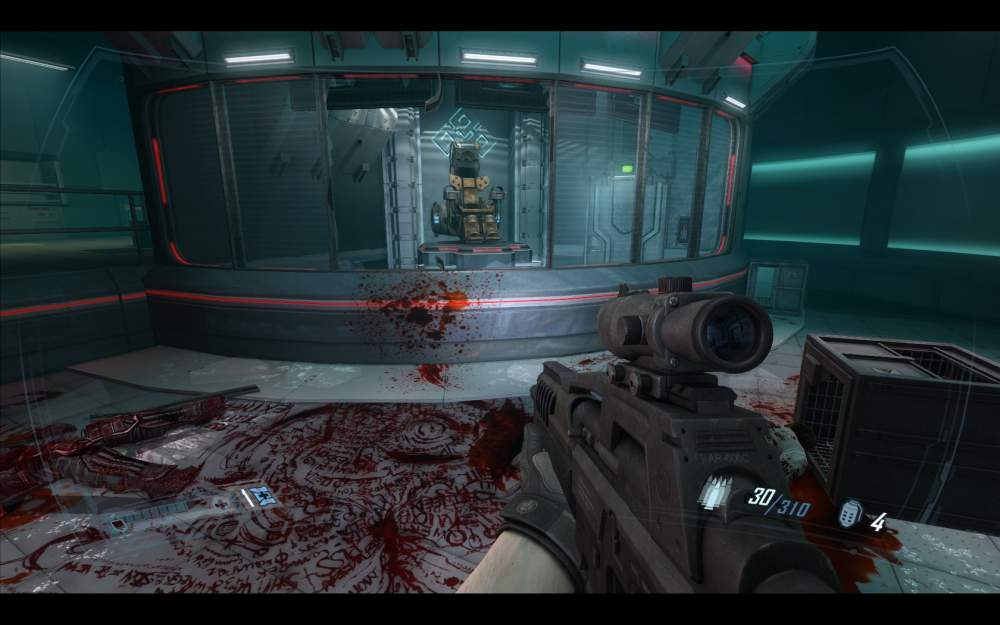
The art team doesn't hesitate to try and scare you with gore, either. The scene I mentioned earlier where you see portions of a medical procedure being performed on yourself is interspersed with hallucinations of zombie doctors tearing out your insides, with gouts of blood flying in every direction. At one point, you sneak up behind a couple of enemy soldiers trying to decipher a huge section of wall that is covered with random words, symbols, and obscenities — all painted with blood. It really does look like something drawn by a psychotic killer, such that I wondered if they contracted the design from a local loony bin. (And presumably, your character feels no cognitive dissonance from gunning down those soldiers, which itself is kind of surreal.) Bloodstains are used liberally, as are all manner of brutal killings. This is definitely not a game for kids or people who faint at the sight of blood. Even aside from the violence and gore, the other artwork is also well done. The attention to detail is refreshing; rooms and objects are correctly proportioned to a greater extent than most shooters. A malfunctioning X-ray machine with throw a series of disjointed X-ray photographs onto a nearby computer monitor. You'll even see T.P.S. reports scattered about an office desk. Everything looks like a real environment, not just an approximation pasted onto an abstract level design.
One of the signature gameplay elements of F.E.A.R. 2 is "reflex time," an ability carried over from the first game. Press a button and, for a short duration, time slows down, giving you a massive advantage over your opponents in a fight. The intention is to make the player feel like an action hero, able to dodge and aim with supernatural speed, and it works. It also makes most fights very easy; I'd recommend going through the game on Normal if it's your first FPS, and on Hard if you have any significant experience. The weapons are another area where F.E.A.R. 2 sets itself apart. There really aren't any bad weapons. They all have their strengths and weaknesses, but you won't spend much time wishing you had a different gun. Even the basic pistol and your melee attack are powerful enough to be interesting. There are definitely some weapons that are more fun, like the missile launcher, the napalm gun, and the laser, but in the end you just wind up switching weapons fairly often as ammo runs out, which does a lot to keep the fights from getting boring.
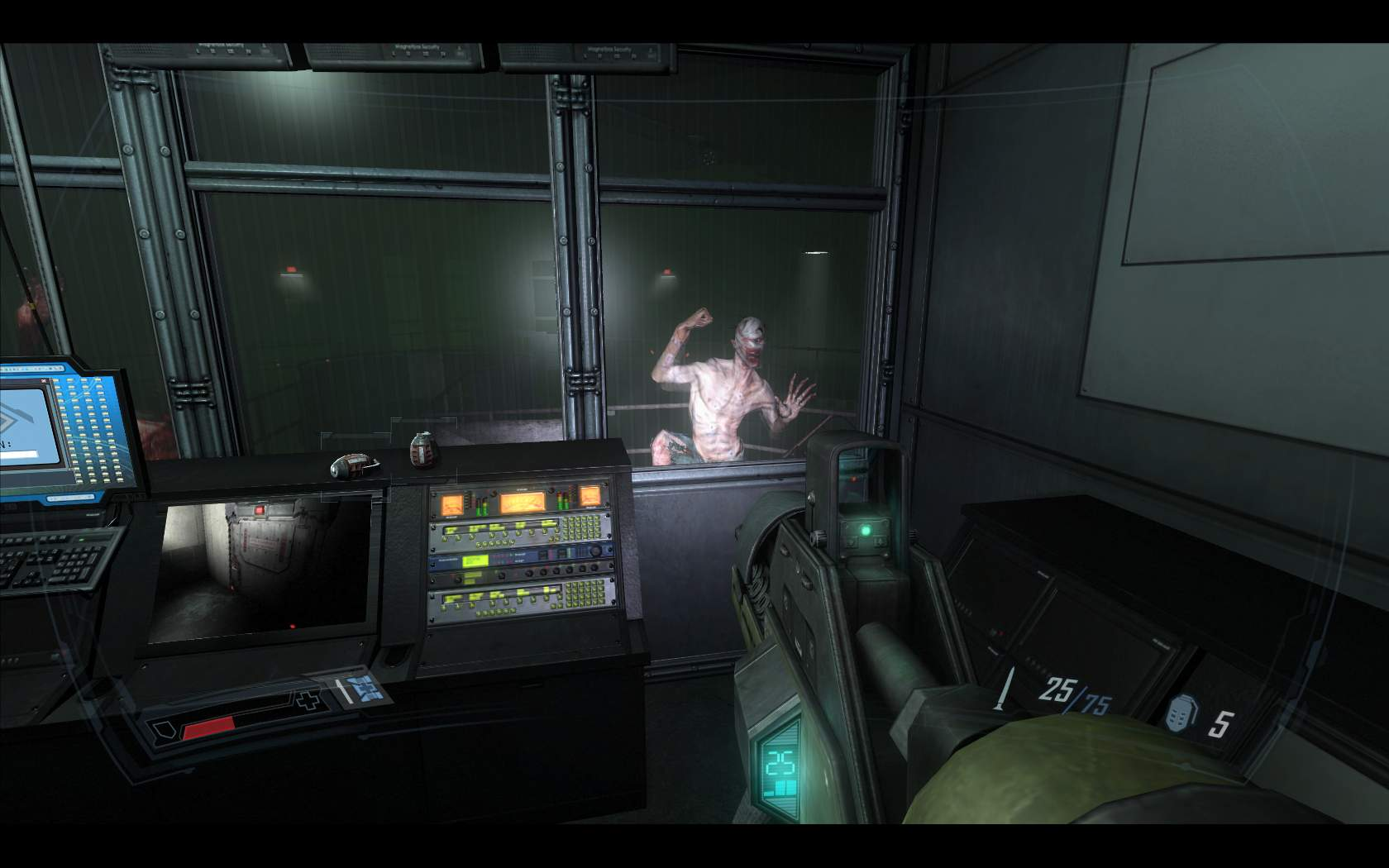
Another instrument they use to keep the fights interesting is the AI, which, as with the first game, is better than average. Enemies are constantly shifting position, finding new cover, and ducking out from behind an obstacle to shoot at you. It forces you to remain active; camping out behind a barrel will get you killed as enemies advance on you. That's not to say it's without flaws; sometimes a soldier will decide to crawl underneath some hanging metal — a very slow maneuver — while you stand five feet away holding a machine gun. The effectiveness of the AI also varies depending on the type of enemy you fight. There are quite a few different kinds, but you wind up fighting the standard soldiers a disproportionate amount of the time, and they handle the AI better than any others. Other enemies tend to be used for dramatic effect. You'll encounter zombie-like creatures that scuttle quickly on all fours, though they are much less scary when you can slow down time. Another type is almost invisible until they attack hand-to-hand. One of the tougher creatures reanimates dead soldiers, and then finds something to hide behind. They take quite a bit of firepower to kill, so you can expect to deal with the revived grunts repeatedly.
Scattered throughout the game are a few situations where you interact with the environment, and a few QTEs. Both are underutilized to the point where they don't really add anything to the gameplay. The QTEs just involve hammering on a button until you win; it's very simple and doesn't really require any effort or brainpower. Granted, most QTEs are added as a way to keep the player connected to a few mini-cutscenes, but the end result isn't very satisfying. The times when you interact with objects are also very shallow; hold down a single button to move an obstacle out of the way, or to close a valve, or to open a set of elevator doors. The added seconds don't really have any affect on what happens to you, so why take the extra time when you can open a regular door with a single click? I'm going to lump the new part of the cover system in with this as well. You can now flip over tables and crouch behind them to shield yourself from enemy fire. It's neat, but there's really no advantage to doing that instead of hiding behind a crate or the corner of a wall. Existing cover is plentiful.
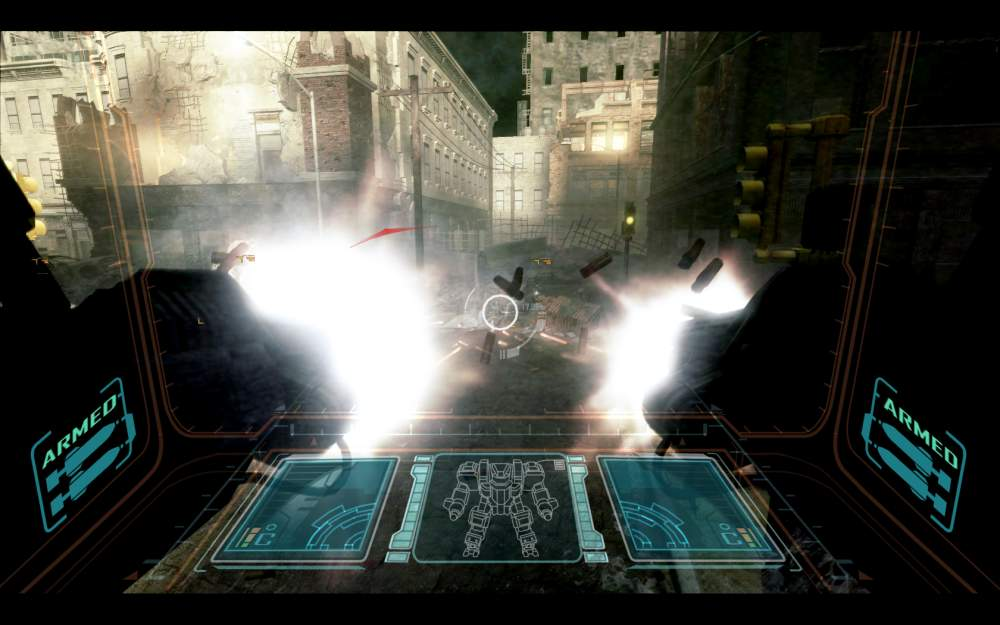
F.E.A.R. 2 infrequently offers a few different ways of fighting. The vast majority of the time, you're on foot holding a weapon of some sort, but you occasionally get to control a turret or a mech. Turrets are very much an upgrade in firepower. Far more enemies swarm than you could normally handle, but the turret cuts them down with ease. Controlling the turret is very easy; some games put silly restrictions like very slow rotation or poor accuracy, but F.E.A.R. 2 gets it right. It's quite fun, and my only complaint is that there aren't more opportunities to use them. The mechs, or "Powered Armor" units are even more powerful, but still very fun and easy to control. You get a couple of mini-guns and a set of rocket launchers, as well as a thermal imaging mode (think Predator). Aside from those two scenarios, there aren't a lot of variations in gameplay. At one point, you're riding on a speeding tram, but you're just walking around on top of it while enemies come to you. There isn't much scenery, and you wouldn't have much time to watch it anyway. The sequence is still fun, but it doesn't hold a candle to similar situations in, say, Gears of War 2.
The game's multiplayer falls into the same trap as the early single-player campaign. It's good, it's fun, and it's interesting, but there's nothing to set it apart from the multiplayer mode of half a dozen other good, fun, interesting shooters. The horror aspect is, of course, completely gone, and the signature time-slowing ability doesn't work because it'd be impossible to code. It has all the standard FPS modes of play (deathmatch, team deathmatch, CTF), and a few other team games that focus on controlling particular points of the map. Armored Front has five such points aligned in a linear manner such that only one is in conflict at a time. You either push the enemy back through successive points or get pushed back yourself. You can use turrets andmechs as well. As I mentioned earlier, all the weapons are relatively powerful in F.E.A.R. 2, and this becomes quite evident in multiplayer games. Players die very quickly without studious use of cover. It may be the case that all the weapons are tuned to be more powerful than they should be. The fights aren't always decided by the first shot, but it happens often enough to be a problem. The maps themselves are, for the most part, very good. There are perhaps a few too many intersections, and a few to many directions you need to watch for enemies, but otherwise they flow quite nicely.
F.E.A.R. 2 is an entertaining game. It's almost exactly what you'd expect out of a triple-A first-person shooter — no more, no less. If you're looking for a quality game and have no problem putting yourself in a state of mind to be creeped out, it will do the job nicely. If you're looking for a title that will push the boundaries of the genre, you're probably better off waiting for another game. There are some great parts to F.E.A.R. 2, and Monolith deserves a lot of credit for making them work as well as they did. This game had the misfortune of coming out after a wave of other, equally compelling titles. It doesn't fall behind, but it doesn't really stand out, either. The bottom line is that if you enjoy horror and first-person shooters, you'll enjoy this game. If your tastes run elsewhere.. well, there's plenty more to pick from.
-
Review: F.E.A.R. 2: Project Origin
First-person shooters comprise one of the most well-developed video game genres in existence. The number of high-quality games and franchises practically demands that any new entry must have an interesting concept and a rock-solid engine. Otherwise, it will quickly get buried under an avalanche of award-winning titles. When the original F.E.A.R. came out in 2005, a well-crafted horror theme, the AI, and a few gameplay innovations allowed it to succeed despite direct competition from established franchises, such as Quake 4 and Call of Duty 2, among others. F.E.A.R. 2: Project Origin draws on the strengths of its predecessor and adds a few improvements. The question that now remains is whether or not the additions make up for the fact that the game's concept is no longer new and unique. Read on for the rest of my thoughts.- Title: F.E.A.R. 2: Project Origin
- Developer: Monolith Productions
- Publisher: Warner Bros. Interactive Entertainment
- System: Windows, PS3, Xbox 360
- Reviewer: Soulskill
- Score: 7/10
The game starts out with a bang; the first act is extremely well designed. You begin in much the same manner as the first game, given little information and left to wonder what, exactly, is going on. You start in a military transport headed to pick up the president of Armachan Technology Corporation — the typical big, evil corporation developing things they really shouldn't. You're introduced to your squad-mates and then quickly separated from them while being taught some of the gameplay basics. The first serious firefight in the game is located within a room filled with antiques, ceramics, and vases stored in huge glass display cases. It's a brilliant choice in setting — priceless decorations shatter and glass flies everywhere. It's almost theatrical; like being a part of a high-budget action flick. As you shoot your way through the increasingly porous living quarters, hallucinations are induced by Alma, the deranged, telepathic, and telekinetic girl from the first game. The act ends when you witness a nuclear explosion far closer than is healthy, and shortly thereafter struggle to remain conscious as the corporation's doctors do something to you.
It's worth saying again — the first level is incredibly cool. Unfortunately, subsequent levels aren't able to match it. I suppose that's to be expected; after all, it's a horror-themed shooter rather than an epic adventure shooter, but the first level does tend to set expectations. For the next few acts, F.E.A.R. 2 treads mostly on familiar ground. You spend a great deal of time escaping an underground hospital/science facility, and wander your way through broken streets with crumbling buildings. That's not to say it's bad, or even unenjoyable ; the settings are still polished and full of detail, and the plot is continually prodded along in an interesting manner. It's just been done before, and often. If you've played a wide variety of first-person shooters, these levels will probably bring a sense of deja vu . Things pick back up after a while, though. You'll navigate your way through a school that was the site of much violence and destruction, go down into the subway, and even further into a high-tech underground tram. The less you know about any given setting, the more easily it lends itself to creepiness, so the more unique environments in F.E.A.R. 2 keep you focused on the horror aspect much better than the stereotypical science labs.
The visual effects that contribute to the horror theme are integrated quite well into the gameplay. The transition from your normal perception to hallucination is often gradual and seamless. Other times, it's sharp and distinct, using the shock of the immediate change to add an ominous vibe. Sometimes your flashlight will start to flicker in a dark area, and you'll begin to hear your character's panicked breathing and rapid heart rate. I'm on the fence about that; it's used to great effect in a few situations, but since fear in the character isn't mirrored by fear in the player, it also tends to serve as an indicator that something surprising is going to happen — thus negating the surprise. Other horror standards come in to play too. Every so often, Alma will flash into existence somewhere near you, and then disappear. Almost too often... but they find ways of keeping it interesting. The music and sound effects are very well done, laying the foundation for tense scenes, the foreshadowing of a terrible discovery, or giving your fight-or-flight reflexes a little boost.
The art team doesn't hesitate to try and scare you with gore, either. The scene I mentioned earlier where you see portions of a medical procedure being performed on yourself is interspersed with hallucinations of zombie doctors tearing out your insides, with gouts of blood flying in every direction. At one point, you sneak up behind a couple of enemy soldiers trying to decipher a huge section of wall that is covered with random words, symbols, and obscenities — all painted with blood. It really does look like something drawn by a psychotic killer, such that I wondered if they contracted the design from a local loony bin. (And presumably, your character feels no cognitive dissonance from gunning down those soldiers, which itself is kind of surreal.) Bloodstains are used liberally, as are all manner of brutal killings. This is definitely not a game for kids or people who faint at the sight of blood. Even aside from the violence and gore, the other artwork is also well done. The attention to detail is refreshing; rooms and objects are correctly proportioned to a greater extent than most shooters. A malfunctioning X-ray machine with throw a series of disjointed X-ray photographs onto a nearby computer monitor. You'll even see T.P.S. reports scattered about an office desk. Everything looks like a real environment, not just an approximation pasted onto an abstract level design.
One of the signature gameplay elements of F.E.A.R. 2 is "reflex time," an ability carried over from the first game. Press a button and, for a short duration, time slows down, giving you a massive advantage over your opponents in a fight. The intention is to make the player feel like an action hero, able to dodge and aim with supernatural speed, and it works. It also makes most fights very easy; I'd recommend going through the game on Normal if it's your first FPS, and on Hard if you have any significant experience. The weapons are another area where F.E.A.R. 2 sets itself apart. There really aren't any bad weapons. They all have their strengths and weaknesses, but you won't spend much time wishing you had a different gun. Even the basic pistol and your melee attack are powerful enough to be interesting. There are definitely some weapons that are more fun, like the missile launcher, the napalm gun, and the laser, but in the end you just wind up switching weapons fairly often as ammo runs out, which does a lot to keep the fights from getting boring.
Another instrument they use to keep the fights interesting is the AI, which, as with the first game, is better than average. Enemies are constantly shifting position, finding new cover, and ducking out from behind an obstacle to shoot at you. It forces you to remain active; camping out behind a barrel will get you killed as enemies advance on you. That's not to say it's without flaws; sometimes a soldier will decide to crawl underneath some hanging metal — a very slow maneuver — while you stand five feet away holding a machine gun. The effectiveness of the AI also varies depending on the type of enemy you fight. There are quite a few different kinds, but you wind up fighting the standard soldiers a disproportionate amount of the time, and they handle the AI better than any others. Other enemies tend to be used for dramatic effect. You'll encounter zombie-like creatures that scuttle quickly on all fours, though they are much less scary when you can slow down time. Another type is almost invisible until they attack hand-to-hand. One of the tougher creatures reanimates dead soldiers, and then finds something to hide behind. They take quite a bit of firepower to kill, so you can expect to deal with the revived grunts repeatedly.
Scattered throughout the game are a few situations where you interact with the environment, and a few QTEs. Both are underutilized to the point where they don't really add anything to the gameplay. The QTEs just involve hammering on a button until you win; it's very simple and doesn't really require any effort or brainpower. Granted, most QTEs are added as a way to keep the player connected to a few mini-cutscenes, but the end result isn't very satisfying. The times when you interact with objects are also very shallow; hold down a single button to move an obstacle out of the way, or to close a valve, or to open a set of elevator doors. The added seconds don't really have any affect on what happens to you, so why take the extra time when you can open a regular door with a single click? I'm going to lump the new part of the cover system in with this as well. You can now flip over tables and crouch behind them to shield yourself from enemy fire. It's neat, but there's really no advantage to doing that instead of hiding behind a crate or the corner of a wall. Existing cover is plentiful.
F.E.A.R. 2 infrequently offers a few different ways of fighting. The vast majority of the time, you're on foot holding a weapon of some sort, but you occasionally get to control a turret or a mech. Turrets are very much an upgrade in firepower. Far more enemies swarm than you could normally handle, but the turret cuts them down with ease. Controlling the turret is very easy; some games put silly restrictions like very slow rotation or poor accuracy, but F.E.A.R. 2 gets it right. It's quite fun, and my only complaint is that there aren't more opportunities to use them. The mechs, or "Powered Armor" units are even more powerful, but still very fun and easy to control. You get a couple of mini-guns and a set of rocket launchers, as well as a thermal imaging mode (think Predator). Aside from those two scenarios, there aren't a lot of variations in gameplay. At one point, you're riding on a speeding tram, but you're just walking around on top of it while enemies come to you. There isn't much scenery, and you wouldn't have much time to watch it anyway. The sequence is still fun, but it doesn't hold a candle to similar situations in, say, Gears of War 2.
The game's multiplayer falls into the same trap as the early single-player campaign. It's good, it's fun, and it's interesting, but there's nothing to set it apart from the multiplayer mode of half a dozen other good, fun, interesting shooters. The horror aspect is, of course, completely gone, and the signature time-slowing ability doesn't work because it'd be impossible to code. It has all the standard FPS modes of play (deathmatch, team deathmatch, CTF), and a few other team games that focus on controlling particular points of the map. Armored Front has five such points aligned in a linear manner such that only one is in conflict at a time. You either push the enemy back through successive points or get pushed back yourself. You can use turrets andmechs as well. As I mentioned earlier, all the weapons are relatively powerful in F.E.A.R. 2, and this becomes quite evident in multiplayer games. Players die very quickly without studious use of cover. It may be the case that all the weapons are tuned to be more powerful than they should be. The fights aren't always decided by the first shot, but it happens often enough to be a problem. The maps themselves are, for the most part, very good. There are perhaps a few too many intersections, and a few to many directions you need to watch for enemies, but otherwise they flow quite nicely.
F.E.A.R. 2 is an entertaining game. It's almost exactly what you'd expect out of a triple-A first-person shooter — no more, no less. If you're looking for a quality game and have no problem putting yourself in a state of mind to be creeped out, it will do the job nicely. If you're looking for a title that will push the boundaries of the genre, you're probably better off waiting for another game. There are some great parts to F.E.A.R. 2, and Monolith deserves a lot of credit for making them work as well as they did. This game had the misfortune of coming out after a wave of other, equally compelling titles. It doesn't fall behind, but it doesn't really stand out, either. The bottom line is that if you enjoy horror and first-person shooters, you'll enjoy this game. If your tastes run elsewhere.. well, there's plenty more to pick from.
-
Review: F.E.A.R. 2: Project Origin
First-person shooters comprise one of the most well-developed video game genres in existence. The number of high-quality games and franchises practically demands that any new entry must have an interesting concept and a rock-solid engine. Otherwise, it will quickly get buried under an avalanche of award-winning titles. When the original F.E.A.R. came out in 2005, a well-crafted horror theme, the AI, and a few gameplay innovations allowed it to succeed despite direct competition from established franchises, such as Quake 4 and Call of Duty 2, among others. F.E.A.R. 2: Project Origin draws on the strengths of its predecessor and adds a few improvements. The question that now remains is whether or not the additions make up for the fact that the game's concept is no longer new and unique. Read on for the rest of my thoughts.- Title: F.E.A.R. 2: Project Origin
- Developer: Monolith Productions
- Publisher: Warner Bros. Interactive Entertainment
- System: Windows, PS3, Xbox 360
- Reviewer: Soulskill
- Score: 7/10
The game starts out with a bang; the first act is extremely well designed. You begin in much the same manner as the first game, given little information and left to wonder what, exactly, is going on. You start in a military transport headed to pick up the president of Armachan Technology Corporation — the typical big, evil corporation developing things they really shouldn't. You're introduced to your squad-mates and then quickly separated from them while being taught some of the gameplay basics. The first serious firefight in the game is located within a room filled with antiques, ceramics, and vases stored in huge glass display cases. It's a brilliant choice in setting — priceless decorations shatter and glass flies everywhere. It's almost theatrical; like being a part of a high-budget action flick. As you shoot your way through the increasingly porous living quarters, hallucinations are induced by Alma, the deranged, telepathic, and telekinetic girl from the first game. The act ends when you witness a nuclear explosion far closer than is healthy, and shortly thereafter struggle to remain conscious as the corporation's doctors do something to you.
It's worth saying again — the first level is incredibly cool. Unfortunately, subsequent levels aren't able to match it. I suppose that's to be expected; after all, it's a horror-themed shooter rather than an epic adventure shooter, but the first level does tend to set expectations. For the next few acts, F.E.A.R. 2 treads mostly on familiar ground. You spend a great deal of time escaping an underground hospital/science facility, and wander your way through broken streets with crumbling buildings. That's not to say it's bad, or even unenjoyable ; the settings are still polished and full of detail, and the plot is continually prodded along in an interesting manner. It's just been done before, and often. If you've played a wide variety of first-person shooters, these levels will probably bring a sense of deja vu . Things pick back up after a while, though. You'll navigate your way through a school that was the site of much violence and destruction, go down into the subway, and even further into a high-tech underground tram. The less you know about any given setting, the more easily it lends itself to creepiness, so the more unique environments in F.E.A.R. 2 keep you focused on the horror aspect much better than the stereotypical science labs.
The visual effects that contribute to the horror theme are integrated quite well into the gameplay. The transition from your normal perception to hallucination is often gradual and seamless. Other times, it's sharp and distinct, using the shock of the immediate change to add an ominous vibe. Sometimes your flashlight will start to flicker in a dark area, and you'll begin to hear your character's panicked breathing and rapid heart rate. I'm on the fence about that; it's used to great effect in a few situations, but since fear in the character isn't mirrored by fear in the player, it also tends to serve as an indicator that something surprising is going to happen — thus negating the surprise. Other horror standards come in to play too. Every so often, Alma will flash into existence somewhere near you, and then disappear. Almost too often... but they find ways of keeping it interesting. The music and sound effects are very well done, laying the foundation for tense scenes, the foreshadowing of a terrible discovery, or giving your fight-or-flight reflexes a little boost.
The art team doesn't hesitate to try and scare you with gore, either. The scene I mentioned earlier where you see portions of a medical procedure being performed on yourself is interspersed with hallucinations of zombie doctors tearing out your insides, with gouts of blood flying in every direction. At one point, you sneak up behind a couple of enemy soldiers trying to decipher a huge section of wall that is covered with random words, symbols, and obscenities — all painted with blood. It really does look like something drawn by a psychotic killer, such that I wondered if they contracted the design from a local loony bin. (And presumably, your character feels no cognitive dissonance from gunning down those soldiers, which itself is kind of surreal.) Bloodstains are used liberally, as are all manner of brutal killings. This is definitely not a game for kids or people who faint at the sight of blood. Even aside from the violence and gore, the other artwork is also well done. The attention to detail is refreshing; rooms and objects are correctly proportioned to a greater extent than most shooters. A malfunctioning X-ray machine with throw a series of disjointed X-ray photographs onto a nearby computer monitor. You'll even see T.P.S. reports scattered about an office desk. Everything looks like a real environment, not just an approximation pasted onto an abstract level design.
One of the signature gameplay elements of F.E.A.R. 2 is "reflex time," an ability carried over from the first game. Press a button and, for a short duration, time slows down, giving you a massive advantage over your opponents in a fight. The intention is to make the player feel like an action hero, able to dodge and aim with supernatural speed, and it works. It also makes most fights very easy; I'd recommend going through the game on Normal if it's your first FPS, and on Hard if you have any significant experience. The weapons are another area where F.E.A.R. 2 sets itself apart. There really aren't any bad weapons. They all have their strengths and weaknesses, but you won't spend much time wishing you had a different gun. Even the basic pistol and your melee attack are powerful enough to be interesting. There are definitely some weapons that are more fun, like the missile launcher, the napalm gun, and the laser, but in the end you just wind up switching weapons fairly often as ammo runs out, which does a lot to keep the fights from getting boring.
Another instrument they use to keep the fights interesting is the AI, which, as with the first game, is better than average. Enemies are constantly shifting position, finding new cover, and ducking out from behind an obstacle to shoot at you. It forces you to remain active; camping out behind a barrel will get you killed as enemies advance on you. That's not to say it's without flaws; sometimes a soldier will decide to crawl underneath some hanging metal — a very slow maneuver — while you stand five feet away holding a machine gun. The effectiveness of the AI also varies depending on the type of enemy you fight. There are quite a few different kinds, but you wind up fighting the standard soldiers a disproportionate amount of the time, and they handle the AI better than any others. Other enemies tend to be used for dramatic effect. You'll encounter zombie-like creatures that scuttle quickly on all fours, though they are much less scary when you can slow down time. Another type is almost invisible until they attack hand-to-hand. One of the tougher creatures reanimates dead soldiers, and then finds something to hide behind. They take quite a bit of firepower to kill, so you can expect to deal with the revived grunts repeatedly.
Scattered throughout the game are a few situations where you interact with the environment, and a few QTEs. Both are underutilized to the point where they don't really add anything to the gameplay. The QTEs just involve hammering on a button until you win; it's very simple and doesn't really require any effort or brainpower. Granted, most QTEs are added as a way to keep the player connected to a few mini-cutscenes, but the end result isn't very satisfying. The times when you interact with objects are also very shallow; hold down a single button to move an obstacle out of the way, or to close a valve, or to open a set of elevator doors. The added seconds don't really have any affect on what happens to you, so why take the extra time when you can open a regular door with a single click? I'm going to lump the new part of the cover system in with this as well. You can now flip over tables and crouch behind them to shield yourself from enemy fire. It's neat, but there's really no advantage to doing that instead of hiding behind a crate or the corner of a wall. Existing cover is plentiful.
F.E.A.R. 2 infrequently offers a few different ways of fighting. The vast majority of the time, you're on foot holding a weapon of some sort, but you occasionally get to control a turret or a mech. Turrets are very much an upgrade in firepower. Far more enemies swarm than you could normally handle, but the turret cuts them down with ease. Controlling the turret is very easy; some games put silly restrictions like very slow rotation or poor accuracy, but F.E.A.R. 2 gets it right. It's quite fun, and my only complaint is that there aren't more opportunities to use them. The mechs, or "Powered Armor" units are even more powerful, but still very fun and easy to control. You get a couple of mini-guns and a set of rocket launchers, as well as a thermal imaging mode (think Predator). Aside from those two scenarios, there aren't a lot of variations in gameplay. At one point, you're riding on a speeding tram, but you're just walking around on top of it while enemies come to you. There isn't much scenery, and you wouldn't have much time to watch it anyway. The sequence is still fun, but it doesn't hold a candle to similar situations in, say, Gears of War 2.
The game's multiplayer falls into the same trap as the early single-player campaign. It's good, it's fun, and it's interesting, but there's nothing to set it apart from the multiplayer mode of half a dozen other good, fun, interesting shooters. The horror aspect is, of course, completely gone, and the signature time-slowing ability doesn't work because it'd be impossible to code. It has all the standard FPS modes of play (deathmatch, team deathmatch, CTF), and a few other team games that focus on controlling particular points of the map. Armored Front has five such points aligned in a linear manner such that only one is in conflict at a time. You either push the enemy back through successive points or get pushed back yourself. You can use turrets andmechs as well. As I mentioned earlier, all the weapons are relatively powerful in F.E.A.R. 2, and this becomes quite evident in multiplayer games. Players die very quickly without studious use of cover. It may be the case that all the weapons are tuned to be more powerful than they should be. The fights aren't always decided by the first shot, but it happens often enough to be a problem. The maps themselves are, for the most part, very good. There are perhaps a few too many intersections, and a few to many directions you need to watch for enemies, but otherwise they flow quite nicely.
F.E.A.R. 2 is an entertaining game. It's almost exactly what you'd expect out of a triple-A first-person shooter — no more, no less. If you're looking for a quality game and have no problem putting yourself in a state of mind to be creeped out, it will do the job nicely. If you're looking for a title that will push the boundaries of the genre, you're probably better off waiting for another game. There are some great parts to F.E.A.R. 2, and Monolith deserves a lot of credit for making them work as well as they did. This game had the misfortune of coming out after a wave of other, equally compelling titles. It doesn't fall behind, but it doesn't really stand out, either. The bottom line is that if you enjoy horror and first-person shooters, you'll enjoy this game. If your tastes run elsewhere.. well, there's plenty more to pick from.
-
Review: F.E.A.R. 2: Project Origin
First-person shooters comprise one of the most well-developed video game genres in existence. The number of high-quality games and franchises practically demands that any new entry must have an interesting concept and a rock-solid engine. Otherwise, it will quickly get buried under an avalanche of award-winning titles. When the original F.E.A.R. came out in 2005, a well-crafted horror theme, the AI, and a few gameplay innovations allowed it to succeed despite direct competition from established franchises, such as Quake 4 and Call of Duty 2, among others. F.E.A.R. 2: Project Origin draws on the strengths of its predecessor and adds a few improvements. The question that now remains is whether or not the additions make up for the fact that the game's concept is no longer new and unique. Read on for the rest of my thoughts.- Title: F.E.A.R. 2: Project Origin
- Developer: Monolith Productions
- Publisher: Warner Bros. Interactive Entertainment
- System: Windows, PS3, Xbox 360
- Reviewer: Soulskill
- Score: 7/10
The game starts out with a bang; the first act is extremely well designed. You begin in much the same manner as the first game, given little information and left to wonder what, exactly, is going on. You start in a military transport headed to pick up the president of Armachan Technology Corporation — the typical big, evil corporation developing things they really shouldn't. You're introduced to your squad-mates and then quickly separated from them while being taught some of the gameplay basics. The first serious firefight in the game is located within a room filled with antiques, ceramics, and vases stored in huge glass display cases. It's a brilliant choice in setting — priceless decorations shatter and glass flies everywhere. It's almost theatrical; like being a part of a high-budget action flick. As you shoot your way through the increasingly porous living quarters, hallucinations are induced by Alma, the deranged, telepathic, and telekinetic girl from the first game. The act ends when you witness a nuclear explosion far closer than is healthy, and shortly thereafter struggle to remain conscious as the corporation's doctors do something to you.
It's worth saying again — the first level is incredibly cool. Unfortunately, subsequent levels aren't able to match it. I suppose that's to be expected; after all, it's a horror-themed shooter rather than an epic adventure shooter, but the first level does tend to set expectations. For the next few acts, F.E.A.R. 2 treads mostly on familiar ground. You spend a great deal of time escaping an underground hospital/science facility, and wander your way through broken streets with crumbling buildings. That's not to say it's bad, or even unenjoyable ; the settings are still polished and full of detail, and the plot is continually prodded along in an interesting manner. It's just been done before, and often. If you've played a wide variety of first-person shooters, these levels will probably bring a sense of deja vu . Things pick back up after a while, though. You'll navigate your way through a school that was the site of much violence and destruction, go down into the subway, and even further into a high-tech underground tram. The less you know about any given setting, the more easily it lends itself to creepiness, so the more unique environments in F.E.A.R. 2 keep you focused on the horror aspect much better than the stereotypical science labs.
The visual effects that contribute to the horror theme are integrated quite well into the gameplay. The transition from your normal perception to hallucination is often gradual and seamless. Other times, it's sharp and distinct, using the shock of the immediate change to add an ominous vibe. Sometimes your flashlight will start to flicker in a dark area, and you'll begin to hear your character's panicked breathing and rapid heart rate. I'm on the fence about that; it's used to great effect in a few situations, but since fear in the character isn't mirrored by fear in the player, it also tends to serve as an indicator that something surprising is going to happen — thus negating the surprise. Other horror standards come in to play too. Every so often, Alma will flash into existence somewhere near you, and then disappear. Almost too often... but they find ways of keeping it interesting. The music and sound effects are very well done, laying the foundation for tense scenes, the foreshadowing of a terrible discovery, or giving your fight-or-flight reflexes a little boost.
The art team doesn't hesitate to try and scare you with gore, either. The scene I mentioned earlier where you see portions of a medical procedure being performed on yourself is interspersed with hallucinations of zombie doctors tearing out your insides, with gouts of blood flying in every direction. At one point, you sneak up behind a couple of enemy soldiers trying to decipher a huge section of wall that is covered with random words, symbols, and obscenities — all painted with blood. It really does look like something drawn by a psychotic killer, such that I wondered if they contracted the design from a local loony bin. (And presumably, your character feels no cognitive dissonance from gunning down those soldiers, which itself is kind of surreal.) Bloodstains are used liberally, as are all manner of brutal killings. This is definitely not a game for kids or people who faint at the sight of blood. Even aside from the violence and gore, the other artwork is also well done. The attention to detail is refreshing; rooms and objects are correctly proportioned to a greater extent than most shooters. A malfunctioning X-ray machine with throw a series of disjointed X-ray photographs onto a nearby computer monitor. You'll even see T.P.S. reports scattered about an office desk. Everything looks like a real environment, not just an approximation pasted onto an abstract level design.
One of the signature gameplay elements of F.E.A.R. 2 is "reflex time," an ability carried over from the first game. Press a button and, for a short duration, time slows down, giving you a massive advantage over your opponents in a fight. The intention is to make the player feel like an action hero, able to dodge and aim with supernatural speed, and it works. It also makes most fights very easy; I'd recommend going through the game on Normal if it's your first FPS, and on Hard if you have any significant experience. The weapons are another area where F.E.A.R. 2 sets itself apart. There really aren't any bad weapons. They all have their strengths and weaknesses, but you won't spend much time wishing you had a different gun. Even the basic pistol and your melee attack are powerful enough to be interesting. There are definitely some weapons that are more fun, like the missile launcher, the napalm gun, and the laser, but in the end you just wind up switching weapons fairly often as ammo runs out, which does a lot to keep the fights from getting boring.
Another instrument they use to keep the fights interesting is the AI, which, as with the first game, is better than average. Enemies are constantly shifting position, finding new cover, and ducking out from behind an obstacle to shoot at you. It forces you to remain active; camping out behind a barrel will get you killed as enemies advance on you. That's not to say it's without flaws; sometimes a soldier will decide to crawl underneath some hanging metal — a very slow maneuver — while you stand five feet away holding a machine gun. The effectiveness of the AI also varies depending on the type of enemy you fight. There are quite a few different kinds, but you wind up fighting the standard soldiers a disproportionate amount of the time, and they handle the AI better than any others. Other enemies tend to be used for dramatic effect. You'll encounter zombie-like creatures that scuttle quickly on all fours, though they are much less scary when you can slow down time. Another type is almost invisible until they attack hand-to-hand. One of the tougher creatures reanimates dead soldiers, and then finds something to hide behind. They take quite a bit of firepower to kill, so you can expect to deal with the revived grunts repeatedly.
Scattered throughout the game are a few situations where you interact with the environment, and a few QTEs. Both are underutilized to the point where they don't really add anything to the gameplay. The QTEs just involve hammering on a button until you win; it's very simple and doesn't really require any effort or brainpower. Granted, most QTEs are added as a way to keep the player connected to a few mini-cutscenes, but the end result isn't very satisfying. The times when you interact with objects are also very shallow; hold down a single button to move an obstacle out of the way, or to close a valve, or to open a set of elevator doors. The added seconds don't really have any affect on what happens to you, so why take the extra time when you can open a regular door with a single click? I'm going to lump the new part of the cover system in with this as well. You can now flip over tables and crouch behind them to shield yourself from enemy fire. It's neat, but there's really no advantage to doing that instead of hiding behind a crate or the corner of a wall. Existing cover is plentiful.
F.E.A.R. 2 infrequently offers a few different ways of fighting. The vast majority of the time, you're on foot holding a weapon of some sort, but you occasionally get to control a turret or a mech. Turrets are very much an upgrade in firepower. Far more enemies swarm than you could normally handle, but the turret cuts them down with ease. Controlling the turret is very easy; some games put silly restrictions like very slow rotation or poor accuracy, but F.E.A.R. 2 gets it right. It's quite fun, and my only complaint is that there aren't more opportunities to use them. The mechs, or "Powered Armor" units are even more powerful, but still very fun and easy to control. You get a couple of mini-guns and a set of rocket launchers, as well as a thermal imaging mode (think Predator). Aside from those two scenarios, there aren't a lot of variations in gameplay. At one point, you're riding on a speeding tram, but you're just walking around on top of it while enemies come to you. There isn't much scenery, and you wouldn't have much time to watch it anyway. The sequence is still fun, but it doesn't hold a candle to similar situations in, say, Gears of War 2.
The game's multiplayer falls into the same trap as the early single-player campaign. It's good, it's fun, and it's interesting, but there's nothing to set it apart from the multiplayer mode of half a dozen other good, fun, interesting shooters. The horror aspect is, of course, completely gone, and the signature time-slowing ability doesn't work because it'd be impossible to code. It has all the standard FPS modes of play (deathmatch, team deathmatch, CTF), and a few other team games that focus on controlling particular points of the map. Armored Front has five such points aligned in a linear manner such that only one is in conflict at a time. You either push the enemy back through successive points or get pushed back yourself. You can use turrets andmechs as well. As I mentioned earlier, all the weapons are relatively powerful in F.E.A.R. 2, and this becomes quite evident in multiplayer games. Players die very quickly without studious use of cover. It may be the case that all the weapons are tuned to be more powerful than they should be. The fights aren't always decided by the first shot, but it happens often enough to be a problem. The maps themselves are, for the most part, very good. There are perhaps a few too many intersections, and a few to many directions you need to watch for enemies, but otherwise they flow quite nicely.
F.E.A.R. 2 is an entertaining game. It's almost exactly what you'd expect out of a triple-A first-person shooter — no more, no less. If you're looking for a quality game and have no problem putting yourself in a state of mind to be creeped out, it will do the job nicely. If you're looking for a title that will push the boundaries of the genre, you're probably better off waiting for another game. There are some great parts to F.E.A.R. 2, and Monolith deserves a lot of credit for making them work as well as they did. This game had the misfortune of coming out after a wave of other, equally compelling titles. It doesn't fall behind, but it doesn't really stand out, either. The bottom line is that if you enjoy horror and first-person shooters, you'll enjoy this game. If your tastes run elsewhere.. well, there's plenty more to pick from.
-
Review: F.E.A.R. 2: Project Origin
First-person shooters comprise one of the most well-developed video game genres in existence. The number of high-quality games and franchises practically demands that any new entry must have an interesting concept and a rock-solid engine. Otherwise, it will quickly get buried under an avalanche of award-winning titles. When the original F.E.A.R. came out in 2005, a well-crafted horror theme, the AI, and a few gameplay innovations allowed it to succeed despite direct competition from established franchises, such as Quake 4 and Call of Duty 2, among others. F.E.A.R. 2: Project Origin draws on the strengths of its predecessor and adds a few improvements. The question that now remains is whether or not the additions make up for the fact that the game's concept is no longer new and unique. Read on for the rest of my thoughts.- Title: F.E.A.R. 2: Project Origin
- Developer: Monolith Productions
- Publisher: Warner Bros. Interactive Entertainment
- System: Windows, PS3, Xbox 360
- Reviewer: Soulskill
- Score: 7/10
The game starts out with a bang; the first act is extremely well designed. You begin in much the same manner as the first game, given little information and left to wonder what, exactly, is going on. You start in a military transport headed to pick up the president of Armachan Technology Corporation — the typical big, evil corporation developing things they really shouldn't. You're introduced to your squad-mates and then quickly separated from them while being taught some of the gameplay basics. The first serious firefight in the game is located within a room filled with antiques, ceramics, and vases stored in huge glass display cases. It's a brilliant choice in setting — priceless decorations shatter and glass flies everywhere. It's almost theatrical; like being a part of a high-budget action flick. As you shoot your way through the increasingly porous living quarters, hallucinations are induced by Alma, the deranged, telepathic, and telekinetic girl from the first game. The act ends when you witness a nuclear explosion far closer than is healthy, and shortly thereafter struggle to remain conscious as the corporation's doctors do something to you.
It's worth saying again — the first level is incredibly cool. Unfortunately, subsequent levels aren't able to match it. I suppose that's to be expected; after all, it's a horror-themed shooter rather than an epic adventure shooter, but the first level does tend to set expectations. For the next few acts, F.E.A.R. 2 treads mostly on familiar ground. You spend a great deal of time escaping an underground hospital/science facility, and wander your way through broken streets with crumbling buildings. That's not to say it's bad, or even unenjoyable ; the settings are still polished and full of detail, and the plot is continually prodded along in an interesting manner. It's just been done before, and often. If you've played a wide variety of first-person shooters, these levels will probably bring a sense of deja vu . Things pick back up after a while, though. You'll navigate your way through a school that was the site of much violence and destruction, go down into the subway, and even further into a high-tech underground tram. The less you know about any given setting, the more easily it lends itself to creepiness, so the more unique environments in F.E.A.R. 2 keep you focused on the horror aspect much better than the stereotypical science labs.
The visual effects that contribute to the horror theme are integrated quite well into the gameplay. The transition from your normal perception to hallucination is often gradual and seamless. Other times, it's sharp and distinct, using the shock of the immediate change to add an ominous vibe. Sometimes your flashlight will start to flicker in a dark area, and you'll begin to hear your character's panicked breathing and rapid heart rate. I'm on the fence about that; it's used to great effect in a few situations, but since fear in the character isn't mirrored by fear in the player, it also tends to serve as an indicator that something surprising is going to happen — thus negating the surprise. Other horror standards come in to play too. Every so often, Alma will flash into existence somewhere near you, and then disappear. Almost too often... but they find ways of keeping it interesting. The music and sound effects are very well done, laying the foundation for tense scenes, the foreshadowing of a terrible discovery, or giving your fight-or-flight reflexes a little boost.
The art team doesn't hesitate to try and scare you with gore, either. The scene I mentioned earlier where you see portions of a medical procedure being performed on yourself is interspersed with hallucinations of zombie doctors tearing out your insides, with gouts of blood flying in every direction. At one point, you sneak up behind a couple of enemy soldiers trying to decipher a huge section of wall that is covered with random words, symbols, and obscenities — all painted with blood. It really does look like something drawn by a psychotic killer, such that I wondered if they contracted the design from a local loony bin. (And presumably, your character feels no cognitive dissonance from gunning down those soldiers, which itself is kind of surreal.) Bloodstains are used liberally, as are all manner of brutal killings. This is definitely not a game for kids or people who faint at the sight of blood. Even aside from the violence and gore, the other artwork is also well done. The attention to detail is refreshing; rooms and objects are correctly proportioned to a greater extent than most shooters. A malfunctioning X-ray machine with throw a series of disjointed X-ray photographs onto a nearby computer monitor. You'll even see T.P.S. reports scattered about an office desk. Everything looks like a real environment, not just an approximation pasted onto an abstract level design.
One of the signature gameplay elements of F.E.A.R. 2 is "reflex time," an ability carried over from the first game. Press a button and, for a short duration, time slows down, giving you a massive advantage over your opponents in a fight. The intention is to make the player feel like an action hero, able to dodge and aim with supernatural speed, and it works. It also makes most fights very easy; I'd recommend going through the game on Normal if it's your first FPS, and on Hard if you have any significant experience. The weapons are another area where F.E.A.R. 2 sets itself apart. There really aren't any bad weapons. They all have their strengths and weaknesses, but you won't spend much time wishing you had a different gun. Even the basic pistol and your melee attack are powerful enough to be interesting. There are definitely some weapons that are more fun, like the missile launcher, the napalm gun, and the laser, but in the end you just wind up switching weapons fairly often as ammo runs out, which does a lot to keep the fights from getting boring.
Another instrument they use to keep the fights interesting is the AI, which, as with the first game, is better than average. Enemies are constantly shifting position, finding new cover, and ducking out from behind an obstacle to shoot at you. It forces you to remain active; camping out behind a barrel will get you killed as enemies advance on you. That's not to say it's without flaws; sometimes a soldier will decide to crawl underneath some hanging metal — a very slow maneuver — while you stand five feet away holding a machine gun. The effectiveness of the AI also varies depending on the type of enemy you fight. There are quite a few different kinds, but you wind up fighting the standard soldiers a disproportionate amount of the time, and they handle the AI better than any others. Other enemies tend to be used for dramatic effect. You'll encounter zombie-like creatures that scuttle quickly on all fours, though they are much less scary when you can slow down time. Another type is almost invisible until they attack hand-to-hand. One of the tougher creatures reanimates dead soldiers, and then finds something to hide behind. They take quite a bit of firepower to kill, so you can expect to deal with the revived grunts repeatedly.
Scattered throughout the game are a few situations where you interact with the environment, and a few QTEs. Both are underutilized to the point where they don't really add anything to the gameplay. The QTEs just involve hammering on a button until you win; it's very simple and doesn't really require any effort or brainpower. Granted, most QTEs are added as a way to keep the player connected to a few mini-cutscenes, but the end result isn't very satisfying. The times when you interact with objects are also very shallow; hold down a single button to move an obstacle out of the way, or to close a valve, or to open a set of elevator doors. The added seconds don't really have any affect on what happens to you, so why take the extra time when you can open a regular door with a single click? I'm going to lump the new part of the cover system in with this as well. You can now flip over tables and crouch behind them to shield yourself from enemy fire. It's neat, but there's really no advantage to doing that instead of hiding behind a crate or the corner of a wall. Existing cover is plentiful.
F.E.A.R. 2 infrequently offers a few different ways of fighting. The vast majority of the time, you're on foot holding a weapon of some sort, but you occasionally get to control a turret or a mech. Turrets are very much an upgrade in firepower. Far more enemies swarm than you could normally handle, but the turret cuts them down with ease. Controlling the turret is very easy; some games put silly restrictions like very slow rotation or poor accuracy, but F.E.A.R. 2 gets it right. It's quite fun, and my only complaint is that there aren't more opportunities to use them. The mechs, or "Powered Armor" units are even more powerful, but still very fun and easy to control. You get a couple of mini-guns and a set of rocket launchers, as well as a thermal imaging mode (think Predator). Aside from those two scenarios, there aren't a lot of variations in gameplay. At one point, you're riding on a speeding tram, but you're just walking around on top of it while enemies come to you. There isn't much scenery, and you wouldn't have much time to watch it anyway. The sequence is still fun, but it doesn't hold a candle to similar situations in, say, Gears of War 2.
The game's multiplayer falls into the same trap as the early single-player campaign. It's good, it's fun, and it's interesting, but there's nothing to set it apart from the multiplayer mode of half a dozen other good, fun, interesting shooters. The horror aspect is, of course, completely gone, and the signature time-slowing ability doesn't work because it'd be impossible to code. It has all the standard FPS modes of play (deathmatch, team deathmatch, CTF), and a few other team games that focus on controlling particular points of the map. Armored Front has five such points aligned in a linear manner such that only one is in conflict at a time. You either push the enemy back through successive points or get pushed back yourself. You can use turrets andmechs as well. As I mentioned earlier, all the weapons are relatively powerful in F.E.A.R. 2, and this becomes quite evident in multiplayer games. Players die very quickly without studious use of cover. It may be the case that all the weapons are tuned to be more powerful than they should be. The fights aren't always decided by the first shot, but it happens often enough to be a problem. The maps themselves are, for the most part, very good. There are perhaps a few too many intersections, and a few to many directions you need to watch for enemies, but otherwise they flow quite nicely.
F.E.A.R. 2 is an entertaining game. It's almost exactly what you'd expect out of a triple-A first-person shooter — no more, no less. If you're looking for a quality game and have no problem putting yourself in a state of mind to be creeped out, it will do the job nicely. If you're looking for a title that will push the boundaries of the genre, you're probably better off waiting for another game. There are some great parts to F.E.A.R. 2, and Monolith deserves a lot of credit for making them work as well as they did. This game had the misfortune of coming out after a wave of other, equally compelling titles. It doesn't fall behind, but it doesn't really stand out, either. The bottom line is that if you enjoy horror and first-person shooters, you'll enjoy this game. If your tastes run elsewhere.. well, there's plenty more to pick from.
-
Facebook Reverts ToS Change After User Uproar
rarel writes "CNN and other media outlets report that Facebook reverted their TOS update and went back to using the previous one. 'The site posted a brief message on users' home pages that said it was returning to its previous "Terms of Use" policy "while we resolve the issues that people have raised."' Facebook's controversial changes to its Terms of Service, previously commented on Slashdot, included a mention that (users) 'may remove (their) User Content from the Site at any time. ... However, (they) acknowledge that the Company may retain archived copies of (their) User Content,' triggering a massive uproar from users and privacy groups." -
TrapCall Service To Bypass Caller ID Blocking
cemaco writes in with news that TelTech, developers of the infamous SpoofCard service, have come out with something even more controversial: a set of services for revealing blocked caller ID numbers. The services take advantage of a loophole in the way caller ID blocking works — it has never been effective when calling an 800 number, because the recipient is paying for the call. So TelTech instructs you how to forward blocked calls (transparently) to their 800 number; the call comes back to your phone in seconds with the formerly hidden caller ID revealed. Advocacy groups for victims of domestic violence are concerned. Victims of annoying calls hiding behind caller ID blocking are rejoicing. -
Facebook Scrambles To Contain ToS Fallout
Ian Lamont writes "Anger over Facebook's ToS update has forced the company to scramble. Yesterday, a spokesman released a statement that said Facebook has never 'claimed ownership of material that users upload,' and is trying to be more open to users about how their data is being handled. Mark Zuckerberg has also weighed in, stating 'we wouldn't share your information in a way you wouldn't want.' Facebook members are skeptical, however — protests have sprung up on blogs, message boards, and a new Facebook group called 'People Against the new Terms of Service' that has added more than 10,000 members today." -
Map As Metaphor In a Location-Aware Mobile World
mattnyc99 writes "Two weeks after the launch of Google Latitude, your inbox is probably full of requests and privacy advocates probably have even more concerns than they did at first. But some tech pundits are already seeing the bigger picture of a digital lifestyle based around the always-on, GPS-based mobile map. The NYTimes's John Markoff has a great piece in today's Science Times about the map as metaphor for a time when 'future systems will probably begin to blur the boundaries between the display and the real world.' Over at Esquire.com's Tech Therapist, Erik Sofge talks to the geek behind Latitude and offers a similar reality check: 'Latitude will be precisely as annoying as e-mail and social networking sites and cell phones themselves — and just as useful. What won't stop Latitude, or the wider rollout of location-based tracking, is bitching about it. These are juggernauts of free, culture-reorienting technology. And you and me, we are but posts on the massive Facebook profile of history.'" -
Map As Metaphor In a Location-Aware Mobile World
mattnyc99 writes "Two weeks after the launch of Google Latitude, your inbox is probably full of requests and privacy advocates probably have even more concerns than they did at first. But some tech pundits are already seeing the bigger picture of a digital lifestyle based around the always-on, GPS-based mobile map. The NYTimes's John Markoff has a great piece in today's Science Times about the map as metaphor for a time when 'future systems will probably begin to blur the boundaries between the display and the real world.' Over at Esquire.com's Tech Therapist, Erik Sofge talks to the geek behind Latitude and offers a similar reality check: 'Latitude will be precisely as annoying as e-mail and social networking sites and cell phones themselves — and just as useful. What won't stop Latitude, or the wider rollout of location-based tracking, is bitching about it. These are juggernauts of free, culture-reorienting technology. And you and me, we are but posts on the massive Facebook profile of history.'" -
Confusion Reigns As Analog TV Begins Shutdown
As TV stations across the country switch off their analog signals, uncertainty reigns. Some 691 stations will have converted to digital broadcasting by midnight tonight (some interpreted the mandate as going digital by Feb. 17, not during Feb. 17, and shut down yesterday). This represents about a third of TV broadcasters nationwide. No one can say how many of the estimated 5.8 million households unready for the transition are in areas served by the stations that are switching now. The FCC added to the uncertainty by imposing extra conditions, making it unclear until last Friday exactly which stations would be switching at the beginning of the transition period. The article quotes a former analyst at Barclays Capital who said the whole process has been "botched politically." -
Will Obama's DOJ Intervene To Help RIAA?
NewYorkCountryLawyer writes "In SONY BMG Music Entertainment v. Cloud, a Pennsylvania case in which the RIAA's statutory damages theory — seeking from 2,200 to 450,000 times the amount of actual damages — is being tested, the US Department of Justice has just filed papers indicating that it is considering intervening in the case to defend the constitutionality of such awards, and requesting an extension of time (PDF) in which to decide whether such intervention 'is appropriate.' This is an early test of whether President Obama will make good on his promises (a) not to allow industry insiders to participate in cases affecting the industry they represented (the 2nd and 3rd highest DOJ officials are RIAA lawyers) and (b) to look out for ordinary citizens rather than big corporations." -
Handset Vendors Plug Micro-USB Charge Ports
ketan324 points to a Register story touting an agreement among several phone makers to settle on Micro USB for their phones' charging ports, writing "It's about time for these cellphone manufacturers to wise up and design a universal phone charger. Although many manufacturers have already 'standardized' to a mini-USB interface, there are many more out there who use proprietary adapters. I wonder how Apple will feel about this? Will they finally realize that their oh-so-special adapter is nothing more than a fudged USB interface?" No legislation required. -
Half the Charges Against Pirate Bay Dropped
eldavojohn writes "Half the charges have been dropped in the second day of the trial against the Pirate Bay. The charges dropped are those relating to 'assisting copyright infringement,' so the remaining charges are simply 'assisting making available.' No information on how this affects the size of the lawsuit or a settlement." -
EU Commissioner Wants Standard For Mobile Phone Connectors
Jantastic writes "European Commissioner Günter Verheugen wants manufacturers of mobile phones to come up with a standard connector for chargers and microphones. If companies fail to do so, proposed legislation should speed up this process. In theory, this could improve competition, while enabling longer life cycles for these devices." -
Nuclear Subs 'Collide In Ocean'
Jantastic noted a BBC report saying "A Royal Navy nuclear submarine was involved in a collision with a French nuclear sub in the middle of the Atlantic. It is understood HMS Vanguard and Le Triomphant were badly damaged in the crash earlier this month. Despite being equipped with sonar, it seems neither vessel spotted the other, the BBC's Caroline Wyatt said." -
The Role of Experts In Wikipedia
Hugh Pickens writes "Episteme, a magazine about the social dimensions of knowledge, has a special issue on the epistemology of mass collaboration, with many of the articles focusing on Wikipedia. One of the most interesting articles is by Lawrence M. Sanger on the special role of experts in the age of Wikipedia. Sanger says the main reason that Wikipedia's articles are as good as they are is that they are edited by knowledgeable people to whom deference is paid, although voluntarily, but that some articles suffer precisely because there are so many aggressive people who 'guard' articles and drive off others (PDF), including people more expert than they are. 'Without granting experts any authority to overrule such people, there is no reason to think that Wikipedia'a articles are on a vector toward continual improvement,' writes Sanger. Wikipedia's success cannot be explained by its radical egalitarianism or its rejection of expert involvement, but instead by its freedom, openness, and bottom-up management and there is no doubt that many experts would, if left to their own devices, dismantle the openness that drives the success of Wikipedia. 'But the failure to take seriously the suggestion of any role of experts can only be considered a failure of imagination,' writes Sanger. 'One need only ask what an open, bottom-up system with a role for expert decision-making would be like.' The rest of the articles on the epistemology of mass collaboration are available online, free for now." Sanger was one of the founders of Wikipedia, and of its failed predecessor Nupedia, who left the fold because of differences over the question of the proper role of experts. Sanger forked Wikipedia to found Citizendium, which we have discussed on several occasions. After 2-1/2 years, Citizendium has a few tenths of a percent as many articles as Wikipedia. -
The Role of Experts In Wikipedia
Hugh Pickens writes "Episteme, a magazine about the social dimensions of knowledge, has a special issue on the epistemology of mass collaboration, with many of the articles focusing on Wikipedia. One of the most interesting articles is by Lawrence M. Sanger on the special role of experts in the age of Wikipedia. Sanger says the main reason that Wikipedia's articles are as good as they are is that they are edited by knowledgeable people to whom deference is paid, although voluntarily, but that some articles suffer precisely because there are so many aggressive people who 'guard' articles and drive off others (PDF), including people more expert than they are. 'Without granting experts any authority to overrule such people, there is no reason to think that Wikipedia'a articles are on a vector toward continual improvement,' writes Sanger. Wikipedia's success cannot be explained by its radical egalitarianism or its rejection of expert involvement, but instead by its freedom, openness, and bottom-up management and there is no doubt that many experts would, if left to their own devices, dismantle the openness that drives the success of Wikipedia. 'But the failure to take seriously the suggestion of any role of experts can only be considered a failure of imagination,' writes Sanger. 'One need only ask what an open, bottom-up system with a role for expert decision-making would be like.' The rest of the articles on the epistemology of mass collaboration are available online, free for now." Sanger was one of the founders of Wikipedia, and of its failed predecessor Nupedia, who left the fold because of differences over the question of the proper role of experts. Sanger forked Wikipedia to found Citizendium, which we have discussed on several occasions. After 2-1/2 years, Citizendium has a few tenths of a percent as many articles as Wikipedia. -
The Role of Experts In Wikipedia
Hugh Pickens writes "Episteme, a magazine about the social dimensions of knowledge, has a special issue on the epistemology of mass collaboration, with many of the articles focusing on Wikipedia. One of the most interesting articles is by Lawrence M. Sanger on the special role of experts in the age of Wikipedia. Sanger says the main reason that Wikipedia's articles are as good as they are is that they are edited by knowledgeable people to whom deference is paid, although voluntarily, but that some articles suffer precisely because there are so many aggressive people who 'guard' articles and drive off others (PDF), including people more expert than they are. 'Without granting experts any authority to overrule such people, there is no reason to think that Wikipedia'a articles are on a vector toward continual improvement,' writes Sanger. Wikipedia's success cannot be explained by its radical egalitarianism or its rejection of expert involvement, but instead by its freedom, openness, and bottom-up management and there is no doubt that many experts would, if left to their own devices, dismantle the openness that drives the success of Wikipedia. 'But the failure to take seriously the suggestion of any role of experts can only be considered a failure of imagination,' writes Sanger. 'One need only ask what an open, bottom-up system with a role for expert decision-making would be like.' The rest of the articles on the epistemology of mass collaboration are available online, free for now." Sanger was one of the founders of Wikipedia, and of its failed predecessor Nupedia, who left the fold because of differences over the question of the proper role of experts. Sanger forked Wikipedia to found Citizendium, which we have discussed on several occasions. After 2-1/2 years, Citizendium has a few tenths of a percent as many articles as Wikipedia. -
Collided Satellite Debris Coming Down?
Jamie found this Bad Astronomy blog on the many reports beginning about 7 hours ago of one or more fireballs in the sky across Texas. That blog's proprietor first doubted that the phenomena could be due to the satellites that collided in orbit last week, but later left the possibility open. The National Weather Service for Jackson, KY put out an announcement about possible explosions and earthquakes across the area and blamed the defunct satellites. "These pieces of debris have been causing sonic booms...resulting in the vibrations being felt by some residents...as well as flashes of light across the sky. The cloud of debris is likely the result of the recent in orbit collision of two satellites on Tuesday...February 10th when Kosmos 2251 crashed into Iridium 33." An Austin TV station has more reports. -
How Google Decides To Cancel a Project
The New York Times is running a story about the criteria involved when Google scraps one of their projects. While a project's popularity among users is important, Google also examines whether they can get enough employees interested in it, and whether it has a large enough scope — they prefer not to waste time solving minor problems. The article takes a look at the specific reasons behind the recent cancellation of several products. "Dennis Crowley, one of two co-founders who sold Dodgeball to Google in 2005 and stayed on, said that he had trouble competing for the attention of other Google engineers to expand the service. 'If you're a product manager, you have to recruit people and their "20 percent time."' ... [Jeff Huber, the company's senior vice president of engineering] said that Google eventually concluded that Dodgeball's vision was too narrow. ... Still, Google found the concepts behind Dodgeball intriguing, and early this month, it released Google Latitude, an add-on to Google Maps that allows people to share their location with friends and family members. It's more sophisticated than Dodgeball, with automatic location tracking and more options for privacy and communication." -
How Google Decides To Cancel a Project
The New York Times is running a story about the criteria involved when Google scraps one of their projects. While a project's popularity among users is important, Google also examines whether they can get enough employees interested in it, and whether it has a large enough scope — they prefer not to waste time solving minor problems. The article takes a look at the specific reasons behind the recent cancellation of several products. "Dennis Crowley, one of two co-founders who sold Dodgeball to Google in 2005 and stayed on, said that he had trouble competing for the attention of other Google engineers to expand the service. 'If you're a product manager, you have to recruit people and their "20 percent time."' ... [Jeff Huber, the company's senior vice president of engineering] said that Google eventually concluded that Dodgeball's vision was too narrow. ... Still, Google found the concepts behind Dodgeball intriguing, and early this month, it released Google Latitude, an add-on to Google Maps that allows people to share their location with friends and family members. It's more sophisticated than Dodgeball, with automatic location tracking and more options for privacy and communication." -
Gamers, EFF Speak Out Against DRM
Last month, we discussed news that the FTC would be examining DRM to see if it needs regulation. They set up a town hall meeting for late March, and part of that effort involved requesting comments from potential panelists and the general public. Ars Technica reports that responses to the request have been overwhelmingly against DRM, and primarily from gamers. The Electronic Frontier Foundation also took the opportunity to speak out strongly against DRM, saying flat out that "DRM does not prevent piracy," and suggesting that its intended purpose is "giving some industry leaders unprecedented power to influence the pace and nature of innovation and upsetting the traditional balance between the interests of copyright owners and the interests of the public." Their full public comments (PDF) describe several past legal situations supporting that point, such as Sony's fight against mod chips, Blizzard's DMCA lawsuit against an alternative to battle.net, and Sony's XCP rootkit. -
Gamers, EFF Speak Out Against DRM
Last month, we discussed news that the FTC would be examining DRM to see if it needs regulation. They set up a town hall meeting for late March, and part of that effort involved requesting comments from potential panelists and the general public. Ars Technica reports that responses to the request have been overwhelmingly against DRM, and primarily from gamers. The Electronic Frontier Foundation also took the opportunity to speak out strongly against DRM, saying flat out that "DRM does not prevent piracy," and suggesting that its intended purpose is "giving some industry leaders unprecedented power to influence the pace and nature of innovation and upsetting the traditional balance between the interests of copyright owners and the interests of the public." Their full public comments (PDF) describe several past legal situations supporting that point, such as Sony's fight against mod chips, Blizzard's DMCA lawsuit against an alternative to battle.net, and Sony's XCP rootkit. -
Gamers, EFF Speak Out Against DRM
Last month, we discussed news that the FTC would be examining DRM to see if it needs regulation. They set up a town hall meeting for late March, and part of that effort involved requesting comments from potential panelists and the general public. Ars Technica reports that responses to the request have been overwhelmingly against DRM, and primarily from gamers. The Electronic Frontier Foundation also took the opportunity to speak out strongly against DRM, saying flat out that "DRM does not prevent piracy," and suggesting that its intended purpose is "giving some industry leaders unprecedented power to influence the pace and nature of innovation and upsetting the traditional balance between the interests of copyright owners and the interests of the public." Their full public comments (PDF) describe several past legal situations supporting that point, such as Sony's fight against mod chips, Blizzard's DMCA lawsuit against an alternative to battle.net, and Sony's XCP rootkit. -
Gamers, EFF Speak Out Against DRM
Last month, we discussed news that the FTC would be examining DRM to see if it needs regulation. They set up a town hall meeting for late March, and part of that effort involved requesting comments from potential panelists and the general public. Ars Technica reports that responses to the request have been overwhelmingly against DRM, and primarily from gamers. The Electronic Frontier Foundation also took the opportunity to speak out strongly against DRM, saying flat out that "DRM does not prevent piracy," and suggesting that its intended purpose is "giving some industry leaders unprecedented power to influence the pace and nature of innovation and upsetting the traditional balance between the interests of copyright owners and the interests of the public." Their full public comments (PDF) describe several past legal situations supporting that point, such as Sony's fight against mod chips, Blizzard's DMCA lawsuit against an alternative to battle.net, and Sony's XCP rootkit. -
The Pirate Bay Is Making a "Spectrial" of It
IDOXLR8 writes "The Harvard Law students defending accused file-swapper Joel Tenenbaum are doing their best to turn his upcoming trial into a media event. But when it comes to pure spectacle, they have nothing on The Pirate Bay. TPB is referring to the event as a 'spectrial,' a cross between a spectacle and a trial. They have set up a site where you can track their current location, complete with journal entries. The trial begins next Monday and features a live audio feed and Twitter translations." -
Net Neutrality Still Lives
BuhDuh writes "Despite previous reports, and as subsequently discussed here, it appears that Sen. Feinstein's amendment (PDF) did not make it into the approved 'HR1' version of the stimulus bill (PDF). Of course, I cannot aver to having read all 680 pages, but searching for the terms Ms. Feinstein used came up blank, so it looks like we can breathe a collective sigh of relief until someone tries to bury similar proposals in the next wide-ranging, must-pass piece of legislation."