Slashdot Mirror
Domain: sourceforge.net
Stories and comments across the archive that link to sourceforge.net.
Comments · 31,462
-
Smart Boot Manager
Alternatively, go grab Smart Boot Manager and avoid messing with configuring lilo/grub/whatever.
SBM pulls up a nice list of every bootable device on your system (including ones that aren't supported by the BIOS), and lets you boot from them. -
ADempiere Compiere fork supports free databaseI haven't run Compiere or ADempiere (their capitalization), but my understanding is that ADempiere is a major fork of Compiere that supports PostgreSQL and touts itself as more "community" oriented. Links: sourceforge, dot com, wikipedia, another wiki.
Google claims to have found a 1.36 million hits for "ADepmiere", which seem incredible to me, as in "not credible." However, a slightly more credible indicator of commercial support in my opinion is that I see different google advertisements keyed on this word.
-
Re:Other Accounts Packages
-
Re:ARCCOS
Hate to break it to them, but I've ripped both Stranger than Fiction and Casino Royale under Linux. I believe that I just used the play_cell program, which is part of the vamps package to rip the uncorrupted chapters and then concatenated them together.
-
Re:16-bit code cannot execute in long mode
NTVDM really does depend on the CPU being able to run in V86 and DPMI compatible modes. That's why the non x86 versions of NT couldn't run DOS or Win16 apps (but would have been able to if NTVDM was a full emulator, although the Alpha port did have a 486 emulator using unique Alpha features). Ntvdm.exe is a container for a Win16 or DOS environment instance, but it depends on the kernel NtVdmControl function to switch to V86 or 16-bit protected modes and setup traps as needed. Since NT doesn't allow user apps to access hardware as a matter of principle (unlike Win9x), NTVDM does indeed emulate some hardware components by trapping interrupt, IO and DMA requests.
I'm sure that Microsoft could write a full emulator if they really wanted to, ala DosBox, but I think they'd rather the whole thing just went away. When the VDM system was created for NT 3.1, full emulation would have been far too slow. The architecture has not changed since.
See also:
DOS from the ReactOS project
Writing a VDD
VDMSound
NTVDM Compatibility Drivers -
Re:16-bit code cannot execute in long mode
NTVDM really does depend on the CPU being able to run in V86 and DPMI compatible modes. That's why the non x86 versions of NT couldn't run DOS or Win16 apps (but would have been able to if NTVDM was a full emulator, although the Alpha port did have a 486 emulator using unique Alpha features). Ntvdm.exe is a container for a Win16 or DOS environment instance, but it depends on the kernel NtVdmControl function to switch to V86 or 16-bit protected modes and setup traps as needed. Since NT doesn't allow user apps to access hardware as a matter of principle (unlike Win9x), NTVDM does indeed emulate some hardware components by trapping interrupt, IO and DMA requests.
I'm sure that Microsoft could write a full emulator if they really wanted to, ala DosBox, but I think they'd rather the whole thing just went away. When the VDM system was created for NT 3.1, full emulation would have been far too slow. The architecture has not changed since.
See also:
DOS from the ReactOS project
Writing a VDD
VDMSound
NTVDM Compatibility Drivers -
Re:DMCA takedown notice
Well, I use dvdbackup which works very well. You can combine that with dvd+rw-tools to burn the rip back to DVD. There are also many tools available that shrink DVD9's to DVD5's so that you don't need to waste money on overpriced dual-layer DVDs such as k9copy (KDE), vamps (command line), and dvd95 (GNOME).
-
Re:buy??
you pay, you get added crap. you *cough* and you get the movie without crap. interesting dilemma.
No dilemma. No dilemma at all. The only reason there isn't more downloading going on is because there aren't more people that know how to do it. I mean, my goodness, if everyone that had a broadband connection knew how to install a BitTorrent client, head over to TorrentSpy or Mininova or The Pirate Bay and download stuff and knew about codecguide.com's Codec Packs so they could play all that media without any problems on their Windows boxes, why, I think we'd see a lot more people watching crap-free entertainment.
You see, these are people that have long been accustomed to selling whatever they please, because they knew we had no choice but to accept it no matter how they chose to present it. If we wanted a movie, we took whatever they threw at us. That's changed, for now, and lawsuits, the DMCA and the rest aside, I don't think they've fully come to grips with that.
don't you love it, when you but a DVD, you get all the bonus commercials you HAVE to see before you can start the movie?
I've bought a lot of DVDs over the past eight or nine years. Lots of them. I like movies, I do. But I have to say, watching purchased DVDs has become similar to the experience I get at the local movie house: i.e., disappointing and not what it used to be. And both groups complain that sales are down. Cripes, what does it take to give these people a clue? The media companies dis their customers when those customers have alternate means of receiving their products (in this case, means that provide no revenue) and they expect sales to increase? Give me a break.
It would surprise me if Sony executives ever got down from their ivory towers (or whatever the obviously isolated spot where they store their upper management) and spoke directly with typical consumers of their products to see what, if anything, said people like about Sony products. Oh, I'm sure Sony's marketing drones have plenty of "focus groups" and "surveys" and all the rest of the trappings of modern marketeering
Media Marketing Rule #1 should be "if the customer BUYS THE DISC it should PLAY."
This is not rocket science. This is about good business. It's about continuing to have a business. -
Re:What?
Umm, VNC?
-
Good thing you can't block them
-
YAKL; Asset keyboard
I use a layout I invented in 1992:
Q W D F J Y U K L P
A S E T G H N I O R
Z X C V ; B M(Please imagine the second and third rows slid to the right appropriately; I don't see how to get Slashdot to indent them.)
My design goals were very similar to those of the Asset keyboard, and as you can see I came up with a very similar layout. I call it YAKL, for -- you guessed it -- "Yet Another Keyboard Layout".
I would never go back to QWERTY; YAKL keeps me on the home row much more, and is accordingly more comfortable and (I'm reasonably sure) faster. But I don't know that I would recommend YAKL, or Asset, to anyone else. There are two reasons. First, as I discovered, learning a new layout isn't just about learning the location of each key individually; it's about learning digraphs and trigraphs. Since the whole point of YAKL was to get more frequently used keys onto the home row, as it turns out, almost every common digraph and trigraph uses at least one letter that has been moved. Bottom line: it still took me a long time to learn the new layout. I don't think it would have taken much longer to learn Dvorak.
And the advantage of Dvorak over YAKL (or any other homebrew layout) is that it's standardized, and you can select it from the layout menu on all the major OSes; you don't have to go through the contortions of creating custom layouts.
-
Exchange-replacementsI've for years been eying the open source Exchange replacement projects. The main problem is MAPI-support for Outlook.
Products like Zimbra and Scalix are mostly open source, but their MAPI/Outlook components aren't. OSER was a grass-roots project aimed at developing open source MAPI-support, but has recently been put on hold by the developers.
It might be fair to say that if you have clients using Outlook you shouldn't complain about coughing up cash to have them connect to your exchange-replacement, but after all these years there (to my knowledge) isn't a fully-compatible server-side open source Exchange replacement.
Mozilla and Google? Yeah right. Tell that to a manager with 500 Outlook-using drones.
-
Re:This is all very clever and wonderful
but until stuff syncs with Outlook, it has no change of defeating it.
I think this is what you are looking for? http://remotecalendars.sourceforge.net/ Provides a bi-directional sync from Outlook to Google Calendar. -
Re:Spazamataz?
Just if anyone is wondering, DSDT stands for Differentiated System Decriptor Table. It defines the configuration of the system motherboard (stored on the BIOS), so that the kernel does not need to be recompiled.
strings -
Where's the leap?
What's the big mystery? ACPI features work seamlessly under windows for any laptop I've ever had with a phenix BIOS
-
MaxiVista might be what you are looking for
I've not used it myself, but some friends have and it worked pretty well. http://www.maxivista.com/ Also perhaps you could bug the synergy team (this is an open source project), although I don't think this feature is something that will be implemented anytime soon... http://synergy2.sourceforge.net/ Though if you just want to control all the computers from one place, then synergy should work.
-
Open source and malformed input
Sure would be nice if this page was updated with more recent results, and if somebody ran the fuzz generator regularly as a community project, like Coverity does for free software project code.
-
Mind.Forth AI Simulates Brainlike Computers
Neuroscientific theory indicates that we will not be able to build truly brainlike computers until we have gone beyond serial, John-Neumann-bottleneck computers into the realm of massively parallel (maspar) hardware and software.
Mind.Forth, a primitive but True AI, simulates the maspar human cortex by taking a few shortcuts based on the differences between neuronal wetware and computer hardware. For instance, Mind.Forth, unlike chatbots, has concepts. Whereas a brain will activate thousands of concept-neurons in parallel, Mind.Forth activates only the most recent instance of a concept, because computer hardware is more reliable in the short term than a single human nerve-fiber, which may be fatigued or even dead.
AIMind-I.com is another pretending-to-be-maspar artificial intelligence based on the original Mind.Forth design.
Mind for MSIE (for Microsoft Internet Explorer) is the JavaScript tutorial program (but still an albeit primitive True AI) that shows you how spreading activation flits from concept to concept in the serial computer pretendimg to be a maspar brain.
-
Mind.Forth AI Simulates Brainlike Computers
Neuroscientific theory indicates that we will not be able to build truly brainlike computers until we have gone beyond serial, John-Neumann-bottleneck computers into the realm of massively parallel (maspar) hardware and software.
Mind.Forth, a primitive but True AI, simulates the maspar human cortex by taking a few shortcuts based on the differences between neuronal wetware and computer hardware. For instance, Mind.Forth, unlike chatbots, has concepts. Whereas a brain will activate thousands of concept-neurons in parallel, Mind.Forth activates only the most recent instance of a concept, because computer hardware is more reliable in the short term than a single human nerve-fiber, which may be fatigued or even dead.
AIMind-I.com is another pretending-to-be-maspar artificial intelligence based on the original Mind.Forth design.
Mind for MSIE (for Microsoft Internet Explorer) is the JavaScript tutorial program (but still an albeit primitive True AI) that shows you how spreading activation flits from concept to concept in the serial computer pretendimg to be a maspar brain.
-
Lemmings, Ambermoon and Captive
Lemmings first - anyone fancy playing it in your browser? Try DHTML Lemmings - try not to kill it
Thalion went a long time ago, but released all of their stuff for the public - one of my favorites was the unfinished (in english at least) Ambermoon - an epic RPG - that, and many more, available on the Thalion Webshrine - break out your amiga emulators
Finally - one of my favorite games of all time was Captive. Sadly the sequel lost some of it's fun for science (to my mind) - it's another RPG, with you controlling a group of 4 droids. The intro music was brilliant - get it here, for a screenshot and a better description read the wikipedia entry. It is notable in that it had 65536 levels - each one having a *lot* of planets to explore... If you'd like to see a tribute to it appear, go check out the FreeCap Project - they need all the help they can get
-
Some suggestions> Did you figure out the problem with changing the partition size and cloning back the XP loadset with Ghost?
From one of my collegues at work in charge of his own dept at our university.
"Yes.
The key is that bootcamp doesn't make the partition "active".
So we have a CD that boots into DOS to run fdisk to activate the partition.
Then it's golden."
Another issue
" I was having problems getting my Ghosted XP load onto my new mini (I could Ghost to the bootcamp-created partition, I could use my 'fdisk' DOS CD to make the partition active, but the damn partition won't show up in an "option" startup "
"So, I grabbed "rEFIt": http://refit.sourceforge.net/"
"Installed this -- was able to "fix" my Windows installation -- then remove it and Windows shows up in the EFI boot options now."
It seems like a pretty cool EFI replacement -- you can use it to set up a "triple-boot" system. -
Re:OthersI just finished getting Zenoss working on a test box two days ago (CentOS 4.3 VM -- not the Zenoss VM image, though). I'm currently testing it to monitor some Windows servers, as that is what we mostly have.
There were a few things missing from the manual installation docs. Here are the steps I used to get it up and running:
- rpm -Uvh perl-Socket6-0.19-1.2.el4.rf.i386.rpm
- rpm -Uvh perl-Crypt-DES-2.05-3.2.el4.rf.i386.rpm
- rpm -Uvh perl-Net-SNMP-5.2.0-1.2.el4.rf.noarch.rpm
- rpm -Uvh MySQL-client-standard-5.0.24a-0.rhel4.i386.rpm
- r
p m -Uvh MySQL-server-standard-5.0.24a-0.rhel4.i386.rpm - y
u m -y install net-snmp net-snmp-utils perl-Digest-HMAC perl-DBI - rpm -Uvh zenoss-1.1.1-0.i386.rpm
- rpm -Uvh Zenoss-Plugins-1.1.1-1.py23.noarch.rpm
- /etc/init
. d/snmpd start - /etc/init.d/zenoss start
- Go to http://zenosshost:8080/ and login admin/zenoss; change admin password
- Install on a Windows host, version 2.4 of Python
- Install on same Windows host, pywin32
- Install Zenwin
- Add the path to the Python executable to the System PATH environment variable
- Edit the Zenwin configuration files to point to the CentOS Zenoss host, and change the username/password in the config files to use the new admin password [WARNING - passwords stored in plain text]
- Install Zenwin as a service, running under an account in the local admin group on the windows host.
- Add the Zenwin service account username/password into to Zenoss web interface.
As for my opinion of it, it seems pretty cool so far, but I'm reserving my final opinion for when I've had a chance to play with it a little more.
-
Re:Handhelds and PDF?
I read lots of PG material that way
Here's a better idea for this one. Use Bibelot to convert the PG text straight to palmdoc. No PDF in the middle, and it will automagically put in the PG chapters. -
Re:Sure there is
Wings3d is written in Erlang, I believe:
http://sourceforge.net/projects/wings
http://www.wings3d.com/index.php -
Clonezilla
Have you looked into DRBL?
It has a program called Clonezilla that serves the images by multicast or unicast. I use that at work for installing the machines with multi-boot (WindowsXP+Ubuntu) and it works just fine and prety fast too
The only thing that you have to try is if it work with mac, but i think it will because of the way that the program does the image of the disc. -
Re:Others
Anyone who was running the (almost) open source Bigbrother would be better of moving to hobbit http://hobbitmon.sourceforge.net/
It monitors everything I want in Linux and Windows systems and can support SNMP -
No more pointless than most thingsI teach electronics to a bunch of kids and use autonomous robotics as a vehicle for this.
Kids really enjoy problem solving for things that move. This creates a great learning environment.
Even plain old bump-and-turn robots have some very interesting control problems, like getting trapped. THis really helps people extend their problem solving skills.
I also work in real-world robotics (big multi-ton mothers).Sure we use simulations for developing control ideas, but those are pretty limited. You can test out various theories, but simulation only takes you so far. You need the real thing to get the dynamcs correct. For some real fun you want to see a huge robot go out of control.
Some of the most interesting research in robotics is being done at the hobbiest level. Lejos http://lejos.sourceforge.net/ has some very interesting abstractions and models for defining and controlling behaviour. Then there's also http://www.seattlerobotics.org/
-
Groundwork OpenSource
Groundwork is a great unification of Nagios and other tools that provides the missing configuration interface Nagios lacks.
http://www.groundworkopensource.com/products/os-ov erview.html
There's a VMware appliance available if you want to take it for a quick spin around the block.
http://sourceforge.net/project/showfiles.php?group _id=160654&package_id=222764 -
Re:Wonderful Triple OS strategyI agree completely. I am still using my Palm Vx as my main PDA, and it's holding up real well for it's age. The digitizer is slipping, and the screen is scuffed a little, but it is relatively indestructable compared to some PDAs I've seen. I'm afraid to sneeze on my flimsy plastic iPaq h2200, but my Palm Vx is half the width, in a metal case, and has been dropped dozens of times, easily. Meanwhile, I've had to crazy-glue the battery cover shut on my iPaq, because the tabs holding it on turned brittle and fractured into a dozen tiny pieces!
My Palm Vx syncs perfectly in Linux, has EasyCalc, the most useful multi-purpose graphing calculator I have found, and is solid as a rock.
Five years ago I would have jumped all over colour screens and multimedia and websurfing, but for a basic PDA you could probably find for $5, older, metal-cased Palms like the V-series and M500s are a godsend.
-
Re:Nickelback?
I read this as being less effective for bittorrent (as your assumption is correct, DHT basically does this on its own already) and more effective for Gnutella. While the gnutella network is maturing to a level past the Bearshare/Limewire days, there are still inherent problems with download speeds simply because a mechanism like DHT (or as the article calls it SET) doesn't currently exist. Are there problems with DHT? Absolutely, I get node errors all the time in Bittyrant. I think this is just the next natural extension for Bittorrent (or distributed FTP, etc)
-
Linux on Palm
This has been a possibility for years. I remember when I had my old Palm IIIx (9 years ago) there was a linux port to the newer "flashable" Palms with the m68k core. Doing a quick google search and you can see there are already some ports: http://palmtelinux.sourceforge.net/ http://palm-linux.sourceforge.net/
-
Linux on Palm
This has been a possibility for years. I remember when I had my old Palm IIIx (9 years ago) there was a linux port to the newer "flashable" Palms with the m68k core. Doing a quick google search and you can see there are already some ports: http://palmtelinux.sourceforge.net/ http://palm-linux.sourceforge.net/
-
CRM114
http://crm114.sourceforge.net/ using hyperspace! It's been working better than spam assassin for me.
-
Re:Why do they have so much power?
You have run a full blown http proxy that examines the content of the webpages coming in and make decisions blocking based on that. This is complicated to setup and maintain and/or costly to purchase/outsource.
SmoothWall Extended Defense Basic PLUS does this, and it is GPL and free and easy.
Read here: http://community.smoothwall.org/forum/viewtopic.ph p?t=20884
Download here: http://sourceforge.net/project/showfiles.php?group _id=114890&package_id=202360 -
Re:I have the right
-
Re:And any K-12 school IT staff worth their salt..
I work in a UK school doing IT support so I have a front line view of what happens.
At a county level we have a fitler that works on basic URL blocking. It's called 'SmartFilter' and it's definately not very 'Smart'. Pupils can easily evade this filter by using CGI:Proxy, PHPProxy, Google Translate or Google Cache for example. Basically as long as the url doesn't match something in it's blacklist, it gets through.
Therefore, at a school level I have implmented a Linux/Squid based proxy with a content filter called DansGuardian. It's a lot more intelligent about filtering and works along the same lines as antispam filters. As well as domain/url blocking it allows grey listing based on the content of the web pages being pulled through it. You assign words or phrases a numerical value and if the page hits a certain score then it's blocked. As the filter is no longer simply relying on the domains/urls this solves the proxy problem.
Yes, some stuff will always get through, I think the above solution is about as good as it gets currently. -
Re:Fuck NO!
These people make the web plain-text ASCII only if they could -- perfect way to kill the web
I use links quite often - using a text only browser is interesting in itself and gives a different perspective on the web. It certainly made me a lot more careful about alt attributes for images.
When someone spots me using it at work and I explain that it's a text browser the look on their face can be comical - but once they see how it works their attitude usually changes.
ASCII only web? Wouldn't worry me!
-
Re:DOA
-
Re:Finally...
GOCR http://jocr.sourceforge.net/
Tesseract-OCR http://sourceforge.net/projects/tesseract-ocr -
Re:Finally...
GOCR http://jocr.sourceforge.net/
Tesseract-OCR http://sourceforge.net/projects/tesseract-ocr -
Very cool.
I've been hoping that someone with deep pockets (Google, IBM, Sun) would take on this area for a while.
There is a major need for an OSS OCR package, and right now the field is pretty bare. There's GOCR, and a commercial offering called OCRShop, and at least that I've run across, that's about it. Nothing really on par with Omnipage, or other commercial packages for other platforms.
I think there are some really neat applications for OCR that have never really been investigated, because it's so expensive to build that capability into other products. A free OCR engine that really worked could lead to some very neat book-scanning applications, just for starters. I don't think that there's really any integrated packages around for helping people scan books and manuscripts. (Right now you have to photograph the pages, keep them organized, then OCR them and proofread the text against the images. Bit of a nightmare.) I'd love to see a free application for libraries that let a user batch scan (via a digital camera -- let's not get into what I think of SANE and scanners generally) a book, and then provided a nice interface for proofreading the OCRed text against the original image.
Something like that could have a huge social impact. There are a lot of libraries where I'm sure they'd love to scan some of their out-of-copyright assets and provide them to patrons in a digital form, but it's just too technically complicated. An easy-to-use program that let the proofreading be done by nontechnical users (maybe remotely, as long as we're dreaming) could vastly increase the volume of digital materials available. -
Re:It's Been Said Already
I'm not sure, but I think there are hacks to get it to play other formats. If not, you can always transcode the video.
Personally, I've been using my SD TiVo and tivoserver on the PC to handle this sort of stuff fairly seamlessly for quite a while. Tivoserver emulates another networked TiVo, transcoding videos on the fly into TiVo's format at a little better than real-time speed. I'm sure there will be a comparable program for Apple TV soon enough. -
Now you can have RPN calc on your mobile
Java based RPN calculator for mobile phones. When learned, it's actually MORE easy and faster to use than typical calculators. http://midp-calc.sourceforge.net/Calc.html (I'm not affiliated in any way with author. I just like this program and want to share with it).
-
Re:My vision on things
What? You never played Mortal Pongbat? You missed out!
-
Re:Price isn't everything; boycott AMD
So, where's that Free Software Intel wireless chipset driver, then? (Just sayin'...)
That would be right here. Everything non-binary is licensed under either GPLv2 or dual-license BSD/GPLv2, according to the documentation. The binaries are released in that form because they are prohibited by FCC regulations from releasing anything that could be modified by the end user to violate regulatory limits. Exactly the same thing applies to the MADWifi drivers for Atheros, who makes available a binary HAL to the developers. -
Re:MySQL pocket reference
Take a look at this - http://sqlrelay.sourceforge.net/
It claims to be able to proxy and load balance database connections, supports different database backends and implements the PHP APIs for MySQL and PostgreSQL itself, so you can use it as a drop in replacement. In theory it should be possible to use it to talk to PostgreSQL using the MySQL API. I was planning to check it out with a view to moving some MySQL/PHP sites over to Postgres, but never did (and don't work at that place any more), so I can't vouch for how well it achieves this. -
denyhosts
you do this manually? Wow. You might want to take a look at denyhosts
-
No, psDoom is more interactive: Re:Lavaps
This is an intuitive way to monitor the processes on your system. It's just "point and click"...I mean "point and shoot."
http://psdoom.sourceforge.net/ -
Re:It's not dead yet
While I appreciate much the work done in Ubuntu, I do not think a centralized repository works all the time.
Repositories are not necessarily centralized. You can easily add secondary and third party repositories. Simply go to the 'Software Sources' admin tool and click the 'Third Party' tab and enter the URL of the vendor's server. Now all of their software will show up in your list of available apps, and all their dependencies will be tracked along with the system dependencies. The apps will auto-upgrade along with all the others (if you so desire).
The only way I can imagine making it easier is to embed a tag in the vendor web site that automatically adds the repository when you click some widget on the web site... but I can imagine security concerns with that.
I do not want to argue with you that Vista is bad. However, most user-level applications are not affected. And I do not think 'DLL hell' is inherently a problem of Windows architecture (still, Microsoft may be to blame, or the other producers of DLLs).
All systems struggle with dependency problems (DLL hell in Windows). My point is that Linux has developed by far the best solution with apt and the like. Microsoft has done something similar with Windows Update, but it does not extend beyond the borders of their own software suite. With Linux, the update architecture is open to all software providers and can be extended to as many servers as you like. It also leaves the door open for continued third party support of legacy systems beyond the official support window (that has actually happened with older Fedora Core distros).
On the other hand, have a look at http://gaim.sourceforge.net/downloads.php to see how many packages are there for x86 Linus! That is what I think as bad as hell.
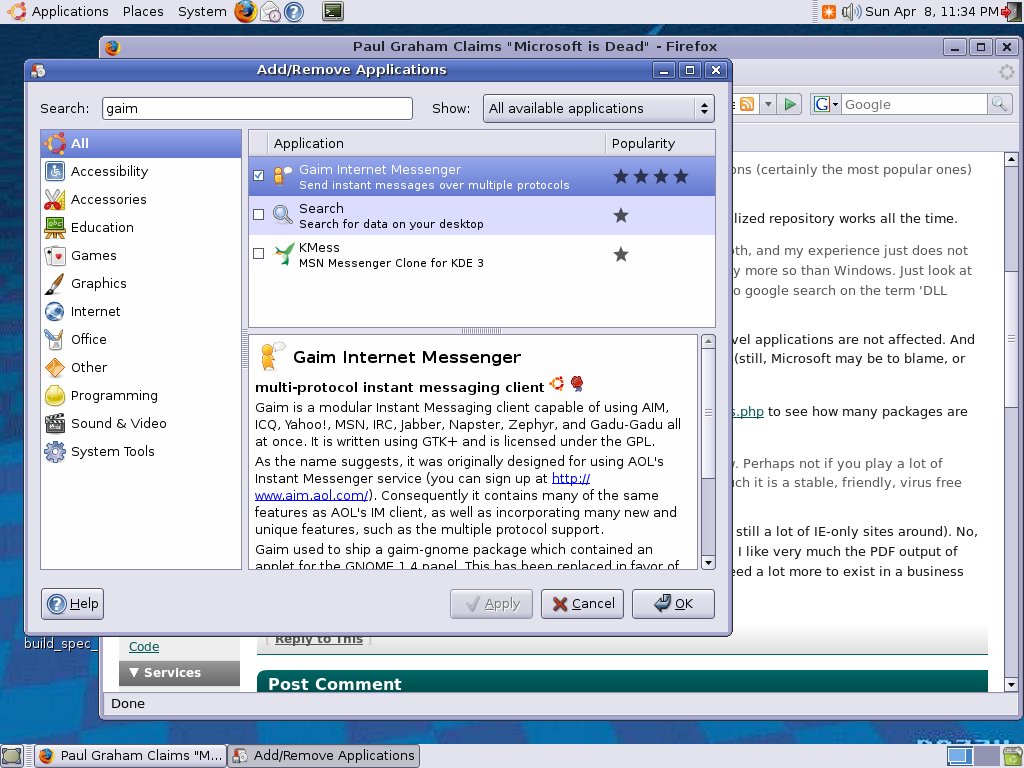
This is a really great example of the misconceptions many still have about Linux... the perception that installing software is a geeky struggle with downloading, configuring, compiling, etc. This is not necessary for most apps, certainly not after they reach the level of polish and popularity as Gaim. Want to know how I would install Gaim? Take a look at this screenshot to see how easy it is to install Gaim on Ubuntu with just a few mouse clicks. And once it is installed, it will be automatically upgraded and kept up to date until I remove it from the system.
Maybe maybe. However, there is some doubt even on surfing (there are still a lot of IE-only sites around). No, I can tell you clearly that OOo is not as good as Microsoft Office, though I like very much the PDF output of OOo--even that is not for technical reasons, I believe. And you would need a lot more to exist in a business environment, which is the biggest source of Windows sales....
I've been surfing exclusively with Firefox and using OpenOffice for home and business use for several years now with no troubles, so obviously mileage can vary. I recommend even my Windows using friends avoid IE in favor of Firefox for security reasons if nothing else. If you are a real power MS Office user and must trade those sophisticated documents with other MS Office users, then certainly you should stick with Windows; but I've found that most people don't push Office that hard and can get by with OpenOffice just fine. Heck, many home users don't even have Office. I would certainly encourage anyone needing an office suite try OpenOffice before shelling out money for MS Office. -
Re:It's not dead yet
What is the business to do with Ubuntu? Does Ubuntu carry all the Linux applications on the planet?
Very nearly so. Via apt repositories, most refined and stable applications (certainly the most popular ones) are available with a click.
While I appreciate much the work done in Ubuntu, I do not think a centralized repository works all the time.
I've been using both Windows and Linux almost since the origins of both, and my experience just does not match yours. The Linux API and ABI have remained very stable, usually more so than Windows. Just look at how much Vista breaks backwards compatibility to see what I mean. Do google search on the term 'DLL hell' for earlier examples.
I do not want to argue with you that Vista is bad. However, most user-level applications are not affected. And I do not think 'DLL hell' is inherently a problem of Windows architecture (still, Microsoft may be to blame, or the other producers of DLLs).
On the other hand, have a look at http://gaim.sourceforge.net/downloads.php to see how many packages are there for x86 Linus! That is what I think as bad as hell.
For a great many people, it is a better option than what they have now. Perhaps not if you play a lot of games, but certainly for Internet surfing and office productivity and such it is a stable, friendly, virus free alternative.
Maybe maybe. However, there is some doubt even on surfing (there are still a lot of IE-only sites around). No, I can tell you clearly that OOo is not as good as Microsoft Office, though I like very much the PDF output of OOo—even that is not for technical reasons, I believe. And you would need a lot more to exist in a business environment, which is the biggest source of Windows sales....