Slashdot Mirror
Domain: space.com
Stories and comments across the archive that link to space.com.
Comments · 2,905
-
Re:Three things.
It would be worth getting Space-X's estimate for the goal though.
Elon Musk, speaking for SpaceX, has already published his estimates. He's been spending $20-$30 million per year on it since 2016 (he's cagey about the exact figure) and he anticipates ramping that up to $300 million per year beginning in early 2019, because he expects development of Falcon 9 and Falcon Heavy to be complete. At that spending rate, he anticipates landing an unmanned ITS spaceship on Mars within the next 10 years, a spaceship so large that the crewed version is expected to have a crew capacity in excess of 100 people. As the Anonymous Coward said, he thinks he will be investing $10 billion towards establishing a Mars colony. Not a footprints and flags mission for Donald Trump, but a self-sustaining colony.
$10 billion in one year does indeed require government money, and yes, at current spending rates globally, it would take a fair-sized chunk of the space budgets of multiple countries to do that without severe disruption to their existing programs. But $10 billion over 30 years is feasible for a single private individual named Elon Musk, regardless of what the governments of the world do. As he said in that announcement, he thinks that the world's governments will ride his coattails to Mars, rather than spending billions of their own to try to get there first (SLS notwithstanding).
However, dumping $10 billion per year onto SpaceX will not reduce the time to Mars colonization to one year from thirty. As with any complex and difficult endeavor, adding money doesn't necessarily make it possible to go much faster. Nine women can not deliver a baby in one month. If nothing else, development of a Mars mission is constrained by the fact that the launch window for a reasonable orbit is available only every 26 months. Even vast amounts of money can only widen that launch window so far before physical constraints start to get in the way. Given the need to test stuff, rather than to just chuck people into the void in untested equipment, it's just barely possible to get people to Mars while Trump is in a second term, if he gets one, and that's with only two test launches. It isn't possible in his first term. The next launch window is in early 2018. SpaceX will be sending an unmanned Dragon capsule to Mars using a Falcon Heavy launch at that time, to test stuff. Developing the entire ITS system between now and then isn't possible no matter how much money you have. The people who know how simply aren't available.
-
Re:Of course he's serious
The problem would be manufacturing and testing. Which is where the money comes in. The next decent Mars launch window is in April of 2018, then there's another in July of 2020. So you make a metric fuckton of rockets for 2018 and mount your payloads and shoot 'em off, then you follow up with humans a couple of years later.
Money. LOTS of money. Ludicrous amounts of money. But it would make a difference, and it could be done.
As it happens, there is someone who has ludicrous amounts of money. He owns a major share of an electric car company that is valued more highly than GM. And he has publicly stated that he plans to hit the 2018 launch window, sending an uncrewed Dragon capsule using the Falcon Heavy launcher, entirely on his own dime. He's currently spending somewhere in the neighborhood of $20-$30 million per year on the ITS project, and that first capsule is part of the project. He's hoping to hit Mars on the first try, something many other organizations have failed to do. He's also hoping his engineers don't confuse Imperial and metric units...
But even Elon Musk at his most optimistic doesn't think the first ITS spacecraft will arrive on Mars in much less than a decade, and that's even after he starts spending $300 million per year on the project starting in early 2019. If Donald Trump pulls off the statistical fluke twice, it's just barely possible he'll still be in office when the first ITS lands on Mars with people on board. Just barely.
-
Re:Reckless Endagerment
Because they're still doing it.
Who are "they" and "what" are they doing?
It's clearly not working as a deterrent.
No one — in the 60+ years history of humanity's space-exploration so far — has been injured by space debris. Either it is not really a significant threat or something is working as a deterrent.
-
Re:Reckless Endagerment
I don't need to give citations for claims I never made. I said absolutely nothing whatsoever about government space disasters
There are no other options: space exploration will be done either by the evil KKKapitali$t$ or by the omni-scient and benevolent government workers.
Earlier in this thread it was alleged, that the former will not pay attention to the dangers of the space-junk injuring folks on the ground because, as Wootery wrote, it will not be the (reckless) capitalist, that will bear the costs of the injury. I countered that pointing out, that the origin of space-junk will be very easy to trace back to the original capitalist, which would allow to prosecute same for reckless endangerment.
To that you replied, that "CEOs are never prosecuted" and that "there is no justice for the rich" — or, if they are prosecuted, they never get the sort of punishment you'd get for the same crime. Even if we stipulate your Che Guevarra-like allegations, you still need to show, that the alternative — government-administered space exploration — ensures more accountability (as well as cost-efficiency, etc.) For that, as a minimum, you need to cite examples of government officials getting punished for their share of disasters. Still waiting...
ZERO cases where a government space craft has caused harm to a civilian not attached to the project
And why do you exclude people attached to the project — it makes no sense... But, hey, it is nice to finally see you trying to explain lack of prosecution by lack of crimes — in your rantings against the CEOs you obviously imply, they commit just as many crimes, but just aren't prosecuted as well.
Anyway, space junk is not actually a big problem back here on Earth — not yet, anyway. So, I'll expand my request for citations — can you name 3 government officials charged in relation to negligence, recklessness, or abuse of power in anything they've been involved in the course of their duties? All I can recall are cases of "early retirement"...
the history of capitalism has been to maximize externalities
Sure! As one would say, it "makes them smart". But the only alternative is it being by done government, which is even harder to punish (in addition to being horribly inefficient in everything they touch).
-
Re:Having more stuff in space = more stuff to hit
O'rly
http://www.space.com/27128-dar...
There you go satellites that repair other satellites go figure.
Obligatory " I for one welcome our orbiting robotic overlords"
-
Re:I thought Trump was supposed to take care of th
Don't blame Trump. Boeing has had some problems with quality recently.
In 2005, FIA (run by Boeing) was partly canceled. The New York Times called it "perhaps the most spectacular and expensive failure in the 50-year history of American spy satellite projects." From space.com, "But Boeing quickly ran into troubles on the highly ambitious and complex FIA program, which fell years behind schedule and overran its budget by billions of dollars."
In 2011, the SBI Net program was canceled. "It was originally envisioned to stretch the 1,969-mile border between the U.S. and Mexico but initial phases of the $1 billion project took longer than anticipated to complete and covered just a small portion, 53 miles, since the project began."
According to Wikipedia, the Joint Tactical Radio System (JRTS) project has had major problems. "The JTRS program was beset by delays and cost overruns, particularly Ground Mobile Radios (GMR), run by Boeing."
The Dreamliner had major problems, including fires. From Wikipedia, "The FAA issued a directive in January 2013 that grounded all 787s in the US and other civil aviation authorities followed suit. After Boeing completed tests on a revised battery design, the FAA approved the revised design and lifted the grounding in April 2013; the 787 returned to passenger service later that month."
This usatoday article, titled "Some of Boeing's programs have problems", lists other problems with Boeing. For example, "V-22 Osprey. The tilt-rotor aircraft, made in partnership with Bell Helicopter, is under congressional scrutiny because of concerns about its high cost of operation, reliability and safety." and "Joint Tactical Radio System Cluster 1. Boeing's management of the project for the military was so bad it received a stop-work order from the Defense Department. Eventually, the program was restructured rather than canceled but with Boeing in a diminished role."
I wonder if some managers are looking at these problems, and deciding that Boeing isn't the best company from which to order planes and services. That would hurt Boeing's sales.
-
Re:So...
Already happened on Iapetus.
-
Re:Is Hawking up for the rigors of spaceflight?
You are acting like you know what the profile is and just aren't telling us. I'm guessing in reality you have no idea.
FWIW, according to this article SpaceShipTwo riders will experience 3Gs on takeoff and 6Gs on decent.
As a reference point, SpaceShipOne riders experienced about ~5G of deceleration when it re-entered the atmosphere...
-
Re:Is Hawking up for the rigors of spaceflight?
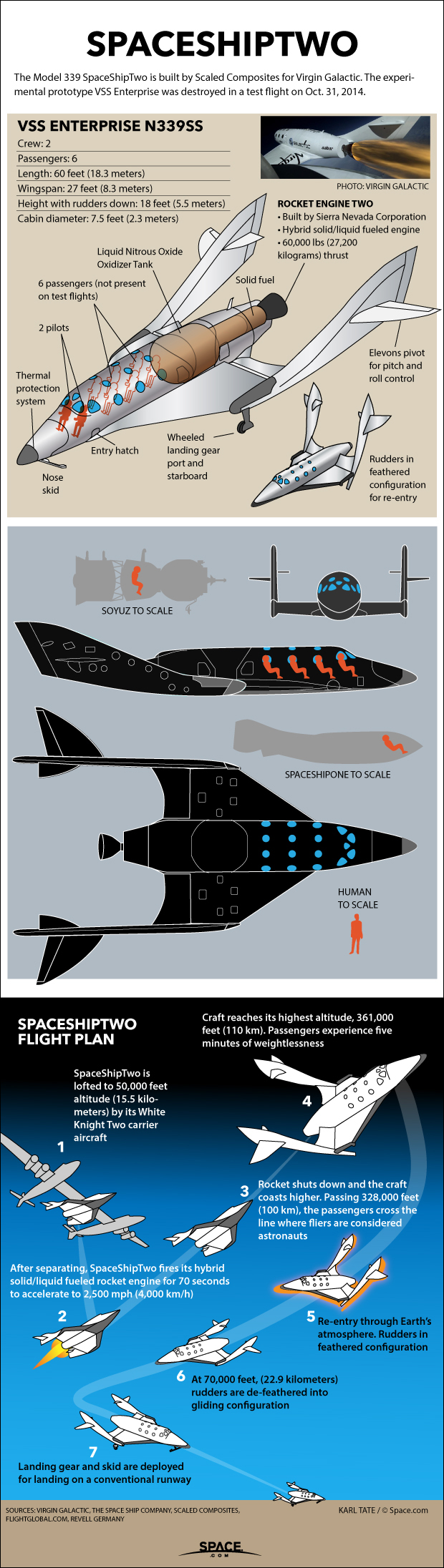
I don't think Virgin Galactic's flight plan involves nearly the kind of g forces one experiences on a rocket. It's basically a plane that goes really really high. Take a look at the flight plan for SpaceShipTwo, which was the previous generation.. (The image came from here)
I really don't know what I'm talking about, so this might be TOTALLY wrong, but: It says it accelerates to 2500mph over 70 seconds. 2500mph divided by 70 seconds, in meters per second, is about 1.5Gs.
-
Re:Is Hawking up for the rigors of spaceflight?
I don't think Virgin Galactic's flight plan involves nearly the kind of g forces one experiences on a rocket. It's basically a plane that goes really really high. Take a look at the flight plan for SpaceShipTwo, which was the previous generation.. (The image came from here)
I really don't know what I'm talking about, so this might be TOTALLY wrong, but: It says it accelerates to 2500mph over 70 seconds. 2500mph divided by 70 seconds, in meters per second, is about 1.5Gs.
-
Re:we can't even be bothered to get that right....
This is what they are trying to do, according to the quote from this space.com article:
"This would be a long loop around the moon It would skim the surface of the moon, go quite a bit further out into deep space and then loop back to Earth," Musk said during the teleconference. "So I'm guessing, distance-wise, maybe [300,000] or 400,000 miles [about 500,000 to 650,000 kilometers]."
If they do this, they will go down in the history books as the farthest people from the earth, I can see how a billionaire might be attracted to that.
-
Re:Rockets are too expensive
I have always been a fan of the idea of using a big freaking laser to launch material into space
-
Re:What makes this special?
http://www.space.com/33840-alien-world-proxima-b-around-nearest-star-could-be-earth-like-video.html
https://en.wikipedia.org/wiki/Gliese_581
Need I continue? Is it too much work for you to take an extra 1-3 seconds to google before you make an ignorant statement like that? Actually it seems that most and perhaps even all stars have planets including rocky ones. What this really shows is the variability possible and that rocky planets are probably ubiquitous and can just be assumed to exist in most cases.
One of the most important changes I've seen in my lifetime has been this shift from pessimistically assuming that there were relatively few rocky planets in the galaxy and that many if not most stars lacked them to what we are actually seeing now: that they are in fact almost everywhere we look carefully enough to the point that it might be more useful to search for stars that don't have any rocky planets. There are plenty of systems where we haven't detected any but the absence of evidence is not the evidence of absence. Small rocky planets are very difficult to detect.
When I first saw the 40 ly figure I thought of Zeta Reticulum which Betty Hill and Marjorie Fish made famous in the 60s. Zeta Reticulum may be one of those few systems that don't have any planets at all: not even gas giants.
Another star with some mythology behind it, Sirius (made famous by the Dogons) appears to lack planets, although again it's difficult for us to be sure of that. We have looked though.
-
Re:I think its time we hack space travel.
I'm having a very hard time seeing how a spacecraft could NOT contain an immense amount of patented tech.
Patents expire and the devil is in the details. If your only criteria is reaching another star, eventually, well heck that mission has been done with 1970s technology, although -- spoiler alert! -- it's not scheduled for the rendesvous for another 40,000 years:
http://www.space.com/22783-voy...
My suspicion is if you were willing to travel slow enough (or endure some time debt by accelerating and decelerating slowly to the speed of light), you'd have no problems getting to another star, patent free, using apollo era technology.
Of course, if you want to build warp drives and solar sails that can be deployed maybe you'll need to license some patents. But only for some years before it becomes public domain.
-
Re: Great idea... But there is a problem...
Delta-V costs are not the only criteria.
The number one limiting factor of any space vehicle is cost per kg at launch. NASA could build a Mars vehicle any size they wanted except they have to figure a way to get it in orbit without spending the entire budget to launch it.
Irrelevant when the number one defining factor of STS is how much pork can be siphoned off to spend into each supporting senator's district and not whether or not it helps the an extremely improbable Mars mission or even just the improbable "planned" moon flyby.
You're the one proposing that it is "easier [to] refuel at the moon" [sic] so the onus is on you to detail how much developing a moon base
I am not proposing. I am relaying what has been proposed.
We're not in junior high here, you can stop trying to play semantic games. You bring the subject to the conversation, you defend it. Knowing that there is hydrogen on the Moon does not mean that it is under the form of water ices nor how accessible it is nor how difficult and expensive harvesting it may be.
sufficient to perform extraction of fuel/oxidizer and the means to transfer them to earth launched vehicles are versus doing so from earth.
No oxidizer is required for electrolysis.
You cannot know that lunar hydrogen is in the form of water ice, have not proven it's accessibility, have not proven that you have worked out the process to develop it as a usable ressource nor proven that you can do so for less than it will cost at that point in time to deliver from earth. Pray do so now.
Don't forget that spending billions to develop a rarely used infrastructure is precisely the point that most critics of NASA have at present...
1) I didn't say it would be easy. I said it would be "easier".
Proof? Nah you don't have proof (indeed you _cannot_ at present) and if this post is any indication you'll try playing semantic games again to attempt to avoid answering.
2) How much fuel is left in a space vehicle after Earth orbit is reached? Very little. There's a reason most space probes use gravity assists to speed them towards their destination. And being unmanned they don't have constraints on time and resources that manned missions will have.
Oooh, ooh I know this one! it's because Nasa, being hobbled by the U.S legislature never invested significantly in lowering the cost of launching mass to orbit, preferring to spend the money on futile studies as the only meaningful yardstick became $$$/district.
3) NASA has been directed to do something; you may not like what they propose but that doesn't mean they can refuse to do it. Get to Mars is directive. For NASA that means getting to the Moon again.
You seem to have been living in a cave with no contact with the exterior for the last few months. Allow me to enlighten you: Nasa's congressional masters and the president have changed. No-one knows exactly what the implications are yet but Trump's declarations that cost cutting is more important than rockets to nowhere means that the directives are to change soon and Mars is not likely to be a directive for much longer.
"Current" NASA plans have a tendency to change with administrations.
Engineering and numbers don't change with administrators. Math is math. What is the cost of launching directly from Earth vs launching from the moon.
Spoken like someone who lives off of studies that will never come to fruition.
-
Re: Great idea... But there is a problem...
$7k/kg by Falcon Heavy pricing. Would you rather a different launch system?
Have you been paying attention? The proposal is not to launch DIRECTLY from Earth. The word you don't seem to understand is DIRECTLY.
Not really. But the problem is your "lowering prices" standards involves having to send things into to an entirely different gravity well (consumables), and landed propulsively, so that other different things can then be launched from said gravity well.
What? The problem is no one has made a vehicle large enough to launch a manned Mars vehicle. No one. It's not about "lowering" standards. It's about practical limits.
Your proposal, absolutely.
False: It's not my proposal. Experts like at MIT say it's the est option.
From Earth, there are no diminishing returns whatsoever. Just the opposite - the more you launch, the cheaper it gets per kg.
Er? Are you insane? There are always diminishing returns. So the ISS was launched at once will all modules intact or was it built over decades? Why was that? Because no one can build a rocket large enough.
One: completely and utterly false. There are a huge number of different proposals for this, all of them technologically feasible.
List one.
Two: your counterproposal involves doing the same for the moon, and then doing constant resupply so that they can build things that require an entire industrial base there. It's an absurdity.
Again, not my proposal
It does not require a huge infrastructure but it does require infrastructure. The alternative is using Earth to refuel at the high cost of LEO orbit costs.
Incorrect, and an absurd statement to make. The "Journey To Mars" program is the core of NASA's focus. (If it wasn't, nobody would ever put MOXIE on Mars 2020.
Do we have a manned space vehicle ready for Mars? It is in the planning stages? By YOUR LOGIC, the mission to Mars doesn't exist either.
-
Re: Great idea... But there is a problem...
Delta-V costs are not the only criteria.
The number one limiting factor of any space vehicle is cost per kg at launch. NASA could build a Mars vehicle any size they wanted except they have to figure a way to get it in orbit without spending the entire budget to launch it.
You're the one proposing that it is "easier [to] refuel at the moon" [sic] so the onus is on you to detail how much developing a moon base
I am not proposing. I am relaying what has been proposed.
sufficient to perform extraction of fuel/oxidizer and the means to transfer them to earth launched vehicles are versus doing so from earth.
No oxidizer is required for electrolysis.
Don't forget that spending billions to develop a rarely used infrastructure is precisely the point that most critics of NASA have at present...
1) I didn't say it would be easy. I said it would be "easier".
2) How much fuel is left in a space vehicle after Earth orbit is reached? Very little. There's a reason most space probes use gravity assists to speed them towards their destination. And being unmanned they don't have constraints on time and resources that manned missions will have.
3) NASA has been directed to do something; you may not like what they propose but that doesn't mean they can refuse to do it. Get to Mars is directive. For NASA that means getting to the Moon again.
"Current" NASA plans have a tendency to change with administrations.
Engineering and numbers don't change with administrators. Math is math. What is the cost of launching directly from Earth vs launching from the moon.
-
Re: Who cares?
"all the water"? "used as fuel"? Um, I think I woke up in a parallel dimension were the insane are running things?
Some of us read up on current space technology.
You do understand that water is composed of hydrogen and oxygen atoms which are currently being used a rocket fuel right?
-
Antropogenic Asteroid Activity (AAA)
I can't help it, but those reports have been increasing in numbers rapidly
Well, obviously, human activity is responsible — do you want me to draw you a hockey-stick diagram?
Just goes to show, how irresponsible some humans (and RethugliKKKan$ in particular) are about our planet...
And it is going to get worse! Then, when the Earth is unlivable, these billionaires will escape to Mars.
-
Please report back on conditions
After your first manned mission to the Earth-like planet Venus:
-
Re:It will be powered by renewable ...
Context! It's currently about 91Mmiles:* "Earth's closest approach to the sun, called perihelion, comes in early January and is about 91 million miles (146 million km)."
* Admittedly, when God created the Sun several GY ago, the distance was probably different, and immaterial. B-)
-
Re:Fixed that for you...
To be useful the probe has to send back some telemetry via radio. Otherwise how do you know it landed? And anyone can receive that telemetry, so you can't really do a sneaky moon landing
Not to feed the conspiracy theorists, but the Lagrange L1 and L2 points lie outside the Earth-Moon system and see the back side of the moon half the time. They are/were occupied by SOHO, WMAP (first link), and Planck. The James Webb Space Telescope is going to be parked at L2 as well.
Theoretically, any of them could be used to relay transmissions from the back side of the moon undetectable from Earth. For that matter, you could turn SOHO around to photograph the back side of the moon if you wanted to. (So could JWST, but it wouldn't have the benefit of sunlight lighting up the half of the moon it sees.) A few missions have been sent into orbit around the moon as well.Say you do somehow land a robotic probe there for no reason at all, how would you conceal it from orbiting satellites that are photographing the surface? We can see the Apollo and Surveyor and various Russian probe landing sites on those photos, taking by various different countries.
Concealing something on the entire surface of the moon is easy. LRO produces the highest resolution images of the moon's entire surface, but the Apollo landing sites still barely show up. We know where to point the camera because we know where the sites are. If we didn't know where, well the moon's surface area is 38 million km^2, so the back side is 19 million km^2. If the lander you're trying to find is 1 square meter, that's like trying to find one special grain of sand 2 mm^2 sitting on top of 38 km^2 of beach. Good luck.
-
A theory I'd love to see tested.
The Arctic ice is melting, the Antarctic ice is growing.
Okay, let's say we have a metal pole, with a top and bottom. It is warmed by a heat source. If the heat source is centrally located, the center will be warm and the ends equally cool.
However, if that heat source is elevated, the upper half of the metal pole will be warmer, and the bottom half cooler. The top of the pole will be significantly warmer than the bottom of the pole.
Presently, our sun has a HUGE hole in the northern hemisphere. "The low density of coronal holes is also responsible for high-speed solar winds. These streams of solar particles blow off the coronal holes about three times faster than they do in higher-density areas of the sun, according to the statement."
http://www.space.com/33047-nas...Why is this significant? Well, we know sunspots correlate to climate temperatures. Less sun spots equal colder periods, more sunspots, correlate to warmer periods.
"Ituitively one may assume the that total solar irradiance would decrease as the number of (optically dark) sunspots increased. However direct satellite measurements of irradiance have shown just the opposite to be the case. This means that more sunspots deliver more energy to the atmosphere, so that global temperatures should rise. "
http://www-das.uwyo.edu/~geert...Okay, so we have a large hole. The hole likely affects the suns gravitational / magnetic forces adjusting the amount of thermal energy released. If so we likely have a thermal gradient in which the higher north you go on the solar plane, the warmer it is. This would explain why the Arctic would be melting and the Antarctic adding ice.
-
Re:Boeing, Sierra Nevada, and SpaceX all delayed.
...there's no chance that Dream Chaser will be ready before the others. Nor will Blue Origin.
well, BO's new shep. capsule will not work for orbital work. As such, they are not in the running on this.
Blue Origin has announced follow-on to the New Shepard spacecraft, the "New Glenn", which will be designed for orbit: http://www.space.com/34034-blu...
However, I think the original poster is correct: New Glenn is not anticipated to be operational on a fast enough schedule for space station crew launch, which needs a vehicle in 2018.
-
Re: no backup
I thought all the space pizza was on Io? http://www.space.com/18272-jup...
-
Re:HAHAHAH
No, that is due to decades old design mistakes being corrected after 2 of the 3 worst US space tragedies (both due to shuttle design defects). The lack of a replacement is the consequence of a changed objective and the moderate success in intentional development of commercial orbit jockeys like SpaceX for whom NASA acted as angel investor and primary customer.
-
Re:not Leland!
I see your cute dog photo and counter with Star Trek uniform on the ISS http://www.space.com/29161-ast...
-
Re:If confirmed, does this make it realistic?
Black holes emitted radiation back in the 19th century. Did you know that?
And did you know that the concept of black holes was first put forth in 1916 with Einstein's GR , in the 20th Century, not the 19th. And the name "Black Hole" wasn't even used to describe them until the 1960's.
http://www.space.com/15421-bla... -
Re:inability to fully recreate production environm
It all depends if you're building software for a web site or a Mars mission. What is the impact of a failure, and is it recoverable?
For the Mars mission:
a) about 186mph
b) no -
Re: And suddenly
Funny though only US has success on the red planet. This is not only Europe's second attempt, but the same bug. In 1999 the computer shut off its thrusters too early too and it crashed it's probe 100 feet in the air.
I forgot the name of the probe for that one.
I'm not certain. The Beagle in 2004 didn't deploy correctly, but otherwise I'm not certain. The Phobos-Grunt didn't make it out of earth gravity in 2011. It is so darn hard to land on Mars. The martian atmosphere is thick enough to make for a lot of heat, but not thick enough to slow you down anywhere near a normal earth type landing. And of course, the distances and reulting delays in communications time were making for around 14 minutes radio time, and 7 minutes of time between atmospheric contact and landing on the surface. So at the time NASA gets word that the lander has contacted the surface, its on the ground. 7 minutes of terror they call it.
Here's a good video, if a little dramatic, of some of the hassles. http://www.space.com/16265-7-m...
Anyhow, its an expensive lesson, but eventually they'll get something good on the ground.
-
Re:Improbability Drive?
Not just the supply ship; it would be a type including the initial colony transport. Perhaps he means to steal it himself at the ribbon-cutting ceremony?
-
Re:Really?
Even in the 60's the moon landings were done by computer. Could a live pilot have executed no, not with the equipment they sent, the fuel use and tolerances for error were far to small.
I believe on Apollo 11 a human had to take over on the landing.
-
Re:Really?
Even in the 60's the moon landings were done by computer. Could a live pilot have executed no, not with the equipment they sent, the fuel use and tolerances for error were far to small.
Nice story. Now here's what really happened: http://www.space.com/26593-apo...
-
Re:It's about time
Should have been done years ago. Better late than never.
-
Re:Carrington Event
Sick AC here - you know, the question we want to know is: WHY NOW?
You're begging the question. As in actually asking a "have you stopped beating your wife" question.
Just because you haven't been paying attention doesn't mean this is something new. Obama's space weather initiatives go all the way back to 2010.
-
Re:Where are all the new stars?
Why didn't we see a few new stars, or a few billion new stars, appear last night?
You didn't look up?
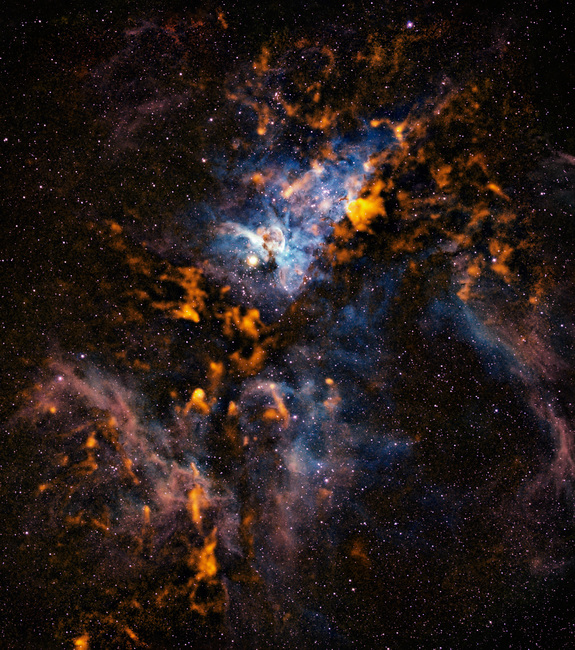
The link below is a 'star nursery' in the Carina Nebula.
http://www.space.com/images/i/...
Astronomers have catalogued many "star nurseries". It's a certainty that there are many, many more beyond our ability to detect if this study has things basically correct.
This shows and labels a newborn star in the Horsehead Nebula.
http://amazingspace.org/news/a...
Just because you don't see bright flashes in the sky every night doesn't mean no stars are being born, they're just usually too incredibly-far away. As another poster who replied pointed out, be thankful they *are* so far away that you don't notice stars being born.
Depending on how close the new star was and when it was born relative to our Earth and Solar system's formation, it could have conceivably prevented the formation of the Solar system as we know it, never mind Earth likely becoming a radiation-blasted, barren, and airless rock if Earth did form first.
Strat
-
Re:Forget Mars...
The moons of Mars are so small that you could jump into orbit because of lack of gravity. So no.
Looks like the current plan is to orbit a space station around Mars and take side trips to the moons.
http://www.space.com/34365-mars-missions-by-nasa-spacex-and-more.html
-
There is water on Mercury!
Mercury lacks water, which is the foremost thing you need, just for oxygen and propellants. Some of the Jovian and Saturnian moons are great, but they are so far away that getting there takes years, also solar power out there is sparse and radiation thick enough to kill you within hours. They are ignored for now with good reason.
http://www.space.com/18687-wat...
[...]
It's time to add Mercury to the list of worlds where you can go ice-skating. Confirming decades of suspicion, a NASA spacecraft has spotted vast deposits of water ice on the planet closest to the sun.
[...] -
Re:radiation is the big stumbling block
This is the quote I read....
"The Mars rover Curiosity has allowed us to finally calculate an average dose over the 180-day journey. It is approximately 300 mSv, the equivalent of 24 CAT scans. In just getting to Mars, an explorer would be exposed to more than 15 times an annual radiation limit for a worker in a nuclear power plant."
Sadly though, when I do the math the 15 times is obviously a mistake, they probably meant that figure for a round trip. I'm sure 50 isn't that big a deal as they would err on the safe side but 300 is not even close. And as I said that's for one way and not counting the stay on Mars itself which also has issues with GCR. I think the issue can be managed but I suspect it'll be 5 decades or more before we're up to anything on that scale. And that assumes we don't manage to blow ourselves up before it happens.
-
Before you do more blabbering...
Obama '08
HOPE! -
Re:Antarctic Bases Different
Actually, it seems even better than that for temperature.
http://www.space.com/17828-mars-weather-curiosity-rover-discovery.html
-
Re:SpaceX cops it in the neck again.
Meh, so long as the facility is back to normal before their return to flight, this might even be good for them. As it stands it's only delaying ULA, increasing the already heavy global backlog on launches and making it harder for customers to bail (It's been a boom period for demand in launches, and providers were already struggling to keep up). The Russians are also suffering delays.
-
Re:Irresponsible
Correct me if I'm wrong but that's kind of fucked up.
Well, you're wrong. So is the summary, so it's not your fault. This rocket was NOT one of the ones that have already been flown. See the submitter's comment. SpaceX has just announced that they've found a partner (SES) to launch a payload (SES-10) on a used booster, whereas this payload was AMOS-6.
And not only that, the payload is attached to this rocket during the first ever static test firing of a reused first stage.
Sorry, also wrong here too. See here for video of their first test-fire (full duration too). That one went significantly better.
-
Re:a very large planet, 15 times the Earth
"I think the IAU really embarrassed themselves with this," said Alan Stern of the Southwest Research Institute in Boulder, Colo. Stern leads NASA's New Horizons mission, which is sending a spacecraft to study Pluto up close. "They created a problem for themselves and for astronomy. It [the definition] created an unworkable algorithm for deciding what's a planet and what's not." [Cosmic Definitions: What Is a Planet?]
Stern particularly objects to the "clearing your neighborhood" criterion.
"In no other branch of science am I familiar with something that absurd," Stern told SPACE.com. "A river is a river, independent of whether there are other rivers nearby. In science, we call things what they are based on their attributes, not what they're next to."
Further, Stern said, the criterion sets different standards for planethood at different distances from the sun. That's because the farther away a planet is from the sun, the bigger it needs to be to clear its zone. If Earth circled the sun in Pluto's orbit, for example, it wouldn't qualify for planethood in the IAU's eyes.
http://www.space.com/12709-plu... -
Re:interstellar mission
we can get there in 20 years with 2 minutes of 100 GW laser blast on a 1g space probe accelerated to 0.2 c. http://www.space.com/32551-bre...
-
Re:And Russians landed on that thing, 10 times
There are clouds in the background, but the pictures focus primarily on the surface of the planet.
-
Re:Radiation is the Deal-Breaker
Outside the Earth's magnetic field, radiation becomes the biggest buzz-kill. It's nasty out there. There's concern that even going to the moon and back exposes you to enough high-energy radiation to cause cardio-vascular disease. Mars could be lethal, not just in getting there, but also after you arrive, because Mars has no magnetosphere strong enough to provide a shield (Earth says, "you're welcome"). Any deep-space research has to solve this problem or manned missions will be a death sentence.
There are lots of deal breakers. Radiation is just one of them. Another is loss of atmosphere. Spaceships leak. The ISS has to get constant resupply of gas because the atmosphere is constantly leaking out into space. They could take more with them as supplies and no doubt will, but that just makes the entire thing heavier and harder to get there. There will have to be some significant work on seals and keeping atmosphere from escaping over the periods of time a Mars mission will take (at least 22 months) before they will be able to go. The process of building something capable of carrying at least four people to Mars will also probably need some improvements and then comes the question of moving it out of orbit and on it's way to Mars which will require some more engineering advances as it's not something we've ever done before. At least we hopefully have the living in zero-G thing worked out with study on various space stations. Still, the ISS is the most expensive human project ever, and a Mars trip will be looking at building an even higher tech one of those and then moving it out of orbit to Mats where there will be landers and then return to the station and Earth. There will be countless deal breakers out there and nobody is even really considering putting forth the money to get them done any time soon.
-
Radiation is the Deal-Breaker
Outside the Earth's magnetic field, radiation becomes the biggest buzz-kill. It's nasty out there. There's concern that even going to the moon and back exposes you to enough high-energy radiation to cause cardio-vascular disease. Mars could be lethal, not just in getting there, but also after you arrive, because Mars has no magnetosphere strong enough to provide a shield (Earth says, "you're welcome"). Any deep-space research has to solve this problem or manned missions will be a death sentence.
-
Re:Must be hiding
Maps of the distribution of dark matter have been produced using weak gravitational lensing, e.g. in the COSMOS survey.
http://www.spacetelescope.org/news/heic0701/
http://www.astro.caltech.edu/~rjm/cosmos/
http://www.space.com/14176-dark-matter-biggest-map-unveiled.html -
Re:String theory is just that: a theory
This means, if you weight 70 kg, your body contains about 34 trillion electron-volts of dark matter (or 6*10^-20 grams).
Only if it's uniformly distributed. If dark matter is black holes, then no. http://www.space.com/33122-dar...