Slashdot Mirror
Domain: space.com
Stories and comments across the archive that link to space.com.
Comments · 2,905
-
Re:Is this just one group stating their opinion?
Large oceans of liquid water under an atmosphere with CO2 tend to form large deposits of carbonate minerals. In other words, we should find wide areas of carbonate rock, especially at low elevations. No carbonate rocks were found, only carbonate signatures in soil. What's news is that the Arizona team spent 6 years using the thermal emission spectrometer to look for carbonates, and didn't find thick layers of it. Other (better) articles on the same news release can be found here or here.
-
Practical, useful, feasible...
and very timely:
Getting power from the moon.
More details at Space.com. -
Re:Moon bases are dumb.russions
analagy
*Russians
*analogy
Just had to switch the 'o' and the 'a'.
Actually, the moon has been found to be a great source of Helium-3, an isotope that would be used in fusion reactors if we had any.
From the linked article:- "Helium 3 fusion energy may be the key to future space exploration and settlement," said Gerald Kulcinski, Director of the Fusion Technology Institute (FTI) at the University of Wisconsin at Madison.
And:
- Scientists estimate there are about 1 million tons of helium 3 on the moon, enough to power the world for thousands of years. The equivalent of a single space shuttle load or roughly 25 tons could supply the entire United States' energy needs for a year, according to Apollo17 astronaut and FTI researcher Harrison Schmitt.
-
Re:...America's attempt to put a man on the moon
Funnily enough, I found/read This article today which gives examples showing humans did go to the moon.
-
The power station IS the rocket.Surprised nobody has commented in this, how convenient for people to be fighting about how many rads per year you get at the surface of Mars.
It seems extremely conservative to me that Russia would take 30 years to get to Mars, especially considering their stated plan is to build a reactor - they'll get to Mars faster if the reactor is in fact what gets them to Mars in the first place.
The U.S. has had a working nuclear rocket engine for forty years, according to a PDF on the ROVER/Nerva project off this page. These are relatively simple engines which shoot hydrogen out the back.
Of course the reference to "already built" is bizarre, who cares if it is already built if they are going to take 30 years to do it? No reason to mention that unless maybe they are talking about tested submarine reactors.
Of course the U.S. has a deal according to this March 2003 article to get Russian nuclear rocket fuels for the nuclear rocket program of Project Prometheus through 2009.
This pdf says that using the NERVA rockets of the 1970s we could get to the moon in a day, or to Mars in 4 months. The article by a Los Alamos researcher is interesting as it talks about the social problems versus technical problems. In all it seems that the nuclear rocket costs half as much, is twice as powerful, and is safe (at least from this paper it seems that reactor core products stay in the reactor). Also from about page 21 there is an interesting section on radiation and human exploration.
It talks about using a gas core nuclear rocket (GCNR) in which we are talking about how to shield crew from radiation in flight, not on the ground, but that this will mean we can get to and from Mars in much less than NASA's planned (1998) mission of 3 years. With a specific impulse of over 3000 seconds, a GCNR ship can have a 3 month transit to Mars, 2 months on the planet, and 4 months back - thus reducing psychological stress factors by keeping the mission to 6-7 months' duration.
There is also the physical deterioration from a long flight.. Apparently the current U.S.-Russia program is aiming for even better, perhaps 2 months each way using small reactors for an unlimited fuel supply and three times better propulsion.
More info:
link
link
link
pro-nuclear space space group with more information -
Mars in opposition could be partly to blame?
Or is it because of mars in opposition?. Nonsense!!
-
More than Perseids... Mars too!
Actually, more than just the Perseids shower is going on these days. On the 27 of this month, Mars will be closer to our planet than it's been in nearly 60,000 years (read more here)
-
Re:I always wondered...
I'm not sure exactly how they plan to fix the spectrometer but I'm sure they're not lying when they say it's an option. Remember the Galileo space probe was recently fixed from hundreds of millions of miles away. Since a Mossbauer spectrometer uses a moving radioactive source to take a spectrum I would guess it might be put through it's paces several times to try to work out a glitch(speculation). The Japanese Mars probe with a failing circuit breaker is currently undergoing repairs to fix it remotely too.
-
NASA Pr0n?
-
Re:Dark matter vs. our matter
Well here's one possibility. If that's possible, anything is.
-
Re:Why does the rate of expansion change?
If the rate was slowing, yes. As it appears the rate is accelerating, we need something else.
Yes, we need dark energy. The question is what dark energy is, if it's somehow connected to "dark matter", the superstring theory or whatever, or if it even exist.
Anyway, some scientists consider dark energy to be generating the force that acts as an inverse gravity, pulling the universe into void (as we know it now).
I guess I'm going to post a question regarding this. -
Re:24 Competitors, eh?
There is this Hungarian company that wants to enter but was rejected. Not very surprising since they intend to use "a zero point field energy/superconductor-based propulsion system"... They are European but I bet they were not in your 5 or 6
-
Re:Death of the X-PrizeSeriously, though, once one group has succeeded, what is the immediate benefit to other groups who may succeed afterwards? No $$ usually leads to seriously reduced efforts.
The X Prize Foundation has thought of that. The are working to set up a "racing" event for passenger-carrying spaceships, with contenders trying to win categories like fastest turnaround time, highest altitude, and numbers of passengers. They are hoping to get big sponsors that are now active in Formula 1, Indycars, and such.
-
More detailsFor those looking for more formal/detailed articles:
Space.com
abc.net.au
Telescopes-Astronomy.com - lots of details about suitable telescopes etc.As an aside, about an earlier event fromThe Universe Today:
A rare astronomical event will occur in May 1999- Mars will be the closest it ever gets, only 52.8 million miles. In addition, the Red Planet is in opposition, which means its face is completely lit up by the Sun. Amateur astronomers will be able to see normally obscure features like the polar caps and canyons. -
Re:Warning bells.
Those incidents you refer to were all several years ago. Starchaser has definitely improved its reputation since then, for its three recent major accomplishments in the last 24 months have all been positive:
37-ft. Nova rocket blasts off!
Churchill liquid engine test success
Nova II capsule test drop success
The next few months will be very exciting. Starchaser plans to integrate all three of the above accomplishments in one project: the manned launch of the Nova rocket -- outfitted with the new Churchill engines -- carrying the Nova II capsule as payload! -
Re:NoDevelopment cost of Hubble: $2 billion
Cost of one space shuttle launch: $600 millionCost of one Proton launch: $120 million
Note, a payload suitable for lifting the HST needs to be developed, but that shouldn't cost more than $120M. (just keep the union shops away from the contract)
-AD
-
So use low accel thrustersThe Deep Space 1 spacecraft was propelled by a TINY amount of thrust over a long period. Mounting tiny low acceleration thrusters at a few structural strong points would do the job in a few months. Likely can't use the telescope during that time because even that low accel is likely to goof up the gyroscopes that hold it steady. But that is preferable to the alternative
-AD
-
Top 6 Russian Spams
6. Ukrainian farm girls and animals. free web membership
5. Enlarge your putin today!
4. If you order today, you get a free Russian space shuttle
3. Free Vacation in Chechnya, Enlist today!
2. Out of work Russian comedian, will work for food. E-mail yakov@smirnov.com
1. Meet beautiful American wives! -
Re:There is a word for the number...
That's an ip address for every star in the universe! With a few left over to boot.
-
SOHO: Operational or scientific?
The problem with SOHO is, that everyone has grown rather dependent on, what originally was a scientific, not an operational mission. It has now become a single point of failure in the gathering of important space weather forecasting data.
Space.com recently had an article about this. Without the constant stream of SOHO data, "it isn't too far off the mark that our forecasting methodology would revert back to the way it was many years ago," Joseph Kunches Chief, Space Weather Operations at the Space Environment Center told SPACE.com. "So without it for a little while...well, you keep your fingers crossed. You hope the Sun doesn't know," he said. -
In other news...
...the Orbital Space Plane, which was discussed in this article, might not have the problems we thought.
In This Space.com article on Space Shuttle Weather Scrubs, there's a selection of an interview from NASA's deputy administrator:
Gregory also dropped a strong hint in Dayton that the so-called Orbital Space Plane, not targeted for 2008, could be a capsule.
The very name of the program, Gregory cautioned, is not meant to imply that the final design will be a winged vehicle. He also said that the chosen design would stress very mature, well-understood technology.
"You will see things that some will call 'retro'," he said. "But when you delve into its capabilities they will be very sophisticated, utilizing all the latest technologies."
When asked at the end of a presentation here why NASA was preparing to spend $20 billion on a "gold-plated Soyuz," Gregory praised the reliability of the Soyuz, but disavowed the questioner's cost estimate.
"I don't think anyone has settled on a number such as that before," Gregory said.
So yeah. Turns out that NASA seems to understand a winged vehicle might not be the optimal way to go for a quick schedule on existing boosters.
Also, considering that Soyuz is about 7150 Kg, a similar (conceptually) spacecraft could easily be launched on an Atlas IIAS or Atlas III rocket, and considering that these vehicles have a 100% success rate thus far...
Lift numbers:
Atlas IIAS: 8610 Kg to LEO
Atlas IIIA: 8640 Kg to LEO
Atlas IIIB: 10,718 Kg to LEO
If they ended up using an Atlas V or Delta 4 EELV, they could get away with significantly more payload as well... but on a very new launch platform. Delta 4's can carry from 8600 to 24000+ Kg per laucnch. Atlas V's can lift from 10300 to 25000 Kg to LEO. -
Damn.
For a moment I thought this article was about how new regulations threaten to ban the sport of model rocketry. It would be good for that issue to get a little more airplay...
-
Accelerated schedule
According to space.com the schedule for the OSP has been changed from 2010 to 2008.
-
Here's the damn thing HTML FormattedI'm posting this under my login, being the karma whore that I am. Next time I won't be so nice!
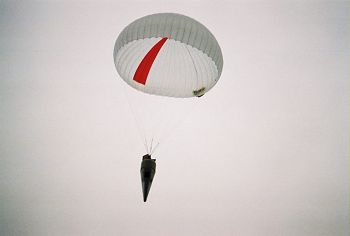
I mean, has Armadillo actually started constructing a rocket that can lift three crew members to 62.1 miles altitude, return safely, and do it again within two weeks??
The short answer is yes, the vehicle is almost done. Here's a picture of it parachuting to the ground during a recent drop test on July 5th.For more pictures of the vehicle, go here. For an article about the drop test, go here.
But I must note that Scaled Composites will probably fly their vehicle to suborbital altitute before Armadillo does. John Carmack, leader of the Armadillo Aerospace team, posted some comments about his progress and schedule.
I believe that the Starchaser team are well-advanced on constructing the Thunderbird rocket that will attempt to win the prize late this year
Actually, Starchaser's current schedule calls for the Thunderbird launch in late 2004. What you are probably referring to is the Nova rocket, which will be launched this year to a height of 30,000 feet, carrying one man. Check out. -
Re:XPrize idea
The Israelis appear to be examining that approach also.
-
Re:Heavy elements
Surak wrote:
'Almost certainly'? I love how astrophysists base their hypotheses on theories that are so far from being conclusively proven that it's ridiculous.
Such is science, all science.
There is no such animal in science as a theory that has been "conclusively proven". You want conclusive proofs, guarantees of truth and falsehood, go to mathematics (and steer clear of fundamental Set Theory while you're there)
First off, how do we know that the Universe is 13 billion years (or whatever?) We don't.
You're right, we don't. What we have is some evidence that the universe is 13-14 billion years old, and some evidence that it's older (and some that it's younger). The "true" age will
The scientific method, honest science, doesn't strive for "truth", it strives for a framework of prediction that becomes more and more accurate and useful as scientists work on them. For example, Newton's theory of accelleration (F=ma) has been disproven, we know it's incorrect, but we still find use in it; Einstein's accelleration theories is more precise, particularly at high speeds and near dense objects. As far as I know, Einstein's theories haven't been disproven, but I'd bet they will be before the end of this century.
If the Universe's existence *is* finite, what was there before the Universe? How did the Universe form? "Big bang"? And this happened how? Remember, there was no Universe, so there was nothing to make a big bang!
There are many ideas about this (what, you thought cosmologists forgot this question?) One popular one is that there's a big bang, the universe expands, runs out of steam, starts contracting, collapses in a "big crunch" which then becomes the next big bang. Another is that quantum fluctuations are capable of creating new universes.
The trouble is, assuming there was a big bang, anything that came before it is currently unverifiable, which means that any ideas about it are difficult or impossible to form a falsifiable hypothesis about it. Unless you have a falsifiable hypothesis to study, you're not doing science. So anything prior to the big bang is currently not subject to scientific analysis, and is therefore just interesting speculation.
It's all predicated on silly little assumptions that are based on no credible, reliable information. Just assumptions on top of assumptions.
No, it's predicated on little assumptions that are based on the best observation and analysis we currently have available. You follow these assumptions back far enough, and you find reach assumptions like "the fundamental laws of nature don't change over time" and "we can make useful observations of reality". While these are assumptions, and they really can't be proven, I think you will find them axioms that are hard to live without.
And then purported to be 'fact'.
A good, honest scientist will never purport anything to be fact beyond "When I did X, I observed Y". Note, this doesn't stop the media from attributing all sorts of "facts" to the scientist erroneously.
That's the problem with much of the scientific community -- too closed-minded.
You are the one sounding closed minded here, by scoffing about scientific theories you clearly don't understand.
My problem with the scientific community is that far too few of its members are the good, honest scientists that I described above, and far too many are administrators, or dishonest scientists more concerned with protecting their jobs and/or ego investments in their theories than keeping the body of understanding growing.
Science is not closed minded, but yes, too often the scientific community can be. We need more scientists in the scientific community. -
Re:Detecting planets.First, towards 2010 those searches using radial velocity variations (i.e. 'gravitational pull', 'wobble') will become sensitive to Jupiter-like planets (planets detected so far are typically more massive than Jupiter, and closer to their parent star), thus planetary systems like ours will become detectable (Jupiter has a 12-year orbit, thus the main problem is the long time baseline required).
Second, there are several projects planned, like the 'Darwin' project of the European Space Agency (ESA) that will specifically target earth-like planets. Here is a short description of Darwin, and links to some other projects.
-
Free Energy =
Free Energy = Laser wars
A New Laser For War And Peace -
Shuttle Atlantis had a breech 3 years earlierSpace.com just posted an article written by an AP reporter saying that Atlantis had a breech 3 years before the Columbia accident.
The breech on Atlantis was attributed to something other than a foam impact though.
The story can be found here. About 2/3 of the way down is where it discusses the cause of the Atlantis incident.
-
Not much in that article
Besides, didn't they run a similar simulation something like a month ago? Is this just really old news of the same test, or a new test entirely?
Perhaps a more interesting article is the following from space.com.
Top Ten: Questions and Answers About the Columbia Board Report
The entire article is a good read, but I found this particularly interesting:
First, the external tank was designed with a layer of insulation foam that isn't supposed to shed during launch. It was designed to stick to the tank, so if it's not sticking then something isn't working the way it's supposed to be.
Second, the shuttle's heatshield of tiles, RCC panels and thermal blankets were not designed to be damaged in any way for any reason. That's why the orbiter isn't allowed to fly through rain, stay outside when it hails or risk having workers drop tools on it. The tiles are especially fragile.
But for some reason, when foam fell off at launch and damaged tiles, NASA managers didn't seem alarmed. When the shuttle came back and there wasn't significant damage, managers convinced themselves there was no safety of flight issue. After 112 flights in which foam shed 70 times and tiles came back damaged every time, shuttle officials got used to it.
-
Re:The article is wrong
Also, it ignores the other particles emitted from the sun. It's not all just photons.
The article is bogus.
Arg. Too bad I don't have my mod points. I don't see why on Earth that was modded as a troll. Yeah, other particles are emitted from the sun. It's called the solar wind, of course. The massive particles in the solar wind would provide a good proportion of the thrust to a solar sail.
There are some propulsion systems that rely entirely on the solar wind, such as the M2P2, which is an interesting concept, IMO better than a regular solar sail. It is simply a propulsion system that has a -
This is why we need manned missions...
Unless you buy into the notion that all the Mars probe failures were due to xenophobic Martians, we've recently witnessed several examples of unmanned, robotic craft turning into expensive piles of junk for reasons ranging from the sublime (legs bounced harder than expected) to the ridiculous (meters? feet? what's the difference?).
Contrast those catastrophic failures with events on human-occupied craft. Fires and collisions on Mir, and of course Apollo 13 for those who get their science from the local multiplex -- yet the craft kept flying, due to human involvement and ingenuity. The conclusion is clear: the more complex the system, the more likely you need a non-silicon-based intelligence to keep it from self-destructing.
To address the issue at hand: NASA wants to send a nuclear-powered spaceship to Jupiter? Cool, but you'd darned well better include a crew compartment, unless you *want* to see what happens during a space-based meltdown.
The bottom line is that there is no way to predict everything that can go wrong with any complex system. That's why we need more manned missions. Spend less money on absolutely "perfect" systems, and more on systems to support a human presence to fix it when it breaks.
After all, Captain Cook explored the south Pacific with nothing more than boats of wood, and men of iron. He also had a whip, and generous quantities of very strong beer... -
This is why we need manned missions...
Unless you buy into the notion that all the Mars probe failures were due to xenophobic Martians, we've recently witnessed several examples of unmanned, robotic craft turning into expensive piles of junk for reasons ranging from the sublime (legs bounced harder than expected) to the ridiculous (meters? feet? what's the difference?).
Contrast those catastrophic failures with events on human-occupied craft. Fires and collisions on Mir, and of course Apollo 13 for those who get their science from the local multiplex -- yet the craft kept flying, due to human involvement and ingenuity. The conclusion is clear: the more complex the system, the more likely you need a non-silicon-based intelligence to keep it from self-destructing.
To address the issue at hand: NASA wants to send a nuclear-powered spaceship to Jupiter? Cool, but you'd darned well better include a crew compartment, unless you *want* to see what happens during a space-based meltdown.
The bottom line is that there is no way to predict everything that can go wrong with any complex system. That's why we need more manned missions. Spend less money on absolutely "perfect" systems, and more on systems to support a human presence to fix it when it breaks.
After all, Captain Cook explored the south Pacific with nothing more than boats of wood, and men of iron. He also had a whip, and generous quantities of very strong beer... -
This is why we need manned missions...
Unless you buy into the notion that all the Mars probe failures were due to xenophobic Martians, we've recently witnessed several examples of unmanned, robotic craft turning into expensive piles of junk for reasons ranging from the sublime (legs bounced harder than expected) to the ridiculous (meters? feet? what's the difference?).
Contrast those catastrophic failures with events on human-occupied craft. Fires and collisions on Mir, and of course Apollo 13 for those who get their science from the local multiplex -- yet the craft kept flying, due to human involvement and ingenuity. The conclusion is clear: the more complex the system, the more likely you need a non-silicon-based intelligence to keep it from self-destructing.
To address the issue at hand: NASA wants to send a nuclear-powered spaceship to Jupiter? Cool, but you'd darned well better include a crew compartment, unless you *want* to see what happens during a space-based meltdown.
The bottom line is that there is no way to predict everything that can go wrong with any complex system. That's why we need more manned missions. Spend less money on absolutely "perfect" systems, and more on systems to support a human presence to fix it when it breaks.
After all, Captain Cook explored the south Pacific with nothing more than boats of wood, and men of iron. He also had a whip, and generous quantities of very strong beer... -
Why bother with giant mirrored sheets?
-
More Coverage
There is a good article at space.com and more details with pictures at the Eurocket site. The Globe and Mail notes that the mission set a record for having 9 payloads and placing 8 satelites in orbit.
-
The Best is Yet to Come
In the next decade we will see the first of a totally new class of orbiting space telescopes - large arrays of sensors spanning many tens of miles across. These will be true orbiting interferometers which will bring amazing optical resolution to "near-earth" explorers.
The ramifications for earth-based planetary exploration are huge. Currently, work is being performed on how to keep such a satellite array in perfect alignment. Low-thrust ion engines and tide-stabilizing configurations are flying as we speak.
NASA has plans to launch the first Space-Based Interferometer in 2009. Taking into account the inevitable schedule slide, we should start seeing some really cool pictures in about 2012. AND, since the array will live relatively close to our "Big Blue Marble," it might also be a reason to keep the ISS and the manned space program in general running for another decade. All it takes is $$$$$$$$$$$$$$$$$$$.
-
Re:A thought or two...
By taking advantage of friction with the air, the Orbiter can slow down, and not be travelling at Mach 20 or so when it lands
Is it friction or ram pressure? -
Re:What the hell is going on at NASA?
I think it's time to reconsider the validity of spending billions on disaster after disaster when so much needs to be taken care of at home.
Ok, let me get this straight. You list some of NASA's failures and ignore all of its successes, and conclude from that analysis that NASA is a big waste of time and money? Hmm...
NASA's budget is 14 GigaUSD per year. Bush's innefectual, for-the-wealthy tax cut is 35 GigaUSD per year. If your true interest is taking care of problems at home like war and famine, you should be attacking the Bush administration, not NASA. -
Re:Does it constitute life? Tough call
Is mars far enough from earth that this would indicate life is probably "all over" the universe, or might that mars life have a common source with our own?
Mars and Earth exchange material all the time from impacts on their surfaces. There are several instances of rocks that came from Mars having been found on Earth and the reverse is most likely true also, that Earth rocks have traveled to Mars. So if there is life on Mars, there is a chance that it came from Earth - or maybe even life on Earth even originated on Mars.
Take a look at this NASA site for more information about Mars-Earth meteorites. Here's a space.com article that describes just how Earth is hit by a Mars meteor about once a month. -
columbia
The last time I heard about weird electical lightning formations was when they were throwing around ideas and someone had a suspiscious picture.
from space.com
While it's not likely Columbia was struck by lightning flying through clear skies some 40 miles high, it is possible that some kind of electrical event took place. At least one image is reported to exist in which it appears something like lightning is striking, or discharging from, the shuttle as it approached the California coast.
Also a little more detail in this article.
I never heard anything else so apparantly they decided that the picture was fake or irrelevant, I guess. I wasn't able to find any more current info. -
Yes, space weather forecasting is a good thing
What do you do, move the Earth out of the way? Put your tinfoil hat on? Why bother forecasting the Sun's weather, not much you can do.
From space.com:
Strong storms can be deadly to spacewalking astronauts. The crew of the International Space Station, while inside, is generally not endangered, but they do have a special protective area they can go to in a severe storm.
And, more importantly for most of us, from msnbc:
Advance warning of impending storms allows satellite operators to reduce the risk of damage to some satellites by shutting down electronics. Engineers anticipate problems in an effort to recover damaged satellites before they are lost. Extra staff can be brought in. Agreements are made to shift signals to other satellites.
-
Re:What is this guy on?
I found a link about this: http://www.space.com/scienceastronomy/helium3_000
6 30.html -
Fission vs. Fusion
He3 is a byproduct of natural fusion in stars, &c. However, many people have speculated that it might be a good fuel for controlled fusion. H3 isn't very good for controlled fusion.
-
Oooh, fireworks pretty....
At least the wreckage will fall where it won't do much damage.
-
Re:Degrading OrbitWhat is kind of sad is that Dr. Robert Forward was one of the originators of the technology but he never got to see his work in space.
Oh, man, I read your post and thought "Robert Forward is dead? I hope he's mistaken about that." Unfortunately, he died last year, and I for one will miss him for his unique style of hard science-fiction and his innovations in physics and space travel. He did a lot of work on tether propulsion systems. Unlike Arthur Clarke, he patented a lot of his inventions. I wonder if the company he set up will see any money from their use, or if he was just a little too far ahead of his time?
-
Tethers... [grumble]Stupid Slashdot![/grumble]
This morning I was typing in a long post on my
Hell I even wrote about listening to Bob Forward (Dr. Forward to you, heh heh) tell me the story of how he found a kilt-making company in Scotland that still had old-fashioned weaving machines which could be modified to create the tethers. In fact I went so far as to link to a eulogy I wrote about Bob when he died. It was a great post! It had everything!
But then
It's like I was never meant to blog it... -
Re:What I don't get...
Agreed, and I'm not sure the other replies understood your point.
As I see it, the other end of the cable is hooked to a bigass weight - at least, that's what the massive, spacecraft-size block looks like in the schematics. Where does that block come from, and how do you boost it even to LEO? Do you mine a passing comet for all that metal?
Spinning the cable I don't think would be the problem - get a weight (spacecraft) attached to the other end and the whole mess will rotate, with the cable ballast dropping its orbit level while the craft is boosted.
Of course, then you have to push the bigass weight back where it was, using probably as much propulsion/fuel/whatever means you used to get it up there in the first place.
Don't see the savings - perhaps the article's at fault or I'm a waterhead. I still like the space elevator better. -
Aldrin not mentioned?
Aldrin has been talking about this for years for a Mars transit system.
No mention of him at all? -
Re:What I don't get...
Well, looking at this image, it looks like once the tether's orbit has begun to deteriorate, it will just keep falling until it burns up/hits Australia. Rather an odd form for a disposable propulsion system, though...