Slashdot Mirror
Domain: space.com
Stories and comments across the archive that link to space.com.
Stories · 1,058
-
Strange Asteroids Baffle Scientists
Raver32 writes to mention that two nearby asteroids may be evidence of a new class of asteroid or long eroded mini-world. Mineral evidence gathered using photometric data shows these asteroids to contain basalt not normally found in asteroid belt objects. "The lack of basalt and another mineral, olivine, in asteroid belt objects has long puzzled scientists. These two minerals would have formed the crust and mantle, respectively, of belt objects the size of Vesta or larger; theory predicts that more than half of all asteroids should be composed of one or the other of these substances" -
Voyager Spacecraft Celebrate 30th Anniversary
Raver32 writes to mention that 30 years after the original launch of Voyager 2, both Voyager spacecraft are still going strong. Flying away from us some billions of miles from our solar system's edge they continue to be a wealth of information more than 25 years after their original mission concluded. Voyager 1 currently is the farthest human-made object at a distance from the sun of about 9.7 billion miles (15.6 billion kilometers). Voyager 2 is about 7.8 billion miles (12.6 billion kilometers). -
Bigelow Aerospace Fast-Tracks Manned Spacecraft
Raver32 writes "Following the successful launch and deployment of two inflatable space modules, on Monday the owner and founder of Bigelow Aerospace announced plans to move ahead with the launch of its first human habitable spacecraft, the Sundancer. The decision to fast-track Sundancer was made in part due to rising launch costs as well as the ability to test some systems on the ground, company CEO Robert Bigelow said in a press statement. 'As anyone associated with the aerospace industry is aware, global launch costs have been rising rapidly over the course of the past few years,' Bigelow is quoted as saying. 'These price hikes have been most acute in Russia due to a number of factors including inflation, previous artificially low launch costs and the falling value of the US dollar.'" -
Largest-Known Planet Befuddles Scientists
langelgjm writes to mention that scientists are quite puzzled over the discovery of the largest planet yet. According to study-leader Georgi Mandushev it should theoretically not even be able to exist. 'Dubbed TrES-4, the planet is about 1.7 times the size of Jupiter and belongs to a small subclass of "puffy" planets that have extremely low densities. The finding will be detailed in an upcoming issue of Astrophysical Journal. [...] "TrES-4 is way bigger than it's supposed to be," Mandushev told Space.com. "For its mass, it should be much smaller. It basically should be about the size of Jupiter and instead it's almost twice as big." "TrES-4 appears to be something of a theoretical problem," said study team member Edward Dunham, also of the Lowell Observatory. "Problems are good, though, since we learn new things by solving them."'" -
Astronomers Witness Whopper Galaxy Collision
Raver32 writes "A major cosmic pileup involving four large galaxies could give rise to one of the largest galaxies the universe has ever known, scientists say. Each of the four galaxies is at least the size of the Milky Way, and each is home to billions of stars. The galaxies will eventually merge into a single, colossal galaxy up to 10 times as massive as our own Milky Way. "When this merger is complete, this will be one of the biggest galaxies in the universe," said study team member Kenneth Rines of the Harvard-Smithsonian Center for Astrophysics. The finding, to be detailed in an upcoming issue of Astrophysical Journal Letters, gives scientists their first real glimpse into a galaxy merger involving multiple big galaxies. "Most of the galaxy mergers we already knew about are like compact cars crashing together," Rines said. "What we have here is like four sand trucks smashing together, flinging sand everywhere."" -
Newfound Planet Has Earth-Like Orbit
Raver32 writes with a link to the Space.com site, and an article discussing an extra-solar planet that looks a lot like ours from a distance. At least, its orbit does. The planet is located about 300 light years away, in the constellation Perseus. It circles its giant red star every 360 days and was discovered by 'looking for wobble', the shift in a star's movement that hints at orbiting planets. "The discovery could help astronomers understand what will happen to our sun's brood of planets when it exhausts its store of hydrogen fuel and its outer envelope begins to swell. When that happens in an estimated 5 billion years, our sun will be so big that it will engulf the inner planets and most likely Earth. But long before that happens, life on our planet will have perished and its seas will have boiled away." -
Public Discussion Opened on Space Solar Power
eldavojohn writes "The National Security Space Office (NSSO), an office of the DoD, has taken a novel approach to a study they are doing on space based solar power. They've opened a public forum for it and are interested in anyone and everyone's expertise, experience and ideas on the best means to harvest energy in space. I suppose this is similar to the DoD's $1 million for an energy pack just without the award. Still, if you want to have an influence on the US's plans in space, this would be an easy armchair place to start. Space.com also has more on the details." -
Top Ten Discoveries of the Mars Rovers
eldavojohn writes "Space.com brings us the top ten discoveries of the Martian rovers that landed there in 2004. They were expected to last three months but, as Slashdot has covered time and time again, they have lasted over three years. From minor discoveries about the formation of Mars to images of atmospheric phenomena, to final and definitive proof of a Mars with water, these two robots have definitely reserved themselves a place in the history books. Pending a dust storm, they may not even be done with their mission yet." -
Northrop Grumman to own Scaled Composites
Dolphinzilla writes "According to Space.com, Northrop Grumman Corporation agreed on July 5 to increase its stake in Burt Rutan's Scaled Composites (designers of Space Ship One, Proteus) from 40 percent to 100 percent. They have purchased the company outright, marking a new future for the space pioneering firm. 'Scaled Composites currently is working with Sir Richard Branson's Virgin Galactic venture on a vehicle designated for now as SpaceShipTwo, which would carry two pilots and six paying passengers into suborbital space for a few minutes of weightlessness. The company also is building a new carrier aircraft, dubbed WhiteKnight2, that will carry SpaceShipTwo to an altitude of 15 kilometers before releasing it to soar to suborbital space. The two companies last year formed a joint venture called the Spaceship Company to build the new vehicles.'" -
The Dusty Concern for the Mission to Mars
eldavojohn writes "Astronauts sent to the red planet may find much of their job involving the task of dusting off their equipment and suits. The president says we're going there but the dusty planet has some obstacles and uncertainties for engineers because we don't have a sample of Martian dust. Is it toxic? Will it conduct electricity and short circuits? Will astronauts suffer from the triboelectric effect? How large is the average grain? Will humans be allergic to it? Will sinuses jeopardize a mission? Will a dust storm stop a take off and return flight? So many uncertainties from something as simple as dust but one thing is clear — we need samples!" -
Mars Rovers Threatened By Dust Storms
mrcgran writes "Space.com is reporting a new potentially deadly weather condition threatening the Mars rovers: 'The first and largest dusty squall has reduced direct sunlight to Mars' surface by nearly 99 percent, an unprecedented threat for the solar-powered rovers. If the storm keeps up and thickens with even more dust, officials fear the rovers' batteries may empty and silence the robotic explorers forever. "This thing has been breaking records the past few days. The sun is 100 times fainter than normal. We're hoping for a big break in the storm soon, but that's just a hope." '" -
Bigelow Aerospace Deploys Genesis 2 Space Module
ThePopeLayton writes "Space.com is reporting that Bigelow Aerospace has successfully launched its Genesis 2 Space Module. This is significant as Bigelow Aerospace is one of a few private groups currently developing space technologies. The module was launched in a compact form and upon achieving a stable orbit will be inflated using compressed air. Bigelow's website is reporting 'the second experimental pathfinder spacecraft has been successfully launched and inserted into orbit.' The module has a variety of things on board: Scorpions, Hissing Cockroaches, Ant colonies, and even a Bingo game." -
X Prize Foundation Announces Lunar Lander Competitors
Raver32 writes to tell us the X Prize Foundation has announced eight of the nine groups planning to compete in this year's Northrop Grumman Lunar Lander Challenge. "The ninth team requested to remain confidential, lending an air of controversy to the announcement. Space bloggers have surmised the ninth team is Amazon.com founder Jeff Bezos' Blue Origin, but sources told SPACE.com that information was wrong. Their confidentiality period ends 60 days before the start of the competition at which time the X Prize Foundation will announce the team's name." -
Scientist Calls Mars a Terraforming Target
Raver32 writes "Mars will be transformed into a shirt-sleeve, habitable world for humanity before century's end, made livable by thawing out the coldish climes of the red planet and altering its now carbon dioxide-rich atmosphere. How best to carry out a fast-paced, decade by decade planetary face lift of Mars — a technique called "terraforming" — has been outlined by Lowell Wood, a noted physicist and recent retiree of the Lawrence Livermore National Laboratory and a long-time Visiting Fellow of the Hoover Institution. Lowell presented his eye-opening Mars manifesto at Flight School, held here June 20-22 at the Aspen Institute, laying out a scientific plan to "experiment on a planet we're not living on."" -
ISS Computer Failure
A number of readers wrote us with news of the computer problems on the International Space Station. Space.com has one of the better writeups on the failure of Russian computers that control the ISS's attitude and some life-support systems. Two out of six computers in a redundant system cannot be rebooted. The space shuttle Atlantis may have its mission extended until the problem is fixed. A NASA spokesman was optimistic that the problem can be resolved; worst-case scenario would be for the shuttle to evacuate everyone onboard the ISS. Engineers are working on the theory (among others) that the failure may have been triggered by new solar panels installed earlier in Atlantis's mission. -
Europe Unveils New Space Plane for Tourist Market
mrminator writes to tell us Space.com is reporting that Europe's largest space contractor, EADS, has just announced their plans to build a new space tourism vehicle. The new rocket, powered by liquid methane and liquid oxygen will carry passengers on a 90 minute round trip flight for somewhere in the neighborhood of 200,000 euros ($267,000). -
Transit Method Reveals Many Extrasolar Planets
eldavojohn writes "You might recall not too long ago the first photo of an extra solar planet or, more recently, the mapping & speculation on these planets that lie outside our own solar system. Long since those first few spotted in the 90s, we're now starting to find them in droves due to the popularity of a method that relies on the planet passing directly between the viewer on earth and the star that it orbits. Be sure to check out Space.com's list of the most interesting extra-solar planets. Will we ever find Earth 2.0 candidates?" -
Transit Method Reveals Many Extrasolar Planets
eldavojohn writes "You might recall not too long ago the first photo of an extra solar planet or, more recently, the mapping & speculation on these planets that lie outside our own solar system. Long since those first few spotted in the 90s, we're now starting to find them in droves due to the popularity of a method that relies on the planet passing directly between the viewer on earth and the star that it orbits. Be sure to check out Space.com's list of the most interesting extra-solar planets. Will we ever find Earth 2.0 candidates?" -
Shuttle Atlantis Launched Without Incident
forkazoo writes "Space.com is reporting the successful launch of the space shuttle Atlantis. There were no major incidents or problems during the launch, except that there was some concern about the weather at the two European abort landing sites. The weather cleared up and the launch was pretty much perfect. 'Preliminary analysis of images taken by onboard cameras revealed expected "popcorning" foam loss during ascent but none that appeared to strike the orbiter. NASA has kept a close watch on the shedding of fuel tank foam insulation during shuttle launches since the 2003 Columbia accident, which claimed the lives of seven astronauts, and made modifications to reduce the amount of debris shed during liftoffs.' The launch was broadcast live NASA TV stream." -
Massive Cave Found on Mars
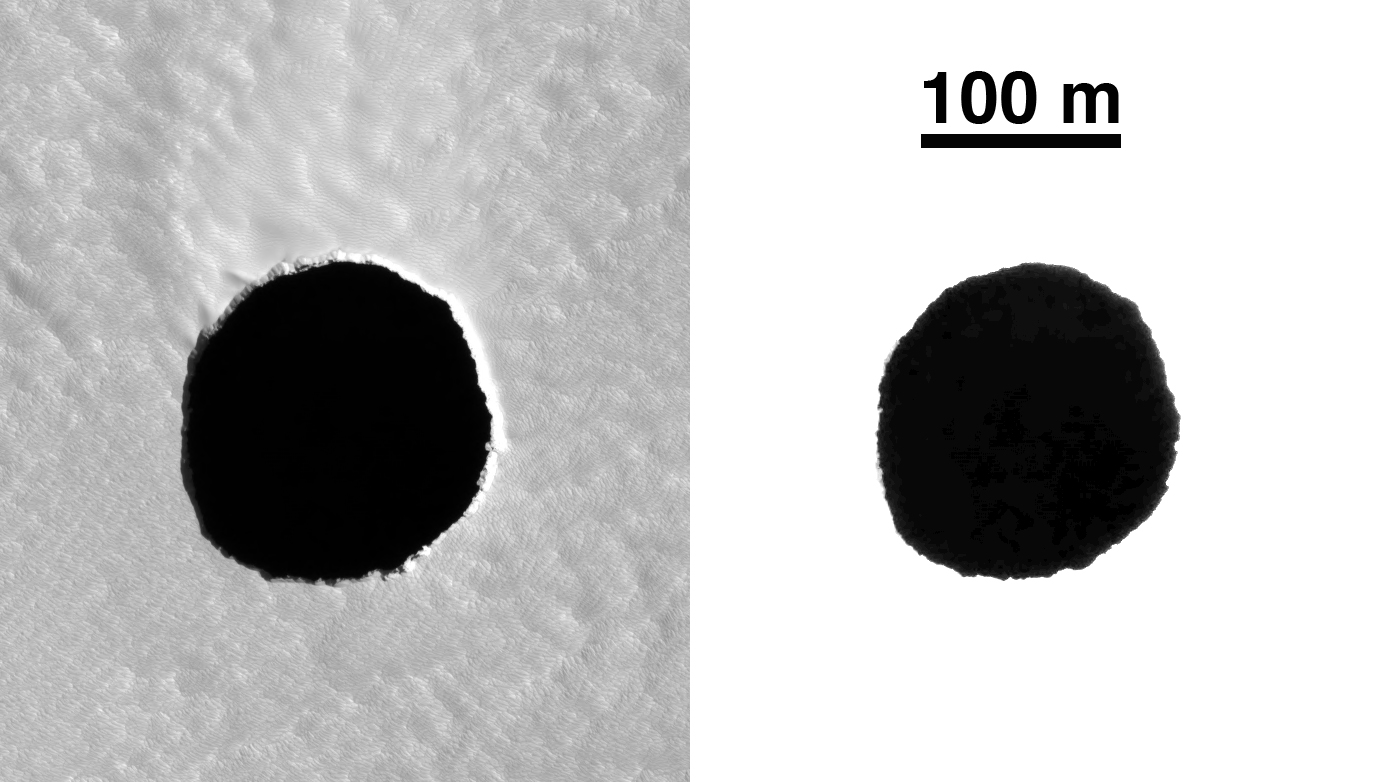
mrcgran writes "Space.com is reporting a very deep hole found on Mars: 'The geological oddity measures some 330 feet (100 meters) across and is located on an otherwise bright dusty lava plain to the northeast of Arsia Mons, one of the four giant Tharsis volcanoes on the red planet. The Mars Reconnaissance Orbiter (MRO) used its High Resolution Imaging Science Experiment (HiRISE) instrument to draw a bead on the apparent deep hole — a feature that may cause more scientists to ponder about potential subsurface biology on Mars. Because the spot lacks a raised rim or tossed out material called ejecta, researchers have ruled out the pit being an impact crater. No walls or other details can be seen inside the hole, and so any possible walls might be perfectly vertical and extremely dark or — more likely — overhanging.' The original image and its cutout at full resolution can be found in the HiRISE site." -
Extrasolar Planet Could Harbor Life
BlueMorpho writes with a link to a Space.com article about a recently discovered extrasolar planet that may be able to harbor 'life as we know it.' Orbiting around the star Gliese 581 is a small rocky ball that might have the same liquid ocean and drifting continent configuration we're familiar with. The find may be unique in all of space exploration as this planet appears to be within a habitable band of temperatures for life, and is categorically not a gas giant. "The bottom line is exciting ...The conditions for life could be there, but is life itself? As yet, there's no way to know unless the planet has spawned beings that are at least as clever as we are. As part of the SETI Institute's Project Phoenix, we twice aimed large antennas in the direction of Gliese 581, hoping to pick up a signal that would bespeak technology ... Neither search turned up a signal." -
NASA Gears Up for the Regolith Rumble
eldavojohn writes "NASA is holding another scientific challenge to see which autonomous robot can move the most regolith in 30 minutes. The finer details: 'To win the cash prizes for NASA's Regolith Challenge, teams must demonstrate fully autonomous robots capable of collecting at least 330 pounds (150 kilograms) of mock Moon dirt within 30 minutes. Whichever robot moves the most regolith over the benchmark limit, while still meeting contest specifications, wins, NASA said. But in order to compete, lunar regolith excavators must weigh less than 88 pounds (40 kilograms) and run on less than 30 kilowatts of power, according to contest rules.'" -
Earth Bacteria May Hitch A Ride To The Stars
An anonymous reader writes "Space.com has an article on how old rocket stages are carrying bacteria from Earth to interstellar space. For example, four upper rocket stages were used to boost deep space probes Voyager 1, Voyager 2, Pioneer 10 and New Horizons. The spacecraft were sterilized, but the rocket stages were not, and they now carry the bacteria of the engineers who handled them. If the rocket stages hit a habitable planet, and the bacteria survive the journey, they would be able to reproduce and colonize the planet ... not that there's a high liklihood of that. 'In 40,000 years, this wayward 185-pound (84 kilogram) lump of metal will pass by the star AC+79 3888 at a distance of 1.64 light-years. ... Given the sheer expanse of time that lies ahead of the four discarded rockets, at least one is likely to eventually encounter a planet. But even if that planet's environment is conducive to life, the long dormant bacteria will not just gently plop into some exotic ocean. No soft landing can be expected.'" -
Winner of NASA Glove Contest Named
eZtaR writes "The winner of NASA's $200k spacesuit glove contest has been found. He's an unemployed aerospace engineer, named Peter Homer, and claims to have bought most of the materials in local shops and on eBay." -
New Theory Links Biodiversity to the Stars
eldavojohn writes "Space.com's Mystery Monday has an article proposing a hypothesis that our solar system's undulations directly affects biodiversity on earth through cosmic-ray exposure. There's data that, through the fossil record, shows us earth's biodiversity peaking again and again until a great cataclysmic period where it is greatly reduced. The theory essentially suggests that this 62 million year cycle can be attributed to how our solar system moves within the milky way galaxy which turns out to be a 64 million year cycle. It's a plausible explanation though very tough to prove, hopefully we don't have to wait around 64 million years to draw a conclusion on this hypothesis." -
New Theory Links Biodiversity to the Stars
eldavojohn writes "Space.com's Mystery Monday has an article proposing a hypothesis that our solar system's undulations directly affects biodiversity on earth through cosmic-ray exposure. There's data that, through the fossil record, shows us earth's biodiversity peaking again and again until a great cataclysmic period where it is greatly reduced. The theory essentially suggests that this 62 million year cycle can be attributed to how our solar system moves within the milky way galaxy which turns out to be a 64 million year cycle. It's a plausible explanation though very tough to prove, hopefully we don't have to wait around 64 million years to draw a conclusion on this hypothesis." -
Black Hole Cluster Spawns Massive Cloud
Shifty Jim writes in with an article at space.com reporting that a cluster of galaxies harboring black holes may be the source of a massive cloud millions of light years across. Quoting: "A giant cloud of superheated gas 6 million light years wide might be formed by the collective sigh of several supermassive black holes, scientists say. The plasma cloud... might be the source of mysterious cosmic rays that permeate our universe... The plasma cloud is located about 300 million light years away near the Coma Cluster and is spread across a vast region of space thought to contain several galaxies with supermassive black holes... embedded at their centers." -
A Symmetrical Cosmic Red Square
Remember the hexagon surrounding Saturn's north pole? Now for our delectation Ano_Nimass Coward sends us to Space.com for a look at a nebula with near perfect bilateral symmetry surrounding a dying star. The so-called Red Square ranks among the most symmetrical objects ever observed by scientists. "If you fold things across the principle diagonal axis, you get an almost perfect reflection symmetry," said the leader of a study of the object, recently published in Science. A possible explanation for the structure's glow, if not its shape, was advanced in a paper appearing in PNAS, which attributes the glow of a similar object — dubbed, confusingly, the Red Rectangle — to exotic space-hardened organic molecules called Polycyclic Aromatic Hydrocarbons. PAHs are normally unstable but may occur in places like the nebula in question, in nanostructured clusters that are extremely stable and radiation hardened. -
A Symmetrical Cosmic Red Square
Remember the hexagon surrounding Saturn's north pole? Now for our delectation Ano_Nimass Coward sends us to Space.com for a look at a nebula with near perfect bilateral symmetry surrounding a dying star. The so-called Red Square ranks among the most symmetrical objects ever observed by scientists. "If you fold things across the principle diagonal axis, you get an almost perfect reflection symmetry," said the leader of a study of the object, recently published in Science. A possible explanation for the structure's glow, if not its shape, was advanced in a paper appearing in PNAS, which attributes the glow of a similar object — dubbed, confusingly, the Red Rectangle — to exotic space-hardened organic molecules called Polycyclic Aromatic Hydrocarbons. PAHs are normally unstable but may occur in places like the nebula in question, in nanostructured clusters that are extremely stable and radiation hardened. -
Water Found in Exoplanet's Atmosphere
anthemaniac writes "Astronomers have long suspected that water should exist in the atmospheres of extrasolar planets. Now they have evidence. Water has been discovered in a planet called HD209458b, which was previously found to have oxygen. From the article: 'The discovery ... means one of the most crucial elements for life as we know it can exist around planets orbiting other stars.' But don't go looking for little green men. You might remember HD209458b as a 'hot Jupiter' that boils under the glow of its very nearby star." -
Water Found in Exoplanet's Atmosphere
anthemaniac writes "Astronomers have long suspected that water should exist in the atmospheres of extrasolar planets. Now they have evidence. Water has been discovered in a planet called HD209458b, which was previously found to have oxygen. From the article: 'The discovery ... means one of the most crucial elements for life as we know it can exist around planets orbiting other stars.' But don't go looking for little green men. You might remember HD209458b as a 'hot Jupiter' that boils under the glow of its very nearby star." -
Large Caves Found on the Surface of Mars
David DelMonte writes "Space.com is reporting on the discovery of seven dark spots near the Equator on Mars. The thinking is that these are cave openings. The openings are the size of football fields, and one of them is thought to extend approximately 400 feet below the surface.'The researchers hope the discovery will lead to more focused spelunking on Mars. "Caves on Mars could become habitats for future explorers or could be the only structures that preserve evidence of past or present microbial life ," said Glenn Cushing of Northern Arizona University, who first spotted the black areas in the photographs.'" -
Tatooine's Double-Sunset a Common Sight
anthemaniac writes "Thirty years ago, Luke Skywalker beheld something that scientists are just now realizing is likely quite common in the universe: double sunsets. Astronomers have long known that binary star systems are common. And models suggested that planets could form in these systems, even though there's a double-tug of gravity on the material that would have to form a planet. Observations from NASA's Spitzer telescope, show that binary systems are just as likely to be surrounded by planet-forming debris disks are are lone stars." -
Spaceport America Takes Off
SeaDour writes "Spaceport America, being built north of Las Cruces, New Mexico, is finally becoming a reality and is set to become the world's first commercial spaceport. Governor Bill Richardson recently secured 33 million dollars from the state legislature for the final design, and a proposed 0.25% sales tax increase in Dona Ana County, where the facility is to be constructed, is expected to bring an additional 6.5 million dollars per year (if approved by voters next week). Richard Branson, the head of upstart Virgin Galactic, on Monday agreed to lease the facility for 27.5 million dollars over twenty years. If all continues to go as planned, SpaceShipTwo will make its first suborbital joy ride in two to three years." -
Astronomers Explode Virtual Supernova
DynaSoar writes "Scientists at the University of Chicago's Center for Astrophysical Thermonuclear Flashes have created a simulation of a white dwarf exploding into a type 1a supernova. Using 700 processors and 58,000 hours, they produced a three second movie showing the initial burst that is thought to be the source of much of the iron in the universe. Understanding these supernovas is also important to testing current cosmological theories regarding dark matter and dark energy, as their brightness is used as a measurement of distance, and discrepancies found in the brightness of very distant supernovas consistently seem to indicate a change in the speed of expansion of the universe over time." -
Enormous Amount of Frozen Water Found on Mars
schweini writes "Space.com is reporting that the Mars Express probe's MARSIS (Mars Advanced Radar for Subsurface and Ionospheric Sounding) experiment has detected and measured an enormous amount of water ice near Mars' south pole, which would be sufficient to submerge the whole planet's surface underneath approximately 10m of water on average." -
Enormous Amount of Frozen Water Found on Mars
schweini writes "Space.com is reporting that the Mars Express probe's MARSIS (Mars Advanced Radar for Subsurface and Ionospheric Sounding) experiment has detected and measured an enormous amount of water ice near Mars' south pole, which would be sufficient to submerge the whole planet's surface underneath approximately 10m of water on average." -
Kuiper Belt Collision Found; Possible Comet Source
siglercm writes "Astronomers have detected the remnants of an ancient collision in the Kuiper Belt, the region of bodies found outside of our solar system. The massive impact between a nearly Pluto-sized body and one half as large created a 'collisional family' of objects; this is the first such family identified in the Kuiper Belt. The largest body produced may cross Neptune's orbit in the distant future, but it's possible that smaller objects created by the smash-up have already fallen into the inner solar system as comets." -
Orbital Express Launches Tonight
airshowfan writes "When a geosynchronous satellite is launched into space, no human ever gets to touch it again. This means that, other than for minor software issues, there is no way to fix it if it breaks, so it has to work perfectly, almost autonomously, for 20 years non-stop. There is also no way to refuel it once it's out of thruster fuel, the reason why it can't last more than 20 years even if it gets to that mark working very well, with batteries and solar cells still going, which is often the case. If only there were a robotic spacecraft in geostationary orbit that could change broken satellite components and refuel those older satellites, then satellites would be a lot less risky and would last a lot longer. Does this robotic spacecraft mechanic sound like science fiction? It launches tonight." -
Milky Way's Black Hole a Gamma Source?
eldavojohn writes "A paper recently accepted for publication (preprint here) proposes a sound explanation for the source of the gamma rays that permeate our galaxy. The Milky Way's central object Sagittarius A*, widely believed to be a supermassive black hole, is now suspected to be the source. To test this theory, two scientists created a computer model to track the protons, flung outward with energies up to 100 TeV by the intense magnetic fields near the event horizon, as they make a random walk through the plasma environment. It can take thousands of years for them to travel 10 light-years from the black hole, where they collide with lower-energy protons to form pions. These decay into gamma radiation emanating from a torus-shaped region around the central object." -
Hubble Telescope's Main Camera Shuts Down
anthemaniac writes "Space.com is reporting that the aging observatory's primary camera, the ACS, has been in safe mode since the weekend. From the article: 'An initial investigation indicates the camera has stopped functioning, and the input power feed to its Side B electronics package has failed.' The camera has shut down before and been revived." -
NASA Commemorates Space Shuttle Tragedies
eldavojohn writes "Space.com is covering NASA's commemoration of the Apollo 1 crew & the last shuttle crews of both the Challenger and Columbia orbiters. The Apollo 1 crew was lost forty years ago yesterday to a fire while testing their spacecraft on a launch pad. From the article: 'While the nearly two decades separating NASA's three space disasters allowed room for the agency to grow complacent, the relatively short time between the 2003 loss of Columbia and the end of the shuttle program could avoid a repeat of such behavior.'" -
The Mystery of Saturn's Atmosphere
eldavojohn writes "Scientists are being forced to rethink theories on why Saturn's upper atmospheric temperature is hotter than can be explained by absorbed sunlight. 'This unexplained "energy crisis" represents a major gap in our understanding of these planets' atmospheres,' the scientists write. 'We need to re-examine our basic assumptions about planetary atmospheres and what causes the observed heating.'" -
NASA to Launch Magnetic Storm Probes
eldavojohn writes "The aurora borealis (also known as the Northern Lights) has long been known to be an effect resulting from the Sun's solar wind pushing particles into the earth's magnetic field and atmosphere. In light of the possible danger that these substorms could pose to astronauts & equipment, NASA is now planning a mission to track down these magnetic storms and disturbances. The program's not so catchy name of Time History of Events and Macroscale Interaction during Substorms has a slightly catchier acronym of THEMIS. From the article, "In order to scan the Earth's magnetic field and pinpoint the origin of substorms, THEMIS researchers plan to stagger their spacecraft in different orbits that range in altitude from 10 to 30 times the radius of the Earth (the planet's radius is about 3,962 miles, or 6,378 kilometers)."" -
Comet McNaught Visible in Broad Daylight
AbsoluteXyro writes "As the amateur astronomers among us already know, Comet McNaught has been gracing the early morning and late evening skies... as it approaches the Sun, some estimate it has the potential to become 40 times brighter than Venus, or a magnitude of -8.8! In fact, it has recently been reported at SpaceWeather.com that Comet McNaught is now visible in broad daylight! From the article: "It's fantastic," reports Wayne Winch of Bishop, California. "I put the sun behind a neighbor's house to block the glare and the comet popped right into view. You can even see the tail."" -
Comet McNaught Visible in Broad Daylight
AbsoluteXyro writes "As the amateur astronomers among us already know, Comet McNaught has been gracing the early morning and late evening skies... as it approaches the Sun, some estimate it has the potential to become 40 times brighter than Venus, or a magnitude of -8.8! In fact, it has recently been reported at SpaceWeather.com that Comet McNaught is now visible in broad daylight! From the article: "It's fantastic," reports Wayne Winch of Bishop, California. "I put the sun behind a neighbor's house to block the glare and the comet popped right into view. You can even see the tail."" -
Pillars of Creation Destroyed
anthemaniac writes with news about the Pillars of Creation, an iconic structure in the Eagle Nebula some 7,000 light-years distant. The Hubble Space Telescope's image of this structure is one of the most widely recognized astronomy images ever captured. Now a new image from NASA's Spitzer Space Telescope suggests that the pillars probably toppled 6,000 years ago. From the article: "Astronomers think [a] supernova's shock wave knocked the pillars down about 6,000 years ago. But because light from that region of the sky takes 7,000 years to reach us, the majestic pillars will appear intact to observers on Earth for another 1,000 years or so.'" -
Pillars of Creation Destroyed
anthemaniac writes with news about the Pillars of Creation, an iconic structure in the Eagle Nebula some 7,000 light-years distant. The Hubble Space Telescope's image of this structure is one of the most widely recognized astronomy images ever captured. Now a new image from NASA's Spitzer Space Telescope suggests that the pillars probably toppled 6,000 years ago. From the article: "Astronomers think [a] supernova's shock wave knocked the pillars down about 6,000 years ago. But because light from that region of the sky takes 7,000 years to reach us, the majestic pillars will appear intact to observers on Earth for another 1,000 years or so.'" -
NASA Will Go Metric On the Moon
An anonymous reader writes "Space.com is reporting that NASA has decided to use the metric system for its new lunar missions. NASA hopes that metrication will allow easier international participation and safer missions. The loss of the Mars Climate Orbiter was blamed on an error converting between English units and metric units. 'When we made the announcement at the meeting, the reps for the other space agencies all gave a little cheer,' said a NASA official." -
Approaching Solar Storm Forces ISS to Take Cover
vichyschwa writes "A Coronal Mass Ejection resulting from an X3 Solar Flare earlier today is forcing the ISS and Shuttle astronauts to take cover and may result in communication disruptions. Last week, the same sunspot generated what astronomers described as a rarely imaged solar tsunami. The activity began with an X9 flare Dec. 5. According to Spaceweather.com, "satellites may experience some glitches and reboots, but astronauts are in no danger." However, the astronauts were ordered to a protective area of the space station as a precaution."