Slashdot Mirror
Domain: stanford.edu
Stories and comments across the archive that link to stanford.edu.
Comments · 4,853
-
Re:Not smart Enough?
In "What does China think", Mark Leonard describes your last idea as currently being tried out in China, especially in the city of Zeguo http://cdd.stanford.edu/polls/china/
Also, china is evaluating other types of democracy, such as inner party democracy, election of lowest (and closest to the people) levels, or consultations (all significant decisions are open to everyone) in Chonqying, a city with over 30 million inhabitants, making it larger than most countries in Europe. Of course, in China with all it's issues of civil rights, there is still a huge amount of influence possible, but I think all of these are fascinating developments. -
Here's a good start
Polhode motion explained: here.
A solid object in space (not necessarily a sphere) has three principal axes of rotation. Call them x, y and z. x is the short axis, which is where the other two axes' energy will redistribute (eventually). The trick is to figure out from observation of fixed points on the surface of the object, where this axis extends from. It is at these two points, commonly known as the North and South Poles, where a grab could be made - at any time. The other two axes don't even have to be stabilised at this point (in fact, the middle axis (y) will always be unstable). The long axis, z, has the smallest moment of inertia hence will eventually spin itself out, the angular momentum distributing (nominally) to the other two axes. Absent outside influences such as friction, this is an inevitability.
A famous example is Earth itself. Some of us are aware it has a primary rotation period about its x axis (the shortest axis, North to South), of 23 hours 56 minutes 4 seconds (relative to a distant fixed point in space). It also has several other minor rotational anomalies, the most important of which being the precession of the Poles, describing a circle 46.8 degrees in diameter over 25,700-odd years.
-
Re:Makes sense
It depends what your goals are as well. In academic releases, I see two main drivers of the choice:
1. BSD/MIT-style if your #1 goal is to get your code used as widely as possible. Maybe you have a strong personal belief that some method should be widely adopted; maybe you hope to benefit from the publicity of saying "as seen in Excel 2015!" about one of your methods; maybe you just consider it not worth putting any restrictions on; or various other reasons. Lots of examples of these.
2. GPL-style if you don't want Excel or Matlab to be able to incorporate your code without negotiating a separate license. This is often chosen when the goal is to do a split commercial/open-source release, with the hopes that Microsoft et al will pay for commercial licenses, while free-software projects are allowed to use the code freely. This is sometimes promoted as an alternative to another license commonly used in academia for that purpose, "free for non-commercial use" (and variants like "free for research/educational use"), which is not a free-software license. An example is the Stanford Parser and related NLP tools.
3. LGPL-style if you have a large enough piece of software to constitute a nontrivial library, and are okay with it being incorporated into major commercial software without a separately negotiated license, but are worried about proprietary extensions not being shared back with the original project. An example is the Waffles machine-learning library.
-
Re:The Atlantic (article) is a joke
OT: I rarely meet someone who cares about it so I thought I'd take the opportunity to ask: What good news sources have you found for Sub-Saharan Africa? I'll dump what I have below in case anyone is interested:
Here's what I know:
* AllAfrica.com: Unfortunately they take the "All" too seriously; far too comprehensive
* BBC: I have to wade through too much trivia to find nuggets of valuable knowledge
* Financial Times (ft.com): Sparse coverage, but the reporting is among the best in the world
* The Economist: Sparse, but excellent analysis
* The East African (theeastafrican.co.ke): Best English reporting I've found from Sub-Saharan Africa, but not enough content to cover the continent.
* Daily Nation (nation.co.ke): Similar to The East African, and I think from the same publisher
* AfricaFocus.org: I don't know much about itAlso, these sites list some options:
http://www-sul.stanford.edu/depts/ssrg/africa/news.html
http://africa.wisc.edu/?page_id=892#AfricaNews -
Re:get over it
Because, funnily enough, important education content like Stanford's machine learning lectures are available exactly via Youtube and torrents: http://see.stanford.edu/see/lecturelist.aspx?coll=348ca38a-3a6d-4052-937d-cb017338d7b1
If you're at Stanford you've presumably paid for and have access to that already. If you're not at Stanford, shouldn't your own university be providing the equivalent material?
The idea of paying to attend a unniversity and then relying on another university's online learning materials seems bizarre. -
Re:get over it
Because, funnily enough, important education content like Stanford's machine learning lectures are available exactly via Youtube and torrents: http://see.stanford.edu/see/lecturelist.aspx?coll=348ca38a-3a6d-4052-937d-cb017338d7b1
-
Re:Unenforceable?
Libertarian principles leave us without roads, police or fire services
Libertarians are not anarchists, sir.
Where there are externalities or public goods (such as police protection), each person may be better off if some of each person's rights are infringed [...] Given the importance of such services, it is arguably permissible to force individuals to provide certain services (in violation of full self-ownership) as long as everyone benefits appropriately.
But, don't let me stop you from being rude and ignorant.
-
Re:Windows 95 vs Windows 7
(yes, I realize you were kidding) Hover is available for download here http://www.stanford.edu/~cammat/HOVER/index.html and here's the Weezer "Buddy Holly" video. http://www.youtube.com/watch?v=kemivUKb4f4 (Vevo account unfortunately)
-
Simple and Good
Tries and Bloomfilters are wonderful algorithms, because they are simple, if you want something a tad bit more complicated use Locality-Sensitive Hashing to find similar documents from a big set of documents.
-
Synergies with printable technologies
It is possible to print solar cells, electronic circuits, capacitors, batteries, and antennas on flat flexible sheets. It seems to me that if you combined those technologies with this you'd be able to make completely functional robots.
-
Re:Monitor the computersEither way, you could force the students to install VNC in their machines, then get a package like VNCplay to record all the test taking sessions. http://suif.stanford.edu/vncplay/freenix05-html/ Advise the students that all the screen sessions are being recorded, and enjoy watching them cheat with their smartphones instead.
Or you could have the students work on their computers to solve the test, and walk around the room. Anyone you dislike is excused and gets to (re)take the same test on the next class period (instead of having the day off), only with no electronics allowed. Since they saw it already, they should be responsible for memorizing all of the necessary equations. In the "same" test, you change a few numbers so any memorized answers will be wrong. No partial credit.
-
Re:EMACS?
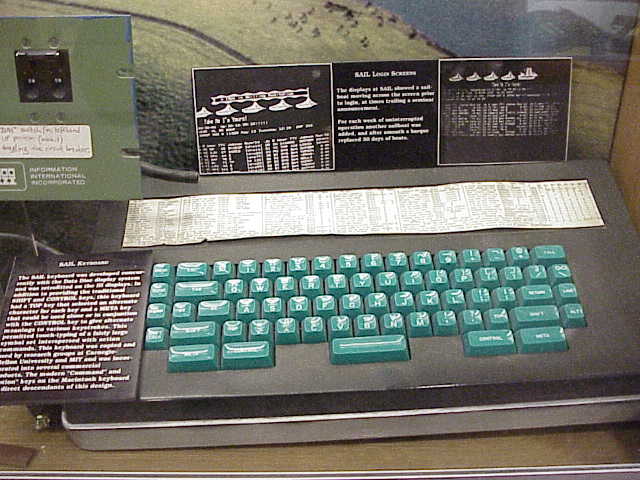
The MIT Space Cadet keyboard was a response to the Stanford SAIL keyboard., which had CONTROL, TOP, SHIFT, and META shifts. The SAIL character set had a reasonable set of math symbols, reached via the TOP key, and there were programming environments that used them. Here's a paper by John McCarthy on the SAIL character set.
I've used both of those systems. The math symbols on the SAIL keyboard were nice, since they had display glyphs to go with them. All those function and shift keys on the Symbolics 3600 keyboard were not all that useful. Most of them didn't do much.
I'm typing on a Windows Natural Keyboard, which was the upper limit of excessive buttons for Windows. There are 19 extra function keys. The "calculator" button really brings up the calculator. The "Menu" button brings up a menu. The "Mail" button brings up Thunderbird. None of this is particularly useful.
-
Re:EMACS?
The MIT Space Cadet keyboard was a response to the Stanford SAIL keyboard., which had CONTROL, TOP, SHIFT, and META shifts. The SAIL character set had a reasonable set of math symbols, reached via the TOP key, and there were programming environments that used them. Here's a paper by John McCarthy on the SAIL character set.
I've used both of those systems. The math symbols on the SAIL keyboard were nice, since they had display glyphs to go with them. All those function and shift keys on the Symbolics 3600 keyboard were not all that useful. Most of them didn't do much.
I'm typing on a Windows Natural Keyboard, which was the upper limit of excessive buttons for Windows. There are 19 extra function keys. The "calculator" button really brings up the calculator. The "Menu" button brings up a menu. The "Mail" button brings up Thunderbird. None of this is particularly useful.
-
Re:Picky
I disagree. It takes a while for people to learn their own nature, what works best for them, and what they really want. 'Adapting to' a mate means knowing how to take the measure of a person, knowing how to tell when the 'fit' is right -- whether for a life together, or just for coffee. You're not born knowing that; you have to learn from experience. And it gets much easier with age. Neuroplasticity is a lifelong phenomenon.
-
Re:*obliged* to think in words?
I found this via google. Fairly interesting.
-
PhDs at Stanford are easy to get?
PhD's in Stanford are easy to get? I am surprised by that. His work looks fairly rigourous and he's had a few papers published. The methodology he employs in his PhD seems reasonable enough - which aspects of his thesis ("Learning and short-term retention of paired associates in relation to specific sequences of interpresentation intervals") do you have an issue with?
I also note he has a first degree in Maths, so I guess he's probably ok on this knowledge. Probably he could get by undergraduate level engineering.
You note "Let's see how long he'll last": reading his curriculum vitae I'd say probably a little while longer, seeing as he completed his PhD in 1966 and has been producing papers and been employed since then, that's about 45 years so far...
-
Re:the 16 scientists are not climatologists
Interesting point: you should not only consider the risk (for instance of climate change), but rather compare the cost of doing something and the cost of doing nothing. Of course that process alone does not guarantee it is objective: it matters greatly how you define and estimate such costs. This specific economist is accused by some of bias in this regard.
-
If Carlsberg made the obvious, news...
...then this would surely take the prize.
Stars convert matter to energy in the form of electromagnetic radiation as a result of nuclear fusion reactions in the core. Ergo, they shed mass - our own Sun sheds mass at the rate of some 4.2 million tonnes per second (citation). This converts to pure energy, incident at Earths equator at around 1000W/m^-2.
But don't worry, if the iron cycle weren't endothermic then the Sun would be good for another 600 billion years or so...
-
low overhead publishing alternatives
There have been a few mentions of PLoS and several pre-print servers But a transition from a major publishing conglomerate (Elsevier, Springer, Kluwer) doesnt require building your own capability from the ground up, or dropping the more formal review structure for a pre-print/forum type arrangement There are several very reasonable, non-profit publishing outlets available, the one that jumps to mind is HighWire Press. http://highwire.stanford.edu/ They provide the framework and hosting, you provide the typical editorial board and reviewers Several large societies now use them, including the American Society for Microbiology.
-
not too good for archiving
After some years of neglect, since the late 1990s some libraries, universities, and other cultural organizations have realized that videogames are an important cultural artifact, so are worth preserving just like films and other bits of culture are. There are now things like this at Stanford, and quite a few others. These are usually put together by buying used arcade cabinets, cartridges, CDs, etc., from anything from flea markets to eBay (in addition to donations from individuals and collectors).
Videogame makers seem to be doing whatever they possibly can to make this as difficult as possible, especially for organizations like libraries that need to follow the law. It seems like if videogames are actually documented/preserved as interesting cultural artifacts, it's going to be by less-official organizations that crack them.
-
Re:*Sigh* There's no drama.
Nothing to do with Thrun and his resignation - especially considering he resigned in April 2011 before his online AI class later that fall.
-
Good crowdsourcing and Bad crowdsourcing.
There is crowdsourcing in which you look for exoplanets or translate ancient greek texts ( https://www.zooniverse.org/ ), crowdsourcing in which your computer folds protein models to better understand disease ( http://folding.stanford.edu/ ), and then there is crowdsourcing in which you test weapons systems to help kill people more effectively. I like how the Pentagon is skipping the recruitment propaganda part (We Need You! *pointy finger*) and just putting a gun in our hands (sic). Its bad enough that the American government spends as much as it does on "defense" without subversively enlisting people to test weapons systems for them. I won't be playing that particular game.
-
Re:Bah. This was the correct decision.
What if I modified a public domain work, and asserted a copyright of my own on it? Will I still have the copyright? A "no" answer would seem to invoke ex post facto.
(Modified public domain works may be copyrighted: http://fairuse.stanford.edu/Copyright_and_Fair_Use_Overview/chapter8/8-b.html)
-
Re:It’s inevitable
"Well, it would be hard for the next flu pandemic to not be worse that the last one, since the last flu pandemic killed fewer people in the U.S. than the flu usually kills each year (I do not have worldwide numbers, but my impression is that they were pretty low as well). "
Depends on what sort of flu:
-
Re:And...
I'm assuming this is limited to certain ways of storing information. After all, in 2009 Stanford researchers claim to have stored 35bits per electron (not even atom).
http://news.stanford.edu/news/2009/january28/small-012809.html -
Re:Knuth in high dudgeon
The second link didn't come across properly with my make-link FF extension: http://www-cs-faculty.stanford.edu/~knuth/joalet.pdf
-
Re:Head up thier ass
They could get a trademark on Google.
oh yeah??
If you have a better source, the internet wants to know.
-
perfect for
foldingclothes@home*
-
Re:"Earlier than expected"?
Studies are done world-wide of lake sedimentology and glacier ice chronology to better understand climatic and human activities over periods where historical records either don't exist or are limited. Have they been done in Peru? Yes. For example, this one deals with human activities over ~1400 years, and this one deals with sediment cores from Lake Titicaca and wet/dry climate cycles. This paper is a good example of how multiple studies from several sites can be combined together to better understand the history of climate change across a larger region (South America and the Carribbean). Lakes in arid areas are particularly interesting because they are so sensitive to changes in climate, so they get studied a lot.
There are additional citations in those papers, and if you search for "Lake Titicaca" "sediment core" and "climate", you'll find plenty of studies in the Peru/Bolivia area, but because most of what you've done is sneer at the idea that anyone could figure out anything about past climates, I doubt you'll really care. However, if other people want to investigate the topic there is plenty available. It is inevitably technical, but the basic principles are not hard to grasp with a bit of effort.
-
Folding@home
This does not exactly answer the question, but I just wanted to remind about Folding@home as another way of helping humanity if you don't want to directly donate money.
-
Re:Farm GPS, airplanes, and who owns the bandwidth
Sorry, also look at the Parkinson presentation from the same Stanford Precision Time and Position Conference --
http://scpnt.stanford.edu/pnt/PNT11/2011_presentation_files/01_Parkinson-PNT2011.pdf
He gives a very nice spectrum on slide 4 -- note the little bump at the bottom labeled "Starfire/Omnistar" -- that's the correction signal used by the John Deere precision GPS system, and others, broadcast by Inmarsat III. It's f*ing buried under the proposed LightSquared 10H signal at 1550.2, and still under the skirts of their 10L signal at 1531!
Yup, that has a nice picture illustrating the problem.
ANYTHING carried by Inmarsat III in that band just below GPS L1 is so screwed if LightSquared uses those frequencies!
this is also a pretty clear indication that FCC was bought off at a high level, and their technical types didn't get to look at it -- they would have screamed.
Yes, that seems to be happening a lot lately. Good, bottom-up technical analysis from FCC engineers get overridden by political concerns. Broadband over Power Lines (BPL) is another egregious example of politics forcing idiotic technical decisions. Spectrum sharing compatibility analysis seems to have been left back in the last millennium some how.
-
Re:Farm GPS, airplanes, and who owns the bandwidth
Sorry, also look at the Parkinson presentation from the same Stanford Precision Time and Position Conference --
http://scpnt.stanford.edu/pnt/PNT11/2011_presentation_files/01_Parkinson-PNT2011.pdf
He gives a very nice spectrum on slide 4 -- note the little bump at the bottom labeled "Starfire/Omnistar" -- that's the correction signal used by the John Deere precision GPS system, and others, broadcast by Inmarsat III. It's f*ing buried under the proposed LightSquared 10H signal at 1550.2, and still under the skirts of their 10L signal at 1531!
You can't design around that!
ANYTHING carried by Inmarsat III in that band just below GPS L1 is so screwed if LightSquared uses those frequencies!
this is also a pretty clear indication that FCC was bought off at a high level, and their technical types didn't get to look at it -- they would have screamed. -
Stanford Symposium held 2011/11/17
Look at the docs posted for the recent symposium at Stanford:
http://scpnt.stanford.edu/pnt/
Opening comments on how LightSquared destroys GPS:
http://scpnt.stanford.edu/pnt/PNT11/2011_presentation_files/01_Parkinson-PNT2011.pdf
the FAA report on testing:
http://scpnt.stanford.edu/pnt/PNT11/2011_presentation_files/09_Bunce-PNT2011.pdf
The LightSquared idea is a good one, but not on the frequencies they've selected! -
Stanford Symposium held 2011/11/17
Look at the docs posted for the recent symposium at Stanford:
http://scpnt.stanford.edu/pnt/
Opening comments on how LightSquared destroys GPS:
http://scpnt.stanford.edu/pnt/PNT11/2011_presentation_files/01_Parkinson-PNT2011.pdf
the FAA report on testing:
http://scpnt.stanford.edu/pnt/PNT11/2011_presentation_files/09_Bunce-PNT2011.pdf
The LightSquared idea is a good one, but not on the frequencies they've selected! -
Stanford Symposium held 2011/11/17
Look at the docs posted for the recent symposium at Stanford:
http://scpnt.stanford.edu/pnt/
Opening comments on how LightSquared destroys GPS:
http://scpnt.stanford.edu/pnt/PNT11/2011_presentation_files/01_Parkinson-PNT2011.pdf
the FAA report on testing:
http://scpnt.stanford.edu/pnt/PNT11/2011_presentation_files/09_Bunce-PNT2011.pdf
The LightSquared idea is a good one, but not on the frequencies they've selected! -
Re:Farm GPS, airplanes, and who owns the bandwidth
Nope, it's not adjacent channel interference -- the precision positioning people use a correction signal (from a satellite) in L band, below the GPS L1 signal, that is completely swamped by the LightSquared system -- these precision positioning systems, which are also used in highway construction and other large developments as well as in large scale agriculture, are among the systems that the study identified as impossible to make work even with a redesign -- these bands were meant for weak signal reception of satellite signals, NOT for multi-kilowatt ground stations.
And when you talk about adjacent channel, remember that GPS boxes aren't so much receivers as correlators -- and they are working with signals that are effectively below the noise floor -- that's why correlation techniques have to be used. What might be acceptable as adjacent channel in other modes is devastating to correlator-based designs.
See for example the FAA report at:
http://scpnt.stanford.edu/pnt/PNT11/2011_presentation_files/09_Bunce-PNT2011.pdf -
To add...Here is a recent presentation from the FAA regarding the interference issues, which includes these findings:
Simulation results showed that completion of the Network of highpowered base stations envisioned by LightSquared would result in degradation or loss of GPS function (ranging, position) at standoff distances of a few kilometers extending to space operations
...
Certain applications, even with modification or complete redesign, would still not be able to perform their current mission in the presence of such a Network broadcasting directly adjacent to the GPS L1 band -
Done Before
Immediately thought of This.
-
Re:Virtual Learning
Actually, the online Machine Learning course is CS229A (Applied Machine Learning), which is obviously different from CS229 (Machine Learning). You can see http://stanford.ml-class.org/ which redirect you to a login page for real Stanford students. I would agree though that CS229A is a dumbed down version of CS229.
-
See: Integrity
http://www-cs-students.stanford.edu/~blynn/gitmagic/ch08.html If this doesn't explain why you are wrong, keep googling. You'll figure it out eventually.
-
Re:Amazing
That was not against God's laws. Copernicus believed he was revealing God's law, displacing a false hypothesis.
Pope Clement VII (r. 1523–1534) had reacted favorably to a talk about Copernicus's theories, rewarding the speaker with a rare manuscript. There is no indication of how Pope Paul III, to whom On the Revolutions was dedicated reacted; however, a trusted advisor, Bartolomeo Spina of Pisa (1474–1546) intended to condemn it but fell ill and died before his plan was carried out (see Rosen, 1975). Thus, in 1600 there was no official Catholic position on the Copernican system, and it was certainly not a heresy. When Giordano Bruno (1548–1600) was burned at the stake as a heretic, it had nothing to do with his writings in support of Copernican cosmology, and this is clearly shown in Finocchiaro's reconstruction of the accusations against Bruno (see also Blumenberg's part 3, chapter 5, titled “Not a Martyr for Copernicanism: Giordano Bruno”).
http://plato.stanford.edu/entries/copernicus/
http://jameshannam.com/copernicus.htm -
Re:This is informative how?
One of the essays Brian Leiter has in Naturalizing Jurisprudence: Essays on American Legal Realism and Naturalism in Legal Philosophy is a survey of various predictive theories of jurisprudence. Referring to this overview in his entry on realism in legal philosophy in the Stanford Encyclopedia of Philosophy, he remarks that "The best social-scientific accounts of adjudication, for example, boast predictive success that is so feeble (better than coin-tosses, but not much!) that their explanatory models, with their implicit concepts of law, earn no epistemic credence."
Or, put another way, what we're looking for is not the sort of correlation that emerges from sheer chance given the constraints of the system. What we're looking for a correlation that is higher than what a coin flip would determine. And it seems that, presently, there is no predictive theory of law can do that with any significant degree of certainty.
Also, as I mentioned in a reply to someone else, looking only at the cases that go before SCOTUS is a bit misleading. One has to look at all the cases that SCOTUS considers hearing.
-
Re:No, this is quite wrong
I didn't go to class to learn thermodynamics, I just need to read research by those who have:
Here is the long form proving my point: http://www.stanford.edu/group/greendorm/participate/cee124/TeslaReading.pdf
Here is the easy web version: http://www.teslamotors.com/goelectric/efficiency
"In an electric vehicle, chemical energy is stored in a battery. Lithium-ion batteries are used in Tesla vehicles because of high energy density. Converting the chemical energy to free electrons (electrical energy) can be greater than 90% efficient – some energy is lost to heat in cells and other battery pack components such as current conductors and fuses. The remaining components of the Tesla powertrain – the drive inverter and motor – are also extremely efficient. Overall, drive efficiency of the Tesla Roadster is 88% - almost three times more efficient than an internal combustion powered vehicle."
"Chemical energy is stored as gasoline in a conventional car. Combustion is used to convert the chemical energy into thermal energy. Pistons convert the thermal energy to the mechanical work that turns the wheels. The conversion process is, at best, 35% efficient. The majority of the energy stored in the gasoline is lost as heat."
-
Re:Breaks a lot of dependancies
Dark energy and Dark matter are very different things which address very different problems in astronomy - the only thing they have in common is the term "dark", used because they are both describing forces and objects which are inferred to exist by - well a force we conventionally don't consider ourselves to "see" (gravity).
Dark matter has been very convincingly observed in the bullet cluster, for example.
Your disbelief is essentially a limitation of human senses - we're EM friendly beings, particularly in the visible band but we pretend we can also understand X-Rays and Radiowaves by the same concept. However since we possess no finely tuned mechanism for observing gravity, clearly anything which is EM transparent might not exist at all!
-
Re:Waste of everyone's time
I have recently experienced some modest insight into this incomprehensible (to me and perhaps you) way of thinking (legal = right) by seeing Sandel's lecture on communitarian moral philosophy and recalling a TED talk on the empirical psychological differences between liberal and conservative values.
Of course, it wasn't that I thought of all conservatives as slavering idiots or scheming monsters or anything. You can basically understand and respect their motives by knowing and listening to them; you don't need no fancy book lernin. Conversely, approaching from a different angle doesn't make them any less wrong, when they're wrong. Still, it was interesting and humbling to look at the issue a different (for me) way.
I still don't agree with the communitarian idea that we need a moral explanation for group-oriented choices, or the idea that many people have that adhering to group law is in itself a moral good. I wasn't compelled by any of the examples I saw in Sandel's lecture, of situations where you would allegedly need to choose between a group (communitarian moral) obligation and a liberal moral one. I would still call it immoral to help your friend bury a body, no questions asked, just because they're your friend. However, these ideas do provide another way to look at things from the perspective of my many brothers and sisters who do think that way, either communitarian or conservative.
By way of kudos to Sandel, I had no idea he was a communitarian (even if a moderate one) after watching his course lecture videos. Being more or less ignorant of this subject, I hadn't read about his criticism of Rawls. Maybe you could tell he wasn't totally on board with the libertarians, but he still gave the ideas a fair hearing, it seemed to me (if in my ignorance).
(Terminology alert: if you have trouble distinguishing the word "liberal" in the political context from the term in the philosophical context, please fix that before replying. It's trivial to do so.)
-
Re:They call this "greenwashing".
-
Re:Beat 'em to it
Your visual system does NOT do 3D mapping of anything. It does some model fitting from a stereoscopic image, and cannot do most of what their sensor platform does. You're either horribly misinformed or just trolling.
The forest they looked at would be about as accessible in terms of location accessibility to a human eye as it is to their platform: they fly a plane over the forest. Their sensor platform is mounted on a plane.
Alas, it's silly to think a human could be as effective as their sensor platform, because their platform has access to way more data than human visual system does. Not only do the spectrometers sense well into the infrared (2um), but the LIDAR system also measures 3D distribution of biomass, and the relief of the underlying terrain. They can see freaking old riverbed right through the trees, while also seeing the tree canopies. The latter image is not a photograph, mind you. It is a visualization, or reconstruction, of the LIDAR and spectral data.
In the "good old days", when all you had was your eyes and a theodolite, you'd need a lengthy and risky expedition on the ground to acquire all that 3D data manually -- and that works well only for ground relief. We're not monkeys.
-
Re:Beat 'em to it
Your visual system does NOT do 3D mapping of anything. It does some model fitting from a stereoscopic image, and cannot do most of what their sensor platform does. You're either horribly misinformed or just trolling.
The forest they looked at would be about as accessible in terms of location accessibility to a human eye as it is to their platform: they fly a plane over the forest. Their sensor platform is mounted on a plane.
Alas, it's silly to think a human could be as effective as their sensor platform, because their platform has access to way more data than human visual system does. Not only do the spectrometers sense well into the infrared (2um), but the LIDAR system also measures 3D distribution of biomass, and the relief of the underlying terrain. They can see freaking old riverbed right through the trees, while also seeing the tree canopies. The latter image is not a photograph, mind you. It is a visualization, or reconstruction, of the LIDAR and spectral data.
In the "good old days", when all you had was your eyes and a theodolite, you'd need a lengthy and risky expedition on the ground to acquire all that 3D data manually -- and that works well only for ground relief. We're not monkeys.
-
Re:Lisp is a fascinating language with honored his
It might seem antiquated and weird to us nowadays, but emacs-lisp is actually fairly typical of the dialects of its day. It's day was just the late-70s/early-80s. Scheme and Common Lisp did a lot to modernize Lisp, and they just happened to be the first popular dialects on commodity machines so it's easy to forget that Lisp predates all computing paradigms and has given them all a shot at one point or another.
-
Re:Lisp is a fascinating language with honored his
Lisp prehistory details its invention of the logical IF expression which conditionally evaluates one side or another depending on an evaluated result. Fortran featured computed gotos, but they were awkward to use by comparison.