Slashdot Mirror
Domain: stanford.edu
Stories and comments across the archive that link to stanford.edu.
Comments · 4,853
-
Re:acceleration structures, etc...
Ok, I can see the benefit of being able to bail out early in cases where geometry is far away or the full resolution hasn't been loaded in from disk or network or wherever it comes from. I can also see the benefit of storing the texture and geometry in the same data structure. It sound kind of like roam but in three dimensions. I'm not sure if you'd have problems with discontinuities between neighboring voxels of different sizes.
I'm not very knowledgeable of volume rendering, but this seems to be pretty similar, though they only tested the algorithm on a very small dataset. I shall look forward to seeing this sort of thing in a modern game.
-
Some things seem beyond the military's kenThe way to shield ourselves from these attacks is to be at the forefront of technology, tactics and procedures relating to operating in cyberspace. We have systems and software that are protected by multiple layers of security and functional redundancy. We train our people to be on the cutting edge of this technology, and we find ways secure our information.
The issue of Internet security and being on forefront of technology seems to me like it has much more to do with education and intelligence than with the military directly. If you want the country as a whole to be on the forefront of technology, you have to have the highly educated people who create and master said technology. To my mind, this issue becomes more of how we can improve abysmal public schools and the like than what the military can do.
I'm reminded of Foucault, who in Power/Knowledge discussed the idea of power in the context of a network or society. The military is embedded in the network of American power, and in the domain of Internet security and the like it seems to rely even more on other parts of the network than it does in other forms of operation like physical combat.
-
Do the math
>>> So, how is all the new demands for electricity going to be satisfied.
A lot more easily than you seem to think.
There are about 3T vehicle miles logged in the US each year. An electric car requires about 250Wh/mi, well-to-wheel. Using electricity to power the US's total yearly vehicle miles would require 250Wh/mi x 3Tmi = 750M MWh.
For comparison, the total amount of electricity generated in the US per year is 4,000M MWh, or 5-6 times as much. Converting every vehicle in the US to all-electric would add less than 20% to the electricity generation needs of the most car-happy country on earth.
For further comparison, note that the US used 115Mbbl of oil in 2006 to generate 41M MWh, meaning that existing generating facilities generate roughly 1M MWh per 3Mbbl. Accordingly, the 4,000Mbbl of gasoline and diesel the US consumes to run its vehicles for a year could be converted to 1,300M MWh, or nearly twice as much electricity as would be needed to run all-electric versions of those vehicles.
If getting enough electricity to run an all-electric fleet is the problem you're worried about, you simply haven't done the math. -
No patents on mathematics
The problem with software patents is that anything that's really novel (...) is basically a mathematical algorithm. Since you can't patent mathematical algorithms, there shouldn't be any need for software patents. I'm not sure if I've ever seen anything really inventive in software that wasn't a mathematical algorithm.
According to a paper posted just below, you find yourself in perfect agreement with no lesser IT guru than Donald E. Knuth, author of The Art of Computer Programming, who had already admonished the US Commissioner of Patents and Trademarks many years ago that:To a computer scientist, [any distinction between different kinds of algorithms to make them patentable] makes no sense, because every algorithm is as mathematical as anything could be. An algorithm is an abstract concept unrelated to physical laws of the universe.
-
Re:In other words ...
I agree with you. Impetus to transform the internet is coming from every direction. They won't be happy until we have a "trusted path" to our "trusted computers". We discussed all this before from a different context, when Stanford University was announcing their Clean Slate Design initiative. I was so inspired by the slashdot discussion at the time that I did some in depth research on the topic and put up a blog Since then, Stanford has removed their Clean Slate design White Paper from their site. (Why?)
-
Re:"Making Available" kinda like...
As I understand, libraries are protected, but if a patron uses the photocopier, said patron is liable for copying. More info here: http://fairuse.stanford.edu/Copyright_and_Fair_Use_Overview/chapter7/7-d.html
-
precautionary principle
You missed, with the "back off unless you have a double-blind study bit. Insistence on a double blind study is not the demonstration of a rational scientific approach to the issue that it might at first appear. In fact, you have it upside down, in this case. Demanding a double-blind study to support action to *stop* an optional surgical removal of an otherwise healthy body part violates the precautionary principle for example. It's a non-controversial argument to claim that cutting off part of a healthy body for religious, cultural, or other non-medical reasons, without evidence that this *does not* cause harm is at the very least a violation of the precautionary principle.
There also considerable evidence that the practice does cause actual harm, greater in some cases than in others.
Male circumcision - see the harm to get a balanced picture
Circumcision Complications
Consider another example. Cigarettes are full of substances which cause cancer in laboratory rats. Where are the double blind studies supporting the claim that cigarette smoking causes cancer in people? Well, there really aren't any, because it isn't ethical to conduct these types of studies which would require exposing a group of human volunteers to known or suspected carcinogens. There are other ways to get reasonably reliable data on which to base public policy, however.
The onus in the case of physical mutilation (circumcision of either gender certainly qualifies) should be on those doing the mutilating of the defenseless child. There are no double blind studies which demonstrate that we have not deprived our children of the most sensitive part of their anatomy, and that we haven't permanently deprived them of maximum sexual enjoyment. (All those folk who cry out on any political issue, Think of the children! forget to consider or care about what happens if they mange to make it to adulthood.) With respect to circumcision, however, there are recent studies which indicate that male circumcision might reduce the spread of AIDS. The evidence isn't conclusive, but it does complicate the issue of male circumcision.
Although it might seem clear that female genital mutilation is rather more dramatically barbaric, male circumcision is by no means a harmless practice. Perhaps not all the patients are harmed, but some are undoubtedly harmed, irrevocably.
Finally, it's worth noting that although the extent of the legal and human rights of children remain the subject of debate, it's clear that most modern democratic societies at least, agree that children have some rights. You may be the parent of YOUR children, but the system of laws governing your country almost certainly limit what you may do to them. You certainly would do hard time, and or have the children taken away, in any western democray for amputating part of their nose or their ear or their hand or foot. Why not for amputating part of their penis? -
Re:Middle Finger
If you can patent a single click whats to stop you patenting a double?
-
Re:To Be used by Which Application?
"Simulations" sums it up. Just the word "simulations" is enough to suck up any conceivable amount of processing power they will ever have.
Folding@Home runs about a petaflop these days, so they're planning to build the equivalent of about 1,000 Folding@Homes. But Folding@Home is barely making a dent in the number of proteins scientists want to fold. Just this one existing simulation project could probably saturate the proposed exaflop computer.
What if they want to simulate battle field conditions? Surely the number of possible "moves" between millions of troops, with many possible sets of actions and equipment and hundreds of thousands of vehicles on any terrain on the planet represents a number of possibilities significantly greater than a game of chess, with it's mere 32 game pieces that can only act in turns in very strictly defined, non-linear ways on a 64-space game board. But depending on which mathematician you listen to, just the number of possible moves in chess might be in the vicinity of 10^10^50, or the much lesser 10^120. How much processing power would it take to "solve" chess? Well, by these estimates, if every atom in the entire universe were harnessed into a quantum computer, and it worked on the problem for the entire life of the universe, it wouldn't have time to finish solving the game.
An exaflop is nothing when it comes to simulation. Any competent group of college science students could probably propose simulation software that makes useful work for a yottaflop machine. And if they wanted to simulate something like evolution, they'd still have to use really high abstraction levels to simplify things enough to get any results within a human's lifespan. I wonder if a yottaflop can even simulate one insect at the molecular level in real time, much lessa mouse, or several organisms interacting with each other and their environment.
Back to the military: just accurately simulating the possible variations they might want to try to improve a single firearm might keep a computer like the one they propose busy for a long time. It's not a question of what they'd ever come up with to do with all that power, its a question of how to prioritize the countless project for which each of which could occupy all its time. Or to simplify, optimize, and abstract the problems they're working on enough to get results even with an exaflop to play with. -
Re:Very real concern
Something like Overshadow?
-
Re:Joel
Please read http://plato.stanford.edu/entries/type-theory/.
Every predicate defines a type. That's what a type is! The extension of a predicate. -
Re:Joel
Types, types, types, you keep talking about TYPES! That's where you're running into trouble. App Hungarian is about semantics, not typing.
Types are a semantic concept, not a syntactic one. Indeed, for every predicate P, there is a type associated with it. The set of all objects for which P is true is called the extension of P, and this set determines a type; and by construction, members of the the extension are of type P.
If you have read Programming Ruby, this is why they make such a big deal of saying that "Classes Aren't Types" -- classes, by construction in a message passing object system, don't define extensions. On the other hand, an object's "singleton class" -- the 'class' consisting of the canonical list to the methods to which an object will respond -- is a type.
So pick a predicate "IsABoolean" and another "IsADifferentiableCurveInTheComplexPlane". Both define types. Neither is a particularly good prefix.
http://plato.stanford.edu/entries/type-theory/ -
Re:Billions
The practical concerns of a vacuum tube computer of such scale are obvious; on the other hand the practical concerns of a transistor one are not at all. The problems are almost entirely of nano-fabrication; unlike the vacuum tube case, the resources required are not at all prohibitive.
You seem not to grasp the dimentions of complexity and connectivity in human brain, thus your silly insistence on some magical "nanofabrication" (yet another pipe-dream nowhere near practical application) solving all the problems. Squeezing gazillions of transistors into some box is only one tiny aspect of the problem, dealing primarily with reducing the size of any AI to manageable levels. All the major unsolved problems remain untouched even if such a thing is accomplished.
There may be insurmountable practical concerns we do not yet know, but for you to proclaim they exist is no more defensible than Kurzweil's position that they do not.
This is hogwash. All I am saying is that given the current state of affairs combined with history of the field (something you are desperately trying to pretend does not exist) renders Kurzweil's "prediction" of full-fledged AI (and that means consciousness - no weaseling out of this one) astronmically unlikely to come true in the time-frame he specified.
As I repeatedly pointed out, he (and you) are yet another in a long, long line of uncritical, hubris driven propagandists of "just around the corner" great scientific "breakthroughs", which - quite mysteriously - fail to materialize decade after decade despite of billions upon billions of dollars sunk into the research.
Turing machines *can* simulate quantum phenomena to any desired precision.
This pretty much ends any discussion with you on the subject. You should explain how are you planning to achieve this feat to the physicists of the world and collect your inevietable Nobel prize in the process, given the current state of knowledge of quantum phenomena whereby the running joke is that there are more theories of these processes then there are physicists involved. We do not have a clue what is going on at those levels, only wild guesses, never you mind "simulating" any of it.
Fuck, we can't properly simulate much more higher-level processes involving whole atoms and molecules for lack of computing power and understanding, or did you not hear of this project which attempts to harness the power of millions of home computers to attempt to simulate, in a matter of weeks and months folding of a single protein!
You are out of your mind if you think we have (or will have in 20 years) anything like the computing power or knowledge required to simulate 100 billion neurons. Forget 100 billion, in fact we can't properly simulate one cell in its entirety and the prospects look rather grim that we will be able to do this in many decades.
If you want to say that brains can't be simulated, you're going to have to do better than that. You need something like a "soul" that is completely inscrutable for it to be out of reach of Turing machines.
We do not know the nature of consciousness, therefore we do not know if it is an emergent property of certain complex systems such as those that can be simulated by Turing machines, or if it is somehow tied to the quantum phenomena and requires something "extra" to be present such as a particular arrangement of molecules in some way sensitive to certain quantum effects the nature of which we do not yet understand. This does not necessarily preculde a conscious AI from being constructed but it would render the problem orders of magnitude more complex.
And then there is of course the possibility that consciousness is somehow dependant on some hereto unknown extra-dimentional entanglements which would throw the whole thing into complete
-
Re:Why is this here?
Think of this as education.
While it's common practice, most consumers who look to
http://www.slac.stanford.edu/xorg/nmtf/nmtf-tools.html#thruput
FWIW, the poster's measurement of throughput, crude though it is, is way better than I see through Time Warner during normal business hours. It's unfortunate what we yanks pass off as Broadband, but then again; when was the last time you read about a horribly obtuse piece of pork barrel legislation on -
Network Admin? Baseline the network utilization!I've heard this said before..."this can be quite annoying when trying to determine whether a client needs to switch over to a T1 or if their current ISP will suffice." It's a service that the ISP is providing on their network, learn to work with it. And this is a good reason why you should be trending the link utilization before making a recommendation.
Unless there is an problem with the link that can be immediately identified at the time you tested, like a physical problem, then you should develop a baseline of the customers network utilization. Generally, a single download provides insufficient information to in order for to give the employer or customers a recommendation related to their link utilization. This is especially important when the upgrade costs money.
Trending the link utilization is easy to do with free open source tools that will run on Linux, Windows, or a Mac. Or you can pay some $$ and buy software that will perform network utilization trending. Many protocol analyzers have this feature too. As a network administrator/engineer I expect that you can figure how how to tap the link or access the link devices network interface utilization, SNMP, RMON, or even NetFlow/sFlow information.
This is easy to do, just setup an extra PC or laptop on the customers premise for a week, just lock it down logically and physically. Free tools that I regularly use are Ntop (http://www.ntop.org/news.html) and Cacti (http://www.cacti.net). I'm sure that someone on this list can recommend a dozen other solutions.
These tools provide a graphical means to display the link utilization over time, providing greater information over a single download test, thus allowing you to make a more informed recommendation. And the graphics make nice additions to your reports! One scenario would be that the customer is seeing a slow down of their internet connectivity after lunch or late afternoon. Well, trending might reveal that indeed the network utilization peaks at these times when workers get back from lunch and just before they go home. And maybe it's only a few people hogging the bandwidth. On customer networks I've discovered P2P file sharing, large file downloads (movies and ISO's), and even infected computers used as repositories. The customer would have plenty of bandwidth if they just cleaned up that mess or better managed the limited resource with both technical or administrative (policy-based) controls.
And if you have more time, then check out the list of even more network management tools at http://www.slac.stanford.edu/xorg/nmtf/nmtf-tools.html or http://www.ubuntugeek.com/bandwidth-monitoring-tools-for-linux.html.
HTH someone.
-
Journal article isn't available to the public yet.
This is not the "journal article". This is just the Stanford press release about it. The article is released tomorrow. But there are 200 comments here from people who have already decided what they think about it. I'd like to see the author's data. I didn't think such detailed canoe info was available. "canoes of oceania" lacks hull lines drawings for instance. Here's the stanford press release, which is the same as that slashdot post. http://news-service.stanford.edu/pr/2008/pr-ehrlich-021308.html and here's the article: http://www.eurekalert.org/jrnls/pnas/07-11802.htm the article gets released tomorrow. Today I get this error: "You currently do not have access to this embargoed journal page." I assume only "peer reviewers" get access until then, so they don't get confused by multiple comments from people who haven't actually read it. If you have actually read the article or can give me access, please let me know, I've photographed, measured and drawn many pacific outrigger canoes.
-
Summary of a summary
There isn't an article yet. It's due out on Feb 19 - "in the online Proceedings of the National Academy of Sciences" - from TFA.
The "article" is really a summary itself - in fact, it's more like a press release of the paper to come. Jared Diamond's in the "article" - a pretty heroic character for those that think - saying a good thing about the paper, so there's a clue.
In fact - a little googling revealed that TFA in question is nothing more than a sophomoric rewording of a Stanford "news release" - http://news-service.stanford.edu/pr/2008/pr-ehrlich-021308.html
Wake me on the 19th when there's something to see. -
human-level intelligence is an ever-receeding goal
I don't have a PhD, but I was associated with the Stanford AI project in the 1960s. We made some real advances in Chess and Checkers, and did some interesting work on machine hearing and vision, but playing ping-pong was well beyond what our arm could do, and driving in traffic was well beyond our cart.
Our funding wasn't bad—we were able to purchase a PDP-6, which wasn't cheap—and the researchers had good imaginations. The problem of human-level intelligence, however, when you look closely at it, is a very large problem. We can define nearby milestones, and make some progress towards them, but I think creating a human-level intelligence is much more than 20 years in the future, just as it was in 1967.
-
Re:StunnedAt any rate, I find it surprising that we would expect more backbone out of corporations dealing with the American government than we expect out of them when dealing with, say, the Chinese government. If we tolerate Google "playing by China's rules" when all they stand to lose is their entry into the Chinese market, then why would we expect better of AT&T when they would be running afoul of their home country's government? It is not rational to expect private entities to take a harder line with China than that taken by the government of the nation in which they're headquartered. The United States accepts preposterously imbalanced tariffs with China, and as far as I know so far, is not planning to boycott the upcoming Olympics, despite the UK gag order. Our government is not acting in a principled manners in its dealings with China in our name, and has not done so, for some time. The chorus that Google, a privately-owned entity, should be more principled in its dealings with China than the United States government is, amounts to holding it to higher standards as a "corporate citizen," a fallacious concept in the first place, than the real citizens are holding yourselves and your representatives. It is not Google's fault, and not its owners' personal responsibility, that access to the cheapest labor on Earth has been a higher political priority of our "representatives" than the interests of the general populace; that has been going on since before "Google" was so much as a Lego brick.
-
Computing Ethics Links
Here is a bunch of links about Computer Ethics from when I was researching about it. The google video link (last one on this list) is particularly interesting. Computer ethics is actually a university research topic! http://www.brook.edu/its/cei/cei_hp.htm http://ethics.csc.ncsu.edu/ http://www.southernct.edu/organizations/rccs/resources/teaching/teaching_mono/moor/moor_definition.html http://plato.stanford.edu/entries/ethics-computer/ http://www.cs.sunysb.edu/ProfessionalEthics.html http://www.cs.berkeley.edu/~bh/hackers.html http://cat.inist.fr/?aModele=afficheN&cpsidt=4279094 http://cyberethics.cbi.msstate.edu/ http://www.oekonux.org/texts/copykillsmusic.html http://www.progilibre.com/Open-Source-Alternative-ou-fausse-route-_a350.html http://www.osalt.com/ http://en.wikipedia.org/wiki/FOSS http://en.wikipedia.org/wiki/Richard_Stallman http://en.wikipedia.org/wiki/Copyleft http://en.wikipedia.org/wiki/GNU_General_Public_License http://creativecommons.org/ http://www.dwheeler.com/oss_fs_why.html http://www.itc.virginia.edu/policy/ethics.html http://www.brook.edu/its/cei/overview/Ten_Commanments_of_Computer_Ethics.htm http://www.acm.org/serving/se/code.htm http://www.ieee.org/portal/site http://video.google.fr/videoplay?docid=-3088012854941915784&q=computer+ethics
-
Nanowire battery
I hope the University of Illinois is working with Stanford on the Nanowire battery: http://news-service.stanford.edu/news/2008/january9/nanowire-010908
-
Link to actual paper
Here's the actual paper: Hoeft_2008JPsychiatrRes.pdf
I emailed the progenitor of the paper about the "kind of video game" issue. I posit that word jumble games and MMORPGs are the sort of games that are likely to addict women.
If he ever writes back (unlikely), I'll post.
-l -
Re:Goldfinger meets Pogo
Ok let's not be paranoid here people, and apply a bit of the critical thinking class everyone took in college. Five Separate locations, with one reporting power problems. A bit of detective work using the following data will lead to the most simple and likely conclusion for geological activity.
Map of affected areas:
http://www.ilovebonnie.net/cablecuts.jpg
Map of undersea cables:
http://image.guardian.co.uk/sys-images/Technology/Pix/pictures/2008/02/01/SeaCableHi.jpg
Seismic activity report for the past 30 days from the IRIS Consortium:
http://www.iris.edu/seismon/last30.html
Seismic activity report from the USGS NEIC (Shared with IRIS):
http://earthquake.usgs.gov/eqcenter/recenteqsww/
Add a little third party analysis and study from when the first effects were seen:
https://confluence.slac.stanford.edu/display/IEPM/Effects+of+Fibre+Outage+through+Mediterranean
"Bear in mind that the fact the outage did not start until around 6:00am, and re-routing traffic before the end of the day will both dilute the effect. Also the effects were not uniform on all hosts in a country."
Statement denying ship anchor involvements:
http://ukpress.google.com/article/ALeqM5hTi5wNwTD66nvWdTAQw20SaFI_GQ
"'A marine transport committee investigated the traffic of ships in the area, 12 hours before and after the malfunction, where the cables are located to figure out the possibility of being cut by a passing vessel and found out there were no passing ships at that time,' said the statement. The ministry added that the location, 5 miles from the port of Alexandria, was in a restricted area so ships would not have been allowed there to begin with."
Correlating the affected locations, dates and above analysis dates we can find the following.
For the January 30th time frame cuts, the following seismic activity was in the region on the following dates:
DATE LAT LON MAG DEPTH REGION
31-JAN-2008 00:01:23 39.97 33.27 4.8 10.0 TURKEY
29-JAN-2008 15:16:55 37.63 23.39 4.3 42.0 SOUTHERN GREECE
04-FEB-2008 22:15:41 38.13 21.95 4.9 30.8 GREECE
For the February 1st and (1st) 5th cut, the following seismic activity was in the region on the following dates:
DATE LAT LON MAG DEPTH REGION
02-FEB-2008 05:33:21 26.42 52.96 4.8 10.0 PERSIAN GULF
For the (2nd) February 5th cut, the following seismic activity was in the region on the following dates:
DATE LAT LON MAG DEPTH REGION
04-FEB-2008 08:26:54 -8.83 107.99 4.9 35.0 JAWA, INDONESIA
30-JAN-2008 11:03:20 -9.80 108.06 4.8 10.0 SOUTH OF JAWA, INDONESIA
30-JAN-2008 10:31:59 4.27 96.60 4.5 39.3 NORTHERN SUMATERA, INDONESIA
27-JAN-2008 12:48:00 -8.65 110.69 4.6 35.0 JAWA, INDONESIA
26-JAN-2008 06:08:02 1.08 97.23 4.5 35.0 NORTHERN SUMATERA, INDONESIA
24-JAN-2008 12:03:39 -3.95 101.63 5.3 35.0 SOUTHERN SUMATERA, INDONESIA
23-JAN-2008 19:23:34 -2.89 101.12 5.1 50.0 SOUTHERN SUMATERA, INDONESIA
23-JAN-2008 13:03:21 1.37 97.22 4.8 29.0 NORTHERN SUMATERA, INDONESIA
We can look at this data and conclude the simplest explanations is likely to be undersea damage associated with seismic activity. Rock slides and underwater stresses aren't limited to the specific time frame for an earth quake either. There are afters -
More than 5 cutsThere are likely more than the 5 being reported by the media, possibly 8. There has certainly been confusion on the subject. The following was written by Richard Sauder and is quoted from this web page: http://www.cyberspaceorbit.com/ConnectingTheDots.htm
By my count, we are probably dealing with as many as eight, maybe even nine, unexplained cut or damaged undersea cables within the last week, and not the mere three or four that most mainstream news media outlets in the United States are presently reporting. Given all this cable-cutting mayhem in the last several days, who knows but what there may possibly be other cut and/or damaged cables that have not made it into the news cycle, because they are lost in the general cable-cutting noise by this point. Nevertheless, let me enumerate what I can, and keep in mind, I am not pulling these out of a hat; all of the sources are referenced at the conclusion of the article; you can click through and look at all the evidence that I have. It's there if you care to read through it all 1) one off of Marseille, France 2) two off of Alexandria, Egypt 3) one off of Dubai, in the Persian Gulf 4) one off of Bandar Abbas, Iran in the Persian Gulf 5) one between Qatar and the UAE, in the Persian Gulf 6) one in the Suez, Egypt 7) one near Penang, Malaysia 8) initially unreported cable cut on 23 January 2008 (Persian Gulf?)
The article includes the following links as references to document the above list of believed cuts:
1) http://www.jpost.com/servlet/Satellite?c=JPArticle&cid=1202064573279&pagename=JPost%2FJPArticle%2FShowFull
2) http://www.middle-east-online.com/english/business/?id=24186
3) http://www.khaleejtimes.com/DisplayArticle.asp?xfile=data/theuae/2008/February/theuae_February121.xml§ion=theuae
4) http://www.breitbart.com/article.php?id=080202132053.iohfg5ob&show_article=1
5) http://www.abc.net.au/news/stories/2008/02/04/2153455.htm
6) http://afp.google.com/article/ALeqM5i03tUdyj8wf2Xa9P4trWEjqAJdyQ
7) http://www.arabianbusiness.com/510132-internet-problems-continue-with-fourth-cable-break?ln=en
8) http://www.globalresearch.ca/PrintArticle.php?articleId=7980
9) https://confluence.slac.stanford.edu/display/IEPM/Effects+of+Fibre+Outage+through+Mediterranean
10) http://www.cnn.com/2008/WORLD/meast/02/01/internet.outage/?iref=hpmostpop
11) http://www.iht.com/articles/2008/02/04/technology/cables.php
12) http://www.nytimes.com/2008/01/31/business/worldbusiness/31cable.html?_r=2&oref=slogin&oref=slogin
13) http://www.infoworld.com/article/08/01/31/Cut-cable-disrupts-Internet-in-Middle-East_1.html
14) -
Are they gonna call it...
a GraPhyx card? If they release a combo card that is. No one is gonna buy a seperate physics card, right? But a combo card could enable real time rendering of stuff like this: http://physbam.stanford.edu/~fedkiw/
-
Why can live sports events be copyrighted?
They are in no way creative works. What "original authorship" exists? "Copyright shelters only fixed, original and creative expression," which a football game isn't.
Furthermore, to be copyrighted, a work must be fixed into a "tangible medium." That is not the case for a live broadcast (although it might be for an after-the-fact replay). -
http://akebono.stanford.edu/yahoo/ no longer works
I remember when I used to access the Yahoo homepage from http://akebono.stanford.edu/yahoo/ - great days! Every so often, out of nostalgia, I checked that URL to see if it still forwarded to the Yahoo website, and guess what - it always did
-
http://akebono.stanford.edu/yahoo/ no longer works
I remember when I used to access the Yahoo homepage from http://akebono.stanford.edu/yahoo/ - great days! Every so often, out of nostalgia, I checked that URL to see if it still forwarded to the Yahoo website, and guess what - it always did
-
Re:U2's always been like this (Re:Hey Paul)
If we could only find someone like Casey Kasem ranting like that off-mike, the war for fair use would be over, and we geeks would finally have won.
I don't believe you have a clue what fair use actually is. Please read the following tutorial on fair use from Stanford
Downloading music without permission gets no help from the first two criteria for determining fair use, fails the third and fourth miserably and the fifth is debatable.
Less sensation and more information. -
Re:Slashdotted
-
Re:Slashdotted
http://www.youtube.com/watch?v=GWWIn29ZV4Q
Yes, the website was slash-dotted.....
We plan to have it up again at: http://make3d.stanford.edu/
(Slashdot brought the whole Stanford AI lab servers down: http://ai.stanford.edu/
Meanwhile, please see:
http://cs.stanford.edu/people/asaxena/reconstruction3d/
for an year old page. -
Re:Slashdotted
http://www.youtube.com/watch?v=GWWIn29ZV4Q
Yes, the website was slash-dotted.....
We plan to have it up again at: http://make3d.stanford.edu/
(Slashdot brought the whole Stanford AI lab servers down: http://ai.stanford.edu/
Meanwhile, please see:
http://cs.stanford.edu/people/asaxena/reconstruction3d/
for an year old page. -
Re:Slashdotted
http://www.youtube.com/watch?v=GWWIn29ZV4Q
Yes, the website was slash-dotted.....
We plan to have it up again at: http://make3d.stanford.edu/
(Slashdot brought the whole Stanford AI lab servers down: http://ai.stanford.edu/
Meanwhile, please see:
http://cs.stanford.edu/people/asaxena/reconstruction3d/
for an year old page. -
Re:As a matter of interest...There's already mounting evidence that gravity waves and other effects predicted by Einstein's general theory of relativity exist.
Since the two neutron stars in PSR1913+16 are moving so fast and close together they should, according to General Relativity, emit large amounts of gravitational radiation. This makes them lose energy: Their orbits will therefore shrink and their orbiting period will shorten.
Indirect evidence: The binary pulsar has been observed continuously since its discovery, and the orbiting period has in fact decreased. Agreement with the prediction of General Relativity is better than 1/2%. This is considered to prove that gravitational radiation really exists. This in turn is currently one of our strongest supports for the validity of the General Theory of Relativity.
http://nobelprize.org/nobel_prizes/physics/laureates/1993/illpres/discovery.htmlGP-B scientists expect to announce the final results of the experiment in december 2007, follow-
ing eight months of further data analysis and refinement. Today, Everitt and his team are poised to
share what they have found so far--namely that the data from the GP-B gyroscopes clearly confirm
Einstein's predicted geodetic effect to a precision of better than 1 percent.
http://einstein.stanford.edu/
So if they did not exist it would be hard to explain these experimental results. Also, as far as we know all of the fundamental forces have wave/particle natures so the lack of gravity waves/gravitons would be surprising. But you never know
p.s.
I think the use of the words 'Fails to detect' is harsh. It would have truly 'failed' only if the event was known to have taken place close enough for it to be detected by LIGO.The absence of a gravitational-wave signal meant GRB070201 could not have originated in this way in Andromeda. Other causes for the event, such as a soft gamma-ray repeater or a binary merger from a much further distance, are now the most likely contenders.
http://mr.caltech.edu/media/Press_Releases/PR13084.html -
Solve this quickly
Solve this very quickly: Dilute his trademark by spelling it lower case and use the term in a link to an(other) attorney's site. He can't sue the attorney and can't sue you. If you recall, Google got upset when everyone was using "googling" and they tried in vain to stop it because it would dilute the trademark they had created, and that was Google, a company that actually is doing something worth trademarking not some half-wit attorney who thinks he knows cyberlaw or even cyberlaw or possibly cyberlaw and EVEN cyberlaw.
Take that ya farging bastitch. -
Re:Ah, but...
Hume says it smarterer than I can...
Hume--and Kant--are also a lot 'smarterer' than me
However, Kant did come up with quite a plausible theory for why Hume was not quite right about that (and in doing so, essentially invented epistemology as a separate area of study). Whether or not he successfully demonstrated that his theory was correct is (still) an open question.
Very briefly what he supposed was that any experience whatsoever of the 'world' is only accessible through certain features of our perceptual and cognitive apparatus. Chief among these are time and space, but in addition, there are twelve a priori categories, including "causality and dependence" according to which experiences are ordered.
To put it in plainer language, time and space have to do not with reality as such, but with how we perceive reality, while the categories (including causality) and reason allow us to systematize our experiences. It's possible to think of time and space as analogous to being stuck in a space suit with a yellow-tinted visor. You can look through the visor, but everything will look yellow. You can't really be sure that everything--or anything--is yellow, but the only way you can see anything at all is to see it as something yellow.
The practical upshot of this is that according to Kant, while (contra Hume) genuine scientific inquiry is possible without recourse to faith in causation etc, and while our experience is of a real world, there are definite limits to human knowledge:
- because time and space are properties of our perceptual and cognitive apparatus, it is absolutely impossible to discover what the world might be 'like' without reference to them, and
- the answers to most of the traditional metaphysical questions--such as questions of the existence of god or the immortality of the soul--cannot be determined scientifically.
For more information, you can go to the Stanford Encyclopedia, or to the source, but when reading Kant, always be sure to take the proper precautions: take adequate food and water, allow plenty of time to get back before dark, and always let somebody know where you're going...
-
Re:Systematic literature reviewYou can't collect, read, assess and synthesise "all available information" on Computer-Science, so you migth go more narrow and do Cryptography, but that's equally impossible. So you might go more narrow and do Diffie-Hellman. Even then you could only be certain you've found the most well-known articles and research on it, there's always going to be a risk that some student in India (say) has published a paper that includes information not found anywhere else. There's no way to tell.
I don't want to argue with you, but this excerpt made me think about the great Donald E. Knuth, whose story is well known: in the 60's, he devised the lofty project of writing a set of books about algorithms, that would be the definitive and comprehensive source of knwoledge about this topic. It is the famous and acclaimed The Art of Computer Programming.
All is fine, except that the level of detail and perfection that Dr. Knuth set himself to pursue led him to search for every piece of information about algorithms that could included in his books, and also to invent an idealized assembler (twice, MIX then MMIX) to get a feel "how it really works concretely", to program his own typesetting system, the great TeX (twice, first in Pascal then in C) --and to invent by the side his own programming methodology, literate programming (which has never caught on)-- and to revise accordingly his first three volumes once or twice each.
Now, forty years later, the wealth of knowledge about algorithms has grown exponentially, to the point that no one man could know all about it, and he is nowhere near the completion of his initial goal. Moreover, the workload he has currently assigned himself to complete unfortunately seems to require a longer time than his expected remaining lifetime (he was born in january 1938). And there are not many things more disheartening than seeing someone dying too early to achieve his lifetime Graal...
Sorry for being glum and offtopic,
-
Or, to generalize:
The thing that bugs me a lot about this so-called semantic web is its reliance on humans to be accurate. Our minds do not operate on the same clear-cut logic as a machine, in other words we are able to make inferences from semantics.
Or, to generalize: the problem with the "semantic web" is that Good Old-Fashioned AI failed, and somebody seems to have failed to get the memo. The "semantic web" really is just "expert systems, now with XML! (but don't call them that!)." Somebody failed to read or understand late Wittgenstein.
-
Re:Trying to break the law is not a crime.
Attempting to break the law is not against the law, unless there is specifically a law that makes it a crime for you to attempt to break the law (and convict you even if you don't succeed).
I'll give you one example: Suicide
-
Re:Computer scientists don't understand "infinity"
Well, The article says this: Otherwise, Koltun said, with an infinite number of trees, some of the outliers are bound to look more like Jackson Pollock paintings than neighborhood trees., and the box says "By navigating with a mouse through an infinite number of trees on Dryad, virtual-world enthusiasts can create the trees of their dreams."
-
Multi-actuators panels for Holophonic audio
I've recently been at IRCAM, where I could hear their wave field synthesis sound reproduction system:
Using a wall of flat panels as speakers, they have the ability to turn a room into a sonic landscape, where the audience can walk around multiple moving sound sources as if virtual speakers where spread in the room. In a way it's a kind of analog to lightfield rendering in image synthesis.
The effect has to be heard to fully grasp how this represents the next step beyond X.1 sound reproduction. If you get a chance to go to an exhibition that uses this technology, I strongly recommend you go just to immerse yourself in such a soundscape.
Perhaps the poster's technology could help make this technology affordable ? -
Re:Lisp interpreter written in Lisp
John McCarthy's original paper where Lisp is invented: Recursive Functions of Symbolic Expressions and their Computation by Machine. Paul Graham translated it into modern Common Lisp.
-
Re:discredit global warming theories? no way
"cosmic rays being a major influence on low level cloud formation"
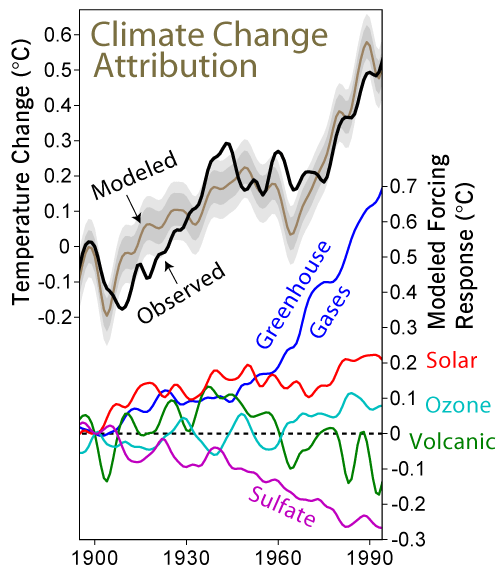
The problem with the cosmic ray theory is that there has not been any increase in cosmic rays over the 30 odd years we have been observing them. In other words how can no change in cosmic rays cause a change in cloud cover?
The implicit assumption of "skeptics" (and I used the term lightly) is that the IPCC has not investigated solar flux. The IPCC attribution graph shows this assumption is false, in fact it shows that the IPCC belives the sun is responsible for roughly a quarter of the warming and humans for more than half. -
Re:The limits of science
The Russell anecdote reminds me of the following saying of John McCarthy:
An atheist doesn't have to be someone who thinks he has a proof that there can't be a god. He only has to be someone who believes that the evidence on the God question is at a similar level to the evidence on the werewolf question.
-
Not Fair Use
Yes, making a copy of a CD for personal use is legal.
No, it's not "fair use," as I understand it, if you're making a copy of the entire thing, because of test number 3 of 17 USC Sec. 107. (Go watch A Fair(y) Use Tale again, or check out the Stanford Copyright & Fair Use web site: Fair use is a copyright principle based on the belief that the public is entitled to freely use portions of copyrighted materials forpurposes of commentary and criticism.)
Rather, 17 USC Sec. 1008 provides an explicit exception for "noncommercial use by a consumer." Prior to the addition of Chapter 10 by the Audio Home Recording Act in 1992, ripping a CD was copyright infringement.
"Fair use" doesn't mean, "that seems fair." It's a specific limitation on copyright law, and one that is not involved in ripping entire CD's. -
Re:The limits of scienceThank you, sir, for putting this discussion on the right track. The central issue is epistemology -- or, rather, ignorance of epistemology, particularly when this topic arises on certain geek news sites. However, I think we'll have to respectfully disagree on a few points. Perhaps you'd prefer a more technical treatment, but let's start simple for the benefit of the readers.
the limitations of science should be seen as the limitations of human knowledge.
No offense intended, but the prevalence of this fallacy makes it one of my pet peeves.
First, and most importantly, this position is inherently false because it is self-refuting. It is a serious and far-reaching claim, requiring justification. However, the claim itself falls outside the limitations of science. It cannot meet its own standard of justification. To state that "Only scientific claims are knowable" is equivalent to stating, "Only ten-word sentences are true."
At worst, the claim proves its own falsehood. At best, it suggests its own unknowability. So, in the best case, you should neither expect anyone to believe you, nor complain when they don't.
This idea is a form of positivism. Positivism enjoyed remarkable popularity for an remarkably short span in the early 20th century. Many hailed positivism as the end of religion, just before it died a rapid death at its own hands... though not before the scientific community had adopted it as -- oops! -- unquestioned dogma. It is a myth, perpetuated from generation to generation by those who don't know better. (Hey, that sounds a lot like Dawkins! Fancy that.)
Second, this position is also incidentally false. One could hold that a rational person shouldn't accept any non-scientific claim, even if that claim somehow happens to be correct. But no one actually does this. There are plenty of propositions that most of us accept, though they lie outside the limitations of science. The clearest example is the claim that the universe exists. Is that silly? Let me rephrase: the claim that the universe, rather than the Matrix, exists. By definition, this question can never be addressed scientifically. But that doesn't prevent it from being true, and one is hardly considered irrational or unscientific for believing in a real universe.
Other examples abound, including logic, ethics, human rights, and (of course) the principles of science itself. You are free to claim that we can't know if science works, but then you can hardly make the recommendation that you are making.We just need to face up to the fact that we appear to be epistemically limited creatures.
It is quite clear that we have epistemic limitations. But it is also quite clear that those limits aren't quite as narrow as you propose. Any epistemology that's too limited will probably be self-refuting.
Even if it's possible to doubt some of the things I've mentioned, like an objective physical world, (1) there is no obligation to do so, and (2) no one actually does so, including full-fledged skeptics (as Hume himself admits). In a many cases, perhaps most cases, doubting has no epistemic superiority over not doubting. This leads philosopher Dallas Willard to quip, "You can't just doubt your beliefs and believe your doubts. Sometimes you have to doubt your doubts and believe your beliefs."
But it is the prevailing intellectual fashion to doubt. This is really too bad, because unjustified doubt is no more intelligent than unjustified belief, a.k.a. gullibility. And it is no more accurate.
It seems to me that I could just as well suggest, "We just need to face up to the fact that it is sometimes rational to accept unprovable truths." Even if, say, the principles of science don't possess epistemic certainty, they are suffici -
Cars and drive-by-wire
Yes, very true regarding the isolation. Additionally, planes' rigorous inspection and freedom from interference allows planes to be fly-by-wire, but we do not have this luxury with cars yet...
No production car has a total steer-by-wire system yet; every car still has an absolute mechanical linkage between the steering column and the wheels. A LOT of manufacturers have been looking into alternatives -- BMW in particular (I know this car manufacturer the best) has some completely "steer-by-wire" systems are in concept cars. They have a hybrid system currently called "active steer" since '04, which I think all BMWs have, which basically increases the angle to the wheels at lower speeds.
Numerous cars now have complete "throttle-by-wire", present in BMWs though since about 2004, so there is no mechanical gas pedal linkage, and this is now relatively common, but not universal among cars. Apparently there were some complaints about it early, but now the programming is very similar to the mechanical linkage. If you lose your throttle control due to a computer malfunction, it is simply not as bad as completely losing your steering.
For some really good articles on the issues involved, check out:
http://findarticles.com/p/articles/mi_hb078/is_200311/ai_hibm1G1110736640
http://www.autofieldguide.com/columns/1103pb.html
And some guy's Stanford Ph.D. thesis -- actually a pretty good read, summarizing issues nicely.
http://www-cdr.stanford.edu/dynamic/bywire/dissertation.pdf
http://auto.howstuffworks.com/steering5.htm -
Ah, now i understand you...
Yes, you're free to choose for yourself what cause you want to help out. As you should be. And I'm free to try to persuade others to help a very worthwhile cause:
http://folding.stanford.edu/
-
Re:FoldingAtHomeET is more interesting to you until a very near relatives comes up with a serious illness like Cancer, AIDS
Some poster mentioned it earlier: If you priorities is to spend youd budget on the best way to save lives then research into Cancer or AIDS isn't the best place to put it, even within the medical research field. There are other diseases that kill far more people but get far less research dollars than Cancer/AIDS already! The money goes into areas where the research companies think there will be the best return on the investment!
That said, it is a fallacy to suggest that SETI might also result in a cure for all known ills by finding the aliens who already have the cures! Again, from another poster, the best thing SETI could do is offer a wake-up call to the religiously infatuated, perhaps providing some coffee flavoured smelling salts at the same time.
FWIW, I used to run SETI, before and after BOINC. I also ran a number of other BOINC clients, including:-
SETI,
Folding,
Climate Prediction,
Einstein searching for gravitational waves,
LHC helping with the Large Hadron Collider,
Predictor trying to predict protein structure from protein sequences,
QMC,
Rosetta,
Stardust,
yada yada yada
but removed it a year or so back as it did seem to get in the way rather too often.BOINC was just too clunky. Why did you have to register individually with each BOINC project, be given yet another HUGE number, have to search for the interesting projects yourself. BOINC should have taken care of the registration once, then offered a drop-down of active projects. Selecting something interesting would do all the install stuff for you and allow you to control the shares from the Client - currently (or at least when I left it) if you wanted to alter the share of one particular project got you had to go to each Project's website rather than just set it within the client. Just clunky!
Anyway, I moved on, but I'd have to say I'm sort of interested again and may fire up SETI again for a while to see how things have progressed since I last offered some cycles!
-
No, You're Wrong
Did I say that people's spare CPU cycles should be mandated to SETI? As if that were feasible or even possible?
When I say that Protein Folding *should* take precedence over SETI, I'm simply making an appeal to people's personal priorities--and mine favor understanding and curing diseases over inconclusive alien signal-hunting every day of the week.
Yes, you're free to choose for yourself what cause you want to help out. As you should be. And I'm free to try to persuade others to help a very worthwhile cause:
http://folding.stanford.edu/