Slashdot Mirror
Domain: techcrunch.com
Stories and comments across the archive that link to techcrunch.com.
Stories · 1,414
-
Evernote Slashes 15 Percent of Its Workforce (techcrunch.com)
Evernote, one of the most popular productivity apps on the market, is struggling to stay on top of the charts. TechCrunch, after reporting two weeks that the company "lost several of its most senior executives," is reporting that Evernote's CEO Chris O'Neill on Tuesday laid off 54 people -- roughly 15 percent of the company's workforce. O'Neill said it is now focusing its efforts around specific functions, including product development and engineering. From the report: We've just been in touch with Evernote. It pointed us to a newly posted piece by O'Neill in which he outlines the company's strategy going forward, which includes to "operate with a more focused leadership team," to "operate more efficiently," and to "double down on product development -- both quality and velocity." As for its funding situation, an Evernote representative insists that things are far from dire. The company is not fundraising, says this person; further, we're told Evernote has $30 million on its balance sheet and will exit the year without burning cash. This comes after "a person who tipped TechCrunch off to the executive departments two weeks ago characterized Evernote as 'in a death spiral,' saying that user growth and active users have been flat for the last six years and that the company's enterprise product offering hasn't caught on." -
Evernote Slashes 15 Percent of Its Workforce (techcrunch.com)
Evernote, one of the most popular productivity apps on the market, is struggling to stay on top of the charts. TechCrunch, after reporting two weeks that the company "lost several of its most senior executives," is reporting that Evernote's CEO Chris O'Neill on Tuesday laid off 54 people -- roughly 15 percent of the company's workforce. O'Neill said it is now focusing its efforts around specific functions, including product development and engineering. From the report: We've just been in touch with Evernote. It pointed us to a newly posted piece by O'Neill in which he outlines the company's strategy going forward, which includes to "operate with a more focused leadership team," to "operate more efficiently," and to "double down on product development -- both quality and velocity." As for its funding situation, an Evernote representative insists that things are far from dire. The company is not fundraising, says this person; further, we're told Evernote has $30 million on its balance sheet and will exit the year without burning cash. This comes after "a person who tipped TechCrunch off to the executive departments two weeks ago characterized Evernote as 'in a death spiral,' saying that user growth and active users have been flat for the last six years and that the company's enterprise product offering hasn't caught on." -
'I'm Admin. You're Admin. Everyone is Admin.' Remote Access Bug Turns Western Digital My Cloud Into Everyone's Cloud (theregister.co.uk)
Researchers at infosec shop Securify revealed this week a vulnerability, designated CVE-2018-17153, which allows an unauthenticated attacker with network access to the device to bypass password checks and login with admin privileges. From a report:This would, in turn, give the attacker full control over the NAS device, including the ability to view and copy all stored data as well as overwrite and erase contents. If the box is accessible from the public internet, it could be remotely pwned, it appears. Alternatively, malware on a PC on the local network could search for and find a vulnerable My Cloud machine, and compromise it. According to Securify, the flaw itself lies in the way My Cloud creates admin sessions that are attached to an IP address. When an attacker sends a command to the device's web interface, as an HTTP CGI request, they can also include the cookie username=admin -- which unlocks admin access. Thus if properly constructed, the request would establish an admin login session to the device without ever asking for a password. In other words, just tell it you're the admin user in the cookie, and you're in. The researcher told TechCrunch that he reported the vulnerability to Western Digital last year, but the company "stopped responding." -
Cloudflare Wants Internet Route Leaks To Be a Thing of the Past (techcrunch.com)
Cloudflare wants routing issues to be a thing of the past by deploying a new feature to try to stop route leaks and hijacks in their tracks. From a report: Cloudflare told TechCrunch that rolling out resource public key infrastructure (RPKI) to all of its customers for free will make it far more difficult to reroute traffic -- either by accident or deliberately. RPKI, in a nutshell, helps to ensure that traffic goes to the right place through a route that's verified as legitimate and correct by using cryptographically signed certificates.
"When two networks connect with each other -- say, AT&T and Verizon -- they announce the set of IP addresses for which they should be sent traffic," said Nick Sullivan, Cloudflare's head of cryptography. "The RPKI is a security framework to make sure a network announces only its legitimate IP addresses." Cloudflare's push in the right direction follows an effort by the National Institute for Standards and Technology, which last week published its first draft of a new standard, which incorporates RPKI as one of three components that will help prevent route leaks and hijacks. A possible approval is expected in the coming weeks. -
Altaba To Settle Lawsuits Relating To Yahoo Data Breach For $47 Million (techcrunch.com)
An anonymous reader quotes a report from TechCrunch: Altaba, the holding company of what Verizon left behind after its acquisition of Yahoo, said it has settled three ongoing legal cases relating to Yahoo's previously disclosed data breaches. In a Monday filing with the Securities and Exchange Commission, the former web giant turned investment company said it has agreed to end litigation for $47 million, which the company said will "mark a significant milestone" in cleaning up its remaining liabilities. The deal is subject to court approval, which attorneys for both sides asked the court to approve the deal within 45 days, according to a filing submitted Friday. One of the data breaches occurred in mid-2013, where data on all of the company's three billion users was stolen. The other breach occurred a year later and resulted in 500 million accounts being stolen, including email addresses and passwords. -
Does LinkedIn Suck? (techcrunch.com)
"LinkedIn Sucks" writes TechCrunch's John Biggs: I hate LinkedIn. I open it out of habit and accept everyone who adds me because I don't know why I wouldn't. There is no clear benefit to the social network. I've never met a recruiter on there. I've never gotten a job. The only messages I get are spam from offshore dev teams and crypto announcements. It's like Facebook without the benefit of maybe seeing a picture of someone's award-winning chili or dog. I understand that I'm using LinkedIn wrong. I understand I should cultivate a salon-like list of contacts that I can use to source stories and meet interesting people. But I have my own story-sourcing tools and my own contacts. It's not even good as a broadcast medium....
LinkedIn is a spam garden full of misspelled, grunty requests from international software houses that are looking, primarily, to sell you services. Because it's LinkedIn it's super easy to slip past any and all defenses against this spam.... I know people have used LinkedIn to find jobs. I never have. I know people use LinkedIn to sell products. It's never worked for me.
The article ends with advice for people trying to contact him on LinkedIn for promotional purposes. "LinkedIn isn't a game. It isn't an alternative to MailChimp. It's a conversational tool. Use it that way." But what do Slashdot's readers think? Is LinkedIn a valuable resource for finding recruiters and job offers, interesting perspectives, and updates on your friends' careers?
Or does LinkedIn suck? -
Some Northern California Cities Are Blocking Deployment of 5G Towers (techcrunch.com)
Hkibtimes tipped us off to some interesting news from TechCrunch: The Bay Area may be the center of the global technology industry, but that hasn't stopped one wealthy enclave from protecting itself from the future. The city council of Mill Valley, a small town located just a few miles north of San Francisco, voted unanimously late last week to effectively block deployments of small-cell 5G wireless towers in the city's residential areas. Through an urgency ordinance, which allows the city council to immediately enact regulations that affect the health and safety of the community, the restrictions and prohibitions will be put into force immediately for all future applications to site 5G telecommunications equipment in the city. Applications for commercial districts are permitted under the passed ordinance....
According to the city, it received 145 pieces of correspondence from citizens voicing opposition to the technology, compared to just five letters in support of it -- a ratio of 29 to 1. While that may not sound like much, the city's population is roughly 14,000, indicating that about 1% of the population had voiced an opinion on the matter. Blocks on 5G deployments are nothing new for Marin County, where other cities including San Anselmo and Ross have passed similar ordinances designed to thwart 5G expansion efforts over health concerns... The telecom industry has long vociferously denied a link between antennas and health outcomes, although California's Department of Public Health has issued warnings about potential health effects of personal cell phone antennas. Reduced radiation emissions from 5G antennas compared to 4G antennas would presumably further reduce any health effects of this technology.
The article concludes that restrictions like Mill Valley's "will make it nearly impossible to deploy 5G in a timely manner." -
Drone Startup Airware Is Shutting Down After Raising $118 Million (techcrunch.com)
Drone operating system startup Airware, which has appeared in a number of stories over the years, announced today that it will be shutting down immediately despite having raised $118 million from investors. " The startup ran out of money after trying to manufacture its own hardware that couldn't compete with drone giants like China's DJI," reports TechCrunch. "The company at one point had as many as 140 employees, all of which are now out of a job." From the report: Founded in 2011 by Jonathan Downey, the son of two pilots, Airware first built an autopilot system for programming drones to follow certain routes to collect data. It could help businesses check rooftops for damage, see how much of a raw material was coming out of a mine, or build constantly-updated maps of construction sites. Later it tried to build its own drones before pivoting to consult clients on how to most efficiently apply unmanned aerial vehicles. While flying high, Airware launched its own Commercial Drone Fund for investing in the market in 2015, and acquired 38-person drone analytics startup Redbird in 2016. In this pre-crypto, pre-AI boom, Airware scored a ton of hype from us and others as they tried to prove drones could be more than war machines. But over time, the software that shipped with commercial drone hardware from other manufacturers was good enough to make Airware irrelevant, and a downward spiral of layoffs began over the past two years, culminating in today's shutdown. Demonstrating how sudden the shut down is, Airware opened a Tokyo headquarters alongside an investment and partnership from Mitsubishi just four days ago. As for the employees, they "will get one week's severance, COBRA insurance until November, and payouts for unused paid time off," reports TechCrunch. -
Safe AI Requires Cultural Intelligence (techcrunch.com)
An anonymous reader shares an excerpt from a report written by Gillian Hadfield via TechCrunch. Hadfield is a professor of law and strategic management at the the University of Toronto; a faculty affiliate at the Vector Institute for AI; and a senior policy advisor at OpenAI. From the report: Building machines that can perform any cognitive task means figuring out how to build AI that can not only learn about things like the biology of tomatoes but also about our highly variable and changing systems of norms about things like what we do with tomatoes. [...] For AI to be truly powerful will require machines to comprehend that norms can vary tremendously from group to group, making them seem unnecessary, yet it can be critical to follow them in a given community. [...] Norms concern things not only as apparently minor as what foods to combine but also things that communities consider tremendously consequential: who can marry whom, how children are to be treated, who is entitled to hold power, how businesses make and price their goods and services, when and how criticism can be shared publicly. Successful and safe AI that achieves our goals within the limits of socially accepted norms requires an understanding of not only how our physical systems behave, but also how human normative systems behave.
Norms are not just fixed features of the environment, like the biology of a plant. They are dynamic and responsive structures that we make and remake on a daily basis, as we decide whether or when to let someone know that "this" is the way "we" do things around here. These normative systems are the systems on which we rely to solve the challenge of ensuring that people behave the way we want them to in our communities, workplaces and social environments. Only with confidence about how everyone around us is likely to behave are we all willing to trust and live and invest with one another. Ensuring that powerful AIs behave the way we want them to will not be so terribly different. Just as we need to raise our children to be competent participants in our systems of norms, we will need to train our machines to be similarly competent. It is not enough to be extremely knowledgeable about the facts of the universe; extreme competence also requires wisdom enough to know that there may be a rule here, in this group but not in that group. And that ignoring that rule may not just annoy the group; it may lead them to fear or reject the machine in their midst. -
Facebook's 'Rosetta' System Helps the Company Understand Text Within Image, Which is Crucial In Handling Memes, Flagging Abusing Content (techcrunch.com)
Facebook announced on Tuesday a new AI system, codenamed "Rosetta," which helps teams at the company as well as those at Instagram identify text within images to better understand what their subject is and more easily classify them for search or to flag abusive content. From a report: It's not all memes; the tool scans over a billion images and video frames daily across multiple languages in real time, according to a company blog post. Rosetta makes use of recent advances in optical character recognition (OCR) to first scan an image and detect text that is present, at which point the characters are placed inside a bounding box that is then analyzed by convolutional neural nets that try to recognize the characters and determine what's being communicated. This technology has been in practice for a while -- Facebook has been working with OCR since 2015 -- but implementing this across the company's vast networks provides a crazy degree of scale that motivated the company to develop some new strategies around character detection and recognition. -
Two Lawmakers Urge FTC, CFPB To Keep Pressure On Equifax (techcrunch.com)
An anonymous reader quotes a report from TechCrunch about the little fallout Equifax has faced for one of the worst data breaches in U.S. history: The credit rating giant, one of the largest in the world, was trusted with some of the most sensitive data used by banks and financiers to determine who can be lent money. But the company failed to patch a web server it knew was vulnerable for months, which let hackers crash the servers and steal data on 147 million consumers. Names, addresses, Social Security numbers and more -- and millions more driver license and credit card numbers were stolen in the breach. Millions of British and Canadian nationals were also affected, sparking a global response to the breach. Yet, a year on from following the devastating hack that left the company reeling from a breach of almost every American adult, the company has faced little to no action or repercussions.
"There was a failure of the company, but also of lawmakers," said Mark Warner, a Democratic senator, in a call with TechCrunch. Warner, who serves Virginia, was one of the first lawmakers to file new legislation after the breach. Alongside his Democratic colleague, Sen. Elizabeth Warren, the two senators said their bill, if passed, would hold credit agencies accountable for data breaches. "With Equifax, they knew for months before they reported, so at what point is that violating securities laws by not having that notice?," said Warner. "The message sent to the market is 'if you can endure some media blowback, you can get through this without serious long-term ramifications', and that's totally unacceptable," he said. Earlier this year, the company asked a federal judge to reject claims from dozens of banks and credit unions for costs taken to prevent fraud following the data breach. The claims, if accepted, could force Equifax to shell out tens of millions of dollars -- perhaps more. The hundreds of class action suits filed to date have yet to hit the courts, but historically even the largest class action cases have resulted in single dollar amounts for the individuals affected. And when the credit agent giant isn't fighting the courts, federal regulators have shown little interest in pursuit of legal action. Sen. Elizabeth Warren wrote a letter Thursday to the heads of the Federal Trade Commission (FTC) and Consumer Financial Protection Bureau (CFPB) complaining about their lack of action. "Companies like Equifax do not ask the American people before they collect their most sensitive information," said Warren. "This information can determine their ability to access credit, obtain a job, secure a home loan, purchase a car, and make dozens of other transactions that are critical to their personal financial security. The American people deserve an update on your investigations."
"[O]nly the Securities and Exchange Commission has brought charges -- not for the breach itself, but against three former staffers for allegedly insider trading," TechCrunch points out. -
Microsoft, Google Are Holding Hardware Events Next Month
Microsoft and Google are holding hardware events next month for the Surface computers and Pixel smartphones, respectively. According to TechCrunch, Microsoft is expected to refresh some of its existing products, like the Surface Pro and Studio, on October 2 at 4:00 PM EST in New York City. It's possible we'll see some new additions to the Surface family, but Microsoft did recently announced the Surface Go a couple weeks ago, so it will be off the list. The event tagline is "a moment of your time," which may mean a Surface Watch could be unveiled at the event.
As for Google, they're expected to announce the Pixel 3 and Pixel 3 XL, and possibly a new Pixelbook, which runs ChromeOS. The tagline for this event is "I [heart] NY," hinting at the Pixel 3 with the numeral in the heart emojicon. The event will be held at 8:00 AM PST on October 9 at Spring Studios. The Verge reports: The Pixel 3 and Pixel 3 XL are the third generation of the Google-branded Pixel line that was first introduced in 2016. In the past few weeks, hardware units of both devices have made their way into the world, giving us a very good idea of what to expect from the announcement. Both devices are expected to get some design tweaks, including a somewhat controversial large notch on the Pixel 3 XL and a glass back for wireless charging on both devices. Each of the Pixel devices will also have dual front-facing cameras and a single rear camera. -
Huawei Caught Cheating Performance Test For New Phones (techcrunch.com)
An anonymous reader quotes a report from TechCrunch: UL, the company behind the tablet and phone performance benchmark app 3DMark, has delisted new Huawei phones from its "Best Smartphone" leaderboard after AnandTech discovered the phone maker was boosting its performance to ace the app's test. The phones delisted were the P20, P20 Pro, Nova 3 and the Honor Play. "After testing the devices in our own lab and confirming that they breach our rules, we have decided to delist the affected models and remove them from our performance rankings," the company said in a statement.
For the Huawei case, the rules are actually a little fuzzy. Phones are permitted to adjust performance based on workload, which results in peaks or dips in performance for different apps, but they are not permitted to hard-code peaks in performance specifically for the benchmark app. Huawei reportedly claimed that the peak in performance seen during the run of the benchmark app was an intuitive jump determined by AI; however, when an unlabeled version of the benchmark test was run, the phones were unable to recognize it and, as a result, displayed lower performances. In other words, the phones aren't so smart after all. -
EU To Move Ahead With Cultural Quotas For Streaming Services (techcrunch.com)
An anonymous reader quotes a report from TechCrunch: The European Union is set to move ahead with a plan to enforce pan-European quotas on streaming services like Amazon Prime Video and Netflix to support production of locally produced film and video content. Roberto Viola, the European Commission's directorate general of communication, networks, content and technology told Variety that the new rules are on track to be approved in December. The proposals will require that streaming services give over at least 30% of their on-demand catalogues to original productions made in each EU country where a service is provided (individual EU Member States could choose to set the content bar even higher, at 40%).
Streaming services will also have to ensure visibility and prominence for local content -- so no burying the 'European third' in a dingy corner of the site where no one will find it, let alone stream it. The EU lawmakers' intention is to stand up for cultural diversity against the might of Hollywood and the flattening power of platforms -- in the latter case by making platforms invest in local content production rather than just doing the easy thing of fencing yet more Marvel superhero movies. -
Wikimedia Warns EU Copyright Reform Threatens the 'Vibrant Free Web' (techcrunch.com)
The Wikimedia Foundation has sounded a stark warning against a copyright reform proposal in Europe that's due to be voted on by the European Parliament next week. From a report: In the post, also emailed to TechCrunch, Maria Sefidari Huici, chair of the Wikimedia Foundation, writes: "Next week, the European Parliament will decide how information online is shared in a vote that will significantly affect how we interact in our increasingly connected, digital world. We are in the last few moments of what could be our last opportunity to define what the Internet looks like in the future. The next wave of proposed rules under consideration by the European Parliament will either permit more innovation and growth, or stifle the vibrant free web that has allowed creativity, innovation, and collaboration to thrive. This is significant because copyright does not only affect books and music, it profoundly shapes how people communicate and create on the internet for years to come."
Backers of the reform proposals argue they will help European creatives be fairly recompensed for their work. But critics argue the proposals are not balanced and will chill the creative freedoms of web users to share and comment on content online. -
Scientists Make a Touch Tablet That Rolls and Scrolls (techcrunch.com)
An anonymous reader quotes a report from TechCrunch: Research scientists at Queen's University's Human Media Lab have built a prototype touchscreen device that's neither smartphone nor tablet but kind of both -- and more besides. The device, which they've christened the MagicScroll, is inspired by ancient (papyrus/paper/parchment) scrolls so it takes a rolled-up, cylindrical form factor -- enabled by a flexible 7.5inch touchscreen housed in the casing. This novel form factor, which they made using 3D printing, means the device can be used like an erstwhile Rolodex (remember those?!) for flipping through on-screen contacts quickly by turning a physical rotary wheel built into the edge of the device. (They've actually added one on each end.) Then, when more information or a deeper dive is required, the user is able to pop the screen out of the casing to expand the visible display real estate. The flexible screen on the prototype has a resolution of 2K. So more mid-tier mobile phone of yore than crisp iPhone Retina display at this nascent stage. The scientists also reckon the scroll form factor offers a pleasing ergonomically option for making actual phone calls too, given that a rolled up scroll can sit snugly against the face. The team posted a video showing the prototype in action. They will be presenting the project at the MobileHCI conference on Human-Computer Interaction in Barcelona next month. -
Lenovo's Yoga Book C930 Laptop Swaps the Keyboard For an E Ink Display (techcrunch.com)
Lenovo has launched a laptop with an e-ink display in place of a normal keyboard. An anonymous reader writes: The Yoga Book C930 laptop follows in the footsteps of the Yoga Book A12, the convertible that was all the rage at IFA back in 2016. That device swapped the standard keyboard for a touchscreen, so the surface could double as a drawing pad. It wasn't particularly conducive for typing, but it certainly was innovative. The C930 takes things even further, swapping the Halo keyboard for E Ink. It's an interesting application for the technology, which has largely been relegated to the world of e-readers. The secondary display serves the same function as on the A12, doing triple duty as a keyboard, notepad and e-reader. The C930 will be available in October, starting at $1,000. -
John McAfee's 'Unhackable' Bitfi Wallet Got Hacked -- Again (techcrunch.com)
Earlier this month, computer programmer John McAfee released "the world's first un-hackable storage for cryptocurrency & digital assets" -- a $120 device, called the Bitfi wallet, that McAfee claimed contained no software or storage. McAfee was so sure of its security that it launched with a bug bounty inviting researchers to try and hack the wallet in return for a $250,000 award. Lo and behold, a researcher by the name of Andrew Tierney managed to hack the wallet, but Bitfi declined to pay out, arguing that the hack was outside the scope of the bounty. TechCrunch is now reporting that Tierney has managed to hack the Bitfi wallet again. An anonymous reader shares the report: Security researchers have now developed a second attack, which they say can obtain all the stored funds from an unmodified Bitfi wallet. The Android-powered $120 wallet relies on a user-generated secret phrase and a "salt" value -- like a phone number -- to cryptographically scramble the secret phrase. The idea is that the two unique values ensure that your funds remain secure. But the researchers say that the secret phrase and salt can be extracted, allowing private keys to be generated and the funds stolen. Using this "cold boot attack," it's possible to steal funds even when a Bitfi wallet is switched off. Within an hour of the researchers posting the video, Bitfi said in a tweeted statement that it has "hired an experienced security manager, who is confirming vulnerabilities that have been identified by researchers." -
John McAfee's 'Unhackable' Bitfi Wallet Got Hacked -- Again (techcrunch.com)
Earlier this month, computer programmer John McAfee released "the world's first un-hackable storage for cryptocurrency & digital assets" -- a $120 device, called the Bitfi wallet, that McAfee claimed contained no software or storage. McAfee was so sure of its security that it launched with a bug bounty inviting researchers to try and hack the wallet in return for a $250,000 award. Lo and behold, a researcher by the name of Andrew Tierney managed to hack the wallet, but Bitfi declined to pay out, arguing that the hack was outside the scope of the bounty. TechCrunch is now reporting that Tierney has managed to hack the Bitfi wallet again. An anonymous reader shares the report: Security researchers have now developed a second attack, which they say can obtain all the stored funds from an unmodified Bitfi wallet. The Android-powered $120 wallet relies on a user-generated secret phrase and a "salt" value -- like a phone number -- to cryptographically scramble the secret phrase. The idea is that the two unique values ensure that your funds remain secure. But the researchers say that the secret phrase and salt can be extracted, allowing private keys to be generated and the funds stolen. Using this "cold boot attack," it's possible to steal funds even when a Bitfi wallet is switched off. Within an hour of the researchers posting the video, Bitfi said in a tweeted statement that it has "hired an experienced security manager, who is confirming vulnerabilities that have been identified by researchers." -
Google's $50 Titan Security Keys Are Now Available in the US (engadget.com)
Last month, Google introduced its Titan Key -- a physical security key used for two-factor authentication -- and now it's widely available for purchase in the US through company's Google Store. Almost any modern browser and mobile device, as well as services such as Dropbox, Twitter, Facebook, Salesforce, Stripe support the Titan Key. It's Google's take on a Fast Identity Online key, a physical device used to authenticate logins over Bluetooth. From a report: For $50, you'll get a USB security key and a Bluetooth security key as well as a USB-C to USB-A adapter and a USB-C to USB-A connecting cable. What happens if you lose them? From a report: A downside of physical keys is that if lose them, you're toast. That's why you have two keys -- one is meant to be a backup. Google says it can help you gain access to your account again but the recovery process can take days. VentureBeat adds: It's not meant to compete with other FIDO keys on the market, stressed Sam Srinivas, product management director for information security at Google, during a press pre-briefing. Rather, it's "for customers who want security keys and trust Google," he said. Further reading: None of Google's 85,000 Employees Have Been Phished in More Than a Year After Company Required Them to Use Physical Security Keys For 2FA. -
Facebook Expands Its Express Wi-Fi Program For Developing Markets Via Hardware Partnerships (techcrunch.com)
Facebook is today launching a partner program for its Express Wi-Fi initiative, which helps bring higher-speed connections to developing markets, including India, Indonesia, Kenya, Nigeria, and Tanzania. From a report: The program itself involves having local business owners install Wi-Fi hotspots, where internet service is provided by local ISPs, mobile network operators, and others that Facebook has partnered with. Now, Facebook is launching a new partner program that will allow access point manufacturers to build devices compatible with Express Wi-Fi. Its debut lineup of partners for "Express Wi-Fi Certified," as the partner program is called, include Arista, Cambium Networks, and Ruckus Networks, an ARRIS Company. Facebook first began testing Express Wi-Fi three years ago, and has since expanded it to the five above countries and 10 partners. -
Netflix Is the Latest Company To Try Bypassing Apple's App Store (marketwatch.com)
Netflix is testing a way for users to register and pay for the streaming service while bypassing Apple's app store and hefty commission fees. MarketWatch reports: Netflix is looking into a new sign-up approach where users in some countries are no longer able to register for streaming service. They are being redirected to the mobile web version of the app and asked to enter payment details with Netflix directly. The test is running in 33 countries, not including the U.S., through the month of September, according to TechCrunch. This comes just months after Netflix in May made billing through Google Pay unavailable to new customers, though current subscribers that pay via Google Play can continue to do so until they cancel their accounts. -
The Consequences of Indecency (techcrunch.com)
Ron Wyden, a senior U.S. Senator from Oregon, argues there should be consequences for internet companies that refuse to remove hate speech from their platforms. An anonymous reader shares an excerpt from a report Wyden wrote via TechCrunch: I wrote the law that allows sites to be unfettered free speech marketplaces. I wrote that same law, Section 230 of the Communications Decency Act, to provide vital protections to sites that didn't want to host the most unsavory forms of expression. The goal was to protect the unique ability of the internet to be the proverbial marketplace of ideas while ensuring that mainstream sites could reflect the ethics of society as a whole. In general, this has been a success -- with one glaring exception. I never expected that internet CEOs would fail to understand one simple principle: that an individual endorsing (or denying) the extermination of millions of people, or attacking the victims of horrific crimes or the parents of murdered children, is far more indecent than an individual posting pornography.
Social media cannot exist without the legal protections of Section 230. That protection is not constitutional, it's statutory. Failure by the companies to properly understand the premise of the law is the beginning of the end of the protections it provides. I say this because their failures are making it increasingly difficult for me to protect Section 230 in Congress. Members across the spectrum, including far-right House and Senate leaders, are agitating for government regulation of internet platforms. Even if government doesn't take the dangerous step of regulating speech, just eliminating the 230 protections is enough to have a dramatic, chilling effect on expression across the internet. Were Twitter to lose the protections I wrote into law, within 24 hours its potential liabilities would be many multiples of its assets and its stock would be worthless. The same for Facebook and any other social media site. Boards of directors should have taken action long before now against CEOs who refuse to recognize this threat to their business. In an interview with Recode, Wyden said that platforms should be punished for hosting content that goes against "common decency." "I think what the Alex Jones case shows, we're gonna really be looking at what the consequences are for just leaving common decency in the dust," Wyden told Recode's Kara Swisher. "...What I'm gonna be trying to do in my legislation is to really lay out what the consequences are when somebody who is a bad actor, somebody who really doesn't meet the decency principles that reflect our values, if that bad actor blows by the bounds of common decency, I think you gotta have a way to make sure that stuff is taken down." -
Millions of Texas Voter Records Exposed Online (techcrunch.com)
A folder containing an estimated 14.8 million Texas voter records was left on an unsecured server without a password. Considering Texas has 19.3 million registered voters, this leak is very substantial. The file was discovered by a New Zealand-based data breach hunter who goes by the pseudonym Flash Gordon. TechCrunch reports: It's not clear who owned the server where the exposed file was found, but an analysis of the data reveals that it was likely originally compiled by Data Trust, a Republican-focused data analytics firm created by the GOP to provide campaigns with voter data. The file -- close to 16 gigabytes in size -- contained dozens of fields, including personal information like a voter's name, address, gender and several years' worth of voting history, including primaries and presidential elections. It's not known exactly when the data was compiled, but an analysis of the data suggests it was prepared in time for the 2016 presidential election. It's also not known if the file is a subset of the 198 million records leak last year -- or if it's a standalone data set. -
DNC Says Reported Hack Attempt Was a False Alarm (wsj.com)
furry_wookie writes: A suspected attempt to hack into the Democratic National Committee's voter database was actually a cybersecurity test [Editor's note: the originally submitted article might be paywalled; an alternative source], the organization said. The DNC, which was [allegedly] hacked by Russian intelligence officers during the 2016 presidential campaign, said Tuesday it had contacted the Federal Bureau of Investigation after being alerted to an apparent phishing scheme by the computer security firm Lookout Inc., which uncovered a replica of the login page to the DNC's Votebuilder database during an online scan. In a statement early Wednesday, Bob Lord, the DNC's chief information security officer, said the DNC and its partners who reported the site 'now believe it was built by a third party as part of a simulated phishing test.' -
Australia Bans Huawei, ZTE From Supplying Technology For Its 5G Network (techcrunch.com)
An anonymous reader quotes a report from TechCrunch: Australia has blocked Huawei and ZTE from providing equipment for its 5G network, which is set to launch commercially next year. In a tweet, Huawei stated that the Australian government told the company that both it and ZTE are banned from supplying 5G technology to the country, despite Huawei's assurances that it does not pose a threat to national security. Earlier today, the Australian government issued new security guidelines for 5G carriers. Although it did not mention Huawei, ZTE or China specifically, it did strongly hint at them by stating "the Government considers that the involvement of vendors who are likely to be subject to extrajudicial directions from foreign government that conflict with Australian law, may risk failure by the carrier to adequately protect a 5G network from unauthorized access or interference." In its new security guidelines, the Australian government stated that differences in the way 5G operates compared to previous network generations introduces new risks to national security. In particular, it noted the diminishing distinctions between the core network, where more sensitive functions like access control and data routing occur, and the edge, or radios that connect customer equipment, like laptops and mobile phones, to the core. Huawei Australia said in a statement: "We have been informed by the Govt that Huawei & ZTE have been banned from providing 5G technology to Australia. This is a extremely disappointing result for consumers. Huawei is a world leader in 5G. Has safely & securely delivered wireless technology in Aust for close to 15 yrs." -
'Legacy System' Exposed Black Hat 2018 Attendees' Contact Info (techcrunch.com)
An anonymous reader quotes a report from TechCrunch: A "legacy system" was to blame for exposing the contact information of attendees of this year's Black Hat security conference. Colorado-based pen tester and security researcher who goes by the handle NinjaStyle said it would have taken about six hours to collect all the registered attendees' names, email and home addresses, company names and phone numbers from anyone who registered for the 2018 conference. In a blog post, he explained that he used a reader to access the data on his NFC-enabled conference badge, which stored his name in plaintext and other scrambled data. The badge also contained a web address to download BCard, a business card reader app. After decompiling the BCard app, the researcher found an API endpoint in its code, which he used to pull his own data from the server without any security checks. By enumerating and cycling through unique badge ID numbers, he was able to download a few hundred Black Hat attendee records from the server. The API was not rate limited either at all or enough to prevent the mass downloading of attendee records, the blog post said. The legacy system's API was disabled within a day of the disclosure. Black Hat said in a statement: "Thanks to them for disclosing this promptly and responsibly to our technology partner, who addressed the vulnerability immediately. We're working with our partner to ensure this isn't an issue in the future." -
Saint Louis University Is Outfitting Student Living Spaces With Thousands of Echo Dots (techcrunch.com)
Saint Louis University announced this week a plan to outfit living spaces with 2,300 Echo Dots. The smart speakers will be ready by the time classes start later this month. TechCrunch reports: SLU is quick to note that it's "the first college or university in the country to bring Amazon Alexa-enabled devices, managed by Alexa for Business, into every student residence hall room and student apartment on campus." It's certainly not the first to adopt Amazon's smart speakers, but it's among the largest scale for this sort of deployment. While the product has become a mainstay in plenty of American homes, it does seem like an odd choice dorms and student campus. SLU has worked with Alexa for Business to create 100 custom questions, including, "What time does the library close tonight?" and "Where is the registrar's office?"
The company addressed [the privacy concerns] on a privacy page, writing: "Because of our use of the Amazon Alexa for Business (A4B) platform, your Echo Dot is managed by a central system dedicated to SLU. This system is not tied to individual accounts and does not maintain any personal information for any of our users, so all use currently is anonymous. Additionally, neither Alexa nor the Alexa for Business management system maintains recordings of any questions that are asked." -
BitTorrent Founder Bram Cohen Has Left the Company (theverge.com)
An anonymous reader quotes a report from The Verge: Bram Cohen, a co-founder of BitTorrent, the company which oversees the development of eponymous P2P protocol, has left its board, he told TorrentFreak. The revelation comes weeks after the file-sharing service provider said it had been acquired by blockchain startup Tron. It remains unclear exactly when Cohen, who also served as a lead engineer at the firm for years, made the decision to part ways with the company. He hinted to TechCrunch last year that, as of August, he was no longer involved in the day-to-day operations of the company. The departure of Cohen underscores BitTorrent's long battle to find a lucrative business model. The company, the services of which are used by more than 100 million customers, has long struggled to find new applications of its platform and avenues to bring home some cash. In 2016, the company announced a mobile music and video streaming service [called] BitTorrent Now, which it abruptly shut down months later while also firing its co-CEOs. Last year, the company shut down its much hyped live streaming service BitTorrent Live, which Variety described as a brainchild of Cohen. -
MoviePass Is Limiting Selection To 'Up To Six Films' a Day (techcrunch.com)
MoviePass is changing things up once again. In an email, CEO Mitch Lowe outlined the latest updates to the once-unlimited subscription plan. Most notable among the changes is the limiting of selection to "up to six films to choose from daily, including a selection of major studio first-run films and independent releases." TechCrunch reports: On top of that, there may be further limitations on showtime availability for the selected titles, based on "the popularity of those films on the app that particular day." The company has already begun limiting access to specific films, starting with a barring of major blockbusters and moving toward limiting selection generally. Now users can go to the "This Week's Movies" page to see what's available. Right now, there's a semi-consistent, rotating selection. Which movies are chosen and when will likely be at least partially dependent on deals struck between MoviePass and studios/distributors. -
Google Releases a Searchable Database of US Political Ads (techcrunch.com)
An anonymous reader quotes a report from TechCrunch: In an effort to provide more transparency and deliver on a promise to Congress, Google just published an archive of political ads that have run on its platform. Google's new database, which it calls the Ad Library, is searchable through a dedicated launch page. Anyone can search for and filter ads, viewing them by candidate name or advertiser, spend, the dates the ads were live, impressions and type. For anyone looking for the biggest ad budget or the farthest reaching political ad, the ads can be sorted by spend, impressions and recency, as well. Google also provided a report on the data, showing ad spend by U.S. state, by advertiser and by top keywords. -
Tinder Founders Sue Dating App's Owners For At Least $2 Billion (techcrunch.com)
An anonymous reader quotes a report from TechCrunch: A group of Tinder founders and executives has filed a lawsuit against parent company Match Group and its controlling shareholder IAC. The plaintiffs in the suit include Tinder co-founders Sean Rad, Justin Mateen and Jonathan Badeen -- Badeen still works at Tinder, as do plaintiffs James Kim (the company's vice president of finance) and Rosette Pambakian (its vice president of marketing and communications). The suit alleges that IAC and Match Group manipulated financial data in order to create "a fake lowball valuation" (to quote the plaintiffs' press release), then stripped Rad, Mateen, Badeen and others of their stock options. It points to the removal of Rad as CEO, as well as other management changes, as moves designed "to allow Defendants to control the valuation of Tinder and deprive Tinder optionholders of their right to participate in the company's future success."
The lawsuit also alleges that Greg Blatt, the Match CEO who became CEO of Tinder, groped and sexually harassed Pambakian at the company's 2016 holiday party, supposedly leading the company to "whitewash" his actions long enough for him to complete the valuation of Tinder and its merger with Match Group, and then to announce his departure. In response, the plaintiffs are asking for "compensatory damages in an amount to be determined at trial, but not less than $2,000,000,000." IAC and Match Group issued a statement denying the allegations: "...Match Group and the plaintiffs went through a rigorous, contractually-defined valuation process involving two independent global investment banks, and Mr. Rad and his merry band of plaintiffs did not like the outcome. Mr. Rad (who was dismissed from the Company a year ago) and Mr. Mateen (who has not been with the Company in years) may not like the fact that Tinder has experienced enormous success following their respective departures, but sour grapes alone do not a lawsuit make. Mr. Rad has a rich history of outlandish public statements, and this lawsuit contains just another series of them. We look forward to defending our position in court." -
California May Become First State To Require Companies To Have Women On Their Boards (techcrunch.com)
Two female state senators from California are spearheading a bill to require companies to have women on their boards. "SB 826, which won Senate approval with only Democratic votes and has until the end of August to clear the Assembly, would require publicly held companies headquartered in California to have at least one woman on their boards of directors by end of next year," reports TechCrunch. "By 2021, companies with boards of five directors must have at least two women, and companies with six-member boards must have at least three women. Firms failing to comply would face a fine." From the report: "Gender diversity brings a variety of perspectives to the table that can help foster new and innovative ideas," said Democratic Sen. Hannah-Beth Jackson of Santa Barbara, who is sponsoring the bill with Senate President Pro Tem Toni Atkins of San Diego. "It's not only the right thing to do, it's good for a company's bottom line."
Yet critics of the bill say it violates the federal and state constitutions. Business associations say the rule would require companies to discriminate against men wanting to serve on boards, as well as conflict with corporate law that says the internal affairs of a corporation should be governed by the state law in which it is incorporated. This bill would apply to companies headquartered in California. [A] legislative analysis of the bill cautioned that it could get challenged on equal protection grounds, and that it would be difficult to defend, requiring the state to prove a compelling government interest in such a quota system for a private corporation. -
Facebook Now Deletes Posts That Financially Endanger, Trick People (techcrunch.com)
An anonymous reader quotes a report from TechCrunch: It's not just inciting violence, threats and hate speech that will get Facebook to remove posts by you or your least favorite troll. Endangering someone financially, not just physically, or tricking them to earn a profit are now also strictly prohibited. Facebook today spelled out its policy with more clarity in hopes of establishing a transparent set of rules it can point to when it enforces its policy in the future. "We do not, for example, allow content that could physically or financially endanger people, that intimidates people through hateful language, or that aims to profit by tricking people using Facebook," its VP of policy Richard Allen published today. Web searches show this is the first time Facebook has used that language regarding financial attacks. -
Audius Raises $5.5 Million To Decentralize Music, Help Artists Get Paid Faster (techcrunch.com)
A new company called Audius, lead by entrepreneur and DJ Ranidu Lankage, has raised $5.5 million to build a blockchain-based alternative to Spotify or SoundCloud. "Users will pay for Audius tokens or earn them by listening to ads," reports TechCrunch. "Their wallet will then pay out a fraction of a cent per song to stream from decentralized storage across the network, with artists receiving roughly 85 percent -- compared to roughly 70 percent on the leading streaming apps. The rest goes to compensating whomever is hosting that song, as well as developers of listening software clients, one of which will be built by Audius." From the report: Audius plans to launch its open-sourced product in beta later this year. But it's already found some powerful investors that see SoundCloud as vulnerable to the cryptocurrency revolution. Audius has raised a $5.5 million Series A led by General Catalyst and Lightspeed, with participation from Kleiner Perkins, Pantera Capital, 122West and Ascolta Ventures. They're betting that Audius' token will grow in value, making the stockpile it keeps worth a fortune. It could then sell chunks of its tokens to earn revenue instead of charging artists directly. The big question will be whether Audius can use the token economy to crack the chicken-and-egg problem of getting its first creators and listeners on a platform that might be less functionally robust than its traditional competitors. There are a lot of moving parts to decentralize, but there are also plenty of disgruntled musicians out there waiting for something better. -
Elon Musk Says He's Considering Taking Tesla Private; Tesla Suspends Shares As It is Expected To Make an Announcement (cnn.com)
Elon Musk said he's thinking about taking Tesla private. More specifically, he said he may buy back the company for $71.3 billion (at a share price of $420), and already has the funding to do so. From a report: Musk, the CEO and largest shareholder of the electric car maker, said on Twitter on Tuesday that he has secured funding from a private buyer. He implied that the funding values the company at $420 a share. The stock had been worth about $342 a share before Musk's tweet, and shares quickly jumped as high as $371. The stock had climbed slightly earlier in the day after the Financial Times reported that Saudi Arabia has quietly built a big stake in Tesla. Tesla didn't immediately respond to a request for comment. About an hour and 20 minutes after the Musk tweet, trading in Tesla stock was suspended because the company was expected to release news. TechCrunch: Musk's hope, he later tweeted, is that "all current investors remain with Tesla even if we're private. Would create special purpose fund enabling anyone to stay with Tesla. Already do this with Fidelity's SpaceX investment." Musk, who said he would stay on as CEO, also seems willing to have a provision for retail investors, who have held Tesla shares prior to Dec. 31, 2016, to convert their shares into private shares. Musk, in response to a tweet, said he's "super appreciative of Tesla shareholders" and "will ensure their prosperity in any scenario." Musk has publicly mused about taking Tesla private before, saying in a 2017 Rolling Stone profile: "I wish we could be private with Tesla," Musk murmurs as they exit. "It actually makes us less efficient to be a public company."
Analysts speaking to Reuters said they believe Musk is serious. George Galliers of Evercore ISI, said, "I can't believe this is something to bluff or make fun of. Given his historic frustration with short sellers, analysts and certain parts of the press, it is perhaps also not surprising that he has given consideration to taking the company private."
Update: Elon Musk sent an email to employees on Tuesday to explain his rationale behind the move. He wrote: Earlier today, I announced that I'm considering taking Tesla private at a price of $420/share. I wanted to let you know my rationale for this, and why I think this is the best path forward. First, a final decision has not yet been made, but the reason for doing this is all about creating the environment for Tesla to operate best. As a public company, we are subject to wild swings in our stock price that can be a major distraction for everyone working at Tesla, all of whom are shareholders. Being public also subjects us to the quarterly earnings cycle that puts enormous pressure on Tesla to make decisions that may be right for a given quarter, but not necessarily right for the long-term. Finally, as the most shorted stock in the history of the stock market, being public means that there are large numbers of people who have the incentive to attack the company. I fundamentally believe that we are at our best when everyone is focused on executing, when we can remain focused on our long-term mission, and when there are not perverse incentives for people to try to harm what we're all trying to achieve. This is especially true for a company like Tesla that has a long-term, forward-looking mission. SpaceX is a perfect example: it is far more operationally efficient, and that is largely due to the fact that it is privately held. This is not to say that it will make sense for Tesla to be private over the long-term. In the future, once Tesla enters a phase of slower, more predictable growth, it will likely make sense to return to the public markets. In a tweet moments ago, Musk said, "Investor support is confirmed. Only reason why this is not certain is that it's contingent on a shareholder vote." -
Palm-branded Smartphones Could Return This Year (techcrunch.com)
Palm's smartphone return appears to still be on track for 2018. From a report: Last year, an executive at TCL confirmed that the dearly departed mobile brand would be making a comeback as part of the smartphone conglomerate's portfolio, and with a little under five months left in the year, the 'PVG100' has hit the FCC and WiFi alliance. The handset was spotted by Android Police, but we don't really have much more to go on than a name and a couple of WiFi bands. As the site notes, however, the absence of 5GHz support leads one to surmise that this won't exactly be a barn-burning flagship. The handset also looks to be running Android 8.1 -- not really a surprise, given that Android Pie is still limited to Pixel and a smattering of other devices. -
Researchers Discover Large Twitter Botnet Pushing Ethereum Scam (techcrunch.com)
Trailrunner7 writes: Twitter has something of a bot problem. Anyone who uses the platform on even an occasional basis likely could point out automated accounts without much trouble. But detecting bots at scale is a much more complex problem, one that a pair of security researchers decided to tackle by building their own classifier and analyzing the characteristics and behavior of 88 million Twitter accounts. Using a machine learning model with a set of 20 distinct characteristics such as the number of tweets relative to the age of the account and the speed of replies and retweets, the classifier is able to detect bots with about 98 percent accuracy. The tool outputs a probability that a given account is a bot, with anything above 50 percent likely being a bot.
During their research, conducted from May through July, Jordan Wright and Olabode Anise of Duo Security discovered an organized network of more than 15,000 bots that was being used to promote a cryptocurrency scam. The botnet, which is still partially active, spoofs many legitimate accounts and even took over some verified accounts as part of a scheme designed to trick victims into sending small amounts of the cryptocurrency Ethereum to a specific address. Unlike most botnets, the Ethereum network has a hierarchical structure, with a division of labor among the bots. Usually, each bot in a network performs the same task, whether that's launching a DDoS attack or mining Bitcoin on a compromised machine. But the Ethereum botnet had clusters of bots with a three-tier organization. Some of the bots published the scam tweets, while others amplified those tweets or served as hub accounts for others to follow. Wright and Anise mapped the social media connections between the various accounts and looked at which accounts followed which others to create a better picture of the network. Anise and Wright will discuss the results of their research during a talk at the Black Hat USA conference on Wednesday and will release their detection tool as an open source project that day, too. -
FCC Admits It Was Never Actually Hacked (techcrunch.com)
An anonymous reader quotes a report from TechCrunch: The FCC has come clean on the fact that a purported hack of its comment system last year never actually took place, after a report from its inspector general found a lack of evidence supporting the idea. Chairman Ajit Pai blamed the former chief information officer and the Obama administration for providing "inaccurate information about this incident to me, my office, Congress, and the American people." It was so galling to everyone looking for answers that the GAO was officially asked to look into it. The letter requesting the office's help at the time complained that the FCC had "not released any records or documentation that would allow for confirmation that an attack occurred, that it was effectively dealt with, and that the FCC has begun to institute measures to thwart future attacks and ensure the security of its systems." That investigation is still going on, but one conducted by the FCC's own OIG resulted in the report Pai cites.
Pai's statement was issued before the OIG publicized its report, as one does when a report is imminent that essentially says your agency has been clueless at best or deliberately untruthful at worst, and for more than a year. To be clear, the report is still unpublished, though its broader conclusions are clear from Pai's statement. In it he slathers Bray with the partisan brush and asserts that the report exonerates his office: "I am deeply disappointed that the FCC's former [CIO], who was hired by the prior Administration and is no longer with the Commission, provided inaccurate information about this incident to me, my office, Congress, and the American people. This is completely unacceptable. I'm also disappointed that some working under the former CIO apparently either disagreed with the information that he was presenting or had questions about it, yet didn't feel comfortable communicating their concerns to me or my office. On the other hand, I'm pleased that this report debunks the conspiracy theory that my office or I had any knowledge that the information provided by the former CIO was inaccurate and was allowing that inaccurate information to be disseminated for political purposes." UPDATE: The complete Office of Inspector General report has been released, refuting claims that a cyberattack was responsible for disrupting the FCC's comment system last year. -
Facebook Has Asked Large US Banks To Share Detailed Financial Information About Customers as it Seeks To Boost User Engagement [Update] (wsj.com)
Facebook wants your financial data. The social media giant has asked large U.S. banks to share detailed financial information about their customers, including card transactions and checking account balances, as part of an effort to offer new services to users, The Wall Street Journal reported Monday. From the report: Facebook increasingly wants to be a platform where people buy and sell goods and services, besides connecting with friends. The company over the past year asked JPMorgan Chase, Wells Fargo & Co., Citigroup and U.S. Bancorp USB to discuss potential offerings it could host for bank customers on Facebook Messenger, said people familiar with the matter. Facebook has talked about a feature that would show its users their checking-account balances, the people said. It has also pitched fraud alerts, some of the people said. Data privacy is a sticking point in the banks' conversations with Facebook, according to people familiar with the matter. The talks are taking place as Facebook faces several investigations over its ties to political analytics firm Cambridge Analytica, which accessed data on as many 87 million Facebook users without their consent. Update: Shares of Facebook surged nearly 3% following the report. A paywall free, alternative source of this story.
Update 2 (18:10 GMT): Talking to TechCrunch, Facebook has, in part, denied WSJ's report. TechCrunch: Facebook spokesperson Elisabeth Diana tells TechCrunch it's not asking for credit card transaction data from banks and it's not interested in building a dedicated banking feature where you could interact with your accounts. It also says its work with banks isn't to gather data to power ad targeting, or even personalize content such as what Marketplace products you see based on what you buy elsewhere. -
New Alexa Skill Plays Fake Stupid Arguments To Scare Off Burglars (techcrunch.com)
TechCrunch reports on a new Alexa skill called "Away Mode". Instead of lights and noises, you can keep your home safe from unwanted visitors by playing lengthy audio tracks that sound like real -- and completely ridiculous -- conversations. When you launch Away Mode, Alexa will play one of seven audio tracks penned by comedy writers from SNL, It's Always Sunny in Philadelphia, and UCB... These include gems like "Couple Has Breakup While Also Trying to Watch TV," "Two Average Guys Brainstorm What's Unique About Themselves So They Can Start a Podcast About It," "Emergency PTA Meeting To Discuss Memes, Fidget Spinners, and Other Teen Fads," and more. There are conversations from a book club where no one discusses the book, a mom walking her daughter through IKEA assembly over the phone, a stay-at-home mom losing her s***, and argument over a board game....
After enabling the skill on your Alexa device, you can cycle through the various conversations by saying "Next"... The tracks themselves are around an hour or so long... There are other "burglar deterrent" skills for Alexa if you're interested in the general concept, like that play fake house alarms or sound like guard dogs. But Away Mode is just a little more fun.
It's the brainchild of San Francisco-based Hippo Insurance, whose brand manager hopes to get people thinking about home security (though she says it isn't meant to be a serious security tool). Yet, "Theoretically it's a good idea," adds former California police chief Jim Bueermann (now the head of the nonprofit Police Foundation). "If this thing mimics real conversation, it's much more likely to trick the burglar into believing somebody is home."
In one fake argument, a board game player shouts "Hand me the rulebook! The other rulebook! That's the rules reference.... No, it's in the learn-to-play guide. That's the quick reference!" -
Surface Go Reviews Are All Over the Place (arstechnica.com)
The reviews for Microsoft's Surface Go tablet are in, and they're all over the place. While the press generally agrees that the processor is slow and can only handle light tasks, such as browsing and mail, there are mixed conclusions as to whether or not the 10-inch, $399 tablet is worth buying. Ars Technica's Peter Bright summarizes: So, should you buy one? That's hard to say. Mashable was a fairly unequivocal "no:" for light productivity, a Chromebook or iPad does the job for less money, and the performance is too problematic for anything much beyond that. On the other side of the coin, Windows Central reckoned that "as a mini-PC [Surface Go] is about as good as you can get," and Ed Bott said, "It's the best cheap PC I've ever used." Gizmodo called it the "perfect representation of what laptops at this price should be." For everyone else, it depends. TechCrunch says that it's worth a look, but there's no shortage of competition around this price point. Acer and Lenovo, among others, offer decent systems that are a bit cheaper. PCWorld concludes that, if you want a tablet, get an honest-to-god tablet (which is to say, an iPad) rather than a system with Windows 10. But if you want something small and light and might just need the full flexibility of a PC, Go is the system to go for. Engadget acknowledged that the Go is "full of compromises" but that, as a "secondary device," the keyboard and software compatibility give it the edge over other tablets. The Verge concludes similarly: it's "probably not the right thing to be your only computer," but it could have a "real place" as a secondary machine. And VentureBeat took a similar line: if you really want the flexibility of a two-in-one, "you're unlikely to find anything better," but if you want either a laptop or a tablet, "you'll find better options for less." As a refresher, the Surface Go features a 10-inch touchscreen display with a 1800x1200 (217 PPI) resolution and 3:2 aspect ratio, an Intel Pentium Gold 4415Y Kaby Lake processor with up to 8GB of RAM and 128GB storage via a SSD (the 64GB eMMC variant features 4GB of RAM), integrated Intel HD Graphics 615, and "up to 9 hours" of battery life. The base model is just $399, compared to the $549 model with 128GB/8GB RAM. -
Tesla Is Building Its Own AI Chips For Self-Driving Cars (techcrunch.com)
Yesterday, during his quarterly earnings call, Tesla CEO Elon Musk revealed a new piece of hardware that the company is working on to perform all the calculations required to advance the self-driving capabilities of its vehicles. The specialized chip, known as "Hardware 3," will be "swapped into the Model S, X, and 3," reports TechCrunch. From the report: Tesla has thus far relied on Nvidia's Drive platform. So why switch now? By building things in-house, Tesla say it's able to focus on its own needs for the sake of efficiency. "We had the benefit [...] of knowing what our neural networks look like, and what they'll look like in the future," said Pete Bannon, director of the Hardware 3 project. Bannon also noted that the hardware upgrade should start rolling out next year. "The key," adds Elon "is to be able to run the neural network at a fundamental, bare metal level. You have to do these calculations in the circuit itself, not in some sort of emulation mode, which is how a GPU or CPU would operate. You want to do a massive amount of [calculations] with the memory right there." The final outcome, according to Elon, is pretty dramatic: He says that whereas Tesla's computer vision software running on Nvidia's hardware was handling about 200 frames per second, its specialized chip is able to crunch out 2,000 frames per second "with full redundancy and failover." Plus, as AI analyst James Wang points out, it gives Tesla more control over its own future. -
Magic Leap Offers a First Look At Its Mixed Reality OS (cnet.com)
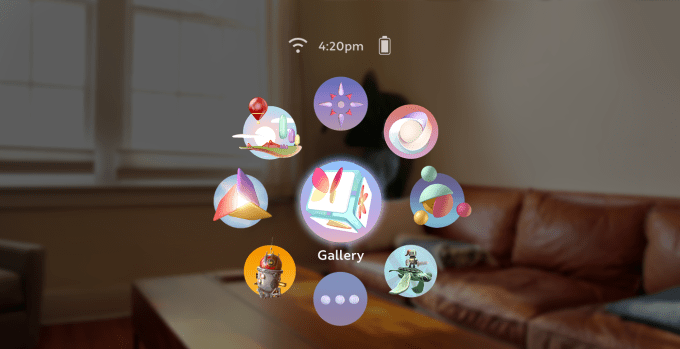
TechCrunch's Lucas Matney describes the Lumin operating system that will power Magic Leap's upcoming Magic Leap One mixed reality headset: Alright, first, this is what the Magic Leap One home screen will apparently look like, it's worth noting that it appears that Magic Leap will have some of its own stock apps on the device, which was completely expected but they haven't discussed much about. Also worth noting is that Magic Leap's operating system by and large looks like most other operating systems, they seem to be well aware that flat interfaces are way easier to navigate so you're not going to be engaging with 3D assets just for the sake of doing so. The company seems to be distinguishing between two basic app types for developers: immersive apps and landscape apps. Landscape apps like what you see in the image above, appear to be Magic Leap's version of 2D where interfaces are mostly flat but have some depth and live inside a box called a prism that fits spatially into your environment. It seems that you'll be able to have several of these running simultaneously. Immersive apps, on the other hand, like the game title, Dr. Grordbort -- which Magic Leap has been teasing for years -- respond to the geometry of the space that you are in and is thus called an immersive app.
Moving beyond apps, the company also had a good deal to share about how you interact with what's happening in the headset. Magic Leap will have a companion smartphone app that you can type into, you can connect a bluetooth keyboard and there will also be an onscreen keyboard with dictation capabilities. One of the big highlights of Magic Leap tech is that you'll be able to share perspectives of these apps in a multi-player experience which we now know is called "casting," apps that utilize these feature will just have a button that you can press to share an experience with a contact. -
Magic Leap Offers a First Look At Its Mixed Reality OS (cnet.com)
TechCrunch's Lucas Matney describes the Lumin operating system that will power Magic Leap's upcoming Magic Leap One mixed reality headset: Alright, first, this is what the Magic Leap One home screen will apparently look like, it's worth noting that it appears that Magic Leap will have some of its own stock apps on the device, which was completely expected but they haven't discussed much about. Also worth noting is that Magic Leap's operating system by and large looks like most other operating systems, they seem to be well aware that flat interfaces are way easier to navigate so you're not going to be engaging with 3D assets just for the sake of doing so. The company seems to be distinguishing between two basic app types for developers: immersive apps and landscape apps. Landscape apps like what you see in the image above, appear to be Magic Leap's version of 2D where interfaces are mostly flat but have some depth and live inside a box called a prism that fits spatially into your environment. It seems that you'll be able to have several of these running simultaneously. Immersive apps, on the other hand, like the game title, Dr. Grordbort -- which Magic Leap has been teasing for years -- respond to the geometry of the space that you are in and is thus called an immersive app.
Moving beyond apps, the company also had a good deal to share about how you interact with what's happening in the headset. Magic Leap will have a companion smartphone app that you can type into, you can connect a bluetooth keyboard and there will also be an onscreen keyboard with dictation capabilities. One of the big highlights of Magic Leap tech is that you'll be able to share perspectives of these apps in a multi-player experience which we now know is called "casting," apps that utilize these feature will just have a button that you can press to share an experience with a contact. -
Facebook Finally Discloses Pro-Brexit Ads (techcrunch.com)
"The UK parliament has provided another telling glimpse behind the curtain of Facebook's unregulated ad platform by publishing data on scores of pro-Brexit adverts..." reports TechCrunch, adding that the 2016 ads "were run prior to Facebook having any disclosure rules for political ads. So there was no way for anyone other than each target recipient to know a particular ad existed or who it was being targeted at." An anonymous reader quotes their report: The targeting of the ads was carried out on Facebook's platform by AggregateIQ, a Canadian data firm that has been linked to Cambridge Analytica/SCL... [I]t's not clear how many ad impressions they racked up in all. But total impressions look very sizable. While some of what runs to many thousands of distinctly targeted ads which AIQ distributed via Facebook's platform are listed as only garnering between 0-999 impressions apiece, according to Facebook's data, others racked up far more views. Commonly listed ranges include 50,000 to 99,999 and 100,000 to 199,999 -- with even higher ranges like 2M-4.9M and 5M-9.9M also listed....
The publication of the Brexit ads is, above all, a reminder that online political advertising has been allowed to be a blackhole -- and at times a cesspit -- because cash-rich entities have been able to unaccountably exploit the obscurity of Facebook's systemically dark ad targeting tools for their own ends, and operate in a darkness where only Facebook had oversight (and wasn't exercising any), leaving the public no right of objection let alone reply, despite it being people's lives that are indelibly affected by political outcomes.... The company has been making some voluntary changes to offer a degree of political ad disclosure, as it seeks to stave off regulatory rule. Whether its changes -- which at best offer partial visibility -- will go far enough remains to be seen.
Earlier this month the UK's data watchdog released a report titled "Democracy disrupted?" in which the UK's Information Commissioner recommends an "ethical pause" of political advertising on social media to allow key players "to reflect on their responsibilities in respect to the use of personal data..." And this weekend an interim report from the House of Commons' media committee "said democracy is facing a crisis because the combination of data analysis and social media allows campaigns to target voters with messages of hate without their consent," according to the Associated Press.
"Tech giants like Facebook, which operate in a largely unregulated environment, are complicit because they haven't done enough to protect personal information and remove harmful content, the committee said." -
Ford Plans To Spend $4 Billion On Autonomous Vehicles By 2023 (techcrunch.com)
An anonymous reader quotes a report from TechCrunch: Ford Motor plans to spend $4 billion through 2023 in a newly created LLC dedicated to building out an autonomous vehicles business. The automaker announced Tuesday it has created Ford Autonomous Vehicles LLC, which will house the company's self-driving systems integration, autonomous-vehicle research and advanced engineering, AV transportation-as-a-service network development, user experience, business strategy and business development teams. The $4 billion spending plan includes a $1 billion investment in startup Argo AI. The new LLC will be primarily based at Ford's Corktown campus in Detroit and will hold Ford's ownership stake in Argo AI, the company's Pittsburgh-based partner for self-driving system development. -
Uber Self-Driving Cars Back On Public Roads, But In Manual Mode (techcrunch.com)
An anonymous reader quotes a report from TechCrunch: Uber is putting its autonomous vehicles back on Pittsburgh's city streets, four months after a fatal accident involving one of its self-driving cars prompted the ride-hailing company to halt testing on public roads. But for now, Uber's modified self-driving Volvo XC90 vehicles will only be driven manually by humans and under a new set of safety standards that includes real-time monitoring of its test drivers and efforts to beef up simulation. The sensors, including light detection and ranging radar known as LiDAR, will be operational on these self-driving vehicles. They won't be operated in autonomous mode, however. Uber will use these manually operated self-driving vehicles to update its HD maps of Pittsburgh. This manual-first rollout is a step toward Uber's ultimate goal to relaunch its autonomous vehicle testing program in Pittsburgh, according to Eric Meyhofer, head of Uber Advanced Technologies Group, who published a post Tuesday on Medium. Uber said that all its self-driving vehicles, whether they're driven manually or eventually in autonomous mode, will have two Uber employees inside. "These 'mission specialists' -- a new name Uber has given to its test drivers -- will have specific jobs," reports TechCrunch. "The person behind the wheel will be responsible for maintaining the vehicle safety, while the second 'mission specialist' will ride shotgun and document events." Every vehicle will also have a driver monitoring system that will track driver behavior in real time. -
Waymo's Autonomous Vehicles Are Driving 25,000 Miles Every Day (techcrunch.com)
With Nevada Governor Brian Sandoval at the National Governors Association, Waymo CEO John Krafcik announced a huge milestone: Waymo's fleet of self-driving vehicles are now logging 25,000 miles every day on public roads. The company reportedly has 600 self-driving Chrysler Pacifica Hybrid minivans on the road in 25 cities. Waymo has also driven 8 million miles on public roads using its autonomous vehicles, "meaning the comopany has been able to double the number of autonomous miles driven on public roads in just eight months," reports TechCrunch. From the report: The company also relies on simulation as it works to build an AI-based self-driving system that performs better than a human. In the past nine years, Waymo has "driven" more than 5 billion miles in its simulation, according to the company. That's the equivalent to 25,000 virtual cars driving all day, everyday, the company says. This newly shared goal signals Waymo is getting closer to launching a commercial driverless transportation service later this year. More than 400 residents in Phoenix have been trialing Waymo's technology by using an app to hail self-driving Chrysler Pacifica Hybrid minivans. The company says it plans to launch its service later this year. -
Senate Wants Netflix, Spotify To Send Out Federal Emergency Alerts (techcrunch.com)
Senators in Hawaii and South Dakota have introduced a bill, called the "Reliable Emergency Alert Distribution Improvement (READI) act, that would "explore" broadcasting alerts to "online streaming services, such as Netflix and Spotify," amongst other changes to the Emergency Alert System. TechCrunch reports: Some of the other things the bill touches on:
- Users on many phones can currently disable federal alerts; they want to get rid of that option
- Building a better system for reporting false alarms and figuring out what happened
- Updating the system to better prevent false alarms, and to better retract them when they do happen