Slashdot Mirror
Domain: teslamotors.com
Stories and comments across the archive that link to teslamotors.com.
Comments · 652
-
Re:To be fair?
I think EVs need to be more strictly regulated in their mileage claims. Let them go on the same treadmill as they gasoline/diesel cars must ride.
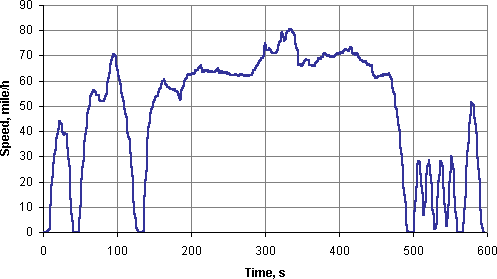
That's part of the problem, actually. They *do* go on the same treadmill that gasoline/diesel cars must ride. However, gasoline cars are most efficient at around 55mph. On the contrary, the Tesla Roadster, like most EVs, is most efficient at low speeds -- in its case, about 18 miles per hour. Plus, it regens from stop and start, while conventional gasoline cars don't. The net result is that they ace their city mileage, and due to the fact that the US06 highway cycle still has lower speed sections and stops and starts, they do better than they would if you're driving long distances on an interstate (the US06 cycle is more like taking a highway from your home to work than driving from state to state). So out of pure coincidence, our current cycles tend to overstate EV ranges.
Some EVs are even worse than Tesla. The Nissan Leaf's 100 miles range is on the LA-4 city cycle, which is even gentler than the FTP-75 cycle that our cars' city mpg rating is based on. And the Mitsubishi MiEV's 100 mile range is based on the Japanese 10-15 cycle, which is also exceedingly gentle.
I like Aptera's approach for stating range. The Aptera 2e is a composite 2-seater with a large payload area and a ridiculously low drag coefficient. They only give their vehicle a 100 mile range, but that's for 75mph, two passengers, a full payload, and AC and headlights on.
-
regen braking best case
You wrote "Good God people - think! I'm an electrical engineer who has been driving a gas-electric hybrid since 2002, and if regenerative breaking was able to recover even half the energy, I'd be amazed."
Prepare to be amazed.
http://www.teslamotors.com/blog4/?p=58
Tesla is saying their best case is in the 64% ballpark.
You claim the insight's sweet spot is 50mph. Have you tried 30 mph? That's where most cars get the best mileage (and how the Tesla went so far).
Consumer reports just did a piece on fuel efficiency (see http://blogs.consumerreports.org/cars/2009/09/tested-speed-vs-fuel-economy.html) and they didn't even test speeds below 55 mph. The MPG of every single car was increasing as speed went down.
-
The truth is available with high school physicsI am always interested in the CO2 output of these pure electric vehicles. After all, right now we power most of the electric grid with coal and until that changes it dosen't make sense to wish or just assert what things out to be instead of just doing some simple research and high school physics calculations.
Let's look at the real data from the real sources...
According to Tesla motors official specifications the motor has a output of 248 peak horsepower (185kW) and 276 ft/lbs (375 Nm) of torque. Also, for full charge it takes "3.5 hours using the Tesla Motors Home Connector at 240 Volts and 70 amps" which for simplicity and because they have neglected to disclose the actual kwh of full empty to full charge at room temperature (capacity will degrade with use) lets assume is 3.5hrs * (240V * 70A) = 58.8 kwh. Most likely this is an overly conservative estimate because of the constant current constant voltage nature of charging lithium batteries. This is more important than battery capacity because it is the load the power plant feels to charge your car and is the important quantity of interest. This will take you 244 miles on average (from same site) of course flat straight stretches will get better but it is the average that is most important. Total is 58.8 kwh/ 244 miles or about
Now go look at EPA official website for determining CO2 emissions (in the US) and you can see that generating one kwh gives you 7.18x10^-4 metric tons of CO2. In addition, they also state on the same page you generate 8.81*10-3 metric tons of CO2 per gallon gasoline.
Lets do some simple math. At
Note that this is bested by emissions from diesel vehicles at this point. Untill fission or fusion or solar or whatever comes on line, and given the cost of these vehicles, it dosent make sense. Even if the battery were somehow cheap *now* it still wouldn't make much enviornental sense over a efficent chemical fuel based design.
-
Re:too little, too late.
At least Tesla Motors is on the right track. 500+KM on 45 min charge (recyclable lith ion batteries),
O, ye delusional fanboy.
From Tesla:
Home Connector
Charging rate of 56 miles range per hour at max power
The Home Connector is the fastest way to charge your Roadster and ideal to install in your garage. You can fully recharge your car - from empty to full - in less than 4 hours. This is the most "intelligent" connector making it ideal for long-term storage. Any certified electrician can install this unit.
$3000 -
Just get a few (more) electric cars on the road...
One problem I have with all this efficiency stuff is that we can't just ignore generation like California has attempted to do.
Just look at what they're proposing to replace traditional gasoline vehicles, even hyrids - plug in Hybrids and EVs. Both of them use electricity instead of gasoline. All well and good, especially if the electricity was generated in a green manner.
But, consider the consumer that averages 30 miles a day. This gives you 10k miles a year, but I'm figuring the road warriors who are on the high end still mostly drive liquid fuel vehicles. Using the Tesla Roadster as an example, consumption of electricity is on the order of 3 miles/kwh*, or 28kwh per 100 miles epa est(3.5m/kwh). That means the consumer will use 10 kwh to power his vehicle, or 300kwh extra during a month.
Now, the 'average' family uses ~1000kwh/month, so this will be a 30% increase in their usage, easily wiping out increased efficiencies from replacing light bulbs and appliances with versions that use 10-30% less electricity.
*Buried in the article.
-
Re:Customer is a sucker... do the math
I've spent plenty of time in race shops and pits. Performance is performance and economy is economy. Two different things.
Even Tesla doesn't mention efficiency in their performance specs. http://www.teslamotors.com/performance/perf_specs.php
They do talk about range, which can make a difference on the track but look at their numbers. They're not good. The Corvette is still the better performer. Wanna talk about recharge/refill times?
Don't get me wrong. I think the Tesla is a very impressive car with some great performance specs but it's not the giant killer people make it out to be.
-
Re:Private property. Keep out
No. It's pure naivete to think that Tesla will somehow continue in this business as a car manufacturer. They don't even manufacture the body of the car they sell. They are an IP company through and through. Their only hope is to have a good patent chest and find licensees.
Daimler seems to be interested, and I'm sure they aren't the only ones who want to build an electric vehicle.
Anyone who thinks Tesla will be around as a car manufacturer 3 years from now ought to buy stock in Moller today.
BTW, in regards to using Lotus for the assembly and manufacturing of the Roadster, that was a business decision which was made at the early stages of developing the car in hopes to bring the vehicle to market sooner. For all of the changes that they have had to make in order to accommodate the electric motor and fit more with an American automotive market, they might as well have simply built the manufacturing plant in the USA.
As it is now, all Lotus does is put the vehicles together with only about 10% of the vehicle parts coming from the Lotus supply chain.
If you read Elon Musk's blog entry about this and other early manufacturing decisions, this was a decision if done again would have happened quite differently. The next vehicle, the "Model S", is going to have the manufacturing plant in California, of all places. Nearly all of the parts except for a few more or less standard parts like brake pads are going to be manufactured directly by Tesla.
To go trolling like this and claiming that Tesla is only an IP company has completely missed what they have accomplished or what their plans and investments in real estate are planning on doing. It certainly doesn't sound like a pure IP company to me.
-
Re:Customer is a sucker... do the math
The tax rebates for electric cars are pure subsidization, but they also have a lot of research grants. I admit that the rebates are probably only a couple million since Tesla has only shipped a few hundred cars. Tesla turned a profit for one quarter, but nobody is expecting them to do it again in the foreseeable future. They created a niche for super expensive electric race cars and are hopping to make 1200 cars this year... I don't see them staying around very long.
Comparing Tesla's situation to GMs is silly. The only reason GM got anything from the government is because of how many people they employ.
I don't think Tesla will go under until Nissan and Ford get their electric vehicles out. Hopefully one of them will actually be able to make an electric vehicle that is viable. The planned Fisker and Tesla cars are all still way too expensive. -
Re:465 Million $ loan??
I would feel better if they were making an AFFORDABLE economical vehicle that would benefit the majority of Americans (and the environment).
Me too, but experience has shown that you can't approach the problem that way. A number of companies have tried make "economical" electric cars, and they end up looking (and driving) like golf carts, while still costing more than, say, a Honda Civic. So when the companies go to sell these cars, the American public just laughs at them, and the companies quickly go out of business. The companies never have a chance to produce a more attractive product, because they never have a chance to establish the manufacturing base necessary to make electric vehicles efficiently, and therefore they can't compete with gas-powered cars.
Tesla is trying to opposite approach: instead of trying to compete with Ford/Honda/Toyota/GM/etc on the low end (an economic suicide mission), they are starting from the high end and working their way down. It turns out that you can make a fairly competitive electric sports-car, because at the high end, pricing is less of an obstacle to consumer acceptance, and therefore you can sell cars even if you have to give them a pretty large markup to offset your startup costs.
Tesla's next step after the Roadster will be to sell the Model S, which will compete with the Mercedes and the BMWs of the world and sell in greater numbers than the niche Roadster product. Assuming the Model S is successful, their next product will be an even more inexpensive model to compete with the Nissans and Hondas of the world. At each step of the way, they leverage the capital and knowledge gained in the previous product to make something that is more mainstream, more cheaply than they previously could have done. In this way, they (hopefully) have a viable path towards making electric cars a popular mass-market product, which is something that you can't say for the electric-car companies that tried things your way and failed.
Who knows whether they will succeed or not, but the plan certainly has its merits.
Making 10,000 unaffordable "green" cars over 10 years has very little environmental impact and not worth my tax dollars in my opinion
That isn't the goal, so your opinion is unfounded.
-
Tesla Motors!
Most all these arguments are as moot as the MIT project. Tesla Motors already has commercial production vehicles on the road that exceed the performance and fuel specifications of most gasoline and many other electric vehicles.
Tesla is also working on quick charge solutions like capacitor based charging stations and even in car storage.
I don't fault these guys for their little project and PERHAPS something useful will come of it. But, the real world work has already been done, it's just a matter of ramping up production to the point that it becomes affordable. We have not yet seen the economies of scale tip in the average consumers favor.
-
Tesla Motors!
Most all these arguments are as moot as the MIT project. Tesla Motors already has commercial production vehicles on the road that exceed the performance and fuel specifications of most gasoline and many other electric vehicles.
Tesla is also working on quick charge solutions like capacitor based charging stations and even in car storage.
I don't fault these guys for their little project and PERHAPS something useful will come of it. But, the real world work has already been done, it's just a matter of ramping up production to the point that it becomes affordable. We have not yet seen the economies of scale tip in the average consumers favor.
-
Re:Anyone know the economics on these?
While the Aptera is more efficient than the Tesla, the S uses about 1/2 the energy per mile the Prius does. This is usually compared on a "well to wheel" basis that includes wasted energy in the generation/transportation of the fuel. Tesla has a page on this stat. http://www.teslamotors.com/efficiency/well_to_wheel.php
-
Parent post is precisely correct
I live in the midwest. I have a lot of family over the range of this vehicle. However, for day to day operation, I wouldn't need more than 100 miles in range. A vehicle like this would be my car for driving to work and driving home.
For driving long distances, I'd just use a gas-based vehicle. I'd keep my old car around for that. Probably would need it half a dozen times during the year at most.
There will be some folks who will find the range of this car to be limiting. But how many compared to those who won't?
I think the real issue here is the calendar life of the battery. How long until I have to replace the batteries? That's what makes it easier for me to compare, apples to apples, the cost of the car vs. using gas.
Based on the info I read here: http://www.teslamotors.com/blog2/?p=39
Of course, hopefully whatever the battery replacement would be in 5 years of advancing battery technology would make the replacement battery a smart replacement for other reasons -
Re:You prob want a rest after 300 miles
The battery pack you get for $57.4K (the cheapest model) is a 160 mile pack, not a 300 mile pack.
And you aren't going to be able to fully charge it in 45 minutes. LIons just won't stand for it. You should be able to put 85% of the charge in in 45 minutes, but since it such rapid charging reduces the lifespan of the battery, Tesla doesn't recommend you charge it in 45 minutes (at least they don't recommend it for the Roadster, this has a similar pack so I presume this is the same).
Acceptable range is kind of a tricky idea, if you had a charger everywhere, then this might be okay. But instead, you are likely to drive to your range and find there is no place to charge it at your stopover or destination.
Here's an example of how the difficulties in recharging an electric car makes it less useful than a gas car.
http://www.teslamotors.com/blog5/?p=68
This guy took a 40 hour trip and spent 8 hours of it waiting for his car to charge. 4 hours walking (twice) around an RV park waiting for his car to charge to 88%.
And he really enjoyed his trip! The point is for the battery to last for everyday commutes, if you're going to do any kind of distance you can either wait for it to charge and read a book or something (people are so impatient these days) or just rent a car for the trip...
99% of people won't need more than 100 miles a day, and that's the whole point. How often do you actually do more than 300 miles in a day, for me it would be 1-2x a year and i wouldn't mind renting something for those trips.
-
Re:You prob want a rest after 300 miles
The battery pack you get for $57.4K (the cheapest model) is a 160 mile pack, not a 300 mile pack.
And you aren't going to be able to fully charge it in 45 minutes. LIons just won't stand for it. You should be able to put 85% of the charge in in 45 minutes, but since it such rapid charging reduces the lifespan of the battery, Tesla doesn't recommend you charge it in 45 minutes (at least they don't recommend it for the Roadster, this has a similar pack so I presume this is the same).
Acceptable range is kind of a tricky idea, if you had a charger everywhere, then this might be okay. But instead, you are likely to drive to your range and find there is no place to charge it at your stopover or destination.
Here's an example of how the difficulties in recharging an electric car makes it less useful than a gas car.
http://www.teslamotors.com/blog5/?p=68
This guy took a 40 hour trip and spent 8 hours of it waiting for his car to charge. 4 hours walking (twice) around an RV park waiting for his car to charge to 88%.
-
Re:O(1)
-
Re:O(1)
... So an electric car with a 300 mile range is pretty much impossible to build at any price
I hate to prove you wrong, but the Tesla Motors Model S is far from impossible to build and it even has a price.
-
Re:Tesla Fanboi
This is for the Roadster, but I'd guess that the Model S has similar or greater battery life:
We limit how fast this aging and loss of range happens by working very hard to select the best cells, design the best cooling systems, and carefully manage charge states. By doing all of this we expect more than 100,000 miles of driving range and more than five years of useful life.
-
Re:Electric vehicles aren't great
This is pretty stupid. He assumes that the Tesla batteries will last as long as laptop batteries do. Three years. Read up on all that Tesla does to lengthen their battery lifetimes. Tesla says you will still have 70% capacity after 5 years and 50,000 miles.
-
Not really that important...
I'm not seeing how this story or any other story about GM and their "Volt" is noteworthy. The Volt is not a marvel of engineering. It's not innovative. It's the same crappy "hybrid" concept that every other auto maker has tried to push. The Volt only goes 40 miles on a charge before rolling over to the gas engine. And at the nearly $40,000 price point, why bother buying it? If you spent a bit more money, you can buy a Tesla Model S, priced at about $50,000 (assuming you can get the rebate). The Model S doesn't even have a gasoline engine, goes over 7 times farther than the Volt on a single charge, can go from 0 to 60 in under 6 seconds, and looks a hell of a lot better than the Volt IMO.
If GM uses this new laboratory to produce cars with no gasoline engine (all electric), I'm on board. But if they use it to push this ridiculous Volt and other similar hybrids onto the market, it'll be just another waste of our taxpayer dollars.
-
Re:Next up, world's most efficient sports car
-
Quick?
Anyone notice that their "supercar" isn't as quick as the Tesla Roadster (0-60 3.9 secs)? It definately has Tesla beat in top speed. Perhaps "quickness" isn't a big deal for Le Mans-type racing? http://www.teslamotors.com/
-
Re:17.8560357 kilometers per liter
In 2016 I will be driving a car that does 33 to 50 kilometers per liter. http://evolution.loremo.com/ This car is based on technology that is available NOW.
That Loremo looks ingenious; the rear-facing rear seats are an interesting idea, but I know what'll happen with kids in the back:
* one will be upset that she can't see Mum & Dad
* the other will be car-sick.The Tesla Model S looks promising, too, but would need to be about half the price before I could get really interested.
-
Re:Those who say it cannot be done...
About $7000, including donor car. I estimate about two man-months of actual labor, interspersed over almost three years of real time.
But why do you ask? I thought we were talking about well-to-wheels efficiency. If you want an EV that saves money, you don't want my car. If you want a fast, long-range EV, there are better options as well (there are even really fast home-built EVs).
I built *my* car for *my* needs. Which were: reliability and carrying my family around. I never have to change filters, plugs, or belts. None of my parts wear out except the wheels, and the only lubrication I require is the transmission fluid.
My car requires no maintenance, which is what I was shooting for. I happened to get efficiency, "zero emissions", silence, battery-backup for my house in disasters, the ability to refuel from any electrical outlet, and the cool factor (my kids love it, and brag about it to their friends).
Oh, and the "EV Grin": the amazing feeling you get from driving the car you built yourself.
I'd say it was worth the 7K. I'd gladly do it again.
-
Elon Musk...
... should buy it. And start an east coast presence for Tesla.
-
Re:Two Steps Forward, One Step Back
Tesla says that their roadster gets 100 miles out of 28 kWh (it's in the fine print):
So assuming that a passenger car is (eventually) going to want ~100 kWh isn't real crazy. Unless I am drunk, that's 4000 watts all day, for a single vehicle. I'm not familiar with what sort of electric service is typical for commercial setups, but I doubt that they have the 40,000 watts (Wikipedia implies that NEMA maxes out at 60A x 600 Volts) that they would need to serve a paltry 10 cars per day (and those watts are in addition to whatever they are using now).
-
Re:1 step forward, 2 steps back
Actually, no - it can charge in as little as 3.5 hours: http://www.teslamotors.com/display_data/teslaroadster_specsheet.pdf
-
Re:This is meaninglesss...
Actually, Testla's "sweet spot" in terms of efficiency is 18 mph (see this Tesla blog), so the original poster wasn't that far off. According to their own charts, a Testla roadster will ideally go 400 miles to a charge going 13 to 22 mph, but only 240 miles to a charge at 55 mph.
-
Re:Great
A Tesla wouldn't be affordable even if it wasn't electric. It's a Lotus Elise with the engine replaced.
In addition to the parent to my post, this isn't true. According to this post the two share few parts, such as the windshield and the softtop.
Which in my opinion is a HUGE mistake. They should have taken the elise, gutted the drivetrain, and THEN retrofitted their own battery powered drivetrain.
Tesla shouldn't be a car company, the should be a powertrain company that is showcased in their choices of a few cars.
-
This is a 'great' car.
Fast, flashy, exotic. But not for the masses. Yet. And the masses are where the real difference comes in.
It's research like this that will bring EVs to the masses. Tesla already is planning a lower price car, the Model S. At $49,900, after a $7,500 federal tax credit, it's high priced but there may be another in the wings.
Falcon
-
Re:Very promising!
We love Tesla because they are doing something. The research and investment will lead to future electric cars that really are affordable. See the Model S for a big step in that direction.
-
Re:Cool, it practically pays for itself
Tesla decided to dump the multi-speed transmission, as the manufacturer of the tranny couldn't meet the torque and RPM specifications in the production vehicles. All sorts of finger pointing went with the issue, and it nearly took the whole company (Tesla) down with the lack of a quality transmission.
Oh, a two-speed transmission was built, but it only got a couple thousand miles on it before it had to be replaced. This blog entry goes into details on how the problem was finally "fixed", with what was a single-speed transmission.
-
Re:Cool, it practically pays for itself
In fact, go look at the pictures at http://www.teslamotors.com/design/cockpit/gallery-cockpit.php and you'll see a stick shift with what looks like reverse, 1 and 2.
-
Re:Great
They're working on that. Welcome to the Model S. The downside, it's still $50,000, but getting much closer to normal prices for cars. Also not bad when you consider it's meant to compete with BMW 5 Series level of cars.
-
Re:Great
A Tesla wouldn't be affordable even if it wasn't electric. It's a Lotus Elise with the engine replaced.
In addition to the parent to my post, this isn't true. According to this post the two share few parts, such as the windshield and the softtop.
-
Re:Very promising!
No, they really are traditional commodity laptop cells. They're LiCoO2+graphite 18650s purchased in bulk from the same companies that sell those cells to laptop pack manufacturers. They did that because they wanted cells that were already in mass production so as to keep costs down.
-
Re:Great
Tesla, I believe, will be a luxury sports car brand in the spirit of Ferrari.
I beg to differ. They're already working on a car that has more than two seats and will sell for 1/2 the price of the roadster. I'd say that's quite a jump in affordability. The Model S is nowhere near economy car prices, but it's a large step closer.
-
Re:Environment?
They're essentially not, essentially, yes, no. The phosphates and spinels most other auto makers are using, even moreso.
I'm not sure what you think is in li-ion batteries that you're picturing is so toxic. These aren't lead-acid or nickel-cadmium here. Want to know what goes into a lithium phosphate battery? Lithium salts (like you find in mineral water -- in fact, they're actually produced from salt flats where mineral waters evaporated), iron powder, phosphoric acid, sugar (for a carbon binding), porous polyethylene (separator), graphite or amorphous carbon (anode), any one of a variety corrosive but generally nontoxic electrolytes, casing, wiring, and so forth. You'll find worse stuff in a lot of bulk steels than you will in LFP cells.
-
Re:Obligatory
-
Re:Enough talk ...
1) Tesla is trying to peel off the top layers of the market, where the profit margins are greater. Automotive manufacturing is a very cash intensive business, and Tesla simply doesn't have the cash to make a mass consumer model at the moment.
2) I, too, am impressed with the family orientation with the Model S. I don't know if I believe the marketing assertion that this new design has the vehicle storage space of an SUV or a station wagon, but it certainly is larger than the Roadster's room for a bag of golf clubs or a couple sacks of groceries (about 5 ft^3). Keep in mind that the design of the Roadster was for the higher-end luxury sports car market, where storage space and passenger room are more afterthoughts than something integral to the design of the vehicle.
3) The Model S is designed to go more for mass production. It certainly is going to be more than Tesla's current production of 100 Roadsters per month. Even so, getting even to 50k per year takes an incredible amount of capital, which is one of the reasons why Tesla went into a huge cash crunch last year. See my rebuttal to point one above.
4) I don't know how you can make an efficient battery pack much cheaper than what Tesla already is doing. The current battery pack for the Roadster costs between $5k and $10k, and will last somewhere between 5 and 10 years. That sounds pretty close to the $500/year that you are citing here, but it remains to be seen just how long this design will hold out in practice and real world driving. There are no other major production vehicles to compare here, although keep in mind the Roadster's (and the Model S) driving range which is a significant limiting factor on the cost. More driving range on a charge == more battery == more cost for the battery.
I think Tesla has their priorities down pretty well, which does include the "Blue Star" model that is a future design intended to push real hard for the mass consumer market with a 2005 price point of between $25k and $30k. While very little has been said about this vehicle or marketing strategy, it hasn't been invalidated or refuted by Tesla either since it was originally discussed by both Martin Eberhard and Elon Musk.
The general business plan is here:
http://www.teslamotors.com/blog2/?p=8
It certainly is worth reading, and seeing what they plan on doing. This Model S isn't the "affordable" family car, but it is going to be a production full-sized American car worthy of that name. Tesla doesn't have to worry about fuel millage issues to form it into an SUV to get around those requirements, but it certainly is going for that group of customers who are typically called "Soccer Moms" and other suburban demographics.
BTW, I'd love to see the source on Tesla teaming up with Mercedes for anything but doing service for their European customers. This is genuine news to me, and I have some doubts about it owing to the other errors you seem to have about Tesla. I, for one, and incredibly glad they have not gone with a cheap Indian car maker... Tesla has a good reputation of its own that could only get screwed up with somebody who doesn't care about the quality they've put into their vehicles and is only interested in selling their own brand of cars.
-
Re:American cars....
Actually, Tesla Roadsters do have gears.... even a "transmission" after a fashion. The original design called for a 2-speed transmission so the car could have an efficient "cruise" range and still be able to reach the target 0-60 mph in under 4 seconds. It turned out the be a bigger mess than it was worth, as trying to shift gears on a transmission when the main engine power supply is going at 15,000 rpm or more is a bit beyond a typical gasoline or even diesel engine rate. The torque of an electric motor was also hell on the transmission.
It was a good thought on Tesla's part, and one of the few really bad screw-ups in the design of the Roadster. It nearly killed the company too. It still uses a transmission to send the energy to the wheels, but the issues with having to engage a clutch and shift gears have been eliminated.
For details about this, see the Tesla blog on this topic:
-
More 'leaked' info
-
Re:Environmental issues
Where to start?
1) We're talking about li-ion, not "lithium batteries". Lithium batteries are a completely different tech.
2) There is no single type of battery known as "li-ion"; it's a family of different chemistries. Each one has their own different traits regarding recycleability.
3) The single element that makes it hardest to recycle li-ions is the presence of a cobalt cathode, which makes the cells much more flammable and provides pretty much all of their (limited) toxicity. Most EV manufacturers are looking at li-ion variants that don't use them.
4) Even in cells that use cobalt cathodes, such as Tesla's, they're perfectly recycleable.
5) The main reason li-ions aren't generally recycled isn't due to some sort of impossibility of it; it's that the ingredients, especially in the newer variants, are dirt cheap. Cobalt is a relevant portion of the costs of traditional li-ions, but that's gone in the latest. What in a LiP cell is worth recycling? Lithium carbonate at $7 a kilogram? Graphite at even cheaper? Phosphorus and iron? The raw ingredients are pretty worthless. Which brings us to our next points.
6) There is not a "limited" amount of lithium in the least. Lithium carbonate can be recovered from seawater in virtually limitless quantities at $22-$32 a kilogram with first generation technology. That's a couple percent of the total cost of the batteries. The reason people don't generally do that is because it can be gotten *even cheaper* from places like Bolivia, Chile, China, etc, for $7-8/kg (used to be $4-5/kg, but recent demand has outpaced scaleups of the mines). It's so cheap people can afford to use it for low-value uses like greases and glasses. In fact...
7) At *current prices*, they have big competition right here in the US. These sorts of prices make the Kings Valley lithium deposits (Nevada) being developed by Western Lithium Corporation economical, for example. There's enough lithium in that one deposit, for example, to build hundreds of millions of electric vehicles.
I could keep going, but I think I've made my point that you know nothing about what you're talking about.
-
Re:Sounds heavy to me
The small motors used in typical hybrids are over 90% efficient going forwards and over 85% efficient acting as a generator.
And the ones used in diesel-electric locomotives add another 7% to that. ANY motor big enough for a car will be efficient if properly built.
For sports cars.
For all cars Otherwise, why is no production hybrid using one?
Actually, the tesla roadster is coming equipped with a two-speed sequential gearbox plus reverse. This is necessary because the vehicle is a super high performance car and it needs to hit high speeds. Commuter cars don't need two forward gears, so they don't need any gears (except perhaps as part of the mechanism which drops the shaft, if any) so they don't need a reverse gear, either.
Your news is old, they ended up tweaking the motor to spin even faster as they couldn't solve the problems with the two speed transmissions.
A "generator-motor" system is called a "series hybrid", whether you have batteries or not.
I'd tend to disagree; without any way to store the electrical power, the system is unable to decouple fuel usage and motive force; or recover energy via regenerative braking. If it's considered a hybrid; it's a pretty weak one.
So far attempts to use a single power system to do meaningful regenerative braking on that scale have failed.
Source? What do you consider 'meaningful' regenerative braking? Still, current production hybrids use NiMH batteries; with a 66% charge efficiency, meaning that discounting generator/motor losses you lose a third of your energy just charging the battery. Going by your 85% generator and 90% motor, that's 50% recovery stop to go. LiIon is 99.9% efficient done right, increasing the overall efficiency of regenerative braking to 76%. Might lose a bit of efficiency with the control circuits as well, but I think that's included in the motor efficiencies. Anyways, that's effectively 50% more energy, which means 50% more miles recovered from the stopping energy. Would boost the effective mileage of stop and go city driving quite a bit. Let's see Toyota boasts about it, Lexus claims it, Ford claims it.
The only thing limiting the usage of regenerative braking is the power of the electric motor and that it can only be applied to the wheels hooked up to the drive train. IE if you have a front wheel drive hybrid, braking lightly enough to only use regenerative braking will only have drag on the front wheels. Not actually that bad - regenerative braking is naturally anti-lock.
If you don't care about regenerative braking and batteries, then there's really no reason why you would need that many batteries, or for that matter, any at all beyond what you need to start the engine which runs the generator.
I have always figured the ideal solution was to build a generator into a turbine (to reduce the weight of the generator.) Chrysler drove a turbine-powered car across the country in the 1960s. My understanding is that it ate transmissions. I aim to eliminate the transmission. If your generator is not large it had better be fast. Turbines are fast. Seems like the perfect match, to me.
Right now though, fast small turbine = inefficient loud turbine. Atkinson style IC engines are quieter, more efficient, and need less maintenance.
Electronic control is becoming more common anyway. There's a lot of small-to-medium sized equipment with an electronically-controlled hydraulic drive, now. And if I were designing some
-
Re:Sounds heavy to me
The small motors used in typical hybrids are over 90% efficient going forwards and over 85% efficient acting as a generator.
And the ones used in diesel-electric locomotives add another 7% to that. ANY motor big enough for a car will be efficient if properly built.
For sports cars.
For all cars Otherwise, why is no production hybrid using one?
Actually, the tesla roadster is coming equipped with a two-speed sequential gearbox plus reverse. This is necessary because the vehicle is a super high performance car and it needs to hit high speeds. Commuter cars don't need two forward gears, so they don't need any gears (except perhaps as part of the mechanism which drops the shaft, if any) so they don't need a reverse gear, either.
Your news is old, they ended up tweaking the motor to spin even faster as they couldn't solve the problems with the two speed transmissions.
A "generator-motor" system is called a "series hybrid", whether you have batteries or not.
I'd tend to disagree; without any way to store the electrical power, the system is unable to decouple fuel usage and motive force; or recover energy via regenerative braking. If it's considered a hybrid; it's a pretty weak one.
So far attempts to use a single power system to do meaningful regenerative braking on that scale have failed.
Source? What do you consider 'meaningful' regenerative braking? Still, current production hybrids use NiMH batteries; with a 66% charge efficiency, meaning that discounting generator/motor losses you lose a third of your energy just charging the battery. Going by your 85% generator and 90% motor, that's 50% recovery stop to go. LiIon is 99.9% efficient done right, increasing the overall efficiency of regenerative braking to 76%. Might lose a bit of efficiency with the control circuits as well, but I think that's included in the motor efficiencies. Anyways, that's effectively 50% more energy, which means 50% more miles recovered from the stopping energy. Would boost the effective mileage of stop and go city driving quite a bit. Let's see Toyota boasts about it, Lexus claims it, Ford claims it.
The only thing limiting the usage of regenerative braking is the power of the electric motor and that it can only be applied to the wheels hooked up to the drive train. IE if you have a front wheel drive hybrid, braking lightly enough to only use regenerative braking will only have drag on the front wheels. Not actually that bad - regenerative braking is naturally anti-lock.
If you don't care about regenerative braking and batteries, then there's really no reason why you would need that many batteries, or for that matter, any at all beyond what you need to start the engine which runs the generator.
I have always figured the ideal solution was to build a generator into a turbine (to reduce the weight of the generator.) Chrysler drove a turbine-powered car across the country in the 1960s. My understanding is that it ate transmissions. I aim to eliminate the transmission. If your generator is not large it had better be fast. Turbines are fast. Seems like the perfect match, to me.
Right now though, fast small turbine = inefficient loud turbine. Atkinson style IC engines are quieter, more efficient, and need less maintenance.
Electronic control is becoming more common anyway. There's a lot of small-to-medium sized equipment with an electronically-controlled hydraulic drive, now. And if I were designing some
-
Production is still important...
Salt storage isn't something that scales down well; it's used by solar thermal plants, not solar voltiac cells. You wouldn't be placing this every mile, you'd be keeping it at the solar plant.
In my combined vision for the future I figure a couple things:
1. Plug in Hybrids/EVs will have a far greater role.
2. Due to expense/savings, many/most home charging stations will have load leveling capabilities.
3. Putting a PHEV/EV in a garage will swamp all but the most extreme energy saving measures otherwise taken. The tesla roadster has a 53kwh battery, and uses 28 kwh per 100 miles. 3.57 miles/kwh. Figure an annual average driving distance of 15000 miles, that's 4.2K kwh/year, 350 kwh/month. About 50% of the average annual usage of households in the USA(8,900 kwh/year. Keep in mind that the Tesla is light and efficient compared to most EVs due to it's sports car heritage and LiIon batteries. Oh, and that most families at this point have 2 or more vehicles.A - Given 1&3, More generating capacity will be needed, not less, even if our population remains stable.
B - Given A&2, the difference between peak and baseload should shrink.
C - Despite 3, energy saving and leveling measures should be taken where practical.
D - Despite what realtors tell us, homes DON'T always increase in value. It's mostly the land the house sits on. At some point it's worth it to tear the sucker down and build a *GOOD* house on the plot. Good today = energy efficient. All sorts of tricks are possible with a new house that aren't possible or practical with an old one. But I'd put a dryer(30A@220V) or even stove(50A) plug into the garage.
E - Save the oil/NG for building materials and long range high speed travel.Get people off of direct electric heat and towards geothermal heat pumps. Interesting tidbit - did you know that heat pump water heaters are produced? They'll cool and dehumidify the air around the hot water tank while heating the water. Cost is around a third that of direct electric. They've also developed heat pump dryers - they need a line to a drain like the washer, but use substantially less electricity and dry clothes faster with less heat. If I was running a laundrymat in a trustworthy area, I'd seriously consider them - not only would it reduce my expenses with the dryers, it'd also reduce the amount of AC needed.
I figure lots of solar in areas where peak demand tends to coincide with peak sun, wind in the appropriate areas, all backed up by a ton of nuclear capacity - and nuclear CAN load level; they're generally run at max capacity because they're the cheapest source of demand electricty going. Spreading solar out is pretty much required; in my area putting a wind turbine up next to/in a lot of the small towns would reduce the amount of electricity lost on wires.
-
Re:That's it?
Chevy Volt...40/100 miles on a single charge...promising an electric vehicle by 2011...
Please. The big 3 are useless and should have been allowed to die (thanks for continuing to waste my taxes gov). Tesla has had cars for purchase for a couple years now. Granted they're slow off the line at the moment, but at least they're not simply a paper-concept with crap specs and have created some kind of decent (and available) standard to strive for: Tesla Motors -
Wheee! 1,000 HP!
And a range of 5 miles if you use it.
Now that gas has come down in price, predict these things - as always - arriving too late/early for the market.Still want a Tesla, tho'.
-
boring year in technologyYes, the article really underlines that 2008 was a boring year in technology. Flash memory? GPS? Sure, both are technologies that continue to evolve and get new applications, but if the top ten list can't find anything that isn't this old, it really must have been a year not much happened. Better Speedos? Really scraping the bottom of the barrel.
I'd go for Tesla motors shipping their first electric roadster as top ten news, myself, but that may be so old hat for/. readers nobody cares to read it.
-
Patent claims are NOT proof!
I concluded a year ago that this was a lot of smoke and mirrors, mostly depending on the obvious square function of the formula for energy storage vs. voltage. However, several people who actually have worked with pure barium titanate note it's highly non-linear characteristics, i.e. its dielectric constant drops dramatically as the field gradient increases, an effect also known as dielectric saturation. It gets right down to atomic level physics. The reduction in capacitance at stated voltages is so great that the claims appear to be overstated by a factor of 100 or so! To make this work they are claiming they have overcome the fundamental limitations of this material. The patent spells out part of it but does not prove it actually works. Anatoly Moskalev gave some great analysis in this link: http://www.teslamotors.com/blog2/?p=46 (search for "About EEStore supercapacitor hype") If correct, these guys are still using non-proven hype to attract capital. If any single investor has not had the device actually proven for both energy density and voltage, they are taking a huge, huge risk. Personally, I hope we are all wrong and this thing actually works. It would be a HUGE advance. However, I'm not investing nor holding my breath...