Slashdot Mirror
Domain: teslamotorsclub.com
Stories and comments across the archive that link to teslamotorsclub.com.
Comments · 79
-
Re:They've been pushing this angle for a while
They are not standard lithium-ion batteries. For example, the cell design is different in order to cut cost. They do not have the normal dimple on top nor do they contain the protection circuit. The protection is provided by a low melting point wire that is bonded to the battery that doubles as a fuse. They are also not exclusive to Panasonic since they also work with Sanyo.
The chemistry is also a bit different. The batteries are automotive grade. They are designed to handle more temperature extremes and for rapid charging as well as for longer life than a laptop cell. As for Tesla owning the chemistry I heard that during one of the quarterly earnings conference calls. They did a lot of research and testing for their batteries. Arguably most of their technology lies in their battery management and pack designs but they also have a number of key patents in the actual cell design.
http://www.teslamotorsclub.com...
http://www.teslamotorsclub.com...I had a good talk with a friend of mine who works there in R&D. He was describing it all a compromise between three things: reliability, performance and capacity. Choose two of the three.
They have some interesting patents as well, such as a metal air battery design.
-
Re:They've been pushing this angle for a while
They are not standard lithium-ion batteries. For example, the cell design is different in order to cut cost. They do not have the normal dimple on top nor do they contain the protection circuit. The protection is provided by a low melting point wire that is bonded to the battery that doubles as a fuse. They are also not exclusive to Panasonic since they also work with Sanyo.
The chemistry is also a bit different. The batteries are automotive grade. They are designed to handle more temperature extremes and for rapid charging as well as for longer life than a laptop cell. As for Tesla owning the chemistry I heard that during one of the quarterly earnings conference calls. They did a lot of research and testing for their batteries. Arguably most of their technology lies in their battery management and pack designs but they also have a number of key patents in the actual cell design.
http://www.teslamotorsclub.com...
http://www.teslamotorsclub.com...I had a good talk with a friend of mine who works there in R&D. He was describing it all a compromise between three things: reliability, performance and capacity. Choose two of the three.
They have some interesting patents as well, such as a metal air battery design.
-
Re:Batteries have no "moat".
Here's one where a Tesla was rear-ended by a semi. The Tesla was able to drive away, despite being knocked forward around 100'. The semi wasn't going anywhere.
-
Re:Do they distribute the source?
There's a lot of GPL software in Ubuntu, starting with the Linux kernel. Does Tesla distribute the source code to Model S owners that ask?
I am not aware, yet. Have only see one owner be vocal in the past about trying to get it, but haven't . A few relevant threads. Lots of noise and general ignorance about Copyright in there, so prepare yourself.
Anyone want to get the source code for the Linux (etc.) in your car?
Running on Linux
Copyright (and Libel) Discussion -
Re:Do they distribute the source?
There's a lot of GPL software in Ubuntu, starting with the Linux kernel. Does Tesla distribute the source code to Model S owners that ask?
I am not aware, yet. Have only see one owner be vocal in the past about trying to get it, but haven't . A few relevant threads. Lots of noise and general ignorance about Copyright in there, so prepare yourself.
Anyone want to get the source code for the Linux (etc.) in your car?
Running on Linux
Copyright (and Libel) Discussion -
Re:Do they distribute the source?
There's a lot of GPL software in Ubuntu, starting with the Linux kernel. Does Tesla distribute the source code to Model S owners that ask?
I am not aware, yet. Have only see one owner be vocal in the past about trying to get it, but haven't . A few relevant threads. Lots of noise and general ignorance about Copyright in there, so prepare yourself.
Anyone want to get the source code for the Linux (etc.) in your car?
Running on Linux
Copyright (and Libel) Discussion -
Re:Everything is watching you these days...
Actually, what's more likely is that they saw his post on the Tesla Motors Club forum detailing what he'd done and then connect the dots between the forum post and ownership data:
Successful connection on the Model S internal Ethernet network
Tesla has been known to connect forum users to actual owners and proactively contact the owners via phone when they report problems with their car there.
-
Re:Musk's Hubris...
While the Fire Authority's report stated the most likely cause was a "high resistance connection at the wall socket or the Universal Mobile Connector from the Tesla charging system", Tesla says its own data shows the car was charging normally, with no fluctuations in the temperature and no malfunctions capable of causing a fire.
This is key and it is important to determine exactly where this fire occurred.
The Tesla supplied UMC is designed to adapt to multiple plug types with an adapter so one can plug into a NEMA 14-50 (typical stove outlet), 5-15 (standard 120V outlet) or others.
It is well documented that these adapters can melt - it appears that in some conditions the adapter's PINs do not establish a good connection leading to overheating. Here are three examples:
http://www.teslamotorsclub.com/showthread.php/15304-Plug-Adapter-on-my-Universal-Mobile-Connector-has-melted
http://www.teslamotorsclub.com/showthread.php/18092-Schmelted-UMC-NEMA-14-50
http://www.teslamotorsclub.com/showthread.php/23212-Scary-issue-with-Nema-14-50-adapter-meltingNow that doesn't mean that's what happened here. Faulty 14-50 outlets (no fault of Tesla) have also caused similar issues. There are two examples in this thread:
http://www.teslamotorsclub.com/showthread.php/19576-Burned-220V-Adapter
If it were me, I would not be using the Tesla UMC (Universal Mobile Connector) for daily charging - these plugs/outlets are not designed for daily plugging/unplugging. I would use the Tesla HPWC (High Power Wall Connector) instead and save the UMC for actual mobile use.
I am also not crazy about the design of the adapter plugs on the UMC. Not only do the pins appear not to necessarily mate very well (compare these pins to the connector that actually plugs into the car!), but the extra length of the adapter exerts extra leverage on the outlet/adapter which makes it easier to end up with a poor connection unless you support the UMC well.
-
Re:Musk's Hubris...
While the Fire Authority's report stated the most likely cause was a "high resistance connection at the wall socket or the Universal Mobile Connector from the Tesla charging system", Tesla says its own data shows the car was charging normally, with no fluctuations in the temperature and no malfunctions capable of causing a fire.
This is key and it is important to determine exactly where this fire occurred.
The Tesla supplied UMC is designed to adapt to multiple plug types with an adapter so one can plug into a NEMA 14-50 (typical stove outlet), 5-15 (standard 120V outlet) or others.
It is well documented that these adapters can melt - it appears that in some conditions the adapter's PINs do not establish a good connection leading to overheating. Here are three examples:
http://www.teslamotorsclub.com/showthread.php/15304-Plug-Adapter-on-my-Universal-Mobile-Connector-has-melted
http://www.teslamotorsclub.com/showthread.php/18092-Schmelted-UMC-NEMA-14-50
http://www.teslamotorsclub.com/showthread.php/23212-Scary-issue-with-Nema-14-50-adapter-meltingNow that doesn't mean that's what happened here. Faulty 14-50 outlets (no fault of Tesla) have also caused similar issues. There are two examples in this thread:
http://www.teslamotorsclub.com/showthread.php/19576-Burned-220V-Adapter
If it were me, I would not be using the Tesla UMC (Universal Mobile Connector) for daily charging - these plugs/outlets are not designed for daily plugging/unplugging. I would use the Tesla HPWC (High Power Wall Connector) instead and save the UMC for actual mobile use.
I am also not crazy about the design of the adapter plugs on the UMC. Not only do the pins appear not to necessarily mate very well (compare these pins to the connector that actually plugs into the car!), but the extra length of the adapter exerts extra leverage on the outlet/adapter which makes it easier to end up with a poor connection unless you support the UMC well.
-
Re:Musk's Hubris...
While the Fire Authority's report stated the most likely cause was a "high resistance connection at the wall socket or the Universal Mobile Connector from the Tesla charging system", Tesla says its own data shows the car was charging normally, with no fluctuations in the temperature and no malfunctions capable of causing a fire.
This is key and it is important to determine exactly where this fire occurred.
The Tesla supplied UMC is designed to adapt to multiple plug types with an adapter so one can plug into a NEMA 14-50 (typical stove outlet), 5-15 (standard 120V outlet) or others.
It is well documented that these adapters can melt - it appears that in some conditions the adapter's PINs do not establish a good connection leading to overheating. Here are three examples:
http://www.teslamotorsclub.com/showthread.php/15304-Plug-Adapter-on-my-Universal-Mobile-Connector-has-melted
http://www.teslamotorsclub.com/showthread.php/18092-Schmelted-UMC-NEMA-14-50
http://www.teslamotorsclub.com/showthread.php/23212-Scary-issue-with-Nema-14-50-adapter-meltingNow that doesn't mean that's what happened here. Faulty 14-50 outlets (no fault of Tesla) have also caused similar issues. There are two examples in this thread:
http://www.teslamotorsclub.com/showthread.php/19576-Burned-220V-Adapter
If it were me, I would not be using the Tesla UMC (Universal Mobile Connector) for daily charging - these plugs/outlets are not designed for daily plugging/unplugging. I would use the Tesla HPWC (High Power Wall Connector) instead and save the UMC for actual mobile use.
I am also not crazy about the design of the adapter plugs on the UMC. Not only do the pins appear not to necessarily mate very well (compare these pins to the connector that actually plugs into the car!), but the extra length of the adapter exerts extra leverage on the outlet/adapter which makes it easier to end up with a poor connection unless you support the UMC well.
-
Re:Musk's Hubris...
While the Fire Authority's report stated the most likely cause was a "high resistance connection at the wall socket or the Universal Mobile Connector from the Tesla charging system", Tesla says its own data shows the car was charging normally, with no fluctuations in the temperature and no malfunctions capable of causing a fire.
This is key and it is important to determine exactly where this fire occurred.
The Tesla supplied UMC is designed to adapt to multiple plug types with an adapter so one can plug into a NEMA 14-50 (typical stove outlet), 5-15 (standard 120V outlet) or others.
It is well documented that these adapters can melt - it appears that in some conditions the adapter's PINs do not establish a good connection leading to overheating. Here are three examples:
http://www.teslamotorsclub.com/showthread.php/15304-Plug-Adapter-on-my-Universal-Mobile-Connector-has-melted
http://www.teslamotorsclub.com/showthread.php/18092-Schmelted-UMC-NEMA-14-50
http://www.teslamotorsclub.com/showthread.php/23212-Scary-issue-with-Nema-14-50-adapter-meltingNow that doesn't mean that's what happened here. Faulty 14-50 outlets (no fault of Tesla) have also caused similar issues. There are two examples in this thread:
http://www.teslamotorsclub.com/showthread.php/19576-Burned-220V-Adapter
If it were me, I would not be using the Tesla UMC (Universal Mobile Connector) for daily charging - these plugs/outlets are not designed for daily plugging/unplugging. I would use the Tesla HPWC (High Power Wall Connector) instead and save the UMC for actual mobile use.
I am also not crazy about the design of the adapter plugs on the UMC. Not only do the pins appear not to necessarily mate very well (compare these pins to the connector that actually plugs into the car!), but the extra length of the adapter exerts extra leverage on the outlet/adapter which makes it easier to end up with a poor connection unless you support the UMC well.
-
Re:The peril of new technology
I am suggesting that there is something unusually wrong with Teslas in that their "fuel tank" can be easily pierced to start a fire, because of how it is mounted.
Right, I got that. The problem is that your suggestion is false. It's not easy. It actually takes major impact.
If you don't see how "bus picking up big spongy thing" is a less likely scenario than "bottom of car being pierced by random debris", please think a bit.
Well actually, I don't see how. I assume you have some statistics which show that?
You don't get to absolve yourself from safety problems because, "Well the driver wasn't behaving responsibly."
Yes, yes you do. Cars are expected not to behave nicely if you abuse them. They are only expected to function if you do not run them into anything, or over anything inappropriate.
But what causes the problem in the first place? An engine repeatedly overheating, followed by a leak, followed by a pooling. And what happens at the first overheat? An instrument panel warning. The timescales involved are nothing like the collide-warn-and-catch-fire Tesla sequence
The two situations are not directly comparable, I'll give you that.
Still DEFINITELY a recall issue, and Ford's not getting any brownie points from me for it - I just wish Tesla would make the same admission.
Tesla has issued a firmware update which mitigates the issue, stopping the vehicle from decreasing its ride height automatically. This underscores the fact that it is the driver's responsibility to drive the car. Now, if the driver wants to increase the risk that they will damage the car if they drive over something they should have seen and avoided, they will have to do so manually.
Gasoline cars and EVs have different kinds of risks based on their different designs. Some of these risks are inherent; it's probably always going to make sense to put the energy storage down low on an EV. Few of these risks are necessary at all; we could be using PRT or another type of solution in order to provide travel. Instead, we have chosen to use automobiles, with all their predictable failings. We have been tricked into believing that they substantially increase freedom, and defend our "right" to them on that basis. As a result, we have to deal with whole classes of problem which are unnecessary. Since we live in the real world, these problems lead to tradeoffs between different sets of benefits and drawbacks when choosing a particular technology. Gasoline cars have so far have both been shown to be more dangerous to their occupants in the case of a catastrophic failure of the power storage system, and more likely to suffer one both in the case of a collision and when the driver has done nothing to precipitate a problem.
There's just no basis on which to suggest that EVs are more dangerous or more likely to have a problem which could be dangerous when the available evidence suggests that the opposite is true in both cases. I for one am withholding judgment for a few more years, yet, and waiting for the involvement of more players in the EV market as well as more vehicle-miles traveled, but based on the limited available evidence, so far EVs seem much safer.
-
Re:He misses the point
Shoving a spike through my gas tank is not a guaranteed fire. An environmental incident, maybe, but certainly not a guaranteed fire.
Puncturing a LiIon battery is a fire almost every time.
Maybe (though I'm skeptical), but no one has died from a punctured battery in a Tesla yet due to the firewall design. Each cell is wrapped in a gel that reacts in the presence of fire to cool down the pack and to harden into a material with low conductivity to heat. You can read more about the very interesting design here.
Sadly, you can't say the same for a gas tank, and punctured tank fires can get very energetic, very fast. Just ask the families of any number of Jeep Grand Cherokee owners, thanks to an unshielded plastic tank anchored close to the rear.
It's not impossible for an electric vehicle to catch fire due to the battery, but there's less that burns easily without gas & oil, and a more careful design like Tesla's allows you to safely bring the car to the side of the road and exist first. The only people to have died in an incident where an electric vehicle's battery system caught fire most likely did so from the force of impact.
Hell, that's another nod for Tesla, because one of the three fires that got so much press involved some drunk idiot driving through a concrete wall into a tree. The man walked away just fine. (Or more ran away to flee the cops and asked Tesla to expedite the replacement. However, being bought by total douches is no sign your car isn't safe.)
-
Re:They should upgrade the warning ...
People say lots of things on the internet, does not mean it's true.
Inside the Tesla battery pack
The engineer who disassembed the pack (Ingineer) did not find any evidence of intumescent goo.And if you want to see what the pack looks like after a less severe incident with a trailer hitch, look here:
Easy to see that the bottom of the pack is aluminum, not steel from that picture (look at the size of the welds and how the aluminum shredded around the impact point) While steel would be stronger than aluminum, the weight of steel is just way too high to justify using it over aluminum.
-
Re:They should upgrade the warning ...
People say lots of things on the internet, does not mean it's true.
Inside the Tesla battery pack
The engineer who disassembed the pack (Ingineer) did not find any evidence of intumescent goo.And if you want to see what the pack looks like after a less severe incident with a trailer hitch, look here:
Easy to see that the bottom of the pack is aluminum, not steel from that picture (look at the size of the welds and how the aluminum shredded around the impact point) While steel would be stronger than aluminum, the weight of steel is just way too high to justify using it over aluminum.
-
Re:They should upgrade the warning ...
People say lots of things on the internet, does not mean it's true.
Inside the Tesla battery pack
The engineer who disassembed the pack (Ingineer) did not find any evidence of intumescent goo.And if you want to see what the pack looks like after a less severe incident with a trailer hitch, look here:
Easy to see that the bottom of the pack is aluminum, not steel from that picture (look at the size of the welds and how the aluminum shredded around the impact point) While steel would be stronger than aluminum, the weight of steel is just way too high to justify using it over aluminum.
-
Re:Maybe so but it is American Made
parts for EVERYONE are always made in china or overseas somewhere. even mighty caddy has parts made overseas. no one can resist the lure of cheap parts. but assembly location does matter and its built here, not in china.
The Model S has only 55% of it's parts made in US/Canada:
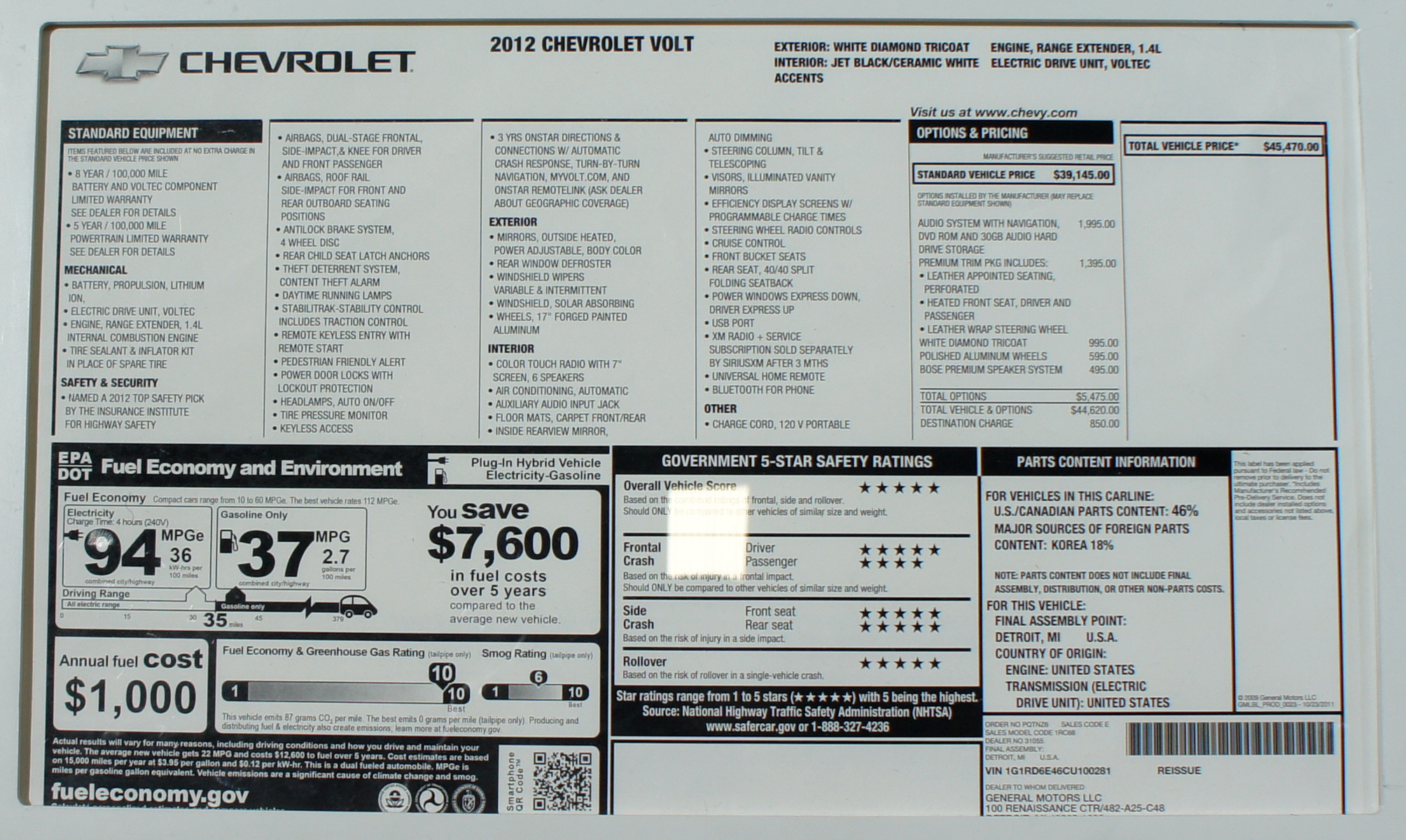
http://www.teslamotorsclub.com/attachment.php?attachmentid=8233&d=1343437424The vast majority of Ford/GM/Chrysler cars are above this percentage, although only slightly (mostly in the 60-70% range). There are a handful that are significantly higher, as well as a handful significantly lower. I can't find any info about the Cadillac ELR, but the Chevy Volt is only 46% US/Canadian parts:
http://upload.wikimedia.org/wikipedia/commons/3/3e/2012_Chevrolet_Volt_window_sticker_01_2012_0483.jpg -
Re:NHTSA pushed a 5 star rating
Tesla has a lot of cross bracing in the front that normally would not be possible in a front engine car. There's a massive pillar that goes between the top of the front suspension. Since the battery pack is under the entire passenger compartment and has steel plates it helps further strengthen the passenger compartment.
The front bumper is connected to two hexagonal extruded aluminum bars designed to absorb the impact.
I have seen some pictures of Teslas that have been in some very bad accidents. In one, a BMW M5 ran a stop sign at 60MPH and hit the front quarter panel of the Tesla. All occupants were OK though.
Tesla head-on with a Honda Accord: (sadly the accord occupants did not survive) http://www.teslamotors.com/forum/forums/model-s-safe
-
Tesla swap vs. Better Place swap
Since Elon has said that the Model S ( and presumably the Model X) is capable of conversion to battery swap
It's not automated, but yes, jack the car up at a dealer, detach the battery pack, attach a charged one. Tesla Motors has been vague on the details. Since owners own the car and its expensive warrantied battery pack, most likely a dealer will give you a loaner battery as a courtesy for a long trip, and you'll later return to pick up your original. Obsessive fans at Tesla Motors Club debate more elaborate swapping networks but as yet there's no evidence that Tesla will go for it. Musk has shown he'll do whatever it takes for his EVs to compete, but it seems Tesla is busy building out the Supercharger Network (relatively fast DC quick charge stations spread along major routes, unless you're a dumbass New York Times reporter).
perhaps Tesla will try to get the Better Place switch station tech - despite the company's failure, they did have solid working tech as Tesla could benefit tremendously by not having to reinvent, er, the wheel.
BP's intellectual property includes their outdated battery pack design (Tesla's flat sheet is better), the QuickDrop technology for attaching the battery (Tesla's is better), and automating the battery swap with robots. The last seems only worth a few million, unless evil patents are involved.
-
Re:And this is why DOE needs to be defunded
It's worse than that. Not only do they get a government loan with very favorable terms, the federal government gives a credit to those who buy their product.
Tesla’s loan of $465 million was to be paid back over ten years following the start of production of the Model S.
We have a $7500 tax credit for electric vehicles purchased in 2010 through 2012, up from $2500 from 2008 through 2009. Like most taxes, this credit has rules but this one only has the requirement that the credit cannot reduce the tax below zero so we can assume utilization will be very high.
Telsa won't release detailed numbers but this site shows about 73% of reservations from the US for the Model S. They do release delivery numbers which show 253 through Sept 1st, 2012 and 1000 Roadsters through Jan 2010.7500 * 253 *
2500 * 1000 *So the feds are out at least 3 million to date. Strangely, this credit is based on production numbers.
The credit begins to phase out for a manufacturer’s vehicles when at least 200,000 qualifying vehicles manufactured by that manufacturer have been sold for use in the United States (determined on a cumulative basis for sales after December 31, 2009). For additional information see Notice 2009-89
We'll assume Telsa makes 20000 Model S since that is it's production target for 2013. If 73% are bought by Americans with a tax liability greater than $7500:
20,000 *More reading of the 10-K shows this:
In December 2009, we finalized an arrangement with the California Alternative Energy and Advanced Transportation Financing Authority (CAEATFA) that will result in an exemption from California state sales and use taxes for up to $320 million of manufacturing equipment. To the extent all of this equipment is purchased and would otherwise be subject to California state sales and use tax, we believe this incentive would result in tax savings by us of up to approximately $31 million over the period starting in December 2009 and ending in December 2013. The equipment purchases may be used only for three purposes: (i) to establish our production facility for Model S in California, (ii) to upgrade our
Palo Alto powertrain production facility, and (iii) to expand our current Tesla Roadster assembly operations at our Menlo Park facility. In January 2012, we finalized an additional agreement with CAEATFA that will result in an exemption from California state sales and use taxes for
up to $292 million of manufacturing equipment. To the extent all of this equipment is purchased and would otherwise be subject to California
state sales and use tax, we believe this incentive would result in tax savings by us of up to approximately $24 million over the period starting in December 2011 and ending in March 2015. The equipment purchases may be used only for two purposes: (i) to develop the Model X crossover vehicle and its production capacity in California and, (ii) to further upgrade our powertrain production facilities in California.Up to $56 million in lost revenue from the State of California. I'm not convinced their operation is viable without the massive tax breaks they are receiving. Telsa operated at a 40 million loss in 2012 and I didn't go into the free parking, use of rest area charging stations, and other incentives given to drivers of electric vehicles.
-
Re:hydrogen ftw
Do you really care what the station looks like?
yes people care what the station looks like. This is why it will never work.
when people think of getting gas, they think of going to the clean shell station on the corner with the TVs and candy bars. A level III charger is like parking at an electrical substation and plugging in. it's not going to be adopted, even in pilot phases.
Have you seen a Level III charge station?
http://www.hybridcars.com/news/coulomb-promises-gas-pump-style-ev-rapid-charging-26436.html
http://www.teslamotorsclub.com/showthread.php/4092-TEPCO-CHAdeMO-Level-III-quot-quick-quot-charging-station-connectorIs it really any worse than a modern gas pump?: http://travis.kroh.net/archives/003205.jpg
During normal EV use, you'll never have to visit a charging station
I agree with you that level III charging is as unneccesary as it is impractical. Everybody will charge at home, and nobody will buy an EV unless they have the capability for home charging.
I completely agree that everyone with an EV will charge at home (or work).
However, the fast-charge stations will still be necessary for longer trips. 90% of my trips are less than 100 miles (probably 80% are less than 12 miles). But for those occasions when I want to make the 150 mile trip to grandma's house, I'd like the ability to charge up on the way there. a 20 minute charge stop on a 3 hour, 150 mile trip is just an extra 10%. And while I'm at grandmas, I can plug into her 120VAC outlet and charge up overnight.
The nice thing about EV charge stations is that they don't have to be limited to gas stations since there are no big tanks of flammable fuels to store - anywhere that can handle a high power electrical feed (Shopping centers, business parks, etc) can put in a charge station. McDonalds could put in a few Level III chargers to let patrons charge while they eat. Shopping malls could put in dozens of Level II chargers to let shoppers charge for a few hours while they shop.
Another solution that I've seen proposed is to come up with a standard "generator pod"
I've never heard of this. Sounds like weasel words. I imagine one of those uhaul tows, except with a diesel generator inside! The idea is essentially the same as a Chevy Volt - a plug in hybrid or extended range EV. a gasoline engine maintains state of charge after 40 miles.
Here are some home made examples:
http://evmaine.org/html/ev_trailers.html
And one commissioned by Toyota:
http://www.evnut.com/rav_longranger.htm
And you're right, it's exactly like a u-haul trailer with a generator inside. Why should I pay for and maintan an Internal Combustion Engine when nearly all of my trips are short enough to run on batteries alone? I'd rather rent an engine when I need it. I don't understand your "weasel words" comment?
-
Re:FIRST LAWSUIT!
Define "actually ran out of battery power". In the default mode, the Tesla Roadster stops running well before the battery is empty. Now, the exact level at which this happens doesn't seem to be documented anywhere official, but it appears to be about 10% full. You can disable this, but Tesla Motors advise against it because it reduces battery lifespan.
The other catch is that the car apparently reduces performance to encourage you to recharge even before this. Now, again the level at which this happens isn't documented anywhere, but if the battery really was at 20% then it's entirely possible the Top Gear team were experiencing loss of power and battery warnings.
The "20% battery left" statement by Tesla's PR department is very misleading.
-
Re:Tesla is misrepresenting the claims made.
They don't SAY it ran out, but they do IMPLY it ran out. They go "But then... Oh..." he looks down and it decreases its acceleration.
Or possibly the car deliberately decreased its acceleration because the battery was running low. Note that "low" doesn't mean "close to 0%" - it would seem that the car stops running completely at 10% battery left unless you want to reduce your battery life by overriding this. 20% battery when the warnings come on and the car starts reducing its performance to get you to recharge is totally plausible.
-
Re:Cold fusion
Wow, Michael Bay, is that you?
Meanwhile, back in reality...
-
SAE J1772 vs. Mennekes vs TEPCO standards
It looks like SAE J1772 will be the American and Japanese standard for level 1 (~120V AC) and level 2 (~220V AC) charging. (More accurately, this is the SAE J1772-2009 revision using the round connector developed by Yazaki. There is already a rectangular J1772 connector developed a decade ago, mostly made by AVCON, that the few hundreds of USA recharge stations and EVs have been using for years.) Tesla says they will retrofit their AC connector to J1772.
But for even faster charging while you have some tea, USA and Japan have decided need to send ~480V DC to the car. On reason given is that supplying any higher AC voltages would make on-board converters too heavy for the car, but it also could be that the residential supply in USA and Japan doesn't go that high. The SAE J1772 group is working on a level 3 high-voltage DC spec, but it's unclear whether the same connector can handle the power. The Nissan Leaf already has a separate DC charge port next to the J1772 connector, see some pictures. I think it and the Mitsubishi i-MiEV use the Japanese TEPCO design for DC, and Tokyo Electric Power Co is behind this CHAdeMO group.
Meanwhile in Europe some manufacturers are poised to to adopt the Mennekes connector, which can handle up to 400V AC three-phase and 63A; I'm not sure where they stand on DC charging. IEC 62196-2 seems a large set of standards for sending juice to a car, I don't know who's supporting it.
These specs are far more elaborate than electrical specifications and a physical connector. They have complicated signaling between the car and charger to indicate what voltages and currents can safely be transferred, timed protocols to turn on the juice, some transfer data during charge to indicate how it's progressing, the car can negotiate with Enron for a discount night-time rate, etc. I imagine you could make adapter cables between different standards, but I assume they would need smart firmware, or at least some way to signal "Just give me 208V AC and forget the protocols" dumbed-down mode.
-
Re:Regular coopers
As far as all electrical or even hybrid vehicles all my experiences with them tell me a few things, they don't have the same sort of get up and go power to them that a regular vehicle has in most cases and they are terribly expensive to repair.
Hmm, your Tundra can do 0-60 in under 4 seconds, and a quarter mile in under 13? A stock Tesla roadster can http://www.teslamotorsclub.com/video/3068-tesla-roadster-sport-nedra-record-12-643-1-4-mile.html
And a 1972 Datsun converted to pure electric is even faster. 0-60 in 2.9 seconds, quarter mile in 11.5 seconds. http://www.plasmaboyracing.com/whitezombie.php
That's an awful lot of get up and go power.
As for repairs, all indications are battery electric vehicles will be much cheaper to maintain and repair, due to the much simpler design of an electric motor vs a ICE. Time will tell on that one. But with no oil to change, no air filters, no timing belts, PCV valves or catalytic converters, and only one moving part in an electric motor -- it seems a good bet.
--Woof! -
Re:$50,000? Affordable
More drivel out of Musk I presume.
Oh, give me a freaking break. No, it's a giant conspiracy, and the 320 (as of my last check) people who've "gotten" their roadsters are in on it, right?
Look, if you're going to live in a fantasy world like that, there's no helping you.
-
Re:No, Tesla is a ponzi scam
Read and weep.
I read to page 5 of your second link, where all three people in the thread complaining about not getting their refunds yet announced that they had received them. I would say it's all over but the tears, but none have yet come, and I do not believe that any will be forthcoming.
-
No, Tesla is a ponzi scam