Slashdot Mirror
Domain: trainweb.org
Stories and comments across the archive that link to trainweb.org.
Comments · 28
-
Re:I believe I speak for a dozen people when I say
It didn't help that from 1942-1962, Railroad tickets were taxed something like 10%, and that tax money went to the general fund (which then got doled out to the interstate highway system and the airports that directly competed with them). Source (admittedly biased but the best I could find with a quick google).
-
Re:25000 hp sustained is a lot25,000 hp sustained is a ton! I wonder how they keep it from melting. 8 engines per locomotive. 2 locomotives were used for the record-breaking train. An individual engine only needs to put out ~1500hp. Still a heap of power, but not enough to grenade the trans, and there's a big crankshaft in there. Also, they only turn at 4000 rpms, instead of the 10k+ rpms you'd get in a typical top-fueler.
However, this train probably doesn't do a 1/4 mile in 4.4 seconds. Indeed - not from a standing start. That's 3.3Gs, and the customers might spill their wine. When it gets up to speed it covers a mile in about 10 seconds. -
Re:No, no it wasn'tFor example, the new Accela trains can go fast but the track isn't good enough for most stretches. (Also I think the towns they go through don't allow the trains to run at full speed). In addition the track is shared with slower trains. In the end, for the stretch from Boston to NY, there's only a short stretch where the trains run at full speed.
Several reasons for that:
(1) The trains are overweight due to unrealistic Federal crash protection regulations. It would be far better to focus more on crash prevention rather than setting stupid standards for crash strength. The excess pork limits their max acceleration, so they might not be able to reach their top speed, even on a stretch of track that can support it.
(2) The trains' tilting ability is limited by their being 4 inches too wide to tilt to their full extent. Not sure if that's a problem with the track construction being incorrect, or the specs for the trains changing during construction.
(3) Track quality, as said before.
A far better solution in the US would be lighter electric or diesel multiple-unit trains that can run as 80-100 mph, but do so more consistently and have good acceleration when starting out from a station. Something like the IC3 FlexLiner would be great, IMHO.
-
Re:Its not just computers.
Hmmm....But here's one you all miss. I can't drive - never got around to learning and I've so far never lived in a country where the auto industry killed the public transport systems. Now, I don't expect to be able to jump in a car and have it "just work" for me. Haven't a clue how to even start the thing, let alone anything else. Oil change, carburetor, clutch: all obscure arcane technical terms to me. I'll get around to learning some day, but that's the point. Most people have no intention of ever learning anything about computers but still expect to be able to use them, often for some vague purpose they've heard about on Oprah, and them blame the computers/geeks when they don't understand something, can't do something, try to do something but actually do something else...etc. And to top it all, many of those people are resolutely proud of their lack of ability. I agree that the informative page 2 What it all means of this article is symptomatic of the problem: "Excell - this helps to run programs on your PC" WTF?
-
Re:Why high Oil and Gas prices have a good side to
A lot of that comes from the fact that much of the country was developed in a time when driving anywhere you wanted to go was a possibility, so things here tend to be very spread out, which makes efficient public transportation difficult to implement.
Lest we forget the monopolistic practices, for example by GM, of buying public transit pointedly to destroy it. (For which they were ultimately fined around $1000, if I recall correctly) -
Re:hack/case mod Idea
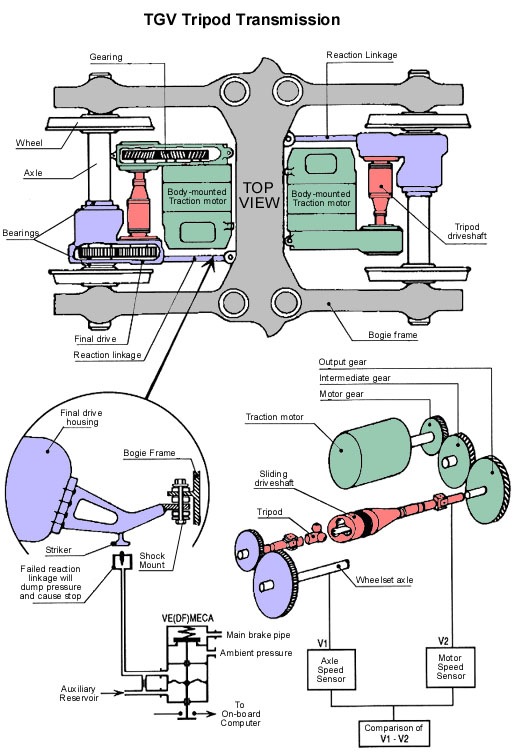
You could fit a whole laptop in this one: http://www.trainweb.org/tgvpages/acela.html#diagr
a ms -
Not so impressive, French TGV is faster
By the time the test ends in early 2008, the operator hopes to hit the maximum speed of 250 mph -- faster than the train will travel during regular operation.
French company Alstom SA's TGV, or Train a Grande Vitesse, is currently the world's fastest train, operating at a top speed of 218 mph.
Current record for the TGV is 320mph -
Re:Why don't we have trains like this in US?
There is an interesting story about the San Francisco Bay Bridge. If you haven't seen it, it is a double-deck bridge. When first built the lower deck had train tracks and car lanes. The upper span was just for cars travelling in both directions.
The passenger train system (the Key System / Key Route) was successful but somewhat limited as the East Bay area spread out away from SF/Oakland. It was discontinued in 1958. General Motors (surprise, surprise) obtained 64% of the stock of the company which ran the Key System through a front company. They replaced the entire board and essentially dismantled the system piece by piece. GM then planned to replace the system with GM buses. The regional governments tried to stop the plan, but lost out eventually.
GM continually tried to dismatle all trains, and even had some help by the Oakland transportation department in converting popular train lines (96% ridership) into car lanes because the trains (travelling at street level) were trying up car traffic.
I love this quote: "The PUC had granted a large fare increase for Jan. 1, 1948 for "service improvements." After the fares were raised, GM stated its 'motorization" plan was the "service improvement.'" Motorization was the replacing of street cars and electric trains with buses.
Through fare increases and service cut backs, GM got what it wanted all along. Removing trains and selling buses and cars!
Source: http://www.trainweb.org/mts/ctc/ctc03.html
So, it wasn't a conspiracy so-to-speak, but underhanded corporate tactics to sell product. -
Re:Trains are best for medium distances
the reason that the Acela ride is so much smoother than the regular train is the car-levelling system that they have. It automatically compensates for curves, etc. It's pretty cool. Trainweb's page about Acela has more info.
-
Re:Nothing more than a kludge to a broken system
Really, why, in North America, are we so fixated on the automobile for personal transport?
Because some big corporations (General Motors & some others in the auto industry) decided they'd make more money that way. Here's one blurb that starts discussing it (scroll down a few paragraphs):
One dramatic example is the "Los Angelizing" of the US economy, a huge state-corporate campaign to direct consumer preferences to "suburban sprawl and individualized transport -- as opposed to clustered suburbanization compatible with a mix of rail, bus, and motor car transport," Richard Du Boff observes in his economic history of the United States, a policy that involved "massive destruction of central city capital stock" and "relocating rather than augmenting the supply of housing, commercial structures, and public infrastructure." The role of the federal government was to provide funds for "complete motorization and the crippling of surface mass transit";
Another choice quote:
The private sector operated in parallel: "Between 1936 and 1950, National City Lines, a holding company sponsored and funded by GM, Firestone, and Standard Oil of California, bought out more than 100 electric surface-traction systems in 45 cities (including New York, Philadelphia, St. Louis, Salt Lake City, Tulsa, and Los Angeles) to be dismantled and replaced with GM buses... In 1949 GM and its partners were convicted in U.S.district court in Chicago of criminal conspiracy in this matter and fined $5,000."
Here's a more detailed history of the controlled demolition of the Bay Area "Key System":
General Motors, and some other companies in the automobile industry, acquired 64% of the stock of the Key System (officially the Railway Equipment and Realty Company) through a "front" company, National City Lines, in 1946. They replaced the board of directors with their own stooges, who then approved a motion to scrap company plans to purchase PCC type streetcars and electric trolleybuses. Today it would be called a "hostile take-over." Orders for more trains were cancelled. Soon they started to decimate the system, first destroying the electric trolleybus line (that, while still under construction, was almost completed) followed by streetcars and electric trains.
It's a small comfort to know that the US government whoring itself to corporate America's interests is not a recent phenomenon. -
Re:it's about time...
A single chip of gallium and some other chemicals is used to create the light.
Um, that's one method, as I stated. GaN LEDs are blue to ultraviolet in color. They may be coated with chemicals that emit yellow light, together creating the illusion of white. This isn't ideal for all purposes; light using more of the spectrum is more pleasing (more like sunlight) and so is desireable for indoor lighting, hence tri-color LEDs.
-
Re:This is technological progress...
as well as being "Adenosine Tri-Phosphate", ATP also crops up in the UK rail industry - "Automatic Train Protection", first successfully used in the UK on the Docklands Light Railway, although earlier versions were used on the London Undergorund Victoria Line and by the Great Western Railway.
-
Re:Entropy.
Not exactly. It was GM that was doing the buying, and it wasn't the bus they had in mind as a replacement.
The result is a system that may be adaptable, but certainly isn't more efficient than a mixed bus/metro/trolley/whatever system would have been.
From what I've seen on TV, US buses (with their unbelievably loud engines and generally rubbish design, especially when compared to what we have in Europe) aren't exactly an attractive option for traveling. -
My mileage
My preferred method of transportation gets 1.2 gallons per mile....
Which is better than a hybrid car for certain numbers of people..... -
Why a maglev?This is useless technology.
Why? For speed?
Conventional trains routinely hit 320 km/h FOR LONG STRETCHES AND DURATIONS (not just for 10km portion out of a 700 km journey), and have gone as fast as 515 km/h in tests.
The sheer complexity of the switches (*) guarantees that the resulting network will be much less flexible than an ordinary conventional high-speed rail whose switches are of the ultra-simple time-tested conventional design.
What does speed gives you? Since the energy expenditure squares each time the speed is doubled, you soon hit a wall where the energy efficiency drops well below an aircraft.
For example, a 1200 km trip (New-York_Chicago) Speed time saved* Energy How much more than
100 12 10000 at 100 km/h
200 6 6 40000 4 times
300 4 2 90000 9 times
400 3 1 160000 16 times
500 2.4 0.6 250000 25 times
600 2 0.4 360000 36 times
700 1.71 0.29 490000 49 times
* from previous time Fucking slashcode that won't let PRE pass. Fuck it (and cowboy neal too, at the same time).So, each time you increase speed by 100 km/h, your energy use soars so much that for saving a paltry quarter-hour, you spend 13 times more energy than needed to go at 100 km/h!!!
This is the reason french TGVs only run at 300 km/h. They are designed for 400 km/h and routinely hit 450 km/h for demos but running them at 400 km/h would be too expensive for the tiny amount if time gained.
A high-speed maglev runs at the surface, where the air resistance is waaaaay much higher than for an aircraft at 35,000 feet. So the energy expenditure per seat IS GOING TO BE HIGHER than an airplane!
Even though the speed of sound is much higher on the ground than at 60,000 feet (where Concorde used to fly), 1000 km/h maglev trains will need very long viaducts and tunnels to avoid becoming high-speed stomach wrenching roller-coaster rides.
The only way a maglev could be useful is running within an evacuated tunnel in a long journey.
In theory, the trains could run at the orbital speed of the altitude they are; energy expenditure would then be zero (all you'd need is to accelerate the train to speed, and you'd recover most of that energy by decellerating it at destination). But the costs of digging tunnels that would be so perfectly aligned, immune to geological havoc (crossing from one tectonic plate to another isn't really a walk in the park) and to keep the thing perfectly evacuated would likely be prohibitive (and maintenance guys would need to work in spacesuits...). Such money should be spent instead for a space elevator.
-
Impressive? How's that?
It is impressive only in that it is a maglev. Frankly, it is only ~66 km/h faster than the TGV's old record which uses conventional technology
It would be interesting to see a cost comparison of high speed conventional to maglev track. Using Occam's razor, why bother with maglev if conventional can yield equivalent performance? Not only does maglev require a unique track, it may require dismantling of old track and infrastructure to provide replacement service. For what end? A few minutes faster between stations?
And then one could ask: if you need speeds of +500 km/h to get somewhere in a reasonable time, why not just take a plane?
-
Re:Impressive
Yep, a TGV recorded 515.3 km/h (320.3 mph) back in May 1990, not bad at all.
Details on TGVWeb. -
Re:AUTOMOBILE comparison
Certainly, if every copied MP3 or other media is a 1:1 correlation with a lost album sale, and every "shared" MP3 is responsible for hundreds of lost sales, then one city BUS must then be responsible for the loss of the sale of 40-60 automobiles?
Absolutely, which is why General Motors used its influence to cause dozens of cities to dismantle their streetcar system after World War II. -
Re:Internet access
Good point, everyone claims "Well trying to shelter the kids is pointless, they will find out about it sooner or later and then all you have done it make it more desirable by forbidding it."
Dern right!When I was a kid, I had all the access I would want to my father's pr0n (pretty lame by today's standards).
On the other hand, my mother strictly forbade me to take the subway.Guess what? I'm a subway freak nowadays. I travel to faraway & exotic places just to have a look at their wierd subways.
-
I'd like to see...
I'd like to see a beowulf cluster of those dropped on this guy's 'nads.
-
Re:Tubes already crowded
Err... all of London's trains are the same height... Well, at least, on the Picadilly, Northern, Victoria, Circle, District, Jubilee, and Central lines.
'Tain't so! There are two sorts of undergound train: "sub-surface stock," which is 3.695 metres high and operates on the Circle, District, Metropolitan, Hammersmith & City and East London lines; and "tube stock," which is 2.882 metres high and found on all other lines. All this, and much much more information than you ever wanted, can be found at Tubeprune's LU Rolling Stock page. -
Jet train tests in 1966
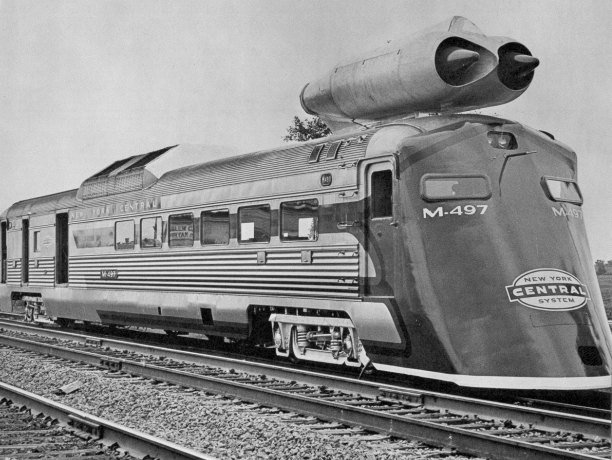
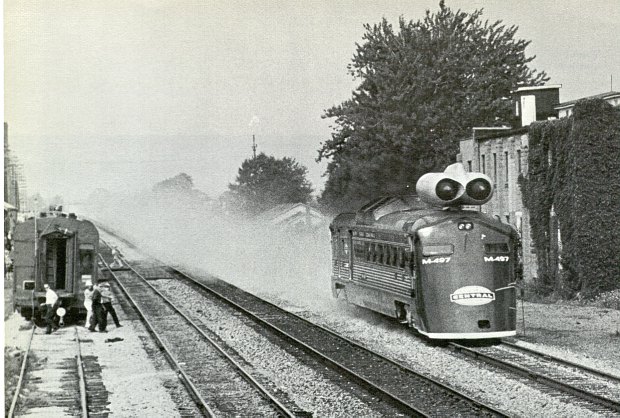
Here's some information about the jet-powered M-497, tested in 1966 by New York Central. There's an interesting article about it in the Fall 1999 issue of Invention & Technology, if you have access to a copy.
Anyway, you've got to check out the pictures:
http://www.trainweb.org/railpix/ampix/nyc-m497s1.
j pg
http://www.trainweb.org/railpix/ampix/nyc-m497run1 -
Jet train tests in 1966
Here's some information about the jet-powered M-497, tested in 1966 by New York Central. There's an interesting article about it in the Fall 1999 issue of Invention & Technology, if you have access to a copy.
Anyway, you've got to check out the pictures:
http://www.trainweb.org/railpix/ampix/nyc-m497s1.
j pg
http://www.trainweb.org/railpix/ampix/nyc-m497run1 -
Re:well meaning??
Iconography is not inherently more understandable. It is more understandable when the icons used are well known and useful. Warchalking marks fall into neither of these. They are not (and most likely never will be) well known, and for most people, they are of no use.
One is not going to immediately understand all symbology one encounters. But ignorance of a symbol system does not immediately negate that system's value or usefulness. How much of the public understands HAZMAT placards (including the NFPA Diamond) that they see on trucks and cargo transportation systems around them on a regular basis? Yet this is a very useful system that is, by Federal regulation, widely used.
Fine, fine. But as you pointed out - what good are these Warchalking symbols if nobody understands them? You will find that as a meme, Warchalking has already made pretty good headway. It has gone from an odd, and somewhat obscure idea on a website to being referrenced to in numerous world-class publications and at least one public statement from a US Federal agency. The meme is being spread - whether it takes hold and survives will probably depend on how useful people find it.
I mean, I'm the kind of person who could benefit from an intentionally open network, but you know what? I'm never going to take the time to learn yet another "standard" written by someone who felt the need to make things much more complex than is necessary. However, if I was in the city, and I saw a sign that said "If you'd like to use my wireless node, the info is: blah blah blah", that'd be easy to use, obvious, and useful to even those who aren't inherently technical people.
This leads in to our next point - how useful is the Warchalking symbol system? Sure - one can advertise one's node via the various websites out there and posting a sign on a physical public bulletin board. But that would assume that those who could use your node already know about the website and had the forethought to jot down the information in advance. And public bulletinboards are rare enough in their own right. You might attract the ire of the local city if you stuck pieces of paper to the sides of buildings. You could write out "If you'd like to use my wireless node..." in chalk but that requires a LOT more effort to write and is not as easy to understand quickly if somebody is walking by.
A chalk symbol is a non-damaging way of marking information that is both easy to mark and quick to understand if the individual has taken the time to learn the basic symbology.
One final observation - I find it odd that you refuse to learn something that you claim you could benefit from. And then you claim the system is complex. I would suggest you actually take a look at the system you are criticizing. You may find it a lot less complex than you imagine. But be careful, you may loose the ignorance you seem place so much pride in. -
Re:Ice StormIndeed, I remember seeing on TV the diesel get dragged down the street of one town. (This isn't the first time you Yanks have copied a good Canadian idea!)
Here is one story that mentions in in paragraph 8: Railways of Canada Archives
-
Re:rail in the U.S.Cost per mile in a car: 12 cents for gas and amortized repairs.
Cost per mile on a train: variable over range, 10 cents I suppose for an average trip ($4 for a 40 miler down the peninsula). And no fees for parking.So the government's involved. Did you forget to notice the expenditure on road construction? For 2002, the US DOT is granted 32 billion for highway subsidies. In practice, the federal subsidy is usually 1/4 to 1/5 of a total project cost, the remainder being composed of state and local bond issues and some chunk of the tax base. So, hey, $150 billion this year on highways. Sounds inexpensive to me. Oh, and that's just the standard road package. There are other line-item pork packages that more than double that number.
I'll just avoid the trivial measure of quantifying environmental costs. One day soon, those, too will be in every cost project sheet. Some pollution credits are already traded on the open market between the G7 & NATO states. Add that, and the 'car per person, everywhere' lifestyle gets pricey.
Putting it under government control can 'hide the losses', if by 'hide' you mean 'place budget in full public access'. For private sector loss hiding, Enron was the rule rather than the exception, they were just overzealous.
-
We had the possibility...
Here in Phoenix, there was an initiative passed called Transit 2000. That link is now dead, but here is one that gives the information about it in more detail. Notice the cost. Notice where it is being put. I live here in Phoenix, and I honestly don't know where they plan on getting space along the roads and freeways they plan this thing to follow - it isn't there. That last site says construction is supposed to begin in 2003. I tend to doubt it. Likely the money will be pocketed by our "illustrious" government.
That is system picked. Want to see what we could have had, for far less money, had our government had more vision, and taken a chance on a proven inventor?
The SkyTran System
This is a system invented by Douglas J. Malewicki, an independent inventor.
Read about SkyTran. I am sure there are a few drawbacks, but I would say the majority of them have been seen to by Mr. Malewicki. His reasoning is sound, and fully documented.
Unfortunately I won't get to see my tax dollars go toward this system... -
Re:Industrial use of Fuel Cells...Possible? Sure; the traction motors don't care where the power comes from.
Practical? A quick browse of TrainWeb revealed that a typical locomotive diesel cranks out about 4500 horsepower, which is about 3.4 megawatts. The DOE expects fuel cell efficiency to reach 75% by 2015, whereas diesels peak at about 45%. So figure a fuel-cell-powered locomotive would require about 2MW. Energy Research Corp. is developing multi-megawatt generators for the Navy, so a rail version isn't too great of a stretch. One of DOE's goals in this same timeframe is to cut the cost of fuel cell energy to two-thirds that of a diesel generator, so a fuel-cell locomotive may even be cost effective before long.
   ddb (who has a vague, grainy-black-and-white childhood memory of seeing a steam-powered freight, ca. 1958)