Slashdot Mirror
Domain: tuhs.org
Stories and comments across the archive that link to tuhs.org.
Comments · 116
-
The first version of Unix had mail
V1 of Unix from 1971 had a man page for the mail command. Multics had a MAIL command. Shiva did not invent these systems that are the fundamental basis of modern email.
If Shiva claims to have coined the term email in short form or as an acronym (EMAIL) or as the name for his system, fine. But there is a big difference between coining a term and inventing something and we already have well explored this concept in society. By trying to create this stupid fantasy of his, he's just losing all his credibility and we will just ignore him.
The amazing thing is, this guy seems smart and well spoken, why would he ruin his reputation by making easily disprovable claims over such a widely used and revered technology. It's proof that you have to be careful with people and what they say, they may just be a crazy fucker.
-
Re: Buy Windows from Microsoft, make it open sourc
> Add Unix Sys V as well.
Have you looked at Illumos? As I understand it, it's the most modern derivative of OpenSolaris available and the closest you can get to actual SVR4 source code.
TUHS has lots of ancient Unix source code up to Version 7 and 32V. I haven't dug into it but I imagine you could get close to a full SVR4 system with the available sources.
But then, Linux and the BSDs have evolved so much since then, I'm not sure having SVR code would gain you much. It's just for historical interest IMHO; you can now do anything with the available free code that you could do with SVR, and more.
-
Re:Giant problem
> Real problem for Oracle too. sprintf. Owned by AT&T.
Yeah, and open sourced by Caldera in 2002.
-
Re:What is systemd exactly?
Cool thing, even in the beginning Unix had man pages. You can check them out.
-
Re:~/.cshrc
> And some foolish folks decided to go ahead and replace
Have you ever taken a look at the original Bourne Shell code? All the way up to V7, this header file was applied to each and every line of source code of the original Bourne Shell:
http://minnie.tuhs.org/cgi-bin...Essentially, this header turned C into a really crummy version of ALGOL -- and the source code was written with that in mind. It took them until 1984 to de-ALGOLize the source code, and it was still a horrible mess after that.
So the Bourne-Again Shell (Bash) was created in 1989 as a response to the shoddy code (and other limitations). Then, when that one bloated out of control, people started going back to the "minimal Bourne Shell" approach in the modern incarnations of Ash and Dash; but by then, Bash had already become the de-facto replacement for Bourne Shells.
In the end though, for any nasty bug you find in Bash, you'll probably find two in the original Bourne Shell --- only hidden behind virtually unreadable source code.
And it is very likely, that nasty things lurk in tcsh, ksh and others. After all, as someone sage once said: "Any non-trivial program that consists of more than three lines of code has at least one bug."
-
Old Unix is free
Caldera open sourced Ancient Unices 12 years ago: http://www.tuhs.org/Archive/Ca...
-
Re:The good old days
Talk about simplicity. Here is an example 'Makefile' from Unix 6. Compare it to today's auto-tools:
chdir lib
cc -c -O *.c
ar r
rm *.o
chdir
cc -s -O y?.c
cmp a.out
cp a.out
rm a.out *.o -
The original UNIX source code
-
Re:I remember ...
I remember the first time I saw Unix, in 1976. The first step in installing it was to compile the C compiler (supplied IIRC in PDP-11 assembler)
As I remember, and as the "SETTING UP UNIX - Sixth Edition" document says (see the start *roff document in this V6 documentation tarball - yes, I know, tarballs are an anachronism here
If you are set up to do it, it might be a good idea immediately to make a copy of the disk or tape to guard against disaster. The tape contains 12100 512-byte records followed by a single file mark; only the first 4000 512-byte blocks on the disk are significant.
The system as distributed corresponds to three fairly full RK packs. The first contains the binary version of all programs, and the source for the operating system itself; the second contains all remaining source programs; the third contains manuals intended to be printed using the formatting programs roff or nroff. The `binary' disk is enough to run the system, but you will almost certainly want to modify some source programs.
You didn't have to recompile anything (at least not if you had more than 64KB; I had to do some hackery with the assembler to get it to run on a 64KB machine, as there wasn't enough memory to run the C compiler - I had to stub out the pipe code with an assembler-language replacement for pipe.c, and then recompile the kernel with a smaller buffer cache and the regular pipe code). Most users probably either had to or had good reasons to recompile the kernel (different peripherals, more memory for the buffer cache - or less memory in my case, so I had to shrink it from 8 whole disk blocks to 6 - etc.), and if you weren't in the US eastern time zone or didn't have daylight savings time you had to change ctime.c, or whatever it was called, in the C library for your time zone, recompile the C library, and then rebuild all utilities with the new C library (no Olson code and database, no shared libraries, no environment variables so no TZ environment variable).
-
Playing with simh and OLD unices
There's nothing like playing with simulated old gear, e.g. with simh, using old operating systems; but playing with old Unices also has its charm.
-
System V source code
I take it this does not include a complete set of System V (Release 4.2 or 5) source code does it?
Having never seen any AT&T Unix code newer than the reprint of Lions' A commentary on the Unix Operating System, (based on V6 - 1975) and the "ancient" Unix source from The Unix Heritage Society.
It would be purely academic and novelty, but it would be of geeky interest to have access to System V's source code.
-
Re:hmm
http://www.tuhs.org/wiki/The_Unix_Heritage_Society
Historians can be interested in any number of things, they are not all like Indiana Jones...
-
Re:Is UNIX even worth suing over these days?
Linux and the BSDs have pretty much made UNIX obsolete.
I don't know about Linux, but BSD definitely contained Unix code from USL, and vice-versa. They settled out of court. Should ever SCO decided to go after BSD, it would open a big can of worms. More details can be found in The Unix Heritage Society and Bitsavers Archives.
-
Re:Reading the disk will be tricky.
Take a look at the unix heritage society. See http://minnie.tuhs.org/TUHS/ I once used some code I found there as the basis of a program I wrote that could read an antique CCC scsi disk from that era on a Sun workstation and export the files.
-
Re:Serious bug in gcc?
Of course NULL is part of the C language, you blathering idiot, and it always has been. The level of ignorance here astounds me. Don't post about things you don't understand.
Quoting from C89: (not C99, C89, the one that's older than dirt.)
4.1.5 Common definitions The following types and macros are defined in the standard header . Some are also defined in other headers, as noted in their respective sections.... NULL which expands to an implementation-defined null pointer constant
NULL wasn't even "added" in C89: NULL appears in the oldest, cruftiest UNIX code you can imagine. (That link is the original cat command from 1979.)
-
Re:Overtaken by virualization
``Basically chroot was an early attempt at virtualization. It allowed one to keep servers separated and contained, '' chroot() appears in seventh edition (http://minnie.tuhs.org/UnixTree/V7/usr/src/libc/sys/chroot.s.html), released in January 1979. It's written in PDP11 assembler. It's a hell of a stretch to argue it was meant for virtualisation, server containment or whatever use it might be put to today.
-
Gentlemen[1], start your screen scrapers
But before you do, let me just fill you in on how the Australian experience went, and why paying may not be such a bad thing.
Historically, there's been no XMLTV guide data source for Australians. So there have been a litany of screen scrapers that downloaded guide web pages, massaged them into XMLTV format, and passed them on to MythTV and friends.
The only problem is, the program guides are controlled by the TV networks, and the TV networks hate us. Ouch, but true. They've made the leap of logic that, if we had program guide data on our DVRs, we can skip the commercials.[2] So they've been arguing that they own the copyright to the guide data[3] and any unauthorised use of it (i.e. screen scraping) is a breach of their terms.
The only commercial company to publish guide data for DVRs is IceTV and they've been a lawsuit magnet from abovementioned TV networks. Not many people would pay a monthly subscription to something that could be killed at any time.
Meanwhile, in screen scraping land, it's been a game of cat-and-mouse. Find a web site that publishes guide data. Write a screen scraper (or wait for someone else to). In a few months, notice that nothing's been scheduled for a few days - the screen scraper has broken because they've (intentionally) changed the format to deter this. Find another web site. Repeat.
They did all sorts of things to deter us. Obfuscation through JavaScript. Only allowing n page views per hour. After they converted all the guide details to GIFs, we gave up. Most people have moved to IceTV or ozTiVo.
The ozTiVo guide is an interesting idea. It's essentially a wiki that people manually fill in with guide data. Then you can use its XMLTV interface to get guide data out. You're reliant on other people to fill it in, and (due to above copyright issue in Australia) a lot of program details are generic or omitted. But it's workable. This is a model which other people may be interested in setting up.
Fortunately for IceTV, in the last few days, it won its court case and is now happily legit.
So, to sum up, we in Australia are actually happy to pay for quality guide data. Because we know the alternatives. If someone wants to set up a screen scraper, good luck to you - we fought the good fight and lost, but maybe you won't.
--
[1] Ladies too!
[2] No, I don't know how they came up with that either.
[3] In Australia, this has historically been a grey area. -
Site scraping works.
Whilst a pay service might work well the fact is that site scraping can be very effective and provide very good results.
Australian users have never really had guide data available to them, so we have basically relied on either IceTV, a (very well done) for-pay data source, or ozTivo. Recently Australian users have had a new resource, Shepherd.
Shepherd is basically a bunch of scripts that are automatically updated and designed to read quite a few websites and data sources (including IceTV and ozTivo) and provides the best quality data I've seen so far. The set up is relatively easy, if you can get MythTv set up you can certainly get Shepherd set up, and doesn't require ongoing maintenance, once you get it working the script will keep itself up to date.
The TLDR version: Site Scraping can and does work well. -
Bourne Shell
The Bourne Shell must get some kind of mention here. What do you do if you prefer ALGOL to C? Why, #define your own syntax, and thus turn boring old C code into a thing of beauty.
-
Bourne Shell
The Bourne Shell must get some kind of mention here. What do you do if you prefer ALGOL to C? Why, #define your own syntax, and thus turn boring old C code into a thing of beauty.
-
Bourne Shell
The Bourne Shell must get some kind of mention here. What do you do if you prefer ALGOL to C? Why, #define your own syntax, and thus turn boring old C code into a thing of beauty.
-
Re:This is troubling
In Australia, I've been using reliably for over 2 years (it has been around longer) the Oztivo TV Guide data, which is community created, supported and maintained. It was originally set up by a group of people who imported Tivo devices to Australia, where there is no Tivo data available. This data has been extended so there are now Mythtv and MCE scripts to allow access to the data. I've found the data to be better than some of the Aussie pay-services, purely because the guys who maintain the data are using it as well, so have a vested interest in making it as useful as possible. This service supports TV across all the states and regional centers in Australia, as well as the cable and satellite channels.
I'm guessing it's down to a need - in the US, there has not been a need for this kind of community data source, as Zap2It has been a free source. Now that it's gone, I'd be guessing there will be multiple US community based solutions springing up within weeks, and within 6-12 months most will fall away or aggrigate, leaving one or two that everyone uses. -
Re:This is troubling
In Australia, I've been using reliably for over 2 years (it has been around longer) the Oztivo TV Guide data, which is community created, supported and maintained. It was originally set up by a group of people who imported Tivo devices to Australia, where there is no Tivo data available. This data has been extended so there are now Mythtv and MCE scripts to allow access to the data. I've found the data to be better than some of the Aussie pay-services, purely because the guys who maintain the data are using it as well, so have a vested interest in making it as useful as possible. This service supports TV across all the states and regional centers in Australia, as well as the cable and satellite channels.
I'm guessing it's down to a need - in the US, there has not been a need for this kind of community data source, as Zap2It has been a free source. Now that it's gone, I'd be guessing there will be multiple US community based solutions springing up within weeks, and within 6-12 months most will fall away or aggrigate, leaving one or two that everyone uses. -
Re:Bullshit!
I guess this is enough to disregard the fact that it was GNU/Linux - *not BSD* - that was the first truely free Unix like OS.
Apparently Bill Joy started putting BSD together in early 1977. The FSF didn't exist until October 1985. From what I've read, the UNIX sources were distributed completely without restriction even earlier than 1977, since due to the antitrust case against them, AT&T weren't allowed to begin selling an operating system. The only charge that was being put on the source was the price of the mag tape, and I also don't know of any license restrictions either. Given the degree of university collaboration that existed early on, I can only assume that there weren't any. AT&T only became restrictive with the source themselves when they were released from the ban on selling it.
AFAIK, the main reason why UNIX wasn't used much outside of universities very early on was because of it originally being written for the PDP-8 and 11, which were very different architectures to the 80386. The first port that I know of to the 80386 that took place that I know of was the one done by the Jolitzes, which ended up becoming (more or less, anywayz) what we now know as FreeBSD.
It sounds like you've got the version of history that Stallman wants people to have; i.e., the one that makes him look like the sole father of the entire practice of releasing source code in general. From what I've been able to figure out anywayz, the truth is a bit different. UNIX was developed very collaboratively from its' inception, and as you yourself probably know, without source, that can't really happen.
Probably enough to disregard the fact that the "evil" FSF was already making available a shitload of software when Bill Gates was still dabbling in GWBASIC
The ANSI standard for Minimal BASIC is dated 1978, the same year Microsoft was founded. According to Wikipedia, the FSF was founded in October 1985...Looks like you're off by a couple of years. According to that, BASIC existed *before* the FSF. Also...I don't know what your own definition of "free" is, but Stallman himself was selling copies of Emacs during the 80s.
Rewriting history must be a nice hobby.
Reading history is a great hobby, sure...it allows me to know when it's been rewritten by someone else.
You might dislike it, you might have another, but *ours* has been there well before BSD did *anything*.
Unfortunately that simply is not true...it's what you've been told. Don't take my word for it though...Go and do some research of your own. Some links that might help:-
Some accounts of early UNIX history from the UNIX Heritage Society. There's some early source code there as well.
20 Years of Berkeley UNIX.
Some info about where Stallman originally got at least some of his ideas.
The Art of UNIX Programming, which has a fair amount of historical info as well.
A rather non-canon biographical portrait of Stallman.
Another second opinion on Stallman, more or less in general.
Maybe if you take the time to go through this material, you might start to realise what my beef is. I don't like bullies, and I don't like frauds...Stallman is both, which from reading the above, you will learn. I strongly urge anyone else here who views me as merely a baseless troll to go to the above links and read that material as well. If I am a troll, the point of it is very simple:- This Emperor has no clothes. -
Re:VMs
Ooh, just found Emulab - looks promising!! Offers access to lots of PCs running various OSs.
Also, forgot to mention access to Cray Unicos (and other supercomputers!) and pdp unix preservation society (not just PDP images). -
Re:International Use
Check out the ozTivo group. Depending on the Tivo model you have, you might still be in luck. And if you don't have the right model but someone else you know state-side does, you might want to organise a swap before you come over here
-
Re:Linux ripped it off?
-
Re:From vi to vim, now back again to vi
Where do you even find the original vi?
The Unix Heritage Society has the original source code. Get the file 2bsd.tar.gz . It's a beautiful tarball. The timestamps in it go back to May 1979! Vi is located in the src/ex directory. This source code might be hard to compile, but Gunnar Ritter has added the needed changes to make it run on Linux. Try http://ex-vi.sourceforge.net/ -
TUHS
If you haven't already, you may try contacting The UNIX Heritage Society. They're a group of individuals that love old hardware, and may have a member locally that would loan or otherwise provide you with older equipment.
-
Re:All this comes as I think about going to BSD
Thank you for sharing your views on which BSDs to look into. I had not found enough information to properly judge, it seems. I think I'll take a look into both FreeBSD and OpenBSD and perhaps try to keep tabs on Dragonfly.
If ever I fall off the deep end, I can start up a PDP-11 emulator and use the ancient Unix from http://www.tuhs.org/ -
The Spirit of UNIX
Probably the oldest standard that people still refer to is AT&T's 1985 System V Interface Definition (SVID).
I routinely use printed Seventh Edition (Bell Labs Research) UNIX manuals, even when writing C for Linux. It also helps one remain blissfully ignorant of the 'cat -v' option and similar excrescences. Also the Tenth Edition UNIX manuals. I have to remember the changes introduced by Standard C and the like, but it's convenient to have the essence of the modern-day manual in printed form. Of course, there are some people out there who delight in using Fifth, Sixth, Seventh etc Editions on PDP-11s etc - see the PDP-11 UNIX Preservation Society, http://minnie.tuhs.org/PUPS/. I wish I had a larger garage! How much would a PDP-11/40 cost me now, anyway?
Peter Salus' book "A Quarter Century of UNIX", Addison-Wesley, 1994 (corrected 1995), ISBN 0-201-547771-5 is a good informal UNIX history.
"Those who do not understand UNIX are condemned to reinvent it -- badly."
-- Henry Spencer -
My Suggestion:
Release your product in Australia! Or at the very least, in Europe, so that there is a native PAL version that we can grey import...
FYI, there is a small community of Tivo users here already. http://minnie.tuhs.org/twiki/bin/view -
AAC is patent encumbered.
Why limit yourself to inferior hardware players just because u want to support an "open" format. AAC is not "closed" by any definition.
From a legal standpoint AAC has the exact same problems as MP3. That is that several aspects of the encoding / decoding process are patented, and you must license them in order to legally distribute an encoder or decoder. This makes it impossible have a legal open source implimentation. In fact, one such project has already been shut down after receiving a cease and decist letter from Dolby Labs. If anything the AAC patent holders have been less lenient with open source developers than the MP3 patent holders.
So, if you were happy with the legal restrictions on MP3 and choose to switch to OGG for purely technical reasons, then the legal restrictions on AAC should be no problem. However, the reason that the OGG project was started, and the reason that many people switched to it was to get away from the legal encumberances that surrounded MP3. It is a format that is patent free and anyone may write an implementation, without any licencing requirements. For people who care about that AAC definitely NOT open, and is not acceptable. -
Australia would be lucky to get a TiVo
First, I should point out, I am Australian.
That said, the choices when it comes to PVRs in Australia is horrible.
Choice? What choice? The first real one the Australian public has seen is 'Foxtel IQ' which was released early this year. This happens to also be the device they mention in this article.
Ask an Australian last year what a PVR was, and they would have no idea. Hell, ask them this year, and they probably still have no idea (even after Foxtel's fairly large advertising campagines).
Some of us, didn't take this entire situation sitting down, and stated importing TiVos. Thus, OzTiVo was born. For the first time, it allowed Australians experience a true PVR. although, few people then, and even now, actually know about it.
The Foxtel IQ box fails when put up against an imported TiVo in every way, except one: It can record two shows at once. Other then that, it's all bad. The sad fact is, the general public has no idea how badly they are being ripped off. It will cost you $500 for 'Foxtel IQ', which Foxtel remains ownership of, if you disconnect, they take the box back.
Their versions of 'season passes' has many problems, and often doesn't work - They have nothing like 'wish lists', they don't have TV guide data for the vast majority of free-to-air stations and it's full of copy-protection among other rubbish. Not to mention the bad UI...
I feel bad knowing how good a TiVo is, and how many people still continue to buy Foxtel IQ. It is *not* good.
Give me a TiVo any day. -
Re:What makes a good Comment?
My favorite comment (not written by me) is this line from the Unix V7 source:
sub r3,r0 / this is the clever part
You can see the whole file at http://minnie.tuhs.org/UnixTree/V7/usr/sys/40/m40. s.html
Seeing the entire context doesn't enlighten me any more than does the single line above. The only purpose of the comment, imo, is to flag to the reader "if you think you understand what is happening here, you might want to look again." -
Stay in the swamp
You invented ethernet. Even before that, you were THERE, and helped operate, the first big ARPANet demo for Congress. You founded 3Com. You wrote more Inforworld columns than a mere human like me could read. You are the Old Master, Yoda in the swamp.
Don't spoil it now by being Dvorak. Please.
Linux is only Unix on the outside. There's scarcely little code on the inside from 1992. And I believe there is none (zero, nada) from before 1975. I know this because I've looked at the early UNIX code at http://tuhs.org/ and what little survives is not found in Linux.
Windows a copy of the Mac? In the sense that English is a copy of French, maybe [flames >/dev/null]. Some elements are the same, but how you do things with them is quite different.
Asking what the new OS will be is asking the wrong question. Ask instead what new class of devices will need an OS, and the answer would follow from that. I say "would" because I'm not sure even that question is relevant. -
Re:Well that's just great...
It has hit AU, just not "retail". The OzTiVo crew have got the solution humming, and its a beautiful thing.
OzTiVo homepage
Personally I have a MythTV box, but thats because of the higher geek-quotient involved -
Re:Uh... usr != user
Indeed -- the reason
Just to clarify, the letters USR do not mean USER, sure it may sound plausible, but I assure you, USR actually stands for Unix System Resources. Think about it. For the historians in the house, remember, the first version of Unix wasn't multiuser. That didn't come about until it was ported to early C on the pdp-11.
Goto http://minnie.tuhs.org/PUPS/, the PDP-11 Unix Preservation Society, and get a simulator and the rk-ll disk images and actually run it. It's neat. -
Re:A Jerq at Every Desk(For those of you who aren't Rob Pike or Dennis Ritchie:)
The Jerq was the original name for the Blit -- a name that management didn't approve of, for some reason.
More info: AT&T 5620 (and Related Terminals) Frequently Asked Questions
And also: Can someone advise me regarding a gui for UNIX
From: Dennis Ritchie <dmr@plan9.bell-labs.com>
Norman Wilson's account of the Jerq/Blit etc. is quite complete and correct, though there was some recycling of names. 'Jerq' actually was used quite early, when Pike got interested in bitmap graphics. The name was a takeoff on the Three Rivers Perq, which he (and I) saw at Lucasfilm Ltd. while attending an early Usenix. Blit was the slightly more PC version (suggested either as part of BitBlt or "Bell Labs Interactive Terminal). The originals used the Motorola 68000, and part of the development messup was AT&T Computer systems' decision to switch to the WE32000 processor with consequent delay for porting and reworking.
The earliest versions were not quite as wonderful in practice as Norman suggests for the later ones. They were built by the Teletype corp. model shop (in quantity of a few hundred) and downloading the OS took several minutes at 1200bps--necessary at startup, since they didn't have a ROM for the whole thing, just enough for doing a download. They were also static electricity antennas! Many is the time that I would shift in my chair, then touch the keyboard, only to have the terminal reset itself. I developed the habit of putting my hand on the heavy steel case before moving around.
On the other hand, the basic idea was architecturally right (and the later commercial versions were not so subject to static, and had ROM for the OS). They were even nicer at 9600bps.
It's good to know that Norman is still using his.
Dennis
-
Re:Wow, that's great ...Actually, it's less of a joke than you might think. Here's an interesting bit from the article:
Note that in order to run 5th edition UNIX with gbaunix, you must have an RK05 disk image of 5th edition UNIX, which is not included in the gbaunix distribution. SCO owns the copyright for the 5th edition (and several others).
Thankfully, Caldera released (under a BSD-style license) this particular UNIX edition, along with some others, shortly before the name change in 2002. Here is the license [PDF Alert], if anyone's interested.
-
Re:Xenix or Venix?
Heh but I spoke too soon. There was also a Venturcom Venix that ran on PDP's.
I used the x86 version in the mid 90's, and had never heard of the PDP one. -
Re:It's so obvious...
And *poof* all the ancient Unices are suddenly in the public domain
All their ancient Unices are already public domain. -
Tivo here in Oz ready or not
Some enterprising people have already set up sites to modify imported machines, and supply the data.
tivo site for making australian Tivo
Tivo Weeknees -
Re:April 7th, 1969Read The Evolution of the Unix Time-sharing System by Dennis M. Ritchie. Not that the answer is there but it's a good read.
An answer to your question can be found in the TUHS archive. Once inside an archive mirror look for the Readme in the directory PDP-11/Distributions/research/1972_stuff for this quoteIn the early version of UNIX, timestamps were in 1/60th second units. A 32-bit counter using these units overflows in 2.5 years, so the epoch had to be changed periodically, and I believe 1970, 1971, 1972 and 1973 were all epochs at one stage or another.
-
Re:Wake up Tivo
The Australians seem to have figured out how to get Tivo to work with XMLTV and notably w/o a subscription, see wktivoguide. It shouldn't be too hard to adapt this to CA.
-
SCO and Open Source
Funny. I was doing some research on SCO/Caldera and it's previous commitment to Open Source/Free Software. What I found was this guys making some weird announcements. This one seems very strange to me.. Please, look closely to the "unenforceability of the GNU general public license and other open source licenses" phrase. It is from 2001.
-
SCO may not know origin of codeThe Sydney Morning Herald continues its mainstream coverage of the SCO vs IBM roadshow by posting an article where Dr Warren Toomey, a Unix historian, says that SCO may not know the origin of their own code.
Article text follows:
SCO may not know origin of code, says Australian UNIX historian
By Sam Varghese
September 9, 2003More doubts have been cast on the heritage of System V Unix code, which the SCO Group claims as its own, by an Australian who runs the Unix Heritage Society.
Dr Warren Toomey, now a computer science lecturer at Bond University, said today: "I'd like to point out that SCO (the present SCO Group) probably doesn't have an idea where they got much of their code. The fact that I had to send SCO (the Santa Cruz Organisation or the old SCO) everything up to and including Sys III says an awful lot."
He said that even though SCO owned the copyright on Sys III, a few years ago it did not have a copy of the source code. "I was dealing with one of their people at the time, trying to get some code released under a reasonable licence. I sent them the code as a gesture because I knew they did not have a copy," he said with a chuckle.
Dr Toomey's statements come a few days after Greg Rose, an Australian Unix hacker from the 1970s, raised the possibility that there may be code contributed by people, including himself, which has made its way into System V Unix and is thus being used by companies like the SCO Group.
Dr Toomey said this was one reason why the code samples which the SCO Group had shown at its annual forum had turned out to be widely published code.
SCO was unaware of the origins of much of the code and this "explains how they could wheel out the old malloc() code and the BPF (Berkeley Packet Filter) code, not realising that both were now under BSD licences - and in fact they hadn't even written the BPF code," Dr Toomey said.
He said that there was lots of code which had been developed at the University of New South Wales in the 70s which went to AT&T and was incorporated into UNIX without any copyright notices.
"At that time the development that was going on was similar to open source - the only difference was that the developers all had to have copies of the code licensed from AT&T," he said.
Dr Toomey, who served 12 years with the Australian Defence Force Academy, an offshoot of the University of New South Wales, before joining Bond University, said he had source code for Unices from the 3rd version of UNIX which came out in 1974 to the present day. "I don't have Sys V code but there are people with licences for that code who are members of the Unix Heritage Society. We can compare code samples any time," he said.
He agreed that the codebase of Sys V was a terribly tangled mess. "It is very difficult to trace origins now. There is an awful lot of non-AT&T and non-SCO code in Sys V. There is a lot of BSD code there," he said.
In March, the SCO Group filed a billion-dollar lawsuit against IBM, for "misappropriation of trade secrets, tortious interference, unfair competition and breach of contract."
SCO also claimed that Linux was an unauthorised derivative of Unix and warned commercial Linux users that they could be legally liable for violation of intellectual copyright. SCO later expanded its claims against IBM to US$3 billion in June when it said it was withdrawing IBM's licence for its own Unix, AIX.
IBM has counter-sued SCO while Red Hat Linux has sued SCO to stop it from making "unsubstantiated and untrue public statements attacking Red Hat Linux and the integrity of the Open Source software development process."
-----
Wordforge writing contest now open: deadline 2003-03-28
-
Rebuttal of Darl's claims
In doing this we angered some in the Open Source community by pointing out obvious intellectual property problems that exist in the current Linux software development model.
It's not obvious to me that there are intellectual property problems in the current Linux software development model. In particular, there are no problems that don't exist in traditional closed source development either. If anything, Linux developers have a greater incentive not to copy code, because their work is available for public scrutiny. Had Microsoft, for example, "infringed" on your copyrights, you wouldn't even know about it!
The second development was an admission by Open Source leader Bruce Perens that UNIX System V code (owned by SCO) is, in fact, in Linux, and it shouldn't be there. Mr Perens stated that there is "an error in the Linux developer's process" which allowed Unix System V code that "didn't belong in Linux" to end up in the Linux kernel (source: ComputerWire, August 25, 2003).
You have misquoted Perens. He certainly did not claim that "Unix System V" code was in Linux. He said there was code in Linux that is "very similar" to System V, but has a traceable open-source origin:
The code is from Unix version 3, the oldest known version of Unix that still exists in machine-readable form. The complete source for that system can be found here on the net. In 2002, Caldera released this code as Open Source, under this license. Caldera is, of course, the company that now calls itself SCO. The license very clearly permits the Linux developers to use the code in question.
It is also worthy of note that this code was removed from the kernel for technical reasons before it was shown at SCOForum, and that, as part of the ia64 port, it was never even a part of any major commercial Linux distribution.
To date, we claim that more than one million lines of Unix System V protected code have been contributed to Linux
To arrive at a number remotely close to "one million lines", you must not be referring to Unix System V code itself. This is probably why you used the phrase "Unix System V protected code". You seem to think that NUMA, RCU, and JFS--technologies copyrighted and patented by IBM--somehow now belong to SCO thanks to your contract with IBM. IBM disputes this, of course.
In any event, your contract claims give you absolutely no right to collect license fees from end-users over these technologies. IBM holds the copyrights on the code; it was IBM's to give to Linux. If doing so breached IBM's contract with you, you are within your rights to seek damages from IBM. However, the contracts between SCO and IBM simply cannot apply to end-users who are not a party to the contracts.
Bruce Perens addresses this issue here, at the end of same the article from which you misquoted him earlier in your letter.
You draw some pretty serious conclusions from this one weak example of infringement: "In fact, this issue goes to the very heart of whether Open Source can be trusted as a development model for enterprise computing software." Closed source software is not immune from the same kinds of problems. Take a look at the recent patent lawsuits against Microsoft. Can Closed Source be trusted as a development model for enterprise computing software?
You mentioned that the aforementioned code copying issue damaged the open source community's credibility, but I find it telling that you didn't mention the other code copying example given at SCOForum. This example intended to show that SCO owns the Berkely Packet Filter code (which is, of course, part of BSD), and that an implementation of the BP
-
Re:What about copyright?
>> But then the same argument could be used to say he should be able to publish their proprietary "secret" System V UNIX source.
You can download v2, v3, v4, v5, v6 and v7 of the UNIX code here.
Enjoy! -
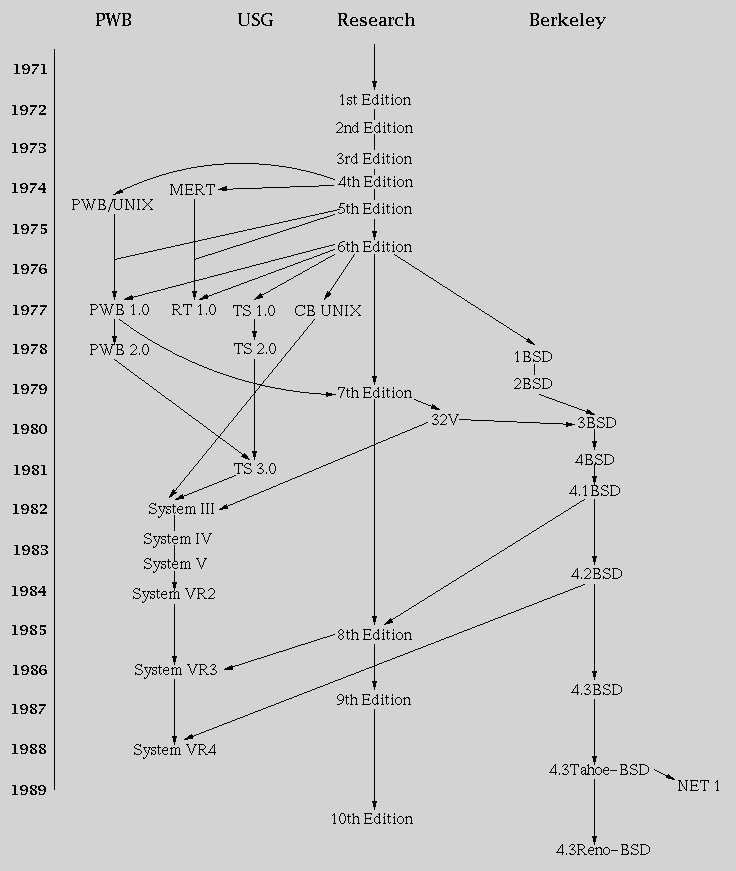
Update the UNIX Family Tree!
The Unix History Graphing Project could use some updating if Linux really does have (legally obtained) code from Sequent, AIX, Irix, etc. It would be really great of Linux were responsible for the de-fragmenting of Unix! It looks like we are heading that way...