Slashdot Mirror
Domain: tuwien.ac.at
Stories and comments across the archive that link to tuwien.ac.at.
Comments · 186
-
Re: Problem: Pythagoras was not the first to prove
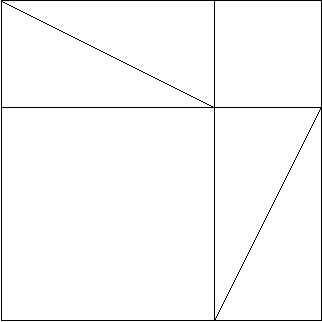
I think you're missing the forest for the trees. Ignore the small squares; the larger square demonstrates the proof using a variation of the classic https://www.dbai.tuwien.ac.at/...
-
Off of the Austrian Coast?
You can tell that Vienna University of Technology doesn't have a naval architecture department. The picture with the caption "The platforms remain steady - even when the sea is rough" shows ripples that a blue-water sailor considers "dead calm". Also, the statement "When the air tanks are correctly dimensioned, the waves rise and fall under the Heliofloat without making any significant impact on the platform" can only be true for a limited range of wave frequencies. The deck will need significant stiffness, or lots of flex joints, to deal with all other conditions.
-
"somewhat of a legend"
An OS, written and supported by one programmer, not a great start. But with a custom programming language? Oh hell no. I've seen what happens when you create a custom C-like language for a system, and I was glad I didn't have to support the legacy project that used it.
-
Re:Not a surprise
I did have to re-add the slashbox... but as I was too lazy to setup an RSS feed or even manually load the page, the slashbox was my portal to freshmeat.
I used to frequent it much more often back in the day, when I had time to explore and experiment with software. Still, there's always something interesting there to someone.
I even have an old Freshmeat.net black tee shirt from back in the day, with a fun "nutrition facts" label. Can't find even a close pic online.
Here's a random snapshot from circa 2000: http://gd.tuwien.ac.at/.vhost/...
-
Re:So what are these "transmitters"?
Either an 8,500 euro transceiver http://www.cubesatshop.com/ind... or an SDR (Software Defined Radio) http://publik.tuwien.ac.at/fil... (or maybe the $18 receiver noted at http://sdr.osmocom.org/trac/wi... and http://hackaday.com/2012/06/27..., or a SoftRock TXRX http://fivedash.com/index.php?...), an upconverter/downconverter, dual circular polarized antennas, and an S-band broadband amp. See http://mdkenny.customer.netspa... for frequency specs. 73s and best regards, y'all, de K7AAY
-
Metapixel
There is also a really nice UNIX command line tool called Metapixel to do photomosaics.
-
Re:never understood the appeal
What you really want is to just run DOOM v1.9 with the command line option '-timedemo demo3'. That will give you a pair of numbers that is easily converted into average FPS. There's even a nice list of machines and their results in this benchmark.
You'll notice that performance is also dependent on the amount of cache available, and the type of video card. This is why it's hard to do simple CPU benchmarks and extrapolate that to game performance. A 100mhz 486 with an ISA video card performs worse than a 66mhz 486 with a VLB video card. How this relates to performance in emulation is anyones guess.
-
Re:ONLY A BIT ??
Quantum computers aren't intended for general purpose computing or math operations
Not entirely true. There is a lot of work being done on general purpose quantum computing architectures at the moment. In fact there are already some quantum compilers out there such as http://tph.tuwien.ac.at/~oemer/qcl.html. Also, a number of algorithms do actually require math operations to be performed by the quantum processor. Remember that measuring a qubit collapses its wavefunction so it is often important to do math operations on qubits before they are measured.
-
Re:haskell for the masses? sure, but only...
Because both are homoiconic AI languages.
It takes about 100 lines to write a Prolog parser in Lisp, or to write a Lisp parser in Prolog. You can't do that for C-Lisp or C-Prolog combination.
Also, it would help if you actually read my posts. They're really short, it doesn't take much effort.http://web.student.tuwien.ac.at/~e0225855/lisprolog/lisprolog.html
http://treewalker.wordpress.com/p-lisp-a-lisp-interpreter-in-prolog/ -
A standard Open-Source Quantum Computing Language
What we really need is a "standardized" open-source quantum computing language so that we can develop and exchange quantum algorithms to prepare for the day when quantum computers are real.
Right now we have the QCL language, QCF for Matlab/Octave, and the Cove framework that could be used with any language, but it looks like there is really only a C# implementation right now.
None of these have really taken hold as a "standard" though, and probably elements of all of them could be brought together in something multi-platform and all-inclusive.
-
Everything runs Linux hereAt the University where I study, pretty much everything runs on Linux or other UNIX-based systems. Even a large amount of the student population runs Linux as their preferred OS.
Students and staff have an LDAP account. All mails go to your
Local WLAN offers 802.1x authentication, VPN and IPSec and unencrypted access with a web-based authentication gateway. To remotely access resources, you can either use VPN and mount your home directory via NFS or ssh to a public student server and do ssh forwarding from there or use X11 forwarding.
Pretty much all operating systems are supported. Detailed instructions and support are provided for Windows, Linux, OS X.
I am aware that this setup is not very common, but it does prove that it is indeed possible to run the IT of an entire university with thousands of students on Linux and support every major operating system.
I'm also sure that you university could easily support Linux if they only wanted to. Linux already supports nearly every protocol you could throw at it and most Linux users know what they are doing. Just enable some non-proprietary protocol, post an example configuration file and you should be good to go.
Some examples of how good Linux support looks like can be found here and here.
-
Everything runs Linux hereAt the University where I study, pretty much everything runs on Linux or other UNIX-based systems. Even a large amount of the student population runs Linux as their preferred OS.
Students and staff have an LDAP account. All mails go to your
Local WLAN offers 802.1x authentication, VPN and IPSec and unencrypted access with a web-based authentication gateway. To remotely access resources, you can either use VPN and mount your home directory via NFS or ssh to a public student server and do ssh forwarding from there or use X11 forwarding.
Pretty much all operating systems are supported. Detailed instructions and support are provided for Windows, Linux, OS X.
I am aware that this setup is not very common, but it does prove that it is indeed possible to run the IT of an entire university with thousands of students on Linux and support every major operating system.
I'm also sure that you university could easily support Linux if they only wanted to. Linux already supports nearly every protocol you could throw at it and most Linux users know what they are doing. Just enable some non-proprietary protocol, post an example configuration file and you should be good to go.
Some examples of how good Linux support looks like can be found here and here.
-
Re:That picture
speaking of which the english full resolution links seem broken, this will suffice.
-
Could be the software you use on Linux/BSD
I wouldn't be surprised if they are using off the shelf tools like FFTW on that supercomputer. It was just yesterday I was amazed at IBM featuring FFTW3 binaries and sources for BlueGene, just like some laptop support software from their website.
I can't find the URL (which I saw on IBM) now but, as you see from here http://www.complang.tuwien.ac.at/skral/fftwgel.html , it is just 2.7 mb ordinary tar.gz file, builds on PowerPC 440. Of course, number of PPC 440's it runs on is what matters
-
Re:Fuck you PC World.
http://www.ifs.tuwien.ac.at/dp/timecapsule/timecapsule.html has a bit more meat on it
-
Old idea is old.
Linux has had this long ago.
http://www.complang.tuwien.ac.at/ulrich/mergemem/ - for example.Note that the savings referred to are on kernel 2.0.33.
I used it on my 8M laptop - worked well.
-
Charles Moore, 1983From "Interview With Charles Moore" Forth Dimensions, July/August 1983, Vol V, No 2:
I did think of one use for a computer, though. Back in the Sierras there were mosquitoes. 1 could see a little solar-powered or laser-based zapper I wear on my head, that shoots mosquitoes. And any mosquito that comes within two feet of me is dead!
-
Re:Similar tool
Grrrr. I didn't notice the lack of linking during preview.
Did you actually follow that link? It goes to a junk page.
Perhaps one of these tools will be more useful:
-
Re:It's Simple Really You Pay Someone Who Knows Ho
+1 to the above. Like anything else, you pay for someone else's expertise, or you learn yourself.
The best and most through guide to web testing and security out there is to the Web Application Hackers Handbook, but the OWASP Testing Guide is a good intro and a free download you can start working with today.
The best way to learn is by doing, and OWASP WebGoat is a good interactive learning environment. It's also quite easy to try out using the OWASP Live cd, which has many of the testing tools like burp, paros, etc and also webgoat ready to run.
There's also a fairly decent "white box" source code scanner for PHP called pixy. You may wish to check that out also.
If you want to pay someone, that's what I do for a living, and I know a decent number of others in the field if you want recommendations.
-
Re:this is just debootstrap
-
Re:this is just debootstrap
-
Re:this is just debootstrap
-
Re:this is just debootstrap
-
Re:this is just debootstrap
-
Re:Show attached block devices
Users of a non-Unix OS will be surprised that you can work with files after deletion, when they are still open. That your programs in the old version are still running after a system update to a newer version, and after quitting and starting them, they are in the new version. Awesome.
Bash* and the way you can connect programs lego-like is known here, but still, remarkable. For solving issues in 2-3 lines people who did the (atomar) programs never thought of before+.
ssh-tunnels are cool stuff, as well as fuse-mounting sshfs. Things like dialog, kdialog, zenity are also not known so much.
Just press tab twice and read all man/info pages for commands you don't know
____
* Dear zsh-users, I don't care that zsh is better.
+ (blatant ad: http://twoday.tuwien.ac.at/jo/topics/fun+with+Linux/?start=5 ) -
Project ARS: neuro-psychoanalysis for AI!
Check out
http://ars.ict.tuwien.ac.at/
The trick is to introduce findings from psychoanalysis and neurology into AI. A totally new and promising approach. Is supposed to be used for intelligent buildings (ambient assisted living, etc.) one day. -
Re:Stallman is still around?Kate is a much better editor than either vim (stateful editor? No thanks!) or emacs (ever tried to get line numbers on that thing?) Yeah, I have tried to display line numbers. Quite easy with this. It's a rare case where I would want line numbers of course -- the currne tline number is in the modeline, and going to a given line number is straightforward, so displaying them usually doesn't matter.
-
Re:Another step towards AI
SIFT is ok even for occluded objects, but is horrid in 3-d because SIFT features cannot match up for a significantly rotated scene. There are better algorithms that can recover both the shape of the scene as in the article and even produce the location of the camera as a by-product.
In terms of object recognition, there has been great work done by treating an "nxn" pixel image as a point in n^2 space, and then reducing the computation space and projecting a given image onto that new, lower-dimensional approximation of the original object, and finding a match via a nearest-neighbor search through recognized objects.
There is also good work being done in terms of getting a detailed 3-d model using structured light methods: http://www.prip.tuwien.ac.at/research/research-areas/3d-vision/structured-light
There is good literature out there, but sometimes the math gets over my head =P -
Re:While it's great news...
Quantum programming isn't all too difficult. Learn about quantum computing through this guy's webpage. http://tph.tuwien.ac.at/~oemer/qcl.html/
The Quantum Computing in QCL PDF has some really great information for those interested in learning the basics. -
Nothing special
Here in Austria, Students can get Office 2007 Enterprise for 8 Euros, so thats not really special.
Similar prices are available for several other products. -
Nothing special
Here in Austria, Students can get Office 2007 Enterprise for 8 Euros, so thats not really special.
Similar prices are available for several other products. -
You have a SID6581 collection?
The SID6581 lives on.
I'm surprised that the poster didn't create his own. The card in question is basically the chip and a game port. -
backup script with bash and rsync
Since I didn't found myself a simple, robust, free solution I wrote a script that uses rsync and a gentoo server to backup my
You can find it here if you are interessted: http://stud4.tuwien.ac.at/~e0325716/apple_backup.h tml.
Greetings, Astifter -
Exifdater console utilityI use a console utility called EXIFdater, licensed under the GPL. The author thoughtfully provides both C source code (compilable with gcc) and a Win32 executable binary.
Exifdater reads date EXIF data from a jpg file, and renames the file according to the pattern that you specify in the command parameters. It can incorporate the original filename in the new filename. You can then organize your photos according to date, simply using your filesystem. This way you are not locked into any database format.
Here is a script that I wrote to run exifdater with my favourite parameters:
#!/bin/sh
# this script is
# usage exifrename FILE
# for multiple files: for i in $(ls);do exifrename $i; done
exifdater -p @y-@n-@d. $1
# @y=year, @n=month, @d=day
# the '-' and '.' characters are literal strings
So if I use the above script on a file originally named IMG_005.jpg, it renames it 2006-11-21.IMG_005.jpg
The exifdater page also has a link to a public domain utility called jhead. I haven't used it yet, but it appears to have more features than exifdater, including editing the JPEG header comments. -
NEW OFFER FREE
so this is my offer: ONLY 5 (Source Code included).
http://stud3.tuwien.ac.at/~e0125565/DSCN1147.MOV
and on top of this 11 FREE cigs are included. -
Re:NiiiiiiiiceGiven the nature of Quantum computing, you can encode 2^n states in n qubits (quantum bits). Given the ability to encode an exponetial number of states and the ability to operate over each state simutanously, you could simply decrypt a given set of information for each key (one step) and validate which one is the correct one (most likey using some language recongnition, or other well-known method). The choice of an algorithm isn't really an issue, because of the pure brute force power provided. Here are some of the references from which I base this upon:
http://www.qubit.org/library/intros/comp/comp.htm
l / -
XSS prevention in web browser?
In my master thesis I implemented a solution in the mozilla firefox web browser that protects the surfing user. It analyzes the data access and data flow in the JavaScript engine of the web browser.
NoMoXSS (no more XSS)
http://www.seclab.tuwien.ac.at/projects/jstaint/
Although it is only a prototype of an implementation (in a rather old version of firefox), it shows the potential of this solution to stop XSS attacks. -
I thought it ws just NASA who sponsored......crackpots but it looks like ESA do too. On the other hand, according to the guy's web page he was sponsored by NASA too so that helps to explain things a bit.
BTW You may look at this guy's web site and wonder how I can accuse someone with those credentials of being a crackpot. But actually he has the hallmarks. In particular he's an engineer who does "fundamental physics" on the side. You gotta watch out for these people.
So mark my words, in a few years time this experiment will be just another cold fusion with nobody able to verify the results are a new gravitational phenomenon. Producing gravitational fields from superconductors has a long history of experimental failure (or successes, if you view them as verifying GR), and there's no theoretical motivation for expecting to see new phenomena here. But I guess that as long as he isn't spending too much taxpayer money he isn't doing any harm. -
Re:confused
I was speaking of the recent FM receiver, you must mean the iTrip Nano It looks as though the iTrip Nano can only take over the whole screen while it is connected while the Apple model has a higher resolution tuning UI. I can't find any indication that there is an official SDK for developing iPod extensions, the only protocol information seems to be this which only covers the 3rd Gen iPod. The point stands that Apple can release new firmware anytime they want to add functionality for to support a new accessory, but the 3rd parties are limited to what hacks they can produce by reverse engineering the existing dock protocols.
-
It looks like a software problem.
I do not know the exact details, so accept this as a pure speculation.
It seems like a software problem. Think it like the "Weak Reference" issue in garbage collection. Since a system task is always demanding CPU the ACPI subsystem will of course not decrease the power.
Such things also happen in Linux world. For example the update daemon causes disk activity every 10 minutes, which prevented the hard disk from spinning down. Since this was a big issue with laptops, it's now fixed in later versions (my system no longer has -
No, three.
Chuck Moore once produced a Forth system with a three-key keyboard. Chords were supported, so you could key seven different patterns. That system was an exercise in minimalism; the CPU only had about 4000 transistors, and generated the waveforms for a color TV in software. It was an elegant dead end.
-
Re:I hate such dithering
Actually, some programs implement various forms of stochastic dithering (random rounding) for that reason. What those algorithms do is add a random or pseudo-random number to each value to cause fractional values to quantize either to the next larger or next smaller number with a probability related to the fractional value.
How does that help? The end result is slightly noisier than the Floyd-Steinberg case, but you stand the opportunity to make things look better in mouse-overs and animations. Specifically, if you use pseudo-random numbers for the random component, and you use the same pseudo-random number for a given pixel position, then you have "stable noise," avoiding the inherent sparkling that you'd otherwise get over the course of an image due to algorithms like Floyd Steinberg. You also avoid the cross-hatch pattern that fixed dither patterns like "ordered dither" give you.
Ordered dither and stochastic dither are actually nearly equivalent for the most part. Both add a "rounding pattern" to the image before quantizing, with ordered dither adding a fixed pattern and stochastic dither adding a random or pseudo-random pattern. This PDF file seems to give a good, brief overview of various quantization techniques for images.
You probably hate Floyd-Steinberg for web development--it screws up mouse-overs and bloats GIFs--but what you probably don't realize is that all those "1-bit DAC" CD players with "BIGNUMx oversampling" out there are using delta-sigma modulation, which is the same concept of error-diffusion, but for a 1 dimensional signal.
--Joe -
Quantum Computers
If the development of quantum computers succeeds then you will need to find a different mechanisim all together as Shor's Algorithm can factor numbers in polynomial time and might cause some problems even for large key lengths.
-
Re:Cal Poly was part of the launch
http://sseti.gte.tuwien.ac.at/express/mop/ This is the SSETI Express team home page.
-
Re:It's too damned early here
Device Logics/DR DOS is distributing kernel code written by someone else (Udo Kuunt) based on the original Open Dos source code. I am not sure what the legalese behind the original release of the OpenDOS kernel source code is, and I am not having much luck finding a copy of the license online; but for anyone whose interested, here's a timeline of recent DR DOS/Enhanced Dr DOS history to refer to.
Unless I read TFA wrong, the only way that FreeDOS enters into the picture is that two of the GNU programs distributed by their project is included (without source code availability) with "DR DOS 8.1". But the contention regarding the kernel code centers around what was released by Caldera and what license it was released under as well. -
Re:Where are the apps?I have, last one I tried was iirc 1.5.04. It still sucks to the point of being unusable on an 800mhz system. I'm using linux, maybe the windows JVM performs better.
I'm puzzled. What exactly sucks? I know people who use, for example, the NetBeans IDE on Linux and Windows on machines of that spec. There are no performance problems at all with the Java 5.0 VM either in terms of general use or the GUI.I haven't seen performance problems that would differentiate Java from any other platform in quite some time. Eclipse and VS.NET run about the same when it comes to responsiveness. jGnash runs as fast as GnuCash or even Quicken for that matter.
I haven't run NetBeans in a long time so I cannot comment about that. Eclipse runs slower on Linux than Windows but Gantt Project, Umlet and Visual Paradigm run about the same. Curiously enough, Poseidon runs much slower on Linux than Windows.
-
More information
From the SSETI Express page:
Payload systems:
The Attitude Control and Determination System controls the attitude of the spacecraft using a pair of magnetorquers and a passive magnet and determines the attitude of the spacecraft using a magnetometer and a pair of sun-sensors.
The camera uses CMOS technology and is capable of taking full colour pictures in the visual range at a ground resolution of about 100m per pixel, with an image size of 1280x1024 pixels. It will be used to take images of the Earth.
The S-Band unit is the secondary communications system. It contains a microwave transmitter and TNC and is capable of 38400bps data downlink, or transponding audio from UHF via three patch antennas (S-Band ANT), acting as a voice repeater for radio amateurs.
T-PODS - These three pods contain the three Cubesat passengers during the launch and coasting phases. After injection they will act as launcher tubes, ejecting the Cubesats from SSETI Express so that they can pursue their own missions.
SSETI Express will carry three small nano-satellites into orbit as passengers. These will be ejected from SSETI Express shortly after the launch, and will then undergo their own, separate, missions.
The three cubesats are:
NCUBE-2 -Developed by the Andøya Rocket Range, Norway. This Cubesat will track boats around the Norwegian coastline (and one reindeer on land).
[I, for one, welcome our new reindeer-tracking overlords!]
UWE-1 - Developed by the University of Würzburg, Germany. This Cubesat will test new communications protocols.
XI-V Developed by the University of Tokyo, Japan. This Cubesat will test commercial off-the-shelf technology and has a camera to take pictures of the Earth.
SSETI Express has two 'radios' on-board.
On UHF 437.250MHz there is a FM transceiver that can transmit and receive the AX25 packet telemetry and payload data at the data rate of 9k6bps. The transceiver produces approx 3 watts of RF output that feeds a canted 1/4 wave whip, which is mounted on the top plate. It incorporates a standard TNC7-Multi to convert the data to and from the OBC. It also has an audio and RSSI feed to the S-Band Tx. It was constructed by Holger Eckardt DF2FQ and is based upon his T7F UHF packet transceiver.
Communications - On S-Band there is a transmitter on 2401.835MHz which can transmit packet data at a data rate of 38k4bps. It can also be configured to work in a voice transponder configuration. It produces approximately 2.5 watts of RF output which feed a three way splitter to the three patch antennas. The enclosure, power splitter and antennas were provided by the University of Wroclaw SSETI team and the electronics were produced by five members of AMSAT-UK. The unit comprises of a switch mode power supply, exciter board, amplifier board, controller board and a sensor board. The TNC is identical to the TNC7 Multi being used in the UHF transceiver except that it is set for a different baud rate.
Typical Groundstation:
To receive data from SSETI Express the requirements are similar to those for previous 9k6 Pacsats.
To receive UHF telemetry, a steerable circularly polarised yagi with 12dBic gain with, preferably, a masthead preamplifier, should be satisfactory for reception of the data . The receiver must have an IF bandwidth of at least 20kHz and an audio output that is taken from the discriminator before any 'shaping'. This audio is then fed into a suitable KISS-enabled TNC which itself is connected to a PC normally via a serial port. To transmit to the satellite (when 'friendly telecommands' have been enabled) an RF output power of 10 watts on UHF should be sufficient.
To receive S-Band data, the antenna gain will need to be more than 21dBic and in this case RHCP (right hand circular polarisation) is a must. Again a mast mounted preamplifier will be required. As the data rate is 38k4bps the IF bandwidth will need to be approx 80kHz together with a K -
Re:Galactic colission simulations
Things like this happen all the time.
You mean like on my screensaver? -
Start with what interests you
I was in a similar situation just this term at school. Althought it wasn't a senior project course, one of my programing courses has a project that basically came down to "do whatever you want, but be sure that you can demonstrate your ability to X, Y, Z and be able to justify design decisions, etc."
I found the best way to chose a project was to think of something that I found interesting, and knew enough about to be able to reasonably finish the project in a term, but that would still offer me an opportunity to learn.
In the end, I settled on writing a GUI frontend for QCL since it allowed me to learn more about Qt, and I got to work with something relalted to Quantum Computing, which I've always found extremely interesting, without having to have a PhD in physics to completely understand what I was doing.
If anybody is wondering, the frontend will eventually be released on sourceforge as kqcl.
I've seen a lot of threads saying that there is no sense in doing something difficult when you can get a good grade by just following the status quo. While it's important to not be so ambitious that you set yourself up to fail, remember that taking on an interesting project that gives you the opportunity to learn something new and contribute back to the community is often it's own reward. -
Re:Cygwin is the reason.Cygwin is free
Cygwin is not free. From http://cygwin.com/faq.html
In particular, if you intend to port a proprietary (non-GPL'd) application using Cygwin, you will need the proprietary-use license for the Cygwin library.The company, whom I work for, develops and sells closed source software. I contacted redhat for the details. The "buy out" license is prohibitively expensive. We ended up using a proprietary package because it was cheaper.
I use a lot of open source at work. cygwin, inkscape, Gantt Project, umlet, and dia to name just a few. But I use open source at work only as a consumer. I do not package any of the code in the company's products. At work, I use open source as a user, not a developer. Home is a different story. I code to plenty of open source there. None of that goes into work, however.