Slashdot Mirror
Domain: twitter.com
Stories and comments across the archive that link to twitter.com.
Stories · 1,968
-
Connecting the Unwired World With Balloons, Satellites, Lasers & Drones
1sockchuck writes: New projects are seeking to connect the unwired world using balloons, drones, lasers and satellites to deliver wireless Internet. There are dueling low-earth orbit satellite initiatives backed by billionaires Elon Musk (SpaceX) and Richard Branson (OneWeb), while Google's Project Loon is using balloons (which sometimes crash) and Facebook is building a solar-powered UAV (Project Aquila). “The Connectivity Lab team is very focused on the technical challenges of reaching those people who are typically in the more rural, unconnected parts of the world,” Jay Parikh, vice president of engineering at Facebook says. “I think that we need to get them access. My hope is that we are able to deliver a very rich experience to them, including videos, photos and—some day—virtual reality and all of that stuff. But it’s a multi-, multi-, multi-year challenge, and I don’t see any end in sight right now.” -
Ask Slashdot: What Would You Do If You Were Suddenly Wealthy?
An anonymous reader writes: There are a few articles floating around today about comments from Markus Persson, aka "Notch," the creator of Minecraft. He sold his game studio to Microsoft last year for $2.5 billion, but he seems to be having a hard time adjusting to his newfound fame and wealth. He wrote, "The problem with getting everything is you run out of reasons to keep trying, and human interaction becomes impossible due to imbalance. ... Found a great girl, but she's afraid of me and my life style and went with a normal person instead. I would Musk and try to save the world, but that just exposes me to the same type of a$#@%&*s that made me sell minecraft again." While he later suggests he was just having a bad day, he does seem to be dealing with some isolation issues. Granted, it can be hard to feel sorry for a billionaire, but I've wondered at times how I'd handle sudden wealth like that, and I long ago decided it would make the human relationships I'm accustomed to rather difficult. So, how would you deal with Notch's problem? It seems like one the tech industry should at least be aware of, given the focus on startup culture. -
Uber Hires Hackers Who Remotely Killed a Jeep
An anonymous reader writes: The past several weeks have been rife with major vulnerabilities in modern cars, but none were so dramatic as when Charlie Miller and Chris Valasek tampered with the systems on a moving Jeep Cherokee. Now, Miller and Valasek have left their jobs to join a research laboratory for Uber. It's the same lab that became home for a number of autonomous vehicle experts poached from Carnegie Mellon University. From the article: "As Uber plunges more deeply into developing or adapting self-driving cars, Miller and Valasek could help the company make that technology more secure. Uber envisions autonomous cars that could someday replace its hundreds of thousands of contract drivers. The San Francisco company has gone to top-tier universities and research centers to build up this capability." -
AMD Still Struggling With Linux Gaming
An anonymous reader writes: AMD's Linux gaming performance has been embarrassingly bad, and it doesn't look like there's any quick remedy. Virtual Programming just released Dirt: Showdown for Linux, and it's the latest example of AMD's Linux driver issues: AMD's GPU results are still far behind NVIDIA's, with even the Radeon R9 Fury running slower than NVIDIA's aging GTX 680 and GTX 760. If a racing game doesn't interest you, Feral Interactive confirmed they are releasing Company of Heroes 2 for Linux next week, but only NVIDIA and Intel graphics are supported. -
Jason Scott of Textfiles.com Is Trying To Save a Huge Storage Room of Manuals
martiniturbide writes: Remember Jason Scott of Textfiles.com, who wanted your AOL & Shovelware CDs earlier this year? Right now -- at this moment! -- he trying to save the manuals in a huge storage room that was going to be dumped. It is a big storage room and some of these manuals date back to the thirties. On Monday a team of volunteers helped him to pack some manuals to save them. Today he needs more volunteers at "2002 Bethel Road, Finksburg, MD, USA" to try to save them all. He is also accepting Paypal donations for the package material, transportation and storage room payment. You can also check his progress on his twitter account. -
WearDuino Uses Arduinos to Make Wearable Medical Sensors (Video)
WearDuino, now being developed by PDX Wearable Health Lab, is the brainchild of Mark Leavitt, MD, PhD; "an experimenter, maker, mentor and consultant in wearable health technologies, drawing on his lifelong experience in the fields of engineering and medicine." The WearDuino, he says, "is an open source wearable wireless sensor." The prototype fits in a FitBit case because, according to Dr. Leavitt, there are millions of unused ones out there, both surplussed by people who bought Fitbits and then stopped using them, and in the form of aftermarket cases sold to make your Fitbit cuter than when it came from the factory. In any case, WearDuino is still in the prototype stage. Dr. Leavitt plans to look for funding through Crowd Supply, but isn't "there" yet, so if you want to get on board with this health wearables project, you'll want to sign up for their Google Group or follow them on Twitter. You might also want to check out Quantified Self (tag line: "self knowledge through numbers"), and even if you vastly prefer videos to text articles, check out the text transcript ("Show/Hide Transcript") attached to this article, because it contains nearly twice as much information as the video, and goes a little deeper than the video into Dr. Leavitt's reasons for building the WearDuino -- none of which are financial gain, believe it or not. -
Android M's Official Name Is Marshmallow
An anonymous reader writes: As they've done in the past, Google has revealed the name for the upcoming version of Android with a new statue in front of its headquarters. Android's sixth version will be called Marshmallow. Dave Burke, Android's VP of engineering, unveiled the statue on Twitter. Google has also released the Android 6.0 SDK and the final M preview. -
Growing Vegetables In Space, NASA Astronauts Tweet Their Lunch
An anonymous reader writes: Astronauts on the International Space Station got their first taste of space-grown lettuce today. It took the astronauts about an hour to harvest and prepare the lettuce both plain and with oil and vinegar. The Times reports: "The vegetable experiment had been a long-awaited harvest for the astronauts, who say that the ability to grow and sustain crops in space may someday aid travelers on long space trips. Cultivating crops is seen as a critical step in the path to traveling to Mars, for instance. Before the harvest, the astronauts did what any sensible Earthling with a Wi-Fi connection would do: They celebrated lunch in an exclusive locale by tweeting a picture of the goods." -
Finnish Police: If You See Uber Car, Call 911
emakinen writes: The police in Helsinki, Finland has announced in a tweet that if you see someone driving Uber car, you should call 911 (or actually, 112 in Finland). In an article in the local newspaper they have explained that there is an ongoing investigation to find out whether or not Uber is legal in Finland and they want to interrogate Uber drivers. Normally you should have a permit to drive a taxi in Finland. -
Fantastic Four Reboot Released To Tepid Reception
An anonymous reader writes: Another month, another superhero movie based on the Marvel universe. Today marked the release of Fantastic Four, an attempt to reboot a film franchise that did poorly in the theaters as recently as 2007. This isn't the same crew that's been pushing out blockbuster after blockbuster, though — it's the crew that keeps releasing mediocre X-Men flicks. From early reviews, it looks like we can expect to see another reboot in 2025. Rolling Stone calls it "the cinematic equivalent of malware," saying that even a solid cast of actors couldn't save it from failure. A.V. Club says it "struggles to fill out its relatively brief runtime," the NY Times says even its special effects aren't up to snuff. Metacritic shows rare agreement between fans (27/100) and critics (2.7/10), and it does just as poorly on Rotten Tomatoes. Even director Josh Trank seemed to have a problem with the film. Those who have seen it, what did you think? -
Marvell's Kinoma Create Keeps On Creating (Video)
Marvell is the parent company. Kinoma is the company Marvell bought in 2011 that "provides an open-source, cross-platform ECMAScript stack aimed at developing software for Internet of Things products and other embedded devices." They'll sell you a little hardware, too, which makes sense when you realize that parent company Marvell is big-time in the hardware business and will happily help you produce your IoT product -- for a fee, of course. Slashdot interviewed Peter Hoddie at last year's OSCON, so please consider this video an update. And before you ask: Peter says Kinoma is open source, from the bottom to the top -- to which we reply, "we like it like that." -
Largest DebConf Ever Will Hit Heidelberg In Mid-August
New submitter alfino writes: Less than two weeks away, DebConf15, the 16th Debian Conference, scheduled to take place 15–22 August in Heidelberg, Germany, has been officially announced. The organisers are expecting more than 550 participants from 53 countries (making it the largest DebConf so far, and the first in history that will be closing registrations early), and have presented a schedule packed with talks and events, including several prominent, invited speakers, and yet plenty of room for informal and ad-hoc collaboration. Most events will be streamed live to allow for remote participation, and archived for later consumption.
The celebrations of Debian's 22nd birthday on 16 August, the traditional "Cheese & Wine BoF", a screening of the Oscar-award-winning documentary Citizenfour (which mentions Debian in its end credits), and a day trip for all attendees top off the programme. Additionally, DebConf15 will be preceeded by DebCamp, a week of sprints, workshops and hacking sessions. It is expected that much progress will be made on Debian (gcc5 transition, planning of the next stable release "stretch", etc.), and of course Free Software in general. The conference itself begins with an Open Weekend geared to the public, and featuring a job fair.
Attendance is free of charge thanks to numerous sponsors, including Platinum Sponsor Hewlett-Packard. Registration is required nonetheless and only very few places are left.
The conference will be tracked on various social media sites using hashtag #DebConf15. Even though Debian does not endorse proprietary services, @DebConf will have the news. -
HEVC Advance Announces H.265 Royalty Rates, Raises Some Hackles
An anonymous reader writes: The HEVC Advance patent pool has announced the royalty rates for their patent license for HEVC (aka H.265) video. HEVC users must pay these fees in addition to the license fees payable to the competing MPEG LA HEVC patent pool. With HEVC Advance's fees targeting 0.5% of content owner revenue which could translate to licensing costs of over $100M a year for companies like Facebook and Netflix, Dan Rayburn from Streaming Media advocates that "content owners band together and agree not to license from HEVC Advance" in the hope that "HEVC Advance will fail in the market and be forced to change strategy, or change their terms to be fair and reasonable." John Carmack, Oculus VR CTO, has cited the new patent license as a reason to end his efforts to encode VR video with H.265. -
A Tweet-Sized Exploit Can Get Root On OS X 10.10
vivaoporto writes: The Register reports a root-level privilege-escalation exploit that allows one to gain administrator-level privileges on an OS X Yosemite Mac using code so small that fits in a tweet. The security bug, documented by iOS and OS X guru Stefan Esserwhich, can be exploited by malware and attackers to gain total control of the computer. This flaw is present in the latest version of Yosemite, OS X 10.10.4, and the beta, version 10.10.5 but is already fixed in the preview beta of El Capitan (OS X 10.11) Speaking of exploits: Reader trailrunner 7 notes that "HP’s Zero Day Initiative has released four new zero days in Internet Explorer that can lead to remote code execution." -
Anonymizing Wi-Fi Device Project Unexpectedly Halted
An anonymous reader notes that a project to develop an anonymizing Wi-Fi device has been canceled under mysterious circumstances. The device, called Proxyham, was unveiled a couple weeks ago by Rhino Security Labs. They said it would use low-frequency radio channels to connect a computer to public Wi-Fi hotspots up to 2.5 miles away, thus obscuring a user's actual location. But a few days ago the company announced it would be halting development and canceling a talk about it at Def Con, which would have been followed with a release of schematics and source code. They apologized, but appear to be unable to say anything further.
"In fact, all [the speaker] can say is that the talk is canceled, the ProxyHam source code and documentation will never be made public, and the ProxyHam units developed for Las Vegas have been destroyed. The banner at the top of the Rhino Security website promoting ProxyHam has gone away too. It's almost as if someone were trying to pretend the tool never existed." The CSO article speculates that a government agency killed the project and issued a gag order about it. A post at Hackaday calls this idea absurd and discusses the hardware needed to build a Proxyham. They say using it would be "a violation of the Computer Fraud & Abuse Act, and using encryption over radio violates FCC regulations. That’s illegal, it will get you a few federal charges — but so will blowing up a mailbox with some firecrackers." They add, "What you’re seeing is just the annual network security circus and it’s nothing but a show." -
CSTA: Google Surveying Educators On Unconscious Biases of Students, Parents
theodp writes: According to a Computer Science Teachers Association tweet, Google is reportedly asking educators to assess the unconscious bias of students and their parents for the search giant. "We are in the early stages of learning how unconscious bias plays out in schools, and who would benefit most from bias busting materials," begins the linked-to 5-page Google Form, which sports a ub-edu@google.com email address, but lists no contact name. "This survey should take 15 minutes to complete, and your responses are confidential, meaning that your feedback will not be attributed to you and the data will only be used in aggregate form." The form asks educators to "list the names of organizations, tools, and resources that you have used to combat unconscious bias," which is defined as "the attitudes or stereotypes that affect our understanding, actions, and decisions in an unconscious manner." A sample question: "Who do you think would benefit most from unconscious bias training at your school (or program)? Rank the following people in order (1=would most benefit to 5=would benefit least) training: Student, Parent (or guardian), Teacher (or educator), Guidance counselor, Principal." Google deflected criticism for its lack of women techies in the past by blaming parents' unconscious biases for not steering their girls to study computer science, suggesting an intervention was needed. "Outreach programs," advised Google, "should include a parent education component, so that parents learn how to actively encourage their daughters." -
Well-Played: Microsoft Parlays NSF Video 'Remake' Into National CS K-12 Crisis
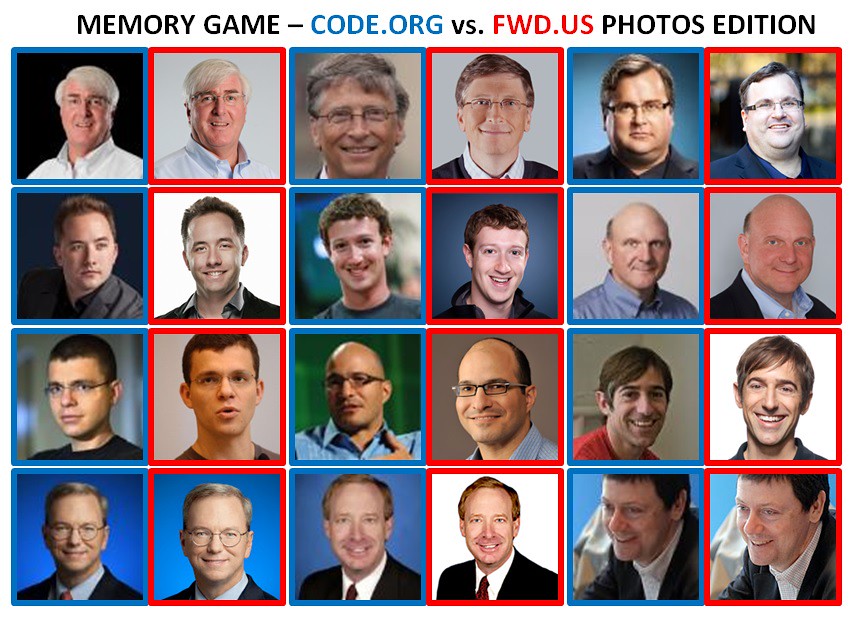
theodp writes: K–12 computer science and information technology teachers head to Grapevine, TX this week for the 2015 CSTA Conference. A glance at the draft agenda shows a remarkable number of presenters employed by or tied to two-year-old Code.org, the tech-bankrolled nonprofit that coincidentally sprung up together with Mark Zuckerberg's FWD.us PAC just months after Microsoft called for the creation of a national K-12 CS and tech immigration crisis to advance its agenda. Code.org's shaping of the nation's CS K-12 education began with the release of its tech-billionaire and celebrity-studded, slickly-produced What Most Schools Don't Teach video, which went viral on YouTube after being promoted by politicians, Facebook, Google, and a Microsoft-sponsored theatrical release, sparking a groundswell of interest in expanding K-12 CS education, succeeding where a similarly-themed-and-messaged but decidedly-amateurish National Science Foundation video of real-but-little-known computer scientists failed just months earlier (YouTube Doubler comparison). (More, below.) "The time is ripe to seize that opportunity," declared the ACM's and Code.org's Cameron Wilson, describing how Code.org was forming a coalition with Microsoft, Google, NSF, NCWIT, ACM, CSTA, and others with the goal of changing policy to support CS education. Computer science educators literally applauded Code.org's efforts, which have led to funding of a number of new K-12 CS projects, and may soon make No Child Left Behind Act funding available for K-12 CS education. Despite promises of transparency, details of the relationship of the National Science Foundation, now-NSF partner Code.org, the White House, ACM, NCWIT, College Board, and Code.org's corporate and billionaire backers — including Microsoft, Google, and Facebook — have never really been explained. -
Hacking Team Scrambling To Limit Damage Brought On By Explosive Data Leak
An anonymous reader writes: Who hacked Hacking Team, the Milan-based company selling intrusion and surveillance software to governments, law enforcement agencies and (as it turns out) companies? A hacker who goes by "Phineas Fisher" claims it was him (her? them?). In the meantime, Hacking Team is scrambling to minimize the damage this hack and data leak is doing to the company. They sent out emails to all its customers, requesting them to shut down all deployments of its Remote Control System software ("Galileo") — even though it seems they could do that themselves, as the customer software apparently has secret backdoors. Perhaps they chose the first route because they hoped to keep that fact hidden from the customers? And because every copy of Hacking Team's Galileo software is secretly watermarked, the leaked information could allow researchers to link a certain backdoor to a specific customer. -
Hacking Team Hacked, Attackers Grab 400GB of Internal Data
Several readers sent word that notorious surveillance company Hacking Team has itself been hacked. Attackers made off with 400GB worth of emails, documents, and source code. The company is known for providing interception tools to government and law enforcement agencies. According to the leaked files, Hacking Team has customers in Egypt, South Korea, Kazakhstan, Saudi Arabia, Oman, Lebanon, Mongolia, Russia, Germany, Sudan, and the United States — to name a few. It has been labeled an enemy of the internet by Reporters Without Borders. "Clients have had their passwords exposed as well, as several documents related to contracts and configurations have been circulating online." Nobody knows yet who perpetrated the hack. -
Researcher Who Reported E-voting Vulnerability Targeted By Police Raid in Argentina
TrixX writes: Police have raided the home of an Argentinian security professional who discovered and reported several vulnerabilities in the electronic ballot system (Google translation of Spanish original) to be used next week for elections in the city of Buenos Aires. The vulnerabilities (exposed SSL keys and ways to forge ballots with multiple votes) had been reported to the manufacturer of the voting machines, the media, and the public about a week ago. There has been no arrest, but his computers and electronics devices have been impounded (Spanish original). Meanwhile, the information security community in Argentina is trying to get the media to report this notorious attempt to "kill the messenger." Another source (Spanish original). -
Google: Stop Making Apps! (A Love Letter)
An anonymous reader writes: Seasoned Silicon Valley software executive and investor Domenic Merenda has written a love letter to Google, and it's filled with "tough" love. The main thesis is that Google, as a company, should stop making apps, and instead focus on using its enormous data assets to make meaningful connections between people and facilitate organic engagement within a rich ecosystem. Interestingly, the article cites Wikipedia's information that Google maintains over 70 apps on the Android platform alone. -
AP CS Test Takers and Pass Rates Up, Half of Kids Don't Get Sparse Arrays At All
theodp writes: Each June, the College Board tweets out teasers of the fuller breakouts of its Advanced Placement (AP) test results, which aren't made available until the fall. So, here's a roundup of this year's AP Computer Science tweetstorm: 1. "Wow — massive gains in AP Computer Science participation (25% growth) AND scores this year; big increase in % of students earning 4s & 5s!" 2. "2015 AP Computer Science scores: 5: 24.4%; 4: 24.6%; 3: 15.3%; 2: 7.1%; 1: 28.6%." [3 or above is passing] 3."Count them: a whopping 66 AP Computer Science students out of 50,000 worldwide earned all 80 pts possible on this year's exam." 4. "Remember that AP exam standards are equated from year to year, so when scores go up, it's a direct indication of increased student mastery." 5. "Many AP Computer Science students did very well on Q1 (2D array processing–diverse array); >20% earned all 9/9 pts" [2015 AP CS A Free-Response Questions] 6. "The major gap in this year's AP Computer Sci classrooms seems to be array list processing; Q3 (sparse array): 47% of students got 0/9 pts." -
AP CS Test Takers and Pass Rates Up, Half of Kids Don't Get Sparse Arrays At All
theodp writes: Each June, the College Board tweets out teasers of the fuller breakouts of its Advanced Placement (AP) test results, which aren't made available until the fall. So, here's a roundup of this year's AP Computer Science tweetstorm: 1. "Wow — massive gains in AP Computer Science participation (25% growth) AND scores this year; big increase in % of students earning 4s & 5s!" 2. "2015 AP Computer Science scores: 5: 24.4%; 4: 24.6%; 3: 15.3%; 2: 7.1%; 1: 28.6%." [3 or above is passing] 3."Count them: a whopping 66 AP Computer Science students out of 50,000 worldwide earned all 80 pts possible on this year's exam." 4. "Remember that AP exam standards are equated from year to year, so when scores go up, it's a direct indication of increased student mastery." 5. "Many AP Computer Science students did very well on Q1 (2D array processing–diverse array); >20% earned all 9/9 pts" [2015 AP CS A Free-Response Questions] 6. "The major gap in this year's AP Computer Sci classrooms seems to be array list processing; Q3 (sparse array): 47% of students got 0/9 pts." -
AP CS Test Takers and Pass Rates Up, Half of Kids Don't Get Sparse Arrays At All
theodp writes: Each June, the College Board tweets out teasers of the fuller breakouts of its Advanced Placement (AP) test results, which aren't made available until the fall. So, here's a roundup of this year's AP Computer Science tweetstorm: 1. "Wow — massive gains in AP Computer Science participation (25% growth) AND scores this year; big increase in % of students earning 4s & 5s!" 2. "2015 AP Computer Science scores: 5: 24.4%; 4: 24.6%; 3: 15.3%; 2: 7.1%; 1: 28.6%." [3 or above is passing] 3."Count them: a whopping 66 AP Computer Science students out of 50,000 worldwide earned all 80 pts possible on this year's exam." 4. "Remember that AP exam standards are equated from year to year, so when scores go up, it's a direct indication of increased student mastery." 5. "Many AP Computer Science students did very well on Q1 (2D array processing–diverse array); >20% earned all 9/9 pts" [2015 AP CS A Free-Response Questions] 6. "The major gap in this year's AP Computer Sci classrooms seems to be array list processing; Q3 (sparse array): 47% of students got 0/9 pts." -
AP CS Test Takers and Pass Rates Up, Half of Kids Don't Get Sparse Arrays At All
theodp writes: Each June, the College Board tweets out teasers of the fuller breakouts of its Advanced Placement (AP) test results, which aren't made available until the fall. So, here's a roundup of this year's AP Computer Science tweetstorm: 1. "Wow — massive gains in AP Computer Science participation (25% growth) AND scores this year; big increase in % of students earning 4s & 5s!" 2. "2015 AP Computer Science scores: 5: 24.4%; 4: 24.6%; 3: 15.3%; 2: 7.1%; 1: 28.6%." [3 or above is passing] 3."Count them: a whopping 66 AP Computer Science students out of 50,000 worldwide earned all 80 pts possible on this year's exam." 4. "Remember that AP exam standards are equated from year to year, so when scores go up, it's a direct indication of increased student mastery." 5. "Many AP Computer Science students did very well on Q1 (2D array processing–diverse array); >20% earned all 9/9 pts" [2015 AP CS A Free-Response Questions] 6. "The major gap in this year's AP Computer Sci classrooms seems to be array list processing; Q3 (sparse array): 47% of students got 0/9 pts." -
AP CS Test Takers and Pass Rates Up, Half of Kids Don't Get Sparse Arrays At All
theodp writes: Each June, the College Board tweets out teasers of the fuller breakouts of its Advanced Placement (AP) test results, which aren't made available until the fall. So, here's a roundup of this year's AP Computer Science tweetstorm: 1. "Wow — massive gains in AP Computer Science participation (25% growth) AND scores this year; big increase in % of students earning 4s & 5s!" 2. "2015 AP Computer Science scores: 5: 24.4%; 4: 24.6%; 3: 15.3%; 2: 7.1%; 1: 28.6%." [3 or above is passing] 3."Count them: a whopping 66 AP Computer Science students out of 50,000 worldwide earned all 80 pts possible on this year's exam." 4. "Remember that AP exam standards are equated from year to year, so when scores go up, it's a direct indication of increased student mastery." 5. "Many AP Computer Science students did very well on Q1 (2D array processing–diverse array); >20% earned all 9/9 pts" [2015 AP CS A Free-Response Questions] 6. "The major gap in this year's AP Computer Sci classrooms seems to be array list processing; Q3 (sparse array): 47% of students got 0/9 pts." -
AP CS Test Takers and Pass Rates Up, Half of Kids Don't Get Sparse Arrays At All
theodp writes: Each June, the College Board tweets out teasers of the fuller breakouts of its Advanced Placement (AP) test results, which aren't made available until the fall. So, here's a roundup of this year's AP Computer Science tweetstorm: 1. "Wow — massive gains in AP Computer Science participation (25% growth) AND scores this year; big increase in % of students earning 4s & 5s!" 2. "2015 AP Computer Science scores: 5: 24.4%; 4: 24.6%; 3: 15.3%; 2: 7.1%; 1: 28.6%." [3 or above is passing] 3."Count them: a whopping 66 AP Computer Science students out of 50,000 worldwide earned all 80 pts possible on this year's exam." 4. "Remember that AP exam standards are equated from year to year, so when scores go up, it's a direct indication of increased student mastery." 5. "Many AP Computer Science students did very well on Q1 (2D array processing–diverse array); >20% earned all 9/9 pts" [2015 AP CS A Free-Response Questions] 6. "The major gap in this year's AP Computer Sci classrooms seems to be array list processing; Q3 (sparse array): 47% of students got 0/9 pts." -
A Failure For SpaceX: Falcon 9 Explodes During Ascension
MouseR writes with bad news about this morning's SpaceX launch: About 2:19 into its flight, Falcon 9 exploded along stage 2 and the Dragon capsule, before even the stage 1 separation. Telemetry and videos are inconclusive, without further analysis as to what went wrong. Everything was green lights. This is a catastrophe for SpaceX, which enjoyed, until now, a perfect launch record. TechCrunch has coverage of the failure, which of course also means that today's planned stage one return attempt has failed before it could start; watch this space for more links. Update: 06/28 15:06 GMT by T : See also stories at NBC News, The Washington Post, and the Associated Press (via ABC News). According to the Washington Post, what was a catastrophe for this morning's launch is only a setback for the ISS and its crew, rather than a disaster: A NASA slide from an April presentation said that with current food levels, the space station would reach what NASA calls “reserve level” on July 24 and run out by Sept. 5, according to SpaceNews. [NASA spokeswoman Stephanie] Schierholz said, however, that the supplies would last until the fall, although she could not provide a precise date. Even if something were to go wrong with the SpaceX flight, she said, there are eight more scheduled this year, including several this summer, “so there are plenty of ways to ensure the station continues to be well-supplied.” Of note: One bit of cargo that was aboard the SpaceX craft was a Microsoft Hololens; hopefully another will make it onto one of the upcoming supply runs instead.
Elon Musk has posted a note on the company's Twitter channel: "Falcon 9 experienced a problem shortly before first stage shutdown. Will provide more info as soon as we review the data." -
Are We Too Quick To Act On Social Media Outrage?
RedK writes: Connie St-Louis, on June 8th, reported on apparently sexist remarks made by Sir Tim Hunt, a Nobel prize winning scientist, during an event organised for women in sciences. This led to the man's dismissal from his stations, all in such urgency that he did not even have time to present his side, nor was his side ever offered any weight. A leaked report a few days later suggests that the remarks were taken out of context. Further digging shows that the accuser has distorted the truth in many cases it seems. This is not the first time that people may have jumped the gun too soon on petty issues and ruined great events or careers. -
Security Researcher Drops 15 Vulnerabilities for Windows and Adobe Reader
mask.of.sanity writes: Google Project Zero hacker Mateusz Jurczyk has dropped 15 remote code execution vulnerabilities, including a single devastating hack against Adobe Reader and Windows he reckons beats all exploit defenses. He said, "The extremely powerful primitive provided by the vulnerability, together with the fact that it affected all supported versions of both Adobe Reader and Microsoft Windows (32-bit) – thus making it possible to create an exploit chain leading to a full system compromise with just a single bug – makes it one of the most interesting security issues I have discovered so far." Jurczyk published a video demonstration of the exploit for 32-bit and 64-bit systems. His slides are here [PDF]. -
Mayday PAC's Benjamin Singer Explains How You can Help Reform American Politics (Video)
Larry Lessig's Mayday PAC is a SuperPac that is working to eliminate the inherent corruption of having a government run almost entirely by people who manage to raise -- or have their "non-connected" SuperPACs raise -- most of the money they need to run their campaigns. The Mayday PAC isn't about right or left wing or partisan politics at all. It's about finding and supporting candidates who are in favor of something like last year's Government by the People Act. As we noted in our Mayday Pac interview with Larry Lessig last June, a whole panoply of tech luminaries, up to and including Steve Wozniak, are in favor of Mayday PAC.
This interview is being posted, appropriately, just before the 4th of July, but it's also just one day before the Mayday PAC Day of Action to Reform Congress. They're big on calling members of Congress rather than emailing, because our representatives get email by the (digital) bushel, while they get comparatively few issue-oriented phone calls from citizens. So Mayday PAC makes it easy for you to call your Congressional representatives and even, if you're too shy to talk to a legislative aide in person, to record a message Mayday PAC will leave for them after hours.
The five specific pieces of legislation Mayday PAC currently supports are listed at the RepsWith.US/reforms page. Two are sponsored by Republicans, two by Democrats, and one by an Independent. That's about as non-partisan as you can get, so no matter what kind of political beliefs you hold, you can support Mayday PAC with a clear conscience. (Note: the transcript has more information than the video, which is less than six minutes long.) -
Apple To Pay Musicians For Free Streams, After All
vivaoporto writes: As reported on Re/code, Apple media boss Eddy Cue appears to have capitulated and Apple Music will be paying music owners for streaming even during customers's free trial period. He says Taylor Swift's letter, coupled with complaints from indie labels and artists, did indeed prompt the change.
Cue says Apple will pay rights holders for the entire three months of the trial period. He explains that it can't be at the same rate that Apple is paying them after free users become subscribers, since Apple is paying out a percentage of revenues once subscribers start paying. Instead, he says, Apple will pay rights holders on a per-stream basis.
No word from Swift or her camp about whether Apple's move is enough to get her to put "1989," her newest album, on Apple Music. On Twitter, she says, "I am elated and relieved. Thank you for your words of support today. They listened to us." -
ECMAScript 6 Is Officially a JavaScript Standard
rjmarvin writes: The ECMAScript 6 specification is now a standard. ES6 is the first major revision to the programming language since 1999 and its hallmark features include a revamped syntax featuring classes and modules. The Ecma General Assembly officially approved the specification at its June meeting in France, ECMAScript project editor Allen Wirfs-Brock announced. -
Online At Last: Comet Lander Philae Wakes Up
techtech writes with this news from the BBC: The European Space Agency (ESA) says its comet lander, Philae, has woken up and contacted Earth. Philae, the first spacecraft to land on a comet, was dropped on to the surface of Comet 67P by its mothership, Rosetta, last November. It worked for 60 hours before its solar-powered battery ran flat. The comet has since moved nearer to the sun and Philae has enough power to work again, says the BBC's science correspondent Jonathan Amos. An account linked to the probe tweeted the message, "Hello Earth! Can you hear me?" Watch this space for some more links to follow. Update: 06/14 13:39 GMT by T : From the ESA's Rosetta blog: When analysing the status data it became clear that Philae also must have been awake earlier: "We have also received historical data - so far, however, the lander had not been able to contact us earlier," [according to project manager Dr. Stephan Ulamec.] Now the scientists are waiting for the next contact. There are still more than 8000 data packets in Philae’s mass memory which will give the DLR team information on what happened to the lander in the past few days on Comet 67P/Churyumov-Gerasimenko. -
Clinton Foundation: Kids' Lack of CS Savvy Threatens the US Economy
theodp writes: As the press digs for details on Clinton Foundation donations, including a reported $26+ million from Microsoft and Bill Gates, it's probably worth noting the interest the Clintons have developed in computer science and the role they have played — and continue to play — in the national K-12 CS and tech immigration crisis that materialized after Microsoft proposed creating such a crisis to advance its 'two-pronged' National Talent Strategy, which aims to increase K-12 CS education and the number of H-1B visas. Next thing you know, Bill is the face of CS at the launch of Code.org. Then Hillary uses the Clinton Global Initiative (CGI) conference to launch a Facebook, Microsoft, and Google initiative to boost the ranks of female and students of color in CS, and starts decrying woeful CS enrollment. Not to be left out, Chelsea keynotes the NCWIT Summit and launches Google's $50M girls-only Made With Code initiative with now-U.S. CTO Megan Smith. And last December, the Clinton Foundation touted its initiatives to engage middle school girls in CS, revamp the nation's AP CS program, and retrain out-of-work Americans as coders. At next month's CGI America 2015, the conference will kick off with a Beer Bust that CGI says "will also provide an opportunity to learn about Tech Girls Rock, a CGI Commitment to Action launched by CA Technologies in partnership with the Boys & Girls Clubs of America that helps girls discover an interest in tech-related educational opportunities and careers." On the following days, CGI sessions will discuss tech's need for a strong and diverse talent pipeline for computer and information technology jobs, which it says is threatened by "the persistent poor performance of American students in science, technology, engineering, and math," presenting "serious implications for the long-term competitiveness of the U.S. economy." So what's the long-term solution? Expanding CS education, of course! -
Tweets To Appear In Google Search Results
mpicpp writes with news that Google will now begin showing tweets alongside search results. Mobile users searching via the Android/iOS apps or through the browser will start seeing the tweets immediately, while the desktop version is "coming shortly." The tweets will only be available for the searches in English to start, but Twitter says they'll be adding more languages soon. -
Gates, Zuckerberg Promising Same Jobs To US Kids and Foreign H-1B Workers?
theodp writes: Over at the Bill Gates and Mark Zuckerberg-bankrolled Code.org, they're using the number of open computing jobs in each state to convince parents of the need to expand K-12 CS offerings so their kids can fill those jobs. Sounds good, right? But at the same time, the Gates and Zuckerberg-bankrolled FWD.org PAC has taken to Twitter, using the number of open "STEM" jobs in each state to convince politicians of the need to expand the number of H-1B visas so foreign workers can fill those jobs. While the goal of Microsoft's 'two-pronged' National Talent Strategy is to kill two birds [K-12 CS education and H-1B visas] with one crisis, is it fair for organizations backed by many of the same wealthy individuals to essentially promise the same jobs to U.S. kids and foreign H-1B workers? -
MAME Changing License To Fully Libre One
jones_supa writes: The source code of MAME (Multiple Arcade Machine Emulator) has long been freely available, but it's never been completely libre. Instead, it's been available under a modified BSD license that prohibits, among other things, commercial use of the code. MAME engineer Miodrag Milanovic explains that such a license was put in place to deter "misuse of MAME in illegal ways," but it also kept legitimate commercial entities doing business with the software. Examples of such could be museums that charge entry fees from using MAME in their exhibits, or copyright holders rereleasing vintage games encapsulated inside MAME. Now the project wants to go fully open. Milanovic continues: "Our aim is to help legal license owners in distributing their games based on MAME platform, and to make MAME become a learning tool for developers working on development boards." As of yet, there are no specific details about the new license. -
Harry Shearer Walks Away From "The Simpsons," and $14 Million
Actor Harry Shearer, perhaps best known as the voice of several characters on The Simpsons, including that of Montgomery Burns, will be leaving the show's cast, according to CNN. Showrunner Al Jean said Shearer was "offered the same deal as the rest of the cast, but turned it down." ... Shearer is not just walking away from Springfield, but also a large sum of money. The actor was offered a guaranteed $14 million for two years of work, according to someone with direct knowledge of the matter. The proposed deal also allowed for him to do other projects if he wished." That last part, though, seems to be in dispute, and central to Shearer's decision to leave; Shearer tweeted that it's because he "wanted what we've always had: the freedom to do other work." -
(Hack) and Slash: Doing the LORD's Work
Emmett Plant (former Slashdot editor as well as video interviewee) writes: Legend of the Red Dragon was written by Seth Robinson in 1989, and it remains one of the most popular games of the DOS BBS era. Chris England has been doing his part to keep the game alive for the past twelve years, adapting an installation that runs on Linux. I was only able to play for two days before I was overcome with curiosity -- I wrote to Chris, politely inquiring as to how it all came together. Read on below for a look into Chris's motivations, the state of the project, and just how deeply nested it can all get, when bringing games from early BBS days into the modern era. Emmett Plant: What was your first encounter with LORD?
Despite it's PG-13 nature, I discovered the game at age 12 when I was running a local dial-up BBS [The Slaughter House, Langley BC] and echo-mail network. I had never heard of the game, but users kept asking for it. I ignored the first few requests, but eventually caved to my loyal regulars and installed it. My first time "playing" it was actually just to test to see if it worked. Had I have been more inquisitive and known it was an interactive text based RPG about slaying dragons, I would have installed--and played it--much earlier.
EP: You've had this game running for well over a decade now. Has it gotten easier to manage as time has gone by, or has it become more difficult?
With many years of fine tuning and automation, it has become very easy to manage. Between work and my addiction to the remote British Columbia wilderness, either my time was saturated or I was simply not around to keep up with issues like investigating players suspected of using multiple accounts or dealing with players taking advantage of known bugs. This led to a level of frustration among users in early years. For example, in our environment there is no carrier detection. If a player disconnected in an IGM [In-Game Module], they were essentially protected from being battled by other users. Fast forward to today where if a player attempted this, within a short period of time the system would detect it and leave them vulnerable, "sleeping in the fields.”
EP: You've created a custom BBS to manage these games -- How does it work?
The BBS part is a fairly basic sign-up, authentication and menu system made in perl. Much like a regular BBS, when a user selects the menu option to enter a game, a dropfile is generated and passed to the game. After that, things get a little different. It dynamically creates an autoexec.bat to invoke the games start.bat file with the appropriate node parameter and then fires up dosemu. The BBS itself listens locally on a non-standard port through xinetd/in.telnetd, as I needed to create a proxy script to reside in front listening for the incoming telnet connections. This was necessary in order to sanitize some undesirable input with a script that could make decisions and manipulate the packet contents in some cases. Aside from that, there are a number of automation scripts running in the background which range from compensating for lack of carrier detection and analyzing logs to converting LORD color ASCII to HTML and of course sending me a text message when it's time to announce a winner and reset a game.
EP: LORD was written in the dial-up era. What challenges have you faced in making it available for the modern age?
There are so many pieces that need to work together. I tried a number of combinations of operating systems, dosemu/dos versions, netfossil drivers, ANSI drivers, BBS software, LORD versions, IGM's, etc. It was difficult to find a combination where all components would play nice for the long haul. Having a stable environment was a top priority, so I decided to make my own BBS, forget about the fossil routines and just run the game as if it's running locally. This resulted in stability, but presented a number of other challenges from a security standpoint. IGM's with special sysop functions like "drop to DOS" were out of the question and I needed to prevent every possible method that could be used to break out of a batch file.
EP: There's a Facebook group and a Twitter account for the games -- How are these social media tools used?
Prior to Facebook and Twitter, we used a forum on the website so players could communicate outside the game and I could announce upcoming rounds. Though I had moderators, it was still something I needed to babysit and keep secure. I was very happy to outsource the forum to Facebook as it was less work for me while at the same time, it gave the game a little more mainstream/modern exposure. Twitter seemed like a good platform to announce the start of new rounds, but I think most rely on the Facebook notification.
EP: How do you deal with problematic players?
If someone gets completely out of hand and or won't adhere to warnings, disabling the account and iptables seems to solve the issue efficiently. It takes a lot more effort for someone to change their IP address, and sign up again from a new email address than it does for me deal with it. And for what motive? To write something rude or annoying in the daily news or flowers? Most people just don't get that bored, so it has only come to that a couple of times.
EP: What do you do for a dayjob?
You probably guessed, but I will go ahead and confirm that I’m a System Administrator.
EP: Why do you do this?
Though I shut down the dialup BBS after a few years of service--in pursuit of figuring out how Internet web servers, mail servers and database servers worked--those sysop/sysadmin instincts didn't go away. I felt rather guilty about letting BBS users down, but the reality is that I needed to selfishly tie up the phone line and replace DOS with Slackware. Making this system was my way of making up for it and then some.
--
Editorial Note: The author of this piece made a $10 donation to the site before inquiring to write this article. He’s a level 8 warrior in Game 1, and he’s been killed at least three times already. He does not regret the donation. -
(Hack) and Slash: Doing the LORD's Work
Emmett Plant (former Slashdot editor as well as video interviewee) writes: Legend of the Red Dragon was written by Seth Robinson in 1989, and it remains one of the most popular games of the DOS BBS era. Chris England has been doing his part to keep the game alive for the past twelve years, adapting an installation that runs on Linux. I was only able to play for two days before I was overcome with curiosity -- I wrote to Chris, politely inquiring as to how it all came together. Read on below for a look into Chris's motivations, the state of the project, and just how deeply nested it can all get, when bringing games from early BBS days into the modern era. Emmett Plant: What was your first encounter with LORD?
Despite it's PG-13 nature, I discovered the game at age 12 when I was running a local dial-up BBS [The Slaughter House, Langley BC] and echo-mail network. I had never heard of the game, but users kept asking for it. I ignored the first few requests, but eventually caved to my loyal regulars and installed it. My first time "playing" it was actually just to test to see if it worked. Had I have been more inquisitive and known it was an interactive text based RPG about slaying dragons, I would have installed--and played it--much earlier.
EP: You've had this game running for well over a decade now. Has it gotten easier to manage as time has gone by, or has it become more difficult?
With many years of fine tuning and automation, it has become very easy to manage. Between work and my addiction to the remote British Columbia wilderness, either my time was saturated or I was simply not around to keep up with issues like investigating players suspected of using multiple accounts or dealing with players taking advantage of known bugs. This led to a level of frustration among users in early years. For example, in our environment there is no carrier detection. If a player disconnected in an IGM [In-Game Module], they were essentially protected from being battled by other users. Fast forward to today where if a player attempted this, within a short period of time the system would detect it and leave them vulnerable, "sleeping in the fields.”
EP: You've created a custom BBS to manage these games -- How does it work?
The BBS part is a fairly basic sign-up, authentication and menu system made in perl. Much like a regular BBS, when a user selects the menu option to enter a game, a dropfile is generated and passed to the game. After that, things get a little different. It dynamically creates an autoexec.bat to invoke the games start.bat file with the appropriate node parameter and then fires up dosemu. The BBS itself listens locally on a non-standard port through xinetd/in.telnetd, as I needed to create a proxy script to reside in front listening for the incoming telnet connections. This was necessary in order to sanitize some undesirable input with a script that could make decisions and manipulate the packet contents in some cases. Aside from that, there are a number of automation scripts running in the background which range from compensating for lack of carrier detection and analyzing logs to converting LORD color ASCII to HTML and of course sending me a text message when it's time to announce a winner and reset a game.
EP: LORD was written in the dial-up era. What challenges have you faced in making it available for the modern age?
There are so many pieces that need to work together. I tried a number of combinations of operating systems, dosemu/dos versions, netfossil drivers, ANSI drivers, BBS software, LORD versions, IGM's, etc. It was difficult to find a combination where all components would play nice for the long haul. Having a stable environment was a top priority, so I decided to make my own BBS, forget about the fossil routines and just run the game as if it's running locally. This resulted in stability, but presented a number of other challenges from a security standpoint. IGM's with special sysop functions like "drop to DOS" were out of the question and I needed to prevent every possible method that could be used to break out of a batch file.
EP: There's a Facebook group and a Twitter account for the games -- How are these social media tools used?
Prior to Facebook and Twitter, we used a forum on the website so players could communicate outside the game and I could announce upcoming rounds. Though I had moderators, it was still something I needed to babysit and keep secure. I was very happy to outsource the forum to Facebook as it was less work for me while at the same time, it gave the game a little more mainstream/modern exposure. Twitter seemed like a good platform to announce the start of new rounds, but I think most rely on the Facebook notification.
EP: How do you deal with problematic players?
If someone gets completely out of hand and or won't adhere to warnings, disabling the account and iptables seems to solve the issue efficiently. It takes a lot more effort for someone to change their IP address, and sign up again from a new email address than it does for me deal with it. And for what motive? To write something rude or annoying in the daily news or flowers? Most people just don't get that bored, so it has only come to that a couple of times.
EP: What do you do for a dayjob?
You probably guessed, but I will go ahead and confirm that I’m a System Administrator.
EP: Why do you do this?
Though I shut down the dialup BBS after a few years of service--in pursuit of figuring out how Internet web servers, mail servers and database servers worked--those sysop/sysadmin instincts didn't go away. I felt rather guilty about letting BBS users down, but the reality is that I needed to selfishly tie up the phone line and replace DOS with Slackware. Making this system was my way of making up for it and then some.
--
Editorial Note: The author of this piece made a $10 donation to the site before inquiring to write this article. He’s a level 8 warrior in Game 1, and he’s been killed at least three times already. He does not regret the donation. -
Two Programmers Expose Dysfunction and Abuse In the Seattle Police Department
reifman writes: Programmers Eric Rachner and Phil Mocek are now the closest thing Seattle has to a civilian police-oversight board. Through shrewd use of Washington's Public Records Act, the two have acquired hundreds of reports, videos, and 911 calls related to the Seattle Police Department's internal investigations of officer misconduct. Among some of Rachner and Mocek's findings: a total of 1,028 SPD employees (including civilian employees) were investigated between 2010 and 2013. (The current number of total SPD staff is 1,820.) Of the 11 most-investigated employees—one was investigated 18 times during the three-year period—every single one of them is still on the force, according to SPD.
In 569 allegations of excessive or inappropriate use of force (arising from 363 incidents), only seven were sustained—meaning 99 percent of cases were dismissed. Exoneration rates were only slightly smaller when looking at all the cases — of the total 2,232 allegations, 284 were sustained. This is partly why the Seattle PD is under a federal consent decree for retraining and oversight. You can check out some of the typically excellent Twitter coverage by Mocek from his #MayDaySea coverage. -
Recent Paper Shows Fracking Chemicals In Drinking Water, Industry Attacks It
eldavojohn writes: A recent paper published in the Proceedings of the National Academy of Sciences turned up 2-Butoxyethanol from samples collected from three households in Pennsylvania. The paper's level headed conclusion is that more conservative well construction techniques should be used to avoid this in the future and that flowback should be better controlled. Rob Jackson, another scientist who reviewed the paper, stressed that the findings were an exception to normal operations. Despite that, the results angered the PR gods of the Marcellus Shale Gas industry and awoke beltway insider mouthpieces to attack the research — after all, what are they paying them for? -
Scientists Have Paper On Gender Bias Rejected Because They're Both Women
ferrisoxide.com writes: A paper co-authored by researcher fellow Dr. Fiona Ingleby and evolutionary biologist Dr. Megan Head — on how gender differences affect the experiences that PhD students have when moving into post-doctoral work — was rejected by peer-reviewed PLoS Onebecause they didn't ask a man for help.
A (male) peer reviewer for the journal suggested that the scientists find male co-authors, to prevent "ideologically biased assumptions." The same reviewer also provided his own ironically biased advice, when explaining that women may have fewer articles published because men's papers "are indeed of a better quality, on average," "just as, on average, male doctoral students can probably run a mile race a bit faster." PLoS One has apologized, saying, "We have formally removed the review from the record, and have sent the manuscript out to a new editor for re-review. We have also asked the Academic Editor who handled the manuscript to step down from the Editorial Board and we have removed the referee from our reviewer database." -
Armadillo Aerospace Resurrected On Kickstarter By the Team Members
savuporo writes: Team members from John Carmack's defunct suborbital rocket company, Armadillo Aerospace, have re-launched the suborbital rocket project now as Exos Aerospace through a Kickstarter campaign. While original Armadillo efforts stopped just shy of actually getting to space, the team intends to pick up where they left off, rebuild and make it into a sustainable suborbital payload business. Carmack, while not involved, says their core is "arguably the most competent in suborbital alt-space."
There are multiple other small launcher startups springing up again across the globe — Rocket Labs recently unveiled their new engines, Firefly is making progress, and Lin Industrial also announced their rocket recently. -
7.8 Earthquake Rocks Nepal, Hundreds Dead
An anonymous reader writes: Nepal was struck by an earthquake of magnitude 7.8 today, with an epicenter 80 km east of the country's second biggest city, Pokhara. Its effects were also strongly felt in the capital, Kathmandu. Casualty reports conflict, but authorities have indicated at least 500 are dead and many more are feared to be trapped. Nepal has declared a state of emergency for the affected areas, and asked for international humanitarian assistance. India and Pakistan have both offered help. Some Indian cities were affected by the earthquake as well, and there are reports of avalanches on Mt. Everest, which has many climbers at any given time. -
Twitter Rolls Out New Anti-Abuse Tools
An anonymous reader writes: After facing criticism that it gives trolls and hatemongers a platform to intimidate people, Twitter has now rolled out a new set of tools and policies to handle abusive tweets. Previously, they only prohibited threats of violence that were "direct" and "specific," but now that's been expanded to all threats of violence or tweets promoting violence. They said, "Our previous policy was unduly narrow and limited our ability to act on certain kinds of threatening behavior." Twitter has also added non-permanent bans, as well as this: "[W]e have begun to test a product feature to help us identify suspected abusive Tweets and limit their reach. This feature takes into account a wide range of signals and context that frequently correlates with abuse including the age of the account itself, and the similarity of a Tweet to other content that our safety team has in the past independently determined to be abusive." Twitter's general counsel recently said, "Freedom of expression means little as our underlying philosophy if we continue to allow voices to be silenced because they are afraid to speak up. We need to do a better job combating abuse without chilling or silencing speech." -
FBI Accuses Researcher of Hacking Plane, Seizes Equipment
chicksdaddy writes: The Feds are listening, and they really can't take a joke. That's the apparent moral of security researcher Chris Roberts' legal odyssey on Wednesday, which saw him escorted off a plane in Syracuse by two FBI agents and questioned for four hours over a humorous tweet Roberts posted about his ability to hack into the cabin control systems of the Boeing 737 he was flying. Roberts (aka @sidragon1) joked that he could "start playing with EICAS messages," a reference to the Engine Indicating and Crew Alerting System.
Roberts was traveling to Syracuse to give a presentation. He said local law enforcement and FBI agents boarded the plane on the tarmac and escorted him off. He was questioned for four hours, with officers alleging they had evidence he had tampered with in-flight systems on an earlier leg of his flight from Colorado to Chicago. Roberts said the agents questioned him about his tweet and whether he tampered with the systems on the United flight -something he denies doing. Roberts had been approached earlier by the Denver office of the FBI which warned him away from further research on airplanes. The FBI was also looking to approach airplane makers Boeing and Airbus and wanted him to rebuild a virtualized environment he built to test airplane vulnerabilities to verify what he was saying.
Roberts refused, and the FBI seized his encrypted laptop and storage devices and has yet to return them, he said. The agents said they wished to do a forensic analysis of his laptop. Roberts said he declined to provide that information and requested a warrant to search his equipment. As of Friday, Roberts said he has not received a warrant. -
India's Net Neutrality Campaign Picks Up Steam, Sites Withdraw From Internet.org
First time accepted submitter arvin (916235) writes The Huffington Post reports on prominent Indian websites withdrawing from Facebook's internet.org initiative. The net neutrality debate in the country has focused on zero-rating, where ISPs offer a free data plan which provides access to a set of websites that pay to be included. Internet.org provides free access to Facebook, Bing, Wikipedia and a few other websites. Another similar service, Airtel Zero, lost its flagship partner as e-commerce company Flipkart withdrew following a social media backlash.
Net neutrality activists believe that as these plans proliferate, access to the open internet will become extremely expensive or unavailable, innovation will slow as for startups are prevented from reaching the market, and the competitive consumer ISP market will be replaced with a cartel negotiating against internet companies. In a campaign similar to that in the US, over 630,000 Indians sent responses to their regulator through the website savetheinternet.in. -
SpaceX Dragon Launches Successfully, But No Rocket Recovery
New submitter monkeyzoo writes: SpaceX has successfully launched a Falcon 9 rocket carrying a SpaceX Dragon spacecraft en route to the International Space Station with supplies (including an Italian espresso machine). This was also the second attempt to land the launch rocket on a barge, but that was not successful. Elon Musk tweeted that the rocket landed on the recovery ship but too hard to be reused. Video of the launch is available on the SpaceX webcast page.