Slashdot Mirror
Domain: typepad.com
Stories and comments across the archive that link to typepad.com.
Stories · 209
-
Lawyer Sues To Get a Patent On Marketing
I Don't Believe in Imaginary Property writes "Lawyer Scott Harris, one of the inventors of the concept of a 'marketing company devoted to selling/marketing products produced by other companies in return for a share of their profits,' is appealing the USPTO's rejection of US Patent Application No. 09/387,823 which was intended to patent that 'invention.' This court action is important because it directly challenges the In Re Bilski ruling, which tightened the rules to get rid of most so-called 'business method' patents. One of Mr. Harris's legal theories is that a 'company is a physical thing, and as such analogous to a machine.' If the name seems familiar, it's because Mr. Harris has a long history of inventive legal maneuverings. I'm honestly surprised that SCO never tried to hire or sue him." -
Court Upholds AP "Quasi-Property" Rights On Hot News
I Don't Believe in Imaginary Property writes "A federal court ruled that the AP can sue competitors for 'quasi-property' rights on hot news, as well as for copyright infringement and several other claims. The so-called 'hot news' doctrine was created by a judge 90 years ago in another case, where the AP sued a competitor for copying wartime reporting and bribing its employees to send them a copy of unreleased news. The courts' solution was to make hot news a form of 'quasi-property' distinct from copyright, in part because facts cannot be copyrighted. But now the AP is making use of the precedent again, going after AHN which competes with the AP, alleging that they're somehow copying the AP's news. The AP has been rather busy with lawsuits lately, so even though the AP has a story about their own lawsuit, we won't link to it." -
Apple's Mac OS X Update Breaks Perl
mir writes "It looks like if you use CPAN to install modules, Apple's latest security update might just have broken your Perl. According to Tatsuhiko Miyagawa 'The Security Update brings (old) IO.bundle with version 1.22 but your IO.pm has been updated to the latest 1.23 on CPAN shell. (But hey, 1.23 was released in 2006...Why do you bring that ancient version back, Apple!?)'." -
Dell Selling Dual-Boot Laptops
rsmiller510 writes "The EE Times reports this week that Dell has released a hybrid laptop running both Linux and Windows clearly aimed at business travelers. Linux for quick tasks and Windows for more intensive ones, but will such a machine really fly in the business world?" -
Oprah Sued For Infringing "Touch and Feel" Patent
I Don't Believe in Imaginary Property writes "Oprah Winfrey, or to be more precise, Oprah's Book Club, is being sued by the inventor/patent attorney Scott C. Harris for infringing upon his patent for 'Enhancing Touch and Feel on the Internet.' So Oprah's Book Club is now one of many people and entities being sued over this patent because they allow people to view part, but not all, of a book online before purchasing it. Mr. Harris also sued Google Books for infringing upon this patent. He actually was fired from his position as partner at Fish & Richardson for that, because Google is a client of that law firm and they had conflict of interest rules to uphold." It would be entertaining to see Oprah give very wide and mainstream publicity to the abuses enabled by our current patent system.
Update: 01/07 22:03 GMT by KD : The blog author Joe Mullin wrote to point out that the lawsuit was not filed by the inventor, Scott C. Harris, but rather by the shell company Illinois Computer Research, which seems to exist for the purpose of filing lawsuits based on this particular patent. -
Google's Mayer Says Personalization is Key To Future Search
rsmiller510 writes "In a wide-ranging interview with Tech Crunch's Michael Arrington on Wednesday at Le Web in Paris, Google's Marissa Mayer talked about all things Google, but what I found most interesting was when the conversation turned toward the future of search. Mayer said the key to the future of search lies in personalization. ... Mayer said in the future, Google (and presumably other search tools) will understand more about the user and be able to deliver more relevant information based on that knowledge. 'We think that when you look at the winning search engine in 2020 and what traits it's likely to have, we think the one thing that will be true is that it will understand more about you the user.'" Video of the interview with Mayer is available at Tech Crunch. The personalization of search content focuses mainly on SearchWiki, which we discussed when it went live last month. The Register has a more cynical take on the discussion, seizing on comments by Mayer which indicated Google employees may evaluate SearchWiki's user ratings and use them to make "obvious changes" to search results for everyone. -
Google Was 3 Hours Away From DOJ Antitrust Charges
turnkeylinux writes "Google Inc. and Yahoo! Inc. called off their joint advertising agreement just three hours before the Department of Justice planned to file antitrust charges to block the pact, according to the lawyer who would have been lead counsel for the government. 'We were going to file the complaint at a certain time during the day,' says Litvack, who rejoins Hogan & Hartson today. 'We told them we were going to file the complaint at that time of day. Three hours before, they told us they were abandoning the agreement.'" -
Should You Get Paid While Your Computer Boots?
An anonymous reader notes a posting up at a law blog with the provocative title Does Your Boss Have to Pay You While You Wait for Vista to Boot Up?. (Provocative because Vista doesn't boot more slowly than anything else, necessarily, as one commenter points out.) The National Law Journal article behind the post requires subscription. Quoting: "Lawyers are noting a new type of lawsuit, in which employees are suing over time spent booting [up] their computers. ... During the past year, several companies, including AT&T Inc., UnitedHealth Group Inc. and Cigna Corp., have been hit with lawsuits in which employees claimed that they were not paid for the 15- to 30-minute task of booting their computers at the start of each day and logging out at the end. Add those minutes up over a week, and hourly employees are losing some serious pay, argues plaintiffs' lawyer Mark Thierman, a Las Vegas solo practitioner who has filed a handful of computer-booting lawsuits in recent years. ... [A] management-side attorney... who is defending a half-dozen employers in computer-booting lawsuits... believes that, in most cases, computer booting does not warrant being called work." -
Google Exec Hints At Future Open Platform
rsmiller510 writes "At the recent Web 2.0 Summit, Dave Girouard, who is president of Google's enterprise division, stated that his company's long-term goal is to open up the Google development stack to outside developers. If this is true, then it could have some serious long-term implications for developers who could use Google services in new and interesting ways." -
Amazon Beefs Up Its Cloud Ahead of MS Announcement
Amazon has announced several major improvements to its EC2 service for cloud computing. The service is now in production (no longer beta); it offers a service-level agreement; and Windows and SQL Server are available in beta form. ZDNet points out that all this news is intended to take some wind out of Microsoft's sails as MS is expected to introduce its own cloud services next week at its Professional Developers Conference. -
Linux As a Model For a New Government?
An anonymous reader writes "The hedge fund investor who prided himself on achieving 1000% returns, Andrew Lahde, wrote a goodbye letter to mark his departure from the financial world. In it, he suggests people think about building a new government model, and his suggestion is to have someone like George Soros fund a new government that brings together the best and brightest minds in a manner where they're not tempted by bribery. In doing so, he refers to how Linux grows and competes with Microsoft. An open source government. How would such a system work, and could it succeed? How long before it became corrupt? Would it need a benevolent dictator (Linus vs. Soros)?" -
Enterprise Software Sales Dried Up In September
CurtMonash writes "As I predicted a week ago, it looks as if the third quarter was ugly for software vendors, due to the economic crisis. SAP said 'The market developments of the past several weeks have been dramatic and worrying to many businesses. These concerns triggered a very sudden and unexpected drop in business activity at the end of the quarter.' My old acquaintance John Treadway, who used to work in Sybase's financial services vertical unit, reports that things are even worse than that in the financial services industry, Wall Street and retail banks alike. So now what? Well, IT is a huge part of capital spending, and at enterprises that have to cut back capital spending, IT is going to get hurt. On the other hand, high-growth companies — Web businesses, analytic services providers, etc. — may try to power through the downturn. And the more directly an IT project affects near-term profits, the more likely it is to survive." -
Is Open Source Different In Europe Than In the US?
An anonymous reader writes "The first Europe Open Source Think Tank just concluded and Larry Augustin posted some interesting observations on open source in Europe versus the US. Essentially, he says that users in Europe care more about the open source nature of a product than do US users. US users are just trying to save a buck while European users actually care about access to the source code. Do Slashdot readers observe the same thing? Are the reasons for using open source software different in other parts of the world as well?" -
Appeals Court Rules US Can Block Mad Cow Testing
fahrbot-bot tips a story of mad cow disease, a private meat packer that wants to test all of its beef for the disease, and the USDA, which controls access to the test kits and just won an appeals court ruling that the government has the authority to block testing above and beyond the 1% the agency performs. Creekstone Farms Premium Beef sought to test 100% of its beef, in order to reassure its export markets, especially Japan and South Korea, that its beef is safe. Large meat packers opposed any such private testing, because they feared they would be forced into 100% testing and would have to raise prices. The appeals court ruled, 2 to 1, that under a 1913 law, test kits that are used only after an animal is killed still constitute "diagnosis" and "treatment" — this for a disease that has no treatment and is 100% fatal — and therefore fall under the USDA's authority to regulate. -
Your Online Profile Actually Tells a Lot About You
An anonymous reader writes "Despite all the media reports that your Facebook profile is giving the wrong impression, a psychological study shows people really can understand your personality from your online profile. Turns out you're not giving the wrong impression with your profile; you're giving the right impression to the wrong people. You can actually learn more about someone's Agreeableness from their online profile than from a first date." -
Alfresco-Adobe Pact Continues To Strengthen Open Source
rsmiller510 writes "Last week Adobe surprised a few people with the announcement that it was including Alfresco content management services as part of its LiveCycle Enterprise Suite Update 1 package. The surprise was two-fold: that Adobe felt it was necessary to add content management services at all, and that it chose open source vendor Alfresco as its content management partner. I spoke to Alfresco CEO John Powell to get his perspective on the pact and how it can help push open source into the enterprise mainstream. Powell is understandably excited by this arrangement, and one of the main reasons, he says, is because the Adobe partnership gives his company credibility with companies that might otherwise not even sniff at an open source vendor." -
Augmenting Data Beats Better Algorithms
eldavojohn writes "A teacher is offering empirical evidence that when you're mining data, augmenting data is better than a better algorithm. He explains that he had teams in his class enter the Netflix challenge, and two teams went two different ways. One team used a better algorithm while the other harvested augmenting data on movies from the Internet Movie Database. And this team, which used a simpler algorithm, did much better — nearly as well as the best algorithm on the boards for the $1 million challenge. The teacher relates this back to Google's page ranking algorithm and presents a pretty convincing argument. What do you think? Will more data usually perform better than a better algorithm?" -
Cisco, Troll Tracker Blogger Sued For Defamation
Joe Mullin writes "We've discussed Troll Tracker here before — the anonymous blogger who was outed last month as Rick Frenkel, a Cisco lawyer. Since then, two lawyers from the notoriously patent-friendly Eastern District of Texas have filed defamation suits against Frenkel and Cisco, and Frenkel's blog has been shuttered. One of the plaintiffs, a renowned patent judge's son, may have been hunting the anonymous blogger for months. This week Cisco announced new blogging guidelines in response to the Troll Tracker fiasco. The company acknowledged that 'a few Cisco employees used poor judgment' during secret-blog-time, but they're largely standing by their man. Cisco's new rules will prohibit only anonymous blogging by employees about issues for which 'they have responsibilities at Cisco.'" -
Cisco, Troll Tracker Blogger Sued For Defamation
Joe Mullin writes "We've discussed Troll Tracker here before — the anonymous blogger who was outed last month as Rick Frenkel, a Cisco lawyer. Since then, two lawyers from the notoriously patent-friendly Eastern District of Texas have filed defamation suits against Frenkel and Cisco, and Frenkel's blog has been shuttered. One of the plaintiffs, a renowned patent judge's son, may have been hunting the anonymous blogger for months. This week Cisco announced new blogging guidelines in response to the Troll Tracker fiasco. The company acknowledged that 'a few Cisco employees used poor judgment' during secret-blog-time, but they're largely standing by their man. Cisco's new rules will prohibit only anonymous blogging by employees about issues for which 'they have responsibilities at Cisco.'" -
Cisco, Troll Tracker Blogger Sued For Defamation
Joe Mullin writes "We've discussed Troll Tracker here before — the anonymous blogger who was outed last month as Rick Frenkel, a Cisco lawyer. Since then, two lawyers from the notoriously patent-friendly Eastern District of Texas have filed defamation suits against Frenkel and Cisco, and Frenkel's blog has been shuttered. One of the plaintiffs, a renowned patent judge's son, may have been hunting the anonymous blogger for months. This week Cisco announced new blogging guidelines in response to the Troll Tracker fiasco. The company acknowledged that 'a few Cisco employees used poor judgment' during secret-blog-time, but they're largely standing by their man. Cisco's new rules will prohibit only anonymous blogging by employees about issues for which 'they have responsibilities at Cisco.'" -
Cisco, Troll Tracker Blogger Sued For Defamation
Joe Mullin writes "We've discussed Troll Tracker here before — the anonymous blogger who was outed last month as Rick Frenkel, a Cisco lawyer. Since then, two lawyers from the notoriously patent-friendly Eastern District of Texas have filed defamation suits against Frenkel and Cisco, and Frenkel's blog has been shuttered. One of the plaintiffs, a renowned patent judge's son, may have been hunting the anonymous blogger for months. This week Cisco announced new blogging guidelines in response to the Troll Tracker fiasco. The company acknowledged that 'a few Cisco employees used poor judgment' during secret-blog-time, but they're largely standing by their man. Cisco's new rules will prohibit only anonymous blogging by employees about issues for which 'they have responsibilities at Cisco.'" -
Drinkable Languages Offered At LA Time-Travel Mart
An anonymous reader writes "Via the sci-fi blog io9 comes a fantastic project that not only has a great premise but backs a great cause. The San Francisco writing center called 826 Valencia works to teach kids passion for the written word. The program really works, and has expanded to other cities across the country in an effort to get more young people writing. To fund these outreach programs, the organization has opened some ... unique businesses in their new locales. The LA chapter, for example, features a Time Travel mart. The imaginative place features dozens of products like Robot Milk, Viking Oderant, and Olde Fashioned English Gunpowder. Other centers around the country offer similar themed experiences, like the NYC Brooklyn Superhero Supply Co. or Seattle's Greenwood Space Travel Supply Corporation." -
Drinkable Languages Offered At LA Time-Travel Mart
An anonymous reader writes "Via the sci-fi blog io9 comes a fantastic project that not only has a great premise but backs a great cause. The San Francisco writing center called 826 Valencia works to teach kids passion for the written word. The program really works, and has expanded to other cities across the country in an effort to get more young people writing. To fund these outreach programs, the organization has opened some ... unique businesses in their new locales. The LA chapter, for example, features a Time Travel mart. The imaginative place features dozens of products like Robot Milk, Viking Oderant, and Olde Fashioned English Gunpowder. Other centers around the country offer similar themed experiences, like the NYC Brooklyn Superhero Supply Co. or Seattle's Greenwood Space Travel Supply Corporation." -
Blackboard Wins Patent Suit Against Desire2Learn
edremy writes "Blackboard, the dominant learning management system (LMS) maker, has won its initial suit against Desire2Learn. Blackboard gets $3.1 million and can demand that Desire2Learn stop US sales. (We discussed Blackboard when the patent was issued in 2006) This blog provides background on the suit. Blackboard has been granted a patent that covers a single person having multiple roles in an LMS: for example, a TA might be a student in one class and an instructor in another. You wouldn't think something this obvious could even be patented, but so far it's been a very effective weapon for Blackboard, badly hurting Desire2Learn and generating a huge amount of worry for the few remaining commercial LMSs that Blackboard has not already bought, and open source solutions such as Moodle (Blackboard's pledge not to attack such providers notwithstanding)." -
Geekonomics
Ben Rothke writes "First the good news — in a fascinating and timely new book Geekonomics: The Real Cost of Insecure Software, David Rice clearly and systematically shows how insecure software is a problem of epic proportions, both from an economic and safety perspective. Currently, software buyers have very little protection against insecure software and often the only recourse they have is the replacement cost of the media. For too long, software manufactures have hidden behind a virtual shield that protects them from any sort of liability, accountability or responsibility. Geekonomics attempts to stop them and can be deemed the software equivalent of Unsafe at Any Speed. That tome warned us against driving unsafe automobiles; Geekonomics does the same for insecure software." Read on for Ben's take on this book. Geekonomics: The Real Cost of Insecure Software author David Rice pages 362 publisher Addison-Wesley rating 9 reviewer Ben Rothke ISBN 978-0321477897 summary How insecure software costs money and lives Now the bad news — we live in a society that tolerates 20,000 annual alcohol-related fatalities (40% of total traffic fatalities) and cares more about Brittany Spears' antics than the national diabetes epidemic. Expecting the general public or politicians to somehow get concerned about abstract software concepts such as command injection, path manipulation, race conditions, coding errors, and myriad other software security errors, is somewhat of a pipe dream.
Geekonomics is about the lack of consumer protection in the software market and how this impacts economic and national security. Author Dave Rice considers software consumers to be akin to the proverbial crash test dummy. This combined with how little recourse consumers have for software related errors, and lack of significant financial and legal liability for the vendors, creates a scenario where computer security is failing.
Most books about software security tend to be about actual coding practices. Geekonomics focuses not on the code, but rather how insecurely written software is an infrastructure problem and an economic issue. Geekonomics has 3 main themes. First — software is becoming the foundation of modern civilization. Second — software is not sufficiently engineered to fulfill the role of foundation. And third — economic, legal and regulatory incentives are needed to change the state of insecure software.
The book notes that bad software costs the US roughly $180 billion in 2007 alone (Pete Lindstrom's take on that dollar figure). Not only that, the $180 billion might be on the low-end, and the state of software security is getting worse, not better, according the Software Engineering Institute. Additional research shows that 90% of security threats exploit known flaws in software, yet the software manufacturers remain immune to almost all of the consequences in their poorly written software. Society tolerates 90% failure rates in software due to their unawareness of the problem. Also, huge amount of software problems entice attackers who attempt to take advantage of those vulnerabilities.
The books 7 chapters are systematically written and provide a compelling case for the need for security software. The book tells of how Joseph Bazalgette, chief engineer of the city of London used formal engineering practices in the mid-1800's to deal with the city's growing sewage problem. Cement was a crucial part of the project, and the book likens the development of secure software to that of cement, that can without decades of use and abuse.
One reason software has significant security vulnerabilities as noted in chapter 2, is that software manufacturers are primarily focused on features, since each additional feature (whether they have real benefit or not) offers a compelling value proposition to the buyer. But on the other side, a lack of software security functionality and controls imposes social costs on the rest of the populace.
Chapter 4 gets into the issues of oversight, standards, licensing and regulations. Other industries have lived under the watchful eyes of regulators (FAA, FDA, SEC, et al) for decades. But software is written removed from oversight by unlicensed programmers. Regulations exist primarily to guard the health, safety and welfare of the populace, in addition to the environment. Yet oversight amongst software programmers is almost nil and this lack of oversight and immunity breeds irresponsibility. The book notes that software does not have to be perfect, but it must rise to the level of quality expected of something that is the foundation of an infrastructure. And the only way to remove the irresponsibility is to remove the immunity, which lack of regulation has created a vacuum for.
Chapter 5 gets into more detail about the need to impose liability on software manufacturers. The books premise is that increased liability will lead to a decrease in software defects, will reward socially responsible software companies, and will redistribute the costs consumers have traditionally paid for protecting software from exploitation, shifting it back to the software manufacturer, where it belongs.
Since regulations and the like are likely years or decades away, chapter 7 notes that short of litigation, contracts are the best legal option software buyers can use to leverage in address software security problems. Unfortunately, most companies do not use this contractual option to the degree they should which can benefit them.
Overall, Geekonomics is an excellent book that broaches a subject left unchartered for too long. The book though does have its flaws; its analogies to physical security (bridges, cars, highways, etc.) and safety events don't always coalesce with perfect logic. Also, the trite title may diminish the seriousness of the topic. As the book illustrates, insecure software kills people, and I am not sure a corny book title conveys the importance of the topic. But the book does bring to light significant topics about the state of software, from legal liability, licensing of computer programmers, consumers rights, and more, that are imperatives.
It is clear the regulations around the software industry are inevitable and it is doubtful that Congress will do it right, whenever they eventually get around to it. Geekonomics shows the effects that such lack of oversight has caused, and how beneficial it would have been had such oversight been there in the first place.
To someone reading this review, they may get the impression that Geekonomics is a polemic against the software industry. To a degree it is, but the reality is that it is a two-way street. Software is built for people who buy certain features. To date, security has not been one of those top features. Geekonomics notes that software manufacturers have little to no incentive to build security into their products. Post Geekonomics, let's hope that will change.
Geekonomics will create different feelings amongst different readers. The consumer may be angry and frustrated. The software vendors will know that their vacation from security is over. It's finally time for them to get to work on fixing the problem that Geekonomics has so eloquently written about.
Ben Rothke is a security consultant with BT INS and the author of Computer Security: 20 Things Every Employee Should Know.
You can purchase Geekonomics: The Real Cost of Insecure Software from amazon.com. Slashdot welcomes readers' book reviews -- to see your own review here, read the book review guidelines, then visit the submission page. -
Diebold Election Results Released By AZ Judge
Windrip writes "A judge in the case covering the nature of the database used in Diebold Gems software during Pima County, Arizona elections has ruled the DB is not a computer program (pdf). The result is that the Arizona Democratic party will have the chance to review previous elections for transparency and accuracy. ''The Pima County Democratic Party sued the county this year for the electronic databases from past elections. The party requested the databases and passwords be released according to Arizona public-records law. Pima County denied that part of the request, while turning over other records the party asked for. In closing arguments of the four-day trial that began Dec. 4, Pima County argued the databases meet the definition of a computer program, which is protected by state law, said Deputy County Attorney Thomas Denker." -
The Happiest Days of Our Lives
If you've ever read Wil Wheaton's blog (clevernickname to us), you know he's not afraid to put everything on the table. One of the things I've always admired about his writing is his willingness to talk about his kids. On the internet. With ... people. Despite the obvious problems that could cause, Wil has been sharing anecdotes about his adventures in parenting since the early days of WWDN. His newest book, The Happiest Days of Our Lives, talks about growing up geek and what it means to be a nerd and a father at the same time. Read on for my review. The Happiest Days of Our Lives author Wil Wheaton pages 136 publisher Monolith Press rating 8/10 reviewer Zonk ISBN 0974116017 summary Wil Wheaton's recollections of growing up, and parenting, as a nerd.
That the bones of the book's content comes directly from Wil's website shouldn't distract you. Whether you've been a reader all along (and might recognize some of these stories) or not, they've all been expanded and clarified for inclusion in the book. That clarification is something that comes across very strongly in Happiest Days, especially if you have read any of his previous work. Wil has put a great deal of work into the craft of writing over the past few years, and it shows. Some three years have passed since his sophomore effort in Just a Geek, and even more since Dancing Barefoot.
Where once it seemed as though Wil had something to prove in his writing - that he was over showbiz, that he was over Star Trek - Happiest Days is full of simple stories. The day he bought a Lando Calrissian action figure essentially by mistake, a simple outing for ice cream with his sons; they're everyday events but artfully told. In total he has about thirteen short tales in the chapbook-sized novel, ranging from just two pages long to a few dozen.
Some of his most evocative stories (and the reason this review is here) are all about Wil's growth as a nerdling. The most evocative for me was the chapter 'a portrait of the artist as a young geek', which details Wil's introduction to tabletop roleplaying. From his first brush with the infamous 'red box' D&D set at Christmas 1983, to his experience teaching his kids how to roll up characters under the 3.0 rulesset, the story reminds me (and may remind you) of a D6-laden past.
And really, that's what Wil makes this a book about. It's about his own past, his troubles, his triumphs, but in reality this is meant to be a book that reaches out to you as a reader. If you see something of yourself in the kid who agonized in the toy aisle, if you see something of yourself in the dad who argues with his kids over the radio station (and rocks out to 80s synth-pop), then the purpose of the Happiest Days has been fulfilled. Or at least, as I see it.
And, of course, if you like Wil's discussion of Star Trek there's some elements of that there as well. The difference, again, is that instead of pining for Trek itself, Wil reminisces about the impact Trek has had upon him. Great experiences talking like adults with Jonathan Frakes, the chance to speak to Ron Moore backstage at a con, and the recording of a documentary are what makes for stories from Wil in the here and now.
Probably the book's strongest element is also its biggest drawback. Wil's vicious editing and strong prose makes for an incredibly short book. The amount of story and emotion packed into the bare 136 pages is impressive. But ... it's still just 136 pages. And for $20, that seems a bit steep. For me, though, it was worth it to support an author that's been a pleasure to watch grow over the last several years. From blogger to published writer, Wil Wheaton's journey is laid out in miniature in the pages of Happiest Days. With the sour taste of Just a Geek washed out of his mouth, my hope is that we'll see more long-form work from Wheaton in the future. In the meantime this is a worthy 'sequel' to Dancing Barefoot, and well worth a look by fans of the well-placed word.
You can purchase The Happiest Days of Our Lives from Monolith Press. Slashdot welcomes readers' book reviews -- to see your own review here, read the book review guidelines, then visit the submission page. -
OpenDocument Foundation To Drop ODF
poet sends us to Computerworld for a story on the intention of the OpenDocument Foundation to drop support for Open Document Format, OASIS and ISO standards not withstanding, in favor of the Compound Documents Format being promoted by the W3C. The foundation's director of business affairs, Sam Hiser, dropped this bomb in a blog posting a couple of weeks ago. Hiser believes CDF has a better shot at compatibility with Microsoft's OOXML, and says that the foundation has been disappointed with the direction of ODF over the last year. -
Japanese Stealth Fighter Announced as 'Return of the Zero'
reporter writes "According to a news article by the Associated Press, Tokyo has begun developing an indigenous stealth jet fighter that will be deployed in 2016. Mitsubishi, the prime contractor, has already developed a full-scale model, of which several pictures have been accidentally leaked to the press. The model is named 'Mitsubishi ATD-X"'. A laboratory of the French government has evaluated the "stealthy-ness" of ATD-X, and given it a high rating. Will ATD-X achieve air superiority over the F-22, which Washington refuses to sell to Tokyo?" -
PAX 2007 In A Nutshell
Last weekend the dark horde of nerddom descended on Seattle, entering the heart of the 'Emerald City' to gorge itself on the music, culture, and humor of gaming. The Penny Arcade Expo (PAX) once again brought together fans of the influential webcomic for a festival that, without even trying, seems to be taking the place of old E3. Though they were expecting around 30,000 people, the word was that by early Sunday they'd already gone through some 40,000 badges. There were DSes everywhere, concerts at night, a packed exhibit hall, and benchmark comic strips created by Mike Krahulik and Jerry Holkins adorned almost every wall. Despite all the people and the noise, somehow the event had a community feel to it that was hard to understand ... and even harder to describe. I'll try, though, along with impressions from games on the show floor and the incredible music of folks like Jonathan Coulton and the Minibosses. Read on, and All Hail Ball. The Early Weekend
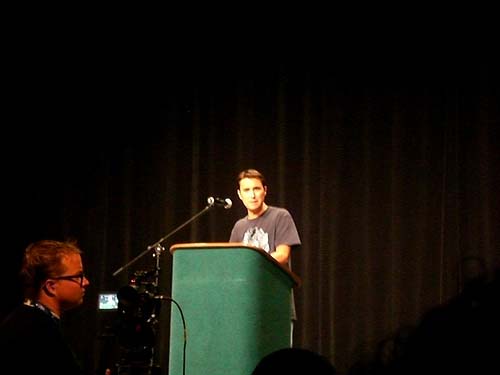
If you missed my discussion of Friday's events, it's understandable; it went up this past Saturday. Suffice it to say that Wil Wheaton's keynote speech was the highlight of the evening. His praise of social gaming, and the relationship-building power of the PAX-goer's favorite pastime resonated incredibly well with the packed theatre. The after-action report on his blog says it all: "My keynote went perfectly, and the audience (and the gaming press online) responded to it in ways I never dreamed possible. I didn't think there would be slightly more than 5000 people in the room when I spoke ..."
The first Penny Arcade Panel featured a lot of middlin' questions, highlighted by the incredible singing power of Jerry Holkins. A description of his performance is in my weekend update, but the real surprise didn't come until after the questions were done. The end of the panel turned ugly when the PA gents left the stage for Uwe Boll to have a chance at the mike. Gabe said later that weekend that he was surprised by the crowd reaction. "You can tell when a crowd is angry, and this was the first time I've felt that at at PAX." The unapologetic Boll was screamed at fairly mercilessly by the attendees.
Other events from the early weekend included a discussion of modern storytelling in videogames. Luminaries Ron Gilbert (Monkey Island), Dave Grossman (Sam and Max) and Nate Fox (Sly Cooper) came together to jaw on a topic near to their hearts. The group discussed linear stories vs. sandbox-style gameplay, user-created content, kids games, and the importance of theme even if your core story isn't all that great: "Grossman [said], 'Well, story isn't just about dialogue and narrative, right - I mean really you want to learn something about the human experience. I think that if I weren't doing adventure games I wouldn't think of myself as a narrator, but rather as the hand of fate. I'm going to kind of let you run around and do what you want and everything. Just to let the player go around and do what they want - they can feel like it's the good hand of fate or the bad hand of fate, but not that they're completely being controlled.'"
The Rain-Slick Precipice of Darkness, the Penny Arcade videogame currently in development, was a visible presence at the show all weekend. The Friday unveiling of a new game demo to the media at a special Q&A event was followed by a weekend's worth of running through the game for attendees on the show floor. Most everyone got to see the title, and hear the news that it will be coming to Xbox Live alongside its PC distribution avenues. The opening, grim, text still makes me smile: "Four gods wait on the windowsill / Where once eight gods did war and will / And if the gods themselves may die / What does that say for you and I?"
PA Panel II
While the first PA Q&A panel was entertaining just to hear Holkins and Krahulik talk, the second panel actually had a number of insightful questions, touching statements, and funny moments. And, thankfully, there were no stoned guys rambling about their paranoid fantasies at the microphone; always a plus. Long queues formed at the two microphones to question the gents, and here are some highlights:- Paul Barnett, Design Manager for the Warhammer Online Massively Multiplayer game, drew applause for his short advertisement during a trailers reel before the event started. He used his clipped British wit to compare Warhammer to World of Warcraft like so: If you're going up against the Beatles, don't try to be the Beatles. You'll end up looking like the Monkees. Instead, we're going to be Led Zeppelin.
- A question about the changes to the primary characters over the year led Mike Krahulik to discuss his influences, such as Stan Sakai. He's essentially 'never finished' with the characters, and we can expect to see further changes to his art style in the coming years.
- Drawings of Gabe and Tycho in ping pong outfits prompted readers to ask if we would ever see that as a project down the road. They're enthusiastic about it and would love to do it, as up until now readers have just seen a few simple images. To further tease us, they described the backstory to the piece: Set in the 80s, a cold war US is still facing down Russia. A little-known clause in the UN charter states that table tennis can be used to decide grudges; the loser forfeits their country. The US table tennis team is slain, and so a group of four people at ping pong camp (including our protagonists) are drawn into international excitement.
- A question about the appeal of the Halo franchise has the gents noting that the series has grown on them considerably.
- In negotiating the price for the XBLA version of the Rain-Slick Precipice of Darkness, they feel they'll have a good deal of leverage as regards pricing (and content as well).
- Several great ideas for projects and future PAX ideas are mentioned, including support of a nerdcore show currently touring the area and an Indie Games FreePlay area.
- When asked about origins of the hobos in Precipice of Darkness, Tycho notes that the game is a 'hobage' of different sources. The Achievement for 100 hobo kills? Hobicide.
- A reader challenges the two to a thumb war, which Jerry wins quite promptly by kicking Gabe in the nuts. He declines to continue, saying he 'values his beanbag.'
- When asked to endorse some games on the exhibit show floor, both gentlemen put their weight behind Eye of Judgement and Sega Rally.
- Someone notes that the current in-the-works game is very much a 'Tycho' game ... lots of words. He wonders what kind of 'Gabe' game they'd like to make. Mike ponders the concept of a brawler, or perhaps something not unlike Turtles in Time.
- The idea of making sure the ball comes back to PAX every year, 'to recharge' is brought up. It could then be sold on eBay to help fund the annual Child's Play charity. They both really like this idea.
- A reader asks what the 'worst thing' either of them have ever done is. Mike tells the story of a time when he set a trap for his family's cat in the backyard, and ended up stringing up the pet by the neck into a tree. It survived, but he has always felt terribly. Jerry, on the other hand, equivocates. When Mike gets tired of it, he tells a story of Jerry drinking a glass of Chai and finding a bug near the bottom of his glass ... which he then upended and finished after fishing out the bug.
Having had a good look at the game at Gen Con, I used my PAX chance to talk to the folks at EA Mythic to dig a little bit deeper on one of the game's claims to fame: Realm vs. Realm combat. Just hours before I spoke to the folks at EA, a team from their company had announced professions from the High Elf and Dark Elf factions for the very first time. I tried to glean just a little bit more PvP-specific information about these races for you, but it was not to be.
Just the same Ryan Barnard (game designer) and Eric Correll (producer on the game) were very forthcoming. The pair was happy to discuss different elements of their signature game feature. For example, new players will have the PvP-focused game introduced to them gradually at low levels. There's a soft introduction, beginning that portion of the title's seamless integration into the overall gameplay. Open-world PvP in specific parts of the starting zones will most likely be their first exposure. Quests will lead them to RvR areas, and eventually will direct them to the instanced 'Scenario'-style missions. Throughout the game, the portion of land that is focused on these activities starts small, but eventually dominates gameplay; the RvR 'city capture' system is Warhammer's 'end game'.
Warhammer Online's unique systems, like the Tome of Knowledge and the Public Quest, also touch on RvR. The Tome will explain elements of Player vs. Player combat, and will record your successes in battle. RvR Public Quests, meanwhile, are currently undergoing retooling. They want them 'right', and currently have taken them all out of the game to make sure they're just so; they hope to have them back into the game by launch.
This feel of 'rightness' is something they're aiming for in their scenarios as well, with the goal of integrating these instances not only into PvP progression, but the ongoing story of the game as well. Each is themed to the area they're in, and tells the tale of a specific conflict between the Order and Chaos armies.
Introducing players who might not otherwise participate in RvR into the fundamentals of that gameplay style is also something the team is focusing on. While they acknowledge that some people just don't want to play against other players, they see folks who are hard and fast about that rule as the minority. They're looking to make PvP a core part of the game, and as such they'll be approaching it differently than a primarily PvE focused game might. This affects multiple game design elements, all the way down to the 'hook' of Public Quests, which gets folks who might not even ever group thinking more favorably about gaming with others. Racial pride is also a factor; by priming characters from low levels to be 'pro-Dwarf', or whatever, players will be more likely to come to their society's aid. They're all steps in a chain, the team hopes, to changing outlooks soured by less focused titles.
On the other side of the equation, the end-game city capture system sees factions sacking the racial homes of their opponents. Though reluctant to use the term 'end game' specifically, the team members were happy to admit that it will be the focus at max-levels. RvR combat will funnel players towards the opposing side, hoping to push the 'antagonists' back to their city walls. They also pointed out, however, that there are other elements in play at that high level. PvE content and public quests are still around, though diminished, and they have plans to further expand both sides of the max-level content once the game is released.
Organized Play, as featured in Guild Wars and now World of Warcraft, is not something they're currently planning for. They'd love to eventually do tournaments for RvR teams at some point, but they're so focused on getting it out the door in a timely fashion that it's not particularly on their radar. As they put it, "we hope we have that problem".
The cutting edge of their work is, obviously, on the Elves at the moment. They're still working to tune the scenarios and open-world play for the Elven areas, and are always working to ensure that classes are balanced and the 'fun' is present.
This cutting edge blends well with some of the surprises that the team had in store for them when masses of people finally entered the Beta. Probably the most surprising for the RvR team: their carefully crafted points of control battlefield objective system, which requires holding targets in open-world PvP, are almost completely being ignored. While they worked hard on this mechanic, the players are more interested in the actual act of combat when in an open-world environment. Scenario tactics are welcomed, but outside of those instances the two sides really just want to enter the fray. The team hopes to have them in the game in some capacity, but they're going to undergo heavy retooling before that happens.
As we wrapped things up, we discussed the reflection this decision has on their overall attitude towards the game: if it's not working, it needs to go/be fixed/tuned/rehashed/whatever. Killing what you thought was going to be the end-all be-all is not outside the realm of possibility, even this late in the game. RvR, and the game in general, has to be fun. No exceptions.
Fury
I'll be honest: Fury came at me from nowhere. I'd read about it before coming to the show, knew that it was approaching an Open Beta, and that it was a free-to-play PvP title. That was just about all I knew when I sat down to play and chat with Fury's lead designer Adam Carpenter.
When you're trying to quantify Fury's gameplay type, it's better to think less about online RPGs and more about first-person shooters. Fury has essentially taken the swords and sorcery milieu and dropped that whole cloth into an FPS schema. In each match, players spawn in, rush out, and slam into each other in extremely fast altercations. Everything is fast; from character creation to combat can be just a few minutes.
This is the underpinning of developer Auran's outlook: fun, fast, and free. Instead of grinding through a PvE component, Fury characters are built entirely around a series of abilities and equipment available at character creation. Each character can play whatever role you want them to in a given match, and their role can be changed freely between altercations. Want to act as a support class in one match? You put on your gear that aids healing type abilities, load those healing abilities into your hotbar , and go. Want to act as a ranged DPS class? Swap those healing bits out for the appropriate gear and powers. Players will never have to whine about not having the right class for a fight, as everyone has flexibility.
Gameplay itself, character abilities, focuses on colors. Your ability bar is full of various attacks, and they are themed around different colors. Each player has a small gauge on their screen to help ascertain how many color points they have built up. These points are gained by using 'low level' colored abilities. A basic blue attack, for example, might give you one blue point. As you move through combat, your gauge will fill with colored points. Higher points unlock the use of more powerful abilities on your hotbar, which in turn use up your points. Fascinatingly, each ability color has a diametric opposite; red points counter blue points and players with red points in their bar will actually be less effective with blue abilities. This led the designers to create special point-manipulating abilities; in the middle of the fight you can switch a player's point colors. You can also steal points, leading to the 'change-their-color-steal-their-points' combo move, leaving your opponent defenseless and cold in the world.
Each color has a sort of 'theme', with green abilities having a sort of nature-y feel to it, while blue abilities being sort of icey. There are ranged and melee abilities in all colors, so there won't be any particular demanded role for a color ability. For most players the only real constraint will be up to what abilities you have on hand as a result of previous accomplishments. While most common abilities will be available by default when you purchase the game, new powers will be unlocked via achievements as you succeed in combat. Achievements include everything from taking the most objectives during a match, to killing the most people, to healing the most ... and your rewards are appropriate for what you accomplish.
Rewards on the equipment side are a bit more random. After completing a match, random loot is generated for the party, and people /roll for it. That's pretty much 'the way it is', going right around the usual sort of arguments at pick up group might have when dealing with looted gear. Gold is equally distributed, of course, and both items and gold are commensurate with your success in the just-completed mission.
It's worth noting here that Fury will have a for-pay option, allowing you to slap down a subscription fee if you want ... but it will have nothing to do with the quality of your in-game items. Money is only given to the Auran folks for the addition of convenience and depth. I should say there is some overlap with items: one of the for-pay conveniences is the ability to roll on three items instead of two. A for-pay player has a bit more in the way of item space, some options for purchasing things from vendors, and other simple things that makes the game just a little bit easier for having forked over your cash. Depth, in this case, is all about in-game ladders. While free players will compete on ladders of various types, paying players will have a long list of different ladder types to participate in. Server, guild, and individual progress will all be tracked for various rewards and bragging rights.
Those bragging rights will come in the form of an online representation of your character's escapades. Kill counts, 'flag' steals, and other metrics will be tracked on an official page for your character, and viewable by anyone. Guilds with an interest in going deeper into min-maxing can make use of the human-readable stats that will be generated locally by the client in a text file. Officers can collect these document to see which builds are working, which aren't, and where the group as a whole needs to focus.
The game build playable on the PAX show floor was already five months old, and showed it. There were server problems a few times, and the game looked more than a little bit jaggy. Even through the cruft, though, there was a lot of promise showing through. The settings were gorgeous despite the outdated rendering model, and the fun factor of actual play was very high. Fury is a simple, brutal combat game, and it makes no pretensions about it. With the promise of free online play for the price of a PC game title, this seems like a pretty nice package. It's definitely not going to be for everyone; there's none of the painstaking polish of Guild Wars, or the deep PvE experience of World of Warcraft. For folks looking for a quick, focused good time Fury may just be what you're looking for.
Jonathan Coulton, Frontalot, Minibosses Concert
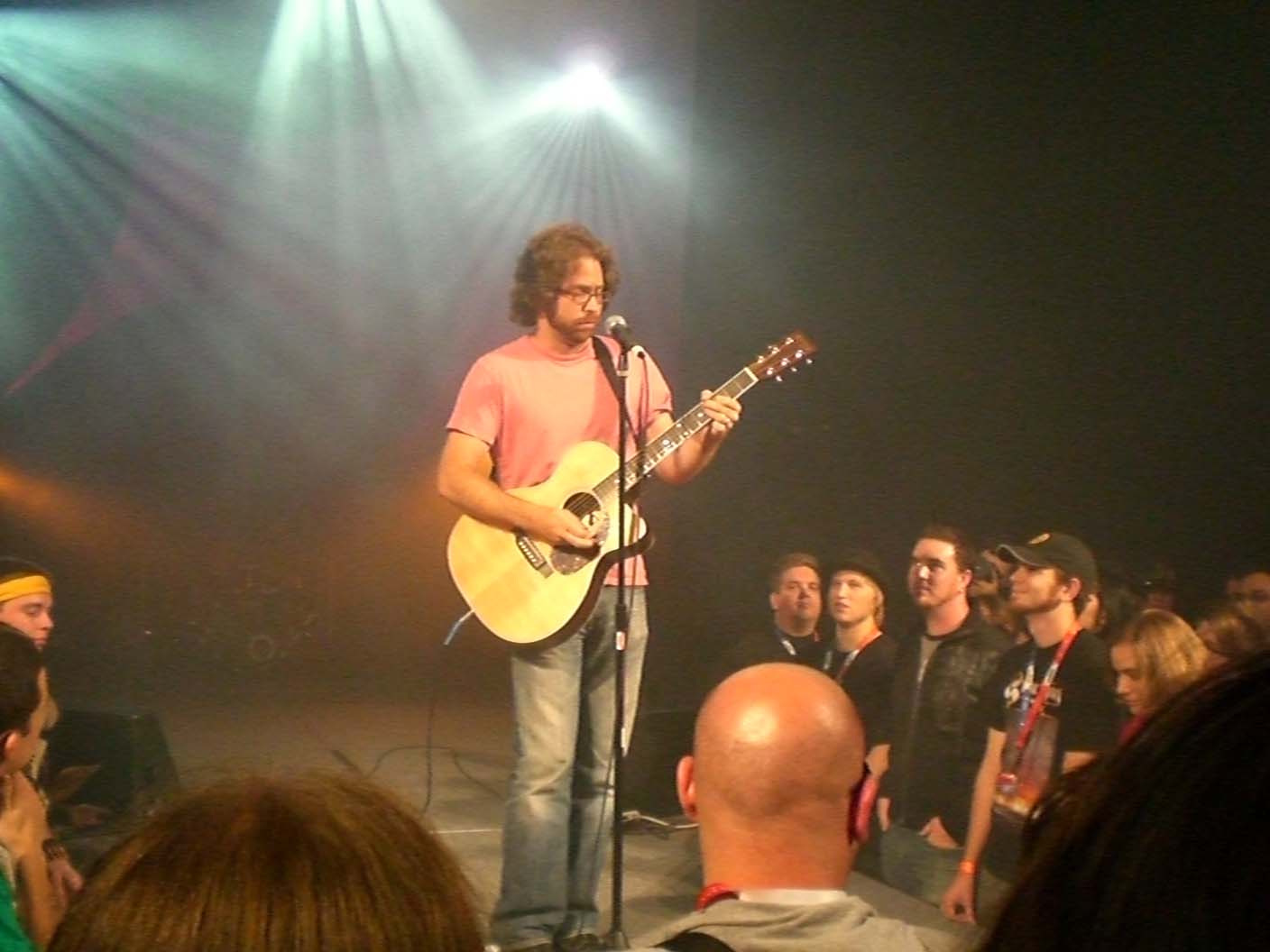
I'm sure many of you could have told me how transcendent Jonathan Coulton's music is, but when I entered the theatre on Saturday night for the triple-headed mega-show I was something of a Coulton newb. I'd heard Code Monkey, of course, but I'd never made much of an effort to seek out his music. Whether it was his intent to really reach the audience that night or not, he made a convert out of me. His haunting lyrics about superficiality, squid, cybernetics, robotics, technology, programming, and zombies were funny, touching, and thought provoking. I asked a friend who followed his music to confirm for me that he usually doesn't play terribly large venues. I had to ask because it was only really apparent during the few moments when he paused to take in the size of the audience. He was really, very good. Coulton had easily the largest crowd of the night, with his mass dwarfing even the groups on hand later for MC Frontalot and the Minibosses. His final song for the night, re: Your Brains was tremendous to experience in the midst of thousands of hand-waving flesh-craving growl/singing faux undead. Both Frontalot and the Minibosses put on amazing shows as well, of course, showing off their polished shows and firm grasp of their material. Frontalot was in rare form, with several new songs of his most recent album. Just the same ... Coulton was the show of the night for me, and it was a privilege to be able to see such a great act in person.
The Games And Panels of PAX
There were so many events and games, demos and panels, at the event that I couldn't make it to every interesting experience. Thankfully, other sites can pick up the slack.
The panel on licensed games explored the pros and cons of using someone else's IP to make a title. "Too many cooks in the kitchen" was seen as the primary problem, with the high cost associated with such a deal a close second.
"Pitch Your Game Idea" is always a very well-attended panel, and this year was no exception. Dozens and dozens of people lined up to present their game ideas to a panel of industry veterans. They were then 'cut', American Idol style, working through less solid game ideas towards the pearly center. There were apparently a surprising number of women there, and the contestant that won was one of them. Her simple, Pong-like concept had a graphical background that became more complicated as the game went on.
That showing would have been a relief to the folks at the very well attended "Women in Games" panel. The event focused around the challenges of entering the industry, and the issues associated with working the day to day grind once you're in.
A number of folks had hands-on time with titles I didn't get to, including Haze, Tabula Rasa -
eBay Bargains Soon To Be A Thing Of The Past?
ScaredOfTheMan writes to mention that, as expected, companies are utilizing the decision in Leegin Creative Leater Products v. PSKS to force the take-down of auctions on eBay because auctions are priced too low or even stating the auction itself is an infringement of their intellectual property rights. -
Why Microsoft Won't List Claimed Patent Violations
BlueOni0n writes "Earlier today, Microsoft announced it will begin actively seeking reparations for claimed patent infringement by Linux and the open source community in general. One opinion on why Microsoft won't reveal these 235 alleged IP infringements to the public is that they're afraid of having the claims debunked or challenged — so instead they're waiting until the OS community comes to the bargaining table. But a more optimistic thought is that Microsoft may be afraid to list these supposed violations because it knows the patents can be worked around by the open source community, leaving Microsoft high and dry without any leverage at all." -
Bloggers Propose Code of Conduct
akintayo writes "The New York Times reports that in response to the recent brouhaha, some technology bloggers have suggested raising the level of civility on tech blogs by implementing a code of conduct. Kathy Sierra, a technology blogger and friend of O'Reilly was subjected to threats and insults from readers and other bloggers. In partial response, O'Reilly and others have proposed a code of conduct which could include restrictions like the outlawing of anonymous accounts." -
EA To Invest In China's MMOG Firm The9
Gamasutra is reporting on announced plans from EA to invest in The9, the Massive firm that currently runs World of Warcraft in the Chinese market (among several other properties). EA Mythic recently announced they would be sending Warhammer Online into Asia, and one could easily imagine The9 being an instrumental part of that endeavor. The WoW angle is another wrinkle to keep in mind, as well: "Shanghai-based MMO executive Bill Bishop points out in some detailed analysis on his weblog: 'EA and Vivendi Universal Games (owners of Blizzard, developer of World of Warcraft) are direct competitors. Perhaps the Blizzard-The9 contract does not have any protection for Vivendi in the event that a competitor takes a significant stake in The9, but that would be surprising.'" -
Taxes, Second Life and Warcraft
An anonymous reader wrote in to say that there is "...a new law review article that explores the tax treatment of players in Second Life and World of Warcraft. The bottom line is that commercial activity that occurs in virtual worlds should be taxed the same as in the real world. But purely personal activity within virtual worlds should not be taxed." -
Google Desktop for Mac Released
Julio Ojeda-Zapata writes "Google on Tuesday will release a Mac version of Google Desktop. This software, like the PC version, indexes the content of a hard drive and serves it up on familiar Google-style search-result Web pages (or via a its own drop-down results list, if you prefer). But Google Desktop for the Mac is streamlined compared to the busy, gadget-y Windows version, which isn't necessarily a bad thing. The focus is squarely on search — including local indexing of an online Gmail account of your choice. It will also index your iDisk." -
Death Threats In the Blogosphere
Several readers have written in about the death threats and threats of sexual harm that have been directed at tech blogger Kathy Sierra. She is the author of a number of books about Java and a popular speaker at conferences. She has now stopped blogging and cancelled her appearance at eTech. She names the names of four prominent bloggers who are backers of two sites on which the threats were posted. Others in the blogosphere like Robert Scoble and Tim Bray have posted publicly in support of Sierra. Scoble in particular emphasizes the streak of misogyny that is still all too evident in the tech world. The Washington Post is also grappling with the issue of vile comment posts that flirt with illegality. One commenter on Bray's post summed it up: "The Internet used to be a university. Then it became a shopping mall. But now, it's a war zone." -
Texas Bill For Open Documents
Ditesh Kumar tips us to a blog entry by Sam Hiser noting a bill filed in Texas that would require state agencies to conduct their work in an open document format. After Microsoft's grueling battle against ODF in Massachusetts, bluest of blue states, it must be galling to face te same fight in the reddest of the red. Hiser notes that the bill includes a rigorous and sound definition of an open document format, which ODF would meet but Microsoft's current OOXML submission would not. -
Financial Analyst Calls Second Life a Pyramid Scheme
Petey_Alchemist writes "Silicon Valley gossip rag Valleywag is carrying a story about Second Life being a new spin on the old pyramid scheme. The article, which consists mostly of selections from the report of financial consultant Randolph Harrison, suggests that not only are most people deceived about the amount of money they can make in Second Life, but also about how easily they can withdraw it. It says 'Like the paid promotion infomercials that run on CNBC, sadly SecondLife is a giant magnet for the desperate, uninformed, easily victimized. Its promises of wealth readily ensnare those who can least afford to lose their money or lives to such scam in exactly the same way that real estate investor seminars convince divorcees with low FICO scores to buy houses sight unseen with no money down.'" -
Get on the 'Gates for President' Bandwagon
netbuzz writes "Dilbert's Scott Adams kicked off the idea in his November 19th blog post, saying there isn't anything wrong with this country that President Bill Gates couldn't cure in less time than it takes to get a new operating system out the door. Today, the idea is moving forward with a brand-new 'Bill Gates for President' Web site. Adams is also back on the campaign trail, flogging the site and Gates' candidacy." A blog post at Network World includes a lot of eye-rolling about this idea, but neither Adams nor the folks at the 'Gates for President' website seem to be taking this lightly. -
Experts Rate Wikipedia Higher Than Non-Experts
Grooves writes "A new Wikipedia study suggests that when experts and non-experts look to assess Wikipedia for accuracy, the non-experts are harder on the free encyclopedia than the experts. The researcher had 55 graduate students and research assistants examine one Wikipedia article apiece for accuracy, some in fields they were familiar with and some not. Those in the expert group ranked their articles as generally credible, higher than those evaluated by the non-experts. One researcher said 'It may be the case that non-experts are more cynical about information outside of their field and the difference comes from a natural reaction to rate unfamiliar articles as being less credible.'" That's the problem people face when 'everyone who disagrees with you is a moron'. -
Wil Wheaton's GenCon SoCal Recap
Mr. Wheaton (CleverNickName to you) had the chance to attend GenCon SoCal, the westerly companion to the event held every summer in Indianapolis. He writes, in his regular column at Suicide Girls, about the joys of a nerd in his natural environs. From the article: "I made my way over to the correct hotel, and finally felt like I was at one of the cons I remember. It was intimate, dimly-lit, and packed with people in costumes, people playing games, people napping on couches, and people doing the things that geeks do. I passed one guy gloating into his cell phone, 'So, I guess you're not picking up your phone after that humiliating defeat?' He was cleaning up the aftermath of a Magic: The Gathering duel. A pair of men passed me, heavily engaged in conversation. One of them said to the other, 'Not only is it a valid thought, it's a valid line of discussion!' I have no idea what they were talking about, but it certainly seemed, uh, valid to them. Four teenagers (two boys and two girls) walked in front of me as I crossed the lobby, one wearing a Cthulhu backpack. All of them were dressed in black pants, the boys with the obligatory flannel shirts unbuttoned over their T-shirts. " If you're worried about it, Wil's column is in a SFW part of the site. You can also read some of his editorial cuts on the WWdN In Exile blog. -
Scott Adams Suggests Bill Gates For President
gerrysteele writes to point out a recent post to the Dilbert blog, in which Scott Adams discusses the atheist ascendancy in America and rationalizes the need for an atheist leader. From the article: "Ask a deeply religious Christian if he'd rather live next to a bearded Muslim that may or may not be plotting a terror attack, or an atheist that may or may not show him how to set up a wireless network in his house. On the scale of prejudice, atheists don't seem so bad lately. I think that in an election cycle or two you will see an atheist business leader emerge as a legitimate candidate for president. And his name will be Bill Gates." -
Mozilla People Answer Firefox 2.0 Questions
Chris Beard was "point" on this interview, but got help writing his answers to your questions from other Mozilla and Firefox people. (Since this was sort of a "companion" interview to one we did just before it with MSIE dude Dean Hachamovitch, you might want to look at the two Q&A posts side by side and compare the way they answered.)
1) cake
by Anonymous Coward
How was the cake from MS?
Chris: It was a nice surprise actually, and we think it's great that Microsoft is taking an interest in browser development again. Of course there wasn't nearly enough of it to go around since there are thousands of people worldwide working together to make Firefox possible, but those of us at the Mountain View office made sure to enjoy it for everybody :) .
2) FireFox 2 Rendering Speed Compared to IE7
by MSTCrow5429
Dear Chris Beard, I have used Firefox since before 1.0, and one thing that Internet Explorer has always beaten FF on is rendering speed. With the release of IE7, Microsoft has made IE at least feel faster than before, and it certainly has adopted many features that made FF such a stand-out, security not withstanding. I would like to know if Mozilla has made it a priority in the past to give FF a rendering speed competitive with or faster than IE, and if we will see FF becoming competitive with or faster than IE in rendering web pages in future releases? Thanks.
Chris: Performance continues to be a high priority for us, and we test every nightly build to make sure that we're getting faster, not slower than our previous releases. We're really happy with Firefox 2, it's a very solid release with three or four times the amount of fixes and work as went into 1.5. We're hearing a lot of positive feedback about the performance of Firefox 2 as compared to Internet Explorer 7, especially on interactive web sites (even Robert Scoble recently blogged that "Firefox 2 was a LOT faster on AJAX". Zimbra, who makes a really rich web-based productivity suite also recently posted that by their internal tests, "Firefox was more than twice as fast as IE 7 and four times faster than IE 6".
But we're still looking to do better, and the next version of Gecko (the platform which is used for rendering web pages) has several improvements to our graphics infrastructure and layout engine which should continue to speed up our page rendering time. Brendan Eich recently blogged about Mozilla 2, which will contain even more improvements for performance. So yes, it's definitely something we have as a continual priority.
3) Competition
by Phroggy
What do you feel are the greatest strengths and weaknesses of Opera?
What do you feel are the greatest strengths and weaknesses of Safari?
What do you feel are the greatest strengths of IE7? (I won't ask about weaknesses...)
Chris: First of all, I just want to say that we're totally thrilled to see a revitalized ecosystem around the Web experience. That was our primary goal from the inception of Mozilla (to promote choice and innovation on the Web) and I think it's clear that users now have more choice and the Web is a much more innovative place.
Specifically and personally, I think that Opera is a great tool for fans of those really big swiss-army knives. It's an everything-in-one approach, much like the original Mozilla Suite and Seamonkey, and that totally works for some people. However, the experience can be quite overwhelming for the average Web user.
For Safari, I think they've got some excellent system integration. It's really nice that they can leverage Keychain and Address Book like they do, and of course, it's a Cocoa based application which gives it a bit of UI integration that we don't yet have. I'm a little disappointed that they're so focused on making the entire experience Apple-centric, though, and would love to see more ability for users to customize their experience and the applications they can integrate with Safari.
IE7 has taken a lot of steps forward from IE6 and it's nice to see them following along with the features introduced by Opera, Safari and Firefox -- and that have made Firefox so popular; that's a huge vindication for us, and we're flattered to be imitated. They've shipped some improvements to the standard Windows printing platform which I'm a little jealous of, but hopefully those will be part of Vista so that all Windows applications can take advantage of them, too.
4) Future?
by nine-times
What does the long-term future have in store for Firefox? Is the web browser going to become more feature rich, or is the Mozilla team going to aim at keeping Firefox very minimalist and optimized? If the former, what features do you think will help advance the user experience of the web? If the latter, how will you differentiate Firefox from its competitors and maintain the brand in absence of flashy new features?
Chris: The Firefox Charter states that our goal is to provide the most useful browser to the largest possible market while maintaining a simple interface that focuses on helping users accomplish their online tasks. That means adding the features which we think are useful for accomplishing tasks, but making sure that they're not thrust into users' faces unless they want them. We think people are doing more interactive things online these days, and are visiting more places than the average web user visited 4 or 5 years ago, so we're looking at features that help people navigate their "local web" and are also looking at providing tools for helping them act on the information they find there. If we design them right, they'll "just work" like users expect, much like we feel the Search Suggestion and Spell Checking features of Firefox 2 "just work".
5) Tackling The DOM
by x3nos
With the most recent releases of FF 2.0 and IE7 almost simultaneously, from a person who does QA for a web deliverable software company, trying to debug and locate the source of inconsistencies in the way that FF 2.0 and IE7 handles DOM - what steps is the Mozilla foundation taking to help blaze the trail for some kind of standardization in DOM? I realize that IE has its own version of DOM, but is there hope that 1) Mozilla will better respond to erratic DOM programming from those that develop for IE or that 2) Mozilla will somehow influence the Microsoft camp to come over to standards?
Chris: Compatibility with IE is something we look very seriously at (in all areas, not just the DOM API) and in the obvious cases where there's no specification (de facto or "standard") that dictates what the right thing is -- we do our best to match IE's behavior. But we also realize that trying to be bug-for-bug compatible with IE is a dead end. So, we work with the W3C and groups like the WHATWG to find the common ground and a resolution that benefits everyone. We also actively promote and encourage developing to open standards, but Microsoft's decisions in this area are obviously out of our direct control.
6) Firefox Features
by Eideewt
Firefox was created partly as an alternative to the bloated Mozilla suite. Now as Firefox matures, it too is gaining features. While all of them are fairly useful, some, such as spell check, web feed previews, and session restoration, might be better implemented as extensions. Firefox is still a fairly lightweight browser, and I appreciate Firefox 2.0's improved response speed, but I still worry that Firefox is becoming the kind of software that I hate.
How committed is the team to keeping Firefox's core as small as possible, and what, if any, features might be turned into extensions in the future?
6A) Re:Firefox Features
by diamondsw
As an add on to that question, since you can distribute extensions with the installer, why not just make these "official" extensions rather than building them into the app? Then people could easily switch them off or substitute third party ones (think tab management).
You've created a great extension management system, yet aren't using it yourselves.
Chris: A lot of the answer for question 4 here applies as well. Our community is surprisingly conservative, and we ask ourselves a lot of tough questions about whether or not a feature is really needed and used by a majority of users before we add it into Firefox. Spellchecking is a perfect example. As more and more users move to Web-based e-mail and other types of online content creation, a feature like inline spellchecking just makes sense. For those who don't need it, it's mostly out of the way and costs them nothing in terms of usability. But when you do need it, it's there, and it helps.
We're also encouraging more and more feature development as extensions, and promoting that work through programs like Mozilla Labs, as a way of allowing us to test things out before accepting them into the main product itself.
I don't know if there's a need for "official" extensions, but we are planning on making it easier to understand which extensions have been extensively tested by the Mozilla community for performance and compatibility issues, as part of an upcoming upgrade to the Firefox add-ons site.
7) Add In Validation
by Jarhead1972
Chris;
Does FF worry that an unscrupulous add-on developer could produce what could be a click-fraud capable bot net hidden in an add-on that could be promoted and distributed by FF team? What steps are taken to prevent it given the add-ons are not signed or hosted by FF?
Chris: We've got a committed team of contributors who keep a close eye on recommended extensions distributed by Mozilla. And we continue to build out the community and tools available at addons.mozilla.org to keep up with the increasing activity and demand for Firefox add-ons. We're also working on a major revision to this site that we'll be launching soon.
8) Old Bugs
by SeaFox
Has the Mozilla team considered adopting timeframes to the resolution of bugs, no matter what the severity? I've seen bugs on Bugzilla that, while minor, have been open since before the browser was named Firefox, some without any comment besides the initial confirmation they exist. Why do issues stay unaddressed after multiple major releases?
Chris: We're always evaluating and prioritizing the most important bugs. Thousands of bugs are of next to no consequence for most users and those will be prioritized below the bugs that affect large numbers of users. Putting some timeframe on bugs would encourage bug fixing around age rather than severity or visibility and that prioritization doesn't best serve the needs of our users.
Of course, we do understand that there are some issues which, while they're not a high priority for most Firefox users, might be very important to one or a small group of users and that's why we leave these Bugzilla reports open and we encourage interested people to become a part of the Mozilla project by contributing fixes for even the lower priority issues.
9) Firefox and Macs
by chrisgeleven
When will Firefox get some much needed love on Mac OS X? The toolbars look hideous, the form widgets don't look aqua like, and there is no integration into OS X services (like the dictionary). Plus there is always a need for speed improvements.
Chris: It turns out that it's hard to find developers with rich experience in application development on Mac, but we'd be happy if any passionate open-source Slashdot Mac users want to help out! We're constantly improving our platform support and Gecko 1.9 will have support for Cocoa which will improve our form widget rendering as well as the ability to integrate with OSX services.
10) Future of Thunderbird
by Kelson
Thunderbird, as a companion to Firefox, seems to be getting the "also-ran" treatment. Releases tend to trail Firefox releases by weeks or months, and there seems to be very little promotion or marketing.
Do you expect the influx of Eudora developers to change this? Are there any plans for more coordination between Firefox and Thunderbird in terms of scheduling, marketing and promotion?
Chris: Thunderbird has achieved a solid position in the email client market, with several million active users worldwide. As you note, we're focused as an organization on Firefox but we're also starting to look and think about what modern communications should look like online. Especially as we see more and more people making the Web their primary communications medium. Thunderbird has a loyal following and has made inroads into the enterprise, so any future planning around Thunderbird will take those factors into account.
-----
Thanks to everyone for all the great questions and remember that the conversation doesn't have to end here. As an open source project you can reach us through the newsgroups and other forums, or join us in our global effort to make the Web better for everyone.
-
Ask a Mozilla Person About Firefox 2.0
Last week's interview guest was Dean Hachamovitch, formal title "general manager Internet Explorer at Microsoft Corp." This week we have Chris Beard, Mozilla's Vice President of Products. (Here's a recent "pre-Firefox 2 release" interview with Chris that you might want to look at to avoid duplicating questions.) Chris will be calling on other Mozilla and Firefox people to help answer your questions, but he's the point man here. Slashdot interview rules apply, as always. -
"Dilbert" Creator Gets Voice Back
Scott Adams lost his voice 18 months ago to a disorder called Spasmodic Dysphonia. One day, it returned. He is apparently the first person in history to recover from this malady. Read his account. It is inspirational. I can't find any other word for it. -
Mozilla vs Debian Analyzed
lisah writes "Linux.com has a behind the scenes look at the history of the ongoing debates between Debian and Mozilla that predate Debian's last release, Sarge. The article also reports the issue may have been laid to rest for good now that Debian tentatively plans on calling it "Iceweasel" but attorney Larry Rosen said this never should have been a debate in the first place. In addition, Mozilla has been prompted to clarify its position on the company's marketing blog." -
Citizen Journalism Expert Jay Rosen Answers Your Questions
We posted Jay Rosen's Call for Questions on September 25. Here are his answers, into which he's obviously put plenty of time and thought. This is a "must read" for anyone interested in the growing "citizen journalism" movement either as a writer/editor or as an audience member -- and please note that Rosen and many others say, over and over, that one of the major shifts in the news media, especially online, is that there is no longer any need to be one or the other instead of both.
1) Where do you see newspapers' role in this?
by Stick_Fig
First off, my credentials: I'm the former employee of an experimental newspaper, Bluffton Today, located in Bluffton, South Carolina. It's an exciting place, let me tell you. The focus has been on reverse publishing but at the same time tempering blogs with traditional journalism. The staff still writes articles; they still edit heavily. They use the web only to the degree where it doesn't dip into libel and slander and builds on its strengths. My question to you is, do you think Bluffton is on the right track? It felt like, in the 15 months I was there, they definitely were, but I'm a biased party. I left thinking, "If only newspapers did more of this..." I know what I'm betting the farm on in my career, and it isn't tired, boring, traditional journalism. It isn't the straight and narrow of blogs, either. Rather, I feel that it's important to look at both sides and find how they can work together, because God knows there's some 60-year-old editor somewhere who won't look at Bluffton as anything more than a gimmick. I'm gonna be that guy in the newsroom fighting the good fight to get more untraditional voices into the the paper in more places than the editorial page.
Rosen:
Bluffton Today (Bluffton, SC is near Hilton Head Island) did several things that were important to try in 2005. They said the editorial engine would be the online edition; it would "produce" the printed paper. This is the opposite of how newspapers did things for the first ten years of their Web lives. They just re-purposed the content from the print edition, and called that an "online newspaper."
By reversing what's primary in production you change head sets in the newsroom because a professional newsroom engineers everything--including the talents of its employees--around the production ordeal. The "daily miracle" it was once called, because making the newspaper required such a fantastic act of just-in-time coordination. Many things had to be routinized for the miracle to occur. (Including ideas about journalism and the user's place in it.)
Steve Yelvington of Morris Digital Works, who worked on the Bluffton Today site, called it an "inversion" because content would flow from the Web to print rather than vice versa. The editorial engine should be the more interactive one, in which more of the community can participate. The goal was a virtuous circle. "Community conversation feeds professional journalism. Journalism feeds conversation. And around, and around." I think there is something to that idea.
How well it works is for people in Bluffton to address. I like that Bluffton Today tried to go Lessig on the news industry. It ditched the read only platform and re-built on read/write. Yelvington said at the launch: "Everyone gets a blog. Not just staffers, but everyone in the community. LeMonde (France) and the Mail and Guardian (South Africa) are doing this, too." Giving everyone a blog may be an obvious idea. But it's a different track. "Everyone gets a photo gallery. Everyone can contribute events to a shared public community calendar...." The site was built on Drupal technology. It had free classifieds. It was different.
If the experience of doing Bluffton Today has tempered some of that initial boldness, that's as it should be. I'm not surprised that the staff still writes articles; they still edit heavily. A web-to-print, highly-interactive, low barrier to entry, read-write, everyone-contributes newspaper is still a daily production headache. Articles, photos, headlines, and ads have to come together. Unedited, the site would have almost no value, although it can have unedited parts with high value.
"It isn't tired, boring, traditional journalism. It isn't the straight and narrow of blogs, either. It's important to look at both sides..." I agree with that, Stick. My new adventure, NewAssignment.Net, is a hybrid site for that reason. (Pros and amateurs collaborate on reporting projects.) In January of 2005 I wrote Bloggers vs. Journalists is Over for the same reason.
Bluffton today was a first wave attempt at innovation. Today initiatives like that face some second wave facts. Bringing capacity online does not itself create activity, so if you're counting on user activity, you better come with more than nifty new capacity. Create more writers and suddenly you may need more editors. "The conversation feeds journalism, journalism feeds the conversation" is a powerful idea, but we are several steps away from knowing how it works to create a live, intelligent filter in the newsroom.
There's just a long way to go. But yeah, you were on the right track working for those guys. Deeply so.
2) How to Get More Respect
by NewYorkCountryLawyer
I am convinced that online media have made a huge contribution to getting out the truth when the corporate media are seeking to suppress the truth. While there are a growing number of people aware of this phenomenon, reports in the 'blogosphere' just do not get the same respect and currency received by reports in the 'major' or 'corporate' media. What do we, as a community, need to do to enhance the respect internet journalists receive in the world at large?
Rosen:
Well, "suppressing" the truth is not how I see the failures of modern journalism, or of our current press. I think it's bigger than that.
Bob Woodward, who is in the news this week, is at the top of the reporting game, an industry unto himself. In two books, Bush at War and Plan of Attack, he failed to tell the truth about the Bush White House because his methods were not up to the obstacle they met: an administration that had broken through all the reality checks normally placed on a president and his closest aides. One by one these measures came under abnormal stress. The policy-making process used by presidents got subverted. The normal channels for sounding out opinion were just disowned. The intelligence community came under extreme stress when asked to supply facts for a decision already made.
A Congress controlled by the same party was expected to go along, which meant accepting the president's definition of reality. Oversight got evacuated. The normal tensions with the press were driven deeper: keep them back, keep them out, tell them nothing, tear them down. If someone does break a story from inside you immediately punish and isolate anyone who spoke to the reporter. You make them disown their words. You make them repent.
This is the story Woodward missed because he got inside it, so to speak. Ron Suskind, one of the few in Washington who did not miss that story, called it "the retreat from empiricism." To me, it's the big narrative yet to come out about the Bush White House. Attack Without a Plan was too crazy to be credible to Woodward. So he wrote Plan of Attack instead. I haven't read his new book yet, just the reviews and excerpts. But from early accounts, State of Denial is his attempt to get back the ground he lost, despite having the best access.
Woodward didn't "suppress" the story. Rather, he couldn't imagine it. Those are the kinds of failures that interest me. Sometimes things are suppressed. Often, the truth eludes professional journalism because no one thought to look for it. I welcome your question, What do we, as a community, need to do to enhance the respect internet journalists receive in the world at large? My first answer is: we have to look for it.
You know how, when you've really mastered something and there's a news account of it, the news story will invariable get several (basic) things wrong? Eliminate the several things and respect will rise. If you want to inform the world of something, grok it before you rock it is a good simple rule.
Correct ourselves early and often. Correct the reporting in the major media, early and often. Fact check your own ass first, then your neighbor's. We should major in transparency; the "major" media will take a minor in that. Diversity of outlook in the reporters ultimately improves the reporting. The blogosphere has advantages there, especially as it does more reporting.
I think we have to accept that Big Media, which isn't going anywhere, is society's default legitimacy-distribution machine. But that doesn't mean it works well. The machine itself can lose legitimacy without exactly falling apart. If you're an upstart publisher of news and you suck at it, Big Media will try to ignore you. If you're an upstart publisher of news and you're really good at it, Big Media will try to ignore you. Then when you assume the shape of a writes-itself story--first bloggers to go to the political conventions!--Big Media will over-cover you, spreading a small bit of understanding over lots and lots of stories. Six months later it's time to debunk the trend they missed, then over-hyped and finally misdescribed. It's not personal. It's protective. It's also cheaper than figuring out what's going on.
We can win a lot of points for Net journalism just by being the opposite of that.
3) What about mob-rule journalism?
by Chas
What sort of safeguards are in place to do fact-checking and prevent false/obviously slanted mob-rule style reports from being propagated as fact?
Rosen:
People hear phrases like "an experiment in open source reporting" and they see it immediately: What's open to the wisdom of the crowd is vulnerable to the actions of the mob. Wanting to be helpful, the volunteer may slant reports without realizing it. Through the portals marked "citizen," the paid operative can also go. How do you prevent all of that?
To me this is a puzzle with many pieces. It won't have one solution; it will take many overlapping systems working together. I can't tell you--yet--how we're going to build a fact-checking and verification system into NewAssignment.Net. But I can tell you that the site will fail without one, so we'll have to try to figure it out, with help from a lot of people. To simply pass along unchecked reports received from strangers over the Net would be fantastically dumb. To discount the possibility of people trying to game the system would be dumb, too; the more successful the site is, the more probable the gaming is. Not to mention spam, duplication, all kinds of junk.
What sort of safeguards are in place? Here are my answers so far. You tell me what is missing or cracked in this foundation:
One: The editors are full time on it. Assignments flow through editors several times before they are published by NewAssignment.Net. That's the pro-am way. It's an editor's job not to be gamed, not to publish bum facts. Everything that goes out has the editor's name on it. It's not an answer to everything--this reliance on "good editors"--but it's a proven system, a simple one, and a start.
Two: Users Self-Police. I'm not sure "community" is the right word for the eventual users of New Assignment. People use that term too loosely, in my opinion. But if NewAssignment.Net develops a base of active, loyal and intelligent users, it's not unreasonable that they can help police the site, especially if they understand that verifiying information and preventing fraud are basic to everything we're trying to do. And so a second answer, after editors, is a culture among users: catch errors, catch mistakes, catch fraud and manipulation. A mob mentality has to be met by something stronger; if you attract the right kind of users, that can happen. It would be foolish to think it will just because you're counting on it.
Three: Given enough eyeballs, all facts can be checked. I think there is every chance of developing a special subgroup of users who are effective fact checkers of the larger base of contributors, including new and casual contributors. One thing we are definitely going to do is see whether retired journalists and ex-journalists will volunteer to work with other natural born sticklers and operate our fact-checking system, which not only has to work, but eventually be better than industry standard. I don't know yet what that system will look like, or how systematic it will be. One of my advisers is interested in this puzzle and working on some ideas, assisted by a professional fact checker who emailed me offering to help. That's how we are going to solve this. Social scientists call it "muddling through."
Four: The site itself has to make verification easy. I mean in the way it is built and meant to operate. For example, editors have to be able to sort the raw from the initially verified from the double checked. This is one of the challenges for the developers of the New Assignment site, which will be Chapter Three. It's a new partnership--here's an about page for them--formed by Zack Rosen, who is my nephew, one of the originators of Dean Space and the co-founder of CivicSpace on the Drupal platform; and Josh Koenig, a co-founder of DeanSpace who started Music for America, a non-profit. They are both Drupal developers, active in that community. The third partner is Matt Cheney, who is trained as a librarian and worked as a researcher at National Center for SuperComputing Applications.
They're going to build the site with open source tools. Josh Koenig has a post up about the New Assignment project. It promises an Open Practice model: "posting tutorials, video screen casts, interviews, and write ups as our own work progresses and as we research others." Verification and fact-checking have to become open practices themselves. The developers understand that.
Five: The one percent rule.. Experience suggests a small slice of users will do most of the volunteer work. According to the one percent rule in social media, which is more of a tendency than a law, "if you get a group of 100 people online then one will create content, 10 will 'interact' with it (commenting or offering improvements) and the other 89 will just view it." This bears on the verification puzzle because we're not talking about "checking" vast hordes of people. If regular contributors provide most of the contributions, their reputations for reliability can accumulate at the site. In a well-designed system that will happen.
Six: How have others solved the problem? You tell me: has creating a reliable system of volunteer contributors ever been faced before on the Web? Did it prove unsolvable? I would expect NewAssignment.Net to look at prior cases first and find the key lessons.
4) Money
by truthsearch
Do you believe that as money flows into civic journalism that it'll change the equation? Obviously there are some people who's primary goal is to become famous and/or make money through more open journalism. Will the large community of contributors flush out those with less altruistic intentions? I guess I'm really asking will civic journalism be self-correcting as it gets bigger? Or is there a way it may become just as corrupted as much of the current mainstream professional journalism?
Rosen:
I doubt there's any incorruptible system, just different kinds of pressures, with greater and lesser freedoms for the journalists involved. We can certainly hope for a self-correcting system, but it's not likely to happen on its own.
There's nothing wrong with seeking recognition for great work. People who want to be become famous or make a salary through the more open forms in Net journalism aren't the enemy. Not at all. But they are going to have to work with users under conditions that build trust and permit collaboration. It's hard for me to see how the bad actors will succeed at that, but I am not discounting it, either.
Here's a site called Sportingo. It says it's a "new type of sports media company," which is "focused on telling the story from the fans' perspective." Users can write articles, which will be "professionally edited." They can rate and comment on articles written by peers.
Sportingo will own all the content published on the site. There are no plans to pay contributors. The company is for-profit. Tal Rozow, the marketing manager, told me that that "Sportingo authors aiming for a professional writing career will be able to benefit from having by-lines appearing on our website." He said he's confident that a strong network of independent sports writers will emerge at the site, and maybe that will happen. But I'm not sure it's a system designed to build trust among all the players involved.
Everyone I have consulted about open source projects of any kind has stressed one thing over and over: the importance of understanding what would motivate people to contribute to the gift economy of the project. You have to get that right, they say. Ultimately I believe a non-profit foundation is a more secure one. If there are profits and they are extracted by the owners, not distributed to co-creators; that's a problem. If there are profits and they go into doing more and better journalism, that's different.
5) What's wrong with other extant examples?
by crush
I'm assuming that you evaluated and rejected some of the other high-profile citizen journalism outfits that predate the founding of your own project. Off my head I can think of:
* The Indymedia network is one of the longest standing examples of an attempt to have a large citizen journalist network.
* The Pacifica Network (especially the Democracy Now show)
* The New Standard
What was it that you found lacking in the above and why did you decide to start a new project instead of reforming and adapting one of the above? Do you think that your decision to accept corporate sponsorship (which is rejected by the Pacifica Network) will see your organization's focus inevitably drift toward the anodyne ineffectiveness of e.g. NPR?
(And of course, how could I forget WikiNews?)
Rosen:
There's nothing "wrong" with these prior examples. I admire them all. I was especially pleased to see that the New Standard met its do-or-die fundraising goal last week. That site is an experiment with reader-supported, totally independent, strenuously-factual reporting. High standards of verification are meant to prevail. I think the New Standard has a lot in common with professional journalism, except it rejects the political economy of commercial news media entirely. It's run as a collective among those who do the work. I am thrilled that it will remain around, because we need to try lots of solutions to how to fund serious reporting. Just as I'm thrilled that Independent Media Center and its collectives around the world keep humming. I agree with Chris Anderson that what blogging begat--citizen journalism--Indy Media begat, too.
I didn't "evaluate and reject" the New Standard, Indy Media, Pacifica and Wiki News. Nor is it my place to decide they need fixing. They don't. The people who founded those organizations deserve a lot of credit for creating something new and daring-- and genuinely alternative. They inspired me. So did lots of others. (New West, for example, or Witness.org.) NewAssignment.Net is really about a single proposition: that if journalists and networks of users can report stuff together that neither could easily do alone, the public sphere will benefit and the site will build trust. I think there's room for that.
My decision to accept $100,000 from Reuters means we'll have an editor who can test the possibilities in networked journalism, as Jeff Jarvis calls it. My job is to make sure that Reuters has no influence on that person. The company has said it will have no editorial control, and no claim on the content. I agree: it won't. I think we can persuade users that it works as advertised. But people are free to draw their own conclusions about what the gift means, and I'm sure they will.
6) Plagiarism and Ethics?
by goombah99
Lately there's been a few incidents of Plagiarism in the news, not to mention some wholesale ethical breaches of faked stories (e.g. Blair at the NY times and "a million Little pieces"). But the thing is, the reason those are news is that they are both exceptional and something that is specifically drummed in to any professional journalist not to do. Indeed, breaking this taboo is probably even more of a sin to the the fellow journalists than to the general public because of this entrenched ethic.
Yet we know that on college campuses, where we can measure the phenomenon, plagiarism is comparatively rampant. So evidently the common man cannot restrain himself.
It seems to me this is a serious issue for any new journalism form with a low barrier to entry and a high degree of anonymity for the author. How does this ethos get enforced in such a realm?
A related question is the ethical division of commentary and news. We know that's become a problem in the media for some outlets where management has a thumb on the content. But the traditional news organs, especially newspapers, still refrain for the most part. Indeed, the NY times just went so far as to remove the typeset justification from any article that contained any sort of analysis or opinion, reserving the justified typesetting for only traditional factual journalism stories so the difference is apparent to the reader from the start. How do we reinforce that ethos in the untrained journalist?
Rosen:
When people plagiarize they do it for a particular self-interested reason: to meet a deadline, get an unwanted task out of the way, get their full time salary with limited work. These motivations will probably be rarer in the New Assignment model. Why volunteer for a project only to cheat at it?
"The common man cannot restrain himself." Sorry, I don't trust that kind of language. Beyond that making stuff up is not a way to develop a base of users on the Web; people aren't that dumb! You speak of a "low barrier to entry and a high degree of anonymity for the author." But for most users the higher the anonymity factor for the author, the higher the barrier of trust.
What some people can't seem to get over is that other people can say any damn thing they want on the Internet! How can you trust any of it? is their natural reaction to all open systems. Closed systems--and professional journalism is one--develop trust in one way. Open systems have to do it a much different way. Expecting one to look like the other is unreasonable.
We aren't going to learn much about this puzzle by asking how the "common man" can be trained to imitate his betters in the news media. I refer you to sociologist Raymond Williams, who once said, "There are no masses, there are only ways of seeing people as masses." It is these ways of seeing that are retrograde. But they show up in the most surprising places.
7) Scale
by FuturePastNow
First, I'll admit that I haven't read much about citizen journalism other than Jeff Jarvis' [buzzmachine.com], but as a non-blogger thinking of getting in to it, I was wondering:
Much of the discussion seems to be about getting out from under the control of "gatekeepers" like publishers and media owners. Yet, while the internet is less concerned with money, it has its own form of currency: popularity, in the form of the link.
Doesn't this just turn the highest-traffic sites into new gatekeepers? Especially as the number of blogs increases, the gap between "rich" and "poor" expands?
I suppose what I'm really asking is, it's hard enough to get noticed today- how will someone just starting out get noticed ten years from now?
Rosen:
Ten years from now? Jeez, I have no idea what the world of media access will be like then. But anyone who is just starting out in self-publishing should consult Clay Shirky's Power Laws, Weblogs, and Inequality, so as not to become prematurely disillusioned by discovering its truths later on.
Certainly there are new gatekeepers. (Slashdot itself is one. But does it work the same way the old system did?) Traffic-wise, there's still rich and poor. (But is this list as static as that one?) Hierarchies have not gone away. (And who said they would?) Inequality has not disappeared. (But did you really think it could?)
You still have to fight to be noticed, good work can still go unnoticed. Life online is not entirely fair, or completely different. There's a new attention economy to replace the old. The sooner we reconcile ourselves to these common sense conclusions, the easier it will be to see what is actually different today.
Here are some things that stand out for me: Amateurs have joined professionals and they own a part of "the press." An audience that was once connected "up" to Big Media but not across to each other is now connected both ways. The cost for like-minded people to locate each other and collaborate has fallen dramatically. The tools of media production have been widely distributed, and broad distribution of content is no longer impossible for small, upstart producers. For professionals, they're not required to affiliate with Big Media in order to operate as a journalist, though most will. They can be stand alones and independents. The people formerly known as the audience (as I call them) are now a productive force to be reckoned with, and Big Media has just started that reckoning. The Net has new ways of distributing attention, which have taken their place alongside the old.
Still, there's a long way to go before we can say that our media system has been made more democratic, responsive and responsible.
8) What impact would this have on national elections?
by StressGuy
The Electoral process seems to be more of a "marketing contest" and marketing takes bags and bags of money. There's commercial time, signs, billboards, radio, etc. Let's face it, a commercial is, at most 90 seconds to tell me why I should vote for you - hardly enough time. So, all we see are glittering generalities or, all to often, "don't vote for the other guy" spots.
If "Citizen Journalism" takes off, do you see this as a way that candidates without the massive financial resources normally required to sustain a traditional campaign could actually compete? Could this make the "third party candidates" a credible threat? Could this actually serve to "level the playing field"?
Rosen:
We should be cautious here. I think the most we can say is that a system that was almost entirely closed and self-sustaining--in which a handful of people raised the money, took the polls, handled the candidates, made the ads, narrated the campaign and talked about the candidates on TV--has been disrupted. The people who ran it are not as confident as they once were in their ability to manage things and get the outcomes they want. Their party has been crashed, but it's not "over." Nor is it "ours."
It's possible that insurgent candidacies--not backed by current players in the system--will have an easier time of it in the years ahead, just as insurgent news providers have more of an opening now. That's as far as I would go on the leveled field.
9) Dilution of Protection
by ObsessiveMathsFreak
How long before corporations and wealthy individuals start employing goons, lawyers and wiretaps, a la HP, to threaten and intimidate citizen journalists with no real legal recourse? If faced with this, should a citizen journalist just back off and let the guilty win? How can the protections now enjoyed by the fourth estate be extended to citizen journalism without diluting them?
Rosen:
As a matter of law and public policy, I think "fourth estate" protections should focus on significant acts of journalism, not people in pre-fab categories or the kind of organization that surrounds the giver of news. All those who are engaged in the act of informing a broader public of what's going on deserve to be under the First Amendment umbrella that protects the press. The press itself is composed of amateur and professional wings.
But that's no answer to goons with lawyers who threaten to sue. Citizen journalists are definitely vulnerable there, which makes you realize why we have big media organizations in the first place. We have to be more creative. Robert Cox, head of the Media Bloggers Association (I am a founding member of the group) has shown that "an orchestrated campaign by bloggers to defend a fellow blogger in what appears to be a frivolous lawsuit" can work. That's encouraging but not a complete answer, either. Legal intimidation will happen, and I'm sure there will be times when the bad guys will win.
10) Blogging
by From A Far Away Land
When asking a primary source for information, I find that telling them I'm doing so to create a report on my blog tends to make them clam up, or continue to be unwilling to provide information that ought to be publicly available. What technique or phrases should I use to convince the interviewee that I both have a legitimate use for their information, and the right to obtain it?
Rosen:
Sometimes you have a right to obtain information from a primary source. Sometimes it's not a matter of your rights but their decision to recognize you and cooperate. If search costs are high for making an informed decision about whether to trust a blogger who shows up with questions, sources will seek to reduce costs by using reputation and even stereotype (bloggers: ugh) as proxies.
I don't think there's a proper technique or a magic phrase that will solve this problem. There's only one solution I can see. Send the guy the URL for the "about" section of your site. That page ought to persuade potential sources that legitimate use will be made of their information. It should tell them what you are up to, and why. The site itself, the reporting and commentary there, is the best reason any source has to cooperate. Ah, but how do you convince them to take the time and look?
There's at least one way. Break a story so that the source's world is talking about it and next time around the source will speak to you-- and go to your About page. I asked Dean Wright of Reuters what the biggest obstacle for NewAssignment.Net will be when it launches. "The same one that the more minor players in the mainstream media have: getting your calls returned," he said. "Then when you complete a project and publish, you may find that other media outlets are reluctant to pick up your stories." The only answer to that is "do some compelling projects that cannot be ignored."
NewAssignment.Net will try to take that advice. It will do stories developed by users into assignments that are given to journalists. It could also do stories developed by journalists and divided into parts for users to assign themselves. (Mechanical Turk meets the Center for Public Integrity.) I hope it will do stories where teams of users and journalists figure out the division of labor together.
Sometimes the network will be the knowledge producer, the journalist the enabler. Other times the journalist will be the producer, and the network the enabler. Pro-am journalism is not inherently better than am-pro. Amateur users could in some cases do it all themselves, with editors watching and giving the green light in stages. Different combinations beg to be tried. It's unwise to say in advance that we know how it will work, or that it can't. -
The 40th Anniversary of Star Trek
Digitus1337 writes to mention the 40th Anniversary of the original Star Trek series. StarTrek.com's article has a look back at that first episode, and tries to explore the whys behind the popularity that followed it. From the article: "On the evening of the 8th of September, following Daniel Boone, this new NBC show premiered with an episode called 'The Man Trap.' The angle of the story was different, to say the least: It was a love story with a sci-fi twist, borne of a relationship from the doctor's past, featuring a monster that, in the end, just wanted to live. It was moving, tragic and anything but cheesy. The viewers -- at least the ones who were paying attention -- were hooked." Update: 09/09 16:16 GMT by Z : Just to be sure you're aware of it, Slashdot's own CleverNickName is celebrating the 40th anniversary by reviewing episodes of ST:TNG on TVSquad. He begins with "The Naked Now". You know, "You are fully functional, aren't you?" -
Patent Review via Community Not Wiki-based
Moe Napoli writes "Articles have recently surfaced (CNET/ZDnet, Fortune and a mention here at Slashdot) incorrectly identifying the recent USPTO pilot Community Patent Review program to be Wiki-based. While a number of Slashdotters have identified why such an approach would create more problems than solve, the program's architect, NYLS Prof. Beth Noveck, continues the discussion and further clarifies why the program is not Wiki-based, yet 'conveys the appropriate sense of openness, transparency and collaboration.'"