Slashdot Mirror
Domain: ucr.edu
Stories and comments across the archive that link to ucr.edu.
Comments · 689
-
Re:Pressed CD is the correct answer
glass is technically a liquid
There is no clear answer to the question "Is glass solid or liquid?". In terms of molecular dynamics and thermodynamics it is possible to justify various different views that it is a highly viscous liquid, an amorphous solid, or simply that glass is another state of matter which is neither liquid nor solid. The difference is semantic. In terms of its material properties we can do little better. There is no clear definition of the distinction between solids and highly viscous liquids. All such phases or states of matter are idealisations of real material properties. Nevertheless, from a more common sense point of view, glass should be considered a solid since it is rigid according to everyday experience. The use of the term "supercooled liquid" to describe glass still persists, but is considered by many to be an unfortunate misnomer that should be avoided. In any case, claims that glass panes in old windows have deformed due to glass flow have never been substantiated. Examples of Roman glassware and calculations based on measurements of glass visco-properties indicate that these claims cannot be true. The observed features are more easily explained as a result of the imperfect methods used to make glass window panes before the float glass process was invented.
-
Re:Joins?
The error - and even most scientists have not understood this - is, to make a spearation between the two. There is no single moment, where something became "alive".
One criteria might be the ability to reproduce.
Very simple "lifeforms" can be self-reproducing, e.g. one with only 54 base pairs, but only if they are parasitic. Such "lifeforms" exploit the complex and sophisticated DNA machinery of the host to accomplish reproduction. The host had to exist first.
However, the simplest known lifeform that can reproduce independently is the Mycoplasma genitalium bacteria, with 582970 base pairs! This probably isn't the simplest one that can theoretically exist - it is hard to imagine the right combination out of 4^582970 appearing at random in the pre-life organic soup - but whatever simpler thing existed before it is a mystery, as well as why none of the simpler forms still exist today (if that is the case).
(Posting AC because credit belongs here.)
-
Re:Other archival projects
Urban myth.
http://math.ucr.edu/home/baez/physics/General/Glass/glass.html
We have plenty of examples of glass objects that are unchanged from Roman times.
-
Re:there's no easy answer
[Viruses are] complex machines that can cause their own replication in their environment.
Regarding the complexity of viruses and related parasitic entities, the potato spindle tuber viroid is a circular piece of RNA with only 359 bases (Subcellular Life Forms) i.e. it can be unambiguously described with 718 bits (at 2 bits per base). And in the lab, artificial "lifeforms" have been made with as few as 54 bases (same web page), i.e. 108 bits. These certainly help blur the boundary between life and non-life.
-
Re:Huh.
Oh Yeah, we'll understand them better, but you've got to read that last sentence's two clauses together. That better understanding isn't going to return us to the belief that electrons obey classical mechanics. That's what I got from the last sentence of your comment I was replying to.
This article talks about electrons (any wave-particle) moving faster than light.
-
John Baez's reading list
You might check out John Baez's article, "How to learn physics".
-
Re:Pop-Sci but well worth it...
Oh, I forgot - I wanted to comment on the rest of those books and add a couple.
Re: Griffiths books - they are both really good as intros to these topics (both are amongst my favorite "pleasure" reading physics books), but in the field they are often considered too elementary to be "serious," for better or worse. It's not that they are wrong, just that they are a little too user-friendly, which to me is a good thing.
If you can manage to wade through the extreme density that is that Shankar book, that should rectify things for QM - I have to say, though, I did not particularly enjoy that book, which surprised me since I adored his "Basic Training in Mathematics" book (likely too basic for a math major, I'd guess) and found him to be a fascinating lecturer (I never took one of his classes, but I occasionally slipped in and watched while between other classes). I think it's just too difficult to be so brutally thorough and remain interesting throughout an entire tome like that.
Jackson's E+M book is really the gold standard for classical E+M, though I'd really recommend hitting the literature if you're into stuff like self-action and all that.
Actually, I just noticed that the Griffith's recommendation was for his particles book, not QM, so scratch my QM comments - though if you find Shankar's book too weighty, pick up Griffith's QM book as a start, like most of his books it's very digestible (should take just a couple days to get through). If you find Griffith's particles book too light, which you hopefully will after a couple reads, you'll want some real field theory. The "standard" here is the Peskin/Schroeder book. That can be a little tough if you don't already know something about it; as a slightly more basic step in that direction, check out Zee's Quantum Field Theory in a Nutshell, which I was very pleasantly surprised with.
You'd also be remiss not to pick up something that Feynman has written on field theory, as I don't know that anyone else has understood it in as straightforward a manner as he has - there's always his various QED papers, which you MUST read all of, but as an astrophysicist, your thoughts will likely turn to gravity, in which case the often overlooked Feynman Lectures on Gravitation are definitely worth your time. Take the later chapters with a grain of salt, as some of the claims about stars are wrong; that said, his approach is quite interesting, and his approach to the Einstein equations is freaking amazing (he starts with a "bare" spin-2 theory, figures out how it's "wrong," and "fixes it up" until it "works," and lo and behold, Einstein's equations pop out of nowhere; those quotation marks hide all of the hard work required to get there, of course!).
Er, and also, I kind of hate to dump another 1000+ page monster of a book on your list, but as an astrophysicist you probably ought to read Misner/Thorne/Wheeler's Gravitation. It's great, though I can't promise it's just a few days work. The Wheeler stuff at the end is too speculative and flowery for my tastes, but the rest is pretty useful, and it's definitely worth keeping in your bookcase to intimidate anyone that might enter!
Robert Wald also has a great General Relativity book that might be less threatening; IMO, you should definitely own Wald and MTW. I'd suggest you avoid anything written by either Einstein or Dirac on the subject like the f***ing plague.
Also, check out http://math.ucr.edu/home/baez/physics/Administrivia/rel_booklist.html for Joh -
Re:Hopelessly confused about a "single photon"
Believe it or not, "a single photon" isn't as small of an amount of light as you'd think.
In a study, 60% of participants were able to correctly identify a pulse of 90 "green" photons. Because only approximately 10% of the light that enters your eye ends up on your retina, that's just 9 photons required to trigger a neural response.
Because your retinas have approx. 350 rods in them, which sense light in a dark environment (and only in black & white), those 9 photons are spread across those 350, which can be interpreted to mean that parts of your eye are indeed responding to single photons.
Considering just how small of an amount of light/energy is contained within a single photon, this result is absolutely astonishing.
For more information regarding single photons, read up on the photoelectric effect. It's quite simple in concept, and its discovery by Einstein in 1905 conclusively confirmed the notion that light exists as a particle.
This paved the way to Quantum Physics, and won Einstein the Nobel prize in 1921.
-
The mystery of "life"There is a long, long way to go before a self-reproducing organism results from a random combination of DNA, artificial or not.
It is possible for a very simple "lifeform" with only 54 base pairs to be self-reproducing, but only if it is parasitic. Such "lifeforms" exploit the complex and sophisticated DNA machinery of the host to accomplish reproduction.
I found it amazing that the simplest known lifeform that can reproduce independently is the Mycoplasma genitalium bacteria, with 582970 base pairs! This probably isn't the simplest one that can theoretically exist - it is hard to imagine the right combination out of 4^582970 appearing at random in the pre-life organic soup - but whatever simpler thing existed before it is a mystery, as well as why none of the simpler forms still exist today (if that is the case).
This has been bugging me for some time, and as far as I can tell no one has a good answer.
-
Re:Close but no cigar...Whether a machine is considered self-reproducing or not is somewhat subject to interpretation I suppose. Similar issues arise with quines (self-reproducing programs). For example, consider the classic C quine,
char*f="char*f=%c%s%c;main(){printf(f,34,f,34,10);}%c";main(){printf(f,34,f,34,10);}
For me, this is not a true quine, because there is no "#include<stdio.h>". It will not compile on typical C compilers. (There are longer quines that do have the include.)Basically, you have to agree on a starting environment and what "self-reproducing" means. Computer viruses might be argued to be better quines than a program that simply prints itself and requires a human (or another program) to take the output and run it again.
Similarly, one might demand that a true self-reproducing machine be able to reproduce itself in the middle of the desert with only the sand as raw material and sunlight for energy. But most people would accept something in between that and the machine described in TA.
Self-reproducing lifeforms have similar issues. It is possible for a very simple "lifeform" with only 54 base pairs to be self-reproducing, but only if it parasitic. On the other hand, the simplest known lifeform that can reproduce independently is the Mycoplasma genitalium bacteria with 582970 base pairs. This probably isn't the simplest one that can theoretically exist - it is hard to imagine the right combination out of 4^582970 appearing at random in the pre-life organic soup - but whatever simpler thing existed before it is a mystery.
-
Re:Relativity question
I WILL USE PREVIEW NEXT TIME I PROMISE (ok, not really
No. If you throw a ball mass m at velocity v relative to yourself (and v<<c) then you can still use 1/2*m*v^2 to calculate its speed relative to you.
But other (inertial) observers who think you are moving will not see the ball go v faster than you.
http://math.ucr.edu/home/baez/physics/Relativity/SR/velocity.html
I've not actually read through that page but given who's name is in the URL I'm confident it's correct:
Tim. -
Re:That's Nothing to be Proud Of
According to the Usenet Physics FAQ, one photon will trigger the retina, but the brain filters out the signal unless it gets several in a small period if time:
http://math.ucr.edu/home/baez/physics/Quantum/see_a_photon.html -
What about lambda calculus ?
i know you computer scientists like playing mathematician, but there's a reason why you're the butt of mathematicians jokes. because you guys are nothing more than glorified engineers.
And category theory applied to functional programming ? -
Re:Great vaporware application
LAPTOP. SENSORS. WILL. GET. NO SIGNAL. Not a little, not below the noise threshold, not an eensy weensy bit. NONE. NADA. ZIP.
Read my lips : You're an idiot. Sensors return noise for many reasons, either because of their noise level or because they're close to a source of noise, like a hard drive spinning close to them. Besides they're more sensitive than you claim, here's some of what I've found to illustrate my claim
"Place your laptop on a table and see the seismic waves from tapping your toe on the floor. Lay your laptop on your chest and see your heartbeat. And of course, if there is a real earthquake, SeisMac will be displaying full seismic information while you drop, cover and hold-on." from here.
"It was interesting to see how even the vibration of the internal hard drive shows up as a spike in the spectrum." "the sensors do seem to be pretty darn sensitive. My typing makes the Z sensor go wild..." from here.
Also look at the graphs here. Not only do you see noise before the earthquake (and not 0 readings) but the event is clearly recorded.
But back to our theoretical argument. You claim that you'll get no signal. This is so wrong. As I've shown you'll get a signal, even noisy, and as you would understand if you had as much knowledge as you try to make it sound like, averaging noise signals that contain the same (desirable) signal and a different noise will reduce the noise.
The difference between you and I being that I actually studied DSP and have read literature about it, here's a relevant extract about coherent averaging from Rick Lyons' "Understanding Digital Signal Processing" : "In the coherent averaging process, [...] we collect multiple sets of signal plus noise samples [...]. The noise, however, is different in each sample set and will average toward zero. The point is that coherent averaging reduces the variance of the noise, while preserving the amplitude of signals that are synchronous, or coherent, with the beginning of the sampling interval. With coherent averaging, we can actually improve the signal-to-noise ratio of a noisy signal."
And here is a post that shows that by using that technique, the SNR improves by sqrt(N), N being the number of of sensors. That means that 100 macbooks will be 10 times more sensitive than 1. Which proves my point that it takes a certain amount of them to rival with the sensitivity of a seismometer.
And if you're gonna tell me that they can catch noise but no signal, even buried deep in the noise, how the fuck would that get filtered out in the first place? How could the vibrations of the ground could be left out?
That has been my only point in this whole debate: That no matter how good your amplification and filtration is, you cannot create a signal where there IS NONE.
Retard.
-
Research Project's WebsiteHere is the project's website. It is also being planned for Desktop computers with an inexpensive USB accelerometer attachment. This actually makes sense, as desktops move less than laptops and are less prone to spurious vibrations like the clickityclack of the the train.
if they're inexpensive enough, I wouldn't mind dropping 15$ on a USB accelerometer. Heck, I'd drop $25 if it was at all accurate, as I'm highly interested as to see how sensitive and see what kinds of vibrations it does pick up.
-
Research Project's WebsiteHere is the project's website. It is also being planned for Desktop computers with an inexpensive USB accelerometer attachment. This actually makes sense, as desktops move less than laptops and are less prone to spurious vibrations like the clickityclack of the the train.
if they're inexpensive enough, I wouldn't mind dropping 15$ on a USB accelerometer. Heck, I'd drop $25 if it was at all accurate, as I'm highly interested as to see how sensitive and see what kinds of vibrations it does pick up.
-
Re:ID is an ally in this case
our location in the universe (which it has been shown is the center given the concentric circles of variation within the CMB radiation)
WTF? What twisted logic made this ridiculous statement come about? If we accept the big bang theory (which we should, it's pretty well established by now) and an infinite universe, everywhere is in the center of the universe. -
Re:ISP-less internet topology
well, there already is software to do isp-less networks... just look at netsukuku or dart...
but the real problem is not that isp would kill those applications... instead, problem is security, since -like some slashdotters already pointed out- you can always rewrite the app, just like someone already did with tor.... -
Re:What's the deletionist justification?
Part of the problem is there are broad areas of knowledge that have virtually no accepted sources for determining notability. For example, blogging and web comics both have this problem. Standard media rarely talks about blogs and the influence they can have.
For example, John Baez has written since 1993, "This Week's Finds in Mathematics. It's effectively a blog before there were blogs (it started on the USENET). Recently, I listened to Garrett Lisi describe (in a discussion on his recent paper, "An Exceptionally Simple Theory of Everything") how a John Baez "This Week's Finds" on the E8 Lie group lead to his work (which in turn was sufficient to make Lisi notable in Wikipedia). In the room of around 20-30 mathematicians and physicists, it appeared to me that most understood what Lisi meant by this though this wasn't a fair and objective sampling (since it was at UC Davis which both has a strong math physics program and is part of the same system as UC Riverside where Baez resides).
But how do you determine notability for such a thing? Wait for someone important to notice (that is win the "NYT lottery" if you will)? Point is that there is a lot of potentially notable stuff invisible to the outside world. How do you describe the impact of a webcomic when there are no accpeted measures for that? This is a vibrant area with a zillion mayfly comics that come and go. There's no reason that these should all be notable. But one see common art and plot themes. A short run comic can be influential due to some notable feature or innovation in its design. Or just extraordinarily creative.
My take here is that Wikipedia has inadequate tools for determining notability for a lot of ephemeral internet phenomena.
-
Re:Thinking in circles anyone?
Hi!
You scored 73, mostly due to having a theory with no testable predictions. -
Re:An appropos quote
I'm familiar with modern physics, and I'm also familiar with modern physicists (particularly since I am one). Nobody thinks that the current situation is really a good one, but it gets predictions made and verified, and nobody has yet come up with anything unequivocally better. Certainly nobody regards current theories as "sacred". Sorry to burst your anti-establishment bubble, but it just ain't so. So unless you've got something better (in which case I would very much like to see it. That would be quite exciting, if it really is better and works.), I'd ask you to shut your trap. Fish or cut bait. Whining about string theory and the standard model doesn't really help anyone do anything, except for make you sound like a crackpot. Especially when your complaints about string theory (in another comment) reveal that you don't quite fully understand the situation there. I don't much care for string theory myself, but your arguments against it just don't hold much water.
BTW, you mentioned a PhD. What is it in? What research did you do (for the PhD), and what research are you doing now? Your nick suggests that you are perhaps a biologist, which would make me wonder what relationship you think a PhD in biology has to your ability to discern, evaluate, and comment on the state of modern physics. -
Re:Another forceJust to confuse the uninitiated, lets consider the difference between free and bound light:
However, if light is trapped in a box with perfect mirrors so the photons are continually reflected back and forth in both directions symmetrically in the box, then the total momentum is zero in the box's frame of reference but the energy is not. Therefore the light adds a small contribution to the mass of the box. This could be measured--in principle at least--either by the greater force required to accelerate the box, or by an increase in its gravitational pull.
-
Re:Simulation errorQuantum mechanics is easy to simulate. Oh good. Somebody better let the Lattice QCD guys know that the game is up. We now know that what they are doing is actually easy, so they can stop pretending they need supercomputers, grant money, and years of research to get any results. Matter of fact, let's just forget them. It's so easy we might as well do it ourselves!</sarcasm>
On another note, you might want to check out this rubric I found for evaluating the quality of a new scientific theory. I think you'd score very highly! -
Re:What?
This is incorrect as stated. Photons don't have rest mass, but they DO have energy and momentum. It is the energy and momentum which couple to gravity, so that photons do interact gravitationally.
A good reference is here:
http://math.ucr.edu/home/baez/physics/Relativity/SR/light_mass.html -
Re:Hawking Radiation Conversion
http://math.ucr.edu/home/baez/physics/Relativity/BlackHoles/hawking.html
"Hawking predicted it should glow like a blackbody of temperature
6 × 10⁻⁸/M kelvins,
so only for very small black holes would this radiation be significant. Still, the effect is theoretically very interesting, and folks"
" However, the total lifetime of a black hole of M solar masses works out to be
10^71 M3 seconds
so don't wait around for a big one to give up the ghost."
Mmm some actual research as opposed to crapping from memory
http://casa.colorado.edu/~ajsh/hawk.html
"Hawking radiation has a blackbody (Planck) spectrum with a temperature T given by
kT = hbar g / (2 pi c) = hbar c / (4 pi rs) "
looks like some formatting has been lost
"- the hawking radiation is also 'useful energy', by definition of low entropy."
if that statement is true you might be more right than me but the "by definition" looks dodgy -
Re:Casimer Effect
Dear mods,
WTF? Kindly RTFM.
Sincerely,
Science -
Re:What?My dearest APODNereid, you are assuming that I have a case to make. The relevance of my links is to inform. I have no desire to necessarily contradict nor support pln2bz, but to find out. You make me feel non-Bush: "If you're not for us, then you're against us".
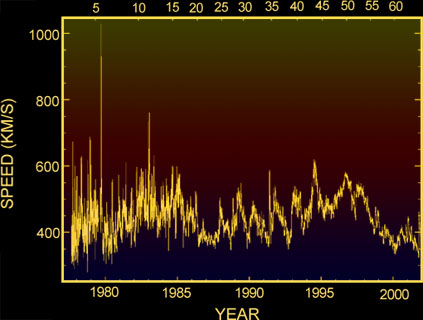
I disagree with you interpretation of all the links. The theoretical models of the Solar Wind suggest that it accelerates at least an order of magnitude beyond "a few solar radii", and it I am not mistaken, the graph at 1AU is still rising, which I believe is an acceleration, albeit small.
And as I said in my posts, the Voyager data looks inconclusive to me (but of course I an an amateur). http://spacephysics.ucr.edu/images/richardsonSSV.jpg This chart seems to show increases in speed from 1-20, and 25-50AU, and decreases from 20-25, and 50-70AU.
Of course this does not imply that the Solar Wind accelerates over these distances, and indeed, the UCR page speculates that acceleration occurs within 10-20 solar radii.
But at least we all have more information to ponder, and if that deserves criticism, then so be it. -
Accelerating solar windTheoretical models of the Solar Wind suggest that its speed steadily increases until at least 20 or 30 solar radii, and perhaps somewhat past Mercury, and is perhaps even increasing past the orbit of Earth. See "Explaining the acceleration of the fast solar wind" at http://www.obspm.fr/actual/nouvelle/jun05/solarw.en.shtml, and in particular Figure 2 (Zouganelis et al, The Astrophysical Journal Letters, 2005).
This seems at odds with the Voyager mission, where "Researchers had long predicted that the solar wind speed would decrease with distance from the Sun" and verified by Voyager 2, see http://spacephysics.ucr.edu/index.php?content=v25/v8.html.
It is also noted that "Since 1977, Voyager has been monitoring the solar wind velocity and density", and the "Image - 39k" seems less conclusive, see http://spacephysics.ucr.edu/index.php?content=solar_wind/sw/swq1.html -
Accelerating solar windTheoretical models of the Solar Wind suggest that its speed steadily increases until at least 20 or 30 solar radii, and perhaps somewhat past Mercury, and is perhaps even increasing past the orbit of Earth. See "Explaining the acceleration of the fast solar wind" at http://www.obspm.fr/actual/nouvelle/jun05/solarw.en.shtml, and in particular Figure 2 (Zouganelis et al, The Astrophysical Journal Letters, 2005).
This seems at odds with the Voyager mission, where "Researchers had long predicted that the solar wind speed would decrease with distance from the Sun" and verified by Voyager 2, see http://spacephysics.ucr.edu/index.php?content=v25/v8.html.
It is also noted that "Since 1977, Voyager has been monitoring the solar wind velocity and density", and the "Image - 39k" seems less conclusive, see http://spacephysics.ucr.edu/index.php?content=solar_wind/sw/swq1.html -
Re:It's not an assumptionWish I had the mod points, but I don't... but you're dead right, it's not a pure assumption. There have been plenty of observations made to try and pin down the propagation speed of gravity. Shamelessly cribbed from an article I found on the topic:
While current observations do not yet provide a direct model-independent measurement of the speed of gravity, a test within the framework of general relativity can be made by observing the binary pulsar PSR 1913+16. The orbit of this binary system is gradually decaying, and this behavior is attributed to the loss of energy due to escaping gravitational radiation. But in any field theory, radiation is intimately related to the finite velocity of field propagation, and the orbital changes due to gravitational radiation can equivalently be viewed as damping caused by the finite propagation speed. (In the discussion above, this damping represents a failure of the "retardation" and "noncentral, velocity-dependent" effects to completely cancel.)
The rate of this damping can be computed, and one finds that it depends sensitively on the speed of gravity. The fact that gravitational damping is measured at all is a strong indication that the propagation speed of gravity is not infinite. If the calculational framework of general relativity is accepted, the damping can be used to calculate the speed, and the actual measurement confirms that the speed of gravity is equal to the speed of light to within 1%. (Measurements of at least one other binary pulsar system, PSR B1534+12, confirm this result, although so far with less precision.)
NewScientist also ran an article in 2003 about a then-new experiment to measure the speed of gravity. There's even a Wikipedia article on the topic. -
Re:As a matter of interest...
If gravity WERE as slow as the speed of light, the sun would have long ago lost its planets and itself would have left the galaxy.
This is not a true statement; if it were, General Relativity would have been rejected as wrong a long time ago. That gravity waves propagate at the speed of light is fundamental to GR. There's a more technical discussion here which points out that, under most circumstances, the Newtonian and GR predictions of gravitational behavior are very close, and propagation delays are "almost" canceled out by other effects that have to be taken into account by GR. (The article also points out that, if you adjust Newton's equations to account for a propagation delay, the orbits of planets become unstable. Newton's equations just don't work that way, so you really have to change your thinking to conceptualize in GR terms.)The equations for gravity don't have time values. That should tell us something.
Those are Newton's equations you're talking about, which describe the gravitational force. For those equations, there is no time dependency. However, Newton's equations also don't provide predictions for things like frame dragging and clocks running slower in higher gravitational fields; GR does provide predictions and explanations for these phenomena, all of which have been experimentally verified. Guess what? The relativistic equations for gravity do involve the time domain -- there's a reason why relativity introduced us to the concept of "space-time" as a single entity, after all. -
Re:Question about gravity
-
Re:Question about gravity
apparently general relativity explains this by bending space-time.
So a black hole is a space-time bender... -
Re:Question about gravity
Other people have answered your question (radiation cannot escape from inside the horizon, but it can still generate a static external field), but here is a FAQ with more detail, including the quantum picture.
-
Re:4 points, in which any two vertices are connect
Diamond isn't stable, like glass, it just takes billions of years to lose it's shape, or something like that.
Or something.
What makes you think that glass isn't stable? (link, link)
I have an archeologist friend who works with Roman glass found along the Silk Road. Looks perfectly stable to me (well, at least those pieces that aren't smashed to bits). -
Re:Spoiled It
There is no system cooler than absolute zero. But there IS negative temperature, which is actually hotter than the same system having a positive temperature.
-
Re:Spoiled It
The whole point of "absolute zero" is that there _are_ no negative temperatures.
So there is negative temperature. It is just not what you think it is.
-
Bulletin from University of California, Riverside
See also this link. There's a picture. http://www.newsroom.ucr.edu/cgi-bin/display.cgi?id=1730
-
E8 is not the answer, M is the answer!
E8 is not the answer, M is the answer!
AFAIK, E8 is the largest exceptional Lie group, but why limit reality to Lie groups?
(http://en.wikipedia.org/wiki/Classification_of_finite_simple_groups)
I think our reality deserves to be described by the largest sporadic group, the Monster:
http://www.daviddarling.info/encyclopedia/M/Monstrous_Moonshine_conjecture.html
http://en.wikipedia.org/wiki/Monster_group
http://math.ucr.edu/home/baez/week66.html -
Re:pln2bz, you are a renowned fraud
Comparative mythology is a science with rigorous methodology, and physics is not? Direct observation, with mathematical modeling, is bunk but translated/copied/forged human religous writings and artifacts, amounting to hearsay and outright lies, are not?
You seem to be quite intent to portray me as anti-science. Is it not possible that I believe in the scientific method, but just disagree with mainstream science? You appear to confuse the two
Comparative mythology is structured similar to the way in which we evaluate court testimony. You analyze the testimony of multiple cultures for similarities on specific themes. People like yourself add significant confusion to the matter because you've never given it a chance. Like others, you incorrectly believe that the Garden of Eden is a *religious* concept even though both the historical and fossil records indicate quite clearly that the phenomenon was physical and occurred for the entire world. You are aware that alligator fossils and coral reef fossils have been found at all latitudes, right?On this forum, you act like a contrarian blowhard with an unsatisfied ego.
You're the same guy we put up with around here espousing the disproven virtues of the Electric Universe cosmology and decrying fusion and the Standard Model.
Same on several bunk-science forums, according to a few seconds with google. I encourage moderators and interested readers to review your post history on Slashdot, and view samples your other writings on the web.Perhaps we'd save some time if people actually just read the materials themselves, eh? After all, that appears to be the real problem -- the outright dismissal of data that is enigmatic to numerous disciplines.
You have an "us-versus-them" mentality that seems to pit you against Carl Sagan an awful lot, as well as other mainstream (and typically famous) scientists. It's as though you're at least as happy to sling mud at someone like Sagan as you are to imagine yourself part of a darkhorse theory of physics as it spreads its wings, blowing away the infantile ignorance and superstitions of old.
Your posts on Slashdot (and elsewhere) score you highly on the crackpot index:
http://math.ucr.edu/home/baez/crackpot.htmlI'm sorry you think that I'm a crackpot. I'm really quite a normal person who was not dissuaded from reading materials that I subsequently found compelling. Why does everybody who disagrees with mainstream astrophysics have to be so loony? I mean, you act as if astrophysics is some sort of laboratory science, and that so long as the mathematical equation exist to make the theory work, then the mathematical equations must be true. Few degreed astrophysicists ever even attempted to develop the ability to compare and contrast cosmological models; most are satisfied to accept the theories they were taught in school as fact. You're so hostile to alternative physical models for the universe that you never allowed your brain to even witness them in any depth. You and others here put far more effort into learning the math than you do the philosophy and history of science. I've taken plenty of math in my life, but it is not a substitute for a rounded education. You appear to be completely unaware that many of the strongest adherents to the Electric Universe Theory are the laboratory plasma physicists. Even the guy who invented magnetohydrodynamics pleaded with the scientific community during his Nobel Physics acceptance speech to drop the frozen-in-place magnetic field concept. I mean, every week that goes by, more and more peer-reviewed papers are being published that indicate filaments surrounded by helical magnetic fields (do a Harvard Abstracts paper search on "elephant trunk"). Sure, there are ways to create such things without the filaments being electrical currents, but it is complete nonsense
-
pln2bz, you are a renowned fraud
I started writing a post illustrating how your analysis is conclusively incorrect, but you're really "not even wrong". Ever. I think this post instead will be more illuminating to the Slashdot readership:
Here's another gem in an illustrious succession from you:
"So long as astrophysicists refuse to follow the changes occurring within the field of comparative mythology -- which is an actual discipline with real scientific methodology -- they cannot claim that their theories were arrived at by rigorous methodology."
Comparative mythology is a science with rigorous methodology, and physics is not? Direct observation, with mathematical modeling, is bunk but translated/copied/forged human religous writings and artifacts, amounting to hearsay and outright lies, are not?
On this forum, you act like a contrarian blowhard with an unsatisfied ego.
You're the same guy we put up with around here espousing the disproven virtues of the Electric Universe cosmology and decrying fusion and the Standard Model.
Same on several bunk-science forums, according to a few seconds with google. I encourage moderators and interested readers to review your post history on Slashdot, and view samples your other writings on the web.
You have an "us-versus-them" mentality that seems to pit you against Carl Sagan an awful lot, as well as other mainstream (and typically famous) scientists. It's as though you're at least as happy to sling mud at someone like Sagan as you are to imagine yourself part of a darkhorse theory of physics as it spreads its wings, blowing away the infantile ignorance and superstitions of old.
Your posts on Slashdot (and elsewhere) score you highly on the crackpot index:
http://math.ucr.edu/home/baez/crackpot.html
Clearly you are not a scientist, but a dilettante. You support Velikovskian catastrophism as the origin of Venus, despite evidence both profound and prodigious against. Have you ever calculated an orbit? An orbital? Would you even know how to begin? Do you know what the latter is? Do you know what binding energy is? Do you know what a differential equation is, even? Clearly, no. If the answer were yes, you could see why these things were rejected by accredited scientists as soon as they became testable.
You always seem to find an audience on Slashdot just large enough to make "+5 Insightful". Your delusion is sickening, but the moderation is saddening. You need to learn critical thinking; it's the only thing that has gotten humans from fearful lives on the savanna to somewhat less fearful lives on the internet. As it stands, your abominable, deplorable disinformation is detrimental to human thought and understanding, and thus to human society at large.
On behalf of myself, other Slashdot readers, and the rest of humanity who must endure the machinations of any aspiring tech-folk you might poison or deter from productivity or enlightenment: stop clogging the internets with garbage and start that critical thinking bit. -
Re:Hey, it makes a prediction, that's REAL science
Hmmm.... The Scientific Method may be more accurately summarized as follows:
1. Observe
2. Develop Hypothesis
3. Make predictions based on hypothesis
4. Test predictions by experimentation
Remember: a Hypothesis is not the same as Theory -
Re:Hey, it makes a prediction, that's REAL science
Hmmm.... The Scientific Method may be more accurately summarized as follows:
1. Observe
2. Develop Hypothesis
3. Make predictions based on hypothesis
4. Test predictions by experimentation
Remember: a Hypothesis is not the same as Theory -
Re:He'd be safer with HDMIOf course you can send a "digital" on-off signal to a speaker. The low pass filtering is in the mechanical inertia. Don't you remember the audio demos in the 80s on the PC's internal speaker? The speaker was driven by a logic gate. Now you have class-D amplifiers. Granted they use an external LC filter but you can dispense with it if you're cheap and it'll still sound like sound...
-
Re:Magnetic Reconnection?
"Science is not a democracy, by the way."
Agreed.
"Instead, we should attempt to understand the arguments that are being made and discuss the logic behind both sides in the argument."
Science is not a democracy; all ideas and proposals need not and should not be given equal weight, and it is proper for ideas that are outlandish on their face to be casually dismissed without bothering to engage in such a dialog; the nature of the claims make it apparent that a truly rational discourse with its adherent is not forthcoming.
Extraordinary claims require extraordinary proof: don't expect to be considered until you've gathered such proof.
"There have been plenty of intelligent people who believed that space plasmas are electrical."
And they did their work in the Nineteenth Century. Not that "plenty" matters any because, as you correctly pointed out, science is not a democracy.
"There is a person on wikipedia called ScienceApologist, who has been censoring EU Theory from wikipedia on the basis that there are no published papers which support EU Theory."
I'm being repressed! Come see the violence inherent in the system! 40 points on Ye Olde Crackpot Index.
"EU theorists did in fact get published in September in an IEEE publication. "
Science is not a democracy: electrical engineers and cosmologists are not equals. Electrical engineers are not qualified to comment on the nature of the observable universe any more than a cosmologist is qualified to design a microprocessor.
"Not being popular is not an excuse to avoid reading about something,"
Science is not a democracy: it's not being ignored because it's unpopular, it's being ignored because it's unlikely.
"especially when there are such over-zealous censors who believe it is their duty to prevent the public from understanding the debate about electricity in space."
Science is not a democracy: in the interest of promoting human understanding, it is his duty to fight mis- and disinformation, to "prevent the public from misunderstanding the lack of a debate about electricity in space," as it were.
"Evaluating theories purely on the basis of who looks or sounds the smartest is a downward spiral."
But evaluating theories based on an educated guess as to their likelihood, and noting when proposals cherry-pick favorable observations and conveniently ignore damning evidence to the contrary, is a necessary culling. Again, science is not a democracy, and extraordinary proof is required.
As I mentioned earlier, many imaginative thinkers from the Nineteenth Century would have agreed with what you espouse, due to the lack of collected evidence, of observations. But here in the Twenty-First, not only have we gathered a mountain of evidence to the contrary, but we now apply the science learned from that contrary evidence on a daily basis; computers that rely on the quantum mechanical properties of semiconductors, powered by nuclear fission, have been propelled by general relativity to places scarcely imagined a century ago, and you're spending your time trying to sift through data collected by these space probes, trying to find something that can be twisted and misconstrued to support your pet theory, all while ignoring (indeed, hoping to dismiss) the science behind how those probes were built, how they got there, and how they gathered that data. -
Re:Entanglement and causality?Do me a favor and review the Michelson - Morley experiment and what it really proved or disproved. And remind me when they performed the experiment in the absence of a gravitational field. It disproved the idea of a luminiferous aether. Or to be more accurate: none of the many thousands of experiments performed since M-M, with increasingly accurate apperatus, either based on the same principle as M-M or on different principles (such as TroutonNoble) have produced results consistent with the presence of a luminiferous aether.
Now, Maxwell's equations are not Galilean invariant.
Previously, it was therefore assumed that this was because they only worked in one frame: the rest frame of the luminiferous aether. But there is no luminiferous aether.
So either Maxwell's equations are wrong, or they work in all inertial frames. If the latter, then the speed of light is the same in all inertial frames. Einstein postulated this, and derived a new set of non-Galilean transformations from this assumption.
The correctness of Einsteins postulate, and its consequences, have since been checked experimentally many, many times (some examples).
Now, I presume that by "remind me when they performed the experiment in the absence of a gravitational field", you're referring to the "aether drag" hypothesis that the aether is dragged along with mass. I would note that, if it's dragged by mass, then there's no such thing as 'the rest frame of the luminiferous aether' for Maxwell's equations to hold in, which means either Maxwell was wrong or, again, the equations hold in all inertial frames. The latter means special relativity, and I doubt you're suggesting the former. So the inertial drag hypothesis doesn't exactly solve anything. But that's irrelevent, anyway, since it's been experimentally disproven. Hamer tried the experiment with the huge lead blocks which you're aware of. So did a few other people. No drag detected. In a fit of desperation, someone tried to explain that by suggesting that it only worked for very large masses or those masses with large magnetic fields. No dice: J O Lodge noted that no other planets had that effect. Finally, someone realised that if aether drag were true, there wouldn't be any stellar aberration; and the hypothesis died a well-deserving death.
Regarding relativity and self-contradictory: you're right, I apologise; on re-reading you were referring to quantum mechanics -- but since the entire rest of your post was criticisms of relativity, I think you'll forgive my confusion.
Regarding your parenthetical last comment, "appear to be" is a bit ambiguous: If A and B are, provably, mutually exclusive; then yes, proving A does indeed necessarily disprove B.
I'm not sure what you're trying to prove with your comment on ring laser gyroscopes. If you're suggesting that they're somehow incompatible with special relativity, I'm afraid you're going to have to explain further.
Not necessarily now, though; it's 2:53 in the morning and I'm going to bed. Good night!
-
Re:Just looked it up...
Citing Stephen Hawking's quotation as proof for something is an argument from authority. You're right in thinking I didn't read the quote, because I didn't, and I'm not going to. I don't really care what Stephen Hawking said about anything.
The fact of the matter is that in science, we have facts, laws, hypotheses, and theories. Facts are observations. Laws are collections of these observations. Hypotheses are guesses at explaining why these laws are so, and they must be testable to be taken seriously. A theory is a rigorously tested hypothesis -- a graduated hypothesis. It is an explanation for an observed phenomenon.
Just because you can't understand basic scientific definitions doesn't mean you're not being an idiot. You certainly are being one. It doesn't even make sense to me, either; you obviously have no idea how the scientific process works, but you're still trying to debate it with me. Really, it shouldn't be left up to debate (I'm certainly no scientist myself), but to evidence -- evidence which I have provided in the form of a link to Wikipedia, which, for reasons unknown, you have a problem with. It happened to be the first source I found (probably because it is the first place I check for these kinds of things) on the matter. If you really wish to find more information, there's an abundance of books floating around about the scientific method and its elementary principles.
It's pretty hilarious that you argue with the source I provide to illustrate my point. I don't think I can even get anywhere like this. I don't even think I could convince you of how wrong you are if I had Stephen Hawking himself tell you so. You are bent on challenging anything that doesn't fit your mindset, which is quite strange to me.
Here are some more links for you, courtesy of google:
http://wilstar.com/theories.htm
http://physics.ucr.edu/~wudka/Physics7/Notes_www/n ode7.html#SECTION02122000000000000000
http://en.wikipedia.org/wiki/Physical_law -
Re:Methods...Yes but if you are able to travel close to the speed of light relative to where you left (a big if) the distance you are traveling contracts radically and the time to make the trip decreases as well. The people who saw you leave will long be dead by the time you get back to see them though.
Look here for details.
-
Re:Expanding Universe?
If galaxies are close enough, they can collide. Generally, a gravitationally bound system will resist the Hubble expansion (which is why our solar system and galaxy are not expanding at the rate the universe does). Only when the bodies are spread far apart and not gravitationally bound to each other does the universe's expansion dominate. See this FAQ and this and this for details.
-
Re:Lack of Caring
Everybody who buys a "class notes" book from the bookstore should write down the publisher of every work copied in the books, and confirm that the school indeed obtained permission from the publisher to make the copies, as well as noting how many people are in the class to see how many copies were made.
At least at my university, the need to obtain permission and license the copyrighted works appropriately is one of the reasons why course readers can be so unbelievably expensive. [I've seen 200 page readers which cost $40.00, purely because of the copyrighted content contained within them. (They're found sitting next to some of the $8.00 readers of equivalent length which contains stuff written by the instructors of the course.)]