Slashdot Mirror
Domain: ucr.edu
Stories and comments across the archive that link to ucr.edu.
Comments · 689
-
Re: java is a dead language
I program in Java professionally, and I have to say you really did a good job explaining what's good about Java in your post. The multi-threading thing in particular is a huge deal, as I haven't found another language that truly excels at multi-threaded development like Java does, at least with the same quality of life as Java provides (languages like Python and Ruby provide better development quality of life in my opinion, but without the excellent multi-threading support...or a type system, and many other things that would take a while to get into).
I also feel like recent improvements to the Java language (basically Java 7 & 8) may give it a new lease on life, though I think the long term picture for Java is pretty grim, because it's held back by historical baggage and Oracle. In particular, even if Java doesn't lose ground to newer non-JVM languages like Python, then Java will lose ground over time to Kotlin and other JVM-based languages like Scala or Groovy. These newer JVM languages simply don't have the historical baggage of Java (and if you love Java but haven't tried out Kotlin you really should).
Also, another problem for all of these JVM-based languages is that Oracle's recent licensing of the JVM is troubling. That said, it can survive this thanks to OpenJDK and other open source JVM initiatives, but we may be in for some rocky times in Java-land.
I’ve found Java quite effective for writing short programs of less than 100 lines to explore mathematical ideas, like how many polygons can meet at a snugly at a point(see http://math.ucr.edu/home/baez/...). So Java does not need massive projects to be really useful.
I recently discovered and learned Julia, and I think it's the ideal language for these kinds of math exploration problems. It combines the raw firepower of languages like C and a developer quality of life that exceeds even the best languages I've seen previously. It's very popular with the High Performance Computing crowd. It has high level features that no other popular language has, such as multiple dispatch, though it manages to be a very practical language at the same time. It also has some surprisingly nice libraries in certain areas, like their graph theory library. I think it has a very bright future ahead of it. If you haven't tried it, you really should (or if you tried it a few years ago, you should give it another spin now that it's at version 1.0).
That said, even Julia isn't perfect (yet?). Right now the biggest problem is that while it has excellent HPC support, it's still lagging behind on its multi-threading support. Basically, it currently assumes that you are fine with running your additional threads inside other processes (possibly on other machines), and Julia makes this very easy for the developer to accomplish, though it's not quite the same as having cheap in-process threads like in Java. Another issue, specific to enterprise development, is that the ecosystem is still evolving VERY rapidly, even though the language has finally settled into version 1.0, so libraries shift under your feet all the time (though fortunately, they have a top notch package management system to handle library versioning). Oh, also start up times can be pretty bad due to how compilation works (basically, you can pre-compile code, but it's easy to end up having to compile at least some of the program on startup rather than ahead of time), but there are solutions to this most of the time and it buys a lot of positives (though it can be especially annoying when a library didn't optimize their startup times).
I'm also somewhat concerned about the use of garbage collection in Julia. Some recent results make me think that automatic reference counting may be the future in this area. While this concern applies to Java as well (there's a reason Java programs are so memory hungry!), it's compounded in Julia because it complicates the bridging of C and Julia, which would otherwise be seam
-
Re: java is a dead language
Java is as fast as C for the most part
Extraordinary claims demand extraordinary evidence.
If you want a program to execute under a second, then write it in C, or another compiled language.
However, if the program is likely to be running a minute or more, than a well written Java program will most likely out perform a well written C program. Because in Java, the code parts that are executed intensely, will be compiled into native machine code optimized for that run time profile by the Just-in-Time Java compiler that is part of the JVM. The JIT can even in-line code that is at the end of a long pointer chain.
Big enterprise applications running on on big multi-core count computers with a terabyte of RAM can make effective use of Java for long running programs. As the JVM makes good use of the multicores and gobs of RAM.
I once ran a silly benchmark, and found that the JVM/JIT had created 2 threads to run code in the same method, because it had found that my 2 large for loops could be run in parallel.
I have programmed in over 25 languages, including COBOL, C (I actually was paid to teach C to experienced programmers one year), ARM3 assembler, and Python. Found Python had some good points, indenting eliminated brackets and no need for lots of semicolons, but I found it too gimmicky and didn’t handle multi-threading very well compared to Java.
I’ve found Java quite effective for writing short programs of less than 100 lines to explore mathematical ideas, like how many polygons can meet at a snugly at a point(see http://math.ucr.edu/home/baez/...). So Java does not need massive projects to be really useful.
Cross platform support is also good. I wrote a Java Application to find duplicated files on my Linux box, and a friend had no problems running it on his Microsoft box.
I find Java is my favourite language, though I also have things I don’t like about it. No language is perfect, and there are many considerations to be taken into account for selecting a language for development.
-
Crackpot index
Give this press release a crackpot score. E.g.: 5 points for each mention of "Einstien", "Hawkins" or "Feynmann". So 20 points right there.
-
reminds me of O. Heaviside & Maxwell's equati
I'm reminded of Oliver Heaviside, who refactored Maxwell's equations into the useful and familiar vector notation that has adorned many tshirts of electrical engineering and physics students. Heaviside took an unwieldy set of twenty field equations, and reduced them to four. I do wonder what insights we can potentially learn if the model itself is refactored into an elegant form.
Her PhD thesis: https://arxiv.org/pdf/1611.091...
The mathematician John Baez has an engaging writing style, and gave an amusing account of octonian numbers (His blog is very interesting BTW): http://math.ucr.edu/home/baez/
"There are exactly four normed division algebras: the real numbers (R), complex numbers (C), quaternions (H), and octonions (O). The real numbers are the dependable breadwinner of the family, the complete ordered field we all rely on. The complex numbers are a slightly flashier but still respectable younger brother: not ordered, but algebraically complete. The quaternions, being noncommutative, are the eccentric cousin who is shunned at important family gatherings. But the octonions are the crazy old uncle nobody lets out of the attic: they are nonassociative."
-
reminds me of O. Heaviside & Maxwell's equati
I'm reminded of Oliver Heaviside, who refactored Maxwell's equations into the useful and familiar vector notation that has adorned many tshirts of electrical engineering and physics students. Heaviside took an unwieldy set of twenty field equations, and reduced them to four. I do wonder what insights we can potentially learn if the model itself is refactored into an elegant form.
Her PhD thesis: https://arxiv.org/pdf/1611.091...
The mathematician John Baez has an engaging writing style, and gave an amusing account of octonian numbers (His blog is very interesting BTW): http://math.ucr.edu/home/baez/
"There are exactly four normed division algebras: the real numbers (R), complex numbers (C), quaternions (H), and octonions (O). The real numbers are the dependable breadwinner of the family, the complete ordered field we all rely on. The complex numbers are a slightly flashier but still respectable younger brother: not ordered, but algebraically complete. The quaternions, being noncommutative, are the eccentric cousin who is shunned at important family gatherings. But the octonions are the crazy old uncle nobody lets out of the attic: they are nonassociative."
-
Re:Some comments about the origin of Relativity
Dear Zorpheus,
The overlooked history of the development of Lorentzian Relativity and the subsequent development of Einsteinian Relativity is indeed very interesting. I have the strong feeling that someday it will be taught in all universities, not just as a lesson about the history of science but primarily as a lesson about human nature.
Historian of science Herbert Dingle stated that although from 1904 until 1919 relativity theory was generally ascribed to Lorentz, "with the apparent success in 1919 of Einstein’s general theory, with its then quite new and terrifying mathematical machinery of tensor calculus, came the fatal climax. Almost overnight ‘the relativity theory of Lorentz’ became ‘Einstein’s special relativity theory’, and it was immediately hailed as such by the mathematical experts. The established physicists
This historical turn of events could not happen without the "apparent success of the general theory", based on the famous 1919 eclipse expedition. Yet science historians John Earman and Clark Glymour have shown that the evidence presented was unquestionably inadequate. It was principally the triple-pronged public relations of the Astronomer Royal, the President of the Royal Society and Arthur Eddington that lent General Relativity its 1919 victory. See "Fabulous Science Fact and Fiction in the History of Scientific Discovery" by John Waller.
Anyway, please note that special relativity can indeed handle accelerating objects or accelerating frames of reference. This is explained in the following link at the website of John Baez (famous for being the author of the "crackpot index"):
http://math.ucr.edu/home/baez/...
In any case, on the relativistic notion that "it is impossible to detect motion by measuring differences in the speed of light", as tentatively concluded by the Michelson-Morley experiment, the Sagnac experiment shows that this can in fact be done. The Sagnac Effect demonstrates that depending on the placement of the observer, it is possible to see this variable speed of light and to confound apparent "time dilation".
Best regards,
Juan
-
Re:Electric universe bullshit.
It's ironic that the MeerKAT telescope was designed to study black holes along with other things... as the electic universe bullshit says black holes don't exist.
Einstein was right, and the electric universe bullshit is a con job. Thomas Roberts, Fermilab (you know, a real scientist):
http://math.ucr.edu/home/baez/...
Note, however, that SR is not perfect (in agreement with every experiment), and there are some experiments that are in disagreement with its predictions. See Experiments that Apparently are not Consistent with SR where some of these experiments are referenced and discussed. It is clear that most, if not all, of these experiments have difficulties that are unrelated to SR. Note also that few if any standard references or textbooks even mention the possibility that some experiments might be inconsistent with SR, and there are also aspects of publication bias in the literature. That being said, as of this writing there are no reproducible and generally accepted experiments that are inconsistent with SR, within its domain of applicability.
einstein was right? you mean, where he said black holes don't exist, and they were a mathematical peculiarity at most, a ghost in the equations.
-
Electric universe bullshit.It's ironic that the MeerKAT telescope was designed to study black holes along with other things... as the electic universe bullshit says black holes don't exist.
Einstein was right, and the electric universe bullshit is a con job. Thomas Roberts, Fermilab (you know, a real scientist):
http://math.ucr.edu/home/baez/...Note, however, that SR is not perfect (in agreement with every experiment), and there are some experiments that are in disagreement with its predictions. See Experiments that Apparently are not Consistent with SR where some of these experiments are referenced and discussed. It is clear that most, if not all, of these experiments have difficulties that are unrelated to SR. Note also that few if any standard references or textbooks even mention the possibility that some experiments might be inconsistent with SR, and there are also aspects of publication bias in the literature. That being said, as of this writing there are no reproducible and generally accepted experiments that are inconsistent with SR, within its domain of applicability.
-
Re:An epic failure in science journalism
Save your reader some time and just rate yourself on the Crackpot Index. Admittedly, you're at least creative, using " on a quest of proving textbook theory right" instead of "hidebound reactionary" or "self-appointed defender of the orthodoxy".
-
Mirrors
we're lucky this got announced early, so there have been efforts to save this data:
-
Re:Why LIGO is a scam
If true, this was the most interesting part of your article, Louis. Got an external link to back it up?
Here's a link to an article explaining of why it's false: http://math.ucr.edu/home/baez/physics/Relativity/GR/grav_speed.html
-
Re:Let's all start running now!
You mean that humans created the situation? Perhaps - although one needs to blame the entire human race for that: we live in a system, and that system has behavior. But the question of whether humans created the situation is not so clear. I know that the mainstream news paints that picture, but the facts are less certain. E.g., the CO2 that humans produce is about 1% of what nature produces annually. And yes, global temperature has been rising if you look only at the holocene; but if you go back farther, we are very square on a trend, and global temperature has been much higher than it is today: http://math.ucr.edu/home/baez/.... And yes, CO2 has been rising, but that is cyclic as well; do you know that during the time of the dinosaurs CO2 was TEN TIMES what it is today? - and yet Earth was verdant: https://en.wikipedia.org/wiki/.... So humans _might_ be causing global warming, but it is not so clear, and it is also not clear that the ecosystem cannot adjust.
-
Re:Ninth, mofo.
They most definitely are. There are 3 different species commonly referred to as "daddy longlegs" in North America: Opiliones (harvestmen), not a true spider; Diptera (crane fly), sometimes also called "mosquito eaters" or "mosquito hawks"; and Pholcidae (cellar spiders), an actual spider.
Wikipedia makes reference to all three species as "daddy longlegs". If you're going to quibble about "daddy longlegs" vs "daddy longlegs spider", here's an article referencing Pholcidae as "daddy longlegs spider": http://spiders.ucr.edu/daddylo... -
SRT Interpretation Comes Into Mainstream Question
The prevailing interpretation (not the validity) of Einstein's special theory of relativity definitions relating frame time (t) to proper time (tau):
d(tau) = dt - dr/c = invariant
dr = dx + dy + dzwill be challenged by a source that is regarded as "mainstream" by the STEM community. The new interpretation will not challenge the validity of these definitions, nor will the new interpretation be accepted as "mainstream physics" during 2016. However, due to the prominence of the challenger and the challenged, there will be a mild form of mass hysteria in the scientific community as well as media. The challenger will claim the hysteria is due to the disruptive implications to mainstream physics while the challenged will claim the hysteria is due to the appearance of a rare species of "crackpot" -- one with mainstream credibility. This controversy may well result in mainstream funding (NSF, etc.) to "debunk" the "cranks" during 2016 although, in mainstream discourse, spin may be placed on less aggressive terms to similar effect, due to the prominence of the challenger. The blogosphere will most decidedly not shy away from such invective.
-
Re:A lot simpler: Energy
Yes, being able to run at 1g for up to a month would really open up the solar system with a month of 1g easily taking a ship to Neptune. Even a steady 0.1g would be wonderful and is likely actually possible.
Btw, according to http://math.ucr.edu/home/baez/... one ship year (1.19 Earth yr) at 1g will put the ship at about 0.56 lyrs and a velocity of 0.78 c with a trip to Centauri (including stopping at the end) taking 3.6 ship years. -
Re:A lot simpler: Energy
That looks suspiciously like a Newtonian formula and it's going to break down long before a year passes and the ship is doing 0.8c.
Here is a page with closer to the correct math, http://math.ucr.edu/home/baez/... which shows after 1 year ship time (1.19 yr Earth time) the ship will have traveled 0.56 lyrs and a trip to Centauri, (including slowing down) takes about 3.6 ship years.
Some tables from the above URL, sorry about the formattingT t d v
1 year 1.19 yrs 0.56 lyrs 0.77c 1.58
2 3.75 2.90 0.97 3.99
5 83.7 82.7 0.99993 86.2
8 1,840 1,839 0.9999998 1,895
12 113,243 113,242 0.99999999996 116,6414.3 ly nearest star 3.6 years
27 ly Vega 6.6 years
30,000 ly Center of our galaxy 20 years
2,000,000 ly Andromeda galaxy 28 years
n ly anywhere, but see next paragraph 1.94 arccosh (n/1.94 + 1) years -
Re:Betteridge's law of headlines says ... no
Agreed, but this is the bitter price of incremental improvement: backward compatibility.
Maybe it's time to open a new "expanded emoji" section with inflection dimensions and leave the old ones where they are for backward compatibility.
But, how many varieties of avocado will we need? http://ucavo.ucr.edu/avocadova...
-
Re:Of course it never gets past the event horizon.
A particle falling into a black hole never perceives itself as having moved past an event horizon, as an apparent event horizon recedes before it. The horizon keeps receding in the direction of the "singularity" until it's torn apart on the way in.
This isn't true. Particles do in fact pass the event horizon in finite time (as judged in their own time frame). In fact, for very large black holes (tens of thousands of solar masses), it would easily be possible to pass the event horizon without experiencing tidal forces strong enough to rip you apart... in finite time.
An external observer never perceives a particle falling past the so-called "true" horizon; it perceives the falling object's time as slowing down to a virtual stop at the event horizon.
While this is sort of true, the idea of an external observing viewing an astronaut "frozen in time" just above the event horizon is just not true in any practical sense.
What you'd actually observe if you watched someone fall into a black hole is the light from that person exponentially getting dimmer and fading out basically completely in finite time (i.e., probably within a fraction of a second for reasonable sized black holes). Yes, theoretically you can get a photon emitted and taking years or centuries to reach an external observer, but the amount of emitted light decays exponentially fairly quickly -- so as an external observer you'd actually see someone basically "disappear" at the event horizon in finite time (and fairly quickly actually). (For some details and a sample calculation with explanation, see here.)
Both of these views are logically consistent under a simple constraint: nothing ever passes an event horizon, and there's no such thing as a "true" horizon, only apparent horizons. The outside observer's view of "truth" should be given no more precedence as being reality than the infalling observer's perception.
Well, since both of your "views" are sort of wrong (or, well, at least misleading), I'm not sure the rest of your explanation should be taken as true.
Also, the problem is notions of simultaneity and where time and space is in black holes is quite complex when you try to compare observers in general relativity -- basically, you really can't come up with objective metrics that will satisfy notions of simultaneity for observers except in a local sense. So talking about whether a black hole "has formed" or where the event horizon "is" at a particular moment of time becomes quite complicated when you start to involve "external" observers. (For some details, see here for a bit of an explanation.)
Anyhow, there's lots of debate going on with Hawking about what exactly goes on with black holes (and information), but my point is that trying to apply simple intuition to general relativistic effects around black holes is pretty much destined to fail, or at least lead to a lot of misunderstandings.
-
Re: TL;DR
No, from an outside perspective it's never inside the event horizon. Only from the perspective of the matter entering the black hole does it cross. Saying "by then it's well within the event horizon" is simply not accurate from an outside perspective. No data collected from Earth will ever correspond to a reality in which the object has passed the event horizon.
The more I think about your post here, the more wrong it sounds to me. The only way to conclude that an object has passed the event horizon would be to observe the absence of radiation from that object. And that definitely occurs in finite time, since photons are discrete. See here, which offers the following explanation:
Now, this led early on to an image of a black hole as a strange sort of suspended-animation object, a "frozen star" with immobilized falling debris and gedankenexperiment astronauts hanging above it in eternally slowing precipitation. This is, however, not what you'd see. The reason is that as things get closer to the event horizon, they also get dimmer. Light from them is redshifted and dimmed, and if one considers that light is actually made up of discrete photons, the time of escape of the last photon is actually finite, and not very large. So things would wink out as they got close, including the dying star, and the name "black hole" is justified.
As an example, take the eight-solar-mass black hole I mentioned before. If you start timing from the moment the you see the object half a Schwarzschild radius away from the event horizon, the light will dim exponentially from that point on with a characteristic time of about 0.2 milliseconds, and the time of the last photon is about a hundredth of a second later. The times scale proportionally to the mass of the black hole. If I jump into a black hole, I don't remain visible for long.
-
Re:TL;DR
Another one that I see a lot of people having trouble with: that of there being a universal speed limit. I'm surprised at how many people think this means there's a speed limit from all perspectives.
If we launch some incredible 100fold-staged antimatter spacecraft capable of reaching 0.999c toward Alpha Centauri 4,3 light years away, from the perspective of people on Earth, it'll never reach or exceed c and will take a touch over 4,3 years to get there. But from the perspective of people onboard the spacecraft, they're reaching their destination in only 70 days. From our perspective, their time slows down 22,4-fold; from theirs, Earth time has speed up. We see their velocity as capped off at c; to them, it's as if they can just keep accelerating without limit.
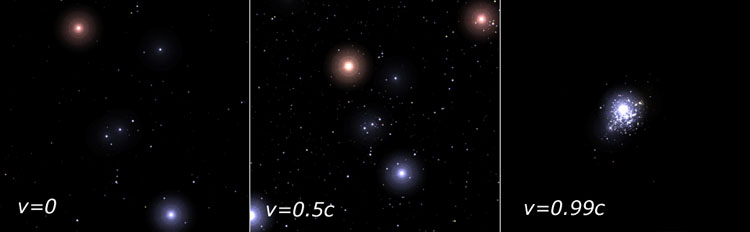
Now, it's not exactly like "going really fast"; everything around them seems pinched toward the forward direction and shifted to blue, like this - the same situation as where we see light emitted from particles moving at relativistic speeds relative to us (such as a black hole's event horizon) doppler shifted and distorted. If the occupants of our spacecraft go fast enough, even the cosmic microwave background will be shifted into the visible spectrum.
-
The Usenet Physics FAQ did it better
For a more thorough and slightly more technical approach to the same subject, check out the Usenet Physics FAQ's article "Is Faster-Than-Light Travel or Communication Possible?". Here's the conclusion:
To begin with, it is rather difficult to define exactly what is really meant by FTL travel and FTL communication. Many things such as shadows can go FTL, but not in a useful way that can carry information.
There are several serious possibilities for real FTL which have been proposed in the scientific literature, but these always come with technical difficulties.
The Heisenberg Uncertainty Principle tends to stop the use of apparent FTL quantum effects for sending information or matter.
In general relativity there are potential means of FTL travel, but they may be impossible to make work. It is thought highly unlikely that engineers will be building space ships with FTL drives in the foreseeable future, if ever, but it is curious that theoretical physics as we presently understand it seems to leave the door open to the possibility.
FTL travel of the sort science fiction writers would like is almost certainly impossible. For physicists the interesting question is "why is it impossible and what can we learn from that?"
-
Re:Question - Is Fermat's Last Theorem Dead?
He scores high on the crank test
-
Re:I thought the distinction was arbitrary already
If you actually click the photon link in that article, it lists a mass.
You're right. It lists a theoretical mass of zero. And it has been experimentally verified to be less than a very small number, but no experiment will ever be able to show it is zero, because there's always some error.
I feel like I'm going to argue semantics forever if I push this though.
That's one way to avoid admitting you are wrong. Instead try a better article and actually learning something.
-
Re:I thought the distinction was arbitrary already
The one scientists use today: invariant mass aka rest mass.
http://math.ucr.edu/home/baez/physics/ParticleAndNuclear/photon_mass.html
-
Microsoft is embracing Android?
"If anything, Microsoft is embracing Android & iOS more these days", cybrthng
Yea, that's why they are extorting patent licenses from Android hardware manufacturers and polluting the Internet with fake Android security FUD
OS Flaw Leaves Android Wide Open for App Hack Attacks, Richard Adhikari -
Re:Nothing?
As long as there's no faster-than-light travel, "X happens before Y" is an invariant - it's true in all reference frames.
No. http://math.ucr.edu/home/baez/... and for the longer version http://en.wikipedia.org/wiki/L.... In these examples, the doors either close at the same time for the observer stationary with respect to the barn, or at different times for the observer running with the pole.
OK, sorry, should have said ""X doesn't happen after Y" is an invariant" (there don't exist reference frames such that X happens before Y in one frame and X happens after Y in another frame).
Again no. A running coming from the other direction would see the doors close in the other order. I think the AC parallel to this post explains it pretty well.
-
Re:Nothing?
As long as there's no faster-than-light travel, "X happens before Y" is an invariant - it's true in all reference frames.
No. http://math.ucr.edu/home/baez/... and for the longer version http://en.wikipedia.org/wiki/L....
In these examples, the doors either close at the same time for the observer stationary with respect to the barn, or at different times for the observer running with the pole.Congratulations! You have failed to understand what relativity means! Hint: Time is fucking relative!
-
Re:Nothing?
As long as there's no faster-than-light travel, "X happens before Y" is an invariant - it's true in all reference frames.
No. http://math.ucr.edu/home/baez/... and for the longer version http://en.wikipedia.org/wiki/L.... In these examples, the doors either close at the same time for the observer stationary with respect to the barn, or at different times for the observer running with the pole.
OK, sorry, should have said ""X doesn't happen after Y" is an invariant" (there don't exist reference frames such that X happens before Y in one frame and X happens after Y in another frame).
-
Re:Nothing?
As long as there's no faster-than-light travel, "X happens before Y" is an invariant - it's true in all reference frames.
No. http://math.ucr.edu/home/baez/... and for the longer version http://en.wikipedia.org/wiki/L.... In these examples, the doors either close at the same time for the observer stationary with respect to the barn, or at different times for the observer running with the pole.
-
Re:Not fair
Critical Dance Studies!
Damn you Lorem Ipsum placeholder hrefs! -
Re:Year of Linux on the desktop?
Anyhow, good luck without your researchers.
What, all 50 of them in Silicon Valley? FFS, I didn't even RTFA but I got enough from the summary to understand that this is less than a rounding error compared to Microsoft's overall R&D and engineering staffs.
Also, can we make it Schnell's Law that anyone who mentions the Year of the Linux Desktop without irony has triggered Godwin's Law about the Occam's Razor of Linux zealots' Panglossian combination of The Seven UI Laws, the Joel Test and Newton's First Law of Motion? Unless of course they have done it as part of a Russian Reversal.
-
Re:Crichton is an idiot.
>"Science requires only one investigator who happens to be right, "
The one investigator publishes a paper, his work is confirmed by many others, he wins the Nobel Prize, and a new consensus is created. This differs from one loud voice who disagrees with the current consensus. For a handy metric for differentiating the two, see John Baez's Crackpot Index.
-
Re:Time to travel 11 light years
Swallow a cactus or look for d = (c^2/a) [ch(aT/c) - 1] on this page.
-
Re:Certainly yes
Oh, finally found the link I wanted. apply this to your favorite "all the physicists are wrong" theory - try for a high score!
-
Re:E = MC^2
I don't think the article suggest that photons have no momentum, but have zero rest mass. Its the motion of the photon that give it the property of mass.
These articles provide reasonable explanations: http://math.ucr.edu/home/baez/... and http://en.wikipedia.org/wiki/R... -
Re:Mostly done by 1985...
there was always a tiny but measurable probability that trapped light and thus information could escape.
Isn't that the same thing as Hawking Radiation? I'm sure Dr. Hawking proposed and submitted work explaining the same thing.
In fact, here is what I am talking about. -
Re:Weather is NOT climate
-
Re:Weather is NOT climate
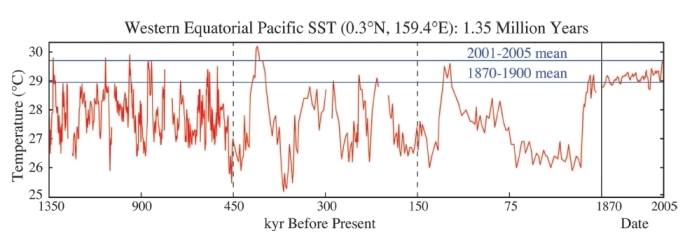
If you look at the temperature over the last millionish years...
http://math.ucr.edu/home/baez/...you can see it's been this hot many times before without human intervention.
you can see the temperature made a major move upwards a looooong time before the 1800's. from 26c to 29c. Humans almost certainly had nothing to do with that or other massive temperature shifts between 26 and 30c that have occurred repeatedly over the last millionish years.This particular move may be enhanced by humans. 7 billion human beings are having widespread effects on the planet. And it looks like we may be on target for 11 billion humans instead of 9 billion humans.
That's a lot of Co2, methane from cows, asphalt paved and building covered ground that used to be forest in most places.
But we are not even at a record temperature yet, similar temperature moves have happened many times (dozens, scores?) over the last million years without humans being the cause.
Based on the evidence of the historical record the temperature could fall 3 degrees shortly after it peaks. Well after we are dead of course.
Right now, I think the most likely course is temperatures will continue to rise slowly- we'll see the oceans rise by 20" by 2100.
And we'll have *too many* people. Way over the carrying capacity of the earth. We've overbred and it really doesn't matter what we do if we don't get the population down. We are just moving deck chairs on a sinking Titantic.
Here's the last 10 million years
http://4.bp.blogspot.com/-6ftZ...It shows a pretty strong correlation between co2 and temperature. It also shows the co2 level has fluctuated a lot without humans around and that the temperature has been as high and lower many times in the last 10 million years.
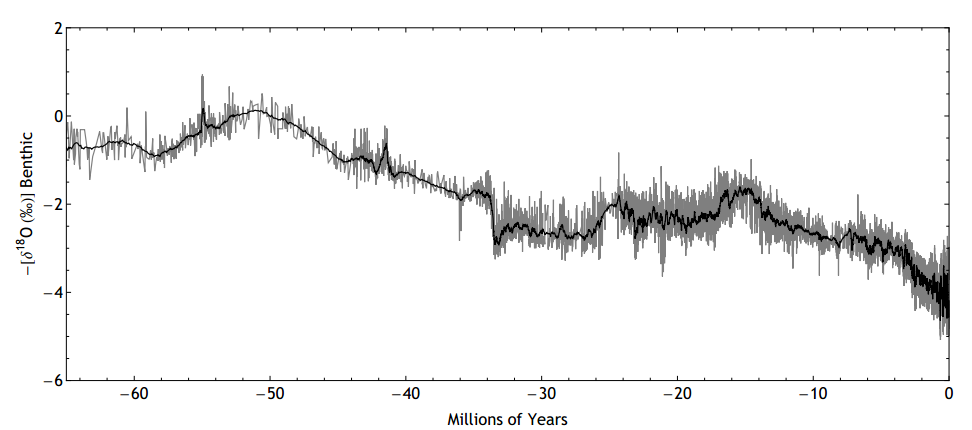
Here's the last 65 million years
http://mpe.dimacs.rutgers.edu/...We are at the bottom of a 65 million year long cooling period.
Here's the last 2.4 billion years
http://geology.utah.gov/survey...We could just be exiting a near ice age. It looks like much of the time, the average temperature of the earth has been about 72F. About 10 degrees warmer than it is now. Humans could be the cause- but even without human interaction, the temperature seems likely to return to the mean at some point in the future. On a billion year scale, the current temperatures are uncommonly low.
-
Re:Which means
By the way, if light, as it travels, creates these Heisenberg uncertainty fluctuation particle/antiparticle pairs, why don't these particle/antiparticle pairs Rayleigh self-scatter light, as in one photon goes through this slowdown, and scatters the 2nd photon (or more exactly wave packet, wave quantum) coming right behind it? That could be part of the explanation of redshift of distant galaxies, as opposed to them running faster the farther away they are, creating this Big Bang picture, they might be sitting still and light simply traveling long long long distances self-scatters in a Rayleigh way and somehow coming out of the scattering it actually shifts the atomic emission band frequency down as opposed to just filter it? Can you pull off or eke out such an explanation? I really don't like the theory where very distant galaxies are running away faster than the speed of light from us, in our reference frame, and it's OK as long as our 3D Universe is a volume on a 4D sphere, stretching very fast, and locally, everywhere you still have limited speed of light.
And how do you describe particle antiparticle pairs as wave-antiwave packets? There may really not be such a thing as a particle, and everything is just a certain vibration of "ether", with specific rules of what kinds of vibrations are allowed, and how the vibrations suddenly collapse, and there is no such thing as a "transformation" of a photon into a million kind of particle/antiparticle pairs, but more like a vibration encountering an already present fluctuation, and interacting with it. Vacuum might have a structure that allows certain types of wave packets with definite rules and axioms that interact through collapses of the wave that spread over an entire galaxy, at a single nanosized point on a screen, and string theory might be beating around the bush, but it requires 26 or so dimensions rolled up, and Occam's razor is very eager to cut crap with 26 dimensions. Btw we can thank a lot of Occam's razor http://math.ucr.edu/home/baez/.... Through it we killed phlogiston, caloric, vis viva and ether as useless concepts. Phlogiston got killed by Lavoisier, Mr. Oxygen and his wife in 1778 (Jean Michel Jarre has an album titled Oxygen), "vis viva" got killed by Wohler in 1828 by making "organic" urea out of "inorganic" ammonium cyanate, organic materials previously thought to have require life-force, or vis viva to be created. Caloric (which, btw, was introduced by Lavoisier himself, such is science, you win some, you lose some, oh well) was killed by Joule in 1843, showing that heat is not a conserved fluid, but can be generated. And Einstein and his wife killed the concept of "ether" in 1905 based on the Michelson-Morley experiment trying to measure the speed of Earth through ether with unprecedented accuracy with a superb interferometer suspended on a pool of mercury in 1879 at Western Reserve University. When you had man/woman duos doing the work, as in Einstein or Lavoisier, it's probably impossible to separate the individual contributions of the two, and assign credit as credit is due, 35% going to one person, 65% to the other. By the way Lavoisier's head rolled during the French Revolution, because he made a living through the tax office, concocting even better ways to extort even more money out of the people. And during the guillotine sessions, when a whole lot of nobility family trees were instantly trimmed, before chopped some heads were told to keep blinking as long as possible after they are chopped, and they could do it for about 35 seconds before giving out. So even getting your head chopped is not instant death, and hanging is probably not so either, there is mental awareness, anguish and agony for at least 35 seconds. Lethal injection, preparing the inmate, tying him down, that creates a lot of stress right there, and probably the most humane way of execution is not telling a death row inmate when he's gonna go, gassing him in his cell/chamber with anesthetics, then wi -
Re:Which means
Btw, exactly. Occam's razor http://math.ucr.edu/home/baez/... cuts out any such superfluous bs from science. We have a solar neutrino problem, http://en.wikipedia.org/wiki/S... , we cannot detect all the neutrinos that are supposed to be flooding us from the Sun, so we suppose that they have a very weak interaction coefficient, but to really fit the graph, we need one more object concocted, a neutrino mass. My college professor said give me 19 independent variables, and I can fit an elephant with a graph. Give me 20, and I can accurately fit the tail too. Occam's razor is against such things. Observational evidence showing neutrinos propagating faster than light is exciting, not disheartening!
The real answer to the solar neutrino problem is that there is no fusion going on inside the Sun. Yeah, you heard that right, time to revise all science textbooks. Or how else do you explain that a tiny little object in the night sky sets off not one, but three neutrino detectors worldwide, but we keep listening to the neutrinos from the Sun and they ain't coming, when in fact the detectors should be flooded and drowned in solar neutrino signals, and ignore distant galaxy events. Fact is there is no fusion going on inside the Sun, the Sun is only hot for the same reason the inside of the Earth is hot: Thorium, Uranium 238 and 235, and Potassium-40. In fact that is why an asteroid is cold, the Moon has no molten lava, because it's too small, nor does Mars, or Mercury, but Venus is sufficiently large to possess one, Earth is larger, and Jupiter, underneath all that hydrogen, is probably even hotter than Earth, and so are probably Saturn, Uranus, and Neptune, depending on the size of their silicate-cores. If you dumped a bunch of silicate asteroids with terrestrial abundance of thorium, uranium and potassium-40, together, into an Earth-sized mass, you'd get a planet with a molten inside, and a certain degree of surface temperature just from that, and total heat emissions. If you gathered enough similar asteroids and planets in extra-solar-system space, and dumped it all together to form an object the mass of the Sun, you'd pretty much get a Sun, with 5778 K surface temperature, not just molten volcano lava underneath a cold crust, but the whole surface would be volcano lava. Under such mass the gravity would be big enough to hold back even hydrogen, even at that 5800 K temperature, but as holding more and more back increases size, it increases gravity and increases compression and accelerates the nuclear reactor, i.e., the temperature goes up, and hydrogen gets boiled off and shot off as solar wind, and the Sun has a somewhat steady size, instead of an ever-growing one. Such compression/temperature rise cycles, blowing off hydrogen into outer space, it cooling by thermal radiation, falling back onto the Sun, with very long characteristic times, could explain ice-ages and global warming ages, as hydrogen can take a long trip all the way past Pluto, then stop, then get slowly accelerated back and fall back unto the Sun, and this whole thing could be steady state, but once in a while you have a massive comet or what not bring new fuel, or create a cold spot, or what not, and create minute fluctuations that could self amplify into full scale ice ages. But helium, being 4 times heavier than hydrogen, stays down, so the reason for the 75% hydrogen and 25% He in the Sun is a simple distillation process by molten lava down below, not a fusion conversion of hydrogen to helium, else our neutrino detectors would be screaming and not even noticing a distant SN1987A under the heavy noise. In fact when you look up in the sky and you see all the stars, that's pretty much all the matter there is in the Universe, so to speak, because if it gets massive, it gets hot by the natural abundance of nuclear isotopes, everything massive enough is a natural nuclear reactor fueled by the diffuse, trace, nuclear isotop -
Re:Not the Big Bang
The law of physics in question states that no information can be propagated faster than light. This does not conflict with space itself expanding superluminally. I'd suggest this Usenet FAQ, Is Faster-Than-Light Travel or Communication Possible? for a more detailed answer.
-
Re:Not the Big Bang
The Usenet Physics FAQ has a page covering this, although it doesn't answer your question directly:
-
Re:The Science is settled!
You must be from the American Petroleum Institute...
Ah yes, nothing like an ad hominem attack to soundly refute a claim.
Tell us, what other scientific discipline has ever been "settled"? Look here for over a century of experiments on relativity. Are scientists who TO THIS FUCKING DAY try to falisfy relativity labelled "deniers"?
-
Re:They didn't pay the rent?
At that point, the velocity needs to be computed through general relativity, which is fiendishly more complicated than just v/a.
Actually, it's just v = c*tanh(a*T/c).
-
Re:Time travel is not possible without
Well, no, in GR it would be a pseudogravitational field, or sometimes a Coriolis field, especially in precisely this application.
Pseudogravitational fields are useful tools but cause some controversy when people argue that they are substantive, similarly to how manifold substantivalist arguments work, or alternatively that they tend to lead towards the use of pseudotensors (like Landau-Lifshitz) which some people are uncomfortable with, usually on the grounds that frames of reference are inappropriate tools to use in GR problems.
Baez deals with this sort of thing entertainingly here:
http://math.ucr.edu/home/baez/physics/Relativity/SR/TwinParadox/twin_gr.html
'There's a reason why such forces carry the prefix "pseudo",' and the argument that introducing pseudotensors essentially turns a GR problem into an SR one (which is handy, thanks Albert!).
-
Re:massless photons vs black hole
Wow! Linking to a slashdot comment to prove a point? What? Is Wikipedia too good for you?
Photons have no "rest mass".
But as every photon is moving it has 'kinetic' mass, h*v / (c^2).Also, the slashdot comment indicates 'kinetic mass', but doesn't survive a unit check... Wherever this equation came from, its wrong.
Here are some resources for you:
http://www.askamathematician.com/2010/09/q-how-can-photons-have-energy-and-momentum-but-no-mass/
http://pveducation.org/pvcdrom/properties-of-sunlight/energy-of-photon
http://web.utk.edu/~cnattras/Phys250Fall2012/modules/module%201/photons.htm
http://math.ucr.edu/home/baez/physics/ParticleAndNuclear/photon_mass.html -
Re:No
Of course not. Back then kids learned about guns and respected them... or rather acted like stupid juveniles with access to firearms
-
Re:"Nearby star"
Passengers on a manned flight at 1g acceleration/deceleration would experience it as only 6.2 years according to this.
AC's get no respect, especially when gamers can game their replies for mod points by trumping the original post about an an idea above your comment. If you're into moderation rep, then guessing the right comment to reply to is a gamble. Better luck next time.
-
Re:Launch exploratory robots ASAP!
Anyway, to get relativistic effects, we would need much better propulsion than anything we have thought of so far. Science fiction for now.
So so informative seeming. So so wrong. Relativistic effects are clearly visible in the GPS system.
Now, the statement "to get a useful proportional reduction in perceived trip time from relativistic effects we would need much better propulsion.." would be true. The problem is not, however, with the maximum rate of acceleration; we already do many G acceleration and 1G continuous might be a very good way to go. The problem is that we have no reasonable way of fuelling such a rocket
-
Re:Why?
http://math.ucr.edu/home/baez/physics/Relativity/SpeedOfLight/FTL.html#14
Even the statement that "the speed of light is constant" is open to interpretation in general relativity. Einstein himself, on page 76 of his book "Relativity: the Special and the General Theory", wrote that the statement cannot claim unlimited validity. When there is no absolute definition of time and distance it is not so clear how speeds should be determined.