Slashdot Mirror
Domain: ucsd.edu
Stories and comments across the archive that link to ucsd.edu.
Stories · 107
-
Earth's Carbon Dioxide Levels Reach Highest Point In 800,000 Years (washingtonpost.com)
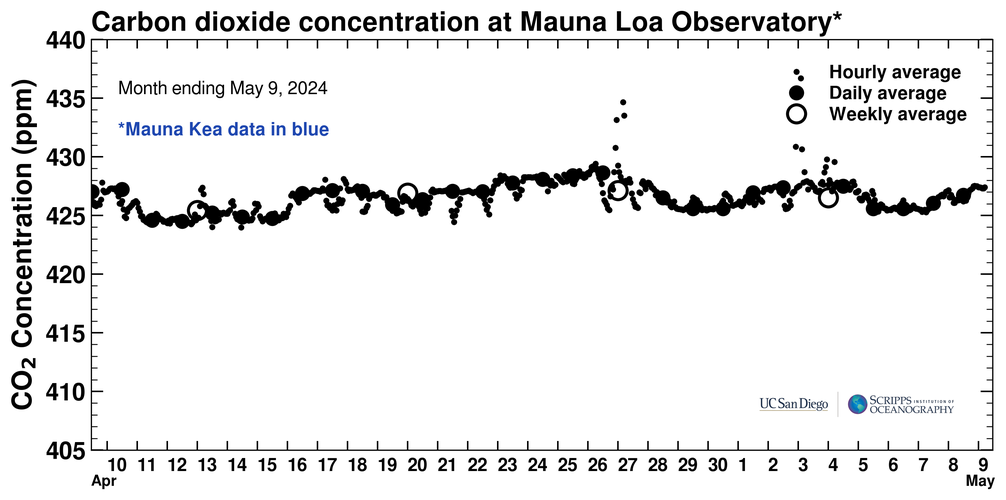
An anonymous reader quotes a report from The Washington Post: For the first time since humans have been monitoring, atmospheric concentrations of carbon dioxide have exceeded 410 parts per million averaged across an entire month (Warning: source may be paywalled; alternative source), a threshold that pushes the planet ever closer to warming beyond levels that scientists and the international community have deemed "safe." The reading from the Mauna Loa Observatory in Hawaii finds that concentrations of the climate-warming gas averaged above 410 parts per million throughout April. The first time readings crossed 410 at all occurred on April 18, 2017, or just about a year ago. Carbon dioxide concentrations -- whose "greenhouse gas effect" traps heat and drives climate change -- were around 280 parts per million circa 1880, at the dawn of the industrial revolution. They're now 46 percent higher. According to Scripps Institute of Oceanography, this amount is the highest in at least the past 800,000 years. "We keep burning fossil fuels. Carbon dioxide keeps building up in the air," said Scripps scientist Ralph Keeling, who maintains the longest continuous record of atmospheric carbon dioxide on Earth. "It's essentially as simple as that." -
Kids Praised for Being Smart are More Likely to Cheat (ucsd.edu)
An anonymous reader quotes the University of California: An international team of researchers reports that when children are praised for being smart not only are they quicker to give up in the face of obstacles, they are also more likely to be dishonest and cheat. Kids as young as age 3 appear to behave differently when told "You are so smart" vs. "You did very well this time"...
The research builds on well-known work by Stanford's Carol Dweck, author of "Mindset," who has shown that praising a child's innate ability instead of the child's effort or a specific behavior has the unintended consequence of reducing their motivation to learn and their ability to deal with setbacks... In another study, published recently in Developmental Science, the same co-authors show that the consequences are similar even when children are not directly praised for their smarts but are merely told that they have a reputation for being smart.
Then again, another study found that students also performed better in school if you paid them to get good grades. -
Brain-Inspired 'Memcomputer' Constructed
New submitter DorkFest writes: "Inspired by the human brain, UC San Diego scientists have constructed a new kind of computer that stores information and processes it in the same place. This prototype 'memcomputer' solves a problem involving a large dataset more quickly than conventional computers, while using far less energy. ... Such memcomputers could equal or surpass the potential of quantum computers, they say, but because they don't rely on exotic quantum effects are far more easily constructed." The team, led by UC San Diego physicist Massimiliano Di Ventra published their results in the journal Science Advances. -
Scientists Overcome One of the Biggest Limits In Fiber Optic Networks
Mark.JUK writes: Researchers at the University of California in San Diego have demonstrated a way of boosting transmissions over long distance fiber optic cables and removing crosstalk interference, which would mean no more need for expensive electronic regenerators (repeaters) to keep the signal stable. The result could be faster and cheaper networks, especially on long-distance international subsea cables. The feat was achieved by employing a frequency comb, which acts a bit like a concert conductor; the person responsible for tuning multiple instruments in an orchestra to the same pitch at the beginning of a concert. The comb was used to synchronize the frequency variations of the different streams of optical information (optical carriers) and thus compensate in advance for the crosstalk interference, which could also then be removed.
As a result the team were able to boost the power of their transmission some 20 fold and push data over a "record-breaking" 12,000km (7,400 miles) long fiber optic cable. The data was still intact at the other end and all of this was achieved without using repeaters and by only needing standard amplifiers. -
Finding Genghis Khan's Tomb From Space
rossgneumann writes Genghis Khan really, really didn't want anyone to know where he was buried. The soldiers escorting his body to its final resting place killed everyone they passed, killed the people who built the tomb, and then were killed themselves. An elegant solution to this problem bubbled up from two unlikely sources: a man described as a "modern day Indiana Jones" and amateur archaeologists. -
Be True To Your CS School: LinkedIn Ranks US Schools For Job-Seeking Programmers
theodp writes "The Motley Fool reports that the Data Scientists at LinkedIn have been playing with their Big Data, ranking schools based on how successful recent grads have been at landing desirable software development jobs. Here's their Top 25: CMU, Caltech, Cornell, MIT, Princeton, Berkeley, Univ. of Washington, Duke, Michigan, Stanford, UCLA, Illinois, UT Austin, Brown, UCSD, Harvard, Rice, Penn, Univ. of Arizona, Harvey Mudd, UT Dallas, San Jose State, USC, Washington University, RIT. There's also a shorter list for the best schools for software developers at startups, which draws a dozen schools from the previously mentioned schools, and adds Columbia, Univ. of Virginia, and Univ. of Maryland College Park. If you're in a position to actually hire new graduates, how much do you care about applicants' alma maters? -
UCSD To Test Safety of Spinal Stem Cell Injection
An anonymous reader writes Researchers at the University of California, San Diego School of Medicine have launched a clinical trial to investigate the safety of neural stem cell transplantation in patients with chronic spinal cord injuries. This Phase I clinical trial is recruiting eight patients for the 5-year study. Pre-clinical studies of these cells by Ciacci and Martin Marsala, MD, at the UC San Diego School of Medicine, showed that these grafted neural stem cells improved motor function in spinal cord injured rats with minimal side effects indicating that human clinical trials are now warranted. -
Walter Munk's Astonishing Wave-Tracking Experiment
An anonymous reader writes in with a look at a scientist's interesting wave-tracking experiment and the incredible journeys that waves make. His name is Walter Munk, now in his 90s and a professor emeritus at the Scripps Institution of Oceanography in La Jolla, California. About 60 years ago, he was anchored off Guadalupe Island, on Mexico's west coast, watching swells come in, and using an equation that he and others had devised to plot a wave's trajectory backward in time, he plotted the probable origins of those swells. But the answer he got was so startling, so over-the-top improbable, that he thought, "No, there must be something wrong." His equations said that the swells hitting beaches In Mexico began some 9,000 miles away — somewhere in the southern reaches of the Indian Ocean, near Antarctica. "Could it be?" he wrote in an autobiographical sketch. Could a storm half way across the world produce a patch of moving water that traveled from near the South Pole, up past Australia, then past New Zealand, then across the vast expanse of the Pacific, arriving still intact – at a beach off Mexico? He decided to find out for himself. That is why, in 1957, Walter Munk designed a global, real life, wave-watching experiment. -
Can a Computer Identify Your Urban Tribe?
Zothecula writes "Whether it's fashion, a favorite football team, or a certain kind of music, humans seem to enjoy being considered part of a larger group, and often self-identify as such. With this in mind, students from the University of California, San Diego Jacobs school of Engineering are currently developing a computer algorithm that can deduce from an image whether you're a goth, surfer, hipster, or biker." -
Your Digital Life Will Only Get More Crowded... If You Let It
Nerval's Lobster writes "By 2015, Americans' ability to access digital media at home and on mobile devices will raise the average volume of media consumed to the equivalent of nine DVDs worth of data per person, per day – not including whatever media they consume at work. That estimate adds up to 15.5 hours of media use per day per person, which breaks down to 74 gigabytes of data per person and a national, collective total of 8.75 zettabytes, according to a new report. Between 2008 and 2013, Americans grew from watching 11 hours of media per day to 14 hours per day – a growth rate of about 5 percent per year, lead author James E. Short wrote in the report. The increasing number of digital-data consumers and the shift from analog to digital media drove the total volume of data in bytes to grow 18 percent per year. That growth rate 'is less than the capacity to process data, driven by Moore's Law, [of about] 30 percent per year,' he added, 'but is still impressive.' Social media is growing even faster than other options – 28 percent per year, from 6.3 billion hours in 2008 to an estimated 35.2 billion hours in 2015. Companies expecting to catch the attention of either employees or customers will have to do so in the context of an increasingly media-swamped population. Digital data consumption will continue to rise, the SDSC projections estimate, possibly to more than an average of 24 hours per person per day – which is only possible assuming multiple simultaneous data streams running through the minds of Americans watching TV, browsing the Web and texting each other simultaneously, probably to ask why they never have time to just sit and talk any more." -
Bitcoin Perfectly Anonymous — Until You Spend It
jfruh writes "One of the great attractions of Bitcoin as a currency is that it's completely secure and anonymous. But according to researchers (PDF) from UC San Diego and George Mason University, that anonymity starts to vanish the minute you exchange bitcoin for real-world items or conventional currencies. The researchers tracked transactions across the Bitcoin ecosystem and found points where it would be easy for a government with subpeona power to find the identity of a Bitcoin user. They also concluded that the currency wasn't especially attractive for money-laundering purposes." Graph theory explains many things. -
UCSD Lecturer Releases Geotagging Application For "Dangerous Guns and Owners"
NF6X writes "UCSD Lecturer Brett Stallbaum has released an Android app called Gun Geo Marker to allow people to 'Geolocate Dangerous Guns and Owners.' The app description states: 'The Gun Geo Marker operates very simply, letting parents and community members mark, or geolocate, sites associated with potentially unsafe guns and gun owners. These locations are typically the homes or businesses of suspected unsafe gun owners, but might also be public lands or other locations where guns are not handled safely, or situations where proper rights to own or use any particular type of firearm may not exist.' I question how the motivation behind developing this app differs from, say, developing an app to allow others to publicly geotag homes of people believed to belong to a particular religion or political party." -
Observed Atmospheric CO2 Hits 400 Parts Per Million
symbolset writes "Over the past month a number of individual observations of CO2 at the Mauna Loa Observatory have exceeded 400 parts per million. The daily average observation has crept above 399 ppm, and as annually the peak is typically in mid-May it seems likely the daily observation will break the 400 ppm milestone within a few days. This measure of potent greenhouse gas in the atmosphere should spark renewed discussion about the use of fossil fuels. For the past few decades the annual peak becomes the annual average two or three years later, and the annual minimum after two or three years more." -
Observed Atmospheric CO2 Hits 400 Parts Per Million
symbolset writes "Over the past month a number of individual observations of CO2 at the Mauna Loa Observatory have exceeded 400 parts per million. The daily average observation has crept above 399 ppm, and as annually the peak is typically in mid-May it seems likely the daily observation will break the 400 ppm milestone within a few days. This measure of potent greenhouse gas in the atmosphere should spark renewed discussion about the use of fossil fuels. For the past few decades the annual peak becomes the annual average two or three years later, and the annual minimum after two or three years more." -
'CodeSpells' Video Game Teaches Children Java Programming
CyberSlugGump writes "Computer scientists at UC San Diego have developed a 3D first-person video game designed to teach young students Java programming. In CodeSpells, a wizard must help a land of gnomes by writing spells in Java. Simple quests teach main Java components such as conditional and loop statements. Research presented March 8 at the 2013 SIGCSE Technical Symposium indicate that a test group of 40 girls aged 10-12 mastered many programming concepts in just one hour of playing." -
Building Better Body Armor With Nanofoams
Zothecula writes "Given that scientists are already looking to sea sponges as an inspiration for body armor, perhaps we shouldn't be surprised that foam is also being considered ... not just any foam, though. Unlike regular foam, specially-designed nanofoams could someday not only be used in body armor, but also to protect buildings from explosions." -
GRAIL Mission Video Released
SchrodingerZ writes "A new video was released yesterday by NASA from the GRAIL mission probes, which ended their mission last month as they impacted the lunar surface. 'Dramatic' footage was captured by the probe Ebb on December 14th. The video was taken from the 'MoonKAM (Moon Knowledge Acquired by Middle school Students) cameras. It shows the view of Ebb flying at an altitude of 6 miles (10 km) above the Moon's northern hemisphere in the vicinity of Jackson crater (22.4N 163.1W).' Two videos were released, one from the fore and one from the aft of the probe, showing a forwards and backwards time lapse containing 931 and 1,489 pictures each of the lunar terrain. The footage was part of the probes' final systems check before they shut down and were sent into a controlled impact to a predetermined location." -
Elementary School Kids Explore the Moon At Close Range
sighted writes "The twin robotic spacecraft that make up the new GRAIL mission to map the moon's gravity include small cameras in addition to their primary scientific instruments. The first images from those cameras, as selected by school kids, were downlinked to Earth on March 20. 'MoonKAM is based on the premise that if your average picture is worth a thousand words, then a picture from lunar orbit may be worth a classroom full of engineering and science degrees,' said Maria Zuber, GRAIL mission principal investigator." -
Nanowire Forests Use Sunlight To Split Water
An anonymous reader sends this excerpt from IEEE Spectrum's Nanoclast blog: "One of the fundamental problems with fuel cells has been the cost of producing hydrogen. While hydrogen is, of course, the most abundant element, it attaches itself to other elements like nitrogen or fluorine, and perhaps most ubiquitously to oxygen to create the water molecule. ... Now researchers at University of California, San Diego have developed a quite different approach to mimicking photosynthesis for splitting water molecules by using a 3D branched nanowire array that looks like a forest of trees. ... The nanowire forest [uses] the process of photoelectrochemical water-splitting to produce hydrogen gas. The method used by the researchers, which was published in the journal Nanoscale (abstract), found that the forest structure of the nanowires, which has a massive amount of surface area, not only captured more light than flat planar designs, but also produced more hydrogen gas." -
UCSD Researchers Create Artificial Cell Membrane
cylonlover writes with an excerpt from a Gizmag article: "The cell membrane is one of the most important components of a cell because it separates the interior from the environment and controls the movement of substances in and out of the cell. In a move that brings mankind another step closer to being able to create artificial life forms from scratch, chemists from the University of California, San Diego (UCSD), and Harvard University have created artificial self-assembling cell membranes using a novel chemical reaction. The chemists hope their creation will help shed light on the origins of life." The full paper is available in the Journal of the American Chemical Society (behind a paywall). -
10-Centimeter Single-Celled Organisms Photographed 6 Miles Underwater
New submitter roat35 tips news that researchers from the Scripps Institution of Oceanography have used Dropcam — a relatively small, glass-walled device containing an HD camera — to make videos of lifeforms that exist in the Mariana Trench, more than six miles below the surface of the Pacific Ocean. One of the more interesting organisms at those depths is the Xenophyophore, a creature which, despite being single-celled, can grow to be over 10 centimeters wide. "Scientists say xenophyophores are the largest individual cells in existence. Recent studies indicate that by trapping particles from the water, xenophyophores can concentrate high levels of lead, uranium and mercury and are thus likely highly resistant to large doses of heavy metals. They also are well suited to a life of darkness, low temperature and high pressure in the deep sea." -
Space Is (Not) the Place, Says Professor
snoop.daub writes "A while back, we discussed UCSD professor Tom Murphy's post about the limits on growth in energy use and economies. Partly in reaction to Slashdot's response (and my own writeup!), he's back with a new post arguing that space is not a solution to enable continued growth. There's a lot of good stuff in here about public misconceptions regarding the difficulty of space travel and the like; again definitely worth the read." -
The Genetics of Happiness
Hugh Pickens writes "Studies comparing identical twins with non-identical twins have helped to establish the heritability of many aspects of behavior. Recent work suggests that about one third of the variation in people's happiness is heritable. Jan-Emmanuel De Neve has taken the study a step further, picking a popular suspect — the gene that encodes the serotonin-transporter protein, a molecule that shuffles a brain messenger called serotonin through cell membranes — and examined how variants of the 5-HTT gene affect levels of happiness. The serotonin-transporter gene comes in two functional variants—long and short and people have two versions (known as alleles) of each gene, one from each parent. After examining genetic data from more than 2,500 participants in the National Longitudinal Study of Adolescent Health, De Neve found that people with one long allele were 8% more likely than those with none to describe themselves as very satisfied with life and those with two long alleles were 17% more likely of describing themselves as very satisfied. Interestingly enough, there is a notable variation across races with Asian Americans in the sample having on average 0.69 long genes, white Americans with 1.12, and black Americans with 1.47. 'It has long been suspected that this gene plays a role in mental health but this is the first study to show that it is instrumental in shaping our individual happiness levels (PDF),' writes De Neve. 'This finding helps to explain why we each have a unique baseline level of happiness and why some people tend to be naturally happier than others, and that's in no small part due to our individual genetic make-up.'" -
Limits On Growth of Energy Use and Economies
snoop.daub writes "Dr. Tom Murphy, professor of astrophysics at UCSD, has a new blog called 'Do The Math,' and the first few posts are doozies. In the first, he shows the impossibility of continued exponential growth in energy use. Even if a new, 'free' energy source is developed, thermodynamic limits on efficiency mean that the heat associated with converting this energy into useful work will increase the temperature of the earth to unbearable levels within 300 years. In the second, he extends the argument to economic growth. The timescales there are faster, only 50-100 years. Fascinating stuff. Time to stop breeding, folks, or to get our butts into space." -
Limits On Growth of Energy Use and Economies
snoop.daub writes "Dr. Tom Murphy, professor of astrophysics at UCSD, has a new blog called 'Do The Math,' and the first few posts are doozies. In the first, he shows the impossibility of continued exponential growth in energy use. Even if a new, 'free' energy source is developed, thermodynamic limits on efficiency mean that the heat associated with converting this energy into useful work will increase the temperature of the earth to unbearable levels within 300 years. In the second, he extends the argument to economic growth. The timescales there are faster, only 50-100 years. Fascinating stuff. Time to stop breeding, folks, or to get our butts into space." -
A New Approach To Reducing Spam: Go After Credit Processors
WrongSizeGlass writes "A team of computer scientists at two University of California campuses has been looking deeply into the nature of spam, and they think found a 'choke point' [PDF] that could greatly reduce the flow of spam. It turned out that 95 percent of the credit card transactions for the spam-advertised drugs and herbal remedies they bought were handled by just three financial companies — one based in Azerbaijan, one in Denmark and one in Nevis, in the West Indies. If a handful of companies like these refused to authorize online credit card payments to the merchants, 'you'd cut off the money that supports the entire spam enterprise,' said one of the scientists." Frequent Slashdot contributor (and author of a book on Digital Cash) Peter Wayner wonders if "the way to get a business shut down is to send out a couple billion spam messages in its name." -
World's Servers Process 9.57ZB of Data a Year
CWmike writes "Three years ago, the world's 27 million business servers processed 9.57 zettabytes, or 9,570,000,000,000,000,000,000 bytes of information. Researchers at the School of International Relations and Pacific Studies and the San Diego Supercomputer Center estimate that the total is equivalent to a 5.6-billion-mile-high stack of books stretching from Earth to Neptune and back to Earth, repeated about 20 times. By 2024, business servers worldwide will annually process the digital equivalent of a stack of books extending more than 4.37 light-years to Alpha Centauri, the scientists say. The report, titled 'How Much Information?: 2010 Report on Enterprise Server Information,' (PDF) was released at the SNW conference last month." -
World's Servers Process 9.57ZB of Data a Year
CWmike writes "Three years ago, the world's 27 million business servers processed 9.57 zettabytes, or 9,570,000,000,000,000,000,000 bytes of information. Researchers at the School of International Relations and Pacific Studies and the San Diego Supercomputer Center estimate that the total is equivalent to a 5.6-billion-mile-high stack of books stretching from Earth to Neptune and back to Earth, repeated about 20 times. By 2024, business servers worldwide will annually process the digital equivalent of a stack of books extending more than 4.37 light-years to Alpha Centauri, the scientists say. The report, titled 'How Much Information?: 2010 Report on Enterprise Server Information,' (PDF) was released at the SNW conference last month." -
The Fight Against Dark Silicon
An anonymous reader writes "What do you do when chips get too hot to take advantage of all of those transistors that Moore's Law provides? You turn them off, and end up with a lot of dark silicon — transistors that lie unused because of power limitations. As detailed in MIT Technology Review, Researchers at UC San Diego are fighting dark silicon with a new kind of processor for mobile phones that employs a hundred or so specialized cores. They achieve 11x improvement in energy efficiency by doing so." -
Physicists Build Bigger 'Bottles' For Antimatter
intellitech writes "Once regarded as the stuff of science fiction, antimatter — the mirror image of the ordinary matter in our observable universe — is now the focus of laboratory studies around the world. While physicists routinely produce antimatter with radioisotopes and particle colliders, cooling these antiparticles and containing them for any length of time is another story. Clifford Surko, a professor of physics at UC San Diego, who is constructing what he hopes will be the world's largest antimatter container, said physicists have recently developed new methods to make special states of antimatter in which they can create large clouds of antiparticles, compress them and make specially tailored beams for a variety of uses." -
Confidential Data Not Safe On Solid State Disks
An anonymous reader writes "I always thought that the SSD was a questionable place to store private data. These researchers at UCSD's Non-Volatile Systems Laboratory have torn apart SSDs and have found remnant data even after running several open source and commerical secure erase tools. They've also proposed some changes to SSDs that would make them more secure. Makes you think twice about storing data on SSDs — once you put it on, getting it off isn't so easy." -
History Sniffing In the Wild
An anonymous reader writes "Kashmir Hill at Forbes documents a recent study by UCSD researchers showing that 'history sniffing' is being actively used by mainstream ad networks like Interclick as well as popular porn sites like YouPorn in order to track what other sites you visit. The vulnerability has been known for almost a decade, but this paper documents hundreds of commercial sites exploiting it today (PDF)." -
Major ISPs Help Fund BitTorrent User Tracking Research
An anonymous reader writes "I was scanning conference proceedings to come up with ideas for a reading group I run at my workplace, and I noticed an interesting paper from the new IEEE WIFS forensics conference. Researchers from the University of Colorado have published a technique for tracking BitTorrent users (PDF) by joining and actively probing torrent swarms using low-cost cloud computing services. They claim their methods allowed them to monitor the entire Pirate Bay torrent set for as little as $13/mo using EC2. But that's not even the interesting part. Their work appears to have been 'funded in part through gifts from PolyCipher' — a broadband ISP consortium. That's right; three major national ISPs funded this round of BitTorrent tracking research, not the MPAA/RIAA. Could this be evidence of ISP support for ACTA and a global three-strikes law?" -
Each American Consumed 34 Gigabytes Per Day In '08
eldavojohn writes "Metrics can get really strange — especially on the scale of national consumption. Information consumption is one such area that has a lot of strange metrics to offer. A new report from the University of California, San Diego entitled 'How Much Information?' reveals that in 2008 your average American consumed 34 gigabytes per day. These values are entirely estimates of the flows of data delivered to consumers as bytes, words and hours of consumer information. From the executive summary: 'In 2008, Americans consumed information for about 1.3 trillion hours, an average of almost 12 hours per day. Consumption totaled 3.6 zettabytes and 10,845 trillion words, corresponding to 100,500 words and 34 gigabytes for an average person on an average day. A zettabyte is 10 to the 21st power bytes, a million million gigabytes. These estimates are from an analysis of more than 20 different sources of information, from very old (newspapers and books) to very new (portable computer games, satellite radio, and Internet video). Information at work is not included.' Has the flow and importance of information really become this prolific in our daily lives?" -
Brain of Patient H.M. Being Sliced, Streamed Live
buswolley writes "The slicing of the brain of the famous amnesic patient H.M. into giant histological sections is now in full swing, and is being streamed live. The brain specimen is frozen and sectioned whole during one continuous session that is expected to last approximately 30 hours." -
Going Head To Head With Genius On Playlists
brownerthanu writes "Engineers at the University of California, San Diego are developing a system to include an ignored sector of music, dubbed the 'long tail,' in music recommendations. It's well known that radio suffers from a popularity bias, where the most popular songs receive an inordinate amount of exposure. In Apple's music recommender system, iTunes' Genius, this bias is magnified. An underground artist will never be recommended in a playlist due to insufficient data. It's an artifact of the popular collaborative filtering recommender algorithm, which Genius is based on. In order to establish a more holistic model of the music world, Luke Barrington and researchers at the Computer Audition Laboratory have created a machine learning system which classifies songs in an automated, Pandora-like, fashion. Instead of using humans to explicitly categorize individual songs, they capture the wisdom of the crowds via a Facebook game, Herd It, and use the data to train statistical models. The machine can then 'listen to,' describe and recommend any song, popular or not. As more people play the game, the machines get smarter. Their experiments show that automatic recommendations work at least as well as Genius for recommending undiscovered music." -
How To Build a 100,000-Port Ethernet Switch
BobB-nw writes "University of California at San Diego researchers Tuesday are presenting a paper (PDF) describing software that they say could make data center networks massively scalable. The researchers say their PortLand software will enable Layer 2 data center network fabrics scalable to 100,000 ports and beyond; they have a prototype running at the school's Department of Computer Science and Engineering's Jacobs School of Engineering. 'With PortLand, we came up with a set of algorithms and protocols that combine the best of layer 2 and layer 3 network fabrics,' said Amin Vahdat, a computer science professor at UC San Diego. 'Today, the largest data centers contain over 100,000 servers. Ideally, we would like to have the flexibility to run any application on any server while minimizing the amount of required network configuration and state... We are working toward a network that administrators can think of as one massive 100,000-port switch seamlessly serving over one million virtual endpoints.'" -
USB-Based NIC Torrents While Your PC Sleeps
jangel sends us to WindowsForDevices.com for news on a prototype device created by researchers from Microsoft and UC San Diego. It's a USB-based NIC that includes its own ARM processor and flash storage, and can download files or torrent while a host PC is sleeping. As a result, its inventors say, the "Somniloquy" device slashes power usage by up to 50x. The device requires a few tweaks on the host OS side save state before sleeping. The prototype works with a Vista host but the hardware comprising the NIC is based on a Linux stack. Here is the research paper (PDF). -
Now From Bruce Schneier, the Skein Hash Function
An anonymous reader writes "Bruce Schneier and company have created a new hash function called Skein. From his blog entry: 'NIST is holding a competition to replace the SHA family of hash functions, which have been increasingly under attack. (I wrote about an early NIST hash workshop here.) Skein is our submission (myself and seven others: Niels Ferguson, Stefan Lucks, Doug Whiting, Mihir Bellare, Tadayoshi Kohno, Jon Callas, and Jesse Walker). Here's the paper." -
Duplicating Your Housekeys, From a Distance
Roland Piquepaille writes "Some clever computer scientists at UC San Diego (UCSD) have developed a software that can perform key duplication with just a picture of the key — taken from up to 200 feet. One of the researchers said 'we built our key duplication software system to show people that their keys are not inherently secret.' He added that on sites like Flickr, you can find many photos of people's keys that can be used to easily make duplicates. Apparently, some people are blurring 'numbers on their credit cards and driver's licenses before putting those photos on-line,' but not their keys. This software project is quite interesting, but don't be too afraid. I don't think that many of you put a photo of their keys online — with their addresses." I wonder when I'll be able to order more ordinary duplicate keys by emailing in a couple of photos. -
Are 68 Molecules Enough To Understand Diseases?
Roland Piquepaille writes "A researcher from the University of California at San Diego (UCSD) claims that 68 molecules can explain the origins of many serious diseases. After reviewing findings from multiple disciplines, he 'realized that only 68 molecular building blocks are used to construct these four fundamental components of cells: the nucleic acids (DNA and RNA), proteins, glycans and lipids,' and he said that 'these 68 building blocks provide the structural basis for the molecular choreography that constitutes the entire life of a cell.'" -
Watching China Turn Off the Pollution
NewbieV points out coverage of the effort to assess Beijing's air pollution control efforts. Quote from one of the investigators: "This will be a very interesting experiment that can never happen again." Here's the main project scientist's site on the monitoring effort, and Newsweek coverage that brings out a paradoxical effect of reducing pollution on global warming. "Unmanned aerial vehicles are measuring emissions of soot and other forms of black carbon. The instruments are observing pollution transport patterns as Beijing enacts its 'great shutdown' for the Summer Olympic Games. Chinese officials have compelled reductions in industrial activity by as much as 30 percent and cuts in automobile use by half to safeguard the health of competing athletes immediately before and during the games." -
Watching China Turn Off the Pollution
NewbieV points out coverage of the effort to assess Beijing's air pollution control efforts. Quote from one of the investigators: "This will be a very interesting experiment that can never happen again." Here's the main project scientist's site on the monitoring effort, and Newsweek coverage that brings out a paradoxical effect of reducing pollution on global warming. "Unmanned aerial vehicles are measuring emissions of soot and other forms of black carbon. The instruments are observing pollution transport patterns as Beijing enacts its 'great shutdown' for the Summer Olympic Games. Chinese officials have compelled reductions in industrial activity by as much as 30 percent and cuts in automobile use by half to safeguard the health of competing athletes immediately before and during the games." -
UAVs Will Study Californian Smog
Roland Piquepaille writes "The California Energy Commission is funding a research effort named CAPPS, short for California AUAV Air Pollution Profiling Study. CAPPS will use autonomous unmanned aerial vehicles (AUAVs) to gather meteorological data as the aircraft fly through clouds over Southern California. The goal is to study smog and its consequences as well as better understand the sources of air pollution. The first flights started in April 2008 and data collection will continue until January 2009. But read more for additional references and photos of these autonomous unmanned aircraft." -
U of CA Constructs 220 Million Pixel Display
eldavojohn writes "Engineers at the University of California, San Diego have built a 220 million pixel display across 55 high-resolution tiled screens. Linked via optical fiber to Calit2's building at UC Irvine, the display can deliver real-time rendered graphics simultaneously across 420 million pixels to audiences in Irvine and San Diego." -
New Algorithms Improve Image Search
bc90021 writes "Electrical engineers from UC San Diego are making progress on an image search engine that analyzes the images themselves. At the core of this Supervised Multiclass Labeling system is a set of simple yet powerful algorithms developed at UCSD. Once you train the system (the 'supervised' part), you can set it loose on a database of unlabeled images. The system calculates the probability that various objects it has been trained to recognize are present, and labels the images accordingly. After labeling, images can be retrieved via keyword searches. Accuracy of the UCSD system has outpaced that of other content-based image labeling and retrieval systems in the literature. One of the co-authors works at Google, where the researchers have access to image collections at the largest of scales." -
An Origami Lens for Your Camera Phone?
Roland Piquepaille writes "Your next camera phone might get a new kind of lens if researchers at the University of California at San Diego convince the cell phones makers. They have designed an 'origami lens' which will slim high resolution cameras. Today, their 5-millimeter thick, 8-fold imager delivers images comparable in quality with photos taken with a compact camera lens with a 38 millimeter focal length. In a few years, these bendable lenses could be used in high resolution miniature cameras for unmanned surveillance aircraft, cell phones and infrared night vision applications." -
Underwater Robot to Re-Cross Gulf Stream
karvind writes "PhysOrg is running story about a small autonomous underwater vehicle, or AUV, named Spray which was launched yesterday (March 25, 2005) about 12 miles southeast of Bermuda. The two-meter-(6-foot)-long orange glider with a four-foot wingspan will slowly make its way northwest, crossing the Gulf Stream and reaching the continental shelf on the other side before turning around and heading back to Bermuda, where it will be recovered in July. Spray made history last fall as the first AUV to cross the Gulf Stream, but this time it is making the trip from the other direction." -
Whereables?
d4 asks: "Thad Starner has been using a wearable computer daily since 1993, and Steve Mann has had an impressive amount of press coverage over the years. But if you want wearable computing in 2005, it seems you must build your own system. Why, after all this time and attention, are wearables still not commercially available?" -
Robotic Science Network Watches Our Oceans
Roland Piquepaille writes "I bet most of you have never heard about Argo, an ambitious scientific project about the observation of our oceans. This project is endorsed by 18 countries and just reached a milestone: there are today more than 1,500 robotic floats reporting about salinity changes or predicting El Niño events, among other ones. This news release from the University of California at San Diego says that the Argo floats, which are autonomous ocean-traveling robots programmed to sink more than a mile below the ocean surface, are helping scientists all over the world to look at the future of our whole planet. And in 2007, when the deployment is completed, 3,000 underwater robots will help us to better understand the changes in our climate. You'll find more details, pictures and references in this overview."