Slashdot Mirror
Domain: usb.org
Stories and comments across the archive that link to usb.org.
Comments · 233
-
Re:erm... what?
but it lags in performance by an order of magnitude.
This is just not true. A single channel of Thunderbolt does 10Gbps bi-directional. A single channel of USB 3 does 4.0 Gbps bi-directional. That's a factor of 2.5x, not 10x.
And yes, thanks to the new bi-directional bus (USB 2 was shared) USB 3 can already reach 2.5 Gbps in real-world tests. Also being introduced right now are improved UASP (SCSI scheduling) protocols to utilize the same percentage of the bus as Firewire did. Support for UASP is already shipping in products like Asmedia controllers and Intel's 70-series chpsets.
-
Re:iPad can charge off of USB ...
Like most other gadgets, the iPad can charge off of a USB port. That would be 5 Vdc.
Actually, the iPad can not be charged off a standard USB port while it is powered on. It draws 1.5 amps (more than the
There are USB ports that will charge the iPad (if they support the Battery Charging v1.1 spec), but having those on a device is rare.
The iPad can charge slowly when it is asleep from a standard USB 2.0 port if there is nothing else drawing power.
My iPad 1 has been charging from the USB port on my Chumby since it was new - hasn't run down yet.
-
Re:iPad can charge off of USB ...
Like most other gadgets, the iPad can charge off of a USB port. That would be 5 Vdc.
Actually, the iPad can not be charged off a standard USB port while it is powered on. It draws 1.5 amps (more than the
There seems to be existing aviation oriented adapters that can deliver 2 amps. http://www.lonestaraviation.com/Power-Adapter-USB-Socket.html
-
Re:iPad can charge off of USB ...
Like most other gadgets, the iPad can charge off of a USB port. That would be 5 Vdc.
Actually, the iPad can not be charged off a standard USB port while it is powered on. It draws 1.5 amps (more than the
There are USB ports that will charge the iPad (if they support the Battery Charging v1.1 spec), but having those on a device is rare.
The iPad can charge slowly when it is asleep from a standard USB 2.0 port if there is nothing else drawing power. -
Re:Why PCMCIA?
http://www.usb.org/developers/usbfaq#sig6
http://www.interfacebus.com/Design_Connector_Serial_ATA.html
the other link i found, on fciconnect, the impedance stated "100ohm minimum".so, thank you for pointing out that it's critical to find good connectors!
we didn't pick PCMCIA because "it's cool", we picked it because it's still a mass-volume part (Conditional Access Modules) but is legacy as far as portable computers are concerned. and because it's user-removable. and because, quite simply, there isn't anything better. yes i looked at MiniPCI, i found _one_ image of a removable MiniPCI with ejector assembly: could i find who made it? could i hell.
COM express - saw that one. it's not user-removable - factory only. that defeats the object.
remember also: we're aiming for *mass-volume*. "enthusiasts" happen to be a critical link in the chain to bootstrap our way _up_ to mass-volume.
in other words, by the time we get _to_ mass-volume, we can always go and either raise some funds or spend existing funds raised by that point to get a proper impedance-matched PCMCIA connector specially made. or, say "what the heck" and get something else made.
regarding 0.1" headers: PCMCIA's 68-pin connector was designed for repeated insertion/removal. 0.1" headers are not. yes i looked around, tried to find a low-cost connector that would go onto the end of a PCMCIA card (in place of the 68-pin one). couldn't find one. if in your experience you know of something that would work, here please do tell me!
the other thing to take into account is that by sticking to PCMCIA 68-pin connectors we can even re-use pre-existing casework.
*sigh* absolute absolute last resort: both the SATA _and_ USB2 can be ramped down in top speed. SATA i think you can do as low as 150mbits/sec, something like that. i did look this up as part of the evaluation process. didn't quite do as experienced a job as you, though, so thank you for the heads-up.
-
Re:TFA (-1, wrong)
I believe your understanding is incorrect. According to this whitepaper, the transfer speed is individually negotiated between each connection point, and the hub buffers data and matches speed as required. In other words, as I read it, every device attached to that hub operates at its individual negotiated data rate, and the upstream data rate of the hub is always the maximum it negotiates with the host. A slow device does not handicap a fast device, even on the same hub.
This whitepaper only covers USB 1.0, 1.1, and 2.0, so I suppose the case with USB 3.0 may possibly differ, but I tend to doubt it given the established USB philosophy.
-
Re:News is spam (maybe)
The video says they're waiting for the USB3.0 spec to be finalized before they can release a product.
What? The USB 3.0 spec isn't finalized yet? So what's with all those USB 3.0 devices out there?
Such a pity. The USB IF guys certainly are good at teasing us though. Harumpth. USB 3.0 Spec available for download. Especially since this group of "USB 3.0" devices doesn't exist (dated January 2010. Yes, 2010).
Yup, they're still waiting nearly 2 years after the spec's been available to show off their 2TB flash drive.
-
Re:News is spam (maybe)
The video says they're waiting for the USB3.0 spec to be finalized before they can release a product.
What? The USB 3.0 spec isn't finalized yet? So what's with all those USB 3.0 devices out there?
Such a pity. The USB IF guys certainly are good at teasing us though. Harumpth. USB 3.0 Spec available for download. Especially since this group of "USB 3.0" devices doesn't exist (dated January 2010. Yes, 2010).
Yup, they're still waiting nearly 2 years after the spec's been available to show off their 2TB flash drive.
-
Re:Power over ethernet!
compared to USB the RJ45 connector isn't sooo bad.
according to the USB 3 specs the standard connector has to survive at least 1500 cycles, this presentation shows no problems with RJ45/PoE for at least 800 connection cycles (no idea if min. cycles are part of any RJ spec).
-
USB Battery Charging specification
and either refusing to charge or deliberately drawing less power when you detect the wrong charger.
One could argue based on the power management portions of the USB specification that drawing less power meets the spec, but refusing to charge does not. A device MUST NOT* draw more than one unit of current (100 mA in USB 2.0) until it successfully associates to the host controller. After a device is configured, it MAY request up to five units (500 mA) but MUST NOT draw more than the host says is available. The recent Battery Charging v1.2 spec specifies a protocol on the data lines that devices can use to detect dumb chargers and chargers that can provide more power, so that devices know when they MAY deliberately draw more power. You SHOULD support manufacturers of phones and other devices that support USB Battery Charging.
* RFC 2119 modal adverbs != shouting.
-
Re:Repugnant
There are several extensions to the USB spec, among them is the "Battery Charging Convention":
http://en.wikipedia.org/wiki/Universal_Serial_Bus#Power
http://www.usb.org/developers/devclass_docs/batt_charging_1_1.zip [zip'ed PDF] -
Underspecified device classes
his whole present bit is the direct result of manufacturers failing to implement things to the appropriate standard.
Provided that there exists such a standard. A lot of USB device classes aren't specified enough to allow for a generic class driver, such as bitmap printers (printer device class 1.1 doesn't define a baseline printer control protocol and page description language), flatbed scanners, storage devices that aren't the sort of block devices envisioned by the Mass Storage Class (such as EPROM programmers), and adapters to connect legacy devices (such as RS232 serial ports). And I don't see how a standard for low-level interfaces to video cards can keep up with the changing state of GPUs, apart from unaccelerated VESA.
-
Re:New custom chipset...with no drivers?
No, the CDC ACM class is not that new; it has been used for mobile phones for several years. It is at least present in the "Wireless Mobile Communications Devices" document dated February 9, 2007. See http://www.usb.org/developers/devclass_docs/CDC1.2_WMC1.1.zip for full details.
-
Re:SuperSpeed USB...
To be technically correct - the best kind of correct - USB-IF's preferred name for USB 2.0 is "Hi-speed", not "high".
LOL yeah. And then I see they've now added two arrows to "SuperSpeed" to show it's full duplex.
I can't wait until they then add 8-bit lanes and still keep the "serial" nomenclature.
-
Re:SuperSpeed USB...
So then USB 2.0 was "high speed"
To be technically correct - the best kind of correct - USB-IF's preferred name for USB 2.0 is "Hi-speed", not "high". Presumably they came up with the name at a Drive-Thru.
-
Apple is doing the right thing here
We all love to call out Apple when they design deliberate incompatibility into their devices, but there is a perfectly valid technical reason for what Apple is doing here, and, in fact, they are following a USB specification (which LadyAda unfortunaterly didn't even test).
Without data communications or when suspended, devices may legally draw no more than 2.5mA from a host, which is useless for charging. In fact, even if you're generous and pretend they're connected, devices are not allowed to draw more than 100mA without negotiating for a higher current, which requires actually talking to the host, and 100mA is still too little to charge properly. 500mA is the maximum allowed by the USB spec, but devices must negotiate it (there may be too many devices on the bus for negotiation to succeed).
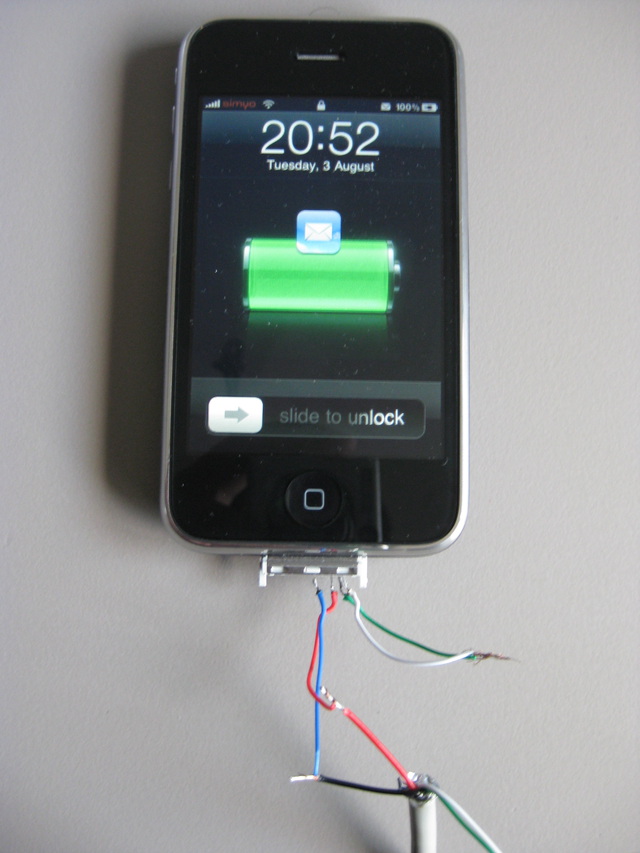
Before there was a spec for "dumb" USB chargers, Apple used the resistors as a sentinel to avoid drawing too much current from undersized chargers in order to avoid damaging the host. This is a hack, but it works, and honestly, we're smart enough to figure out a couple resistors on the data lines. It's not like they're using crypto auth on the charger. They have a perfectly valid reason to do this. Devices which charge from "dumb" chargers aren't following the spec, though this is a common industry practice.
As it turns out, the USB-IF came up with a USB Battery Charging spec. The spec is long and boring, but it boils down to: short together the data lines (no resistors required) and you indicate that you're a dumb charger that can supply anywhere from 0.5A to 1.5A.
Guess what happens when you short the data lines of an iPhone 3G and supply 5V. Did Apple just follow a standard? Incredible!
(Yes, I'm not following the USB spec there by in turn using a USB cable to supply the 5V and not negotiating over its data lines. I didn't feel like grabbing a dedicated 5V PSU for the shot, so sue me.)
-
Re:Use microSD{,HC} + adapters
Well, I reloaded the cited page with JavaScript enabled: still no "super Digital" cards listed. I see the following: CFast Cards, Secure Digital Cards, High Capacity SD Cards, MicroSD Cards, MicroSDHC, CompactFlash Cards, I-Temp CF Cards, and MiniSD Cards. All the 'SD' cards use the "Secure Digital" logo.
Super Talent Secure Digital card also provides security feature called Content Protection for Recordable Media (CPRM), which enables a new distribution system for music and other commercial media and assures a high level of protection against illegal copying.
- http://www.supertalent.com/products/sd_detail.php?series=Secure Digital Cards
If it makes you feel any better I am thinking of trying MMC cards to see it the problems I have experienced with SD cards are simply due to Crappy card readers. Very few are actually USB certified. Even some that have the logo don't appear to be on the list. I am going to have to investigate whether is is possible to certify a card reader implementing CPRM (because it breaks the generic mass storage device driver). If is possible that the certified devices are only tested with CF or MMC cards.
-
Re:You can buy a serial-to-usb converter for $15Even with "real serial ports", which USB-to-serial devices are, you often need a "breakout box" to get a piece of equipment to talk to you. There's the whole DTE/DCE thing that may require you to reverse TX and RX (e.g. null modem). Then one side might want DTS/CTS pulled active, while the other doesn't care. Then even when you get them to talk you might have no flow control and loose characters.
Come to think of it USB ports that adequately present themselves as a CDC ACM device might just be a better idea.
-
Re:Apple's activity is criminal here, Palm's is le
I'm recalling articles from when it was formed. Long, long ago. I suggest you go to the USB-IF site and peruse their documentation.
If it was "long, long ago," could it be that your recollection of what the contract actually says is inaccurate? As mysidia points out, the USB-IF membership agreement explicitly says that membership does not grant any patent license. It doesn't even grant a license to use the trademarked USB logo--there's a separate USB-IF Trademark License Agreement for that, and USB-IF membership is not required to license the trademarks. It appears to me that you're the one making unfounded legal representations when you say that Palm "would still be in breach of contract with the USB-IF and there by using the patents illegally." In any case, it seems a bit presumptuous of you to claim that Palm would be breaching some contract when you don't actually know what contracts they've signed, and haven't recently read the ones that they probably did sign.
-
Re:Apple's activity is criminal here, Palm's is le
There's been no report of a special contract existing between Palm and USB-IF other than the normal membership agreement.
-
Re:Apple's activity is criminal here, Palm's is le
The logos as seen here:
http://www.usb.org/home
are trademarks held by the USB-IF and its member companies.USB does not qualify as a genericized trademark because references to USB are clearly for the specific interface as described by USB-IF. To have USB be a genericized term then USB must be commonly used to describe cables plugged into computers which it is not.
-
Re:SuperSpeed?Incorrect.
Directly from USB.org, link: here
Hi-Speed USB extends the speed of the connection from 12 Mbps on Original USB up to 480 Mbps on Hi-Speed USB, providing an attachment point for next-generation peripherals which complement higher performance PCs and user applications.
-
Re:Talk about a pathetic article
Palm has a license agreement and a legally binding contract with USB-IF. They violated that, hence making it illegal for them to do what they did.
http://www.usb.org/developers/vendor/ -
Re:Palm Got What They Deserved
How does one "snyc" with iTunes?
You open and read the iTunes Library XML file. This lets you see all the song and playlist information. Then you copy song files from a predictable directory structure (~/Music/iTunes/iTunes Music/Artist Name/Album Name/Song Name.fileextension) onto your machine. You can also directly edit the XML file to (for instance) update play counts and when it was most recently played. This method has been unchanged for a few years, and is officially supported. It does require a 3rd party application, but since Mac and Windows have triggers to launch an application if the relevant device connects, you can sync auto-magically on device connect, and all the end user has to do is determine initially which playlists they'd like to sync.
Didn't I just see a post [slashdot.org] suggesting that Apple's API has been stable for years and that the problem was that Palm wasn't actually using the API?
Yes. Palm has never used the above described API. Instead, they're trying to trick iTunes by claiming to be an iPod. The controversy is that the current version of iTunes checks that the device is both an iPod, and made by Apple. To pass that second check, Palm would have violate the USB standard (and possibly their USB licensing agreement).
How much would a pair of USB "speecs" cost?
The specification is free, but getting a Vendor ID costs between $1000 and $4000 per year. It would be the Vendor ID license that Palm would be violating.
-
Re:Palm Got What They Deserved
How does one "snyc" with iTunes?
You open and read the iTunes Library XML file. This lets you see all the song and playlist information. Then you copy song files from a predictable directory structure (~/Music/iTunes/iTunes Music/Artist Name/Album Name/Song Name.fileextension) onto your machine. You can also directly edit the XML file to (for instance) update play counts and when it was most recently played. This method has been unchanged for a few years, and is officially supported. It does require a 3rd party application, but since Mac and Windows have triggers to launch an application if the relevant device connects, you can sync auto-magically on device connect, and all the end user has to do is determine initially which playlists they'd like to sync.
Didn't I just see a post [slashdot.org] suggesting that Apple's API has been stable for years and that the problem was that Palm wasn't actually using the API?
Yes. Palm has never used the above described API. Instead, they're trying to trick iTunes by claiming to be an iPod. The controversy is that the current version of iTunes checks that the device is both an iPod, and made by Apple. To pass that second check, Palm would have violate the USB standard (and possibly their USB licensing agreement).
How much would a pair of USB "speecs" cost?
The specification is free, but getting a Vendor ID costs between $1000 and $4000 per year. It would be the Vendor ID license that Palm would be violating.
-
Re:apple - the most anti-open company
First of all, they couldn't do that, because they can't get rid of existing, certified devices made by Palm which contain Palm's vendor ID. (The vendor ID is also distinct from USB-IF membership. Gaining membership entitles you to one free vendor ID, but a vendor ID can also be purchased without becoming a member. Non-members will be able to use their vendor ID, but won't be able to become certified or use the USB-certified logo. [1])
Secondly, it still wouldn't be illegal for Palm to make USB-compatible devices. They just wouldn't be certified by the USB-IF. Additionally, they could conflict with new devices made by the new company, but even so it would be in the interests of the new company to avoid this by using different device IDs. Deliberately conflicting with Palm's devices would be (while perhaps permissible, if Palm had lost its USB-IF membership)
-
Re:apple - the most anti-open company
btw: The USB IF does have the power to deny further use of the USB spec to Palm under breech of license, such that future Palm devices could not use USB connectivity, should the USB-IF feel Palm will not continue to avoid future license issues.
Citation? My understanding is that the USB spec itself is open and the USB-IF is merely a certification agency which vets USB devices and attests to their quality and interoperability.
USB Implementers Forum, Inc. is a non-profit corporation founded by the group of companies that developed the Universal Serial Bus specification. The USB-IF was formed to provide a support organization and forum for the advancement and adoption of Universal Serial Bus technology. The Forum facilitates the development of high-quality compatible USB peripherals (devices), and promotes the benefits of USB and the quality of products that have passed compliance testing.
https://www.usb.org/members_landing:
The USB Implementers Forum, Inc. (USB-IF) was established in 1995 to support and accelerate the market and consumer adoption of USB compliant peripherals. Today, the USB-IF has more than 800 member companies and has led the way in helping companies introduce hundreds of USB-compliant products to the market. Members of the USB-IF enjoy many benefits including eligibility to participate in the USB-IF Compliance Program.
If you're not tested and certified by the USB-IF, you can't use the USB logo, but AFAIK they can't keep you from making USB-compatible devices.
-
Re:apple - the most anti-open company
btw: The USB IF does have the power to deny further use of the USB spec to Palm under breech of license, such that future Palm devices could not use USB connectivity, should the USB-IF feel Palm will not continue to avoid future license issues.
Citation? My understanding is that the USB spec itself is open and the USB-IF is merely a certification agency which vets USB devices and attests to their quality and interoperability.
USB Implementers Forum, Inc. is a non-profit corporation founded by the group of companies that developed the Universal Serial Bus specification. The USB-IF was formed to provide a support organization and forum for the advancement and adoption of Universal Serial Bus technology. The Forum facilitates the development of high-quality compatible USB peripherals (devices), and promotes the benefits of USB and the quality of products that have passed compliance testing.
https://www.usb.org/members_landing:
The USB Implementers Forum, Inc. (USB-IF) was established in 1995 to support and accelerate the market and consumer adoption of USB compliant peripherals. Today, the USB-IF has more than 800 member companies and has led the way in helping companies introduce hundreds of USB-compliant products to the market. Members of the USB-IF enjoy many benefits including eligibility to participate in the USB-IF Compliance Program.
If you're not tested and certified by the USB-IF, you can't use the USB logo, but AFAIK they can't keep you from making USB-compatible devices.
-
Re:Talk about a pathetic article
I'd copy the USB articles of incorporation, but they are in a non-copyable pdf
http://www.usb.org/about/usbif_articles_of_incorp052605.pdf
points 2,3,5 and 7 talk about things like
'enabling and promoting increased interoperability and reliability among USB products'
and
'To protect the needs of consumers, promote ease of use, and increase competition among vendors by supporting the creation and implementation of reliable, uniform, industry-standare compliance test procedures and processes which support the interoperability of USB-based products and services'
Apple has clearly not been promoting interoperability...
-
Re:apple - the most anti-open company
Actually, the worst would be that the USB-IF decides to make an example of Palm. Palm is in breach of contract, so the USB-IF might be able to confiscate or get an injunction against anything developed using documentation obtained under the contract. At the very least Palm would need to strip all the USB logos from all of their products.
It's hard to say what all licenses/contracts Palm has violated. The USB-IF membership only has one big clause: "Unauthorized use of assigned or unassigned USB Vendor ID Numbers and associated Product ID Numbers are strictly prohibited." The advantages of being a member are getting access to technology(other licenses/contracts) and branding. http://www.usb.org/developers/USBIF_Member_Agreement_03122009.pdf
It really depends on how the USB-IF felt about Palm preemptively filing a grievance against Apple. -
Re:What about other keyboard manufacturers?
All USB keyboards are vulnerable. The blame here rests on the USB Device Firmware Update Specification, which specifies how firmware updates are supposed to work. Hint: there's no security. The only reason this makes news at all is because it has the word "Apple" in the title.
Spec compliant, secure: choose one. USB was designed for single user computers without security in mind. The only way to solve this (partially) with existing hardware would be to block access to hardware devices from applications running as non-root users, which is fundamentally contrary to the desire to get device drivers out of the kernel for stability. Short of that, this can only be solved by putting a more powerful CPU in the keyboard controller so that it can do a signature check on its own firmware.
-
Re:More interesting quote from Palm
It looks like the paragraph Palm is referencing can be found towards the top of the second page of the USB-IF Membership Application, specifically this sentence:
Unauthorized use of assigned or unassigned USB Vendor ID Numbers and associated Product ID Numbers are strictly prohibited.
Although, at the same time, the way Palm restored iTunes syncing with the Pre was to have it use Apple's Vendor ID Number, which is also expressly prohibited by another couple of sentences in the very same paragraph:
Each Vendor ID Number is assigned to one company for its sole and exclusive use, along with associated Product ID Numbers. They may not be sold, transferred, or used by others, directly or indirectly, except in special circumstances and then only upon prior written approval by USB-IF.
So unless Palm has already acquired said written approval from the USB-IF, they are also in violation of their agreement.
It looks to me like Palm is very clearly in the wrong, and that Apple may or may not be, depending on who gets to be the official interpreter of the phrase "unauthorized use." I have to say, in a world where "ID" is normally short for "identification," using a "Vendor ID Number" to identify devices that came from that vendor sounds pretty standard.
-
Re:Apple cannot block and it's not illegal
This isn't a hack. This would be like changing your Firefox UA string to read as IE. Wow, that was a clever little hack there!
...except that it's against USB spec to do this, according to peripheral compliance (PDF link, as others have mentioned). Use your own Vendor ID, or don't develop for USB.
While it might not technically be illegal so far as anything Apple can do about it, it may be a breach of contract with the USB Consortium. It's certainly out-of-spec. While web users are used to all the garbage out there (content AND protocol), the hardware guys are a little more gung-ho about making sure it works as designed, and with good reason!
-
Re:Apple cannot block and it's not illegal
2) I'm pretty sure Apple sill not sue. What legality is there around USB identifiers? Nothing. The only hook there is the Apple string in the ID, but I don't think it's enough to put a case around. Why bother with the expense of a suit.
Wrong. USB Identifiers are controlled by USB Implementor's Forum, Inc.
The USB logo and USB trademark are only allowed to be used by entities in compliance with the USB Implementor's Forum agreements (see the Vendor agreement here). One of those agreements is that you (the displayer of the logo and user of the trademarks) are not allowed to spoof another entity's Vendor ID.
This means that Palm lost their right to display the USB logo on their product, and that they are not allowed to claim USB compliance. This in turn may mean that anyone buying a Pre for its advertised USB support may be allowed to file a suit against Palm for misrepresenting their product.
-
Re:Aha, one mode
The USB Consortium's peripheral compliance checklist is pretty clear on the matter. If the vendor IS you're using doesn't match the vendor on your application, you're not compliant. I don't know how this affects your ability to get a logo or a license, however.
-
Re:Ultra-wideband IS dead
The RF protocol for Wireless USB has already been decided, and it's definitely UWB. From the Wikipedia article on Wireless USB:
Wireless USB is based on the WiMedia Alliance's Ultra-WideBand (UWB) common radio platform, which is capable of sending 480 Mbit/s at distances up to 3 meters and 110 Mbit/s at up to 10 meters.
Also, from the official USB Implementer's Forum page on Wireless USB:
Wireless USB will support robust high-speed wireless connectivity by utilizing the common WiMedia MB-OFDM Ultra-wideband (UWB) radio platform as developed by the WiMedia Alliance.
One has to look around a bit to find them, but there are devices on the market right now which implement the UWB-based Wireless USB interface, e.g. the IOGear Wireless USB Hub and Adapter. It is highly unlikely that the USB-IF would switch to WiFi (or anything else) so late into the development process.
-
Re:oh god, please no.
[A 15 meter DVI cable] takes care of video. Now what about audio, keyboard, mouse and game controllers?
Audio is easy; USB is harder, as USB cables can't be longer than 5 meters. You can use a chain of five hubs in a row, but that gets expensive, and at least some of your hubs will have to be self-powered (that is, using their own wall wart instead of sucking 5 V from upstream). In fact, USB.org recommends something that amounts to tunneling USB over Ethernet for long distances. But by far, the hardest step is drilling holes in your walls, especially if you live in a state with a restrictive electrical code or your landlord isn't technically adept. And it's still a pain in the behind to insert the game disc (the one that you bought, or the one that you burned when you purchased a download) to play if the PC's in another room.
-
Re:And why the hell do I need a driver for this?
Actually I think there's an argument for drawing power off the bus, and only limiting current such that the 5V line stays in spec, i.e 5V±5%. That way you could safely draw more than 500mA from a USB wallwart which could supply it but did not enumerate.
Hmm, it turns out there is a standard way to detect wallwarts
http://www.usb.org/developers/devclass_docs/batt_charging_1_0.zip
Basically host chargers short D+ and D-. If a device detects this it can draw a higher current.
-
Re:USB?
Have some sort of method to signify the presence of a "dumb charger" to the device. THIS IS NOT COVERED BY ANY CURRENT USB SPECIFICATION
You mean, like, the Battery Charging Spec v1.0 Spec and Battery Charging Adopters Agreement.
USB-IF solved this one in 2007.
-
Re:USB?
Actually, there is a specification from the USB Implementers Forum (USB-IF) for battery charging at up to 1.5A. You can download the specification ('Battery Charging Spec v1.0 Spec and Battery Charging Adopters Agreement') from their website.
You're right that USB charging is pretty badly standardized at the moment though. For instance, neither my iPhone nor my Garmin Nuvi will charge without their special cables with magic resistances. I used to be able to charge an iPod off a USB cable I soldered onto a 5V supply, but not so with the iPhone.
-
Re:USB?
Actually, there is a specification from the USB Implementers Forum (USB-IF) for battery charging at up to 1.5A. You can download the specification ('Battery Charging Spec v1.0 Spec and Battery Charging Adopters Agreement') from their website.
You're right that USB charging is pretty badly standardized at the moment though. For instance, neither my iPhone nor my Garmin Nuvi will charge without their special cables with magic resistances. I used to be able to charge an iPod off a USB cable I soldered onto a 5V supply, but not so with the iPhone.
-
Re:USB is hopeless
negotiation can take place where it can then ask for up to 1 amp.
The USB Implementors forum disagrees... http://www.usb.org/developers/usbfaq/ -
Re:Drat you Steve!
The odds are zero. USB is a master/slave protocol, not peer-to-peer, and you cannot connect two USB host ports.
You could invent a gadget that connects to both ports, design a new non-standard USB class specification for target-mode-on-a-host, and implement an OS X driver for it. I don't see that happening.
-
Re:Drat you Steve!
The odds are zero. USB is a master/slave protocol, not peer-to-peer, and you cannot connect two USB host ports.
You could invent a gadget that connects to both ports, design a new non-standard USB class specification for target-mode-on-a-host, and implement an OS X driver for it. I don't see that happening.
-
Faster version of "horrible"
If you haven't looked at the USB spec, please do. It's one of those well-intentioned structures that's suffering from design-by-committee. Unfortunately, the design committee was wearing blinders, and completely missed the requirements of any device that requires decent real-time response. Yes Virginia, your USB gamepad requires a very different interface structure than your USB hard drive. So there are exceptions
Distributing power via the USB connector is a redeeming quality, but that's about it. The protocol overhead is insane. I can achieve better than 12MBps throughput with bone-stock RS-485 drivers. I can only assume that the corporate interests had to create a "new" interface spec so they could control it
Firewire seems much better suited to doing -
Re:Embossing
Looks like that's the way it's suppose to be, only engraved instead of embossed and the other side is optional to have the manufacturer's logo. Embossing would be raised, not recessed. Since reading your post I've looked at every USB connector I can find. I've gotten my hands on about 10 completely different USB cables. Not a single one of them follows what you claim. I finally decided to take a look at the specification.
If you look at the USB 2.0 spec, http://www.usb.org/developers/docs/ (download the 9.8 MB zip file and open the "usb_20.pdf" file, then go to page 93 you'll see that both sides can be engraved, the top with the USB logo and optionally be embossed with a little nub while the bottom can be engraved with the manufacturer's logo.
I haven't found a single connector with a nub on the top, which I think should have been made a requirement. Most of the connectors I've looked at are engraved as specified, however, some are embossed (raised lettering) like my Logitech USB cable and the the Apple ones are neither, they are just printed on (the blind could probably create a pretty big huff against Apple for inaccessibility if they wanted). The some have the USB logo engraved on both sides.
Quote from page 93 of the spec:
"The USB Icon is embossed, in a recessed area, on the topside of the USB plug. This provides easy user
recognition and facilitates alignment during the mating process. The USB Icon and Manufacturerâ(TM)s logo
should not project beyond the overmold surface. The USB Icon is required, while the Manufacturerâ(TM)s logo
is recommended, for both Series âoeAâ and âoeBâ plug assemblies. The USB Icon is also located adjacent to
each receptacle. Receptacles should be oriented to allow the Icon on the plug to be visible during the
mating process. Figure 6-6 illustrates the typical plug orientation." -
Re:Where is the "standars" body
Intel has provided chipset makers with a draft specification for a USB 3.0 eXtensible Host Controller Interface (XHCI), making good a promise it made a couple of months ago.
I thought we had a standards body that would release such a spec to developers. This development in my opinion, might have other chip makers release a "renegade USB 4.0" promising new features and the like.
As others have replied, there is a finalized USB 3.0 spec accepted by a standards body that includes Apple, HP, NEC, Microsoft, Intel, and Agere.
However, the article is talking about Intel's draft spec for their USB 3.0 host controller, which implements the USB 3.0 spec and is expected to become the standard design. Everybody was waiting for Intel's implementation because even minor differences in host controller designs can cause problems with incompatibilities (a problem FireWire had to deal with in its early days).
For previous versions of USB, Intel designed a fast, reliable host controller and released the spec under a royalty-free license. For USB 3.0, it appeared Intel was temporarily witholding the spec so that they could recoup some of the significant costs to design the spec before everyone else could implement the spec for free. The others threatened to design their own host controller spec in response, which could cause problems with incompatibilities. Intel apparently relented and released their spec.
-
Re:All USB keyboards are identical
USB doesn't specify a standard way for devices to have a unique identifier. The result is that all USB devices of a given model appear identical to the host.
Wrong. USB specifies the mechanism for obtaining a device's unique serial number through the iSerialNumber field of the standard device descriptor. (See section "9.6.1 Device" of the USB2 spec, available at http://www.usb.org/developers/docs/)
However, it is not a mandatory part of the spec. For example, some cheaper joysticks do not have a unique serial number and Windows will generate a synthetic serial number based on the port into which the device is plugged into. This is also why plugging a device into another port may trigger the "Windows has finished installing drivers for your new device", even though the device had been previously connected to another port.
I sure hope that at that kind of price, they're at least burning some unique serial number into the USB controller.
-
Intel's positing on the USB-IF seems strongIntel and some of their favourite customers are on the board of USB Implementer's Forum .
This may seem like the odds are stacked in Intel's favour, and I'ms sure they thing so too, by not allowing anyone else near the host controller spec. Despite this, I think that the other board members would fully realise that Intel is a minority against the combined force of AMD, Via, SiS and Nvidia in production of chipsets for desktop PCs.
The USB-IF board knows the danger of losing control of the standard if it is forked, so I'm sure they will in no uncertain terms tell Intel to invite AMD, Via, SiS and Nvidia to the party. Of couse Intel could ignore this and keep going, but it risks finding its spec left out of the USB 3.0 standard
-
Re:So...So will this mean in the end we will have 2 competing USB standards? USB-Intel and USB-AMD? I think this is about host controller specs not wire protocols. So it will be like with USB 1.0 where there was OHCI and UHCI. Universal Host Controller Interface was Intel and Vias controller standard and OHCI was everyone else's. Including Microsoft. OHCI was supposed to be do more in hardware, though I don't think it made much difference in practice. But both controllers were compatible on the wire - you could easily make devices that worked with both. IIRC there were cases where the OHCI controller, because it had more informatation about the protocol could respond to information from a device inside the same frame. UHCI controllers were basically dumb and needed intervention from software on the host, so they'd respond to some device condition during the next frame, after the host stack had had a chance to think.
But according to the USB spec both behaviours are correct since the device can't make any assumptions about what overheads exist on the host.
I can't find the reference to device visible differences between UHCI and OHIC and in any case it was a very rare case. I did find this presentation by Intel that shows OHCI and UHCI performing almost identically despite the fact that OHCI controllers basically do the USB protocol in software and UHCI is just a bus master DMA engine attached to a serial interface with the protocol is done in software.
http://www.usb.org/developers/presentations/pres0598/bulkperf.ppt
With USB 2.0 there was a push to a unified host controller spec called EHCI. From what I can tell this spat means that there will possibly be two rival host controller specs because Intel haven't published their spec in time for other people to implement it. But I don't think that will fork the wire protocol, I think it just means that OSs will need to have two new host controller like USB 1.0 drivers rather than one like USB 2.0.
You could argue that UHCI was a good thing since it uses less hardware and performs about the same.
Incidentally Wikipedia writes this up based on the "Good open standards vs vile proprietary standards" meme, which seems a bit unfair. Both OHCI and UHCI are based on published specifications which are freely available. I don't know if you need to pay a license fee to implement either or both of them - I actually think you don't since USB was successful because you didn't need to pay a per port fee when it was introduced, unlike Firewire.
http://en.wikipedia.org/wiki/OHCI
The difference seems to me more like a software engineer view (Microsoft want to do it all in hardware like OHCI) of the world vs a hardware engineer view of the world (Intel say do it all in software with UHCI)