Slashdot Mirror
Domain: uspto.gov
Stories and comments across the archive that link to uspto.gov.
Stories · 664
-
Data Engineer In Google Case Is Identified
theodp writes "Meet Engineer Doe. A NY Times report has identified Marius Milner as the software engineer at the center of the uproar over a Google project that used Wi-Fi sniffing Google Street View cars to collect e-mail and other personal data from potentially millions of unsuspecting people. Milner, creator of the wardriving software NetStumbler, referred questions to his lawyer. Google declined to comment. A patent search shows the USPTO awarded Google and Milner a patent in June 2011 for protecting Internet users from 'hackers and other ne'er-do-wells [who] may seek to tap into communications on a network.'" -
Activision Blizzard Sued For Patent Infringement Over WoW, CoD
New submitter thunderdanp writes with news that a company called Worlds Inc. has filed a patent suit against Activision Blizzard, targeting World of Warcraft and the Call of Duty series. The patents in question describe a "System and Method for Enabling Users to Interact in a Virtual Space." Worlds Inc. is quite glad that "their" technology has "helped the businesses of virtual worlds gaming and the sale of virtual goods to grow into a multibillion-dollar industry" — but now they want a cut. -
IBM Patent: Smart Floors Detect Heart Attacks, Intruders
An anonymous reader writes "An IBM patent issued in March describes multitouch floors that detect who is in the home and what they're doing – perfect for detecting intruders and falls, notes MSNBC. CEPro.com suggests the technology also could be used to replace cameras and sensor arrays typically required for gesture control, and could detect staggering teens and 'unregistered' boyfriends. The floors could have 'tremendous implications for home health technology.'" -
Google Actually Patenting Its April Fools' Joke
theodp writes "On April Fools' Day, Google joked it was partnering with NASCAR on self-driving cars. Google Racing, the search giant joshed, had its roots in Project Caddy, which demonstrated the viability of self-driving golf carts. And in the future, Google added tongue-in-cheek, your kids will travel unattended in driverless-car car pools. Funny stuff, huh? Only thing is, GeekWire reports the USPTO disclosed Thursday that Google actually has a patent pending for driverless golf carts, as well as cars that can autonomously pick up kids from school and be switched into 'sport mode,' where 'the vehicle may navigate through turns at the maximum speed that is safe.' In addition to cars, trucks and golf carts, Google's patent application calls dibs on autonomous busses, boats, airplanes, helicopters, lawnmowers, recreational vehicles, amusement park vehicles, trams, trains, and trolleys. Google also describes how its invention will enable autonomous police cars to conduct high speed chases and give law enforcement vehicles 'a limited amount of control over nearby vehicles.' So, is the patent application legit, or did Google team up with the USPTO on a belated April Fools' goof?" -
The Phantoms of Google+
theodp writes "Engadget reports that Google wants a patent on its System and Method for Generating a Ghost Profile for a Social Network. The brainchild of five Googlers, the invention is designed to convert anti-social-networking types to the joys of Google+ and its ilk. From the patent: 'A problem arises when users of social networks are friends with people that are opposed to social networks. The second group misses out on an important social component. For example, many users only share their photos on a social networking site. As a result, users that do not want to join the social network are forced to either join with reservations or miss out on the social component, such as viewing pictures.' By generating an unsearchable 'ghost profile' when a member of the social network invites a Google+ adverse friend to join, Google explains, non-believers get to participate in social networking activities without providing user information." -
Graphics Rendering Patent Suits Target Apple, Samsung, HTC, RIM, LG and Sony
angry tapir writes "Formerly known as Silicon Graphics, Graphics Properties Holdings has filed six separate patent cases against Apple, Samsung, Research In Motion, HTC, Sony and LG with the U.S. District Court for the District of Delaware. The patent at issue in the lawsuits relates to floating point calculations to render graphics, and is registered as patent number 8,144,158 with the U.S. Patent and Trademark Office." -
Judge Orders Oracle and Google To Talk, Again
Reader Fluffeh snips from and links to Ars Technica with the latest chapter in the ongoing Google vs. Oracle fight involving patents, Java, and Android, writing that executives at both companies were "'ordered to hold one last round of settlement talks no later than April 9th, with the trial over Google's alleged use of Java technology in Android set to begin April 16,' though '[t]he last-ditch effort to avoid a trial seems unlikely to succeed. ... Oracle initially accused Google of violating seven patents, but has since dropped most of them. This is due to the U.S. Patent and Trademark Office ruling the patents described technology that was not patentable. Two patents assigned to the Oracle-owned Sun Microsystems remain: #6,061,520 which covers "an improvement over conventional systems for initializing static arrays by reducing the amount of code executed by the virtual machine to statically initialize an array," and #RE38,104 which covers a type of compiler and interpreter." -
Judge Orders Oracle and Google To Talk, Again
Reader Fluffeh snips from and links to Ars Technica with the latest chapter in the ongoing Google vs. Oracle fight involving patents, Java, and Android, writing that executives at both companies were "'ordered to hold one last round of settlement talks no later than April 9th, with the trial over Google's alleged use of Java technology in Android set to begin April 16,' though '[t]he last-ditch effort to avoid a trial seems unlikely to succeed. ... Oracle initially accused Google of violating seven patents, but has since dropped most of them. This is due to the U.S. Patent and Trademark Office ruling the patents described technology that was not patentable. Two patents assigned to the Oracle-owned Sun Microsystems remain: #6,061,520 which covers "an improvement over conventional systems for initializing static arrays by reducing the amount of code executed by the virtual machine to statically initialize an array," and #RE38,104 which covers a type of compiler and interpreter." -
Nokia Applies For Vibrating Tattoo Patent
New submitter CanHasDIY writes "Tired of waiting for the Pip-Boy or Omni-Tool to be invented? Never fear! Nokia is developing the basic technology needed to make your dreams a reality: haptic-feedback tattoos. According to the patent application, Nokia is proposing 'a material attachable to skin, the material capable of detecting a magnetic field and transferring a perceivable stimulus to the skin, wherein the perceivable stimulus relates to the magnetic field.' Basically, the process is the same as for normal tattooing; the difference is in the ferromagnetic ink. Kind of brings new meaning to the term 'embedded device,' doesn't it?" -
Google Works On Kinect-Like Interface For Android
bizwriter writes "A patent filing made public last week suggests that Google may be trying to implement a motion-detection interface, like Microsoft Kinect, for portable electronic gadgets. The patent application is for technology that turns a mobile device's camera into a motion-input system. In other words, it could be goodbye to fingerprints and streaks on the front of your tablet or smartphone. Google could incorporate such a feature into Android in general or keep it as a differentiating advantage for its acquisition of Motorola." -
Amazon Patents Annotating Books, Digital Works
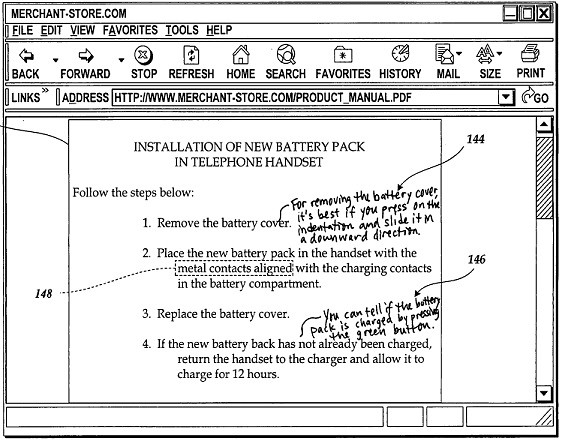
theodp writes "On Tuesday, the USPTO granted Amazon a patent on its Method and System for Providing Annotations of a Digital Work, which covers 'receiving an annotation of the digital work, storing the annotation, and providing the annotation to a user.' This includes annotations received in a graphical or handwriting format, as well as highlighting of text." I think I smell at least one example of prior art. -
Google: Best Adaptation of a Novel To a Patent?
theodp writes "The USPTO's Thursday publication of Google's patent application for Inferring User Interests was nicely-timed, coinciding with what ZDNet called Google's privacy policy doomsday. The inventors include Google Sr. Staff Research Scientist Shumeet Baluja, the author of The Silicon Jungle, a cautionary tale of data mining's promise and peril, which Google's Vint Cerf found 'credible and scary.' No doubt some will feel the same about Beluja's patent filing, which lays out plans for mining 'user generated content, such as user interests, user blogs, postings by the user on her or other users' profiles (e.g., comments in a commentary section of a web page), a user's selection of hosted audio, images, and other files, and demographic information about the user, such as age, gender, address, etc.'" -
Yahoo Unfriends Facebook With Aggressive Patent Demands
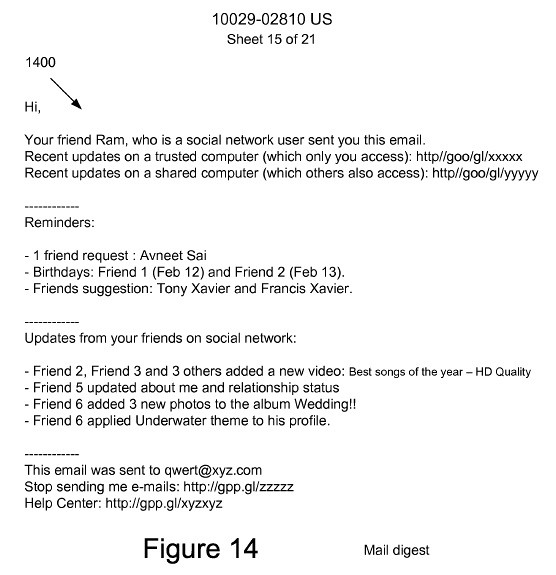
theodp writes "'Hate to see something happen to that multi-billion IPO of yours,' is essentially the IPO-threatening message Yahoo sent to Mark Zuckerberg and Facebook investors on the eve of the social networking giant's IPO. Yahoo, unlike the Sopranos, is using IP as its muscle to collect its IPO-protection money: 'We must insist that Facebook either enter into a licensing agreement [for 10-20 Yahoo-owned patents] or we will be compelled to move forward unilaterally to protect our rights,' Yahoo explained in a statement alerting the NY Times to its demand. Yahoo issued a similar last-minute threat to Google on the eve of its 2004 IPO, prompting Google to pony up 2.7 million shares to settle Yahoo's patent lawsuit. BTW, should Facebook also be concerned that Amazon has been beefing up its PlanetAll social networking patents from the '90s, including the one issued Tuesday covering a Social Networking System Capable of Notifying Users of Profile Updates Made by Their Contacts?" -
IBM Seeks Patent On Judging Programmers By Commits
theodp writes "How'd you like to be deemed unworthy of a job based upon a scan of your GitHub updates? That's what proposed in a newly-published IBM patent application for Automated Analysis of Code Developer's Profile, which proposes weeding out developer candidates for certain roles based on things like the amount of changes one typically makes with each commit, how frequently and regularly one makes commits, what hours of the day one makes commits, the percentage of commits with conflicts that one resolves, and the 'depth' of one's commit comments ('shallow', 'mid-range' or 'deep'). Big Blue explains that commit or repository interactions can be used to produce a 'conclusion report' that compares a developer to others who have profiles on the repository, which helps management 'avoid wasted time with ineffective developers." -
President By Day, High-Tech Headhunter By Night
theodp writes "The White House is following up on an offer made by President Barack Obama this week to help find a job for an unemployed semiconductor engineer in Texas. The offer was made during a live online town hall after the ex-TI engineer's wife questioned the government's policy concerning H-1B visa workers. Obama asked for EE Darin Wedel's resume and said he would 'forward it to some of these companies that are telling me they can't find enough engineers in this field.' While grateful, patent-holder Wedel said the president's view on the job prospects for engineers in his field 'is definitely not what's happening in the real world.' Duke adjunct professor Vivek Wadhwa offered his frank take on 40-year-old Wedel's predicament: 'The No. 1 issue in the tech world is as people get older, they generally become more expensive. So if you're an employer who can hire a worker fresh out of college who is making $60,000 versus an older worker who is making $150,000, and the younger worker has skills that are fresher, who would you hire?' Coincidentally, Texas Instruments sought President Obama's help in reducing restrictions on the hiring of younger foreign workers in 2009, the same year it laid off Wedel." -
Google Patents Caching MLK Day Search Results
theodp writes "Google remembers Dr. Martin Luther King, Jr. not only with its Doodles, but also with its patents. 'Right around the Martin Luther King Holiday,' explained Google in its application for a recently-granted patent on Discovery of Short-Term and Emerging Trends in Computer Network Traffic, 'there may be many searches about "Martin Luther King"...Thus, it would be useful to have better methods of detecting short term trends for the purposes of caching search results to making them more readily available to users.' You may call the invention of detecting and caching 'MLK Day Sale' search results patently obvious, but the USPTO calls it U.S. Patent No. 8,082,342. Hey, at least it's arguably better than the patents issued to Microsoft and Google for avoiding walking or driving down Martin Luther King Boulevard!" -
US Congressmen: Facebook Evading Privacy Questions
An anonymous reader writes "Two U.S. congressmen have accused Facebook of evading questions about whether it tracks users in order to deliver targeted ads. Joe Barton, a Texas Republican, and Edward Markey, a Massachusetts Democrat, said the social networking giant failed to adequately answer questions raised by a patent application that suggests Facebook could be tracking users on other websites. The duo previously asked the Federal Trade Commission to investigate accusations that Facebook tracks its users even after they log out of the social network, an issue the company says it has since fixed." -
IBM Snags Patent On Half-Day Off of Work Notifications
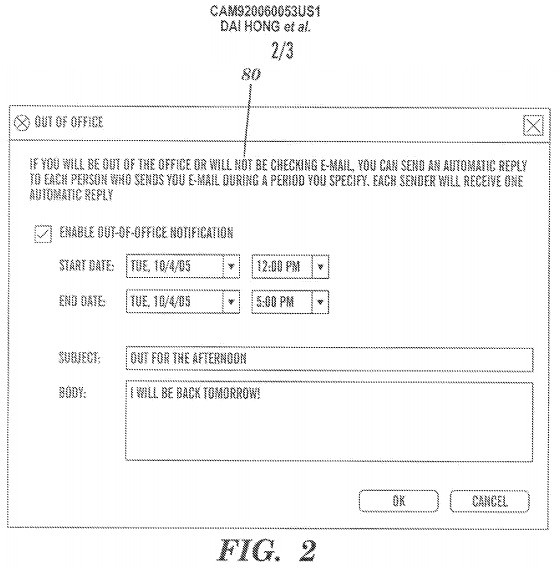
theodp writes "The USPTO appears to have lowered the bar on obviousness, awarding a patent to IBM Tuesday for its System for Portion of a Day Out of Office Notification. 'Out of office features in existing applications such as Lotus Notes, IBM Workplace, and Microsoft Outlook all implement a way to take a number of days off from one day to many days,' acknowledges purported patent reformer Big Blue. 'Yet, none of these applications contain the feature of letting a person take a half-day or in more general terms, x days and x hours off.' Eureka! And yes, the invention is every bit as obvious as you can imagine." -
IBM Granted Your-Paychecks-Are-What-You-Eat Patent
theodp writes "On IBM's Smarter Planet, at least as envisioned in Big Blue's recently-granted patent for 'providing consumers with incentives for healthy eating habits', the FDA will team up with employers and insurers to determine your final paycheck based upon what you eat. IBM explains that whether a given food item is considered healthy may vary based on a number of factors, including 'individual health histories, family health histories, food intake, exercise routines, medications, and other health related factors', and may even be time dependent ('incentives are greater for consumption of a particular food item during a designated lunch time and less for consumption of the particular food item during other periods of time'). Before being issued, IBM's patent request languished for ten years and was only granted after a Patent Examiner's rejection was overturned on appeal. IBM CEO Sam Palmisano has been a cheerleader for pay-for-monitored-healthy-eating on a national level, which seems to be neatly aligned with the goals of his fellow CEOs on the Business Rountable, who told President Obama in 2009, 'It's very important that we don't have a government [healthcare] plan competing with a private plan and finding out that our employees or the citizens in general could go to a plan that doesn't have the same incentives and requirements and behavioral characteristics to make sure that they do the right things long term'." -
Amazon Patents Deducing Religion From Gift Wrap
theodp writes "If you're the giver or recipient of presents gift-wrapped by Amazon, you may want to take a gander at U.S. Patent No. 8,060,463, granted to Amazon last month for Mining of User Event Data to Identify Users with Common Interests. Among other things, Amazon explains the invention can be used to identify recipients of gifts as Christian or Jewish based on wrapping paper. From the patent: 'The gift wrap used by such other users when purchasing gifts for this user, such as when the gift wrap evidences the user's religion (in the case of Christmas or Hanukkah gift wrap, for example.)'" -
ITC Judge: Motorola Mobility Infringed Microsoft Patent
chrb writes "An International Trade Commission judge has issued a preliminary ruling that Motorola Mobility infringed one of Microsoft's patents. The disputed patent covers storing a meeting request on a mobile device, and was rejected by the European Patent Office as being 'obvious.' The judge also ruled that six other Microsoft patents were not being infringed. Experts say that this will strengthen Microsoft's hand in collecting patent fees on Android. Microsoft recently claimed that it now collects patent fees on over half of all Android devices sold." -
Apple Patents Using Apps During Calls
bizwriter writes "Apple has had quite a week in patents for the iPhone, and it's only Tuesday. First was the victory at the International Trade Commission over HTC. And now there's a shiny new patent on switching to an app during a live phone call (#8,082,523). There may be non-infringing ways of doing something similar, but they probably will be clumsy in comparison." -
Apple Wins Injunction Banning Import of HTC Devices
Newly accepted submitter squish18 writes "All Things D reports that Apple has won an injunction banning the import of some HTC phones starting in April 2012. The ruling by the ITC stems from two claims of the '647 patent concerning software used to enter personal data in mobile devices. It is interesting to note that the ITC has also reversed previous rulings regarding regarding infringement of two other '647 claims, as well as patent '263 claims." It looks like Apple's victory is relatively minor. They lost claims on all patents except for one, and HTC/Google can work on implementing similar functionality in a non-infringing way. -
Apple Wins Injunction Banning Import of HTC Devices
Newly accepted submitter squish18 writes "All Things D reports that Apple has won an injunction banning the import of some HTC phones starting in April 2012. The ruling by the ITC stems from two claims of the '647 patent concerning software used to enter personal data in mobile devices. It is interesting to note that the ITC has also reversed previous rulings regarding regarding infringement of two other '647 claims, as well as patent '263 claims." It looks like Apple's victory is relatively minor. They lost claims on all patents except for one, and HTC/Google can work on implementing similar functionality in a non-infringing way. -
Google Awarded Driverless Vehicle Patent
theodp writes "On Tuesday, Google was awarded U.S. Patent No. 8,078,349 for methods and devices for Transitioning a Mixed-mode Autonomous Vehicle from a Human Driven Mode to an Autonomously Driven Mode. From the fast-tracked patent application, which was filed last May and kept under wraps at Google's request: 'The autonomous vehicle may be used as a virtual tour guide of Millennium Park in Chicago. In the example embodiment, the vehicle may have an instruction to drive to the Cloud Gate (Silver Bean) sculpture at Millennium Park. When the vehicle arrives, the autonomous instruction may tell it to wait in the location for a predetermined amount of time, for example 5 minutes. The instruction may then direct the vehicle to drive to the Crown Fountain at Millennium Park and again wait for 5 minutes. Next, the instruction may tell the vehicle to drive to the Ice Rink at Millennium Park and wait for another predetermined amount of time. Finally, the vehicle instruction may tell the vehicle to return to its starting position.'" -
Amazon Granted Location Tracking Patent
bizwriter writes "A new patent for Amazon just put the company squarely in the location tracking controversy. It covers a system to not only track, through mobile devices, where individuals or aggregated users have been, but to determine where they're likely to go next to better target ads, coupons, or other messages that could appear on a mobile phone or on displays that individuals are likely to see in their travels. The system could also use someone's identity to further tailor the marketing according to demographic information." -
Google Throws /. Under Bus To Snag Patent
theodp writes "Before Danny Hillis and Bran Ferren invented Google's newly-patented system for 'Delegating Authority to Evaluate Content', Google says users looking for content evaluation websites were condemned to the likes of Amazon.com and Slashdot. From the patent: 'Many sites found on the World Wide Web allow users to evaluate content found within the site. The Slashdot Web site (www.slashdot.org) allows users to "mod" comments recently posted by other users. Based on this information obtained from the users, the system determines a numerical score for each comment ranging from 1 to 5.' The problem with sites like Slashdot, Google told the USPTO, is that 'because there is no restriction on the users that may participate, the reliability of the ratings is correspondingly diminished.' Commissioning a small number of trusted evaluators or editors would increase the reliability of the evaluations, Google notes, but wouldn't allow nearly as much content to be evaluated. Google's solution? Allow trusted evaluators to transfer a 'quantity of authority' to like-minded 'contributing authorities', who in turn designate and delegate authority to additional like-minded contributing authorities. Think Microsoft Outlook 97 Delegate Access meets Slashdot Karma Points, and you've got the general idea!" -
Amazon, Apple, Microsoft, and Google Chase 'Got Milk?' Patents
theodp writes "Among the new iOS 5 features is Reminders, which Apple explains this way: 'Say you need to remember to pick up milk during your next grocery trip. Since Reminders can be location based, you'll get an alert as soon as you pull into the supermarket parking lot.' But does Reminders infringe on a newly-granted patent to Amazon for Location Aware Reminders, which covers the use of location based reminders to remind a user 'to purchase certain items such as, for example, as milk, bread, and eggs'? Or could Reminders run afoul of Google's new patent for Geocoding Personal Information, which covers triggering a voice reminder or making a computing device vibrate when a user approaches a location if 'one of the user's events is a task to pick up milk and bread'? Not to be left out of the 'Got Milk?' patent race, Apple also has a patent pending for Computer Systems and Methods for Collecting, Associating, and/or Retrieving Data, which covers providing a reminder to a user whose 'to do' list includes 'get milk' when the user's location matches 'a store that sells the item "milk."' (Continues, below.) theodp continues: "That should not be confused with Microsoft's pending patent for Geographic Reminders, which allows users to specify reminders such as 'pick up milk if I am within a ten minutes drive of any grocery store.' That all four tech giants chose to pursue remember-the-milk patents — and the USPTO is considering and granting them — is all the more remarkable considering that Microsoft suggested location-based reminders were obvious in a 2005 patent filing, which informed the USPTO that 'a conventional reminder application may give the user relevant information at a given location, such as 'You're near a grocery store, and you need milk at home.' So much for that immediate patent quality improvement promised by the America Invents Act!" -
Amazon, Apple, Microsoft, and Google Chase 'Got Milk?' Patents
theodp writes "Among the new iOS 5 features is Reminders, which Apple explains this way: 'Say you need to remember to pick up milk during your next grocery trip. Since Reminders can be location based, you'll get an alert as soon as you pull into the supermarket parking lot.' But does Reminders infringe on a newly-granted patent to Amazon for Location Aware Reminders, which covers the use of location based reminders to remind a user 'to purchase certain items such as, for example, as milk, bread, and eggs'? Or could Reminders run afoul of Google's new patent for Geocoding Personal Information, which covers triggering a voice reminder or making a computing device vibrate when a user approaches a location if 'one of the user's events is a task to pick up milk and bread'? Not to be left out of the 'Got Milk?' patent race, Apple also has a patent pending for Computer Systems and Methods for Collecting, Associating, and/or Retrieving Data, which covers providing a reminder to a user whose 'to do' list includes 'get milk' when the user's location matches 'a store that sells the item "milk."' (Continues, below.) theodp continues: "That should not be confused with Microsoft's pending patent for Geographic Reminders, which allows users to specify reminders such as 'pick up milk if I am within a ten minutes drive of any grocery store.' That all four tech giants chose to pursue remember-the-milk patents — and the USPTO is considering and granting them — is all the more remarkable considering that Microsoft suggested location-based reminders were obvious in a 2005 patent filing, which informed the USPTO that 'a conventional reminder application may give the user relevant information at a given location, such as 'You're near a grocery store, and you need milk at home.' So much for that immediate patent quality improvement promised by the America Invents Act!" -
Amazon, Apple, Microsoft, and Google Chase 'Got Milk?' Patents
theodp writes "Among the new iOS 5 features is Reminders, which Apple explains this way: 'Say you need to remember to pick up milk during your next grocery trip. Since Reminders can be location based, you'll get an alert as soon as you pull into the supermarket parking lot.' But does Reminders infringe on a newly-granted patent to Amazon for Location Aware Reminders, which covers the use of location based reminders to remind a user 'to purchase certain items such as, for example, as milk, bread, and eggs'? Or could Reminders run afoul of Google's new patent for Geocoding Personal Information, which covers triggering a voice reminder or making a computing device vibrate when a user approaches a location if 'one of the user's events is a task to pick up milk and bread'? Not to be left out of the 'Got Milk?' patent race, Apple also has a patent pending for Computer Systems and Methods for Collecting, Associating, and/or Retrieving Data, which covers providing a reminder to a user whose 'to do' list includes 'get milk' when the user's location matches 'a store that sells the item "milk."' (Continues, below.) theodp continues: "That should not be confused with Microsoft's pending patent for Geographic Reminders, which allows users to specify reminders such as 'pick up milk if I am within a ten minutes drive of any grocery store.' That all four tech giants chose to pursue remember-the-milk patents — and the USPTO is considering and granting them — is all the more remarkable considering that Microsoft suggested location-based reminders were obvious in a 2005 patent filing, which informed the USPTO that 'a conventional reminder application may give the user relevant information at a given location, such as 'You're near a grocery store, and you need milk at home.' So much for that immediate patent quality improvement promised by the America Invents Act!" -
Amazon, Apple, Microsoft, and Google Chase 'Got Milk?' Patents
theodp writes "Among the new iOS 5 features is Reminders, which Apple explains this way: 'Say you need to remember to pick up milk during your next grocery trip. Since Reminders can be location based, you'll get an alert as soon as you pull into the supermarket parking lot.' But does Reminders infringe on a newly-granted patent to Amazon for Location Aware Reminders, which covers the use of location based reminders to remind a user 'to purchase certain items such as, for example, as milk, bread, and eggs'? Or could Reminders run afoul of Google's new patent for Geocoding Personal Information, which covers triggering a voice reminder or making a computing device vibrate when a user approaches a location if 'one of the user's events is a task to pick up milk and bread'? Not to be left out of the 'Got Milk?' patent race, Apple also has a patent pending for Computer Systems and Methods for Collecting, Associating, and/or Retrieving Data, which covers providing a reminder to a user whose 'to do' list includes 'get milk' when the user's location matches 'a store that sells the item "milk."' (Continues, below.) theodp continues: "That should not be confused with Microsoft's pending patent for Geographic Reminders, which allows users to specify reminders such as 'pick up milk if I am within a ten minutes drive of any grocery store.' That all four tech giants chose to pursue remember-the-milk patents — and the USPTO is considering and granting them — is all the more remarkable considering that Microsoft suggested location-based reminders were obvious in a 2005 patent filing, which informed the USPTO that 'a conventional reminder application may give the user relevant information at a given location, such as 'You're near a grocery store, and you need milk at home.' So much for that immediate patent quality improvement promised by the America Invents Act!" -
Amazon, Apple, Microsoft, and Google Chase 'Got Milk?' Patents
theodp writes "Among the new iOS 5 features is Reminders, which Apple explains this way: 'Say you need to remember to pick up milk during your next grocery trip. Since Reminders can be location based, you'll get an alert as soon as you pull into the supermarket parking lot.' But does Reminders infringe on a newly-granted patent to Amazon for Location Aware Reminders, which covers the use of location based reminders to remind a user 'to purchase certain items such as, for example, as milk, bread, and eggs'? Or could Reminders run afoul of Google's new patent for Geocoding Personal Information, which covers triggering a voice reminder or making a computing device vibrate when a user approaches a location if 'one of the user's events is a task to pick up milk and bread'? Not to be left out of the 'Got Milk?' patent race, Apple also has a patent pending for Computer Systems and Methods for Collecting, Associating, and/or Retrieving Data, which covers providing a reminder to a user whose 'to do' list includes 'get milk' when the user's location matches 'a store that sells the item "milk."' (Continues, below.) theodp continues: "That should not be confused with Microsoft's pending patent for Geographic Reminders, which allows users to specify reminders such as 'pick up milk if I am within a ten minutes drive of any grocery store.' That all four tech giants chose to pursue remember-the-milk patents — and the USPTO is considering and granting them — is all the more remarkable considering that Microsoft suggested location-based reminders were obvious in a 2005 patent filing, which informed the USPTO that 'a conventional reminder application may give the user relevant information at a given location, such as 'You're near a grocery store, and you need milk at home.' So much for that immediate patent quality improvement promised by the America Invents Act!" -
Microsoft Patent Aims To Curb Obnoxious Employee Behavior
theodp writes "GeekWire reports that a pending Microsoft patent for monitoring workplace behavior would do Dwight Schrute proud. Three Microsoft inventors propose curbing obnoxious workplace habits in an equally obnoxious fashion — using a computer device for monitoring and analyzing workers' interactions over video conferences, telephone, text messages and other forms of digital communication to look for patterns of negative and positive behavior, and assigning behavior scores to employees based on what the system finds. Bad behavior, Microsoft explains, might include wearing dark glasses in a video conference, wearing unacceptable clothing to a business meeting, cutting off others during conversation, prolonged monologues, and even how one nods one's head in agreement, shakes one's head indicating disagreement, and makes hand gestures." -
Apple's New Patent Weapon — Location Services
DaveyJJ writes "Once again, it seems Apple is about to take intellectual property claims to a new level. Apple has been reissued a patent they acquired from Xerox that pretty much wraps up what we know as 'location services' as their own. In the overview, the patent says the system involved will display information specific to the location the device is in. The language used in the patent is broad and powerful. I guess now we wait and see whom Apple will use this against?" -
White House Responds To Software Patents Petition
New submitter obliv!on writes "As previously discussed, the White House has started to reply to petitions on their 'We the People' website. They've now replied to the petition asking for an end to software patents. The response mentions the America Invents Act and encourages the use of the USPTO's open implementation website. Quoting: 'There's a lot we can do through the new law to improve patent quality and to ensure that only true inventions are given patent protection. But it's important to note that the executive branch doesn't set the boundaries of what is patentable all by itself. Congress has set forth broad categories of inventions that are eligible for patent protection. The courts, including the U.S. Supreme Court, have interpreted the statute to include some software-related inventions.' The response goes on to denote some open source and open data initiatives in government. It's nice to hear that the administration understands 'concerns that overly broad patents on software-based inventions may stifle the very innovative and creative open source software development community.' However, the overall response redirects action to the petitioners through participating in the open implementation site and contacting Congress, instead of a promise to prepare additional legislative measures for Congress to consider on behalf of the petitioners." -
Apple Granted Patent For Slide To Unlock
generalhavok writes "The United States Patent & Trademark Office has approved Apple's patent on the slide to unlock gesture used on iOS devices. Interestingly, this patent was earlier dismissed in Europe due to prior art. With many Android phones using a similar slide gesture, it will be interesting to see how this new patent will affect the patent wars between Apple and Android vendors." -
Acacia Sues Amazon Over Kindle Fire
walterbyrd writes "A company called Smartphone Technologies filed the suit last Friday in Texas Eastern District Court accusing the Kindle Fire tablet of violating four of its patents. Smartphone Technologies is owned by Acacia Research, a firm that buys and licenses patents and is seen by many as a patent troll. 'One patent cited in the suit, U.S. Patent No. 6,956,562, simply refers to a method for using a touch screen to enter commands on a handheld computer. Another patent in question relates to a method for storing calendars on a PDA and was initially issued to Palm in 2002.'" -
Acacia Sues Amazon Over Kindle Fire
walterbyrd writes "A company called Smartphone Technologies filed the suit last Friday in Texas Eastern District Court accusing the Kindle Fire tablet of violating four of its patents. Smartphone Technologies is owned by Acacia Research, a firm that buys and licenses patents and is seen by many as a patent troll. 'One patent cited in the suit, U.S. Patent No. 6,956,562, simply refers to a method for using a touch screen to enter commands on a handheld computer. Another patent in question relates to a method for storing calendars on a PDA and was initially issued to Palm in 2002.'" -
Apple Tries To Patent 3rd Party In-App Purchasing
bizwriter writes "Apple has spared no effort in trying to injure its arch mobile rival through the courts, like blocking Android vendors from important markets through patent and trademark infringement suits. Now it's developing an additional angle: an attempt to patent in-application purchases from third parties, as an application filed on April 26, 2010 and made public on Thursday made clear." -
Dan Shechtman Wins Chemistry Nobel For Quasicrystals
Stirling Newberry writes with word that Dan Shechtman of Israel's Technion has won the Nobel prize in chemistry for his discovery of quasicrystals, and provides a short description of why quasicrystals are exciting: "Quasicrystals fill space completely, but do not repeat, even though they show self-similar patterns, the way pi has order, but doesn't repeat. That is, they tessellate in an ordered way, but do not have repeating cells. In art, Girih tiles showed the essential property of being able to cover an infinite space, without repeating. In mathematics, Hao Wang came up with a set of tiles that any Turing Machine could be represented by, and conjectured that they would eventually always repeat. He turned out to be wrong, and over the next decades, tiles that did not repeat, but showed order, were discovered, most famously, though not first, by Penrose. Physically, when x-rays diffract, that is are scattered, from a crystal, they form a discrete lattice. Quasicrystals also have an ordered diffraction pattern, and it tiles the way ordered non-repeating tiles do. Quasicrystal patterns were known before Shechtman labelled them. So why care? Because crystals have only certain symmetries, and that determines their physical properties. Quasicrystals can have different symmetries, and do not bind regularly, and so different physical properties – which means new kinds of materials. Some examples: highly ductile steel, and, in something that is a bit of a by-word among people who study them, cooking utensils." -
Facebook Files For a Patent To Track Its Users On Other Sites
suraj.sun sends word that a recent Facebook patent application details specific methods for tracking its users while they're using other websites. Michael Arrington pointed out over the weekend that this follows explicit statements from Facebook employees that the social networking giant has "no interest in tracking people." Quoting the Patent Application: "In one embodiment, a method is described for tracking information about the activities of users of a social networking system while on another domain. The method includes maintaining a profile for each of one or more users of the social networking system, each profile identifying a connection to one or more other users of the social networking system and including information about the user. The method additionally includes receiving one or more communications from a third-party website having a different domain than the social network system, each message communicating an action taken by a user of the social networking system on the third-party website. The method additionally includes logging the actions taken on the third-party website in the social networking system, each logged action including information about the action." -
Purdue Researchers Demonstrate Low-Power, Fast FeTRAM Memory
eldavojohn writes "Researchers at Purdue University's Birck Nanotechnology Center have released news of a proof of concept new ferroelectric transistor random access memory or 'FeTRAM.' This new technology is nonvolatile and the researchers claim it could use up to 99% less energy than current flash memory. Unlike most FeRAM technology that uses a capacitor, FeTRAM provides nondestructive readout by storing information using a ferroelectric transistor instead. From the article: 'The new technology also is compatible with industry manufacturing processes for complementary metal oxide semiconductors, or CMOS, used to produce computer chips. It has the potential to replace conventional memory systems.' So if they get this into production, you might not have to worry about your laptop cooking your genitals. They've been published in ACS (paywalled) and the professor leading the research has many patents filed relating to transistor nanotechnology." -
IBM Seeks Patent On Retailer-Rigged Driving Routes
theodp writes "On IBM's Smarter Planet, you may drive further than need be to get to your destination. Big Blue's pending patent for Determining Travel Routes by Using Fee-Based Location Preferences calls for the likes of Walmart, Starbucks, and Best Buy pay a fee in return for having your route calculation service de-optimize driving instructions to make you do a drive-by of their stores, and an additional fee if GPS tracking of your car indicates you actually took the suboptimal route. The same IBM inventors also have a patent pending for Environmental Stewardship Based on Driving Behavior, which calls for yet another fee to be assessed when a retailer-friendly-but-suboptimal route causes your vehicle to enter a congested area and produce more pollution." -
IBM Seeks Patent On Retailer-Rigged Driving Routes
theodp writes "On IBM's Smarter Planet, you may drive further than need be to get to your destination. Big Blue's pending patent for Determining Travel Routes by Using Fee-Based Location Preferences calls for the likes of Walmart, Starbucks, and Best Buy pay a fee in return for having your route calculation service de-optimize driving instructions to make you do a drive-by of their stores, and an additional fee if GPS tracking of your car indicates you actually took the suboptimal route. The same IBM inventors also have a patent pending for Environmental Stewardship Based on Driving Behavior, which calls for yet another fee to be assessed when a retailer-friendly-but-suboptimal route causes your vehicle to enter a congested area and produce more pollution." -
Amazon's Bezos Seeks Spacecraft Patents
An anonymous reader writes "Design News reports that Amazon.com founder Jeff Bezos is seeking patents related to his 'Blue Origin' commercial space venture. Blue Origin was recently in the news when Bezos quietly admitted that its second test capsule launch in August went out of control at 47,000 feet. The head scratcher with the patents, according to Design News, is that one is for a two-stage rocket, which doesn't seem particularly novel. What is unique, and questionable as to whether it will work, is patent application 20110017872 for 'Sea Landing of Space Launch Vehicles and Associated Systems and Methods.' This one has a reusable rocket going up into suborbital flight, then the booster stage reenters the earth's atmosphere in a tail-first orientation and lands upright on a ship (boat)." -
USPTO Issues 8,000,000th Patent
toybuilder writes "It took nearly 80 years for the first 1 million patents to issue in the U.S. On Tuesday, the U.S. Patent and Trademark Office issued its eight-millionth patent. This most recent 1 million patents took only about 5 years." -
Jeff Bezos Wants To Put an Airbag In Your iPhone
theodp writes "Don't want to pay Apple $199 to repair the cracked screen of the $199 iPhone you dropped? Neither, apparently, does Amazon CEO Jeff Bezos. A patent application made public Thursday lists Bezos as an inventor of 'a system and method for protecting devices from impact damage,' which proposes using airbags, springs, and even a jet propulsion system to keep your iPhones, iPads, and other portable devices safe and out of the clutches of the Genius Bar. Let's hope there's an API — those gas cartridges could be a game-changer for fart apps!" -
Apple Patents Portrait-Landscape Flipping
theodp writes "On Tuesday, the USPTO granted a patent to Apple for Portrait-landscape rotation heuristics for a portable multifunction device (USPTO), which covers 'displaying information on the touch screen display in a portrait view or a landscape view based on an analysis of data received from the one or more accelerometers.' Perhaps the USPTO Examiners didn't get a chance to review the circa-1991 Computer Chronicles video of the Radius Pivot monitor before deeming Apple's invention patentable. Or check out the winning touchArcade trivia contest entry, which noted the circa-1982 Corvus Concept sported a 15-inch, high-resolution, bit-mapped display screen that also flipped between portrait and landscape views when rotated, like our friend the iPhone. Hey, everything old is new again, right?" -
Lawyer Attempts To Trademark Bitcoin
An anonymous reader writes "A NY based lawyer has submitted an application to the US Patent and Trademark Office claiming first use of the term bitcoin on June 22nd, 2011. The evidence of first use in the form of a letter detailing his wife's offer to sell "bitcoin" for $17.50 on June 23rd. A pdf extolling the virtues of bitcoin has also been uploaded to his law firms webpage." -
Facebook Locks Down Social Gift Giving Patent
bizwriter writes "Facebook has been on a roll of late, nailing a number of patent grants that will help it retain dominance in social networking by creating barriers for competitors. Yesterday came patent number 7,970,657, 'Giving gifts and displaying assets in a social network environment'. Although it doesn't directly prevent other social networks from enabling gift giving among users, a clever legal and technical maneuver makes it far more difficult."