Slashdot Mirror
Domain: uspto.gov
Stories and comments across the archive that link to uspto.gov.
Stories · 664
-
USPTO Publishes Suggestions For Intellectual Property Enforcement
First time accepted submitter rjkimble writes "In June, the USPTO solicited proposals for voluntary best practices supporting intellectual property enforcement, especially against infringement that occurs online. It received 23 responses from individuals and organizations, including Google, the EFF, and the MPAA and RIAA. [On Wednesday] they were posted to the USPTO web site." -
Google Patents "Scroogling"
theodp writes "In Microsoft's eyes, the idea of scanning Gmail so advertisers can bid on access to those suffering from breast cancer, bi-polar disorder, depression, and panic anxiety, deserves no kudos. The USPTO, on the other hand, feels it deserves a patent. GeekWire reports that Google has been awarded a patent on "Scroogling", aka its system and method for targeting information based on message content in a reply. Google takes some jabs at Microsoft in the diagrams accompanying the patent, including one implying that MS-Access and Excel files pose security risks, and another that suggests alternatives to Access." -
Uncle Sam Finally Wants To Hear From Us On Digital Copyright Law?
NewYorkCountryLawyer writes "Can it be true? The US government claims it really wants to hear from us on the subject of how copyright law needs to be modified to accommodate the developing technology of the digital age? I don't know, but the US Patent & Trademark Office (which btw has nothing to do with administering copyright) says 'we really want to hear from you' and the Department of Commerce Internet Policy Task Force wrote a 122-page paper (PDF) on the subject, so they must really mean it, right? But I couldn't find the address to which to send my comments, so maybe that was an oversight on their part." -
Uncle Sam Finally Wants To Hear From Us On Digital Copyright Law?
NewYorkCountryLawyer writes "Can it be true? The US government claims it really wants to hear from us on the subject of how copyright law needs to be modified to accommodate the developing technology of the digital age? I don't know, but the US Patent & Trademark Office (which btw has nothing to do with administering copyright) says 'we really want to hear from you' and the Department of Commerce Internet Policy Task Force wrote a 122-page paper (PDF) on the subject, so they must really mean it, right? But I couldn't find the address to which to send my comments, so maybe that was an oversight on their part." -
Bill Gates Seeking Patent To Make Shakespeare Less Boring
theodp writes "GeekWire reports that Bill Gates and Nathan Myhrvold are seeking a patent on making textbooks less boring by using a cellphone or other device to scan text on a page, parse its meaning, and automatically create suitable accompanying video or pictures to keep students engaged. From the patent application for Autogenerating Video From Text: 'A student is assigned a reading assignment. To make the assignment more interesting, the student may use his or her mobile phone to take a picture of a page of the textbook. The systems and methods described herein may then generate a synthesized image sequence of the action occurring in the text. Thus, rather than simply reading names and dates, the student may see soldiers running across a battlefield.' Furthermore, the patent explains, the experience may be tailored to a user's preferences: 'For example, in a video clip about a Shakespearean play, the preference data may be used to insert family members into the video clip instead of the typical characters.'" -
Administration Seeks To Make Unauthorized Streaming A Felony
wabrandsma writes "From the Washington Post: 'You probably remember the online outrage over the Stop Online Piracy Act (SOPA) copyright enforcement proposal. Last week, the Department of Commerce's Internet Policy Task Force released a report on digital copyright policy that endorsed one piece of the controversial proposal: making the streaming of copyrighted works a felony. As it stands now, streaming a copyrighted work over the Internet is considered a violation of the public performance right. The violation is only punishable as a misdemeanor, rather than the felony charges that accompany the reproduction and distribution of copyrighted material.'" -
Google Patents Displaying Athletes On Sports Fields
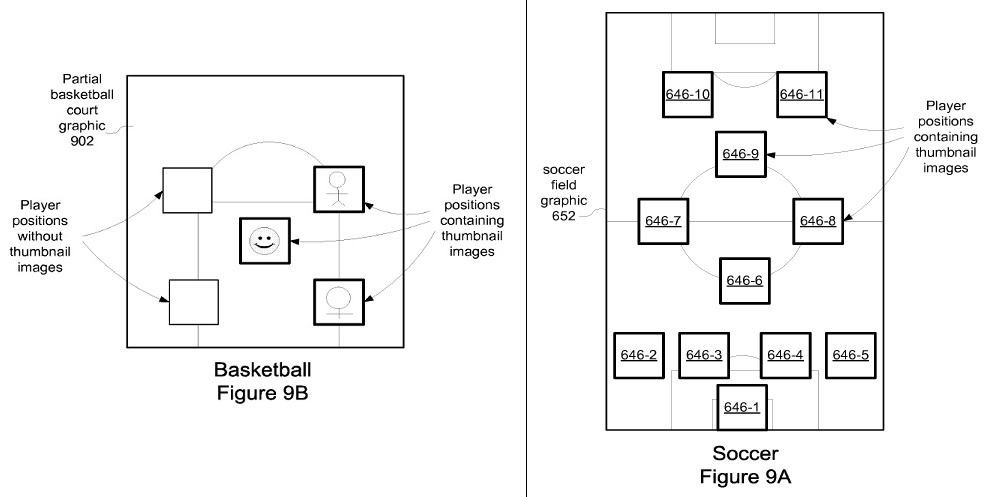
theodp writes "Just about anyone that's familiar with sports has seen position and depth charts, in which athletes are portrayed on the athletic fields their sport is played on. But that didn't stop Google from asking for — and the USPTO granting — a patent on displaying pictures of athletes on the fields on which their sport is played, or in legal-speak, its Method, System, and Graphical User Interface for Personalized Online Sports Team Charts. 'One aspect of the invention,' explains Google, 'involves a graphical user interface on a computer that includes a graphic of an athletic playing field or a portion thereof, and a plurality of player positions on the athletic field. At least some of the player positions contain thumbnail images selected by a first user. The thumbnail images provide links to corresponding profiles in an online social network.' Six Googlers, including Orkut Buyukkokten, were credited as inventors in the 2007 patent application." -
Apple Files Patent For New Proprietary Port
rwise2112 writes "Apple proposes a solution to multiple port requirements within limited space: the two in one port. The port is described as a 'Combined Input Port,' where two different interfaces could be in one port. The input port includes an outer wall defining a receiving aperture, a substrate positioned within the receiving aperture. One set of contacts is configured to communicate with a first connector and the second set of contacts is configured to communicate with a second connector. Looks like another addition to the special Apple cable lineup." -
Google Patents Image-Capturing Walking Sticks
theodp writes "GeekWire reports that Google has patented an image-capturing walking stick, which can boldly go where no Google Street View Car can. The walking stick has embedded cameras and location sensors, and a switch at the bottom that causes the device to snap pictures whenever the stick hits the ground. The patent also covers using canes and crutches in a similar fashion." -
Apple Files Patent For Digital Wallet and Virtual Currency
another random user writes "Apple has applied for a patent on a combined virtual currency and digital wallet technology that would allow you to store money in the cloud, make payments with your iPhone, and maybe communicate with point-of-sale terminals via NFC. The patent application, published [Thursday] by the U.S. Patent and Trademark Organization, details how iPhone users could walk into a store, pay for goods with their phone, and walk out with their merchandise. Though Apple is late to the virtual wallet game, that doesn't seem to stop them trying to patent the process. There does not appear to be anything in the patent application which describes something that can't already be done." -
Microsoft Patents "Cartoon Face Generation"
theodp writes "The latest round of patents granted by the USPTO included one for Cartoon Face Generation, an invention which Microsoft explains 'generates an attractive cartoon face or graphic of a user's facial image'. Microsoft adds, 'The style of cartoon face achieved resembles the likeness of the user more than cartoons generated by conventional vector-based cartooning techniques. The cartoon faces thus achieved provide an attractive facial appearance and thus have wide applicability in art, gaming, and messaging applications in which a pleasing degree of realism is desirable without exaggerated comedy or caricature.' A Microsoft Research Face SDK Beta is available. Hey, too bad Microsoft didn't have this technology when they generated Bob from Ralphie!" -
Google Seeks 'Do-No-Discoverable-Evil' Patent
theodp writes "E-mails and other communications between employees,' explains Google in a newly-published patent application for its Policy Violation Checker invention, 'can implicate potential violations of company policy or local, state or federal law that can go unchecked by attorneys or other legal personnel.' So how can you avoid those embarrassing Goldman Sachs and Enron e-mail gaffes? Use Google's 'methods and systems for identifying problematic phrases in an electronic document'! From the patent application: 'Documents may be used as evidence in court, administrative, or other proceedings. It is in a company's best interest to minimize or eliminate policy violations and/or situations that could give rise to legal liability. It is also often in a company's best interest to be able to Pack [?] these situations. Problematic phrases include, but are not limited to, phrases that present policy violations, have legal implications, or are otherwise troublesome to a company, business, or individual.' So, if you can't Do-No-Evil, at least you can Do-No-Discoverable-Evil!" -
Move Over Apple - Samsung Files For a Patent On Page Turn
Nate the greatest writes "Remember last year when Apple received a patent on the faux page curl in iBooks? Lots of people laughed at the idea that Apple could patent the page turn, but not Samsung. The gadget maker has just filed for their own page turn patent. The paperwork explains in great detail what the page turn looks like, how the software would work, and what on screen gestures could be used to turn the page." -
Bezos Patenting 'Dumb' Tablets, Glasses, Windshields
theodp writes "GeekWire reports on Amazon CEO Jeff Bezos' pending patent on remote displays that communicate with base stations and operate on wireless power. Reducing devices to mere screens with minimal storage that receive pre-rendered content (e.g., bitmap images), the patent application explains, eliminates the need for bulky batteries or processors, and employing techniques like electromagnetic or electrostatic induction allows one to cut the cord completely. Such remote displays, Amazon suggests, could find a home on college campuses (tablets), in your car (windshield displays or DVD players), and even on your face (eyeglasses)." There's already a (not wirelessly powered) device similar to the one described in the patent. -
Google Reportedly Making a Smartwatch, Too
judgecorp writes "With Samsung and (reportedly) Apple already making smartwatches, Google has now joined the party, according to a (paywalled) report in the Financial Times. The Google Watch is apparently being made by the Android group, and could have some synergy with Google's other wearable tech — the Glass spectacles. The distinctive thing in Google's patent seems to be having two displays — one for public data and a flip-up one for more private stuff." -
Mobile Sharing: "Bezos Beep" Vs. Smartphone Bump
theodp writes "GeekWire wonders if the 'Bezos Beep' could replace the smartphone bump for mobile content sharing. A newly-published patent application listing Amazon CEO Jeff Bezos as sole inventor describes the use of audio signals to share content and communicate between devices, eliminating the need for NFC chips and facilitating the simultaneous sharing of content with multiple people via a remote server. From the patent application: 'For example, a first device can emit an encoded audio signal that can be received by any capable device within audio range of the device. Any device receiving the signal can decode the information included in the signal and obtain a location to access the content from that information.'" -
Apple Patent Describes iTunes Reselling and Loaning System
An anonymous reader writes "An Apple patent granted on 7 March details a system allowing customers to resell iTunes and iBooks content to other users at a reduced price, or to loan the content temporarily for free. Such a system could pave the way for second hand content being made available on iTunes for a discounted price." (Note: Beware the auto-playing video ad, with sound.) -
Microsoft: the 'Scroogled' Show Must Go On
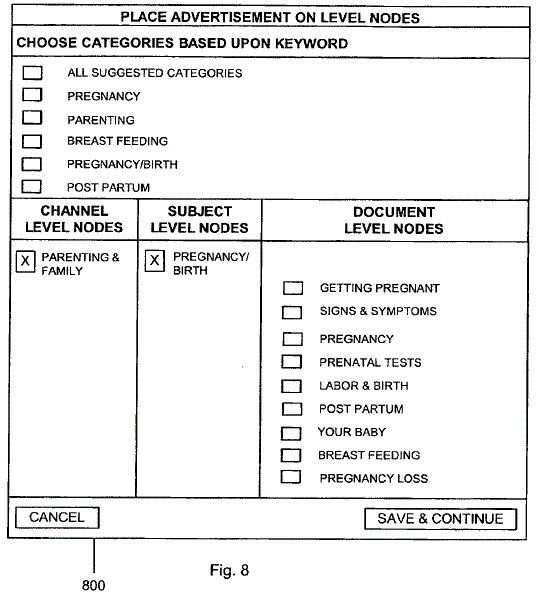
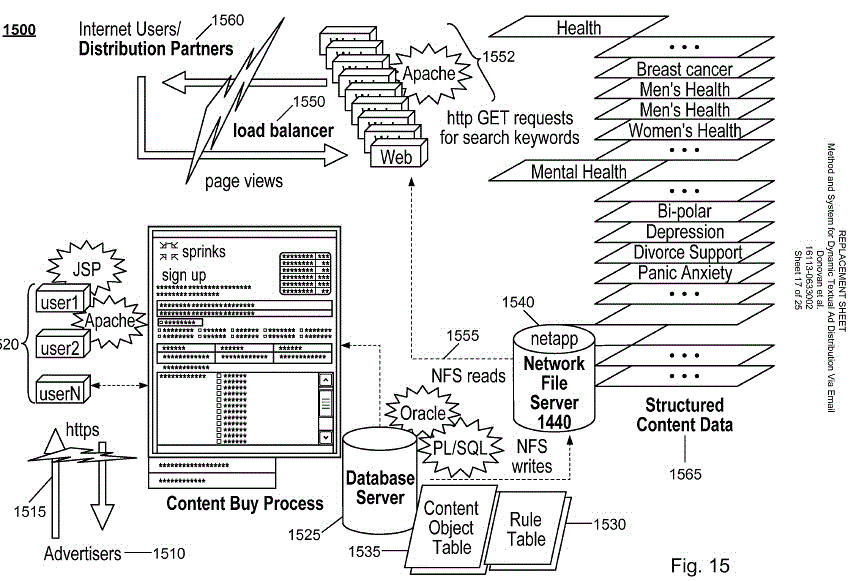
theodp writes "Microsoft says that the death of its 'Scroogled' ad campaign against Google has been greatly exaggerated. 'Scroogled will go on as long as Google keeps Scroogling people,' said a Microsoft spokesperson. 'Nearly 115,000 people signed a petition asking Google to stop going through their Gmail.' So, is Microsoft's scare campaign justified? Well, in a recently-published patent application for a Method and System for Dynamic Textual Ad Distribution Via Email, Google explains how its invention can be used to milk more money from advertisers by identifying lactating Moms, which might make some uneasy. Google also illustrates how advertisers can bid on access to those suffering from breast cancer, bi-polar disorder, depression, and panic anxiety. Hey, what could possibly go wrong?" -
Google Patents Staple of '70s Mainframe Computing
theodp writes "'The lack of interest, the disdain for history is what makes computing not-quite-a-field,' Alan Kay once lamented. And so it should come as no surprise that the USPTO granted Google a patent Tuesday for the Automatic Deletion of Temporary Files, perhaps unaware that the search giant's claimed invention is essentially a somewhat kludgy variation on file expiration processing, a staple of circa-1970 IBM mainframe computing and subsequent disk management software. From Google's 2013 patent: 'A path name for a file system directory can be "C:temp\12-1-1999\" to indicate that files contained within the file system directory will expire on Dec. 1, 1999.' From Judith Rattenbury's 1971 Introduction to the IBM 360 computer and OS/JCL: 'EXPDT=70365 With this expiration date specified, the data set will not be scratched or overwritten without special operator action until the 365th day of 1970.' Hey, things are new if you've never seen them before!" -
Amazon Patents the Milkman
theodp writes "Got Milk? Got Milk Delivery Patent? Perhaps unfamiliar with the concept of the Milkman, the USPTO has granted Amazon.com a patent for the Recurring Delivery of Products , an idea five Amazon inventors came up with to let customers schedule product deliveries to their doorsteps or mailboxes on a recurring basis, without needing to submit a new order every time. 'For instance,' the filing explains, 'a customer may request delivery of one bunch of bananas every week and two gallons of milk every two weeks.'" -
Details of Google's Project Glass Revealed In FCC Report
Flozzin writes with news that documents published to the U.S. Federal Communications Commission's website have provided new details about Project Glass, Google's augmented-reality headset. "A test report describes video playing on the device alongside audio running to a 'vibrating element.' The description tallies with a patent filing suggesting it plays sound via 'bone-conduction' tech rather than earbuds. Developers are due to receive a test edition of the headset later this year. ... [The FCC's papers] describe data being sent to the small screen display via wi-fi and Bluetooth using a radio unit manufactured by Broadcom. The equipment is also said to be able to store video files internally and can be recharged by plugging a power connector into the computing unit on the right-hand arm of the glasses' frame. However, the most arresting detail is the suggestion that audio is provided without the user needing to wear headphones which might disturb how they hear ambient sounds. Last week Google filed a patent application entitled Wearable Computing Device with Indirect Bone-Conduction Speaker." -
Apple Granted Trademark For Its Stores
walterbyrd sends this news from ZDNet: "The U.S. Patent & Trademark Office approved Apple's request to trademark the design and layout of its stores last week, according to patent office records. ... Apple has requested that no store be allowed to replicate various features, including 'a clear glass storefront surrounded by a panelled facade' or an 'oblong table with stools... set below video screens flush mounted on the back wall.'" -
CES: Another Chording Keyboard Hits the Market (Video)
Wayne Rasanen's Decatxt chording keyboard may be new and exciting to him, and he says has a patent on it so apparently the USPTO found it novel and original, but it's not the first chording keyboard by many long shots. The idea has been around (at least) since 1968. And let's not forget Braille chording keyboards, as described in a 1992 IEEE paper. And if you have an iPhone and want to experiment with a virtual Braille chording keyboard, there's an app for that. Maybe we're just jaded. Or maybe we've known a lot of blind people who used one-handed Braille chording keyboards to type as fast with one hand as a sighted person using a QWERTY keyboard and two hands. So it's hard for us to get excited about a chording keyboard. Be that as it may, we wish Wayne Rasanen all the luck in the world as he brings his invention to market. -
Dean Kamen Invents Stomach Pump For Dieters
You may soon have another option to lose weight other than dieting and exercise thanks to Dean Kamen. The inventor has designed a pump that can suck the cheeseburgers out of your stomach and replace it with water. From the article: "The pump was invented by Dean Kamen, the same man who brought you the Segway, and perhaps more fittingly, a breakthrough dialysis machine. This pump works by routing a tube directly into the user's stomach and then sucking out some of the gooey, masticated goodness. The user then squeezes a little plastic bag to replace that volume of stomach-stew with water. Sounds great, right? There are some catches though. It hasn't been approved by the FDA yet, and some of the users in the tests had problems with certain foods like 'cauliflower, broccoli, Chinese food, stir fry, snow peas, pretzels, chips, and steak.' Oh, also there's a tube going into your stomach that you use to pump unpuked vomit into the toilet. Participants in trial studies did manage to lose about half of their excess weight this way, around 45 pounds on average, so apparently it works." -
Apple Files Patent For "Active Stylus" For Use With Capacitive Touchscreens
MojoKid writes "Apple may be looking to improve upon the stylus as we know it today. The Cupertino company filed a patent application with the USPTO for what it calls an 'Active Stylus,' which can be used on capacitive touch sensor panels like those found on the iPhone, iPad, and iPod Touch devices. 'Unlike conventional styluses which work passively by blocking electric field lines between the drive and sense electrodes of a capacitive touch sensor panel, the styluses disclosed in the various embodiments of this disclosure can either act as a drive electrode to create an electric field between the drive electrode and the sense lines of a mutual capacitive touch sensor panel, or as a sense electrode for sensing capacitively coupled signals from one or more stimulated drive rows and columns of the touch sensor panel or both.' According to Apple, active styluses allow for more accurate input without driving up cost." -
Microsoft Granted Patent For Augmented Reality Glasses
another random user writes with an excerpt from the BBC about Microsoft's vision for augmented reality glasses: "A patent granted to the U.S. tech firm describes how the eyewear could be used to bring up statistics over a wearer's view of a baseball game or details of characters in a play. The newly-released document was filed in May 2011 and is highly detailed. ... Although some have questioned how many people would want to wear such devices, a recent report by Juniper Research indicated that the market for smart glasses and other next-generation wearable tech could be worth $1.5bn by 2014 and would multiply over following years." Noticeable differences from Google's version: two lenses, a wrist computer, and wires. -
Apple Patents Page Turn Animation
An anonymous reader sends this quote from the NY Times Bits blog: "If you want to know just how broken the patent system is, just look at patent D670,713, filed by Apple and approved this week by the United States Patent Office. This design patent, titled, 'Display screen or portion thereof with animated graphical user interface,' gives Apple the exclusive rights to the page turn in an e-reader application. ... Apple argued that its patented page turn was unique in that it had a special type of animation other page-turn applications had been unable to create." The article doesn't really make it clear, but this is for the UI design of showing a page being turned, not the actual function of moving from one page to another. That said, the patent itself cites similar animations in Flash from 2004. -
Google Patents Guilt-By-Association
theodp writes "Guilt by association is defined as the attribution of guilt (without proof) to individuals because the people they associate with are guilty. It's also at the heart of U.S. Patent No. 8,306,922, which was awarded to Google on Tuesday for Detecting Content on a Social Network Using Links, the invention of three Googlers. In its patent application, Google argues that if an individual posts content to social networks such as Facebook, MySpace, Orkut, Twitter, LinkedIn, YouTube, etc. 'that is illegal (e.g., content violating copyright law, content violating penal statutes, etc.), inappropriate for minors (e.g., pornography, "R" or "NC-17" rated videos, adult content, etc.), in contravention of an end user licensing agreement (EULA), etc.', then their friends 'may be likely to post content to their profile pages related to similar topics.' Google further explains: 'For instance, a first user and a second user that are designated as friends on a social network may be friends based upon a set of common interests (e.g., the first user and the second user are both interested in tennis). If the first user adds content to its profile page that is related to sports, then the friendship (link) between the first user and the second user can indicate that the profile page of the second user is likely to contain content related to sports as well.' By extension, the same holds true for porn, pirated videos and music, etc., right? So, would you feel comfortable being judged by the online company you keep?" -
Apple Loses Patent Case For FaceTime Tech, Owes $368 Million
beeudoublez writes "Apple was ordered to pay $368 million today to a software company named VirnetX over patents related to Apple's FaceTime technology. Apple engineers testified they didn't pay attention to any patents when building FaceTime. 'The jury, which had sat through the five-day trial, ruled that Apple infringed two patents: one for a method of creating a virtual private network (VPN) between computers, and another for solving DNS security issues. ... It's not the first time VirnetX has won a payout from a major tech firm: the company bagged $105.7m from Microsoft two years ago, and it may not be the last either. VirnetX has a separate case against Apple pending with the International Trade Commission and it has court cases against Cisco, Avaya and Siemens scheduled for trial next year.'" It's not all bad news for Apple today, though — according to Ars, they've won a new patent for a rounded rectangle (D670,286). -
Facebook Patents Pokes-Per-Minute Limits
theodp writes "The USPTO lowered the bar again on Tuesday, granting U.S. Patent No. 8,296,373 to four Facebook inventors for Automatically Managing Objectionable Behavior in a Web-based Social Network, essentially warning users or suspending their accounts when their poking, friend requesting, and wall posting is deemed annoying. From the patent: 'Actions by a user exceeding the threshold may trigger the violation module 240 to take an action. For example, the point 360, which may represent fifty occurrences of an action in a five hour period, does not violate any of the policies as illustrated. However, the point 350, which represents fifty occurrences in a two hour period, violates the poke threshold 330 and the wall post threshold 340. Thus, if point 350 represents a user's actions of either poking or wall posting, then the policy is violated.'" -
Samsung Galaxy Nexus Ban Overturned
Maow writes with word that the U.S. Federal Appeals Court has reversed a sales ban on Samsung's Galaxy Nexus phone. According to the decision (PDF), "Regardless of the extent to which Apple may be injured by the sales of the Galaxy Nexus, there is not a sufficient showing that the harm flows from Samsung’s alleged infringement. ...the district court abused its discretion in enjoining the sales of the Galaxy Nexus." The ruling also said Apple didn't do a good enough job showing that the allegedly infringing features were "core" to the Nexus's operation. The case centered on what is called "unified search," a method for bringing together search results from multiple places, such as a device's internal memory and the internet at large (U.S. Patent #8,086,604). "Apple must show that consumers buy the Galaxy Nexus because it is equipped with the apparatus claimed in the ’604 patent—not because it can search in general, and not even because it has unified search." -
DRM Could Come To 3D Printers
another random user sends this excerpt from TorrentFreak: "Downloading a car – or a pair of sneakers – will be entirely possible, although Ford and Nike won't be particularly happy if people use their designs to do so. A new patent, issued this week by the U.S. Patent & Trademark Office and titled 'Manufacturing control system', describes a system whereby 3D printer-like machines (the patent actually covers additive, subtractive, extrusion, melting, solidification, and other types of manufacturing) will have to obtain authorization before they are allowed to print items requested by the user. In a nutshell, a digital fingerprint of 'restricted items' will be held externally and printers will be required to compare the plans of the item they're being asked to print against those in a database. If there's a match, printing will be disallowed or restricted." -
Microsoft Patents 1826 Choropleth Map Technique
theodp writes "A newly-granted Microsoft patent for Variable Formatting of Cells covers the use of 'variable formatting for cells in computer spreadsheets, tables, and other documents', such as using the spectrum from a first color to a second color to represent the values in or associated with each cell. Which is really not a heck of a lot different from how Baron Pierre Charles Dupin created what's believed to be the first choropleth map way back in 1826, when he used shadings from black to white to illustrate the distribution and intensity of illiteracy in France. By the way, beginning in March, the U.S. will switch from a first-to-invent to a first-to-file system of granting patents. Hey, what could go wrong?" -
Boeing Proposes Using Gas Clouds To Bring Down Orbital Debris
cylonlover writes "Boeing has filed a patent application for a method of disposing of dead satellites and other debris orbiting the earth by hitting them with a puff of gas. The method, which is still at the conceptual stage, is designed to slow down satellites, forcing them to re-enter the atmosphere without sending up more space junk that itself will need disposing of. The idea is to send a small satellite into orbit containing a gas generator. This generator can be a tank of cryogenic gas, such as xenon or krypton, or a device designed to vaporize a heavy metal or some relatively heavy elements like fluorine, chlorine, bromine, or iodine. This gas would be released as a cloud in the same orbit as the debris, but traveling in the opposite direction." Clever of them to patent this, since knock-off space-junk removal systems are in such high demand. -
Google Glass, Augmented Reality Spells Data Headaches
Nerval's Lobster writes "Google seems determined to press forward with Google Glass technology, filing a patent for a Google Glass wristwatch. As pointed out by CNET, the timepiece includes a camera and a touch screen that, once flipped up, acts as a secondary display. In the patent, Google refers to the device as a 'smart-watch. Whether or not a Google Glass wristwatch ever appears on the marketplace — just because a tech titan patents a particular invention doesn't mean it's bound for store shelves anytime soon — the appearance of augmented-reality accessories brings up a handful of interesting issues for everyone from app developers to those tasked with handling massive amounts of corporate data.For app developers, augmented-reality devices raise the prospect of broader ecosystems and spiraling complexity. It's one thing to build an app for smartphones and tablets — but what if that app also needs to handle streams of data ported from a pair of tricked-out sunglasses or a wristwatch, or send information in a concise and timely way to a tiny screen an inch in front of someone's left eye?" -
SceneTap Patents Using Cameras To Determine Bar Goers' Weight, Height, Gender
nonprofiteer writes with news on what SceneTap has been up to for the last few months since. From the article: "SceneTap uses facial recognition technology to help bar-hoppers decide which night spot to go to based on how crowded a bar is and what the age and gender ratio is. ... Despite the fact that what the app does now is fairly innocuous. But what the app could do in the future, as described in a patent application filed in June, is pretty creepy. The patent application describes much more detailed data collection, including bar goers' race, height, weight, attractiveness, hair color, clothing type, and the presence of facial hair or glasses, and includes other possibilities usually left to the realm of dystopic fiction, including putting microphones in the cameras that could detect what customers are saying, and using facial recognition technology to identify customers and then get information about them from social networking websites and databases to determine 'relationship status, intelligence, education and income for the entire venue.'" -
Motorola Seeks Ban On Macs, iPads, and iPhones
bonch writes "Google-owned Motorola is asking the International Trade Commission to ban every Apple device that uses iMessage, based on a patent issued in 2006 for 'a system for providing continuity between messaging clients.' Motorola also claims that banning Macs and iPhones won't have an impact on U.S. consumers. They say, 'With so many participants in the highly competitive Wireless communication, portable music, and computer market, it is unlikely that consumers would experience much of an impact if the requested exclusion orders were obtained.' The ITC has yet to make a decision." -
Google Bans Online Anonymity While Patenting It
theodp writes "'It's important to use your common name,' Google explains in its Google+ ground rules, 'so that the people you want to connect with can find you.' Using a 'secondary online identity,' the search giant adds, is a big Google+ no-no. 'There are lots of places where you can be anonymous online,' Betanews' Joe Wilcox notes. 'Google+ isn't one of them.' Got it. But if online anonymity is so evil, then what's the deal with Google's newly-awarded patent for Social Computing Personas for Protecting Identity in Online Social Interactions? 'When users reveal their identities on the internet,' Google explained to the USPTO in its patent application, 'it leaves them more vulnerable to stalking, identity theft and harassment.' So what's Google's solution? Providing anonymity to social networking users via an 'alter ego' and/or 'anonymous identity.' So does Google now believe that there's a genuine 'risk of disclosing a user's real identity'? Or is this just a case of Google's left hand not knowing what its right hand is patenting?" -
Microsoft Patents Whacking Your Phone To Silence It
another random user writes with news of a patent application from Microsoft that details a method for silencing your phone by giving it a whack. "There are a variety of circumstances under which it may be desirable to quickly control a device without having to interact with a traditional user interface. For example, often mobile device users forget to set their mobile devices in a silent or vibrate mode and the device rings or makes sounds at an inopportune moment." And yes, 'whack' is the technical term used in the patent (20120231838): "receiving information indicative of acceleration of the mobile communications device; determining correlation between the information indicative of acceleration of the mobile communications device and exemplar whack event data; and based at least on the correlation, controlling an audio signal of the mobile communications device." This method is not recommended for controlling the audio output of animals or children. -
Google Patents Profit-Maximizing Dynamic Pricing
theodp writes "A newly-granted Google patent on Dynamic Pricing of Electronic Content describes how information gleaned from your search history and social networking activity can be used against you by providing tell-tale clues for your propensity to pay jacked-up prices to 'reconsume' electronic content, such as 'watching a video recording, reading an electronic book, playing a game, or listening to an audio recording.' The patent is illustrated with drawings showing how some individuals can be convinced to pay 4x what others will be charged for the same item. From the patent: 'According to one innovative aspect of the subject matter described by this specification, a system may use this information to tailor the price that is offered to the particular user to repurchase the particular item of electronic content. By not applying discounts for users that may, in relation to a typical user, be more inclined to repurchase a particular product, profits may increase.' Hey, wasn't this kind of dynamic pricing once considered evil?" -
Google Awarded Face-To-Unlock Patent
An anonymous reader writes "CNet reports that Google was awarded a patent yesterday for logging into a computing device using face recognition (8,261,090). 'In order for the technology to work, Google's patent requires a camera that can identify a person's face. If that face matches a "predetermined identity," then the person is logged into the respective device. If multiple people want to access a computer, the next person would get in front of the camera, and the device's software would automatically transition to the new user's profile. ... Interestingly, Apple last year filed for a patent related to facial recognition similar to what Google is describing in its own service. That technology would recognize a person's face and use that as the authentication needed to access user profiles or other important information.'" -
Google Awarded Face-To-Unlock Patent
An anonymous reader writes "CNet reports that Google was awarded a patent yesterday for logging into a computing device using face recognition (8,261,090). 'In order for the technology to work, Google's patent requires a camera that can identify a person's face. If that face matches a "predetermined identity," then the person is logged into the respective device. If multiple people want to access a computer, the next person would get in front of the camera, and the device's software would automatically transition to the new user's profile. ... Interestingly, Apple last year filed for a patent related to facial recognition similar to what Google is describing in its own service. That technology would recognize a person's face and use that as the authentication needed to access user profiles or other important information.'" -
Samsung Beats Apple In Tokyo, Itching To Sue Over LTE Patents
AmiMoJo writes "A court in Tokyo has ruled that Samsung Electronics did not infringe on a patent relating to transferring media content between devices. Tokyo District Judge Tamotsu Shoji dismissed the case filed by Apple in August, finding that Samsung was not in violation of Apple patents related to synchronizing music and video data between devices and servers." This particular battle is just one front in a patent war that spans ten countries and dozens of cases. Samsung also confirmed it was ready and willing to sue Apple if an LTE iPhone ever hits the market. Meanwhile, Apple was granted a number of new patents on Tuesday, including one for changing settings on a wireless device depending on its location (#8,254,902). For example, sound and light from the device could be disabled when entering a movie theater, or communications with other devices could be disabled in a science laboratory. -
Google Granted Cloud OS Patent
An anonymous reader writes "This week, Google was given approval of a network OS patent that it applied for back in 2009. The design of the OS is built for 'providing an operating system over a network to a local device' to provision new versions of operating systems onto hardware devices. Filed in March 2009, the idea for Chrome OS was protected by Google early in the development process of the OS, but it was hardly new and unique, given the general description of its features in the patent itself. It is the best sign yet that Google is working toward seamless hardware and software experiences." -
Microsoft Won't Say If Skype Is Secure Or Not. Time To Change?
jetcityorange writes "When asked repeatedly a Microsoft spokesperson refused to confirm or deny that Skype conversations [could be monitored]. Microsoft was granted a patent a month after purchasing Skype that covers 'legal intercept' technology designed to be used with VOIP services. Is it time to consider more secure alternatives like Jitsi like Tor's Jacob Appelbaum suggests?" -
Apple Wins Mobile Patent On Displaying Lists, Documents
walterbyrd writes "Apple yesterday was granted Patent no. 8,223,134 for 'Portable electronic device, method, and graphical user interface for displaying electronic lists and documents.' According to the patent's description, the technology relies upon a touch-screen display and includes both the function for displaying lists and documents, and how they look on a mobile product." -
Apple Patents Polluting Facebook, Google Profiles
theodp writes "On Tuesday, the USPTO granted Apple an odd patent on Techniques to Pollute Electronic Profiling, which presumably might concern the targeted ad revenue-hungry folks at Google, Facebook, and LinkedIn (and their investors). The patent, apparently assigned to Apple from Novell, is designed to thwart 'dataveillance techniques from automated Litter Brothers,' including lawful targeted and aggressive marketing tactics. Creating cloned identities that are 'intentionally populated with divergent information [e,g., fake phone numbers, email accounts, credit or debit card accounts],' explains the patent, 'circumvents the reliability and usefulness of dataveillance used by network eavesdroppers and effectively provides greater privacy over the network to principals.'" -
Amazon Patents Pitching As-Seen-On-TV Products
theodp writes "Q. What do you get when you surround the image of Men in Black star Will Smith trying on sunglasses with a pitch for 'MIB Bill Smith Dark Shades'? A. U.S. Patent No. 8,180,688. 'Many people consume broadcast media such as television shows and movies for many hours a week,' Amazon explained to the USPTO in its patent application for a Computer-Readable Medium, System, and Method for Item Recommendations Based on Media Consumption. 'The consumed broadcast media may depict a variety of items during the course of the transmission, such as clothing, books, movies, accessories, electronics, and/or any other type of item.' So, does Amazon's spin on As Seen on TV advertising deserve a patent?" -
Microsoft Wins US Import Ban On Motorola's Android Devices
jbrodkin writes "The U.S. International Trade Commission today ordered an import ban on Motorola Mobility Android products, agreeing with Microsoft that the devices infringe a Microsoft patent on 'generating meeting requests' from a mobile device. The import ban stems from a December ruling that the Motorola Atrix, Droid, and Xoom (among 18 total devices) infringed the patent, which Microsoft says is related to Exchange ActiveSync technology. Today, the ITC said in a 'final determination of violation' (PDF) that 'the appropriate form of relief in this investigation is a limited exclusion order prohibiting the unlicensed entry for consumption of mobile devices, associated software and components thereof covered by ... United States Patent No. 6,370,566 and that are manufactured abroad by or on behalf of, or imported by or on behalf of, Motorola.' Motorola (which is being acquired by Google) was the last major Android device maker not to pay off Microsoft in a patent licensing deal. Microsoft has already responded to the decision, saying it hopes Motorola will now reconsider." -
Google Patents Using iPhones To Kill 'Free Bird'
theodp writes "At Chicago's Billy Goat Tavern, construction workers found physical threats an effective way to discourage smart-ass Whitney Young High School students from playing annoying jukebox songs over and over again. But with Google's newly-patented technology for the Collaborative Rejection of Media for Physical Establishments, you no longer need to resort to violence to prevent Elton John Songs from being played on jukeboxes in bars. Its invention, boasts Google, 'enables customers of an establishment to collaboratively reject a media file that is currently playing and/or pending to be played within that establishment by entering data into a personal wireless portable computing device on their person, for example a cellular telephone.' But don't get your hopes up too high, kids. Much like Google's dual-tier stock plan, the patent calls for 'customer status levels including a premium status and a standard status,' so a premium customer will be able to veto attempts by lowly standard customers to kill his requests to play MC Hammer's 'Can't Touch This'. The patent comes from a quirky Outland Research IP portfolio acquired by Google; its inventor is Louis B. Rosenberg, a Stanford PhD and professional film maker."