Slashdot Mirror
Domain: utah.edu
Stories and comments across the archive that link to utah.edu.
Comments · 688
-
Re:Hmmm.... robotics?
To implement a visual search engine you need to be able to perform the following:
texture segmentation - splitting up a picture into segments of distinct objects. In a panoramic scene, you want to split the picture up into objects such as sky, ocean, waves, beach, boats, pier, wall, people, animals. As a psychological experiment, you can show someone a picture , point to a particular point and ask them what the first word that the associate with that point is. Then you will see how every scene becomes segmented by our own vision systems.
Basic image segmentation is implemented using edge detection by Fourier Transforms (FFT, IFFT, DFT). This is a very computation intensive stage that is typically implemented using DSP's, GPU's or even dedicated ASIC's. Data used by the FFT can be in any dimension 1D (audio/radar), 2D (images) and 3D (volume visualisation). But to match the resolution of a human eye, you would need a 100 Megapixel floating point framebuffer.
texture classification - having identified the silhouette of an object, now attempt to match the contents to a particular object. Simple ways include colour histograms and silhouette matching. More advanced methods attempt to simulate the first few layers of the human retina using Gabor filters, Ring filters and Wedge filters.
But just to model a single type of retinal cell requires one or more FFT operations for an entire image. And
there are at least twelve different types of such cells. For efficiency precalculated results of sample images are generated (these are referred to as feature vectors) and then compared against the results of any new image.
For a really technical explanation of how human vision works have a look at The organisation of the retina and visual system
texture retrieval - the actual design of the search engine to retrieve images through content rather than just keyword:
QBIC - Query By Image Content. IBM's image retrieval database system
All of this has to performed for a single image. For an entire movie requires the processing of hundreds of thousands of images. -
Internet access
This is about time. If you are trying to accomplish work on long International flights, simple laptop accommodations are a necessity, even in coach. And given that more and more work is absolutely dependent upon Internet access, this is welcome indeed.
I've found Qantas to be one of the most accommodating airlines as well as one of the most progressive. While my last flight on Quantas was not all it could be (not the fault of Qantas), I would fly them in preference to just about any other carrier and most other carriers could learn from them. Even their international coach is most comfortable with more entertainment options than I've seen on other carriers and given their Internet access, upcoming trips to Japan and China will likely be on Qantas unless the other carriers can step up and offer Internet access. -
Cone snails
You really should see these snails hunt and eat fish .
Some years ago, I spent a bit of time in Toto Olivera's lab (the guy who pioneered all of the conotoxin research) and it was amazing to watch these snails follow, track and eventually harpoon and eat fish in the aquarium. It turns out that the poison these snails use is a complex cocktail of peptides and small molecules that act on a variety of protein channels with implications for everything from the pain mentioned in the article to anesthesia to anti-convulsants. -
Way off base.
- That is so off. From here, wind is 7.5 vs's subsidized coal's 4.5. But if coal is required to clean up its' act (i.e. clean coal, bury the CO2, etc), then the costs will be about 15.Points out that all of the power is subsidized
- Yeah, this is true. Most of these plants are located in places where the winds blow 70-90%. Sadly, when they are needed most (high temps), is when they are likely to be at their worse. That is why I keep saying that our research dollars should go into energy storage (heat, capacitors, etc).
Now the trick is to get Xcell to use nukes for their base plants, rather than the gas or coal that they want. -
Taningia danae
There have been 8 armed squid described before including the Taningia danae species by the same scientists, though our understanding of these animals is poor at best. Though I have to say I am puzzled as to why the Octosquid was assigned to the Mastigoteuthidae genus other than it seems to be a catchall genus for weird squid species that we do not know much about...
Oh and hey Otter! What's up dude? I actually had no idea these guys were in Kona. Had that been known, I would have visited last time I was there. -
Solid state
I expect solid state storage to make redundant the need for liquid cushioning for hard drives and we won't be dealing with this cushioning problem for long. Already there have been a number of incidents where solid state memory is proving far more resistant to physical damage (shock and water immersion) than "rotational media" and with plummeting costs, consumers will have access to far more solid state media in the very near future anyway. Hey the people that are being really hard on their equipment are going with solid state storage, so why should not the rest of us for our iPods, laptops and iPhones?
Besides, I just don't know about fluid filled electronics. I've played around with liquid cooling in the past and have never been able to come up with a reliable (read: long term=years) solution that does not leak. We run our systems 24/7 and I thought that perhaps Apple had come up with a decent solution for liquid cooling on their older G5 towers, but we currently have a dual G5 in the shop that had managed to pee all over itself. Needless to say, that is a system that is awaiting a part from IBM and is down, not doing anything productive. Apple had the right idea in dumping the IBM and their liquid cooling necessity and I think that for the time being, I'll avoid drives bathed in liquid as well... Especially given that the articles focus is for equipment that receives more physical impacts than a desktop machine.
P.S.... Not sure why this was posted under YRO... -
Absurd
Oh great. Just what we need are more incidents like this and this. Who gets to define "amateur"? Or how about what is really going to happen is simply giving the police more latitude in harassing photographers who are operating from open, public spaces already paid for in taxes by the taxpayer? From this text Mr. Dunn suggested that the city deliberately kept the language vague, and that as a result police would have broad discretion in enforcing the rules. I'd say that it looks like it. Also, from the article who plan to use a tripod in a public location for more than 10 minutes, including the time it takes to set up the equipment. Why a tripod? Does that make for a professional? If so, I must be a triple professional, because I have three tripods.
This is simply absurd and as a photographer, I will *not* be traveling into NYC if this proposed policy becomes law. -
Re:Legal cell phone use
-
Re:Legal cell phone useI disagree. Talking on a hands-free system isn't as good as just driving the freakin' car, but it is better than using a handset. Well the research done on the topic *strongly* disagrees with you. (My dad does public safety research at HSRC which is one of a number of places that have looked at this question...I can dig up results if you want, but a few minutes on google will do just as well.) Hands free (Potentially less dangerous than talking with a passenger.) Wrong. Talking on a handsfree device is more likely to distract you than talking to a passenger. A passenger is in the same car looking at the same potentially dangerous situations that you are, your cell phone conversant isn't. A passenger has a higher bandwidth of communication (expressions, non-verbals) than a low-bitrate cell phone meaning you have more information to use to determine what is being communicated, thus your cognitive burden is lowered. Anyway, I think voice dialing is a HUGE win, and hands free talking has noticeably less negative impact on driving in my experience. Thing is, your experience is 1. limited and 2. biased. Nothing personal, but people are notoriously subject to confirmation bias (we take note of things that support our beliefs, and ignore those that don't...without really realizing that we are doing it). This is why scientific studies note both presence and absence of a thing.
Some notable links backing up my handsfree assertion. There are several other common distractions. Fiddling with the stereo, disciplining children, applying makeup, and eating come to mind. Map reading ranks. I actually saw a guy reading a novel while merging onto the highway about a week ago. Unreal. Agreed, there are lots and lots of things that distract us from the complex cognitive task of driving. That does not mean we should say 'oh fuckit' and ignore evidence that handsfree options are just as bad as non-handsfree cell phones.
-Ted -
That pesky thing called 'evidence'
"The study concludes that that inattention blindness explains the researchers' widely publicized 2001 findings that users of hands-free and hand-held cell phones are equally impaired, missing more traffic signals and reacting to signals more slowly than motorists who do not use cell phones."
Cell Phone Users Drive 'Blind' (University of Utah)
You fail. -
Re:Replication of Results?
What many people fail to realize is that genetic testing is already being done, routinely, all over the world. (Yes, also in the US)
Typically termed Genetic Newborn Screening, a newborn is tested against a number of diseases before being discharged from the hospital.
See the following for some information:
http://learn.genetics.utah.edu/teachers/units/newb orn/NGS-student%20packet.pdf
So your comment that genetics is just a promising technology for years to come is, at least somewhat wrong. It's here already, in many other forms as well. (Think genetically engineered foods for instance)
I will agree however, that there is huge potential and on the large scale, we are probably still in the dark ages of genetics at the moment... -
Re:Efficiency as opposed to thermoelectric?You want to read the Original Article. Although the link above is almost an exact copy, there's some interesting stuff at the bottom of the original:
Physicist Orest Symko's graduate students will present their studies during an Acoustical Society of America technical session from 8 a.m. to 10:05 a.m. MDT Friday, June 8 in Parlor B of the Hilton Salt Lake City Center hotel, 255 S. West Temple.
It would be interesting to hear all the questions there. I imagine yours will be handled pretty well.
Obviously the conversion to sound can't beat Carnot's Theorem, and it says in the article it doesn't start until there's a temperature gradient of at least 90 degrees F. In other words, it's not very efficient. -
Link to main site.
-
Re:I agree totally.... BUT
Yes we should keep writing efficient code, just like Mel, the Real Programmer.
People were making the same argument twenty-five years ago, why write bloated and slow code that needs a fast 2MHz CPU to run it at an acceptable speed, can't we just make things optimized like the good old days? -
... and a concrete example is...
-
Re:It's possible.
It is not about having just enough light. It also comes down to the quality of the optics, how well they are engineered to control light rays and deal with internal off axis light. Also, the ability of the larger sensor size of the dSLR allows for much less noise generated by each pixel allowing for higher range. To get some idea, all images on Jonesblog are shot with a dSLR (Canon 20d) and I think you will agree that images captured with dSLRs are much higher quality in both low and high light levels.
-
Start with Slackware. Seriously.
Your best bet is to start with Slackware 11, it's a manual distribution which will force you to actually get involved with it and learn how things work under the hood.
For example, you have to write your own iptables firewall script. But by doing this, you'll be able to understand the output of "iptables --list" on any distro out there and see what it's doing behind the scenes (for instance, amusingly, what holes does it leave open if any?).
You can download the distro here, for free:
http://www.slackware.com/
(my favorite mirror is: http://slackware.cs.utah.edu/pub/slackware/slackwa re-11.0-iso/)
There's a good book on it available here: http://www.slackbook.org/
Think of it this way (using a car analogy like the other guy, but more seriously):
If you learn to drive in a car with a five speed stick and a clutch, you'll be able to drive almost any wheeled vehicle on Earth with very little futzing around. It's almost like having a superpower.
But if you start out driving an automatic, you'll ONLY be able to drive automatic until somebody teaches you manual. And you won't have any reason to learn it, so you'll miss out on a potentially important skill.
It's better to start out with something challenging and switch to the easy stuff later.
Go Slackware, be a nerd like us! You'll thank me later. -
Multi-Monitors make money for your company
I work for a large aerospace company. The job I do requires that I switch between about 5 different programs to gather the information I need to generate our final product. Working with one screen was very tedious and error prone.
I was successful in getting dual monitors accepted by my manager and my manager's manager and I started in the position you are in now.
One of the things that I did that I believe was helpful in getting dual monitors accepted was sharing the monitor I had with as many people possible. I used it for a week, then put it on another person's desk for a couple of days with the understanding that they would write up how they used it and what they thought of it. About 15 people got to test drive it and I got positive responses from almost every one who used it. We found that setup time was about 5 minutes and the learning curve was almost non-existent.
The other thing that helped was figuring the number of minutes per week that it would take to pay for the monitor over its lifespan.
A monitor must be purchased (assume your company will get a loan to pay for them and will therefore pay interest), delivered, installed, maintained, insured, and cooled by the building's A/C. My calculations (very rough calculations) brought the cost of a 15 inch flat panel monitor over a lifespan of 5 years to about $1000. At my "fully burdened labor rate" (basically what the company charges the customer for my labor; HR might be able to get this data for you) of about 120 dollars per hour in 5 years I would need to save 2 minutes a week to break even. 2 minutes a week for 5 years is about 9 hours over the life of the monitor and some of the testimonials that I got back from the people I shared the monitor with were reporting saving 30 minutes in the first day.
Do the calculations for saving 2 minutes per day and suddenly you are making the company some money. If you even get close to the commonly reported 10% boost in productivity (4 hours per week!?!) they should rename a holiday for you.
MANAGERS: If your people use multiple programs concurrently to do their jobs, you will be hero to your employees AND to your management if you introduce multiple monitors.
As far as research that supports the claim of increased productivity with multiple monitors, as of a year ago when I was looking, I found that most articles referenced a paper from the University of Utah entitled "Productivity and Multi-Screen Displays" . This paper makes the claim that productivity is increased by 10%.
The other study I found was done by Microsoft and was called "Toward Characterizing the Productivity Benefits of Very Large Displays" This study concludes "...Users were significantly faster working on the large display. In addition, all but one participant preferred carrying out the tasks on the larger display surface, and user satisfaction measures were significantly better for the larger display...". -
Re:Hooray!
As I said back in 2002, " it's hard to appreciate just how much thought and effort went into the design and interface. Little features like the lack of a built in speaker means that the iPod will never be used to offend others by thoughtlessly playing loud music and imparting an unconscious societal feeling of contempt for the device".
-
Hooray!
I've commented before about some of the hassles of travel lately (and some of the possible solutions), and all I have to say about the FCC maintaining the ban of cell phones on planes is thank you!. Aside from the "insufficient technical information" statement, this ruling is going to prevent someone from having violence done to them because of their inane constant droning to any and all within earshot. I once had the displeasure of sitting on a plane on the tarmac for two hours while our flight was delayed and the pilot allowed everyone to use their cell phones. It was torture as most folks were not talking on their cell phones to arrange transportation or take care of business, but they were talking (loudly) about everything and nothing and forcing those around them to have to listen! Even worse, people began trying to speak over one another and the volume gradually increased until there was an amazing din of people calling their friends to say "Hey! Hey! Betcha can't guess where I'm calling you from! An airplane! Ha ha ha ha, yeah and on my own cell phone even!". It was a horrible forced invasion of personal space and ever since then I had been hoping that the FCC would not allow this to become a common occurrence.
-
Hooray!
I've commented before about some of the hassles of travel lately (and some of the possible solutions), and all I have to say about the FCC maintaining the ban of cell phones on planes is thank you!. Aside from the "insufficient technical information" statement, this ruling is going to prevent someone from having violence done to them because of their inane constant droning to any and all within earshot. I once had the displeasure of sitting on a plane on the tarmac for two hours while our flight was delayed and the pilot allowed everyone to use their cell phones. It was torture as most folks were not talking on their cell phones to arrange transportation or take care of business, but they were talking (loudly) about everything and nothing and forcing those around them to have to listen! Even worse, people began trying to speak over one another and the volume gradually increased until there was an amazing din of people calling their friends to say "Hey! Hey! Betcha can't guess where I'm calling you from! An airplane! Ha ha ha ha, yeah and on my own cell phone even!". It was a horrible forced invasion of personal space and ever since then I had been hoping that the FCC would not allow this to become a common occurrence.
-
Re:how do you...
Extracting DNA is actually a somewhat trivial process, easily done at home with common household products.
Its just a matter of breaking down the cell membranes- which are essentially fatty acids with proteins in them, easily dissolved by detergents. Next, separating the DNA from the rest of the cytoplasm, by putting the extract in alcohol.
A more challenging aspect is preparing the extracted DNA for analysis; you have to clone and amplify the DNA in order to make a DNA library, that becomes more expensive. Nevertheless, processes and enzymes to make DNA libraries have been around for at least 30 years.
The hardest, and most interesting part of this new field of Metagenomics, is making sense of all the data, and observing changes in the DNA as the fauna react to the environment around them. But actually getting the DNA out, thats high school biology. -
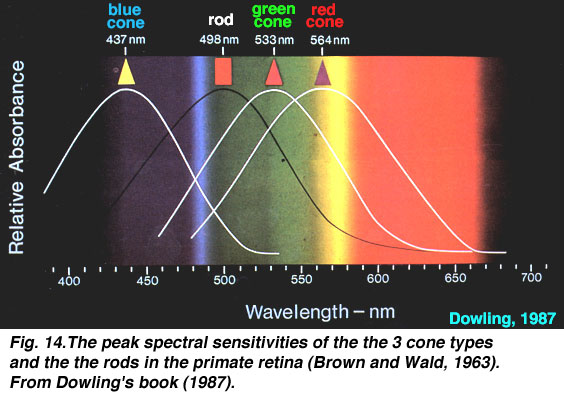
Re:True colourViolet is especially tricky. Its wavelength is shorter than blue, but in addition to stimulating your blue cones, your red cones are also slightly sensitive to it.
This doesn't make any sense. Red cones are not sensitive to blue light. Here is a diagram showing the sensitivities of of the three cones (S, M, and L or Blue, Green and Red) in our retina whose signals combine to create color.
Our perception of color comes from the combination and comparison of the stimulation of three different cones, each maximally sensitive to different wavelengths. The output of the cones gets combined in what are called opponent pathways, one is Red-Green, and the other is Blue-yellow. The Red-Green pathway compares the output of the Red and Green cones and the Blue-yellow pathway compares the output of the blue cone with the sum of the red and green cones. This is why you will never see a color that is reddish-green or blueish-yellow (see nick) at least in the additive sense that red+blue=violet and yellow+blue+green.
So why does extremely short wavelength light appear to contain a reddish component? I don't believe that anyone knows the answer to that yet. But the hypothesis is that somewhere along the path from cone to cortex the input from a blue cone and red cone combine which turns our perception of an extremely short wavelength light into a combination of short wavelength light (blue) and extremely long wavelength light (red). So our sensation of color becomes a continuum that loops back on itself as opposed to our sense of pitch (which is also frequency or wavelength).
Interestingly people who have had their lenses removed are somewhat able to perceive ultraviolet light. This is because the lens ordinarily blocks UV light and blue cones are sensitive to UV light but very little ever penetrates to the retina normally. Apparently they see it as lilac.
Many mammals, fish, birds, insects, and reptiles (basically everyone except us) are able to see UV light as well. It's a good that we can't for two reason. One is that there is more chromatic aberration at shorter wavelengths. Basically blue light bends more than red light. This makes focusing more difficult. Also, more importantly, UV light damages DNA which is a very, very, bad thing. This is a good resource for learning more.
-
Re:It's so true.
It's the geek chicks, isn't it? =)
Dude, it's always been about the chicks. Geek chicks, punk chicks, smart chicks.... One day I even had the dumb luck of meeting a person that embodied all qualities in the same person. -
Re:GPS Accuracy
I would be interested to learn exactly how they collected this data.
Thee is a LOT more info found on the page linked below than in the page linked in the summary.
http://www.mines.utah.edu/~rbsmith/RESEARCH/UUGPS. html -
Re:The cynical--and obvious--answerUsing a mobile phone at all (except with hands-free kits) is illegal while driving.
Sorry to break it to you but hands free doesn't help the problem of focusing on driving.
The study reinforced earlier research by Strayer and Drews showing that hands-free cell phones are just as distracting as handheld cell phones because the conversation itself - not just manipulation of a handheld phone - distracts drivers from road conditions....Each of the study"s 40 participants "drove" a PatrolSim driving simulator four times: once each while undistracted, using a handheld cell phone, using a hands-free cell phone and while intoxicated to the 0.08 percent blood-alcohol level after drinking vodka and orange juice. Participants followed a simulated pace car that braked intermittently. Both handheld and hands-free cell phones impaired driving, with no significant difference in the degree of impairment. That "calls into question driving regulations that prohibited handheld cell phones and permit hands-free cell phones," the researchers write.
http://unews.utah.edu/p/?r=062206-1 -
Re:Sensitive data storage?
Can you spray them with Lysol to erase them in an emergency?
The information is included in the bacteria's DNA. Lysol will kill the bacteria, but leave the DNA intact.
I'm not sure what is in Lysol, but rubbing alcohol will not destroy DNA (at least not initially). Rubbing alcohol is one component in your Kitchen DNA Lab. -
Re:Slashdotted
Naw, it's not the Macs, but the database that is limiting the connections and likely their bandwidth restrictions. I have a fair amount of experience getting Slashdotted on another website hosted exclusively on a Mac and I've yet to see it have a problem, even though it is a graphics intensive site.
-
Lots of folks making the switch
There are some issues certainly of migrating from one platform to any other platform, but it has been interesting to see a number of long time Windows users in hard core sciences with entrenched work flows that made them very dependent upon Windows to make the switch. When I joined the current group I was in, I essentially catalyzed a complete switch of our lab that is now percolating to many other labs in the group. These switchers have not and are not switching because I kept hitting them over the head with how great the platform is. Rather, they kept seeing the amazing presentations I gave with the help of apps like Keynote, or how easy it was to host a number of high traffic websites from a single OS X machine (including my blog), our lab site, and Webvision among a number of others. Or even how easy it was for me to replace an SGI, a Windows machine and a older Mac with a single incredibly powerful workstation running OS X. The new MacPros are one of the most amazingly powerful systems for the dollar that I've ever used making scientific calculations quick and easy.
-
Lots of folks making the switch
There are some issues certainly of migrating from one platform to any other platform, but it has been interesting to see a number of long time Windows users in hard core sciences with entrenched work flows that made them very dependent upon Windows to make the switch. When I joined the current group I was in, I essentially catalyzed a complete switch of our lab that is now percolating to many other labs in the group. These switchers have not and are not switching because I kept hitting them over the head with how great the platform is. Rather, they kept seeing the amazing presentations I gave with the help of apps like Keynote, or how easy it was to host a number of high traffic websites from a single OS X machine (including my blog), our lab site, and Webvision among a number of others. Or even how easy it was for me to replace an SGI, a Windows machine and a older Mac with a single incredibly powerful workstation running OS X. The new MacPros are one of the most amazingly powerful systems for the dollar that I've ever used making scientific calculations quick and easy.
-
Lots of folks making the switch
There are some issues certainly of migrating from one platform to any other platform, but it has been interesting to see a number of long time Windows users in hard core sciences with entrenched work flows that made them very dependent upon Windows to make the switch. When I joined the current group I was in, I essentially catalyzed a complete switch of our lab that is now percolating to many other labs in the group. These switchers have not and are not switching because I kept hitting them over the head with how great the platform is. Rather, they kept seeing the amazing presentations I gave with the help of apps like Keynote, or how easy it was to host a number of high traffic websites from a single OS X machine (including my blog), our lab site, and Webvision among a number of others. Or even how easy it was for me to replace an SGI, a Windows machine and a older Mac with a single incredibly powerful workstation running OS X. The new MacPros are one of the most amazingly powerful systems for the dollar that I've ever used making scientific calculations quick and easy.
-
Spiders and Goats and Cows, Oh My!
Here's a great article on the pros and cons of "pharming" (deriving medicinal properties from animals):
pharming article
"Spiderman II: Spidergoat? It sounds like a sequel to "Spiderman: The Movie" - Spidergoat! OK, maybe not, but it is a very interesting application of transgenics. The dragline form of spider silk is regarded as the strongest material known; it's 5 times stronger than steel and twice as strong as Kevlar. People have actually tried starting "spider farms" to harvest silk, but the spiders are too aggressive and territorial to live close together. They also like to eat each other.
Though the genes for dragline silk were isolated several years ago, attempts to produce it in bacterial and mammalian cell culture have failed. When the genes were put into a goat and expressed in the mammary glands, however, the animal produced silk proteins in its milk that could be spun into a fine thread with all the properties of spider-made silk. This can be used to make lighter, stronger bulletproof vests, thinner thread for surgery and stitches or indestructible clothes." -
Re:Wrong. do not pass cell phone use laws.
are you suggesting that drivers should only be pulled over if they are exibiting dangerous driving behaviors such as swerving or they should be pulled over if they are engaging in any significantly distracting behavior (cell phone talking, makeup, drunk)? if it's the later then really what's the difference if they're pulled over under a reckless driving law or a cell phone law? if it's the prior then there's a couple of problems.
using your logic we would also be allowing people with any level of alcohol in their system on the road. we also wouldnt be adequetly protecting other drivers from people talking on their cell phones as their reduced reaction time is a menace to everyone (they're as bad as drunk drivers: http://unews.utah.edu/p/?r=062206-1) and would not likely manifest itself in an observable manner until the time of an accident. -
Just in time for Macworld?
Hrmmmm..... just in time for Macworld? Oh please, oh please, oh please.....
I've written about this before in a number of places, but most recently here on my last trip to Argentina, but I am hoping that we will see a revised 12in Powerbook nee MacBook Pro (or smaller) in the next Macworld because I really do miss the smaller form factor. It would be tremendously useful for travelers and photographers as well as giving us better battery life.
I am currently using a 15in Powerbook that I traded up from when the 12in Powerbook was cancelled, but a smaller footprint would help tremendously with travel. With the 15in Powerbook/Macbook Pro, I love the illuminated keyboard and the performance, but would be willing to pay a premium to carry a smaller laptop, subnotebook or tablet running OS X. It does not even have to have an optical drive as I rip movies I purchase or rent to the hard drive for long airline flights and in fact, if we could get flash drives down a bit in price (or get a sweet deal on bulk purchases for the manufacturer), it would be possible to even get rid of the hard drive provided we could still pack 30-40 GBs of storage space in the device. Battery life would be improved and if you combine it with a 10in diagonal new technology LED display (or OLED), we may even be able to get away with seven or eight hours of honest full on battery life. So Steve, come on dude. We've talked about this before several times. The technology currently exists or is damn close and I am sure there is a market for such a device, so please, please, please. -
Re:Ranking....
Googlebot : WGET http://prometheus.med.utah.edu/~bwjones/
It contain text: +1 point
It contain no selling-shit: +1 point
It contain
Googlebot finished. -
Ranking....
Yeah, well there are lots of blogs that do better than a number of businesses and organizations for whatever reasons Google assigns ranking. I get a number of amused emails from people that find Google ranks my blog higher than their dedicated sites for a shocking number of items. They want to know how I've engineered it, and I have to say I honestly don't know. But if they want to pay Google to increase their ranking above mine, go for it.
I suspect part of the reason is my selective use of links in articles I post to supplement the content I post with targeted information, as well as my hosting it from my office in an educational institution. Occasionally getting linked from places like Slashdot, BoingBoing and Digg can't hurt either.... -
A place for the professional communicator...
One might make an argument for this, but I am not quite so sure this is the "demise of the professional photojournalist" for a number of reasons, not the least of which is the ability to effectively communicate. Sure a picture can tell a thousand words, but that photograph needs to be placed in context. I take lots of photos that describe what I see, do and where I go, but I would never think of myself as a professional journalist. These images for me are a means to communicate and keep in touch with family and friends (a blog, right?), not to disseminate the news to the rest of the world. The fact that sometimes images from my site do resonate with news agencies/institutions or individuals around the world is cool, but it is a rarity that I get requests for re-publication (one every three months or so) and it is not how I make my living.
Additionally, there is also the issue of ethics that most professional publications usually get right, but there are the admitted occasional screw-ups. Usually however, there are issues of image/video provenance to deal with that may not always reflect reality ("I found it on the Internets, so it must be true!") that editorial boards put through a vetting process to filter out much of the fakery/deceipt.
The Internet has enabled the ability to democratically (small "d") reach huge masses of people with relatively few resources and I expect that we will see more citizen reporting as the years go on. It may in some cases also challenge the mainstream media for particular stories, but the reality is that most folks have other jobs/things that keep them busy and they do not have the resources or time to become professional journalists. When they do obtain the appropriate resources/time/credibility, they have just crossed over into the world of the professional journalist.
Technology will cause things to change and serve as a destabilizing influence for many established institutions, but I think we will always have and pay people who relate the news to us, bring us the wider world and tell stories. This will become especially more important as increasing percentages of societies become more specialized and fragment their time into narrowly defined regions of interest/study. -
A place for the professional communicator...
One might make an argument for this, but I am not quite so sure this is the "demise of the professional photojournalist" for a number of reasons, not the least of which is the ability to effectively communicate. Sure a picture can tell a thousand words, but that photograph needs to be placed in context. I take lots of photos that describe what I see, do and where I go, but I would never think of myself as a professional journalist. These images for me are a means to communicate and keep in touch with family and friends (a blog, right?), not to disseminate the news to the rest of the world. The fact that sometimes images from my site do resonate with news agencies/institutions or individuals around the world is cool, but it is a rarity that I get requests for re-publication (one every three months or so) and it is not how I make my living.
Additionally, there is also the issue of ethics that most professional publications usually get right, but there are the admitted occasional screw-ups. Usually however, there are issues of image/video provenance to deal with that may not always reflect reality ("I found it on the Internets, so it must be true!") that editorial boards put through a vetting process to filter out much of the fakery/deceipt.
The Internet has enabled the ability to democratically (small "d") reach huge masses of people with relatively few resources and I expect that we will see more citizen reporting as the years go on. It may in some cases also challenge the mainstream media for particular stories, but the reality is that most folks have other jobs/things that keep them busy and they do not have the resources or time to become professional journalists. When they do obtain the appropriate resources/time/credibility, they have just crossed over into the world of the professional journalist.
Technology will cause things to change and serve as a destabilizing influence for many established institutions, but I think we will always have and pay people who relate the news to us, bring us the wider world and tell stories. This will become especially more important as increasing percentages of societies become more specialized and fragment their time into narrowly defined regions of interest/study. -
Re:People plain just don't like cell phone users
-
Re:Can I get one
Oh, it's sarcasm all right. Made even funnier by the fact that cellphone-impaired drivers are more dangerous than alcohol-impaired drivers!
-
solar powered steerable laser in Argentine Pampas
I work with the Pierre Auger Cosmic Ray observatory located in the Pampas of Argentina. The detectors of the observatory cover an area of about 60x60 km. Near the middle of this array, myself and a small group of colleagues constructed an ultra-violet laser "test beam" facility. Sort of simulates the signature of a cosmic ray, but traveling upward. http://casab.physics.utah.edu/clf
-
Re:Research abstract; more info
Actually, this paper can be accessed from Bressloff's publications page: http://www.math.utah.edu/~bresslof/papers.html
-
Not good.....
Speaking as a scientist who used to study sleep and sleep disorders, I have to say this is troubling. Sleep has evolved for a purpose and a number of studies have shown that sleep is necessary or crucial to consolidate long term memories, stabilize mood and more. If you are a simple automaton in your job, then *perhaps* you might be able to get away with something like modafinil for short periods of time, but if your job requires thought and the use of memory and higher cognitive function, then you are doing yourself a disservice by taking these drugs. I worry that the long term effects will not become apparent until years later, like I suspect might happen with PDE inhibitors like Viagra, Cialis and Levitra.
Humans have evolved an organized architecture of sleep where we progress through a number of stages of sleep. In other words, sleep is an active state that is not homogenous in that there are five generally accepted states of sleep separate from consciousness. Stages 1 and 2 are light sleep whereas 3 and 4 are deeper, more restful states of sleep with lower brain metabolic rates and more cortical synchronization. Stage 5 or REM sleep is actually a very active stage of sleep with very high metabolic requirements rivaling that or exceeding wakefulness and its thought that REM sleep may be necessary for memory consolidation. The trick is that the architecture of sleep is broken up into various stages and you do not really approach the most intense REM periods until after you have progressed back and forth through some of the other stages including a more brief period of REM sleep earlier in the night. So, the most intense REM period is late into sleep and often early in the morning. If you short change yourself of the other sleep periods, you reduce the quantity and quality of your REM sleep period. -
Yes, please!
I wonder how the airlines are going to keep inappropriate video (i.e. porn or even just movies like "Snakes on a Plane" or "Alive") from appearing on the seat-back displays."
That's funny as I was wondering the same thing when Apple's press announcement appeared in my inbox. Of course the issue of other movies like those you mentioned should not even be an issue as it is content that the user has loaded on their own iPods (and you should not be looking at your neighbors content anyhow). As to porn and other questionable content, this really comes down to etiquette and if there are those on the flight that will display such content where others may see it (like kids), they are likely pissing people off for other reasons. All told, this is a great idea and I'd rather have to deal with other people's movies than having to listen to them talk on their cell phones (Please! FAA, Nnnoooooooo!) or worse. Flying anywhere is becoming more and more onerous these days and at the very least, having airlines support ways to charge laptops or iPods during long flights would be a huge benefit as Empower outlets are pretty hard to find on many flights in coach and sometimes even in first or business class.
I've had to deal with enough problems flying anyhow again and again and again and anything that will keep people quiet and minding their own business is a good thing. -
Yes, please!
I wonder how the airlines are going to keep inappropriate video (i.e. porn or even just movies like "Snakes on a Plane" or "Alive") from appearing on the seat-back displays."
That's funny as I was wondering the same thing when Apple's press announcement appeared in my inbox. Of course the issue of other movies like those you mentioned should not even be an issue as it is content that the user has loaded on their own iPods (and you should not be looking at your neighbors content anyhow). As to porn and other questionable content, this really comes down to etiquette and if there are those on the flight that will display such content where others may see it (like kids), they are likely pissing people off for other reasons. All told, this is a great idea and I'd rather have to deal with other people's movies than having to listen to them talk on their cell phones (Please! FAA, Nnnoooooooo!) or worse. Flying anywhere is becoming more and more onerous these days and at the very least, having airlines support ways to charge laptops or iPods during long flights would be a huge benefit as Empower outlets are pretty hard to find on many flights in coach and sometimes even in first or business class.
I've had to deal with enough problems flying anyhow again and again and again and anything that will keep people quiet and minding their own business is a good thing. -
Yes, please!
I wonder how the airlines are going to keep inappropriate video (i.e. porn or even just movies like "Snakes on a Plane" or "Alive") from appearing on the seat-back displays."
That's funny as I was wondering the same thing when Apple's press announcement appeared in my inbox. Of course the issue of other movies like those you mentioned should not even be an issue as it is content that the user has loaded on their own iPods (and you should not be looking at your neighbors content anyhow). As to porn and other questionable content, this really comes down to etiquette and if there are those on the flight that will display such content where others may see it (like kids), they are likely pissing people off for other reasons. All told, this is a great idea and I'd rather have to deal with other people's movies than having to listen to them talk on their cell phones (Please! FAA, Nnnoooooooo!) or worse. Flying anywhere is becoming more and more onerous these days and at the very least, having airlines support ways to charge laptops or iPods during long flights would be a huge benefit as Empower outlets are pretty hard to find on many flights in coach and sometimes even in first or business class.
I've had to deal with enough problems flying anyhow again and again and again and anything that will keep people quiet and minding their own business is a good thing. -
Yes, please!
I wonder how the airlines are going to keep inappropriate video (i.e. porn or even just movies like "Snakes on a Plane" or "Alive") from appearing on the seat-back displays."
That's funny as I was wondering the same thing when Apple's press announcement appeared in my inbox. Of course the issue of other movies like those you mentioned should not even be an issue as it is content that the user has loaded on their own iPods (and you should not be looking at your neighbors content anyhow). As to porn and other questionable content, this really comes down to etiquette and if there are those on the flight that will display such content where others may see it (like kids), they are likely pissing people off for other reasons. All told, this is a great idea and I'd rather have to deal with other people's movies than having to listen to them talk on their cell phones (Please! FAA, Nnnoooooooo!) or worse. Flying anywhere is becoming more and more onerous these days and at the very least, having airlines support ways to charge laptops or iPods during long flights would be a huge benefit as Empower outlets are pretty hard to find on many flights in coach and sometimes even in first or business class.
I've had to deal with enough problems flying anyhow again and again and again and anything that will keep people quiet and minding their own business is a good thing. -
Yes, please!
I wonder how the airlines are going to keep inappropriate video (i.e. porn or even just movies like "Snakes on a Plane" or "Alive") from appearing on the seat-back displays."
That's funny as I was wondering the same thing when Apple's press announcement appeared in my inbox. Of course the issue of other movies like those you mentioned should not even be an issue as it is content that the user has loaded on their own iPods (and you should not be looking at your neighbors content anyhow). As to porn and other questionable content, this really comes down to etiquette and if there are those on the flight that will display such content where others may see it (like kids), they are likely pissing people off for other reasons. All told, this is a great idea and I'd rather have to deal with other people's movies than having to listen to them talk on their cell phones (Please! FAA, Nnnoooooooo!) or worse. Flying anywhere is becoming more and more onerous these days and at the very least, having airlines support ways to charge laptops or iPods during long flights would be a huge benefit as Empower outlets are pretty hard to find on many flights in coach and sometimes even in first or business class.
I've had to deal with enough problems flying anyhow again and again and again and anything that will keep people quiet and minding their own business is a good thing. -
Yes, please!
I wonder how the airlines are going to keep inappropriate video (i.e. porn or even just movies like "Snakes on a Plane" or "Alive") from appearing on the seat-back displays."
That's funny as I was wondering the same thing when Apple's press announcement appeared in my inbox. Of course the issue of other movies like those you mentioned should not even be an issue as it is content that the user has loaded on their own iPods (and you should not be looking at your neighbors content anyhow). As to porn and other questionable content, this really comes down to etiquette and if there are those on the flight that will display such content where others may see it (like kids), they are likely pissing people off for other reasons. All told, this is a great idea and I'd rather have to deal with other people's movies than having to listen to them talk on their cell phones (Please! FAA, Nnnoooooooo!) or worse. Flying anywhere is becoming more and more onerous these days and at the very least, having airlines support ways to charge laptops or iPods during long flights would be a huge benefit as Empower outlets are pretty hard to find on many flights in coach and sometimes even in first or business class.
I've had to deal with enough problems flying anyhow again and again and again and anything that will keep people quiet and minding their own business is a good thing. -
Yes, please!
I wonder how the airlines are going to keep inappropriate video (i.e. porn or even just movies like "Snakes on a Plane" or "Alive") from appearing on the seat-back displays."
That's funny as I was wondering the same thing when Apple's press announcement appeared in my inbox. Of course the issue of other movies like those you mentioned should not even be an issue as it is content that the user has loaded on their own iPods (and you should not be looking at your neighbors content anyhow). As to porn and other questionable content, this really comes down to etiquette and if there are those on the flight that will display such content where others may see it (like kids), they are likely pissing people off for other reasons. All told, this is a great idea and I'd rather have to deal with other people's movies than having to listen to them talk on their cell phones (Please! FAA, Nnnoooooooo!) or worse. Flying anywhere is becoming more and more onerous these days and at the very least, having airlines support ways to charge laptops or iPods during long flights would be a huge benefit as Empower outlets are pretty hard to find on many flights in coach and sometimes even in first or business class.
I've had to deal with enough problems flying anyhow again and again and again and anything that will keep people quiet and minding their own business is a good thing.