Slashdot Mirror
Domain: utexas.edu
Stories and comments across the archive that link to utexas.edu.
Comments · 1,356
-
Welcome to West Texas!I say a bunch of us should get together, pool our resources, and buy up a couple of thousand square miles of land and have it designated a no-light zone.
Well, you could always buy Loving County, Texas. From the Handbook of Texas Online:Loving County consists of 671 square miles of flat desert terrain with a few low-rolling hills stretching over calichified bedrock and wash deposits of pebbles, gravel, and sand. The county closed its school system in 1972 because only two students were enrolled. In 1980 there were fifty-nine whites and thirty-two Hispanics in the county; the median age was 45.3 years. Fifty residents had received four years of high school, and there were four college graduates. At the end of 1989 the estimated population increased slightly to 100, but prospects for future development remained slim.
Looks like a good bet for your proposal! Imagine a whole community of Slashdotters in the middle of the West Texas desert.
But don't forget to bring your own water. "Water from the Pecos, however, is too saline for drinking, so the 100 residents of the county haul water from a community tank." Evian, it ain't.
On the bright side, though, we could elect CowboyNeal as County Sheriff! -
Re:This is a bit wierd.
(Warning: NSFW)
Too... contextually... relevant. -
Learn Elvish!
-
Learn Elvish!
-
Re:Why Python is good at our university
this is what's wrong with American education at all levels
You do realize that Dijkstra's not an American -
Re:Obsolete?
Am I the only one who thinks that translation is quickly becoming obsolete?
Almost everyone can speak, read and write at least tolerable english and most young people can have full fledged discussions in it.
That isn't much help if you want to read (say) De Uitvreter by Nescio and you don't know Dutch, does it? Or for a slightly more geeky angle, if you want to read Edsger Dijkstra's Dutch texts?
JP
-
And here's another fine Diebold product...
...the Bevo Bucks vending machine at the Univ of Texas, with the swipe card system made by Diebold.
Get yer free Snickers bars, then head off to the polling station to contemplate which switch is the best way to vote Republican. All courtesy of Diebold. -
Is HTML really that hard?
The link from the parent: http://www.csr.utexas.edu/grace/gallery/gravity/0
3 _07_GRACE.html -
Re:This is what I've been saying.
[...] I'd say that Linux has a whole bunch of black eyes from this and it will still be a few years before it gets to court.
It's been said that "With enough eyeballs, all bugs are shallow." (Linus Torvalds).
So... SCO may blacken some of those eyes, but there will be many more that are left untarnished. Yes, SCO is giving Linux many black eyes, but this is the height of the "then they fight you" phase that Gandhi spoke of. I predict the fight will get dirtier before the "then you win" phase.
(Aside: I've wanted to short SCO since they were at 9. Good thing I don't have any money left! 1/2
-
Something from frontier
Is it just me or does this ship looks so much like someting out of frontier (Elite). Even the jet of flames from behind it.
-
Re:Cool
You mean you can't read this from the Texas version? It's plenty big, it's just that the user interface sucks.
-
Skewed translation?
Has anyone noticed that the English translation of certain selected passages appear to have a decided slant toward Jehovah's Witnesses? I had always though the Latin word "dominus" was a regular noun meaning "lord" or "master", not a proper name.
-
Re:Turn up the resolution on the scannerwhy go to all the trouble of digitizing a document that you can barely read the digital version of
Inquiries regarding the availability of higher-resolution digital images for research or publication should be directed to the Center's staff. I think they'll probably offer a CDROM for purchase. The images on the site are 600x875 pixels, 187k jpegs.
The British Library has scans of two editions, with pages at 1450x2048 pixels, 851kb jpegs; almost sharp enough to forge a copy (they're worth about $20m).
-
Re:Whew...
Good thing God isn't around anymore. I'm sure He'd be pissed about the copyright infringement.
Did you read that in this Bible already ?? On one of the pages, God left this message - "I am going for space travel in my spaceship (See pic of spaceship on top left of this this page ). I wanna check out a black hole. Those suckers look really cool. If I don't come back, you write stories about me and save the world"
-
image size
It is nice they put this thing online, but it is nothing else than a marketing gag for mmore funds or something.
at the current size it is totally useless, you click on enlarge image - and you get an image at a size where it is barely readable. am i supposed to use a magnification glass on my screen or something? If you do it, do it right (read: at right size) or leave it. -
Re:Props to UT
"UT is my school. It is waaay underrated as a geek school. It's the #5 engineering school in the country, but no one ever mentions it."
Supposedly also one of the Top 10 CS schools in the USA, with a recent departmental reorganization dedicated to moving it up to a Top 5 school.
Also, I think some of the sub-fields in its CS graduate program are already supposedly Top 5 programs.
And a very low 4554013 Quotient for the CS faculty, too.
See department info at http://www.cs.utexas.edu/, especially the research areas.
BTW, the HRC also has lots of geeky stuff in addition to famous bibles, such as a collection of fantasy and science fiction. I don't think you can just walk in and browse the collection, though. -
Re:Props to UT
"UT is my school. It is waaay underrated as a geek school. It's the #5 engineering school in the country, but no one ever mentions it."
Supposedly also one of the Top 10 CS schools in the USA, with a recent departmental reorganization dedicated to moving it up to a Top 5 school.
Also, I think some of the sub-fields in its CS graduate program are already supposedly Top 5 programs.
And a very low 4554013 Quotient for the CS faculty, too.
See department info at http://www.cs.utexas.edu/, especially the research areas.
BTW, the HRC also has lots of geeky stuff in addition to famous bibles, such as a collection of fantasy and science fiction. I don't think you can just walk in and browse the collection, though. -
Re:Props to UT
"UT is my school. It is waaay underrated as a geek school. It's the #5 engineering school in the country, but no one ever mentions it."
Supposedly also one of the Top 10 CS schools in the USA, with a recent departmental reorganization dedicated to moving it up to a Top 5 school.
Also, I think some of the sub-fields in its CS graduate program are already supposedly Top 5 programs.
And a very low 4554013 Quotient for the CS faculty, too.
See department info at http://www.cs.utexas.edu/, especially the research areas.
BTW, the HRC also has lots of geeky stuff in addition to famous bibles, such as a collection of fantasy and science fiction. I don't think you can just walk in and browse the collection, though. -
West Texas: McDonald Observatory, Marfa, Big Bend
I highly recommend a jaunt through West Texas, though it is a bit out of the way from anywhere (except El Paso, and no reason to go there! apologies to an El Pasoans here). Visit Big Bend National Park, McDonald Observatory, (one of the biggest & best in North America), the Marfa Lights (creepy, literally unexplained phenomenon).
-
Re:compared to say
"pan", for bread, is apparently from the "root language", a patched together half understood language that linguists have been working on figuring out. If you look, "pan" or a close cognate, is the word for bread in many different, non related languages. Just one of those words that kept making it up through.
spanish->pan
french->pain
italian->pane
japan ese,romanjii->pan
portuguese->pão
course, four of those are gimmes 'cause they're all just dialects of Latin, if you look at it that way.
ok here's one i can back up a little more:
the word "father" in a wide array:
Sanskrit Greek Latin Gothic English
pita pater pater fadar father
anyways, i'm no expert, just interested-- check out ancientscripts.com for a ton more about this stuff, and then hop over to omniglot when you want some more, but a little different. -
Done before - with disastrous resultsThe concept of showing off the latest technology with a dazzling display of its power has been done before, though I'm sure we can all hope that it doesn't have the same unexpected results as the famous Crash At Crush. From the Handbook of Texas:
CRASH AT CRUSH. A plaque fifteen miles north of Waco in McLennan County marks the site of the "Crash at Crush." On September 15, 1896, more than 40,000 people flocked to this spot to witness one of the most spectacular publicity stunts of the nineteenth century-a planned train wreck. The man behind this unusual event was William George Crush, passenger agent for the Missouri, Kansas and Texas Railroad. In 1895 Crush proposed to Katy officials that the company stage a train wreck as an attraction; he planned to advertise the event months in advance, sell tickets to transport spectators to and from the site on Katy trains, and then run two old locomotives head-on into each other.
I don't know if Murphy's Law had been established in 1895, but its results were in clear evidence: despite assurances that it couldn't happen, one of the train's boilers exploded upon the collision. The result (as sung by Texas songwriter Brian Burns):
The engines met in a thunderous crash and climbed each other toward the sky,
the impact rattled the earth for miles around, and the twisted wreckage did fly.
In a moment more the boilers exploded, and the steam blocked out the sun,
some lost their lives while others lie bleeding, and the rest of them could only run.
Clickety-clack, clickety-clack, wheels a-rumblin' on the railroad track,
once they go they can't turn back, once they go they can't turn back.
In a cotton field near Waco, Texas between two peaceful hills
a sign reminds us to hold respect for the power of the beasts we build,
and you and I in our lifetimes will never get to feel such a rush
as the people who saw and lived to tell of the awesome crash at Crush.
Frankly, I can't see any way to stage an "X-Prize Cup", with multiple competitors simultaneously trying for the biggest spectacle, without chancing a repeat of the Crash At Crush. That said, I'd buy a ticket... but I'd leave the kids at home. -
Re:EWD 696Hi WanderingHermit,
It was written by Edsger Dijkstra (one of the most influential thinkers in software design). A great guy. Died last year, I think.
But he wasn't talking about teaching - he was talking about conceptualizing - in particular, about reasoning in software development and mathematics. He argued that visual design tools in programming made you focus on the thing that was made visible, (which is usually the easy bit), rather than the hoards of less visible possibilities, wherein lie bugs, limitations and assumptions.
He's probably right - although I know enough programmers who have problems expressing the basic requirements to suggest that a bit of vision can upgrade a hopeless programmer into a fairly hopeless one. It may be that his reasoning explains why visual programming tools have never replaced the text editor for anything other than very simple software development, just as graph plotters haven't replaced equations for mathematicians!
But this has nothing - much - to do with teaching or learning....well, judge for yourself, here's the original:
http://www.cs.utexas.edu/users/EWD/ewd06xx/EWD696
. PDFTo be honest, I don't think the parent post is relevant - the quote is selective and out of place. Interesting to be forced to become aware of that, though: it's a non-obvious subtlety about progression from novice to expert.
Cheers.
-
Burroughs Cut Up recordings
Did anyone else notice that his technique for the interview is based off, or strikingly similiar to that used my William Burroughs cut up
-
Re:Simply wrong
... and the Ronald Reagan Presidential Library
Guess when you run the country for a better part of a decade (and don't resign or get impeached), they tend to name stuff after ya, huh? -
Edsger W. Dijkstra opined on this subject...
"Being a better programmer means being able to design more effective and trustworthy programs and knowing how to do that efficiently. It is about not wasting storage cells or machine cycles and about avoiding those complexities that increase the number of reasoning steps needed to keep the design under strict intellectual control. What is needed to achieve this goal, I can only describe as improving one's mathematical skills, where I use mathematics in the sense of "the art and science of effective reasoning". As a matter of fact, the challenges of designing high-quality programs and of designing high-quality proofs are very similar, so similar that I am no longer able to distinguish between the two: I see no meaningful difference between programming methodology and mathematical methodology in general. The long and the short of it is that the computer's ubiquity has made the ability to apply mathematical method more important than ever."
prof. dr. Edsger W. Dijkstra - EWD1209
-Adam -
Code elegance, precision and other stuff.
The problem is all engineers have provided a Q&D solution at least one. Time? Money? Other constraints? I can't tell, but it sometimes seems people prefer things tat "work quite well" to things that actually work they way they're meant to work. Yesterday,
-
Favorite Quote
"I would therefore like to posit that computing's central challenge, viz. 'How not to make a mess of it', has not been met. On the contrary, most of our systems are much more complicated than can be considered healthy, and are too messy and chaotic to be used in comfort and confidence. The average customer of the computing industry has been served so poorly that he expects his system to crash all the time, and we witness a massive worldwide distribution of bug-ridden software for which we should be deeply ashamed."
E.W. Dijkstra: The end of Computing Science?
Austin, 19 November 2000 -
Suggested reading
I loved this one. The wolf-goat-cabbage problem will never be the same again.
-
Dear Intel, please make me a faster chip...equivalent of the above in 1985 is EWD947
True Slashdotter alright!
-
Right up the /. reader's alley...
I decided to pick one at random, and chose How "they" try to corrupt "us".
It's his discussion on an attempt by Microsoft to pressure his department into
using their products by offering fame and fortune (uhh... I mean graduate
fellowships). He was truly a wise man! -
Call for volunteers
The EWD archive is looking for volunteers to convert the handwritten articles to google-able HTML. See here if you are interested.
-
Call for volunteers
The EWD archive is looking for volunteers to convert the handwritten articles to google-able HTML. See here if you are interested.
-
Wife swapping???
There is some saucy stuff in there that he's written about wife swapping and you thought CS was dull.
Tom. -
Can someone shed more light on his misc. info?
Does anyone know if he routinely let people know what type of pen he was using when he wrote that particular document? Here's one of the ones I found.
Why did he do this? For his own personal notes on which pens were good (I guess important if you are frequently writing things).
Why did he use pens and not electronic formats? For a CS person that surprises me. -
Challenger's O-ring led to new O-ring design...
The Challenger (as well as Columbia, and the newer vehicle that was being built - Discovery) had a flaw in the design of its O-ring that NASA itself knew could cause problems in flight. The design itself worked (proven by earlier flights of the shuttles). However, the design was not resilient to, as you said, external problems that were not properly thought up before-hand, such as massive fluctuations in temperatures (which led to the failure of the seal on the booster rocket).
A university student did an excellent case study on the Challenger incident, including the O-ring design "flaw," and what NASA did to improve upon the design.
If it were in NASA's tome of simulated problems, there would have been a way to make sure a rescue would have been possible. Even if we had to park the shuttle in orbit (or on the international space station) until a rescue could have been performed. It tires me to listen to the people that say "well, they would have run out of oxygen if they were not able to return immediately."
Fact: humans will never be able to calculate for every single variable in a system. It's just impossible. I completely agree with you. We will continue to develop better designs that will hopefully prevent further destruction and loss of life. -
A Good ResourceBack in the mid-90's I taught sophomore world literature at the University of Texas in a computer classroom. At the same time I worked as a proctor in the Computer Writing and Research Laboratory there. I would highly recommend checking out their web site (http://www.cwrl.utexas.edu).
The lab's mission for the past decade or so has been to explore and facilitate the use of computers in a teaching environment, with a focus on teaching writing (since the lab is part of the English dept.). Not only should the web site have resources and advice you can use, but I'm sure that any of the people involved with the lab, whether graduate students or professors, would be glad to "talk" with you.
-
Re:Why are we so surprized?
The article, unfortunately, is a little hyperbolic - Gary Urton has done some fine work, but they've taken what's essenntially a metaphor about any point of choice being a binary element and suggested something that's a bit misleading. I don't think there's any indication that color-function was standardized across quipu-makers: just like some elements of coding style are unique from programmer to programmer, I see nothing surprising about the fact that the choice of materials for different cord-groups would be a matter of personal taste and mnemonics for the quipu-maker (and materials are dyes used also seemed to rely heavily on the region that the quipu was produced.)
The quipu were base-10. They did, in fact, use a "place holder" comparable to a zero, and the relationship between that place holder and the Quechua word for "zero" suggests that you could say there was a zero concept.
The discovery of the base-10 nature of the quipus was done by noting how sets of hanging strings, interepreted as base-10 (lowest set of knots as 1-place, second set of knots as 10's-place, etc) would add up to the same number the number on a cord which hung at the top of those groups.
Urton's Social Life of Numbers is a very good book about the quipu, but there are some concerns: he makes some historical claims based on ethnographic research (that's a bit a-historical).
A more rigorous look at the mathematics of the quipu is Mathematics of the Incas. It's also a fun book, teaching one how to make one's own quipus. -
ACL2
ACL2 is a theorem proving and modeling environment, based on Common Lisp, which is used for verification of hardware and software. I believe AMD used it to prove the correctness of the floating-point division algorithm in one of their processors.
-
Re:NIMBYEvn if it doesn't make sense to you, the North American power grid is divided into a number of disconnected regions that are only connected via DC interconnects to keep the different regions isolated. All generation on single interconnected AC grid is in sync. If a big generation plant in California has a sudden failure it can affect every generator on its grid from California to northern British Columbia. The DC links isolate and protect the different grids from failures on the other grids.
As there is no good reason to keep the different grids in sync - they are not in sync. As the fully conncted regions get larger there are more and more problems keeping the whole system "clean" and reliable. Over view of North America Power Grid
-
Re:On balance I say exploration is worth the risk.
Ok, what about the british against the dutch. In 1850 the dutch had control of Indonesia and were expanding north. The British saw that the farming they were doing was making them very, very rich, so the british had to expand into the straits settlements (now Malaysia and Singapore) to give them the muscle to supress the unrest near home.
Notice that the british and the dutch never fought each other directly in this exchange. instead they captured the weaker, easier targets to build their empires and thereby make the idea of a direct war between empires unthinkable.
In the same way America will never fight China. They'll be best trading buddies. America WILL attack weak, emaciated Iraq, because modern China has done the same thing to Tibet.
Notice that you do NOT want to be the weaker player in this game.
So ask youself, do you want Earth to be like Modern America or Tibet? What's in your best interests?
I say expand, explore and carry nukes. -
Re:Anyone actually use a beowolf cluster?
I built the first one at the Institute for Advanced Technology, they've since built two more. Saves them money over using time on the Crays at the Pickle Research Campus.
-
Re:Anyone actually use a beowolf cluster?
I built the first one at the Institute for Advanced Technology, they've since built two more. Saves them money over using time on the Crays at the Pickle Research Campus.
-
Re:Is this news?
-
Re:Subtle Difference
OK, if you want to believe that the human brain is entirely deterministic, I can play devils advocate...
The human mind is a the very least a chaotic system, and being such you can not determine the initial conditions from the final conditions, therefore it can not be claimed that any input to the human mind (video game violence...) causes a human being to become violent. -
Re:So the best thing that one can do...
The scariest thing here about this story is that both of these dim bulbs have law degrees. Are they giving degrees away when you get enough box tops!?
No, they're selling them for tons of cash, like they have for a long time. And please, don't tell me about people failing out. That only happens to the 'not fabulously wealthy.'
note: law school links just chosen at pseudorandom. Just making a point, not accusing any one school of being any worse than any other. -
EO 440 and Palm Pilot
When I was in Comp. Sci. at Carleton a couple years ago, I used an old EO 440 machine for taking notes, and a seriously hacked up Palm "Pilot 5000" as my calandar.
The Palm was absolutely indispensible for me. I found, before I had it, that I would frequently come to class and people would say "So, are you ready to hand in that assignment tomorrow?" to which I would inevitably reply "What assignment?"
Having a little box in my pocket that would beep at me two or three days before an assignment was due (or, better, an exam was coming up) made it so I never had to worry about this stuff (well... except in the classes I never went to, and therefore never found out about the assignments and exams
The EO (or, I suppose a Tablet PC, if you want to come into the 21st century
I also tried using a laptop for a while. This works well for the most part. The exception is in math courses. It's a little difficult to quickly enter in a complex formula from a keyboard, especially one with many exponents/subscripts/greek letters/integrals. You'll find yourself developing little short-hands like "OMEGA" or "INTEGRATE(...)", but that can only take you so far, and it's still a little cumbersome. Physics classes had simliar problems, although there you find yourself trying to draw out free-body diagrams in ASCII art. Both of these problems are resolved on a tablet where you can just draw the formulas/diagrams.
-
Encryption level?
Will this level of encryption suffice?
http://ccwf.cc.utexas.edu/~eclectic/toys/jive.html -
Fuck AOL. Mirror here.
-
Re:Accuracy (Goes past Mars too...)From Science Magazine
If the spin axis of 1950 DA is fixed near our direct rotation pole solution, solar pressure and asteroid perturbations could counter the Yarkovsky effect so that the probability of a collision in 2880 would be comparable to that of the initial detection case of 0.33%. Thus, the impact probability currently lies in the interval from 0 to 0.33%, where the upper bound will increase or decrease more rapidly as physical knowledge improves than as ground-based optical astrometry accumulates. We are unable to calculate a reliable, specific collision probability, because the trajectory uncertainties are dominated by unmeasured or poorly determined systematic physical effects.
And don't forget it goes out past Mars, too! For more calculation fun, of course, don't forget
- Galactic tide
- Numerical integration error
- Solar mass loss
- Solar oblateness
- 61 additional asteroids [not included in their model]
- Planetary mass uncertainty
- Solar radiation pressure
And a wacky idea I've had floating around for a while:
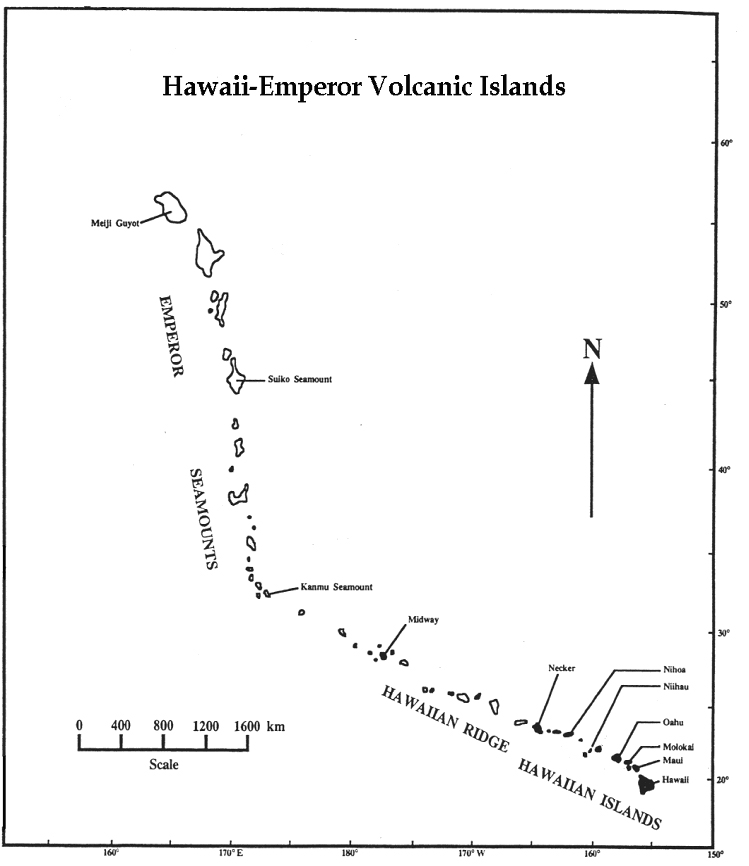
Could the "hole" which produced Hawaii be the result of an ancient impact? Then the Hawaiian Islands, the Hawaiian Ridge and the Emperor Seamounts are just a record of the Pacific plate drifting over that impact site, which is still bubbling...
And if you accept that, what produced the "sudden" left turn in the volcanic chain? Did the Pacific plate go "bump"?
-
Consolation prizes