Slashdot Mirror
Domain: utoronto.ca
Stories and comments across the archive that link to utoronto.ca.
Comments · 412
-
1968
1968 was an important year in world history, no doubt about it. In 1998, there was a wave of documentaries, books and essays about that year. The authors focused on yippies trashing democratic convention in Chicago, Warsaw Pact invading Czechoslovakia, student uprising in Paris, Mexico massacre, flower-power, maoism, Vietnam war, Beatles recording white album or Che Guevara in Bolivia.
Almost nobody noticed that 1968 was also the year when Noyce an Moore founded Intel, Douglas Engelbart demoed for the fist time GUI, mouse and word processing, UCLA and Stanford started to build their networking connection. Even today, scholars seem not to notice the relevance of these facts. -
Computer forensic has other clues...A Sciencedaily.com article recaps a news release about U of Toronto researchers, David Lie and Ashvin Goel, who are at work on [as in they do not have a finished tool or product to announce] on software that not only detects intrusions but backtracks to the sources and cleans up the damage. The article hints
These naive hackers also leave clues. Although they use IP (Internet protocol) addresses to bounce from machine to machine, hackers pick up languages used on interfaces along the way, leaving a trail of breadcrumbs that trace back to the point of origin.
that the native human language of the locale where each in the chain of nodes used for an attack creeps into the evidence/clues. I wonder what they are talking about? -
Computer forensic has other clues...A Sciencedaily.com article recaps a news release about U of Toronto researchers, David Lie and Ashvin Goel, who are at work on [as in they do not have a finished tool or product to announce] on software that not only detects intrusions but backtracks to the sources and cleans up the damage. The article hints
These naive hackers also leave clues. Although they use IP (Internet protocol) addresses to bounce from machine to machine, hackers pick up languages used on interfaces along the way, leaving a trail of breadcrumbs that trace back to the point of origin.
that the native human language of the locale where each in the chain of nodes used for an attack creeps into the evidence/clues. I wonder what they are talking about? -
Re:I know this is a stupid idea, but . . .
I think you're looking for Cyborg Steve, and he's from UofT not MIT. Could know something about some kind of a electronic magnifying glass to zoom in on maps or books but I don't think he'll be able to offer any real assistance.
-
Re:I know this is a stupid idea, but . . .
I think you're looking for Cyborg Steve, and he's from UofT not MIT. Could know something about some kind of a electronic magnifying glass to zoom in on maps or books but I don't think he'll be able to offer any real assistance.
-
Re:"racist"
"...but under NO circumstances would I argue that driving stoned is safer than driving drunk."
Studies show otherwise:
http://varsity.utoronto.ca:16080/archives/119/apr1 3/news/high.html -
Re:What is the difference between US and "3rd Worl
-
Re:100% secure - but the transport medium onlyUnless I've missed something, this is strictly a 1 hop solution.
Transceiver <-> optical fiber <-> Transceiver.
If you add a router, you now can only verify that no one has tampered with the data between you and the router. You have to trust the router to verify the data between itself and the next hop. And, you have to trust that the router itself has not been compromised.
It will get interesting if they can use Quantum Teleportation to send the photon directly to the receiver without any messy cabling.
-
Re:Speed of Gravitational attraction ?
The speed of gravity is the speed of light. You're concerned with causality. Basically the gravity you feel now is a superposition of the force created by the distribution of mass around you in the past, with objects further away acting on you further back in the past. The important thing is that gravity force is proportional to the inverse of the distance away from the source squared. The further away you are from the gravity source, the less force you feel. So while it is important to know what is going on close to you with high detail, you just need to know how things average out on the long scale. As such the speed of gravity blurs into an average the further back you go.
The reason why this is not important in the simulation is that the timestep updates are drastically shorter than the amount of time they actually cover. It's all averaged. It's kind of like taking snapshots of the universe and for each snapshot you calculate the forces and update. As long as you do it often enough to satisfy the accuracy of the force update scheme then you won't expect too much deviation from the continuum solution statistically. No one claims these are the "exact trajectories" of the universe.
Basically the things that matter in this type of simulation are statistcal. No one is saying that this is "exactly" how the universe evolved. They just model the mass distribution based on the cosmic microwave background and propagate it forward in time, checking to see how the power spectrum of the gravitational potential varies over time, and other statistical values like how much the mass clumps up (the same thing really), how large the clumps are, angular momentum, etc.
It's very sensational to claim that one is "simulating the universe". In a sense they are, but it is only on the coarsest scale. As far as the 10 billion particles, it's not like they've blown the previous simulations out of the water. While they do use a more computationally expensive force scheme (I'm only using a particle mesh scheme), I've been running 6 billion particle simulations for the last year, http://www.cita.utoronto.ca/webpages/code/pmfast/.
For some really good examples of these kinds of simulations in action (including a movie of the universe!) check out the following: http://www.cita.utoronto.ca/~dubinski/nbody/ -
Re:Speed of Gravitational attraction ?
The speed of gravity is the speed of light. You're concerned with causality. Basically the gravity you feel now is a superposition of the force created by the distribution of mass around you in the past, with objects further away acting on you further back in the past. The important thing is that gravity force is proportional to the inverse of the distance away from the source squared. The further away you are from the gravity source, the less force you feel. So while it is important to know what is going on close to you with high detail, you just need to know how things average out on the long scale. As such the speed of gravity blurs into an average the further back you go.
The reason why this is not important in the simulation is that the timestep updates are drastically shorter than the amount of time they actually cover. It's all averaged. It's kind of like taking snapshots of the universe and for each snapshot you calculate the forces and update. As long as you do it often enough to satisfy the accuracy of the force update scheme then you won't expect too much deviation from the continuum solution statistically. No one claims these are the "exact trajectories" of the universe.
Basically the things that matter in this type of simulation are statistcal. No one is saying that this is "exactly" how the universe evolved. They just model the mass distribution based on the cosmic microwave background and propagate it forward in time, checking to see how the power spectrum of the gravitational potential varies over time, and other statistical values like how much the mass clumps up (the same thing really), how large the clumps are, angular momentum, etc.
It's very sensational to claim that one is "simulating the universe". In a sense they are, but it is only on the coarsest scale. As far as the 10 billion particles, it's not like they've blown the previous simulations out of the water. While they do use a more computationally expensive force scheme (I'm only using a particle mesh scheme), I've been running 6 billion particle simulations for the last year, http://www.cita.utoronto.ca/webpages/code/pmfast/.
For some really good examples of these kinds of simulations in action (including a movie of the universe!) check out the following: http://www.cita.utoronto.ca/~dubinski/nbody/ -
Actually, the implications are likely real
It is considered likely by many that a polytime algorithm for deciding instances of NP-complete problems would also provide efficient keyspace search for cryptanalysis. This is a consequence of the "polytime thesis" (sorry about the crufty link, but I didn't spot anything better offhand: look way down near the end), which states that any real-world problem that has a polytime algorithm has a feasible algorithm. Note that this is both fuzzy and a thesis rather than a theorem, but I am not aware of any counter-examples. So, based on empirical evidence of past discoveries, we might well expect that if we can find a polytime algorithm for keyspace search, we can also find a feasible algorithm.
Consider the problem of deciding whether a number is prime. This problem was recently shown to be in P, but the algorithm given requires around |n|**12 steps in practice. Obviously, this is still not a feasible algorithm. Proponents of the polytime thesis, however, are not concerned: they believe that a low-order polytime algorithm will soon be found. I tend to agree with them.
-
Re:Discrimination is discrimination
In 1976, I was told I was free as a result of reaching 18 years of age. All I was given was instructions that I needed to go out and join the job market... even though I'm white, I was given no property, and no special birthright.
Hmm, I respectfully disagree. I suggest you take a look at White Privilege: Unpacking the Invisible Knapsack -
Re:Bad things keep happening to Bluesky
Here's yet another collision is 2002. My guess is this is the one being referenced in the CTV article, not the one just off campus that I was referring to.
-
Perspective from another solar car teamIt is incredibly sad that the substance of the debate here is whether there should be large cars on the road, and on who is ultimately to blame for this tragedy. (The entire discussion can be summarized as follows: somebody threw in a typical Hummer insult, SUV owners became defensive and started saying silly things about research not having a place in the world, everyone comes out looking like insensitive clods)
This won't be the end of solar racing, although it will be a significant setback for the Toronto team. They have lost a friend, a teammate and many, many, many hours of work, spent not only building their car but also convincing people that their cause is worth supporting. The team has a solid history--they placed 11th in the 2003 American Solar Challenge (and won the saftey award), 12th in ASC2001, 14th in WSC2001, and they were the top rookie team in SunRayce 1999 (info from their website).
I imagine that the future will see a serious review of solar car saftey rules, which will result in changes to the specifications for solar cars as well as the conditions under which they should be driven. Even though solar powered cars are not the way of the future, the sport has led to the develompent of new technologies that are nevertheless important (the world's most effiecient electric motors and maximum power point trackers), and it teaches young engineers far more about engineering than they could possibly learn in any other way.
A public show of support (and
Jeff Thompson
Yale Solar Racing -
"modern safety technology"
The Toronto solar car, and similar vehicles at universities around the world, serve as rolling testbeds for high-performance solar technology. They are not intended as commercial vehicles, being rather long-distance race cars designed for competitions like the World Solar Challenge) and SunRace.
For a collection of photographs, see the WSC photos from 2003. To keep the scale intact (and because it is the vehicle I have easy numbers for), the "Queens" car in the lower-left corner of the page is approximately 6m long, 2m wide and 1m high. The vehicles are extremely light, with the Queen's car coming in at 410 kg (902 lbs) without driver. [1]
Periodically (*) the Canadian vehicles tour regions of the country to provide a conservation and engineering presentation aimed primarily at high school students. I doubt that CBC's comment relating the tour to last summer's blackout has any basis. It appears that the tour kicked off at the end of July.
My heart goes out to those who knew Andrew Frow.
*: Possible annually, the Canadian Solar Tour site I found is currently down.
[1] Queen's University, Kingston, Ontario, Canada. <http://www.solarcar.queensu.ca>. Referenced numbers from <http://130.15.142.62/solar/CurrentCar>. (Both will slashdot really easily, so not linked)
-
Re:Their projectThere was a good article and pictures of the car in UofT Magazine.
http://www.blueskysolar.utoronto.ca/MediaGfx/Prin
t Scan/PDF/uoftmagazine_winter04.pdf -
Re:Comment on University of Waterloo's general new
Your idea shows that you have no concept of the limitation of solar cells.
The solar car that crashed (which I am presuming was Bluesky's latest car, but it could be an earlier one with less power) has solar cells rated at producing 1050 watts (check here, scroll to the bottom) which Google converts as being 1.40807319 horsepower. So about 1.5 horsepower.
Compare this to a regular gasoline engine having perhaps 100 horsepower, and remembering that to retrofit a car to be solar you have to put in batteries (ie EXTRA WEIGHT), I would claim that such a conversion would be either impossible or highly infeasible. -
Re:Quantum SETIin the sense that any change in behaviour of one would instantly (exactly synchronized regardless of distance!!!) be felt by the other, its twin.
The results are random. So the entangled photons 'match' but if you can only see one end of the experiment all you get is random photons and no way of knowing what happens at the other end.
And anyway, this assumes that the 'hidden variable' model is wrong.
Bell's Theorem is the most interesting result of this effect.
-
interconnect is the thingwhat you buy depends mostly on how much you want to spend on your interconnect, which in turn depends on your applications. You can spend >50% of your cash on the interconnect - but do you need to?
- are your apps parameter study serial jobs? (interconnect doesn't matter much - just use gigE)
- already written MPI apps? (few large messages? many small?)
- OpenMP only? (you need large SMP nodes)
- do they need large bandwith or low latency or both?
Infiniband or gigabit ethernet are your main options. IB is low latency, and probably even more cost effective then gigE, but you may need the gigE anyway for a maintainance network (netbooting, NFS etc.). gigE usually comes with the motherboard, but you still need to budget for a fat tree of switches to connect it all. Myrinet's too pricy and (I think) slower then IB, but might be simpler to connect and has more mature MPI implementations for it.
Watch out for big vendor cluster software people - they may not actually know what they're doing.... not naming any names. What big vendor actually did (for the cluster next door to ours) was make it all slower!
IMHO you don't need that serial maintainance network crap they try to sell you, or even IPMI or similar. these Xeon/P4/Athlon64/Opteron clusters should be reliable enough that it's a waste of money. Our 264 node (528 Xeon) machine is fine without it.
If you want real bang for your buck then avoid the large expensive gigabit ethernet switches - they usually have limited backplane bandwith anyway. We use 2D mesh networking made from a stack of 24port gigE switches and had the fastest machine in Canada for a while... our networking is now way simpler than the hypercube-like topology on that page, but every node is still a router, and it works really well.
OSCAR is a great install system for a cluster. Do it yourself - it's the only way you'll ever be able to maintain the machine in the long term anyway... Just buy the hardware from anyone who gives you the best deal and looks like they'll be around for 5 years to replace nodes as they die.
Drop us a line if you want more dodgy advice - are your apps parameter study serial jobs? (interconnect doesn't matter much - just use gigE)
-
Re:Pure geniusFirst, I got this Slashdot account years ago when I was in school. I am no longer in school, so your speculations about the tax I pay are moot.
Second, I said "almost 50% income tax", which I think any reasonable reader could interpret to mean that we have a tax bracket well over 40% occupied by people without egregiously large incomes (which is, in fact, what I meant).
What is "well over 40%"? Given that this was said in the context of comparing Canadian taxes against American, I don't think it's too unreasonable to say that residents of a province with a tax bracket over 43% would quality, since that puts them at 47% total tax when the GST (a tax Americans don't pay) is included, and that's "almost 50%". With this criterion, 8 of the 10 provinces qualify. If we consider only a reasonable income for a junior software developer (say, $65000/yr) then three provinces still qualify: Quebec, Nowfoundland, and Manitoba. As for the other 5 provinces, their top tax bracket starts at CDN$104648, which is certainly a reasonable salary for someone with a
So, while you may disagree with some of the above logic, does it at least absolve me of "stupidest person in the world" status?
-
Re:Maybe
are you kidding?
some microbes Shmoo like there's no tomorrow, and they're very much exhibitionists about it.
the censors would have to work overtime during production of this series. -
Re:and the avg Mac or Linux system?
and the avg Mac or Linux system? How many days were they "absent".(emphasis mine)
I don't know if I am an average Linux user, but my uptime is approaching 100 days. This is my full-time development system (and I have all the latest software).
No, those stats aren't made up. And yes, this is a Gentoo system running ACCEPT_KEYWORDS="~x86" (Gentoo's version of Debian unstable -- sort of). -
Re:Insurance Policy??????
No way. We can find out with a little google? You hallucinated something (NASA taking insurance on the Rovers) and your "proof" is we can find the proof?
umm, whatever, 'phurd'.
Every space program since Sputnik has had Insurance Policies against failure. Do you even know what the word 'insurance' means? Do you know anything about multi-million dollar projects and the way they are organized, projected, and protected?
I do.
Therefore I don't need to use google to 'know' this, nor do I feel the need to justify every single thing I say with a google reference, since a) its freakin' obvious space program financial managers take out insurance, and b) I'm smart.
Since, perhaps 'phurd', you're a moron who is unable to use google, let alone think, for himself, and most certainly seem to have such a low opinion of the world and others living in it, here's a few choice links for you, off the top of the google:'space program insurance' stack:
Mission Costs, UToronto.
etc. I'll leave it up to you to find the one for the rover program, dud. I'm sure you can manage that. -
I call BS on you!
If you look at the resulting MPEGs from MOPITT, the Canadian project that tracked CO emmisions through the atmosphere, you can clearly see great gobs of CO breaking off of Asia and drifting across the Pacific to North America where they are absorbed. An interesting side note is that you can clearly see the CO being produced by one of the large scale forest fires that occured that year in the Northwest.
-
New *BSD book by John Skipp
There is also a new book on *BSD by John Skipp. Get in your car and go down to the mall and pick one up today.
-
Re:Generally, it's not a good idea
I am a McGill alumnus, so I am biased...
There is a strong American presence at the undergraduate level (nearly 20% of the international student population) so by virtue of that, McGill is *somewhat* well-known in the northeastern U.S., at least among college-bound kids and their parents.
See this article on McGill University for an idea. Many of the alumni are household names in the U.S.
Consider this also: public reputation is not the same as academic reputation.
The McGill name may not be well-known to the U.S. public, but in academic circles it sparks recognition.
Also, I am not sure if it really is much harder to get a job with a foreign degree than a U.S. one, because when I browse faculty pages at most U.S. schools, a good number of professors seem to have foreign graduate degrees (granted, these profs were not American to begin with, but....). Anecdotally, I know of many Canadian profs who teach at U.S. schools.
Having said that, graduate funding at McGill is not as good as it ought to be, despite being a first tier research institution. McGill professors are the richest in the country yet only a limited portion of their funds are used to fund grad students (I wonder why).
So let me point the submitter to some Canadian schools that will *guarantee* graduate funding to anyone who can get into some of their programs (doesn't matter if you're Canadian or not). As far as I can tell, the University of Toronto funds every student accepted.... Info here. University of Alberta, University of Western Ontario, McMaster University funds all students accepted to selected programs.
In my experience, U.S. schools often don't like to fund Masters students because M.S. programs are too short for them to extract any useful research out of the students (projects funded by research grants usually take years). They prefer to fund Ph.D. students.
But in Canada, M.S. students have an almost equal chance of getting funding.
Anyway, as some other poster said, there will be insular schools and outward-looking schools. The United States is a big and diverse country - one cannot really generalize.
(P.S. but sometimes it is tempting... for instance, I was watching Letterman last night, and David Letterman was talking to a lady from Texas (this was on Stupid Pet Tricks). He asked her, "So if you drive west from Texas, you hit New Mexico, right?". She said yes. "What state is west of New Mexico?"... and she said "I don't know". And she's from Texas! I'm not American and even I know Arizona is west of New Mexico. But as I said, the U.S. is a big country... and there are all kinds out there.)
-
Re:Generally, it's not a good idea
I am a McGill alumnus, so I am biased...
There is a strong American presence at the undergraduate level (nearly 20% of the international student population) so by virtue of that, McGill is *somewhat* well-known in the northeastern U.S., at least among college-bound kids and their parents.
See this article on McGill University for an idea. Many of the alumni are household names in the U.S.
Consider this also: public reputation is not the same as academic reputation.
The McGill name may not be well-known to the U.S. public, but in academic circles it sparks recognition.
Also, I am not sure if it really is much harder to get a job with a foreign degree than a U.S. one, because when I browse faculty pages at most U.S. schools, a good number of professors seem to have foreign graduate degrees (granted, these profs were not American to begin with, but....). Anecdotally, I know of many Canadian profs who teach at U.S. schools.
Having said that, graduate funding at McGill is not as good as it ought to be, despite being a first tier research institution. McGill professors are the richest in the country yet only a limited portion of their funds are used to fund grad students (I wonder why).
So let me point the submitter to some Canadian schools that will *guarantee* graduate funding to anyone who can get into some of their programs (doesn't matter if you're Canadian or not). As far as I can tell, the University of Toronto funds every student accepted.... Info here. University of Alberta, University of Western Ontario, McMaster University funds all students accepted to selected programs.
In my experience, U.S. schools often don't like to fund Masters students because M.S. programs are too short for them to extract any useful research out of the students (projects funded by research grants usually take years). They prefer to fund Ph.D. students.
But in Canada, M.S. students have an almost equal chance of getting funding.
Anyway, as some other poster said, there will be insular schools and outward-looking schools. The United States is a big and diverse country - one cannot really generalize.
(P.S. but sometimes it is tempting... for instance, I was watching Letterman last night, and David Letterman was talking to a lady from Texas (this was on Stupid Pet Tricks). He asked her, "So if you drive west from Texas, you hit New Mexico, right?". She said yes. "What state is west of New Mexico?"... and she said "I don't know". And she's from Texas! I'm not American and even I know Arizona is west of New Mexico. But as I said, the U.S. is a big country... and there are all kinds out there.)
-
Re:How do you tell...
does Canada value freedom and speech in all the same ways as the USA does?
Dude in Ontario we allow women to walk around topless. Who the fuck cares about speech! -
Re:Tempest in a teapot!
One of the princiapl tenets of capitalism, is that entities that supply better value will succeed, to the expense of entities that do not.
Why do so many people insist on treating capitalism as some kind of god-figure that will make everything work out if you just worship properly? This statement is true under many circumstances, but if you understand the concept of the "prisoner's dilemma" class of problem, you will recognize that there are many circumstances under which it fails. I would suggest reading The Efficient Society by Joseph Heath. I'm not sure RFID tags worry me as much as they worry some people around here, but as a society we can not afford to ignore these issues by saying "don't worry, Mammon will fix it for us". -
Where the name comes fromFrom the tutorial:
Q: What does kst stand for?
A: The 'k' in kst stands for the same thing as the K in KDE. (ie, the letter after J and before L). The 's' and the 't' have a similar explanation.
-
SUBSCRIBER RUINER
Science : KDE Conquers Astrophysicists with Kst
Posted by simoniker in The Mysterious Future!
from the winner-is-you dept.
Telex4 writes "The Free Software community is constantly inundated with interesting new projects, but occasionally something crops up which is really special. Kst is just such a project. Started by Barth Netterfield, an astrophysicist, as a personal project to plot data from his experiments, it has now taken on a life of its own, being used in numerous academic projects, and finding funding from several government agencies. Intrigued by this project's success, and with a little prod from co-developer George Staikos, I interviewed Barth and George about kst, Free Software and physics." -
SUBSCRIBER RUINER
Science : KDE Conquers Astrophysicists with Kst
Posted by simoniker in The Mysterious Future!
from the winner-is-you dept.
Telex4 writes "The Free Software community is constantly inundated with interesting new projects, but occasionally something crops up which is really special. Kst is just such a project. Started by Barth Netterfield, an astrophysicist, as a personal project to plot data from his experiments, it has now taken on a life of its own, being used in numerous academic projects, and finding funding from several government agencies. Intrigued by this project's success, and with a little prod from co-developer George Staikos, I interviewed Barth and George about kst, Free Software and physics." -
Re:Steve Mann has been doing this for a whileNo, it's a display as well as a camera.
What Steve could use is some indsutrial design work on his devices. I'm sure they work, but
-
Re:Canadian TV censorshipThe University itself may have its own problems with censorship, but at least get the organization right.
I was wondering how this was an issue of censorship...?
The meeting in question was of a pro-Palestinian group that demanded all attendees sign a pledge to support principles like "We support the right of the Palestinian people to resist Israeli and colonialism by any means of their choosing."
The University was only prepared to allow the meeting to proceed if the organizers allowed anyone to freely attend without signing a pledge first. In an institution that must be dedicated to academic and political freedom it would have been unconscionable to bar students who disagree on points of doctrine from attending. Indeed, it would have been an infringement of the constitutional rights of dissenters to freedom of speech and conscience.
Note that the University has a formal policy on the disruption of meetings--students who chose to attend would not have a free pass to disrupt proceedings, and would face sanctions from the University. Also, any students who freely chose to sign the pledge were welcome to do so.
-
Re:Canadian TV censorship
University of Toronto != Canadian Government
The University itself may have its own problems with censorship, but at least get the organization right. -
This is all very telling
... considering reception on most Centrino laptops I've encountered is garbage compared to what I get on my iBook (my favourite incident was when the local Microsoft evangelist would have Windows bluescreen on him whenever a wireless network was detected - GO CENTRINO!
-
It's not bad at the University of TorontoI'm just finishing up my MBA at the University of Toronto, and we aren't even provided with a computer lab anymore. For the past 2 years every MBA student has been required to have their own wireless-enabled laptop.
The wireless network goes beyond just the business school as well. It's the same network all over campus, with the same username/password combo as well as other authentication tokens. Here's a map. [ It's a big campus, solidly-packed with buildings. I'm guessing that what's shown on the map here is a bit over 2 square miles. ]
Of course, the Intel-sponsored school rankings doesn't include "foreign schools", but I've got to say I'm pretty impressed with things here at U of T.
Cheers,
Richard -
Re:Yeah but...
I have a bunch of PowerBook 170's and 180's...
Turn them into digital picture frames. This gentleman turned his PowerBook 100 into a Digital Picture Frame for relatively little cost. If I had a leftover PowerBook that would be one of my first projects. -
Re:Awesome.
Right now I plan on going to a college that is either in New England, New York, or south east Canada.
South? We don't have that. We have a west, an east, and a far north.
In any case, if you're considering schools in Canada, I highly suggest that you take a look at the Maclean's Canadian University Ranking, if you haven't already.
If you're looking out east (and I mean east of Ontario), I've heard nothing but good things about Francis Xavier University in Nova Scotia. Plus, you can see the school ring from a mile away, you'll never have trouble identifying fellow alumni. (It has a big black 'X' on it)
In Ontario, U of Toronto is good for just about everything, and is in a huge city, whereas Guelph has one of the best bio/chem programs going, and a laid back complete-university-town feel to it.
Alternate suggestion: University of British Columbia on the west coast. You have to go all the way to the west end of the country, but some of the bonuses included with this school are good weather, good weed, easy access to world-class skiing, and a topless beach.
Speaking of topless, in Ontario bare female breasts are perfectly legal. I can tell you from experience that this facet of the law is often incorporated into frosh week activities.
Good Luck! -
Re:Awesome.
...I have yet to find any university that comes close to matching Waterloo's program.
I think you should pay a visit to Skule(TM). -
Re:this is interesting news
It's interesting that the NIF first full light is now pushed back to 2014. There's a small chance we may just beat them to ignigion.
I work at the Omega Laser(still the most powerfull in the world at 60 Terawatts! ya!) and there is currently construction going on here to complete what is called Omega EP(extended performance) by ~2007. Omega EP will produce an astounding 2.6 PETAWATTS(million billion watts!!) of power for a around a picosecond (so about 2-3 Kilojoules per shot which is much less than the NIF's megajoule scale shots) making it, by far the worlds most powerfull laser when complete. The new laser will use what's called chirped pulse amplification to produce its incredibly high petawatt scale power.
Using the current 60 beam 60 Terawatt (~30Kj) laser to compress a pellet of hydrogen fuel and then just before the moment of maximum inward compression and then stagnation; the EP petawatt beam will fire, producing an instant injection of Mev scale electrons directly into the center of the collapsing target and hopefully producing high fusion yeilds and perhaps even approaching ignition. The Gekko XII laser in Japan with its 500 terawatt scale CPA lser has validated this scheme, which is called "fast ignition", reporting that with the CPA laser used at maximum compression with their 12 beam 40 terrawat laser they've achieve an increase in neutron output(fusion yield) by 1 to 2 orders of magnitude...Can't wait till we can fire ours up! -
Here's a few I made from old laptops...
-
Re:Totally Worthless
Woodbees are pretty ferocious, and may someday be able to able to eat plastic like that bacteria in _The Andromeda Strain_. They could probably take one of these robots down in a few minutes. Better to have it alert the proper authorities with the proper equipment.
-
Re:Why...Do they buy magazines, etc? Nope.
Yep.
My university has online fulltext access to 1635 different journals and preprints--whose names start with the letter 'A'. (A&G Information Services to Azerbaijan International). As of April 2003, they licensed 19375 electronic serials; we've probably cleared twenty thousand now. (There's another thirty thousand serials in dead tree form, though some of those are duplicated in several locations, and some overlap with the electronic periodicals.)
The vast majority of these electronic subscriptions are accessible to students from their home computers through some sort of proxy. Unlike a physical library, we can make essentially unlimited concurrent use of most of the resources. For a large university with a substantial population of graduate students doing research, desktop access to a large number of journals is virtually indispensible.
For a music-oriented college, I can see the benefits of a readily-accessible online music service. Is Napster the best choice? Who knows. Should it be dismissed out of hand as a waste? I don't think that's fair.
-
Re:Wow, what a gigUmm, no.
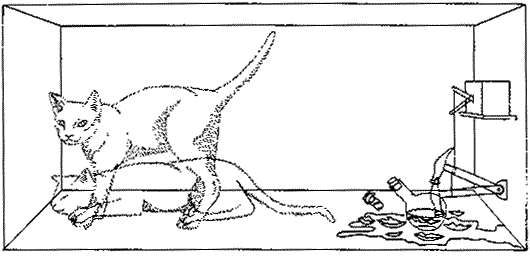
These physicists (sp?) have just created the biggest manefestation of a quantom physics illustration ever (namely scrondiggers (sp?) cat).
The Schrodinger's cat scenario requires that you are able to retrieve the item (cat, superstrings, etc.) and check to see if it is alive or dead, intact or destroyed, or whatever.
When we make observation our predispositions on the data influence the observation and change the reality.
How, precisely? Does it read our minds?
In other words YOU CAN'T BE WRONG NO MATTER WHAT YOU SAY!
Perhaps if you're psychotic? -
Hrmph.From the registration page: $395 CAD for early bird registration. $145 CAD to watch the webcast?.
They should open source the conference itself. Where's the love?
-
Re:Not much informationYou don't need a drive to use of an encoder. There are hand controllers which take input from encoders, but provide instructions, left/right/up/down x units, so that a human user can point the thing in the right direction.
Quite true. A particularly nice example exists on the old 74" telescope at the David Dunlap Observatory. The encoders feed into a computer which displays not the absolute position but the difference between the current position and where you want to point to. All you have to do is move the telescope until the display shows zero. (The 1920's design of the telescope makes it impractical to fully automate, large movements are done by hand, once the telescope has been roughly pointed the automatic guiding system takes over. The offset encoder system is very accurate though.)
My original point was that the price list seems to have little relation to the telescope itself. Neither the photos nor the list of dissasembled parts shows an encoder, hand controller or the like. I'd be interested to read your ATM mentors comments, perhaps you could post them up here as reply when you have them.
-
Re:The easiest way
I tend to think CS is better as a hobby... and especially so if you still want to see patients.
There are plenty of opportunities and interesting projects out there if you want to do some technical work... and you don't even have any formal training to get involved and make a contribution:
OSCAR McMaster
GPLed software for the family practice. I went to one of their workshops... led by a engineer/MD from my alma mater.
GnuMed
My personal favourite. wxPython & PostgreSQL based. Led by an engineer/MD.
Tk Family Practice
The creator has an amazing collection of free eMedicine links.
The future of eMedicine is going to look like this - picture of Dr Tux. The British Medical Journal thinks so -- Medical software's free future
If you want to do engineering, I'd go the biomedical engineering route--that is where I'm coming from... and will continue to do some work. -
Re:Eeeegads!
Why the university keeps him on I have no idea.
In additoin to "being" a cyborg, he is also a professor. I know he sometimes teaches an undergrad course on digital signal processing, and of course a 4th-year undergrad/1st-year grad course called "Personal Cybernetics and Intelligent Imaging Systems". Obviously he's heavily focused on wearable computing, but part of that includes active research in the image processing field. So, sure, he's a bit of a quirky character, but he teaches and does publishable research, and that's what university professors are supposed to do. You can go to his homepage and click on the "research papers" and "textbooks" links to get a better idea of his research area. -
Re:Priceswish people would quit spouting out the crap about "above human eye limits". There is no such thing. We don't know what the maximum frame rate that the eye can see is.
Others have noted that the eye is an analog device, and so the notion of a 'frame rate' is absurd for that reason. Fair enough. Still, there's a limit to how fast the receptors in the human eye can 'refresh' themselves. Light shining on the eye triggers reversible chemical reactions; the rate at which the receptors can be restored to their unstimulated state after exposure to light arguably places an upper limit on the eye's 'frame rate'. In getting that signal to the brain, again a number of reversible reactions take place, all of which may impose an upper limit on your vision 'refresh rate'.
For those that are interested, there's not a bad description of the entire process in point form here, as well as a more detailed description of phototransduction (what happens when photons strike the retina) here. A diagram of the phototranduction cascade is here.