Slashdot Mirror
Domain: uwa.edu.au
Stories and comments across the archive that link to uwa.edu.au.
Comments · 112
-
Re:More to come
What that article conveniently leaves out: taken as a whole bloc (that is, averaging all the nations), about half of sub-Saharan Africa's GDP comes from foreign aid.
Maybe because it isn't true. This paper says between 5% and 20% over the years, lately in the 10% range.
I notice you didn't reply to the European liberals' plan to recolonize Africa because they (with best of intentions) looked at the facts and saw that they are failing to govern themselves. But that's Slashdot, right? Just ignore anything inconvenient.
Name just one majority-white, white-ruled nation that requires anything like 10% of its GDP to be foreign aid. I'll wait.
Or a related question: name one black-ruled majority-black place where you would like to live. It doesn't have to be a foreign nation. It could be a place like Atlanta or Birmingham, where the majority black electorate has elected black officials in the city.
-
Re:More to come
What that article conveniently leaves out: taken as a whole bloc (that is, averaging all the nations), about half of sub-Saharan Africa's GDP comes from foreign aid.
Maybe because it isn't true. This paper says between 5% and 20% over the years, lately in the 10% range.
-
"Application" dates to System 0.97
Finder has always referred to executables as "applications". (Source: any screenshot of Finder going back to 0.97) This is true in both the user interface and the four-character file type code used in classic Mac OS to identify each file's content type. The file type code for executables is APPL, short for "application".
Do you also require a citation that the use of "app" as short for "application" predates July 2008 when iPhone OS 2 was released?
-
Re:Bad arguments
So, basically what you just said is that I was ignoring your points, so in return, you will ignore mine.
Basically what I said is your points are wrong and invalid. You essentially said something akin to "more people with cancer die in this hospital, thus it is a bad hospital" without recognizing that the hospital has 100 times more beds and 300 times more cancer patients than the "better" hospital (getting into some Simpson's Paradox material).
Again: I'm talking about whole populations and their observable behaviors in response to environmental stimulus; you're talking about population demographics and their general average behavior across all environmental stimulus, and extrapolating that by analogizing their demographic to a certain type of stimulus and claiming that describes a population's reaction to the stimulus.
What I had said is that the rate of population growth decreases as prosperity increases.
Yet each reduction in scarcity across all of human history has caused a boom in population. Human population has been shown directly tied to prosperity in a causal manner: societies capable of producing more per population achieve higher populations, and developments of new technology which raises that ceiling causes an increase in population growth rate.
Hell, quick google finds things
The greatest single factor in the history of human population growth has been developments in technology and the associated social changes arising from it. From the first development of tools to the development of agriculture and the later rise of industry, technology has expanded the resources available for the support of large populations.
The first important fact to consider is that technological growth helps drive population which itself helps drive technological progress. This is due to the ability of technological improvements to increase the agricultural productivity of both individuals and societies, and thus allowed for a boom in available resources which provided sustenance for a larger population.
This is the subject of a lot of economic study, forming the basis of many further arguments about what affects technical progress and, thus, further drives population growth.
So, again: you're talking about sociology and demographics; I'm talking about economy and populations.
-
Read the actual paper
Here is the actual paper. The methodology does not strike me as reaching a representative population:
Visitors to climate blogs voluntarily completed an online questionnaire between August and October 2010 (N = 1377). Links were posted on 8 blogs (with a pro-science
science stance but with a diverse audience) -
Re:Jet Airplane
Try put the stuff in the boot. There's no "green house" effect in the boot. It will get hotter than ambient, but it won't get as hot as in the passenger compartment: http://school.maths.uwa.edu.au/~fowkes/SunFowkes/hotcarsels091209.pdf
If you want to test it out to be safe, put a candle (melts at about 60-70 C, beeswax melts at a lower point) at an angle in a container in the boot and in the compartment. If it melts or bends after the whole day that means it's probably too hot.
-
Re:Think about it....
And all that will still leave the system worthless for anything other than emergency response.
Video surveillance is useless for identifying people because (1) compression impacts exactly those spatial frequencies needed for face recognition and (2) humans are bad at identifying faces (unless they are very familiar). Even if a face is not present in a lineup, people say it is 70% of the time.
[1] Video Surveillance is Useless (presentation) http://www.csse.uwa.edu.au/~pk/Research/VideoIsUselessANZFSS/
[2] Video Surveillance: Legally Blind? http://www.csse.uwa.edu.au/~pk/Research/pkpapers/legallyblind.pdf
[3] Face Recognition in Poor Quality Video http://pss.sagepub.com/content/10/3/243.short -
Re:Think about it....
And all that will still leave the system worthless for anything other than emergency response.
Video surveillance is useless for identifying people because (1) compression impacts exactly those spatial frequencies needed for face recognition and (2) humans are bad at identifying faces (unless they are very familiar). Even if a face is not present in a lineup, people say it is 70% of the time.
[1] Video Surveillance is Useless (presentation) http://www.csse.uwa.edu.au/~pk/Research/VideoIsUselessANZFSS/
[2] Video Surveillance: Legally Blind? http://www.csse.uwa.edu.au/~pk/Research/pkpapers/legallyblind.pdf
[3] Face Recognition in Poor Quality Video http://pss.sagepub.com/content/10/3/243.short -
Gabor Filters
It's unclear from the article exactly what processing goes on to get to the sketch, but if plain Gabor filters were actually used for edge detection, the result might not be that good. Phase congruency is a measure that uses Gabor filters to produce a pretty good edge detection result. Posting as anon so I don't look like a know-it-all; I'm not affiliated with Peter Kovesi, either.
-
University of Western Australia
Here at UWA we have full Linux support. CS units regularly set projects requiring a *NIX OS, and all Lab machines boot at least Windows and Fedora (and there's a Mac lab with triple-boot).
Step-by-step networking instructions are also provided for Windows XP, Vista, 7, Ubuntu, OS X, iOS, Android and Symbian.
http://its.uwa.edu.au/wifi/unifi/setup_and_troubleshooting -
Re:How is this news?
More detail:
http://lists.ucc.gu.uwa.edu.au/pipermail/lore/2006-August/000040.htmlhttp://www.merit.edu/mail.archives/nanog/1997-04/msg00340.html
http://www.merit.edu/mail.archives/nanog/1997-04/msg00444.html
http://portal.acm.org/citation.cfm?id=347428&dl=ACM&coll=http://web.archive.org/web/20070328170121/http://www.riverstonenet.com/support/bgp/design/index.htm
-
Guy Ben-Ary was doing this five years ago
Guy Ben-Ary is an artist who did a residency at the SymbioticA Research Lab at the University of Western Australia and then at the Potter Lab at Georgia Tech. During that time he created a system where a culture of rat brain neurons controlled a robotic pen controller to draw "art". Further, the two components (brain and arm) were geographically separated and communicated across the internet.
MEART: The Semi Living Artist
-
Photographs of the first dish
Recent (1 week old) photographs of the site, the first dish, and the array can be found here http://local.wasp.uwa.edu.au/data/Boolardy/ This includes movies showing the three rotational axes of the dish, some gigapixel panoramas, and ladyBug footage.
-
Re:Cisco Packet Tracer
I also had Chris McDonald as a lecturer when I was at UWA several years ago and he was by far the best lecturer that I had in my time there. Just about everyone that took one of his courses would comment on how interesting and relevant his classes were. I'm not at all surprised speedwaystar is making the same comment.
Although, it is a bit of a brown noser comment...
-
Re:Cisco Packet Tracer
We use CNET, it lets you simulate any layer of a network stack, but really its better for teaching low-level networking by getting you to recreate a the OSI stack, rather than teaching you how to configure this or that type of node/router.
If you want you can see frames and acks between this and that node as they travel across the various links needed to reach the final point, a thorough way to visualize what's going on, but not the fastest way to teach someone how to use ifconfig or configure a cisco router. -
Re:That's why people get more than one display...
I can imagine wanting more! I want one of these! Although my implementation would be a cylindrical, not spherical, screen, giving me a 120 x 90 display area that spans my desk.
- fractoid-with-mod-points -
Re:Hard to Do
I would think that you need as many points as possible. On old maps it won't be a standard disortion. It will be a disortion from point to point. Say you have 5 churches on a line (1 dimension) and on the map it is 1 cm/inch between each church. The real distance could be 1km/mile from A to B. 2 for B to C 1.5 C to D and 0.5 from D to E. Ok, most likely the differences won't be that big, but you should get the idea.
So you can not just say to take A C and E and then calculate B and C. Adding a second dimension will be a bit more complicated to explain, but the idea is the same.
It would be neat to see how disorted the grid would be and where the biggest differences/errors are.
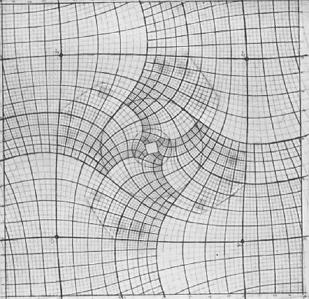
Would it be something like http://im-possible.info/images/articles/escher_printgallery/escher_grid.jpg
or more like http://local.wasp.uwa.edu.au/~pbourke/miscellaneous/cube2cyl/grid_00000.jpg
And will it depend on map maker or period the map was made in or any other reason why this would be happening.On European maps a lot of todays roads are still the same as the roads the Romans (what did they ever do for us?) made.
-
Re:It's all about the tech
You are so far out of touch it's a waste of time talking to you. Nevertheless, because your naivete is good for a laugh:
1. Inertial guidance systems more than accurate enough to find a given block in a specified city have been around since the 1950's. A retarded calculator could do the job, much less a half-decent P4 chip. 2. Shape templates are also childishly easy. You aren't talking about anything sophisticated or error-proof; nothing much more complicated than a silhouette or quick scan through a few thousand images would do the trick. From a given height and orientation there's only so many shapes that fit a semi or a train, or a particular office building. A basic camera and desktop PC can read ASLAN from human hands, for fuck sake. What do you need with "computer vision", especially when a mistake will probably still do damage? Anything here would be more than sophisticated enough to do the job:
http://www.slideboom.com/presentations/72734/Automated--shape--detection
http://www.springerlink.com/content/xx452562rw513402/
http://www.csse.uwa.edu.au/~pk/Research/MatlabFns/othersites.html
A lot of very expensive American ordnance wound up pounding the hell out of civilian targets in the former Yugoslavia because some nasty-minded people figured out all you needed to simulate a SAM site was a microwave oven and a few basic tools. Get a clue.
-
Video Surveillance is Useless
Video Surveillance is Useless Presentation from prominent computer vision researcher, inventor of phase correlation method It basically saying, that on current tech level video surveillance is useless for face identification. What follow is that it's actually harmful, due to wrong impression of it's reliability.
-
Guidance from Alan Perlis comes to mind
Epigrams of programming:
120 Adapting old programs to fit new machines usually means adapting new machines to behave like old ones.
( http://www.pam1.bcs.uwa.edu.au/~michaelw/Perlis_Epigrams.html )
-
Re:Wait... what!?
Maybe the techs didn't have the right screwdriver to remove the hard disk drive? For some bizarre reason, certain manufacturers seem to delight in using Torx screws (hexagon socket) to secure their hard disk drives, while everything else is the standard PC screw (Reference diagram). The only way to remove this type of screw without damage is to have the exact Torx screwdriver available.
If the disks were in a RAID array, care would have to be taken to make sure they were replaced in the exact sequence as they were in the original system. But, most IT departments aren't allowed to disassemble/assemble hardware - they either get a service technician to come in, or send the hardware back by courier.
-
Dome projection screen
Make a dome screen from it. The parabola is perfect for this purpose. See http://local.wasp.uwa.edu.au/~pbourke/projection/domemirror/uprightdome2/
-
Re:POV-Ray
[POV-Ray galleries] So what you're saying is.... metallic spheres on checkerboards?
That's so 80's. Now there's pirate ships, Lochness Monsters, bonsai tree gardens, light-houses, gargoyles, etc. At this link they are purchasable as posters:
http://www.zazzle.com/products/gallery/POVcomp.asp
Another approach is the "short code contest" (link below). This is where the contestant has to limit the size of the POV code that generates the image. Along with the image, perhaps on a plaque below, you could post the POV code (equation) that generates it. That would show the both beauty and the technology (math) behind it.
http://local.wasp.uwa.edu.au/~pbourke/exhibition/scc3/final/
Sure, the "short code" contest is a bit closer to the "silver sphere on a checkered board" kind of themes, but that alone does not make it bad, especially if you can show the equation with it. Show both: the complex ones (no plague) and the short-code ones with equation plagues. -
Snake oil
This thing won't work. Increasing the FOV already causes terrible distorted images along the edges of your imagery. The very reason that I took back the Matrox Tripple Head2Go device a while back.
Now you take this stretched image and project it onto a dome. The stretched images get further streched as it is smeared along the edges of the dome.
Yes it is true that you don't see much detail in your periphery but you will be perfectly capable to interpret the direction of movement in your periphery vision. Because the perspective is distorted so badly you will feel a very uncomfortable dizzying sensation every time the camera direction changes.
If you are serious about Dome projection you will need to pre-distort the image before projecting it onto the dome. Something Graphics card drivers should be capable of in my opinion but in custom software easily achieved with a shader program.
You will want to check out Paul Burkes research here:
http://local.wasp.uwa.edu.au/~pbourke/projection/domemirror/
And in particular his paper:
http://local.wasp.uwa.edu.au/~pbourke/papers/dime2006/dime2006.pdf
There is also great distortion software that inserts itself between OpenGL/DirectX and the application here: http://immersaview.com/sol7.html
I am afraid that simply projecting on a Dome is just not good enough and will make you literally puke after 30 minutes or so. -
Snake oil
This thing won't work. Increasing the FOV already causes terrible distorted images along the edges of your imagery. The very reason that I took back the Matrox Tripple Head2Go device a while back.
Now you take this stretched image and project it onto a dome. The stretched images get further streched as it is smeared along the edges of the dome.
Yes it is true that you don't see much detail in your periphery but you will be perfectly capable to interpret the direction of movement in your periphery vision. Because the perspective is distorted so badly you will feel a very uncomfortable dizzying sensation every time the camera direction changes.
If you are serious about Dome projection you will need to pre-distort the image before projecting it onto the dome. Something Graphics card drivers should be capable of in my opinion but in custom software easily achieved with a shader program.
You will want to check out Paul Burkes research here:
http://local.wasp.uwa.edu.au/~pbourke/projection/domemirror/
And in particular his paper:
http://local.wasp.uwa.edu.au/~pbourke/papers/dime2006/dime2006.pdf
There is also great distortion software that inserts itself between OpenGL/DirectX and the application here: http://immersaview.com/sol7.html
I am afraid that simply projecting on a Dome is just not good enough and will make you literally puke after 30 minutes or so. -
Early steps already taken
SymbioticA, a cross-disciplinary life sciences and art research lab at the University of Western Australia has been taking "baby steps" in this process. You can read about their "disembodied cuisine" project where they grew frog skeletal muscle over biopolymer and ate it.
It turns out the biggest problem with doing these kinds of experiments are regulations. Research labs may lose their licenses if they produce food for eating, actual food production has tremendous amount of regulation, and the transport of "biological samples" are highly regulated (although transport of a flank steak is much less regulated).
Also real "meat" is not just muscle cells, but a rich microstructure of muscle, connective tissue, and fat. So it will push the limits of tissue engineering to come up with something that actually tastes good. -
Vegan and Ready
I'm a vegan and if someone offered me a delicious cloned steak, I'd eat it in a heartbeat. And yes, even if the cloned meat needed original animal tissue to start off with, I'd be OK with it. In fact as early as 2003, the Australian research group SymbioticA, made cloned frog steaks from a still living frog. So animals, theoretically, could be donors to cloned meat projects without even having to die. Here is the link to SymbioticA and a link to an article about those delicious frog steaks... mmm... http://www.symbiotica.uwa.edu.au/welcome http://www.wired.com/medtech/health/news/2004/02/62385?currentPage=all
-
proof by mutual reference, virtual self-reference
So-called “proof by mutual reference” is a classic invalid technique for proof, and AFAICT this incident would exemplify it. If, however, one were to assume the complicity of parties involved, it could be seen as an allusion to a clever hack that some writers pulled off some time ago in which a book was put together which contained reviews of the book. I have made a(n admittedly) cursory attempt at finding an online account of this hack (the mastermind of which may have been Douglas Hofstadter) and failed to come up with a link for you; any replies containing suitable links thereto would be appreciated.
-
Re:Not that simpleI really hope that this isn't truly a "new" discovery
This guy did it in the 80s, and wrote an undergraduate text about it (well with traffic shock waves as a minor part) released 1994.
-
Re:April 2004 --- what number?
I'm sure if you emailed Paul, he'd let you know what happened to the previous contests (probably hiding under the data mat at Swinburne. He'd a very down to earth guy and would help you out if possible. His email address is at the top of his home page: http://local.wasp.uwa.edu.au/~pbourke/index.html
-
Paul Bourke
It seems nobody has yet mentioned the work of Paul Bourke (if that name seems familiar, he hosted the POV-Ray short code competition recently featured on Slashdot). I'm a fan of his work on fractals (scroll down, there's a *lot* of stuff on that page), especially slices of four-dimensional Julia sets. Definitely mathematical art of the highest order.
... well, that is, unless you're a fan of Ken Perlin instead
-
Paul Bourke
It seems nobody has yet mentioned the work of Paul Bourke (if that name seems familiar, he hosted the POV-Ray short code competition recently featured on Slashdot). I'm a fan of his work on fractals (scroll down, there's a *lot* of stuff on that page), especially slices of four-dimensional Julia sets. Definitely mathematical art of the highest order.
... well, that is, unless you're a fan of Ken Perlin instead
-
Paul Bourke
It seems nobody has yet mentioned the work of Paul Bourke (if that name seems familiar, he hosted the POV-Ray short code competition recently featured on Slashdot). I'm a fan of his work on fractals (scroll down, there's a *lot* of stuff on that page), especially slices of four-dimensional Julia sets. Definitely mathematical art of the highest order.
... well, that is, unless you're a fan of Ken Perlin instead
-
Re:Found SCC4
Another: http://ozviz.wasp.uwa.edu.au/~pbourke/exhibition/povfrac/final/
Not sure which year and can't find any others. -
Re:I wonder
The site where the results of this competition are held is an excellent place to start. Paul Bourke, who also posted the article, creates a lot of this stuff. I *strongly* suggest you spend some time on that site. To start with, try: http://local.wasp.uwa.edu.au/~pbourke/surfaces_curves/
-
Found SCC4
http://local.wasp.uwa.edu.au/~pbourke/exhibition/scc4/final/
But still can't find 1 & 2. -
Archive of old contest results?
I love this stuff, and want to look at all of it. I found SCC3 at http://ozviz.wasp.uwa.edu.au/~pbourke/exhibition/scc3/final/
but I can't find contests number 1, 2, nor 4. I tried the Wayback machine, with no luck. Maybe I didn't search right. Anybody know where to find 'em? -
Re:Slashdot + Many Videos = Where is the mirror
wget http://local.wasp.uwa.edu.au/~pbourke/exhibition/scc5/final.html -O- -q -U Mozilla |grep \\.mov |sed -e "s@.*href=.@@" -e "s@mov.*@mov@" |while read e; do echo http://local.wasp.uwa.edu.au/~pbourke/exhibition/scc5/$e; done |xargs wget -U Mozilla --referer="http://local.wasp.uwa.edu.au/~pbourke/exhibition/scc5/final.html"
-
Re:Slashdot + Many Videos = Where is the mirror
wget http://local.wasp.uwa.edu.au/~pbourke/exhibition/scc5/final.html -O- -q -U Mozilla |grep \\.mov |sed -e "s@.*href=.@@" -e "s@mov.*@mov@" |while read e; do echo http://local.wasp.uwa.edu.au/~pbourke/exhibition/scc5/$e; done |xargs wget -U Mozilla --referer="http://local.wasp.uwa.edu.au/~pbourke/exhibition/scc5/final.html"
-
Re:I wonder
So how on earth does one come up with the trig functions necessary to do these transformations by hand without a modeller? Look at the complexity of the winner.
I am not artistic by any stretch of the imagination, but I do enjoy math and programming and downloaded POV-Ray and the related documentation hoping to learn more about art through programming. So far, I made a sphere on a checkered floor, and POV-Ray handled all of the trig for me there.
Any tutorials out there on mathematic transformations and how they apply to a 3d rendering? -
And somewhere in Australia...
a server does an amazing impression of the second-place winner.
-
Similar stuff
Similar stuff:
http://local.wasp.uwa.edu.au/~pbourke/fractals/dla3d/ -
Old
Old news: http://local.wasp.uwa.edu.au/~pbourke/projection/Wii/index.html, the wii remote is not accurate enough.
-
Re:Prefuse.org visualization toolkit
Some pretty tidy work there. In case you are after some extensions (to the view ability) check out http://local.wasp.uwa.edu.au/~pbourke/projection/Wii/index.html. Although it uses a wii as a controller, I think the really cool thing is the "navigable movie" aspect. In your case, you could render extremely large images (yes, I know there is a limit of decoder speed and disk IO) and write a quicktime movie player (using the API) so that while the movie is playing, you can navigate around.
The link is on Paul Bourke's site, and if you are in anyway related to visualisation, you should check it out. Especially the fractal stuff (and there is a *lot*). -
duh!
i didn't have any trouble finding a variety of resources that answer your questions using google.
why are you asking slashdot ?
in particular, this looks interesting: http://www.csse.uwa.edu.au/~pk/studentprojects/lib or/
as did this: http://www.itl.nist.gov/iad/894.03/nigos/mbark.htm l -
Completely Automated iLectures/Lectopia
Built by the University of Western Australia and also used by Curtin University, there are completely automagic systems in use.
From Curtin's site:
A lecturer walks into their next lecture, turns the microphone on and delivers a lecture. An hour or so later, without any human intervention, an appropriately titled link automatically appears on the web page of that unit adding the just finished lecture to the list of all the lecture recordings for that unit.
Links
http://www.lectopia-service.uwa.edu.au/about
http://www.lectopia.uwa.edu.au/history.lasso
http://ilectures.curtin.edu.au/information/ -
Completely Automated iLectures/Lectopia
Built by the University of Western Australia and also used by Curtin University, there are completely automagic systems in use.
From Curtin's site:
A lecturer walks into their next lecture, turns the microphone on and delivers a lecture. An hour or so later, without any human intervention, an appropriately titled link automatically appears on the web page of that unit adding the just finished lecture to the list of all the lecture recordings for that unit.
Links
http://www.lectopia-service.uwa.edu.au/about
http://www.lectopia.uwa.edu.au/history.lasso
http://ilectures.curtin.edu.au/information/ -
Lectopia
Hi,
Congratulations on podcasting your lectures. I was involved in setting up exactly this sort of thing at a large Australian University. The good news is that you have nothing to fear; Our lecturers had similar concerns, but after we implimented our system we found no visibile drop off in attendance. And a lot of students downloaded the lectures (in fact, most downloaded them within 48 hours of the actual lecture). In some subjects, particularly law, the hit rate was over 50% of the enrolment. But it turns out most students were using the lecutures for revision. Apparently this was an important factor for students from a non english speaking background.
The system you want is lectopia. http://ilectures.uwa.edu.au/ (and no, I don't work for them) -
No attendance drop with our podcast lectures
We automatically record around 70 lectures per week using the Lectopia System http://lectopia.uwa.edu.au/ and haven't noticed any major drops in attendance in any of those lectures. One of our departments, the School of Computing, did a study of the use of Lectopia across a number of units and found there was no discernable drop in attendance at all compared to the control classes that hadn't used the system.
What we find is that although any recording is only second-best to a good-quality live interactive lecture, it is great for reviewing lectures before exams, for English-as-a-second-language students, those with disabilities and distance and part-time students, as well as regular students who have time-table clashes or who just slept in. We also notice some students putting down their pens and instead listening and participating in class and then later at home or in a computer lab with headphones on and the web browser in the background, writing notes on the lecture in Word as they pause and rewind the recording.
For some lecturers this system is the easiest and simplest way for them to get their lecture content "webified" and it's also great to be able to enable last year's version of a lecture when the lecturer is sick or the lecture has to be cancelled for some reason.
We use the Lectopia system (originally called iLectures) which is an enterprise-class system that enables lecturers to book their lectures at the start of semester and then on the day of each lecture just walk in, turn on the microphone (which triggers the recording) and deliver their lecture as they would normally. 15 minutes or so after they finish their lecture, streaming and podcast versions of the lecture appear on the web in their unit web pages all without any human intervention.
The system automatically captures whatever gets shown on the data projector as a high resolution, high quality XGA stream synchronised to the audio from the lecture theatre sound system so students can see the mouse moving around as the lecturer talks. It also means that no matter whether the lecturer is browsing the web, running a program or just showing powerpoint slides, it all gets recorded at a high enough quality for the users to read the small text better than if they were actually in the lecture theatre.
The system automatically compresses multiple versions for different bandwidths from 14k up to 1Mbps or more in Windows Media, Quicktime, MPEG-4, MP3, iPod audio book and 3GP formats for mobile phones etc in streaming as well as multiple downloadable formats. It also automatically publishes podcast versions to iTunes U.
Duke University in Durham NC uses Lectopia http://www.duke.edu/ddi/projects/capture.html to automatically record their lectures to fill all those iPods they give out to their students. A third of the universities here in Australia and New Zealand also use the system. The University of Western Australia (the original developer of Lectopia) records over 400 lectures per week across over 40 lecture theatres while at least one other university in Australia is planning to install automated Lectopia digitisers in 150 classrooms across their campuses.
We see podcasting/streaming lectures as a very valuable enhancement of existing lectures, something which turns them into a resource available 24/7/365 anywhere in the world. Not a silver bullet to replace lectures, but rather something to expand their usage and capture their value making something that used to last for one hour once a year in one room on campus into something available anytime, anywhere.
-Mart
Martin Hill, Digital Media Specialist
Information Management Services, Curtin University of Technology
Western Australia
web: http://ilectures.curtin.edu.au/ -
Lecture recordings
At my university we have recordings of lectures available to download. Generally I don't use them but they are handy if I have missed the lecture or want to go over it again at home. The kids who skip the lectures and say they will watch it later generally don't, but some people I know will stay home if they only have 1 class and do it there so they don't have to make the trip to uni.
We only have access to the lectures of the courses we are enrolled in. At my uni attendence is not required for lectures, only for tutorials and labs, so people skipping class will only indirectly affect their marks.
And now a quick plug for the software my uni uses and developed: Lectopia: http://ilectures.uwa.edu.au/