Slashdot Mirror
Domain: vt.edu
Stories and comments across the archive that link to vt.edu.
Comments · 740
-
Re: Wait... what happened to the famous pipeline?
Couldn't have looked that hard.
Virginia Tech in 2004 upgraded their PowerMac G5s to Xserve G5s .
https://vtnews.vt.edu/articles...Feb 01, 2005 - University of Illinois preps 640-node Apple Xserve G5 cluster
https://appleinsider.com/artic... -
Depends what a textbook is and for what usage
There was a good discussion on the vlogbrothers youtube channel (video and comments): https://www.youtube.com/watch?...
It really depends who are the target users of textbook. As a first time introduction to a topic, textbooks tend to be a little rough. But as collections of carefully curated piece of knowledge, they are valuable.
There is a need for a carefully written description of a concept and the various versions of it, with 200 exercises some of them with solutions. That is what a textbook is. Whether it is print or not is an orthogonal issue. OpenDSA ( https://opendsa-server.cs.vt.e... ) is a pretty good online textbook for data structures and algorithms for example.
Now, there is value to a printed copies of some books and there is value to electronic ones depending on you usage of them.
We can't replace all our textbook with 3 minute video discussion of the topic. Such videos do not get in enough details and can not be precise enough and can not provide with dozens of alternate versions. But they can be a pretty good introduction to a topic.
-
Re:EPYC problem
The only problem with AMD processors is they don't implement transactional memory operations.
I can understand your concern if you need this for research, but as an optimization, transactional memory has so far proved pretty underwhelming.
-
Re:what's the plan for moral choice?
According to some research, automated cars crash less than human drivers. 1.6 compared to 2.5 crashes per million miles for the most severe category of accidents, and 5.6 compared to 14.4 for the least. The problem is those miles are not really comparable to the entire set of miles driven by humans. I would say the answer is nobody really knows how safe they are compared to people.
-
Re: Rats fleeing a sinking ship
You keep trying to side track the conversation.
Says he of the ever moving goalposts. Waaay back in this conversation, you said
So this is the version where they got it not to kill people? Funny, I would have put that feature in first.
You didn't say "better than humans" or any sort of comparison to humans. You effectively said, "It has to be perfect."
As soon as I pointed out how perfect is a ridiculous standard, considering humans aren't perfect, you started shifting those goalposts. Next it was, "why couldn't the system see something people can see?". What you've done is pick one situation where the system didn't work as intended, you ignored hundreds of the exact same situation, in the exact same part of the exact same road where it did, so I guess it makes sense for this to be an issue for you. Rational people don't do that. Only people with a serious agenda cherry pick like that and ignore all the evidence to the contrary.
In your last two sentences, you've finally gotten to a reasonable argument to have:
Human driving is very safe if you consider the 3.2 *trillion* miles driving in the US every year. Much safer than Autopilot would be if it were to drive everywhere and in all conditions like a human.
Now we're comparing rates of accidents between humans as a whole and autopilot as a whole. Bravo, this is actually meaningful, and what I was saying all along, albeit indirectly.
So lets have that discussion. There isn't a ton of research on this, but there is a little. AUTOMATED VEHICLE CRASH RATE COMPARISON USING NATURALISTIC DATA is from 2016 and finds that self driving cars are a lot safer. How Safe Are Self-Driving Cars? Waymo Proves They’re Pretty Darn Safeis from 2017 and summaries WayMo data, which you can argue is likely a bit biased towards Google. But even in the worst case scenario, they find self-driving cars an order of magnitude safer than human drivers.
In the NHSTA's report on the Tesla crash where it hit the semi-truck side-on and took off the top of the car, they interestingly don't find fault with Tesla. Just that they needed to be more specific on the limitations of autopilot. And buried in that report is a graph that shows auto-steer dropping the accident rate (airbag deployment) per million miles from 1.3 to 0.8 when it's enabled. I'm finding it hard to find non-fatality rates for the whole US, but in the couple of states I looked at, the accident rate seems to be between 1 and 3 for most types of roads.
If you've got more comprehensive and current research, I'd be very happy to see it. Unfortunately there doesn't seem to be a ton, but what's out there seems to strongly suggest that the current self-driving tech is at least as safe as the average driver, if not more safe, in most circumstances.
-
Re:Big mistake!
Secondly measured in terms of accidents and fatalities, autonomous cars have already caused less accidents per miles driven than your average human driver, so if that's your metric, the argument can be made that said bar has already been passed, although that obviously does not mean that the safety cannot and should not be further improved until the fatalities drop to zero.
Two points:
1) This comparison is of automated vehicles driving only in the safest conditions to humans driving in all conditions. That introduces a huge bias in favor of automated vehicles.
2) From your link:Low exposure for self-driving vehicles (about 1.3 million miles in this study) increases the uncertainty in Self-Driving Car crash rates compared to the SHRP 2 NDS (over 34 million miles) and nearly 3 trillion vehicle miles driven nationally in 2013 (2,965,600,000,000).
Current data suggest that self-driving cars may have low rates of more-severe crashes (Level 1 and Level 2 crashes) when compared to national rates or to rates from naturalistic data sets, but there is currently too much uncertainty in self-driving rates to draw this conclusion with strong confidence.[Emphasis mine]
This isn't an apples-to-apples comparison. It's an apple-seed-to-orange-tree comparison, and should be taken with a whole lot of salt. -
Re:Big mistake!
What's your proposed model for testing an autonomous car driving amidst normal traffic conditions that does not include actually having it drive among normal road traffic?
As far as I've read, Google (Waymo) created an entire fake town to test different traffic situations out before letting their autonomous cars onto the actual roads in actual towns...I have not heard of Uber doing such a thing.
Secondly measured in terms of accidents and fatalities, autonomous cars have already caused less accidents per miles driven than your average human driver, so if that's your metric, the argument can be made that said bar has already been passed, although that obviously does not mean that the safety cannot and should not be further improved until the fatalities drop to zero.
This is a completely irrelevant statistic at this point. You're comparing accidents per miles driven of regular vs. experimental self-driving cars (all of which, btw, have human drivers which are supposed to - and often do - intervene to prevent accidents)...the two "sample sizes" so to speak are so vastly different that no valid comparison is possible. How many miles have self-driven cars driven? Several orders of magnitudes less than regular cars. How many self-driving cars are on the roads at any point? Tens? Hundreds? On the other hand there are hundreds of millions of cars in the US alone, which means tens of millions of cars are on the road every day, i.e. at least a couple of million driving at any one moment. Those regular cars drive in all conditions, on all roads, during all times of day, in every imaginable traffic situation, and, apart from beginner drivers riding around with instructors (who have a second brake to use at the passenger seat), none of those drivers are being constantly supervised by someone who can take control of the vehicle if they make a mistake. So comparing their accident record to self-driving cars which are being tested in a handful of cities and which, by admition of the manufacturers of said self-driving cars, cannot yet handle all weather conditions for example, is just...nonsense.
Bottom line: put 5 million self-driving cars on the road (using current technology), let them drive randomly around (i.e. no careful selection of driving days based on weather, routes based on street suitability for current technology, etc.), remove the human driver supervising them, and I'm pretty sure that accident rate will be higher than with normal cars.
Finally, the link you provided talks only about Google cars. No data about Uber or the other players in this game.
Plane safety has gone up dramatically as a result of tens and hundreds of accidents in both software and hardware, and the same's true with 'regular' cars. Your standard seems to me to be an illogical 'unless it's completely failsafe it should not be used at all', and if we followed that principle we'd still be using horses.
You're missing a crucial point here. When cars first came about, many cities would not allow them...many others allowed them if a person would walk (yes, walk) in front with a red flag, a horn, or shouting "danger!" or something like that (yes, this is true...). Early cars were, in modern terms, painfully slow - not just due to lack of engine power but also due to lack of infrastructure (no paved roads) and regulation ("jaywalking" had to be invented as a crime to allow car traffic to move more smoothly and more safely, on the back of a lot of lobbying by the car companies). There was a gradual ramp up of cars and the necessary infrastructure to support them. Similar things happen with airplanes - airports were placed away from built up areas, flight routes restricted, and this meant that potential harm from a failure was limited to the passengers - whom no one had forced to fly. Testing of self-driving cars on infrastructure not built for them (but built for huma
-
Re:Big mistake!
Testing is also done (or should be done) in controlled environments until you get way past the alfa and beta stages. Putting the autonomous car on the road can be justified when the car doesn't need human supervision and it can deal with normal traffic conditions in day and night with the same performance as that of a human driver.
What's your proposed model for testing an autonomous car driving amidst normal traffic conditions that does not include actually having it drive among normal road traffic?
Drive around in real traffic with a human driver in a car kitted out with all the sensors that the autonomous car would have. Record the sensor data. Use that sensor data to build a simulation to train the AI. I know an actual solution would be more complicated, but it could be done. It's just cheaper to put real cars on real roads and endanger real people.
Secondly measured in terms of accidents and fatalities, autonomous cars have already caused less accidents per miles driven than your average human driver, so if that's your metric, the argument can be made that said bar has already been passed, although that obviously does not mean that the safety cannot and should not be further improved until the fatalities drop to zero.
You can't just lump all autonomous vehicles together under one rubric when the issue is whether Uber should be allowed to continue road testing. Uber has a significantly worse safety record that its peers when taken their statistics are considered in isolation. Their technology is much less mature with more human interventions required per mile, creating more mode switches for the human operator and more opportunities for failure.
-
Re:Big mistake!
What's your proposed model for testing an autonomous car driving amidst normal traffic conditions that does not include actually having it drive among normal road traffic?
Secondly measured in terms of accidents and fatalities, autonomous cars have already caused less accidents per miles driven than your average human driver, so if that's your metric, the argument can be made that said bar has already been passed
There are entire test sites for self-driving cars. Once your car meets some standard in the test site, you could then take it on the road. https://www.freep.com/story/mo... Autonomous vehicles, in general, may be safer than ones operated by the average human driver. But that doesn't mean that the *Uber* vehicles are safer than ones operated by human drivers.
It appears that Waymo and such have done a great job getting their vehicles as ready as possible before putting them on the road and, as a result, have a great safety record. Uber just slapped a bunch of components together probably using technology that they "borrowed" from competitor without understanding, put it on the road, and watched the failures pile up. Their failure rate is one per 13 miles vs Gogole's one per 5k miles. Now there are some thing that make those not a perfect comparison but even giving Uber an order-of-magnitude benefit of the doubt, their cars are still awful dangerous things that don't belong on the road. That's different than saying no autonomous cars belong on the road.
-
Re:Big mistake!
Testing is also done (or should be done) in controlled environments until you get way past the alfa and beta stages. Putting the autonomous car on the road can be justified when the car doesn't need human supervision and it can deal with normal traffic conditions in day and night with the same performance as that of a human driver.
What's your proposed model for testing an autonomous car driving amidst normal traffic conditions that does not include actually having it drive among normal road traffic?
Secondly measured in terms of accidents and fatalities, autonomous cars have already caused less accidents per miles driven than your average human driver, so if that's your metric, the argument can be made that said bar has already been passed, although that obviously does not mean that the safety cannot and should not be further improved until the fatalities drop to zero.
And we know how software engineers think.. Throw the alfa software to the public and fix mistakes afterwards.
We should also know all know that alpha or not, there's no bug-free software. You can do all the simulations and all the testing you want, bugs and accidents will still happen. However, once they do and are fixed, the vehicles will not do the same mistakes again, which is not true for most human drivers. Human drivers also do not learn from the mistakes of other human drivers that they've never met. Autonomous cars do.
I fail to see what the problem is here. We all knew this was going to happen because it always happens with new transportation technologies that are in the process of being perfected. Plane safety has gone up dramatically as a result of tens and hundreds of accidents in both software and hardware, and the same's true with 'regular' cars. Your standard seems to me to be an illogical 'unless it's completely failsafe it should not be used at all', and if we followed that principle we'd still be using horses.
-
Re:Wished Ballard didn't give up on their gas-turb
it's only efficient when running at full power, and a huge fuel hog at lower power settings.
That is nonsense.As soon as you are in the mid range it is already quite efficient (considering the maximum): http://www.dg.history.vt.edu/c...
-
Re:so, here is something interesting.. a thank you
Hey Tim, upon reflection, I do owe you some thanks for correcting some of the facts I placed out there.. OK X-serves did remain in production for over a year, but I think the other person did bring up a good counter point "To whom were they sold to?" To be upfront the original argument was around the conjectured reasoning behind Apples move from SF to SJ, so lets stick with that ok.. Enjoy California.
Yeah, like SIXTEEN TIMES longer than the 6 months you originally claimed.
They sold a bunch to some Universities. I think Virginia Tech even made a supercomputer out of a roomful of them.
Beyond that, they had some success with some Rendering Farms for a couple of movie-industry companies. Can't remember any names off hand. But they couldn't compete head to head with Linux in that market due to cost considerations.
Unfortunately, they never got serious traction in business, mostly due to price; but they were a fine piece of tech, built with Apple's usual insane attention to detail, and I really wish they had made the transition to Intel. -
Re:Translation...
It's difficult. A manufacturer would have to see so obvious a business case for making a super-speed non-silicon processor that the worries about risk would be swept aside. (And from a paranoid viewpoint, the military might want to keep a super-speed process tightly under its own control.) That said, IBM has been working with SiGe for decades and may have a viable process. https://arstechnica.com/gadgets/2015/07/ibm-unveils-industrys-first-7nm-chip-moving-beyond-silicon/
Be aware that SiGe is mostly used for mixed signal devices, where the ability of Ge to make good bipolar devices is useful. The native oxide of germanium is not a good insulator like SiO2, which makes Ge FETs problematic. There are other challenges with making Ge FETs, discussed here: http://www.adsel.ece.vt.edu/files/journal/74.pdf.
It's going to take time, and when we get there, the processes with new materials or silicon hybrids are going to be more expensive.
-
You want a project?
Here's a project. Model how any small part of the Interplanetary Transport Network works. Then please send it to me. Here is a paper to help you get started: http://www2.esm.vt.edu/~sdross... Have fun coding!
-
Software wasn't tested
I daresay your response seems a little anti-regulation-ish.
The fault analysis didn't include the software, and indicates that the machine passed FDA muster without even considering the safety aspects of the software. It only states that the company did some testing.
Indeed, it would appear that the FDA accepted the "software is inconsequential" argument at the time of review.
Here's is a quote from the analysis:
In March 1983, AECL performed a safety analysis on the Therac-25. This analysis was in the form of a fault tree and apparently excluded the software. According to the final report, the analysis made several assumptions:
(1) Programming errors have been reduced by extensive testing on a hardware simulator and under field conditions on teletherapy units. Any residual software errors are not included in the analysis.
(2) Program software does not degrade due to wear, fatigue, or reproduction process.
(3) Computer execution errors are caused by faulty hardware components and by "soft" (random) errors induced by alpha particles and electromagnetic noise.
The fault tree resulting from this analysis does appear to include computer failure, although apparently, judging from these assumptions, it considers only hardware failures. For example, in one OR gate leading to the event of getting the wrong energy, a box contains "Computer selects wrong energy" and a probability of 10^11 is assigned to this event. For "Computer selects wrong mode," a probability of 4 x 10^9 is given. The report provides no justification of either number.
-
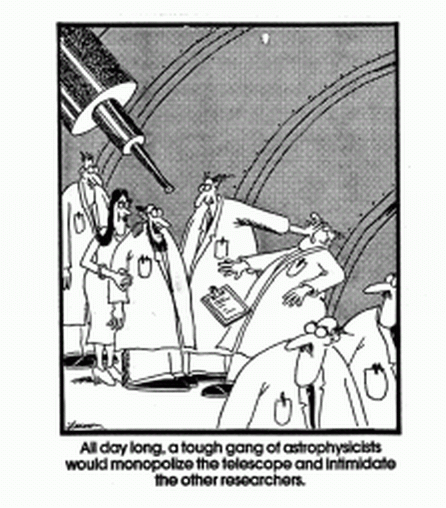
oblig. Far Side
Larson knew about this.
-
Re:Not just for coding
You mean like the Virginia Tech Math Emporium?
Math Emporium website if you want to contact them. I am sure the process could be adapted for K-12 without much difficulty.
-
Re:Anti-Tesla Rhetoric!
What I find most annoying about all this is less the could of smug, and more the fact that household electricity use is such a small slice of the pie of overall US energy use. From wind power to this DC nonsense, it's obsessing on feelgood measures of little importance to the big picture.
This biggest slice of the pie is industrial energy use where electricity isn't part of the picture: "Primary energy use" by heavy industry for blast furnaces and the like. Industrial electricity use is the next biggest slice, followed by IIRC industrial transportation.
False, residential accounts for 22 % of energy use in USA. In fact, buildings in general (commercial + residential) take up the largest slice of the pie. http://scholar.lib.vt.edu/ejou...
-
Re:Okay, what is it?
It's a great tool for typing in long passwords (provided you keep it physically secure), or working with two factor auth mechanisms. I had reviewed YubiKey Standard a while back, you can find further information on here.
-
Re: Won't save most of the 4000 lives
hahahaha oh look another person that dosn't understand friction. Surface area isn't part of the equation unless it is actully sticking to the other surface.
The coefficient of friction for tires is not a constant. It decreases with the loading for typical auto and truck weights.
Tire friction is nothing like what we were taught in physics class.
https://www.tut.fi/ms/muo/tyre...
http://bsesrv214.bse.vt.edu/Ho... -
Re:Nuclear Generating Station Shuts Down Safely
Oh, but right.., it's NOOCOOLAR POWAH! It must mean a near-miss meltdown and a cover up! I'll get my potassium iodide pills and my tinfoil hat and make some popcorn.
Ha ha! It is little use pointing out that a transformer exploded and a power plant shut down quickly and safely because it was unable to push its load into the grid. Reading between the lines, it does look like an item that floated to the top because of the word 'nuclear'. Stations trip all the time.
There is nothing comfortable and socially appealing about opposing nuclear power, unless you are shrilly terrified about full-fallout nuclear bomby Armageddon as portrayed in countless movies, or honestly believe that barely measurable traces of cesium in fish is an impending extinction event for the fish, or for us. Perhaps you fear to go down to the basement, where you will breathe in molecules of radioactive radon gas. One should be far more concerned about traces of pharmaceuticals, antibiotics, pesticide and fertilizer runoff, or (if you lived in the 60s, problem dealt with) lead from gasoline. Or even land erosion from human development!
I think people tend to be more pragmatic than that. A lot of it is just noise to be cool, like the muttered remarks heard around the schoolyard. There are folks who find it fun to drop the same nuclear zingers time after time. And I think they are some of the same folks promoting wind and solar. You have to realize that in the end the joke's on you.
Solar and wind energy solutions are like the throw-pillows of civilization. They are cuddly, come in lots of fun shapes and colors and you can hug them like little trees... but when all is said and done they will be unable to provide a meaningful level of lumbar support. Your time rearranging them is wasted. It's wasted because despite the excitement of the solar bubble, the base load generation challenge will be ultimately solved with coal, natural gas or nuclear energy. And the people who are pushing for coal and natural gas (yes they do exist but seldom post here), or are just afraid of nuclear energy, want you to be afraid of nuclear energy too. Join the club, right?
When the best ways to propagate myths are with dumb jokes, it's not funny.
To all the folks out there who rail on about nuclear: If you must fear something, fear the use of coal. Because that is what we in North America will be drawn completely into when (not if) natural gas declines. Even as she builds out coal plants China is becoming concerned about sulfuric aerosols from coal burning. We are not as much concerned because our emission controls are better and continental air circulation is better., which seems to keep the problem at a more comfortable distance.
Learn more! Read about the grid! [Gardner, dissertation] A Wide Area Perspective on Power System Operation and Dynamics is a good read on the challenges of operating a resonant grid.
Perfecting wind and solar is worthy on small scale to serve individuals and small communities. But it cannot clothe and feed them like an industrial society does. In the background the pursuit of BIG solutions (so called base load) that can power factories and water treatment plants is essential.
___
See Thorium Remix and my letters on energy,
To The Honorable James M. Inhofe, United States Senate
To whom it may concern, Halliburton Corporate -
Re:Global Warming Wiped Out Mars?
I think they are confusing wind erosion with water erosion. Moisture gets absorbed in rocks even in vacuum - probably the Moon might have some crystal water in some silicates too - , but Mars probably never had a temperature/gravity pressure to sustain liquid water on the surface, unless solar output was much different. The atmosphere is extremely thin, but because of low gravity, 1/3 of Earth's dust flies up easier too. Otherwise the temperature/pressure is probably at the solid/gas transition. Here, the pressure ranges from 0.0044 psi(0.003 atm) on Olympus Mons's peak to over 0.1675 psi (0.011 atm) in the depths of Hellas Planitia, so it's between 0.3% and 1.1% of the atmospheric pressure we have on Earth. The triple point of water is 0 degrees C (more like 0.01) and 0.006 atm, or 0.6% of that on Earth. So in theory, there might have been liquid water extremely close to the triple point, but the temperature would have to be above 0 (which is probably rare) and under 20C or so (under room temperature.) Just cuz you could have a puddle of liquid water physically existing in the open atmosphere of Mars, it does not mean that it would not evaporate away super fast, as even iced over frozen clothes hung out to dry in the winter eventually dry even under the freezing point in the sun (and you have to be careful not to break your jeans or underwear when frozen and brittle, they are very fragile), so a puddle of liquid water would evaporate very fast unless the atmosphere is at 100% humidity or close to it, under such pressure, and then once in the atmosphere, the gravity of Mars is so weak that it would easily reach terminal velocity and escape. And you can tell that it would, from the atmospheric composition of Mars which is 96% CO2 at molecular weight 44, 1.9% Argon, 1.9% Nitrogen, and traces of oxygen, carbon monoxide, methane, water, etc. Molecular weight of water is 18, and much lighter than 28 for nitrogen and 32 for oxygen or 44 for CO2. Planets with cold enough surface and high enough gravity capture hydrogen too from the solar wind, including all the gas giants like Jupiter, Neptune, Saturn and Uranus, with a molecular weight of 2, but Mars is too weak gravitationally to go as low as 18, and Venus is too hot to go as low as 18, and they boil off hydrogen at 2, water at 18, nitrogen at 28, oxygen at 32, and only have CO2 and H2SO4 and the like remaining in the leftover distillate, while Jupiter boils off nothing, but earth boils off hydrogen at 2, helium at weight 4, but does not boil off methane at 16, water at 18, nor nitrogen 28, oxygen at 32, etc. So liquid water does not exist on Mars under present circumstances because it boils off fast from the surface pond and then boils off fast from the atmosphere into outer space. If in the past the temperature were colder, by ether lower solar output (like ice age on earth), or by Mars being in a farther away orbit, and then getting knocked closer by something else, but farther away it was just the proper amount of cold to hold water on its surface atmosphere, at least you could have had a saturated water vapor atmosphere on Mars, but it might have been under zero celsius, to where yes, you have water, but it's all ice, like at the poles, and never liquid, simply because Mars lacks the gravity to hold it in the atmosphere under enough pressure where it can stay there over 0 degrees required by liquid water, otherwise the only water on Mars is in the solid/gas transition range in the graph below: http://www.sv.vt.edu/classes/M...
I think they are confusing wind erosion with water erosion, or maybe ice/glacier erosion remotely possible if you fly off on a tangent of coincidences and luck, but never liquid water. Mars is too small for water. Venus is a whole lot of different story, about the same size as Earth, and all it would need to get life on it pronto is that at its Lagrange point it needs to wear some huge ass shades to be cool. -
Re:Leading question
Bennett, please stop trying to do science. You're not good at it. If you don't know what you're doing, and clearly you demonstrated that with the laughable "survey", there are places to get information about conducting proper research studies. They are called "graduate education programs in survey research" for the DIY crowd (here's a good one), and then there are for-hire services that can do them for you. Either way, get some help before you embarrass yourself again.
-
Re:What the fuck are you talking about?
Professor is an English word, albeit one with a Latin origin, and it has been an English word for about 700 years. Most English words do not get inflected by gender. It must be admitted that many occupation-words that can be used as pronouns are inflected (actor/actress, waiter/waitress, etc.), but professor is not among those words. Professora does not appear in any English dictionary I tried, such as dictionary.reference.com. Professor, emeritus, and emerita all appear in every dictionary I tried.
Furthermore, "Professors Emeriti/ae" is often used as the plural. The 's' plural demonstrates that "professor" is being used in its English-language form.
Surely if a student were to talk about their "professors", you would not lecture them on their ignorant use of plurals. Why, then, do you insist that the professor is "professor emeritus" is actually a different word in a different language and therefore subject to different inflections?
And if that isn't convincing, there's the fact that "Professor Emerita" is an officially-conferred title, and therefore it is correct by definition:
http://www.sfu.ca/policies/gaz... -- an example from Canada
http://www.ucc.ie/en/academics... -- an example from Ireland
http://www.vtnews.vt.edu/artic... -- an example from the United StatesWhat I find particulary fascinating though is the insecurity apparent in perhaps a large number of readers who prefer to defend and repeat a corrupt usage from someone who may not have known better, lest their own competency in English be considered.
The pot calling the kettle black.
-
Silicon Snake Oil
http://scholar.lib.vt.edu/ejou...
Stoll re-emphasizes his belief that the most comprehensive educational programming and technology systems could never replace a quality teacher. He recalls his own experience in a graduate physics class. The professor is discussing radiative transfer as Stoll is daydreaming in the back of the classroom. The professor realizes that Stoll isn't quite following the lecture and pauses to ask Stoll a few questions. Caught off-guard, Stoll has to think quickly and come up with a valid response. Fumbling through his first few questions, Stoll is skillfully led to the answer by a talented professor, using the only educational tool available; the Socratic method. Stoll states that there are plenty of computer programs that calculate radiative transfer, and even admits to writing some of them. However he believes that there are no software programs which could have taught him "as effectively as goofing off in Professor Marty Tomasko's class did" (p. 120).
-
Re:Not a flamebait summary
I have long held the belief that software can be life critical at times and software engineers should be held to the same professionalism as any other form of engineering.
It is a matter of fact, not belief, that software can be life critical. For the majority of software, though, cost and time-to-market considerations far outweigh coding to the highest professional standard. "Good enough" wins.
-
Re: "I WILL GIVE UP MY MOBILE..."
I think it was this study:
http://www.vt.edu/spotlight/ac...along with explanation (by study author) on this podcast:
http://freakonomics.com/2013/1...that formed my opinion.
-
It's all about cost
For any skilled profession the resource availability usually dictates what the wage price would be for that resource. The exception being lawyers and healthcare because they've been given a licensed right to charge prices outside of market forces. When Businesses look at labor costs they always want the cheapest price because usually labor is the highest cost by percentage, meaning anything they can do to drive that cost down is thought to be best for the bottom line. That's why H1-B Visas exist, not because of a shortage but because of the mythology that somebody from another nation with a lower standard of living and costs can be brought in to do the same work for less. That's why you have lawyers and companies who specialize in gaming the system by lobbying and helping companies avoid legal risks for skirting the law to ostensibly demonstrate that yes, the H1-B system does lower labor costs and it's good for the economy and allows businesses to compete in the global marketplace. That means we need more H1-B workers. All it really does is devalue your domestic workforce and place more experienced people out of work by putting up a laundry list of reasons why you shouldn't hire somebody even though they have the skills. The same can be said for "diversity" initiatives in companies which are really which are quota systems that allow legal discrimination. Because a company has a "diversity" program, some even have senior level positions for diversity with absolutely meaningless job functions, they can claim that they'll promote the hiring and accelerated advancement within the organization for people who are considered "diverse." So H1-B programs logically follow into this because the company has an "active diversity program." Again, all a smoke screen for the fact that they just want to screw local resources looking for work. As they say be cautious in trying to buy a $10,000 Ferrari because finding one, while possible, will take a long time and when you get it it'll probably be a piece of shit.
-
Re:Whenever I hear about electric car failures
I am reminded why most lifeforms has been storing energy chemically, as opposed to electrically, for billions of years.
Oh, you mean like this? Coming soon to an electric car near you! lol
-
really the first? VT had one in Aug 2012
Virginia Tech has had a similar machine up and running in a lobby of one of the engineering buildings since at least Aug 2012...similar name, too. http://www.vt.edu/spotlight/innovation/2012-08-13-3d/dreams.html
-
Re:The problem with the Lisa
What is instruction backout?
When a page fault occurs part-way through an instruction, the CPU has to interrupt execution. After the page has been brought in from disk, execution can resume. But it must resume as if a page fault hadn't occurred. The usual approach is to restart from the instruction that failed, which means that instruction gets done twice.
The problem is that some instructions aren't idempotent - doing them twice has effects different than doing them once. On some CPUs, an instruction can call for both a memory access and a register increment. If the memory access faults, the register must not be incremented twice. So either the instruction has to be backed out to the state just before it started, or the state of the partially executed instruction has to be saved in the interrupted state. (The M68010 actually did the latter; there were extra words in the state saved on an interrupt to hold data about partially finished instructions.)
This gets much more complicated in superscalar machines, where multiple instructions have to be undone. See these lecture notes from a CS course at U. Vermont, which discusses "back-out", and its successors. In machines with out-of-order execution superscalar processors, you can't just back up; undoing the state of the CPU on a page fault is a big deal. It works, but it took Intel 3,000 engineers to design the Pentium Pro to do out of order x86 code.
-
Pot is very dangerous, and must be controlled
Driving within three hours of smoking pot is associated with a near doubling of the risk of fatal crashes.
Oh dear, that's almost as dangerous as dialing a phone.
Given how the police have broad surveillance powers to correlate cell phone logs against the mandatory GPS units installed in our cars in order to determine if we were dialing while driving, it is not unreasonable that we demand they have similar powers over knowing when pot smokers inhale their illicitly legal drug.
-
Re:Well, that sounds unsinkable
I believe the design *was* flawed, or at least there was an issue with the materials of construction, in regard to the rivets used to hold the plates together that made up the hull.
http://www.nytimes.com/2008/04/15/science/15titanic.html?pagewanted=alland there's this which is totally a design thing:
Although the compartments were called watertight, they were actually only watertight horizontally; their tops were open and the walls extended only a few feet above the waterline [Hill, 1996]. If the transverse bulkheads (the walls of the watertight compartments that are positioned across the width of the ship) had been a few feet taller, the water would have been better contained within the damaged compartments.
-
Certify the software works first
Before worrying about security of the software, how about worrying about the correctness and fault-tolerance of the software and hardware?
Most famous is the Therac-25 incident, but it's not the only one.
-
Re:scientifically
In theory, yes. The type of design (a "waverider") places the hypersonic shockwave directly beneath the vehicle. Basically, you're surfing the shockwave. This reduces the stresses involved, improves stability and should allow considerably more control than could be achieved with the space shuttle (you have sufficient lift from a waverider to glide). Waveriders do have disadvantages - most designs only work at specific speeds, the wings have a habit of frying and they rely on cooling by radiation (only effective at high altitude).
Old wisdom on waveriders:
http://research.lifeboat.com/surf.htm
http://www.aerospaceweb.org/design/waverider/waverider.shtmlPublished theory:
http://www.waset.org/journals/waset/v79/v79-79.pdf
http://www.dept.aoe.vt.edu/~mason/Mason_f/ConfigAeroHypersonics.pdfMulti-speed waveriders:
http://www.springerlink.com/content/x75nh2154nuh5464/Amateur waverider research:
http://www.gbnet.net/orgs/staar/waveriders.htmlNB: The STAAR group beat NASA and the US DoD to the first working waverider airfoil, as noted on their site. Perhaps NASA's problem with their current design is that they're not threatening the engineers with bagpipe music.
-
Huh?
The same way a course in "Star Trek" makes its way into Georgetown University. Or "Art History" or "Golf Management" or dozens of other courses at dozens of other universities. Because higher education stopped being about actual education and more about a) making money and b) making the students feel good about themselves.
Probably started around the time Philosophy classes stopped reading and teaching Neitzsche, Bacon, Aristotle, and Kant, and started being about... well, slacking off, wondering randomly about whatever, and getting high. Biggest contributing factor, IMO, was when people started to feel they need college degrees, but weren't smart enough or dedicated enough to actually study seriously. So, colleges started making up stupid courses people could take, without requiring them to actually do any work. This allows everyone to get a degree, but makes half of them worthless. But hey, now most people at least have a college degree, right?
First, since when is art history a made up course to only make money? Just because it might have been filler for your course of study doesn't mean it's insignificant to others who are in creative/arts side of the university and need to understand the history and driving forces in their field. Second, when was the last time you looked at a current Philosophy course catalog? Still digging away at everyone from Plato to L. Ron Hubbard. Not sure what you would classify as a university, but there aren't a lot of slack courses at the one I attended and taught at. Insightful my fanny!
-
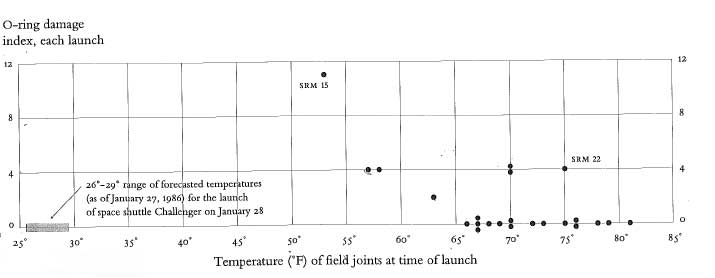
Incomplete Data Lead to Decision to Launch
NASA wasn't aware of the link between subzero temperatures and o-ring failures. Boisjoly and Morton Thiokol engineers tried to convince NASA of the issue, but the only evidence they provided was incomplete and showed no correlation. This is the data they provided- http://courses.cs.vt.edu/cs3604/lib/WhistleBlowing/challenger.1.gif This is the FULL data that Morton Thiokol did not present in arguing to delay launch- http://www.d.umn.edu/~cstroupe/f11/4260/assets/tufte_o_ring_damage.jpg
-
Re:Real life and renders collide
The physics of shock diamonds is well understood. If you can model the physics, you can show it on a computer screen. Turns out it's fairly easy and doesn't require a lot of computer horsepower.
-
Re:Deader Than a Doornail
Actually, corruption is "the action of making someone or something morally depraved or the state of being so." OR, more appropriate to this instance, "dishonest or fraudulent conduct by those in power, typically involving bribery." So, no, it really has to do with morality than ethics. See also, Philosophy 1304: Morality and Justice
-
Re:I've been Folding for years on GPUs
I have been volunteering for more than a decade now. I first started with united devices. They have stopped now for about 5 years. I started with single core computers. About 4 years ago I bought my first 4 core computer and last year I bought two 6 core computers. The 6 core computers do twice as many results than the 4 core computers. The 4 core computers do 6 times as many results as the single core. Therefore I think a single 6 core computer would pay for itself in electricity costs in less than three years I would think that this would continue with a super computer that has thousands of cores. Here is a link to a super computer that cost only $1,4000,000 http://www.eng.vt.edu/news/virginia-tech-s-wu-feng-unveils-hokiespeed-new-powerful-supercomputer-masses. Now if only 100,000 volunteers donated just $20 each for a total of $2,000,000 someone could purchase that super computer and have $600,000 for their expenses. $20 a year is probably far less than the average volunteer is paying for the extra electricity. I think that this super computer would do more results than the over 500,000 members of World Community Grid do now.
-
Re:Great idea!
Here's a study by the Virginia Tech Transport Institute which says talking on the phone isn't at all dangerous for truck drivers and is only has a tiny risk for car drivers. Based on real life (cameras logging near misses in actual cars and trucks), so it might be a little more accurate than the video games other researchers use.
-
Re:Oh c'mon, why the outcry?
Depends how you count:
Konrad Zuse - Z1 program-controlled computer ~ 1936. His Z3 was the world's first fully functional programmable computer ~ 1941.
http://ei.cs.vt.edu/~history/Zuse.html
and by "computer" people point to the IBM's Hollerith punch card technology.
http://www.ibmandtheholocaust.com/ -
Re:VisualIDs did it betterPart of it is that, going by the examples, this statement in the Vash FAQ is just flat-out wrong:
How does Vash work for color blind or other visually impaired individuals?
Despite its visually striking and distinctive impact, color plays only a small role in differentiating between Vash images.
Rather, it shows that the intent is right but the execution has failed: that no two images are differentiated only by being coloured differently is good, but that the shapes composing a given image are defined entirely as borders between colourfields is extremely problematic: because two adjacent colours may or may not even actually be distinguishable for the viewers--as someone who's protanomalous myself, I have difficulty even seeing any of those shapes that are defined purely by boundaries between fields of red/green or blue/purple; and some of the gradients actually make things even worse.... It's like the joke about the `drawing of a polar bear in a blizzard'. So, you've ended up making colour a much more important aspect than you think
- Color Universal Design (CUD) - How to make figures and presentations that are friendly to Colorblind people -
- Color Vision, Color Deficiency (an intro/guide for UI-, web- and other graphic designers)
There's one particular issue that's mentioned in the Firelily article, though only briefly, and it deserves being brought to attention--as a Slashdot commenter did some years back:
blue & red should not be placed next to each other, generally. Since they fall roughly at opposite ends of the visible spectrum, the eye's focal power differs the most between those colors. As your eye/brain tries to focus properly on two colors that require slightly different adaptations, you can perceive a "vibration" -- the boundary between the red & blue will have a high-frequency shimmering or vibrating appearance.
It may also be useful to read `Rainbow Color Map (Still) Considered Harmful'; there are some applicable lessons in there, though they're harder to find.
-
Ethics bibliography
Maybe some have been paid to forget ethics. Here is a list of science ethics papers: http://www.files.chem.vt.edu/chem-ed/ethics/vinny/ethxbibl.html
. -
Re:The article lies.
Bingo. There are *lots* of studies. The author of this article is speaking from ignorance. A quick look through the publications from Virginia Tech's HCI group, viz group and gigapixel project shows an abundance of work on this. And that is just one university. I'm sure there are *many* other examples.
-
Re:The article lies.
Bingo. There are *lots* of studies. The author of this article is speaking from ignorance. A quick look through the publications from Virginia Tech's HCI group, viz group and gigapixel project shows an abundance of work on this. And that is just one university. I'm sure there are *many* other examples.
-
Re:The article lies.
Bingo. There are *lots* of studies. The author of this article is speaking from ignorance. A quick look through the publications from Virginia Tech's HCI group, viz group and gigapixel project shows an abundance of work on this. And that is just one university. I'm sure there are *many* other examples.
-
Re:The article lies.
Bingo. There are *lots* of studies. The author of this article is speaking from ignorance. A quick look through the publications from Virginia Tech's HCI group, viz group and gigapixel project shows an abundance of work on this. And that is just one university. I'm sure there are *many* other examples.
-
Re:Total misread of available data
$6200/term undergrad, $13k for out of state. You were saying?
-
Re:Fiction
Really? Because, you know, multiple other sources say that Zuckerberg started the prototype in September of 2003, and what we know as Facebook was launched in February of 2004.
If I recall rightIy, my vt.edu email address allowed me to register sometime in late 2004 or early 2005. On campus, it was starting to generate a lot of buzz as a great tool to bring lots of people together on short notice.
Your response is typical of what I was talking about though -- memory is a strange and elastic thing. You've been on Facebook for so long it feels like it's been 8 years, but it hasn't, and it really couldn't possibly have been.