Slashdot Mirror
Domain: wccftech.com
Stories and comments across the archive that link to wccftech.com.
Comments · 92
-
Nope
Intel and Microsoft joining hands in making a Windows 7 unfriendly ecosystem – SpeedStep to add support for RAM and more
http://wccftech.com/intel-skyl...
Skylake users given 18 months to upgrade to Windows 10
"And next generation processors, including Intel's Kaby Lake, won't be supported in old Windows."
http://arstechnica.com/informa... -
Re:Who gives a fuck?
The card is designed for data mining and neural network research; it's not for games or even remotely intended to be used for them.
Bullshit.
http://www.geforce.com/hardwar...
"With the DNA of the worldâ(TM)s fastest supercomputer and the soul of NVIDIA® Keplerâ architecture, GeForce® GTX TITAN GPU is a revolution in PC gaming performance."I admit I don't completely know who they focus on with the Titan cards.
10-11 Tflops single precision performance with this one.
317-343 Gflops double precision.
159-171 Gflops half precision (shouldn't that one be higher?)The idea with the more professional card is to hit 5+ Tflops of couble precision performance?
http://wccftech.com/nvidia-pas...I don't really know where the Titan cards fall between the consumer cards and the professional cards.
Once re-released as the GTX 1080Ti it will definitely be a gamers card.I guess without further evidence saying "yes it is!" is just as good as saying "no it isn't!"
It's an expensive gaming card but those who want this performance now only have this option.
-
The elephant i
Well, it doesn't look too good for AMD. Their "super efficient" RX 480 uses much more power than the 1060 and is slower.
On the bright side is the price of the 480 is only $200 (well, eventually it will be -
Re:Its about time
Nope, this is used for more efficient VR support in the Unreal & Unity engines. Though the same hardware feature can be used for foveated rendering too.
-
Re: Yes, definitely assholes
Do you have an example of such marketing? I've never seen it.
Read *between* the lines like an actual human being. Not like a pedant trying to win an argument on a technicality.
https://www.technologyreview.c...
http://electrek.co/2016/04/20/...
"During a presentation following the release of the system, Musk said that in good road conditions âoepeople may [remove their hands from the steering-wheel], but we donâ(TM)t advise that.â "
In other words, you can do it, but we don't advise it. "wink wink [cough]lawyers made us say this[cough]".
That is generally the message they are broadcasting.
http://gizmodo.com/elon-musk-c...
" Even with this early version, itâ(TM)s almost twice as good as a person."
He doesn't say, it makes a human driver safer by acting as a useful failsafe. He specifically says it drives better than people do.
Read between the lines.
http://wccftech.com/tesla-auto...
" The feature itself has gained a lot of fame in the recent months thanks to its obvious novelty value and the fact that it is the first hands-off, self-driving technology on the market today."
Ah, but some of this is journalism and press coverage not actually marketing from Tesla. Right. So what? You think Tesla isn't loaning the cars and press kits to journalists? You think they aren't leveraging that mis information...
https://www.teslamotors.com/en...
They fucking link to it right from their own site. This link is on that page:
http://www.cnet.com/roadshow/v...
And this is the caption:
"Tesla doesn't have a fully autonomous car yet. But, with the addition of Autopilot mode, cruising down the highway is now a hands-off affair."You can't credibly claim that Tesla isn't spreading the word that autopilot allows for 'hands off driving'; despite the disclaimers here and there.
-
Re:WHy dont we sue ice
Isn't this basically the same as suing winter because people gamble on hockey
Not really. Valve has been on a lot of people's radar already for how some of its F2P marketplaces are operating. (Team Fortress, DOTA, and CS:GO in particular.)
http://wccftech.com/problem-un...
A 2nd part of the issue is that the major Casino's are unregulated, allow minors to play, (and accusations that its rigged by its owners etc.) So these sites are operating illegally; and quite probably corrupt.
There's a reasonable argument to bad that Valve has an obligation to prevent such sites from tying into its APIs etc.
There is also a reasonable argument to be made that Valve is endorsing it by allowing such things as this:
For example:
CS:GO Lounge
"A community based around the trading of CS:GO items ""trading" lulz... right, "trading"... the discussion has a nice forum post pinned for everyone:
Bets: the all-in-one guide
http://steamcommunity.com/grou...or this, a "hey kids, if you got scammed its on you" and then signs off with safe betting.
http://steamcommunity.com/grou...
This isn't on some 3rd party site. This is right on the steam forums, in a Steam Group. You can arguably suggest that its not steams problem to stop 3rd parties from betting... but this stuff is right on Steam. They probably do need to take some ownership of the issue if they are letting it make itself that comfortable right on steam itself.
-
Re:Low TDP?
The new nVidia GPUs have quite high TDP sadly... Will these new AMD ones go as low as the GTX 750 Ti? Those were great for fanless operation.
Some models will, but almost certainly not the RX480. I think the suggestion is roughly GTX950 performance for 50W, nVidia lists the power draw of a 750 Ti as 60W. Of course these are all marketing slides, not third party reviews but yeah the power savings from 28nm to 14nm are substantial.
-
Re:Performance characteristics
-
Re:deca-core
I was thinking the exact same thing. Perhaps this? link
That really is a weird comment though.
-
Re: Super-Overdrive Mode!
If it's true that TSMC can do volume at 10 nm then it really is a watershed. Intel is struggling to do volume at 10 nm
We'll see. As far as I know, Intel doesn't announce test tapeouts since they're not in the business of selling design and process tech but rather actual processors. But if you look at slides from their 14nm release you see PRQ = product release qualification = volume production was late Q2 2014 and there's yield graphs back to May 2013. Considering Intel was on a two-year tick-tock I would think it's natural if their first test was mid-2015 and Kaby Lake was announced in July because the yields were way too low.
A full 300mm wafer is 70695 mm^2, a Skylake quad is 122mm^2 and at 10nm you're probably looking at ~1000 CPUs/wafer. So with 0,1% yield you can issue the PR release saying you've made a 10nm chip, but if you don't have consistency in the process it's not worth launching because the net result costs more than a mature 14nm process. In any case parity is pretty good too, being a half-node behind is fighting with a cost handicap that's really tough to beat as AMD has noticed. When they launch Zen/Polaris it's the first time in forever they're on roughly even footing with Intel.
-
Re:Can we get them to remove other annoyances?Riiiight, what do you THINK he is gonna say? "Yeah we are sucking up your data and BTW Metro is shit, I'll see myself out as I don't need this job, thx" dumbass? That is like asking SJWs if they are racist or asking a neocon if they are for corporate welfare, all that robot is gonna do is preach the party line.
Take some truth and drink it deep thats some tasty truth nom nom nom enjoy the big plate of truth, I can give you more if you would like, wallpaper the page if you want?
-
Re:iPads faster than Core i5 laptops
Considering that the average iPads sold today is faster than the average laptop (i.e. Intel Core), the answer would appear to be yes.
http://wccftech.com/apple-a9xi...
bullshit, you need to learn to read. What the results show is the pro is on par with low end mobility specced tablets and other mac's.
-
iPads faster than Core i5 laptops
Considering that the average iPads sold today is faster than the average laptop (i.e. Intel Core), the answer would appear to be yes.
-
Yes, harder.
They stared with forcibly not allowing Windows 7 and 8.1 to run on Skylake hardware after 18 months...
http://arstechnica.com/informa...They're also removing USB 2.0 support, to make sure your much-older computers are properly neutered. Guess you're going to be using that Skylake-esque hardware after all...
http://wccftech.com/intel-skyl...Don't ask a question if you don't want to know the answer!.
-
Re:Missed the main reason
What is the performance per watt of the new 18 core Xeon chip compared to the best Xeon that existed in 2010?
I don't know, but the benches for the new 40 core Broadwell EP chip indicate that with almost 7 time the cores, the speed up is only about 5 times faster at a rough guess. The per core performance isn't much better, but what they did manage was to reduce the power requirements significantly, I think. So yes, in 6 years, they did manage to double total performance depending upon workload. Obviously single threaded performance didn't scale up, but multi-threaded tasks will benefit significantly at a reduced power load. The new CPUs are estimated to cost more than double ($2K+) compared to the older CPUs (about $1K at the time, between $90 and $300 today).
At this point you'd have to start adding in consideration of budget. Dual socket hexcore systems in 2010 would have been at a comparable price, although using more than double the power, and have half the performance, for example (if you were using Intel). For certain task types, you might have been better off buying AMD multi-core systems with 4+ sockets, although I have no performance numbers for those in that date range.
-
Re:Damn cloud (watch out)
I bet those LGA sockets sprigy wires start wearing out in a couple of years.
Why do you think Intel is going to only BGA (soldered in CPU's ) in near the future?Thus you may have no choice. Hint, I've been noticing my older Intel LGA based PC's no longer bios post.
-
Re:They don't need to be up there
Considering one can get an 18 core 2.2 GHz Broadwell-EP chip for $999:
http://wccftech.com/ebay-xeon-...8 core Zen-chip maybe will reach up to what you ask for vs your 4 core chip but what about against the 6, 8 and 10 core Broadwell-EP ones?
Or maybe AMD will let a 16 core Zen out for normal desktop users too, if it fit the same cheap motherboard I guess that could be somewhat disruptive.
-
Hey AMD, show us your new CPUs for 2016
Hey, AMD, show us your new CPUs for 2016. Everything you got now is long in the tooth.
How right you are. But their basic problem has been that they were still stuck on old semiconductor fabrication processes. Intel has spent a bunch of money on fab technology and is about two generations ahead of AMD. It didn't help that their current architecture isn't great.
I'm not a semiconductor expert, but as I understand it: the thinner the traces on the semiconductor, the higher clock rate can go or the lower the power dissipation can be (those two are tradeoffs). Intel's 4th-generation CPUs were fabbed on 22 nm process, and their current CPUs are fabbed on 14 nm process. AMD has been stuck at 28 nm and is in fact still selling CPUs fabbed on a 32 nm process. It's brutal to try to compete when so far behind. But AMD is just skipping the 22 nm process and going straight to 14 nm. (Intel has 10 nm in the pipeline, planned for 2017 release, but it should be easier to compete 14 nm vs 10 nm than 32/28 nm vs 14 nm! And it took years for AMD to get to 14 nm, while there are indications that they will make the jump to 10 nm more quickly.)
But AMD is about to catch up. AMD has shown us their new CPU for 2016; its code-name is "Zen" and it will be fabbed on a 14 nm process. AMD claims the new architecture will provide 40% more instructions-per-clock than their current architecture; combined with finally getting onto a modern fab process, the Zen should be competitive with Intel's offerings. (I expect Intel to hold onto the top-performance crown, but I expect AMD will offer better performance per dollar with acceptable thermal envelope.) Wikipedia says it will be released in October 2016.
Intel is so far ahead of AMD that it's unlikely that AMD will ever take over the #1 spot, but I am at least hoping that they will hold on to a niche and serve to keep Intel in check.
The ironic thing is that Intel is currently making the best products, yet still they feel the need to cheat with dirty tricks like the Intel C Compiler's generating bad code for CPUs with a non-Intel CPUID. Also I don't like how Intel tries to segment their products into dozens of tiers to maximize money extraction. (Oh, did you want virtualization? This cheaper CPU doesn't offer that; buy this more expensive one. Oh, did you want ECC RAM? Step right up to our most expensive CPUs!)
Intel has been a very good "corporate citizen" with respect to the Linux kernel, and they make good products; but I try not to buy their products because I hate their bad behavior. I own one laptop with an Intel i7 CPU, but otherwise I'm 100% non-Intel.
I want to build a new computer and I don't want to wait for Zen so I will be buying an FX-8350 (fabbed on 32 nm process, ugh). But in 18 months or so I look forward to buying new Zen processors and building new computers.
-
Hey AMD, show us your new CPUs for 2016
Hey, AMD, show us your new CPUs for 2016. Everything you got now is long in the tooth.
How right you are. But their basic problem has been that they were still stuck on old semiconductor fabrication processes. Intel has spent a bunch of money on fab technology and is about two generations ahead of AMD. It didn't help that their current architecture isn't great.
I'm not a semiconductor expert, but as I understand it: the thinner the traces on the semiconductor, the higher clock rate can go or the lower the power dissipation can be (those two are tradeoffs). Intel's 4th-generation CPUs were fabbed on 22 nm process, and their current CPUs are fabbed on 14 nm process. AMD has been stuck at 28 nm and is in fact still selling CPUs fabbed on a 32 nm process. It's brutal to try to compete when so far behind. But AMD is just skipping the 22 nm process and going straight to 14 nm. (Intel has 10 nm in the pipeline, planned for 2017 release, but it should be easier to compete 14 nm vs 10 nm than 32/28 nm vs 14 nm! And it took years for AMD to get to 14 nm, while there are indications that they will make the jump to 10 nm more quickly.)
But AMD is about to catch up. AMD has shown us their new CPU for 2016; its code-name is "Zen" and it will be fabbed on a 14 nm process. AMD claims the new architecture will provide 40% more instructions-per-clock than their current architecture; combined with finally getting onto a modern fab process, the Zen should be competitive with Intel's offerings. (I expect Intel to hold onto the top-performance crown, but I expect AMD will offer better performance per dollar with acceptable thermal envelope.) Wikipedia says it will be released in October 2016.
Intel is so far ahead of AMD that it's unlikely that AMD will ever take over the #1 spot, but I am at least hoping that they will hold on to a niche and serve to keep Intel in check.
The ironic thing is that Intel is currently making the best products, yet still they feel the need to cheat with dirty tricks like the Intel C Compiler's generating bad code for CPUs with a non-Intel CPUID. Also I don't like how Intel tries to segment their products into dozens of tiers to maximize money extraction. (Oh, did you want virtualization? This cheaper CPU doesn't offer that; buy this more expensive one. Oh, did you want ECC RAM? Step right up to our most expensive CPUs!)
Intel has been a very good "corporate citizen" with respect to the Linux kernel, and they make good products; but I try not to buy their products because I hate their bad behavior. I own one laptop with an Intel i7 CPU, but otherwise I'm 100% non-Intel.
I want to build a new computer and I don't want to wait for Zen so I will be buying an FX-8350 (fabbed on 32 nm process, ugh). But in 18 months or so I look forward to buying new Zen processors and building new computers.
-
Re:For the love of...
That is coming with Zen which will be coming along with a new socket which will allow them to combine the APU and CPU lines along with a completely new architecture designed by the same guy who made the Athlon64
So there really is no point in releasing a new chip until the new socket boards by the OEMs are ready to go, especially not just for PCIe 3 which test after test has shown has a completely negligible effect on performance even with 3 way crossfire. The simple fact of the matter is we have yet to saturate PCIe 2 yet and with AAA titles costing so much to make AND the fact we have just started on a new console generation that came out of the gate with lower performance than midrange gaming PCs? I seriously doubt we'll see PCIe 3 used as anything but a bullet point on a box for the foreseeable future, its just not needed.
-
Re: Mostly irrelevant to most people
Hey, I've been staying analytical and being honest when I'm outside my skill set. The personal attack is uncalled for.
You don't need to take my word on it for benchmark cheating. A Google search will do. Here's an older one but, it went all the way to a class-action suit that Intel had to settle: Intel lawsuit. The most recent article about CPU cheating was 2009 though GPU cheating is still rampant in the news. On the CPU side they have either cleaned up their act enough to stay out of the news or just haven't been caught. I can't say for sure which.
Though none of this will be detailed enough for you as your knowledge is more specialized and most news is not going to go to that level. I can't fix that.
-
Re:I'd like to hear from content creators
The mouse / keyboard has a low adoption rate on consoles. Partly this is due to it being a relatively expensive peripheral set for a console, but the bigger part is that most console games will not need or require a keyboard and monitor- meaning that much of your userbase won't have the required input.
This direly hurts the motivation to make a keyboard / mouse game- and there's a big flipside. The keyboard and mouse for Xbox famously do not work in Halo, and this is a huge controversial point in console gaming. Mouse + Keyboard (really, mouse plus buttons) is VASTLY superior to joystick for any FPS game, meaning that if your FPS supports mouse input, you are screwing your other users in pvp.
So, that's a huge deal.
The second big piece is graphics, which consoles are universally awful at. Remember that getting a game to run in 1080p is only one small part of how a game looks- you simply can't push polys with a 400 dollar gaming machine like you can with a serious graphics card.
http://cdn.wccftech.com/wp-con...
That long bar is not even close to state of the art for PC graphics.
There is literally no comparison.
but a big piece is that it would essentially become mandatory
-
Re:in a previous article about the new chips.....
For the following post, the sarcasm flag is assumed to be active.
1. has to rely on 3rd parties to integrate their hardware into an existing enterprise..
Yes because Apple's primary focus is enterprise. It's not like Dell or HP ever rely on 3rd parties for consumer or enterprise. Ever.
2. Srir was a huge failure even with 3rd party support
That's why they removed and banished it from all iPhones and iPads and they didn't include it in the new AppleTV.
3. Newton (even with the greatest minds it still could nto get off the ground)
Yes because 20 years ago, mobile hardware was much superior than it is today. Also at the time, Apple was a tightly focused machine.
4. Deperciation of the equipment as compared to its "PC" equiv. is way out of whack.
That's why whenever I go to buy used Apple machines, they are 1/2 of what the comparable Dell or HP is. They are so cheap, people are begging me to take their Macs.
5. They have to reply on 3rd parties for any and all laptop/desktop hardware (intel)
Yes because Dell, HP, Lenovo, Samsung, Asus, etc have all started to make their own processors now. Every single one of them even have their own GPUs and make their machines by hand. I've seen the farms where they grow their cases from the soil. It's all organic.
6. they bastardized a variant of BSD and "made it their own" also a 3rd party reliance.
Instead of every other OS out there that magically one day was born. Linux isn't based on Unix at all. And Windows was created completely by Gates and Co one night and didn't rely on design cues from VMS or DOS or anything prior.
7. They tried to tout a turnkey infrastructure (X system [xserv, etc]) which lasted 2-4 years and resembled SUN equipment..
Because every time a company makes a product they should sell that product FOREVER even if it isn't very profitable or core to their strategy. That's why Microsoft and Dell still make MP3 players. IBM still makes PCs right?
8. the cost of the equiv. equipment (PC) is a 3rd of the cost.
In every single case this is true. That's why people still buy Macs; suckers!
9. For any credible attempt at repair, a device must be taken to a service center, no way to "HOME-FIX"
Yes, the internet and websites dedicated to fixing computers don't exist. Also all other manufacturers will honor your warranty when you try to fix things yourself. Warranty, schmwarranty, they say.
10. when people in my env. request a mac. after about a week or so they request a windows 7 vm poped on the "DESKTOP" so they can remain productive and still have the nice SHiny..
This has nothing to do with the fact that some companies rely and insist on Windows only things. I mean, IE is famous for being completely compatible with every other browser known in existence. This is the opposite of those PCs where they have only 1 option: Windows or die. That's fine. Less choice is so much better.
So now we are on the 6th gen of the Iphone, and.......... Samsung the #1 Iphone competitor is varying their production of chips to Apple, like thats a suprise.. It actually seems so friggin lame..
Yes because chip fabs are everywhere. You can't go down the street without some homeless bum offering to move me to a 10nm process. Especially companies like NVidia who didn't decide to use Samsung to fab the Tegra X1. And Apple didn't do a responsible thing by using 2 different fabs for redundancy. Not at all
With so Much Apple has going for itself.. Why can't it just produce their own products and why with all the brilliant pe
-
Re:Two major problem with phone benchmarks
1. Javascript benchmarks. They should be outlawed, period. They test the software (browser) more than the CPU. Also they are probably single threaded or close to be.
2. On-screen 3D game benchmarks. Because they favor phones with low-res display such as iPhones.
None of the benchmarks in TFA even consider RAM size and flash memory speed, which both have real-world benefits.
I'm sure that ALL of these benchmarks are done by Apple shills.
Right.
Oh, and whiner, I found this and this about the memory subsystem in the iPhone 6s. Glad you asked! -
Re:what about low end cards?
It doesn't do much to help GPUs.
It does if you implemented Asynchronous Compute in your GPUs (which AMD apparently has going back to their Graphics Core Next 1.0 processors).
-
Re:Much ado about relatively little yet.
Of course, the biggest monster jump didn't make it in:
http://wccftech.com/mainstream...So there might not be very dramatic bumps to be had even with updated libraries/compilers/etc.
-
Re:DO NOT WANT
CPU/GPU integration is for farmers, to paraphrase Seymour Cray.
CPU/GPU integration has much lower latency than discrete a GPU. The HSA based AMD chips pass data from the fast, single threaded, fast branching core to the massive array of relatively slow FPU units in a few nanoseconds.
Which is why HSA benchmarks seem to work so well
http://www.tomshardware.com/re...
http://wccftech.com/amd-kaveri...If you want fast comptuting, low latency comms is where it's at
-
Re:All Marketing, no hard tech facts...
Some here: http://wccftech.com/amd-radeon...
-
Quantum
That Project Quantum looks very interesting @ 17 Teraflops! More info here: http://wccftech.com/amd-intros...
-
R9 380X is faster
AMD are about to release the 390x (with HBM memory) which already has been benchmarked faster than the Titan X, but consumes more power.
http://wccftech.com/stacked-hb...
The thing is Maxwell is much more power efficient than GCN, but it does so by crippling double prescision performance.
That means AMD could see a lot of sales from the FirePro version of the 390x. -
Re:Extrapolate?
Anyone care to extrapolate from current benchmarks as to how this new processor will compare to Intel's desktop offerings? I would like to see Intel have some competition there.
FX-8350: 2012
"Zen": 2016The 40% jump is more like 0%, 0%, 0%, 40%.
If you compare a 3770K (best of 2012) to a 4790K (best of today) you get a ~15% frequency boost and another ~10% IPC improvements. If the leaked roadmaps are to believed Skylake for the desktop is imminent which will bring a new 14nm process and a refined micro-architecture at the same time as Broadwell missed their tick for the desktop, so in the same timeframe Intel will have improved 30-40% too.
Anyway you asked about AMD and I answered with Intel but it's a lot easier to get a meaningful answer without getting into the AMD vs Intel flame war. In short, even if AMD comes through on that roadmap they're only back to 2012 levels of competitiveness and honestly speaking it wasn't exactly great and AMD wasn't exactly profitable. They're so far behind that you honestly couldn't expect less if they weren't giving up on that market completely, which honestly thinking I thought they had. And I wonder how credible this roadmap is, I remember an equally impressive upwards curve for Bulldozer...
-
Re:For low power? None
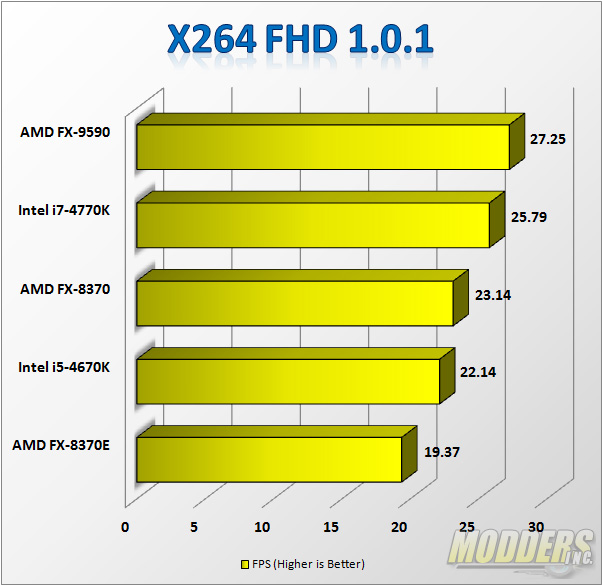
The article uses a bone stock FX-9590 against very heavily overclocked (around 150% of factory maximum specs) and water-cooled Intel setups, plus saddles the AMD chip with high RAM latencies even compared to the Intel chips using the same frequency of DDR3 RAM. I'm aware that the 9590 is essentially an FX-8370 that binned very well and got a clock boost from the factory because of it, but AMD has had these chips up to 8.7 GHz and HardOCP tested it at bone stock with poorly configured RAM. They could have at least given the AMD chip some overclocking, fancy cooling, and the same RAM latency figures. That would have been more apples-to-apples.
Here's a review that tested all the chips at stock settings with more typical RAM configurations. It's also the article from which the price-to-performance bar chart was derived (compared against Newegg retail prices) and is representative of what a typical system builder who is not taking the risks involved in overclocking can expect from the hardware. Here are a few more benchmarks of x264 which is what I cared about when buying a desktop CPU.
Until the stock performance numbers divided by the price come out higher on the Intel side, the AMD is the better value if you don't want to heavily overclock your chip and void your warranty. Intel has always had faster CPUs available than AMD, but they have always carried a significantly higher price tag. I'd prefer to have that money to buy something else like an SSD or more RAM. For other people, low power consumption or higher maximum performance may matter far more to them than the price tag, and I don't begrudge their choice to get Intel chips because that's what meets their needs. -
Re:A highly relevant comment from the previous pos
Here's something that doesn't need 'conspiracy' to understand. Unity is playing bad on the PC because they're issuing 50k draw calls on DX11.
The game (in its current state) is issuing approximately 50,000 draw calls on the DirectX 11 API. Problem is, DX11 is only equipped to handle ~10,000 peak draw calls. What happens after that is a severe bottleneck with most draw calls culled or incorrectly rendered, resulting in texture/NPCs popping all over the place.
Ironically, instead of blaming AMD for this, AMD is actually providing a solution. I don't like it personally, but the Mantle API specifically solves this problem today while we wait for DX12/OpenGL Next.
Of course, it's only available on AMD hardware and besides, because Ubi is in a company wide PR deal with nVidia to use GameWorks(TM) THEY CAN'T USE IT!
So instead of blaming AMD, Ubi should either go sit in a corner (because they know what they did wrong), or they need to look into a mirror (because they don't recognize that they're the real problem)
-
Re:PC couch multiplayer is a thing now
has [players choosing one platform over another on the basis of graphical detail] actually happened?
I imagine that a lot of hardcore gamers chose PS3 over Wii and PS4 over Wii U for just this reason: graphical detail.
Do you really think it's going to happen [with Steam Machine]? I don't think so.
I must respectfully disagree on this point. A Steam Machine would have the extra detail plus Steam sales, which I'll grant decrease revenue per copy but often dramatically increase the publisher's continuing revenue from a title long after launch. And though the reviewed machine is set to cost $100 more than the PS4, I imagine Steam games are less likely to need the recurring fee of a subscription to PlayStation Plus.
-
Seems like Haswell support limited
The summary says that Intel Haswell CPUs will support DirectX 12, however it seems that only Iris and Iris Pro iGPUs will support it according to this article:
http://wccftech.com/microsofts... -
Re:Why not open source it?
While this was sorta-kinda true five years ago, a *lot* has changed since then.
The OpenGL specification has one big fundamental advantage over Direct X, namely, extensions. While extensions certainly aren't perfect, they do allow you to include new functionality in OpenGL - in DirectX, if you got a new technology, you have to wait for Microsoft to implement this.
Furthermore, OpenGL 4.4 has all features of DirectX 11 has and then some. It is about as easy if not easier to develop for, and is even faster[1] than DX11. DX11 is a good API, but it's getting outdated.
Shame that the XB One won't be able to utilize DX12...
Further reading: http://wccftech.com/open-gl-di...
-
Re:Great News!
Since AMD was very clear that Mantle only works with their GPUs based on GCN architecture
No actually they were very clear it does not require GCN architecture, it works with GCN cards but does not require it. See the "Multi-Vendor" slide here.
Mantle is designed to be a thin hardware abstraction:
-Not tied to AMD's GCN architecture -
Re:"Android most important platform for gaming"
Wrong. Console gaming is more popular than ever. There's certainly no downward trend, more people are gaming on consoles than ever before *and* they are gaming on smart phones, they are just playing different types of games on each.
-
Re:Pull an AMD
Actually check out Haswell's die configuration, the integrated graphics takes up about 2 times more area than the L3 cache. Also, look at how dense the transistors are in the GPU area, looks as dense or maybe even more dense than the cache. It wouldn't surprise me if graphics are a source of manufacturing problems in addition to L3 at this point.
-
Re:Funny you should ask . . .
There will be LGA versions of Haswell. The biggest difference is on LAPTOP boards many of their notebook models will have processors soldered to the board. This makes tons of sense to do; some board makers are already doing it.
2: Desktop sales have flattened because companies are extending refresh cycles; Refresh cycles are being extended because software companies are pushing less demanding software to reduce hardware spend. By various studies, by year 3 desktop failure rates are 10-15%; after year 5 desktop failure rates are over 50%. Repairing desktops is cheaper and easier than repairing notebooks; Notebook failures after 3 years are largely disk and motherboard related, and parts scarcities hinder repairing the unit.
3: For notebooks, smartphones and tablets there are some arguements for the spend but do keep in mind, a low-end $300 desktop lasting 5 years beats out a $700 business laptop + $150 Docking station for the same thing lasting 3; the biggest laptop screen you get these days is 18 inches and the biggest arguement for a dock is to connect the unit to multiple monitors.
4: Until voice recognition comes along, data entry is going to hinder smartphones and tablets. Even then, there are environmental factors that will make VR undesirable.
5: Companies are learning the hard way they're being sold a can of pig excriment labeled sirloin when they go with cloud services. You cannot modify or customize Cloud ERP or CRM sufficiently for your medium sized or larger business; providors haven't, and can't, price those changes into their operating models. For Small companies, hey cloud ERP and CRM are great. Microsoft is never going to allow a direct compeditor to buy 1 exchange license and run 20 customers off of it; they'll provide the service themselves, but it will be a different product. Similarily, when customers are purchasing to customize, they are are going to shy away from products where vendors provide competing versions of server and cloud versions because of the same reason; nobody's going to beat MS on their own turf. Cloud companies cannot keep up; many changes are occuring in reverse and the companies that are successful are providing 1 cheap, necissary, non-critical product e.g. backups, password safes, et-cetra as one example. Check MS Azure's studies on their site, nobody is putting anything critical in the cloud.
-
"Yes this is very real!".... NOT
-
References for that claim
The US completely ignored copyright from other countries up into the 60ties.
I agree with that if by "the 60ties", you mean the 1860s.
the United States was a pirate nation that ignored copyrights for its first 100 years.
Source: http://www.aaronsw.com/weblog/000859
In the 1800's, when the americans were a developing nation, they had no qualms in pirating foreign intellectual properties and technologies. People like Charles Dickens (British) etc., complained that this practice was hurting them, but the US did not see it to their benefit to respect foreign claims and piracy thrived. When the U.S. had developed more and there was a local market for their own authors etc., they came up with copyright protection for their own citizens while still not extending the same protection to foreign works. Only, when there was a significant market in Europe etc. for American works, did the U.S. move towards international copyrights. In a nutshell, when they were developing, they ignored copyrights; and when the role was reversed, they sought to protect their works.
Source: http://wccftech.com/forum/america-and-piracy-some- history-t9724.html
In any case, more and more of the world's economies are moving towards intellectual property, rather than tangible property. That makes comparisons to past history a little difficult. Take a piece of software, for example. Software can involve the involvement of millions of man-hours. It results in no physical product at all. In contrast, historically, the products of labor have been a mixture of intellectual property and physical property. Cars are designed, but they also have to be built. Books lean a little more towards intellectual property, but you still have to physically create them. Contrast that with something like software. Even drugs (while being a physical product) spend much more on development than actual production. As the developed world moves to heavy intellectual property development, countries like China are not only stealing the intellectual property, but doing it at a time when developed countries' economies are built much more heavily on intellectual property and while China maintains large trade surpluses over those same developed countries because they produce physical products (rather than intellectual property).
Also, while intellectual property is a big deal to me (as a software developer, who produces absolutely NOTHING except for intellectual property), I think it's also important to maintain a distinction between what type of intellectual property these countries are stealing. If they steal drug recipes in order to save lives, well, it's stealing, but it's understandable to a certain degree (it's about life or death, like stealing from a pharmacy in order to save someone's life if you really can't afford the price). If they steal a spreadsheet or wordprocessor, it's less understandable and more about economics. If they steal the viagra recipe, video games, or cartoon characters, it's more about greed and shafting the 1st world developers. Why the distinction? Because entertainment is not some essential product that makes a life-or-death difference. In many cases (like entertainment products), there isn't much of a reason they could give that mitigates the stealing itself.