Slashdot Mirror
Domain: wikimedia.org
Stories and comments across the archive that link to wikimedia.org.
Comments · 6,832
-
Re:we've had a few
Old military electronics always had wires laced (maybe they still do this, haven't been into any new equipment).
It's laced with a heavy waxed cloth, similar to extra wide tooth floss. Originally cotton, probably something synthetic now. There would be loops every inch or two down the wire bundle, connected to each other. I'm having a hard time explaining that for some reason.
Do you mean something like this?
Here's a picture -
Market Segmentation!
Some early customer focus groups have described the new UI as 'dubiously pocket friendly' and used such hurtful phrases as 'ugly' and 'Why does my phone need a team of medical technicians following me around?'.
A friendly reminder that Black and Decker makes the other major tool for improving the precision and SNR of brain activity data has so far been enough to shut them up.
-
Re:High debt is bad.
This might also help explain what is going on:
http://upload.wikimedia.org/wikipedia/en/9/90/Revenue_and_Expense_to_GDP_Chart_1993_-_2008.pngThe spending has to come down radically.
Either it comes down or the dollar collapses.
-
Re:Roughly equivalent my ass.
I think you probably meant to link to this copy of the file instead:
http://upload.wikimedia.org/wikipedia/commons/e/ed/PVeff(rev130307).jpg
-
Re:Whats the alternative?
Knowing Microsoft, they'll probably release SP2 for Win7, which puts the "Modern" UI on top of it too
The best part is it took them years to get people to use the built-in themes so apps would look right on every version of Windows, according to the user prefs.
Then they totally ignore it and render everything manually so it looks wrong everywhere. I just had a look at upgrading to Visual Studio 2012 (literally a few hours ago) and the IDE is now just a big grey square. Dark grey icons on a light grey background, even the title bar stays gray when the window is active. The file icons are grey huge 8-bit size pixels. It's ugly as sin.
Screenshot: https://upload.wikimedia.org/wikipedia/en/4/4f/Visual_Studio_Express_2012_for_Desktop.png
(Note that the popup dialog has different colors and styles than the main window - isn't that against their own guidelines?)
Colors give hints, they let you identify those little toolbar icons, they make you more productive. Yellow icon, open file. Blue icon, save. All the icons with red balls are related to each other
Now all that visual information has been thrown away (from "visual" studio, no less) and it just looks like death. What are they planning to do? Run it on EGA systems with only 8 colors?
If this is the future Windows mindset then it's dead, yes. If only Linux wasn't so fragmented and removed from store shelves...
-
Re:No
have you ever BEEN to wikipedia? ever see that donation bar up top with jimmy wales' face on it? what about this page, ever been to it?
-
Apple is US and UK Only
Your right I do *state* that Apple is a localised phenomena in US and UK, they even sell less than Android even in those places elsewhere else they sell badly. Apple do not sell over 40M units consistently [A number half that of Samsung Alone
I do mention China...although it could have easily been Brazil, When Apple has a teeny tiny market share, and not one single reference refutes that fact, irrespective of various variances. Is still sitting 80% behind Android
-
Apple is US and UK Only
Your right I do *state* that Apple is a localised phenomena in US and UK, they even sell less than Android even in those places elsewhere else they sell badly. Apple do not sell over 40M units consistently [A number half that of Samsung Alone
I do mention China...although it could have easily been Brazil, When Apple has a teeny tiny market share, and not one single reference refutes that fact, irrespective of various variances. Is still sitting 80% behind Android
-
Re:Missing the point...
They may not get the same treatment if found guilty - some could get the death penalty.
B) illegally bug their interrogation rooms, snoop confidential files, and hamper the defense at all opportunities, and hold the hearings before a non-impartial military tribunal?
Good grief - you really believe that BS? I'll sort it out for you. Bugging the rooms would have been done by the intelligence agencies with no feedback to the prosecution unless it was in reaction to things like this. The "snooping" probably happened as described - no doubt the systems were built and manned by the lowest bidder. It is the defense that has been hampering the movement of the cases with all manner of legal challenges, fighting tooth and nail on behalf of their clients. (Of course they did manage to secure a new Supreme Court precedent that will come back to bite the US in the ass - POWs can challenge their status in Federal Court. WW2 anyone? ) It isn't that the military tribunal isn't impartial, but when you are killing thousands of people with bombs and planes, you might be on weak ground.
-
Re:Awesome
"The idea that climate has been stable and is being upset by human activity is the left wing version of young earth creationism"
If I had mod points then that sentence would be worth at least a million. Climate change alarm is based on a myth of past climate stability - it is disguised creationism.
Nice straw man you've put up there to cut down, too bad no real scientists say that. Hell, if the climate hadn't changed here since the last ice age this message would be coming to you from deep under the ice cap. Here for example is a graph of the last 2000 years, last 12000 years, last 450000 years. The climate changes naturally but not like now, which is all the time I'm going to waste arguing with a closed mind. And even though the planet has been hotter than it is now (look at the 450k year graph, nobody's denying this shit) a rapid man-made climate change won't leave nature or people time to adapt. Change that happens in a century is different than change that happens over 10000 years.
-
Re:Awesome
"The idea that climate has been stable and is being upset by human activity is the left wing version of young earth creationism"
If I had mod points then that sentence would be worth at least a million. Climate change alarm is based on a myth of past climate stability - it is disguised creationism.
Nice straw man you've put up there to cut down, too bad no real scientists say that. Hell, if the climate hadn't changed here since the last ice age this message would be coming to you from deep under the ice cap. Here for example is a graph of the last 2000 years, last 12000 years, last 450000 years. The climate changes naturally but not like now, which is all the time I'm going to waste arguing with a closed mind. And even though the planet has been hotter than it is now (look at the 450k year graph, nobody's denying this shit) a rapid man-made climate change won't leave nature or people time to adapt. Change that happens in a century is different than change that happens over 10000 years.
-
Re:Awesome
"The idea that climate has been stable and is being upset by human activity is the left wing version of young earth creationism"
If I had mod points then that sentence would be worth at least a million. Climate change alarm is based on a myth of past climate stability - it is disguised creationism.
Nice straw man you've put up there to cut down, too bad no real scientists say that. Hell, if the climate hadn't changed here since the last ice age this message would be coming to you from deep under the ice cap. Here for example is a graph of the last 2000 years, last 12000 years, last 450000 years. The climate changes naturally but not like now, which is all the time I'm going to waste arguing with a closed mind. And even though the planet has been hotter than it is now (look at the 450k year graph, nobody's denying this shit) a rapid man-made climate change won't leave nature or people time to adapt. Change that happens in a century is different than change that happens over 10000 years.
-
Re:My observation
Because rather consistently while the US debt has grown, the GDP has grown at a faster rate.
Actually that isn't the case at all. The budget deficit is increasing faster than the GDP is growing.
The fact that it's currently not true has to do with (a) tax cuts, (b) off-the-books, now-on-the-books wars, and (c) the current economic crisis--the sort that seems to happen at least once a decade. It's precisely those chain of events that is why the debt looks so bad now.
Golly, it's almost as if you got so far in my post and just stopped reading.
This means that the debt keeps getting bigger and bigger, even adjusting for inflation.
And let me quote you a different, more usable graph. Us National Debt - Dollars Relative to GDP. You'll note that over the last decade, the relative percentage of debt to GDP was relatively stable until 2008, the start of the financial crisis. And it really spiked the next year when the off-the-books wars were added to the on-the-books reports by Obama (meaning the graph is spiritually wrong). Btw, you'll notice that coupled with your graph, my point stands. Debt kept getting bigger and bigger even adjusting for inflation, but apparently GDP was growing even faster (by value, not by percentage) which evened out. Of course if you included the wars earlier in the graph, there would have been a more steady rise the whole time and your point would be more valid...but then perhaps we'd have ended the wars earlier and the whole discussion would be a bit more moot.
When a company becomes heavily in debt, shows only the possibility of increasing debt, and its assets can't be liquidated to make up for that debt, the debtors begin to lose trust that this company will ever repay its assets and will stop lending.
The US government is doing exactly that. Sooner or later one of two things is going to happen. Either they print so much money that the dollar gets to a point where no foreign governments will accept it for trade (it has already done that in many places) that it eventually becomes worthless to the US citizens as well, so there would be no point in buying government bonds because you wouldn't gain anything by doing so, which results in the government having no more money to borrow, and government employees (soldiers, teachers, contractors, etc) no longer get paid, so the government basically just shuts down. Or, if they stop printing money, they'll default on their loans, and nobody buys bonds anyways.
Yea, I more or less went through those potential scenarios further into my post. I also pointed out Greece as an example.
Greece is what happens when governments go bankrupt. Now imagine that on a much larger scale.
Bigger riots? Or have you not noticed that Greece, no matter how discontent the population is, is still chugging along? Yeah, there's been a lack of growth in recent years--a predictable result when you cut a lot of jobs and the general growth effect from a big spender. But it's far from an economic collapse. An economic recession, yes. To imagine it on a larger scale, seriously, would just mean a bigger recession--but quite likely at the same percentage rate as Greece shows.
Taxing the shit out of the wealthy won't solve the problem either, for a multitude of reasons. Poor people don't hire other people. Making the rich poor is a bad idea for that reason.
"Poor" people hire other people all the time; be it small b
-
Re:My observation
Because rather consistently while the US debt has grown, the GDP has grown at a faster rate.
Actually that isn't the case at all. The budget deficit is increasing faster than the GDP is growing.
The fact that it's currently not true has to do with (a) tax cuts, (b) off-the-books, now-on-the-books wars, and (c) the current economic crisis--the sort that seems to happen at least once a decade. It's precisely those chain of events that is why the debt looks so bad now.
Golly, it's almost as if you got so far in my post and just stopped reading.
This means that the debt keeps getting bigger and bigger, even adjusting for inflation.
And let me quote you a different, more usable graph. Us National Debt - Dollars Relative to GDP. You'll note that over the last decade, the relative percentage of debt to GDP was relatively stable until 2008, the start of the financial crisis. And it really spiked the next year when the off-the-books wars were added to the on-the-books reports by Obama (meaning the graph is spiritually wrong). Btw, you'll notice that coupled with your graph, my point stands. Debt kept getting bigger and bigger even adjusting for inflation, but apparently GDP was growing even faster (by value, not by percentage) which evened out. Of course if you included the wars earlier in the graph, there would have been a more steady rise the whole time and your point would be more valid...but then perhaps we'd have ended the wars earlier and the whole discussion would be a bit more moot.
When a company becomes heavily in debt, shows only the possibility of increasing debt, and its assets can't be liquidated to make up for that debt, the debtors begin to lose trust that this company will ever repay its assets and will stop lending.
The US government is doing exactly that. Sooner or later one of two things is going to happen. Either they print so much money that the dollar gets to a point where no foreign governments will accept it for trade (it has already done that in many places) that it eventually becomes worthless to the US citizens as well, so there would be no point in buying government bonds because you wouldn't gain anything by doing so, which results in the government having no more money to borrow, and government employees (soldiers, teachers, contractors, etc) no longer get paid, so the government basically just shuts down. Or, if they stop printing money, they'll default on their loans, and nobody buys bonds anyways.
Yea, I more or less went through those potential scenarios further into my post. I also pointed out Greece as an example.
Greece is what happens when governments go bankrupt. Now imagine that on a much larger scale.
Bigger riots? Or have you not noticed that Greece, no matter how discontent the population is, is still chugging along? Yeah, there's been a lack of growth in recent years--a predictable result when you cut a lot of jobs and the general growth effect from a big spender. But it's far from an economic collapse. An economic recession, yes. To imagine it on a larger scale, seriously, would just mean a bigger recession--but quite likely at the same percentage rate as Greece shows.
Taxing the shit out of the wealthy won't solve the problem either, for a multitude of reasons. Poor people don't hire other people. Making the rich poor is a bad idea for that reason.
"Poor" people hire other people all the time; be it small b
-
Re:My observation
Well, balancing the budget is just, to put it bluntly, a really bad idea. There's a reason companies will frequently borrow to expand themselves. It is often the case that to do so produces better returns than the interest/dividends rates one has to pay on those loans/dividends/whatever. By the same token, government action into funding research (which leads to people/companies expanding the economy) and social programs (which provide a base framework of funding to keep the economic engine running even in bad times) can well pay for themselves. How do I know this to be true? Because rather consistently while the US debt has grown, the GDP has grown at a faster rate.
Actually that isn't the case at all. The budget deficit is increasing faster than the GDP is growing.
This means that the debt keeps getting bigger and bigger, even adjusting for inflation. When a company becomes heavily in debt, shows only the possibility of increasing debt, and its assets can't be liquidated to make up for that debt, the debtors begin to lose trust that this company will ever repay its assets and will stop lending.
The US government is doing exactly that. Sooner or later one of two things is going to happen. Either they print so much money that the dollar gets to a point where no foreign governments will accept it for trade (it has already done that in many places) that it eventually becomes worthless to the US citizens as well, so there would be no point in buying government bonds because you wouldn't gain anything by doing so, which results in the government having no more money to borrow, and government employees (soldiers, teachers, contractors, etc) no longer get paid, so the government basically just shuts down. Or, if they stop printing money, they'll default on their loans, and nobody buys bonds anyways.
Greece is what happens when governments go bankrupt. Now imagine that on a much larger scale.
Taxing the shit out of the wealthy won't solve the problem either, for a multitude of reasons. Poor people don't hire other people. Making the rich poor is a bad idea for that reason. Also, if you even hint at doing so, they can and WILL leave. Look at France. A few years back they made tax increases designed to bring in an extra $120 billion in revenue, and the result was a net reduction of $50 billion in revenue below what they already had. Why? Because people just left, many of them bringing their businesses along with them, even people who lived in France over generations proudly spanning from time immemorial. Trying to fix that problem by preventing people from leaving is just asking for a civil war. Ceasing assets will result in what is happening in Cyprus right now.
Go look at all of the nasty things that Johnny Depp had to say about America prior to permanently moving to France back in 2003 or so, how evil America is, and how France was this beautiful paradise. After realizing that they were basically taxing away basically everything he had, he RAN back to America as fast as he could.
Taxing your way out of a budget deficit is like trying to dig your way out of a hole.
-
Re:Well the ultimate value of Bitcoin is
NOTICE TO JANE Q. PUBLIC:
The words "value" and "worth" are subjective in nature. You can read about this anywhere in a good dictionary.
Like other fiat currencies, bitcoin is without intrinsic value. Look it up.
There is no "standard" amount of computational time or computing power (hashrate) required to mine a bitcoin block. For any given hashrate/difficulty, there is an statistically expected amount of blocks that will be found over a given timeframe. Difficulty changes every two weeks in response to network hashrate in order to keep the amount of blocks found at a predictable, pre-defined rate. Since difficulty changes, the computational resources required to keep bitcoin production at a predictable rate changes.
It is entirely possible - although incredibly unlikely - that I could start my 7970 mining right now and find a block in the next few hours. My 25 bitcoins obviously would not have the same computational time wrapped up in them as the average block found by other miners/pools.
You keep saying that your silly claims are supported by any "good technical description of Bitcoin", yet you fail to provide any links. Here let me help you...there's this and this and most importantly this.
Oh wait...NONE of those resources mention anything about a bitcoin "value standard"! Maybe you should stop posting in this thread lest you make an even bigger fool of yourself.
-
Similar case in Russia
France and Russia are very different states indeed, but it's interesting that Russian Wikipedia had a similar incident recently. The Russian Wikimedia received a request from the government to remove the 'Cannabis smoking' article from Russian Wikipedia (see google-translated version). The request in an ultimate manner states that if the article won't be removed during 24 hours then 'the hosting provider is obliged to limit access to such website' (haha, hosting provider from USA?) and if the hosting provider refuses to do that, then 'the IP address of the website will be listed in a database of addresses to whish ISP's will limit access'. The request PDF is here.
-
Re:Be careful what you wish for...
Ah, but you aren't thinking degenerately enough. Have you seen the Pulse Audio diagram? ALSA is a source *and* a sink in the PulseAudio abstraction layer—what a great design!
In the spirit of PulseAudio, I imagine a typical Unix design approach for a de novo "universal" framework to allow application remoting would be a meta-layer on *top* of both X and Wayland (and/or any other framework that comes along). And, for platform portability, it could render widgets using Java Swing.
-
Re:The biggest problem
Chrome doesn't even show it, what do you mean it's "empty also"?
I mean there is empty space - when I open chrome it looks pretty much like this:
With empty space in the title bar, all along the top, up to the standard icons on the far right to minimize, restore, and close the window.
-
Re:Let Me Get This Straight Dept.
> L1 is great as a pass-through point for a lunar elevator,
Rotovator/Skyhook type rotating elevators are demonstrably better in mass ratio, transit time, and meteor exposure than a stationary elevator.
Assume you want to take off and land from the Moon, and your rotating elevator is designed for a comfortable 1 gravity at the tips. Lunar orbit velocity @ 280 km altitude is 1560 m/s. To have an equal rotation tip velocity @ 1 g you need a 248 km radius. Thus the tip becomes motionless over the Lunar surface at about 30 km altitude (we want some clearance to avoid mountains and for orbit shifts). The rotation period is 1000 seconds. If you wait half a rotation and let go, you are moving at twice orbit velocity, because the velocity of tip + orbit motion of the center of the structure now add instead of cancel. This is more than enough to escape the Moon. By climbing some part of the 248 km radius and timing when you let go, you can inject to a wide range of orbits. Compare this to climbing a 60,000 km stationary elevator to Earth-Moon L1. It takes longer, and is more limited in destinations. Not to mention 120 times less exposure to damage from meteoroids.
As far as materials required, the acceleration varies linearly from center to tip, so it is equivalent to 124 km stress at 1 gravity. Carbon fiber has a scale length of 360 km ( http://upload.wikimedia.org/wikipedia/commons/d/d4/Materials_Scale_Height_and_Tip_Velocity.PNG ). Allowing a 2.8 reduction of the breaking strength for factor of safety and structural overhead, we get 128 km design scale. Rotating structures need to taper by a factor of e per design scale, so this Rotovator would taper by a factor of 2.8 from center to tip. This is quite reasonable as a design.
-
Re:About those RussiansDepressing seeing this modded up to 5.
You also forget the AIR POWER that the Americans brought to bear on Germany's manufacturing cities and supply lines. Without manufacturing, the German war machine collapsed.
Completely inaccurate. The British began large-scale bombing of Germany in early 1942, while the US began bombing in mid-1942. Combined raids started in mid-1943.
What did German military production do during that time period? This chart (.pdf, page 32) shows production rising almost continuously from 1941 until it peaked in July 1944. Other sources show various production components also peaking in 1944, e.g. tanks. (This massive increase in production is typically credited to Albert Speer, who was appointed as Armaments Minister in early 1942, although the linked paper disputes that.)
In the meantime, on the Eastern Front, the Soviets won the Battle of Stalingrad in February, 1943, after which they relentlessly pushed the Germans back across Russia and Eastern Europe.
In fact, strategic bombing had a minimal impact on German production, and Germany's military reversals certainly weren't due to inadequate materiel.
-
Re:Aerogel vs. M&Ms
It's more impressive when you do it the other way around: http://upload.wikimedia.org/wikipedia/commons/thumb/e/ea/Aerogelbrick.jpg/568px-Aerogelbrick.jpg
-
Re:Aerogel vs. M&Ms
The insulative properties are also pretty dramatic. There is another picture floating around with some crayons in place of the flower. That little stunt might not work as well with carbon aerogels as it does with silica ones, though...
-
Re: Longest Running Linux Distribution
you clearly don't know what you are talking about!
to be stable doesn't mean that system is old or outdated, means that it works always. slackware software versions are as updated as other distros, but they will only update the software is its known that will not bring problems! nobody wants a Xorg server that is full of bugs or that cant be used with nvidia or ati/amd drivers. In slackware, after one upgrade, the system will continue to work... not all distros can say the same.
check the distro timeline, its not a month or 2, only debian is close to that, the others is a lot more... and even that, slackware first releases were usable, most of the first releases of the other distros were barely usable, and they were using better software and tools.
please remember that what other distros released as their first version is totally different from what you have today... yet slackware is almost the same, the software is new (its even newer than debian in most cases) but the concept is almost the same as the original one. That is not a bug, its a feature, what worked in that time, still works today.
You can see in the timeline that most distros disappeared, but you cant see how each distro changed nor the problems they had... go read about the a.out to elf migration in each distro to learn why slackware is looked as a very stable distro.
slackware may not be a top distro, but slackware never tried to be that, never tried to grab the desktop window users, like most other distros... slackware is for those that want to learn, those that want control, those who want a stable system. If you aren't one of this, please go to other distro, after all, each distro have its own market niche.
Today, many people want a windows like distro, like ubuntu or mint, but that doesnt mean that the users that want to learn have disappeared. yes, after installing slackware, you need to configure some things... but its YOUR system, you take the decisions, you enable or disable things! not someone in ubuntu or fedora or gnome developement cycle that thinks what you should or should not use.
-
Re:Diesel?
My car that has a conventional diesel engine uses electronic injectors. No electricity = no injectors = no fuel = no running. The engine alone has 3 separate computers required to run the engine.
-
Re:Finally
> I know right? We got so much oil from Iraq and Afghanistan that gas is now back below $2 / gal and the world is a better place.
Not only that, but the world is having more opium/heroin as well. The taliban seem to be enjoying capitalism.
-
Re:Doesn't sound too good
Respectfully, I don't know why this was modded up. There's a lot of bad information in here.
On the one hand, you're right that NVIDIA can't get into the x86 CPU market. Intel controls that lock and key. Though NVIDIA does have things to share (they have a lot of important graphics IP), but it wouldn't be enough to get Intel to part with an x86 license (NVIDIA has tried that before).
However you're completely off base on the rest. Cost has nothing to do with why NVIDIA is out of the Intel chipset business. NVIDIA's chipset business was profitable to the very end. The problem was that on the Intel side of things NVIDIA only had a license for the AGTL+ front side bus, but not the newer DMI or QPI buses that Intel started using with the Nehalem generation of CPUs. Without a license for those buses, NVIDIA couldn't make chipsets for newer Intel CPUs, and that effectively ended their chipset business (AMD's meager x86 sales were not enough to sustain a 3rd party business).
NVIDIA and Intel actually went to court over that and more; Intel eventually settled by giving NVIDIA over a billion dollars. You are right though that there's not much to chipsets these days, and if NVIDIA was still in the business they likely would have exited it with Sandy Bridge.
As for Stacked DRAM. That is very, very different from PoP RAM. PoP uses traditional BGA balls to connect DRAM to a controller, with the contacts for the RAM being along the outside rim of the organic substrate that holds the controller proper. Stacked DRAM uses through silicon vias: they're literally going straight down/up through layer of silicon to make the connection. The difference besides the massive gulf in manufacturing difficulty is that PoP doesn't lend itself to wide memory buses (you have all those solder balls and need space on the rim of the controller for them) while stacked DRAM will allow for wide memory buses since you can connect directly to the controller. The end result in both cases is that the RAM is on the same package as the controller, but their respective complexity and performance is massively different.
-
Re:this VR helmet will work!
Don't forget the worst side-effect, it slowly makes you look like Forest Whitaker in "Battlefield Earth".
-
Re:Why not choose a more appealing subject?
And whatever happened to the effort to reconstruct the auroch? I'd really like to see them.
Me too! Look at the size of those things! Can you imagine the barbecue?
-
Re:Never Mind the Model M....
.......This was the best keyboard they ever made...
http://commons.wikimedia.org/wiki/File:IBM-3279.jpg
One of the first products I ever worked on, over 30 years ago.
Now - I do love the feel of the beam spring - but unlike the F, they were not the most resilient in the face of horrible abuse - shell notwithstanding.
I have a couple, and since I can't source replacement springs yet, I'm building a functional unit out of two battered devices I found on that eBay thang.
Stupid irony, of course I'm in Toronto and can't seem to find anything here.
I'm no EE but I've scragged up a replacement controller using a modern uC with USB HID support, but unlike the F which are relatively common and easy for find or replicate parts for - the actual beam spring in the switch module is fragile and hard to find (wtf - square hole? din' want the plate to twist, eh? Well it seems to fatigue, damn )If you have any helpful thoughts, feel free to reply here - or better yet, come say 'hi' on irc: freenode #geekhack, or visit the web forum at geekhack.org - bunch of keyboard folk, some of whom are big fans of the IBM keyboards.
I'm around on both - send me a pm on the forum, or say 'hi' on the irc.
Looking forward,
dfj -
Never Mind the Model M....
.......This was the best keyboard they ever made... http://commons.wikimedia.org/wiki/File:IBM-3279.jpg One of the first products I ever worked on, over 30 years ago.
-
The reason for naming it Mir:
It's a warning. Any minute from now Ubuntu may slide into a flaming descent of fragmentation.
-
Re:Cars produce more
How about the historical average value for CO2?
Question is what period to average over
Over hundreds of millions of years we'd end up with a very high average. In fact the further you go back, the higher the average. There's something wonderfully twisted about the idea of pitching a plan to set an industry friendly high target CO2 level to US right wingers by explaining that we should set it at the average over the last say 100 million years given that a sizeable minority of them would be young Earth creationists who don't actually believe the Earth is 100 million years old.
http://commons.wikimedia.org/wiki/File:Phanerozoic_Carbon_Dioxide.png
How about the average over 400,000. That looks like it would be about 250ppm, i.e. quite a bit lower than today. On the other hand consider
http://www.geocraft.com/WVFossils/last_400k_yrs.html
Do rising atmospheric CO2 concentrations cause increasing global temperatures, or could it be the other way around? This is one of the questions being debated today. Interestingly, CO2 lags an average of about 800 years behind the temperature changes-- confirming that CO2 is not the cause of the temperature increases. One thing is certain-- earth's climate has been warming and cooling on it's own for at least the last 400,000 years, as the data below show. At year 18,000 and counting in our current interglacial vacation from the Ice Age, we may be due-- some say overdue-- for return to another icehouse climate!
So either way it seems like we need to get those SUV engines running. Also tell the Brazilians to fell more rainforest to stop them sucking the valuable CO2 out of the biosphere and causing an economically disastrous ice age.
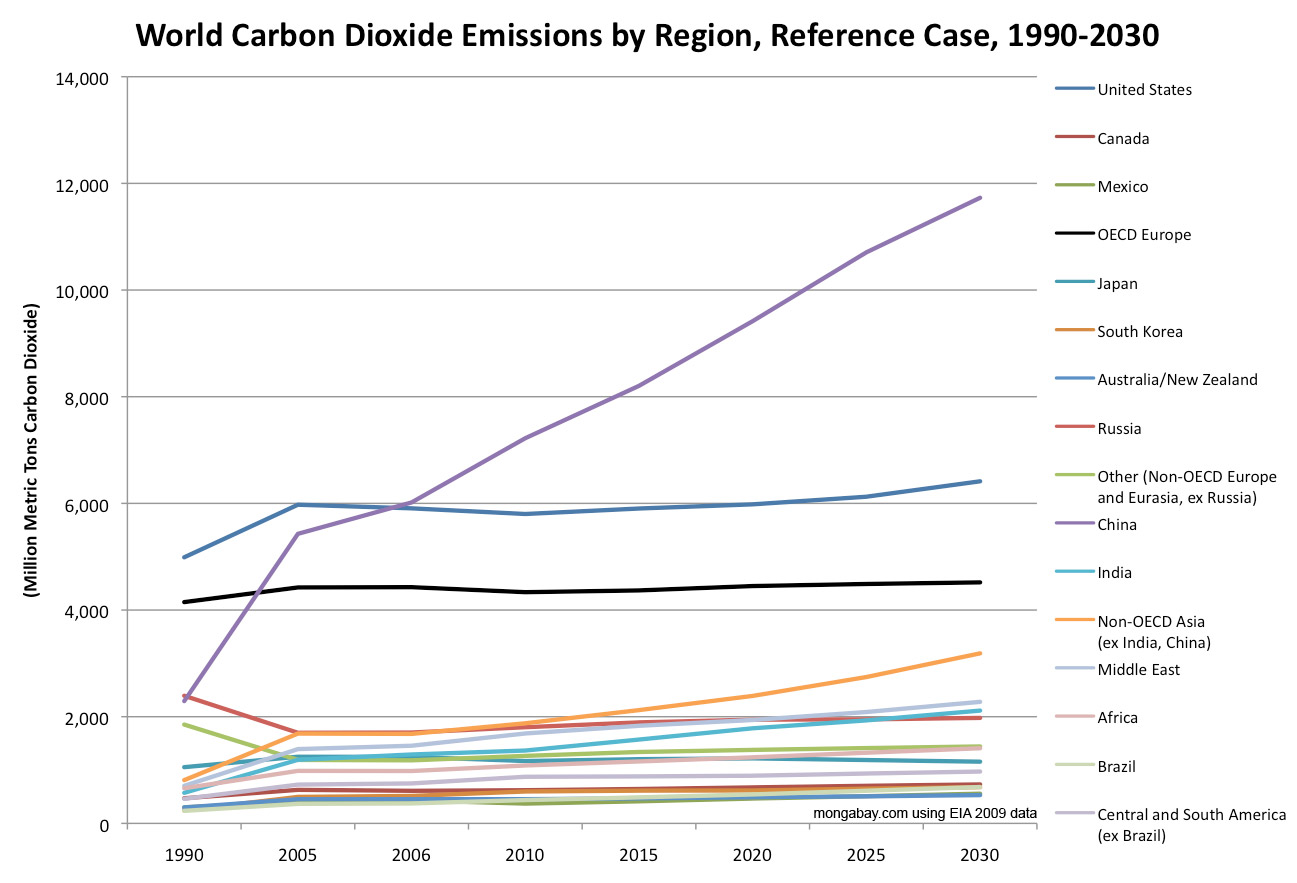
Luckily the Chinese are doing a heroic job emitting CO2.
http://photos.mongabay.com/09/forecast_co2_line.jpg
So it doesn't really matter what the US tries to do - even if it could somehow magically cut its CO2 output to zero in the long run we'll have a lot more of it around thanks to China. And over a few decades it is almost certain that Burma, Vietnam and the like will industrialise in much the same CO2 intensive way China has. Taiwanese manufacturers have a "China+1" strategy - i.e. build factories in China plus one other country. In fact China is a big country and it is only the coastal regions that are highly industrialised and thus emit the CO2. Unfortunately that pattern is unlike to be repeated in smaller developing countries that make up the rest of Asia - they are likely to end up as industrialised as Japan over the whole country.
So the odds of humanity as a whole agreeing to cut its total CO2 output is zero. That's not really unreasonable actually - the US and Europe industrialised in a CO2 intensive way. Their CO2 outputs are now flat or falling because the factories have moved to Asia. If I were in China, Burma or Vietnam I'd be very hostile to the idea that my country should stop industrialising because of concerns about CO2 affecting the climate in the future. Especially if those concerns came from countries who have already passed through that stage of development. Even a new Cultural Revolution in China would only cause a pause in the process. Once it was over it would resume.
-
Re:Who would have thought
it was a great idea to start building homes on swamp land?
I dunno... ask the people in New Orleans who built homes on drained swampland that was below sea level that required constant pumping of water into canals (where the canal water level is higher than the hour ground levels).
http://upload.wikimedia.org/wikipedia/commons/2/20/New_Orleans_17th_Street_Canal_filling.JPG -
Re:Linux vs OS-X
No there isn't. There is probably less than 2 mo, and that's 2 mo where Symbian was underselling Lumia 2::1.
http://upload.wikimedia.org/wikipedia/commons/a/ac/World_Wide_Smartphone_Sales_Share.png
-
Re:Slashdot's story title is grossly wrong
Mobile providers will provide the TEXT (ie.low bandwidth) version of wikipedia free of charge, via a regular mobile data channel. They will not be providing Wikipedia via text message (SMS).
That would make more sense, but the Wikimedia blog also says SMS (and USSD, similar to SMS with a 183 character message limit):
http://blog.wikimedia.org/2013/02/22/getting-wikipedia-to-the-people-who-need-it-most/
...pioneering a program to give mobile users USSD & SMS access to Wikipedia.
-
Re:I say cut the F-35
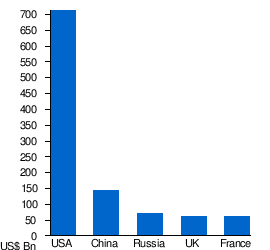
Yes, but lets cut where we can cut. I think you and I would agree on a lot but I've come to the conclusion that there are plenty of things that most of us would agree, even if begrudgingly, that we can stop spending on. We have troops in over 150 countries... how about only 50? We spend more than twice as much on our military than the REST OF THE WORLD COMBINED. We spend over five times as much as the next biggest spender China.
http://upload.wikimedia.org/wikipedia/en/timeline/9b6b4ac6234a38d7f61757290055617d.pngOur military expenditures aren't just huge, they are to the point of being borderline insane. We have enough nukes to kill every human on earth 100 times over, there's no possibility of any country invading us for at least the next several hundred years. Let's just stop. Fuck the middle east, Fuck Isreal, Russia is not going to invade Europe, lets send some humanitarian aid to Africa but otherwise let that continent deal with its own affairs.
We've basically accomplished nothing with our police actions since the Korean war. Now even the Koreans want us out and we wont leave. Enough's enough, lets just stop and spend our money on something that doesn't kill people for a change.
-
Re:SHOW ME A GOOD JEW....
-
Re: It's The American Drean
Oh, and to throw one back at ya, why do you need an airbase in every state of the US? Apart from pork-barreling that is. After all, it is not as if China is going to invade, say, Colorado without going through somewhere, and yet there are no fewer than five bases there.
Not to mention six in England. You afraid the English might want to start War of Independence, part 2?
http://upload.wikimedia.org/wikipedia/commons/a/ad/Air_Force_Facilities.jpg
-
Re:Red states, Blue states
That's not really the relevant correlation, because as a sibling poster points out, that doesn't actually control for anything.
More interesting to me is happiness versus median household income: There may be some sort of relationship between those two, but there appear to be some happy places that aren't rich and some rich places that aren't happy.
-
Re:Gamers are not idiots ...
Think of this in terms of mail. 40 years ago I could rent or buy sheet music for some Elvis songs, copy it, and send it by mail to a friend of mine.
Citation needed. I presume you are implying that that was *legal*, not just that you could physically do it. How was that not copyright infringement?
Sheet music was copyrighted, even in the late 1800s.. http://upload.wikimedia.org/wikipedia/commons/5/5f/Maple_Leaf_Rag.PNG
-
Re:Yes
So I'm sorry but until you get somebody with a brain to be the head of a distro, one who'll flip the bird to Torvalds and just fork the whole damned thing and make a Linux distro where you can update the damned thing without shit breaking?
Unfortunately it's not Torvalds you should flip the bird to. There are a lot of components that live between the applications and the kernel, and pulseaudio is one of them. Here's a pretty good illustration, Linus controls the kernel layer with the ALSA/OSS hardware drivers, HAL and network stack (for remote sound), but not the pulse engine or library layer. Also all USB devices work in the same way, the kernel only has basic USB read/write functions so if your device doesn't have drivers it's not Linus or the kernel at fault. There have also been many cases where the initialization/config/user interface has been broken, you can fix it from the command line but out of the box it appears broken.
Of course all of this doesn't matter if you're the user, anything that breaks anywhere from the GUI to the kernel is broken, but if we're going to play pin the blame game it is important. For example if you want to pin the blame on pulseaudio then Red Hat created it and many other distros like Ubuntu implemented it very poorly, Linus was not at all in the decision loop and I think he'd be very insulted if people though he'd approved that clusterfuck. What we should have is more people like Torvalds that could hit all these other projects with a cluebat, honestly if all components were run like he runs the kernel we wouldn't be having this discussion. His rule 1, 2 and 3 is don't break userspace.
-
Re:easy
hyperspace
Pathetic Atarians, we call it the third dimension!
-
Re:It begins, the horrible Asteroid B-movie.
It starts, with a killer asteroid hurling towards the earth.
Our hero is summoned, and immediately springs into action.
He sets out with his trusty weapon to save the world from the danger of the week.
After a long and awesome journey, he finally reach his destination.
Finally there, he slowly takes aim, breathes, and fire at The Killer Meteor. The meteor, alerted to his presence, fights back. What follows is a long action sequence only slowing down now and then so our hero can do manly poses.
After a long battle, and lots of shooting and fishing was done, there was only a small fragment left, just enough to spend the CGI budget, and show everyone how dangerous The Killer Meteor could have been.
No one was killed, and the world was again saved thanks to our hero.
-
Re:iDiots
Did they rearrange the geography for ya?
-
Re:End the boondoggle
Octane and E85 is not a valid comparison. http://upload.wikimedia.org/wikipedia/commons/thumb/0/0f/Gas_Station_Pump_Five_Octane_Ratings.jpg/687px-Gas_Station_Pump_Five_Octane_Ratings.jpg South Dakota approved 85 octane gas; http://www.argusleader.com/interactive/article/20120913/NEWS/309130037/85-octane-gas-now-legal-parts-South-Dakota
-
Fuck the pope.
This is the guy who should take his place, dismantle their ridiculous cult, and bring some common sense back to the world.
http://upload.wikimedia.org/wikipedia/commons/d/da/Ghost_-_GRF_2012.jpg
-
Re:Welcome to Capitalism
Is that worse than ignoring the cost and focusing only on the measurable good of government programs?
You pay for what you get, and you get what you pay for. The US does not spend more per household than other major economies. As a factor of GDP, it spends particularly little. If you exclude military spending (the US spends as much on the military as the next 10 countries combined), it looks even rosier.
http://upload.wikimedia.org/wikipedia/commons/f/f5/2010_National_Spending_of_the_USA_compared_to_G20.jpg
http://en.wikipedia.org/wiki/Government_spending#As_a_percentage_of_GDPThe only countries which spend notably less are poverty states and failed states. If you (and Ron Paul) think the US would be better off with the tax/spend model used by Somalia, Burma and Turkmenistan rather than the model used by China, Norway and the United Kingdom, then you're going to need some fairly weighty facts to back it up.
-
Re:How about...
He didn't have to run a campaign at all. Illinois' 4th district has been so grotesquely gerrymandered that it's been nicknamed 'earmuffs.' It's designed to include two majority Hispanic areas.
https://upload.wikimedia.org/wikipedia/commons/a/a0/IL04_109.gif
This man hasn't ever received less than 75% of the vote, and has had this seat for 20 years. He hasn't had to run so much as a primary since around 1994.
-
And the problem is getting worse too
The difference is nicely illustrated by this graphic http://commons.wikimedia.org/wiki/File:Binaryvdecimal.svg


.jpg)