Slashdot Mirror
Domain: wikipedia.org
Stories and comments across the archive that link to wikipedia.org.
Stories · 7,048
-
Stand and Deliver Teacher Jaime Escalante Dies
DesScorp writes "Jaime Escalante, the math teacher portrayed in the hit '80s movie Stand and Deliver, has died of cancer at age 79. Escalante is legendary for creating the advanced math 'pipeline' program at Garfield High in East Los Angeles in the '70s and '80s, an area populated mostly by poorer Hispanic families. Escalante's students eventually outpaced even richer schools in advanced placement tests for calculus. Escalante refused to accept excuses from his students or community about why they couldn't succeed, and demanded a standard of excellence from them, defying the notion that poor Hispanic kids just weren't capable of advanced work. While Escalante became a celebrity because of the hit movie about his efforts, jealousy from other teachers ... as well as red tape from teacher's unions and the public school bureaucracy, resulted in Escalante and his hand-picked teachers leaving Garfield. Since his departure, Garfield has never replicated Escalante's success with math students, and Reason Magazine reported on the shameful way in which others tore down what Escalante and his teachers worked so hard to build." -
Gonorrhea As the Next Superbug
WrongSizeGlass writes "Reuters is reporting that Gonorrhea risks becoming a superbug: 'The sexually transmitted disease gonorrhea risks becoming a drug-resistant "superbug" if doctors do not devise new ways of treating it, a leading sexual health expert said.'" -
James Lovelock Suggests Suspending Democracy To Save the World
mosb1000 writes "Climate scientist James Lovelock claims it may be necessary to put democracy on hold to prevent a global climate catastrophe. He goes on to say that the best remedies may be adaptation techniques such as building sea defenses." Lovelock is famously the creator of the Gaia hypothesis. -
James Lovelock Suggests Suspending Democracy To Save the World
mosb1000 writes "Climate scientist James Lovelock claims it may be necessary to put democracy on hold to prevent a global climate catastrophe. He goes on to say that the best remedies may be adaptation techniques such as building sea defenses." Lovelock is famously the creator of the Gaia hypothesis. -
LRO Photographs Soviet Lunar Landers From the '70s
braindrainbahrain writes "Photographs of the Sea of Crises on the Moon taken by the Lunar Reconnaissance Orbiter show the Soviet lunar landers Luna 20, Luna 23 and Luna 24, which landed on the Moon in the 1970s. In addition to the landers, it is possible to see the tracks made by the Lunokhod lunar rover! The Soviet Lunokhod lunar rover predates the first successful Mars Rover by some 30 years. (Note: Very cool old-style artists' drawings of the Soviet craft at the Wikipedia links above.)" -
LRO Photographs Soviet Lunar Landers From the '70s
braindrainbahrain writes "Photographs of the Sea of Crises on the Moon taken by the Lunar Reconnaissance Orbiter show the Soviet lunar landers Luna 20, Luna 23 and Luna 24, which landed on the Moon in the 1970s. In addition to the landers, it is possible to see the tracks made by the Lunokhod lunar rover! The Soviet Lunokhod lunar rover predates the first successful Mars Rover by some 30 years. (Note: Very cool old-style artists' drawings of the Soviet craft at the Wikipedia links above.)" -
LRO Photographs Soviet Lunar Landers From the '70s
braindrainbahrain writes "Photographs of the Sea of Crises on the Moon taken by the Lunar Reconnaissance Orbiter show the Soviet lunar landers Luna 20, Luna 23 and Luna 24, which landed on the Moon in the 1970s. In addition to the landers, it is possible to see the tracks made by the Lunokhod lunar rover! The Soviet Lunokhod lunar rover predates the first successful Mars Rover by some 30 years. (Note: Very cool old-style artists' drawings of the Soviet craft at the Wikipedia links above.)" -
LRO Photographs Soviet Lunar Landers From the '70s
braindrainbahrain writes "Photographs of the Sea of Crises on the Moon taken by the Lunar Reconnaissance Orbiter show the Soviet lunar landers Luna 20, Luna 23 and Luna 24, which landed on the Moon in the 1970s. In addition to the landers, it is possible to see the tracks made by the Lunokhod lunar rover! The Soviet Lunokhod lunar rover predates the first successful Mars Rover by some 30 years. (Note: Very cool old-style artists' drawings of the Soviet craft at the Wikipedia links above.)" -
LRO Photographs Soviet Lunar Landers From the '70s
braindrainbahrain writes "Photographs of the Sea of Crises on the Moon taken by the Lunar Reconnaissance Orbiter show the Soviet lunar landers Luna 20, Luna 23 and Luna 24, which landed on the Moon in the 1970s. In addition to the landers, it is possible to see the tracks made by the Lunokhod lunar rover! The Soviet Lunokhod lunar rover predates the first successful Mars Rover by some 30 years. (Note: Very cool old-style artists' drawings of the Soviet craft at the Wikipedia links above.)" -
Journalism Students Assigned To Write On Wikipedia
Hugh Pickens writes "eCampus News reports that at the University of Denver, journalism students are assigned to write Wikipedia entries as part of a curriculum that stresses online writing and content creation, and students have so far composed 24 Wikipedia articles this year, covering topics from the gold standard to the San Juan Mountains to bimetallism, an antiquated monetary standard. Journalism instructors Lynn Schofield Clark and Christof Demont-Heinrich say students are told to check their sourcing carefully, just as they would for an assignment at a local newspaper. 'Students are leery about mentioning Wikipedia, because they might be subjected to criticism. But I tell them it's an online source of knowledge that just has some information that might be questionable, but that doesn't mean you have to dismiss all of [its content],' says Demont-Heinrich, who first assigned the Wikipedia writing to students in his introductory course taught during the university's recent winter semester. He said the Wikipedia entries didn't require old-school shoe leather reporting — because the online encyclopedia bars the use of original quotes — but they teach students how to thoroughly research a topic before publishing to a site that has over 350 million unique visitors and gets over 10 billion page views a month. 'I see journalism as being completely online within the next two to five years,' says Demont-Heinrich. 'If you're not trained to expect that and write for that, then you're not going to be ready for the work world.'" -
Journalism Students Assigned To Write On Wikipedia
Hugh Pickens writes "eCampus News reports that at the University of Denver, journalism students are assigned to write Wikipedia entries as part of a curriculum that stresses online writing and content creation, and students have so far composed 24 Wikipedia articles this year, covering topics from the gold standard to the San Juan Mountains to bimetallism, an antiquated monetary standard. Journalism instructors Lynn Schofield Clark and Christof Demont-Heinrich say students are told to check their sourcing carefully, just as they would for an assignment at a local newspaper. 'Students are leery about mentioning Wikipedia, because they might be subjected to criticism. But I tell them it's an online source of knowledge that just has some information that might be questionable, but that doesn't mean you have to dismiss all of [its content],' says Demont-Heinrich, who first assigned the Wikipedia writing to students in his introductory course taught during the university's recent winter semester. He said the Wikipedia entries didn't require old-school shoe leather reporting — because the online encyclopedia bars the use of original quotes — but they teach students how to thoroughly research a topic before publishing to a site that has over 350 million unique visitors and gets over 10 billion page views a month. 'I see journalism as being completely online within the next two to five years,' says Demont-Heinrich. 'If you're not trained to expect that and write for that, then you're not going to be ready for the work world.'" -
International Longest Tweet Contest Seeks Entries
An anonymous reader writes "The 1st International Longest Tweet Contest is open for submissions until April 12. It looks to be a take-off of the famous Obfuscated C Contest. So far the record is 4.2 kilobits encoded per tweet, based on exploiting the fact that Twitter actually passes the full 31 bits of ISO 10646 (the international standard that Unicode is based on), not the roughly 20.08 bits/character of Unicode itself." -
Will Your Answers To the Census Stay Private?
Hugh Pickens writes "James Bovard writes in the Christian Science Monitor that Americans are told that information gathered in the census will never be used against them and the House of Representatives, in a Census Awareness Month resolution passed March 3, proclaimed that 'the data obtained from the census are protected under United States privacy laws.' Unfortunately, thousands of Americans who trusted the Census Bureau in the past lost their freedom as a result. In the 1940 Census, the Census Bureau loudly assured people that their responses would be kept confidential. Within four days of the attack on Pearl Harbor, the Census Bureau had produced a report listing the Japanese-American population in each county on the West Coast. The Census Bureau's report helped the US Army round up more than 100,000 Japanese-Americans for concentration camps (later renamed 'internment centers'). In 2003-04, the Census Bureau provided the Department of Homeland Security with a massive cache of information on how many Arab Americans lived in each ZIP Code around the nation, and which country they originated from — information that could have made it far easier to carry out the type of mass roundup that some conservatives advocated. 'Instead of viewing census critics as conspiracy theorists, the nation's political leaders should recognize how their policies have undermined public faith in government,' writes Bovard. 'All the census really needs to know is how many people live at each address. Citizens should refuse to answer any census question except for the number of residents.'" -
Tracking Pedophiles By Their Typing Habits
An anonymous reader writes "Pedophiles using the internet to target youngsters could be tracked down — by the way they use a keyboard. Researchers are investigating ways to use technology which can determine a typist's age, sex and culture within ten keystrokes by monitoring their speed and rhythm." Since Phrenology hasn't exactly panned out, they gotta try something new. -
Indian Military Hopes to Weaponize the Searing "Ghost Pepper"
coondoggie writes "The military in India is looking to weaponize the world's hottest chili, the bhut jolokia or 'ghost pepper,' according to a number of news outlets. The Bhut Jolokia chili pepper from Assam, India is no ordinary pepper. In tests first conducted by the New Mexico State University in 2008 and subsequently confirmed by Guinness World records and others, the Bhut Jolokia reached over one million Scoville heat units, while the next hottest, the Red Savina Habenero, clocks in at a mere 577,000. Scoville units are a universally accepted measure of chili hotness." -
Flaw In Emergency Response System May Have Killed Hundreds
Hugh Pickens writes "The Telegraph reports that a flaw in the way emergency response software was set up to handle Category A responses in Great Britain may have cost hundreds of lives over the past ten years. Most ambulance services use an international computerized system designed in America and in the US version, a fall of more than 6 feet receives the maximum priority response. However, the government committee which governs its use in Great Britain decided that such cases should be deemed less urgent, and excluded from an eight minute category A target response time. If a call involved a fall of more than 6 feet it was designated a lower priority 'category B response' despite the presence of life-threatening conditions which were supposed to receive the most urgent category A response. The flaw came to light after Bonnie Mason, 58, fell 12 feet down the stairs and died from a head injury after emergency controllers in Suffolk failed to identify her situation as 'life-threatening.'" -
Google Hands Out Web Security Scanner
An anonymous reader writes "Apparently feeling generous this week, Google has released for free another of their internally developed tools: this time, a nifty web security scanner dubbed skipfish. A vendor-sponsored study cited by InformationWeek discovered that 90% of all web applications are vulnerable to security attacks. Are Google's security people trying to change this?" -
Need Help Salvaging Data From an Old Xenix System
Milo_Mindbender writes "I've recently gotten ahold of an old Altos 586 Xenix system (a late '80s Microsoft flavor of Unix) that has one of the first multi-user BBS systems in the US on it, and I want to salvage the historical BBS posts off it. I'm wondering if anyone remembers what format Xenix used on the 10MB (yes MB) IDE hard drive and if it can still be read on a modern Linux system. This system is quite old, has no removable media or ethernet and just barely works. The only other way to get data off is a slow serial port. I've got a controller that should work with the disk, but don't want to tear this old machine apart without some hope that it will work. Anyone know?" -
Sci-Fi Writer Peter Watts Convicted of Assault
SJrX writes "CBC news is reporting that Peter Watts has indeed been convicted of Assaulting border guards, (discussed here). He will be sentenced April 26th." -
Amazon Battles Apple By Arm-Twisting Publishers
bizwriter writes "Apple has upset the e-book pricing cart by agreeing to a so-called agency model, where the publisher sets the price and the seller takes a cut. This goes contrary to the degree of control Amazon likes, so although it apparently gave in to Macmillan back in February, it turns out that Amazon continues twisting arms. The problem publishers face is that Apple has a most-favored-nation clause, so it gets the best deal that the publishers offer. If the publishers give in to Amazon, then they also have to provide the same terms to Apple." -
The Woes of Munich's Linux Migration
mikrorechner writes "The H Online has a writeup of the problems encountered by LiMux (Wikipedia entry), one of the most prominent Linux migration projects in the world, trying to introduce free software into the highly heterogenous IT infrastructure of the City of Munich. Quoting: 'Florian Schiessl, deputy head of Munich's LiMux project for migrating the city's public administration to Linux, has, for the first time, explained why migrating the city's computing landscape to open source software has taken longer than originally planned.'" Here is Shiessl's blog, in which he details some of the transition problems. -
Millennium Prize Awarded For Perelman's Poincaré Proof
epee1221 writes "The Clay Mathematics Institute has announced its acceptance of Dr. Grigori Perelman's proof of the Poincaré conjecture and awarded the first Millennium Prize. Poincaré questioned whether there exists a method for determining whether a three-dimensional manifold is a spherical: is there a 3-manifold not homologous to the 3-sphere in which any loop can be gradually shrunk to a single point? The Poincaré conjecture is that there is no such 3-manifold, i.e. any boundless 3-manifold in which the condition holds is homeomorphic to the 3-sphere. A sketch of the proof using language intended for the lay reader is available at Wikipedia." -
Startup's Submerged Servers Could Cut Cooling Costs
1sockchuck writes "Are data center operators ready to abandon hot and cold aisles and submerge their servers? An Austin startup says its liquid cooling enclosure can cool high-density server installations for a fraction of the cost of air cooling in traditional data centers. Submersion cooling using mineral oil isn't new, dating back to the use of Fluorinert in the Cray 2. The new startup, Green Revolution Cooling, says its first installation will be at the Texas Advanced Computing Center (also home to the Ranger supercomputer). The company launched at SC09 along with a competing liquid cooling play, the Iceotope cooling bags." -
Obama Administration Withholds FoIA Requests More Often Than Bush's
bonch writes "Agencies under the Obama administration cite security provisions to withhold information more often than they did under the Bush administration. For example, the 'deliberative process' exemption of the Freedom of Information Act was used 70,779 times in 2009, up from the 47,395 of 2008. Amusingly, the Associated Press has been waiting three months for the government to deliver records on its own Open Government Directive." -
Milgram's Experiment — the TV Show
vieux schnock writes "A controversy has arisen over a French television show reproducing Milgram's experiment in front of a live audience. Milgram's original experiment wanted to show the willingness of study participants to 'obey an authority figure who instructed them to perform acts that conflicted with their personal conscience.' But this time, it seems that television can play that deadly 'authority' figure with more devastating results: While Milgran got 65% of the participants to hit the maximum jolt button, '[in] the final tally, 81 percent of the contestants turned up the juice to the maximum.'" -
Lord British's Lost Lunar Rover Found, After 37 Years
Lanxon writes "The guy behind Ultima Online once bought an old Russian rover, despite it being lost on the moon somewhere. And now, using images released by NASA, it has been located on the moon's surface after nearly four decades of being MIA, reports Wired. Richard Garriott, who created the Ultima Online multiplayer game, bought the Lunokhod 2 in a Sotheby's auction in New York in 1998. And so new was the discovery of his lost possession, he hadn't even heard that the craft had been discovered when Wired spoke to him." (Richard Garriott is also well known as Lord British.) -
The Death of the US-Mexico Virtual Fence
eldavojohn writes "A couple of years ago it was announced that the Boeing-built virtual fence at the US-Mexico border didn't work. Started in 2006, SBInet has been labeled a miserable failure and finally halted. A soon-to-be-released GAO report is expected to be overwhelmingly critical of SBInet, causing DHS Chief Janet Napolitano to announce yesterday that funding for the project has been frozen. It's sad that $1.4 billion had to be spent on the project before the discovery that this poorly conceived idea would not work." -
Simpler "Hello World" Demonstrated In C
An anonymous reader writes "Wondering where all that bloat comes from, causing even the classic 'Hello world' to weigh in at 11 KB? An MIT programmer decided to make a Linux C program so simple, she could explain every byte of the assembly. She found that gcc was including libc even when you don't ask for it. The blog shows how to compile a much simpler 'Hello world,' using no libraries at all. This takes me back to the days of programming bare-metal on DOS!" -
Deposit Checks To Your Bank By Taking a Photo
Pickens writes "The Mercury News reports that consumers will soon be able to deposit a check by snapping a photo of it with a cell phone and transmitting an encrypted copy to their bank. Although some critics contend paperless deposits are an attempt by the banking industry to eliminate 'float,' the standard one- or two-day waiting period between the time someone writes a check and the time the money is actually taken out of their account, actually remote-deposit capture started out as a way for big companies and financial institutions to process huge numbers of checks without having to ship them around the country. 'Our customers are becoming more and more tech-savvy,' said an SVP for mobile banking at Citibank. 'We're trying to support those people on the go.' Although the process adds a new wrinkle to concerns about fraud and the privacy of financial data, banks and the technology companies helping them say they have largely overcome these concerns. Another bank SVP said, 'For many institutions struggling to raise deposits and differentiate, this is an outstanding offering they can roll out inexpensively [note: interstitial]. It's a sticky product.'" -
SETI Is 50 Years Old; No Sign of ET
EagleHasLanded writes "The Search for Extraterrestrial Intelligence is 50 years old next month, and still no sign of intelligent alien life. Paul Davies of the Beyond Center (also Chairman of the SETI Post-Detection Taskgroup) says it's time to re-think and expand the search for ET." -
Air Force Spaceplane Readying For Launch
FleaPlus writes "The US Air Force is currently preparing for the launch of the secretive X-37B OTV-1 (Orbital Test Vehicle 1) spaceplane, which was transferred from NASA to DARPA back in 2004 when NASA opted to focus its budget on lunar exploration. The reusable unmanned spaceplane is set to launch in April on top of a commercial Atlas V rocket, orbit for up to 270 days while testing a number of new technologies, reenter the atmosphere, then land on auto-pilot in California." -
Pi Day and an Interview With a Pi Researcher
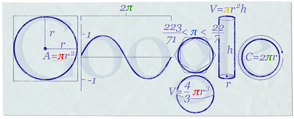
JoshuaInNippon writes "In honor of Pi Day, March 14 (or 3.14 for those who may need a hint), readers may be interested in reading an interview with Professor Daisuke Takahashi, the Japanese researcher who found 2.5 trillion digits of Pi back in August, before being apparently being edged out in December by a French computer programmer looking to prove his efficient coding abilities. Professor Takahashi's interview gives some unique insight into one man who truly marvels at the number that has driven people to ever greater lengths to find more digits for centuries." Plant Kingdom adds "There have been a number of proposals for alternatives to March 14 (see the Wikipedia page for Pi Day). Here's mine: when the Earth has gone through 1/pi-th of its orbit, as measured from Winter Solstice to Winter Solstice. I've put together a web site to make the case." -
Toyota Acceleration and Embedded System Bugs
An anonymous reader writes "David Cummings, a programmer who worked on the Mars Pathfinder project, has written an interesting editorial in the L.A. Times encouraging Toyota to drop claims of software infallibility in their recent acceleration problems. He argues that embedded systems developers must program more defensively, and that companies should stop relying on software for safety. Quoting: 'If Toyota has indeed tested its software as thoroughly as it says without finding any bugs, my response is simple: Keep trying. Find new ways to instrument the software, and come up with more creative tests. The odds are that there are still bugs in the code, which may or may not be related to unintended acceleration. Until these bugs are identified, how can you be certain they are not related to sudden acceleration?'" -
Final Decision Deferred On ".xxx" Domains
Hugh Pickens writes "The Associated Press reports that the board of the Internet Corporation for Assigned Names and Numbers has deferred a decision until June on whether to create a '.xxx' Internet suffix as an online red-light district, beginning a 70-day process of consultations on a domain that could help parents block access to adult sites. ICM Registry LLC first proposed the '.xxx' domain in 2000, and ICANN has rejected it three times already since then, but an outside panel last month questioned the board's latest rejection in 2007, prompting the board to reopen the bid. Backers of '.xxx' have billed the proposal as a way for the adult-entertainment industry to clean up its act, though some adult sites worry that governments would wind up mandating the use of '.xxx' and that sites with the '.xxx' suffix could easily be blocked by government web filters in the future. 'I am very concerned and fearful of censoring adult material that should be made available for adults. It scares the hell out of me,' says Malcolm Day, head of AdultShop.com, adding that if adult websites weren't allowed to have '.com' domains and could only register under the '.xxx' address, then 'many governments (across the world) would try to block them.'" -
UK Intel Agency's Missing Laptops Might Contain Sensitive Data
superapecommando writes "GCHQ lost 35 laptops in one year, potentially containing highly sensitive data. The UK's electronic spy centre was today lambasted by MPs for having a 'cavalier' attitude to data security. The centre is responsible for tracking the electronic communications of terrorists. In a new report, the Commons Intelligence and Security Committee expressed concern that GCHQ appeared to be entirely unaware whether or not the computers, lost in 2008, contained top secret information on people posing an imminent security threat to the country." -
Nearby Star Forecast To Skirt Solar System
PipianJ writes "A recent preprint posted on arXiv by Vadim Bobylev presents some startling new numbers about a future close pass of one of our stellar neighbors. Based on studies of the Hipparcos catalog, Bobylev suggests that the nearby orange dwarf Gliese 710 has an 86% chance of skirting the outer bounds of the Solar System and the hypothesized Oort Cloud in the next 1.5 million years. As the Oort Cloud is thought to be the source of many long-period comets, the gravitational effects of Gliese's passing could send a shower of comets into the inner Solar System, threatening Earth. This news about Gliese 710 isn't exactly new, but it's one of the first times the probability of this near-miss has been quantified." -
Nearby Star Forecast To Skirt Solar System
PipianJ writes "A recent preprint posted on arXiv by Vadim Bobylev presents some startling new numbers about a future close pass of one of our stellar neighbors. Based on studies of the Hipparcos catalog, Bobylev suggests that the nearby orange dwarf Gliese 710 has an 86% chance of skirting the outer bounds of the Solar System and the hypothesized Oort Cloud in the next 1.5 million years. As the Oort Cloud is thought to be the source of many long-period comets, the gravitational effects of Gliese's passing could send a shower of comets into the inner Solar System, threatening Earth. This news about Gliese 710 isn't exactly new, but it's one of the first times the probability of this near-miss has been quantified." -
Scientists Need Volunteers To Look At the Sun
Hugh Pickens writes "BBC reports that Royal Observatory's 'Solar Stormwatch' needs volunteers to help scientists spot Sun storms — known as coronal mass ejections — before they cause damage on Earth. 'When you look up at the Sun obviously it's too bright to look at properly,' says Dr. Marek Kukula of the Royal Observatory, but 'with special instruments and telescopes you can see there's all sorts of stuff going on.' NASA already monitors the Sun using two 'STEREO' spacecraft that produce 3D images of earth's nearest star, which can show the trajectory of these explosions. However, the sheer amount of data means NASA's scientists are unable to analyze the data as closely as they need — which is where the world's Internet population comes in. After a brief tutorial, users get access to the actual 3-D images taken by the STEREO spacecraft. If a user believes they have spotted the beginnings of a solar storm, they can bring it to the attention of scientists. 'Every little bit counts,' says Kukula. 'I've spoken to the scientists involved and they all agree that even if you log-on and just do it for a few hours, get bored and never touch it again it's all really useful — and helps them to do their work.'" -
T-Mobile's First HSPA+ Modem Goes On Sale Sunday
adeelarshad82 writes "T-Mobile announced that the webConnect Rocket USB Laptop Stick, the first HSPA+ device for the US, will be available beginning on Sunday, March 14. The device was originally announced at MWC in February. HSPA+ is interesting because it could enable 4G LTE-like speeds using existing 3G infrastructure and according to a hands-on, it smokes Wi-Max. Right now, it's still just for Philadelphia, although we should see several major cities light up with HSPA+ on both coasts well before the end of 2010." -
Sony's PS3 Motion Controller Gets Demoed and Named
itwbennett writes "In a 45-minute press conference at the Game Developers Conference in San Francisco, Sony announced its motion controller, officially named the Playstation Move. The Move consists of the Eye Toy (a camera pointed at the player) and a wand-like controller with a lighted ball at the end and a range of buttons on the shaft, writes blogger Peter Smith. 'Alternatively games can use two of the wands, or one wand and one "sub-controller" that has an analog stick (the camera is always required),' says Smith. 'If this is sounding very much like the Wii's Remote and Nunchuk well, you aren't far off (though at least there's no cable between the two parts to smack you in the face when things get heated).' Here are Smith's thoughts on the demo: 'All in all, the demos seemed OK, but I, at least, wasn't really blown away by any of them. That said, it's always hard to tell how well these systems work without actually trying them for yourself. You need to feel the connection (or lack thereof) between what your hands are doing and what's going on on-screen in order to be sure. For example, in the boxing demo the player did a quick spin move that led to a roundhouse punch. It's hard to say if his motion triggered a pre-set action (a 'combo') or if the system was able to track the controller that accurately, and was able to 'connect the dots' from when his body briefly occluded the wand to when it reappeared.'" -
"Mythical Man-Month" Supposedly Busted By MIT Startup
An anonymous reader writes "We all know about the Mythical Man-Month, the argument that adding more programmers to a software project just makes it later and later. A Linux startup out of MIT claims to have busted the myth, using an MIT holiday month to hire 20 college student interns to get all their work done and quadrupling its productivity." -
Theoretical Breakthrough For Quantum Cryptography
KentuckyFC writes "Quantum cryptography uses the quantum properties of photons to guarantee perfect secrecy. But one of its lesser known limitations is that it only works if Alice and Bob are perfectly aligned so that they can carry out well-defined polarization measurements on the photons as they arrive. Physicists say that Alice and Bob must share the same reference frame. That's OK if Alice and Bob are in their own ground-based labs, but it's a problem in many other applications, such as ground-to-satellite communications or even in chip-to-chip communications, because it's hard to keep chips still over distances of the order of the wavelength of light. Now a group of UK physicists have developed a way of doing quantum cryptography without sharing a reference frame. The trick is to use entangled triplets of photons, so-called qutrits, rather than entangled pairs. This solves the problem by embedding it in an extra abstract dimension, which is independent of space. So, as long as both Alice and Bob know the way in which all these abstract dimensions are related, the third provides a reference against which measurements of the other two can be made. That allows Alice and Bob to make any measurements they need without having to agree ahead of time on a frame of reference. That could be an important advance enabling the widespread use of quantum cryptography." -
Ask the UK Pirate Party's Andrew Robinson About the Issues
VJ42 writes "With the 2010 UK general election fast approaching, the Pirate Party of the United Kingdom will be fielding elections for the first time. The Digital Economy bill and ACTA are hot topics for UK geeks, and the Pirate Party is looking to pick up some votes. Their leader, Andrew Robinson, has agreed to answer your questions. Normal Slashdot interview rules apply." -
Ask the UK Pirate Party's Andrew Robinson About the Issues
VJ42 writes "With the 2010 UK general election fast approaching, the Pirate Party of the United Kingdom will be fielding elections for the first time. The Digital Economy bill and ACTA are hot topics for UK geeks, and the Pirate Party is looking to pick up some votes. Their leader, Andrew Robinson, has agreed to answer your questions. Normal Slashdot interview rules apply." -
Time To Take the Internet Seriously
santosh maharshi passes along an article on Edge by David Gelernter, the man who (according to the introduction) predicted the Web and first described cloud computing; he's also a Unabomber survivor. Gelernter makes 35 predictions and assertions, some brilliant, some dubious. "6. We know that the Internet creates 'information overload,' a problem with two parts: increasing number of information sources and increasing information flow per source. The first part is harder: it's more difficult to understand five people speaking simultaneously than one person talking fast — especially if you can tell the one person to stop temporarily, or go back and repeat. Integrating multiple information sources is crucial to solving information overload. Blogs and other anthology-sites integrate information from many sources. But we won't be able to solve the overload problem until each Internet user can choose for himself what sources to integrate, and can add to this mix the most important source of all: his own personal information — his email and other messages, reminders and documents of all sorts. To accomplish this, we merely need to turn the whole Cybersphere on its side, so that time instead of space is the main axis. ... 14. The structure called a cyberstream or lifestream is better suited to the Internet than a conventional website because it shows information-in-motion, a rushing flow of fresh information instead of a stagnant pool." -
Amateur Records the "Sound" of Mars Express
gyrogeerloose writes "A French amateur radio operator who built his own ground station using equipment from an abandoned telecom uplink site has listened in on the ESA's Mars Express space probe. While his antenna is too small to allow him to download actual data, he was able to record and convert the signal of the probe's X-Band transmitter into an audio file." -
Why Wikipedia Articles Vary So Much In Quality
Hugh Pickens writes "A new study shows that the patterns of collaboration among Wikipedia contributors directly affect the quality of an article. 'These collaboration patterns either help increase quality or are detrimental to data quality,' says Sudha Ram at the University of Arizona. Wikipedia has an internal quality rating system for entries, with featured articles at the top, followed by A, B, and C-level entries. Ram and graduate student Jun Liu randomly collected 400 articles at each quality level. 'We used data mining techniques and identified various patterns of collaboration based on the provenance or, more specifically, who does what to Wikipedia articles,' says Ram. The researchers identified seven specific roles that Wikipedia contributors play (PDF starting on page 175): Casual Contributor, Starter, Cleaner, Copy Editor, Content Justifier, Watchdog, and All-round Editor. Starters, for example, create sentences but seldom engage in other actions. Content justifiers create sentences and justify them with resources and links. The all-round contributors perform many different functions. 'We then clustered the articles based on these roles and examined the collaboration patterns within each cluster to see what kind of quality resulted,' says Ram. 'We found that all-round contributors dominated the best-quality entries. In the entries with the lowest quality, starters and casual contributors dominated.'" -
Improving Education Through Better Teachers
theodp writes "The teaching profession gets schooled in cover stories from the big pubs this weekend, as Newsweek makes the case for Why We Must Fire Bad Teachers, and the NY Times offers the more hopeful Building a Better Teacher. For the past half-century, professional educators believed that if they could only find the right pedagogy, the right method of instruction, all would be well. They tried New Math, open classrooms, Whole Language — but nothing seemed to achieve significant or lasting improvements. But what they ignored was the elephant in the room — if the teacher sucks, the students suck. Or, as the Times more eloquently puts it: 'William Sanders, a statistician studying Tennessee teachers with a colleague, found that a student with a weak teacher for three straight years would score, on average, 50 percentile points behind a similar student with a strong teacher for those years. Teachers working in the same building, teaching the same grade, produced very different outcomes. And the gaps were huge.' But what makes a good teacher? When Bill Gates announced his foundation was investing $335 million in a project to improve teaching quality, he added a rueful caveat. 'Unfortunately, it seems the field doesn't have a clear view of what characterizes good teaching,' Gates said. 'I'm personally very curious.'" -
Dead Pigs Used To Investigate Ocean's "Dead Zones"
timothy writes "As places to study what happens to corpses, the Atlantic Ocean is both much larger and much more specialized than the famous 'body farm' in Knoxville, TN. But for all kinds of good reasons, sending human bodies into Davy Jones' locker just to see where they float and how they bloat is unpopular. Pigs don't pay taxes, and more importantly, they don't vote. So Canadian scientists have taken to using them as human-body proxies, to study what happens when creatures of similar size and hairlessness (aka, us) end up 86ed and in the drink." -
DMCA Amendment Proposed For UK
Grumbleduke writes "During today's debate in the UK's House of Lords on the much-criticized Digital Economy Bill, the unpopular Clause 17 (which would have allowed the government to alter copyright law much more easily than it currently can) was voted out in favor of a DMCA-style take-down system for websites and ISPs. The new amendment known as 120A sets up a system whereby a copyright owner could force an ISP to block certain websites who allegedly host or link to infringing material or face being taken before the High Court and made to pay the copyright owner's legal fees. This amendment was tabled by the Liberal Democrat party, which had so far been seen as the defenders of the internet and with the Conservative party supporting them. The UK's Pirate Party and Open Rights Group have both strongly criticized this new amendment."