Slashdot Mirror
Domain: wiley.com
Stories and comments across the archive that link to wiley.com.
Comments · 614
-
Strong scientific consensus
-
Re:Models are inaccurate, but not wrong
America centric? Arrhenius and Tyndale? Do you think that the website is inventing the research papers being discussed? What about the scientific evidence, are the properties of H2O and CO2 also somehow "America centric"?
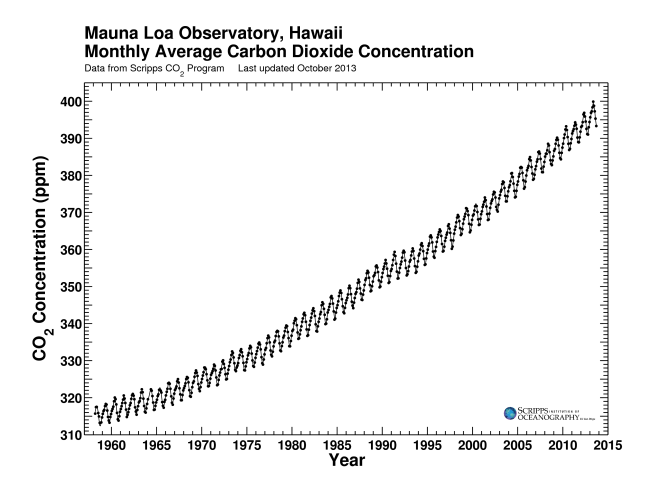
Arrhenius' paper was well-received, but it did contradict existing assumptions that the Earth was generally static or cyclical. Plate tectonics would not be widely accepted until the 1950s. The concept of ice ages had become mainstream only in the 1870s. In point of fact, Arrhenius was writing about CO2 in relation to his interest in the origin of ice ages. That it suggested anthropogenic warming was possible was incidental. Researchers in the early 20th Century had made measurements which suggested that additional CO2 would not have an effect on the Earth's climate. The theory was widely discredited on that basis, even though Arrhenius' equations and calculations seemed to be sound. Other lines of evidence spoke against the idea of a static Earth, and CO2's indisputably also key role in atmospheric warming spurred scientists to attempt to measure global concentrations of CO2 in the 1950s, culminating with the work of Keeling in 1960.
AGW was neither always controversial nor always accepted. Like most scientific ideas it had to gain acceptance, and as always, our theories about the universe improve with better data. The nice thing about the history of science is that it is objective: there are either published papers and observations or there are not. If AGW was as well established in the early 20th Century as you say, then you should have a plethora of evidence. So let's take a quick trip to Google scholar, and start searching for anything climate related that happens to turn up, and see what it says.
Civilization and Climate, 1922
"...there is a widespread idea that climatic uniformity is the normal condition..."
"As to the assumed uniformity of climate, meteorologists do indeed find that so far as records are yet available...there are no certain indications of progressive climatic changes."
An Introduction To Weather And Climate, 1943
"Water vapor is much the most important of the atmosphere's absorbing gases, although carbon dioxide and ozone are of minor importance."
"Very insignificant amounts of both solar energy and terrestrial energy are likewise absorbed by ozone, oxygen, and carbon dioxide."
Climate and evolution, 1915 seems to take the view that climatic changes are exclusively due to the shape and position of the continents, and that the shape and position of the continents is mostly due to erosion, not continental drift.
Ah, here's a good one. G. S. Callendar, 1949 "CAN CARBON DIOXIDE INFLUENCE CLIMATE?" You will also find Callendar's work highlighted in the AIP "Discovery of Global Warming" website I linked earlier, and I believe this article in particular is mentioned.
An interpretation of climatic change in terms of the variable carbon dioxide content of the atmosphere was first proposed some sixty years ago by the famous Swedish physicist, Sevante Arrhenius, who made some of the classic experiments on the absorption of heat radiation by gases. Since then the theory has had a chequered history; it was abandoned for many years when the preponderating influence of water vapour radiation in the lower
-
Not much. I do look at data which may upset you.
The refugee crisis you refer to is actually the second Syrian refugee crisis.
The first refugee was an internal displacement of 1.5 million people (out of a population of 20 million) over the period 2007-2011 during crops failed due to unprecedented drought. Over two hundred villages were completely depopulated, and 40% of Syria's agricultural workforce was lost. Domestic wheat production crashed, and prices skyrocketed as it was replaced by imports.
So you had over a million hungry, unemployed displaced people crowded into cities, when a bad harvest in Russia caused a spike in global wheat prices. Check out the graph in this link labelled "World Monthly Grains Price Index" and note the massive upswing in prices in 2010 - 2011. There was a similar price spike in 2007, but back then Syria produced essentially all the wheat it consumed. In 2010 Syria only produced 80% of what it needed, resulting in underconsumption -- aka "starvation". You can check out the figures here.
Finally note that the so-called "Day of Rage" which critically destabilized the regime took place on March 15, 2011. The timing was not coincidental.
Now you can talk to me about "political struggle" in Syria. The roots of that struggle are of course decades old. But the effects were exacerbated by the worst drought in 900 years.
Without the sarcasm, try to stay on topic lest you continue to be perceived as a shithead Troll.
I have stayed on topic. Shithead troll I guess is a matter of perspective. Syria is exactly the kind of scenario security planners are worried about. And one reason they are worried is that many in the public literally find the idea of climate-driven refugees unimaginable. People who've been paying attention find it all too easy to imagine.
-
Re: What an empty life
Actually, take a closer look here:
http://onlinelibrary.wiley.com...
I think this does a good job of presenting the % probability based on the 95% confidence interval what years might be considered ranked as what.
tl;dr - claiming any "hottest year evar" is fake news, being specific "X% possible hottest year evar" is real news.
-
Re: What an empty life
Looks like this is the closest I could find to 95% confidence intervals: http://onlinelibrary.wiley.com...
The difference in uncertainty between early measurements and recent ones is *huge*.
-
Headline VERY misleading
The headline is quite misleading. What the story actually says is that the previous estimate was 1.6 cm per decade, and the new number is 1.7 cm per decade--with an error range that it might be as low as 1.4.
Really this isn't "We've been wrong!"-- it's more "we have a slightly better estimate now."
The abstract of the article is here: http://onlinelibrary.wiley.com...
-
The original paper
I'm astonished that the discussion has gone on so long without the original paper in Wiley's "Chemistry Select being linked to. Even more astonishing (or depressing, if you like to think of Slashdotters averaging one or two more braincells than the average) is that no-one has commented on the fact that the paper is available without having to go through Wiley's paywall.
-
Re:What are we forgetting...
The earth will be uninhabitable far before a few billion years. Hell, there's evidence that Venus had oceans up to ~700 million years ago http://onlinelibrary.wiley.com... . And when was the Cambrian explosion again? ~600 million years ago? Maybe those things aren't unrelated...
-
Re: fallacy
And more ignorant nonsense gets modded Informative. The anti-science here is getting worse. Posters like you not only drastically overestimate your own knowledge of unfamiliar fields, you then insist to others it must all be a scam.
Weather and climate models aren't some arbitrary curve-fitting; they're physically based using ridiculously detailed physical simulations of air movements and ocean currents, starting from an observed state and running the simulation forward. Read up a little, and maybe you'll learn how to learn again.
And the over-zealous faith in anything tagged science is just as bad.
Simulations of plasma physics are orders of magnitude more detailed still, and examining problems over immensely smaller timescales, like fractions of seconds of a cubic metre, as opposed to decades and centuries of our entire planet. Go talk to physicists working with plasma physics though and ask them about computer simulated predictions for any radical new plasma confinement configuration. The computer simulated results are a reasonable starting point, but are certainly not considered definitive by anybody. More often than not, on building a real world machine it doesn't match the simulation. So much so in fact, that often times demonstrating a promising configuration in a computer model isn't enough to even get a prototype built.
The sacrifices in accuracy made for a plasma physics model is minute compared to what climate models have to do. We are talking computational cells the mesuared in miles in many cases.
You can act indignant and rail against claims that over fitting isn't a problem because of the physical simulation underneath, but you are simply flat wrong. The enormous number of simplifications made to compute results is a huge window for injecting over fit into a hindcast. Read up on climate model tuning and you'll see the authors themselves saying EXACTLY that(quote at the end). They note that there are times were you get better results by taking variables AWAY from the more realistic values they should have.
CM3w predicts the most realistic 20th century warming. However, this is achieved with a small and less desirable threshold radius of 6.0 m for the onset of precipitation. Conversely, CM3c uses a more desirable value of 10.6 m but produces a very unrealistic 20th century temperature evolution.
-
Re:67% is not that good
today will be the same as yesterday
That's not exactly pushing the boundaries, is it?
one should also always consider forecasting models against general predicted climate averages
And how will long-term climate averages help model the North Atlantic Oscillation?
it seems the full research paper is behind a paywall
Try this one.
-
Re:Link to the paper
A better link is the one from ScienceDaily which points to here: the actual paper. My employer blocks sci-hub because they regularly post papers in violation of copyright.
-
Re:NASA disagrees with you
Ah, so we have two scientific studies that contradict each other. No consensus! And the scientists of both studies can point to why the other study is inaccurate. So given the fact that there is no consensus on this subject, why then do you choose to support one study over the other, especially when there isanother study that seems to support the other?
-
Paper link
Because I had to click through three pages to get to the actual source:
-
Re:Comcast is right for once.
Pop-up ads aren't so simple, they serve the useful function of making a product more familiar, and thus more desirable. This is a phenomenon documented by reputable psychology research. It has also been demonstrated that nasty behavior - especially online - is generally used to shut down people's critical faculties, which probably tells us something about the intellectual integrity of your position.
Citations:
Familiarity and desirability as it related to marketing: http://psycnet.apa.org/?&fa=ma...
The nasty effect: http://onlinelibrary.wiley.com...
-
Re:Clickbait Science
My bad. here is the main paper referred to in TFA (although the one I posted is also referenced.).
However, the point stands: the press report is breathless hype of one very small study, with only 23 patients and a threshold of p , using a largely subjective test as a measure. That doesn't mean the study is wrong, but it does mean that everybody running out and buying blue blocking sunglasses to fight bipolar disorder is an insane and utterly unscientific response.
-
Re:Like most of Earth's existence?
Here's a paper on the potential instability of several glaciers in West Antarctica: Widespread, rapid grounding line retreat of Pine Island, Thwaites, Smith, and Kohler glaciers, West Antarctica, from 1992 to 2011.
-
Re:This is what happens when you have
let me help. rate of sea level rise increasing. tinyurl.com/gqx9hgy [Peter Sinclair]
Nerem et al. 2011 [Lonny Eachus, 2016-02-10]
Why did Lonny Eachus link to a graph showing a 3.1 mm/year global sea level trend? Since that's higher than Lonny's claimed "1.1 mm/year", doesn't that simple comparison show the rate of sea level rise is increasing (i.e. accelerating) over the long term? And since Lonny's accused scientists of being "liars" if they acknowledge the global sea level rise of ~3 mm/year, why did Lonny cite a graph containing what he called a lie from a scientist he's previously called a "liar"?
Furthermore, that's not a peer-reviewed paper. It's a slide from a 2011 presentation which hasn't been turned into a peer-reviewed paper. A real skeptic might wonder why it hasn't. Hint: in 2011 Jane/Lonny briefly stopped denying satellite measurements of sea level because they showed a short term drop. Of course, scientists told Jane that this was because the 2011 La Nina caused such massive flooding that global sea level fell temporarily. See Boening et al. 2012 (PDF).
So is it really surprising that calculating sea level acceleration from 1993-2011 gave an unrepresentative answer? Especially because that's a short timespan, and detecting acceleration requires a longer timespan than just detecting a trend. Maybe we could learn why that 2011 presentation hasn't become a peer-reviewed paper by looking at that same data up to 2016.
Let's analyze that raw data (backup) from sealevel.colorado.edu (backup). Here are accelerations and uncertainties for timespans that all end at 2016.1 but start at 1993, 1994, etc. Notice the similarities between the satellite acceleration graph and the older global tide gauge acceleration graph I've shown Jane/Lonny. All the black best-fit accelerations are positive. More recent accelerations tend to be larger. (The most recent accelerations and even their red lower 95% confidence intervals are off the scale even though the upper vertical limit is twice as high as in the older graph.) This tends to suggest that not only is global sea level accelerating, it's even "jerking" up.
(Technical note: those 95% confidence intervals were calculated using a ARMA(1,1) noise model. I also tested AR(1), MA(1), ARMA(1,2), and ARMA(2,1), but ARMA(1,1) minimized both the AIC and BIC.)
let me help. rate of sea level rise increasing.
-
Re:Radiation
Good point. Lets find some info. My first find:
http://onlinelibrary.wiley.com...
The time-average solar neutron flux above 10 Mev at 1 AU over the last solar cycle is found to be 3×10³ neutron/cm2 sec, with a peak intensity at 30 to 40 Mev. This solar neutron flux is comparable to the neutron leakage flux above 10 Mev produced by interactions of galactic cosmic rays with the earth's atmosphere
So there's obviously some high energy neutrons available, and it sounds like enough to compete with the neutrons generated by cosmic-ray interactions with normal matter.
-
Re:This article smacks of fat acceptance
I don't know if you saw this study: http://onlinelibrary.wiley.com... Basically, some these people ended up with metabolisms that only needed 800 calories a day after dieting (although they would still feel hungry).
Anyway, what I realized from the study is that there is a difference between feeling hungry, and needing nourishment. That probably seems obvious but somehow to me it wasn't. So the next question is, how can I recognize the difference in my own body, and use it to my advantage?
My answer has been this: when I feel hungry, I drink a v8 (small can), or eat vegetables or something similar. Doesn't taste great, but whatever. If the feeling of hunger goes away, then it was just a feeling. If it persists, then I probably actually am in need of nourishment, and follow up by eating something more.
So far, since I've been doing this, I've been eating a lot more vegetables, been eating less, and a surprising advantage is that everything I eat tastes so much better, because I only eat it when I really need nourishment.
Anyway, that is my current hypothesis, maybe it will help you. -
Re:Credibility of Climate Science
Successful predictions include surface warming and stratospheric cooling coincident with a rise in CO2 levels, and stronger warming effects at the poles. Are you under the misapprehension that producing fine-grained projections of global temperature is the only thing that climate scientists do?
The challenge I put forth asked for correctness of just 80% for any cited prediction
Studies usually already include their error margins. If a prediction comes in within its own error margin, that is a successful test. Surely you don't apply your own arbitrary standards to other physical sciences? As it happens, results within the error margins of prediction are true for Hansen et all (1988), linked previously, for Plass (1956), Arrhenius (linked previously), and most accurately by Sawyer (1972), who managed to get both the magnitude of increased emissions and the resulting temperature increase exactly correct. I apparently wasn't clear when I gave you the temperature predictions earlier for Sawyer, Plass, and Hansen. I assumed that you would be able to find a graph of global temperatures for the 20th Century. Here's a graph for you, which corroborates their findings. I hope it's not too much trouble to be able to look at my previous posts for the numbers.
Also, Arrhenius (1896) and Callendar (30s-40s) were confirmed in the mid-50s with CO2 and temperature measurements. You could also consider Plass and Kaplan (1952) to be confirmation of the previous work on the matter. Also, you will note that Hansen's spacial distribution of the temperature anomaly was very accurate. Looking at graphs in the 1995 IPCC report their prediction (p40) of the warming trend matches the observed warming through to the present quite well.
We see scary predictions published — even on Slashdot — about once a week.
If you're getting your scientific information from the popular press, you're probably being misinformed in some manner. In my experience newspaper articles are rarely peer reviewed, and I don't think I've seen very many cited, or that have citations. As it happens, I believe most of the articles on Slashdot are concerned with weather events and annual records.
does this mean, you admit, no predictions I seek have been made until "just recently"?
What you want isn't actually a test of the science in the way you think it is. Global climate models cannot be used to disprove AGW any more than epidemiological models can be used to disprove the germ theory of disease, and Kerbal Space Program is similarly not a test of relativity. Economists can construct models to show that rapid expansions of the monetary supply cause harmful inflation, and there is empirical evidence to support this idea. Constructing a model to predict the exact effects of the Fed's Quantitative Easing program would be something of a challenge. Failure to model something accurately means that your model is inaccurate, not that the theory is wrong. Are climate models inaccurate? Of course they are! Every model is inaccurate. All of science is inaccurate, it's inherent to empirical observation. The question is to what degree they are useful, and to begin to be able to answer that, I would suggest you start here or
-
Re: 10%. 90%
67% is not a consensus. [GiordyS]
Are you referring to the same AMS survey where 57% of the respondents say on page 24 that they don't consider themselves experts in climate science?
A poster above (arguing for the consensus position btw) posted a recent survey that indicates only 67% of AMS members believe that a majority of warming since 1950 is anthropogenic. That's not a consensus. https://gmuchss.az1.qualtrics.... [GiordyS]
That was me. Why do you seem to think that survey is a good way to estimate the scientific consensus on AGW among experts in the subject?
Estimating the scientific consensus on AGW can be performed repeatedly and independently by surveying peer-reviewed scientific abstracts which state a position about whether humans caused most of the global warming since 1950. Cook et al. 2013 (C13) did this.
Another method of estimating the scientific consensus is to email the scientists who write those peer-reviewed papers and ask if their paper(s) endorse AGW. C13 did this, but it can't be repeatedly indefinitely because the authors would eventually stop answering. One might also search for statements by those authors, to avoid self-selection bias caused by some authors not responding to emails. Anderegg et al. 2010 did this.
Why do you keep ignoring those estimates in favor of a survey where 57% of the respondents explicitly don't consider themselves experts in climate science? If you had a question about heart surgery, would you actually ignore a survey of 77 actively practicing heart surgeons in favor of a survey where 57% of the respondents say they're not heart surgery experts?
However, the evidence I've seen regarding consensus is mixed. I've seen some worthless studies - one "97%" survey only surveying~75 scientists and asking a near worthless question... [GiordyS]
Good grief. I've already explained that Doran and Zimmerman 2009 surveyed 3146 scientists, and reported all those results in their figure 1. I also already explained that their question wasn't "worthless". I also already explained that Doran and Zimmerman examined the most expert subset: 79 scientists "who listed climate science as their area of expertise and who also have published more than 50% of their recent peer-reviewed papers on the subject of climate change".
Again, if you surveyed doctors about a topic involving heart surgery and only 77 out of 3145 of those doctors were actively practicing heart surgeons, wouldn't you be more interested in what those experts have to say?
But it's interesting that GiordyS doubles down on his objection to Doran and Zimmerman using an expert subset of their sample. Keep that in mind.
... I've recently seen a paper that only shows ~65% agreement among AMS members for example. [GiordyS]
Since only 37% of those AMS survey respondents consider themselves experts in climate science, that's consistent with figure 1 in Cook et al. 2016 which shows the AGW consensus is lower among samples having less expertise in climate scie
-
Re:Earth shifts
Your demands for citations are cute. If they're not in the right format, you won't read them. I'm sure that will make them go away.
To illustrate, that we've seen both kinds of predictions, and that the climate science has a long way to go to establish its credibility. These cooling papers came after Arrhenius, did not they?
Again, we can find contrarian research published about plate tectonics decades after it was accepted science. The existence of papers is not an argument for their credibility.
Arrhenius' first paper on the subject of warming is here. His prediction was about 4-6 degrees per doubling of CO2, with greater effects at the poles. That's on the high end of current estimates, but given the amount of hand-calculation he had to do, it's still a pretty impressive result.
Most of the early work on climate change was proving that it was possible for the climate to change at all, and as you can see in Arrhenius' paper, they mostly deal with the planet in an equilibrium state, and don't account for ever-increasing levels of CO2. One early attempt at modeling the globe in order to make these sorts of predictions was Hansen et al, 1988. He overestimated warming by about 15-25%; this article gives a post-mortem on his predictions. Essentially, using the same model with one slightly different physical constant reproduces the temperature trend far more precisely. An earlier study (Plass 1956) predicted a rise of 1.1 degrees C per century, assuming 1950s emissions levels. Warming since the 1950s has been on the order of
However, you're also reversing the burden of proof. Basic physical laws suggest that a higher partial pressure of CO2 will warm the Earth, and simple laboratory experiments show a strong positive feedback from H2O.
Great! And this was all known this for decades (if not centuries), right?
The laboratory experiments on the infrared absorption of various gases date back to Tyndall (1859), and general radiative laws derived by Boltzmann (1884). A more specific overview of radiative forcing effects can be found in Myhre et al, 1998, if you're interested. So for the general idea that CO2 affects the temperature on Earth, you can look to any of the above for confirmation, or grab an IR camera and take a photograph.
So if CO2 affects the global temperature, and CO2 is measured to be increasing (which presumably you do not dispute), then wouldn't it be obvious that temperature must also increase? Not so fast! The absorption bands of CO2 and H2O overlap, and the atmosphere is so full of water vapor that it periodically precipitates. Clearly anything CO2 could do, H2O must already be doing, right? Bzzt. The flaw in this thinking is that because H2O precipitates out before it reaches the upper atmosphere and CO2 does not, allowing the latter to build up in the upper atmosphere (Kaplan 1952). Specifically, it extends the CO2-rich layer further out into space. There are a couple more details about where emission happens at what probability for a given photon of a given energy, and how many times it can expect to hit something on its way up, but again, your IR photograph should tell you that the mean free path is pretty short. This paper gives an overview of Earth's radiative balance.
I don't have to offer my own theory — because I do not seek to convince and/or compel you to alter your way of life. You seek to do that t
-
Re:The hubris of manYou know, that raises a really interesting question, which I will pose to the professional seismology community as and when I get the opportunity. The question being, "outside the immediate effects of landslides (non-trivial, accepted), is their evidence of damage to trees in active seismic zones?"
There is potential to use tree growth (and tree damage), combined with dendrochronology (dating events by analysis of tree growth rings), as a tool for extending earthquake records beyond the precise knowledge of written history.
Actually, it's not a new technique. E.g. : in the 80s (approx), studies of salt-water killed coastal trees in Cascadia helped to tie down the last large Cascadia earthquake to the winter of 1700, and then tie that to the 26th January from (written) Japanese records of an "Orphan" tsunami.
Even so
Oh, this looks like the dog's dangly bits : http://onlinelibrary.wiley.com...
APPLICATION OF TREE RING ANALYSIS TO PALEOSEISMOLOGY Abstract. Knowledge of a region's seismicity is one of the keys to estimating earthquake hazards. Unfortunately, historical records are generally inadequate for evaluations of seismicity.
Paleoseismology addresses this problem using various techniques for dating earthquake- disturbed materials. Trees, with widespread distribution, identifiable annual growth increments, and sensitivity to environmental change, can provide a unique tool for dating past earthquake eventsInteresting point. I'll pay more attention to it in the future. It isn't exactly ignored at the moment, but might deserve more attention.
-
Re:More accurate statement....
A more accurate statement: 1. Over 90% of scientists think the Earth is more likely to be warming up than cooling down. Even skeptics usually agree with this. 2. Most of these scientists said humans had some sort of impact on the climate, but exactly how much was under debate. In fact, the consensus view at present is that the impact of CO2 is overestimated. Sources: IPCC using too many weasel words https://www.google.com/url?sa=... https://www.google.com/url?sa=... Sorry for the messy links.
Agreed, up to the "the consensus view at present is that the impact of CO2 is overestimated" part.
That doesn't seem to match what I'm reading and it's not evident from the two links you provide:
a single paper from "Science" in 2011 which cites a 66% probability of the ECS being between 1.7 and 2.6 degrees K, which seems offhand considerably lower than the consensus, and which is countered right in the same issue by a comment regarding the excessive sensitivity of their methods to boundary conditions http://science.sciencemag.org/...;
and a paper which suggests that the now well known recent overestimation of global average temp could include unpredicted external forcers such as ENSO, AMO, atmospheric effects, volcanic effects, etc.; increased stratospheric aerosol concentrations; or "a missing decrease in stratospheric water vapour (whose processes are not well represented in current climate models), errors in aerosol forcing in the CMIP5 models, a bias in the prescribed solar irradiance trend, the possibility that the transient climate sensitivity of the CMIP5 models could be on average too high or a possible unusual episode of internal climate variability not considered above". That's just mentioning the possibility that if the sensitivity were overestimated it would explain at least part of the prediction error, hardly a consensus view that it is overestimated.
Neither of these papers demonstrates that "the consensus view at present is that the impact of CO2 is overestimated".
In contrast, a quick google search provides, for instance, a paper from 2013, authored by a dozen luminaries, identifying the usual "estimates of the climate sensitivity for doubled CO2 concentrations of about 3C", and suggesting that taking into account long term effects like the change in albedo would put the sensitivity between 4–6C. http://onlinelibrary.wiley.com...
I'm not arguing that the estimate of the latter paper is correct, just that your suggestion that "the consensus view at present is that the impact of CO2 is overestimated" isn't supported either by the links you provide, or what I see being talked about. -
Re:10%. 90%
The conversation was about the Cook study. And apparently you can't tell how bad a study is even if it's atrociously bad. "From the start we would never be able to claim that ratings were done by independent, unbiased, or random people anyhow." http://www.hi-izuru.org/forum/...
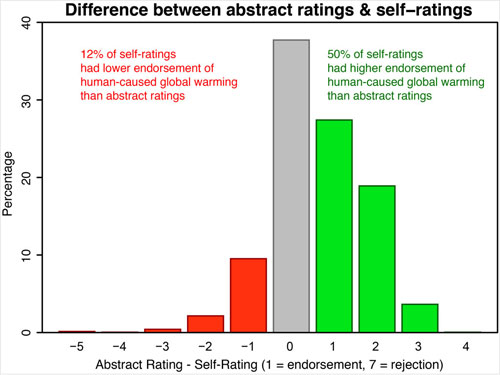
Again, you meant to accuse me and NASA of apparently not being able to tell how bad a study is. And specifically, the conversation was about how the Cook study compared their own ratings to self-ratings done by the authors. Isn't it strange that all your supposedly "atrocious" rater problems actually caused the Cook et al. raters to underestimate the consensus rate compared to the authors' self-ratings?
Funny you should link the Zimmerman study - they surveyed 3145 respondents, but only used 77 of those to get the magic 97% number.
If you surveyed doctors about a topic involving heart surgery and only 77 out of 3145 of those doctors were actively practicing heart surgeons, wouldn't you be more interested in what those experts have to say? From Doran and Zimmerman 2009:
"In our survey, the most specialized and knowledgeable respondents (with regard to climate change) are those who listed climate science as their area of expertise and who also have published more than 50% of their recent peer-reviewed papers on the subject of climate change (79 individuals in total). Of these specialists, 96.2% (76 of 79) answered "risen" to question 1 and 97.4% (75 of 77) answered yes to question 2."
Doran and Zimmerman reported all the results in Fig. 1, which reveals a common (indeed, expected) increase in accuracy as one's subject expertise increases.
... The question asked was "Do you think human activity is a significant contributing factor in changing mean global temperatures?" Most skeptics and luke-warmers, including me, would answer 'yes' to that question. So the survey is essentially meaningless.
Since they show all their results in Fig. 1, and over 30% of the general public answered "no" to that question, it's not clear how Doran and Zimmerman 2009 was "essentially meaningless". Their survey revealed that even using such a broad definition, the general public has been grievously misled. Possibly by compulsive contrarians who don't have any real expertise, but who nevertheless have fun baselessly accusing scientists of dishonesty and fraud.
And remember, Anderegg et al. 2010 used a more precise definition. What regurgitated excuse "justifies" ignoring Anderegg et al. 2010?
Here's a much better discussion on consensus: https://judithcurry.com/2013/1...
If GiordyS and Jane Q. Public's accusations aren't baseless, why do they keep "citing" blog posts, while I'm citing peer-reviewed papers along with statements from NASA and many other scientific organizations?
GiordyS just linked a blog post which proclaims a "52% 'consensus'" because of a 2013 survey of the American Meteorological Society. Had GiordyS really just not read about the new 2016 AMS survey revealed different results?
"Specifically: 29% think the change is largely or entirely due to human activity (i.e., 81 to 100%); 38% think most of the change is caused by human activity (i.e., 61 to 80%); 14% thi
-
Re:10%. 90%
The above doesn't bother you in any way?
Of course it bothers me that you and your merry band of trolls keep regurgitating baseless and libelous accusations.
Would it bother you if a skeptical study falsely described its methods? I bet it would.
All good studies are skeptical, including Cook et al. 2013. Your regurgitated accusations are simply wrong, that's all. Here are a few more independent skeptical studies: Doran and Zimmerman 2009 and Anderegg et al. 2010 and Verheggen 2014. Do you see a pattern yet?
I agree that it is strange NASA is publicly endorsing this utter garbage.
That's good. Now you should consider the possibility that your "utter garbage" accusation is wrong, and NASA is right.
-
Re:10%. 90%
Problem #1: 11,944 research papers which were all specifically about climate change and human influence; they removed the 7,930 "We don't know" from the numbers... (Often, deluded opponents will claim the rejected papers had "climate" as a keyword but were not about climatology; that is false: all 11,944 papers were selected from a larger such set, and were selected because they explored human-caused climate change.)
Really? Are you absolutely sure that those peer-reviewed papers didn't just have "global climate change" or "global warming" as keywords? Because that's how C13 actually selected their sample.
You seem to be incorrectly saying that every single paper which includes those keywords is an attribution study. If you were correct, you'd be able to provide 7,930 abstract quotes saying "we don't know whether global warming is caused primarily by human activities". Is it even remotely possible that those 7,930 papers just weren't attribution studies?
Try to use your approach to estimate the consensus on plate tectonics or evolution. Are abstracts which don't explicitly state that they agree with those theories actually saying "we don't know"? If that's really your position, you must also not think there's a scientific consensus about plate tectonics or evolution.
... took count of the papers which were *definitely* certain, determined that 97% of *those* support human-caused global warming, and labeled that as 97% of *all*.
No, they labeled that as 97% of papers stating a position on the primary cause of global warming. Which is true.
Problem #2: False equivocation. They took count of the number of published papers, and claimed the ratio of published papers agreeing with a position as the ratio of *scientists*.
Wrong. They cited Doran and Zimmerman 2009 and Anderegg et al. 2010 and Verheggen 2014 which really are surveys of scientists.
-
Re:No one is forced to listen to him or buy his st
Actually in the case of Trump, research offers some insights. http://onlinelibrary.wiley.com...">Narcissists often take over leaderless/rudderless groups. Their relentless self-absorption provides a focus to a group that has lost its way. However people tend to become disenchanted with narcissists once they get to know them.
So the Trump phenomenon represents a loss in faith in the Republican party's leadership, and a test of that leadership's ability to convince the base it knows what it's doing.
On the Democratic side you have a mirror phenomenon with Bernie Sanders. Although Sanders does not display the personal self-aggrandizement you'd expect from a narcissist, his single-minded fixation on the billionaire class provides a similar focus for loyalists who feel the party has lost its way. That's infuriating to Democrats who are basically happy with the pragmatic center-left orientation of the party.
I suspect this is what you get in a two-party system where the parties have fought themselves to a stalemate. When neither party can deliver much to it's most ardent supporters, they start casting around for drastic medicine.
-
Re:No one is forced to listen to him or buy his st
Actually in the case of Trump, research offers some insights. http://onlinelibrary.wiley.com...">Narcissists often take over leaderless/rudderless groups. Their relentless self-absorption provides a focus to a group that has lost its way. However people tend to become disenchanted with narcissists once they get to know them.
So the Trump phenomenon represents a loss in faith in the Republican party's leadership, and a test of that leadership's ability to convince the base it knows what it's doing.
On the Democratic side you have a mirror phenomenon with Bernie Sanders. Although Sanders does not display the personal self-aggrandizement you'd expect from a narcissist, his single-minded fixation on the billionaire class provides a similar focus for loyalists who feel the party has lost its way. That's infuriating to Democrats who are basically happy with the pragmatic center-left orientation of the party.
I suspect this is what you get in a two-party system where the parties have fought themselves to a stalemate. When neither party can deliver much to it's most ardent supporters, they start casting around for drastic medicine.
-
Re: Non-believers
...accuracy is unknown, but probably exaggerated. The study doesn't claim what you think it claims.
Says the guy who never even looked at it. You want numbers; where are the numbers backing your claims? Only got blog pages to "cite"?
no one who uses the IPCC reports as primary support can find anything in there.
Here are a handful of the many studies I found with 10 minutes of browsing through IPCC AR5 WG1 Chapter 2.6:
Heatwaves
Donal et al 2013: Updated analyses of temperature and precipitation extreme indices since the beginning of the twentieth century
Choi, G., et al., 2009: Changes in means and extreme events of temperature and precipitation in the Asia Pacific Network regionPrecipitation
Allan, R. P., and B. J. Soden, 2008: Atmospheric warming and the amplification of precipitation extremes
Pryor, S. C., J. A. Howe, and K. E. Kunkel, 2009: How spatially coherent and statistically robust are temporal changes in extreme precipitation in the contiguous USA?There are many more, on many areas. E.g. intense tropical storm frequency? Try Kossin et al 2007. All the pretty graphs, tables, and citations to peer-reviewed studies you could ever want - if you can be bothered to take a look.
Claims of "obfuscation" are pure bullshit. You obviously haven't checked for yourself, because you've already decided that nothing you want to see is going to be there (and heaven forbid that new data might pop your worldview bubble!).
-
Re: Non-believers
...accuracy is unknown, but probably exaggerated. The study doesn't claim what you think it claims.
Says the guy who never even looked at it. You want numbers; where are the numbers backing your claims? Only got blog pages to "cite"?
no one who uses the IPCC reports as primary support can find anything in there.
Here are a handful of the many studies I found with 10 minutes of browsing through IPCC AR5 WG1 Chapter 2.6:
Heatwaves
Donal et al 2013: Updated analyses of temperature and precipitation extreme indices since the beginning of the twentieth century
Choi, G., et al., 2009: Changes in means and extreme events of temperature and precipitation in the Asia Pacific Network regionPrecipitation
Allan, R. P., and B. J. Soden, 2008: Atmospheric warming and the amplification of precipitation extremes
Pryor, S. C., J. A. Howe, and K. E. Kunkel, 2009: How spatially coherent and statistically robust are temporal changes in extreme precipitation in the contiguous USA?There are many more, on many areas. E.g. intense tropical storm frequency? Try Kossin et al 2007. All the pretty graphs, tables, and citations to peer-reviewed studies you could ever want - if you can be bothered to take a look.
Claims of "obfuscation" are pure bullshit. You obviously haven't checked for yourself, because you've already decided that nothing you want to see is going to be there (and heaven forbid that new data might pop your worldview bubble!).
-
Re:Worrying
You can't "convert" someone to become a lesbian. Or straight, for that matter. Sexual attraction is fixed before birth.
Of all the bizarre ideas you have about gender and sexuality, that one is weirdest. Even Kinsey suggested otherwise.
http://link.springer.com/artic...
http://onlinelibrary.wiley.com...
http://www.tandfonline.com/doi...
Your argument has been made much of by people seeking legal change in the status of gays/lesbians but it has shall we say a more complicated relation with actual scientific fact.
-
a better link
Wiley library
http://onlinelibrary.wiley.com... -
Re:War was not invented 10k years ago
We've observed war-like behavior in other primates, so it's likely that it predates homo sapiens entirely and is something carried over from our genetic past. A lot of other animals are territorial as well. If other species were capable of developing complex tools, they would probably use them for fighting as well.
-
Re:Does anyone have a list of the hottest years?
Current science indicates the Little Ice Age was driven largely by volcanic activity with a small added impetus from the Maunder minimum.
Really? for a hundred years? citation required.
The original paper:
Abrupt onset of the Little Ice Age triggered by volcanism and sustained by sea-ice/ocean feedbacks -
Re:oh yes, Yucca Mountain
I'm am having the same problem, it is very difficult to find copies of the original act. This book makes comparison between versions of the original bill. If I can dig it out of my archive I will post what I can.
You triggered an interesting journey, in my attempts to find the online references to the original Bill, it showed that the Bill poses challenges to the very sovereignty of the states and relegating them to the same role as a citizen. You question has uncovered some interesting things that I wasn't aware of as a consequence of forcing this on citizens of Nevada.
-
Re:Simple logic: sexism is wrong
Not all discrimination is bad? Then before we go any further:
1. Explain why it's morally wrong and detrimental to society for women to be discriminated against.
2. If it's wrong then give concrete examples with supporting evidence to show how women are currently being discriminated against-- no need to be exhaustive, three examples will do.1. I'm assuming you mean discriminated against based on societal prejudices. If you mean discrimination such as giving them different bathrooms or private areas to pump breast milk then I find nothing morally wrong about that.
a. Providing equal opportunity is a moral imperative for most people in the western world, especially the United States.
b. Society is improved when every member has equal opportunity to fulfill their full potential. When someone does not fulfill their full potential because of lack of opportunity, gender roles, socio-economic factors, etc. society loses the extra benefit this person could have provided to society.
(people are not forced to meet their full potential based on a moral desire for personal freedom)2.
Science faculty’s subtle gender biases favor male students
How stereotypes impair women’s careers in science
Gender Bias Against Women of Color in Science
Do sexist organizational cultures create the Queen Bee?It is far more reasonable to just ignore the research showing these biases than to claim you cannot find the research. It doesn't take much digging.
-
Re:Simple logic: sexism is wrong
Could you be so kind to actually mention that evidence that shows that "this is an overwhelmingly wrong argument", unless it's just the fact that there are more than X% of people of gender A in particular field.
While you probably won't take the time to read any of these and/or will claim all research you disagree with is biased, here you go. Most of the research where double blind tests are easily done includes using identical resumes other than the gender of the applicant. It is pretty hard to see how people still claim these biases do not exist, but here we are.
Science faculty’s subtle gender biases favor male students
How stereotypes impair women’s careers in science
Gender Bias Against Women of Color in Science
Do sexist organizational cultures create the Queen Bee?Don't feel too bad when you ignore all of this, because other research also shows men evaluate the research that confirms gender bias within STEM contexts as less meritorious than do women
-
Bigger picture of opposing whaling per se
Please correct me if I am wrong but whale populations in the world have been recovering. And multiple species are less than a decade away from not being endangered any more. So the opposition to whaling is from people who don't want to kill whales per se. I am not arguing for premature killing of whales that leads to extinction and I know that has been as issue in the past. But that problem for most areas is going away. And it really only remains a big problem in Oceania. But if you eat meat and your culture eats whales why not eat them? I know that many people here don't eat meat and that is increasing in the Bay Area but consider that not everyone lives in that cultural bubble.
And using whale products for other purposes such as for their skins and oil is much better for the environment than making synthetic products from crude oil. Generally animal products produce fewer allergies and have fewer carcinogens than synthetic materials.
So isn't all the griping here just a matter of people who never want sustainable whaling to resume. But they don't have that right. If they don't want to eat whales or use their skins - that's fine - but they don't have the right to ram down their viewpoints down everyone else's throats, particularly other countries. It reminds me of abortion - if you don't like it, then don't have one but leave other people alone. -
Re:still advocating for extreme mitigation
Suppose 97% of your military commanders came forward and told you they believed that a country would invade.
This is not analogous. The 97% consensus is fraudulent. At best, it is agreement only among climate scientists that there is global warming and that it is mostly human-caused. Once you get away from the sliver of scientists who while most knowledgeable about the situation are also the most beholden, then the consensus drops significantly (for example, Earth scientists had agreement of 90% with the assertion that climate had warmed since 1850 and 82% consensus that most of this change was due to humans).
In particular, this is not a consensus on action to fight climate change or the even stronger target of holding global warming at 2C since 1850! It is interesting how so many people, including you, conflate agreement that most global warming is human-caused (which incidentally I agree with), with some hardcore policy decisions. I am part of the "97%", but I don't agree.
Moving on, there is a great deal of hidden disagreement among climate researchers on the reliability of paleoclimate data, the adjustments made while aggregating that data, and the reliability of climate models to predict future climate. For example, cherrypicking from this survey of climate researchers (from 2008), they found that 26% of those surveyed had absolutely no confidence (a "1" on a scale of 1 to 7) in precipitation predictions for the next 50 years and 33% had a similar absence of confidence in extreme weather predictions over the next 50 years. You don't hear about that when the dire warnings of famine and extreme weather come around, do you?
67% do believe strongly (score 6 or 7) that without mitigation or adaption, there will be catastrophic consequences in the next 50 years.
Moving on, the survey asked an interesting question "The best approach to resolving the problems related to climate change is:" Here, pure mitigation would be "1" and pure adaptation would be "7". A full 30% straddle the fence at "4". 43% favored mitigation to some degree and 27% favored adaptation. Where is the consensus on holding the line at 2C increase since 1850? It doesn't look like 97% to me.
For those who wish to pay attention and learn something about science, this is what happens when you have a manufactured consensus which doesn't actually consider the opinions of the people supposedly polled and stretches the actual claims to claim far more than was actually asked. It's not science, it's an argument from authority fallacy. -
Re: But
Aww, my stalker is back! Hi, stalker!
Don't you have some nutters over at the USGS to argue with? Damned USGS and their pie-in-the-sky analysis that is pretty much exactly what I wrote a couple weeks ago concerning resource availability and work/uncertainties that remain to be resolved! Given that this is what led you to start stalking me, you might want to split your time with stalking them too.
-
High-tech workers not taking parental leave?
Many high-tech workers, however, do not take advantage of such benefits for fear of falling behind at work or missing out on promotions.
The final item in the summary and from TFA caught my attention. Reuters was absent of details on a study proving this statement. The best thing I could find was a a Harvard Business Review article here:
https://hbr.org/2015/11/3-ways-tech-companies-are-offering-parental-leave
Linking to a study here:
http://onlinelibrary.wiley.com...
With highly questionable methods - age, gender, socio-economic background, etc. etc. bias anybody?Volunteers (N = 371, 131 men) participated in exchange for partial fulfillment of their Introductory Psychology research requirement. Of these, 50% were White, 30% were Asian, 4% were Black, 6% were Hispanic, and 10% reported another ethnic identity. The design of the experiment was a 2 (target race: Black, White) × 4 (family leave condition: childcare, parental care, two controls) × 2 (participant gender) between-participants factorial. We used two control targets; one who asked a HR officer for more hours (rather than time off), and one who merely inquired about his employee benefits. We included the latter control condition because it was possible that asking for more hours would be viewed as particularly masculine (e.g., ambitious). However, preliminary analyses showed no significant differences between the two control groups; they were therefore collapsed.
If anybody can find other research surrounding this topic - I'd love to see it. The "best" article I could find was one from Wired:
http://www.wired.com/2015/08/t...
Effectively commenting its about the culture surrounding parental leave at a company - not the actual company policy itself. Netflix policy - unlimited vacation - but highly frowned upon if you take it. Where I'm at - if you have a child - we COVER YOU and there is NO penalty to your career for taking leave. The only email you send out better have pictures of your newborn - that's it. Anything else we'll frown at you for trying to work while you are on parental leave. Same goes for vacation.
Disclaimer: I work in a Tech Hub outside Silicon Valley. If this truly is representative of the culture of Silicon Valley, I really feel sorry for the folks working out there. -
Re:Though spoiled is a likely side effect...
Which does raise an interesting point as to whether or not the effect is due to spending additional time with children or is merely a byproduct of the fact that those who can take time off to spend with their children are far more likely to be wealthy, which is more responsible for the outcome.
In looking for a study to back those assertions up, I immediately found an article from earlier this year reporting on a recent study which reported the opposite results, i.e., that time spent with children didn't matter. I haven't read through it yet, but here's a link to the study in question. (PDF Warning)
I'm all for workers getting maternity or paternity leave if they want to spend time with their newborns, but we shouldn't delude ourselves into why we're doing it. -
Adventures in Minecraft Book is awesome
I bought this book for my kids and it was total mission accomplished in getting the excited about what programs can do:
Adventures in Minecraft
by David Whale, Martin O'Hanlon
http://www.wiley.com/WileyCDA/...that book was created in the pre-microsoft era of minecraft. I suspect it wasn't even mojang sanctioned.
they have a less than complete version of minecraft with a python API exposed. It's amazingly simple to use it so other than unzipping the file it's easy for beginners to use. Works great on a raspberry pi. What you can do is somewhat limited. mainly on the input side of only being able to know where steve is not what he's doing. But by the time you are actually wishing for more you have a great understanding of basic programming in python. So it''s a fantastic first introduction to API programming in python. Kids might want to try scratch first since it's fully self contained without the need to couple to minecraft and thus simpler. But programming in minecraft with python is a very very very engaging experience for kids.
-
Re:Yeah, I know, I'm probably a denier...
I'm not assuming anything. I have looked into it, unlike you.
Associating me with a tv personality as an insult is the best you can do?
I don't give one lick about that person. I'm Canadian and don't pay attention to your ridiculous comedy media.You want answers? Fresh ones off the press??
"Even if we assume that these promises would be extended for another 70 years, there is still little impact: if every nation fulfills every promise by 2030, and continues to fulfill these promises faithfully until the end of the century, and there is no ‘CO leakage’ to non-committed nations, the entirety of the Paris promises will reduce temperature rises by just 0.17C (0.306F) by 2100." Lomborg
-
Re:It must be a biased study
Where did these people work before NASA? They need to be investigated.
It's OK. No need to worry. You can ignore this report. At least one of the authors has already been "investigated" and found to be wanting by the skeptic croud. He is one of the "alarmists" predicting that if the trend to 2007 continued then arctic sea ice could disappear in 2012.
He also, according to the skeptics, cherry-picks:
https://stevengoddard.wordpres...
http://onlinelibrary.wiley.com...
And, indeed, he's (obviously deliberately) done it again here: only using the data to 2008.
On a less facetious note, this could be good, bad, or make no difference to existing thoughts.
Good - some mechanism not considered is allowing substantial transfer of mass from the oceans to the interior of Antarctica. In the shorter term at least this could make sea level rise much less than currently anticipated over the next few centuries.
Bad - there's a much larger than believed loss of ice-mass from somewhere else and the current estimates of expected sea level rise will turn out to be severe underestimates when, e.g. the Greenland icesheet disintegrates and falls into the ocean.
(The only two mechanisms I can think of to account for the observed sealevel rise and the assumption that Antarctica didn't lose mass are much more loss from Greenland or thermal expansion. Excess energy going into heating of the oceans could account for the "pause" too)Indifferent - there's a short-term mechanism that can temporarily move ice mass into interior Antarctica. This can occur over a decade or two before reestablishing longer term trends. This will add noise to the system and make it harder to estimate long term trends from shorter term data but doesn't significantly alter trends from longer terms.
-
Fructose
If you read the full article you see that they are talking about fructose, which is 50% of table sugar. Dr. Lustig has several videos on YouTube of his talks on the problems that fructose causes. I have determined that fructose (or perhaps sugar in general) was the cause of my 'digestive' problems. By greatly reducing my sugar (and thus fructose) intake I've almost eliminated (poor choice of word?) my problems.
-
Re:Define Sugar...
I know it's hard, but you could read the full article:
Isocaloric fructose restriction and metabolic improvement in children with obesity and metabolic syndrome
Dietary fructose is implicated in metabolic syndrome, but intervention studies are confounded by positive caloric balance, changes in adiposity, or artifactually high amounts. This study determined whether isocaloric substitution of starch for sugar would improve metabolic parameters in Latino (n=27) and African-American (n=16) children with obesity and metabolic syndrome.
Dr. Lustig has been campaigning against fructose for years.
-
Re:It's how our politics work
Did you read the summary? Its entire focus is that the recent earthquake swarm is caused by fracking (unlike the many similar earthquake swarms that area has had in the past, apparently).
I RTFA, and there might be some serious issues with it. It has some severe inconsistencies with the report it cites:
http://onlinelibrary.wiley.com...
tl;dr version The report notes that increased fracking and the wastewater injection, if disposed in that manner, might be a problem. But the injection wells are the cause of the problem, not the nature of hydraulic fracking. Those injection wells have been there long before modern day fracking was around. Here's an abstract from Geology http://geology.gsapubs.org/con...
The takeaway is that the culprit here is injection wells for wastewater, which by the way, is not only loaded with brine water, and toxic chemicals, but lubricating agents. It was proobably never a good idea, even when these injection wells were utilized well before modern day fracking - like the culprit wells in Oklahoma.
As noted before, we need to make the fracking fluid more environmentally benign. It won't ever be completely so, as brine is picked up in drilling. But simply pumping it back underground will just expose local fault lines over the years, and endangers a whole lot of folks and real estate.
-
Re:Fukushima was NOT WORTH IT
I'm from Sweden, almost half of our electricity has come from hydro power and the other half from nuclear power.
Well, you guys and Finland and the world leaders in this technology. I commend your countries pragmatic approach to spent fuel containment, of which Japan has none.
Just to give other people here some context, one of the most major criticisms of Yucca Mountain was that the DOE's original policy using the 'Defense in Depth' approach to the specification for building a spent fuel containment facility could not be applied to Yucca's geology. The reason to choose a specific geology (in addition to being seisemically stable) was also to have the geologic chemistry of the rock able to control the the amount of time ground water took to travel through the facility carrying radioactive isotopes, eventually, into the water table. If the amount of time it takes exceeds the decay rate of the longest lived radio-isotopes then the facility was providing defense in depth.
In addition, as a site like that would be containing pu-239, whose half life is around 25000 years, after considering the daughter products you need a geology capable of containing it for 500,000 years, which is what the original specification called for.
Studies of the Yucca mountain hydrology (pdf) revealed that the passage cl-36 from atmospheric nuclear testing took less that 50 years in ground water through Yucca mountain so the reality of Yucca is it is inappropriate to contain *any* kind of radioactive products. The reason is Yucca is pumice and volcanic ash.
Feild studies have established that crystaline rocks like granite and bentonite clays can acheive this control. So far Finland is on track to be the first with an active facility with a Swedish facility also in the works.
Curiously, getting this right should be the one thing pro and anti nuclear folk should be able to agree on, if only for their own reasons. For Nuclear power to continue operating such a storage facility is essential so that new reactors can be deployed and materials removed from reactor sites. For people against Nuclear power such a facility would improve the safety of the industry as a whole by providing a place to store the materials permanently where there ingress into the environment can be controlled.
We don't see any improvements to governance, containment or anything else in Japans Nuclear industry thus very little logic in restarting it.