Slashdot Mirror
Domain: wordpress.com
Stories and comments across the archive that link to wordpress.com.
Stories · 597
-
Justified: Visual Basic Over Python For an Intro To Programming
theodp writes ICT/Computing teacher Ben Gristwood justifies his choice of Visual Basic as a programming language (as a gateway to other languages), sharing an email he sent to a parent who suggested VB was not as 'useful' as Python. "I understand the popularity at the moment of the Python," Gristwood wrote, "however this language is also based on the C language. When it comes to more complex constructs Python cannot do them and I would be forced to rely on C (which is incredibly complex for a junior developer) VB acts as the transition between the two and introduces the concepts without the difficult conventions required. Students in Python are not required to do things such as declare variables, which is something that is required for GCSE and A-Level exams." Since AP Computer Science debuted in 1984, it has transitioned from Pascal to C++ to Java. For the new AP Computer Science Principles course, which will debut in 2016, the College Board is leaving the choice of programming language(s) up to the teachers. So, if it was your call, what would be your choice for the Best Programming Language for High School? -
KDE Frameworks 5.3 and Plasma 2.1 – First Impressions
jones_supa writes Ken Vermette has done a write-up on his experience with the new KDE desktop encompassing Frameworks 5.3 and Plasma 2.1. For starters, some patience is still needed for apps to be ported to KF5, and most of them will be KF4-based for now. Many of the widgets you may have used don't exist yet either, but the good news is that the Plasma goodies which do make an appearance are universally improved. The new search widget is shockingly fast and the notifications tray has been reworked. Visual outlook of desktop has been simplified and things don't feel so tightly packed together anymore. The system settings application has been completely regrouped more by goal than underlying mechanics. Unfortunately the desktop stability leaves a lot to desire: there was several crashes and Plasma had at one point managed to forget colour and wallpaper settings. However the developers seem to be knowing what they are doing, and there's a real feeling that this software will reach rock-solid stability very quickly given the state of it as it stands. -
The Search For Starivores, Intelligent Life That Could Eat the Sun
sarahnaomi writes: There could be all manner of alien life forms in the universe, from witless bacteria to superintelligent robots. Still, the notion of a starivore — an organism that literally devours stars — may sound a bit crazy, even to a seasoned sci-fi fan. And yet, if such creatures do exist, they're probably lurking in our astronomical data right now.
That's why philosopher Dr. Clement Vidal, who's a researcher at the Free University of Brussels, along with Library of Congress Chair in Astrobiology Stephen Dick, futurist John Smart, and nanotech entrepreneur Robert Freitas are soliciting scientific proposals to seek out star-eating life. -
The New (Computer) Chess World Champion
An anonymous reader writes: The 7th Thoresen Chess Engines Competition (TCEC) has ended, and a new victor has been crowned: Komodo. The article provides some background on how the different competitive chess engines have been developed, and how we can expect Moore's Law to affect computer dominance in other complex games in the future.
"Although it is coming on 18 years since Deep Blue beat Kasparov, humans are still barely fending off computers at shogi, while we retain some breathing room at Go. ... Ten years ago, each doubling of speed was thought to add 50 Elo points to strength. Now the estimate is closer to 30. Under the double-in-2-years version of Moore's Law, using an average of 50 Elo gained per doubling since Kasparov was beaten, one gets 450 Elo over 18 years, which again checks out. To be sure, the gains in computer chess have come from better algorithms, not just speed, and include nonlinear jumps, so Go should not count on a cushion of (25 – 14)*9 = 99 years." -
Subsurface 4.3 Released
jones_supa writes "The Subsurface development team proudly announces release 4.3 of the open source divelog and dive planning program, available for all major desktop operating systems. This is the software originally founded by Linus Torvalds, and the development seems to be continuing in great pace. Subsurface now supports flexible filtering of the dive list based on criteria like tags, people or gear. Dive characteristics can now also be copied and pasted to other dives. The dive profile now offers an easy to understand tissue saturation graph that shows tissue saturation at any point during the dive. As another new feature in the dive profile, one can turn on an improved visualization of the gas combinations used during a dive. The dive computer and file format support have also gotten large improvements." -
Book Review: Build Your Own Website: A Comic Guide to HTML, CSS, and WordPress
MassDosage writes "At the the risk of exposing my age I remember building my first website using a rudimentary Unix text editor (Joe) and carefully handcrafting the Hypertext Markup Language (HTML) while directly logged on to the web server it was being served from. Back then Cascading Style Sheets (CSS) weren't even a glint in the eyes of their creators. A lot has changed and there's now a world of fancy WYSIWYG web page editors to choose from as well as Content Management Systems that allow you to create websites without looking at the underlying code at all. While this is all very useful and allows less technical people to create websites I still feel that having at least some knowledge of how everything works under the hood is empowering — especially in situations where you want to go beyond the limits placed on you by a certain tool. This is where Build Your Own Website: A comic guide to HTML, CSS and Wordpress comes into the picture. Its aim is to enable people new to web development to learn the subject by teaching the fundamentals of HTML and CSS first and only then describing how to use a Content Management System (CMS) — in this case Wordpress. While Wordpress might not be everyone's kettle of fish it's a good choice as an example of a modern CMS that is easily accessible and very popular. The concepts presented are simple enough that it should be easy enough for a reader to apply them to a different CMS should they want to. Read below for The rest of MassDosage's review. Build Your Own Website: A Comic Guide to HTML, CSS, and WordPress author Nate Cooper and Kim Gee pages 264 publisher No Starch Press rating 7.5/10 reviewer MassDosage ISBN 1593275226 summary An illustrated introduction to the basics of creating a website To be clear, this book is intended for people who have little to no experience building websites and it is appropriately written in a non-formal, fun and non-threatening manner. Each chapter has the same format where a topic is initially covered at a high level in the form of a cartoon that is really easy to grasp. This is then followed by a more in-depth repetition of the same content using more "traditional" text and diagrams. Most chapters then end with a summary of the key points which can be used as a simple reference. This layout means that if you're a quick learner or are familiar with some of the concepts you can just read the comic section and then try implementing the material covered on your own. On the other hand if you want more information and depth you can read the text that follows.The material is presented in such a way that it should be easy for the reader to "learn by doing" as they copy or modify what the main character in the cartoon does (in this case building a website for her photography portfolio). All that's needed to get started is a browser, a text editor and some knowledge of how to organize files on a file system. This coverage of raw HTML and CSS may sound off-putting to non-technical people but it's presented in such a simple manner that pretty much anyone should be able to follow along. The benefit of this "back to the basics" approach is that one is not limited to using only a certain piece of software and instead the fundamentals can be applied to other tools later.
The book provides a good introduction to HTML and describes some useful tags that can be used to start creating a simple website. CSS are explained in a similar manner and the reader is shown how they can be used to easily change the look of a website. These two technologies are the bedrock on top of which pretty much all web development rests and thus understanding them is a prerequisite for anyone wanting to create their own websites. The book also does a good job of showing how a content management system like Wordpress builds on top of these foundations and how you can still get to the underlying HTML and CSS should you want to (as well as why this might be useful if you want to modify something that Wordpress does or doesn't do). On the Wordpress front the basics are covered — from creating pages and page hierarchies to how these can be categorized and grouped. Unfortunately when going into more detail on this topic things lose a bit of coherence. Wordpress is obviously a big beast which has entire books devoted to it and cramming in a summary of it means having to leave out a lot. It seems as if the author might have had to trim these sections down and this has resulted in the text feeling a bit rushed and confusing which is in contrast with the rest of the book where the topics are covered in a slower and more detailed manner. Any book that describes using a piece of software like Wordpress to the level of explaining how to point and click one's way through certain step risks becoming outdated as the software changes in future. For the most part this shouldn't be too much of an issue as Wordpress isn't covered in too much detail but it does mean that this book probably won't be a reference you still use in five year's time.
On the whole Build Your Own Website: A Comic Guide to HTML, CSS, and WordPress succeeds in its goal of presenting a gentle learning curve and guiding people through what is needed to create a website from scratch. It is just technical enough that readers should be able to understand the fundamentals of what they are doing while being non-intimidating and introducing concepts at a relaxed and fun pace via the comic format. By the end of this book readers should have a solid grasp of the basics of website creation and be able to set up a simple site themselves, either by coding this up in HTML and CSS directly or by using Wordpress. For anything more advanced one would need to move on to other books or self-teaching but this book is a great starting point if you're new to the subject.
You can purchase Build Your Own Website: A Comic Guide to HTML, CSS, and WordPress from amazon.com. Slashdot welcomes readers' book reviews (sci-fi included) -- to see your own review here, read the book review guidelines, then visit the submission page. If you'd like to see what books we have available from our review library please let us know. -
The Personal Computer Revolution Behind the Iron Curtain
szczys writes Obviously the personal computer revolution was world-wide, but the Eastern Bloc countries had a story of PC evolution all their own. Martin Malý tells first hand of his experiences seeing black market imports, locally built clones of popular western machines, and all kinds of home-built equipment. From the article: "The biggest problem was a lack of modern technologies. There were a lot of skilled and clever people in eastern countries, but they had a lot of problems with the elementary technical things. Manufacturing of electronics parts was divided into diverse countries of Comecon – The Council for Mutual Economic Assistance. In reality, it led to an absurd situation: You could buy the eastern copy of Z80 (made in Eastern Germany as U880D), but you couldn’t buy 74LS00 at the same time. Yes, a lot of manufacturers made it, but 'it is out of stock now; try to ask next year.' So 'make a computer' meant 50 percent of electronics skills and 50 percent of unofficial social network and knowledge like 'I know a guy who knows a guy and his neighbor works in a factory, where they maybe have a material for PCBs' at those times." -
Google Suggests Separating Students With 'Some CS Knowledge' From Novices
theodp writes To address the challenge of rapidly increasing CS enrollments and increasing diversity, reports the Computing Education Blog, Google in November put out an RFP to universities for its invite-only 3X in 3 Years: CS Capacity Award program, which aims "to support faculty in finding innovative ways to address the capacity problem in their CS courses." In the linked-to RFP document, Google suggests that "students that have some CS background" should not be allowed to attend in-person intro CS courses where they "may be more likely to create a non-welcoming environment," and recommends that they instead be relegated to online courses. According to a recent NSF press release, this recommendation would largely exclude Asian and White boys from classrooms, which seems to be consistent with a Google-CodeCademy award program that offers $1,000 bonuses to teachers who get 10 or more high school kids to take a JavaScript course, but only counts students from "groups traditionally underrepresented in computer science (girls, or boys who identify as African American, Latino, American Indian or Alaska Native)." The project suggested in the Google RFP — which could be worth $1.5 million over 3 years to a large CS department — seems to embrace-and-extend a practice implemented at Harvey Mudd College years ago under President Maria Klawe, which divided the intro CS offering into separate sections based upon prior programming experience to — as the NY Times put it — reduce the intimidation factor of young men, already seasoned programmers, who dominated the class. Google Director of Education and University Relations Maggie Johnson, whose name appears on the CS Capacity RFP, is also on the Board of Code.org (where Klawe is coincidentally an Advisory Board member), the K-12 learn-to-code nonprofit that has received $3+ million from Google and many millions more from other tech giants and their execs. Earlier this week, Code.org received the blessing of the White House and NSF to train 25,000 teachers to teach CS, stirring unease among some educators concerned about the growing influence of corporations in public schools. -
Twitter Use By Romney and Obama In 2012 Highlight the Speed of Social Media
HughPickens.com writes On 30 August 2012, Hollywood star Clint Eastwood took the stage to lambast President Obama. What ensued was an odd, 11-minute monologue where Eastwood conversed with an empty chair upon which an imaginary Barack Obama sat. The evening of Eastwood's speech the official campaign Twitter account @MittRomney did not mention the actor, while the Obama campaign deftly tweeted out from @BarackObama a picture of the president sitting in his chair with the words "This Seat's Taken". The picture was retweeted 59,663 times, favorited 23,887 times, and, as importantly, was featured in news articles across the country. According to Daniel Kress both campaigns sought to influence journalists in direct and indirect ways, and planned their strategic communication efforts around political events such as debates well in advance. Despite these similarities, staffers say that Obama's campaign had much greater ability to respond in real time to unfolding commentary around political events (PDF) given an organizational structure that provided digital staffers with a high degree of autonomy.
Romney's social media team did well when it practiced its strategy carefully before big events like the debates. But Obama's social media team was often quicker to respond to things and more creative. According to Kress, at extraordinary moments campaigns can exercise what Isaac Reed calls "performative power," influence over other actors' definitions of the situation and their consequent actions through well-timed, resonant, and rhetorically effective communicative action and interaction. During the Romney campaign as many as 22 staffers screened posts for Romney's social media accounts before they could go out. As Romney's digital director Zac Moffatt told Kreiss, the campaign had "the best tweets ever written by 17 people. ... It was the best they all could agree on every single time." -
Collin Graver and his Wooden Bicycle (Video)
This is not a practical bike. "Even on smooth pavement, your vision goes blurry because you're vibrating so hard," Collin said to an Atlanta Journal-Constitution reporter back in 2012 when he was only 15 -- and already building wooden bicycles. Collin's wooden bikes are far from the first ones. Wikipedia says, "The first bicycles recorded, known variously as velocipedes, dandy horses, or hobby horses, were constructed from wood, starting in 1817." And not all wooden bicycles made today are as crude as Collin's. A Portland (OR) company called Renovo makes competition-quality hardwood bicycle frames -- for as little as $2200, and a bunch more for a complete bike with all its hardware fitted and ready to roll.
Of course, while it might be sensible to buy a Renovo product if you want a wood-framed bike to Race Across America, you won't improve your woodworking skills the way Collin's projects have improved his to the point where he's made a nice-looking pair of wood-framed sunglasses described in his WOOD YOU? SHOULD YOU? blog. (Alternate Video Link) -
Collin Graver and his Wooden Bicycle (Video)
This is not a practical bike. "Even on smooth pavement, your vision goes blurry because you're vibrating so hard," Collin said to an Atlanta Journal-Constitution reporter back in 2012 when he was only 15 -- and already building wooden bicycles. Collin's wooden bikes are far from the first ones. Wikipedia says, "The first bicycles recorded, known variously as velocipedes, dandy horses, or hobby horses, were constructed from wood, starting in 1817." And not all wooden bicycles made today are as crude as Collin's. A Portland (OR) company called Renovo makes competition-quality hardwood bicycle frames -- for as little as $2200, and a bunch more for a complete bike with all its hardware fitted and ready to roll.
Of course, while it might be sensible to buy a Renovo product if you want a wood-framed bike to Race Across America, you won't improve your woodworking skills the way Collin's projects have improved his to the point where he's made a nice-looking pair of wood-framed sunglasses described in his WOOD YOU? SHOULD YOU? blog. (Alternate Video Link) -
Manslaughter Conviction Overturned For Scientists Who Didn't Predict Earthquake
Jason Koebler writes: Geologists who didn't warn a town about an impending earthquake are not murderers, an Italian appeals court ruled today. A 2012 decision that rocked the scientific world has been overturned, according to Italy's Repubblica newspapers and confirmed by other Italian outlets. In that decision, six prominent geologists and one government worker were convicted of manslaughter for failing to notify the town of L'Aquila of a 2009 earthquake that killed at least 309 people. The scientists were originally sentenced to six years in prison and were to pay more than $10 million in damages. -
Solving the Mystery of Declining Female CS Enrollment
theodp writes After an NPR podcast fingered the marketing of computers to boys as the culprit behind the declining percentages of women in undergraduate CS curricula since 1984 (a theory seconded by Smithsonian mag), some are concluding that NPR got the wrong guy. Calling 'When Women Stopped Coding' quite engaging, but long on Political Correctness and short on real evidence, UC Davis CS Prof Norm Matloff concedes a sexist element, but largely ascribes the gender lopsidedness to economics. "That women are more practical than men, and that the well-publicized drastic swings in the CS labor market are offputting to women more than men," writes Matloff, and "was confirmed by a 2008 survey in the Communications of the ACM" (related charts of U.S. unemployment rates and Federal R&D spending in the '80s). Looking at the raw numbers of female CS grads instead of percentages, suggests there wasn't a sudden and unexpected disappearance of a generation of women coders, but rather a dilution in their percentages as women's growth in undergrad CS ranks was far outpaced by men, including a boom around the time of the dot-com boom/bust. -
Building All the Major Open-Source Web Browsers
An anonymous reader writes: Cristophe de Dinechin, long-time software developer, has an interesting article on the processes involved in building the major browsers. From the article:
"Mozilla Firefox, Chromium (the open-source variant of Chrome) and WebKit (the basis for Safari) are all great examples of open-source software. The Qt project has a simple webkit-based web browser in their examples. So that's at least four different open-source web browsers to choose from. But what does it take to actually build them? The TL;DR answer is that these are complex pieces of software, each of them with rather idiosyncratic build systems, and that you should consider 100GB of disk space to build all the browsers, a few hours of download, and be prepared to learn lots of new, rather specific tools." -
Incapacitating Chemical Agents: Coming Soon To Local Law Enforcement?
Lasrick writes To this day, Russian authorities refuse to disclose the incapacitating chemical agent (ICA) they employed in their attempt, 12 years ago, to save 900 hostages held in a theater by Chechen fighters. Malcom Dando elaborates on a new report (PDF) that Russia, China, Israel, and a slew of other countries are continuing research into ICAs, and the apparent indifference of the international community into such research. Proponents of ICAs have long promoted their use in a variety of scenarios, including that of law enforcement, because in theory these chemicals incapacitate without permanent disability. Critics, however, point out that these weapons rely on exact dosage to prevent fatality, and that the ability to 'deliver the right agent to the right people in the right dose without exposing the wrong people, or delivering the wrong dose' is a near-impossible expectation. ICAs represent the further misuse and militarization of the life sciences and a weakening of the taboo against the weaponization of toxic substances, and the idea that they could be used in law enforcement situations is a disturbing one." -
The Bogus Batoid Submarine is Wooden, not Yellow (Video)
This is a "wet" submarine. It doesn't try to keep water out. You wear SCUBA gear while pedaling it. And yes, it is powered by a person pushing pedals. That motion, through a drive train, makes manta-style wings flap. This explains the name, since rays are Batoids, and this sub is a fake Batoid, not a real one. It's a beautiful piece of work, and Martin Plazyk is obviously proud to show it off. He and his father, Bruce, operate as Faux Fish Technologies. Follow that link and you'll see many photos, along with a nice selection of videos showing their creations not just in static above-water displays, but in their natural (underwater) element. Meanwhile, here on Slashdot, Martin tells how Faux Fish subs are made. (Alternate Video Link) -
Where Intel Processors Fail At Math (Again)
rastos1 writes: In a recent blog, software developer Bruce Dawson pointed out some issues with the way the FSIN instruction is described in the "Intel® 64 and IA-32 Architectures Software Developer's Manual," noting that the result of FSIN can be very inaccurate in some cases, if compared to the exact mathematical value of the sine function.
Dawson says, "I was shocked when I discovered this. Both the fsin instruction and Intel's documentation are hugely inaccurate, and the inaccurate documentation has led to poor decisions being made. ... Intel has known for years that these instructions are not as accurate as promised. They are now making updates to their documentation. Updating the instruction is not a realistic option."
Intel processors have had a problem with math in the past, too. -
Could Maroney Be Prosecuted For Her Own Hacked Pictures?
Contributor Bennett Haselton writes with a interesting take on the recent release of racy celebrity photos: "Lawyers for Olympic gymnast McKayla Maroney succeeded in getting porn sites to take down her stolen nude photos, on the grounds that she was under 18 in the pictures, which meant they constituted child pornography. If true, that means that under current laws, Maroney could in theory be prosecuted for taking the original pictures. Maybe the laws should be changed?" Read on for the rest.Online warnings about the dangers of teen sexting, from sources ranging from the FBI to MTV, frequently warn that even a minor who takes a sexually explicit picture of themselves can be prosecuted for violating child pornography laws.
And these prosecutions really do happen. One Pennsylvania district attorney threatened child pornography charges against two teen girls who posed for a photo in their bras making peace signs, and tried to force them to write a report on why their actions were wrong and "what it means to be a girl in today's society." (With the ACLU's help, the girls' parents sued to stop the D.A. from following through.) A study from the American Academy of Pediatrics found that in teen "sexting" incidents reported to the police, even in cases where the sexting was between two minors and there were no "aggravating" circumstances (abuse or lack of clear consent), police made arrests in 18% of those cases. (The arrest rate was higher in cases involving "aggravating" circumstances or where an adult was involved in the sexting.)
Meanwhile, hundreds of articles have been written about Porn.com being forced to take down the nude pictures of McKayla Maroney, after receiving word from her lawyers that she was underage when the pictures were taken. As far as I can tell, none of the articles about the incident mentioned that, if her lawyers are correct, then Maroney could be theoretically prosecuted for creating, possessing, and distributing child pornography. Of course nobody wants to see that happen, but the elephant in the living room is that before Maroney's photo leak scandal, many teens were arrested for doing essentially the same thing, and more of them will continue to be arrested after the celebrity nude hacking scandal is old news.
That's not to say that Maroney's photos necessarily did constitute child pornography. Nude or topless photos of minors are not necessarily illegal, if they're not sexually explicit; Thora Birch was under 18 for her topless scene in American Beauty. I haven't seen the Maroney photos (honest -- although I'd like to think that whatever she was doing, she was making her not impressed face). Maybe they really were explicit enough to qualify as child pornography. Maybe they weren't, and Maroney's lawyers misunderstood the law and thought that any of her underage nude or topless selfies were automatically child porn. Or maybe her lawyers knew the pictures were not really child porn, but they were bluffing when they demanded that Porn.com take the pictures down. Whatever the case, Maroney's lawyers claimed the pictures were child pornography, and if they're right, the lawyers just criminally implicated their client as well.
If the pictures really were explicit and she sent them to any of her same-age friends, she could also be charged with disseminating obscene material to a minor. Iowa teenager Jorge Canal was convicted on this charge, and his conviction upheld by the Iowa Supreme Court, after his 14-year-old female friend asked him to send him a picture of his erect penis, and he obliged. (Although since he was 18 at the time of sending the picture, there was no child porn charge.) If his defense attorneys tried a defense along the lines of, "My clients actions harmed absolutely no one, and it's the prosecutors who have ruined the lives of not only my client but also his supposed 'victim', by putting them both through a trauma that will hang over them for the rest of their lives," it didn't work.
Many states have attempted to pass laws specifically addressing sexting by and/or to teenagers by reducing the penalty from a felony child pornography charge to something less severe. What all of these laws still have in common, though, is that they retain the option to impose some criminal penalties on teens for sexting even among themselves. The ACLU has opposed such a bill in Pennsylvania on the grounds that even a misdemeanor charge for teen sexting would be too draconian of a punishment.
"The Need for Sexting Law Reform: Appropriate Punishments for Teenage Behaviors", written by Alexandra Kushner, a legal associate at Winston & Strawn LLP, and published in the University of Pennsylvania Journal of Law and Social Change, argues for de-criminalizing consensual sexting among teens. (The paper argues for retaining the option to prosecute cases involving abuse or malicious forwarding of a sexted picture.) Much of the paper is refreshing for the plain language not often found in legal argumentation; discussing the case of a 16-year-old and 17-year-old who faced child pornography charges for taking sexy pictures of each other, Kushner writes, "They should not have been charged at all because they were not harming each other or anyone else by taking and keeping these pictures." This is exactly the right way to frame the issue, but to most legal scholars, sentences like these are considered simply adorable.
For the other side, you can read "A Legal Response Is Necessary for Self-Produced Child Pornography", by law professor Susan Hanley Duncan. I found it less than convincing because much of the paper stresses that sexting can have serious unforeseen consequences for teens, including public humiliation if the pictures are forwarded to their friends. Well, we know that. But that just raises the obvious question: Isn't that punishment enough, and why do we need criminal charges on top of that? Even buying into the stereotype that teens are focused only on the present -- if a teen is not deterred by the humiliating prospect of having her photo forwarded around the entire school, then why would they be deterred by the threat of prosecution, which is less likely, further out in the future, and a potential risk that they might not even be aware of?
(Note that this logic does not apply to students who forwarded sexted images to harass the person appearing in them -- the person forwarding the image usually does not face the short-term threat of public humiliation, which means a legal penalty might be the only deterrent they would care about. That's one argument for retaining the option to prosecute people who forward sexted pictures maliciously.)
Even the FBI, in their "Advice for Young People" regarding sexting, betrays a certain embarrassment over the hypocritical nature of the laws. To a person forwarding an image of someone else, they warn: "You could face child pornography charges, go to jail, and have to register as a sex offender;" but to the person taking the original picture, they say only vaguely that you could "even get in trouble with the law" -- while leaving out the fact that all of the draconian penalties in their list, also apply to the person who takes the picture, under the laws that the FBI enforces.
But unless or until sexting laws are changed, Maroney probably did violate them according to the statements from her own lawyers, which might lead cynics to think that she escaped being charged because of her celebrity status. I think that's unlikely. Recall that "only" 18% of teens who sexted each other were arrested in cases where the incidents were reported to police, so if she had been a non-celebrity, she probably would have gotten off scot-free as well. Whether a teen gets arrested or charged for "sexting," probably depends less on what they actually did, than the luck of the draw as far as which police officer hears the report of the incident, and which prosecutor ultimately has the discretion to decide whether to file charges. (Of course that makes me a cynic too, but I'm the kind who thinks that people see patterns and non-existent reasons for outcomes that are far more random than we'd like to believe.)
Public reaction is another matter. When District Attorney George Skumanick prosecuted those two girls for posing in their bras making peace signs, he may not have had all of the public on his side, but there would have been an absolute tsunami of outrage if he had tried the same thing against a celebrity like Maroney, trying to get her to write an essay about "what it means to be a girl in today's society." I'm sure she would have been not impressed.
-
David Cameron Says Brits Should Be Taught Imperial Measures
00_NOP writes: Children in the U.K. have been taught in metric measures in school since (at least) 1972, but yesterday British Prime Minister David Cameron suggested that they should actually be taught in Imperial measures (which are still in use officially to measure road distances and speeds, but not really anywhere else). Is this because he hasn't a clue about science or because he is catering to a particular political base? -
Miss a Payment? Your Car Stops Running
HughPickens.com writes Auto loans to borrowers considered subprime, those with credit scores at or below 640, have spiked in the last five years with roughly 25 percent of all new auto loans made last year subprime, a volume of $145 billion in the first three months of this year. Now the NYT reports that before they can drive off the lot, many subprime borrowers must have their car outfitted with a so-called starter interrupt device, which allows lenders to remotely disable the ignition. By simply clicking a mouse or tapping a smartphone, lenders retain the ultimate control. Borrowers must stay current with their payments, or lose access to their vehicle and a leading device maker, PassTime of Littleton, Colo., says its technology has reduced late payments to roughly 7 percent from nearly 29 percent. "The devices are reshaping the dynamics of auto lending by making timely payments as vital to driving a car as gasoline."
Mary Bolender, who lives in Las Vegas, needed to get her daughter to an emergency room, but her 2005 Chrysler van would not start. Bolender was three days behind on her monthly car payment. Her lender remotely activated a device in her car's dashboard that prevented her car from starting. Before she could get back on the road, she had to pay more than $389, money she did not have that morning in March. "I felt absolutely helpless," said Bolender, a single mother who stopped working to care for her daughter. Some borrowers say their cars were disabled when they were only a few days behind on their payments, leaving them stranded in dangerous neighborhoods. Others said their cars were shut down while idling at stoplights. Some described how they could not take their children to school or to doctor's appointments. One woman in Nevada said her car was shut down while she was driving on the freeway. Attorney Robert Swearingen says there's an old common law principle that a lender can't "breach the peace" in a repossession. That means they can't put a person in harm's way. To Swearingen, that would mean "turning off a car in a bad neighborhood, or for a single female at night." -
KDE's UI To Bend Toward Simplicity
sfcrazy (1542989) writes "KDE Software is often criticized for being too complicated for an average user to use. Try setting up Kmail and you would know what I mean. The KDE developers are aware of it and now they are working on making KDE UI simpler. KDE usability team lead Thomas Pfeiffer Thomas prefers a layered feature exposure so that users can enjoy certain advanced features at a later stage after they get accustomed to the basic functionality of the application. He quotes the earlier (pre-Plasma era) vision of KDE 4 – "Anything that makes Linux interesting for technical users (shells, compilation, drivers, minute user settings) will be available; not as the default way of doing things, but at the user's discretion." -
Ask David Saltzberg About Being The Big Bang Theory's Science Advisor
For seven seasons Dr. David Saltzberg has made sure the science on the CBS sitcom The Big Bang Theory is correct. As science consultant for the show he reviews scripts for technical errors, fixing any problems he finds. He also adds complex formulae to whiteboards on set. Before his life as a science advisor, Saltzberg received his Ph.D. in physics from the University of Chicago, performed post-graduate work at CERN, and currently is a Professor of Physics and Astronomy at UCLA. He writes The Big Blog Theory, where he explains the science behind each episode of the show. Dr. Saltzberg has agreed to answer any questions you have about the show or his previous scientific work. As usual, ask as many as you'd like, but please, one per post. -
How the Outdated TI-84 Plus Still Holds a Monopoly On Classrooms
theodp (442580) writes Electronics almost universally become cheaper over time, but with essentially a monopoly on graphing calculator usage in classrooms, Texas Instruments still manages to command a premium for its TI-84 Plus. Texas Instruments released the TI-84 Plus graphing calculator in 2004. Ten years later, the base model still has 480 kilobytes of ROM and 24 kilobytes of RAM, its black-and-white screen remains 96×64 pixels, and the MSRP is still $150. "Free graphing calculator apps are available," notes Matt McFarland. "But smartphones can't be used on standardized tests such as the SAT and ACT. Schools are understandably reluctant to let them be used in classrooms, where students may opt to tune out in class and instead text friends or play games. So for now, overpriced hardware and all, the TI-84 family of calculators remains on top and unlikely to go anywhere." So, to paraphrase Prof. Norm Matloff, is it stupid to buy expensive TI-8x milk when the R cow is free? -
Companies That Don't Understand Engineers Don't Respect Engineers
An anonymous reader writes Following up on a recent experiment into the status of software engineers versus managers, Jon Evans writes that the easiest way to find out which companies don't respect their engineers is to learn which companies simply don't understand them. "Engineers are treated as less-than-equal because we are often viewed as idiot savants. We may speak the magic language of machines, the thinking goes, but we aren't business people, so we aren't qualified to make the most important decisions. ... Whereas in fact any engineer worth her salt will tell you that she makes business decisions daily–albeit on the micro not macro level–because she has to in order to get the job done. Exactly how long should this database field be? And of what datatype? How and where should it be validated? How do we handle all of the edge cases? These are in fact business decisions, and we make them, because we're at the proverbial coal face, and it would take forever to run every single one of them by the product people and sometimes they wouldn't even understand the technical factors involved. ... It might have made some sense to treat them as separate-but-slightly-inferior when technology was not at the heart of almost every business, but not any more." -
Figuring Out Where To Live Using Math
An anonymous reader writes: Dave Munson was thinking about moving, and had a couple broad requirements for a new home: it must be affordable, and its neighborhood must be walkable. Price is easy to chart, but how do you compare the walkability of hundreds of cities? Simple: use math. A website called Walk Score provides rough walkability ratings, but doesn't tell you much about affordability. Munson downloaded the data that went into a city's Walk Score, weighted the relevant variables, and mapped the top results. Then he looked for overlap with the map of areas in his price range. He says, "Capitol Hill, Seattle led the pack. To be honest, I was expecting something a smaller, affordable Midwest town or something, but it the highest scoring areas were usually just outside of major downtowns. Other top areas included Cambridge and Somerville outside of Boston, and the South End in Boston; Columbia Heights, Washington, DC; The Mission District, Lower Haight, and Russian Hill, San Francisco; Midtown, Atlanta; Greenwood, Dyker Heights, Kensington, and Sheepshead Bay, Brooklyn; Graduate Hospital in Philadelphia, where we used to live; Lake View, Chicago; and Five Points, Denver." -
Humans Need Not Apply: a Video About the Robot Revolution and Jobs
Paul Fernhout writes: This explanatory compilation video by CGP Grey called "Humans Need Not Apply" on structural unemployment caused by robotics and AI (and other automation) is like the imagery playing in my mind when I think about the topic based on previous videos and charts I've seen. I saw it first on the econfuture site by Martin Ford, author of The Lights in the Tunnel. It is being discussed on Reddit, and people there have started mentioning a "basic income" as one possible response. While I like the basic income idea, I also collect other approaches in an essay called Beyond A Jobless Recovery: A heterodox perspective on 21st century economics. Beyond a basic income for the exchange economy, those possible approaches include gift economy, subsistence production, planned economy, and more — including many unpleasant alternatives like expanding prisons or fighting wars as we are currently doing.
Marshall Brain's writings like Robotic Nation and Manna have inspired my own work. I made my own video version of the concept around 2010, as a parable called "The Richest Man in the World: A parable about structural unemployment and a basic income." (I also pulled together a lot of links to robot videos in 2009.) It's great to see more informative videos on this topic. CGP Grey's video is awesome in the way he puts it all together. -
Raspberry Pi Gameboy
An anonymous reader writes: An enterprising hacker took on a project to rebuild a broken Gameboy using emulation software, a Raspberry Pi, and a few other easily-obtainable parts. The result: success! The hacker has posted a detailed walkthrough explaining all of the challenges and how they were solved. "Using a Dremel, I cut out a most of the battery compartment as well as some posts that on the case for the LCD that would no longer be needed. Doing so, the Pi sits flush with the back of the DMG case. ... The screen was the first challenge. The screen runs off 12V out of the box which wouldn't work with the USB battery pack. The USB battery pack is rated at 5V, 1000mAH so the goal was go modify the screen to allow it to run at 5V. ... I finally got it to work by removing the power converter chip as well as soldering a jumper between the + power in and the resister on the top right." -
Google Reinstating Some 'Forgotten' Links
An anonymous reader writes Only days after receiving harsh criticism from all corners of the internet for taking down links to news articles, Google has started to reinstate those links. Google's Peter Barron denied that they were simply granting all "right to be forgotten" requests. "The European Court of Justice [ECJ] ruling was not something that we welcomed, that we wanted — but it is now the law in Europe and we are obliged to comply with that law," he said. Still, Google's actions are being called "tactical" for how quickly they were able to stir public dissent over the EU ruling. "It's convenient, then, that it's found a way to get the media to kick up the fuss for it: there are very few news organisations in the world who are happy to hear their output is being stifled. A few automated messages later, the story is back in the headlines – and Google is likely to be happy about that." -
Computational Thinking: AP Computer Science Vs AP Statistics?
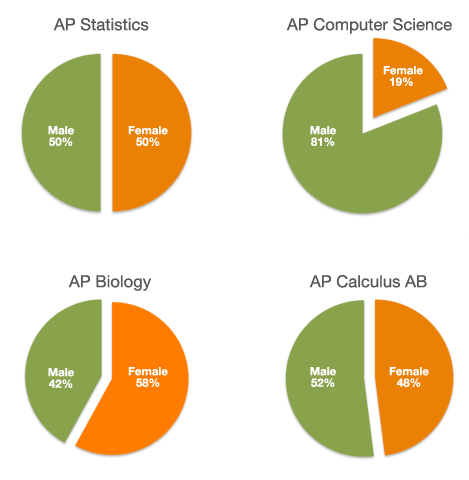
theodp writes: "What if learning to code weren't actually the most important thing?" asks Mother Jones' Tasneem Raja. "Rather than increasing the number of kids who can crank out thousands of lines of JavaScript, we first need to boost the number who understand what code can do." Computational thinking, Raja explains, is what really matters. So, while Google is spending another $50 million (on top of an earlier $40 million) and pulling out all the stops in an effort to convince girls that code and AP Computer Science is a big deal, could AP Statistics actually be a better way to teach computational thinking to college credit-seeking high school students? Not only did AP Statistics enrollment surge as AP CS flat-lined, it was embraced equally by girls and boys. Statistics also offers plenty of coding opportunities to boot. And it teaches one how to correctly analyze AP CS enrollment data! -
Computational Thinking: AP Computer Science Vs AP Statistics?
theodp writes: "What if learning to code weren't actually the most important thing?" asks Mother Jones' Tasneem Raja. "Rather than increasing the number of kids who can crank out thousands of lines of JavaScript, we first need to boost the number who understand what code can do." Computational thinking, Raja explains, is what really matters. So, while Google is spending another $50 million (on top of an earlier $40 million) and pulling out all the stops in an effort to convince girls that code and AP Computer Science is a big deal, could AP Statistics actually be a better way to teach computational thinking to college credit-seeking high school students? Not only did AP Statistics enrollment surge as AP CS flat-lined, it was embraced equally by girls and boys. Statistics also offers plenty of coding opportunities to boot. And it teaches one how to correctly analyze AP CS enrollment data! -
Girls Take All In $50 Million Google Learn-to-Code Initiative
theodp writes: On Thursday, Google announced a $50 million initiative to inspire girls to code called Made with Code. As part of the initiative, Google said it will also be "rewarding teachers who support girls who take CS courses on Codecademy or Khan Academy." The rewards are similar to earlier coding and STEM programs run by Code.org and Google that offered lower funding or no funding at all to teachers if participation by female students was deemed unacceptable to the sponsoring organizations. The announcement is all the more intriguing in light of a Google job posting seeking a K-12 Computer Science Education Outreach Program Manager to "work closely with external leaders and company executives to influence activities that drive toward collaborative efforts to achieve major 'moonshots' in education on a global scale." Perhaps towards that end, Google recently hired the Executive Director of the Computer Science Teachers Association (CSTA), who was coincidentally also a Code.org Advisory Board member. And Code.org — itself a Made With Code grantee — recently managed to lure away the ACM's Director of Public Policy to be its COO. So, are these kinds of private-public K-12 CS education initiatives (and associated NSF studies) a good idea? Some of the nation's leading CS educators sure seem to think so (video). -
Average HS Student Given Little Chance of AP CS Success
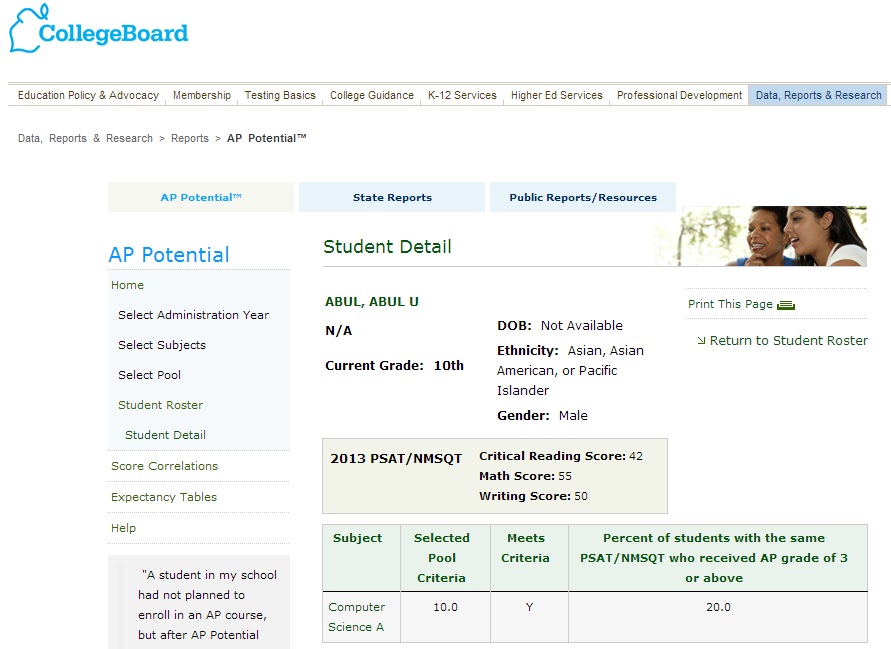
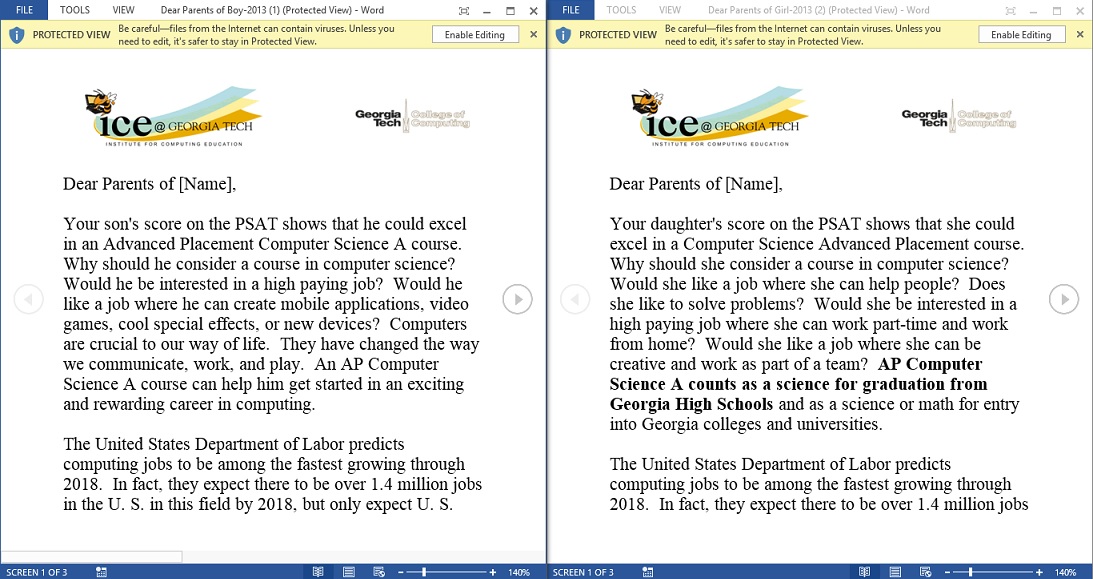
theodp (442580) writes AP Computer Science is taught in just 10% of our high schools," lamented The White House last December as President Obama kicked off CSEdWeek. "China teaches all of its students one year of computer science." And the U.S. Dept. of Education has made the AP CS exam its Poster Child for inequity in education (citing a viral-but-misinterpreted study). But ignored in all the hand-wringing over low AP CS enrollment is one huge barrier to the goal of AP-CS-for-all: College Board materials indicate that the average 11th grader's combined PSAT/NMSQT score of 96 in reading and math gives him/her only a 20%-30% probability of getting a score of '3' on the AP CS exam (a score '4' or '5' may be required for college credit). The College Board suggests schools tap a pool of students with a "60-100% likelihood of scoring 3 or higher", so it's probably no surprise that CS teachers are advised to turn to the College Board's AP Potential tool to identify students who are likely to succeed (sample Student Detail for an "average" kid) and send their parents recruitment letters — Georgia Tech even offers some gender-specific examples — to help fill class rosters. -
Aspiring Astronaut Gideon Gidori Invents a New Holiday: Star Day (Video)
Gideon wants to be an astronaut. You could even describe him as "space-obsessed." He wants to be the first astronaut from Tanzania. The only African to make it into space so far is Mark Shuttleworth, who is from South Africa. Can Gideon talk Elon Musk into launching from Tanzania, which is directly on the equator? How about bringing in other space buffs and entrepreneurs? Don't think this is a silly idea. Gideon is only 14, but he's a straight-A student at the Florida Air Academy, and before that was one of the top students at Shepherds Junior School in Arusha, which Mama Lucy Kamptoni originally financed by raising and selling chickens. Gideon's scholarships to Shepherds and later to Florida Air Academy have been financed in part by EpicChange.org, which is also helping him spread the word about Star Day (tomorrow; June 7), the holiday Gideon created, which is being celebrated all over the world even in this, its first year of existence. You can celebrate it, too. All you have to do, weather permitting, is sleep outdoors under the stars, and maybe make a wish or two. After all, wishing (and a lot of studying and hard work) have helped Gideon get to where he is today, and may yet help him become Tanzania's first astronaut. -
My Neighbor Totoro In Virtual Reality
An anonymous reader writes "Nick Pitton, the developer behind the Spirited Away Boiler Room VR experience, has released his second project: the bus stop scene from Studio Ghibli's famous movie My Neighbor Totoro, once again in virtual reality for the Oculus Rift. Pittom 'hand-painted' the textures in Photoshop to recreated the painted-background feel of the movie. For the characters (Totoro and the Catbus) he used a cel-shaded approached to approximate the animated look from the movie. For his next project, he plans to recreate the ship and characters from the acclaimed anime Cowboy Bebop." -
Sifting Mt. Gox's Logs Reveals Suspicious Trading Patterns
This analysis of trading logs from the Mt. Gox Bitcoin exchange analyzes a subset of the transactions that took place there prior to the exchange's collapse, and makes the case that two bots (the writer calls them "Willy," and "Markus") were making suspicious transactions which may have been used to intentionally manipulate the trading price, and which can explain the loss of Bitcoin inventory on which the exchange's failure was blamed. The author of the analysis says "[T]here is more than plenty of evidence to suspect that what happened at Mt. Gox may have been an inside job. What I hope to achieve by releasing this analysis into the wild is for the public to learn the truth behind what happened at Mt. Gox, how it affected the Bitcoin price, and hopefully for the individuals responsible for the massive fraud that occurred at Mt. Gox to be put to justice. Although the evidence shown in this report is far from conclusive, it can hopefully spur a more rigorous investigation into Mt. Gox’s accounting data, both by the public (using the leaked data) and the authorities (forensic investigation on the actual data)." -
R Throwdown Challenge
theodp (442580) writes "'R beats Python!' screams the headline at Prof. Norm Matloff's Mad (Data) Scientist blog. 'R beats Julia! Anyone else wanna challenge R?' Not that he has anything against Python, Matloff adds, but he just doesn't believe that Python or Julia will become 'the new R' anytime soon, or ever. Why? 'R is written by statisticians, for statisticians,' explains Matloff. 'It matters. An Argentinian chef, say, who wants to make Japanese sushi may get all the ingredients right, but likely it just won't work out quite the same. Similarly, a Pythonista could certainly cook up some code for some statistical procedure by reading a statistics book, but it wouldn't be quite same. It would likely be missing some things of interest to the practicing statistician. And R is Statistically Correct.'" -
Imminent Server Seizure Tests Brazil's New Internet Bill of Rights
sunbird (96442) writes "Less than one week after passing the Marco Civil da Internet, Article 3 of which purports to protect free expression and privacy of personal data from government intrusion, a Public Prosecutor in Brazil is seeking to seize a server hosting research groups, social movements, discussion lists and other tools. The server is hosted by the Saravá Group, which has adopted a policy of not storing connection logs to protect the privacy of users. The Public Prosecutor is seeking to identify individuals involved in Rádio Mudo, a project hosted by Saravá, but as Saravá does not store logs, there is no information on the server that is responsive to the investigation. This action comes as Brazil seeks to place itself in the forefront of protecting internet privacy after it hosted the Net Mundial conference. Saravá has called for a protest action today at 1PM local time (9AM PT/12noonET) to protest against the seizure." -
Enlightenment E19 To Have Full Wayland Support
An anonymous reader writes "Full Wayland support has been added to Enlightenment 0.19. Building upon earlier Wayland support, Enlightenment can now act as its own Wayland compositor by communicating directly with the kernel's DRM drivers instead of having to rely upon Weston. The Wayland support is still considered experimental but it's now the first Linux desktop with full Wayland support." Quick README on building and using it. -
Nate Silver's FiveThirtyEight Relaunches As Data Journalism Website
Hugh Pickens DOT Com writes "After a parting of ways with the New York Times after calling 50 out of 50 states right in the 2012 elections, Nate Silver has relaunched FiveThirtyEight as a website dedicated to data journalism under the auspices of ESPN. Silver has expanded his staff from two full-time journalists to 20 and instead of focusing on politics exclusively FiveThirtyEight's coverage will span five major subject areas — politics, economics, science, life and sports. According to Silver, his team has a broad set of skills and experience in methods that fall under the rubric of data journalism including statistical analysis, data visualization, computer programming and data-literate reporting. 'One of our roles will be to critique incautious uses of statistics when they arise elsewhere in news coverage. At other times, we'll explore ways that consumers can use data to their advantage and level the playing field against corporations and governments.' The site has launched with a variety of stories including 'Many Signs Pointed to Crimea Independence Vote — But Polls Didn't,' 'Building a Bracket Is Hard This Year, But We'll Help You Play the Odds,' 'Toilet Seat Covers: To Use or Not to Use,' and 'Three Rules to Make Sure Economic Data Aren't Bunk.'
The story that caught my eye was 'This Winter Wasn't the Coldest, But It Was One of the Most Miserable' with some good data visualization that showed that although average temperature may not have set records in the Northeast Corridor this winter, the intensity of the cold when it did hit was impressive. According to Matt Lanza although most statistics cite the winter of 1978-79 as the coldest in U.S. history, the winter of 2013-14 brought a rare combination of miseries that many of us hadn't seen in years, and some had never seen. It was colder than usual, it was extremely cold more often than usual, and it snowed more than usual in more places than usual. Traditionally, big snow winters occur in a couple regions. The East Coast might have great snows, while the Midwest is quiet. Snowfall this winter didn't discriminate; it blanketed just about everybody (outside the dry West and icier Mid-South). Look how many cities had not just a little more, but way more, than their normal snowfall." -
U.S. Students/Grads Carrying Over $1 Trillion In Debt
An anonymous reader writes "Time reports that American students and grads were carrying $1.08 trillion in student loan debt at the end of 2013. This compares to just $253 billion a decade earlier. Aggregate debt grew 10% in the past year alone. 'By comparison, overall debt grew just 43% in the last decade and 1.6% over the past year.' About 70% of students graduate with some amount of debt, and the average amount owed is $29,400. 'Delinquencies on student loans have risen dramatically over the past decade: 11.5 percent of graduates were at least 90 days late on paying back their loans at the end of 2013, compared with 6.2 percent delinquencies on student loans in 2003. Moreover, the Fed's figures on delinquencies hide more stark data: nearly half of all students with debt aren't currently in repayment thanks to deferments and forbearances and the fact that students are not expected to pay while they're in school.' An attached graph shows an alarming spike in delinquent loans that looks a bit like mortgage delinquencies did at the beginning of the sub-prime crisis." -
Scottish Independence Campaign Battles Over BBC Weather Forecast
00_NOP writes "The political battle over Scotland's independence ballot — to take place in September this year — has now moved on to how the BBC project the UK on their national weather forecast. The BBC use a projection based on the view of Britain from geostationary weather satellites and so there is naturally some foreshortening at the northern end of Britain (Scotland, in other words). But nationalist campaigners say this means Scottish viewers are constantly being shown a distorted image of their country which makes it look smaller and hence (in their view) less able to support independence. In response others have suggested that the nationalists are truly 'flat earthers.'" -
Live Q&A With Ex-TSA Agent Jason Harrington
Jason Harrington (@Jas0nHarringt0n) is a controversial blogger, frequent contributor to McSweeney's Internet Tendency, and one of the TSA's least favorite ex-employees. His descriptions of life on the job as a TSA agent caused some big waves and restarted a national discussion on security theater. Jason will be answering your questions below for the next couple of hours, or until the security line starts moving again. Please keep it to one question per post so everyone gets a chance. Update: 03/01 02:11 GMT by S : Jason has finished up for now — you can skip to his answers at his user page, or simply browse the comments to read everything. Thanks Jason for answering our questions! -
The Whole Story Behind Low AP CS Exam Stats
theodp writes "At first glance, the headline in The Salt Lake Tribune — Very Few Utah Girls, Minorities Take Computer Science AP Tests — appears to be pretty alarming. As does the headline No Girls, Blacks, or Hispanics Take AP Computer Science Exam in Some States over at Education Week. Not One Girl Took The AP Computer Science Test In Some States warns a Business Insider headline. And so on and so on and so on. So how could one quibble with tech-giant backed Code.org's decision to pay teachers a $250 "Female Student Bonus", or Google's declaration that 'the ultimate goal of CS First is to provide proven teaching materials, screencasts, and curricula for after-school programs that will ignite the interest and confidence of underrepresented minorities and girls in CS,' right? But the thing is, CollegeBoard AP CS exam records indicate that no Wyoming students at all took an AP CS exam (xls) in 2013, and only a total of 103 Utah students (xls) had reported scores. Let's not forget about the girls and underrepresented minorities, but since AP CS Exam Stats are being spun as a measure of CS education participation (pdf) and equity, let's not forget that pretty much everyone has been underrepresented if we look at the big AP CS picture. If only 29,555 AP CS scores were reported (xls) in 2013 for a HS population of about 16 million students, shouldn't the goal at this stage of the game really be CS education for all?" -
Tech's Gender and Race Gap Starts In High School
An anonymous reader writes "Diversifying the tech industry is a prominent topic these days, with much analysis being done on colleges and companies that employ software engineers. But exam data shows the gap is created much earlier — it's almost overwhelming even before kids get out of high school. From the article: 'Ericson's analysis of the data shows that in 2013, 18 percent of the students who took the exam were women. Eight percent were Hispanic, and four percent were African-American. In contrast, Latinos make up 22 percent of the school-age population in the U.S.; African-Americans make up 14 percent. (I don't need to tell you that women make up about half.) There are some states where not a single member of one of these groups took the test last year. No women in Mississippi or Montana took it. Seven states had no Hispanic students take the exam: Alaska, Idaho, Kansas, Mississippi, Montana, Nebraska, and North Dakota. And 10 states had no Black students take the exam: Alaska, Idaho, Kansas, Maine, Mississippi, Montana, Nebraska, New Mexico, North Dakota, and Utah. In some of these states, there simply aren't many students of any race or gender taking the test, which helps explain the dearth of young women and minorities. (Indeed, no women or minorities took the exam in Wyoming—but that's because no students at all took it.) But Idaho had nearly 50 students taking it, and Utah had more than 100.'" -
90 Percent of Businesses Say IP Is "Not Important"
langelgjm writes "In 2009, the National Science Foundation teamed up with the Census Bureau to ask U.S. businesses how important intellectual property was to them. Now, after three years of surveys, the results are in. Astonishingly, it turns out that when asked, 90 percent of businesses say intellectual property is 'not important'. While some very large businesses and specific sectors indicate that patents, copyrights, and trademarks are important, overall, the figures are shockingly low. What's more, the survey's results have received hardly any press. It appears that formal intellectual property protection is far less important to the vast majority of U.S. businesses than some federal agencies, such as the patent office, are willing to admit." -
Create Your Own Bullet Time Camera Rig With Raspberry Pi
sfcrazy writes "A team of extremely creative people have created a really inexpensive bullet time set-up using Raspberry Pis — and the whole set-up costs less than a professional DSLR camera. The rig looks more like the LHC at CERN using nearly half a kilometre of network cables, 48 Raspberry Pis fitted with cameras and PiFace Control. The rig worked perfectly — in terms of doing what a bullet time set-up should do. Raspberry Pis achieved the Hollywood's 'frozen time' effect at a much lesser cost." -
Tech Companies Set To Appeal 2012 Oracle Vs. Google Ruling
sl4shd0rk writes "In 2012, Oracle took Google to court over Java. In the balance hung the legalities of writing code to mimic the functionality of copyrighted software. The trial was set to determine how all future software would be written (and by whom). Oracle's entire case boiled down to an inadvertent 9 lines of code; an argument over a simple and basic comparison of a range of numbers. The presiding judge (who had some background in writing software) didn't buy it stating he had 'written blocks of code like rangeCheck a hundred times before.' A victory for more than just Google. This week, however, Microsoft, EMC, Oracle and Netapp have filed for appeal and seek to reverse the ruling. It's not looking good as the new bevy of judges Indicating they may side with Oracle on the issue." -
Why Competing For Tenure Is Like Trying To Become a Drug Lord
Hugh Pickens DOT Com writes "Scott Jaschik writes in Inside Higher Education that the academic job market is structured in many respects like a drug gang, with an expanding mass of outsiders and a shrinking core of insiders and with income distribution within gangs extremely skewed in favor of those at the top, while the rank-and-file street sellers earned even less than employees in legitimate low-skilled activities. According to Alexandre Afonso, academic systems rely at least to some extent on the existence of a supply of 'outsiders' ready to forgo wages and employment security in exchange for the prospect of prestige, freedom and reasonably high salaries that tenured positions entail. 'What you have is an increasing number of brilliant PhD graduates arriving every year into the market hoping to secure a permanent position as a professor and enjoying freedom and high salaries, a bit like the rank-and-file drug dealer hoping to become a drug lord,' says Afonso. 'To achieve that, they are ready to forgo the income and security that they could have in other areas of employment by accepting insecure working conditions in the hope of securing jobs that are not expanding at the same rate.' The Chronicle of Higher Education recently reported on adjunct lecturers who rely on food stamps to make ends meet. Afonso adds that he is not trying to discourage everyone from pursuing Ph.D.s but that prospective graduate students need to go in with a full awareness of the job market." -
Mathematicians Team Up To Close the Prime Gap
Hugh Pickens DOT Com writes "On May 13, an obscure mathematician garnered worldwide attention and accolades from the mathematics community for settling a long-standing open question about prime numbers. Yitang Zhang showed that even though primes get increasingly rare as you go further out along the number line, you will never stop finding pairs of primes separated by at most 70 million. His finding was the first time anyone had managed to put a finite bound on the gaps between prime numbers, representing a major leap toward proving the centuries-old twin primes conjecture, which posits that there are infinitely many pairs of primes separated by only two (such as 11 and 13). Now Erica Klarreich reports at Quanta Magazine that other mathematicians quickly realized that it should be possible to push this separation bound quite a bit lower. By the end of May, mathematicians had uncovered simple tweaks to Zhang's argument that brought the bound below 60 million. Then Terence Tao, a winner of the Fields Medal, mathematics' highest honor, created a 'Polymath project,' an open, online collaboration to improve the bound that attracted dozens of participants. By July 27, the team had succeeded in reducing the proven bound on prime gaps from 70 million to 4,680. Now James Maynard has upped the ante by presenting an independent proof that pushes the gap down to 600. A new Polymath project is in the planning stages, to try to combine the collaboration's techniques with Maynard's approach to push this bound even lower. Zhang's work and, to a lesser degree, Maynard's fits the archetype of the solitary mathematical genius, working for years in the proverbial garret until he is ready to dazzle the world with a great discovery. The Polymath project couldn't be more different — fast and furious, massively collaborative, fueled by the instant gratification of setting a new world record. 'It's important to have people who are willing to work in isolation and buck the conventional wisdom,' says Tao. Polymath, by contrast, is 'entirely groupthink.' Not every math problem would lend itself to such collaboration, but this one did." -
A Math Test That's Rotten To the Common Core
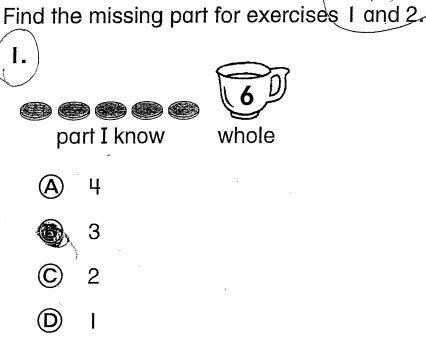
theodp writes " The Common Core State Standards Initiative," explains the project's website, ""is a state-led effort that established a single set of clear educational standards for kindergarten through 12th grade in English language arts and mathematics that states voluntarily adopt." Who could argue with such an effort? Not Bill Gates, who ponied up $150 million to help git-r-done. But the devil's in the details, notes Washington Post education reporter Valerie Strauss, who offers up a ridiculous Common Core math test for first graders as Exhibit A, which also helps to explain why the initiative is facing waning support. Explaining her frustration with the intended-for-5-and-6-year-olds test from Gates Foundation partner Pearson Education, Principal Carol Burris explains, "Take a look at question No. 1, which shows students five pennies, under which it says 'part I know,' and then a full coffee cup labeled with a '6' and, under it, the word, 'Whole.' Students are asked to find 'the missing part' from a list of four numbers. My assistant principal for mathematics was not sure what the question was asking. How could pennies be a part of a cup?" The 6-year-old first-grader who took the test didn't get it either, and took home a 45% math grade to her parents. And so the I'm-bad-at-math game begins!"