Slashdot Mirror
Domain: worldbank.org
Stories and comments across the archive that link to worldbank.org.
Comments · 379
-
Re:That last sentence...
Where exactly are the underperforming schools where Asians make up 50 % of the population ?
Hanoi?
No. Vietnam scores higher than America on the standard PISA test. Their schools may be bamboo shacks with dirt floors, but they are not underperforming.
-
Re:More than $100
Poor people are poor because they can't get jobs. One of the reasons is that they can't get to jobs. Can't afford a reliable car and insurance and gas in the US? Can't work! Too often, that's the equation.
But long distance rail travel is unrelated to commuting. If people commute by public transport at all, they commute primarily by bus, both in the US and Germany.
The other reasons they are poor are that we were equally bad in investing in other things we should have spent more upon publicly, like good primary education.
The US actually spends slightly more per capita than Germany on primary education relative to per capita GDP, and a lot more in absolute terms, so that's simply not true.
http://data.worldbank.org/indi...
No. If anything, I assert that good trains are a hallmark of the set of good economic policies that lead to the general well-being of the citizenship.
Railroads in Europe are a legacy of imperialism, nationalism, crony capitalism, and pleasant transportation for the upper classes. Given that they are only responsible for 10% of passenger miles even in places like Germany, they are not a big part of the "general well being". They made some sense pre-automobile, now they are an expensive anachronism. Once self-driving and electric cars are widespread (likely long before HSR's completion date), they will be completely obsolete.
-
Re:Help me out here a little...
The average German uses a bit more than half the electricity
Those are interesting figures. Germans use a bit more than half of Americans, but Iceland uses 5 times (!) as much as an average American. What the hell are they doing over there, cranking up the electric heater and leaving the doors open?
-
Re:Help me out here a little...
But germans on average just use a tenth of the power an american uses, so bottom line we pay less than you.
The average German uses a bit more than half the electricity of the average American. So your power bill is on average roughly 1.5x that of an American. That cost may not be entirely in your electricity bill. It could be hidden in the cost of goods which require electricity to produce.
Also note that as a percentage, Germany's energy production (not just electricity generated) is skewed more towards oil than the U.S (roughly 1/3 vs 1/4). That energy for home heating has to come from somewhere. In raw joules (or kWh), it's still less than the average American though. Germans are notoriously efficient in their energy use (nearly 1/4th that of the typical American - this includes industrial use, not just residential). Living in a relatively cold climate with few natural energy resources and high energy prices forces you to be efficient. The Japanese are in a similar position and use less than half the energy per capita of Germans. -
Re:They're called trees.
Europe and Asia (where the former has few forests left [...]
http://en.wikipedia.org/wiki/L...
Canada and the United States 26%
European Union 35%And from
http://wdi.worldbank.org/table...
Europe it was 36.5% in 200 and 37.9% in 2012.Not sure how good these statistics are, because it says 'Canada &United States = 26%' and then 'Canada =31%' and 'USA= 30.84%'... In any case, Europe has more forest area atm and amount of forest is growing rather than decreasing.
Or did you mean Europe has few forests left compared to situation from 2000 years ago? I can agree with that, but I don't think that global warming is THAT old - we used to have some mini ice age in meantime I think...
-
Some skepticism...
I read TFA, and looked as some of the links. I have no idea what the overall situation is, and these sites certainly do not provide the information. Just as an example, I found various maps that document forest losses. Areas of the world where forest cover is increasing (most of Europe, for example) are simply shown as "no losses". In other words, they show forests that were cut down, or that burned, but they do not show newly forested areas, or forests that have recovered from burning.
With this kid of biased data, we have no idea what the overall global balance is.
Finding unbiased data turns out to be really difficult, at least, after 20 minutes or so I hadn't found anything I trusted. There were some national agencies where you could download raw data. But every organization that has put data together into some sort of overview is an organization that has a political point to make. Greenpeace always cooks the numbers to make their point. The same for logging industry sites, only they cook the numbers in the opposite direction.
The best site I found is from the World Bank, but it only goes through 2012, and doesn't provide much detail. According to the summary graph, 31.0% of the total land area of the planet was covered by forest in 2010, 30.9% in 2011, and then back up to 31.0% in 2012. Another presumably neutral site is from the UN, but their data only goes through 2010.
Does anyone have a better source that provides halfway objective information on this stuff?
-
Re: So What
Total government expenditures in the US were around 10% of GDP in 1930. Was the US a lawless hellhole at 10%?
Cause it's around 40% today.
No it isn't. More like 16% according to the World Bank
-
Re:Also, about long term unemployment...
That long term unemployment number is as a percentage of unemployed people, per the link you posted. The department of labor (the bureau of labor statistics) calculates unemployment with a national household survey:
http://www.bls.gov/bls/unemplo...
The world bank unemployment numbers (which are actually gathered by the international labor organization) are just a regurgitation of the BLS numbers above, which you'd know if you'd bothered at all to investigate the numbers you are quoting above.
See:
http://data.worldbank.org/indi...
(look at the metadata for the source)
http://www.ilo.org/dyn/lfsurve...
(each country has it's own source, methodology, etc).
Valid complaints would be that the numbers reported don't include the homeless (although those estimates are gathered elsewhere), you don't understand the report, or that it conflicts with your personal opinion.
-
Also, about long term unemployment...
Also, about long term unemployment...
http://data.worldbank.org/indi...
This table shows that U.S. long term unemployment as of 2012 was 29.3%
My understanding is that it was down somewhat, but that was based on preliminary numbers. Not renewing the Unemployment Insurance Extension in the last federal budget moved some people from short term to long term unemployed as they fell of the unemployment insurance rolls. My numbers were pre this event, so it's possible the number has gone back above 30% at this point in time,
Generally, politicians will avoid renewing Unemployment Insurance extensions prior to midterm elections, since it deflates the DOL statistics, and makes it look like the unemployment situation is getting better, when it really means that those who were counted in the prior accounting are now long term and no longer receiving Unemployment Insurance benefits.
In particular, this was intended to make the Democrats look better relative to the unemployment situation going into the midterms; the Republicans won anyway, so expect the benefits to be extended the next time, and potentially going into the presidential election (it really depends on whether it's more important to make the (now Republican Controlled) congress look bad, or it's more important to make a Democratic presidency look good.
If it's renewed going into the 2016 presidential election, it will mean that the Democrats expect to lose the White House to the Republicans, and the Republicans are intentionally eating a potential loss of congressional seats to attain the White House.
It's basically a balancing act by both parties, and I'd vastly prefer we just use the World Bank numbers, and be done with it, rather than playing political games with people's lives, but there you go...
-
Re:Hasn't been involved with Greenpeace since 1985
More like his wallet took a sharp turn to the right https://en.wikipedia.org/ "Moore has earned his living since the early 1990s primarily by consulting for, and publicly speaking for a wide variety of corporations and lobby groups" https://en.wikipedia.org/wiki/.... So why was he in Greenpeace in the first place, likely pursuing the opposite sex. Caring sharing community activities often have a preponderance of the fairer sex (they are referred to as the 'fairer sex' for a reason) http://siteresources.worldbank....
-
Re:Incentives
Oh, pooh-berries. Should have cited. Here ya go! http://data.worldbank.org/indi...
-
Re:Nothing important.
Since widely availability of contraception, and most notable TV, such countries don't exist anymore
Let's give some examples: Nigeria has a population growth rate of 2.3% (which is a doubling time of just over 30 years). India and Indonesia still have population growth rates of 1.3% (doubling time of roughly 55 years). Pakistan has a population growth rate of 1.8% (doubling time of roughly 39 years). These rates are all due to reproduction and include a bit of emigration.
For example, if we blissfully extrapolate Nigeria's current growth rate and population (127 million today) through the next three centuries, a typical Club of Rome exercise, we get almost three orders of magnitude more people, roughly 110-120 billion people. Even if these people somehow consume only a tenth of the resources of the present global population, that's about half again as much resources consumed just by Nigeria than by the entire world today.So the main problem is still pollution, erosion, distribution, and behind that imperialism (no matter if religion based in Africa or foreign influence in Asia or south america), wrong approaches in globalization, corruption etc.
Of course not. If the population of the world were a tenth the present amount, these would not be serious problems.
The population growth in India, or any other place of the world, has nothing to do with land erosion and loss of agrarian soil or water problems in the USA.
Sure, they do. Food is an export product of the US and the high demand for food globally helps put more pressure on the US's agriculture resources. Less demand means less land put under the plow.
My view is that this is typical environmental Calvinism that ignores overpopulation, the elephant in the room. -
Re:not in my tank!
If we accept it's about cleaner air. And we assume that it burns X% cleaner. And we assume that we will burn X% more fuel over the same distance
I have a diesel car and I get excellent economy as well as producing less green house gas than an equivalent petrol engine. My car is able to take 5% bio-diesel (B5) as per manufacturers guidelines however in Sydney Australia I find it almost impossible to get B5 or any bio-diesel for that matter. Of course if I had a petrol car I can get 10% Ethanol (E10) which is normally cheaper (Government/Taxpayer subsidised) than diesel although because I get a better fuel economy the price evens out.
Actually even though many people will seen E10 as cheaper than diesel many are not aware (or don't care) that while a hike in petrol can be felt by the petrol consuming motorist a hike in the price of diesel is actually felt by everyone since all haulage in Australia and in the Americas is by trucks that normally have diesel engines. Even most fishing boats and smaller sea going craft use diesel mainly because it is economical and is a much safer fuel. As an example (don't do this at home) throw a lighted match into a can filled with petrol and you better have a decent fire extinguisher handy. Do the same with a can of diesel and it will most likely go out. Don't try this in an enclosed space since the resulting petrol fume explosion may be hazardous to your health.
It is possible and very economical to grow crops and even use animal fat for bio-diesel providing you have the land and Australia has the land which is not that much smaller tan the continental USA. However our government seems to prefer using ethanol in petrol possibly due to the lobbying of the sugar producers which I suppose could be likened to the corn lobbyists in the US.
I should point out that Australia has a fairly small population (approx 24 million) and a population density of approximately 3.2/square km compared to the USA which has a population density of 35/square km. It is even worse for smaller countries with larger population and even worse population density (see the following ).
The problem with growing crops for bio-fuel is that you need large areas of land and many countries with a large population density may should not attempt this or at least go for limited production. In the short term these countries may be ok but whether the long term growth and sustainability is feasible that remains to be seen.
It's all about corporate welfare.
I could not agree more.
-
Re:Very admirable
High speed trains are awesome, and they're great for prestige and getting customers to buy that technology. Yet they're out of price range for the majority of customers.
Maybe not? This from a recent World Bank report:
"As of October 1, 2014, over 2.9 billion passengers are estimated to have taken a trip in a China Rail - High Speed train (called CRH services), with traffic growing from 128 million in 2008 to 672 million in 2013, or about 39 percent growth per annum since 2008. In 2013, 530 million of those CRH trips took place on passenger dedicated HSR lines. In 2013, China HSR lines carried slightly more HSR passenger-km (214 billion) than the rest of the world combined. This represented about 2.5 times the HSR passenger-km of Japan, the second largest country in terms of HSR traffic. These are substantial numbers for a system that is still in its early days."
Also, a personal informed opinion here -
Re:Tell that to Alaskans who get BI of US$1000+/ye
Personally, I feel it is unfair that the elderly in the USA get Medicare and Social Security when everyone else does not
The most ridiculous part of this is that the elderly are the group that consumes the majority of health care services, and thus the US is bearing the majority of the brunt of an entirely public health care system anyways. I have a feeling this is why health care spending is so much higher in the US than other countries.Why not just cover the generally-freak accidents of people in their youth for the small incremental cost?
Health care is one industry, much like policing or firefighting, that is makes no sense to not run as a public program. It will undoubtedly take the US another 20-30 years to figure this out. Oh, and the excessive health care spending doesn't translate into results, at least if we go by life expectancy. -
Re:And?
No. You just have an expensive plan imposed on you by a local monopoly at gunpoint. You are stuck with that plan regardless of how effective or responsive it is.
Actually, that's not true. The average American pays (considerably) more for less service than the average Canadian, and it's not just Canada. Every country in the world pays less for health care than America and many of them also get better service. Last time I checked the American health care was the most expensive in the world. As a country, the U.S. spends 50-100% more (17.9% of GDP) than other first world countries (9%-12% of GDP) on health care and Americans get the 38th best health care in the world.
I would rather spend my own money as I see fit.
Of course you would and that's why medical expenses are one of the leading causes of brankruptcy in the United States. People like you gamble and when they lose, they stick everyone else with bill. Frequently while braying endlessly about how everyone else should take personal responsibility for their actions.
Planned economies often miss important details (like flouride toothpaste) or drive away useful goods and services.
We're not talking about planned economies but rather universal health care and anyone who isn't lib-tarded should recognize that you can't have a fair market when the first question is "how much will you pay to not die today"?
-
Re: English-ish?
Maybe you can reconcile the fact that China's literacy rate is 95% with your statement about how they cant speak mandarin?
Here the CIA fact book:
https://www.cia.gov/library/pu...Literacy:
definition: age 15 and over can read and write
total population: 95.1%
male: 97.5%
female: 92.7% (2010 est.)Here the world bank has it at 95% http://data.worldbank.org/indi...
So the world bank and CIA factbook agree.Sure, both those sources could be incorrect because as you post, they never went to school.
You said the young speak mandarin while the old dont, but wouldnt that be in the CIA factbooks statistics as they are a measure of 15 and older?Maybe you can look at the CIA factbook
Languages: Standard Chinese or Mandarin (official; Putonghua, based on the Beijing dialect)....Since Putonghua is the "official" language, and they have a 95% literacy rate.. one can conclude 95% of them speak Putonghua right?
-
Re:Quoted from TFA
The excuse that Government "is not a corporation and cannot be run like one" is nonsense. It's a great ivory tower view....
Perhaps you'd care to back up that opinion with a fact or two explaining why two radically different types of organizations should be run in exactly the same manner? Note that I did not state that government cannot be efficient, but that efficiency is not the top mission of a government agency.
I'll look up the Medicare claim for you when I have a chance, the fraud level in Medicare is enormous - as it is with most programs run the the Feds.
I hear that bank robbers go after banks because that's where all the money is...
The ACA was a giant payoff to the insurance companies
Yes it was. It was also all that was politically achievable in one piece of legislation. Don't believe me? Ask Hillary Clinton what happened to her husband's attempt to take on both the insurance industry AND the healthcare industry all at the same time. Realpolitik is a bitch. I would much prefer we went with some form of single-payer as every other first-world nation on the planet has done (incidentally, at nearly 18% of GDP, the US spends twice as much on healthcare as other nations and gets half the results).
with quid pro quo to the DNC that has blown up in their faces.
So this "pro quo" you speak of is going to be delivered exactly when? I didn't notice Aetna or Cigna littering the DNC with contributions this last election cycle...
Any other view is naive my friend...
How about the view that the ACA saved my best friend's life? That it made it possible for her to purchase insurance which detected her cancer and is providing for treatment she never would've gotten otherwise?
How about the view that the number of uninsured Americans has dropped significantly for the first time since Nixon was President?
How about the view that insurance premium increases have been checked for the first time in my adult life, where they previously had been growing annually at more than double -- sometimes triple -- inflation? You might recall the litany of stories in 2013 of how we would see crazy increases in premium costs? None of those crazy increases actually happened.
How about the view that budget impact was better than the CBO forecast?
Which of these views is "naïve"? All in all, that's not too shabby for what was admittedly a giant insurance company blowjob. I can't wait to see how much better it gets when we get around to reforming the other half. Maybe we'll exorcise the Profit Demon from our healthcare system once and for all and remove the perverse incentives it creates that keep people sick rather than cure them.
-
Re:Unbelievable!
No, they'll just put a wind turbine on top of the oil derrick and proclaim it to be green. My understanding is that, in spite of all the green talk, Denmark has a pretty high per capita CO2 emission rate.
Define "pretty high"
-
Re:We are doomed...
and China's one child policy is probably the best long term action for the environment.
And yet, in most developed first world countries, birth rates have pretty much plateaued, or are on the way there. The US, China, Japan, Singapore, Russia, most of Europe - all currently below population sustaining birth rates at the moment. Check out this chart, sorted by fertility rates from lowest to highest. You can likely notice a clear trend between the upper portions of the chart and the lower regions.
Economics and education (especially of women) is the key, not police state policies that encroach on more of our personal liberties. We need to get everyone to first-world economic status as fast as we can, because then:
1) People will stop pumping out kids en mass, since at that point they're an economic liability, not an advantage, and
2) People will start caring more about the environment when they're not trying to figure out where they'll get they're next meal, or if they will have a roof over their heads tomorrow.Seriously, exploding population was the boogieman twenty or thirty years ago. If we forecast using today's trends, it seems pretty likely that the world's population will most likely peak and then decline. Take a look at the actual data trends (the recent ones - and don't extrapolate linearly), then draw your own conclusions.
-
Re:Not the real problem
You're an idiot, and for proof, Mexico's vaccination rates are at the same level as USA.
-
Re: China is more communist now
You're just lying. Yeah, it's not doing the capitalistic corporate welfare of Obamacare, but it laughs at the philosophy of pure capitalism as much as any senior medic laughs at an upstart freshman medical student who thinks he has a cure for all disease.
But China is really creeping toward social democracy - not "capitalism" or "communism".
-
Re:we spend much more than successful countries
Funding them at the same level as countries that get good results might work.
http://data.worldbank.org/indi...
Using that link, quite a few countries seem to be spending more than the US. For 2010, Finland spent more on education as a percentage of GDP than the US did. In 2010 Finland also spent more per student than the US as a percentage of GDP per capita at the secondary and tertiary levels. Finland's spending was also higher in dollar terms for secondary and tertiary education per student, despite having a lower GDP per capita than the US for 2010. Australia had a higher GDP per capita than the US in 2010 and spent more on primary and tertiary education per student than the US did.
-
Re:we spend much more than successful countries
Funding them at the same level as countries that get good results might work.
http://data.worldbank.org/indi...
Using that link, quite a few countries seem to be spending more than the US. For 2010, Finland spent more on education as a percentage of GDP than the US did. In 2010 Finland also spent more per student than the US as a percentage of GDP per capita at the secondary and tertiary levels. Finland's spending was also higher in dollar terms for secondary and tertiary education per student, despite having a lower GDP per capita than the US for 2010. Australia had a higher GDP per capita than the US in 2010 and spent more on primary and tertiary education per student than the US did.
-
Re:we spend much more than successful countries
Funding them at the same level as countries that get good results might work.
http://data.worldbank.org/indi...
Using that link, quite a few countries seem to be spending more than the US. For 2010, Finland spent more on education as a percentage of GDP than the US did. In 2010 Finland also spent more per student than the US as a percentage of GDP per capita at the secondary and tertiary levels. Finland's spending was also higher in dollar terms for secondary and tertiary education per student, despite having a lower GDP per capita than the US for 2010. Australia had a higher GDP per capita than the US in 2010 and spent more on primary and tertiary education per student than the US did.
-
Re:I Don't Get It
America spends more per student than almost any other country
That doesn't seem to be the case. Finland's education system, for example, is one of the best in the world. Finland's GDP per capita for 2011 is similar to the US's 2011 GDP per capita.
For 2010, Finland spent more on education as a percentage of GDP than the US did. In 2010 Finland also spent more per student than the US as a percentage of GDP per capita at the secondary and tertiary levels. Finland's spending was also higher in dollar terms for secondary and tertiary education per student, despite having a lower GDP per capita than the US for 2010.
For 2010, Australia had a higher GDP per capita than the US and spent more per student in terms of percentage of GDP per capita and also in dollar terms than the US did for primary and tertiary education.
-
Re:I Don't Get It
America spends more per student than almost any other country
That doesn't seem to be the case. Finland's education system, for example, is one of the best in the world. Finland's GDP per capita for 2011 is similar to the US's 2011 GDP per capita.
For 2010, Finland spent more on education as a percentage of GDP than the US did. In 2010 Finland also spent more per student than the US as a percentage of GDP per capita at the secondary and tertiary levels. Finland's spending was also higher in dollar terms for secondary and tertiary education per student, despite having a lower GDP per capita than the US for 2010.
For 2010, Australia had a higher GDP per capita than the US and spent more per student in terms of percentage of GDP per capita and also in dollar terms than the US did for primary and tertiary education.
-
Re:I Don't Get It
America spends more per student than almost any other country
That doesn't seem to be the case. Finland's education system, for example, is one of the best in the world. Finland's GDP per capita for 2011 is similar to the US's 2011 GDP per capita.
For 2010, Finland spent more on education as a percentage of GDP than the US did. In 2010 Finland also spent more per student than the US as a percentage of GDP per capita at the secondary and tertiary levels. Finland's spending was also higher in dollar terms for secondary and tertiary education per student, despite having a lower GDP per capita than the US for 2010.
For 2010, Australia had a higher GDP per capita than the US and spent more per student in terms of percentage of GDP per capita and also in dollar terms than the US did for primary and tertiary education.
-
Re:I Don't Get It
America spends more per student than almost any other country
That doesn't seem to be the case. Finland's education system, for example, is one of the best in the world. Finland's GDP per capita for 2011 is similar to the US's 2011 GDP per capita.
For 2010, Finland spent more on education as a percentage of GDP than the US did. In 2010 Finland also spent more per student than the US as a percentage of GDP per capita at the secondary and tertiary levels. Finland's spending was also higher in dollar terms for secondary and tertiary education per student, despite having a lower GDP per capita than the US for 2010.
For 2010, Australia had a higher GDP per capita than the US and spent more per student in terms of percentage of GDP per capita and also in dollar terms than the US did for primary and tertiary education.
-
somebody lied to you. We spend the most, do it wro
Somebody lied to you.
http://data.worldbank.org/indi...You'll notice that the US spends more than practically any country, and gets among the worst results. If you look at our own spending over time vs results, again you'll see that as budgets have increased, results have gotten worse. Spending more to do more of the wrong thing doesn't help.
-
we spend much more than successful countries
Funding them at the same level as countries that get good results might work.
http://data.worldbank.org/indi...
I'm not sure that cutting funding would be politically popular, though. We spend a lot more than the countries that do well. I don't know if those other countries spend their school time on Mexican culture week, black history month, and global diversity week. They may spend their time learning reading, writing, and arithmetic.
-
what works
We could fund them similarly to the way they are funded in countries that get good results. Details here:
-
cutting to German, Finnish levels might work
Cutting our spending down to those levels might work. All of the countries that get better results than us do spend less.
http://data.worldbank.org/indi...
I noticed one difference between US public schools vs schools that work. When my step-daughters were in elementary school, there were three weeks out of five that were "special". The first week was Mexican culture week and they spent their time singing Mexican songs, making Mexican food, and learning Mexican dances. That was enriching, perhaps. A couple of weeks later was black history, and then "world diversity " or something. That's all fine and well, I understand the value of such things. I strongly suspect, though that Japanese students spent those weeks learning reading , writing and arithmetic. My stepdaughter can make enchiladas, but can't read so well. A good trade?
-
Re:Lots of cheap carbon stuff
While I largely agree with the point of your post, I think that in context of global warming it would be even better to look at CO2 emission/ capita. It doesn't change things around all that much, but treats countries like Iceland a bit better as they use mainly renewable energy sources. http://data.worldbank.org/indi...
-
Re:Lots of cheap carbon stuff
Small changes by those who use the most (China, India, US, Canada in that order) would do most of that.
Where the heck did you get that list?
If you are talking per-capita, China and India don't belong. If you are talking overall, Canada doesn't belong.
Ok, I'll stop being lazy and look it up:
Top 5 per-capita energy consumers:
Iceland
Qatar
Trinidad and Tobago
Kuwait
LuxembourgTop 5 overall energy consumers:
United States
China
Russia
Japan
IndiaAnd would it not be much more fair to look at per-capita numbers? i.e. stop harping on China/India, start worrying about Europe / NA
-
Re:Straight to the pointless debate
I believe it's the other way around: we're prevented from talking about changes because we're too stuck on the large number of people who insist that the answer is "do nothing because nothing is happening/it's not our fault/it'll all be OK," based on information that is usually outright wrong.
The short answer to "what do we do?" is "cut back on CO2 emissions". How we do that is a genuinely good question, since it breaks down into questions like "Who will cut, and how much? What will they do instead? How will we enforce it? Is it fair for some to cut more than others? Can a market-based solution help, or do we need something more extreme? Can we help developing countries that really need cheap energy to continue advancing?" The answers are complex, and hampered by the fact that this is an international problem rather than a local one.
There are things that can be done on a national level, especially in western countries, which have far higher per-capita CO2 production than elsewhere. We can encourage more fuel-efficient transportation and more carbon-efficient fuels. We can spend money on research for energy production which can't compete with fossil fuels today and won't turn a profit this quarter or the next. We can find ways to "price in" carbon emissions, to encourage people to shift towards more climate-friendly alternatives. And you can find ways to create carbon tariffs, so that we don't merely export carbon-producing activities to countries with smaller per-capita economies (and thus smaller per-capita CO2 production, even though they're selling off the results of that CO2 production to other countries).
These aren't easy, but they have been discussed, widely. The problem is that the discussions are utterly moot when the United States is unwilling to even consider them. It has the highest per-capita CO2 production (outside of a few oil producers and a couple of tiny countries that don't contribute much overall). (source)
There's a lot more discussion to have. But until we get past the sheer denialism, which is based on outright lies and paranoia, there's no hope of having it.
-
Re:No Kari???
We need way, way, more women like her on TV.
Yes, let's over-represent a minority group on purpose.
Women are a majority in most developed countries. Where do you live, Afghanistan?
-
Finns still love their cars though
Finland has one of the higher rates of motor vehicle ownership per capita in the world. So despite all the talk, they don't seem to be getting out of their cars.
-
Re:Baby with bathwater
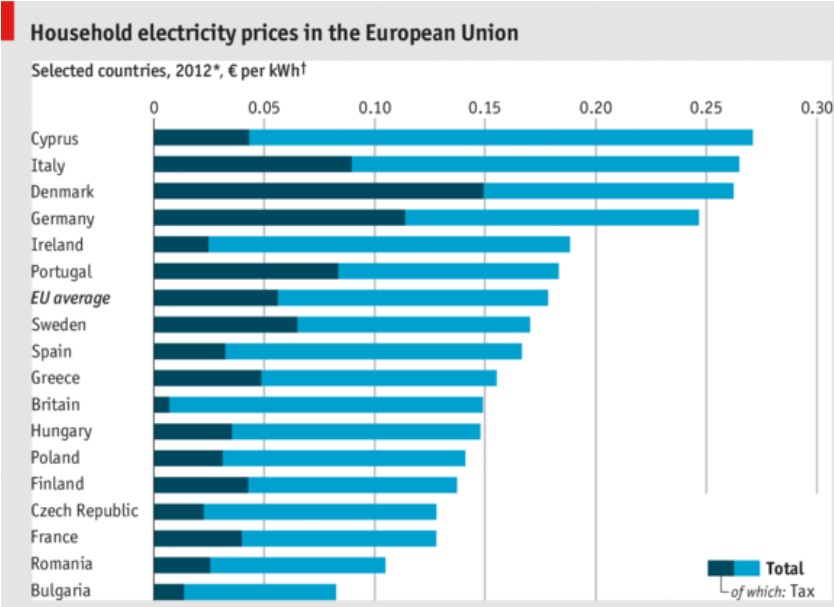
France's overall price of electricity with tax is lower than Denmark's untaxed price, meanwhile emitting >30% less CO2 per capita with a very similar GDP per capita (to within 5%). If we limit our consideration to electricity, France has ~75% lower emissions per MWh generated than Denmark; and over 80% lower than Germany, the renewable powerhouse of the continent. In fact, they have so much zero-CO2 electricity that they can afford to offset the CO2 emissions from many of their neighbors via transmission. Also keep in mind that France has had this CO2 per kWh value for the better part of two decades because its power mix has always been ~70-80% nuclear and ~15% hydro (the rest being filled in with things like gas, hence why this CO2/kWh number isn't a flat zero).
The OECD average is so high mostly because of heavy polluters like the US, being the about 1/4 of the population of the entire OECD (not just the high-income bracket), but twice the per capita CO2 emissions of, say, Germany.
To preemptively dispense with the "we can't build it fast enough" criticism of nuclear, I again present the example of
-
Re:Baby with bathwater
France's overall price of electricity with tax is lower than Denmark's untaxed price, meanwhile emitting >30% less CO2 per capita with a very similar GDP per capita (to within 5%). If we limit our consideration to electricity, France has ~75% lower emissions per MWh generated than Denmark; and over 80% lower than Germany, the renewable powerhouse of the continent. In fact, they have so much zero-CO2 electricity that they can afford to offset the CO2 emissions from many of their neighbors via transmission. Also keep in mind that France has had this CO2 per kWh value for the better part of two decades because its power mix has always been ~70-80% nuclear and ~15% hydro (the rest being filled in with things like gas, hence why this CO2/kWh number isn't a flat zero).
The OECD average is so high mostly because of heavy polluters like the US, being the about 1/4 of the population of the entire OECD (not just the high-income bracket), but twice the per capita CO2 emissions of, say, Germany.
To preemptively dispense with the "we can't build it fast enough" criticism of nuclear, I again present the example of
-
Re:Baby with bathwater
Or goddamn expensive all the while taking a nice steaming dump on the environment.
-
Re:Thanks for pointing out the "briefly" part.
I grabbed the numbers from the World Bank site, though it seems to not be functioning correctly at the moment, as the data won't display for me now.
-
Re:War of government against people?
Will this do?
http://www.publications.parlia...
The graph finishes early, but the trend has continued downwards (i.e. http://www.bbc.co.uk/news/uk-2...)
The problem is the article you cite uses The Daily Mail as it's source, I'm almost inclined to say that automatically makes it wrong, because on average if you take a Daily Mail article and say it's wrong to at least some degree you'll more often be right than not as The Daily Mail exists purely to push a political agenda that often runs against the grain of reality - more recent examples being gay marriage, when the law was going through parliament they published polls saying the majority opposed it, but that ran contrary to every other poll in existence. One of The Daily Mail's past articles (in fact it's the one linked at the bottom of the second article you linked I believe) even conflates crimes and violent crime, so it doesn't even get the absolute most basic comprehension of the numbers right but jumps to conclusions anyway.
Part the issue in comparing firearms offences in the UK is the fact that firearms offence can mean anything from a kid carrying a realistic looking toy gun in public and being told by the police you can't carry realistic looking weapons around, to someone going on a massacre. Whilst firearms themselves are defined in law as non-air weapons - i.e. what most people would see as "proper guns" a firearms offence can involve something that isn't a firearm but looks like one, through to air rifles, through to actual proper guns.
This doesn't contrast well to nations like the US and South Africa where many such offences are kept well away from firearms statistics, but in The Daily Mail's comparisons often ignore this sort of disparity because it doesn't paint the picture they want to paint. Or in other words, many UK firearms offences are actually completely non-violent crimes. Even illegal poaching leads to such offences, for example, carrying a shotgun on private farm land without permission would be an offence under the firearms act.
UK murder rates are even more encouraging now, the UK's homicide rate is below that of nations often seen as some of the most peaceful on earth:
http://en.wikipedia.org/wiki/L...
If you don't trust Wikipedia, the World Bank provides the same data, but the presentation is much more awful IMO:
-
Re:War of government against people?
No. Canada has a massive welfare system funded by their natural resource exploitation.
Seriously? Welfare in Canada is not massive, and Canada isn't as wealthy as the USA.
GNI per capita in Canada in 2012 was 51,570. In the USA it was 52,340. http://data.worldbank.org/indi...
If the USA decides to spend their GREATER wealth on other priorities, well, that's up to them.
-
Re:China anyone?
Look, China puts out over 33% of the emissions today AND RISING. And America is at 15% and dropping.
This is deceiving. It implies that all countries should have equal emissions, regardless of the size of their population. While it's true that China's emissions are increasing (which is bad) and the United States' emissions are decreasing (which is good), as of 2010 the United States still puts out 3x the amount of CO2 as China on a per-capita basis (source).
-
Re:Living up to it's name
Well China is number one in CO2 emissions but per capita you're correct the US is higher per capita than China in CO2 emissions. Now, GHG is one variable in the multidimensional entity you reference but also look at PM10 concentrations which really can screw up your health and surprisingly, Mongolia is the worst at 284, China 82, the US 18. But there are worse offenders such as Saudi Arabia 108, Botswana 199 and I was surprised to see the UAE at 132. Living in those places will definitely shorten your lifespan.
-
But we've emitted more carbon!
I don't understand Krugman (who I respect) saying... "United States accounts for only 17 percent of the world’s carbon dioxide emissions, while China accounts for 27 percent — and China’s share is rising fast."
-
Re: Congressional fix?
When government controls coverage (and it now does) and that coverage goes over budget... costs WILL be reduced
Right now the US spends the highest proportion of GDP on health care of any developed country, and in return gets consistently mediocre outcomes. I bloody well hope costs will be reduced.
-
Re:Useless without a surrogate
I think the Anonymous Coward is talking about the United States, which has a considerably higer ratio.
-
Re:Useless without a surrogate
...it doesn't let guys be teachers anymore.
I don't think so. Statistics show an approximately 50% ratio of female teachers which doesn't seem to be going up (thus implying a decrease in the ratio of male teachers).