Slashdot Mirror
Domain: youtube.com
Stories and comments across the archive that link to youtube.com.
Stories · 2,039
-
Disney IT Workers Prepare To Sue Over Foreign Replacements (computerworld.com)
JustAnotherOldGuy writes: At least 23 former Disney IT workers have filed complaints with the federal Equal Employment Opportunity Commission (EEOC) over the loss of their jobs to foreign replacements. This federal filing is a first step to filing a lawsuit alleging discrimination. These employees are arguing that they are victims of national origin discrimination, a complaint increasingly raised by U.S. workers who have lost their jobs to foreign workers on H-1B and other temporary visas. Disney's layoff last January followed agreements with IT services contractors that use foreign labor, mostly from India. Some former Disney workers have begun to go public (video) over the displacement process -
Interviews: Alan Donovan and Brian Kernighan Answer Your Questions (slashdot.org)
A few weeks ago you had the chance to ask Alan Donovan and Brian Kernighan about programming and their upcoming book, The Go Programming Language (available as an eBook Friday the 20th). Below you'll find their answers to your questions.
Donovan/Kernighan: Thanks to all the Slashdot readers who posed such thoughtful and provoking questions; we’re sorry that space limitations prevent us from answering more of them. Neither of us is part of the core Go team, so we can’t give authoritative answers for some of the questions that deal with future plans for the language or tools.
OpenGL and LockOSThread
by Anonymous Coward
Hi, I've stopped using Go when I saw the hacky stuff I need to do to get libraries like OpenGL to behave correctly. Are there any plans to fix this?
Donovan: The crux of the problem is that many C libraries such as OpenGL implicitly use the identity of the calling thread to store context information. In some cases, this is because the API was designed before multithreading was the norm, when global variables could be safely used to store context information. In other cases, this design is merely a matter of convenience, since it saves passing an extra parameter to every call.
The designers of Go rejected thread-local storage (TLS) because of its tendency to cause "action at a distance": it makes programs slightly shorter but much harder to read. (See p.282 of our book.) Since the lack of TLS in Go is considered a feature, there are no plans to "fix" it, but it may be possible to make TLS-heavy C libraries work better with Go. My colleague David Crawshaw just gave a talk at DotGo 2015 in Paris about this very issue as it concerns OpenGL.
Why was package versioning left out?
by genocitizen
Why was package versioning left out? And are you guys still fond of this decision? As I use Go more and more I see this to be the weak spot; software has been around for many decades, and we all know that it is continuous evolution. Go's import system does not allow specifying or hinting a version, nor does the `go get` command (although it supports major VCSes), and that's how hacks like gopkg.in have been conceived. And it's not like package managers for other languages haven't already solved in a more or less elegant way the problem already...
Donovan: Go is designed for large programs, and versioning is notoriously hard in that context. About ten years ago, there was an experiment to introduce versioning into Google's build system (which was designed by Rob Pike and others). It failed because of the "diamond dependency" problem, which I'm sure many of you have heard of---it's the classic problem of version numbering. Consider four packages A, B, C, D, where A depends on B and C, and B and C both depend on D. This is a diamond dependency. If the author of B decides that only version 1 of D will do, and the author of C requires at least version 2 of D, you have an impossible set of constraints. If you're lucky, you might be able to build A with both the old and the new versions of D, but in general this doesn't work. Since that experiment, Google hasn't touched automated versioning again. The way we do versioning is simple but manual: we treat each version of a package as a separate entity with a distinct name (for example, "D1", "D2"), and work hard to limit the number of versions of each package---ideally to one. That’s why versioning hasn’t been a priority for us at Google. However, this August, the prolific Dave Cheney proposed a scheme for Go package version numbering, so perhaps we’ll see development of this idea in the near future.
Error Handling in Go
by JPyObjC Dude
Go language differs from many other languages in how it handles Errors. Can you summarize the benefits and drawbacks to the Go language error handling approach when compared to Java for large scale applications.
Kernighan: In general, Go strongly encourages being explicit about errors. The standard library functions almost all return an error status along with the function value and your code must do something with that error status; you can’t just ignore errors. In this respect, Go is similar to Java, where you have to either catch or throw errors; you can't just do nothing. This is a nuisance in small one-off programs, but it's a life-saver in larger ones. So both languages are doing "the right thing".
Where they differ is primarily in the use of exceptions. Go does not have an exception mechanism, so there's no direct way to handle all the errors in a single block as there is with Java's try/catch, though the defer statement can help to consolidate error handling. This means that Java code might be somewhat more compact (in this respect only!), but perhaps at the price of not providing as much precise information about what went wrong.
Our Go book spends quite a bit of time on the topic of error handling, and in most of the examples we've tried to show how to deal with errors properly rather than ignoring them, even though this can make the example programs a bit longer.
Donovan: I’ve written a fair amount of Java code and, in my experience, good error handling is about equally hard in both languages. However, Go reduces the syntactic cost of augmenting an error message as you propagate it, because you have to write more or less the same code whether or not you augment the error with new information. Java, by contrast, makes it so tempting to avoid writing try/catch/throw blocks that, too often, programmers propagate exceptions without thinking. It’s interesting that you can never divine such subtle pragmatic differences between languages merely from reading their specs.
Usage
by Behrooz Amoozad
For what scenarios and projects do You recommend it and for which you recommend against using Go?
Kernighan: Go is a very good general purpose language, and we would have no hesitation about using it for any new task. It seems especially well-suited for programs that involve networking or other concurrent tasks; goroutines are very convenient and efficient, and there is also good support for more traditional shared-memory approaches. Empirically, people who write new networking code tend to like Go. I personally would use it for anything where in the past I might have used C or Java or C++.
Go has also gotten some traction as a scripting language, a potential replacement for large Python scripts. This may seem a bit surprising, since scripting languages are very convenient for cobbling something together in a hurry. The problems come later, when the cobbled-together code starts to crash with type errors or other faults that could have been detected much earlier with a statically typed language. Go won't replace Awk for one-liners, nor is it likely to replace Python or Perl or Ruby for 10- or even 100-line programs, but after a while, the combination of type safety and efficiency is worth the somewhat higher up-front cost.
Why should I use Go?
by aaaaaaargh!
For someone like me who likes garbage collection, multiple dispatch, and extreme abstraction capabilities in high level languages like Common Lisp, and safety, compile-time error detection, readability, and speed in low level languages like Ada or Haskell, what are the benefits of using Go in comparison to these two different types of languages? What new useful features does Go bring?
Kernighan: Ada and (especially) Haskell don't seem like low-level languages and Haskell is inscrutable to newcomers, but those are quibbles. Go has everything you mention in both of your lists of desirable attributes (depending perhaps on what you mean by "extreme abstraction"), but it also provides concurrency in a convenient and efficient form; that's a big win for some kinds of applications.
Donovan: Go seems very plain when compared with languages like Common Lisp, C++, Java, or Python. It has no macros, no templates, no classloaders, no metaclasses. Features such as these are often the first things I, being a PL geek, rush to play with when writing toy programs in a new language, but they are not usually the things that matter the most when programming in the large. I can recall without fondness many days spent debugging overly clever uses of the C++ STL or non-hygienic Lisp macros or the Python __call__ method. The design of Go recognizes that simplicity, homogeneity, and familiarity of a large code base are more valuable to the team as a whole than the benefits to each individual of using their favorite (obscure) language features for each task.
Go’s potential
by Qbertino
What serious long-term real-world potential do you see for Go? How do you see the potential of Go replacing existing open source webstacks such as Apache and PHP, Python or Ruby? Was Go built with a technology update of existing approaches in mind? How feasible is it in your opinion to try and replace the existing complex stacks with pure Go runtimes?
Kernighan: The reason it took God only six days to create the universe is that he didn't have to deal with the embedded base. Realistically, no programming language is likely to completely replace major existing code bases; it's just too much work. Go is often a good choice for new projects or where one is planning to rewrite an existing system anyway, and it can provide a good interface to existing code through foreign function interfaces, particularly to C libraries. But wholesale replacements seem unlikely.
Donovan: I agree with Brian that Go isn’t likely to eliminate any other language or library, but that is not its goal. Go provides an attractive alternative. A good part of Go’s popularity comes from the ease with which you can build useful web servers and other distributed systems using little more than the components of the standard library. The library was produced recently, and thus with the benefit of hindsight, by systems experts, and it often makes third-party servers like Apache or frameworks like Rails unnecessary for the first steps---although of course similar frameworks do exist for Go too.
Official Go IDE?
by Qbertino
Is there an official cross-platform Go IDE in the works? Experience shows that adoption is accelerated by offering a solid toolkit that is easy to pick up and get started with - such as the formidable Android Studio IDE Google offers to developers. Are there any plans similar to this for Go? I would like to see it take the place of C++ in the development of performant end-user applications with GUIs - are there any officially sanctioned projects that aim to provide a serious GUI toolkit and stack based on Go?
Donovan: We agree that good IDE support is important for attracting new users to Go, though my colleagues and I came to this realization rather slowly as, perhaps unsurprisingly, most of us use very traditional editors like Vim, Emacs, SublimeText, and even Acme, which are not what most people think of as IDEs. This year, JetBrains have created a team to develop a Go plugin for IntelliJ so that IntelliJ IDEA users can build, test, debug, and refactor programs written in Go as easily as in any other language.
As for cross-platform GUI toolkits, there’s no canonical solution yet, though there have been some interesting experiments such as GXUI and Shiny.
Should Go replace Java?
by Martinjnh
Should Go replace Java as development platform/language for android?
Donovan: The Go team at Google is working hard to make it possible to use Go to write mobile applications on Android and iOS; see Hana Kim's GopherCon 2015 talk, for example. But for now this is just an experiment and, as Brian wrote above, it's not Go's goal to replace major existing code bases.
Safe Performance
by snadrus
Reimplementing the Gnu+Linux toolchain in GoLang could provide safety that decades of eyes on C could not (thinking about the recent BASH bugs & OpenSSL overruns). Even a small portion would add security to Android. Performance is close & 1.5's library loading should keep executables light. Is there interest in rebuilding Linux's base userland?
Donovan: Go is a good fit for these kinds of tools because the language has good runtime safety and a straightforward system call interface, and it compiles to static executables that start quickly and run efficiently. Portability might be a concern: while Go programs themselves are highly portable, Go's runtime currently targets only a handful of major architectures, far fewer than gcc and glibc support. I'm not aware of any rebuilding projects.
tEoPS
by M. D. Nahas
There many books on "how to program" but few on "how to program well". Brian, your book "The Elements of Programming Style" is a wonderful and a classic, but my students have a hard time reading the examples (Fortran 66 and PL/I). Is there any hope for an update? Is there any similar modern-language book that you recommend?
Michael Nahas (son of Joe Nahas)
P.S. I totally stole as much as I could from you when writing my tutorial for the language Coq. Sorry/Thanks!
Kernighan: The languages that Bill Plauger and I used in "The Elements of Programming Style" are either long gone (PL/1) or very much evolved (Fortran), so the code is indeed hard to read today, though most of the rules of good style are still valid. Bill and I once started a version in C but didn't get very far. One problem was that the original book relied almost exclusively on code fragments from textbooks. Modern textbooks are far better than they were 40 years ago; most code is syntactically correct and mostly works. So it was hard for us to find textbook examples to illustrate our rules. Another problem is that real programs are a lot bigger and more complicated than they were, and it's hard to find excerpts that would work in a book. So an update of EOPS isn't likely, much as it would be nice to have one.
As to other books, Josh Bloch and Scott Meyers have written excellent books on how to write good Java and C++ respectively. More broadly, I have always liked Steve McConnell's "Code Complete", and I take a fresh look at Fred Brooks's classic "The Mythical Man Month" every few years. There are plenty of other books about how to program well in various languages and environments; it's well worth reading some of them to see how other authors approach the topic.
C's current place in the world
by MountainLogic
As the legend has it, C was created to support operating system development. As time has gone by C++ has slipped into OS development on larger platforms. It seems that much of the current core use of mother C is centering on embedded processors (all the way down to 8 bit micros with 256 bytes of RAM) and drivers in larger systems. For current use what design choices in C do you see as wise and what would you change given the current usage of C. (P.S. Thank you for co-authoring the most wonderful, perfect, clear and concise technology document ever.)
Kernighan: Bear in mind that C is Dennis Ritchie's work; I can only claim to have written a book with him. Dennis was a great writer as well as a great programmer and language designer, and the book was very much a joint effort.
That said, C is indeed still popular for embedded systems and drivers, where efficiency and the ability to get right down to the hardware matters. I think that changing C today would be counter-productive; one of C's strengths is that it is quite stable. Indeed, I suspect (though without having data to prove it) that except for minor features like // comments most programmers use C as it was after the 1988 ISO standard; the C99 and C11 standards did not change much of programming practice.
Motivation for writing the book
by jameshwang
I was curious out of all the Golang books that currently exists, how does this book, "The Go Programming Language," differ from the rest and fit into the landscape of Golang? I've read some of the other books like "Go Programming Blueprints" and "Go in Action." Specifically with "Go in Action," the table of contents seems similar to your book.
I guess what was your motivation to write this book and how will it be different from all the rest? Brian, are you hoping this book becomes what "The C Programming Language" became but for Golang?
Kernighan: As it says in Ecclesiastes 12:12, "of making many books there is no end", which suggests that your question about whether another book is needed is an old one.
When one writes a book, there is always the belief or at least hope that one can do it "better" than others, not in any negative sense but just that new organization, examples, explanations, and writing will all combine in a way that readers will find helpful. Certainly that has been what Alan and I have tried to achieve with "The Go Programming Language". It would of course be wonderful if the Go book was as helpful to programmers as the C book seems to have been.
I have looked at only a couple of the many Go books that have already been written (and not the ones you mention), and in fact Alan and I quite consciously stopped even looking at titles once we started thinking about our own book, since we didn't want to inadvertently borrow from other authors.
Donovan: For me, one motivation was to write the book I wished I had been able to read when I started learning Go---a comprehensive book that covers not just the language and its library, but one that motivates the design choices, explores advanced features, flags the pitfalls, and conveys the style and aesthetics of the language.
Although comparisons with K&R are inevitable (and flattering), I don't think any technical book can ever be as influential as that one. It was not just a tutorial for the most important language of a (pre-Internet) generation, but also its reference manual and de facto spec. Today, of course, you can browse The Go Tour, Godoc, and The Go Language Specification from your cellphone. Libraries are larger and tooling is more important. A modern book must have a different emphasis. We've tried to show how all the parts fit together. -
Star Wars Battlefront Released (giantbomb.com)
An anonymous reader writes: Yesterday marked the release of Star Wars Battlefront, EA DICE's attempt to resurrect a Star Wars video game series that had great success a decade ago, but gradually petered out over the course of several years. Early reviews for the game are mixed. Games Radar's video review gives it a lot of credit for being incredibly faithful to the feeling of Star Wars. Polygon's review praises the game's accessibility and its broad variety of PvP options, but acknowledges that it had to trade complexity to get there. Giant Bomb's review is much more blunt: "Slick production values, solid controls, and tons of fan service can't make up for mediocre progression and a lack of content." Many reviews rate the graphics highly, and performance is solid even on consoles. It's worth noting that user ratings on Metacritic come in significantly lower than critics' ratings, with the most common complaint being about the dearth of content. -
Microsoft Brings Its Embrace-Extend-Extinguish Game To K-12 Schools?
theodp writes: A year after it paid $2.5 billion to buy Minecraft, Microsoft has announced a partnership with Code.org that makes a Minecraft-themed introduction to programming a signature tutorial of this year's Hour of Code, which hopes to reach 200 million schoolchildren next month in what the Microsoft-funded nonprofit is billing as the largest learning event in history. "A core part of our mission to empower every person on the planet is equipping youth with computational thinking and problem-solving skills to succeed in an increasingly digital world," said Microsoft CEO Satya Nadella in a press release, which also notes that "Microsoft is gifting Windows Store credit to every educator who organizes an Hour of Code event worldwide." Of the Minecraft tutorial, Code.org CEO Hadi Partovi gushed, "Compared to what you would otherwise be doing for school, this is, like, the best thing ever." -
Anonymous Vows Revenge For ISIS Paris Attacks
An anonymous reader writes: As usual, Anonymous members are quicker to respond to threats than investigators and have announced #OpParis as revenge for the Paris attacks. Their action is similar to #OpISIS from this spring, launched after the Charlie Hebdo attacks. Previously Anonymous ousted thousands of ISIS Twitter accounts in #OpISIS. In a more conventional response, the government of France has been bombarding ISIS positions in Syria with airstrikes, and hunting for suspect Salah Abdeslam in connection with Friday's killings. -
'Twas the Week Before the Week of Black Friday
theodp writes: It's almost time for America's answer to the Running of the Bulls (YouTube), kids. So, if you're dreaming of a cheap tech Christmas, it's time to peruse the 2015 Black Friday ads and make your game plan. Get lucky at Best Buy this year, and you could score a $299.99 Dell 15.6" touchscreen laptop (i3, 8GB memory, 1 TB HD), a $399.99 Microsoft 10.8" Surface 3 (Atom x7, 2GB memory, 64GB storage), $899.99 MacBook Pro 13.3" laptop (i5, 4GB memory, 500MB HD), $99 Acer 11.6" Chromebook (Celeron, 2GB memory, 16GB storage), or, for those on a tight budget, a $34.99 7" Amazon Fire tablet. Fight the crowds at Walmart, and you could snag a $199 HP 15.6" laptop (Celeron, 4GB memory, 500GB drive) or $199 iPad mini 2. And for stay-at-home shoppers, Dell's Windows 10 price-breakers include a $149.99 14" laptop (Celeron, 2GB memory, 32GB storage) and a $229 15.6" laptop (i3, 4GB memory, 500MB HD). So, in your experience, has Black Friday been like a claw machine — suckering you with big prizes, but never delivering — or have you actually walked away with a great deal? -
Head of Indonesia's Anti-Drug Agency Proposes Using Crocodiles To Guard Prisons
HughPickens.com writes: BBC reports that Budi Waseso, the head of Indonesia's anti-drugs agency has proposed building a prison island guarded by crocodiles to house death-row drug convicts and says crocodiles make better guards than humans — because they cannot be bribed. "We will place as many crocodiles as we can there," says Waseso. "You can't bribe crocodiles. You can't convince them to let inmates escape." Waseso says only traffickers would be kept in the jail, to stop them from mixing with other prisoners and potentially recruiting them to drug gangs. The plan, reminiscent of James Bond's "Live and Let Die" movie escape, is still in the early stages, and neither the location or potential opening date of the jail have been decided. Anti-drugs agency spokesman Slamet Pribadi confirmed authorities were mulling the plan to build "a special prison for death row convicts" Indonesia already has some of the toughest anti-narcotics laws in the world, including death by firing squad for traffickers, and sparked international uproar in April when it put to death seven foreign drug convicts, including Australians Andrew Chan and Myuran Sukumaran. Despite the harsh laws, Indonesia's corrupt prison system is awash with drugs, and inmates and jail officials are regularly arrested for narcotics offences. -
Before Barbie's Brainy Makeover, Mattel Execs Met With White House, Google
theodp writes: Mattel came under fire last November over its portrayal of Computer Engineer Barbie as incompetent. But the toymaker is now drawing kudos for its new Imagine the Possibilities Barbie ad campaign (video), which shows little girls pretending to be professionals in real-life settings, including a college professor lecturing students about the brain. Ad Age, however, is cynical of the empowering spin on Barbie, which it says "comes across as a manipulative way to silence criticism." Interestingly, some of that criticism may have come from the White House.
WH Visitor Records show that Barbie's brainy makeover came after Mattel execs — Evelyn Mazzocco, Julia Pistor, Heather Lazarus — were summoned to the White House last April to meet with the White House Council on Women and Girls. A little Googling suggests other attendees at the sit-down included representatives of the nation's leading toy makers (Disney Consumer, Nickelodeon, Hasbro, American Girl), media giants (Disney Channels, Viacom, TIME, Scholastic, Univision, Participant Media, Cartoon Network, Netflix), retailers (Walmart, Target), educators, scientists, the U.S. Dept. of Education (including the Deputy Director of Michelle Obama's Reach Higher Initiative), philanthropists (Rockefeller, Harnisch Foundations) — and Google. Representing Google was CS Education in Media Program Manager Julie Ann Crommett, who has worked with Disney to shape programming to inspire girls to pursue CS in conjunction with the search giant's $50 million Made With Code initiative.
The April White House meeting appears to be a reschedule of a planned March meeting that was to have included other Mattel execs, including Stephanie Cota, Venetia Davie, and Lori Pantel, to whom the task of apologizing for Computer Engineer Barbie fell last November. For the first time in over a decade, Barbie was no longer the most popular girls' toy last holiday season, having lost her crown to Disney Princesses Elsa and Anna, who coincidentally teamed up with Google-backed Code.org last December to "teach President Obama to code" at a widely-publicized White House event. -
Ocean-Mapping Robots Could Help Uncover Mysteries of the Deep Blue (thestack.com)
An anonymous reader writes: A swarm of pumpkin-shaped robots is being developed to map oceans, gathering maritime data for use in tourism, reef monitoring and anti-terrorism among other applications. The Eve robot – or Ellipsodial Vehicle for Exploration – was created by Sampriti Bhattacharyya, a robotics engineer at the Massachusetts Institute for Technology (MIT). Inspired by the loss of the Malaysia Airlines plane, the scientist envisions her yellow robots travelling below the water's surface, using their sensors to detect and monitor underwater happenings – both individually and collaboratively. -
Google-Supported CodeGirl Documentary Makes "Exclusive YouTube Premiere"
theodp writes: As part of our Made with Code and media perception initiatives," wrote YouTube CEO Susan Wojcicki over at the Official Google Blog, "I'm excited that we're supporting award-winning documentary filmmaker Lesley Chilcott — of An Inconvenient Truth and Waiting for Superman [and Code.org] fame — on her next film, CodeGirl. Until November 5 Lesley's film will be available for free on YouTube, before its theatrical debut in the next few weeks." Microsoft is pretty jazzed about the movie too, as is Al Gore. Decidedly less excited about CodeGirl is film critic Inkoo Kang, who writes, "CodeGirl, a chronicle of this year's Technovation contest, is just as well-intentioned as its subject. It coasts for as long as it can on the feel-good fuel of watching smart, earnest girls talk about creating an app, but with virtually no tension, context, narrative or characterization driving the story, the documentary grows to feel like a parent describing their daughter's involvement in an international competition. The girls' achievements are impressive, but you definitely don't want to hear about them for nearly two hours. -
Hacking Jules Coaxes Android Wear To Run Nintendo 64 and PSP Emulators (androidpolice.com)
Espectr0 writes: YouTube user Hacking Jules would like you to see his collection of game emulators running on Android Wear. He manages to play classic 3D Mario and Zelda games running in a Nintendo 64 emulator on the original LG G-Watch, while also running Monster Hunter on the PPSSPP emulator.As the linked article admits, this is a work of passion rather than practicality -- if you actually want to play those games enjoyably, don't trade your console or conventional emulator for a smart watch. -
Revisiting Why Johnny Can't Code: Have We "Made the Print Too Small"?
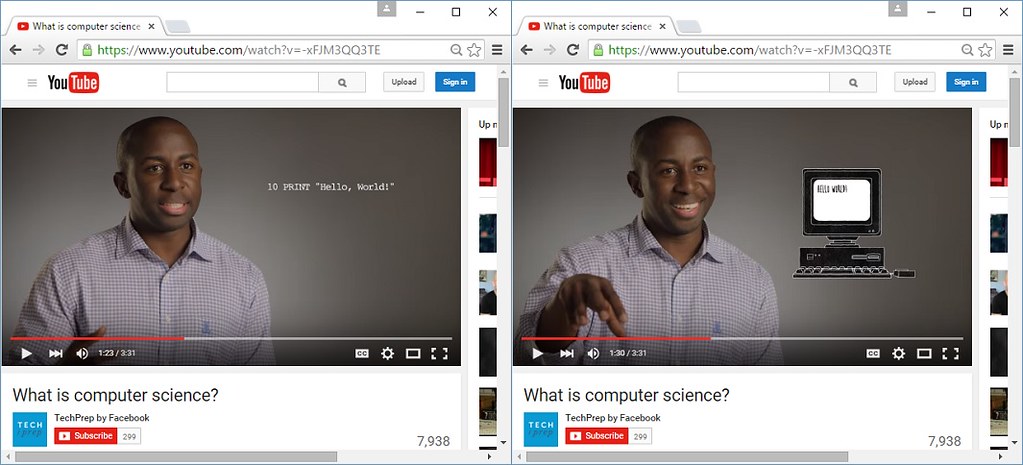
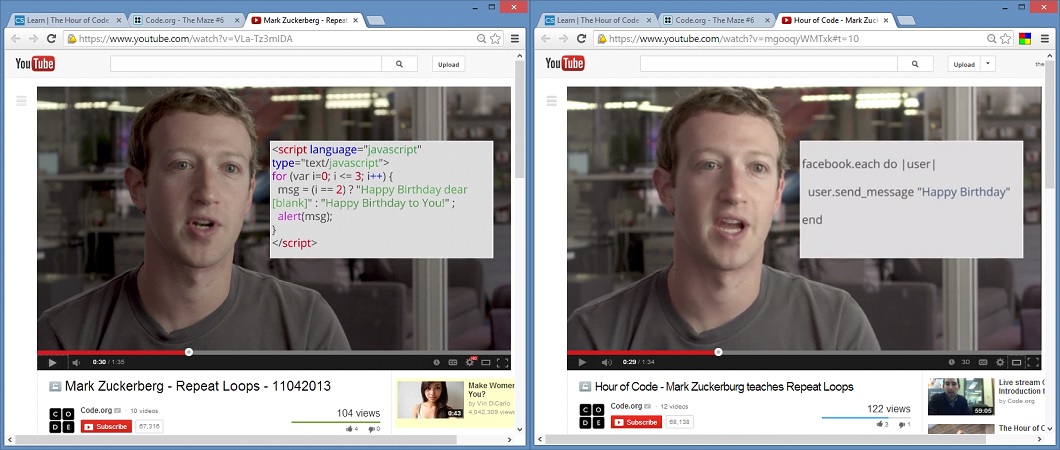
theodp writes: In What is Computer Science?, the kickoff video for Facebook's new TechPrep diversity initiative, FB product manager Adriel Frederick explains how he was hooked-on-coding after seeing the magic of a BASIC PRINT statement. His simple BASIC example is a nice contrast to the more complicated JavaScript and Ruby examples that were chosen to illustrate Mark Zuckerberg's what-is-coding video for schoolkids. In How to Teach Your Baby to Read, the authors explain, "It is safe to say that in particular very young children can read, provided that, in the beginning, you make the print very big." So, is introducing coding to schoolkids with modern programming languages instead of something like BASIC (2006) or even (gasp!) spreadsheets (2002) the coding equivalent of "making the print too small" for a child to see and understand? -
Revisiting Why Johnny Can't Code: Have We "Made the Print Too Small"?
theodp writes: In What is Computer Science?, the kickoff video for Facebook's new TechPrep diversity initiative, FB product manager Adriel Frederick explains how he was hooked-on-coding after seeing the magic of a BASIC PRINT statement. His simple BASIC example is a nice contrast to the more complicated JavaScript and Ruby examples that were chosen to illustrate Mark Zuckerberg's what-is-coding video for schoolkids. In How to Teach Your Baby to Read, the authors explain, "It is safe to say that in particular very young children can read, provided that, in the beginning, you make the print very big." So, is introducing coding to schoolkids with modern programming languages instead of something like BASIC (2006) or even (gasp!) spreadsheets (2002) the coding equivalent of "making the print too small" for a child to see and understand? -
MAME Emulating a Sonic the Hedgehog Popcorn Machine (polygon.com)
New submitter AmericaCounterweight writes: Polygon is reporting that the MAME development team has unearthed and emulated one of the most obscure pieces of Sonic heritage: a popcorn machine. MAME developer David Haywood reports that contributors "purchased the PCB for another novelty Sonic item, this time a SegaSonic Popcorn Shop, a popcorn dispenser machine with a video display. It runs on the Sega C2 board (Genesis type hardware)." This follows news from earlier this year that the MAME team would be switching to a true Open Source license for the project and concentrating on more than just arcade games. MAME project coordinator Miodrag Milanovic also recently appeared at the BalCCon2k15 event to speak about MAME, the current direction of the project, and software preservation. -
Functioning Hoverboard Unveiled (cnn.com)
An anonymous reader writes: Last year, a company called Arx Pax set up a Kickstarter campaign to develop a functioning hoverboard. Now, the company has demonstrated an updated version of the device, which is fully capable of hovering over a surface made out of conductive metal (video on YouTube). CEO Greg Henderson said, "The hover engine creates a primary magnetic field which is then put over a candidate surface like aluminum or copper. The hover engine then creates swirls of electricity and those create a secondary magnetic field, which propels the firsts." The device is expensive; Arx Pax is delivering a handful of units to Kickstarter backers who contributed $10,000. It's out of the reach of typical consumers, but it does seem to work. Plus, the company is sharing their magnetic field technology with teams taking part in the competition to build pods for a prototype of Elon Musk's Hyperloop vacuum tube transportation system. -
Reactions Split On What Canada's Liberal Majority Means For Tech Policy Future (freezenet.ca)
Dangerous_Minds writes: Few could have predicted the Liberal majority win in Canada's recent election. Now that the Canadian government is in a state of transition, some have speculated what the new government will bring to the table when it comes to a policy on technology. Michael Geist is speculating that the people in the new Liberal government may bring about a positive policy change, concluding "All of this points to real change and the chance for a fresh start on Canadian digital policy in the years ahead." Meanwhile, Freezenet has a very different take. Drew Wilson points out that the last time the Liberal government was in power, the party was very combative on digital rights because they were trying to bring in Lawful Access and the Canadian DMCA before Stephen Harper took power. In one very infamous exchange, Sam Bulte lashed out at people like Michael Geist by calling him and his supporters "pro-user zealots". With digital rights not even on the radar during the election outside of Bill C-51 towards the beginning and the Liberals long history on these files, Wilson paints a very bleak future given that the Liberal party now has a majority government and can push through policies unopposed whether controversial or not. -
Tattling Kettles Help Researchers Crack WiFi Networks In London (pentestpartners.com)
New submitter campuscodi writes: Security researchers at Pen Test Partners have found a security vulnerability in the iKettle Wi-Fi Electric Kettle that allows attackers to crack the password of the WiFi network to which the kettle is connected. Researchers say that using this simple trick and information about iKettles, they drove around London, cracked home WiFi networks, and created a map of insecure WiFi networks across the city. The same researchers cracked a Samsung smart-fridge this summer to disclose Gmail passwords. If you have 6 minutes, there's a YouTube video you can watch. -
Deja Vu: Microsoft's 2015 Surface Book Ad and Apple's 2014 'Your Verse' iPad Ad
theodp writes: With its sweeping vistas and narration by the late Robin Williams, Apple's 2014 'Your Verse' ad dramatically showcased the many ways iPads might help people create, from making movies to calibrating wind turbines. So it's interesting that Microsoft's first ad for its new Surface Book (YouTube) bears a striking resemblance to the earlier Apple ad (YouTubeDoubler comparison). Which is probably only fair, since Apple's soon-to-be-released iPad Pro bears more than a passing resemblance to the Microsoft Surface. Hey, good artists copy, great artists steal, right? By the way, between the release of Microsoft's Surface Pro 4, Apple's iPad Pro, and Google's Pixel C, is the keyboard+touch interface poised to be a four-decade "overnight success"? -
Radio Waves Can Be Used To Hijack Androids and iPhones Via Siri and Google Now
An anonymous reader writes: Two French researchers have discovered a way to use the Siri and Google Now voice assistant software to relay malicious commands to smartphones without the user's consent or knowledge. This method relies on a special hardware rig that can send radio waves to smartphones with earphones plugged into them. The radio waves get picked up by the earphone cable, get transformed into electrical signals and then to software commands. The research is accompanied by a YouTube video as well. Note that this attack, as the article explains, so far relies on some bulky dedicated equipment, and on the attacker being close to the system he wants to disrupt. -
Learning To Fly, With a Full-Size Cockpit Simulator
Make Zine features the story of Aidan Fay, a 17-year-old San Diego student who has constructed a full-size Cessna 172 cockpit simulator in his bedroom, controlled by Arduinos and using scavenged game-controller parts. Because the display Fay is using is an Oculus Rift headset, the visual similarity to an actual plane's interior (not to mention the view) isn't as great as some simulators', but the hardware makes it nonetheless more realistic for a headset-wearing pilot than some simulators that might look prettier: he's got actual rudder pedals, and a force-feedback system on a yoke (also real). Fay's interest is more than as a flight simulator enthusiast, though: he's built this system primarily as an educational tool, as he works to get around a medical problem that's delayed his quest for a pilot's license. -
University of Cape Town Team Breaks World Water Rocketry Record (uct.ac.za)
New submitter Cycliclogic writes: A team of engineers based at the University of Cape Town recently had their record breaking flights of their water powered rocket Ascension III ratified by the Water Rocket Achievement World Record Association. This record is for a single stage rocket power purely on pressurized water. Two launches must be completed within two hours, the record being set at the mean above-ground altitude of the two flights. The record now stands at a whopping 2723 Feet (830m). You can watch videos of the launches here. (Warning: they're loud.) -
University of Cape Town Team Breaks World Water Rocketry Record (uct.ac.za)
New submitter Cycliclogic writes: A team of engineers based at the University of Cape Town recently had their record breaking flights of their water powered rocket Ascension III ratified by the Water Rocket Achievement World Record Association. This record is for a single stage rocket power purely on pressurized water. Two launches must be completed within two hours, the record being set at the mean above-ground altitude of the two flights. The record now stands at a whopping 2723 Feet (830m). You can watch videos of the launches here. (Warning: they're loud.) -
Making Your Graphing Calculator a Musical Instrument
An anonymous reader writes: Thanks to a recently published open source music editor/sequencer, you can now create music on Texas Instruments graphing calculators. The complexity of the sound is impressive (video) for such a simple device, which does not feature any dedicated sound hardware. HoustonTracker 2 is open source, and is available for the TI-82, 83, 83Plus, and 84Plus. -
Europe Code Week 2015: Cocktails At Microsoft, 'Ode To Code' Robot Dancing
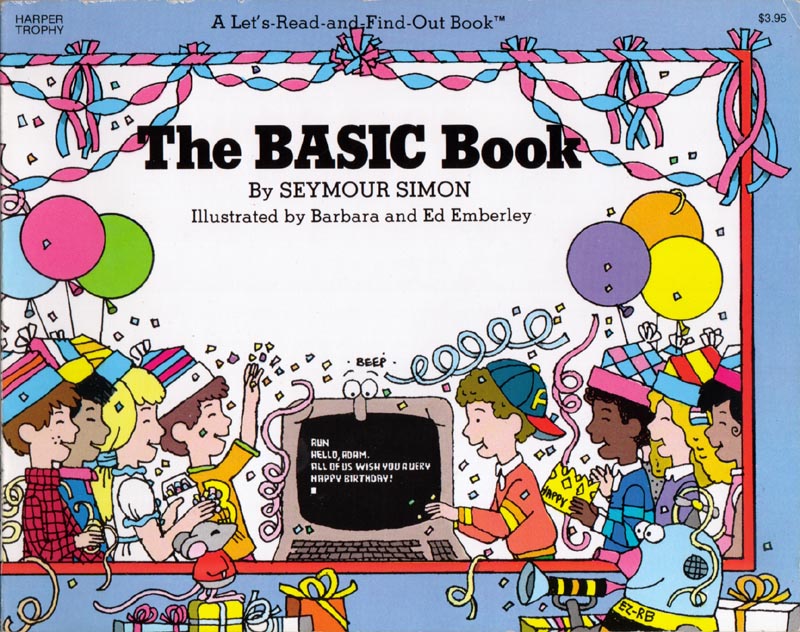
theodp writes: In case your invite to next week's Europe Code Week 2015 kickoff celebration at the Microsoft Centre in Brussels was lost in the e-mail, you can apparently still invite yourself. "Let's meet to celebrate coding as an empowering competence, key for maintaining our society vibrant and securing the prosperity of our European digital economy," reads the invite at the Microsoft and Facebook-powered All you Need is Code website. And to "keep raising awareness of the importance of computational thinking beyond Code Week," EU Code Week is also running an Ode to Code Video Contest, asking people to make short YouTube videos showing how the event's Ode to Code soundtrack causes uncontrollable robot dancing (video) and flash mobs (video). Things sure have changed since thirty years ago, when schoolchildren were provided with materials like The BASIC Book to foster computational thinking! -
Europe Code Week 2015: Cocktails At Microsoft, 'Ode To Code' Robot Dancing
theodp writes: In case your invite to next week's Europe Code Week 2015 kickoff celebration at the Microsoft Centre in Brussels was lost in the e-mail, you can apparently still invite yourself. "Let's meet to celebrate coding as an empowering competence, key for maintaining our society vibrant and securing the prosperity of our European digital economy," reads the invite at the Microsoft and Facebook-powered All you Need is Code website. And to "keep raising awareness of the importance of computational thinking beyond Code Week," EU Code Week is also running an Ode to Code Video Contest, asking people to make short YouTube videos showing how the event's Ode to Code soundtrack causes uncontrollable robot dancing (video) and flash mobs (video). Things sure have changed since thirty years ago, when schoolchildren were provided with materials like The BASIC Book to foster computational thinking! -
Europe Code Week 2015: Cocktails At Microsoft, 'Ode To Code' Robot Dancing
theodp writes: In case your invite to next week's Europe Code Week 2015 kickoff celebration at the Microsoft Centre in Brussels was lost in the e-mail, you can apparently still invite yourself. "Let's meet to celebrate coding as an empowering competence, key for maintaining our society vibrant and securing the prosperity of our European digital economy," reads the invite at the Microsoft and Facebook-powered All you Need is Code website. And to "keep raising awareness of the importance of computational thinking beyond Code Week," EU Code Week is also running an Ode to Code Video Contest, asking people to make short YouTube videos showing how the event's Ode to Code soundtrack causes uncontrollable robot dancing (video) and flash mobs (video). Things sure have changed since thirty years ago, when schoolchildren were provided with materials like The BASIC Book to foster computational thinking! -
Hour of Code Kicks Off In Chile With Dog Poop-Themed CS Tutorial
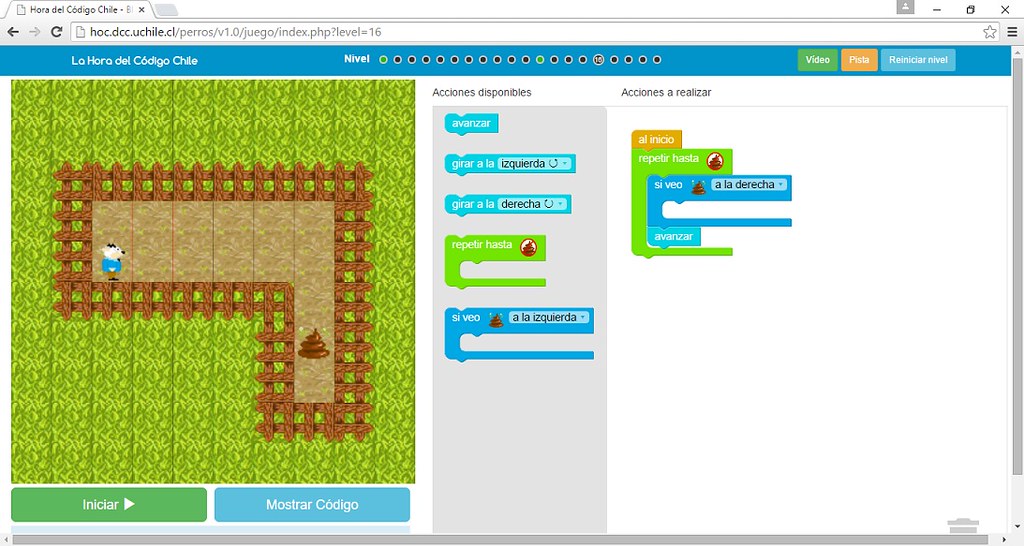
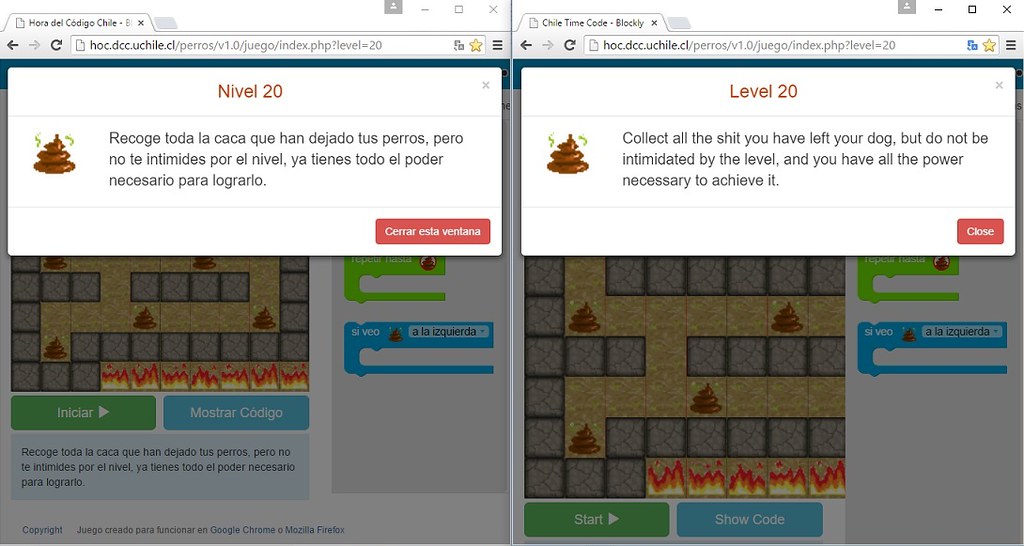
theodp writes: In an interesting contrast to the Disney princess-themed Hour of Code tutorial that 'taught President Obama to code' last December, Chile is kicking off its 2015 Hora del Codigo this week with a top-featured Blockly tutorial that teaches computer science by having kids drag-and-drop blocks of code to pick up dog poop. "Collect all the shit you have left your dog," reads the Google translated instructions for the final coding exercise. In its new video for the Hour of Code 2015 campaign, tech billionaire-backed Code.org notes that it's striving to reach 200 million schoolchildren worldwide by this December. Presumably towards that end, Code.org warns that it will penalize Computer Science tutorials that "work only in English." -
Motorola Marketed the Moto E 2015 On Promise of Updates, Stops After 219 Days
An anonymous reader writes: Over the past few years, Motorola has emerged as one of the best manufacturers for low-to-mid-range Android phones. Unlike many other major manufacturers, they keep their version of Android close to stock in order to keep OS updates flowing more easily. When they began marketing the Moto E 2015, updates were one of the features they trumpeted the loudest. But after the company published a list of devices that will continue to get updates, Android Police found the Moto E to be conspicuously absent. The phone launched on February 25, a mere 219 days ago. According to an official Motorola marketing video from launch day, "...we won't forget about you, and we'll make sure your Moto E stays up to date after you buy it." -
Study: Man-Made Global Warming First Became Evident In the Mid 20th Century
TapeCutter writes: In 1958 the US National Academies of Science (NAS) warned the US government that they had detected a robust Anthropogenic Global Warming (AGW) signal, they have not changed their mind on that claim for 57 years. Like the modern day Al Gore, Frank Capra publicized the possible effects in a popular documentary (video). Today we have news of a study from Melbourne University claiming the effects of AGW first became evident in the mid 20th century. In other words, the NAS could not have picked up the signal much earlier than they actually did. The fact that the last serious scientific objection to AGW (as a theory) was overcome in the mid 20th century by improving spectrometers in heat seeking missile was a remarkable coincidence, NAS took full advantage of that opportunity. -
ESA-JAXA Team Wins 'America's Cup of Rocket Science'
An anonymous reader writes: NASA's Jet Propulsion Laboratory just announced the winners of the 8th edition of the Global Trajectory Optimization Competition, aka the America's Cup of Rocket Science. For the first time, a joint team from ESA and JAXA won the prestigious award. They had to design a nearly impossible mission to perform space-based Very-Long-Baseline Interferometry using the formation flight of three spacecraft around the Earth. Their incredibly complex trajectory can be seen here on the YouTube channel of the winning team. The full final ranking can be also downloaded here. -
Bjarne Stroustrup Announces the C++ Core Guidelines
alphabetsoup writes: At CppCon this year, Bjarne Stroustrup announced the C++ Core Guidelines. The guidelines are designed to help programmers write safe-by-default C++ with no run-time overhead. Compilers will statically check the code to ensure no violations. A library is available now, with a static checking tool to follow in October.
Here is the video of the talk, and here are the slides.The guidelines themselves are here. -
Google DeepMind's AI Beats Humans At Even More Computer Games
An anonymous reader writes: Google DeepMind's learning algorithm has trumped human performance in an even greater range of games from the Atari 2600. The system's performance in classic games for the 80's games console has improved steadily since it was revealed in April last year (video) and a paper released yesterday shows it besting people in 31 titles. -
Girls-Only Computer Camps Formed At Behest of Top Google, Facebook Execs
theodp writes: Reporting on Google exec Susan Wojcicki's appearance at DreamForce, Inc.'s Tess Townsend writes: "The YouTube CEO said her daughter had stated point-blank that she did not like computers, so Wojcicki enrolled her in a computer camp. The camp made her daughter dislike tech even more. Wojcicki reported her daughter came back saying, 'Everyone in the class was a boy and nobody was like me and now I hate computers even more.' So, mom called the camp and spoke to the CEO, asking that the camp be made more welcoming to girls" (video). Fortune reported last July that it was the urging of Wojcicki and Facebook COO Sheryl Sandberg that prompted iD Tech Camps — which Wojcicki's and Sandberg's kids had attended — to spin off a girls-only chain of tech camps called Alexa Cafe, which was trialed in the Bay Area in 2014 and expanded to nine locations in 2015. Earlier this month, Fortune noted that Wojcicki's daughter attended the $949-a-week Alexa Cafe summer camp at Palo Alto High, which was coincidentally hosted in the multi-million dollar Media Center (video) that was built thanks to the efforts of Wojcicki's mother Esther (a long-time Paly journalism teacher) and partially furnished and equipped by sister Anne (23andMe CEO) and ex-brother-in-law Sergey Brin's charitable foundation. -
Researchers Fly 50 Autonomous Planes Simultaneously
New submitter MagicRuB writes: Researchers at the Naval Postgraduate School in Monterey, CA recently flew fifty small autonomous planes together in what they claim is a "record-breaking drone swarm". These aircraft were built from lightweight foam wings with hobby-grade components, and were equipped with an autopilot running firmware based on the open-source Ardupilot project as well as a companion computer running custom autonomy software built on top of ROS and an 802.11n wireless device to communicate with other planes and ground stations. The researchers are using this swarm as a platform for advancing drone technology, and hope to see results implemented in agriculture, search and rescue, and defense applications. -
Using a Smartphone As a Virtual Reality Controller
New submitter mutherhacker writes: A group from Osaka University in Japan and McMaster University in Canada have presented a method to control a virtual 3D object using a smartphone [video]. The method was primarily designed for presentations but also applies to virtual reality using a head mounted display, gaming or even quadrocopter control. There is an open paper online as well as a git repository for both the client and the server. The client smartphone communicates with the main computer over the network with TUIO for touch and Google protocol buffers for orientation sensor data. -
Rupert Murdoch Buys National Geographic Magazine
dywolf writes: In a move that has inspired "dread" among the publication's journalists, as well as long time readers, Rupert Murdoch has just bought a controlling interest in all of National Geographic's media properties. The move turns the long time non-profit into a for-profit media corporation in the process. Some commenters have pointed to Murdoch's previous collaboration with the National Geographic Society, the NatGeo TV channel, as well other once respected publications he has bought such as the Wall Street Journal, as an example of what to expect, and to explain their apprehension at the deal. This raises a question for reader KatchooNJ: As many of you likely know, Rupert Murdoch has famously not been quiet about his denial of climate change. National Geographic gives grants to scientists... so, is anything going to now change with the focus of National Geographic's organization? -
Genes and Ancient Remedies May Help Fight Antibiotic Resistance
szczys writes: We've been hearing about it for years; bacteria are developing resistance to antibiotics and evolving into what are called superbugs. Some forecast the end of our ability to combat infection, but humanity has a knack for making breakthroughs that carry everyone forward. Dan Maloney looked at what is being done to combat antibiotic-resistance and the answer combines new technology with old remedies. It turns out that there are many ancient cures that successfully combat infections (video); they're just mixed in among a lot of cruft. More modern efforts focus on attacking bacteria on the genetic level which is a research area just getting itself up to speed now. -
Hedgehog Rovers Hop and Tumble In Microgravity
New submitter rgreid writes: Prototypes of a new type of rover designed to explore the surface of comets and asteroids have been demonstrated recently by JPL and Stanford. Videos of the rovers in NASA's "vomit comet" show the Hedgehog prototypes performing hopping and tumbling maneuvers in a low-gravity environment. The low gravity and rough terrains found on comets and asteroids make driving with traditional rovers difficult and hazardous— the Hedgehog rovers are specifically designed to overcome these challenges and use the low gravity environment to their advantage. A last-resort "tornado" maneuver shows how the Hedgehogs could leap upwards if they get stuck in a sinkhole. The team's concept was previously covered in 2013; this recent work goes a long way toward demonstrating that Hedgehog rovers could work on a real comet or asteroid. -
How Open Film Project "Cosmos Laundromat" Made Blender Better
An anonymous reader writes: At the beginning of August the Blender Institute released Cosmos Laundromat: First Cycle, its seventh open project. More than just a 10-minute short film, Cosmos Laundromat is the Blender Institute's most ambitious project, a pilot for the first fully free and open animated feature film. In his article on Opensource.com animator and open source advocate Jason van Gumster highlights the film project and takes a look at some of its most significant contributions to the Blender open source project. -
Self-Driving Golf Carts May Pave the Way For Autonomous Cars
itwbennett writes: Researchers from MIT and Singaporean universities are experimenting with self-driving golf carts that use less (and relatively cheap) gear than self-driving vehicles while relying on computation-efficient algorithms. In addition to a webcam, each cart is equipped with four single-beam LIDAR (light detection and ranging) sensors from German maker Sick that have a field of view of about 270 degrees. Two of the sensors were mounted in the cart's front and used for determining its position and obstacle detection. The other two were cheaper, shorter-range sensors and were mounted on the back corners of the cart to scan for obstacles behind and on either side of it. The cost of the sensors was still high (on the order of $30,000) but that's less than solutions used in more sophisticated robotic vehicles. (Google has used $80,000 Velodyne LIDARs on its earlier self-driving cars.) A YouTube video shows the carts traveling the winding paths of a public garden in Singapore at a leisurely 24 kilometers per hour — slow enough for the computers to process all the obstacles (mainly pedestrians and animals). The researchers envision the self-driving vehicles being used in a shared transportation system, as rental bicycles are used in many cities. -
The Coming Terrorist Threat From Autonomous Vehicles
HughPickens.com writes: Alex Rubalcava writes that autonomous vehicles are the greatest force multiplier to emerge in decades for criminals and terrorists and open the door for new types of crime not possible today. According to Rubalcava, the biggest barrier to carrying out terrorist plans until now has been the risk of getting caught or killed by law enforcement so that only depraved hatred, or religious fervor has been able to motivate someone to take on those risks as part of a plan to harm other people. "A future Timothy McVeigh will not need to drive a truck full of fertilizer to the place he intends to detonate it," writes Rubalcava. "A burner email account, a prepaid debit card purchased with cash, and an account, tied to that burner email, with an AV car service will get him a long way to being able to place explosives near crowds, without ever being there himself." A recent example is instructive. Dzhokhar and Tamerlan Tsarnaev were identified by an examination of footage from numerous private security cameras that were recording the crowd in downtown Boston during the Marathon. Imagine if they could have dispatched their bombs in the trunk of a car that they were never in themselves? Catching them might have been an order of magnitude more difficult than it was.
According to Rubalcava the reaction to the first car bombing using an AV is going to be massive, and it's going to be stupid. There will be calls for the government to issue a stop to all AV operations, much in the same way that the FAA made the unprecedented order to ground 4,000-plus planes across the nation after 9/11. "But unlike 9/11, which involved a decades-old transportation infrastructure, the first AV bombing will use an infrastructure in its infancy, one that will be much easier to shut down" says Rubalcava. "That shutdown could stretch from temporary to quasi-permanent with ease, as security professionals grapple with the technical challenge of distinguishing between safe, legitimate payloads and payloads that are intended to harm." (And don't forget The Dead Pool.) -
Lights, Camera, Experiment!
theodp writes: The New Yorker's Jamie Holmes takes a look at How Methods Videos Are Making Science Smarter, helping scientists replicate elaborate experiments in a way that the text format of traditional journals simply can't. The Journal of Visualized Experiments (JOVE), for instance, is a peer-reviewed scientific journal that now has a database of more than four thousand videos that are usually between ten and fifteen minutes long, ranging in subject from biology and chemistry to neuroscience and medicine. "Complexity was always an issue," JOVE co-founder, Moshe Pritsker explains. "Even when biology was a much smaller enterprise, it relied on a degree of specialized craft in the laboratory. But, since the end of the nineties, we've seen a huge influx of new technologies into biology: genomics, proteomics, technologies like microarrays, complex genetic methods, and sophisticated microscopy and imaging techniques." And, as the popularity of the decidedly non-peer reviewed Crazy Russian Hacker's YouTube videos shows, methods videos aren't just for research scientists. -
A FreeBSD "Spork" With Touches of NeXT and OS X: NeXTBSD
There are a lot of open source operating systems out there; being open source, they lend themselves to forks, clones or near clones, and friendly offshoots. There are even services to let you customize, download, and (if you choose) bulk-install your own OS based on common components. Phoronix notes a new project called NeXTBSD that might turn more heads than most new open source OSes, in part because of the developers behind it, and in part because of the positive thoughts many people have toward the aesthetics of NeXTSTEP and Mac OS X. (And while it might be a fork of FreeBSD, the developers would rather call it a spork, instead.) NeXTBSD was announced last week by Jordan Hubbard and Kip Macy at the Bay Area FreeBSD Users Group (BAFUG). NeXTBSD / FreeBSD X is based on the FreeBSD-CURRENT kernel while adding in Mach IPC, Libdispatch, notifyd, asld, launchd, and other components derived from Apple's open-source code for OS X. The basic launchd/notifyd/asld/libdispatch stack atop their "fork" of FreeBSD is working along with other basic components of their new design. You can watch a recording of the announcement as well as a longer introduction linked from Phoronix's story. -
Meet YouTube Gaming, Twitch's Archenemy
An anonymous reader writes: As expected Google has launched its answer to Twitch, YouTube Gaming available on the web, Android and iOS. Techcrunch reports: "We played with the Android app before the launch, and here's how it works. When you open the app, you are presented with a search bar at the top, a few featured channels at the top and then a feed of the most popular channels. The current featured channels don't focus on esports like most Twitch channels. Right now, you can find a 12-hour stream of NBA 2K15, and official stream of Metal Gear Solid V, a speed run of Until Dawn and an Eve Online live show." -
Robots Are Coming For Our Jobs, Just Not All of Them
szczys writes: There was a video published on YouTube about a year ago called Humans Need Not Apply which compared human labor now to horse labor just before industrialization. It's a great thought-exercise, but there are a ton of tasks where it's still science-fiction to think robots are taking over anytime soon. Kristina Panos makes a great argument for which jobs we all want to see taken by robots, others that would be very difficult to make happen, and some that would just creep everyone out. -
Underground Piracy Sites Want To Block Windows 10 Users
An anonymous reader writes: Some smaller pirate sites have become concerned about Windows 10 system phoning home too many hints regarding that the users are accessing their site. Therefore, the pirate administrators have started blocking Windows 10 users from accessing the BitTorrent trackers that the sites host. The first ones to hit the alarm button were iTS, which have posted a statement and started redirecting Windows 10 users to a YouTube video called Windows 10 is a Tool to Spy on Everything You Do. Additionally, according to TorrentFreak, two other similar dark web torrent trackers are also considering following suit. "As we all know, Microsoft recently released Windows 10. You as a member should know, that we as a site are thinking about banning the OS from FSC," said one of the FSC staff. Likewise, in a message to their users, a BB admin said something similar: "We have also found [Windows 10] will be gathering information on users' P2P use to be shared with anti piracy group." -
The Real NASA Technologies In 'The Martian'
An anonymous reader writes: On October 2, movie audiences will get to see Ridley Scott's adaptation of Andy Weir's brilliant sci-fi novel The Martian, about a near-future astronaut who gets left for dead on the planet Mars. (Official trailer.) Both book and film are rooted in actual science, and NASA has now posted a list of technologies featured in the movie that either already exist, or are in development. For example, the Mars rover: "On Earth today, NASA is working to prepare for every encounter with the Multi-Mission Space Exploration Vehicle (MMSEV). The MMSEV has been used in NASA's analog mission projects to help solve problems that the agency is aware of and to reveal some that may be hidden. The technologies are developed to be versatile enough to support missions to an asteroid, Mars, its moons and other missions in the future." They also show off their efforts to develop water reclamation, gardens in space, and oxygen recovery. -
HooperFly is an Open Source, Modular Drone (Video)
Tricopters, quadcopters, hexicopters. A HooperFly can be any of these, or an octocopter or possibly even a larger number than that. The HooperFly is a modular creation, and spokesman Rich Burton says the design is open source (and was showing off the HooperFly at OSCON), so the flier's configuration is limited only by your imagination. The main construction material is plastic tubing available from most building supply and hardware stores. The electronics? We didn't see schematics or code, but presumably they're out there. One thing for sure is that the HooperFly is good for making music videos like M.I.A. & The Partysquad's Double Bubble Trouble (NSFP; i.e. NotSafeForPrudes; has images of 3-D printed guns, flying copters, etc.) and the lyrical Peace Drone at Twilight. It looks like HooperFly lives at the intersection of technology and art, which is a good place to be -- not that there aren't plenty of HooperFly skateboard videos, too, because one of the first things it seems most skateboarders do when they get a camera-equipped drone is shoot a skateboard video and post it to YouTube. But beyond that, intrepid drone pilots can work with the HooperFly's autopilot features to do many beautiful (and hopefully legal) things. -
HooperFly is an Open Source, Modular Drone (Video)
Tricopters, quadcopters, hexicopters. A HooperFly can be any of these, or an octocopter or possibly even a larger number than that. The HooperFly is a modular creation, and spokesman Rich Burton says the design is open source (and was showing off the HooperFly at OSCON), so the flier's configuration is limited only by your imagination. The main construction material is plastic tubing available from most building supply and hardware stores. The electronics? We didn't see schematics or code, but presumably they're out there. One thing for sure is that the HooperFly is good for making music videos like M.I.A. & The Partysquad's Double Bubble Trouble (NSFP; i.e. NotSafeForPrudes; has images of 3-D printed guns, flying copters, etc.) and the lyrical Peace Drone at Twilight. It looks like HooperFly lives at the intersection of technology and art, which is a good place to be -- not that there aren't plenty of HooperFly skateboard videos, too, because one of the first things it seems most skateboarders do when they get a camera-equipped drone is shoot a skateboard video and post it to YouTube. But beyond that, intrepid drone pilots can work with the HooperFly's autopilot features to do many beautiful (and hopefully legal) things. -
Interviews: Ask Engineer and L5 Society Cofounder Keith Henson a Question
Keith Henson is an electrical engineer and writer on space engineering, space law, cryonics, and evolutionary psychology. He co-founded the L5 society in 1975, which sought to promote space colonization. In addition to being an outspoken critic and target of the Church of Scientology, Keith has recently been working on the design of an orbiting power satellite (video here). The proposed satellite would collect solar energy, send it to Earth via microwaves, and Henson has a plan on how to launch it cheaply. Keith has agreed to give us some of his time and answer any questions you might have. As usual, ask as many as you'd like, but please, one question per post.