Slashdot Mirror
Search
Search the archive with full-text matching across story titles, bodies,
and comments. Phrases are quoted; or, -word,
and parentheses behave as in a web search. Queries must be at least
3 characters.
Stories · 13,059
-
Cryptographers Brace For Quantum Revolution
Tokolosh writes: An article in Scientific American discusses the actions needed to address the looming advent of quantum computing and its ability to crack current encryption schemes. Interesting tidbits from the article: "'I'm genuinely worried we're not going to be ready in time,' says Michele Mosca, co-founder of the Institute for Quantum Computing (IQC) at the University of Waterloo..." and "Intelligence agencies have also taken notice. On August 11, the US National Security Agency (NSA) revealed its intention to transition to quantum-resistant protocols when it released security recommendations to its vendors and clients." Another concern is "intercept now, decrypt later", which presumably refers to the giant facility in Utah.In related news, an anonymous reader points out that the NSA has updated a page on its website, announcing plans to shift the encryption of government and military data from current cryptographic schemes to new ones that can resist an attack by quantum computers.
-
Ask Slashdot: Cheapest Functional Computer For Students?
An anonymous reader writes: I've started a second career, teaching English at a High School in a middle class area. While the large majority of students have a computer and internet access at home, about 10-15% do not. I assign papers that must be typed, I have papers turned in online, and I plan to freely refer to texts, videos, and other resources that are available online. This gives an extra disadvantage to students that may be from the poorer end of the strata, and also means extra inefficiency for me, as I have to make allowances for students who don't have a computer available at home.
Right now, I have to tell them to either use school computers during the day, or to pick up a $170 laptop (more than enough — I administer the class using such a laptop). However, I was surprised at the lack of a super-cheap option for students. I'd love to see something for $20 that any student could afford easily, or perhaps I could just gift to a few students. I feel like something in this price range could be sufficiently powerful for basic word processing, youtube videos, and internet searches (internet access is a separate issue). But looking over my options I see:
1) The very cheapest Chromebooks are also in the $170 range.
2) Android Sticks have been around for a while, and do cost in the $20 range, but don't seem to have matured into a generally usable technology. Surprisingly, there doesn't seem to be a community effort to easily turn these Android sticks into Ubuntu/Mint sticks.
3) Students can't be assumed to have the technical know-how to fix up a Salvation Army computer (I wouldn't mind helping out a bit, but I don't want to turn into tech support)
4) A Raspberry Pi costs $70 once you include a case/power supply/etc, and students would receive a big bag of parts.
5) Cheap Windows Tablets have glitches, and don't have an HDMI out.
6) There isn't a good solution to using a cell phone as a desktop computer.
Are any of my assumptions wrong? Are there any other options I'm not considering? -
WSJ: We Need the Right To Repair Our Gadgets
An anonymous reader writes: An editorial in the Wall Street Journal rings a bell we've been ringing for years: "Who owns the knowledge required to take apart and repair TVs, phones and other electronics? Manufacturers stop us by controlling repair plans and limiting access to parts. Some even employ digital software locks to keep us from making changes or repairs. This may not always be planned obsolescence, but it's certainly intentional obfuscation." The article shows that awareness of this consumer-hostile behavior (and frustration with it) is going mainstream. The author links to several DIY repair sites like iFixit, and concludes, "Repairing stuff isn't as complicated as they want you to think. Skilled gadget owners and independent repair pros deserve access to the information they need to do the best job they can."
-
Amazon Stops Selling Fire Phone
An anonymous reader writes: Last June Amazon announced their Fire Phone, an Android device packed with interesting but questionably useful tech that left reviewers unimpressed. Now, just a few weeks after big layoffs in Amazon's Fire Phone division, the phone has gone out of stock globally and seems unlikely to return. GeekWire says it's "an indication that they've finally exhausted their supply and they don't have plans to manufacture anymore."
-
Xbox One Launch Woes Were Preventable, Next Console Likely Digital Download Only
MojoKid writes: Microsoft's Xbox One launch didn't go off exactly as planned in late 2013. Before the console's release, the company was dogged over DRM restrictions with the console and concerns over its high price tag compared to its counterpart, the Sony PlayStation 4. Microsoft would attribute the higher price tag to the included Kinect camera — a peripheral that many gamers didn't particularly care for. Former Xbox Chief Robbie Bach offered his two cents recently on the Xbox One — a console that launched years after he announced he retired from the company in 2010. Bach noted, regarding the Xbox One's rocky launch, "...gosh, I think some of that was predictable and preventable." As for the future of physical game media, Bach doesn't think that the future will be so bright when it comes to DRM and always-connected requirements in the next generation of gaming consoles. He said that the next Xbox would "probably not" have physical media to speak of, with consoles adopting digital-only distribution.
-
Get Big Fast: "500 Club" Delivers Teachers For Code.org
theodp writes: The Waterloo Cedar Falls Courier reports that Ben Schafer, an associate CS prof at the Univ. of Northern Iowa, was recognized at Code.org's annual summit for training 570 K-12 teachers in Iowa, which is equivalent to 5.5 percent of all U.S. teachers trained. Schafer ranked No. 2 in the '500 Club', a Code.org affiliate of trainers who trained more than 500 teachers in the first year of the program. Code.org's K-5 Affiliates "deliver one-day, in-person workshops to local elementary school teachers to teach computer science in a format that's fun and accessible". A Term Sheet explains to potential Affiliates that "Code.org will pay you $50 per workshop-attendee to cover costs, including food, and to compensate you and any teaching assistants." According to a White House' Fact Sheet, Code.org plans to use $20 million in philanthropic funds to train 10,000 teachers by fall 2015 and 25,000 teachers by fall 2016. You can follow their progress on Twitter, kids!
-
Role Model Bhutan Takes Zen Approach To Climate Change
HughPickens.com writes: Matt McGrath writes at BBC that Bhutan, the strongly Buddhist country where up to three-quarters of the population follow the religion, is the only country in the world considered a role model by the Climate Action Tracking organization. Bhutan has put forward the concept of "Gross National Happiness", that represents a commitment to building an economy that would serve Bhutan's culture based on Buddhist spiritual values instead of western material development gauged by gross domestic product (GDP). Bhutan's Constitution mandates its territory to be at least 60% covered by forest – the vast carbon sink a boon for its balancing of humanity and nature. Right now over 70% is under trees, and so great are the forests, that the country absorbs far more carbon than its 750,000 population can produce. As well as inhaling all that CO2, the Bhutanese are pushing out large amounts of electricity to India, generated by hydropower from their fast flowing rivers. The prime minister says that their waters hold the potential to offset 100 million tonnes of Indian emissions every year. That's around a fifth of Britain's current annual outpourings.
Bhutan has embraced electric vehicles and the government envisages the capital city Thimpu, as a "clean-electric" city with green taxis for its 100,000 citizens — Bold plans for a city that at present doesn't have any traffic lights! "We see ourselves on the one hand being able to use electric cars for our own purposes, to protect our environment, to improve our economy, but also to show in a small measure that sustainable transport works and that electric vehicles are a reality," says Tshering Tobgay. ""In Bhutan the distances are short, electricity is very cheap and because of the mountains you can't drive exceedingly fast, so all these combined to provide us with the opportunity for the investment."
According to Dr Marcia Rocha, it's not just a question of Bhutan being spectacularly endowed with natural advantages. "I think they are a country that culturally are very connected to nature, in every document that they submit it's there, it's just a very important focus of their politics." "We may be small, our impact not huge, but we always try many conservation projects," says Kinlay Dorjee, mayor of capital Thimphu. However the modest Bhutanese Prime Minister rejects the idea that his country is the leader of the climate pack. "I feel that calling Bhutan a role model is not appropriate, every country has their own sets of challenges and their own sets opportunities." -
Facebook's Solution To 'One of Education's Biggest Problems' Is a Dashboard
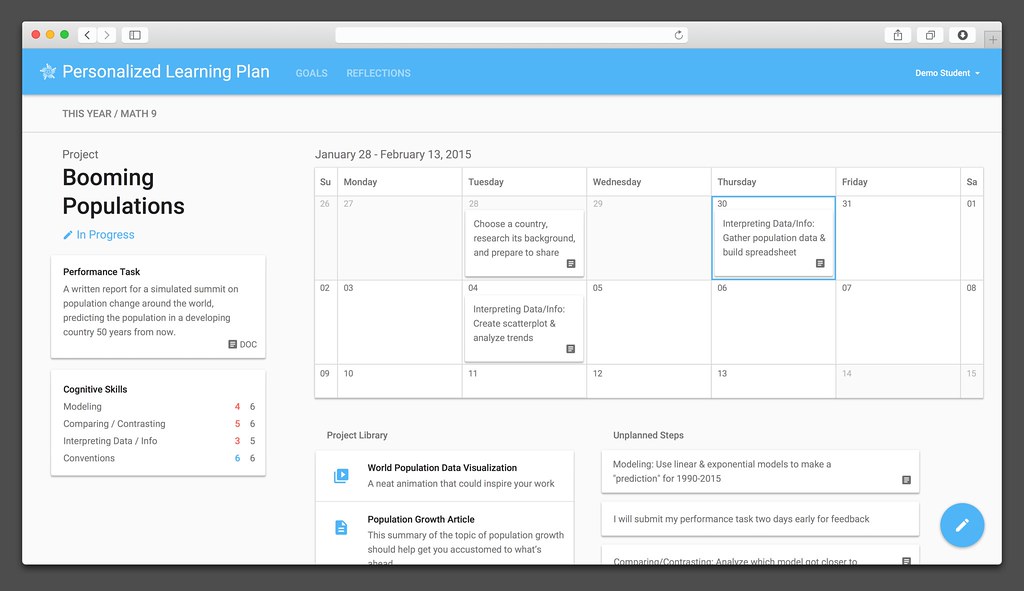
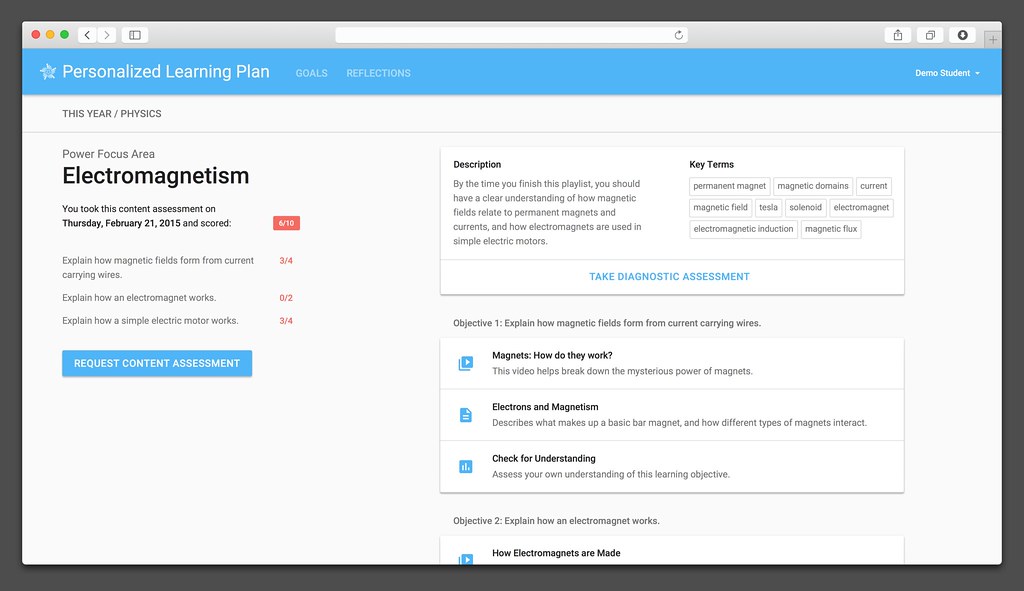
theodp writes: Gushing in July that Facebook engineers had solved one of education's biggest problems, Melinda Gates perhaps set up Segway-like expectations for Facebook's education software. And while The Verge sings the praises of what appears to be progress-tracking dashboards that connect students to mostly free 3rd-party lessons — not unlike Khan Academy or even the 50-year-old PLATO system — it's hard to get jazzed based on the screenshots (1, 2, 3) that Facebook provided in a .zip file accompanying its announcement. The "personalized learning plan" dashboards are a joint effort of Facebook and the Meg Whitman-led and backed Summit charter schools. In a nice circle-of-tech-CEO-education-reform-life twist, the first Summit high school opened in a building in Redwood City after students attending the Bill Gates-touted and backed Silicon Valley High Tech High charter there were evicted to make way, and the Gates Foundation is now spending $8M to bring HP CEO Whitman's Summit charter schools — and presumably Facebook CEO Mark Zuckerberg's personalized learning plans — to Seattle children.
-
Ask Slashdot: Storing Family Videos and Pictures For Posterity?
New submitter jalvarez13 writes: I'm in my early 40's and I will become a dad in less than a month. Until now I've been quite happy with a Canon Powershot S110 for taking pictures and video, but now I'm thinking in longer terms. If some of you have already thought or done something about this, what did you consider when buying photo/video equipment? What about a plan to store the files you generate? I guess there are important decisions you made about to image quality, file formats, storage type, organizing and labelling software, etc.
I'm also wondering if there are any other technologies (stereoscopic cameras?) that I haven't thought about and may be interesting to look at. -
JetBrains Moving Its Dev Tools To Subscription Model
esarjeant writes: For many Java developers, IntelliJ has been our predominant IDE. JetBrains is looking to make their tools easier easier to buy and use by switching to a subscription program. Their plan is to have people pay a monthly/yearly fee for access to the tools instead of upgrading when they're ready. Fortunately, if your subscription lapses it looks like you'll have 30 days to check all your stuff in. How does NetBeans look now? Many members of various developer communities are pushing back against this change: "For a developer with an unstable income, it might be perfectly fine to stay on an older version of the software until they've stashed enough cash to afford the upgrade. That will no longer work." JetBrains has acknowledged the feedback, and say they will act on it.
-
TPP Scuttles Attempts To Fix Orphan Works
jsrjsr writes: David Post, writing at the Volokh Conspiracy blog, describes how the Trans-Pacific Partnership treaty may prevent any changes to copyright law regarding orphan works. Quoting: "Big problem #1 is that copyright law doesn’t require the plaintiff to show any damage whatsoever. And it authorizes awards of up to $150,000 in “statutory damages” for each work that is infringed — independent of any damage assessment. ... It appears that the latest version of the treaty contains, buried within its many hundreds of pages, language that could require the U.S. to scuttle its plans for a sensible revision of this kind. ... Any provision of U.S. law that eliminated 'pre-established damage' or 'additional damages' for any class of works could be a violation of various TPP provisions requiring that such damages be made available, and it even appears that distribution of orphan works would have to subject the distributor to criminal copyright liability."
-
The Paris Climate Talks: Negotiating With the Atmosphere
Lasrick writes: The Paris climate change talks are in December, but what negotiators plan to propose will only be part of non-legally-binding pledges—and they represent only what is achievable without too much difficulty. 2009's Copenhagen Accord say 114 countries agree that global temperature increases should be held below 2 degrees Celsius. "Paradoxically, an accord that should have spurred the world to immediate action instead seemed to offer some breathing room. Two degrees was meant to be a ceiling, but repeated references to an internationally agreed-upon “threshold” led many people to believe that nothing really bad could happen below 2 degrees—or worse yet, that the number itself was negotiable." Dawn Stover writes about alternatives to the meaningless numbers and endless talks: 'The very idea that the Paris conference is a negotiation is ridiculous. You can't negotiate with the atmosphere."
-
Report: Google Will Return To China
An anonymous reader writes: Google famously withdrew from mainland China in 2010 after fending off a series of cyberattacks from local sources. Now, according to a (paywalled) report from The Information, the company is working on plans to return. "As part of the deal Google is looking to strike, Google would follow the country's laws and block apps that the government objects to, one person told The Information." They're also seeking approval for a Chinese version of Google Play.
-
MIT Simplifies Design Process For 3D Printing
An anonymous reader writes: New software out of MIT and the Interdisciplinary Center Herzliya in Israel takes CAD files and automatically builds visual models that users can alter with simple, visual sliders. It works by computing myriad design variations before a user asks for them. When the CAD file is loaded, the software runs through a host of size variations on various properties of the object, evaluating whether the changes would work in a 3D printer, and doing the necessary math to plan tool routes. When a user moves one of the sliders, it switches the design along these pre-computer values. "The system automatically weeds out all the parameter values that lead to unprintable or unstable designs, so the sliders are restricted to valid designs. Moving one of the sliders — changing the height of the shoe's heel, say, or the width of the mug's base — sweeps through visual depictions of the associated geometries."
There are two big drawbacks: first, it requires a lot of up-front processing power to compute the variations on an object. Second, resolution for changes is fixed if you want quick results — changing the design for a pair of 3D-printed shoes from size 8 to size 9 might be instantaneous, but asking for a shoe that's a quarter of a millimeter longer than a size 8 would take several minutes to process. But for scrolling through the pre-computed design changes, the software can present "in real time what would take hours to calculate with a CAD program," and without the requisite experience with CAD. -
Municipal ISP Makes 10Gbps Available To All Residents
An anonymous reader writes: Five years ago, the city of Salisbury, North Carolina began a project to roll out fiber across its territory. They decided to do so because the private ISPs in the area weren't willing to invest more in the local infrastructure. Now, Salisbury has announced that it's ready to make 10 Gbps internet available to all of the city's residents. While they don't expect many homeowners to have a use for the $400/month 10 Gbps plan, they expect to have some business customers. "This is really geared toward attracting businesses that need this type of bandwidth and have it anywhere they want in the city." Normal residents can get 50 Mbps upstream and downstream for $45/month. A similar service was rolled out for a rural section of Vermont in June. Hopefully these cities will serve as blueprints for other locations that aren't able to get a decent fiber system from private ISPs.
-
New Russian Laboratory To Study Mammoth Cloning
An anonymous reader writes: While plans to clone a woolly mammoth are not new, a lab used in a joint effort by Russia and South Korea is. The new facility is devoted to studying extinct animal DNA in the hope of creating clones from the remains of animals found in the permafrost. IBtimes reports: "The Sakha facility has the world's largest collection of frozen ancient animal carcasses and remains, with more than 2,000 samples in its possession, including some that are tens of thousands years old, such as a mammoth discovered on the island of Maly Lyakhovsky; experts believe it may be more than 28,000 years old."
-
More Popcorn Time Users Sued
An anonymous reader writes: The torrent-based video streaming software Popcorn Time has been in the news lately as multiple entities have initiated legal action over its use. Now, 16 Oregon-based Comcast subscribers have been targeted for their torrenting of the movie Survivor. The attorney who filed the lawsuit (PDF) says his client, Survivor Productions Inc., doesn't plan to seek any more than the minimum $750 fine, and that their goal is to "deter infringement." The lawsuit against these Popcorn Time users was accompanied by 12 other lawsuits targeting individuals who acquired copies of the movie using more typical torrenting practices.
-
LILO Bootloader Development To End
An anonymous reader writes: For any longtime Linux users, you probably remember the LILO bootloader from Linux distributions of many years ago. This bootloader has been in development since the 90's but development is finally ending. A homepage message reads, "I plan to finish development of LILO at 12/2015 because of some limitations (e.g. with BTFS, GPT, RAID). If someone want to develop this nice software further, please let me know ..."
-
T-Mobile Starts Going After Heavy Users of Tethered Data
VentureBeat reports that T-Mobile CEO John Legere has announced that T-Mobile will cut off (at least from "unlimited" data plans) customers who gloss over the fine print of their data-use agreement by tethering their unlimited-data phones and grab too much of the network's resources. In a series of tweets on Sunday, Legere says the company will be "eliminating anyone who abuses our network," and complains that some "network abusers" are using 2TB of data monthly. The article says, "This is the first official word from the carrier that seems to confirm a memo that was leaked earlier this month. At that time, it was said action would be taken starting August 17 and would go after those who used their unlimited LTE data for Torrents and peer-to-peer networking."
-
F-35 To Face Off Against A-10 In CAS Test
An anonymous reader writes: Lara Seligman from Defense News reports that the capabilities of the Joint Strike Fighter are to be evaluated for close-air support (CAS) missions. She writes, "To gauge the joint strike fighter's ability to perform in a close-air support role, the Pentagon's top weapons tester has declared the sleek new fighter jet must face off against the lumbering A-10. The Pentagon's Office of Operational Test and Evaluation plans to pit the full-up F-35 against the legacy A-10 Warthog and potentially other fighter jets to evaluate the next-generation aircraft's ability to protect soldiers on the ground."