Slashdot Mirror
Domain: anandtech.com
Stories and comments across the archive that link to anandtech.com.
Comments · 3,318
-
More information
http://www.anandtech.com/cpuchipsets/intel/showdo
c .aspx?i=2955 provides a much more detailed look at the new processor architectures coming from Intel. A little better than the PR blurb at ars'. -
Re:Is AMD beaten?
I'm not sure what reviews you've been looking at but AMD is not nearly "keeping pace" with Intel, not for the last year anyway. http://www.anandtech.com/cpuchipsets/showdoc.aspx
? i=2879 clearly shows the intel architecture shining, with many benchmarks having the slowest Intel core beating the fastest AMD. At the same time, Intel is acheiving twice the performance per watt, and these are cores, some of which have been on the market for 6-12 months. Intel has also already released their dual-chip, eight core server line which is slated to make its way into a Mac Pro within 3 weeks. AMD's "hold" on the 4-way market exists because of the conditions 2 years ago when those servers were built. If you want a true comparison (as you claim to be striving for) then you need to look at what new servers are being sold and what the sales numbers are like (I don't have that information). But since the 8-core Intel is again using less than half of the thermal power an 8-core AMD offering, I would wager that an informed IT department wouldn't be choosing the Opteron route.
AMD is capable of great things but Intel has set their minds on dominating the processor world for at least the next 5 years and it will take nothing short of a major evolutionary step from AMD to bring things back into equilibrium. Whilst AMD struggles to get their full line onto the 65nm production scheme, Intel has already started ramping up the 45nm, and that's something that AMD won't quickly be able to compete with.
Intel's latest announcement of modular chip designs and further chipset integration are interesting but I'll reserve judgement until some engineering samples have been evaluated. I'm not ready to say that an on-board memory controllers is hands-down the best solution, but I do agree that this is a great step towards mobile hardware (think smart phones / pda's / tablets ) using less energy and having more processing power while fititng in a smaller form factor. -
There is no "SATA II"
SATA II is the old name of the organisation that created the SATA standard (although I can't find what the acronym used to stand for). It has since changed its name to SATA-IO ("International Organisation") because everyone mistook the two I's as Roman numerals and assumed the newly created SATA 3Gb/s standard was "version 2" of SATA. It's not. It's just a new signalling rate and other features like NCQ are separate.
-
Re:CableCARD is all that matters
"to say that a homebrew DVR is not functional because there is no CableCard support in Linux is just plain wrong."
Totally agree. This isn't a MythTV problem; MythTV can handle the HD stream just fine.
I'd gladly lease another CableCard for my MythTV box if there was a tuner available that supported it. The only one I've ever heard of is this one, which is still not out even for Vista
-
This story is 4 months old
-
Re:Obligatory karma hit
Nope. As seen here, they started at 750Mhz. If it's at 700MHz, it could very well be a Duron, instead.
-
Re:Longer than I thoughtIt's impossible to preform a CPU upgrade on an Xbox (original). The CPU is a special pin design which is soldered directly to the motherboard. Don't believe me? Here, I'll quote from http://www.anandtech.com/showdoc.aspx?i=1561&p=2:
The 0.18-micron CPU is contained within Intel's mobile FC-BGA package that is soldered directly onto the Xbox's motherboard. This not only prevents anyone from attempting to upgrade the CPU but it also reduces the space necessary for the CPU.
-
Re:Not a very helpful benchmark
Then try Anandtech's analysis and benchmarks with Windows Vista Ultimate 64-bit.
Summary, the Core 2 Duos still win with the X2 6000+s almost making parity with the E6700 cpus with 64-bit apps. -
Re:I'll care when AMD catches up to the Core 2 DuoThe fact of the matter, however, is that Core 2 Duo processors at 65nm now have about the same power consumption as their Athlon 64 X2 counterparts at 90nm--about 65W.
I highly recommend taking a look at processor electrical specifications. And keep in mind that Intel's power figures are more optimistic ("typical") than AMD's ("max").
I don't think we should trust the power "specs" from Intel, AMD, or any source that only focuses on the CPU. If you want to compare power consumption between Core 2 Duo and Athlon 64 X2, I think you should look at total system power consumption with whatever chipsets you plan to use.For example, on the "mainstream" P965 and nForce 590 chipsets, the Core 2 Duo systems consume significantly less power than the Athlon 64 x2 counterparts. Note that the nForce 590 chipset is power-hungry, but NVIDIA chipsets are more popular than ATI chipsets. I cannot find Core 2 Duo vs Athlon 64 x2 benchmarks that use a more power-friendly ATI chipset (I'm sure I've seen one before), but I guess that shows how unpopular ATI chipsets are. I'm sure AMD acquisition will change things.
-
Re:Price WarAt least in my case, I see no reason to change CPU as my xp2400 does well enough by me. That's nuthin'. My primary desktop is a 900MHz Celeron (P3-based) with TNT2 m64 graphics running Windows 2000 (I don't know why that makes me proud). It can (barely) play DVD/XviD videos, browse the web with Opera/IE6, run Office XP, and Win2K will get security updates until July 2010. It meets my current needs.
However, a "killer app" is coming later this year that will probably convince me to upgrade: hi-def porn. I'm not kidding (checks "Post Anonymously" box).
As Anandtech showed, a high-bitrate h.264 Blu Ray movie requires (without GPU help) a Core 2 Duo E6700 to playback without skipping frames. A low-end DirectX 9/10 GPU will help a little, but I'll obviously need a Core 2-era dual-core CPU to run my killer app.
Since HD DVD's and Blu Ray's DRM has been cracked, I expect hi-def porn to be available to rent and rip pretty soon (I don't plan to download 20+ GB per movie).
I personally feel triumphant for skipping a CPU architecture generation (Netburst/Athlon64), four GPU architecture generations (T&L, DX7, DX8, DX9), two memory generations (DDR/DDR2), and an OS (WinXP). If I wasn't such a horn dog, I could probably use my 900MHz Celeron until extended support for Win2K ends in 2010.
-
Re:A plea to DellWTF is with ram prices? CPU's, hard disks, displays are all going down as per usual but ram, which normally follows the rest of the industry is sticking darn tight to that 200$ US per 2gb of decent quality ram level.
It's been there for a while, it's becoming quite annoying - I had a 2gb machine 2 years ago and it cost maybe 300$ US, 100$ US in 2 years does not make for a good price drop!
I hear ya. RAM prices are so frickin' unpredictable. I've been hoping for a DDR2 price war similar to the fantastic PC133 price war of November 2001, when the shipping cost of PC133 was higher than the price of the RAM itself (128MB - $5, 256MB - $10). -
What about the performance improvements?
Reviews such as here and here show that Vista gaming performance is actually better than XP's in Direct3D applications, at least with AMD's more mature drivers. OpenGL performance, on the other hand, is horrible, along with Nvidia's drivers altogether. But Vista gaming isn't as bad as the article makes it out to be.
-
Re:Coherence changed my life
In the Apple case, the OS is not a separable part of the system with intrinsic value of its own, except in the contrived case where you are not going to run MacOS on your Mac. They don't get additional revenue by "sneaking" an unneeded copy onto your new machine - it's just part of the machine.
It's not as contrived as you think. The PowerPC Mac Mini made an excellent web server system, except that OSX suffers from weird problems that cause server apps such as MySQL and Apache to perform much worse than they do under Yellow Dog Linux on the same system. We're talking in terms of orders of magnitude here.
Which brings us back to the OS problem. Particularly during the PPC era, there were other OSes that would run on Macs. In other words, you paid "the Apple tax" every time you bought a new computer, even if you immediately wipe the machine and install Linux, or migrate your OSX installation from your previous machine that you're decommissioning.
On the other hand, I can and have bought ia32 and ia64 computers without Windows pre-installed on them. I was given that choice, something that Apple doesn't give you.
As a side note, OSX can, in theory, be run in a virtual machine under VMWare. Apple, however, tries to make it extremely difficult to do so. It's a lock-in of the worst sort and as a -
Actually, My iMac is pretty good...
-
Re:Shaders
Uhhh... You sure about that? According to an AnandTech.com article it's a fixed function GPU. That and I haven't heard anyone at work speak of it as anything other than a fixed function GPU.
"The Flipper graphics core is a fairly simple fixed function GPU aided by some very powerful amounts of memory bandwidth, but first onto the architecture of the graphics core. Flipper always operates on 4 pixels at a time using its 4 pixel pipelines; each of those pipelines is capable of applying one texture per pipeline which immediately tips you off that the ArtX design wasn't influenced by ATI at all. Since the Radeon and GeForce2, both ATI and NVIDIA's cores have been able to process a minimum of two textures per pixel in each of their pipelines which came quite in handy since none of today's games are single textured anymore.
The fact that the Flipper's T&L is a fixed function T&L unit is a bit of a disappointment as well but it would have been impossible for ArtX to implement ATI's SmartShader programmable pixel and vertex shaders into their design and still meet Nintendo's strict deadlines. The one thing that is playing to the GameCube's favor is that the Flipper GPU was designed solely with console gaming in mind, and the input that went into the T&L unit was much more closely tied to the developers than some of the earlier T&L units for desktop PC graphics cards. Although it may be better suited for its target use than the earliest T&L units for PCs, there is no skirting the fact that with a fixed function T&L pipeline there are limitations to exactly what game developers will be able to do. After seeing what over two years of fixed function T&L support in games for the PC was like, we'd hope for much more out of developer use of Flipper's GPU."
-
Re:Strange...With ReadyBoost you should be able to haul the performance up significantly with a large memory stick. Read the technical description of it on the MS site to cut through the hype - it is a horrible idea and won't help. Read the results of Anandtech's tests of ReadyBoost performance - it makes a very significant impact on performance (in memory-intensive benchmarks, of course). The tests were done on a system with only 512MB of RAM, like the system described in the original comment. Upgrading to 1GB of RAM is better, but ReadyBoost definitely helps. Where did you and the moderators get this idea that ReadyBoost doesn't help?
Not that anybody's reading this thread anymore.
-
Re:Unique feature?
A USB2 flash drive is a USB2 flash drive is a USB2 flash drive. There's no great difference there, unless something is broken.
That's what I thought, too, so I bought the cheapest 1GB USB2 flash drive I could find. Only once I started using it did I discover that just because it's USB2, you don't get USB2 speeds.
This report shows a comparison of various USB2 flash drives. You'll see that there's something like a factor of 5 between the fastest and the slowest. -
More (Better?) Coverage
http://dailytech.com/Life+With+Penryn/article5869
. htm
http://www.msnbc.msn.com/id/16839253/
http://money.cnn.com/2007/01/27/technology/bc.micr ochips.reut/index.htm?cnn=yes
http://www.nytimes.com/2007/01/27/technology/27chi p.html?em&ex=1170046800&en=59a4d10473c4a8c8&ei=508 7%0A
http://news.com.com/Chip+companies+entering+their+ metal+period/2100-1006_3-6153962.html
http://anandtech.com/cpuchipsets/showdoc.aspx?i=29 15 -
Liar!
The GMA950 is a crap 3D card. Even the most basic google research shows that it is NOT a return of Intel to 3D and no reviewer worth a dam has said the graphics "scream". Poor performance and incomplete 3d support are the hallmarks of the GMA950. If you play nothing but Quake II than yea, the GMA950 is for you.
http://www.extremetech.com/article2/0,1697,1821814 ,00.asp
http://www.anandtech.com/video/showdoc.aspx?i=2427 &p=3
http://everythingapple.blogspot.com/2006/03/intel- gma-950-terrible-opengl.html -
Re:The problem with high clock is not just heat ..
It's also how fast your circuits can switch, and how fast the signal can travel on the wires. The execution core of a Pentium 4 also happens to be double-pumped (i.e., it performs operations on both edges of the clock signal). Essentially, those ALUs would be switching at 16GHz
You do know that 8GHz was the target speed that intel always intended to get netburst up to, don't you? An intel representative even stated once "We have positive indications to be able to take Netburst to the 10 GHz space." Only power management and thermal dissipation issues prevented them from releasing a commercial product that was this fast. As I understand it, this particular feat is merely a replication of something Intel did in their own labs over a year ago (although I forget where I read the description of that setup, and a quick google hasn't turned it up). -
Re:Questionable
Yes, NUMA is not avalaible in Intel Core processors.
But Intel has processors with four cores avalaible. 2P motherboards with 4Core processors are cheaper than 4P motherboards with 2Core processors.
You can find a review with more information at:
http://anandtech.com/IT/showdoc.aspx?i=2897
and in:
http://realworldtech.com/page.cfm?ArticleID=RWT111 406114244
The conclusion is (more or less): yes, the scalability of Intel Core Processors is worse than AMD Opteron Processors. However, the price/performance ratio of the Intel Core 2 Quad Processors is great. -
Re:Market Share != Quality
They also cater better than anyone to developers by offering top notch development tools. I'm a java primarily, but I have to give it to them,
Also, MacOS X (in its current form) can't compete with Windows in the server arena (and its trying) because it simply doesn't scale as well as Windows or Linux. Check out this Anandtech article: http://www.anandtech.com/printarticle.aspx?i=2520.
There are huge architectural problems with MacOS X's (as of Tiger) threading model. -
Reviews
I use http://www.anandtech.com/ for the best reviews on the internet! I also just google the item/product.
-
NVidia bug OR memory upgrade issue?
(Couldn't access the article's screen capture - site's bandwidth exceeded.)
I did some googling around, and it appears that Mac Pro systems have been known to Kernel Panic in a number of cases after a memory upgrade. Have you considered that you might have TWO (intermittent) problems?
According to this http://www.xlr8yourmac.com/systems/Mac_Pro/mac_pr
o _ram.html upgrade memory should have larger heatsinks than standard heatsinked FB-Dimms. It has links to: memory test utilities, ECC correction reports, and most notably:FYI - Page 2 of PC site Anandtech's Mac Pro upgrades article has comments on using standard heatsink FB-Dimms (which some readers previously reported worked ok so far at least, although others have noted ECC error corrections)
"We had no problems running all of our benchmarks with the standard (flat heatsink) Crucial FB-DIMMs; however, if we ran a memory stress test for even just a short period of time the modules quickly reported correctable ECC errors. (Apple system profiler memory status section) Apple's original modules did not generate any ECC errors, so it looks like the additional cooling is necessary under the most extreme situations." (emphasis added)
Questions:
- What brand of memory did you upgrade with? Apple? Crucial? Kingston? Other?
- Did your memory have the standard-sized or larger-sized heat sinks?
- What memory stress tests have you run?
- Were any ECC errors reported?
- What was the distribution of memory in your system? (which boards of what size and manufacture in which risers?)
- If you pull the original memory and use just the upgrade memory, does the problem still exist?
Hope this helps!
-
$150 hd-dvd player
I was in Best Buy a couple of days ago and saw Microsoft's 360 HD-DVD player for $150. Anandtech had given it a favorable review and noted that the player could just as easily be hooked up to PC as an xbox. If you already have a hi def screen with an xbox it seems to be a slam dunk purchase. If you don't have the xbox but you have a sufficiently robust pc, you can either watch hi def on your computer monitor or, if your setup allows it, on your HD screen via your PC.
Lots of folks are hedging as to which format will win out but my impression is that if you can buy a player for $150 that gives you an image that's equivalent to a solution that costs 4 times as much and is unavailable, that gives a huge boost to HD-DVD. I say "equivalent" because the initial side by side reviews don't give either format an edge. Another factor is Netflix - you can rent either format from them so your exposure to risking committing to a dead end format is substantially reduced. When the first players came out at $1,000 not many people bit. Now that you can get one player at $150, it strikes me a lot more people will make the jump and it isn't going to be to Blu-Ray. -
AACS vs ICT vs HDCP vs digital vs analogGrandparent wrote:
the degradation discussed is a requirement for non-encrypted content streams. My understanding is that if you connect your new Blu-Ray or HD-DVD player via their analog outputs, or to a non-encrypted digital channel, the output is downgraded to a lower resolution
Parent replied:
Thats incorrect. Degradation is recommended by the HD standards only if the content provider has opted-in for content protection but the hardware used doesn't provide a complete protection path to the display.
So non-opted content will display with full fidelity regardless of whether a non-secured or secured mechanism is used to display the content.
That's incorrect if you're using digital connections (e.g. DVI, HDMI) and commercial BluRay/HD DVD discs (almost all of which use AACS). If you try to play almost any commercial disc using a digital connection and you don't have HDCP protecting every step of the playback process, then it probably won't play at all. However, it probably will play back in full resolution over analog connections (e.g. VGA, component) because most commercial discs have not implemented ICT yet. When ICT is implemented, then the image (over analog connection) will be degredated to a lower resolution. Did that make sense?
To clarify, the rules are different for digital and analog connections. The rules are also different for AACS and ICT.
AACS (Advanced Access Content System) is the encryption system that's currently used by almost all commercial BluRay/HD DVD discs and requires HDCP everywhere (video ouput/input, driver, playback software) to playback (at any resolution) over digital outputs (e.g. DVI, HDMI). The disc probably won't playback at all over a digital connection that isn't fully protected by HDCP. Here's a link with a good explanation: The Authoritative BD FAQ: VIII. Device Connections
ICT (Image Constraint Token) is the DRM system that currently is not used by commercial discs but, when it is implemented, will degrade the resolution if analog connections are used.
You're much more likely to run into DRM problems on a computer/LCD than on a set top box/digital television. All BluRay/HD DVD set top boxes (except XBox 360) have all the DRM requirements built-in and all digital televisions have (at minimum) high-def analog inputs. On the other hand, most high-end computer/LCD setups today are connected with a DVI connection that doesn't have HDCP in either the video card or LCD. These computers (with incomplete HDCP implementations) won't play the movie at all using a digital connection (it will just display an error message). These same computers can playback HD content over a VGA connection (if ICT hasn't been implemented), but that would require changing the LCD connection from good digital to inferior analog. Who would want to do that just for watching HD movies?
More AACS/ICT/HDCP explanations:
HD Video Playback: H.264 Blu-ray on the PC
Review: Sony BWU-100A Blu-ray Recordable Drive -
Re:Interesting..
Duh, all athlon 64 dual cores to date are clock for clock nearly identical though. This means clock speed does matter.
They're almost identical - cache sizes vary, and, more importantly, the new ones (65 nm) have higher cache latency
. -
Re:HTPC
He is not talking about WMF. H.264 encoded files. My AthlonXP 2500+ can handle WMF. H.264 is a different story. The industry is barely getting smooth playback with Core 2 Duo x6800 and high end nVidia cards:
http://www.anandtech.com/video/showdoc.aspx?i=2890 &p=4 -
65nm version marginally slower than 90nm version
Apparently Brisbane (65nm) has a 20-cycle L2 cache latency, vs. the 12-cycle latency from the 90nm versions. http://www.anandtech.com/cpuchipsets/showdoc.aspx
? i=2893&p=3 -
Lower heat (and performance, ....)
...But most of the time irrelevant.
Anandtech has two good reviews here (lower power) and here (lower performance)
The main reason is the increase of L2 Cache Latency from 12 cycles to 20. But in most of the benchmarks the difference is very low. -
Lower heat (and performance, ....)
...But most of the time irrelevant.
Anandtech has two good reviews here (lower power) and here (lower performance)
The main reason is the increase of L2 Cache Latency from 12 cycles to 20. But in most of the benchmarks the difference is very low. -
Nice but a little slower. Surprise!
Anand has a nice review of these new processors, including performance comparisons.
The surprise is that it was a little slower than it's 90nm counterpart. They chased it down to the cache latency going up from 90nm to the 65nm part.
Other than that, it looks good.
-
Re:LCD Production
Most of the actual LCD screen manufacturing is done by few companies
Very true. For example, pretty much every 22" LCD panel is made by Chi Mei (in Taiwan). Samsung, Viewsonic, Benq, Acer, Asus, etc all use Chi Mei panels, the only real difference is the packaging and inputs. I happen to have a 22" Chi Mei, an Acer that I got for $400 Canadian a few months ago and I'm very happy with the quality so far. -
Re:Disk On Module and RAM Disks (formatted)
EDIT: Woops, forgot to select the right formatting
As most slashdotters know, a very large amount of boot time is the result of your systems hard disk speed. Replacing the hard disk that the OS boots from with something faster speeds up boot time dramatically.
There are some products out there already that emulate ATA and SATA drives, but using DRAM (with battery) or Flash to store the actual data instead.
PQI have some flash based ones here: http://www.pqimemory.com/products-storage.asp
Gigabyte have a product called i-ram which is the DRAM based solution here: http://www.anandtech.com/storage/showdoc.aspx?i=24 80
The down side to the RAM solution is it obviously needs a backup battery installed on the card in the case your system is unplugged from the wall socket. If OSs were written to be "RAM-boot-device-aware" this problem could be reduced by storing copies of the nessecary boot files and restoring them from the actual harddisk should they go missing.
As for why computers are still slow to boot today, my best guess is costs. Right now, adding one of these devices to your pc costs more than some people are willing to pay just for a faster bootup time. As memory continues to get cheaper id be willing to bet we will gradually see more pcs with some form of dedicated boot drive. (This is assuming the harddisk isn't replaced by the magical holographic storage we keep hearing about any time soon). The second half of the battle for faster boot speeds is the software support to negate the down sides. RAM based boot drives would need to be backed up to harddisks and flash based drives may need the OS to be aware of the limitation on writes. -
Disk On Module and RAM Disks
As most slashdotters know, a very large amount of boot time is the result of your systems hard disk speed. Replacing the hard disk that the OS boots from with something faster speeds up boot time dramatically. There are some products out there already that emulate ATA and SATA drives, but using DRAM (with battery) or Flash to store the actual data instead. PQI have some flash based ones here: http://www.pqimemory.com/products-storage.asp [pqimemory.com] Gigabyte have a product called i-ram which is the DRAM based solution here: http://www.anandtech.com/storage/showdoc.aspx?i=2
4 80 [anandtech.com] The down side to the RAM solution is it obviously needs a backup battery installed on the card in the case your system is unplugged from the wall socket. If OSs were written to be "RAM-boot-device-aware" this problem could be reduced by storing copies of the necessary boot files and restoring them from the actual hard disk should they go missing. As for why computers are still slow to boot today, my best guess is costs. Right now, adding one of these devices to your pc costs more than some people are willing to pay just for a faster boot up time. As memory continues to get cheaper id be willing to bet we will gradually see more pcs with some form of dedicated boot drive. (This is assuming the hard disk isn't replaced by the magical holographic storage we keep hearing about any time soon). The second half of the battle for faster boot speeds is the software support to negate the down sides. RAM based boot drives would need to be backed up to hard disks and flash based drives may need the OS to be aware of the limitation on writes. -
i-RAMI'm surprised no one's mentioned Gigabyte's i-RAM yet.
According to Anandtech, booting with the i-RAM into Windows XP takes 9.12 seconds.
"With a Western Digital Raptor, you can go from the boot menu to the Windows desktop in 14.06 seconds; with the i-RAM, it takes 9.12 seconds. It's not instantaneous, but it's definitely quicker and noticeable." -
read the anandtech review dumbass
didn't you see the anandtech review back in October? this card is crap. http://www.anandtech.com/showdoc.aspx?i=2865&p=11
-
Re:No different from any other decent server NIC
Aha, found a better source with some real info on this thing. Here.
-
Anandtech == Better Review
Anandtech has a much better review here: Linky: http://www.anandtech.com/cpuchipsets/showdoc.aspx
? i=2865 -
T2000 was obsolete on launch
The Sun T2000 stuff was obsolete the day it launched when compared to competing x86 solutions.
http://www.anandtech.com/printarticle.aspx?i=2727
The CPU power/watt wasn't really that much better compared to x86 stuff of that time.
It is now nearly 9 months from that, and AMD and Intel have improved significantly. Where is the T2000 or T1 now? Look at Intel - their latest CPUs now trash AMD's by about the same margin which AMD used to trash Intel's offerings.
As long as you skip the Intel P4 stuff, and the silly AMD FX stuff (esp the quad one), the recent x86 stuff is pretty decent.
Go do performance/watt stuff yourself. Sure the Sun wins in some niche situations and in situations when you can actually use the crypto engine, but for most cases the T2000 isn't worth the bother.
Sun doesn't even bother doing specint rate for the T2000/T1 (maybe you can guess why looking at Anandtech's benchmarks) - they only do it for their SPARC IV+ and that gets:
Sun Fire E25K (72 processor) 144 cores, 72 chips, 2 cores/chip: 1413, 1644
144 cores, how much money and watts to get a score of 1413?
In contrast Intel's CPU gets a score of 64 with just 2 cores.
Intel(R) DG965WH motherboard( 2.93 GHz, Intel(R) Core(TM) 2 2 cores, 1 chip, 2 cores/chip: 64.3, 64.4
Maybe AMD will have an answer next year, but whatever it is, AMD and Intel in their frenetic race with each other, have left Sun's CPUs behind in the dust.
If your app works much better with a single system image with 144 cores then I guess you could buy Sun, but if rest of us need the processing power of 144 SPARC IV+ cores we'd get about twenty-two single CPU x86 servers with a total of 44 cores (or eleven dual CPU x86 servers), and figure out a way to make do with such "restrictions", like having money left over for storage, UPS, backups, generators, party for everyone etc.
You can still run Solaris on a Sun x86 server y'know -
Looks like it's the chipsets
anandtech's review of the Core 2 Duos indicated that power consumption was really about the same across the board. The AMD EE chips were the least-power hungry, with just about every other chip all in a small span. Methinks someone's test procedures aren't quite accurate
That's also interesting. Note that Anandtech's review used the ATI RD580 chipset (CrossFire XPress 3200) for the AMD CPUs and the Intel 975X chipset for the Intel CPUs. In contrast, the Tech Report's review used the nForce 590 chipset and Intel 975X.A Tech Report article on AM2 chipsets shows that the nForce 590 chipset consumes about 20 watts more than the ATI RD580 (CrossFire XPress 3200) chipset at load. However, the power-hungry nForce 590 chipset has more integrated features: 2 gigabit ethernet chips (RD580 has none), 6 SATA ports (RD580 has 4), and more RAID options. That's probably why most high-end CPU reviews I've seen have used the nForce 590 chipset.
An Anandtech article shows that the Intel 975X chipset consumes about 3-5 watts more than the more current P965 chipset for certain apps, but unfortunately they don't have "load" comparisons. The P965 chipset lacks SLI support, so that's probably why reviewers are using 975X.
So a comparison of platforms that "most people buy" should probably use the Intel P965 chipset and the nForce 570 Ultra chipset. It's too bad review sites tend to use the SLI uber-chipsets.
-
Looks like it's the chipsets
anandtech's review of the Core 2 Duos indicated that power consumption was really about the same across the board. The AMD EE chips were the least-power hungry, with just about every other chip all in a small span. Methinks someone's test procedures aren't quite accurate
That's also interesting. Note that Anandtech's review used the ATI RD580 chipset (CrossFire XPress 3200) for the AMD CPUs and the Intel 975X chipset for the Intel CPUs. In contrast, the Tech Report's review used the nForce 590 chipset and Intel 975X.A Tech Report article on AM2 chipsets shows that the nForce 590 chipset consumes about 20 watts more than the ATI RD580 (CrossFire XPress 3200) chipset at load. However, the power-hungry nForce 590 chipset has more integrated features: 2 gigabit ethernet chips (RD580 has none), 6 SATA ports (RD580 has 4), and more RAID options. That's probably why most high-end CPU reviews I've seen have used the nForce 590 chipset.
An Anandtech article shows that the Intel 975X chipset consumes about 3-5 watts more than the more current P965 chipset for certain apps, but unfortunately they don't have "load" comparisons. The P965 chipset lacks SLI support, so that's probably why reviewers are using 975X.
So a comparison of platforms that "most people buy" should probably use the Intel P965 chipset and the nForce 570 Ultra chipset. It's too bad review sites tend to use the SLI uber-chipsets.
-
Looks like it's the chipsets
anandtech's review of the Core 2 Duos indicated that power consumption was really about the same across the board. The AMD EE chips were the least-power hungry, with just about every other chip all in a small span. Methinks someone's test procedures aren't quite accurate
That's also interesting. Note that Anandtech's review used the ATI RD580 chipset (CrossFire XPress 3200) for the AMD CPUs and the Intel 975X chipset for the Intel CPUs. In contrast, the Tech Report's review used the nForce 590 chipset and Intel 975X.A Tech Report article on AM2 chipsets shows that the nForce 590 chipset consumes about 20 watts more than the ATI RD580 (CrossFire XPress 3200) chipset at load. However, the power-hungry nForce 590 chipset has more integrated features: 2 gigabit ethernet chips (RD580 has none), 6 SATA ports (RD580 has 4), and more RAID options. That's probably why most high-end CPU reviews I've seen have used the nForce 590 chipset.
An Anandtech article shows that the Intel 975X chipset consumes about 3-5 watts more than the more current P965 chipset for certain apps, but unfortunately they don't have "load" comparisons. The P965 chipset lacks SLI support, so that's probably why reviewers are using 975X.
So a comparison of platforms that "most people buy" should probably use the Intel P965 chipset and the nForce 570 Ultra chipset. It's too bad review sites tend to use the SLI uber-chipsets.
-
Re:18 months is, like, a generation
That's interesting--anandtech's review of the Core 2 Duos indicated that power consumption was really about the same across the board. The AMD EE chips were the least-power hungry, with just about every other chip all in a small span. Methinks someone's test procedures aren't quite accurate--not quite sure which ones, though.
-
Re:what? no.Wierd... AnandTech has reviews of the AM2 in May 23, 2006.
Same for AMD.
Meanwhile, a price drop was announced by AMD around July 14 specifically stating the following:Sunnyvale (CA) - A spokesperson for AMD confirmed to TG Daily that customers should expect AMD to announce a substantial price drop in its highest performance desktop processors, including Athlon 64 X2. The price drop should be announced at or about the time that Intel announces the release of its next-generation Core 2 Duo and Core 2 Extreme processors - an announcement which is now expected before the end of the month.
-
Re:Depends on the Architecture
"But megahertz for megahertz. Sorry, no facts there."
No facts where? you mean here: http://www.anandtech.com/cpuchipsets/showdoc.aspx? i=2802&p=4
Heck, just look at the difference between an Intel E6600 and an AMD X2 4600+ They have the EXACT SAME CLOCKSPEED (2.40GHZ), and the E6600 utterly decimates the latter.
"intel runs cooler than amd, mhz for mhz -No evidence for that either"
Where exactly are you looking for your evidence? AMD fanboy message boards? How about trying *any* of the major tech review sites for once?
http://www.tomshardware.com/2006/07/14/core2_duo_k nocks_out_athlon_64/page8.html#_versus_amd_athlon_ 64_fx62
Note the passage: "Of course we took AMD's current processor top model, the Athlon 64 FX-62, and ran the same series of temperature tests. We measured a processor temperature of 64C under high load and 31C for idle operation with Cool & Quiet activated. Both is considerably hotter than with Core 2 Extreme." -
Re:HDTV is a clusterfuck.
Any TV designer who automatically scales 1280x720 up to 1366x768 without an option to turn it off and just display it with black bars ought to be shot.
If that is your opinion, most of the designers who build 1280x720 or 1920x1080 panels into their TVs must be shot as well, because many of them scale up their "native" signals to something at least 3-5% higher to cut away any artefacts that may have creep into the borders of the video signal. I had hoped overscan would go away with the introduction of HDTV, but no such luck. Have a look at this article on anandtech about "Overscan compensation" for ATI and NVIDIA cards to get an idea of the scale of this problem. If you're lucky, this does not happen on "computer" inputs (e.g. VGA or DVI) as opposed to "Video" inputs like component or HDMI. -
Re:I like your solution
There is a better comparison of sizes here.
-
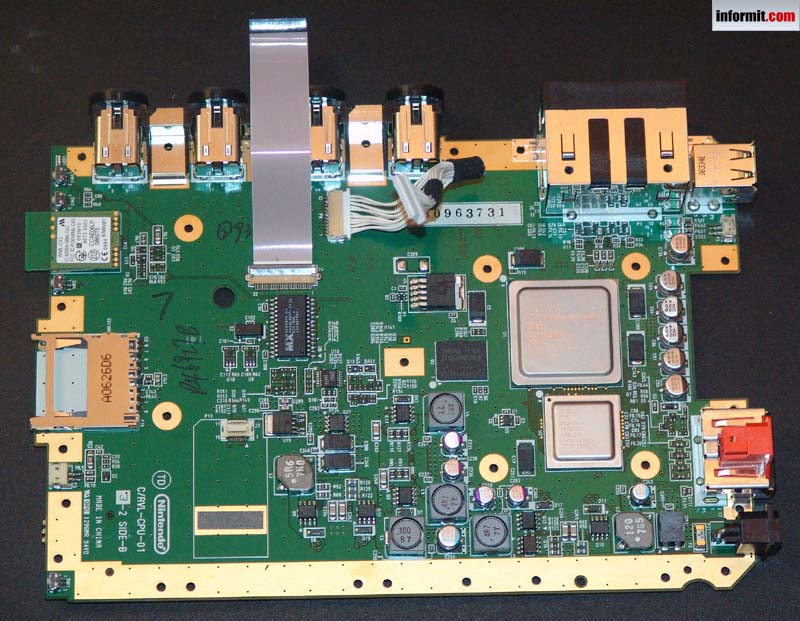
Links for all consolesWhere are the "related stories" ?
- Microsoft XBox 360 disassembled
- Sony Playstation 3 disassembled
- Nintendo Wii disassembled (OK, you already had that one
And for those who don't have time, motherboards photos : - Microsoft XBox 360 disassembled
-
Links for all consolesWhere are the "related stories" ?
- Microsoft XBox 360 disassembled
- Sony Playstation 3 disassembled
- Nintendo Wii disassembled (OK, you already had that one
And for those who don't have time, motherboards photos : - Microsoft XBox 360 disassembled