Slashdot Mirror
Domain: apple-history.com
Stories and comments across the archive that link to apple-history.com.
Comments · 246
-
Re:Already Know that.
You say that the eMac was made "primarily" for educational use, but you might not know that it was originally made exclusively for educational use. It was released in April 2002 and was only available to education customers. It proved so popular that Apple made it available to everybody in June.
Apple has a history of doing this kind of thing. There are Mac models out there that you've probably never even heard of because they were only sold to schools. Like the "Power Macintosh G3 All-In-One" for instance. -
Re:Every 6 years
-
Re:Every 6 years
-
Re:The first and the last!
My bad about the first nVidia card for the Mac being the 4MX. You are correct that the 2MX was the first one on the platform. Brain f*rt or something there.
My mix up came from the fact that the GeForce4MX,
Also, by 2/22/2001, Apple was updating the Cube with a GeForce2MX in it already. It was on 1/9/2001 that they introduced the PowerMac G4 (Digital Audio) with the GeForce2MX. -
Re:Cost
That's insanely cheap compared to the Mac IIfx that was priced over $10,000 back in 1990. (40MHz single processor. 128MB of RAM?) Or the Mac Portable which was abour $6000 when first released iirc. And those aren't even adjusted dollar figures.
Of course, if that little email appended to the above linked page is accurate, the IIfx was created to be sold to the US government. If I were Apple, I'd have made it $10K (each) too. Gift horse, mouth, etc.
-
Re:The All-in-One is cool,
G3 AIO (unframed).
-
All fine and dandy
-
All fine and dandy
-
Re:Oft-Overlooked Point
They probably could make a G5 powerbook, but it would be a mega-luggable; a behemoth among the beautiful, svelte laptops we expect from Apple. This is something they have tried to avoid since the mac portable.
-
Rehash of an old design
Or you mean like Apple started shipping back in May... of 1997!
-
Re:Funky color?
> I first read the title as "G5 iMac to come in marble blaster
> gold" and thought Apple was going back to making funky-
> colored computers.
No kidding. Dammit, Apple! Do you know how many types of iPods you'll have to develop and sell to live down the 'Flower Power' iMac? Don't do this to yourself again. -
To all you "Apple stole this design from.." twats:
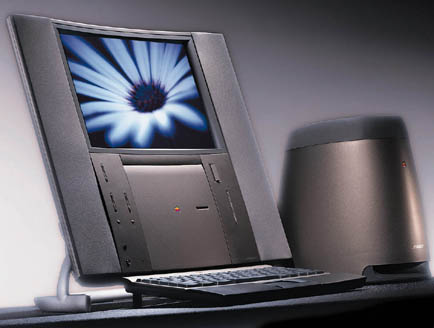
Find me an LCD-in-front, guts-in-back computer that was sold prior to May, 1997, when Apple started selling the 20th Anniversary Macintosh (the computer is completely self-contained-- the cylindrical object in the photo is a subwoofer, if you didn't know).
This is not a revolutionary design, it is merely evolutionary-- Apple updated their original seven year-old design. -
Re:Apple Can't Come Up With An Original Idea
I've been selling and servicing PCs from that family for years.
Unless you've been doing it since before May, 1997, you'll need to readjust your assessment of who appropriated whose design. -
Re:Just wondering
guess again.
Shipped in 1997. The Gateways were later, and crappier (although MUCH less expensive).
Nice try though! -
Yeeeeaah...
Look, Ive used macs since the orignal - that just had 1Mb of ram!
The original Macintosh had only 128k of RAM. The first Mac one could have one megabyte of RAM in was the Macintosh Plus, which came out two years later.
I won't try to justify my knowledge of Macs by stating I've been using them since the beginning, my first Mac was a IIsi. But I will point out I seem to know more than you do about your own computer. I'll also point out the iMac is by Apple's own definition a consumer machine, so I'm not shocked the new iMac wasn't built for the "hard core corporate client." A gamer may be a type of consumer, but they are more prosumer, and haven't considered the iMac in the past because the screen nor the graphics card can be upgarded.
If you're looking for an iMac to satisfy both of these users, you will be looking for a very long time. The two groups are opposites in term of needs.
Does a corporate user need a high-horsepower graphics card? No.
Is 5.1 sound important to Powerpoint presentations? No.
Does a company want systems that just get the job done without being extravagently expensive? Yes.
Is liquid cooling necessary in the workplace? No.
Does extra piping for liquid cooling annoy IT guys trying to replace a bad NIC? Yes. -
Yeeeeaah...
Look, Ive used macs since the orignal - that just had 1Mb of ram!
The original Macintosh had only 128k of RAM. The first Mac one could have one megabyte of RAM in was the Macintosh Plus, which came out two years later.
I won't try to justify my knowledge of Macs by stating I've been using them since the beginning, my first Mac was a IIsi. But I will point out I seem to know more than you do about your own computer. I'll also point out the iMac is by Apple's own definition a consumer machine, so I'm not shocked the new iMac wasn't built for the "hard core corporate client." A gamer may be a type of consumer, but they are more prosumer, and haven't considered the iMac in the past because the screen nor the graphics card can be upgarded.
If you're looking for an iMac to satisfy both of these users, you will be looking for a very long time. The two groups are opposites in term of needs.
Does a corporate user need a high-horsepower graphics card? No.
Is 5.1 sound important to Powerpoint presentations? No.
Does a company want systems that just get the job done without being extravagently expensive? Yes.
Is liquid cooling necessary in the workplace? No.
Does extra piping for liquid cooling annoy IT guys trying to replace a bad NIC? Yes. -
Yeeeeaah...
Look, Ive used macs since the orignal - that just had 1Mb of ram!
The original Macintosh had only 128k of RAM. The first Mac one could have one megabyte of RAM in was the Macintosh Plus, which came out two years later.
I won't try to justify my knowledge of Macs by stating I've been using them since the beginning, my first Mac was a IIsi. But I will point out I seem to know more than you do about your own computer. I'll also point out the iMac is by Apple's own definition a consumer machine, so I'm not shocked the new iMac wasn't built for the "hard core corporate client." A gamer may be a type of consumer, but they are more prosumer, and haven't considered the iMac in the past because the screen nor the graphics card can be upgarded.
If you're looking for an iMac to satisfy both of these users, you will be looking for a very long time. The two groups are opposites in term of needs.
Does a corporate user need a high-horsepower graphics card? No.
Is 5.1 sound important to Powerpoint presentations? No.
Does a company want systems that just get the job done without being extravagently expensive? Yes.
Is liquid cooling necessary in the workplace? No.
Does extra piping for liquid cooling annoy IT guys trying to replace a bad NIC? Yes. -
Re:How long?How long do you think it will be before a clueless mac fanboy claims that a flatscreen PC like this was an Apple innovation?
-
Nitpicking about the original Mac
Look, Ive used macs since the orignal - that just had 1Mb of ram!
The first Mac had 128K of RAM:
http://www.apple-history.com/noframes/body.php?pag e=gallery&model=128k -
Re:Unlikely
Actually, the first mac - The Macintosh 128 - Had 128 kb of ram, hense the name. It was maximum, so no, you didnt have a 1 Mb version!
You can read all about it here: clicky
It didnt even have a harddrive, so no, you didnt have a 1 Mb harddrive Macintosh at that point either.. It worked solely by 400 k floppy discs. Oh the days, the system and several programs on a single disc. -
Re:How long?
-
Re:Reasons to like the previous iMac design better
1. There's a hole in the rear of the stand through which always-connected cables can be routed. And there's always the option of the Bluetooth module, keyboard, and mouse to remove *those* wires from the equation.
2. Those who can, do. Those who can't, criticize. Let's see you stuff all those electronics into a smaller space and still provide adequate cooling, Einstein.
3. The new design allows them to use larger displays than 20", the weight of which the arm on the old iMac would not physically support (this is straight from the mouth of an Apple engineer who was visiting my office a few weeks ago).
4. The Cinema Displays use the same base, and those are pretty damned stable. How much crap do you have on your desk?
5. The granddaddy of the thin, LCD-in-front, guts-in-back computer is the 20th Anniversary Mac, released in May 1997. Apple is updating their own old design, not copying current designs of competitors.
6. Yeah, yeah. If they were selling it for $2, there'd be some fool whining "I'd buy it, if it was $1.50!"
~Philly -
Really amazing
At first, I was a little underwhelmed with the design. Hey, it just looks like their monitor; big deal. But after looking at it for a while, I like it.
Conceptually, this is even more impressive than Apple's previous G4 Cube design. In that case, you had a Kleenex-sized box that housed the computer. Now it's all housed in the screen, along with the slot loading drive. Leads me to think they'll have a G5 PowerBook sometime soon.
I also like the way Apple is explicitly marketing it as an upsell to their wildly successful iPod. -
Re:Guts of the computer behind the monitor?
Cupertino, start your photocopiers!
I don't seem to recall Sony, Dell or IBM making "guts of the computer behind the LCD"-style computers prior to May 1997, when Apple first did it. -
Re:Hardware cost
and Apple had to settle out of court with MS in exchange for a cash infusion.
Sorry, but you are quite wrong. The $150 mil MS paid had nothing to do with 'bailing' out Apple, but rather was a final step in the on-going GUI lawsuit. The agreement also provided for 5 years of MS Office for Mac dev, which allowed MS to say that they were supporting alternative OSes.
Start here, and google for more, if need be.
(tig) -
Where is Apple?
I'm sure everybody remembers the Cube, which flopped in the market, but still enjoys a cult following (much like the Newton). They were one of the pioneers of the SFF PC but have completely withdrawn from this market. They were also one of the pioneers of the one spindle ultra-portable, but have since left the market for true ultra-portables to PC manufacturers. The 12" PB is nice, but at 4.6lb it's one of the heaviest 12" laptops on the market today. For people who never use the optical drive on the road, lighter is nicer.
Pitty that Apple currently does not offer products in the catagories I'm most interested in, the SSF PC and the ultra-portable laptop. -
Where is Apple?
I'm sure everybody remembers the Cube, which flopped in the market, but still enjoys a cult following (much like the Newton). They were one of the pioneers of the SFF PC but have completely withdrawn from this market. They were also one of the pioneers of the one spindle ultra-portable, but have since left the market for true ultra-portables to PC manufacturers. The 12" PB is nice, but at 4.6lb it's one of the heaviest 12" laptops on the market today. For people who never use the optical drive on the road, lighter is nicer.
Pitty that Apple currently does not offer products in the catagories I'm most interested in, the SSF PC and the ultra-portable laptop. -
Re:Upgrade to what?
They should use what they are already developing on to make the iPod: PXA2XX-series X-Scale boards!
With support for PCMCIA, CF, and MMC/SD built in, plus AC'97, serial, and LCD controllers on_CHIP_, it's a no-brainer. Plus, the X-Scale is already used in several high-quality PDAs, including a Linux-based series (the Sharp Zaurii).
One quick way to test the idea would be to recompile XDarwin for the Zaurus SL-6000. Why?
1) Put a Mac-like OS on a PDA and you're halfway there.
2) Zaurus sports the largest array of expansion types (CF, SD/MMC, _and_ USB Host!), clearly a worthy successor to the Newton's dual PCMCIA slots.
3) With the only full-VGA Sharp LG Silicon screen available in the U.S., a large pop-out thumb-board, and a 1500mAh battery, the Zaurus is a beautiful monster, overpowered and meaty... like a hand-held Mac IIfx!
4) It's ridiculously expensive... and, c'mon, isn't that a prerequisite of Macintosh *anything*?
If you're too impatient to wait for Apple to bring the iNewton to market, and too broke to afford a Zaurus, you can probably hack together your own version using a Gumstix board. I figure this homebrew Newton could probably use the Linux 2.6 kernel, XDarwin, and a spare portable DVD screen, and go by the name of iOfNewt -
Re:Sell Homebrew Kits for $200-300!!!
Interestingly enough, this is how they sold their first computers.
-
Price of Apple IIe$1,395.
What amazes me stayed at 1MHz, and was able to sell machines. The Apple I, released in 1976, was a 1MHz machine. The Apple II debuted in 1977, at 1MHz. The Apple II+ (my first computer, may God rest its soul) in '79, at 1MHz. The Apple IIe in '83, at 1MHz. The Apple IIc in '84, 1MHz. The Apple IIe Enhanced, at, you guessed it, 1MHz. That computer wasn't discontinued 'till 1993, for crying out loud.
Mind you, the Apple IIc+, Apple IIGS, and Macintosh were introduced during that timeframe at higher clock rates, but still, for 17 years, they sold a machine at the same speed. What the hell happened to Moore's Law?
-
Re:Who is tired of the billions of Apple articles
>it matters how nifty the case is
Funny you should mention that. Apple's first computer didn't even have a case.
>It's no longer just enough to come up with a good idea; it must be marketed.
When was having a great idea and not telling anybody about it enough? "Build a better mousetrap..." is just a saying.
Cleanliness of code has never been a critical success factor. Ask IBM, or Microsoft, or Apple (especially Woz - the Apple II was full of impressive hacks, but they were hacks). -
Re:Apple's share of the desktop market.The Apple II dates back to 1977 (the Apple I came out in 1976.) The Commodore PET, therefore, preceeds the Apple II as the "first mass-market desktop" (it sold at about half the price despite the built in monitor and cassette deck too!), except that I don't doubt you can find machines before that.
Personally, I don't know what you're talking about. Apple was a significant player, but its importance was somewhat overblown by the fact that it was popular in schools and resold by a number of companies such as Bell and Howell. Its selling point was that it was one of the first, if not the first, colour home computer.
Outside of the US, Apple was very much a bit player until the Macintosh. In Britain, the home computer was popularized by Sinclair and Commodore, Acorn made a machine (the BBC) that competed in Apple's territory wiping it out completely, and it took Amstrad to actually take the PC out of the office and put it on people's desks. Apple rode along with a wave, it was never the creator of that wave, the wave, clearly, was coming along anyway.
-
Re:It's not the noise made by the fans...
Personally its them damn harddisks that piss me off.
If only someone could suppress the disk noise..
Agreed. My Apple G4 Cube is fanless but alas the hard disk spinning racket is just as annoying as the fan in a regular G4. -
The complete history
I found this site a couple years ago, and i'm sure everyone has heard of it, but just in case: apple-history.com
-
Not late, just went AWOLHumourous.
Even tho you are an AC my ego forces me to correct the record. I had a Mac LC before I joined forces with Satan.
Cheers!
-
NopeYou mean one of these?
Nope, this year some people say they would like a model celebrating the 20th anniversary of the Macintosh, not Apple Inc.
-
Re:Yeah ...You were expecting a 20th Anniversary Mac...
You mean one of these?
-
Re:Important to note...
I fail to see how anyone would confuse an energy process with the original PowerMac
-
1989 called....
...he wanted his laptop back.
-
Re:that's nothing!
The first eprom was the 2kbit (256 byte) 1702, invented in 1971 -- the same year the 4004 microprocessor.
By 1977, you could get a whole Apple I for $666 and it came with 8 KB of memory, so my programmer must have been much older. I got it in about 1988, and used it for about a year - the serial download from my Apple II took a while. -
Re:Patently absurd?
I remember using that very feature of the Win95 beta. Also, Mac OS 7.x supported autoplay - here's a model from 1992 that had a built-in CD-ROM drive and used this OS.
-
Re:XWindows
The point I was making with the link is that MS announced Windows in 1983. I don't know when they copywrited it or used it's name. In those days, I don't remember code names being thrown around like they are now, I suspect that they just said windows.
I thought windows 1.0 was cool, but, in those "text based" days the bar was pretty low except for those who had lisa kind of money. Oh, yeah, it ran on an 4.77Mhz 8088 just fine IIRC.
I found Windows 286/386 (windows 2) to be useful, windows 3.0 was pretty buggy and 3.1 was more stable.
So Windows 3.1 was really the one that took off.
I worked in computer sales at the time.
-
For those interested in Apple history...
Here are several other great Apple history resources.
Sites:
- www.apple-history.com is one of the best Internet sources, with information on every computer Apple ever produced
- apple.computerhistory.org has year-by-year info on Apple with some cool, hard-to-find pictures
Books:
- The Second Coming of Steve Jobs by Alan Deutschman
- Apple Confidential 2.0: The Definitive History of the World's Most Colorful Company by Owen W. Linzmayer
- Insanely Great: The Life and Times of Macintosh, the Computer That Changed Everything by Steven Levy
Other:
- Pirates of Silicon Valley is a largely inaccurate but quite enjoyable movie about Apple's beginnings =)
-
Nostalgic
Just looked at that site, and saw the 1998 iMac. I shuddered when I saw those awful hockey puck mice that Apple chose to include with iMacs. Worst episode ever....
At my university, they replaced them pretty quick with *REAL* mice. (Yes, I risk of sounding like a troll... but you know what I mean if you've ever used one of those mice)
But the Macintosh Classic brought back some fond memories of elementary school. I remember sitting in computer class, and the teacher would say, now double click on clarisworks, and then she'd lecture for about 5 minutes then let us use the program.... because clarisworks took that long to load. -
Apple history
A model by model Apple history can be found here.
-
Re:A stack of paper?
It sounds like the journalist at the time was confusing the Mac with the Apple
It was a neat little package, but the Apple II platform's best days were behind it by then, and most people have probably never seen a -
The Ad
http://www.apple-history.com/movies/1984.mov
Plus, a neato article on it here: http://www.duke.edu/~tlove/mac.htm -
Re:Uh oh what is Apple going to call the new writa
They will call it SuperDrive again. The current use of the name is their second - previously it was used for 1.44MB "HD" floppy drives (e.g. on Mac SE).
-
Re:Just use an Open Firmware password.
Fill up the 80MB hard disk yet? For people who don't know, the 165c was the first color Powerbook. Warning - that link crashes my Safari every time... But works fine in OmniWeb and Camino. YMMV.
Is the 165c vulnerable to this root exploit? -
Re:Amiga.t it was not until the Apple I design that the masses had a truly accessible computing device with a keyboard and screen for text input.
Not really. The Apple I was just a circuit board.
JP