Slashdot Mirror
Domain: apple2history.org
Stories and comments across the archive that link to apple2history.org.
Comments · 90
-
Re: Could be worse
> Apple IIs also had the option for graphical OSes
If you're thinking of GS/OS that didn't come out until 1988.
> and there was a hobbyist UCSD Pascal based GUI OS for Apples, too
If you mean Instant Pascal that came out in 1985.
-
Re: Could be worse
> Apple IIs also had the option for graphical OSes
If you're thinking of GS/OS that didn't come out until 1988.
> and there was a hobbyist UCSD Pascal based GUI OS for Apples, too
If you mean Instant Pascal that came out in 1985.
-
Re:Newsflash: Companies sell things to make a prof
Uh, the WHOLE point of a company is to maximize revenues while minimizing expenses. I'm not saying it is right, but that's the nature of the beast (Capitalism).
How MUCH profit is too much? 2x? 5x? 10x? 20x? Where do you draw this arbitrary line and make a stand saying "You are fleecing your customers TOO much?"
Apple has a LONG history of driving hardware expenses down to maximize profits. i.e. When they sold (Floppy) Disk Drives for the Apple 2.
The Disk II was finally available in July 1978 with the first full version of DOS, 3.1. It had an introductory price of $495 (including the controller card) if you ordered them before Apple had them in stock; otherwise, the price would be $595.
The resulting product, the Disk II, was almost obscenely profitable: For about $140 in parts ($80 after the shift to Alps) [not counting labor costs], Apple could package a disk drive and a disk controller in a single box that sold at retail for upwards of $495
-
Re:Software and outsourced manufacturing
I would actually argue Apple is a trinity company:
* Hardware
* Software (What works + doses of innovation)
* User Experience (aka Branding)This approach started back in the Apple days. Use as few parts as possible (to significantly reduce the raw cost of the final product far below what it costs the competition to make), jack it up to what the market will sustain, and sell the "brand" -- the complete Apple package. e.g. I never saw Microsoft with an Microsoft Care"
Apple's success is not only due to hardware, software, and user experience, but the psychology of marketing. Creating a brand that has a perceived value.
* http://apple2history.org/histo...
His original task on the disk controller was to reduce the chip count from the 40 chips used on the controllers for S-100 machines. In his redesign, he decided to use a single 8-bit ROM for tracking and reacting to the changing states of the disk controller as it decoded the bit stream being read from the disk. This concept eliminated more than a dozen of the chips used on the standard SA400 controller. Beyond that, he made additional design changes that reduced the total chip count to only nine. This eventually reduced further to eight, since two 555 timers were replaced by a single 556 timer.
And of course Apple didn't stop there. They kept pushing the aesthetics of their products to the non-techy user.
By controlling every single link in the chain they have been able to leverage their unique brand.
-
Re:Software and outsourced manufacturing
I would actually argue Apple is a trinity company:
* Hardware
* Software (What works + doses of innovation)
* User Experience (aka Branding)This approach started back in the Apple days. Use as few parts as possible (to significantly reduce the raw cost of the final product far below what it costs the competition to make), jack it up to what the market will sustain, and sell the "brand" -- the complete Apple package. e.g. I never saw Microsoft with an Microsoft Care"
Apple's success is not only due to hardware, software, and user experience, but the psychology of marketing. Creating a brand that has a perceived value.
* http://apple2history.org/histo...
His original task on the disk controller was to reduce the chip count from the 40 chips used on the controllers for S-100 machines. In his redesign, he decided to use a single 8-bit ROM for tracking and reacting to the changing states of the disk controller as it decoded the bit stream being read from the disk. This concept eliminated more than a dozen of the chips used on the standard SA400 controller. Beyond that, he made additional design changes that reduced the total chip count to only nine. This eventually reduced further to eight, since two 555 timers were replaced by a single 556 timer.
And of course Apple didn't stop there. They kept pushing the aesthetics of their products to the non-techy user.
By controlling every single link in the chain they have been able to leverage their unique brand.
-
Re:!HP
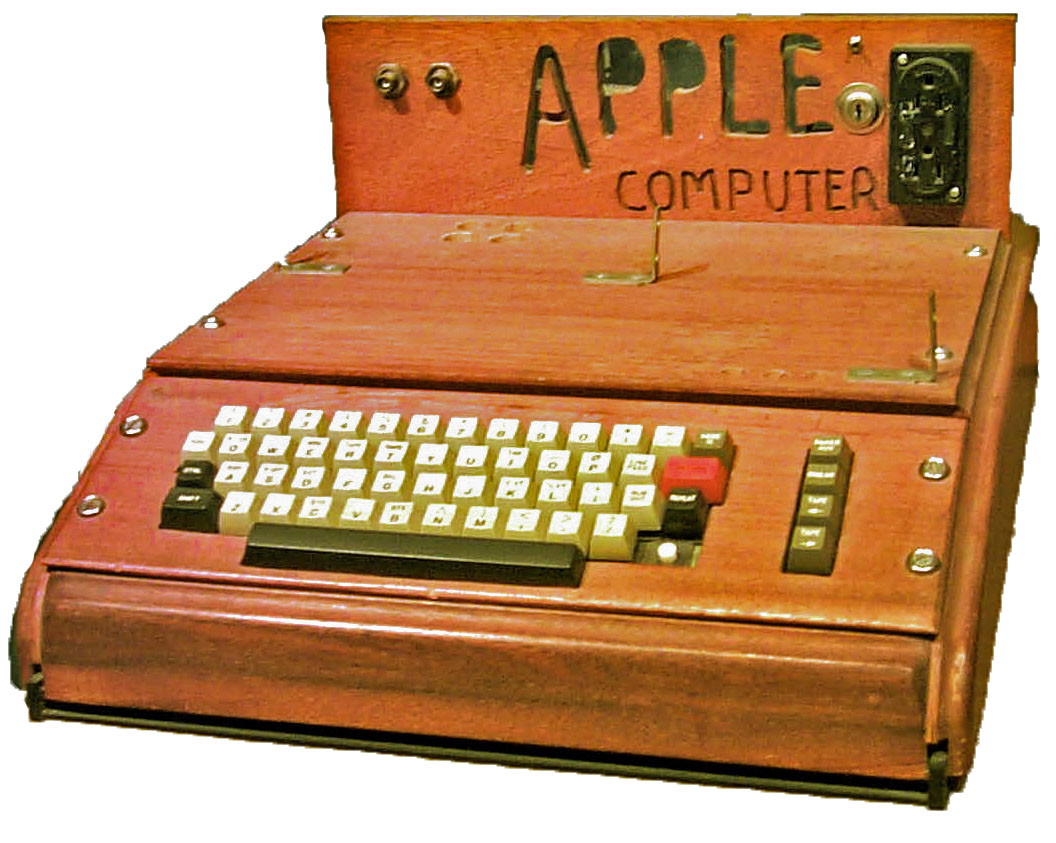
Have you seen an Apple One?
The first thing from Apple was a kit - not for the faint of heart. -
"Beneath Apple DOS" was available then
There was Beneath Apple DOS, a fabulous book from the time which was invaluable for figuring out what was going on. My understanding was that Don Worth and Peter Lechner disassembled the shipped code and sorted out how things worked, with great explanations. Those were a great guide and helpful for writing all kinds of software. I suspect that a similar effort these days would not be resolved without legal intervention- I have no idea if they even asked permission or if it would have occurred to people that you might want to ask. (This PDF of the book says that Apple was not in any way involved in the book, did not endorse it, etc right on the title page.) Then again, the source code for important parts of the ROMS at the time (Woz's Sweet16) was distributed with the computer in hard copy manuals. I learned a great deal from reading the Sweet 16 source for that and also from Beneath Apple DOS. Beneath Apple DOS wasn't full source code, but it did explicitly identify what blocks of code did what in a way that made it easy to understand what was going on and how to change things.
-
Re:Nibble for the Apple II
-
Re:Misuse of the term "virus".
And the first bug was Elk Cloner for mac...and?
The first named virus was Elk Cloner for the Apple II. The Apple II was not a Mac. It's not like it's hard to look up the facts and get them right. http://apple2history.org/history/ah23/
-
Re:Apple IS important here...
> Apple has always gained value from controlling the software and the hardware.
Yup, they learnt this lesson back in the late '70's with the Apple ][ floppy disc drive / controller. Summarizing the fascinating read:
http://apple2history.org/history/ah05/IBM engineers had invented the 8-inch floppy disk in 1971, and over the next two years gradually increased its capacity from 80K to nearly 240K. Alan Shugart, an IBM manager, left that company and formed his own in 1973.
Steve Jobs had been visiting the Shugart offices regularly, insisting that he needed a cheap $100 disk drive. After Wozniak figured out the details of how to control a disk drive, Jobs came back and said that not only did he want a cheap disk drive, he wanted just the mechanism; no read/write electronics, no head load solenoid, no track zero sensor and no index hole sensor.
Following the Consumer Electronics Show, Wozniak set out to complete the design of the Disk II. His original task on the disk controller was to reduce the chip count from the 40 chips used on the controllers for S-100 machines.
The Disk II was finally available in July 1978 with the first full version of DOS, 3.1. It had an introductory price of $495 (including the controller card) if you ordered them before Apple had them in stock; otherwise, the price would be $595. Even at that price, however, it was the least expensive floppy disk drive ever sold by a computer company.
The resulting product, the Disk II, was almost obscenely profitable: For about $140 in parts ($80 after the shift to Alps) [not counting labor costs], Apple could package a disk drive and a disk controller in a single box that sold at retail for upwards of $495.
-
Re:don't buy the fucking thing then
Actually, IIRC, Woz's Integer BASIC and mini-assembler (along with his Sweet 16 (the 6502 Dream Machine) and the Apple Floating-Point Routines) disappeared as early as the Apple ][+. . That's why I used to call the ][+ the "][ minus"...
At least they did bring back the Mini Assembler on the Apple IIGS (and I think the IIC Plus as well).
CALL -151 to get to the Machine Language Monitor from Applesoft BASIC
! to get to the Mini Assembler from there.I even had a letter that I sent in to Nibble magazine published explaining how you could even write up your assembly language code in a word processor, save it as a plain ASCII text file, and load it into the Mini Assembler with some fairly simple command that I can't remember.
-
Re:don't buy the fucking thing then
Actually, IIRC, Woz's Integer BASIC and mini-assembler (along with his Sweet 16 (the 6502 Dream Machine) and the Apple Floating-Point Routines) disappeared as early as the Apple ][+. . That's why I used to call the ][+ the "][ minus"...
I started with the ][+ and had all that stuff. I think it got fp basic by adding a card.
The main difference, so far as I ever new, was that accidentally bumping the reset key wouldn't reset you. A friend who bought before the + came out had a lot of problem with that.
-
Re:don't buy the fucking thing then
][ Forever motherfuckers! Still sore about the total lack of an upgrade path.... and with it the complete abandonment of that early geeky coolness. You could bring those up with no disk at all, start writting basic, drop into the built in assembler. Maybe it wasn't that useful like that, but boy did it ever get my curiosity going as a kid.
Loved Apple of the 80s.
Actually, IIRC, Woz's Integer BASIC and mini-assembler (along with his Sweet 16 (the 6502 Dream Machine) and the Apple Floating-Point Routines) disappeared as early as the Apple ][+. . That's why I used to call the ][+ the "][ minus"...
Actually, I was quite the Apple 1/][/6502 geek in those days. Wrote (among many other things) for the Apple ][, a "program switcher", a virtual-memory "overlay" system for Applesoft BASIC programs (that let you seamlessly and easily write Applesoft programs that were WAY too big to fit in 48K (it actually leveraged the ONERRORGOTO, along with the magical "Ampersand" vector to evaluate what the "error" was (what "missing" BASIC code line was attempting to be referenced) and then used direct disk-sector reads to "swap in" a section of BASIC from disk, while preserving the variable "heap". As long as you didn't do something stupid like break "segments" in the middle of a FOR-NEXT loop, it worked a TREAT!), and an in-situ 13 to 16-sector DOS 3.2 -> 3.3 floppy reformatter. I also produced several variants of Randy Wiggington's most-excellent TED II Editor/Assembler (speaking of Sweet 16. TED II's Editor was written in Sweet 16) that not only assembled to and from disk (it was the only way to assemble DOS 3.3 from source!), but also cross-assembled to 6801, 6809 and even 8048 and 8085 targets.
Good times. Good times... -
Re:A silly question
A floppy drive is easy - a floppy drive is just some motors in a cage - the floppy controller resides on the motherboard and tells those motors how to operate
My guess is that you've never actually SEEN a floppy drive.
Even the most hardware efficient floppy drive of all time, the Disk ][ drive electronics designed by Steve Wozniak for use with the Apple ][, used something like 8 TTL and analog chips on the floppy drive itself, plus some transistors, resistors, capacitors, an inductor, and a few other components. This is IN the drive itself. This connected via a 20-pin (IIRC) ribbon cable to a peripheral card in the computer with 5 more chips on it, including a pair of TTL ROMS that formed a really clever state machine that did the actual GCC "nibble" encoding/decoding. While it is true that the CPU in the Apple ][ controlled the stepper motor for the head movement (and maybe the spindle motor, too. Can't recall) more or less directly, and was responsible for the actual timing of the reading and writing of the "nibbles"; but the actual laying down and picking up of those nibbles on the disk surface was actually all done by the peripheral card and the electronics in the drive enclosure. So, your assertion that the floppy drive is but a box-full-o-motors is demonstrably false.
And as I said, that was the MOST hardware-efficient floppy design of all time. The reference designs by Shugart had a TON of electronics inside the floppy drive itself, and ANOTHER TWO TONS of the most bizarre conglomeration of digital and analog hardware mankind has ever seen on the "interface" card in the computer. I have no idea what the CPU in the host had to do after all this; but I assure you, that NO floppy has EVER been "just a box with motors". Period. You are simply talking out of your ass. -
Re:What do you call multiple walled gardens?
No, Apple's policies are more like the topiary in The Shining than a hedge maze or walled garden. Not only are consumers being denied a way to get where they want to go, the walls of the garden are closing in behind them.
As someone else said, Apple's behavior is a far cry from the company that gave us this.
-
Re:Decimal version numbers
Actually August of 1980. From 13 sector to 16 sectors/track.
http://apple2history.org/history/ah15.htmlAnyways, check out
http://groups.google.com/group/comp.emulators.apple2/topics -
Re:Is it just me?
Right, but Apple's ][GS floppy drives were rather different than the PCs. They even spin the disk at variable speeds to store more on the outer tracks. (The article says inner tracks, but it's got the story backwards.)
-
Re:It's computing, Jim, but not as we know it.
I wouldn't call most short lived - maybe Altair or MSX Basic (remember Microsoft's failed z80 based computer?) - MS released BASIC for every successful platform - Apple (Applesoft BASIC), Tandy (Color BASIC, TRS-80 Level II BASIC), IBM (too many to count - QBASIC and Visual I remember - QBASIC was on OS/2 as well), Commodore (Commodore BASIC), Atari (heh - I read TFA to learn that one), and Amiga (um... damn, can't remember the name, but I'm certain it was MS or MS derived).
Personally, I only used the Atari 400/800 a couple of times. I don't remember them even offering a floppy drive for that one (I remember one later model having them built-in). Shows what I know. I do remember magazines with semi-cross platform BASIC code, which was fun in my pre-teens.
One of the killers for the 400/800 was also the expensive and heavy Faraday Cage they were forced to include by FCC ruling to avoid RF leakage. Apple got around it by licensing an inexpensive FCC approved RF modulator from a separate company (see here) to be sold separately with new Apple ][s (and Commodore avoided the issue, I believe - the PET was grandfathered and the Vic 20 had time to learn by Apple's example). In a low end price war between the 400 and Vic 20 (and later C64), the 400 just couldn't compete.
-
64 bit zip chip? Apples by the pound?
When the Apple ][ was waning I bought a "Zip Chip" for it that ran at 10 mhz!!! WOW! What a difference!!! It still works too.
Zip Chip 10Mhz 6502
Apple ][ Accelerators.The 6502 is limited by those darn 8 bit registers and 16 bit address space though... sigh, if only someone made a 64 bit version of the 6502! Maybe it could be done open source! Get to it.
Ok, someone made a 32 bit version but come on, 64 bits rock!
32 bit 6502Maybe it'll be a kid in the third world using one of these reconditioned Apple ]['s that invents Skynet for afterall: "In the science fiction movie The Terminator (1984), starring Arnold Schwarzenegger, the audience at one point is treated to a view through the T-800 Model-101 robot character's eye/camera display with some 6502 assembly/machine code program fragments scrolling down the screen. The program was listing the Apple ][ Disk Operating System (DOS) 3.3 decompiled program listing." I almost fell out of my seat during the first screening of Terminator when I saw the 6502 listing for I could read the darn stuff! It's nice when they make a multimillion dollar action-scifi movie just for you!
Then of course one day I was in a used computer store where they had a sign attached to a pile of Apple ][s that said "Apple's by the pound"... literally... I think it was $1 a pound or something like that... worked out to maybe 10 bucks each.
Go get'em MIT!!!
-
Start at the back, and work your way forward:
http://apple2history.org/dl/download.pl?file=a2refmanorig.pdf
The Apple II Reference Manual provided not only a handy schematic to all the electronic components (that folded out into a poster-sized thing of beauty), but there are ROM dumps and direct address locations provided throughout.
Excuse the philosophical rant, but there have been three "Apples" so far. The first, with both Steves (The "Accessible" Apple), with one Steve (The "Progressive" Apple), and this one, with "King Steve", attempting to "screen-in" his kingdom.
I believe we can expect an Apple down the road with led by a "Knight on a White Horse" to the resuce, so to speak.. Woz? -
Maybe he needs to stop believing his own marketing
The guy is clearly either misinformed or an idiot.
Quote:
Sweeney: There are many overpriced computers out there. It's like sports cars. They are everywhere, everybody writes about them, but there are only a few who can afford them. There isn't a great amount of people that will spend large amounts of money on that.
****
When gaming computers first came out - back in the Apple IIe and Amiga and so on era - the 8 and 16 bit computers of old, the average computer adjusted for inflation was an order or two higher magnitude in cost to today's machine.
$800-$1000 will buy you a superb PC for gaming. That much adjusted for inflation, barely bought you a pair of floppy drive two decades ago.
http://en.wikipedia.org/wiki/Apple_II
Quote:
The original retail price of the computer was US$1298 (with 4 KB of RAM) and US$2638 (with the maximum 48 KB of RAM).
http://apple2history.org/history/ah09.html
Quote:
The drive mechanism was improved to better read half-tracks on disks (which some copy-protected software used), and at $795 was priced to be less expensive than buying two of the older Disk II drives with a controller card.
$800-$1000 for a good gaming machine is dirt cheap and lots of people DO pay that much. Just look at how many people buy pricey components from NewEgg. -
Re:The good old days
The first time I realized that I could make a career out of this fun computer stuff was when a guy "paid" me to get his SilenType printer working with a 16K RAM "language card" for my Apple II+ (about $300 IIRC). That was great since my giant 48K memory was still not up to the requirement for playing Zaxxon.
My first real job with a paycheck was before I could drive, cracking educational software for a school system. Kids were constantly ruining the floppy disks so my job was to copy all the originals and send out only copies to the teachers. I was willing to do that just for fun and they offered to pay me. What a deal! They even bought me a copy of Locksmith, CopyII+ and an NMI card. I continued doing that through my first year of college. Bought the cool new Apple IIgs for that, then my first Mac (IIcx) afterwards when I finally gave up on my beloved II. I'm happily working away on my MacBookPro. Life is good.
For some odd reason, this still sticks in my head
poke 1014,110
poke 1015,165
makes your & key do a "CATALOG". Lots less typing.
Beagle Bros actually had a hack that would alternate starting up your two floppy drives to sound like a steam train chugging.
My cousin used Zoom Grafix to print out a 5x5 foot mickey mouse. Took days on his Epson MX-80 and was much lighter on one side than the other because the ink ribbon was wearing out. They had the Graftrax+ chip added to the printer so they could print actual graphics, not just letters.
Everybody had a Nibble Notcher to make their disks double-sided.
I still have an article somewhere describing how to snag the read/write track sector (RWTS) from a protected disk and use that to read a copy protected disk and write it out in unprotected format. Was going to submit to Hardcore Computist but never got around to it.
I spent hours combing through games to change references from $C030 to $C020 with Inspector so the sound output would go to the cassette port and thus to my boom box.
I remember the first time I got to see double high-res graphics on an Apple IIe with the extra video RAM. Amazing.
I gave up getting a pair of cross-country skis for Mask of the Sun, which turned out to be not that great.
I've forgotten how painful it was to do wordprocessing at 40 colums with no lower case and no spell checker on AppleWriter. I did have a third-party spell checker but it came on 6 disks. So one spell check required flipping in and out a pile of floppies and a lot of waiting. Had to do the Shift Key Mod running a wire from the shift key to the game paddle button to make the shift keys work. How did I ever get those school papers written.
We had fun pretending that Fire Organ actually matched up with the music we were playing.
And while I'm geezing, it sure was expensive reading about the 84 Olympics or downloading adventure game walkthroughs via my 300 BAUD Hayes Micromodem II over a long distance call to Compuserve for another $12/hour. Ahh, the good old days. -
Re:you forgot one as well
-
Re:RTFM = Best Evar.. BASIC, etc, etc
In high school, Beneath Apple DOS was the Bible for myself and my hacker friends.
-
And in production for almost 18 of those 30 years!
Check out this fascinating time line for an overview of when each model was being produced, along with some computer industry milestones for context. The site has in depth history on the whole story.
Versions of the Apple II were still going strong when Linux and Windows 3.1 were released.
Retirement finally came shortly before Windows 95, but by that time software emulation had become more convenient.
SLM -
Re:Is the Woz really that great?
They also couldn't handle radio emission according to FCC standards for home use either.
According to the Apple II History page the FCC issues were related to the RF modulator design used. I don't think anyone has ever claimed Woz was an RF engineer.
And talking about BASIC, the BASIC language they first created for the Apple II wasn't good either, so they had to buy it from MicroSoft, but at double the price of Commodore.
Then hit that page again and read the part starting with "An interesting bit of trivia about Wozniak's Integer BASIC was that he never had an assembly language source file for it. He wrote it in machine language, assembling it by hand on paper". One of the things Microsoft had going for them when they were working on their BASIC was that they access to much better development tools running on a larger system, and were essentially cross-compiling from there to generate the code for the home PC. Anybody can write a BASIC interpreter, fitting one into a tiny space in the era before there were even good assemblers available was a different thing altogether. -
Re:Prior artQuoted from Apple II History Chapter 3: On the motherboard were two empty sockets that were available for the user to plug in their own ROM chips. The $D000-$D7FF space was most often used by a plug-in ROM chip sold by Apple, known as "Programmer's Aid #1." It contained various utilities for Integer BASIC programmers, including machine language routines to do the following: ...
- Handle hi-res graphics from BASIC, including code to clear the hi-res screen, set colors, plot points and lines, draw shapes and load shapes from tape.
But... from Chapter 16: To fully appreciate this narrative, you need to know a little about an old Integer BASIC program, APPLEVISION. This was found on the DOS 3.2.1 System Master disk, and was a fun little display that showed off the use of hi-res graphics. It began by creating a simple line drawing of a room, with a picture on the wall ("HOME SWEET HOME") and a television set. On the screen of the TV appeared a man who danced to the tune of "Turkey In The Straw", which sounded on the built-in speaker. It ran repeatedly, until the user interrupted the program. It was fascinating at the time, since there was nothing in the program text that showed off exactly how the hi-res effects were accomplished. (my emphasis) -
Re:Prior artQuoted from Apple II History Chapter 3: On the motherboard were two empty sockets that were available for the user to plug in their own ROM chips. The $D000-$D7FF space was most often used by a plug-in ROM chip sold by Apple, known as "Programmer's Aid #1." It contained various utilities for Integer BASIC programmers, including machine language routines to do the following: ...
- Handle hi-res graphics from BASIC, including code to clear the hi-res screen, set colors, plot points and lines, draw shapes and load shapes from tape.
But... from Chapter 16: To fully appreciate this narrative, you need to know a little about an old Integer BASIC program, APPLEVISION. This was found on the DOS 3.2.1 System Master disk, and was a fun little display that showed off the use of hi-res graphics. It began by creating a simple line drawing of a room, with a picture on the wall ("HOME SWEET HOME") and a television set. On the screen of the TV appeared a man who danced to the tune of "Turkey In The Straw", which sounded on the built-in speaker. It ran repeatedly, until the user interrupted the program. It was fascinating at the time, since there was nothing in the program text that showed off exactly how the hi-res effects were accomplished. (my emphasis) -
Homebrew... EVERYTHING!
Back in 1992, I had a short job with a company that made window blinds. They had been around for long enough that the first computer they used was an Apple II. The guy they had doing their software tended to write everything himself, which was in a lot of cases necessary because what they were asking him to do just couldn't be done with any off-the-shelf packages. So, he wrote The Blinds Program. Originally written on some sort of UCSD p-code (remember that?) implementation of Pascal, The Blinds Program eventually got moved through a couple of other Apples, some sort of SmallTalk environment, and a couple of other things until it ended up on a trio of Macintosh II servers and a bunch of Macintosh workstations strung together with their AppleTalk connectors.
However, nothing was off-the-shelf. Literally, nothing. I'm pretty sure the guy wrote most of his own networking protocols, wrote his own database engine, and then wrote the guts of The Blinds Program within it. The data -- ALL data, from details about blinds orders to supplies purchasing to payroll records to scheduling to who knows what -- was in this mysterious custom database that consisted of pointers-to-pointers-to-pointers-of-data. You literally couldn't find anything unless you already knew where it was likely to be. The problem is, the thing was so dependent on its rat's-nest of pointers that if one was corrupted, the system would happily go writing new data to entirely unexpected places, including places that older data might already live.
Whenever anybody needed a new tool, it got written into The Blinds Program. Simple calculator? Put it in The Blinds Program. EDI interface to talk to your customers' systems? Put it in The Blinds Program. Need to dial up a BBS? Let's not use Red Ryder, let's write it into The Blinds Program (with hard-coded phone numbers, of course).
Well, eventually the guy decided he wanted to do something else with his life, and he left, and they handed the thing over to me. After about four weeks of exploring this monster, I realized that (a) the only person in the entire world who could grok it had already left and (b) I didn't wanna be around when (not if) it exploded and took the entire company with it. I went into the general manager's office and laid it out for him: go hire a consultant, have them design you a new system from supportable, off-the-shelf components, pay them to test and maintain it, or this thing is gonna eat your company. And then I resigned. No sense having a digital Hiroshima on my conscience. The GM hemmed and hawed and I think eventually hired the original guy back as a consultant and never did replace The Blinds Program.
The company went out of business in 1999 or so. I was amazed they lasted that long. My old boss got a good deal on a pool table at their bankruptcy sale. -
the PC shouldn't be #1
you're confusing "market share" with innovation - what exactly did the IBM PC bring to the table? About the only innovation was using all off the shelf parts rather than a mix of off the shelf and in-house parts. I could argue the Disk ][ was more innovative.
The IBM PC was marketed as a business machine and sold mostly to businesses because IBM was the definition of business computing at that time. It wasn't really popular as a home computer until later, so you can't even say it brought the PC to most houses - everyone I knew had a Apple, trash-80 or Vic 20 at home (and later C64). I honestly don't remember even seeing a 5150 (the first model IBM) in any house, though I did see one at my dad's office. Even my tech-nut uncle, an electrician by trade, didn't have one, and he had an Altair and several other kit computers, a PET, Vic 20, and TRS-80 - his first PC was an AT (a 286).
Oddly enough, I remember the 5150 number because I disliked the Van Halen album by that title (the first with Sammy Hagar), not by the computer, although the naming is unrelated (VH is named after the studio address where the album was recorded). -
APPLE II FOREVER!!!
I'VE BEEN USING LONG FILE NAMES SINCE 1978.
I SAY THE NEXT CHALLENGE IS LOWER CASE. -
MS/OO Office not in my top 2 listThere are two word processors that I have LOVED and I would really consider going back to them again if I could.
- Apple P.I.E. (Programmers' Interactive Editor). This actually was a real word processor, not a code writing editor. It had a jump to last positions function (keypad 0) and lots of wonderful mindjarring but beloved control sequences. Had a great manual too. This was for the Apple ][. If anyone has a copy please send it to me - I don't know how to read my old floppy disks!
I found references here which says it was made by Robert (aka Rupert) Lissner in 1984 and was the basis for AppleWorks. But here mentions the late David Gordon of Programma International which sounds more correct to me, and capitalizes the PIE. Lissner's was written in Assembler apparently, though Gordon's was too probably. Anyway I always think about how quick and easy it was when I use OpenOffice.org which (not a troll) brings my 128MB Dell Inspiron 7.5K/RH9 to its knees. If anyone has a copy on the net somewhere let me know - can't convert my floppies easily. - The other was a dedicated word processor I think by WANG which we used in our school newspaper around 1982 or so. 8" disks, green phosphor portrait display showed a page at a time. Some other mysterious master disks did other things too but this was basically a word processor only. It felt like you were typing on the page which was shown completely at all times, and you could use arrow keys to move and start typing at any cursor position on the page. This was a wonderful, wonderful word processor, simple and quick and sweet.
- Apple P.I.E. (Programmers' Interactive Editor). This actually was a real word processor, not a code writing editor. It had a jump to last positions function (keypad 0) and lots of wonderful mindjarring but beloved control sequences. Had a great manual too. This was for the Apple ][. If anyone has a copy please send it to me - I don't know how to read my old floppy disks!
-
it may make a huge ditterenceIn 1988, when I was 5, my dad gave me an Apple IIgs with
- Deluxe Paint II
- Chuck Yaegar Flight sim, and
- Some music composition program
- animation program and
- the atomic gorrillas / atomic bananas game (which was in QBasic). I got curious and looked at the source code. I saw numbers. I changed numbers. Cool stuff happened.
Today,- I earn cash on the side with graphic design.
- I am working toward my pilot's licence.
- I deal with stress by composing classical music.
- My interest in computer animation has lead me to work for the US Air Force doing CG visualizations
- And oh yeah - during the day, I make videogames.
My point is this - whatever tech you show your kids - choose wisely. The particular things you choose may really make a big difference.
-
Re:Back in the day
The Integrated Woz Machine was named after the Woz, but it was designed by someone else.
No, stand corrected or perish.
http://apple2history.org/museum/articles/byte8501/ byte8501.html
Why would you name a circuit after a person who didn't invent it? Why would one moderator mod you informative when your not? Go figure.
Enjoy. -
Apple IIc
Apple had no presence in the portables market prior to 1992
Where's the historical perspective? It may come as a surprise to some, but Apple actually made computers *before* the Macintosh. The Apple IIc was compact and roughly portable; although i couldn't tell you for sure (i was a C64 hacker at the time) we all assumed the Apple IIc was a portable because we see it being used on a beach in the movie "2010". Although looking back now, one has to wonder where the battery is in that compact little case. -
Full of ShitBack around the Gulf war Cringely made another observation about the duo which I like. He said Gates was like the Sultan of Kuwait, not wanting the boat rocked and milking the profits from his empire. Jobs was like Hussein, firing his revolver in the air in front of a crowd of fanatics and telling the rest of the world that they are "full of shit".
If you want a very good book about Apple up to the time of Sculley and Jobs' early years try to get hold of The Journey is the Reward by Jeffery Young. West of Eden, the End of Innocence at Apple Computer by Frank Rose is also another good book at this time. Oh, and if you want a laff read Sculley's book Odyssey - a more talentless f*ck and bigger blowhard you could not wish to hire to ruin your business, the guy obviously only made it by marrying the boss's daughter. Sculley is all that is wrong with corporate America. The book must rank with "The Road Ahead" as the deranged ramblings of someone who just didn't get it.
-
Re:Not the First Anti-competiveness from Apple
Nevermind the Toshiba (not IBM/Hitachi) 1.8-inch hard drives had existed for quite some time before Apple made the iPod. Hell, IBM/Hitachi's Microdrive (later used in the Mini) had been out for years. No one else saw their potential, so prior to the iPod the best you could get was a Nomad, which used 2.5-inch hard drives. After all, capacity was everything, right? Apple took a huge risk on a completely new and unproven product and bought their remaining stock. What is "anti-competitive" here?
As for your last paragraph, Microsoft's "superior engineering"? Nevermind that Apple's entire history back to the Apple II (and the Wozniak-designed controllers) has been about superior engineering, and Microsoft's has always been about purchasing/licensing/controlling other software and making it "good enough", all the way back to Microsoft BASIC. -
Re:Apple's chance to get the business market stymi
The ][ platform wasn't opened up to cloning. Granted, no one, including IBM, was prepared to actually sanction this; the culture back then was of every microcomputer manufacturer having its own hardware, OS, disk format, et cetera - each one dreamed of total domination with its own platform. It took Compaq's sleight-of-hand on IBM to do it. Why was no such cleverness pulled with the Apple ][ platform?
Have you ever heard of the Apple II clones such as the Laser?
http://apple2history.org/museum/computers_clones/l aser3000.html -
Re:My iBook died two months ago...Face it - Apple has a history of supporting their legacy customers for as long as is technically and financially feasable, and the developers have generally gone along with this.
Unless you were one of those who bought an Apple IIGS in the early 90's:
Apple's efforts to de-emphasize the Apple II went so far as to have their developer technical support staff specifically recommend that new applications not be created for the Apple II or IIGS, but rather for the Macintosh. Apple authorized dealers tended to direct potential customers away from purchase of any new Apple II product, and towards the Macintosh platform, often making this advice because "the Apple II is about to be discontinued anyway". [Apple II History]
-
Re:The Numbers Game:
hmm, not entirely correct. On the Apple II it was called appleworks. Apple spun off Claris in 1987. http://en.wikipedia.org/wiki/Claris
Way too much history about appleworks: http://apple2history.org/history/ah19.html -
Re:I don't think so
Fuck this -- we have always gone with the best chip out there, starting with the 6502, and we always will.
Woz picked the 6502 because it was cheap ($20). The 8080 and 68000 both cost more ($179). -
Apple II ForeverWhat the heck is running the other 30%?
A large, distributed flock of Apple IIs. There are still a lot of them out there, and Apple did say they would be "forever."
-
Duh...
There Is No Safe Web Browser
Your web browser is absolutely safe as long as your computer doesn't have a network connection and you don't load any unsafe software (i.e., Windows). That reminds of the good old days of the Altair. -
Re:The days of Apple ][e...I miss them.....
Nibble was the best (and still is the best) computer magazine ever.
Paired with Softalk, you had an awesome pair. -
Wrong picture
TFA shows a picture of an Apple
-
old magazines come in handy
I used to keep my old Apple II computer magazines religiously. My parents thought I was a packrat, but it came in handy one day.
It was high school graduation and the end-of-the-year literary magazine came out. One of the students had won 2nd place for SciFi writing in the state, and his story was in that magazine. I started reading it and got sick to my stomach... I had read this somewhere before, after an hour searching through the stacks of magazines, I found the 7-year-old issue. When the principal presented the evidence to the guy, he had never heard of the magazine -- he found it on some BBS somewhere and didn't even have to retype it to plagiarize it.
He had used the paper for some simple english paper, but his teachers liked it so much they pressured him to submit it to the writing contest. He didn't have the balls to admit what he did.
On a nicer note, I still have the copy of Softalk that introduced the Apple Lisa. Fun reading! -
Re:IIe?
Nope. I mean the original, one-floppy, 80-column Appleworks. Database + word processor goodness old-school style.
I must have written about a hundred different papers on that thing. -
IBM Progress bar patent
The paper mentionsthe IBM progress bar patent from 1990: Patent on progress bar
Here's a screen shot from the Apple2GS (Actually its running on a GUS emulator becauses it way too old). AppleIIgs screen shot
Notice the progress bar it displayed as it was starting up. Thats from 1983?
That's a European patent. -
Re:How Many TimesThere's a world of difference here:
- Apple patented stacks, years ago, thus creating intellectual property.
- Apple purchased intellectual property from Xerox: "However, a significant change occurred in 1979 when Xerox bought a large chunk of Apple stock. In return for being allowed this stock purchase, Xerox allowed some of their research ideas to be used in designing an office computer."
- Apple complies with the BSD license agreement, by freely distributing its improvements to the source, and including the license in the source it distributes. I'm no expert, but I imagine they'd face legal action if they were not complying with the license. Thus they use and improve the property therein in good faith, which, I thought was the whole point of open source, right?
The point is, it is only stealing if you take it from someone against their will. Apple, as far as I can tell, does things the proper way, whereas Microsoft often does not.
-
Re:What's in TigerThat's a good point about April Fools and the Tuesday / Friday thing. However, there is one point that could possibly be taken into consideration:
They pooled their financial resources together to have PC boards made, and on April 1st, 1976 they officially formed the Apple Computer Company.
Taken from here.