Slashdot Mirror
Domain: arizona.edu
Stories and comments across the archive that link to arizona.edu.
Comments · 896
-
Enceladus naming of sulci
I was intrigued about why the names of those tiger stripe cracks are middle eastern cities. Googling I found this article which notes that there is a convention of naming features on this moon after places in the Arabian Nights. The page is cool and tells you what a sulcus is. And there's is a link on that page to a giant 6mb map with names of features on it.
-
Direct link to photos
All of the images from the Mars Reconnaissance Orbiter (whether measured in discs or libraries of congress) are online. Fantastic resource.
-
Re:Gravity well
Will plants grow well in 1/6th gravity? Who knows?
These guys, maybe? Ronald J. Anderson, Thomas M. Crabb, John G. Frank, Steven M. Guetschow, Jeffrey T Iverson, Olaf Meding, Robert C. Morrow, E. Don Peissig, Ross W Remiker, Robert C. Richter, David Smith, Jon D. Van Roo, Anton G. Vermaak, and John C. Vignali of Orbital Technologies Corp. for Kennedy Space Center.
Or anyone with access to a working clinostat, really. -
Sci Fi not in conflict with Christianity
the futuristic setting flies in the face of predictions that the second coming will be any day now
I am no biblical scholar, but I am pretty sure that the bible is pretty clear that no one will know when the second coming will occur. Hard science fiction is perfectly compatible with religion. As is hard science, heck, the Vatican operates a major observatory. Research highlights include:
Dark Matter and Energy in the Cosmos
The Acceleration of the Universe
Quasars
Globular Clusters
http://clavius.as.arizona.edu/vo/R1024/Research.html -
WWJD i
-
Bit of an ignorant jab about Catholicism, no?
The Vatican has been a very important centre for astronomical research since well before the space race. A Catholic priest developed the Big Bang theory. The Vatican accepts the reality of evolution and has criticised the American movement to teach "Intelligent Design" in science classes.
Things have changed since 1633 you know (and no, I am not a Catholic.) Maybe you thinking of some other denomination? -
800MHz G4 IS SUPPORTED
I can confirm that an 800MHz G4 is all that is required to install Leopard (the developer preview). A staff member in my department did it with an 800MHz Windtunnel PowerMac - and more interestingly, he used target disk to install Leopard on his unsupported 667MHz TiBook (on which the installer refused to run because it didn't meet the minimum requirements). Here is his entire story. http://forum.oscr.arizona.edu/showthread.php?t=4557
-
Andromeda Strain!!! or not...
Ah, I suspect this was either not a meteorite or there is something else going on given that any meteor leaving a 30 meter wide and 20 foot deep crater (meteor being approximately 30 inches wide) is not going to hit the ground steaming hot. On the contrary, it will be cold as ice (or colder) given its composition and time for heating. However, I suppose it could also be a re-entry event from a satellite carrying a toxic payload like plutonium... After all, we have the remnants of many satellites and the debris associated with them still in decaying orbits and you can easily spot many of them. Some satellites particularly those from the former Soviet Union and China have a history of toxic components. Though I suspect we'll know soon enough if it were a satellite, it would have been tracked by numerous agencies and individuals who monitor that sort of thing.
-
Re:amazing photos
What looks dark can be bright at a different wavelength. It depends on what sensors you are using.
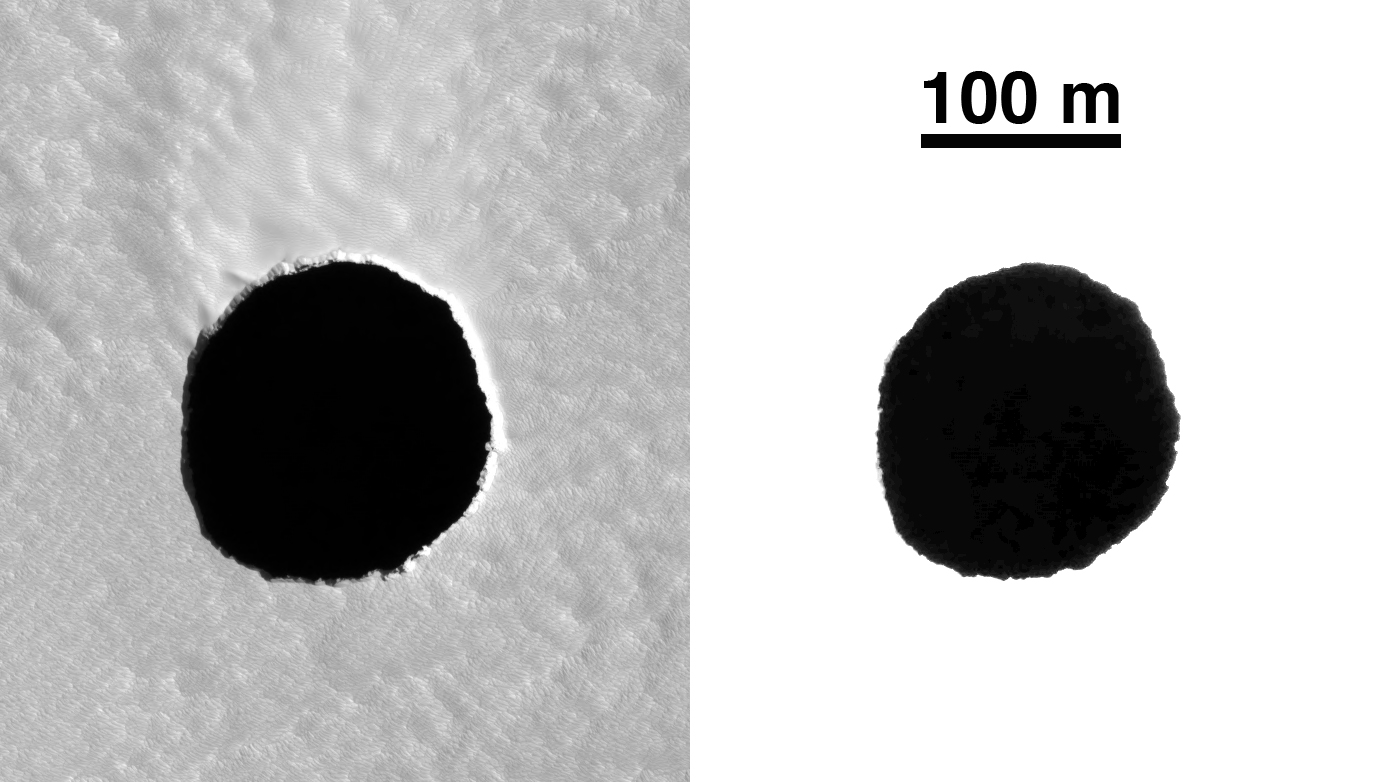
Another fascinating black "thing" on Mars: http://hirise.lpl.arizona.edu/PSP_003647_1745 . But in this case is just a hole in the ground. -
Re:remember...
You may be closer to the mark that you might think. On the University of Arizona's AI Lab page on Dark Web Terrorism Research, there's a section for the Dark Web Portal that says that 500,000 pages from 94 US domestic groups have been collected. I'm hard pressed to think of that many distinct terrorist groups that are operating in the US. Unfortunately, I was unable to find any mention of the criteria used to determine how a group is classified as being terrorist.
-
PSYOPS 101 = FEAR
BOOOOOOOOOOOOOOOOOOOOOOOOOOOOOOO!
If nothing else, there is hope.
ASTEROID IMPACT KILLED OFF DINOSAURS
http://www.lpl.arizona.edu/SIC/impact_cratering/Ch icxulub/Chicx_title.html
We're next!
#BOOOOOOOOOOOOOOOOOOOOOOOOOOOOOO!
RR -
Re:Next?
-
Re:Ideas for next time?
The next Mars lander Phoenix launched last month. It will arrive in May next year.
Although it's not a "rover" it does have solar panels for power. I believe there is no way to clean the solar panels of dust.
So, in short, no, lesson not learned. -
The name is a double entendre
The summary mentions that the name is derived from the mythical phoenix, but this is only part of the story. The probe - the first to be launched as part of NASA's low cost "scout" program - was led by the University of Arizona. It's safe to guess that Phoenix also refers to the capital of the arid state. I wonder if I'm the only one who keeps confusing the leadership of this mission with the ubiquitous University of Phoenix.
For this and more information on the Phoenix mission, see the mission page. -
Re:Canadian Content
The Canadian contribution to the mission is a meteorological station that includes a pressure sensor, three temperature sensors on a mast, a wind telltale, and a lidar (laser radar) system. The lidar will be used to obtain profiles of dust in the atmosphere, and uses a technique very similar to radar or sonar but using pulses of laser light instead. We use lidar systems here on Earth to profile aerosols, ozone, clouds, etc here on earth. The Can con will be complemented by other instruments for atmospheric measurements, including the Stereoscopic Surface Imager (SSI) which will take pictures of the sky through a variety of filters, and the MECA which will measure water vapour. You can read more about the Phoenix instruments at http://phoenix.lpl.arizona.edu/science05.php. This programme, as all space programmes are, is massively collaborative. It is a partnership between NASA, the Canadian Space Agency (CSA), and other international contributors. Peter Smith from the University of Arizona is the Science Team lead. On the Canadian side the Science Team is composed of researchers from York University, Dalhousie University, University of Alberta, and the Geological Survey of Canada. The meteorological station was built by MDA (who also built the Canadarm), Optech and Passat. The launch this morning was quite a thrill. As someone else pointed out, the most challenging part is yet to come: the descent. The landing is very ambitious, with multiple stages including parachutes and retro-rockets. Good fun.
-
We will know.
Actually, there is an instrument specifically designed to study Martian dust aboard the Pheonix Mars lander that is launching next month and will arrive on mars next June.
The MECA (Microscopy, Electrochemistry, and Conductivity Analyzer) instrument actually began life as the Mars Environmental Compatibility Assessment. It was initially sponsored by NASA's Human Exploration and Development of Space initiative, and was designed to determine what risks Martian dust would pose to astronauts. It will look at the size, shape, and composition of the dust using both optical an atomic force microscopes, study the reactivity of the dust using a series of wet chemistry cells, measure the thermal and electrical conductivity of the dust, and look at how the dust sticks to a wide range of materials.
It may not be sample return, but it's a pretty in-depth study of the Martian dust. Given that it is launching in less than a month, I'm surprised it was omitted from the article.
-
We will know.
Actually, there is an instrument specifically designed to study Martian dust aboard the Pheonix Mars lander that is launching next month and will arrive on mars next June.
The MECA (Microscopy, Electrochemistry, and Conductivity Analyzer) instrument actually began life as the Mars Environmental Compatibility Assessment. It was initially sponsored by NASA's Human Exploration and Development of Space initiative, and was designed to determine what risks Martian dust would pose to astronauts. It will look at the size, shape, and composition of the dust using both optical an atomic force microscopes, study the reactivity of the dust using a series of wet chemistry cells, measure the thermal and electrical conductivity of the dust, and look at how the dust sticks to a wide range of materials.
It may not be sample return, but it's a pretty in-depth study of the Martian dust. Given that it is launching in less than a month, I'm surprised it was omitted from the article.
-
Re:As they say...> How much is the contribution of gravitation (weight->pressure->heat) to geothermal activity? I would have guessed it exceeded that of radioactivity.
A couple of billion years ago, you'd be right, but the heat inside the earth today is sustained by radioactive decay. There's also some heating due to tidal effects as the planet gets tugged on by the sun and moon as it rotates. Heat from solar radiation doesn't really penetrate, but the warmer the ocean and the atmosphere are, the less heat escapes from the interior.A neat paper on the Earth's heat budget is located at http://www.geo.arizona.edu/geo5xx/geo519.071/lect
u res/Heat_Budget_Earth.pdf.
The capsule summary:
* A variety of sources heated the Earth immediately during formation: gravitational collapse, adiabatic compression, and short lived radioactivities that quickly disappeared. Gravitational collapse may not have contributed much heat to the inner Earth because it could have been mostly dissipated during accretion, but this is uncertain.
* Today decay of U, Th and K produce something like 40-75% of the observed total heat flux from the Earth. Solidification of the core (heat of fusion) produces about 10%. Cooling of the ancient heat deposited in Earth's formation is 15-50% of the flux.
* So - there is a lot of uncertainty here. It is most likely that radioactive decay dominates over simple cooling of ancient heat today, but this is uncertain. If one includes core solidification as a form of ancient heat (it is latent heat of formation) then the likelihood of radioactive decay dominance diminishes and it becomes possible that ancient heat still dominates today. -
Re:Terraforming...
First, the average temp on mars is -67 F. That is across the entire planet. The equator itself reaches 80F (daytime in summer). As to water, Mars appears to have water. But like everest and Antarctica, it appears to have ice. Is it inhospitable? Hell yes. If it was hospitable, then we would already have sent NUMEROUS colonies there. But that is why we are not there. Yet. As to Eeverst, it belongs mostly to china. And we are on Antarctica, but even that is divided up. But due to laws, it can not be mined or used for more than scientific interest.
-
and one GIANT PUDDLE
-
Re:Actually, it's not pure black...So it's all in one post (like I should have done to begin with...):
The black part is not pure black, actually. There appears to be some structure inside the hole.
I ran the HiRISE cut-out image through photoshop (using a stark black-white striped image gradient) and some structure appears to come out in the black region. It's way down on one side of the color spectrum, but I'm able to see about 4 layers of gradient in the black. Perhaps a professional image analysis could bring out more.
With my limited imaging experience (undergrad astrophysics) it doesn't seem to me like the data that comes out is merely random instrument noise. It looks sort of like broad hilly terrain variations of a scale size similar to those outside the hole.
Here is the original image from HiRISE site.
And here is the enhanced color version that I got by using a high contrast color gradient in photoshop.
That stuff at the bottom looks like lumpy ground a lot like what's outside of the hole.
I bet a high fidelity image enhancement of the original data could bring out a lot more detail though. There's probably already someone doing a paper on it as we speak.
-b
-
Re:Mission Enterprise
This looks like a man-object.
Oh, you said man-made object. Nevermind.
-
Re:With one thing edited out that is....
http://hirise.lpl.arizona.edu/PSP_003234_2210
You were saying? -
Re:What about the lid?
This is a moot point in my household; both the seat and lid stay closed. Even when my girlfriend is out of town. That's because if you don't shut the toilet before you flush, a massive cloud of tiny invisible particles of fecal matter and other nastoids comes shooting out of the toilet in all directions, coating you, the bathroom, and anything else in its path (like say, your toothbrush, if you don't leave it in the medicine cabinet or somewhere sheltered).
This was documented in a mildly famous study by Charles Gerba. It has been amusingly dubbed the F3: the Fecal Fountain Factor.
Now, tiny droplets of shit and piss water won't kill you--if you are healthy, you could likely french kiss your toilet seat and not get sick, but that doesn't mean you wanna. I find the mere knowlege that, if I don't shut the toilet first, I will be bathed an a microscopic shit shower to be sufficiently unappealing that I always do so. And, this way is equitable to all parties involved--no matter if you are a stander, or a sitter, you still have to lift the lid to use the toilet.
Luckily, the ages-old controversy is being brought back by the Japanese. New toilets there have infrared sensors that detect your approach and lift the lid and/or seat for you. Sounds ridiculous, but once you get used to it (that is, use it once), you come around to liking it. And happily, this technology reignites the debate with your female counterpart: you can argue about whether Mr. Smarty Toilet should be programmed to lift the lid, or both lid and seat. That is, until they come up with the next generation of toilets than can differentiate between individual people... -
Re:Why blame everything else?O'BLY?
Honey bees have lots of little hairs on their body. Even their eyes have hairs. Pollen sticks to the hairs while the bees are visiting the flowers. A furry little bee wiggling around inside the flower picks up a lot of pollen. After getting pollen on their body hairs, the bees move it to a special area on their hind legs called pollen baskets . Foraging bees returning to the hive often have bright yellow or greenish balls of pollen hanging from these pollen baskets.
Ooh, that's gotta sting!
Pollen is the yellowish or greenish powder-like substance that sometimes comes from flowers. It may be quite sticky. It contains the male contribution to the next generation of plants. Honey bees mix the pollen with some nectar to form a mixture called beebread that is a protein-rich food used to feed the larvae. As the worker bees move from flower to flower, they spread pollen to many different plants, including important foods such as vegetables (squash and cucum bers), fruits (apples, watermelon, plums, sweet cherries, citrus), nuts (almonds), plants grown for seed (sunflower), and animal feed crops such as clover.
Just kidding, brother. I'm no beekeeper either, but I did find your honest skepticism (like mine) to be provocatively informative, since it encouraged me to read a little bit this lazy saturday morning. I'm still recovering from a concussion and stitches from yesterday, so take my reference above (and the source cited) with an equal amount of skepticism. -
Re:Let's get serious
According to this http://www.lpl.arizona.edu/impacteffects/ 2 mile long asteroid is going to shatter a lot of glass, but you've got to be 600 miles away or closer to suffer. In other words, most people will know about it from the news, or if they're sensitive they'll notice that some noise just passed by. A comet will be more noticeable, but not dramatically - they're made of ice, not iron + nickel.
-
Re:Congress: STFU.
"I have chosen to live in
"Why should my tax dollars go to people who have chosen to live in disaster-prone areas?"
Why should my tax dollars go to people who have chosen to live in areas that DO NOT HAVE ENOUGH WATER TO SUPPORT THE POPULATION except through federally funded water projects?
http://cals.arizona.edu/AZWATER/awr/janfeb07/featu re1.html
STFU, really.
--
BMO -
University of Arizona's Wireless APs
Here at the University of Arizona, Vista doesn't work with our encrypted Wireless APs because Vista's PEAP authentication... doesn't.
http://forum.oscr.arizona.edu/showthread.php?t=292 5&page=2 - one of a few threads in the Office of Student Computing Resources forums following broken wifi and vista
As of right now, Vista users wanting to surf encrypted have to google and find a copy of the Vista-compatible Cisco VPN Client 5.0 beta (the UA's sitelicense website still only has VPN Client 4.9, which is not Vista compatible) and connect to the UA's VPN over our unencrypted public wireless network. -
Re:...shit.
You didn't, by chance attend Midvale School for the Gifted?
-
Better links
Sarver Heart Center
Lancet article (login required) -
http://www.lpl.arizona.edu/impacteffects/
1 km could be a civilisation killer? don't think so: http://www.lpl.arizona.edu/impacteffects/
Your Inputs:
Distance from Impact: 250.00 km = 155.25 miles
Projectile Diameter: 1000.00 m = 3280.00 ft = 0.62 miles
Projectile Density: 3000 kg/m3
Impact Velocity: 40.00 km/s = 24.84 miles/s
Impact Angle: 80 degrees
Target Density: 2500 kg/m3
Target Type: Sedimentary Rock
Energy:
Energy before atmospheric entry: 1.26 x 10²¹ Joules = 3.00 x 10⁵ MegaTons TNT
The average interval between impacts of this size somewhere on Earth during the last 4 billion years is 1.8 x 10⁶years
Atmospheric Entry:
The projectile begins to breakup at an altitude of 67700 meters = 222000 ft
The projectile reaches the ground in a broken condition. The mass of projectile strikes the surface at velocity 39.8 km/s = 24.7 miles/s
The impact energy is 1.25 x 10²¹ Joules = 2.98 x 10⁵MegaTons.
The broken projectile fragments strike the ground in an ellipse of dimension 1.1 km by 1.08 km
Major Global Changes:
The Earth is not strongly disturbed by the impact and loses negligible mass.
The impact does not make a noticeable change in the Earth's rotation period or the tilt of its axis.
The impact does not shift the Earth's orbit noticeably.
Crater Dimensions:
What does this mean?
Crater shape is normal in spite of atmospheric crushing; fragments are not significantly dispersed.
Transient Crater Diameter: 17.2 km = 10.7 miles
Transient Crater Depth: 6.08 km = 3.77 miles
Final Crater Diameter: 25 km = 15.5 miles
Final Crater Depth: 0.78 km = 0.484 miles
The crater formed is a complex crater.
The volume of the target melted or vaporized is 10.9 km3 = 2.62 miles3
Roughly half the melt remains in the crater , where its average thickness is 47.1 meters = 154 feet
Thermal Radiation:
What does this mean?
Time for maximum radiation: 0.54 seconds after impact
Visible fireball radius: 16.6 km = 10.3 miles
The fireball appears 15.1 times larger than the sun
Thermal Exposure: 6.78 x 10⁶ Joules/m2
Duration of Irradiation: 280 seconds
Radiant flux (relative to the sun): 24.2 (Flux from a burner on full at a distance of 10 cm)
Effects of Thermal Radiation:
Much of the body suffers third degree burns
Newspaper ignites
Plywood flames
Deciduous trees ignite -
Re:WDFD!I wonder what might happen when they drive the rover into the crater. If the end up driving it somewhere where this isn't much of a wind, will the solar panels get covered in dust and stop working?
Take a look at a photo of Victoria Crater, taken by the HiRISE camera aboard the Mars Reconnaissance orbiter (look close and you can actually see Opportunity sitting atop a ridge overlooking Duck Bay). Notice the sand dunes in the bottom of the crater. Aeolian features like these aren't probable in the absence of wind. Additionally, I doubt Dr. Squyres, et al., would bet the life of their mission on something like this w/out a clear understanding of his target, and the probability of making it out alive.
-
Re:yamato!
not quite a cannon, and no pictures, but impressive results: http://www.lpl.arizona.edu/impacteffects/
or, for the real BOOM, go here: http://qntm.org/destroy -
They've already funded this. Did they forget?NASA and others have already funded a whole bunch of things to find asteroids. Like:
LINEAR
LONEOS
NEAT
Spacewatch
The next generation involves ones that will find more, find smaller (but still dangerous) ones, and find them faster. Like:
Pan-STARRS (prototype built)
LSST (proposed)
Pan-STARRS most certainly is funded, is in active development, already has a single-telescope prototype up and running to some degree, and hopes to have its full system (4 telescopes, each with a 1.4 gigapixel camera) operational in the next few years. (The nastiest rock we're aware of so far will miss us in about 22 years.)If there is a life on earth ending event occurring from some asteroid they COULD find, does it matter at all? There is nothing we can do about it anyway.
Actually, there is. Nature ran an article 2 years ago on a proposal for a "gravity tractor" by NASA astronauts Ed Lu and Stan Love. I've seen Ed's presentation on it, and he knows his stuff. (He's a farkin' astronaut, after all, and was an astrophysicist before that.)
So, to recap:
NASA has funded this stuff all along. The stuff Congress wants done probably will actually get done. And NASA's own people are already telling anyone who will listen what to do if we do find the big nasty rock.
Exactly why nobody at NASA can remember any of this when testifying before Congress... I have no idea.
Disclaimer: I work for the institute that's the lead organization on Pan-STARRS. Ed Lu used to work there too; I've met him; I may be biased.
Oh, and if you'd like to check out a talk given by Ed, David, and Pan-STARRS's Rob Jedicke and Nick Kaiser, I'm sure my buddy over at AstroDay.net won't mind a few visitors... dunno if you'll all be listen to the audio podcast of the session at the same time, though! -
Re:Lets assume they had the funding
I liked this comment:
"There's always some fun at http://www.lpl.arizona.edu/impacteffects/ " -
Re:Inefficient use of human body
Agreed, but your numbers are a little pessimistic. If you attach a power meter to a bicycle you can measure 200-500 watts during a race, and a strong cyclist can keep this up for hours. For example, this guy reports over 12 MJ output in a 4+ hour race. I think a top athlete in competition could produce well over 12 MJ.
Just harness the power of 300 of those races and you've finally achieved 1 MWh! Ha. -
Could it be Bt Corn?I have no clue what's actually causing the issue, since I know little about bees, but the first thing I thought of when I saw the picture of the guy pouring liquid corn syrup into the hive was that maybe the corn syrup was made from Bt corn (genetically modified to kill insects), and that's what's killing the bees.
Maybe somebody has already disproved this wild theory.
Bt corn seems to spread like mad.
I found one study that says that Bt corn pollen is OK to feed to bees, but I that's pollen, not corn syrup.
-
First Nations, Native American Indians
Hm. I live next to a Canadian border. Believe me, U.S. Customs/DHS turns people away. A friend of mine is a permanent U.S. resident, but is not a U.S. citizen. He was born in Canada. But, he's not a Canadian citizen either as he was born on a Native American reservation in Canada. Not too long after the border restrictions went into place, he visited Canada and got stuck at U.S. customs -- Canadian customs never checked his residency/citizenship status on the way in (which isn't a surprise, since Canadian Customs is very lax in checking IDs), but on the way back in he didn't have one of the then-required documents to prove citizenship (because he doesn't have any). I think finally they just got sick of him and let him go.
This is getting to be a problem in places like New York. By treaty rights the various Iroquois and other tribal members are able to go back and forth across the US/Canadian border but since 911 some are being harassed. A few months ago in the news the leader of a ceremony was threatened when a guard tried to inspect his medicine bundle with tobacco in it. It used to be an Indian could take a boat or canoe across the St. Lawrence River without problems but now they may be stopped and turned back. The same thing is happening on the US/Mexican border. Mmebers of the Tohono O'odham Nation along with other tribes in northern Mexico and Arizona have the right to cross the border here as well however the Border Patrol and DEA agents also harrass them. They also are being harassed, and killed. By coyotes, those who smuggle drugs and "illegal aliens".
Falcon -
Re:No picturesIn this case, the problem isn't the optics involved (like when they showed before and after pictures of the Hubble problem), but in the circuitry to transmit the images from the CCD to the antenna. Check out this schematic. If you look at the top picture, all the way on the right, you'll see 14 stylized circuit boards; that's where the problem is.
Because it's a circuitry/transmission problem, they can essentially recover the image from a particular detector or not. For the 'ringing' problem they've mentioned, if it's a small enough effect they can subtract it from the data.
Also in that picture, they show the 'focal plane assembly'; this is essentially a separate CCD for each color filter used (except the red color which goes all the way across). The problem is very bad in one of the IR chips; bad enough that they can't use the data at all.
In other words, it's a problem with the digital transmission. Just like for digital phone, radio, or TV; you either get a usable signal (perhaps with some drops) or no signal at all.
-
Its all lies
Its all lies.
The camera is not sending back corrupted images, it is selectively censoring the portions of mars which contain sensitive terrorist targets.
All is not lost yet though, just look at one of the amazing images from todays bundle, it shows gullies within a crater.
I really hope they manage to solve this problem. -
Straw men considered highly inflammableHere's the straw man, nicely summarized by kdawson -
Taking issue with the idea that any work is 'untainted' by others' ideas
Um, have you ever heard anyone express this idea? Me neither, it's completely absurd. (Even Emily Dickinson, who locked herself in a room for thirty years, acknowledged her influences.)So Latham parrots the standard Structuralist argument, that we're just vessels for other people's words. "Language speaks us," etc.
So, the theory goes, when we open our mouths its "society" or "our ancestors" talking, and we're just ventriloquist dummies, capable of not much more than rearranging someone else's stuff. Structuralism was big in the fifties but had gone out of fashion by the seventies, and the only place it lives on today is in American lit-crit departments.
Yes, all culture is derivative, but we still know originality when we hear it and see it. You can mix and mash-up day and night and still not come up with anything that shows the spark of originality or genius. Everyone recognizes this except structuralists.
There big problem today is in rewarding that spark of originality, when it's so easy to copy bits. But Latham's argument is dishonest: he makes the problem go away by making "originality" go away. He just wants it all for free. Bwaah!
-
Re:think i can wait...
ground-based adaptive optics imaging are hoped to be able to provide image quality as good as Hubble by the time it is ready to be retired sometime in the next decade.
I thought the Large Binocular Telescope was already doing that, producing images 10 times sharper than Hubble. -
Re:No there arn't
One potential problem with this is that the moon itself is somewhat retro-reflective. This causes the full moon to be a few percent brighter than it should be if it were a pure lambertian reflector. Since any laser's beam will have a diameter of multiple kilometers at the moon, one could argue that the increased reflection is purely caused by random increase in retroreflectivity. The effect is mentioned here and here.
-
No
-
Re:Accckkkkk too many pageviews
Well now, don't want to jump to Conclusions, now do we?
-
Lots More Pictures
This has also been picked up by the major media.
On a side note, the HiRISE team is now posting new large images on the HiRISE Website every week on Wednesday. (A file size and format warning is needed. The full super high resolution photo of the Opportunity landing site is 677 MBytes in JP2 format)
Of course, there are some pics that I wouldn't mind a little more investigation on. I happen to be interested in something I call Gulliver's Golf Ball, something that looks like a perfect sphere, roughly 200 meters across. -
Lots More Pictures
This has also been picked up by the major media.
On a side note, the HiRISE team is now posting new large images on the HiRISE Website every week on Wednesday. (A file size and format warning is needed. The full super high resolution photo of the Opportunity landing site is 677 MBytes in JP2 format)
Of course, there are some pics that I wouldn't mind a little more investigation on. I happen to be interested in something I call Gulliver's Golf Ball, something that looks like a perfect sphere, roughly 200 meters across. -
Lots More Pictures
This has also been picked up by the major media.
On a side note, the HiRISE team is now posting new large images on the HiRISE Website every week on Wednesday. (A file size and format warning is needed. The full super high resolution photo of the Opportunity landing site is 677 MBytes in JP2 format)
Of course, there are some pics that I wouldn't mind a little more investigation on. I happen to be interested in something I call Gulliver's Golf Ball, something that looks like a perfect sphere, roughly 200 meters across. -
Re:Astronomically scientifically interestingI work on a couple telescopes of this type in Arizona, the old NRAO 12 meter scope on Kitt Peak and the 10 meter submillimeter scope on Mt. Graham. See them here. It's true that there aren't many scopes of this type available. There are a couple in Europe and one on Mauna Kea in Hawaii.
The NSF has sunk nearly all their money into the ALMA array in Chile, and we get the scraps. That's unfortunate because they'll never let students near the ALMA array, since it will cost gazillions of dollars per hour to operate. So it's nice to see another single-dish millimeter wave scope opening.
-
Tsunami "expert" Ted Bryant
After RTFA, I found out Ted Bryant is the Tsunami expert in this group of researchers. While researching for my thesis, I was confronted with his book, "Tsunami: the underrated hazard". This work, while being quite easy to understand, can hardly be called scientific based on his way of making citations (grouping all references at the beginning of a chapter which leaves you without the possibility to look up where he drew his conclusions from).
Reviews of his book can be found here: http://hol.sagepub.com/cgi/reprint/12/5/637 and here http://dx.doi.org/10.1016/S0025-3227(03)00086-0 and here: Synolakis, C.E., and G.J. Fryer, 2001. Book Review: Tsunami: the underrated hazard by Edward Bryant, Eos, Trans. Am. Geophys. Union, 82, 588 (can't find a quick link right now).
The existence of so-called megatsunamis is hardly scientifically proven, especially not by the work of Bryant (he classified sedimentary features embedded in sandstone somewhere in Australia as relics of an ancient megatsunami when in a nearby graveyard the same sandstone wouldn't resist local climate and erosion for more than a few centuries).
The propagation of tsunamis with huge waveheights seems to be limited due to dispersion effects and the so-called "Van-Dorn-Effect" should cause these huge waves to break as soon as they reach the continental shelf (http://www.agu.org/pubs/crossref/2005/2004GL02191 8.shtml and http://www.lpl.arizona.edu/~jmelosh/ImpactTsunami. pdf , but also http://www.spaceref.com/news/viewpr.html?pid=10986 ).
After working some time in the field of megatsunamis (my thesis concentrated on the Cumbre Vieja Scenario postulated by Ward&Day back in 2001 (http://www.es.ucsc.edu/~ward/papers/La_Palma_grl. pdf) and, based on scientific grounds, I had to "debunk" it as several researchers have done before me), I have learned to take these reports with a grain (or better, a big portion) of salt.