Slashdot Mirror
Domain: aros.org
Stories and comments across the archive that link to aros.org.
Comments · 85
-
Re:Of course not
There is already a open source version of Amiga OS called AROS which is x86, x86_64, PPC and shortly ARM. http://www.aros.org/
-
Re:Excellent features in Solaris/OpenSolaris
But if you say you have no interest, it just means, you must stick to windows,as you openly say you are not interested in Great technology.
Look, I am often a fan of great technology. I consider LVM more suitable than ZFS - it maintains the file system layer technology and is compatible over a variety of file systems that out perform ZFS. I use backstepping debuggers like "TotalView Debugger", dtrace isn't offering something that unique anymore. My issue however was more of the fact, ZFS, "stability" and dtrace are the only things people ever come up with which are good with Solaris. Nobody mentions things like Solaris containers or zones - and it's likely because the Linux technologies generally out do Solaris in the majority of areas.
I am fed up of hearing, that after all these years, the only thing people can come up with, is still, ZFS (which one can use under Linux with FUSE by the way) and dtrace. I could come up with so many different technologies on Linux that are 'great', from UML, LVM to adept cpu frequency controls, some of the best diagnostic tools (from wireless to power management).
You generally don't hear people repeating the same technologies all the time when they promote GNU/Linux - it has so many different broad uses.
Please create a 128 bit FS and I agree you are a great and also that I will never make a post in slashdot.
I made a very bad file system for AROS four years ago - I made really stupid assumptions when designing my own ext2-like file system.
Not only that it is a 128-bit fs, it just made a few decades of FS obsolete.
ZFS broke the file system layer model on Unix.
And, by the way, i mentioned three, you didn't read it fully
My rant was over people repeating the first two continuously. I have no opinion about the modular debugger because I haven't used it on anything beyond very simple projects.
I can give a bigger list, which include _more_ stability than Linux(My primary OS is Debian GNU/Linux).
I would like that.
So far my experiences with Solaris have been numerous, but nothing has struck me that ground breaking or amazing to stick to using it (Getting KDE to run on Solaris is really, really a pain). I have messed with networking booting, paranoia security (which reminds me, where are file system ACLs on Solaris?), virtual file systems, zones, containers, RBAC, heartbeat setups etc.
-
Re:More compatible than Vista
If you'd asked for references or more information instead of being rude and arrogant we may have been able to have a discussion. What the fuck do you want on a forum? Refereed journal articles? You're being ridiculous.
Not to that extent, but certainly more information than you did provide, rather than the stereotypical flamebait phrases.
Ahh I see so now one of the criteria for commenting on a story is to post references to every comment or anecdote?
A reasonable amount, yes.
Gimme a break. You have no interest in bettering the site
I have far more interest in decent content than you do obviously.
or getting more information from me.
After the generic flamebait material in your post? No, not interested at all.
You're just sore that someone would dare to criticize your pet OS.
My pet OS is AROS, believe it or not I actually use plenty of operating systems daily and I have issues with all of them. None of them is 'perfect' for me. What annoys me is your stupid generic 'memes' which are used as flamebait all the time
How old are you?
If I were to give you any number, you would ridicule it, no point telling you.
That's really too bad because these "memes" are here to stay.
Doesn't mean I won't moderate everyone who uses them as flamebait, and it won't mean people like me will not just simply ignore it.
They summarise a users experience.
That is not a summary.
The fact is Linux isn't ready to be unleashed on mainstream non-hobbyists. Apple does not "just work" and depending on what you do windows may or may not crash every hour - certainly it was true for certain versions of windows (95, ME).
As I said, in certain scenarios. With Apple systems, there is a very good history of the system just not working with everything and even today, there are plenty of oddities and issues with OS X. I have had plenty of widely known, common issues within the mac community, with it for years and I still use it almost daily.
With Windows, the continuous crashing every hour was true for a minority, the systems did not crash to that extent, people claim that happens to the majority of modern Windows systems today - which is certainly not the case.When most of the desktop software isn't written for Linux/Unix
That has never determined in the past if a OS was desktop ready. People claim OS X is ready for the desktop, but it definately does not get the amount of development Linux gets on desktop applications in comparison (just look at the DE development and compare it to the huge OS X software library sites).
when the alternatives are very weak and often incomplete immitations of better software
Honestly, the majority of the software on my Linux desktop are not even incomplete, cheap imitations...
But, let's see. I'll list the desktop applications:
Crossover, Fontforge, Kooka, KPDF (even supports DRM fully, and has features that help the user in certain circumstances), Firefox, Kontact, Pidgin, Krita, Amarok, K3B, Kaffiene, xmms, Kexi, Staroffice, Karbon, Adept, Dolphin, kbluetooth, Keep, Ark, kate, speedcrunch, Strigi, ktemperature, Skype.
Out of that list and comparing against software that is similar which is incomplete and/or cheap imitations of other software, I can confidently say it is: Speedcrunch and Skype. Some of the software listed above obviously adapted concepts from other software, but they are in my opinion, superior to the applications because of the additional features they introduce which the original software does not have, thus not a 'cheap imitation'.
I considered for a bit adding Staroffice to the list, but it -
AROS
-
Re:Acer is Now Doomed
Acer will be getting new patents that Gateway has filed via Amiga Developement LLC. Most of the old C= patents are expiring in the next year or two or already have expired. Acer/Gateway/AmigaDevelopement do not have any AOS source code, that is what AI bought, along with the logos and physical hardware inventories. Only person who can open source AOS is Pentti Kouri since it was his companies that bought Amiga Inc from Gateway.
Besides, who needs AOS open source when there is http://www.aros.org/? -
Acer is Now Doomed
Let us not forget that Acer's purchase of Gateway will more then likely include Amiga Developement LLC which is the fileholder for Amiga patents. So Acer will now hold all licensing of those patents to Amiga Inc which is in a death match against Hyperion who was doing OS4. Yes, I know, Amiga Inc bought the code, the trademarks, existing hardware but not the patents. Gateway only licensed that to Amiga Inc.
So the Amiga curse is in full speed and Acer is now doomed.
dammy
http://www.aros.org/
http://dockets.justia.com/docket/court-wawdce/case _no-2:2007cv00631/case_id-143245/ -
Re:Somehow in all what the three have said....
This thread tree has caused me to take another closer look at d-bus.
I sponsored the inclusion of d-bus into AROS http://www.aros.org/ some time ago.
Point being is that I have know about d-bus for quiet some time.
Closer look: specifically I have more closely looked at qdbus and qdbusviewer which did not exist some time ago. dbus-send did but not a man page for it. Certainly it is a step in the right direction but the complexity level can and should be reduced for the end user access.
You are right, there doesn't seem to be much that supports d-bus and that should be assisted in changing by making it as easy as possible to integrate a d-bus port into applications. So easy that even code aware end users could help or at least do it for themselves.
Somehow, I think d-bus application interface may be overcomplexicated http://techbase.kde.org/Development/Tutorials/D-Bu s/Creating_Interfaces
which does not help to promote it use, certainly not end users. And that is a real shame.
Documentation of what functionality is available in applications having a d-bus port, is also lacking. but this of course would be tied to who ever writes the application interface or at least some way to extract it from the code. -
IMO, the REAL Amiga Went Open Source
Amiga turned into a three ring circus. First you have those who sort of own the copyrights (most of the patents still are owned by Gateway and are licensed out to Amiga). The sad tale of OS4, it was suppost to be owned, sort of, by Amiga Inc and Hyperion. Hyperion's orginal contract to roll out OS4 had a $25K buy back option (which I under was executed by Amiga Inc). Little did Amiga Inc know or realize, Hyperion allowed a newly coded kernel that was owned by Hyperion subcontractors (Frieds (SP) Brothers) to be used so when the buyback option was executed, Amiga Inc couldn't get the kernel since that was owned by a third party. Think it all still in the hands of lawyers and there is no licensed hardware to use for OS4. I don't expect to see any licensed OS4 products being offered for sale for a long period of time.
Second is another closed sourced called MorphOS which runs on third party PPC hardware made by Genesi (the OS and hardware are owned by seperate companies).
Third is where I think the true Amiga spirit lies, a open source version called Amiga Research Operating System (AROS). It's a community OS driven by what we loved in our Amigas. The orginal AROS coders realized that we would never see customized hardware that gave the real Amigas such power and capabilities compared to the painful window boxes of the 1980s. Common hardware (x86) was targetted as the new enviroment, it was the OS that mattered since the x86 had grown far beyond what the A4000 could have offered at the time. AROS is also being ported to PPC (and specifically Genesi's new PPC, EFIKA), x86_64 and hopefully one day, ARM. Self booting x86 ISO can be download (free as in beer) at http://www.aros.org/. AROS is a work in progress so it's not as nice as OS4. Then again, unlike OS4, it can be used on just about any old x86 that you have laying about. AROS is always looking for more developers and there is a third party bounty system setup to motivate AROS developers at http://www.teamaros.org/
Dammy -
Re:download?
try http://www.aros.org/
-
Re:Why Amiga? Why not Zeta?
-
Re:emulator or vmware?
You'll probably get just as much fun from AROS - although, theres, last time i tried it, it did not have any emulation - that may have changed, but i doubt it!
http://www.aros.org/
Nice system, plus it has its own compilers etc so you can write software for it. It would be kinda neat if someone took the interface and ported it to *nix. -
Re:The comedy continues
It's called AROS, the Amiga Replacement Operating System, and it's based on compatibility with the AmigaOS 3.1 API. I don't think they call it a "port", though. Check out http://www.aros.org/.
To disagree with some of the posters above... Amiga isn't dead, but it is dying at the hands of Amiga, Inc., for all I can tell. I like reading ignorant and uninformed people spewing forth about how dead it is, etc., when the reality seems that Amiga is one of the liveliest dead platforms around.
"Amiga: Dead and Loving It!" -
Re:Overall good book, - Your testimony is precious
Dear Mr. Randall, as being a direct witness your testimony is precious.
Contact the author and tell him your story.
If he want, then it could be included in a second edition of the book... Why not?
And for a matter of information... What was your job at Commodore?
Do you still like Amiga, what it was, and what its represnts (ease of using a computer, and the fact it was (is) the user as being THE MASTER, and not the OS being the master... as it happens nowadays in Windows)?
For example you could still be useful in projects like AROS, the Open Source Amiga OS for X86 machines (and PPC and PAlmoS, etc):
http://www.aros.org/
Ciao,
Raffaele -
What about the other zune?
-
Re:Rom Based Systems
Effing ST weenies. How about http://www.aros.org/, then? It's an opensource AmigaOS reimplementation, runs on x86, even. As ANY Atari ST user knows in his heart of hearts, Amiga kicks Atari arse, always has done, always will. TOS/GEM? Pah! How's your multitasking going? Oh yeah, YOU SUCK.
Here kid, here's a nickel. Go buy yourself a real computer.
Old baldheaded guy wiht a beard skulks back off to the machine room loaded with VMS and UNIX -
Re:Rom Based Systems
i have yet to see a modern OS that is more resource friendly and 'better' then the old TOS/GEM combination
Effing ST weenies. How about http://www.aros.org/, then? It's an opensource AmigaOS reimplementation, runs on x86, even. As ANY Atari ST user knows in his heart of hearts, Amiga kicks Atari arse, always has done, always will. TOS/GEM? Pah! How's your multitasking going? Oh yeah, YOU SUCK.
AMIGA 4 EVER!!! AMI RULEZ, ST DROOLZ!!! -
Re:Upside to paying rent
I'll probably never make a major computer purchase again, thanks to the apartment complex dumpster and the dwellers that know that if something still has value, set it off to the side of the dumpster. If no one grabs it in a day of two, then maintaince will dump it in.
My last find (off to the side of the dumpster - I don't dive) was two working compaq 600Mhz desktops with 10 gig hard drives and 128 and 256 megs ram (one I put ubuntu on, the other has windows 98 I think). And now my fastest machine--- one 933Mhz intel board based offbrand that has a scsi interface w/18 gig hard-drive and a matrox millinium graphics boad and 512Megs of ram. Loaded with Windows XP. I decided to spend $42 on a sony dvd DL R/W drive for it. And that is about as major as my hardware purchases get now a days.
Auto junk yards?? Computer Junk houses/shops are also a place to check out though I haven't found a need to vist one in years, perhaps they will come back into public view.
On the manufacture side, seems they would have a motive to take back old stuff rather then let the public do what I do.... not make as many major computer purchases any more.
Alot of this older hardware is still plenty good but perhaps just needing a smaller faster os like AROS http://www.aros.org/ to up its performanc.
I did also recently spend $15 on a monitor adaptor so I could check out 5 of the 6 MAC PPCs I've saved from dumpster death. They all work fine, just can't run OSX on them, but Apple makes everything up to OS8.1 freely available via their web site.
OS software is not an issue, as there is plenty of free one.
Also there are organizations that recycle systems so to provide non-profit groups, hanicaped, etc. with free computers. Check your local area if you are going to toss something tha still works. especially dialup modems if you upgrade to dsl or such. As working dialup modems are small and easy to toss but needed by these recyclers.
Of course there is the stuff that is broken and not gutable and who better then such recycle shops and computer junk houses to sort it out. They should receive some credit for this task, perhaps buy either or both, the manufacture and government. -
Re:Zune? WTF?!?
I knew I'd heard that name before, so with a little help from Google I found this. Since I am far more likely to use AROS than a MP3 player made by Microsoft, that is what it means to me.
Bloody Microsoft, can't even come up with an original name, though that is hardly surprising from a company whose 2 flagship products are named "Windows" (because it provides a windowing GUI) and "Office" (because it is a suite of office software). -
Close, Amiga actually.
From these guys.
And from their developement tool page:
Zune is an object-oriented GUI toolkit. It is nearly a clone (at both API and Look&Feel level) of MUI, a well-known Amiga shareware product by Stefan Stuntz. So MUI developers will feel at home here; others will discover the concepts and qualities that Zune shares with MUI.
I wonder how aros.org feels about this?
-
Re:Efficeon
Atleast with this CPU, the open source Amiga-Like operating system, http://www.aros.org/ will run on it.
dammy
http://www.teamaros.org/ -
and What about AROS?
Can I install AROS as well?
http://www.aros.org/
that way I could quintuple boot
- a dream OS
- a good OS
- a bad OS
- an ugly OS
- a dead OS
I'm not saying what OS is a dream OS. -
Re:Needs web browserI used to run a much older version of Slackware on a 6Mb 386SX20 based monochrome 640x480 laptop, and was just about able to get Netscape 3 going on it. More usefully, I used Slack and NS4 on a 386DX25 with 8MB of RAM for several years, though it wasn't exactly a pleasant experience. I wouldn't recommend either.
It's probably worth noting the biggest problem with what you're proposing is the browser, not the operating system. Despite the fact that a web browser is, for the most part, little more than a rich text viewer with some funky, not particularly complicated, networking added and a relatively minor scripting language, web browsers consume enormous amounts of memory by the 8MB standards you're using. The major issue, as I understand it, is the need to support several zillion pages of legacy, non-standard, HTML. So I'm not sure switching to DOS and GEM is going to help you much. If it does help, there are more pleasant environments that are just as efficient with memory - check out AROS for example.
-
Amigas rocked.
It's kind of sad that so much computing history has been obliterated by the PeeCee. Still, european amiga users mostly jumped ship to Linux.
I remember the [Euro]Demo scene of the early 90s. Good Lord Lir, there were some amazing women into coding on the Amiga. You'd head off to some scandinavian computer camp for the weekend, and be surrounded by 5'10" brunettes who could make an Amiga raytrace in 64K - and they mostly weren't men in drag! (boy, I checked!).
Good times.
Linux could stand to learn a lot from AmigaOS - handling of removeable media being #1.
If you're looking for modern-day "Amiga successors" there are a few choices - Linux+KDE (== NewIcons+ClassAct) or Linux+GNOME (==MagicWB+MUI), obviously, but also:
AROS: http://www.aros.org/ - AmigaOS, but on x86/x64. All the coolness and failings of AmigaOS (i.e. no true memprotect. preemptive-multitasking:co-op-multitasking::full-m emprotect:amiga-memprotect)
DragonFly BSD http://www.dragonflybsd.org/ - Matt Dillon, author of THE Amiga compiler, DICE C, turns his hand to OS design. Like Amiga, only without historical resource-constrained decisions. Message-passing everywhere.
AMIGA ROCKS ON!
-
I have it!
How about AROS?
-
Re:why?
True that. I look at the AROS project (x86 Amiga, more or less) every now and then, but if I hadn't had an Amiga back in the day, I'd never even know it existed. Lack of advertising is a key reason many alternative OS never come to fruition.
-
AROS does this too
The AROS project has been doing bounties for a while now. http://www.aros.org/
-
Re:How about other O/Ss too?Alas the latter is still being actively "sold" and the people who own the rights are still selling hardware and aren't likely to allow it to go FOSS for a long time.
However, there's AROS, a close clone.
Perhaps, ultimately, this is the solution wrt to OS/2 - the fans could clone it, rather than expecting IBM to pay another army of lawyers to go through the source code and work out which bits they "own" and which bits they're obliged to keep private.
-
Re:Freedom matters-Amiga in name only.Spoken like a true zealot.
The fact is AmigaOS on different hardware would have been perfectly usable. Why not download AROS for a demonstration?
-
Re:MorphOSGut feeling - most Amigans not hostile to the concept of Free Software and Open Source moved to Free Software and Open Source. Matt Dillon would be an example, a pioneer in the Amiga world, responsible for closed and open software alike, he's now very big in the BSD community.
Amiga was a big Free Software platform in its time. Most of the networking code was Free Software, and there was fury in the community when the AmiTCP authors took AmiTCP 4 proprietary.
It's been increasingly difficult to be an Amiga user in the last ten years. The platform has practically zero support. Anyone with choices has moved on. Those who loved the platform moved to things like GNU/Linux and got working on trying to make their new platform have the features they missed from the old one.
It's not altogether surprising that a significant minority amongst those left would be FOSS hostile. If they weren't, they'd probably not still be using the Amiga.
Shame about MorphOS though. It'd be nice to see a Free Software attempt at a next-generation AmigaOS (I don't mean AROS, I mean to AmigaOS what Mac OS X is to classic Mac OS, or Windows NT was to DOS/Windows.)
-
Re:What's that? Microsoft isn't supporting it?
AROS probably could run on it.
-
Re:Too little, too late
As a couple of Anonymous Cowards have said, the T-shirts have shipped. Maybe when I get home I'll actually try digging my Amiga out of the cupboard and see if it still works (the 1084 monitor does, it's being used with a Playstation). I might even get as far as making a ROM file and playing with UAE sometime, and/or AROS.
But buy a new Amiga? What for? -
AROS
Again it seems like its time to mention AROS. Its Amiga like, it has less features, less applications, it looks bloody similar, but, its open source. I feel if the future of Amiga lovers lies anywhere, it'll be here. It wont happen over night, but it will happen (if there is an amiga future).
-
Re:PowerPC
That's why http://www.aros.org/ is developed and natively run on x86.
Dammy -
Re:Please, no "Amiga is Dead" stuff...
No, OS4 is closed sourced so you can't say it's what Linux is to Windows. For a better comparison, http://www.aros.org/ is Linux compared to Windows since AROS is open source.
Dammy -
Re:SID and Patent Laws
The settlements from patent infringement on this could be sizeable.
Given the Commodore 64 was released in 1982, and patents last a maximum of 20 years, I think it's safe to say the settlements will be minimal, if there are any at all.Actually, I suspect Commodore doesn't have any valid patents today. Even Amiga Inc, a seperate entity with the rights to the Amiga IP, may have a handful, but the bulk of the cool stuff was done in 1985 with that. This year we can probably see AROS switch to using the Amiga's drop down menus instead of the context-menus they've been doing up until now.
Commodore will have two collections of valid, useful, IP. One is the copyright of certain Commodore produced software. There isn't a lot of that, and little of it is in use today. There's the BASIC ROMs, I guess, but I suspect that Joystick-with-a-C64-in-it thing has licensed them anyway.
The other is the Commodore brand. Fortunately for this company, Commodore didn't become generic in the time taken for Commodore to die, but there's a reason for that - nobody's using it. So it's highly unlikely to net much revenue.
Despite the submitters comment about "copyrights", I suspect this operation will have very little to do unless they get off their arses and release actual products, cashing in on the Commodore brand name. And it remains to be seen how useful that will be.
-
Re:Slashdotted in the mysterious future?I'd be happy with something not Unix based, as long as it's an open system - open in the sense of being open source/free software, expandable, etc. It needs to support TCP/IP, and it has to be mainstream enough to not cause massive problems with the concept of porting software. If AROS had more drivers and had memory protection, I'd be tempted by it because the UI works the way I want a computer to work.
But SkyOS isn't really it. It's a nice design, apparently, and it's got a mainstream enough design to make porting far from impossible (as this article shows), but it's proprietary (I can't make modifications to it or support myself) and it doesn't have the support of a large organization that'll be around for years.
The SkyOS fan club might want to look at Atheos. There, again, was an operating system developed by a single individual to furfill his vision. He then, for reasons unknown, dropped out of sight.
Thankfully, for Atheos users, he'd taken the precaution of GPL'ing the system. So Atheos users were able to support themselves, eventually making an official fork of the no-longer-maintained system, and continue development.
I use Mac OS X, GNU/Linux, and OpenBSD. The former is proprietary but supported by a group that's not going to go away. The latter two are open and support for either's not going to go away. I have moral issues with the former, but for now, it's a good system and from a practical perspective, there's no issue with continuing to use it. SkyOS doesn't really fit as either, and past experience of pointing this out shows that, by and large, SkyOS's major online advocates are a bunch of loud-mouthed jerks who'll accuse anyone of being a free software "zealot" for pointing out the obvious (even when, as I did then and continue to do now, I said it was a choice between having major, guaranteed, commercial support or making it free software.)
So I can't really use it in the hope that if something goes wrong the SkyOS people will do the right thing and find a way to get users the support they need. I don't think they will, they're ideologically opposed to doing so. And because of that, they've created practical barriers to anyone who wants to use it for anything but the most trivial purposes.
-
Re:solving the problem, slashdot style
I don't believe that's the case with freenet, AROS and if you look at most of the projects on sourceforge (Don't look only at the most popular, look at how many projects there are, and check how many of them are suitably developed).
-
sure its possible...
plenty of tossed out systems running plenty fast enough to run something like AROS - Amiga Research Operating System
Its all about a small and efficient OS to bring life back to old hardware. Neither of which linux or windows is.
And it even has standardized user friendly level IPC, of which neither windows or linux yet has.
But AROS is currently lacking developers contributing to it.... and it is FOSS... -
So what's improved?I've never quite understood the fanaticism of the average Mandrake user. I used it for a while and found various problems with it, before eventually migrating over to Slackware.
The point I gave up on Mandrake was when I tried to copy an 8 meg file from one folder to another on a stock Mandrake installation on a Pentium IV 3.4MHz with 2G of RAM and a 120G HD. I was sitting there for more than 20 minutes, doing something that would have taken a few seconds on my Pentium Pro running NT 3.51. 20 minutes. And during this time, Mozilla was frozen, and VIM was virtually unusable.
Can anyone tell me why people still use Mandrake when there are superior offerings out there?
Does this version work any better?
-
Re:Funny you should mention Mandrake...The point I gave up on Mandrake was when I tried to copy an 8 meg file from one folder to another. I was sitting there for more than 20 minutes, doing something that would have taken a few seconds on my Pentium Pro running NT 3.51. 20 minutes. And during this time, Mozilla was frozen, and VIM was virtually unusable.
Can anyone tell me why people still use Mandrake when there are superior offerings out there?
-
Isn't this a bit late?Most operating systems are at much higher versions. Most Linuxen, for example, are at versions 9 or 10. Windows is currently at 5.1 (Windows XP), and Mac OS is at 10.3 with 10.4 around the corner. So is now the time to release AmigaOS 4.0? I mean, aren't most people thinking "AmigaOS 4?" going to assume it's really old and out of date?
Seriously though... development of AROS continues with a lot of progress. Those of us who miss the old platform will probably find AROS a nicer alternative (not limited to PPC and 68xxx for starters), though as - as with its inspiration - it lacks sane memory management and modern security it's far from being production ready today, and unfortunately AmigaOS 4 seems likely to share the same problems.
-
Or other options include....
.... putting a lightweight efficient multitasking OS on it like Amiga Research Operating System
-
An Amiga for us Windows / Linux users...
I prefer WinUAE for all my Amiga needs.
Works perfectly fine with lots of games and even demos functional to 100%. It's still in development (last update just two months ago) and contains numerous features to extend the OS with, although it still feels and functions probably more like the Amiga you came to know than this "AmigaOS 4.0". You can even choose which ROM to use (which aren't freely available, but sold by the old Amiga software company Cloanto) to make it anything from an Amiga 500 with Kickstart 1.3 to an Amiga 1200 with AGA and Kickstart 3.0!
Best of all, the emulator itself is free, fast (or emulates the speed an Amiga would have if you wish), and can be run like a regular program on your existing partition where floppy disks are just simple Megabyte-sized image files.
WinUAE is based on UAE which is open source software, with downloadable binaries for Linux.
An OS of interest might be AROS with a goal to be a full-blown AmigaOS 3.x compatible OS. However, I have a feeling you'll have less problems with the emulator. -
Re:I'm still angry...That's closed source for you.
AROS really is a better choice for amiga diehards imho.
-
Re:Even with new owners...
> And they wouldn't have had to fight a (STILL!) crowded OS market.
While I don't see why open-source has to be the answer to everything, it's an interesting position. There's AROS which is an open-source reimplementation of AmigaOS 3.1, a project started from scratch and from which some pieces had been licensed and used in the commercial AmigaOS 3.5 and 3.9 versions.
But at this point it is mostly what you said, a hobby OS you have to pay for. Much like the remaining Commodore64 hobbyists. If some company would want to make an order I'm sure these guys wouldn't say no, but I don't think anyone expects a lot fo that to happen.
But if the current developers weren't going to get any payment at all, AmigaOS would truely be dead by now, no development at all would be going on anymore, and I cannot believe that opensourcing it would save it from that kind of death. Why? The opensource community is obsessed with Linux and to a lesser degree *BSD. Who among you guys would want to play with an open-sourced AmigaOS? If you did, you'd already know about AROS, and the fact that there's really not a whole lot to do with it, not even compared to the real AmigaOS. So why say it "should be open sourced" when none of you open source zealots would ever have anything to do with it again?? -
Go AROS, go!
AROS is a portable and free desktop operating system aiming at being compatible with AmigaOS 3.1, while improving on it in many areas. The source code is available under an open source license, which allows anyone to freely improve upon it...
-
there's always AROS
-
Re:They don't get OSS
And don't count these os that are no longer maintained or don't have a significative market share: -Amiga
Well, SkyOS doesn't have significant market share either but I digress:
-BeOS
-OS/2
AmigaOS in a free and open form is available in the form of AROS. While I'm not overly happy about the license (MPL based), it is unquestionally open source and free software.
BeOS has a number of free and open clones in development at different stages of being.
OS/2 is still being maintained and is available commercially.
Additionally, other free operating systems do exist, such as Syllable/AtheOS)
So the poster's original point about SkyOS has some merit. It's not Free as in Nelson Mandela, it lacks commercial support, it certainly isn't (to use your criteria) starting with some significant market share, and given it appears to have few advantages over the others and an inability to grow organically (as an open source project might), it seems unlikely to pick up any advantages, and finally nobody who likes it can have confidence in there being future support. AtheOS would have died years ago after its lead developer stopped work on it if it hadn't been for the fact it was GPL'd.
I'm delighted someone isn't looking at what's out there and saying "Hey, I don't need to write another OS", but an OS without marketshare and commercial support needs to show its still capable of being supportable. SkyOS doesn't have that, and anyone who installed it on their own machine and tried to make it their main platform would be taking an enormous risk as a result. You'd actually be better off installing a more recent version of BeOS - there is, after all, a large enough base of people out there that third party support for BeOS is a reality.
-
Animal rights, AROS and logic
Hopefully when AROS is completed, these issues will be addressed.
-
Pease learn from the past!
GTK file requesters are -horrible- period.
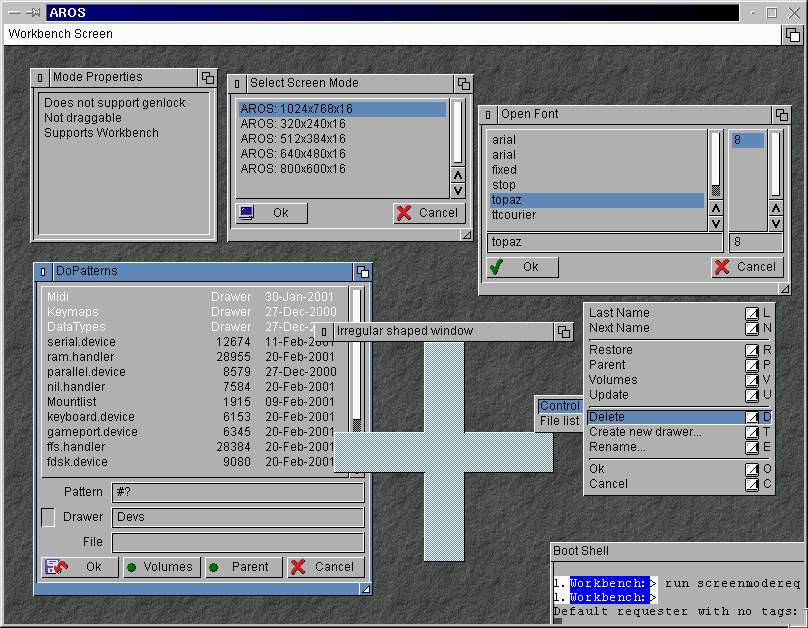
Here's a screenshot of what the Amiga did more than 10 years ago: a simple, clean and usable inteface.
Actually it's an AROS screenshot, but the originals, except the irregular windows that weren't supported, would have looked mostly identical. GTK graphics authors should take inspiration from the other screenshots at that site: The Amiga in the early 90s had a very poor (compared with modern systems) graphics engine, yet its user interface was (and still is IMHO) an example of what can be done with limited resources when there is a good design to start from.