Slashdot Mirror
Domain: astronautix.com
Stories and comments across the archive that link to astronautix.com.
Comments · 776
-
Re:Hmm
Rei, these shapes are less stable at lower speeds (high supersonic, transonic particularly) than at hypersonic speeds.
That's why you use a supersonic drogue chute, followed by the main chute(s), ala Apollo.You can also use a ballute to increase your effective reentry diameter, or large extendable drag plates, or all sorts of other things.
Not having to deploy anything to remain stable is a very good design characteristic. Things that are mission critical (such as, vehicle will spin out of control if you don't release it between Mach 4 and Mach 3.5...) need to be very reliable, and get very expensive and heavy as a result. Moving parts that are mission critical and require (for example) pyro deployment are always a weakspot.
If you can do a design which doesn't require any such components, because it's just inherently stable, you win. Your engineering is easier, you don't have to qualify the component to 99.999% including corner operational envelope cases, etc. You don't suffer from potential lingering maintenance or engineering design error issues.
If it's not there, it can't fail.
Good hypersonic L/D ratio with moderate angle of attack, and a geometry which doesn't make angle of attack heating changes hard on the capsule's "aft body" Apollo had a hypersonic L/D of 0.75, according to Astronautix; are you claiming better? Cite for that and heating (comparative), please?
Actually, it had a hypersonic L/D of 0.25 to 0.3, as the Astronautix entry for the Apollo CSM Command Module section indicates.
As for the geometry and heating issues... if you happen to own Human Spaceflight Mission Analysis and Design then you just need to look at the table of comparative L/D at Alpha for Apollo style and sphere-cone style capsules. I don't have it in front of me to give you the page number, but you can see that you can get good L/D at very mild alpha (25-35 degrees gives you 0.25-0.3 L/D).
That's a very simplified table, for one particular sphere-cone, of course. But it shows you the general case.
Geometry is conducive to CG layouts which let you attain enough angle of attack to be useful As opposed to losing your orbital energy higher up from having a larger blunt base in addition to a good L/D?
The overall drag will be similar for a high alpha sphere-cone and a basic blunt capsule. The blunt capsule has higher drag, but incrementally more rather than a large factor.
By the time you dial in enough alpha with either one to get a good enough L/D to get low enough peak entry Gs for easy human tolerance, the differences are very minor. You always want to see what the conditions are for a 3-4 G reentry, with the required lift (and thus L/D, etc). That's what matters.
If you use passive energy absorbtion for landing on land, such as shock absorbers, crush structure, or space for seats to move downwards on shock absorbing mounts, the narrow part of the capsule being down at impact means that the least fraction of total usable capsule volume is taken up by the space needed for the impact attenuator. At the same time, it gives you the least amount of space for the impact attenuator.
Space doesn't really matter. Length of attenuation material does... the G loading depends directly on how much time and space it takes to decellerate you. But the volume is just a question of what impact attenuation material you use. If you have a low energy dissipation density than you use lower density or lighter attenuators or crush structure... light foam, thin sheet metal constructs which are lightly connected, etc. Higher energy density per unit volume just requires denser energy absorbtion, such as heavier foams, thicker structures, denser aluminum foam
-
Getting back to basics...Finally, an idea that makes sense. The shuttle has failed because it serves too many masters. The Soviets had big budget constraints (at least compared to NASA), so they designed their spacecraft sensibly. Allow me to quote from http://www.astronautix.com/articles/wastolen.htm:
The Russian Soyuz spacecraft has been the longest-lived, most adaptable, and most successful manned spacecraft design. In production for over thirty years, more than 220 have been built and flown on a wide range of missions. The design will remain in use with the international space station well into the next century.
So, how should a man-rated system be designed? Let's see:Put all systems and space not necessary for re-entry and recovery outside of the re-entry vehicle, into a separate jettisonable 'mission module', joined to the re-entry vehicle by a hatch. Every gram saved in this way saves two or more grams in overall spacecraft mass - for it does not need to be protected by heat shields, supported by parachutes, or braked on landing.
Obviously, using seperate man-rated and non-man-rated launchers for the service and mission modules can save even more money. But what should the spacecraft look like:Use a re-entry vehicle of the highest possible volumetric efficiency (internal volume divided by hull area). Theoretically this would be a sphere. But re-entry from lunar distances required that the capsule be able to bank a little, to generate lift and 'fly' a bit. This was needed to reduce the G forces on the crew to tolerable levels. Such a manoeuvre is impossible with a spherical capsule. After considerable study, the optimum shape was found to be the Soyuz 'headlight' shape - a hemispherical forward area joined by a barely angled cone (7 degrees) to a classic spherical section heat shield.
OK, so the Soyuz was designed for use with lunar missions. But is the overall design usable for other missions?By changing the fuel load in the service module, and the type of equipment in the mission module, a wide variety of missions could be performed. The superiority of this approach is clear to see: the Soyuz remains in use 30 years later, while the Apollo was quickly abandoned.
-
Re:Getting There, and CostsThis is a repost from a previous comment (bonus points for the link to it), if you go karma whoring, please be so kind to provide the correct link
The X-20A Dyna-Soar (Dynamic Soarer) was a single-pilot manned reusable spaceplane, really the earliest American manned space project to result in development contracts. It evolved from the German Saenger-Bredt Silverbird intercontinental skip-glide rocket bomber[...]
see more here
here is more on the dynasoar:
The X-20A Dyna-Soar (Dynamic Soarer) was a single-pilot manned reusable spaceplane, really the earliest American manned space project to result in development contracts. It evolved from the German Saenger-Bredt Silverbird intercontinental skip-glide rocket bomber
see here
and something about that Buran shuttle your rip mentions is here:
The Russian Shuttle Buran ("Snowstorm" in Russian) was authorized in 1976 in response to the United States Space Shuttle program. Building of the shuttles began in 1980, with the first full-scale Aero-Buran rolling out in 1984. It was launched by Energia LV. read more here.
As for the cost argument: yes it is true that if you contract all out in your own country, the nett cost for the state is lower than the expended amount. But those are still unproductive workers. If you have your doubts about a third world country doing space research, why use a different standard for first world countries. All those people (working on hyperexpensive spaceprojects) could also develop more and cleaner technologies that might avert the greenhouse runaway that the US seems to want so bad. (In that perspective it is completely logical that the US develops a new space shuttle at twice the cost).
nuff said... -
Re:Why the Barents Sea
I think it's because that's where the subs are. This page lists lots of launches there, most of which were apparently done purely to destroy the missiles.
-
Re:One or two questions related to these articles:
THey moved to wings because the military insisted on it.
What's the point of having a reusable vehicle if it's far more expensive to operate than a one-time-use capsule?? The effort in going through the shuttle inbetween launches cost an enormous amount of money! Mind you, *cheap* reusable vehicles would be good (and nothing stops a capsule from being reusable, russia was building one until lack of cash stopped them)
You can actually land a capsule fairly accurate, within 5 - 10 km^2 IIRC. I assume you think of the soyuz capsule a while ago wich deviated far from it's landing zone. The reason for this was a computer error which stopped the capsule from trying to 'glide' (yes you can steer them a bit!) and it then automatically went for the safest option which was a ballistic trajectory. Lots of G's for the crew, but they were unharmed in the end. -
Go ISRO, GO!!
My Rupees 2 on this on
a) Why this is such a big deal
b) Why at all do this
ISRO deserves all the praise it can get. During these moments, its important to not look just at the success - but view them in the context of our failures.
ISRO did have a few bad starts with our Augmented/Advanced Satellite Launch Vehicles (ASLV) http://www.astronautix.com/lvs/aslv.htm which went crash and burn often enough to earn the title Another Sea Loving Vehicle. This could have very well crippled any space program. But we got it right - and now we get it right most of the time.
In India, the news on Indian channels also focus as much on the reusability of the launch vehicle itself and the loads we are able to ship, thereby making us less reliant on Ariane etc.. Forex is precious, we need to preserve it.
And regarding our priorities - hunger, education etc. Look, India is huge. We get hit bad by disasters, if you look at it most of the objectives of the satellites relate to basic needs - communication, weather, water resource management, land development, disaster management - http://www.isro.org/pressrelease/May01_2005.htm these objectives are of relevance to most of India.
Any country worth its salt must be self reliant, we maybe poor, but I dont believe investing in such technology is wasteful. India may appear to drag its heel more than others - because its big. Our political establishment is pretty bad - but credit where its due - though its messy in the details, there is consensus on the larger issues of development. -
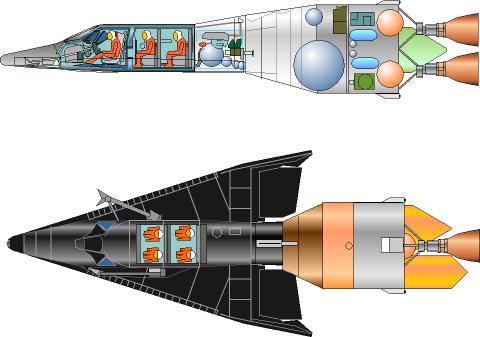
Some similar designs...The first that comes to mind is the Russian Kliper; similar idea with lifting body crew cabin and orbital module behind... Kliper
Of course, there are obvious comparisons to Lookheed's LS-200 "Starclipper" proposal of the 1960's: LS-200
But the best analog is probably Dyna-Soar, the USAF spaceplane of the 1960's: picture, site...
The Death of Dyna-Soar
Ah, distinctly I remember, it was early last December;
It was felt that very shortly, we would be employed no more;
Every day we feared the morrow; vainly we had sought to borrow;
Funds to budget us tomorrow, for our work on Dyna-Soar...
On the sleek and winged spacecraft we called Dyna-Soar...
Cancelled now, forever more.
From off the duct I pulled the shutter, when, whith many flirt and flutter,
Out there flew a stately raven, of the saintly days of yore;
Not the least obeisance made he; not a minute stopped or stayed he;
But with mien of Lord or Lady, perched beside my office door...
Upon a bust of Eugen Sänger, on the bookcase by the door...
Perched, and sat, and nothing more."Prophet !" said I, "Thing of evil !, tell me, agent of the devil,
Whether McNamara axed the program, or just cut us back some more ?
Will he make a presentation, to Congress for appropriation ?
Does he plan continuation, after Fiscal 64 ?
Is the funding in the budget ? Tell me, tell me, I implore..."
Quoth the Raven, "Never more".
Oh, the sleek and winged spacecraft we called Dyna-Soar,
Cancelled now, forever more.
(hopefully not a future statement of the CEV!)
Simon
-
Some similar designs...The first that comes to mind is the Russian Kliper; similar idea with lifting body crew cabin and orbital module behind... Kliper
Of course, there are obvious comparisons to Lookheed's LS-200 "Starclipper" proposal of the 1960's: LS-200
But the best analog is probably Dyna-Soar, the USAF spaceplane of the 1960's: picture, site...
The Death of Dyna-Soar
Ah, distinctly I remember, it was early last December;
It was felt that very shortly, we would be employed no more;
Every day we feared the morrow; vainly we had sought to borrow;
Funds to budget us tomorrow, for our work on Dyna-Soar...
On the sleek and winged spacecraft we called Dyna-Soar...
Cancelled now, forever more.
From off the duct I pulled the shutter, when, whith many flirt and flutter,
Out there flew a stately raven, of the saintly days of yore;
Not the least obeisance made he; not a minute stopped or stayed he;
But with mien of Lord or Lady, perched beside my office door...
Upon a bust of Eugen Sänger, on the bookcase by the door...
Perched, and sat, and nothing more."Prophet !" said I, "Thing of evil !, tell me, agent of the devil,
Whether McNamara axed the program, or just cut us back some more ?
Will he make a presentation, to Congress for appropriation ?
Does he plan continuation, after Fiscal 64 ?
Is the funding in the budget ? Tell me, tell me, I implore..."
Quoth the Raven, "Never more".
Oh, the sleek and winged spacecraft we called Dyna-Soar,
Cancelled now, forever more.
(hopefully not a future statement of the CEV!)
Simon
-
Some similar designs...The first that comes to mind is the Russian Kliper; similar idea with lifting body crew cabin and orbital module behind... Kliper
Of course, there are obvious comparisons to Lookheed's LS-200 "Starclipper" proposal of the 1960's: LS-200
But the best analog is probably Dyna-Soar, the USAF spaceplane of the 1960's: picture, site...
The Death of Dyna-Soar
Ah, distinctly I remember, it was early last December;
It was felt that very shortly, we would be employed no more;
Every day we feared the morrow; vainly we had sought to borrow;
Funds to budget us tomorrow, for our work on Dyna-Soar...
On the sleek and winged spacecraft we called Dyna-Soar...
Cancelled now, forever more.
From off the duct I pulled the shutter, when, whith many flirt and flutter,
Out there flew a stately raven, of the saintly days of yore;
Not the least obeisance made he; not a minute stopped or stayed he;
But with mien of Lord or Lady, perched beside my office door...
Upon a bust of Eugen Sänger, on the bookcase by the door...
Perched, and sat, and nothing more."Prophet !" said I, "Thing of evil !, tell me, agent of the devil,
Whether McNamara axed the program, or just cut us back some more ?
Will he make a presentation, to Congress for appropriation ?
Does he plan continuation, after Fiscal 64 ?
Is the funding in the budget ? Tell me, tell me, I implore..."
Quoth the Raven, "Never more".
Oh, the sleek and winged spacecraft we called Dyna-Soar,
Cancelled now, forever more.
(hopefully not a future statement of the CEV!)
Simon
-
Deja vu
* LockMart CEV proposal
* Big Gemini
* X-20A Dynasoar
* Russian Kliper
Of course, reusing good ideas is a good idea, IMHO. Still, even though the sexiness of wings certainly looks nicer, I'm thinking that the capsule-based proposals by Boeing/Northrop-Grumman and t/Space will be more cost-effective and reliable. Spacecraft need wings about as much as an aircraft needs to float. -
Deja vu
* LockMart CEV proposal
* Big Gemini
* X-20A Dynasoar
* Russian Kliper
Of course, reusing good ideas is a good idea, IMHO. Still, even though the sexiness of wings certainly looks nicer, I'm thinking that the capsule-based proposals by Boeing/Northrop-Grumman and t/Space will be more cost-effective and reliable. Spacecraft need wings about as much as an aircraft needs to float. -
Re:Where's the CRV?
Now if we can get a Crew Return Vehicle turned back back on we have a chance of fully populating the ISS. It would be a nice bonus if such a vehicle was a striped down (toilet-less, stowable) CEV that could use the same launch system.
You mean something like the X-38 (which was coincidentally constructed by Scaled Composites, Burt Rutan's company)? -
The real history of the Delta ClipperTruax's Sea Dragon would have been a better replacement.
My experience with Truax was to get him to cross the street (literally) and meet with Ron Packard -- the congressman who sponsored the Launch Services Purchase Act of 1990. The LSPA was signed into law. I testified before Congress on follow-up legislation for commercial incentives. While in Washington DC, I met with Dana Rohrabacher and told him of Truax's desire to do a trans-Pacific rocket-delivery system for over-night "FedEx" type services based on a scaled down version of the Sea Dragon -- and indicated the commercial incentives legislation could clear the way for private funding by removing the threat of government competition. Rohrabacher then initiated the DC-X program within his district, which was government funded. I happened to be present at a meeting between a group of investors and a private launch service company (intending on commercializing the MX-missile's production lines for launch services) the day the DC-X funding was announced. The investors decided not to bother competing with the government's deep pockets and terminated the meeting upon hearing the announcement. The potential of DC-X to create new "FedEx-like" services across the Pacific was mentioned in the press.
-
Re:Military Payloads Need Reliability: Titan Deliv
Ah...Titan was NOT reliable. It had a success rate of only 86% (http://www.astronautix.com/lvs/titan4b.htm) Atlas has a near perfect record for the last few decades.
-
Excuse me?
Excuse me?
MIR was launched February 20, 1986.
Skylab was launched 28 July 1973.
I am all for giving the Russians their due for their many firsts, but "first space station" is NOT among them. -
Soyuz safty record is comperable to shuttle
They had 2 fatal accidents (Soyuz 1 and Soyuz 11) and a number of *extremely* close calls. The reentry of Soyuz 5, and the first launch attempts of Soyuz 18 and Soyuz-T 10 come to mind. (the latter very much went KABOOM on the pad, the crew were only saved by the escape system, which pulled them away at about 20 Gs...)
Soyuz has less total fatalities than the shuttle, but it carries less people per flight, and has flown less flights.
The fact that the most serious Soyuz failures were early in the program is somewhat in its favor, but from a statistical point of view, it is pretty much a wash. Although the system is in many ways simpler and more robust than the shuttle, the recent Soyuz flights have had their share of problems. The people building and operating it have done an amazing job, but have a severely limited budget and a crumbling infrastructure.
So if you get a chance to ride either, you may as well jump on it -
Soyuz safty record is comperable to shuttle
They had 2 fatal accidents (Soyuz 1 and Soyuz 11) and a number of *extremely* close calls. The reentry of Soyuz 5, and the first launch attempts of Soyuz 18 and Soyuz-T 10 come to mind. (the latter very much went KABOOM on the pad, the crew were only saved by the escape system, which pulled them away at about 20 Gs...)
Soyuz has less total fatalities than the shuttle, but it carries less people per flight, and has flown less flights.
The fact that the most serious Soyuz failures were early in the program is somewhat in its favor, but from a statistical point of view, it is pretty much a wash. Although the system is in many ways simpler and more robust than the shuttle, the recent Soyuz flights have had their share of problems. The people building and operating it have done an amazing job, but have a severely limited budget and a crumbling infrastructure.
So if you get a chance to ride either, you may as well jump on it -
Soyuz safty record is comperable to shuttle
They had 2 fatal accidents (Soyuz 1 and Soyuz 11) and a number of *extremely* close calls. The reentry of Soyuz 5, and the first launch attempts of Soyuz 18 and Soyuz-T 10 come to mind. (the latter very much went KABOOM on the pad, the crew were only saved by the escape system, which pulled them away at about 20 Gs...)
Soyuz has less total fatalities than the shuttle, but it carries less people per flight, and has flown less flights.
The fact that the most serious Soyuz failures were early in the program is somewhat in its favor, but from a statistical point of view, it is pretty much a wash. Although the system is in many ways simpler and more robust than the shuttle, the recent Soyuz flights have had their share of problems. The people building and operating it have done an amazing job, but have a severely limited budget and a crumbling infrastructure.
So if you get a chance to ride either, you may as well jump on it -
Soyuz safty record is comperable to shuttle
They had 2 fatal accidents (Soyuz 1 and Soyuz 11) and a number of *extremely* close calls. The reentry of Soyuz 5, and the first launch attempts of Soyuz 18 and Soyuz-T 10 come to mind. (the latter very much went KABOOM on the pad, the crew were only saved by the escape system, which pulled them away at about 20 Gs...)
Soyuz has less total fatalities than the shuttle, but it carries less people per flight, and has flown less flights.
The fact that the most serious Soyuz failures were early in the program is somewhat in its favor, but from a statistical point of view, it is pretty much a wash. Although the system is in many ways simpler and more robust than the shuttle, the recent Soyuz flights have had their share of problems. The people building and operating it have done an amazing job, but have a severely limited budget and a crumbling infrastructure.
So if you get a chance to ride either, you may as well jump on it -
Soyuz safty record is comperable to shuttle
They had 2 fatal accidents (Soyuz 1 and Soyuz 11) and a number of *extremely* close calls. The reentry of Soyuz 5, and the first launch attempts of Soyuz 18 and Soyuz-T 10 come to mind. (the latter very much went KABOOM on the pad, the crew were only saved by the escape system, which pulled them away at about 20 Gs...)
Soyuz has less total fatalities than the shuttle, but it carries less people per flight, and has flown less flights.
The fact that the most serious Soyuz failures were early in the program is somewhat in its favor, but from a statistical point of view, it is pretty much a wash. Although the system is in many ways simpler and more robust than the shuttle, the recent Soyuz flights have had their share of problems. The people building and operating it have done an amazing job, but have a severely limited budget and a crumbling infrastructure.
So if you get a chance to ride either, you may as well jump on it -
Re:Put Astronauts in the Black Boxes
Parachutes were a nice touch to reduce final impact loads, but as long as astronauts were properly seated in thier accelleration couches, the impact without parachutes would be surviveable
Someone forgot to tell Komarov.
http://www.astronautix.com/graphics/q/qsoy1crs.jpg
A parachute failure in any of the manned capsules would have likely been fatal.
In all, four astronauts have died in capsules during or after rentry, but none because of the reentry itself. Komarov crashed without a parachute, the crew of Soyuz-11 died when a pressure release valve that was desinged to provide fresh air to the crew after reentry was accidently opened early. The crew suffocated. -
Methings we best hurry back to the moon
Unless we actually announced a second rate spot on purpose to fool others
-
Re:RC Landing?
The interesting thing about Buran is how it was created: the Soviet political leadership decided they needed military parity with the space shuttle, even though the design was questionable.
The main sticking point for the Russians was the SSMEs; despite the Russian's excellent record of making rocket engines, they felt they couldn't make them reusable. They opted instead to launch on an Energiya booster and used the space where the engines would have been to put a pair of jets. It's the jets that made Buran good at landing. -
Re:Basic economics says you're wrong...
There are other cheap alternatives, like the superguns. The problem is they are high-G, so some types of cargo may not survive the launch.
-
Re:Getting stuck?
Try a MOOSE perhaps? Surely 40 years of materials development since the initial design tests could help to make one without much hassle.
-
Re:Basic Science!Just Google NERVA. It's not impossible and research rockets have been test fired. All a rocket is needs is a high energy source with some sort of expansion through a nozzle to work. Nuclear piles provide lots of thermal energy and their rocket nozzles don't have to be designed any differently than a conventional chemical rocket. A link to some of the history can be found at http://www.astronautix.com/project/nerva.htm.
No one aside from SF writers having fun is talking about a launch system using Orion. It has too many obvious problems.
-
The "Excess Eleven"NASA's done this before. NASA's astronaut class of 1967, hired for the "Apollo Applications" program that didn't happen, called itself the Excess Eleven. Most of those guys quit or were laid off in the early 1970s.
One wrote a book, "The Making of an Ex-Astronaut".
-
Re:Sounds good, but expensive.
Here is the proposed Russian replacement for Soyuz called Kliper. Astronautix has a little more detail on it. They are planning to show a full size model at the Paris air show in June.
Its an interesting hybrid of lifting body and capsule, it will reenter like a lifting body but pop a parachute and land with a thud like Soyuz. I think its fairly similar to canceled X vehicle Burt Rutan was developing as the ISS lifeboat.
It will carry 6 people or 700 Kilo's of cargo. If you hang one of these on the ISS as the emergency vehicle you could raise the manning level to six people and actually do some research on it for a change. The cargo capacity also appears well suited to resupply the ISS, it can carry a lot more than Progress and Soyuz.
They hope to have it flying by 2010 which just happens to be about when the Shuttle stops flying. They need $10 billion roubles to finish it which sounds like a lot but the exchange rate is 28 roubles to the dollar so that is only $350 million dollars. By contrast NASA is wasting $500 billion on CEV this year alone and they wont get ANYTHING for it other than pretty computer generated images. Building CEV is going to cost at least 36 times as much as Kliper and is scheduled to be 4 years later for its first manned launch, 2010 versus 2014.
Sure looks to me like Russia is hoping to fill the void the Shuttle is going to leave in 2010 with Kliper and essentially take over the ISS if they get the funding to develop it. Whatever happens the Russians are going to be the ONLY people putting people in to LEO on a regular basis from 2010 to 2014, maybe the Chinese will launch a few people too. NASA ought to be ashamed, very ashamed, again.
Seems to me like the Europeans or Japanese should jump at helping with the funding for Kliper. Their investment in ISS has been largely destroyed by NASA's failures, most of their modules are sitting on the ground and they may never get the astronauts onboard the ISS needed to do their planned research. For $350 million they could save their ISS investment and in partnership with Russia develop their own manned space program free of the boat anchor that is NASA, Boeing, Lockheed.
Seems to me like the Chinese could partner with Kliper as well with their new found wealth and jump start their rather slow manned space effort, especially if they get technology sharing in return for cash.
P.S.
I submitted the Kliper article when it came out a few days ago and it was rejected. It is real news versus this fluff piece. Hate to break it to you the shuttle has been scheduled to launch in May for a while now, its not news. The breaking news will be if they manage to stay on schedule for a change. -
Where's the funding?
And how much funding has Kliper received so far? My impression is that they haven't received even a fraction of the 10 billion roubles they say they need. Even if they got that much money, they wouldn't expect a first launch of the vehicle until 2010.
There's some more info on the Kliper over at Astronautix.
Seriously, in the 90s NASA had several abortive projects which got about as far as (or farther than) the Kliper is now. Some examples are the Lockheed Martin X-33, the Orbital Sciences X-34, the McDonnell Douglas DC-X, and the Scaled Composites X-38. Most of these had insurmountable technical difficulties, although my personal suspicion is that the DC-X and X-38 could have evolved into very nice systems. Unfortunately, when it comes to government projects, the funding situation is king. -
More info on SpaceX
I tried submitting a story on SpaceX a couple of weeks ago, but it was sadly rejected. Here's the text of the submission, along with some other interesting info:
Spaceflight Now has an article on SpaceX, a low-cost space launch company started by PayPal co-founder Elon Musk (he is no longer with PayPal). The article describes SpaceX's small-size Falcon I rocket, scheduled to launch a military imaging satellite on its maiden flight in March, and their medium-size Falcon V rocket, scheduled to lift a prototype Bigelow inflatable space habitat next year. Interestingly, the Falcon V has enough capacity to lift a Gemini-style capsule with 5-6 people to orbit. Both rockets have per-pound launch costs approximately one-fifth that of comparable rockets. Long-term plans call for evolving the basic design to heavy-lift and super-heavy lift rockets, assuming SpaceX survives its legal battles with defense giants like Northrup Grumman. Musk believes that ultimately a launch cost of '$500 per pound or less is very achievable' (compared to $10,000 per pound for the Space Shuttle). Elon Musk is a member of the Mars Society, and started SpaceX after he realized that current launch costs would be a large barrier to his plans for a philanthropic mission to put an experimental greenhouse with food crops on Mars.
This radio interview with Elon Musk from 2001 is pretty neat, and has some information I haven't seen elsewhere. -
More info on SpaceX
I tried submitting a story on SpaceX a couple of weeks ago, but it was sadly rejected. Here's the text of the submission, along with some other interesting info:
Spaceflight Now has an article on SpaceX, a low-cost space launch company started by PayPal co-founder Elon Musk (he is no longer with PayPal). The article describes SpaceX's small-size Falcon I rocket, scheduled to launch a military imaging satellite on its maiden flight in March, and their medium-size Falcon V rocket, scheduled to lift a prototype Bigelow inflatable space habitat next year. Interestingly, the Falcon V has enough capacity to lift a Gemini-style capsule with 5-6 people to orbit. Both rockets have per-pound launch costs approximately one-fifth that of comparable rockets. Long-term plans call for evolving the basic design to heavy-lift and super-heavy lift rockets, assuming SpaceX survives its legal battles with defense giants like Northrup Grumman. Musk believes that ultimately a launch cost of '$500 per pound or less is very achievable' (compared to $10,000 per pound for the Space Shuttle). Elon Musk is a member of the Mars Society, and started SpaceX after he realized that current launch costs would be a large barrier to his plans for a philanthropic mission to put an experimental greenhouse with food crops on Mars.
This radio interview with Elon Musk from 2001 is pretty neat, and has some information I haven't seen elsewhere. -
Why falcons are cheap..
The reason falcons will be cheap is not because they use cheap components, but because they have a different approach than old defense contractors like boeing and lockheed.
In fact they use very high quality materials such as a titanium thrust frame in the first stage. But they can afford that because the first stage is reusable.
They also try to avoid any hazardous materials like explosive bolts and dangerous chemicals since that makes working with the rocket before launch much safer and thus cheaper. The falcon I is the first rocket that is allowed to fly without an explosive flight termination system because of redundant thrust termination systems. So there is no bomb on board.
Take a look at the falcon launch complex. It is basically just a simple concrete building and a flatbed truck. The satellite is integrated while the rocket is horizontal, so they do not need a huge building for satellite integration.
The launch control center is a truck trailer, so they only need one for all launch pads and do not have all that expensive computer hardware sitting around idle.
Now compare that with the launch complex for the boeing delta IV. There is a vertical integration building for fitting the payload, a huge umbilical tower and all kinds of facilities to handle the huge quantities of liquid hydrogen that the delta IV needs.
The only large rocket that has a comparably clean launch pad like the falcon is the russian/ukrainian Zenit (also used by Sea Launch), which is also the cheapest of its class.
The falcon I will also have a very benign launch environment for the payload. The amount of vibration is much lower than with other rockets since the falcon does not use solids. See the payload users guide for details. -
Re:Earthquake Machine
Yeah - and sometimes they confuse it with the HARP project, which has similarly been a target for conspiracy theorists.
-
What about a MOOSE?
Come on, they had a pretty good design for a single-person re-entry vehicle that weighed 215kg in the 60's. What could they do with the materials we have now?
Of course, I wouldn't want to be the astronaut that has to manually orient his return vehicle for reentry by pointing a handheld gas gun in the direction of travel..... but if I had no other choice, I'd probably spend 5 minutes thumbing through the manual and leap on in. Mind you, a ballistic reentry would pull 8 or so G's.
Hell, another 15 years and they'll probably make an extreme sport out of it. -
Re:Big rockets?The closest anybody could have gotten to getting it right, would have been to develop reusable boosters; those are the things that the Russian design threw away! The advantage of putting the engines on the US Shuttle is that those expensive engines live to fly again and again. The rest of the US Shuttle stack is largely propellant tanks which are relatively cheap.
Not quite. The Zenith first stage was meant to be retrieved by parachutes + retro-rockets, as well as the second stage. While the second stage was never recovered using this mechanism, the engines of the second stage, below the main tank, were recovered in one of the test flights for inspection. But it seems the whole thing was uneconomic.
See more information here and here. Quote:
-
Re:From the articleDo you really think wings weigh more than your Flash Gordon rocket landing fuel?
I'm not saying it weights more, but some people have made calculations, including for SASSTO, which showed that an equivalent winged TSTO would have 3.6x the dry mass of SASSTO on touchdown. Not to mention that winged vehicles need more complex heatshields, because they spend more time on reentry. While Bono's original concept didn't even need a heatshield : the engine plume on descent was the heatshield. The wings are nothing more than dead weight for most of the trip, they are only useful on reentry.
DC-X was a technology demonstrator. It was not an efficient way of moving payloads to orbit. VentureStar had some serious possibilities, but since it's not Shuttle or ISS, NASA's not interested.
DC-X was a concept demonstrator vehicle by McDonnell-Douglas. Some people did not believe you could make VTVL reliable enough with automated computer control (IIRC they even used modified F-15 avionics). Others did not believe you could execute the weird flip-over on descent (to meet the military requirement of landing back at the same launch pad). DC-X proved these were possible, with a rocket engine using cryogenic liquid fuels. DC-Y aka Delta Clipper was supposed to be the orbital capable follow on vehicle, using mostly off-the shelf technology.
Instead of funding DC-Y, when NASA took over the project from SDIO, they basically canned it and funded a new more expensive project, using bleeding edge technology from LockMart (X-33, the prototype for VentureStar). Guess what, the bleeding edge technology failed (composite fuel tank cracks) and development costs kept increasing.
Do the math. Carrying your landing-on-earth fuel to the Moon means that you have to lift it out of Earth's gravity well, land it on the moon, lift it off the moon, and slow it down for landing. Guess what all those things take? LOTS of fuel.
Bono's original proposals for a trip to the Moon involved in-orbit refueling. Once you have cheap, regular access to orbit, this is easily doable. I do not know why you are interested in going to the Moon though, I mean, the Shuttle definitively cannot land in the Moon either. The wings certainly do not help it. The Apollo Command Module didn't have wings either.
-
Re:From the articleDo you really think wings weigh more than your Flash Gordon rocket landing fuel?
I'm not saying it weights more, but some people have made calculations, including for SASSTO, which showed that an equivalent winged TSTO would have 3.6x the dry mass of SASSTO on touchdown. Not to mention that winged vehicles need more complex heatshields, because they spend more time on reentry. While Bono's original concept didn't even need a heatshield : the engine plume on descent was the heatshield. The wings are nothing more than dead weight for most of the trip, they are only useful on reentry.
DC-X was a technology demonstrator. It was not an efficient way of moving payloads to orbit. VentureStar had some serious possibilities, but since it's not Shuttle or ISS, NASA's not interested.
DC-X was a concept demonstrator vehicle by McDonnell-Douglas. Some people did not believe you could make VTVL reliable enough with automated computer control (IIRC they even used modified F-15 avionics). Others did not believe you could execute the weird flip-over on descent (to meet the military requirement of landing back at the same launch pad). DC-X proved these were possible, with a rocket engine using cryogenic liquid fuels. DC-Y aka Delta Clipper was supposed to be the orbital capable follow on vehicle, using mostly off-the shelf technology.
Instead of funding DC-Y, when NASA took over the project from SDIO, they basically canned it and funded a new more expensive project, using bleeding edge technology from LockMart (X-33, the prototype for VentureStar). Guess what, the bleeding edge technology failed (composite fuel tank cracks) and development costs kept increasing.
Do the math. Carrying your landing-on-earth fuel to the Moon means that you have to lift it out of Earth's gravity well, land it on the moon, lift it off the moon, and slow it down for landing. Guess what all those things take? LOTS of fuel.
Bono's original proposals for a trip to the Moon involved in-orbit refueling. Once you have cheap, regular access to orbit, this is easily doable. I do not know why you are interested in going to the Moon though, I mean, the Shuttle definitively cannot land in the Moon either. The wings certainly do not help it. The Apollo Command Module didn't have wings either.
-
Re:From the articleDo you really think wings weigh more than your Flash Gordon rocket landing fuel?
I'm not saying it weights more, but some people have made calculations, including for SASSTO, which showed that an equivalent winged TSTO would have 3.6x the dry mass of SASSTO on touchdown. Not to mention that winged vehicles need more complex heatshields, because they spend more time on reentry. While Bono's original concept didn't even need a heatshield : the engine plume on descent was the heatshield. The wings are nothing more than dead weight for most of the trip, they are only useful on reentry.
DC-X was a technology demonstrator. It was not an efficient way of moving payloads to orbit. VentureStar had some serious possibilities, but since it's not Shuttle or ISS, NASA's not interested.
DC-X was a concept demonstrator vehicle by McDonnell-Douglas. Some people did not believe you could make VTVL reliable enough with automated computer control (IIRC they even used modified F-15 avionics). Others did not believe you could execute the weird flip-over on descent (to meet the military requirement of landing back at the same launch pad). DC-X proved these were possible, with a rocket engine using cryogenic liquid fuels. DC-Y aka Delta Clipper was supposed to be the orbital capable follow on vehicle, using mostly off-the shelf technology.
Instead of funding DC-Y, when NASA took over the project from SDIO, they basically canned it and funded a new more expensive project, using bleeding edge technology from LockMart (X-33, the prototype for VentureStar). Guess what, the bleeding edge technology failed (composite fuel tank cracks) and development costs kept increasing.
Do the math. Carrying your landing-on-earth fuel to the Moon means that you have to lift it out of Earth's gravity well, land it on the moon, lift it off the moon, and slow it down for landing. Guess what all those things take? LOTS of fuel.
Bono's original proposals for a trip to the Moon involved in-orbit refueling. Once you have cheap, regular access to orbit, this is easily doable. I do not know why you are interested in going to the Moon though, I mean, the Shuttle definitively cannot land in the Moon either. The wings certainly do not help it. The Apollo Command Module didn't have wings either.
-
Re:Big rockets?The Russians got it right with their shuttle - instead of a big main engine on the shuttle, have much more payload space in the orbiter, and launch the thing with a big-ass conventional rocket. Shame the Russians couldn't afford to run their shuttle.
Well, no, the Russians did not get it right.
Their first -- and therefor arguably their last -- mistake was to build a shuttle system that even resembled the US Shuttle which is exactly what they did.
Why? There is essentially no good reason to build a large multipurpose winged reusable orbiter. In particular:
* A reusable orbiter has no business hauling cargo. It just forces the orbiter to be larger and therefor heavier and therefor able to carry less cargo. Carrying passengers and small load of equipment would be OK
* While debate still rages, wings on a reusable space craft are a Bad Idea®; they're heavy, don't help the spacecraft get into orbit, are useless in orbit, and ultimately drastically reduce payload. Alternatives are good ol' ballistic capsules (Soyuz, Apollo, etc) and parachutes or powered vertical landing like you see in old sci-fi movies. Check out the DC-X.
The closest anybody could have gotten to getting it right, would have been to develop reusable boosters; those are the things that the Russian design threw away! The advantage of putting the engines on the US Shuttle is that those expensive engines live to fly again and again. The rest of the US Shuttle stack is largely propellant tanks which are relatively cheap.
Ultimately, there is no "right" way to design, build, and operate and affordable rocket launcher that can provide CATS (Cheap Access To Space). If anyone is interested in actually learning more, they should check out the usenet newsgroup sci.space.tech.
-
Re:Big rockets?I'm surprised that with a $1.5 billion budget they couldn't find a better way to get people into space. Rockets don't seem like the "affordable" answer to me. Maybe a space elevator, or maybe some new technology that nobody's invented yet.
Oy! Where to start?
1. The $1.5 billion is how much Musk made from his sale of PayPal to Ebay, NOT RocketX's development budget.
2. Rockets are the best and only way to get people -- or anything else -- to space and will be for the foreseeable future. Consider that
3. The space elevator concept is very cool but the materials required to build one do not exist. So you could say a "way" has been found but it's currently impossible to build. The materials could be developed in the not too distant future, say, 10-25 years, but they are still at the basic research phase. Cables made using bucky tubes hold promise but still hasn't been demonstrated.
4. SpaceX is not developing "big" rockets. A "big" rocket is something like the Saturn V or the Energia which can lift about 120 tons to LEO (Low Earth Orbit) whereas SpaceX's Falcon I will lift about one ton to LEO and the Falcon V about 5 tons.
5. Rockets are incredibly efficient in terms getting the most power (work? I ain't no engineer) from chemical fuels.
And ultimately,
6. There is nothing intrinsically unaffordable about rockets. You are assuming that "rockets" are necessarily expendable since virtually all current space launcher rockets are expendables. A well designed reusable rocket would be extremely "affordable" to operate but, alas, very tricky and expensive to design and develop. Note that the Space Shuttle is not well designed, not truly reusable, and most certainly not affordable to operate on a commercial basis.
In conclusion, there is little wonder that you are surprised since you know not of what you speak.
-
Re:Big rockets?I'm surprised that with a $1.5 billion budget they couldn't find a better way to get people into space. Rockets don't seem like the "affordable" answer to me. Maybe a space elevator, or maybe some new technology that nobody's invented yet.
Oy! Where to start?
1. The $1.5 billion is how much Musk made from his sale of PayPal to Ebay, NOT RocketX's development budget.
2. Rockets are the best and only way to get people -- or anything else -- to space and will be for the foreseeable future. Consider that
3. The space elevator concept is very cool but the materials required to build one do not exist. So you could say a "way" has been found but it's currently impossible to build. The materials could be developed in the not too distant future, say, 10-25 years, but they are still at the basic research phase. Cables made using bucky tubes hold promise but still hasn't been demonstrated.
4. SpaceX is not developing "big" rockets. A "big" rocket is something like the Saturn V or the Energia which can lift about 120 tons to LEO (Low Earth Orbit) whereas SpaceX's Falcon I will lift about one ton to LEO and the Falcon V about 5 tons.
5. Rockets are incredibly efficient in terms getting the most power (work? I ain't no engineer) from chemical fuels.
And ultimately,
6. There is nothing intrinsically unaffordable about rockets. You are assuming that "rockets" are necessarily expendable since virtually all current space launcher rockets are expendables. A well designed reusable rocket would be extremely "affordable" to operate but, alas, very tricky and expensive to design and develop. Note that the Space Shuttle is not well designed, not truly reusable, and most certainly not affordable to operate on a commercial basis.
In conclusion, there is little wonder that you are surprised since you know not of what you speak.
-
Re:Big rockets?I'm surprised that with a $1.5 billion budget they couldn't find a better way to get people into space. Rockets don't seem like the "affordable" answer to me. Maybe a space elevator, or maybe some new technology that nobody's invented yet.
Oy! Where to start?
1. The $1.5 billion is how much Musk made from his sale of PayPal to Ebay, NOT RocketX's development budget.
2. Rockets are the best and only way to get people -- or anything else -- to space and will be for the foreseeable future. Consider that
3. The space elevator concept is very cool but the materials required to build one do not exist. So you could say a "way" has been found but it's currently impossible to build. The materials could be developed in the not too distant future, say, 10-25 years, but they are still at the basic research phase. Cables made using bucky tubes hold promise but still hasn't been demonstrated.
4. SpaceX is not developing "big" rockets. A "big" rocket is something like the Saturn V or the Energia which can lift about 120 tons to LEO (Low Earth Orbit) whereas SpaceX's Falcon I will lift about one ton to LEO and the Falcon V about 5 tons.
5. Rockets are incredibly efficient in terms getting the most power (work? I ain't no engineer) from chemical fuels.
And ultimately,
6. There is nothing intrinsically unaffordable about rockets. You are assuming that "rockets" are necessarily expendable since virtually all current space launcher rockets are expendables. A well designed reusable rocket would be extremely "affordable" to operate but, alas, very tricky and expensive to design and develop. Note that the Space Shuttle is not well designed, not truly reusable, and most certainly not affordable to operate on a commercial basis.
In conclusion, there is little wonder that you are surprised since you know not of what you speak.
-
Re:Big rockets?I'm surprised that with a $1.5 billion budget they couldn't find a better way to get people into space. Rockets don't seem like the "affordable" answer to me. Maybe a space elevator, or maybe some new technology that nobody's invented yet.
Oy! Where to start?
1. The $1.5 billion is how much Musk made from his sale of PayPal to Ebay, NOT RocketX's development budget.
2. Rockets are the best and only way to get people -- or anything else -- to space and will be for the foreseeable future. Consider that
3. The space elevator concept is very cool but the materials required to build one do not exist. So you could say a "way" has been found but it's currently impossible to build. The materials could be developed in the not too distant future, say, 10-25 years, but they are still at the basic research phase. Cables made using bucky tubes hold promise but still hasn't been demonstrated.
4. SpaceX is not developing "big" rockets. A "big" rocket is something like the Saturn V or the Energia which can lift about 120 tons to LEO (Low Earth Orbit) whereas SpaceX's Falcon I will lift about one ton to LEO and the Falcon V about 5 tons.
5. Rockets are incredibly efficient in terms getting the most power (work? I ain't no engineer) from chemical fuels.
And ultimately,
6. There is nothing intrinsically unaffordable about rockets. You are assuming that "rockets" are necessarily expendable since virtually all current space launcher rockets are expendables. A well designed reusable rocket would be extremely "affordable" to operate but, alas, very tricky and expensive to design and develop. Note that the Space Shuttle is not well designed, not truly reusable, and most certainly not affordable to operate on a commercial basis.
In conclusion, there is little wonder that you are surprised since you know not of what you speak.
-
Re:Isn't this just an RD-180 in disguise?
Just how is their Merlin engine different from the Russian RD-180?
Other than being completely different?
Such as 10 times smaller?RD-180:
RD-180 info at astronautix.com
Propellants: Lox/Kerosene
Thrust(vac): 423,050 kgf.
Thrust(vac): 4,152.00 kN.
Isp: 338 sec.
Isp (sea level): 311 sec.
Burn time: 150 sec.
Mass Engine: 5,393 kg.
Diameter: 3.00 m.
Length: 3.56 m.
Chambers: 2.
Chamber Pressure: 257.00 bar.
Area Ratio: 36.87.Oxidizer to Fuel Ratio: 2.72. Country: Russia/USA.
Status: Hardware.
First Flight: 1999Merlin:
SpaceX page on Merlin via flash link
Sea Level Thrust 71,500 lb
Vacuum Thrust 85,000 lb
Sea Level Isp 261
Vacuum Isp 310
Thrust to weight (fully accounted) 94 -
Why SpaceX is a big deal
First, read this article.
Right now, launch costs are the biggest barrier to having lots of cool things (orbital hotels, factories, lunar bases, etc.) zipping around in space. According to this interview, Musk was previously planning on self-funding a mission to put an experimental greenhouse on Mars, but decided to start SpaceX when he realized that the overall mission cost would be dominated by the launch price.
SpaceX's Falcon I is designed to compete with the Pegasus rocket, which currently dominates the "low-cost" launch market. The Pegasus costs around $20 million to launch 375kg into space. The Falcon I will cost $6 million to launch 670kg into space. Stated differently, the Pegasus costs around $53,000 per kg, while the Falcon I will cost around $9000 per kg.
Things change even more with SpaceX's larger Falcon V rocket, scheduled for a launch this November. This will compete directly with the Delta IV Medium, which costs $90 million to lift 8600kg to LEO. The Falcon V will cost $12 million to lift 6020kg to LEO. That's around $10000 per kg for the Delta IV Medium and around $2000 per kg for the Falcon V.
One of SpaceX's goals is to reuse as much in terms of engines, components, and software as they build larger and larger rocket. As they benefit from economies of scale and build larger rockets, the costs will only drop. -
Why SpaceX is a big deal
First, read this article.
Right now, launch costs are the biggest barrier to having lots of cool things (orbital hotels, factories, lunar bases, etc.) zipping around in space. According to this interview, Musk was previously planning on self-funding a mission to put an experimental greenhouse on Mars, but decided to start SpaceX when he realized that the overall mission cost would be dominated by the launch price.
SpaceX's Falcon I is designed to compete with the Pegasus rocket, which currently dominates the "low-cost" launch market. The Pegasus costs around $20 million to launch 375kg into space. The Falcon I will cost $6 million to launch 670kg into space. Stated differently, the Pegasus costs around $53,000 per kg, while the Falcon I will cost around $9000 per kg.
Things change even more with SpaceX's larger Falcon V rocket, scheduled for a launch this November. This will compete directly with the Delta IV Medium, which costs $90 million to lift 8600kg to LEO. The Falcon V will cost $12 million to lift 6020kg to LEO. That's around $10000 per kg for the Delta IV Medium and around $2000 per kg for the Falcon V.
One of SpaceX's goals is to reuse as much in terms of engines, components, and software as they build larger and larger rocket. As they benefit from economies of scale and build larger rockets, the costs will only drop. -
Hydrazine and Nerve Gas?
I seem to remember that Hydrazine or at least one of its relatives, UDMH is really nasty. Contact with the vapour kills you. OTOH, it has a good specific impulse and is hypergolic with certain oxidizers. This means that it has a good bang per kilo and will self ignite on contact with the oxidizer so making it quite popular for use in an RCS (Reaction Control System) for manouvering in space.
-
Hydrazine and Nerve Gas?
I seem to remember that Hydrazine or at least one of its relatives, UDMH is really nasty. Contact with the vapour kills you. OTOH, it has a good specific impulse and is hypergolic with certain oxidizers. This means that it has a good bang per kilo and will self ignite on contact with the oxidizer so making it quite popular for use in an RCS (Reaction Control System) for manouvering in space.
-
Hydrazine and Nerve Gas?
I seem to remember that Hydrazine or at least one of its relatives, UDMH is really nasty. Contact with the vapour kills you. OTOH, it has a good specific impulse and is hypergolic with certain oxidizers. This means that it has a good bang per kilo and will self ignite on contact with the oxidizer so making it quite popular for use in an RCS (Reaction Control System) for manouvering in space.
-
The Ultimate Saturn V's
I would recommend anyone here check out the Encyclopedia Astronautica. They have a page dedicated to NASA's design studies for future Saturn V variants: http://www.astronautix.com/lvfam/saturnv.htm
And the Saturn V that would be used as a booster for an Orion-drive spacecraft: http://www.astronautix.com/lvfam/orion.htm