Slashdot Mirror
Domain: bloomberg.com
Stories and comments across the archive that link to bloomberg.com.
Stories · 1,477
-
China's Millennials Are Hustling For Part-Time Gigs Instead of Traditional Jobs (bloomberg.com)
Bloomberg has a report today in which it underscores a growing trend among millennials in China who are looking for part-time jobs. From the article: Hopping from one short-term stint to another isn't the sort of aspiration an earlier generation had in China, where the middle-class dream has long been university degrees followed by a stable job -- preferably one backed by the government. In a 2016 poll of 13,000 college students, 48 percent said they didn't want to enter the traditional labor market. Hardly any of these part-time jobs pay well, but it doesn't matter to millennials. The report adds: "The money is little," Zhang Chen, a 21-year-old accounting student said of the short gig that pays about 240 yuan ($35). "But I want a more interesting life." Chen was lined up for the work through DouMi, a startup that focuses exclusively on part-time positions and blends elements of a temp agency with an internet jobs board and marketing service. For around 130 yuan a day, DouMi users can sort crates of milk at a supermarket or hand out pamphlets on frozen sidewalks. Those considered "beautiful women," and between the ages of 18 and 28, can make four times as much plus tips by working as live-streaming models to keep mostly-male viewers entertained. Many of the roles run for mere days or weeks at a time, a flexibility that suits those juggling social lives and university studies. "Every month we have between 300,000 and 400,000 jobs," said Chief Executive Officer Zhao Shiyong. -
Elon Musk Is Really Boring (bloomberg.com)
Sometimes it is hard to tell if Elon Musk is serious about the things he says. But as for his "boring" claims, that's really happening. In a wide-range interview with Bloomberg, the billionaire talked more about his new venture, The Boring Company. The idea began on a Saturday morning a few weeks ago when Musk tweeted, "Traffic is driving me nuts. Am going to build a tunnel boring machine and just start digging..." Over the course of next few hours later, Musk added, "It shall be called 'The Boring Company,' Boring, it's what we do. I am actually going to do this. Excerpts from the story: And so, around noon on a Friday in January, an excavation crew started digging. "I was like, 'Hey, what's the biggest hole we can make by Sunday evening?'" Musk says. [...] "My other idea was to call it Tunnels R Us and to essentially troll Toys "R" Us into filing a lawsuit," he says, letting out a loud and well-articulated ha-ha-ha-ha. "Now we've decided to troll AT&T instead! We're going to call it American Tubes and Tunnels." When I ask him if the tunnel venture will be a subsidiary of SpaceX or an independent company, he responds cryptically. "Don't you read my Twitter? The Boring Company. Or TBC. To Be Continued." An aide chimes in: Yes, the Boring Company, aka To Be Continued, aka Tunnels R Us, aka American Tubes and Tunnels, aka whatever, will indeed be an independent company. Tunnel technology is older than rockets, and boring speeds are pretty much what they were 50 years ago. Musk says he hopes to build a much faster tunneling machine and use it to dig thousands of miles, eventually creating a vast underground network that includes as many as 30 levels of tunnels for cars and high-speed trains such as the Hyperloop. Musk chose the SpaceX parking lot as the site of his first dig, mostly because it was convenient and he could legally do so without city permits. The plan is to expand the current hole into a ramp designed for a large tunnel boring machine and then start digging horizontally once the machine is 50 feet or so below ground, which would make it low enough to clear gas and sewer lines and to be undetectable at the surface. 100 marks to Bloomberg for the headline, and the story which is as funny as it is insightful. -
Elon Musk Is Really Boring (bloomberg.com)
Sometimes it is hard to tell if Elon Musk is serious about the things he says. But as for his "boring" claims, that's really happening. In a wide-range interview with Bloomberg, the billionaire talked more about his new venture, The Boring Company. The idea began on a Saturday morning a few weeks ago when Musk tweeted, "Traffic is driving me nuts. Am going to build a tunnel boring machine and just start digging..." Over the course of next few hours later, Musk added, "It shall be called 'The Boring Company,' Boring, it's what we do. I am actually going to do this. Excerpts from the story: And so, around noon on a Friday in January, an excavation crew started digging. "I was like, 'Hey, what's the biggest hole we can make by Sunday evening?'" Musk says. [...] "My other idea was to call it Tunnels R Us and to essentially troll Toys "R" Us into filing a lawsuit," he says, letting out a loud and well-articulated ha-ha-ha-ha. "Now we've decided to troll AT&T instead! We're going to call it American Tubes and Tunnels." When I ask him if the tunnel venture will be a subsidiary of SpaceX or an independent company, he responds cryptically. "Don't you read my Twitter? The Boring Company. Or TBC. To Be Continued." An aide chimes in: Yes, the Boring Company, aka To Be Continued, aka Tunnels R Us, aka American Tubes and Tunnels, aka whatever, will indeed be an independent company. Tunnel technology is older than rockets, and boring speeds are pretty much what they were 50 years ago. Musk says he hopes to build a much faster tunneling machine and use it to dig thousands of miles, eventually creating a vast underground network that includes as many as 30 levels of tunnels for cars and high-speed trains such as the Hyperloop. Musk chose the SpaceX parking lot as the site of his first dig, mostly because it was convenient and he could legally do so without city permits. The plan is to expand the current hole into a ramp designed for a large tunnel boring machine and then start digging horizontally once the machine is 50 feet or so below ground, which would make it low enough to clear gas and sewer lines and to be undetectable at the surface. 100 marks to Bloomberg for the headline, and the story which is as funny as it is insightful. -
New Office Sensors Know When You Leave Your Desk (bloomberg.com)
An anonymous reader quotes a report from Bloomberg: About a year ago, in a widely reported story, journalists at British newspaper the Telegraph found little black boxes installed under their desks. The devices, which had "OccupEye" emblazoned on them, detected if employees were at their workstations. Not shockingly, writers and editors were suspicious, worried that bosses were monitoring their moves, even their bathroom breaks. The National Union of Journalists complained to management about Big Brother-style surveillance. The company insisted the boxes were intended to reduce energy costs, ensuring that empty cubicles weren't overheated or over-air-conditioned, but the damage was done, and the devices were removed. Sensors that keep tabs on more than temperature are already all over offices -- they're just less conspicuous and don't have names that suggest Bond villains. "Most people, when they walk into buildings, don't even notice them," says Joe Costello, chief executive officer of Enlighted, whose sensors, he says, are collecting data at more than 350 companies, including 15 percent of the Fortune 500. They're hidden in lights, ID badges, and elsewhere, tracking things such as conference room usage, employee whereabouts, and "latency" -- how long someone goes without speaking to another co-worker. Proponents claim the goal is efficiency: Some sensors generate heat maps that show how people move through an office, to help maximize space; others, such as OccupEye, tap into HVAC systems. -
Engineers On Google's Self-Driving Car Project Were Paid So Much That They Quit (theverge.com)
According to a new report from Bloomberg, most of the money Google spent on it self-driving car project, now spun off into a new entity called Waymo, has gone to engineers and other staff. While it has helped retain a lot of influential and dedicated workers in the short run, it has resulted in many staffers leaving the company in the long run due to the immense financial security. The Verge reports: Bloomberg says that early staffers "had an unusual compensation system" that multiplied staffers salaries and bonuses based on the performance of the self-driving project. The payments accumulated as milestones were reached, even though Waymo remains years away from generating revenue. One staffer eventually "had a multiplier of 16 applied to bonuses and equity amassed over four years." The huge amounts of compensation worked -- for a while. But eventually, it gave many staffers such financial security that they were willing to leave the cuddly confines of Google. Two staffers that Bloomberg spoke to called it "F-you money," and the accumulated cash allowed them to depart Google for other firms, including Chris Urmson who co-founded a startup with ex-Tesla employee Sterling Anderson, and others who founded a self-driving truck company called Otto which was purchased by Uber last year, and another who founded Argo AI which received a $1 billion investment from Ford last week. -
Finland's Universal Basic Income Called 'Useless' By Trade Union Economist (bloomberg.com)
An anonymous reader quotes Bloomberg: Finland's basic income experiment is unworkable, uneconomical and ultimately useless. Plus, it will only encourage some people to work less. That's not the view of a hard core Thatcherite, but of the country's biggest trade union. The labor group says the results of the two-year pilot program will fail to sway its opposition to a welfare-policy idea that's gaining traction among those looking for an alternative in the post-industrial age. "We think it takes social policy in the wrong direction," said Ilkka Kaukoranta, chief economist of the Central Organization of Finnish Trade Unions, which has nearly one million members.
Since January, a group of unemployed Finns aged between 25 and 58 have been receiving a stipend of 560 euros ($600) per month. The amount isn't means-tested and is paid regardless of whether the recipient finds a job, starts a business or returns to school... Advocates say it eliminates poverty traps and redistributes income while empowering the individual and reducing paperwork... While limited in scope (it's conditional on the beneficiary having received some form of unemployment support in November 2016) and size (it's based on a randomly-selected sample of 2,000 jobless people), the Finnish trial may help answer questions like: "Does it work"? "Is it worth it"? And the most fundamental of all: "Does it incite laboriousness or laziness...?"
The trade union argues this UBI program would cost 5% of Finland's entire gross domestic product, making it "impossibly expensive." -
Lockheed Martin Screwup Delays Delivery of Air Force GPS Satellites (bloomberg.com)
schwit1 writes: Incompetence by a Lockheed Martin subcontractor will delay the delivery of 32 new Air Force GPS satellites and will likely cost the government millions. Bloomberg reports: "Lockheed has a contract to build the first 10 of the satellites designed to provide a more accurate version of the Global Positioning System used for everything from the military's targeting of terrorists to turn-by-turn directions for civilians' smartphones. The program's latest setback may affect a pending Air Force decision on whether to open the final 22 satellites to competition from Lockheed rivals Boeing Co. and Northrop Grumman Corp. 'This was an avoidable situation and raised significant concerns with Lockheed Martin subcontractor management/oversight and Harris program management,' Teague said in a Dec. 21 message to congressional staff obtained by Bloomberg News. The parts in question are ceramic capacitors that have bedeviled the satellite project. They take higher-voltage power from the satellite's power system and reduce it to a voltage required for a particular subsystem. Last year, the Air Force and contractors discovered that Harris hadn't conducted tests on the components, including how long they would operate without failing, that should have been completed in 2010. Now, the Air Force says it found that Harris spent June to October of last year doing follow-up testing on the wrong parts instead of samples of the suspect capacitors installed on the first three satellites. Harris 'immediately notified Lockheed and the government' after a post-test inspection, Teague said in his message." So, the subcontractor first failed to do the required tests, then they did the tests on the wrong parts. Sounds like the kind of quality control problems we have seen recently in Russia and Japan. The worst part? The contract is a cost-plus contract, which means the U.S. tax payer has to absorb the additional costs for fixing the screw-up, not Lockheed Martin or its subcontractor. -
Microsoft Allowed To Sue US Government Over Email Surveillance (bloomberg.com)
A judge has ruled that Microsoft is allowed to sue the U.S. government over a policy that prevents the tech company from telling its users when their emails are being intercepted. From a report on Bloomberg: The judge said Microsoft has at least made a plausible argument that federal law muzzles its right to speak about government investigations, while not ruling on the merits of the case. "The public debate has intensified as people increasingly store their information in the cloud and on devices with significant storage capacity," U.S. District Judge James Robart in Seattle said in Thursday's ruling. "Government surveillance aided by service providers creates unique considerations because of the vast amount of data service providers have about their customers." -
Uber Hires a Nasa Veteran Who Thinks We'll Start Seeing Flying Cars In Next Three Years (bloomberg.com)
Uber is getting serious about its intentions of building a flying car. Uber's plan involves airborne taxis that will travel 50 to 100 miles between "vertiports" that connect passengers between their homes and offices, according to a report on Bloomberg. Now it is hiring the right leader for this project. From the report: In 2010, an advanced aircraft engineer at NASA's Langley Research Center named Mark Moore published a white paper outlining the feasibility of electric aircrafts that could take off and land like helicopters but were smaller and quieter. The vehicles would be capable of providing a speedy alternative to the dreary morning commute. Moore's research into so-called VTOL -- short for vertical takeoff and landing, or more colloquially, flying cars -- inspired at least one billionaire technologist. After reading the white paper, Google co-founder Larry Page secretly started and financed two Silicon Valley startups, Zee Aero and Kitty Hawk, to develop the technology. Now Moore is leaving the confines of the U.S. National Aeronautics and Space Administration, where he has spent the last 30 years, to join one of Google's rivals: Uber Technologies Inc. Moore is taking on a new role as director of engineering for aviation at the ride-hailing company, working on a flying car initiative known as Uber Elevate. "I can't think of another company in a stronger position to be the leader for this new ecosystem and make the urban electric VTOL market real," he says. -
Microsoft Seeks Trump Order Exemption for Workers With Visas (bloomberg.com)
Microsoft is asking U.S. officials to grant exceptions for law-abiding, visa-holding workers and students from President Donald Trump's immigration order, channeling the outrage expressed by many in the technology industry with a proposed solution. From a report: Such individuals are low-risk -- having already undergone a rigorous vetting process -- and face immediate hardship as a result of last week's order, Microsoft President and Chief Legal Officer Brad Smith said in a letter Thursday to the secretaries of State and Homeland Security. Smith said he believes the two officials are empowered to take the necessary steps to allow certain people entry into the country. The exemptions sought would cover workers with visas sponsored by U.S.-based companies and students with ones obtained via a U.S.-based school. -
US Probes Panasonic Unit For Alleged Bribery Violations (bloomberg.com)
A Panasonic inflight entertainment and communications systems subsidiary is under investigation by U.S. authorities for allegedly breaking bribery and securities laws. From a report: Panasonic Avionics Corp. is being probed by the U.S. Department of Justice and Securities and Securities Exchange Commission for violating the Foreign Corrupt Practices Act, the Osaka-based company said in a statement Thursday. Panasonic said it's cooperating with the agencies, and evaluating the potential financial impact of the probe. The announcement of the probe mars an otherwise positive earnings release for Panasonic, which raised its full-year profit and revenue forecasts. The subsidiary is part of a corporate division that also makes mobile phones, projectors and surveillance cameras with a total of 33,000 employees. The segment had $6.7 billion in sales in the nine months ended Dec. 31, or 14 percent of total revenue. -
Apple Developing Custom ARM-Based Mac Chip That Would Lessen Intel Role (bloomberg.com)
According to Bloomberg, Apple is designing a new chip for future Mac laptops that would take on more of the functionality currently handled by Intel processors. The chip is a variant of the T1 SoC Apple used in the latest MacBook Pro to power the keyboard's Touch Bar feature. The updated part, internally codenamed T310, is built using ARM technology and would reportedly handle some of the computer's low-power mode functionality. From the report: The development of a more advanced Apple-designed chipset for use within Mac laptops is another step in the company's long-term exploration of becoming independent of Intel for its Mac processors. Apple has used its own A-Series processors inside iPhones and iPads since 2010, and its chip business has become one of the Cupertino, California-based company's most critical long-term investments. Apple engineers are planning to offload the Mac's low-power mode, a feature marketed as "Power Nap," to the next-generation ARM-based chip. This function allows Mac laptops to retrieve e-mails, install software updates, and synchronize calendar appointments with the display shut and not in use. The feature currently uses little battery life while run on the Intel chip, but the move to ARM would conserve even more power, according to one of the people. The current ARM-based chip for Macs is independent from the computer's other components, focusing on the Touch Bar's functionality itself. The new version in development would go further by connecting to other parts of a Mac's system, including storage and wireless components, in order to take on the additional responsibilities. Given that a low-power mode already exists, Apple may choose to not highlight the advancement, much like it has not marketed the significance of its current Mac chip, one of the people said. Building its own chips allows Apple to more tightly integrate its hardware and software functions. It also, crucially, allows it more of a say in the cost of components for its devices. However, Apple has no near-term plans to completely abandon Intel chips for use in its laptops and desktops, the people said. -
Roku Owners: Comcast Is About To Sell You Cable TV Without the Cable Box (bloomberg.com)
An anonymous reader quotes a report from Bloomberg: Comcast is making its Xfinity TV service available to subscribers with Roku set-top players via a new app, paving the way for customers of the nation's largest cable provider to watch live programming without the cost or hassle of a cable box. Roku is the first set-stop box to offer the Xfinity TV service, Comcast said in a statement Tuesday. During a test period, subscribers will have to hang on to their cable devices. When the app formally rolls out later this year, they'll be able sign up without renting a cable box. While Comcast expects the majority of its customers to opt for the typical setup, traditional pay-TV providers are trying to be more flexible about where and how people can watch TV given the popularity of streaming services like Netflix and Amazon and the boxes that offer them. Customers with Roku players will be able to watch live TV, browse on-demand libraries and record shows, just as they can with Comcast's boxes. Those who use the Roku as their primary device instead of Comcast's X1 device will receive a $2.50 monthly credit, the company said. -
Microsoft Sells $17 Billion in Second Bond Deal in Six Months (bloomberg.com)
An anonymous reader shares a Bloomberg report: Microsoft found ample demand for its $17 billion bond offering, allowing it to cut borrowing rates on its second multibillion note offering in six months. The tech giant received at least twice as many orders as it had bonds to sell, according to people familiar with the matter. The longest portion of the offering, which generally refinanced debt maturing soon, was a $2 billion, 40-year bond with a 4.5 percent coupon that yields 1.4 percentage points above Treasuries, according to data compiled by Bloomberg. That's down from initial discussions of about 1.55 percentage points. Moody's Investors Service said Microsoft will use proceeds to refinance commercial paper it sold to help support its takeover of LinkedIn. A regulatory filing shows that at the end of 2016, the Redmond, Washington-based company had $25.1 billion of the debt. -
Tesla's Battery Revolution Just Reached Critical Mass (bloomberg.com)
Tesla is all set to cut the ribbon on a massive battery storage facility in the California desert -- the biggest of its kind on earth. It joins similarly huge facilities built by AES and Altagas, which are both set to launch around the same time. Combined, the plants constitute 15% of the battery storage installed globally last year. From a report: Tesla Motors is making a huge bet that millions of small batteries can be strung together to help kick fossil fuels off the grid. The idea is a powerful one -- one that's been used to help justify the company's $5 billion factory near Reno, Nev. -- but batteries have so far only appeared in a handful of true, grid-scale pilot projects. That changes this week. Ribbons will be cut and executives will take their bows. But this is a revolution that's just getting started, Tesla Chief Technology Officer J.B. Straubel said in an interview on Friday. "It's sort of hard to comprehend sometimes the speed all this is going at," he said. "Our storage is growing as fast as we can humanly scale it." -
Trump's Next Immigration Move To Affect H-1B Visas; Require Tech Companies To Try To Hire Americans First: Bloomberg (bloomberg.com)
AdamnSelene writes: A report in Bloomberg describes a draft executive order that will hit the tech industry hard and potentially change the way those companies recruit workers from abroad. The H-1B, L-1, E-2, and B1 work visa programs would be targeted by requiring companies to prioritize higher-paid immigrant workers over lower-paid workers. In addition, the order will impose statistical reporting requirements on tech companies who sponsor workers under these programs. The order is expected to impact STEM workers from India the most. Penguinisto adds: If (perhaps when) the president follows through, his next move could limit or at least seriously alter the way H-1B visas are distributed, putting U.S. citizens at a higher priority, and possibly restricting H1-B visas tighter. From the article: "If implemented, the reforms could shift the way American companies like Microsoft, Amazon and Apple recruit talent and force wholesale changes at Indian companies such as Infosys and Wipro. Businesses would have to try to hire Americans first and if they recruit foreign workers, priority would be given to the most highly paid. "Our country's immigration policies should be designed and implemented to serve, first and foremost, the U.S. national interest," the draft proposal reads, according to a copy reviewed by Bloomberg. "Visa programs for foreign workers should be administered in a manner that protects the civil rights of American workers and current lawful residents, and that prioritizes the protection of American workers -- our forgotten working people -- and the jobs they hold." -
Former Fed Employee Fined $5,000 For Installing Bitcoin Software On Server (bloomberg.com)
An anonymous reader quotes a report from Bloomberg: A former Federal Reserve employee was sentenced Friday to 12 months probation and a $5,000 fine after pleading guilty in October to installing unauthorized software on a computer server at the U.S. central bank. Nicholas Berthaume, who as a communications analyst had access to computer servers at the Fed's Board of Governors in Washington, installed software that connected to an online bitcoin network in order to earn units of the digital currency, according to a statement Monday from the central bank's Office of Inspector General. Berthaume also "modified certain security safeguards so that he could remotely access the server from home," the statement said. When confronted, he tried to cover up his actions by deleting the software; eventually he was fired and admitted guilt, the office said. His actions didn't result in the loss of any Fed information, and the board has enhanced security since the incident, the internal watchdog said. The story was first reported by The Wall Street Journal (Warning: source may be paywalled). -
PayPal Has Been Talking With Amazon on Payments, CEO Says (bloomberg.com)
A new feature could be coming to your Amazon checkout process. It's called PayPal. Amazon and PayPal are in talks about the possibility of the online retail giant supporting PayPal payments at checkout, PayPal CEO Dan Schulman said in an interview. While Schulman didn't say when -- or even if -- a deal might happen between the companies, he did tell Bloomberg that the companies are trying to determine how they can "use one another's assets to the mutual benefit" of their customers. From the report:"We're closing in on 200 million users on our platform right now. At that scale, it's hard for any retailer to think about not accepting PayPal," Schulman said. -
Apple Set To Join Amazon, Google, Facebook in AI Research Group (bloomberg.com)
Apple will take a significant step toward disclosing more of its artificial intelligence research this week by becoming a member of a non-profit AI research consortium founded by five of the tech industry's biggest players, reports Bloomberg. Last September, Amazon, Facebook, Google, Microsoft, and IBM publicly announced The Partnership on AI, an organisation established "to study and formulate best practices, to advance the public's understanding of AI, and to serve as an open platform for discussion and engagement about AI and its influences on people and society." Apple released its first AI paper to the public last year. -
When Their Shifts End, Uber Drivers Set Up Camp in Parking Lots Across the US (bloomberg.com)
A feature report on Bloomberg today illustrates the lives of several Uber drivers, who find shelter in car parking at nights when it's too pricey and tiring to go home. An excerpt from the story: In Chicago, Walter Laquian Howard sleeps most nights at the "Uber Terminal." "I left my job thinking this would work, and it's getting harder and harder," Howard said. "They have to understand that some of us have decided to make this a full-time career." Howard has been parking and sleeping at the 7-Eleven four to five nights a week since March 2015, when he began leasing a car from Uber and needed to work more hours to make his minimum payments. Now that it's gotten cold, he wakes up every three hours to turn on the heater. He's rarely alone. Most nights, two to three other ride-hailing drivers sleep in cars parked next to his. It's safe, he said, and the employees let the drivers use the restroom. Howard has gotten to know the convenience store's staff -- Daddy-O and Uncle Mike -- over the past two years while driving for this global ride-hailing gargantuan, valued at $69 billion. "These guys have become my extended family," said Howard, 53. "It's my second home. We have this joke that I'm the resident. I keep asking them: 'Hey, did my mail come in yet?'" -
Newest Tesla Autopilot Data Shows A 40% Drop in Crashes (bloomberg.com)
There's a surprise in the data from an investigation into Tesla safety by the U.S. National Highway Traffic Safety Administration. An anonymous reader quotes Bloomberg: [W]hile all Tesla vehicles come with the hardware necessary for Autopilot, you need a software upgrade that costs thousands of dollars to make it work. Since buyers can add Autopilot features after purchase, this provides a perfect before-and-after comparison. It turns out that, according to the data Tesla gave investigators, installing Autopilot prevents crashes -- by an astonishing 40 percent...
Now -- thanks to an investigation that initially hurt the company -- there is finally some real data, and it's good news for Tesla... As the software matures to match the new hardware, Musk said on Thursday via a Tweet, Tesla is targeting a 90 percent reduction in car crashes.
UPDATE (5/4/18): The NHTSA has now clarified that their study "did not assess the effectiveness of this technology.
UPDATE (2/16/19): The study's underlying data reveals serious flaws in the methodology that undermine its credibility, according to new analysis from a research and consulting firm. -
Facebook Has a Team That Handles Mark Zuckerberg's Page (cnet.com)
theodp writes: Q. How many Facebook employees does it take to produce Mark Zuckerberg's Facebook page? A. More than a dozen! CNET's Ian Sherr offers his take on the news that Facebook has a team that handles Mark Zuckerberg's page: "Ever notice the photos, videos and posts on the profile page for Facebook's CEO are a lot nicer looking or better written than yours? Don't feel bad. Mark Zuckerberg has a team of people who are increasingly managing his public persona, according to a Wednesday report from Bloomberg Businessweek. Not only do they help write speeches and posts, but they also take photographs of his family and his travels, interspersing them with infographics about the company's user growth and sales. There're even people who delete harassing comments and spam for him. A Facebook spokeswoman said the company's service is an easy way for executives to connect with people." Wonder how many people it took to help craft the latest post, in which Zuck fired back at "some misleading stories going around" about "some land" he purchased in Hawaii (which another Zuck post noted also serves as a petting zoo of sorts for his daughter). -
Apple Increases App Store Prices By 25% Following Brexit Vote (theguardian.com)
Following the UK's vote to leave the European Union last year, Apple is raising prices on its UK App Store by almost 25 percent to counter the depreciation of the pound. For example, an app that costs $0.99 in the U.S., and used to cost 0.79 British pounds, will now cost 0.99 British pounds. The Guardian reports: Apple announced the price rises in an email to app developers on Tuesday, and told them "when foreign exchange rates or taxation changes, we sometimes need to update prices on the App Store." It says the new prices will roll out over the next seven days, giving customers a short opportunity to beat the price increase. Similar price increases are expected to hit other Apple stores, including the iTunes Store for music and video and the iBooks Store. Britain isn't the only country experiencing price changes. India is seeing price increases due to changes in service taxes, while Turkish prices are also rising due to depreciation of the Turkish Lira. Since the vote to leave the European Union, the value of the pound has fallen by 18.5% against the U.S. dollar. In a statement, Apple said: "Price tiers on the App Store are set internationally on the basis of several factors, including currency exchange rates, business practices, taxes and the cost of doing business. These factors vary from region to region and over time." -
US Antitrust Agency Sues Qualcomm Over Patent Licensing (reuters.com)
Qualcomm shares have plunged after the U.S. Federal Trade Commission filed a lawsuit against the company on Tuesday, accusing the company of using "anticompetitive" tactics to maintain its monopoly on a key semiconductor used in mobile phones. Reuters reports: The FTC, which works with the Justice Department to enforce antitrust law, said that San Diego-based Qualcomm used its dominant position as a supplier of certain phone chips to impose "onerous" supply and licensing terms on cellphone manufacturers and to weaken competitors. Qualcomm said in a statement that it would "vigorously contest" the complaint and denied FTC allegations that it threatened to withhold chips in order to collect unreasonable licensing fees. In its complaint, the FTC said the patents that Qualcomm sought to license are standard essential patents, which means that the industry uses them widely and they are supposed to be licensed on fair, reasonable and non-discriminatory terms. The FTC complaint also accused Qualcomm of refusing to license some standard essential patents to rival chipmakers, and of entering into an exclusive deal with Apple Inc. The FTC asked the U.S. District Court for the Northern District of California in San Jose to order Qualcomm to end these practices. -
Microsoft CEO Satya Nadella Warns Against 'Hubris' Amid AI Growth (bloomberg.com)
Microsoft and its competitors should eschew artificial intelligence systems that replace people instead of maximizing their time, CEO Satya Nadella said in an interview on Monday. From the report: "The fundamental need of every person is to be able to use their time more effectively, not to say, 'let us replace you'," Nadella said in an interview at the DLD conference in Munich. "This year and the next will be the key to democratizing AI. The most exciting thing to me is not just our own promise of AI as exhibited by these products, but to take that capability and put it in the hands of every developer and every organization. [...] There's a thin line between hubris and confidence," Nadella said. "Always there is risk of hubris coming back, missing trends. The only long-term indicator of success is, âhow good is your internal culture?'" "What I've learned if anything in three years as CEO is, it's not about celebrating one product," he said. "That, to me, is the sign of a company that's built to last. In tech it's even more harsh." -
Creator of Android Andy Rubin Nears His Comeback, Complete With an 'Essential' Phone (bloomberg.com)
From a report on Bloomberg: Rubin, creator of the Android operating system, is planning to marry his background in software with artificial intelligence in a risky business: consumer hardware. Armed with about a 40-person team, filled with recruits from Apple and Google, Rubin is preparing to announce a new company called Essential and serve as its Chief Executive Officer, according to people familiar with the matter. A platform company designed to tie multiple devices together, Essential is working on a suite of consumer hardware products, including ones for the mobile and smart home markets, one of the people said. The centerpiece of the system is a high-end smartphone with a large edge-to-edge screen that lacks a surrounding bezel. At the Consumer Electronics Show in Las Vegas in early January, Rubin discussed the smartphone with mobile carrier executives, including some from Sprint Corp., people familiar with the talks said. The smartphone, according to the report, would go on sale around the middle of this year and will cost nearly as much as iPhone 7 ($649, off contract). -
Volkswagen Closes In on $4.3 Billion US Settlement in Diesel Scandal (bloomberg.com)
Volkswagen said it's closing in on a deal with U.S. authorities on a $4.3 billion settlement to resolve civil and criminal allegations stemming from its emissions-cheating scandal. From a report on Bloomberg: The agreement, which has yet to be finalized, would lead to a financial expense that exceeds current provisions, the German automaker said. It also includes a guilty plea to some criminal charges, strengthening compliance systems and installing an independent monitor for three years, the Wolfsburg, Germany-based automaker said Tuesday in a statement. VW's management and supervisory boards are scheduled to review the settlement today or Wednesday and may raise provisions related to the scandal, which currently total 18.2 billion euros ($19.2 billion). A final agreement also needs to be approved by U.S. courts. The U.S. Justice Department declined to comment on Volkswagen's statement. -
Google Spin-Off's Newest Self-Driving Minivans Start Road Tests This Month (theverge.com)
"We're at an inflection point where we can begin to realize the potential of this technology," the CEO of Waymo said today. An anonymous reader quotes The Verge: Waymo, the self-driving car startup spun-off from Google late last year, will be deploying its fleet of self-driving Chrysler Pacifica minivans onto public roads for the first time later this month, the company announced at the North American International Auto Show. The minivans will be hitting the roads in Mountain View, California and Phoenix, Arizona, where the company's self-driving Lexus SUVs have already driven thousands of miles over the past few years...
But here's the thing about these minivans. Waymo says that for the first time, it's producing all the technology that enables its cars to completely drive themselves in-house... This allows the company to exert more control over its self-driving hardware, as well as bring the cost down to ridiculously cheap levels. In a speech in Detroit, Waymo CEO Jeff Krafcik said that by building its own LIDAR sensors, for example, the company was shaving 90 percent off its costs. That means sensors that Google purchased for $75,000 back in 2009 now only cost $7,500 for Waymo to build itself.
Waymo's CEO says that using high-resolution LIDAR sensors "helps us more accurately predict where someone will walk next." -
Bitcoin Was 2016's Best-Performing Currency (newsweek.com)
The co-founder of Blockchain published an opinion piece in Newsweek today mocking predictions about the death of bitcoin, saying "each is more wrong than the last... Bitcoin was again declared the world's best performing currency in 2016 by Bloomberg. In fact, it's held that title every year since 2010, with the notable exception of 2014, when it was the worst." An anonymous reader writes: Bitcoin president Nicolas Cary writes that bitcoin has become more stable than many of the world's top currencies, while the British pound "has dropped by more than 17% in a colossal collapse of confidence... In Africa, the Egyptian pound dropped 59% and the Nigerian naira fell 37%. In South America, the Argentine peso plummeted over 17% and the Venezuelan bolivar tumbled so far off a cliff it's difficult to measure -- even bricks of cash are worthless for everyday purchases there. Perhaps most dramatically of all, India, the world's second most populated country, introduced a stunning policy of demonetization declaring banknotes illegal overnight...
"During this time period, and partially in response to it, the price of bitcoin surged... Bitcoin also trounced the stock market from a performance perspective. Brand names like McDonald's, Home Depot and Disney grew at a paltry 1.6% or less; bitcoin outpaced them by over 70 times."
In 2009 one man in Norway bought $27 worth of bitcoin while writing a thesis on encryption, then forgot about them. Six years later, he discovered they were worth nearly $500,000. -
Samsung Proves Its Business Remains Sound Despite Note 7 Fiasco (bloomberg.com)
Samsung underscored the resilience of its business when it reported its best operating profit in three years, weathering the death of its fire-prone Galaxy Note 7 with the help of its workmanlike chip and display divisions and cheaper smartphones. From a report on Bloomberg: The world's largest maker of mobile devices posted a 50 percent surge in quarterly operating profit after demand from Chinese smartphone brands pushed up memory chip prices and buoyed the unit that makes organic light-emitting diode screens. Samsung also touched up an older phone line-up with new colors and features, helping tide it over in the Note 7's absence. Samsung is emerging from its biggest corporate crisis, when reports of incendiary Note 7s forced the Korean company to kill its most profitable gadget. It still hasn't revealed the results of a subsequent investigation into an episode that cost Samsung more than $6 billion and assured Apple of the lead in premium devices over the holidays. It's now counting on its next marquee phone to repair its reputation. "Despite the Note 7's vacuum, Samsung acquitted itself well on the back of sound S7 sales," said Lee Seung-woo, an analyst with IBK Securities Co. in Seoul. "After a softer landing in the first quarter, Samsung is on track for record June quarter profit with the new S8 coming to market." -
Solar Could Beat Coal to Become the Cheapest Power on Earth In Less Than a Decade (bloomberg.com)
Solar power is now cheaper than coal in some parts of the world. In less than a decade, it's likely to be the lowest-cost option almost everywhere, reports Bloomberg. From the article: In 2016, countries from Chile to the United Arab Emirates broke records with deals to generate electricity from sunshine for less than 3 cents a kilowatt-hour, half the average global cost of coal power. Now, Saudi Arabia, Jordan and Mexico are planning auctions and tenders for this year, aiming to drop prices even further. Taking advantage: Companies such as Italy's Enel SpA and Dublin's Mainstream Renewable Power, who gained experienced in Europe and now seek new markets abroad as subsidies dry up at home. Since 2009, solar prices are down 62 percent, with every part of the supply chain trimming costs. That's help cut risk premiums on bank loans, and pushed manufacturing capacity to record levels. By 2025, solar may be cheaper than using coal on average globally, according to Bloomberg New Energy Finance. The solar supply chain is experiencing "a Wal-Mart effect" from higher volumes and lower margins, according to Sami Khoreibi, founder and chief executive officer of Enviromena Power Systems. The speed at which the price of solar will drop below coal varies in each country. Places that import coal or tax polluters with a carbon price, such as Europe and Brazil, will see a crossover in the 2020s, if not before. Countries with large domestic coal reserves such as India and China will probably take longer. -
Tesla Rolling Out Autopilot Software Updates to 1,000 Cars (bloomberg.com)
Tesla Motors began rolling out software updates to customers with newer cars, bringing them to parity with owners who have what's known as "Autopilot 1" and setting the stage to ultimately unleash full self-driving capability. From a report on Bloomberg:"HW2 Autopilot software uploading to 1,000 cars this eve. Will then hold to verify no field issues and upload to rest of fleet next week," Tesla Chief Executive Officer Elon Musk said. When Musk announced in October that all vehicles now being produced at the Fremont, California, factory are shipping with a new hardware suite to enable full self-driving, he warned that the cars would temporarily lack some of the features currently available on Tesla vehicles with "first generation" Autopilot as the company validated the software. That includes some standard safety features like automatic emergency breaking, collision warning and active cruise control. Now customers with the âoeHardware 2â suite will have those features. . -
Republicans Propose Bill To Impose Fines For Live-Streaming From House Floor (digitaltrends.com)
Likely in response to the 25-hour sit-in staged by Democrats earlier in 2016, protesting the lack of gun reform, House Speaker Paul Ryan has proposed new fines and ethics violations for House members that take photo and video from the floor of the chamber. Digital Trends reports: According to Bloomberg, the first violation will net violators a $500 fine, which will be deducted from member's paychecks. Second and subsequent violations will carry a steeper fine of $2,500 per incident. Not only that, any other incidents that may disrupt decorum could be sent to the House Committee on Ethics, potentially leading to sanctions. "These changes will help ensure that order and decorum are preserved in the House of Representatives so lawmakers can do the people's work," a spokeswoman for Ryan said in a statement. Taking photo or video had already been prohibited on the floor, but was never enforced. But after the sit-in, led by John Lewis (D-Ga.), Ryan called a recess, effectively ending the C-SPAN broadcast. That is when Democrats used their phones and took to social media. "The imposition of a fine could potentially violate both the First Amendment, as well as, the Speech and Debate clause, which creates extensive protections for speech by legislators," Chip Gibbons, who serves as the policy and legislative counsel for the Bill of Rights Defense Committee and Defending Dissent Foundation, told Digital Trends in an email. According to Gibbons, courts have already found that under certain circumstances, recording footage does fall under speech. "Given the public interest -- and inherently political nature of the act -- it seems likely that videos, photography, and live streaming from the House floor would also be found to be speech, and protected by the First Amendment," Gibbons said. -
Did Google.org Steal the Christmas Spirit? (theregister.co.uk)
Google.org gives nonprofits roughly $100 million each year. But now the Register argues that festive giving "has become a 'Googlicious' sales push." Among other things, The Register criticizes the $30 million in grant funding that Google.org gave this Christmas "to nonprofits to bring phones, tablets, hardware and training to communities that can benefit from them most," some of which utilized the crowdfunding site DonorsChoose (which tacks a fee of at least $30 fee onto every donation). "The most critical learning resources that teachers need are often exercise books, pen and paper, but incentives built into the process steer educators to request and receive Google hardware, rather than humble classroom staples," claims the Register. theodp writes: [O]ne can't help but wonder if Google.org's decision to award $18,130 to teachers at Timberland Charter Academy for Chromebooks to help make students "become 'Google'licious" while leaving another humbler $399 request from a teacher at the same school for basic school supplies -- pencils, paper, erasers, etc. -- unfunded is more aligned with Google's interests than the Christmas spirit. Google, The Register reminds readers, lowered its 2015 tax bill by $3.6 billion using the old Dutch Sandwich loophole trick, according to new regulatory filings in the Netherlands.
The article even criticizes the "Santa's Village" site at Google.org, which includes games like Code Boogie, plus a game about airport security at the North Pole. Their complaint is its "Season of Giving" game, which invites children to print out and color ornaments that represent charities -- including DonorsChoose.org. The article ends by quoting Slashdot reader theodp ("who documents the influence of Big Tech in education") as saying "Nothing says Christmas fun more than making ornaments to celebrate Google's pet causes..." -
World's Largest Hedge Fund To Replace Managers With Artificial Intelligence (theguardian.com)
An anonymous reader quotes a report from The Guardian: The world's largest hedge fund is building a piece of software to automate the day-to-day management of the firm, including hiring, firing and other strategic decision-making. Bridgewater Associates has a team of software engineers working on the project at the request of billionaire founder Ray Dalio, who wants to ensure the company can run according to his vision even when he's not there, the Wall Street Journal reported. The firm, which manages $160 billion, created the team of programmers specializing in analytics and artificial intelligence, dubbed the Systematized Intelligence Lab, in early 2015. The unit is headed up by David Ferrucci, who previously led IBM's development of Watson, the supercomputer that beat humans at Jeopardy! in 2011. The company is already highly data-driven, with meetings recorded and staff asked to grade each other throughout the day using a ratings system called "dots." The Systematized Intelligence Lab has built a tool that incorporates these ratings into "Baseball Cards" that show employees' strengths and weaknesses. Another app, dubbed The Contract, gets staff to set goals they want to achieve and then tracks how effectively they follow through. These tools are early applications of PriOS, the over-arching management software that Dalio wants to make three-quarters of all management decisions within five years. The kinds of decisions PriOS could make include finding the right staff for particular job openings and ranking opposing perspectives from multiple team members when there's a disagreement about how to proceed. The machine will make the decisions, according to a set of principles laid out by Dalio about the company vision. -
At Apple, Mac Is Getting Far Less Attention - How It Handled the New MacBook Pro Is a Living Proof (bloomberg.com)
Apple CEO Tim Cook may have assured employees that the company is committed to Mac computers, but people working in the Mac team say the company now pays far less attention to the computer lineup, according to Bloomberg's Mark Gurman, who has been right just about every time with Apple scoops. From his report: Interviews with people familiar with Apple's inner workings reveal that the Mac is getting far less attention than it once did. They say the Mac team has lost clout with the famed industrial design group led by Jony Ive and the company's software team. They also describe a lack of clear direction from senior management, departures of key people working on Mac hardware and technical challenges that have delayed the roll-out of new computers. While the Mac generates about 10 percent of Apple sales, the company can't afford to alienate professional designers and other business customers. After all, they helped fuel Apple's revival in the late 1990s. In a stinging critique, Peter Kirn, founder of a website for music and video creators, wrote: "This is a company with no real vision for what its most creative users actually do with their most advanced machines." If more Mac users switch, the Apple ecosystem will become less sticky -- opening the door to people abandoning higher-value products like the iPhone and iPad. The report also sheds light on battery issues in the new MacBook Pro lineup that many have complained about. From the report: In the run-up to the MacBook Pro's planned debut this year, the new battery failed a key test, according to a person familiar with the situation. Rather than delay the launch and risk missing the crucial holiday shopping season, Apple decided to revert to an older design. The change required roping in engineers from other teams to finish the job, meaning work on other Macs languished, the person said. The new laptop didn't represent a game-changing leap in battery performance, and a software bug misrepresented hours of power remaining. Apple has since removed the meter from the top right-hand corner of the screen. -
At Apple, Mac Is Getting Far Less Attention - How It Handled the New MacBook Pro Is a Living Proof (bloomberg.com)
Apple CEO Tim Cook may have assured employees that the company is committed to Mac computers, but people working in the Mac team say the company now pays far less attention to the computer lineup, according to Bloomberg's Mark Gurman, who has been right just about every time with Apple scoops. From his report: Interviews with people familiar with Apple's inner workings reveal that the Mac is getting far less attention than it once did. They say the Mac team has lost clout with the famed industrial design group led by Jony Ive and the company's software team. They also describe a lack of clear direction from senior management, departures of key people working on Mac hardware and technical challenges that have delayed the roll-out of new computers. While the Mac generates about 10 percent of Apple sales, the company can't afford to alienate professional designers and other business customers. After all, they helped fuel Apple's revival in the late 1990s. In a stinging critique, Peter Kirn, founder of a website for music and video creators, wrote: "This is a company with no real vision for what its most creative users actually do with their most advanced machines." If more Mac users switch, the Apple ecosystem will become less sticky -- opening the door to people abandoning higher-value products like the iPhone and iPad. The report also sheds light on battery issues in the new MacBook Pro lineup that many have complained about. From the report: In the run-up to the MacBook Pro's planned debut this year, the new battery failed a key test, according to a person familiar with the situation. Rather than delay the launch and risk missing the crucial holiday shopping season, Apple decided to revert to an older design. The change required roping in engineers from other teams to finish the job, meaning work on other Macs languished, the person said. The new laptop didn't represent a game-changing leap in battery performance, and a software bug misrepresented hours of power remaining. Apple has since removed the meter from the top right-hand corner of the screen. -
Londoners Tests A Self-Driving Beer Tap And An AI-Assisted Brewery (gizmodo.co.uk)
At a bar in London, they're now testing the prototype for a self-driving beer tap, according to drunkdrone. Gizmodo UK reports: All you need to do is select your pint of choice on the touchscreen, pay with a tap of your contactless card and stick your pint glass at its base. The pump contains an electronic valve, which opens to allow beer to flow through. A liquid flow meter ensures the right amount of good stuff comes out.
Meanwhile, Bloomberg is also reporting on a London startup that's brewing beer with a special algorithm that constantly modifies the percentage of each ingredient -- hops, water, yeast and grain -- based on ongoing customer feedback. Levels of carbonation, bitterness and alcohol content all change based on how people are responding... The algorithm produces new recipes every month incorporating the feedback. "There are too many brands out there that just have one recipe for a beer, and they've had it for 60 years," said Hew Leith, co-founder of IntelligentX, the maker of the beer appropriately named AI. "We're not about that. We're about using data to listen to our customers, get all that feedback, and then brew something that's more attuned to what they actually want and need."
He believes the same process could also be used to design perfume, chocolate, and coffee. -
Building a Coder's Paradise Is Not Profitable: GitHub Lost $66M In Nine Months Of 2016 (bloomberg.com)
Though not much popular outside the technology circles, GitHub is very popular among coders around the world. The startup operates a sort of Google Docs for programmers, giving them a place to store, share and collaborate on their work. But GitHub is losing money through profligate spending and has stood by as new entrants emerged in a software category it essentially gave birth to, according to people familiar with the business and financial paperwork reviewed by Bloomberg. From the report: The rise of GitHub has captivated venture capitalists. Sequoia Capital led a $250 million investment in mid-2015. But GitHub management may have been a little too eager to spend the new money. The company paid to send employees jetting across the globe to Amsterdam, London, New York and elsewhere. More costly, it doubled headcount to 600 over the course of about 18 months. GitHub lost $27 million in the fiscal year that ended in January 2016, according to an income statement seen by Bloomberg. It generated $95 million in revenue during that period, the internal financial document says. The income statement shows a loss of $66 million in the first three quarters of this year. That's more than twice as much lost in any nine-month time frame by Twilio Inc., another maker of software tools founded the same year as GitHub. At least a dozen members of GitHub's leadership team have left since last year. -
World Energy Hits a Turning Point: Solar That's Cheaper Than Wind (bloomberg.com)
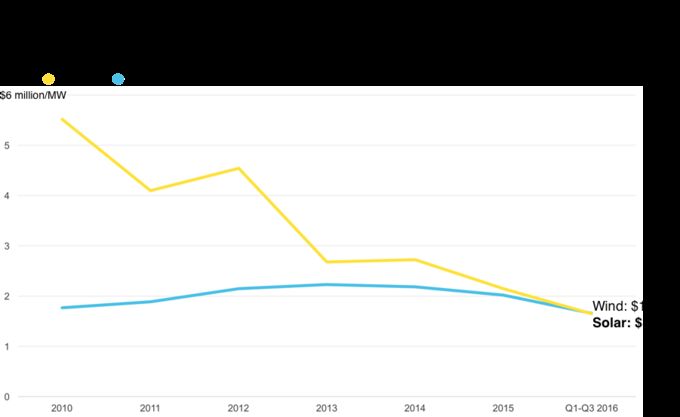
A transformation is happening in global energy markets that's worth noting as 2016 comes to an end: Solar power, for the first time, is becoming the cheapest form of new electricity. From a report on Bloomberg: This has happened in isolated projects in the past: an especially competitive auction in the Middle East, for example, resulting in record-cheap solar costs. But now unsubsidized solar is beginning to outcompete coal and natural gas on a larger scale, and notably, new solar projects in emerging markets are costing less to build than wind projects, according to fresh data from Bloomberg New Energy Finance. The chart shows the average cost of new wind and solar from 58 emerging-market economies, including China, India, and Brazil. While solar was bound to fall below wind eventually, given its steeper price declines, few predicted it would happen this soon. -
Verizon Explores Lower Price or Even Exit From Yahoo Deal (bloomberg.com)
Verizon is reconsidering its $4.8 billion purchase of Yahoo, according to Bloomberg. Citing a source, the publication claims that Wednesday's announcement by Yahoo -- theft of info from one billion users -- has led Verizon to consider scrapping the deal entirely. From the report: While a Verizon group led by AOL Chief Executive Officer Tim Armstrong is still focused on integration planning to get Yahoo up and running, another team, walled off from the rest, is reviewing the breach disclosures and the company's options, said the person, who asked not to be identified discussing private information. A legal team led by Verizon General Counsel Craig Silliman is assessing the damage from the breaches and is working toward either killing the deal or renegotiating the Yahoo purchase at a lower price, the person said. One of the major objectives for Verizon is negotiating a separation from any future legal fallout from the breaches. Verizon is seeking to have Yahoo assume any lasting responsibility for the hack damage, the person said. -
Why China Can't Lure Tech Talent (bloomberg.com)
China may have been hoping to attract tech talent to its nation, but it is unlikely that people in the tech industry will move there. A columnist at Bloomberg explains why: The biggest problem is government control of the internet. For a software developer, the inconvenience goes well beyond not being able to access YouTube during coffee breaks. It means that key software libraries and tools are often inaccessible. In 2013, China blocked Github, a globally important open-source depository and collaboration tool, thereby forcing developers to seek workarounds. Using a virtual private network to "tunnel" through the blockades is one popular option. But VPNs slow uploads, downloads and collaboration. And it isn't just developers who suffer. Among the restricted sites in China is Google Scholar, a tool that indexes online peer-reviewed studies, conference proceedings, books and other research material into an easily accessible format. It's become a crucial database for academics around the world, and Chinese researchers -- even those with VPNs -- struggle to use it. The situation grew so dire this summer that several state-run news outlets published complaints from Chinese scientists, with one practically begging the nationalist Global Times newspaper: "We hope the government can relax supervision for academic purposes." The cumulative impact of these restrictions is significant. Scientists unable to keep up with what researchers in other countries are publishing are destined to be left behind, which is one reason China is having difficulty luring foreign scholars to its universities. Programmers who can't take advantage of the sites and tools that make development a global effort are destined to write software customized solely for the Chinese market. The author has raised several other reasons to make his case. -
Why China Can't Lure Tech Talent (bloomberg.com)
China may have been hoping to attract tech talent to its nation, but it is unlikely that people in the tech industry will move there. A columnist at Bloomberg explains why: The biggest problem is government control of the internet. For a software developer, the inconvenience goes well beyond not being able to access YouTube during coffee breaks. It means that key software libraries and tools are often inaccessible. In 2013, China blocked Github, a globally important open-source depository and collaboration tool, thereby forcing developers to seek workarounds. Using a virtual private network to "tunnel" through the blockades is one popular option. But VPNs slow uploads, downloads and collaboration. And it isn't just developers who suffer. Among the restricted sites in China is Google Scholar, a tool that indexes online peer-reviewed studies, conference proceedings, books and other research material into an easily accessible format. It's become a crucial database for academics around the world, and Chinese researchers -- even those with VPNs -- struggle to use it. The situation grew so dire this summer that several state-run news outlets published complaints from Chinese scientists, with one practically begging the nationalist Global Times newspaper: "We hope the government can relax supervision for academic purposes." The cumulative impact of these restrictions is significant. Scientists unable to keep up with what researchers in other countries are publishing are destined to be left behind, which is one reason China is having difficulty luring foreign scholars to its universities. Programmers who can't take advantage of the sites and tools that make development a global effort are destined to write software customized solely for the Chinese market. The author has raised several other reasons to make his case. -
Japan Sends Its New Space Junk-Fighting Technology To The ISS (phys.org)
What floats 249 miles in the sky, stretches 2,300 feet, and took over 10 years to develop? An anonymous reader quotes Phys.org: Japan launched a cargo ship Friday bound for the International Space Station, carrying a "space junk" collector that was made with the help of a fishnet company... Researchers are using a so-called electrodynamic tether made from thin wires of stainless steel and aluminum... The electricity generated by the tether as it swings through the Earth's magnetic field is expected to have a slowing effect on the space junk, which should, scientists say, pull it into a lower and lower orbit. Eventually the detritus will enter the Earth's atmosphere, burning up harmlessly long before it has a chance to crash to the planet's surface.
Bloomberg has some interesting background: The experiment is part of an international cleanup effort planning to safeguard astronauts and about $900 billion worth of space stations, satellites and other infrastructure... Satellite collisions and testing of anti-satellite weapons have added thousands of debris fragments in the atmosphere since 2007, according to NASA... With debris traveling at up to 17,500 miles an hour, the impact of even a marble-size projectile can cause catastrophic damage. -
Robots Are Already Replacing Fast-Food Workers (recode.net)
An anonymous reader quotes Recode: Technology that replaces food service workers is already here. Sushi restaurants have been using machines to roll rice in nori for years, an otherwise monotonous and time-consuming task. The company Suzuka has robots that help assemble thousands of pieces of sushi an hour. In Mountain View, California, the startup Zume is trying to disrupt pizza with a pie-making machine. In Shanghai, there's a robot that makes ramen, and some cruise ships now mix drinks with bartending machines.
More directly to the heart of American fast-food cuisine, Momentum Machines, a restaurant concept with a robot that can supposedly flip hundreds of burgers an hour, applied for a building permit in San Francisco and started listing job openings this January, reported Eater. Then there's Eatsa, the automat restaurant where no human interaction is necessary, which has locations popping up across California. -
Every US Taxpayer Has Effectively Paid Apple At Least $6 in Recent Years (arstechnica.com)
An anonymous reader shares an ArsTechnica report: Apple has received at least $6 per American taxpayer over the last five years in the form of interest payments on billions' worth of United States Treasury bonds, according to a report by Bloomberg. Citing Apple's regulatory filings and unnamed sources, the business publication found "the Treasury Department paid Apple at least $600 million and possibly much more over the past five years in the form of interest." By taking advantage of a provision in the American tax code, Bloomberg says that Apple has "stashed much of its foreign earnings -- tax-free -- right here in the US, in part by purchasing government bonds." As The Wall Street Journal reported in September, American companies are believed to be holding approximately $2 trillion in cash overseas that is shielded from US taxes. Under American law, companies must pay a 35-percent corporate tax rate on global profits when that money is brought home -- so there is an incentive to keep as much of that money overseas as possible. -
Slashdot Asks: Would You Like Early Access To Movies And Stop Going To Theatres?
It appears many major stakeholders in the movie industry want to bring new titles to you within days, if not hours, as they hit cinemas. Earlier this year, we learned that Sean Parker is working on a service called "Screening Room", an idea that was reportedly backed by Peter Jackson, Steven Spielberg and JJ Abrams, to bring movies on the same day as they show up in theaters. Apple seems interested as well. It is reportedly in talks with Hollywood studios to get iTunes rentals of movies that are still playing on the big screen. Earlier this month, Bloomberg reported that several studios are exploring the idea of renting new movies for $25 to $50 just two weeks after they have hit cinemas.
None of such deals have materialized yet, of course, and also it needs to be pointed out that several movie companies have discarded these ideas before because they know that by offering you new titles so early they are going to lose on all the overpriced cold drinks, and snacks they sell you at the theatre. There's also piracy concerns. If a movie is available early, regardless of the DRM tech these companies deploy, good-enough footage of the movies will crop up on file-sharing websites almost immediately.
But leaving all those aspects aside, would you be interested in getting new titles just hours or a week or two after they hit the cinemas? Would you want to end the decades-long practice of going to a theater? -
Samsung Plans All-Screen Design in New Galaxy S8 Phones (bloomberg.com)
Samsung may have big plans to overcome the whammy of its disastrous Galaxy Note7 this year. The company is reportedly planning to push the boundaries of design with the next flagship smartphone, dubbed the Galaxy S8. The smartphone, which was recently pegged to ship without a headphone jack, will have an "all-screen" design, Bloomberg is reporting. The report adds that there might not be a home button -- at least the way we know it -- and that any part of the lower display will serve as a fingerprint scanner. From the report: The bezel-less displays will provide more viewing real estate while a virtual home button will be buried in the glass in the lower section. Samsung needs the Galaxy S8 to be a hit after suffering through the Note 7 debacle that tarnished its brand, led to an embarrassing recall and may cost the company more than $6 billion. While Samsung is targeting a March release of the S8, that could be delayed until April, the people said. Samsung is adopting tougher testing procedures in the wake of the Note 7 debacle that could push back the launch by about a month, one of the people said. -
Apple Is In Talks With Hollywood For Early Access To Movies On iTunes: Bloomberg (bloomberg.com)
Apple is talking with Hollywood studios to try and get iTunes rentals of movies that are still playing on the big screen. According to a report from Bloomberg, "some studio executives have been pushing to allow home rentals as early as two weeks after theatrical debuts and are considering a deal with iTunes as one option." Bloomberg reports: The most recent talks are part of longer-running efforts by Cupertino, California-based Apple to get new movies sooner, two of the people said. Such an arrangement could help iTunes stand out in a crowded online market for movies, TV shows and music. While the iTunes store helped Apple build a dominant role in music retailing, the company hasn't carved out a similar role in music and video streaming. Hollywood studios typically give theaters exclusive rights to new movies for 90 days or more before issuing them on DVD or making them available for online purchase. One of the concerns about iTunes is whether it will be a secure platform for delivering movies that are still in theaters, the people said. While Apple encrypts iTunes video files so they can't easily be duplicated, it's possible to use a camera to record a movie playing on a TV screen. A leak of picture that's still in theaters would jeopardize returns for the studios and cinema owners. -
Apple's Top Assembler Foxconn Confirms Plans for US Investment, To Create 50,000 Jobs (bloomberg.com)
Foxconn, the biggest assembler of Apple devices, is in preliminary discussions to make an investment that would expand the company's U.S. operations. From a report on Bloomberg: The disclosure came hours after an announcement by U.S. President-elect Donald Trump and SoftBank Group's Masayoshi Son to invest $50 billion in the U.S. and create 50,000 jobs. The money will come from SoftBank's $100 billion technology fund, which was announced in October, a person familiar with the matter said. A document that Son held up after the meeting in Trump Tower also included the words "Foxconn," "$7 billion" and "50,000 new jobs" in addition to SoftBank's numbers. "While the scope of the potential investment has not been determined, we will announce the details of any plans following the completion of direct discussions between our leadership and the relevant U.S. officials," Foxconn said in a statement. "Those plans would be made based on mutually-agreed terms."