Slashdot Mirror
Domain: bu.edu
Stories and comments across the archive that link to bu.edu.
Comments · 256
-
You need to quit making excuses for Linux.
I'm not making excuses for Linux. Fact is is marketing, which Linus distros do little of, has a big impact of what people buy. If advertizing, part of marketing, didn't have an impact then businesses would not spend a lot on it. And yes, businesses do spend a lot on marketing. pharmaceutical companies [pdf warning] spend more on marketing than on research.
Ubuntu is not as a good as a desktop operating system as Windows Vista. It's just not.
Ubuntu may not be good to you but it is to plenty of other users. And there are plenty who do not like Vista, if people liked it then OEMs would not offer a downgrade path from Vista to XP. It also offers competition, and without competition things hardly improve.
Falcon
-
RSI and BU program
BU offers a High school research internship
http://www.bu.edu/summer/high-school-programs/research-internship/how-to-apply.shtml
You might be able to swing something in the CS department there.
The Problem is you really have to start a month or two applying to programs like these...Check out PROMYS, and there is a Stanford one as well.
The "best" is supposed to be RSI...but again they have stopped taking apps.
-
Not The Only Developer
There's a bigger team at Boston University that's been working on this technology.
I particularly like their plans for use in cars. I can imagine combining this with nano piezoelectric technology to create roadways that use passing car vibrations to power illuminated markings that can also transmit road condition information to passing cars or link their light-based inter-car networks around corners and over hills.
The future's so bright, I gotta wear shades that decode and display ambient porn... -
You basically have to read papers..
On Neural Nets at least.. The only text book that I can think of offhand which is decent is Duda, Hart and Stork
Hawkins, like many others, has ripped off many of his ideas from Steve Grossberg (in this case, the ART model). Although he's not very easy to read, especially if you start much earlier than say, Ellias and Grossberg, 1975. You should also check out the work of people like Jack Cowan, Rajesh Rao, Christof Koch , Tom Poggio, David McLaughlin, Bard Ermentrout, among many, many others. I think the above names are sufficient to start a survey.
-
Boston U's Link
The article was slashdotted, so I couldn't RTFA. Google turned up the Boston U project, where it seems they're looking to do something a bit more advanced that mere p2p networking.
-
Re:Diet Coke sticky? corrosive?
There may not be any sugar in diet coke, but it's still kinda messy. Still, mix it with the sugar in a Mentos, and you can bet it's gonna get real sticky. Also, the corrosive nature of coke originates not in the sugar, but in the Phosphoric acid (H3PO4) it contains.
(To be fair, that MSDS is for an 85% solution - about 1500 times stronger than coke)
-
Boston Univ. Engineering programs abroad
Boston University has some excellent Engineering programs abroad. You get to continue taking engineering courses without interrupting your academic progress, with Eng courses taught in English but a chance to learn the local language as well. See http://www.bu.edu/abroad/science/ for a list--specifically, Dresden Engineering, Tel Aviv Engineering and Guadalajara Engineering. I did Dresden 3 years ago, right before BU began offering the Tel Aviv and Guadalajara programs. It's an excellent opportunity to travel and to learn a foreign language and culture. Also, BU takes you on tours of local plants so you can learn about the industrial history and future of these regions.
-
Re:Torrent-only mirrorThe Boston University Linux Users Group is providing a
ftp://lug.bu.edu/pub/distro/ubuntu/
Contains the alternate, desktop, and server torrents for both i386 and amd64.
Hope this helps. Northeastern University College of Computer Science is listed up top under the mirrors. We have a full ubuntu distro mirror. Really fast in case people are on inet2 or in the boston/mass. area. -
Re:Torrent-only mirror
Let's see how Apache can handle it: http://lug.bu.edu/ubuntu/ Same files.
-
Torrent-only mirror
The Boston University Linux Users Group is providing a
ftp://lug.bu.edu/pub/distro/ubuntu/
Contains the alternate, desktop, and server torrents for both i386 and amd64.
Hope this helps. -
Optical fourier analysis
The optical computer section didn't really mention the optical fourier processor. Fourier transforms in this type of system occur in real time, with just a simple lens!
http://sharp.bu.edu/~slehar/fourier/fourier.html
Optical correlators have been built to perform pattern matching, including face recognition:
http://en.wikipedia.org/wiki/Optical_correlator -
terms of use policy
Do they really need to subpoena it? It's right here.
-
Re:Original Paper & Obvious CriticismsThis also means that they cannot generate the 'most beautiful' face but if they did, it would simply be the composition of all their eigenvectors (in this case, ghostly looking images of faces) into one representing the highest scoring beauty. What's to say that this doesn't work? I seem to recall reading that averaged faces tend to be attractive, even if the most attractive faces aren't average (probably due to some hardwiring in the brain to seek genetic diversity).
-
Re:The needs of the US are different from the UK.
Actually, the "politics is like a septic tank, the really big chunks rise to the top" - is a reference to those really big "floaters" that you have to break up with the toilet brush because they're unsinkable
-
Re:Fingerprint scanners suck.
How about a fuzzy extractor?
-
Re:prohibition didnt work for my grandparents
Thanks, but as you will clearly see from the link below, approximately 17,400 died from drunk driving during 2001 in the US versus 2,792 during 9/11...and we should be focusing on the terrorists? I say bring prohibition back.
Drunk Driving vs. 9/11 (terrorism) deaths
Sorry, but alcohol abuse > terrorism.
-S -
Nonsense.
In all civilized countries you are given water when you request it in restaurants and shopping centers, independently of the climate.
Now check my very previous comment, I talk precisely about why this is all nonsense. You USians (but may the bunny help us when it comes to Texans) are not willing to do anything at all and frankly as dispendious beyond what is rationally acceptable.
You clearly don't understand how carbon credits work. Rwanda (or any other poor country) pollutes comparatively little (guys, screw this on your fucking head somewhere, you are 3% of the population, but contribute 25% of global pollution). Thus you buy credits from them so you can keep polluting (but it becomes an expense, so you will have to take measures against polluting to remain competitive) and they will use that money to finance those green technologies that you deride as expensive (go and for bunnies sakes visit Africa. Great people and you will stop the idiotic assumptions).
In Africa, with little or no infrastructure whatsoever, it is immensely cheaper to put solar panels in each house than to line expensive electric power lines for small villages scattered in big areas. The population of Africa is about the one in the US but the area is much bigger (check this for an idea: http://www.bu.edu/africa/outreach/materials/handouts/howbig.html). Local solar energy in a sunny continent becomes the only logic way forward, dispendious expensive mammoth projects are only economical for big towns, of which Africa hasn't got many.
As for Africa being where it is, it certainly does not help that both the EU and US keep subsidizing their agricultural industries (where the Africans could have a competitive advantage) and that they support the dictators your mention when it is convenient to their interests. -
No need to believe...
The good news is that this is all math! There's no need to believe anything one way or another! Sorta exciting huh? You can go and examine all the ART algorithms (I linked wikipedia because it has the PDFs linked.. did you notice? But here's Grossberg's homepage, just in case), and you can go read about HTM. According to Hawkins, HTM has some magical, er I mean, proprietary, component that separates it from ART. I've seen Hawkins speak... in fact, I saw him speak at BU with Steve Grossberg in the audience. He amused the audience by showing a demo that was completely indistinguishable from an ART1 implementation that takes about half an hour to program, and most of the people present had done themselves.
He then failed to answer any substantive questions (including Steve asking him how his model differed from ART), referring us all to online videos of his lectures. I personally asked about how he could reconcile this article with his predictions.. which assume a cortical hierarchy based on 'distance' (in synapses) from primary sensory cortices, rather than examining the relative lamination of various cortices. I notice since then the wikipedia article "On Intelligence" has had its 'experimental prediction' claims toned down quite a bit.
As it happens in terms of books though, Grossberg has written several and has a ton of peer reviewed articles on this very subject. Hawkins to my knowledge doesn't have a single peer-reviewed article on HTM or anything related. -
Not really new..
While loaded with buzzwords, this really involves nothing that's really new. The HTM is just a rehash of Adaptive Resonance Theory
And applications like this aren't exactly new (this link downloads a
Although it is certainly a major engineering challenge to get this type of classification to work over multiple modalities of data in any coherent way, as far as I can tell this project doesn't represent any breakthrough in approach or capability. -
Re:Good scientific journalism is possible...
Programs that teach science journalism as a specialty create writers who try to meet the standards scientists and the public prefer. One program that's more than 30 years old exists at Boston University:
Ellen Ruppel Shell and Douglas Starr are Co-directors of the Science & Medical Journalism Program at Boston Univerity. Their students produce SciTini which you may read at:
http://www.bu.edu/sjmag/index.shtml
If they do not meet your standards, perhaps you should contact them and help to improve the program.
(Disclosure: Douglas Starr was my student at BU decades ago.)
--Kirt -
Re:This only means the RIAA has no case
-
Re:This only means the RIAA has no case
-
To testify what?Chairman of Boston University's Computer Science Department went to bat -- as an expert witness -- for the BU students
What does some limp-wrist academic testify to as an expert - 'Yes, students are ok to download copywritten work because I read on the slashdot that Information is Free and it is only taking money from evil labels not from artists. Why, your honor, do CDs cost 12.99 in stores when they cost only pennies to produce!'
-
Re:Dear CmdrTaco and the Rest of the World,-1 not wholly accurate... where did you come up with that?
Example of programs: Boston College: Course - Boston University: Course different schools.
We can just let Wikipedia settle this
For the UK In general use, a "college" is an institution between secondary school and university, a college of further education and adult education. These institutions were usually called technical colleges, or tech. Recently, however, with the differences in functionality between universities and colleges becoming less clear-cut, and with the phasing out of polytechnical colleges, many people are starting to call such institutions "universities". Many types of institutions have "college" in their names but are not colleges in the general use of the word
For the US In American English, the word, in contrast to its many and varied British meanings, often refers to liberal arts colleges which provide education primarily at the undergraduate level. It can also refer to schools which vocational, business, engineering, or technical curriculum. The term can either refer to both a self-contained institution that has no graduate studies or to the undergraduate school of a full university (i.e. that also has a graduate school).
And btw, those "traffic circles" - Most of us call them a "rotary" and we got'm all over Massachusetts and the greater part on New England -
Re:Barbie
You can't scale barbie to 'the size of an avarage adult female' without still running into the problem of her being insainly proportioned.
From wikipedia
A standard Barbie doll is 11.5 inches tall, giving a height of 5 feet 9 inches at 1/6 scale. Barbie's vital statistics have been estimated at 36 inches (chest), 18 inches (waist) and 33 inches (hips). According to research by the University Central Hospital in Helsinki, Finland, she would lack the 17 to 22 percent body fat required for a woman to menstruate.[10] In 1965 Slumber Party Barbie came with a book entitled How to Lose Weight which advised: "Don't eat." The doll also came with pink bathroom scales reading 110lb, which would be around 35lbs underweight for a woman 5 feet 9 inches tall. In 1997 Barbie's body mold was redesigned and given a wider waist, with Mattel saying that this would make the doll better suited to contemporary fashion designs. [11]
Here is more complete list of her stats. -
Re:Bloggers != JournalistsThey will be treated like journalists when they can demonstratte some ethical and professional resposibility.
Actually, Microsoft *is* treating them like journalists!
Just an example of envelope or ATM journalism that you mostly still see in the Phillipines.
Slightly dated by US standards, sure, where you get hired as press secretary for good coverage, but hey, I mean they're only bloggers.
-
Let's get serious,
Five minutes of thoughtful searching brought up useful, important information for anybody willing to take these sciences and technologies seriously. The National Institute of Health (NIH) stem cell page has some paper abstracts as well as listed universities with programs in these United States (and some online resources). Useful sources of information at this bibliography re: human reproductive cloning, at Boston University and this one. CiteSeer popped up the paper on nuclear transfer / human cloning. Apparently there's at least one dedicated research foundation out there.
Granted, most of these links are preliminary- check those deep databases, like over at PubMed Central, for those detailed reviews of the state of the art. And just for kicks, one last link which (still) impresses me. -
Re:Welcome!Well in the first place, you're assuming I'm taking the opposing position to yours. At this moment, I'm doing no such thing--I've only pointed out that your characterization of the free will problem was question-begging.
What is it that you think is going on inside your head? Do you think it's magic?
Well, what do you think is going on inside yours? Are you quite sure that physics can paint a complete picture of the universe?
... explain how, barring magic, any sort of "free will" can exist in a physical universe.
I guess you do think that physics can completely describe the universe. But on what grounds are you claiming that this universe is [solely] a physical one? (Note that to approach the question of whether or not the universe is physical from the point of view of physics instantly involves you in question-begging again...)
If you're actually interested in thinking about that question, you may want to look into Kant's Critique of Pure Reason. Since you seem to enjoy jumping to conclusions, I will point out that I'm not claiming Kant was right about everything or about anything in particular, but the idea he called "Transcendental Idealism" is still tantalizing enough to be taken seriously by some philosophers, though not by some others.
In extremely brief terms, Kant postulated that space and time, rather than being entities in their own right are characteristics of our 'minds,' (my oversimplification, not Kant's), and that the only way we can understand the universe is in spatiotemporal terms regardless of what the universe might actually be 'like'. In other words, it's conceivable that the universe is not spatio-temporal per-se--and if it's not, then physics cannot provide an exhaustive description of it.
The point is that determinism is a tricky business, and it can't be dismissed or proved as casually as you would have us believe.
-
Haven't we got bigger problems?
I think it's nice that our elected officials are going after customer service departments and tackling social ills like the fact that a pint of ice cream isn't really a pint. But haven't we got bigger problems? Even forgetting about national issues like our tattered Constitution and our dictatorial "President" -- we've got dozens of billion dollar New York corporations that don't pay taxes, we've got $6 BILLION OF
FRAUDULENT TRADES A DAY on the New York Stock Exchange and NASDAQ. We've got estrogen in our water supply which is decreasing male fertility (and fish stocks). And the list goes on....
Somehow I don't think Dell customer service really qualifies as an emergency... -
Realism, locality - or Probability
It could also be that our probability theory is wrong. Probabilty theory is only a mathematical model, albeit a successful one.
Exotic Probability theories preserve locality and realism though can be difficult to accept if you're a frequentist... -
Re:Most ambitious? Most ambitious????
Would they though? Izhikevich has taken a lot of time to try to get neurons into a 'reasonable' computational size, using a bunch of tricks from dynamical systems. This system may approach those dynamics, but it wasn't clear from the article. But that still isn't a general neuronal model. 'Regular' pyramidal cells often receive input from ~10-20k other cells, and there's no general description of which have an 'active' dendritic tree (ie. one that has areas that can spike towards the soma). There are plenty of other neurons, such as pyrimidal neurons in the Hippocampus, or Purkinje cells in the cerebellum, that we KNOW have active dendritic trees, and perform some pretty complex processing. And with a passive system, there's no reason for special processors, GPUs can do the computations just as well as any specialized chip (I know it isn't published yet, but check out things like http://cns.bu.edu/~elddm/ for examples of neural networks on GPUs).
-
Re:it used to be dolphinsReally. They were even training them to do various things. (Look for subs or something. I don't remember.) There was talk of training them to attach mines to enemy vessels. Then an outcry began--rightfully, as far as I'm concerned--that it was a Bad Thing to use such intelligent and simpatico animals for this. Now, I see, they've moved to sharks. No lobby supporting them, I'll bet, but the military also won't be able to train them to do much. Sharks are well below flounders in brain power.
They're not training them, they're remote controlling them
http://www.bu.edu/alumni/buforward/archives/Dec_20 06/articles/spies.html
DARPA turned to Jelle Atema, a College of Arts and Sciences professor of biology at the Boston University Marine Program, who for many years has been researching how marine animals use their sense of smell. Atema proposed that because sharks are expert at tracking odors over very long distances, the key to steering a shark was to follow its nose. With more than a year of DARPA funding, which ended last year, Atema was able to use electrical stimulation of a sharks brain, mimicking odor, to guide the shark around a large tank.
So the simplicity of the shark's brain is actually an advantage. From the shark's point of view, it's chasing the smell, presumably, of prey.
Interestingly, something like this happens naturally. Parasitic wasps perform brain surgery to zombify roaches.
http://www.boingboing.net/2006/02/03/wasp_performs _roachb.html
Makes you wonder if you could do it with higher animals actually. Even though we seem to have aa certain amount of free will about how we achieve our objectives of eating and reproducing and avoiding pain, there's probably low level hardware in our the oldest parts of our brains which enforces those objectives by sending reward/punishment signals 'up' to the high level, conscious bits of our brains. I can imagine that if you attached electrodes in the right places, you could run mammals and even humans in remote controlled zombie mode too. It would be a hellish experience though, since you'd know your free will had been strongly curtailed.
Still, look on the bright side, most -
Re:Yau
"C'est visible que..."
Perelman was probably simply following one of the grand traditions in mathematics, illustrated by the story about Laplace below:
Laplace's Mecanique Celeste, an enormous five volume tome on just about everything you ever wanted to know about celestial mechanics, was first translated into the English language by Nathaniel Bowditch. Though others did it before him, Laplace was notorious for leaving length demonstrations to the reader, usually preceded with "C'est visible que..." (It is obvious that...). Bowditch meticulously filled in all the gaps, but before long he grew to dread those words, for he knew that when he saw them, he was in for a lengthy bit of derivation before what Laplace claimed was obvious was, in fact, obvious.
I think I first came across this anecdote in E.T. Bell's Men of Mathematics, but don't recall for sure - I found it on the net here: http://math.bu.edu/people/jeffs/joke.html -
Nakamura first to make led, BUT
the buffer layer technique was first published by Theodore Moustakas and remains his intellectual property.
Linky
I wish more people knew this. He's one of the best professors I've ever had and a hell of a nice guy. -
Re:Christian Science Monitor
Indeed. I'd been initially very skeptical of any publication with the name "Christian Science Monitor".. until I read a few of their pieces. They're well-written, and actually very well respected, with good reason. Check the Wikipedia Article, they have almost no religious affiliation, great reporting (seven time Pulitzer winner), and stick their neck out for reporters on the line.
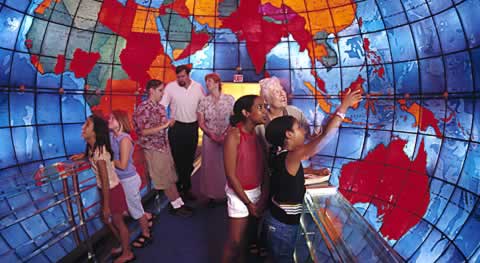
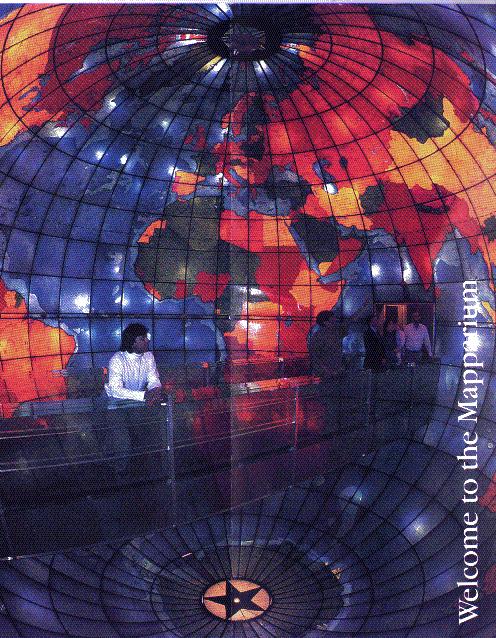
Also, off-topic a little, but if you live in or plan on visiting Boston anytime.. check out the Mapparium, which is located in a library belonging to the CSM. I wasn't too impressed by the thought of seeing what's essentially a really large globe until I actually got to go inside.. the acoustics alone are enough to take your breath away -- you can hear the faintest whisper along the inner diameter (a long way). Pictures don't do it the faintest justice, but here's one. -
Re:So this is like...Here is a very good visual explanation:
-
Re:Hang on...
Being fat isn't genetic either; parents teach thier poor habits to their children, who go on to teach them to thier children.
So its a fact then? I'm sure everyone agrees with you.there is strong evidence from both human and animal studies indicating that genes also contribute to the development of obesity.
University of Washington Centre for GenomicsGenetics is a major determinant of obesity, however, little is known about specific genes that contribute to obesity
Boston University Medical Centre
If you still need more, check here. -
Re:Find a better name.
I'll keep thinking about, but am not sure that just localizing the means of production leads to security. This has been quite facinating, thanks. There is an old papers which I think you would enjoy, The Nature of the Firm by Ronald Coase--it's a pdf here (probably the most inspired economist I know of, he was, of course, smart enough to never admit to being one). He looks at the firm in a similar way as your view on societal units.
-
What's an FFT
Apparently nobody knows what an FFT is. Here's the best description I can give without descending into math too much.
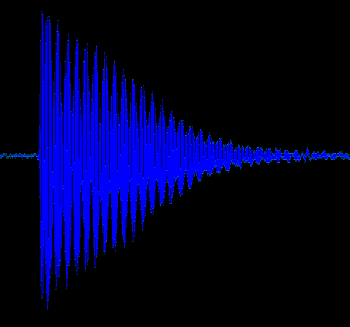
The Fast Fourier Transform is an algorithm to turn a set of data (as amplitude vs. time) into a set of waves (as amplitude vs. frequency). Say that I have a recording of a piano playing an A at 440 Hz. If I plot the actual data that the sound card records, it'll come out something like this picture. There's a large fading-out, then the 440 Hz wave, then a couple of overtones at multiples of 440 Hz. The Fourier series will have a strong spike at 440 Hz, then smaller spikes at higher frequencies: something like this plot. (Of course, that's not at 440, but you get the idea.)
The reason we like Fourier transforms is that once you have that second plot, it's extremely easy to tell what the frequency of the wave is, for example - just look for the biggest spike. It's a much more efficient way to store musical data, and it allows for, e.g., pitch transformations (compute the FFT, add your pitch change to the result, and compute the inverse FFT which uses almost the same formula). It's good for data compression because it can tell us which frequencies are important and which are imperceptible - and it's much smaller to say "Play 440 Hz, plus half an 880 Hz, plus..." than to specify each height at each sampling interval.
The FFT is a very mathematics-heavy algorithm, which makes it well suited for a GPU (a math-oriented device, because it performs a lot of vector and floating-point calculations for graphics rendering) as opposed to a general-purpose CPU (which is more suited for data transfer and processing, memory access, logic structures, integer calculations, etc.) We're starting to see a lot of use of the GPU as the modern equivalent of the old math coprocessor.
If you're looking for more information, Wikipedia's FFT article is a good technical description of the algorithm itself. This article has some good diagrams and examples, but his explanation is a little non-traditional. -
Re:Yes, in New England
There already is a smaller scale version of Silicon Valley roughly centered on Boston, Massachusetts. The partial circle defined by Route 128 (and to a lesser extent the larger one surrounding it defined by Route 495) has most of the required properties already. Heck, it even has the same elevated levels of Asperger's Syndrome that Silicon Valley has.
I think a bigger point is the number of colleges and universities in the Massachusetts area (like MIT, Harvard, Northeastern, and Boston University, to name just a few). Plus, besides Boston, there are numerous other technologically advanced places in that ring (including Cambridge, Saugus, Waltham, and Billerica, to name just a few). If you do a look-up on the saga of ODF and the history of OASIS and/or GNU you'll find a lot of these places mentioned -- OASIS originated in Massachusetts, the Free Software Foundation is headquartered in Massachusetts, and AFAIK Massachusetts was the first government to sanction a special "Open Source Software Trough" to encourage the usage of open source software within both its own branches as well as its local community governments. It's not clear to me where the weird view that Massachusetts is somehow against free software, open source and information sharing that some are espousing is coming from...
-
Re:The Eighth CommandmentNote, by the way, that Caltech demanded Harvey Mudd to return the cannon on threat of legal action only after Caltech students attempted to negotiate with Harvey Mudd's administration in good faith for a number of ways to recapture the cannon--including air-lifting it and moving it in the middle of the night
Fleming house was not amused. They were observing the whole thing and two cars descended on us as soon as we drove the cannon off campus. They were maniacs, trying to stop the truck, trying to rip down the box while the truck was moving. Before we reached the 210 they rammed the back of Larry Hartwick's truck. And the party was over.
I mean, they don't have anything about causing traffic accidents in the Ten Commandments, but that might've been the fourteenth or so. -
What's next
-
Re:It's not Caltech's cannon!
Well I'm confused. According to this article, the cannon that was stolen twenty years ago was in front of Fleming house, and was THE Caltech Cannon. It was later returned to Caltech. However, judging by the photos, the cannon stolen twenty years ago is clearly not the same as the cannon now at MIT.
If the bigger cannon, the one stolen in 86 is THE Caltech cannon, then it was on front of Fleming house then, but isn't any more? Perhaps when that cannon was returned, it was put in a different, more secure area, and another smaller cannon was put at Fleming house? -
Re:From an HMC mailing list
To be fair, it is now against Pasadena city law to steal the cannon. One of the first things they tell frosh when they tell us the story is that we are not, under any circumstances, allowed to steal the cannon anymore. Apparently, after the first time we stole it, we stole it subsequent times and left it all around Los Angeles, which for some reason made them sore. If they don't enforce the rule and make MIT give it back, I for one will be sore.
David (HMC '09) -
As a Harvey Mudd Alumnus
I feel the need to post the link to the original heist: http://people.bu.edu/fmri/somers/cannon.html
-
Blue Screen on a MacBook Pro
The apple design gives this classic crash a classy look.
http://www.eng.bu.edu/~anc/macosx_bluescreen/blue. jpg -
Sounds DangerousFTFA:
"There used to be restrictions on passengers to take methanol on flights," said Ms Tsai.
But, she explained, the International Civil Aviation Organisation (ICAO) recently changed its guidelines to allow passengers to take methanol cartridges with them when they travel.
From the MSDS for Methanol:
Warning! Flammable liquid. May cause skin irritation. May cause central nervous system depression. May be absorbed through the skin. May cause kidney damage. May cause respiratory and digestive tract irritation. May be fatal or cause blindness if swallowed. May cause fetal effects. Causes severe eye irritation and possible injury. Target Organs: Kidneys, central nervous system, eyes.
It's a neurotoxin! It casues blindness! And it's highly flammable!
Sounds like a terrorist's dream. -
Big Bang is not a "theory"
Big Bang is an hypothesis, and a wrong one, too. I've seen four different groups point out four different ways in which the hypothesis is unquestionably refuted. The least subtle that I can recall is the BigBangNeverHappened crew, but they're only one of many. They're not religious whackos, either.
My personal favourite refutation is this image, of a highly redshifted (z=2.11) quasar sitting between us and an opaque galaxy (NGC 7319, part of Stephan's Quintet, z=0.0225), but many others prefer the Blazar 3C 345, an object which is changing shape, if current astrophysics is correct, at roughly seven times the speed of light. However, there's no reason to fight, 'coz there's plenty of other "anomalous" objects to go around.
Notice that the NGC 7319 shot is from Hubble and hosted by JPL; this is not a backyard job or some random Russian with a unique idea, and 3C 345 is from the VLBA and hosted by Boston University. -
Re:Why bother?
Why not just use lapack (http://www.netlib.org/lapack/) or essl(http://scv.bu.edu/SCV/IBMSP/ESSL-howto.html) or gsl (http://www.gnu.org/software/gsl/) ? Read Numerical recipes if you want to understand what the code is doing.
-
Re:The best hack mentioned in the article...
Has nothing on the HMC v. Caltech Cannon heist