Slashdot Mirror
Domain: bu.edu
Stories and comments across the archive that link to bu.edu.
Comments · 256
-
Re:So much for that
Do you have any examples of people apologising for people white or straight? I'm both (kinda) and never apologised for it, or felt guilty for it.
-
Re:I'm not surprised
we keep cutting funding to education and research
Bullshit.
-
Re:I'm torn
I’ve read a lot about mosquitoes and their place in the ecosystem over the past 10 years. Bats, purple martins and other insectivores get a vanishingly small amount of their calories from mosquitoes - less than 2% of the stomach contents of bats. Mosquitoes are quite small and therefore not very calorically rich. Unlike midges and gnats, they don’t really swarm in a way that would allow insectivores to get a whole bunch in one swoop, so generally mosquitoes are providing fewer calories than the expense required to fly at them. Bats, martins and the like mostly end up eating moths and midges. Some species of dragonfly are mosquitovores but, again, not as a large percentage of their caloric intake.
There are species that target mosquito larvae, which bunch up enough to be worth it. The aptly named mosquitofish is one such creature.
But the saving grace even among mosquitofish is that they don’t care what species of mosquito larva they eat - getting rid of the handful that target humans will leave space for the hundreds of other species that exist in the US (let alone the thousands worldwide). There are 3,500 species of mosquito and only 40 of them target humans - getting rid of those would not affect total mosquito mass available for fish. Especially considering that most of the deadliest mosquito vectors in the Americas are invasive species (Aedes aegypti, Asian Tiger Mosquitoes) - wiping them out from this hemisphere should be a good thing. (No one cries over attempts to control/wipe out lionfish in the Caribbean - but attempt to kill an invasive disease vector and everyone gets the vapors.)
Contrast wiping out a handful of mosquito species via bacteria or genetic engineering with the enormous chemical inputs we put into our lakes, streams and rivers in order to just control mosquitoes - we are surely inadvertently killing off other species of insects just trying to control mosquitoes. And when we drain a wetland because of mosquitoes, we impact far, far more species than even the worst case scenario of mosquito extinction. Even ecologists who are nervous about tampering with ecosystem largely agree.
-
Re:ridiculous
I have been saying consistently that these laws are wrong
You've been asserting that they're wrong, and I've been asking you to justify that they're wrong, and you've been stubbornly refusing to do that in any objective way. Instead you just keep falling back on yet more unjustified assertions. Here was your first attempt:
I want to live in a peaceful, prosperous society in which everybody has equal rights and that doesn't degenerate into tyranny.
So I asked you for evidence that anti-discrimination laws make society less peaceful, or less prosperous, or causes them to degenerate into tyranny. I've asked you this repeatedly. You've repeatedly declined to offer any. You seem to take it for granted that they do, yet you're totally unable to point to concrete evidence to back up the claim. These are not questions for philosophical debate. They're factual questions to be answered through data. Do anti-discrimination laws increase the level of violence, decrease the level of prosperity, etc.? Any claims that aren't based on concrete data are worthless.
Then you tried to equate anti-discrimination laws with Nazism, thus demonstrating that you've never heard of Godwin's Law. But when I pointed out this was ridiculous, you responded with an even wilder absurdity:
Second, we're not talking about "anyone", we're talking about the same movement, the progressive movement. The progressive movement has consistently advocated categorizing people by race and make racial distinctions in government policies for more than a century.
So you just equated all progressives with Nazis. Double Godwin! But aside from that, you've just completely rewritten history. Laws have made distinctions based on race for far more than a century. That isn't something the progressive movement invented, it's one of the main evils the progressive movement fought against. Discrimination existed on a massive scale through large parts of the U.S. That's what the Civil Rights Act tried to eliminate. And contrary to your claim that "anti-discrimination laws don't work", it was actually very effective.
But no. Enforcing anti-discrimination laws involves checking to see if people are discriminating. And to check, you need to collect data. And collecting data about race is evil! Therefore, those laws are evil, and we should go back to the pre-Nazi era when black people were forbidden to live in white neighborhoods, attend white schools, use the same restrooms as white people, or sit in the front of the bus. They had so much more freedom back then, before those evil progressives started sending them off to concentration camps.
-
This deal would be good for everyone involved
Rather than some random Wall Street financial services company buying IDG, slapping some paint on it and reselling it three or four years down the road or just writing it off for tax purposes, Hugo Shong would actually have the best interests in mind for this hugely under-invested tech media giant. Shong was a protege' of IDG's founder Pat McGovern and founding general partner of IDG Capital Partners and chairman of IDG Greater China. His purchase of the company would basically be keeping it in the family. This is a good profile of Shong. Of course, this hinges on Trump not blocking this with his trade agenda.
-
Re:Speaking of myths...
Bats "don't really swoop down on your head and get tangled in your hair." They also don't eat 1,000 mosquitoes an hour (PDF).
To be fair pesticides can't even eat bugs.
-
Speaking of myths...
Bats "don't really swoop down on your head and get tangled in your hair." They also don't eat 1,000 mosquitoes an hour (PDF).
-
Re:US disagrees
Well, there is the tax issue, as well as acting like their espionage agencies committing crimes abroad is somehow legal because the US government has authorised it, the Foreign Corrupt Practices Act, which has been used repeatedly to extort money from foreign companies thad had bribed officials in a third country, and a few other extra-jurisdictional abuses of power.
-
Computer Clocks used to be scrambled via NTP flaws
"Researchers at Boston University said this week that they've found flaws in the Network Time Protocol (NTP)"
'We thank the Network Time Foundation, NTPsec, Cisco, and RedHat's security team for quickly issuing patches for various issues described in this work' -
Re:Not new, but new insight in our solar system!
Your link is borked; it should be this.
-
Jane/Lonny Eachus goes Sky Dragon Slayer
Did you see my RT re: NASA budget? NASA environment spending went up 41%, space only 7%. goo.gl/ixcstK [Lonny Eachus, 2015-03-12]
... NASA's climate study budget has gone up 41% while their space budget only went up 7%.
Sure, let's ask Sky Dragon Slayers how many satellites should observe and protect our home planet. As soon as they finish mocking NASA's director because Slayers claim that "global warming" is nonexistent. But even when Slayers insist that "NASA needs to pull its head out of faulty climate science and get back to space," they should remember that not even space is compatible with Sky Dragon Slayerism.
After all, what if NASA just sends more missions to Venus and Mercury? Again, if CO2 isn't the reason, then why is Venus hotter than Mercury? Is Venus hotter than Mercury because of CO2, gray Oreos, or basketball player gloves?
Shouldn't Sky Dragon Slayers be able to answer such simple questions before determining NASA's aims and goals?
Furthermore, Jane should explain why he emphatically rejected the standard physics definition of the term "net". If Jane/Lonny Eachus ever accepts the standard physics definition of the term "net", he'd find that the Sky Dragon Slayer nonsense he's been regurgitating for years is based on a misunderstanding of a basic physics definition.
On that glorious day, Jane/Lonny Eachus would finally have a more credible case for influencing NASA's aims and goals.
-
Boston University professor ...
Alexander Graham Bell was a BU professor initially
-
Jane/Lonny Eachus goes Sky Dragon Slayer
But net radiative power out of a boundary around the source = "radiative power out" minus "radiative power in", so the equation Jane just described also says:
NO!!!!!
After Jane emphatically rejected the standard physics definition of the term "net", it became clear that Jane is hopelessly confused about the term "net". Sadly, this is typical for Jane/Lonny Eachus and other climate contrarians.
After it became clear that Jane is hopelessly confused about the very term "net" which he keeps screaming in ALL CAPS, I explained conservation of energy in a way that didn't require using that troublesome word. At this point, a real skeptic would either try to address this disagreement about a fundamental definition, or agree to disagree about the definition and solve the problem like I did without using the disputed word. But not Jane/Lonny Eachus:
.. No NET incoming radiation from cooler bodies is absorbed, therefore no NET radiation is crossing your boundary FROM those cooler bodies. It comes in and goes right back out.
Instead, Jane kept repeatedly screaming "NET" in ALL CAPS, completely ignoring the fact that his emphatic rejection of its standard physics definition reduces his rant to gibberish. Jane/Lonny Eachus also ignored me after I asked him simple questions about the definition of the word "net", so there doesn't seem to be any way to correct Jane's fundamental misconception.
I try to be tolerant of those who appear to suffer from Dunning-Kruger Syndrome, but one can only be so patient.
Jane/Lonny tries to be tolerant of those he thinks suffer from Dunning-Kruger syndrome, but only if "tolerant" includes endless cussing and screaming garnished with ball washing fantasies. If Jane/Lonny wonders what a Dunning-Kruger victim looks like, he need only look in a mirror:
.. I'm really not sorry to say this after your past behavior, but showing you're wrong is just plain dirt simple. And not JUST wrong, but so ridiculously wrong that I can (and will, believe me!) use it as entertainment for certain of my friends.
.. It feels as though I'm explaining to a high-school student who has never seen a physics problem before.
I keep finding myself in a position where I feel I should explain, but I am at a loss as to why I should have to, becau
-
Yeah, well BS L4 labs are...
Check out this video: http://www.bu.edu/today/2013/v... It's not the CDC, but for a similar lab at Boston University.
It's EXACTLY like the movies, including the positive-pressure plastic suits.
-
Yes, there are methods available
Yikes, that sounds like a terrible experience. My sympathies to your sister in law and the whole family.
There are several methods available, most prominently implanting arrays of electrode over pre-motor cortex, which can then be decoded online and used to control a computer pointer.
See for example:
http://www.youtube.com/watch?v...You might want to contact Frank Guenther at BU. Who has worked on this for several years, and has started the Unlock Project particularly for people in your sister in law's situation.
-
Re:"pro-Russian forces in Crimea"
It'd never happen. I mean, that'd be like every country that had a German minority being invaded by Germany.
You mean like in the Sudetenland crisis (1938) and Austrian Anschluss (1938)? (We won't include Russia's Volga Germans.) Do you want to include the "Aryan" peoples too?
Nothing like that could happen with Russia, right?
Russia Pressures the Baltic States
Nearly three years after all three Baltic States regained their independence, Russia continues to infringe on their sovereignty, intervene in their internal affairs and subject them to coercive diplomacy. Russia's failure to complete the withdrawal of its troops from Estonia and Latvia, a long and varied series of incidents involving the Russian forces, and allegations that Estonia and Latvia have violated the human rights of their Russian-speaking population, are issues that have acquired a particularly menacing aspect in view of Russia's characterization of the Baltics as being within the "near abroad," not as independent and sovereign as other European states--and the recently formulated military doctrine and activist foreign policy that reflect a resurgent Russian imperialism.
-
Re: 3D chips, memristors, photonics, spintronics,It may not be an instant revolution that's already done, but some work really is in progress.
- 3D chips are decades old and have never materialized.
24-layer flash chips are currently produced by Samsung. IBM works on 3D chip cooling. Just because it "never materialized" before, doesn't mean it won't happen now.
- Memristors do not enable any new approach to computing, as there are neither many problems that would benefit form this approach, nor tools. The whole idea is nonsense at this time. Maybe they will have some future as storage, but not anytime soon.
Memristors are great for neural network (NN) modelling. MoNETA is one of the first big neural modelling projects to use memristors for that. I do not consider NNs a magic solution to everything, but you must admit they have plenty of applications in computation-expensive tasks.
And while HP reconsidered its previous plans to offer memristor-based memory by 2014, they still want to ship it by 2018.
- Photonics is a dead-end. Copper is far too good and far too cheap in comparison.
Maybe fully photonic-based CPUs are way off, but at least for specialized use there are already photonic integrated circuits with hundreds of functions on a chip.
- Spintronics is old and has no real potential for ever working at this time.
MRAM uses electron spin to store data and is coming to market. Application of spintronics for general computing may be a bit further off in the future, but "no potential" is an overstatement.
- Quantum computing is basically a scam perpetrated by some part of the academic community to get funding. It is not even clear whether it is possible for any meaningful size of problem.
NASA, Google and NSA, among others, think otherwise.
So, no. There really is nothing here.
I respectfully disagree. We definitely have something.
-
Re:Its counter productive
We would like to know what study this is. Previous work shows the opposite.
http://motherboard.vice.com/blog/higher-rates-of-gun-ownership-dont-correlate-to-less-crime
Now there IS evidence that gun bans are ineffective, which is a different proposition.
-
Re:If you or something you did was noteworthy:
Here's a good quick read on that: http://hep.bu.edu/~superk/pdk.html
So far, no detections for proton decay although [some] grand unified theories predict it.
-
Re:Must have been a B.U. student
http://www.bu.edu/today/2013/university-jumps-in-us-news-world-report-rankings/
Haughty derision it is.
-
Re:GP says, "you may be right"
I haven't looked carefully at "abstract idea" and how that applies to patents (or doesn't).
Hi, thanks for the response.
I'm a mathematician and I honestly find a lot of the "all algorithms are math" argument to be rather weak for reasons I'd be happy to go into. I think "abstract idea" is the real issue. The best analysis of the situation that I've seen so far is Ben Klemens' "The Rise of the Information Processing Patent", the pdf of which can be found here http://www.bu.edu/law/central/jd/organizations/journals/scitech/volume141/documents/Klemens.pdf.
-
Re:No surprise
There is actually some new research into exactly this problem. Using what they call "fuzzy extractors" you can derive a secure key from noisy information. Really cool, check it out http://www.cs.bu.edu/~reyzin/fuzzy.html
-
Re:Who cares
Well, perhaps, though I'd have to dig up some data and make calculations to be sure (obligatory semi-related XKDC)...though, he seems to have obtained a physics PHD recently, so he should at least be able to make ends meet.
Either way it's an oppressive and unjustifiable judgement amount, but I would certainly choose that vs. 20 years in prison. -
Re:Artificial organ scarcity
It's worse than that. There's some discussion about harvesting the organs before the donor is actually dead. You see, when you sign that donor card, your life immediately becomes less valuable to The System as your death becomes more valuable.
-
Re:well...no shit.....
Actually some donate more than others.
Historically, the official line substantially underrepresented the risks of head trauma. As knowledge of the area has grown, an increasing number of players have been putting themselves on the list for inclusion in the brain bank at the BU Center for the Study of Traumatic Encephalopathy... The chap who deliberately shot himself in the chest, rather than the head, to preserve his neural tissue for research is a somewhat extreme example of the phenomenon... -
Re:Economic Espionage
"Not entirely true. Here's but one web page describing laws that restrict individual and corporate action outside the US:
http://www.bu.edu/globalprograms/global-toolkit/getting-established/us-laws-abroad/ [bu.edu]"Only for US citizens or others with assets in the US. This doesn't apply to Airbus, the Saudi airline or the Saudi government.
"Also, certain parts of the IRS code apply to US citizens with foreign income, even if they are no longer US residents."
Ditto.
"And, various laws regarding sex with underage minors, even when legal in the foreign country, still apply to US citizens when abroad."
Ditto.
"Not surprisingly, children born to US citizens while abroad are eligible for US citizenship, by US law."
Ditto.
And ditto for the rest of your examples.
-
Re:Economic Espionage
US laws don't apply except in the US.
Not entirely true. Here's but one web page describing laws that restrict individual and corporate action outside the US:
http://www.bu.edu/globalprograms/global-toolkit/getting-established/us-laws-abroad/Also, certain parts of the IRS code apply to US citizens with foreign income, even if they are no longer US residents.
And, various laws regarding sex with underage minors, even when legal in the foreign country, still apply to US citizens when abroad.
Not surprisingly, children born to US citizens while abroad are eligible for US citizenship, by US law.
Here's another link with a more scholarly discussion of extra-territorial juristiction:
http://www.google.com/url?sa=t&rct=j&q=&esrc=s&source=web&cd=1&ved=0CDIQFjAA&url=http%3A%2F%2Fcorporatecompliance.org%2FContent%2FNavigationMenu%2FResources%2FLibrarymembersonly%2FUS_JurisdictionAbroad.pdf&ei=YyJyT4idOaT20gH-zom2AQ&usg=AFQjCNGOlnjQJ6uhrNRE243R7iDhYXy3FAHere's a preview of another scholarly article:
http://www.jstor.org/discover/10.2307/2203461?uid=3739696&uid=2129&uid=2&uid=70&uid=4&uid=3739256&sid=47698810512577My lay understanding is that generally, US laws do not apply abroad, but that should not be taken as a 100% certainty. Moreover, there are certain US laws which have been written that specifically claim extra-territorial jurisdiction.
-
Re:Sorry, what?
There's some needed context.
Aaronson himself works on quantum complexity theory. Much of his work deals with quantum computers (at a conceptual level--what is and isn't possible). Yet there are some people who reject the idea the quantum computers can scale to "useful" sizes--including some very smart people like Leonid Levin (of Cook-Levin Theorem fame)--and some of them send him email, questions, comments on his blog, etc. saying so. These people are essentially asserting that Aaronson's career is rooted in things that can't exist. Thus, Aaronson essentially said "prove it."
It's true that proving such a statement would be very difficult, and you raise some good points as to why. But the context is that Aaronson gets mail and questions all the time from people who simply assert that scalable QC is impossible, and he's challenging them to be more formal about it.
He also mentions, in fairness, that if he does have to pay out, he'd consider it an honor, because it would be a great scientific advance.
-
increase NASA's budget!
NASA is one of the FEW places where the $ spent MORE THAN PAYS OFF in actual $$s into our economy:
http://en.wikipedia.org/wiki/Budget_of_NASA#Economic_impact_of_NASA_fundingEvery dollar spent on NASA actually GENERATES between $7 and $22 for our economy:
http://www.bu.edu/sjmag/scimag2005/features/NASA.htmPeople who think spending $ on NASA is bad are the same kind of people that think treating an infected wound with HIV infected dog poop is good.
-
Re:What fun!
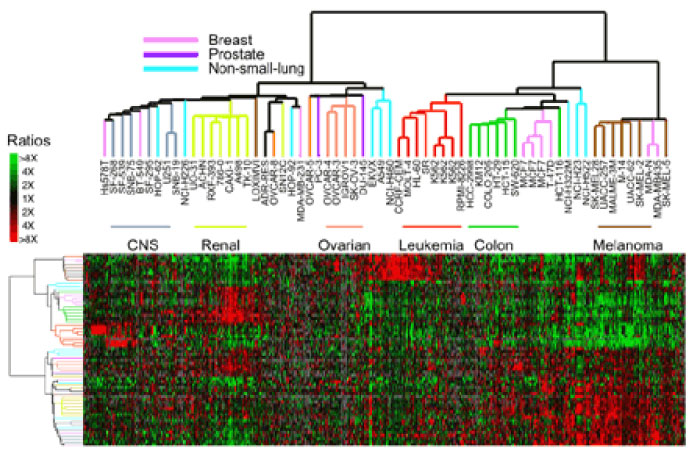
Well, right now we have the ability to take memory dumps and compare them, creating a kind of rudimentary trace log. This shoddy JPEG of a microarray displays one column per gene of interest. Brightness reflects gene expression level (red is low, green is high, grey is in between.) Each row is a separate set of conditions, such as progress through a stress response.
In plant biology, time of day has been used as the y-axis, by taking many different samples at different times. This was done in order to find the genes responsible for changing between photosynthesis and respiration, and created a very cool and nifty image (in one of my textbooks that I don't have readily available) of all sorts of repeated and dynamic patterns, only a tiny fraction of which we understand—but at least we can see them!
Getting a kernel debugger, though, would require the ability to stop time instantly in order to equivalate interrupts and traps. I don't think that's going to happen any time soon.
-
direct link to the paper
A Generation of Software Patents http://www.bu.edu/law/faculty/scholarship/workingpapers/2011.html
-
Re:What about Jaynes...
Unfortunately mere distribution doesn't take something out of copyright, only explicit assignment to the public domain can do that.. and even there are ways to claw it back into copyright, if any piece of the final product is a collaboration.
With regard to the brain, I agree that Bayesian inference can be a good phenomenological tool to model many complex behaviors, but it does not produce useful mechanistic predictions as to how real neural networks actually compute information. Also, Bayesian models have a very difficult time matching the single-event learning capability of the brain. See here (page 31;PDF) for a brief review in the context of motion processing or here (large pdf) for a more rigorous discussion.
-
Re:What about Jaynes...
Unfortunately mere distribution doesn't take something out of copyright, only explicit assignment to the public domain can do that.. and even there are ways to claw it back into copyright, if any piece of the final product is a collaboration.
With regard to the brain, I agree that Bayesian inference can be a good phenomenological tool to model many complex behaviors, but it does not produce useful mechanistic predictions as to how real neural networks actually compute information. Also, Bayesian models have a very difficult time matching the single-event learning capability of the brain. See here (page 31;PDF) for a brief review in the context of motion processing or here (large pdf) for a more rigorous discussion.
-
Re:Hmmmmm
I wrote a similar post below, but make a slightly different criticism. The difference between wet science and "hard" science boils down to one issue: non-linear recurrence (here is a nice history of the split between physics and psychology [big pdf]).
The theory of experimental errors (and all the derived statistics we use) separates errors into two components: systemic, and random error. The random error is by definition assumed to be uncorrelated between observations (sampling errors).
Random error actually contains another component: non-sampling errors, which are systemic errors that have not been identified. The "hard" sciences, since the Renaissance, has been a mostly successful project of identifying non-sampling errors and improving measurements. This was possible because the experimental mediums didn't change very much (the boiling temperature of water was the same for Galileo).
Doing the same thing in wet science is orders of magnitude more difficult, because biological organisms have memory, adapt and change the environment around them. So it's extremely difficult (likely impossible) to maintain a consistent experimental mediums for long periods of time. This in turn, means two very important things: 1) That the systemic errors change between replications of an experiment (asking Galileo "what is a planet?" and the current chair of the physics department at Padua will yield different answers) and 2) Early differences in random error can propagate through the system and become systemic error in later trials in the same setup (eg. Shaking hands causing slight differences in cellular distribution in the petri dish at the beginning of a growth cycle).
I'm not aware of any statistical methods that can be used to better classify the error in this type of environment. So you're left with changing the underlying distribution.. but to what (and for which protocols.. etc etc)?
While there are wet scientists who use statistics poorly, I think the bigger problem is that the statistical tools currently available are pretty wimpy. Econometrics is likely the most developed mathematical formulation for statistical analysis of non-linear recurrent systems. That's not a good thing.
-
Re:Just thought I would point out...
-
Not really true..
There is no significant difference in latency or duration for vertical vs. horizontal saccades (eg: see ), and you're dead wrong about reading speed: In English, the optimal column width for fast reading is somewhere between 50 and 100 characters per line, depending on exact circumstances.
However, there are two other relevant facts: 1) The lower visual hemifield has a larger cortical representation than the upper visual hemifield, and shows modest improvements in visual performance (this is unsurprising, since our hands/tools/ground near us is usually in our lower hemifield) and 2) We can move our head side-to-side more rapidly, and with a larger range of motion than we can up and down, which changes some saccade distributions.
Irregardless of the mechanics of the situation, reading is a highly trained activity, and direction of reading is not universal. Chinese, for instance, can be read top-to-bottom, or with either horizontal possibility as the initial direction, with the reader cued by slightly differing strokes and punctuation . I'm not aware of any bottom-to-top sequential reading in any culture, which is probably due to the above mentioned processing differences. However, there are also mixed reading sequences that use multiple horizontal and vertical elements in a single block, like Mayan hieroglyphs (2x2 blocks LR->TB within block, blocks are read TB->LR ) or the Korean Hangul system (variety of block sizes, read TB->RL). Arguably, the latter systems are most efficient in terms of leveraging the early geometry of the visual system (log-polar, with resolution dropping exponentially with distance from the fovea.
-
Re:Here be dragons
The problem is some things in the physical realm are not computable.
See
http://en.wikipedia.org/wiki/Event_horizon
http://physics.bu.edu/~duffy/py106/Radioactivity.html -
Re:The Advantage
Does that advantage extend to stealing money from rural areas so you can feel smug about your high-speed rail that no-one actually uses?
Yeah. Nobody would take high-speed rail. "In 2003, TGV carried its 1 billionth rider. This milestone marked an era with an average annual ridership of 45 million passengers—a stunning figure considering France’s population of 60 million." (source)
-
"Forced speech" - a First Amendment issue
A federal law compelling websites to be redesigned for defectives raises First Amendment issues. It's "forced speech".
In general, "forced speech" can be required in commercial contexts only. This has been litigated a few times with regard to the Internet and the ADA. OKBridge won on summary judgement; they don't have to make their online bridge site "accessible". (They did put in a large-type option, but you still have to be able to see the cards to play.) AOL settled with the National Federation for the Blind, and AOL made the next version of their client program more compatible with screen reader programs.
The Department of Justice recognizes this. In their notice of proposed rulemaking, they write "It is the Department's intention to regulate only governmental entities and public accommodations covered by the ADA that provide goods, services, programs, or activities to the public via Web sites on the Internet. Although some litigants have asserted that ``the Internet'' itself should be considered a place of public accommodation, the Department does not address this issue here. The Department believes that title III reaches the Web sites of entities that provide goods or services that fall within the 12 categories of ``public accommodations,'' as defined by the statute and regulations. Because the Department is focused on the goods and services of public accommodations that operate exclusively or through some type of presence on the Web--whether hosting their own Web site or participating in a host's Web site--the Department wishes to make clear the limited scope of its regulations. For example, the Department is considering proposing explicit regulatory language that makes clear that Web content created or posted by Web site users for personal, noncommercial use is not covered, even if that content is posted on the Web site of a public accommodation or a public entity."
Incidentally, the site doesn't give you the link to the docket for the proposed rule.
-
Russian hot air
Having lived for most of my life in the "east" under Communism, I am sure that this announcement is hot air...along the lines of nationalistic-pride type of goals that both the U.S. and USSR used to pump out on a regular basis during the cold war. Russia can barely keep up with paying their military bills; their nuclear subs are barely staying afloat and space program is not doing well; it's unthinkable that in this economic climate they will spend the kind of money required to accomplish this.
-
Re: reviving after freezing-impossible
Impossible is a big word-- temporize.
"Freezing essentially explodes the cell walls so there's nothing to revive."
Absolutely correct. The damage done in cryogenics happens at the start. It's likely not correctable going down the road with a few hundred years technology. Most substances reduce in volume when frozen/changed to a solid state, Water is a substance which expands on freezing..
The expansion upon freezing comes from the fact that water crystallizes into an open hexagonal form. This hexagonal lattice contains more space than the liquid state.is there no way to attack this problem, by either
1.expanding cell size to allow for the minute volume increase to not burst cells
2. replacing the water in the body with an exotic substitute
3. finding a different way to freeze the water in the cellsaccording to this http://polymer.bu.edu/hes/articles/ds03.pdf
which I get a really small fraction of - some really low temperature states of water exist that do not require water becoming a crystal, but rather a glass..so it's IMPOSSIBLE RIGHT NOW
-- it may yet be a way is found.... we''ve got what-- 1129 days left??? -
Re:Public Accommodation
AOL settled with the National Organization for the Blind on that one, agreeing to make their client more "accessible". That was in 2000, when AOL's web client mattered.
Target settled their online ADA lawsuit in 2008. But that was related to Target's having physical stores subject to the ADA, and the web site being related to the stores.
The ADA only applies to "commercial speech", where the intent is to sell. In the US, the First Amendment preempts the ADA for non-commercial speech by non-government parties. It would be "forced speech", prohibited by the First Amendment, to require "accessible content" for non-commerce web sites and for content delivered through non-monopoly-regulated channels.
Games aren't usually "commercial speech".
-
Re:fingerprinting
Yep, here's more from Boston University
A more fundamental problem is the lack of underlying statistical evidence. The use of genetic evidence provides a good comparison. Scientists and lawyers subjected the technique, developed in 1984 and first introduced into a U.S. court in 1987, to years of scientific scrutiny and almost a decade of court challenges before it became accepted evidence. In DNA analysis, examiners identify and compare short segments of DNA--generally 13--to make a match. In addition to having established procedures for analyzing evidence, experts have calculated the odds that two people could share the same DNA in all 13 segments. These odds vary slightly based on the prevalence of certain DNA patterns among different ethnic groups but are in the tens of millions to one against two people sharing all 13 segments.
Fingerprint examiners frequently tout the permanance and uniqueness of fingerprints, but they do not know the odds that two people could share a given number of fingerprint characteristic. With no clear rules for how much relevant weight to give to the various print characteristics, like point matches, ridge width, and the spacing of oil pores, German argues that it is impossible to attach probabilities to print identifications. Many experts believe probabilities are unnecessary since examiners would not make or confirm an identification unless they were certain of it. But when three of the most experienced FBI examiners confirm a mistake, as they did with Mayfield's prints, the argument collapses. Other print proponents argue that despite occasional human errors, the method is infallible. Critics like Simon Cole, a legal historian who has testified in many of the court challenges, rightly point out that this is a useless distinction--for whatever reason, fingerprint identifications are sometimes wrong.
The handful of studies of fingerprints show a troubling pattern of errors. Since 1995, Collaborative Testing Services, a company that evaluates the reliability and performance of fingerprint labs, has administered an annual and voluntary test. It sends fingerprint labs a test that includes eight to twelve pairs of prints that examiners confirm or reject as matches. The pairs usually consist of complete, not partial prints, making identifications easier than the real situations examiners face. Nevertheless the error rate has varied from 3% to a dismal 20%.
-
Boston University BU Linux
Boston University has its own brand of Linux, CentOS based. It's somewhat behind vanilla Ubuntu in stable versions, but decent. I don't know how they support laptops and dorms, but I would be surprised if they are not agnostic.
-
Re:Education shouldn't be for profit anyway
Mod this up. Having seen it first hand, I know that some universities cost more simply because they've built up facilities and infrastructure to kill for.
-
Re:Education shouldn't be for profit anyway
Mod this up. Having seen it first hand, I know that some universities cost more simply because they've built up facilities and infrastructure to kill for.
-
Re:Education shouldn't be for profit anyway
Mod this up. Having seen it first hand, I know that some universities cost more simply because they've built up facilities and infrastructure to kill for.
-
Re:Lame Gov
And where is the incentive to create new medications?
To sell them.
You know there are no patents protecting farmer Blake from growing carrots simply because farmer Adams grows them already yet somehow they both manage to grow crops and profit. They call it capitalism. What stops anyone from growing carrots in their yard, nothing, except the farmers skill (versus your own) and economies of scale.
The barrier of entry for pharma is a lot higher and so potential profits are too.
From a 2001 study (I'm sure things haven't changed that much here), http://dcc2.bumc.bu.edu/hs/sager/pdfs/020402/Pharmaceutical%20Marketing%20and%20Research%20Spending%20APHA%2021%20Oct%2001.pdf :
"Last year, a colleague looked at annual reports of six of the biggest drug makers,
and found that just 11 percent of revenues went for R&D in those firms. [...]
Thatâ(TM)s far below the 18.5-20.0 percent levels that the industry says it devotes to
R&D."Elsewhere "31 percent [of revenue] went for marketing and administration." and it's noted that a 1950s senate study reported 4 times the revenue spent on marketing as on R&D.
I don't actually promote negation of drug patents. The 5 years or so of drug trials are the major hurdle. I think a term of license + 5 years (or so) or for compatibility a fixed patent term across all technologies of 10 years from registration is plenty.
Pharma's don't spend a lot on R&D compared to the gain they get in profit (about equal to the R&D figures) the patent deal is too cheap for them IMO.
-
The type of multithreaded design used is what
Look up the term "race condition" here -> http://en.wikipedia.org/wiki/Race_condition , & you'll get an idea of what the "problems inherent" are - I feel the same as you do though, as long as I keep 1 thread doing 1 task, & another thread of execution doing another (albeit, on 2 diff./discrete sets of data, not working on the SAME set of data) - this is known as "coarse multithreading" (keeping multiple threads of execution off the same dataset) vs. "fine multithreading" (see here for more on that -> http://www.cs.bu.edu/~best/courses/cs551/lectures/lecture-02.html ) where the multiple threads of execution work on the same data involved.
(Bit of an "oversimplification" on my part possibly, but the broad strokes are there - the 'finer points' with examples are on those pages from the URL's above I posted)
APK
-
Help! Foreign US PhDs stuck in India over H1B!
I am so glad that this news is FINALLY hitting the circuit. I have a PhD from the US and have been stuck in India for almost 3 months waiting for a visa stamp on an *approved* H1-B petition.
Me and MANY others (US-eductated Indian born scientists) have been stuck in India for more than 3 months. All of us have excellent jobs at National Labs, Universities, and Research Labs.
Discussion forum for PhDs stuck awaiting Visas on approved petitions
Our visas were "conditionally accepted", pending a Security review, since we work in fields which fall under the Technology Alert List.
The problem? The security review is a process without any end date. All our inquiries are being rebuffed by the Department of State saying that this process is critical to National Security.
Excuse me? We have lived in United States for more then 5 years (min. required for a PhD). Just because we came back to India during the Christmas holidays, we are a National security risk? That is just sooo ridiculous. Some folks (as you will read on the forum) have LOST THEIR JOBS!
The topic of the story should really read "United States driving out Foreign born US-educated Scientists". That is what is happening on the ground here. I cannot believe it, its surreal to me.