Slashdot Mirror
Domain: cbo.gov
Stories and comments across the archive that link to cbo.gov.
Comments · 372
-
Re:Trump owns it
Where [SIC] you upset with the ACA passing because of it's obvious costs? What about the QE1, QE2, QE3, and QEForever spending? Any of that bother you?
CBO and JCT estimate that enacting both pieces of legislation—H.R. 3590 and the reconciliation proposal—would produce a net reduction in federal deficits of $143 billion over the 2010–2019 period as result of changes in direct spending and revenues
-
By 2030 90% Americans will have no wealth
50% have no wealth now! Using data from Congressional Budget Office study and doing a polynomial regression shows who got rich and who did not.
-
Tariffs go to the Governments
In a trade war both sides raise taxes/tariffs. These, at least in the US are collected by the Treasury and go into the general fund.
So:
* Citizens purchasing foreign goods pay more (tariff is a tax)
* Companies importing raw materials (for example, steel and aluminum) pay more (tariff is a tax), and will have to charge more for products (indirect tax)The goal of course is to move manufacturing into the US.
But wage disparities cripple this in many cases. We could probably handle things like chip manufacturing competitively, but putting things together via humans is far more expensive in the US. Maybe robots are the answer (they are).
The problem to me is timing. It takes a long time to move the product and processes the tariffs are targeting. And raw materials? Wage disparity again.
Anyway, the tariffs are just a way to increase Federal income, from March through July it was about $1.4 billion from steel and aluminum:
https://www.cnbc.com/2018/08/1...And per the Congressional Budget Office's Monthly Budget Review, "Other Income" was up by $1 billion (includes tariffs), about 1%. Corporate taxes dropped by $92 billion, about 31%.
https://www.cbo.gov/system/fil...
Anyway, corporate tax rate drop was a gift to the already wealthy ($92 billion!) and the tariffs are a tax on the citizens and revenue for the Federal government.
-
Re:Sounds like an excellent reason...
Cutting our military budget by 90% would put us down near Ghana and Nigeria. U.S. military spending is huge simply because the U.S. economy is huge.
Calls to slash military spending made sense in the 1950s and 1960s. But currently it's just slightly above the world average. If you account for Japan and NATO (whom we're obligated to defend by treaty), it's pretty much at the world average.
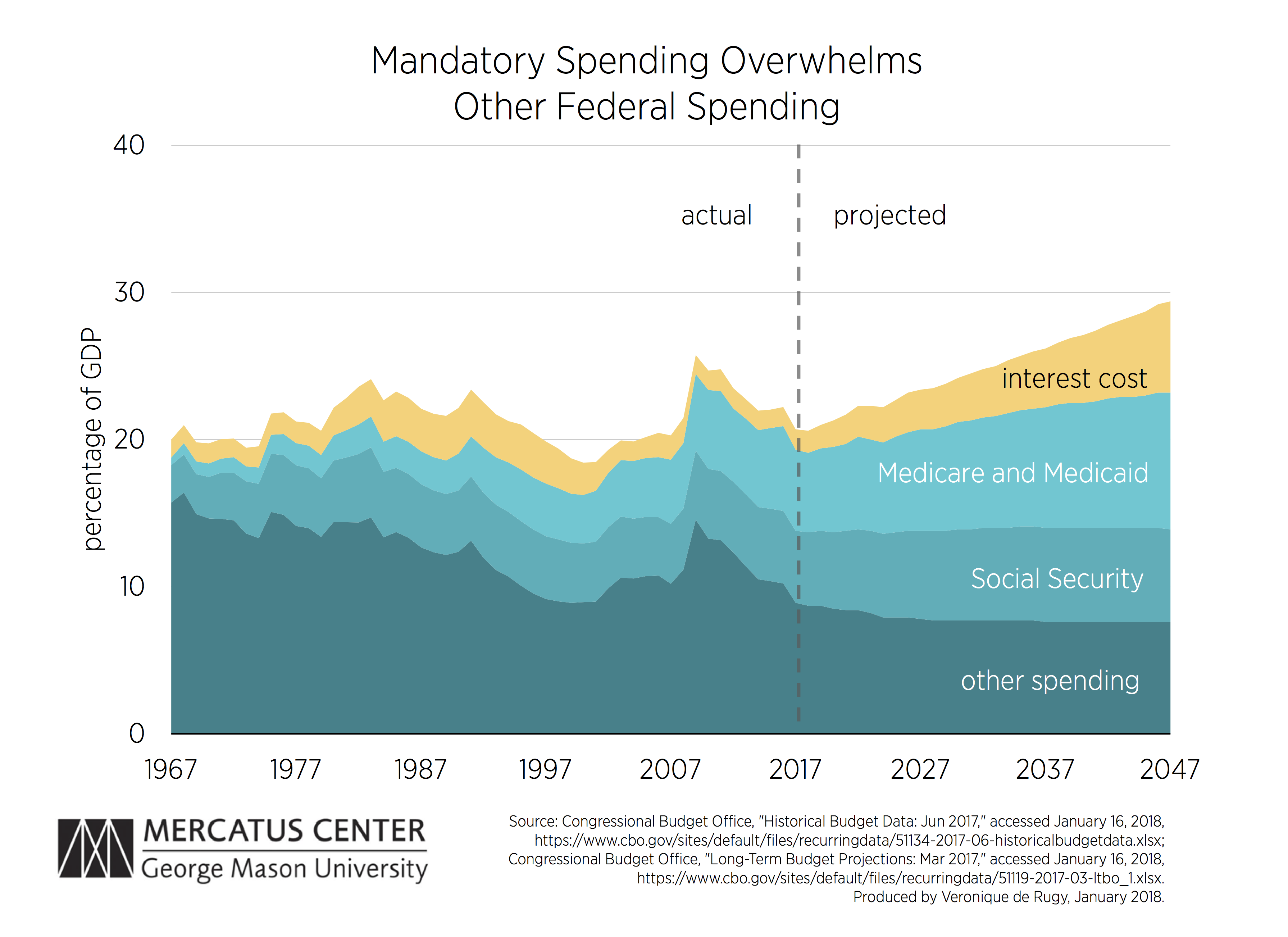
BTW, the biggest budget items are Social Security, and Medicare/Medicaid. They're the programs whose growth is bursting our budget, and what we need to get under control if you want to pay for everyone to go to college. Even if you completely eliminated 100% of military spending, entitlement growth in the next 20 years or so would eat up all that savings. Like it has already eaten up the savings from cutting the military budget from the 1950s/1960s.
I highly recommend you read the CBO long-term budget projections to understand what exactly is causing excessive growth in government spending. -
Re:Ford and the Fed
Tax revenue initially fell after Bush's tax cut, but picked up again after the tech bubble-caused recession. Same for the housing bubble - tax revenue fell during the recession, but returned to historical levels post-recession. In other words, the tax cuts didn't cause the growing deficits and debt.
It's increased spending which is causing the growing deficits. Primarily growth in Social Security, Medicare, and other health programs. Spending on other programs - even defense - has been falling. So Social Security, Medicare, and other health programs are what we need to rein in if we want to get the budget under control. Unfortunately, those are the programs Democrats consider sacrosanct and refuse to allow us to modify.
I'll also point out that the flip side of the stimulus spending under Obama to jump-start the economy, is that once the economy gets going again you reduce spending to below historical levels. Basically government spending should act as a stabilizer, 180 degrees out of phase with the economy (stimulating the economy when it's poor, slowing it down when it's good to prevent it from overheating) The government saves up during good times, so it has a piggy back it can use to spend during bad times.. I agreed that stimulus spending was the correct thing to do after the housing bubble, but opposed it because I knew the second half (reduced spending) would never happen. Leaving us further mired in debt (which went from about 60% of GDP to over 100% under Obama). Unless we get that debt reduced, the only thing saving us right now is the low interest rates. If those go up, the interest on the debt will balloon and begin to dominate the budget. -
Re:Ford and the Fed
Tax revenue initially fell after Bush's tax cut, but picked up again after the tech bubble-caused recession. Same for the housing bubble - tax revenue fell during the recession, but returned to historical levels post-recession. In other words, the tax cuts didn't cause the growing deficits and debt.
It's increased spending which is causing the growing deficits. Primarily growth in Social Security, Medicare, and other health programs. Spending on other programs - even defense - has been falling. So Social Security, Medicare, and other health programs are what we need to rein in if we want to get the budget under control. Unfortunately, those are the programs Democrats consider sacrosanct and refuse to allow us to modify.
I'll also point out that the flip side of the stimulus spending under Obama to jump-start the economy, is that once the economy gets going again you reduce spending to below historical levels. Basically government spending should act as a stabilizer, 180 degrees out of phase with the economy (stimulating the economy when it's poor, slowing it down when it's good to prevent it from overheating) The government saves up during good times, so it has a piggy back it can use to spend during bad times.. I agreed that stimulus spending was the correct thing to do after the housing bubble, but opposed it because I knew the second half (reduced spending) would never happen. Leaving us further mired in debt (which went from about 60% of GDP to over 100% under Obama). Unless we get that debt reduced, the only thing saving us right now is the low interest rates. If those go up, the interest on the debt will balloon and begin to dominate the budget. -
Re:Finally...
Not really, just laying the ground work for pointing out that the Republicans are on track to match Obama.
I see why you posted AC then because you are doing it wrong.
Obama took the debt from 10 Trillion to 19 Trillion. For Trump to do as badly he would have to hit 38 Trillion.
Seeing as we are talking about projections, as a percentage of GDP the CBO has projected that Trump won't come close to matching Obama in debt spending
https://www.cbo.gov/publicatio...
Say what you want about Obama but he never bankrupted a casino. To quote Jim Jefferies, if somebody gave you a casino, and you spent a every day for a year at the bar drunk as a skunk and your nights in your room sleeping with hookers and the staff robbed you blind, at the end of the year, you'd still turn a profit. It takes a truly spectacular kind of moron to bankrupt not one, not two, not three, not four, not five but a grand total of six Hotels/Casinos. You can keep trying to convince us that Trump is anything other America's Yeltsin but you're trying to polish a really big, wet and mushy turd.
You really are a deranged puppy aren't you ? I said you were defensive when you were hiding behind being an AC but I had no idea.
The only reason I posted AC because I didn't want to lose too much karma to being down modded by a bunch of Trumpkins. As for Trump's deficits that report dates to a time before Trump was even sworn in. Remarkably enough, despite this those charts are projecting deficits that exceed the historic deficit average for entire duration of presidency Trump's which seems remarkably prescient since so far Trump's plans for well over 2 trillions in deficits during the first two years of his first term put him on par with Obama in terms of debt generation. At least, as your graph shows, Obama managed to reduce the annual deficits year over year until they were under the historic average in 2015. Oh, and Obama still didn't bankrupt six Casinos like Trump that greatest business genius of all time did whatever your Trump cool-aid induced alternative facts are telling you.
-
Re:Finally...
Not really, just laying the ground work for pointing out that the Republicans are on track to match Obama.
I see why you posted AC then because you are doing it wrong.
Obama took the debt from 10 Trillion to 19 Trillion. For Trump to do as badly he would have to hit 38 Trillion.
Seeing as we are talking about projections, as a percentage of GDP the CBO has projected that Trump won't come close to matching Obama in debt spending
https://www.cbo.gov/publicatio...
Say what you want about Obama but he never bankrupted a casino. To quote Jim Jefferies, if somebody gave you a casino, and you spent a every day for a year at the bar drunk as a skunk and your nights in your room sleeping with hookers and the staff robbed you blind, at the end of the year, you'd still turn a profit. It takes a truly spectacular kind of moron to bankrupt not one, not two, not three, not four, not five but a grand total of six Hotels/Casinos. You can keep trying to convince us that Trump is anything other America's Yeltsin but you're trying to polish a really big, wet and mushy turd.
You really are a deranged puppy aren't you ? I said you were defensive when you were hiding behind being an AC but I had no idea.
-
Re: Occam's Razor
I like how you totally skip over the stated fact of how many would be uninsured.
No, I made fun of your naivite.
First, note that the CBO scored 26 million or 32 million in 2026, not 60 million, and only under the assumption that the market will not provide insurance for those people.
First, that's 32 million additional uninsured, added to the current 28 million, and gee, I don't know, basic math comes out to 60M.
Since the market didn't provide them insurance before ACA and was actively working to deny coverage to an increasing percentage of people applying, what makes you think it would miraculously now start providing insurance for those people?
What the CBO actually is saying is that 18 million people would choose not to get health insurance through ACA in 2018. Democrats are up in arms about it because it exposes how many people are actually being screwed by the ACA. In later years, the falling enrollment will cause insurers to withdraw from the market, which exposes the fiscal irresponsibility of the ACA and the unjust burden it imposes on healthy people. The only rational solution for pre-existing conditions is for government to pick up the tab one way or another.
People not being insured under the ACA doesn't mean they become "uninsured". There are already alternatives for medical coverage and services, and with a repeal of the coverage mandate, there would be a huge market for people like me for alternative forms of coverage.
You have bought the anti ACA arguments hook line and sinker. And yes, not being insured under ACA means they're "uninsured". You are counted as being insured if you're covered by, wait for it, "insurance". There is no alternative form of coverage.
-
Re: Occam's Razor
I like how you totally skip over the stated fact of how many would be uninsured.
No, I made fun of your naivite.
First, note that the CBO scored 26 million or 32 million in 2026, not 60 million, and only under the assumption that the market will not provide insurance for those people.
What the CBO actually is saying is that 18 million people would choose not to get health insurance through ACA in 2018. Democrats are up in arms about it because it exposes how many people are actually being screwed by the ACA. In later years, the falling enrollment will cause insurers to withdraw from the market, which exposes the fiscal irresponsibility of the ACA and the unjust burden it imposes on healthy people. The only rational solution for pre-existing conditions is for government to pick up the tab one way or another.
People not being insured under the ACA doesn't mean they become "uninsured". There are already alternatives for medical coverage and services, and with a repeal of the coverage mandate, there would be a huge market for people like me for alternative forms of coverage.
-
Re:Eisenhower's Farewell Address
The health care number you provide is not relevant to this discussion.
For analysis, we need to carve out all non-government expenditures.
Your value includes the private sector, while the tanker drone cost is taxpayer-supported.
A more realistic number for governmental health care expenditure is $1,040 billion.
PROJECTIONS FOR MAJOR HEALTH CARE PROGRAMS FOR FY 2018
(As of April 1, 2018 )MEDICARE (Net of Offsetting Receipts)
583 BillionMEDICAID
383 BillionHEALTH INSURANCE SUBSIDIES AND RELATED SPENDING
$58 BillionCHILDREN’S HEALTH INSURANCE PROGRAM
$16 Billion -
Re:Eisenhower's Farewell Address
"Let's do the math." ~ Sheldon to Leonard's mother, The Big Bang Theory
MEDICARE (Net of Offsetting Receipts): 583
MEDICAID: 383
HEALTH INSURANCE SUBSIDIES AND RELATED SPENDING: 58
CHILDREN’S HEALTH INSURANCE PROGRAM: 16Total: 1040
13/1040=.0125 or 1.25%.
1.25% additional healthcare expenditure could be provided with the taxpayers $13 Billion slated for the Navy's Carrier-Launched Tanker Drone.
-
Re:And that way, you never will.
Do.... people in Germany really care about how NewYorkers and Midwesterners get to work?
People drive in the US because it's fast, cheap, simple, and convenient.
People also use public transportation because it's... faster, cheaper, simpler, and more convenient.
Dear god, just PARKING in NY you have to pay out the ass. You're rich or dumb to own a car in a big city. And... I imagine the same is true for backwater Barvaria. Do they have subway systems through-out German farmland?
Europe has a better rail system. Many European cities have better mass transit. America has decent mass transit in the bigger cities. Atlanta and LA traffic can go fuck themselves. In a lot of not-major-cities, if you're poor, you take the bus and walk the last 5 blocks. I hear Europe's buses aren't quite as low-class.
the [german] government deliberate makes it expensive to drive. And the German government subsidizes the kind of transportation that the intellectual and political elite in Germany prefers, which is why public transit is excellent near political power centers and universities.
Right, and in the USA we subsidize the oil&gas corporations to the tune of $4.6 Billion/year because they have our economy by the balls. (And they would even if we did make our cities more mass-transity and make passenger-rail more viable, we're just more spread out. Cars and trucks are simply more viable here, fundamentally). Hence, average gas prices here are US$2.81/gal while it's US$5.57/gal in Frankfurt. For a fungible resource that gets shipped globally, there's obviously market-fuckery going on. But you don't see anyone in power, conservatives or libertarians (pft, as if libertarians got into power) alike ever crying about letting the free market decide. So the cost of road upkeep is socialized in the USA, while gas tax pays for the roads in Germany.
-
Re:Since we're quoting Bernie
Earning over $200k and the US is ranked 4th in the world. Earning over $10k and it's ranked 24th. By the way, Taiwan is 15th.
Yes, and if you're, say, a single mother and earn $0/year you still $20000 in disposable income in the US. That income is close to the median income for a single person in Germany. How about that?
The US is great if you are really wealthy, but if you are not then it's much much worse.
Having come to the US with nothing, that's not my experience. I'd rather be poor in the US than be poor anywhere in Europe.
-
Re:needed for what?
Under current systems if you start earning money you lose benefits (because they're not universal) so you end up worse off than if you didn't work.
As you can see from the CBO graph., when you earn no money, you receive about $16000 in benefits and you don't "lose benefits if you start earning money". There are some small discontinuities at higher incomes, but they are pretty easy to fix. Why do you feel compelled to chime in on US policies when you don't know how things work in the US?
The idea with UBI is you get it whether or not you work so working will always leave you better off.
The real way to incentivize people to work is to give people who are capable of working but choose not to no welfare benefits at all, the exact opposite of a UBI.
-
Re:In other words...
We never had a surplus. The national debt has increased every year since 1957.
That's an interesting chart.
Thank you! Many people don't look at the actual data of our national bank balance, so to speak...
Actually, no. You seem to have missed the words "Includes legal tender notes, gold and silver certificates, etc."
The debt on that page can increase when the government prints more money.
Only if that money is put into circulation, either in an attempt to stimulate the economy (Government literally giving money away via zero interest loans), or spent (Government buying goods and services). Print all you want, until it's handed over it's not debt.
An analogy would be that you have $10,000 in your bank account. If you write a $1,000,000 check, you are NOT overdrawn until you hand that check over to someone else. Then that printed money - written check - has become an actual liability that you must honor.
According to the Congressional Budget Office there were real surpluses in the years 1969, and 1998-2001.
No, according to the CBO, there were real BUDGET surpluses, which only counts the on-budget spending. For example, the Federal Government does not consider spending on Social Security, the US Postal Service, Freddie Mac/Fannie Mae, and several other large ticket items as "on budget". So you can keep the rest of spending just under budget, but blow trillions on these via borrowing - and still be, per the CBO, under budget and in surplus.
This would be akin to you having a $10,000/month take-home pay. You spend $9,000 per month on food, utilities, travel, clothing. You spend $3,000 per month on housing, and you spend $2,000 per month on your IRA/401K. Your total spending is $14,000 - with only $10,000 income. BUT, because you consider housing and your IRA/401K not "on budget", you actually ran a surplus! Never mind that your actual net worth dropped by $4,000 (you accumulated $4,000 of debt - excess spending relative to income). You were below your budget on the other things you want to put into your budget, so you're all good.
-
Re:In other words...
We never had a surplus. The national debt has increased every year since 1957.
That's an interesting chart.
The only way for the debt to increase is to spend more than was brought in.
Actually, no. You seem to have missed the words "Includes legal tender notes, gold and silver certificates, etc."
The debt on that page can increase when the government prints more money.
The "surplus" was in name only, because it only dealt with some of the spending of the Federal Government. But we haven't had a surplus since 1957, back when Ike was rolling out the Interstate highway system.
According to the Congressional Budget Office there were real surpluses in the years 1969, and 1998-2001. You'll have to go to Historical Budget Data and open some Excel files to see the actual numbers, but if you do you will see that the debt held by the public decreased in each of those years.
However, that's neither here nor there. Quibbling over the exact numbers doesn't change the fact that Bill Clinton (and a Republican congress) either generated a surplus, or brought America as close as it has been since 1957. But in either case, George W. Bush (and a Republican congress) turned it into the largest deficits in America's history, through a combination of new spending, tax cuts and a disastrous recession.
-
Re:Free stuff for poor people + No Borders
The top 1% pay 27% of taxes now, compared to 15% in 1979 when tax rates were higher. Meanwhile their share of income has increased from 9% to 18%
http://www.factcheck.org/2008/...
And the top 10% pay 72.7% of income taxes and 54.7% of all Federal taxrs. E.g. see page 7 here.
https://cbo.gov/sites/default/...
The top 20%, i.e. highest quintile, pay 86.3% of all income tax and 68.7% of all Federal taxes.
On the previous page you can see how the effective tax rate rises with income quintile, i.e. from 4% to 25%.
So how are the rich, at least the ones who remain, not paying their fair share?
And of course given that it's highly rational for people who are US taxpayers to stop being US tax payers by giving up citizenship. And for people who aren't US taxpayers to avoid become US taxpayers at all cost.
I.e. in general the US's progressive tax system is an incentive for rich people to avoid becoming US citizens or lose that citizenship if they have it.
Meanwhile the US benefits system, sloppy enforcement of immigration rules and easy availability of fake Social Security Numbers to allow illegal immigrants to claim benefits.
That's the problem with the left. Their intentions are good but they don't understand incentives. And if you get incentives wrong you won't get the result you want. See for example South American countries who ended up dirt poor despite electing politicians who had similarly good intentions to help the poor and tax the rich. And the end result was that you have countries like Venezuela and Cuba that would be pretty rich under a government that was only as bad as the US one. Actually the government is far worse and those countries are so poor people flee them for pretty much anywhere else.
-
Well duh
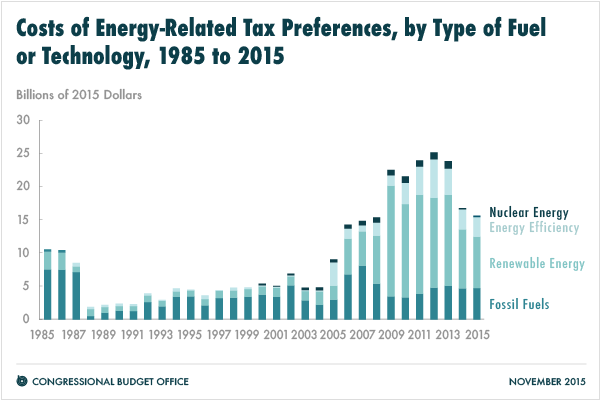
Federal tax subsidies for renewables exploded starting in 2006. Of course any projections made in 2006 based on extrapolating 2000-2005 subsidy levels would be inaccurate.
For solar in particular, it got just $174 million in subsidies in 2007. By 2010 it got $1.1 billion. And in 2013 it received $5.3 billion. Or to put it as TFA does, it received 3046% more in subsidies in 2013 than it did in 2007.
You increase subsidies by 30x over 7 years, the story would've been if growth hadn't increase by more than 40x over 10 years. -
Re:Also ordering Amazon to pay €250m ($293m)
Yeah, that's EU logic for you! Amazon comes to Luxembourg, and Luxembourg says "pay us this much tax to be in our country". Amazon does so. Brussels doesn't agree, and then says to Amazon "you have to pay US more, since Luxembourg gave you a deal we don't like". Why isn't Luxembourg on the hook? They are the ones who made the deal and had the power of taxation over Amazon... I suspect the answer lies in the EU being jealous of the success of the US companies, even though they pay a higher tax rate for earnings in their home country than all the EU except for Great Britain...
-
Re:Draining the middle class, nothing new.
You liberals live in a bubble. The ultra rich live off of investments yes, but the top 10, 5, and 1 percentage income earners pay the way for everyone else. https://www.cbo.gov/publicatio...
-
Re:Lefties hate this tax too
forever avoiding the 'common defense' part
About one-sixth of federal spending goes to national defense. The US accounts for around 1/3 of all military spending on planet earth, and more than the next 7-8 countries combined, depending on how you count.
I'd love to avoid some of that. Then maybe there would be something in the budget for infrastructure and health care. Instead of spending money on things that build the economy (healthy workers; roads, bridges, bike lanes and fibre broadband to the home for them to get to work or transport the result of work), we build up and arm enemies and build weapons with which to blow them up.
-
Re:Uh Oh...
And you obviously don't realize that this is the planet Earth, where shit happens. A small likelihood, over time, grows into a near certainty.
And your numbers are off. Stop making up shit when it's so easy to go to the CBO and get the facts:
CBO and JCT estimate that, in 2018, 15 million more people would be uninsured under this legislation than under current law—primarily because the penalty for not having insurance would be eliminated. The increase in the number of uninsured people relative to the number projected under current law would reach 19 million in 2020 and 22 million in 2026. In later years, other changes in the legislation—lower spending on Medicaid and substantially smaller average subsidies for coverage in the nongroup market—would also lead to increases in the number of people without health insurance. By 2026, among people under age 65, enrollment in Medicaid would fall by about 16 percent and an estimated 49 million people would be uninsured, compared with 28 million who would lack insurance that year under current law.
That's 5 million less. And many of those 15 million are going to wish they had health care insurance, especially with the 6-month penalty if they sign up for coverage, and the pre-existing conditions waivers. The reason for insurance is to spread the risk pool, because it's guaranteed that some will need it, and there is no way to predict it.
And the effect will vary by state:
In the agencies’ assessment, a small fraction of the population resides in areas in which—because of this legislation, at least for some of the years after 2019—no insurers would participate in the nongroup market or insurance would be offered only with very high premiums. Some sparsely populated areas might have no nongroup insurance offered because the reductions in subsidies would lead fewer people to decide to purchase insurance—and markets with few purchasers are less profitable for insurers. Insurance covering certain services would become more expensive—in some cases, extremely expensive—in some areas because the scope of the EHBs would be narrowed through waivers affecting close to half the population, CBO and JCT expect. In addition, the agencies anticipate that all insurance in the nongroup market would become very expensive for at least a short period of time for a small fraction of the population residing in areas in which states’ implementation of waivers with major changes caused market disruption.
The areas with the poorest people will have the fewest purchasers. That means some areas will not have nongroup insurance at any price.
Under this legislation, starting in 2020, the premium for a silver plan would typically be a relatively high percentage of income for low-income people. The deductible for a plan with an actuarial value of 58 percent would be a significantly higher percentage of income—also making such a plan unattractive, but for a different reason. As a result, despite being eligible for premium tax credits, few low-income people would purchase any plan, CBO and JCT estimate.
And how about a new lifetime cap?
Out-of-pocket spending would also be affected for the people—close to half the population, CBO and JCT expect—living in states modifying the EHBs using waivers. People who used services or benefits no longer included in the EHBs would experience substantial increases in supplemental premiums or out-of-pocket spending on health care, or would choose to forgo the services. Moreover, the ACA’s ban on annual and lifetime limits on covered benefits would no longer apply to health benefits not defined as essential in a state. As a result, for some benefits that might be removed from a state’s definition of EHBs but that might not be excluded from insurance coverage altogether, some enrollees could see large increases in out-of-pocket spending because annual or lifetime limits would be allowed.
-
Re:Let's focus on the trivial
Here, take a look at this chart - it's from the CBO, and all numbers on it are relative to GDP.
The military is 11% of the GDP but 30% of revenue.
See above chart - "Defense" is $582BN, which is 3.3% of GDP, but represents 18% of the $3.2T Revenue the government collects - I'd love to see where you came up with "30% of revenue"...
"Defense" accounts for 15% of the federal budget.
-
No surprise: US still in recession
Salaries suck, because the US is still in a recession. With real unemployment well over 20%, comparable to economic powerhouses like Greece, Croatia and Botswana, it's no surprise that salaries are declining. Add in inflation, and they are declining even faster.
There is one overriding reason for the continuing recession: debt. Federal debt in the US is out of control - plus up to $200 trillion of unfunded obligations that everyone is carefully ignoring. If we also ignore those invisible (but inevitable) obligations, the US is still one of the top 20 most indebted nations.
Keynesian economics have been thoroughly debunked. Actually, there was never any evidence that they might be correct. But politicians love them, because they provide an excuse to buy votes by spending other people's money. All of this debt has been built up with promises that never would be fulfilled. But the politicians making those promises are now mostly millionaires, so that's ok.
What cannot go on forever will stop. Debt cannot be infinitely piled on, and countries like the US are reaching the limits of their ability to sell more debt. When this stops, the stopping is likely to be abrupt and unpleasant.
-
Re:Squandered
Yes, so far this fiscal year (since October 1, 2015), the Federal Government has spent $1.22 TRILLION more than it brought in.
According to the CBO, they're anticipating a deficit of about 534 billion for FY 2016. That means one of you is wrong.
So yeah, 20% of the real deficit (spending in excess of revenues) was wasted on a war, 80% was wasted on other things.
Wasted is a value judgment. It's one thing to say the wars in the Middle East were wasteful, but if you want to say 100% of the federal government's spending is waste, well, then you might as well adopt the anarchist banner.
The biggest chunk BY FAR, the overwhelming supermajority of Federal spending is on social wealth transfers, not the military or other spending items.
That'd be a less disingenuous argument if not for the fact that Social Security was largely derived from contributions to it, and if Medicare/Medicaid was not payments to the health industry.
The people who get rich off Medicare/Medicaid are the ones like Rick Scott.
-
Re: Shell games and double talk
Read the link I provided. It will show you that fuel taxes from cars are a net income relative to spending on highways. It's funding of passenger trains (more than just AMTRAK - there are Federal subsidies for commuter/light rail), buses and to a much lesser extent, airplanes. That's the point. But it doesn't fit your pre-determined conclusions (we need more taxes!) so...
No, read the link I provided. You claimed "transportation spending is overwhelmingly going to public transport" which the link I provided indicates is doubtful, since the spending on mass transit is 65 billion, while the total highway spending is 165 billion. Add the rest? Ok, Aviation is 36 billion. Rail is 3 billion. Water is 10 billion. So we have 165 billion versus 114 billion. They simply are not spending overwhelmingly on public transportation. Sorry, but your claim is just not supported. We don't even have to worry about the federal/state breakdown, or the revenues, though that would offer further information if we wanted to look those up. Just as examining the actual costs of maintaining the desired level of transportation infrastructure would offer us more information. Or even the effects of more fuel efficient vehicles, including electric ones. But that's a matter for another day, I'm addressing your unsustainable claim.
You are the one with an agenda to push, whatever it may be, if you want to do that in an actually effective manner, I simply suggest you refrain from making up unsupported conjectures, when they are so readily disproved. You can make a much better case if you do not willfully destroy your own credibility in your own haste to push your preferred narrative.
I would respect you having a clearly stated position on transportation spending and the tax system by which you wish to fund it. I have disdain for your proclivity to make statements that tend to be unsupported by the actual facts. You are doing yourself a disfavor, harming your own position.
-
Re: Shell games and double talk
Yes, because transportation spending is overwhelmingly going to public transport (NOT a Federal issue) and AMTRAK/rail. It is not going back to the source of the income. Get rid of those expenses and you'd find more than enough money to maintain roads.
Amtrak has received under 2 billion dollars from the Federal government each year for the past few years, and that is less than the transfers from the General Fund to the Highway Trust Fund which is also on that page. So even if those funds for Amtrak are going through the Highway Trust fund, they can't be overwhelming. And if they're not funded through that fund, then bringing them up is even more irrelevant.
Spending on "public transport" is too nebulous a term to find information that is definitive on it, let alone discuss whether or not it is a "federal issue", though that is a separate discussion that would distract from the matter at hand anyway, so let's not bother. Nonetheless, given that your assertion about Amtrak is not sustained, and your prior track record of supplying an out-of-date by over a decade source, I cannot take your word as credible.
The CBO, however indicates that public spending (from all sources, federal, state and local), on highways is 165 billion, with mass transit receiving less than half of that. This is not focusing on the revenue streams (though you should note that Federal spending is not the majority anyway, and you haven't shown how much states collect from their own taxes, which complicates the analysis even more since their rates vary considerably, as does the share of local spending from cities and counties), but it does show that your contention that "transportation spending is overwhelmingly going to public transport" is not supported, since the largest share is, in fact, to highways, then the second is to water-related infrastructure. Sorry, but a distant third is not overwhelming.
And you should especially consider that this is not discussing the current state of expenses for maintaining the roads, merely addressing the current spending. It is possible that that current spending in the US on transportation infrastructure is far less than it properly needs to be anyway. So it could be that the best result for transportation investments would easily be far in excess of the current revenues from fuel taxes anyway, regardless of any diversions you might make from current spending. (And let's not forget, transportation investments are supposed to enrich us all, that is their purpose, isn't it?)
I'm sorry, but your assertions just don't seem to be supportable.
I think you are getting too caught up in your need to craft a story, that you are not paying careful enough attention to what you are saying being accurate. Or even meaningful. As I already said to you, really, if you wanted to have a discussion on the preferred taxation method you wanted, you could do so, but offering false contentions is a silly waste of time.
Why not just skip that? Say how you want to do things on their own merits, make an argument without going into unsupported facts.
-
Re:Crap like this
is why I'd like to see a return to the old tax rates from the 50s,60s and 70s before "Reganomics" took hold.
This is a classic case of cargo cult economics. There are several deep problems with this outlook. First, the prosperity of the past had nothing to do with the tax rate. Second, the problems of today have nothing to do with the tax rate. Third, most of the rich never had to pay that tax rate. And fourth, this is a brazen case of envy which completely disregards the harm it would cause and should have no place in economic policies that affect hundreds of millions of people.
So let's start with the first point. The prosperity of the US was generated by a combination of several factors, such as a mostly free society of well over a hundred million people and economy, being the only major power after the Second World War which didn't have to rebuild its economy, and massive industrial and commercial base. Why are we to assume that the tax rate on the highest tax bracket is more relevant than having a huge economic base, for example?
When someone proposes a one-size-fits-all policy like this as a cure-all, they implicitly are assuming that the policy is more important than any other economic factor. I note elsewhere that a replier which claimed a correlation between cutting that tax rate and "stock market bubbles" fails hard in assuming that there was an actual correlation between the tax rate and recessions (which relatively speaking are more serious problems than stock market bubbles),
Second, there is this assumption that the current problems of the US are due to the much lower tax rate of the highest tax bracket. This completely ignores globalization and the fact that US workers compete with billions of workers who can often do the same job for a small fraction of the cost. Increasing the tax rate on the highest income bracket isn't going to make those billions of workers disappear and magically duplicate the unique economic conditions of an era that is now firmly in the past. That fantasy of replicating some irrelevant or even harmful aspect to generate prosperity is what makes this cargo cult economics.
Then there's the issue of the wealthy not paying those exorbitant tax rates.You may have heard of "tax loopholes". There were plenty during this era of high tax rates. This resulted in the extremely wealthy not actually having a huge difference in the effective tax they paid from the past to the present. For example, this letter cites a change for the 0.01% most wealthy from almost 43% in 1979 (when the highest income tax bracket was 70%) to 32% in 2005 (when it was 35%).
Finally, there's the matter of this being a brazen case of envy with no business intruding on a matter that affects hundreds of millions of people. It's a stick-it-to-the-rich fantasy which ignores that the "solution" sticks it to employers. Which in turn is economically suicidal in light of the fact that the biggest problem facing the US is labor competition with the developing world. Nor do we see any sort of well developed rationale for why higher taxes would do anything productive. It's merely assumed to work.
My view is that employers are far more valuable presently in the US economy than skilled workers without a job. Punitive income taxes and the like discourage employment of people by taking away much of the incentive to grow a business to employ more people and by taking away funds that would be used to employ people and squandering it on typically grotesquely inefficient or harmful government program. It's time to try something that works. -
Re:WTF?
Take the bottom 50% (which inevitably includes those above the poverty line, who are earning income). In 2014, they earned about $1 trillion dollars. Total EITC payments were around $65.6 billion. Which more than offsets the 6.2% paid by FICA. And we're not even talking about other benefits - this is direct tax compensation given on the 1040 (which also lists your FICA you're responsible for). So no, the poor generally do NOT pay FICA taxes.
EBT purchases are tax exempt. Yes, they pay property tax, like we all do. But we also gave $50 billion in 2014 to the poor, about $725 per taxpayer in the bottom 50%. I assume that offsets most of the aggregate property taxes paid..
Overwhelmingly, the aggregate tax load (taxes paid minus direct compensation given) for the poor is negative. EITC offsets FICA, Section 8 offsets property taxes, EBT is tax free, etc. Some do fall into corner cases - but many do not.
Now consider that everyone in the top 10% is also paying $8000 in FICA annually (a capped, defined benefit plan that is not available to all the rich - it phases out, even if they paid in). They overwhelmingly pay all of the capital gains taxes, the luxury taxes, and corporate profits (which are given to the rich as bonuses). The top 1% probably fund - directly - 50% of the Federal Government. And they are apparently NOT paying their fair share?
-
Re:Not Obama, much worse
You're very wrong. Look at the graph here, and you'll see current debt as % GDP is below the average for the past 50 years. https://www.cbo.gov/publicatio... The increase in 2009 was due to the banking and auto industry bailouts both critical to the economic recovery since (and quickly brought down). http://www.nytimes.com/interac... The forecast increase after 2016 is more due to demographics than policy. http://www.nytimes.com/2016/01... Regarding hospitals, here is a case from Ascension. http://kff.org/health-reform/i... Specifically "Compared to hospitals in states that did not expand Medicaid, Ascension Health hospitals in states that expanded Medicaid experienced larger increases in Medicaid discharge volumes and decreases in uninsured/self-pay volume from 2013 to 2014". " And "Despite somewhat smaller increases in patient revenue, hospitals in expansion states had larger relative increases in operating margins from 2013 to 2014 compared to hospitals in non-expansion states. Operating margins among hospitals in Medicaid expansion states increased from 2.1 percent in 2013 to 3.4 percent in 2014. Operating margins also increased among hospitals in non-expansion states, but the relative increase was smaller compared to hospitals in expansion states. The increase in operating margins in expansion states was due largely to almost zero growth in the costs of providing health care." To break that down for you: uninsured and self pay have much higher default risk so their reduction improves profitability (revenue forecasts), operating margin is how business make money, and it is increasing faster in states with full ACA rules than others, and quality (successful discharge) is key to avoiding unplanned costs from re-admissions. Notice that the CBO claims non-partisanship, while the other stories are from NY Times Business and Financial news, not the editorial pages. Kaiser Family Foundation covers health industry news, and is considered unbiased by Forbes. For some perspective on why you think they way you do, despite the evidence, see http://blogs.wsj.com/washwire/...
-
Re:And by that he means
Hmm... I don't know why you are showing spending year for 2013 when you are trying to counter Iraq war spending (2003~2011) from GP? Besides, if you want to give data, you should give a link to real sources, not an article which may contain bias comments (a
Also, most people who are receiving social security had done their share (paid into the system) when they were younger. They are now receiving what they paid into. I failed to see that it is a welfare program for these people. Of course, there are those who abuse/cheat the system, but again I failed to see that these people are actually playing a big part of the whole program. Thus, it is unfair to compare the spending with the defense budget.
-
Re:Why I Am a Conservative
To have a government like Finland or the Netherlands requires pretty left-wing policies and attitudes, including paying civil servants well, which requires a lot of tax money. If you keep insisting on low tax rates because we don't have a government type that doesn't arise unless one has somewhat higher tax rates, I'm not sure what to say.
Feds earn 74% more than people in the private sector.
The Cato Institute’s Chris Edwards compared data from the Bureau of Economic Analysis to show that, in his view, civilian federal workers are overcompensated. Factoring both salary and benefits, Edwards pointed to BEA data showing the average federal employee earns about $119,000 annually, compared to the private sector worker who earns $67,000 per year. When comparing just salaries, feds collect 50 percent bigger paychecks, Edwards said.
Since the 1990s, federal workers have enjoyed faster compensation growth than private-sector workers.
More sources:
U.S. Office of Personnel Management: "Senior Executive Service Performance & Compensation"
Congressional Research Service: "The Federal Workforce: Characteristics and Trends"
Congressional Budget Office: "Comparing the Compensation of Federal and Private-Sector Employees".
Apparently our Government is starved for cash? Here's where we tax. Look at how it's spent. -
Re:This would level the playing ground
As I said below, it's a start but you're still basically just saying "Nyuh Uh".
What is your refutation to the CBO, are they too "lying liars!"?
-
Re:This is a good thing.
Wages are stagnant because the upper class has gotten pretty much all of the new wealth.
That simply doesn't work out numerically.
They typically pay a smaller proportion of their income as taxes than I do,
Sorry, but that's nonsense. In fact, the top 20% are the only ones paying a larger share of income tax than the share they receive in income. Don't take my word for it, take the CBO's data: https://www.cbo.gov/publicatio...
Shuffling around money in the bottom 80% doesn't result in wage stagnation.
It does if the middle class is increasingly footing the bill for benefits to low income and out of work families. It does so even more when cash wages are turned into non-cash benefits by government mandate. And both of those have been happening extensively over the last few decades. In addition, the labor force participation rate is dropping, so as families work less, they make less money; nothing sinister about that.
-
Re:This is why..
Also, $40 billion on R&D vs roughly $2.5 billion in advertising by the top 10 Pharma companies in the US. Again, you are off by a ratio of 16-to-1.
If you want to cite CBO reports (a good starting point in almost all cases) then you are low-balling your advertising claim by a factor of 8-1. Here is a 2008 CBO report on drug advertising and it shows that this amounts to $20.5 billion. Even if you pretend that only direct-to-consumer advertising is real advertising, that alone is $4.5 billion, nearly double your weird low-ball claim.
-
Climate Conflict of Interest
Even if a climate scientist proves there's no warming interest in the subject will not vanish overnight.
The same can be said about oil companies' profits if the AGW is real. But any sceptic today is immediately suspected of being on Big Oil's payroll anyway. What's good for the gander, is good for a rooster.
So there's really no conflict of interest.
In 2012 US Federal government budgeted $19.78 bln for climate change research and "clean energy". In 2014 the figure was already $21,408 bln (and it was even greater in 2013). The $1.5 bln would buy a lot of scientists — especially those, who already think AGW is a real concern and whose conscience would thus be a lot cheaper.
But that delta is insignificant compared to the rise in expenditures compared to prior years — in 1998, for example, the US has only spent about $8 bln, if I read the CBO-document correctly — and that was when AGW was believed to be a concern.
You are right, that interest in the subject will not "vanish overnight". But the expenditures will most certainly fall to before 1998-levels and that will mean a lot of unemployed "climate scientists" — at least a half of them. Any judge or politician with a conflict of interest of such magnitude, that wouldn't recuse himself, would be impeached — and for a good reason.
I do not doubt, that you share the concerns over the fabled "Military-Industrial Complex" influencing the government towards "perpetual war" so it can forever sell the armaments. Why can't you recognize the same thing in other walks of life?
-
Re:A Conservative Response
Once again how is that "Hope and Change" working out for you
Meh, slightly better than the last guy.
Or how is the Orwellian affordable care act serving you ?
I've got some news for you: The ACA is LAW, it has dramatically increased the number of insured, and...(wait, wait for it)....the economic sky didn't fall! In fact, the CBO says the ACA is saving the government money.
Do I need to bring up the masterful, Obama, Clinton, Kerry foreign policy that is setting us up for WWIII in the middle east ?
No, you don't. I'm well aware of the missteps of the current administration. But again, certainly no worse than the last guy.
BTW, I can't help but notice that you failed to provide a lefty example of willful stupidity.
You know conservatism and creationism only have two things in common, they begin with a C and end with an M.
That's the kind of bumper-sticker retort one expects from the willfully stupid. Here's the reality.
-
Re:Endlessly Increasing Budgets
Is the federal budget just growing at an inflationary rate? It is not.
Since about 2002, Federal outlays have been growing as a percentage of GDP pretty steadily. I'm not talking about the deficit or absolute dollar amounts. Percentage of GDP takes into account inflation automatically.
-
Re:Imputed Income!
Since you two are so bothered by truth, here are some citations:
Working Paper Series, Congressional Budget Office -- Taxation of Owner-Occupied and Rental Housing
This is from a Democrat Majority U.S. Congress along with a Democrat predominant Executive Branch (President and Departments). See page 3.
-
Wake up, people
If we do not turn the US economy around FAST, US human spaceflight will permanently end SOON (even government-funded SpaceX flights).
When Obama was elected, the US was about 9 Trillion dollars in debt. One President (Obama) has added more debt than all the Presidents before him combined!. We are now well past 18 Trillion in debt. The Obama administration has been lying about the current debt for months now, claiming we have spent no money since about May, because we are at the debt ceiling and they have not yet asked congress to raise it - had they reported the accurate numbers we would be listed at over 19 Trillion in debt now. Just watch: the debt ceiling fight will arise this fall and after congress raises it, the Obama admin will suddenly admit a huge jump in the official debt.
None of this accounts for the over 200 Trillion dollars the politicians have already promised to pay-out in government employee retirement payments and in Social Security and Medicare - Money we are obligated to pay but have no source for funding. We already spend over 70% of federal dollars on social programs, and are spending nearly as much on interest on the massive debt as we spend on the military. If the nation is to go on much longer with things like a space program, then priority number one must be employment and economic growth; working-age people need to be productively employed at high-wage jobs and paying taxes rather than un- or under-employed at low-wage service jobs. I do not particularly like Trump, but he's the only person running who seems to understand business and economics and the mess that the idiots in Washington in both parties have put the nation into.
"If current laws remained generally unchanged, federal debt held by the public would exceed 100 percent of GDP by 2040 and continue on an upward path relative to the size of the economy—a trend that could not be sustained indefinitely." - The CBO (the non-partisan government agency that analyzes budgets for the congress no matter who is in power)
Have no fear, Hillary is promising free college for all, and soon she will start promising more free healthcare and student debt forgiveness too! She's counting on young people being too stupid to understand where even more debt and national bankruptcy lead. "Jeb!" is only very marginally better than "H->", not enough to matter for anybody under 60.
-
Dishonest to the core
The current tax code is a MESS, and the politicians refuse to clean it up becasue THEY made it that way and benefit from it. EVERY single "loophole" was opened-up by a politician responding to the demands of supporters who bribed.... er... "contributed to the campaign of" that politician. Even if you COULD get a generation of politicians to clean it up, the very next wave of elected scum would start adding new loopholes. This is exactly what happened post-Reagan. The tax code in the US was a nightmare in the late seventies. ON PAPER, the rich in America were paying 70%+ on capital gains, and huge amounts on inheritance etc bu IN REALITY the super-rich used lots of lawyers and accuntants to dodge all that and only the middle class actually got stuck with the high rates on their much smaller investments and inheritances. Under Reagan we got "tax reform" that lowered the RATES dramatically AND closed hugh piles of accumulated "loopholes". The economy boomed for 20+ years... but gradually the tax code has re-spawned all sorts of "loopholes" AND the super-rich have been busy creating even more ways to shelter their money from the tax man so that any new reform of the tax code will have to be far smarter.
The big dishonesty of THIS new proposal is this: Tax revenue into the US government is higher today than at any point in US history, and yet under President Obama we have also run the largest deficits in US history. No matter how fast the cash pours in, the current administration spends it faster. (example: Obama has DOUBLED food stamps from approx $40Billion to approx $80Billion per year even though neither unamployment nor inflation had remotely doubled). By proposing a tax to bring in many billions of dollars JUST ONE TIME, President Obama would make his deficit in his last year look tiny, and then appear to balloon way higher when the next president (Republican OR Democrat) gets hit with the first full-impact of all the new Obamacare spending obligations uncamoflaged by BOTH this proposed tax bubble AND the schemes of the ACA that collected the first few years of taxes BEFORE paying-out any benefits (to make the initial years look affordable). Currently, the (non-partisan) CBO projects that our debt will be unsustainable by 2039; there is simply no path forward in which the US can afford Obamacare (and lots of other stuff).
Democrats are being dishonest about all of this, AND so are the so-called "establishment" Republicans. People like the Bushies are just as dishonest about the nation's finaces as Obama is.
-
Re:Quoted from TFA
The excuse that Government "is not a corporation and cannot be run like one" is nonsense. It's a great ivory tower view....
Perhaps you'd care to back up that opinion with a fact or two explaining why two radically different types of organizations should be run in exactly the same manner? Note that I did not state that government cannot be efficient, but that efficiency is not the top mission of a government agency.
I'll look up the Medicare claim for you when I have a chance, the fraud level in Medicare is enormous - as it is with most programs run the the Feds.
I hear that bank robbers go after banks because that's where all the money is...
The ACA was a giant payoff to the insurance companies
Yes it was. It was also all that was politically achievable in one piece of legislation. Don't believe me? Ask Hillary Clinton what happened to her husband's attempt to take on both the insurance industry AND the healthcare industry all at the same time. Realpolitik is a bitch. I would much prefer we went with some form of single-payer as every other first-world nation on the planet has done (incidentally, at nearly 18% of GDP, the US spends twice as much on healthcare as other nations and gets half the results).
with quid pro quo to the DNC that has blown up in their faces.
So this "pro quo" you speak of is going to be delivered exactly when? I didn't notice Aetna or Cigna littering the DNC with contributions this last election cycle...
Any other view is naive my friend...
How about the view that the ACA saved my best friend's life? That it made it possible for her to purchase insurance which detected her cancer and is providing for treatment she never would've gotten otherwise?
How about the view that the number of uninsured Americans has dropped significantly for the first time since Nixon was President?
How about the view that insurance premium increases have been checked for the first time in my adult life, where they previously had been growing annually at more than double -- sometimes triple -- inflation? You might recall the litany of stories in 2013 of how we would see crazy increases in premium costs? None of those crazy increases actually happened.
How about the view that budget impact was better than the CBO forecast?
Which of these views is "naïve"? All in all, that's not too shabby for what was admittedly a giant insurance company blowjob. I can't wait to see how much better it gets when we get around to reforming the other half. Maybe we'll exorcise the Profit Demon from our healthcare system once and for all and remove the perverse incentives it creates that keep people sick rather than cure them.
-
Re:2% is nothing
I'm gonna have to throw this one back at you buddy... You don't know what you're talking about. Military spending is about half of social welfare spending (a good rule of thumb for our budgets is about 1/3 Military, 1/3 Medicare/Medicaid, and 1/3 Social Security). That has been true for a while now. See this graphic for actual data: https://www.cbo.gov/sites/defa...
But the thing is, Medicare, Medicaid, and Social Security are all programs where Americans pay into a program and then get that money back at a later date either as direct cash or as medical care. Military spending, on the other hand, is money that goes nowhere. Sure, we employ Americans, but if your plan to promote jobs is to just give everyone a government job then we might as well be socialist. Hundreds of millions of dollars of military spending goes to bombs we literally vaporize. A shitload of money in the last decade went to building those big ass MRAP trucks that cost $1m apiece that we ended up handing to local law enforcement around the country for free because the military never actually needed them. The US bought $485m in new jets from Italy for Afghanistan and then scrapped them for $32k because they didn't work. http://www.dailytimes.com.pk/f...
US Military spending is RIFE with pork.Do you know how large the military budget is? It is way too big. In 2010 the budget was $700 Billion a year. In 2000 it was only $300B a year, and we were still BY FAR the world's largest military. We've added $400 BILLION dollars to our YEARLY military budget in the last 14 years. And it wasn't Obama that committed to that military spending, it was Bush. The president who committed to massive wars without paying for them (actually decreasing taxes at the same time).
This is how our military spending stacks up to the rest of the world.
http://cdn1.globalissues.org/i...If Obama wanted to add $10B a year to helping Americans, you'd probably flip. But unchecked spending on the military is just fine by you?
The budget that is going through the House tonight has $490 Million for a fighter jet that doesn't work and the military does not want. Meanwhile, we are cutting $92 million from the food stamp program.
http://bulletin.represent.us/5...Military spending in this country is fucking insane man, you literally have no idea. I can tell by your invocation of Obamacare as somehow a significant force in our debt that in fact you have no idea what you are talking about. Obamacare doesn't move the needle. And don't just shout that you know otherwise. You've been lied to and you've eaten it up. Go find the factual data that says Obamacare increased our budget by even 1% of our military spending. It's okay, I'll wait.
-
Re:Abuse of overtime is resulting in unemployment
I got them from the Congressional Budget Office.
Here is a 2009 document that shows the top quintile then was 218,800
http://www.cbo.gov/sites/defau...Okay- I see that while it's not as low as you are saying, I did make a mistake using the average. Here is a breakdown by smaller pieces from the same document.
81st to 90th Percentiles 125,800
91st to 95th Percentiles 169,800
96th to 99th Percentiles 266,200
Top 1 Percent 1,219,600But keep in mind these figures are from 5 years ago. On the same 2013 version of the document, the average was 234k instead of 219k The 81th to 90th percentiles was higher in 2012 (I vaguely recall that it was 131k) and so on.
-
That's too much analysis
See, in today's political climate here in the states, the electorate basis their opinions on soundbites spoon fed to them by the media.
In the case of government finances, all they hear is little things that are put across as 'waste' or are told about complete myths - like the mythical welfare queen driving around in her pink Cadillac.
In the meantime, real problems that are looming are ignored - like the fact that Social Security and Medicare are projected to increase dramatically in the next 20 or so years because of our aging population. (CBO).
We are stuck in the Middle East because of our oil policiy - oil is a strategic resource - see Carter Doctrine. That costs us about $150 billion a year. Nobody bitches because for one, some people are getting very wealthy off of our misguded Middle East policy that will doom future generations to terrorism.
And we have too many people who get off on "American exceptionalism" and beleive the propaganda that we are over there fighty for "Truth, Justice and the American Way" - while invading and occupying countries.
But, our electorate just keeps the TV on and watches crap and is misinformed - sorry, but Jon Stewart falls in there.
Until people start asking, "Who gives a shit?"; "Why?"; and "in the grand scheme of things, is this issue really that important?" we will continue with business as usual.
-
Re:This is supposed to be the *WAY* they do their
Read 'em and weep. Then look up epistemic closure.
-
Re:Only $11 million per person! (Actually $20 mill
$1.3 trillion (US) federal tax cost / 12 million people = $11.3 million per person covered.
Does that look right so far, or did I fat-finger the calculation? That's US trillion, which is different from UK trillion, I believe.As has already been pointed out you were off by a factor of 100 and that's assuming the basis of your calculation is correct. It isn't.
Here is the actually CBO report: https://cbo.gov/publication/45...
They estimate 1.4 trillion over the next __10 years__ with a net cost of $36 billion in 2014. 36 billion for 11 million people is approximately $3300 per person per year. Without considering inflation that is about $33,000 per person over 10 years.
For comparison the US goverment in 2012 spent $4075 per person on healthcare (http://stats.oecd.org/index.aspx?DataSetCode=HEALTH_STAT#).
On a side note, European nations providing free healthcare to their entire population spent about $3500 (Purchasing Parity USD) per person in 2012. Adding in private expenditures and the US spent about 2~2.5x the amount per person on healthcare as comparible nations in Western Europe / Australia / Japan and generally achieved worse out comes in pretty much all categories.
Also to be factored into those long term costs is the proportion of people in the population who will be coming of the age where they need to purchase healthcare - currently circa 15-20 million or so. Factor that they're distributed along the same demography and that's a 800,000 people a year who can be expected to directly benefit (i.e. have health insurance, where they previously wouldn't) each year over the next 10 years, not accounting for people who are likely to benefit from increased competition etc. via other mechanisms (of which the healthcare.gov website is one of them).
-
Re:Only $11 million per person! (Actually $20 mill
$1.3 trillion (US) federal tax cost / 12 million people = $11.3 million per person covered. Does that look right so far, or did I fat-finger the calculation? That's US trillion, which is different from UK trillion, I believe.
As has already been pointed out you were off by a factor of 100 and that's assuming the basis of your calculation is correct. It isn't.
Here is the actually CBO report: https://cbo.gov/publication/45...
They estimate 1.4 trillion over the next __10 years__ with a net cost of $36 billion in 2014. 36 billion for 11 million people is approximately $3300 per person per year. Without considering inflation that is about $33,000 per person over 10 years.
For comparison the US goverment in 2012 spent $4075 per person on healthcare (http://stats.oecd.org/index.aspx?DataSetCode=HEALTH_STAT#).
On a side note, European nations providing free healthcare to their entire population spent about $3500 (Purchasing Parity USD) per person in 2012. Adding in private expenditures and the US spent about 2~2.5x the amount per person on healthcare as comparible nations in Western Europe / Australia / Japan and generally achieved worse out comes in pretty much all categories.
-
Re:Only $11 million per person! (Actually $20 mill
Let's assume
Instead of your napkin calculations, maybe you should look for legitimate estimates.
Here's the Congressional Budget Office: http://www.cbo.gov/publication/45231If you dig around some more, you'll find plenty of other people who have actually run the numbers and explained their forecasts.
In 2013, we saw the following rate increases due to Obamacare:
And if the insurance company doesn't spend 80% or 85% of those premiums on healthcare, they have to cut a check and return the excess to their customers.
Thanks Obama!Also, here's a fact check for your numbers: http://www.factcheck.org/2014/04/how-not-to-use-a-survey/
There's a link to the original survey in there.
Four of fifty states had a sample size of 8 or greater.
The other 46 states had sample sizes of 6 or less.
There's either fuck all for competition in 46/50 states,
or maybe the numbers you quoted aren't very useful for drawing conclusions.