Slashdot Mirror
Domain: change.org
Stories and comments across the archive that link to change.org.
Stories · 45
-
Is It Time For Apple To Acknowledge Flexgate? (macobserver.com)
In January 2019, iFixit revealed a design flaw where the ribbon cable that connects the body of some MacBook Pros to their display wears down too quickly, causing uneven backlighting at the bottom of the display. There now appears to be growing frustration among users at Apple's reaction. Vlad Savov from The Verge said it is time for the company to acknowledge and deal with the issue: A petition, now numbering more than 15,000, would beg to differ. It calls for Apple to publicly recognize Flexgate as a design flaw, and to commit to repair all MacBook Pro laptops affected by it. I think that's exactly what Apple should do, and it's no less than we should expect from a company that touts its reliability and user satisfaction numbers any chance it gets. No one should have to pay upwards of $500 to replace an entire display just because Apple (a) decided to affix a fragile cable to one of the most expensive components in its MacBook Pro, and (b) miscalculated the necessary length of that cable in its first design. -
A 17-Year-Old Has Become Michigan's Leading Right To Repair Advocate (vice.com)
An anonymous reader quotes a report from Motherboard: Surya Raghavendran of Ann Arbor, Michigan isn't your average 17-year-old. Not only does the high school senior run a small business repairing iPhones when he's not in class, but he's raising awareness about people's right to fix their own devices without paying companies like Apple exorbitant fees. "People should be able to choose where they want to get their devices repaired," Raghavendran told me over the phone. "Right to repair will decrease the amount of e-waste and people will retain their devices much longer with suitable repair networks." Raghavendran is doing more than just talking about right to repair, he's become one of the leading advocates for a right to repair law in the state by pushing his lawmakers to introduce legislation that would protect a consumer's right to repair.
Raghavendran started researching the laws around repairing electronics, and he joined up with Environment Michigan -- an environmental activist group -- and started going to Lansing, the state capitol, to ask politicians what they were doing to protect people's right to repair their own devices. Raghavendran sent an email to state senator Rebekah Warren who called him in for a meeting and told him to start a petition. Since July, he's been asking for stories from the public about why the right to repair is important. The right to repair fight is happening all across the country at the local level and Raghavendran's petition has drawn support from people like like Nathan Proctor, the Director of the Campaign for the Right to Repair at US PIRG. Repair.org, a group pushing for right to repair laws all over the country, has draft legislation it wants to get in front of Michigan's state legislature. Proctor has been working with Raghavendran, Environment Michigan, and Michigan legislators to draft right to repair legislation. Proctor wants to pass a right to repair bill that is similar to the one passed in Massachusetts that forced automotive companies to share diagnostic information with third party repair shops. The law passed in 2012 "set a precedent and the industry rolled out the changes nationally," reports Motherboard. -
Benin Becomes the Latest African Nation Taxing the Internet; Citizens and Advocates Denounce the Move (qz.com)
Benin has joined a growing list of African states imposing levies for using the internet. From a report: The government passed a decree in late August taxing its citizens for accessing the internet and social-media apps. The directive, first proposed in July, institutes a fee of 5 CFA francs ($0.008) per megabyte consumed through services like Facebook, WhatsApp, and Twitter. It also introduces a 5% fee, on top of taxes, on texting and calls, according to advocacy group Internet Sans Frontieres (ISF). The new law has been denounced, with citizens and advocates using the hashtag #Taxepamesmo ("Don't tax my megabytes") to call on officials to cancel the levy. The increased fees will not only burden the poorest consumers and widen the digital divide, but they will also be "disastrous" for the nation's nascent digital economy, says ISF's executive director Julie Owono. A petition against the levy on Change.org has garnered nearly 7,100 signatures since it was created seven days ago. -
Microsoft's Interest In Buying GitHub Draws Backlash From Developers
The supposed acquisition of popular code repository GitHub by Microsoft has drawn an unprecedented backlash from the developer community. Over the weekend, after Bloomberg reported that the two companies could make the announcement as soon as Monday, hundreds of developers took to forums and social media to express their disappointment, with many saying that they would be leaving the platform if the deal goes through.
So why so much outrage? In a conversation with Slashdot, software developer and student Sean said that he believes a deal of such capacity would be bad for the open source community. "They've shown time and time again that they can't be trusted," he said. Sean and many other believe that Microsoft would eventually start telemetry program on the code repository. "Aside from Microsoft not being trustworthy to the open source community, I'm sure they'll add tracking and possibly even ads to all the sites within GitHub. As well as possibly use it to push LinkedIn (which they own)," he said. Ryan Hoover, the founder of ProductHunt, wrote on Sunday, "Anecdotally, the developer community is very unapproving of this move. I'm curious how Microsoft manages this and how GitHub changes (or doesn't change)." Even as Microsoft has "embraced" the open source community in the recent years (under the leadership of Mr. Nadella), for many developers, it will take time -- if at all -- to forget the company's past closed-ecosystem approach. Just this weekend, a developer accused Microsoft of stealing his code.
A petition that seeks to "stop Microsoft from buying Github" had garnered support from more than 400 developers. Prominent developer Andre Staltz said, "If you're still optimistic about the Microsoft-GitHub acquisition, consider this: They didn't ask your opinion not even a single bit, even though it was primarily your commits, stars, and repositories which made GH become a valuable platform." More importantly, if the comments left on Slashdot, Reddit, and HackerNews, places that overwhelmingly count developers and other IT industry experts among their audience, are anything to go by, Microsoft better has a good plan on how it intends to operate GitHub after the buyout. Security reporter Catalin Cimpanu said, "LinkedIn has turned into a slow-loading junk after the Microsoft acquisition. I can only imagine what awaits GitHub." On his part, Mat Velloso, who is technical advisor to CTO at Microsoft, said, "I don't think people understand how many of us at Microsoft love GitHub to the bottom of our hearts. If anybody decided to mess with that community, there would be a riot to say the least."
Jacques Mattheij: Companies that are too big to fail and that lose money are a dangerous combination, people have warned about GitHub becoming as large as it did as problematic because it concentrates too much of the power to make or break the open source world in a single entity, moreso because there were valid questions about GitHubs financial viability. The model that GitHub has -- sell their services to closed source companies but provide the service for free for open source groups -- is only a good one if the closed source companies bring in enough funds to sustain the model. Some sort of solution should have been found -- preferably in collaboration with the community -- not an 'exit' to one of the biggest sharks in the tank. So, here is what is wrong with this deal and why anybody active in the open source community should be upset that Microsoft is going to be the steward of this large body of code. For starters, Microsoft has a very long history of abusing its position vis-a-vis open source and other companies. I'm sure you'll be able to tell I'm a cranky old guy by looking up the dates to some of these references, but 'new boss, same as the old boss' applies as far as I'm concerned. Yes, the new boss is a nicer guy but it's the same corporate entity. Update: It's official. Microsoft has acquired GitHub for a whopping sum of $7.5B. -
Microsoft Is Said to Have Agreed to Acquire Coding Site GitHub (bloomberg.com)
Bloomberg reports:
Microsoft Corp. has agreed to acquire GitHub Inc., the code repository company popular with many software developers, and could announce the deal as soon as Monday, according to people familiar with the matter. GitHub preferred selling the company to going public and chose Microsoft partially because it was impressed by Chief Executive Officer Satya Nadella, said one of the people, who asked not to be identified discussing private information. Terms of the agreement weren't known on Sunday. GitHub was last valued at $2 billion in 2015.
GitHub is an essential tool for coders. Many corporations, including Microsoft and Alphabet Inc.'s Google, use GitHub to store their corporate code and to collaborate. It's also a social network of sorts for developers. While GitHub's losses have been significant -- it lost $66 million over three quarters in 2016 -- it had revenue of $98 million in nine months of that year.
On Friday, it was reported that Microsoft was in talks with GitHub about an acquisition. Now it seems like it's actually happening.
Update: Our sister site, SourceForge, has weighed in. Here is a tool that will import your GitHub project to SourceForge.
Update #2: Already, we are seeing plenty of backlash over this news. One user has started a petition to stop Microsoft from buying GitHub.
Update #3: It's official. Microsoft has acquired GitHub for a whopping sum of $7.5B. -
Class Action Suit Filed Against Apple Over the Keyboards in MacBook Pro and MacBook Laptops (theoutline.com)
On Friday, Apple was hit with a class action lawsuit over the butterfly-switch keyboards, found on the current generation MacBook Pro and MacBook lineups, that have plagued its customers since they were released in 2015. The suit, filed in the Northern District Court of California, alleges that Apple "promoted and sold laptops it knew were defective in that they contain a keyboard that is substantially certain to fail prematurely," The Outline reports, and that selling these computers not only directly to its customers but also to third party retailers constitutes a violation of good faith. From the report: The Outline was the first outlet to substantially cover the magnitude of the issue, writing that Apple Geniuses responsible for diagnosing and repairing these Apple computers would benevolently attribute dead keys and double-spacing spacebars to a "piece of dust" stuck under the keyboard. Under Apple's warranty, Geniuses might offer to replace the entire top case of the computer, a process that takes about a week. Out of warranty, it costs about $700 to replace this part on a MacBook Pro. Apple has declined repeatedly to comment on the issue, but directs sufferers to a support page that instructs users how to tilt the computer at an angle, blow canned air under the malfunctioning keys, light candles arranged in the shape of a pentagram, and recite an incantation to Gaia in hopes of fixing their machines. Earlier this month, users kickstarted a petition on Change.org that calls on Apple to recall MacBook Pro units released since late 2016 over the defective keyboard. The petition has garnered about 20,000 signatures. Widely respected iOS developer and Apple commentator Marco Arment tweeted on the news, "We can't know for sure that Apple knew the 2016 keyboards were defective and sold them anyway. But it's hard to see how they couldn't have known. They were released 18 months earlier in the 12" MacBook, and those had the same problems with high failure rates from the start." -
Growing Petition Requests Apple Recall MacBook Pro With 'Defective Keyboard' (fortune.com)
Apple might have some explaining to do if a recent petition against its MacBook Pro continues to gain steam. From a report: A petition surfaced this week on Change.org that calls on Apple to recall MacBook Pro units released since late 2016 over what the petition author Matthew Taylor calls a "defective keyboard." The petition seeks 7,500 signatures and as of this writing, it's closing in on 6,200. Judging by the sheer number of signatures coming in each minute, it shouldn't take long for it to hit the goal.
"Apple, it's time: recall every MacBook Pro released since late 2016, and replace the keyboards on all of them with new, redesigned keyboards that just work," the petition reads. It goes on to say that "every one of Apple's current-gen MacBook Pro models, 13-inch and 15-inch, is sold with a keyboard that can become defective at any moment due to a design failure." -
Snapchat Responds To Change.Org Petition Complaining About the App's Redesign (techcrunch.com)
An anonymous reader quotes a report from TechCrunch: Snapchat has posted an official response to users who signed a petition on Change.org asking the company to reverse its controversial update, which people say makes the app more difficult to use. In the response, Snapchat promises to make a few more changes to the Friends and Discover section in order to address user complaints. These changes were announced yesterday, along with GIF stickers from Giphy. The backlash against Snapchat has been growing in the months since the company rolled out a major revamp, which aimed to make the social app more accessible to a mainstream audience. Snapchat users have left the app bad reviews, complained on social media, turned to rival Instagram, and they signed a Change.org petition entitled, "Remove the new Snapchat update."
Last night, Snapchat posted an official response to the petition, reiterating its stance but also promising a few tweaks that may help to address users' concerns. Specifically, the company said that "beginning soon on iOS and with Android in the coming weeks" it will introduce tabs in the Friends section and in Discover, which it says will make it easier for users to find the Stories they want. This update will let users sort things like Stories, Group Chats, and Subscriptions. Whether these tabs will placate users who just want the old Snapchat back remains to be seen. -
Snapchat Petition Attracts One Million Signatures (bbc.com)
One million people have signed a petition calling on Snapchat to roll back its latest redesign. From a report: The changes were intended to separate interactions with friends from branded content -- including that of celebrities and influencers. Snapchat founder Evan Spiegel wrote in a blog post that he believed blurring the two had contributed to the rise of fake news. However, thousands of Snapchat users say that the new layout is hard to use. Nic Rumsey, who set up the petition, wrote that some are using Virtual Private Network (VPN) apps -- which use servers abroad to mask the location of a device -- in order to access the older version of the platform: "That's how annoying this update has become," he said. "Many 'new features' are useless or defeat the original purposes Snapchat has had for the past years." The petition, posted on the change.org website, is one of several appealing to Snapchat to revert to its previous state. -
DC Fans Angry Over Rotten Tomatoes 'Justice League' Ratings (wired.com)
Rotten Tomatoes launched a new movie-review series called See It/Skip It last week -- but it just made some people hate the site even more. An anonymous reader quotes Wired: Rotten Tomatoes, the review-aggregator-slash-Hollywood-agitator, had irked DC fans by withholding its Justice League score until Thursday night's See It/Skip It premiere -- even though a wave of reviews for the film had already been posted online. The move was ostensibly a ploy to get viewers to tune in for the show, yet others saw a greater villainy at work: Was Rotten Tomatoes, which is owned in part by Warner Bros., actually trying to shield the studio from an inevitably bad grade that could help kill its opening weekend?
The See It/Skip It pushback -- which involved a lot of Tweet-screaming -- was a reminder of just how controversial Justice League had become... With Justice League having earned a less-than-expected $96 million in its opening weekend, the lowest ever for a DCEU title, the movie will likely be seen as a Flash-point moment for DC movies as a whole. Considering how some DC obsessives have reacted to the films' bad reviews -- there have been death threats in the past -- the conspiracy theory is actually a somewhat measured response... But there's another reason for all the pre-release pressure on Justice League: With the exception of this summer's Wonder Woman, the previous DC entries have all earned disappointingly low scores on Rotten Tomatoes... For some fans, the low scores felt like a referendum not only on [director Zack] Snyder's work, but the DC Extended Universe franchise as a whole -- so much so, a few defenders even began to speculate as to whether Rotten Tomatoes was manipulating the DCEU data (or, at the very least, grading the reviews on a much steeper curve than the Marvel films). Such theories filled message boards and Quora discussions, and there was even a Change.org petition to shut the site down that collected more than 23,000 signatures... Dangling the [Justice League] verdict in front of fans, and putting off the inevitable, felt like a misuse of power.
"They just want to focus on the negative," one DC fan told the Chicago Tribune. Meanwhile, the film's director has endorsed a Change.org petition calling for the release of his original edit of the film.
Justice League cost nearly a third of a billion dollars to produce. On Thanksgiving Day, it earned less money than Disney-Pixar's film Coco. -
DC Fans Angry Over Rotten Tomatoes 'Justice League' Ratings (wired.com)
Rotten Tomatoes launched a new movie-review series called See It/Skip It last week -- but it just made some people hate the site even more. An anonymous reader quotes Wired: Rotten Tomatoes, the review-aggregator-slash-Hollywood-agitator, had irked DC fans by withholding its Justice League score until Thursday night's See It/Skip It premiere -- even though a wave of reviews for the film had already been posted online. The move was ostensibly a ploy to get viewers to tune in for the show, yet others saw a greater villainy at work: Was Rotten Tomatoes, which is owned in part by Warner Bros., actually trying to shield the studio from an inevitably bad grade that could help kill its opening weekend?
The See It/Skip It pushback -- which involved a lot of Tweet-screaming -- was a reminder of just how controversial Justice League had become... With Justice League having earned a less-than-expected $96 million in its opening weekend, the lowest ever for a DCEU title, the movie will likely be seen as a Flash-point moment for DC movies as a whole. Considering how some DC obsessives have reacted to the films' bad reviews -- there have been death threats in the past -- the conspiracy theory is actually a somewhat measured response... But there's another reason for all the pre-release pressure on Justice League: With the exception of this summer's Wonder Woman, the previous DC entries have all earned disappointingly low scores on Rotten Tomatoes... For some fans, the low scores felt like a referendum not only on [director Zack] Snyder's work, but the DC Extended Universe franchise as a whole -- so much so, a few defenders even began to speculate as to whether Rotten Tomatoes was manipulating the DCEU data (or, at the very least, grading the reviews on a much steeper curve than the Marvel films). Such theories filled message boards and Quora discussions, and there was even a Change.org petition to shut the site down that collected more than 23,000 signatures... Dangling the [Justice League] verdict in front of fans, and putting off the inevitable, felt like a misuse of power.
"They just want to focus on the negative," one DC fan told the Chicago Tribune. Meanwhile, the film's director has endorsed a Change.org petition calling for the release of his original edit of the film.
Justice League cost nearly a third of a billion dollars to produce. On Thanksgiving Day, it earned less money than Disney-Pixar's film Coco. -
Petition Asks the Developers of Phoenix OS to Open Source the Kernel (xda-developers.com)
An anonymous reader shares a report: Android is mainly considered an open source mobile operating system, but there are a number of closed source elements that hundreds of millions of people use every day. The actual requirements of Android is that the kernel be open sourced for the public. This is enforced by the GPL but sadly this is one of those gray areas where someone actually needs to take legal action to enforce it. Some companies have violated this time and time again, and a new petition is calling for the developers of Phoenix OS to do the right thing. For those who are unaware, Phoenix OS is one of the only full desktop versions of Android that is still being maintained. [...] So a dedicated fan of the platform, Karol Putra, has created a Change.org petition in hopes that it will change their minds. -
Reid Hoffman, Bill Gates, Others Ante Up Another $30 Million To Change.org the World (fortune.com)
theodp writes: Fortune reports that LinkedIn co-founder Reid Hoffman is "leading a $30 million funding round in Change.org, a for-profit petition and fundraising website focused on social and political change." Joining Hoffman in this round, as well as an earlier $25 million round in 2014, is Bill Gates. Change.org, Hoffman explained in a Friday LinkedIn post, "helps enable a world where you don't need to hire a lobbyist to have real impact on the issues and policies that matter to you." He added, "In its decade of existence, Change.org petitions have resulted in more than 21,000 victories, i.e., instances in which a government agency, corporation, or other entity has changed a regulation or a policy in the face of a Change.org petition urging it to do so." Last year, Hoffman joined Gates and some of the biggest names in tech and corporate America who threw their weight behind a Change.org petition that tried to get Congress to fund K-12 Computer Science education. The Change.org petition fell short of its 150,000-signature goal despite claims of support from 90% of the parents of the nation's 58 million K-12 schoolchildren (based on a Google-funded survey of 1,685 parents), widespread press coverage (including a full-page ad in petition signer Jeff Bezos's Washington Post), lobbying efforts by the tech coalition that organized the petition (which counts LinkedIn and Microsoft among its members), and even some free PR from Change.org. -
Reid Hoffman, Bill Gates, Others Ante Up Another $30 Million To Change.org the World (fortune.com)
theodp writes: Fortune reports that LinkedIn co-founder Reid Hoffman is "leading a $30 million funding round in Change.org, a for-profit petition and fundraising website focused on social and political change." Joining Hoffman in this round, as well as an earlier $25 million round in 2014, is Bill Gates. Change.org, Hoffman explained in a Friday LinkedIn post, "helps enable a world where you don't need to hire a lobbyist to have real impact on the issues and policies that matter to you." He added, "In its decade of existence, Change.org petitions have resulted in more than 21,000 victories, i.e., instances in which a government agency, corporation, or other entity has changed a regulation or a policy in the face of a Change.org petition urging it to do so." Last year, Hoffman joined Gates and some of the biggest names in tech and corporate America who threw their weight behind a Change.org petition that tried to get Congress to fund K-12 Computer Science education. The Change.org petition fell short of its 150,000-signature goal despite claims of support from 90% of the parents of the nation's 58 million K-12 schoolchildren (based on a Google-funded survey of 1,685 parents), widespread press coverage (including a full-page ad in petition signer Jeff Bezos's Washington Post), lobbying efforts by the tech coalition that organized the petition (which counts LinkedIn and Microsoft among its members), and even some free PR from Change.org. -
Reid Hoffman, Bill Gates, Others Ante Up Another $30 Million To Change.org the World (fortune.com)
theodp writes: Fortune reports that LinkedIn co-founder Reid Hoffman is "leading a $30 million funding round in Change.org, a for-profit petition and fundraising website focused on social and political change." Joining Hoffman in this round, as well as an earlier $25 million round in 2014, is Bill Gates. Change.org, Hoffman explained in a Friday LinkedIn post, "helps enable a world where you don't need to hire a lobbyist to have real impact on the issues and policies that matter to you." He added, "In its decade of existence, Change.org petitions have resulted in more than 21,000 victories, i.e., instances in which a government agency, corporation, or other entity has changed a regulation or a policy in the face of a Change.org petition urging it to do so." Last year, Hoffman joined Gates and some of the biggest names in tech and corporate America who threw their weight behind a Change.org petition that tried to get Congress to fund K-12 Computer Science education. The Change.org petition fell short of its 150,000-signature goal despite claims of support from 90% of the parents of the nation's 58 million K-12 schoolchildren (based on a Google-funded survey of 1,685 parents), widespread press coverage (including a full-page ad in petition signer Jeff Bezos's Washington Post), lobbying efforts by the tech coalition that organized the petition (which counts LinkedIn and Microsoft among its members), and even some free PR from Change.org. -
Class-Action Lawsuit Targets LG Over Legendary G4, V10 Bootloop Issues (arstechnica.com)
For those affected by LG's infamous bootloop issue with the G4 and V10, you might find some joy in this: several (upset) owners of these devices have lodged a proposed class-action lawsuit in a California federal court. They claim that a repeating bootloop issue "renders the phones inoperable and unfit for any use." In other words: bricked. Ars Technica reports: Thousands of complaints about the G4 have been highlighted on Twitter, Reddit, and YouTube. There was even an online petition to "launch a replacement program for defective LG G4s." Not to be outdone, the V10 has been the subject of many online complaints as well. One of the plaintiffs in the lawsuit (PDF) filed Wednesday said that LG replaced his G4 two times and that his third G4 constantly freezes. The new phone, says the suit, is "manifesting signs of the bootloop defect and is unmerchantable." A year ago, LG acknowledged the problem with the G4 and said it was the result of "loose contact between components." The company began offering replacement devices and fixes. The suit said that even after the January 2016 announcement, "LG continued to manufacture LG Phones with the bootloop defect." The suit claims that both models' processors were inadequately soldered to the motherboard, rendering them "unable to withstand the heat." Initially, the phones begin to freeze, suffer slowdowns, overheat, and reboot at random. Eventually, the suit says, they fail "entirely." -
WikiLeaks Calls for Pardons From President Obama -- Or President Trump (wikileaks.org)
"President Obama has a political moment to pardon Manning & Snowden," WikiLeaks tweeted on Friday, adding "If not, he hands a Trump presidency the freedom to take his prize." And a new online petition is also calling for a pardon of WikiLeaks founder Julian Assange, saying Assange is "a hero and must be honoured as such," attracting over 10,000 supporters in just a few days. An anonymous reader writes: Monday WikiLeaks also announced, "irrespective of the outcome of the 2016 U.S. Presidential election, the real victor is the U.S. public which is better informed as a result of our work." Addressing complaints that they specifically targeted Hillary Clinton's campaign, the group said "To date, we have not received information on Donald Trump's campaign, or Jill Stein's campaign, or Gary Johnson's campaign or any of the other candidates that fulfills our stated editorial criteria." But they also objected to the way their supporters were portrayed during the U.S. election, arguing that Trump and others "were painted with a broad, red brush. The Clinton campaign, when they were not spreading obvious untruths, pointed to unnamed sources or to speculative and vague statements from the intelligence community to suggest a nefarious allegiance with Russia. The campaign was unable to invoke evidence about our publications -- because none exists."
Thursday a WikiLeaks representative expressed surprise that, despite the end of the U.S. election, Julian Assange's internet connection in the Ecuadorean Embassy in London has not yet been restored. -
Ask Slashdot: What Should a Children's Computer Museum Look Like? (yourobserver.com)
Long-time Slashdot reader theodp writes: If you're a wealthy techie looking for a way to establish your legacy, the City of Sarasota has a 117,000-square-foot children's science museum that's vacant and could use a little TLC. Housed on prime Bayfront property, the building that once housed the Gulf Coast Wonder and Imagination Zone might make a fine children's computer museum.
So in case any of those CEOs who stress the importance of getting children interested in CS are reading and want to put their money where their mouth is, any suggestions about what a kids' version of the Computer History Museum should look like? Something like an Apple Store? Microsoft Store? Something else?
There's often criticism about the ways computer science gets taught in schools -- so leave your suggestions in the comments. What would a good children's computer museum look like? -
Suicide Squad Fans Petition To Shut Down Rotten Tomatoes Over Negative Reviews (variety.com)
The much-anticipated movie Suicide Squad has largely failed to impress film critics and normal people alike. People are leaving the theaters disappointed, with a firm belief that DC Universe has let them down again. Vanity Fair goes as far as saying, "Suicide Squad isn't even the good kind of bad," adding that "I'd have to imagine that most fans of Harley Quinn -- male, female, gay, straight -- will be disappointed." The ratings are super low at IMDB and Rotten Tomatoes as well. Amid these reviews, the fans of the film have launched a Change.org petition with the intent of shutting down film review aggregator Rotten Tomatoes. Variety adds: Abdullah Coldwater, the DC Comics fan who drafted the petition, accused the site of giving "unjust bad reviews" that "affects people's opinion even if it's a really great [movie]." He added, "Critics always give The DC Extended Universe movies unjust bad reviews." The petition has received over 13,000 signatures as of this post. "Suicide Squad," which stars Will Smith, Jared Leto and Margot Robbie and is one of the most highly-anticipated movies of the summer, currently has an approval rating on Rotten Tomatoes of 34 percent. In comparison recent critical disgrace "Batman v Superman: Dawn of Justice" settled at 27 percent on 344 critiques, whereas Marvel's "Captain America: Civil War" garnered a laudatory 90 percent with 320 critics chiming in. -
Oracle May Have Stopped Funding and Developing Java EE (arstechnica.com)
While anticipating new features in Java 9, developers also have other concerns, according to an anonymous Slashdot reader: ArsTechnica is reporting that Oracle has quietly pulled funding and development efforts away from Java EE, the server-side Java technology that is part of hundreds of thousands of Internet and business applications. Java EE even plays an integral role for many apps that aren't otherwise based on Java, and customers and partners have invested time and code. It wouldn't be the first time this has happened, but the implications are huge for Java as a platform.
"It's a dangerous game they're playing..." says one member of the Java Community Process Executive Committee. "It's amazing -- there's a company here that's making us miss Sun." Oracle's former Java evangelist even left the company in March and became a spokesman for the "Java EE Guardians," who have now created an online petition asking Oracle to "clarify" its intent and resume development or "transfer ownership of Java EE 8". -
Microsoft President Brad Smith: Computer Science Is Space Race of Today
theodp writes: Q. How is K-12 computer science like the Cold War? A. It could use a Sputnik moment, at least that's the gist of an op-ed penned by Senator Jerry Moran (R., KS) and Microsoft President Brad Smith. From the article: "In the wake of the Soviet Union's 1957 Sputnik launch, President Eisenhower confronted the reality that America's educational standards were holding back the country's opportunity to compete on a global technological scale. He responded and called for support of math and science, which resulted in the National Defense Education Act of 1958 and helped send the country to the moon by the end of the next decade. It also created the educational foundation for a new generation of technology, leadership and prosperity. Today we face a similar challenge as the United States competes with nations across the globe in the indispensable field of computer science. To be up to the task, we must do a better job preparing our students for tomorrow's jobs." Smith is also a Board member of tech-bankrolled Code.org, which invoked Sputnik in its 2014 Senate testimony ("learning computer science is this generation's Sputnik moment") as it called for "comprehensive immigration reform efforts that tie H-1B visa fees to a new STEM education fund [...] to support the teaching and learning of more computer science," nicely echoing Microsoft's National Talent Strategy. Tying the lack of K-12 CS education to the need for tech visas is a time-honored tradition of sorts for Microsoft and politicians. As early as 2004, Bill Gates argued that CS education needed its own Sputnik moment, a sentiment shared by Senator Hillary Clinton in 2007 as she and fellow Senators listened to Gates make the case for more H-1B visas as he lamented the lack of CS-savvy U.S. high school students. -
EFF Petitioned To Investigate Windows 10 Upgrades (change.org)
An anonymous reader writes: One of the most frustrating things about the ongoing stream of stories about Windows 10 upgrades is that there seems to be no way to hold Microsoft to account. Or perhaps there is: a petition asking the Electronic Frontier Foundation to investigate has now been posted on Change.org.
The petition argues "people are being tricked or forced into upgrading to Windows 10 from their current, preferred version of Windows," and describes Microsoft's actions as "ignorantly unethical at best and malicious at worst." -
3 Years Ago, Microsoft Said Tech Should Fund K-12 CS Education. What Changed? (motherjones.com)
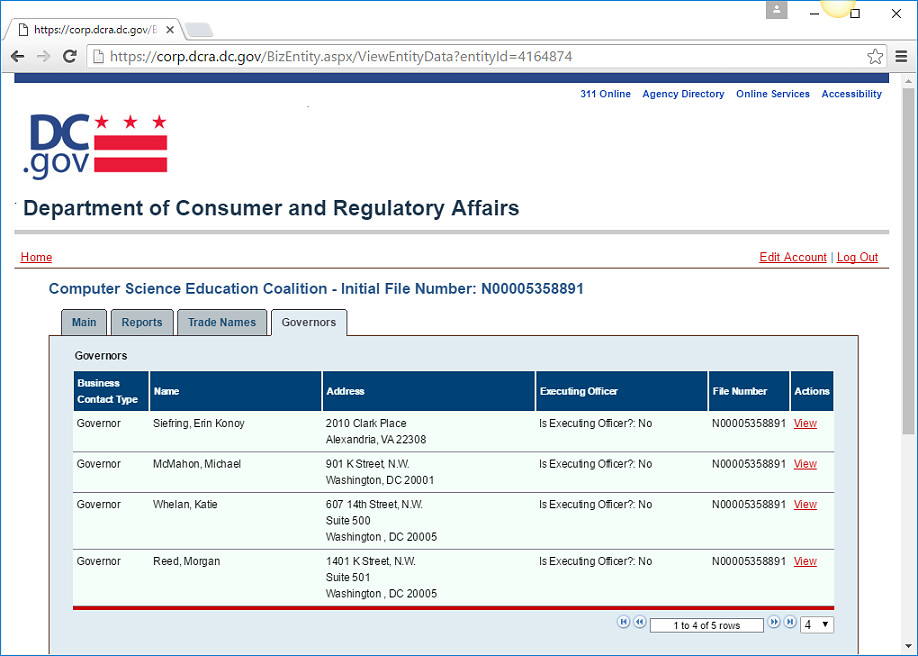
theodp writes: Last week, Microsoft and some of the biggest names in tech and corporate America threw their weight behind a Change.org petition that urged Congress to fund K-12 Computer Science education. The petition, started by the tech-backed CS Education Coalition (btw, 901 K Street NW is Microsoft's DC HQ) in partnership with tech-backed Code.org, now has 90,000+ supporters. But three years ago, Microsoft backed a very different Change.org petition that called for corporate America to foot the STEM education bill.
"While the need to expand high-skilled immigration is immediate," read the letter to Congress, "we also need to expand STEM opportunities in U.S. education. A positive proposal has emerged in Washington to create a national STEM education fund, paid for only by businesses using green cards and visas. This fund will help prepare Americans for 21st-century STEM jobs. The proposal is supported by a broad coalition [PDF] that includes Microsoft, GE, the National Council of La Raza, the National Association of Manufactures, and the National Science Teachers Association, to name a few."
The earlier petition, which wound up with 41,009 supporters, was started by Voices for Innovation, a self-described "Microsoft supported community" that says it's now "proud to support the Computer Science Education Coalition" as part of its efforts to "shape public policies for our 21st century digital economy and society." So, what changed? Well, Mother Jones did warn that what Microsoft promises and what it delivers for education isn't necessarily the same... -
3 Years Ago, Microsoft Said Tech Should Fund K-12 CS Education. What Changed? (motherjones.com)
theodp writes: Last week, Microsoft and some of the biggest names in tech and corporate America threw their weight behind a Change.org petition that urged Congress to fund K-12 Computer Science education. The petition, started by the tech-backed CS Education Coalition (btw, 901 K Street NW is Microsoft's DC HQ) in partnership with tech-backed Code.org, now has 90,000+ supporters. But three years ago, Microsoft backed a very different Change.org petition that called for corporate America to foot the STEM education bill.
"While the need to expand high-skilled immigration is immediate," read the letter to Congress, "we also need to expand STEM opportunities in U.S. education. A positive proposal has emerged in Washington to create a national STEM education fund, paid for only by businesses using green cards and visas. This fund will help prepare Americans for 21st-century STEM jobs. The proposal is supported by a broad coalition [PDF] that includes Microsoft, GE, the National Council of La Raza, the National Association of Manufactures, and the National Science Teachers Association, to name a few."
The earlier petition, which wound up with 41,009 supporters, was started by Voices for Innovation, a self-described "Microsoft supported community" that says it's now "proud to support the Computer Science Education Coalition" as part of its efforts to "shape public policies for our 21st century digital economy and society." So, what changed? Well, Mother Jones did warn that what Microsoft promises and what it delivers for education isn't necessarily the same... -
Top Silicon Valley Execs and Others Urge Congress To Fund K-12 Computer Science Education (techcrunch.com)
An anonymous reader shares a TechCrunch report:Some of the biggest names in tech and corporate America, including Facebook CEO Mark Zuckerberg, Microsoft CEO Satya Nadella, Apple CEO Tim Cook, Facebook COO Sheryl Sandberg and Walmart CEO Doug McMillon, have teamed up with governors and educators to ask Congress to provide $250 million in federal funding to school districts in order to give every single K-12 student in the nation an opportunity to learn how to code. On the legislative side, these tech CEOs are joined by governors from both sides, including California Gov. Jerry Brown (D) and Arkansas Governor Asa Hutchinson (R). Earlier this year, President Barack Obama called for more than $4 billion in funding for states, and $100 million for districts in order to bring computer science curricula to every single K-12 student in the country. What this group of CEOs, governors and educators is asking for today is different. They're saying that this issue can be addressed without growing the federal budget. The petition reads:Not only does computer science provide every student foundational knowledge, it also leads to the highest-paying, fastest-growing jobs in the U.S. economy. There are currently over 500,000 open computing jobs, in every sector, from manufacturing to banking, from agriculture to healthcare, but only 50,000 computer science graduates a year. Whether a student aspires to be a software engineer, or if she just wants a well-rounded education in today's changing world, access to computer science in school is an economic imperative for our nation to remain competitive. And with the growing threat of cyber warfare, this is even a critical matter of national security. Despite this growing need, targeted federal funding to carry out these efforts in classrooms is virtually non-existent. This bipartisan issue can be addressed without growing the federal budget. -
33,000 Sign Online Petition Promoting Guns At Republican Convention (cnet.com)
An anonymous reader writes: "An online petition on Change.org claims that constitutional rights are being denied to those who want to bring a gun to the fight for the Republican Party's future," reports CNET. "Though Ohio is an open carry state, which allows for the open carry of guns, the hosting venue — the Quicken Loans Arena — strictly forbids the carry of firearms on their premises." Citing a quote from the National Rifle Association that gun-free zones are "the worst and most dangerous of all lies," the petition has already attracted more than 33,000 signatures, though CNET reports that the whole petition is a satire they're attributing to the Hyperationalist blog. The petition appears to have attracted its last 8,000 signatures within the last 18 hours, shortly after its URL appeared on a web site for young conservatives. -
Companies Want To Insert Ads Into Unicode (thenextweb.com)
AmiMoJo writes: Food company Nestle has started a petition to get a KitKat emoji into the Unicode standard. They aren't alone, Taco Bell wants a taco emoji added, and Durex suggested adding a condom. While the latter two are at least generic, KitKat is a trademark of Nestle and the "break" image a key part of their marketing. Next year Unicode will include a faceplam emoji (U+1F926) for occasions such as this. -
Companies Want To Insert Ads Into Unicode (thenextweb.com)
AmiMoJo writes: Food company Nestle has started a petition to get a KitKat emoji into the Unicode standard. They aren't alone, Taco Bell wants a taco emoji added, and Durex suggested adding a condom. While the latter two are at least generic, KitKat is a trademark of Nestle and the "break" image a key part of their marketing. Next year Unicode will include a faceplam emoji (U+1F926) for occasions such as this. -
"We Screwed Up," Says Reddit CEO In Formal Apology
An anonymous reader writes: After moderators locked up some of Reddit's most popular pages in protest against the dismissal of Victoria Taylor, and an online petition asking the company to fire CEO Ellen Pao reached more than 175,000 signatures over the weekend, Pao has issued an apology. The statement reads in part: "We screwed up. Not just on July 2, but also over the past several years. We haven't communicated well, and we have surprised moderators and the community with big changes. We have apologized and made promises to you, the moderators and the community, over many years, but time and again, we haven't delivered on them. When you've had feedback or requests, we haven't always been responsive. The mods and the community have lost trust in me and in us, the administrators of reddit. Today, we acknowledge this long history of mistakes. We are grateful for all you do for reddit, and the buck stops with me." -
Removing Libsystemd0 From a Live-running Debian System
lkcl writes The introduction of systemd has unilaterally created a polarization of the GNU/Linux community that is remarkably similar to the monopolistic power position wielded by Microsoft in the late 1990s. Choices were stark: use Windows (with SMB/CIFS Services), or use UNIX (with NFS and NIS). Only the introduction of fully-compatible reverse-engineered NT Domains services corrected the situation. Instructions on how to remove systemd include dire warnings that "all dependent packages will be removed", rendering a normal Debian Desktop system flat-out impossible to achieve. It was therefore necessary to demonstrate that it is actually possible to run a Debian Desktop GUI system (albeit an unusual one: fvwm) with libsystemd0 removed. The reason for doing so: it doesn't matter how good systemd is believed to be or in fact actually is: the reason for removing it is, apart from the alarm at how extensive systemd is becoming (including interfering with firewall rules), it's the way that it's been introduced in a blatantly cavalier fashion as a polarized all-or-nothing option, forcing people to consider abandoning the GNU/Linux of their choice and to seriously consider using FreeBSD or any other distro that properly respects the Software Freedom principle of the right to choose what software to run. We aren't all "good at coding", or paid to work on Software Libre: that means that those people who are need to be much more responsible, and to start — finally — to listen to what people are saying. Developing a thick skin is a good way to abdicate responsibility and, as a result, place people into untenable positions. -
Removing Libsystemd0 From a Live-running Debian System
lkcl writes The introduction of systemd has unilaterally created a polarization of the GNU/Linux community that is remarkably similar to the monopolistic power position wielded by Microsoft in the late 1990s. Choices were stark: use Windows (with SMB/CIFS Services), or use UNIX (with NFS and NIS). Only the introduction of fully-compatible reverse-engineered NT Domains services corrected the situation. Instructions on how to remove systemd include dire warnings that "all dependent packages will be removed", rendering a normal Debian Desktop system flat-out impossible to achieve. It was therefore necessary to demonstrate that it is actually possible to run a Debian Desktop GUI system (albeit an unusual one: fvwm) with libsystemd0 removed. The reason for doing so: it doesn't matter how good systemd is believed to be or in fact actually is: the reason for removing it is, apart from the alarm at how extensive systemd is becoming (including interfering with firewall rules), it's the way that it's been introduced in a blatantly cavalier fashion as a polarized all-or-nothing option, forcing people to consider abandoning the GNU/Linux of their choice and to seriously consider using FreeBSD or any other distro that properly respects the Software Freedom principle of the right to choose what software to run. We aren't all "good at coding", or paid to work on Software Libre: that means that those people who are need to be much more responsible, and to start — finally — to listen to what people are saying. Developing a thick skin is a good way to abdicate responsibility and, as a result, place people into untenable positions. -
Latest Wikipedia Uproar Over 'Superprotection'
metasonix writes: As if the problems brought up during the recent 2014 Wikimania conference weren't enough, now Wikipedia is having an outright battle between its editor and administrator communities, especially on the German-language Wikipedia. The Wikimedia Foundation, currently flush with cash from its donors, keeps trying to force flawed new software systems onto the editor community, who has repeatedly responded by disabling the software. This time, however, Foundation Deputy Director Erik Moeller had the bright idea to create a new level of page protection to prevent the new software from being disabled. "Superprotection" has resulted in an outright revolt on the German Wikipedia. There has been subsequent coverage in the German press, and people have issued demands that Moeller, one of Wikipedia's oldest insiders, be removed from his job. One English Wikipedia insider started a change.org petition demanding the removal of superprotection." -
Jimmy Wales To 'Holistic Healers': Prove Your Claims the Old-Fashioned Way
Barence (1228440) writes with this excerpt from PC Pro: "Wikipedia founder Jimmy Wales has issued a sharp response to petitioners calling for his site to "allow for true scientific discourse" on holistic healing. The petition, currently running on the Change.org site, claims that much of the information on Wikipedia relating to holistic approaches to healing is "biased, misleading, out of date, or just plain wrong". It has attracted almost 8,000 supporters at the time of publication. Wales's response to the petition, posted on the same page, is far from conciliatory: 'No, you have to be kidding me,' he writes. 'Every single person who signed this petition needs to go back to check their premises and think harder about what it means to be honest, factual, truthful. What we won't do is pretend that the work of lunatic charlatans is the equivalent of 'true scientific discourse'. It isn't.'" -
BBC Thinking of Canceling Sky At Night
Smivs writes "A year after veteran presenter Sir Patrick Moore died, the BBC are discussing pulling this iconic program. This has unleashed a torrent of criticism from fans of the monthly science-based astronomy show. There is an on-line petition for those who want to have their say." -
Linus Responds To RdRand Petition With Scorn
hypnosec writes "Linus Torvalds, in response to a petition on Change.org to remove RdRand from /dev/random, has lambasted the petitioner by called him ignorant for not understanding the code in the Linux Kernel. Kyle Condon from the UK raised a petition on Change.org to get Linus to remove RdRand from /dev/random in a bid 'to improve the overall security of the linux kernel.' In his response, Torvalds asked Condon and the supporters of the petition to gain an understanding of Linux drivers and cryptography, and then 'come back here and admit to the world that you were wrong.' Torvalds stressed that kernel maintainers knew what they were doing and the petitioner didn't. Torvalds, in a similar outburst just yesterday, hoped that 'ARM SoC hardware designers all die in some incredibly painful accident.' This came in response to a message from Kevin Hilman when he noted that there were quite a few conflicts in the ARM SoC pull request for Linux 3.12 which were a result of the platform changes conflicting with driver changes going in to the V4L tree." -
Teenage League of Legends Player Jailed For Months For Facebook Joke
Kohath writes "Eighteen-year-old Justin Carter of Austin, Texas was arguing with a friend on Facebook about League of Legends back in February. After being called 'insane,' he responded with 'Oh yeah, I'm real messed up in the head, I'm going to go shoot up a school full of kids and eat their still, beating hearts.' Below that, he wrote 'lol' and 'jk.' He was arrested March 27, 2013 and has been in jail since that time. A hearing to review his case is scheduled for July 1, 2013. His parents have launched a change.org petition to convince the authorities to release their son." -
Google Redesigns Image Search, Raises Copyright and Hosting Concerns
An anonymous reader writes "Google has recently announced changes to its image search. The search provides larger views of the images with direct links to the full-sized source image. Although this new layout is being praised by users for its intuitiveness, it has raised concerns amongst image copyright holders and webmasters. Large images can now easily be seen and downloaded directly from the Google image search results without sending visitors to the hosting website. Webmasters have expressed concerns about a decrease in traffic and an increase in bandwidth usage since this change was rolled out. Some have set up a petition requesting Google remove the direct links to the images." -
New Twitter Policies Put the Kibosh On Mashup Services
dburr writes "If This Then That (IFTTT) is a web mashup service that lets you connect together multiple services in unique and powerful ways. For example, you can automatically bookmark Favorited tweets using a social bookmarking service such as Delicious. Or even notify you by SMS when your server goes down. Unfortunately, Twitter has just announced policy changes that will in effect neuter it. Starting next Thursday, August 27, IFTTT will be disabling all Twitter "triggers" (the real power of IFTTT and its defining feature). (You will still be able to post Tweets through IFTTT) This has upset many long time Twitter users and members of the technorati. I have created a petition in a valiant (and perhaps vain) attempt to express our displeasure at their decision." -
NCSoft Closes "City of Heroes" Publisher Paragon Studios
samazon writes "Earlier today, City of Heroes community manager Andy Belford announced that NCSoft is shutting down Paragon Studios. Over 7,500 individuals were viewing the official CoH forums as of 3:00 PM EST, and this thread from Belford, AKA Zwilinger, notes that 'In a realignment of company focus and publishing support, NCsoft has made the decision to close Paragon Studios. Effective immediately, all development on City of Heroes will cease and we will begin preparations to sunset the world's first, and best, Super Hero MMORPG before the end of the year.' A petition has already been created to save City of Heroes." -
YouTube-MP3 Ripper Creator Takes On Google
judgecorp writes "21-year old computer science student Philip Matesanz is ignoring a 'cease and desist' order from Google over his site YouTube-mp3.org, which rips audio tracks from videos hosted on YouTube. Instead, he has launched a public campaign against Google, arguing that German law allows what he is doing. Matesanz has an online petition." -
Jimmy Wales Calls UK Government To Halt O'Dwyer Extradition
judgecorp writes "Wikipedia founder Jimmy Wales has called on the UK government to stop the extradition of Richard O'Dwyer. O'Dwyer was accused of infringing copyright with his site TVShack, but charges were dismissed in the UK. Wales has set up a petition and calls this the start of a new 'Internet war' following the successful opposition to SOPA earlier this year." -
Delayed Outrage Over A Censored Site; What's a Better Way To Spread News?
Bennett Haselton is back with a thought provoking essay about not just an incident of Internet censorship on an American university campus, but a proposed method of propagating news, so that relevant stories aren't buried as easily by chance or time. Bennett writes: "The real scandal in the story of Arizona State University blocking students' access to the Change.org website, is not just that it happened, but that the block persisted for two months without being mentioned in the media. As a card-carrying member of the 'outrage grapevine,' I surely think we need a way to respond faster." Read on for the rest.This is a tale of censorship. From about December 7th until February 3rd, Arizona State University was blocking all users of its network from accessing the Change.org website, where users can create petitions and circulate them for other users to sign. (The lame excuse offered by the university was that a student had created a petition and was using the change.org site to "spam" other ASU accounts; of course, even if that had been the real reason, it would have easily been possible for ASU to block mail from the change.org servers, without blocking all students from accessing the website.) On February 3rd, after a furor of sudden media attention, the block was lifted.
But that's not the worst instance of censorship in this story. What's more disconcerting is that for the two months that the block was in place, the university's decision to block the website received no media coverage at all. This despite the fact that it was a political website being blocked, at a university with over 70,000 students — a publicly funded university, where a court would have almost certainly found that the blocking violated the First Amendment, had the case ever gone to trial.
I first heard about the original tumblr blog post describing the blocking situation, when someone posted the link on my Facebook wall. So as I went to my profile to read it, I was already predisposed to be pissed off, since almost every link that someone posts on my wall is either an outright scam, or a one-sided rant about an issue that is actually much more complicated than the author thinks it is. Well, it was a one-sided rant, all right, but it was about an issue where there was really only one side: ASU evidently got annoyed about a petition on change.org protesting tuition hikes, so they blocked the site. As I re-read the post, I kept thinking: How can this be true, if we haven't heard about it anywhere else? Perhaps an overzealous ASU network admin put the block in place, and it was reversed just a few hours later, but the tumblr post never got updated? I emailed the blog post's author, Eric Haywood, and the owners of change.org, asking how long the block had lasted before the site was un-blocked — I just assumed that the block couldn't possibly still be in place, two months later. But they confirmed that it was.
The link got blogged and re-blogged around tumblr a few times in December and January, and then, at about the same time as I was sending my emails, the issue suddenly "tipped" into public awareness as it was linked from a widely-read reddit post. Then the blocking received its first official "media" coverage in an article in the ASU student newspaper, the State Press. (Eric Haywood called the article "just ASU spreading it's own propaganda about this issue (they own, run and control the State Press)". I don't know about propaganda, but it did seem a little amateurish — the article says "The author of the original blog post is unknown", even though the guy's name, Eric Haywood, was listed in the post, along with his email address.) Then finally the story spilled over into the "real" media with an article in the Huffington Post, in which the author pointed out that the blocking likely violated the First Amendment. (A few hours after that article appeared, the university unblocked the site so that ASU students could access Change.org on their network again.)
None of the articles commented, however, on how the issue had remained buried for so long; the State Press article said only that the tumblr blog "began circulating the Internet Thursday." A reader could be forgiven for reading the articles and scratching their head and thinking: What is it that just happened? If the site has been blocked for two months, why is this only being written about now?
The answer, I think, is that most people don't realize how arbitrary the process is that determines what issues get news coverage and which ones don't. Before I got involved in a few issues that did receive media coverage (in my late teens, through Peacefire and in co-operative projects with others), I had just assumed that "the news" consisted of all stories that somebody in the media business considered to be "news-worthy." Some journalists just want to sell papers (or attract page-views), while other (better) journalists strive to tell the most important stories — but either way, surely their decision to cover something, or not, should depend on attributes of the story, right? Not on whatever else happened to be going on, or other random circumstances? But then, when I started to be involved in efforts to actually get media coverage for this or that issue, some issues ended up receiving far more coverage than even I thought they really deserved, and others received far less.
Sometimes reporters would frankly admit that they thought something was a good story, but they couldn't cover it because their plate was full that day, and even if they had time later, by that time the issue would be too "cold." Some years ago, I wrote in Slashdot about an experiment in which I sued some spammers in Small Claims court, and filed the court briefs with some of the pages stuck together with a sliver of paper. When the judges rejected the motions (as I expected, since Small Claims judges have been near-uniformly hostile to spam suits), I went to the courthouse to look at the files and found the pages still attached, indicating that the judges had rejected the motions without reading them. What I didn't mention in the original article, was that I had planned at first to give the exclusive story to a Seattle Times reporter, who came down to the courthouse to see the files and interviewed me afterwards. The paper must have thought there was a real story there, since they later sent a photographer to come down and take pictures of the files as well. But then something else landed on the reporter's desk and pushed the story back a few days, and days became weeks, and then the beat switched to a different reporter. When I eventually called to ask if they were still interested, they replied, essentially, that without a current "hook", they couldn't write the story, because now it would look like they weren't doing their jobs for the long intervening period when they didn't write about it, so it was better now to drop it entirely.
Traditional media seems hamstrung by two limitations here: (1) an inefficiency at finding the most important stories that most "deserve" to be written about; and (2) a convention that you can't cover something that's more than a few days old, because then the story looks "dated." The Internet doesn't seem to suffer from limitation #2, as demonstrated by the fact that the blocking of change.org at ASU on December 7th was still able to ignite a controversy on February 3rd. But it does still suffer from limitation #1, as illustrated by the Internet's near-total silence on the issue from December 7th through February 2nd.
Many other people have a pet issue that they think is being "suppressed" by the "liberal media" or the "corporate-owned media" (depending on which side they're on), but the evidence suggests that no conspiracy is necessary to keep an important story from being written about. Sometimes arbitrariness and chance is enough.
My naive earlier assumption — that stories received media coverage because of some combination of attributes of those stories — seems to be a specific instance of a cognitive fallacy, where if you observe that some group of things achieved some end result Z, and all of those things started out possessing some attribute X, then you think that attribute X caused the achievement of result Z. In this case, because we observe that most stories which receive news coverage are important and interesting (with obvious exceptions), we assume that most interesting and important news stories will receive news coverage. Thus, it's frustrating and counterintuitive when we find out about an issue that cries out to be written about, but was ignored by the media. The truth is more likely to be that for every important and interesting story that gets coverage, there are likely to be many other equally important and interesting stories that never make it into the news.
(By the way, I've been unable to find a precise name for the cognitive fallacy wherein if you observe that all things which achieve goal Z have attribute X, then you come to think that attribute X is a good predictor of achieving goal Z. It's not the same as the "post hoc fallacy" or the mistaken belief that "correlation equals causation," because both of those are about the illusion of causation. I'm talking about the correlation being an illusion in the first place — where people come to believe that attribute X is a good predictor of achieving result Z, ignoring the fact that there may be enormous numbers of cases where attribute X is true, but which never go on to achieve result Z. If you know the exact name of that fallacy, shoot me an email and submit a comment below.)
In an earlier article, I proposed a system that would eliminate the arbitrariness in determining which pieces of content are selected to be "the best" and broadcast to a larger audience. I suggested using the algorithm to determine which songs could be pushed out to listeners of a streaming music system, but it could be modified to select which news stories would be considered "important" enough to push out to readers of a news site. (The gist of the idea is that you have each piece of content rated by a random sample of users chosen from the system, and if their average rating is high enough, it gets pushed out to everyone else. If the random sample size is large enough, their average rating will be non-arbitrary, and will be determined by the attributes of the content itself.)
Maybe that algorithm is flawed or maybe someone could find a better one, but the more important thing to realize is that we don't live in that world now, where the attention given to an event is determined by attributes of that event. In the world we actually live in, it's safe to assume that many events take place every day that would have been covered by the news, if it hadn't been for a reporter's missed phone call or some other random happenstance. I have no doubt that the blocking of Change.org on ASU's network could have been a front-page story on CNN, under the right circumstances. I just think that in an ideal world, it should have ended up as a front-page story on CNN regardless of the "circumstances" — but real life, no favorable circumstances means no CNN story.
That might seem like a lot to read into a single case of media silence about a political website being censored at a state university. But while Change.org is no longer blocked at ASU, the inefficient and arbitrary means by which news "events" are discovered and distributed to a wide audience will be with us for a long time.
-
Delayed Outrage Over A Censored Site; What's a Better Way To Spread News?
Bennett Haselton is back with a thought provoking essay about not just an incident of Internet censorship on an American university campus, but a proposed method of propagating news, so that relevant stories aren't buried as easily by chance or time. Bennett writes: "The real scandal in the story of Arizona State University blocking students' access to the Change.org website, is not just that it happened, but that the block persisted for two months without being mentioned in the media. As a card-carrying member of the 'outrage grapevine,' I surely think we need a way to respond faster." Read on for the rest.This is a tale of censorship. From about December 7th until February 3rd, Arizona State University was blocking all users of its network from accessing the Change.org website, where users can create petitions and circulate them for other users to sign. (The lame excuse offered by the university was that a student had created a petition and was using the change.org site to "spam" other ASU accounts; of course, even if that had been the real reason, it would have easily been possible for ASU to block mail from the change.org servers, without blocking all students from accessing the website.) On February 3rd, after a furor of sudden media attention, the block was lifted.
But that's not the worst instance of censorship in this story. What's more disconcerting is that for the two months that the block was in place, the university's decision to block the website received no media coverage at all. This despite the fact that it was a political website being blocked, at a university with over 70,000 students — a publicly funded university, where a court would have almost certainly found that the blocking violated the First Amendment, had the case ever gone to trial.
I first heard about the original tumblr blog post describing the blocking situation, when someone posted the link on my Facebook wall. So as I went to my profile to read it, I was already predisposed to be pissed off, since almost every link that someone posts on my wall is either an outright scam, or a one-sided rant about an issue that is actually much more complicated than the author thinks it is. Well, it was a one-sided rant, all right, but it was about an issue where there was really only one side: ASU evidently got annoyed about a petition on change.org protesting tuition hikes, so they blocked the site. As I re-read the post, I kept thinking: How can this be true, if we haven't heard about it anywhere else? Perhaps an overzealous ASU network admin put the block in place, and it was reversed just a few hours later, but the tumblr post never got updated? I emailed the blog post's author, Eric Haywood, and the owners of change.org, asking how long the block had lasted before the site was un-blocked — I just assumed that the block couldn't possibly still be in place, two months later. But they confirmed that it was.
The link got blogged and re-blogged around tumblr a few times in December and January, and then, at about the same time as I was sending my emails, the issue suddenly "tipped" into public awareness as it was linked from a widely-read reddit post. Then the blocking received its first official "media" coverage in an article in the ASU student newspaper, the State Press. (Eric Haywood called the article "just ASU spreading it's own propaganda about this issue (they own, run and control the State Press)". I don't know about propaganda, but it did seem a little amateurish — the article says "The author of the original blog post is unknown", even though the guy's name, Eric Haywood, was listed in the post, along with his email address.) Then finally the story spilled over into the "real" media with an article in the Huffington Post, in which the author pointed out that the blocking likely violated the First Amendment. (A few hours after that article appeared, the university unblocked the site so that ASU students could access Change.org on their network again.)
None of the articles commented, however, on how the issue had remained buried for so long; the State Press article said only that the tumblr blog "began circulating the Internet Thursday." A reader could be forgiven for reading the articles and scratching their head and thinking: What is it that just happened? If the site has been blocked for two months, why is this only being written about now?
The answer, I think, is that most people don't realize how arbitrary the process is that determines what issues get news coverage and which ones don't. Before I got involved in a few issues that did receive media coverage (in my late teens, through Peacefire and in co-operative projects with others), I had just assumed that "the news" consisted of all stories that somebody in the media business considered to be "news-worthy." Some journalists just want to sell papers (or attract page-views), while other (better) journalists strive to tell the most important stories — but either way, surely their decision to cover something, or not, should depend on attributes of the story, right? Not on whatever else happened to be going on, or other random circumstances? But then, when I started to be involved in efforts to actually get media coverage for this or that issue, some issues ended up receiving far more coverage than even I thought they really deserved, and others received far less.
Sometimes reporters would frankly admit that they thought something was a good story, but they couldn't cover it because their plate was full that day, and even if they had time later, by that time the issue would be too "cold." Some years ago, I wrote in Slashdot about an experiment in which I sued some spammers in Small Claims court, and filed the court briefs with some of the pages stuck together with a sliver of paper. When the judges rejected the motions (as I expected, since Small Claims judges have been near-uniformly hostile to spam suits), I went to the courthouse to look at the files and found the pages still attached, indicating that the judges had rejected the motions without reading them. What I didn't mention in the original article, was that I had planned at first to give the exclusive story to a Seattle Times reporter, who came down to the courthouse to see the files and interviewed me afterwards. The paper must have thought there was a real story there, since they later sent a photographer to come down and take pictures of the files as well. But then something else landed on the reporter's desk and pushed the story back a few days, and days became weeks, and then the beat switched to a different reporter. When I eventually called to ask if they were still interested, they replied, essentially, that without a current "hook", they couldn't write the story, because now it would look like they weren't doing their jobs for the long intervening period when they didn't write about it, so it was better now to drop it entirely.
Traditional media seems hamstrung by two limitations here: (1) an inefficiency at finding the most important stories that most "deserve" to be written about; and (2) a convention that you can't cover something that's more than a few days old, because then the story looks "dated." The Internet doesn't seem to suffer from limitation #2, as demonstrated by the fact that the blocking of change.org at ASU on December 7th was still able to ignite a controversy on February 3rd. But it does still suffer from limitation #1, as illustrated by the Internet's near-total silence on the issue from December 7th through February 2nd.
Many other people have a pet issue that they think is being "suppressed" by the "liberal media" or the "corporate-owned media" (depending on which side they're on), but the evidence suggests that no conspiracy is necessary to keep an important story from being written about. Sometimes arbitrariness and chance is enough.
My naive earlier assumption — that stories received media coverage because of some combination of attributes of those stories — seems to be a specific instance of a cognitive fallacy, where if you observe that some group of things achieved some end result Z, and all of those things started out possessing some attribute X, then you think that attribute X caused the achievement of result Z. In this case, because we observe that most stories which receive news coverage are important and interesting (with obvious exceptions), we assume that most interesting and important news stories will receive news coverage. Thus, it's frustrating and counterintuitive when we find out about an issue that cries out to be written about, but was ignored by the media. The truth is more likely to be that for every important and interesting story that gets coverage, there are likely to be many other equally important and interesting stories that never make it into the news.
(By the way, I've been unable to find a precise name for the cognitive fallacy wherein if you observe that all things which achieve goal Z have attribute X, then you come to think that attribute X is a good predictor of achieving goal Z. It's not the same as the "post hoc fallacy" or the mistaken belief that "correlation equals causation," because both of those are about the illusion of causation. I'm talking about the correlation being an illusion in the first place — where people come to believe that attribute X is a good predictor of achieving result Z, ignoring the fact that there may be enormous numbers of cases where attribute X is true, but which never go on to achieve result Z. If you know the exact name of that fallacy, shoot me an email and submit a comment below.)
In an earlier article, I proposed a system that would eliminate the arbitrariness in determining which pieces of content are selected to be "the best" and broadcast to a larger audience. I suggested using the algorithm to determine which songs could be pushed out to listeners of a streaming music system, but it could be modified to select which news stories would be considered "important" enough to push out to readers of a news site. (The gist of the idea is that you have each piece of content rated by a random sample of users chosen from the system, and if their average rating is high enough, it gets pushed out to everyone else. If the random sample size is large enough, their average rating will be non-arbitrary, and will be determined by the attributes of the content itself.)
Maybe that algorithm is flawed or maybe someone could find a better one, but the more important thing to realize is that we don't live in that world now, where the attention given to an event is determined by attributes of that event. In the world we actually live in, it's safe to assume that many events take place every day that would have been covered by the news, if it hadn't been for a reporter's missed phone call or some other random happenstance. I have no doubt that the blocking of Change.org on ASU's network could have been a front-page story on CNN, under the right circumstances. I just think that in an ideal world, it should have ended up as a front-page story on CNN regardless of the "circumstances" — but real life, no favorable circumstances means no CNN story.
That might seem like a lot to read into a single case of media silence about a political website being censored at a state university. But while Change.org is no longer blocked at ASU, the inefficient and arbitrary means by which news "events" are discovered and distributed to a wide audience will be with us for a long time.
-
Philatelists Push Petition For Pluto Probe Postage
Hugh Pickens writes "Space.com reports that an online petition directed at the USPS and its Citizen Stamp Advisory Committee (CSAC) hopes to collect 100,000 signatures or more by March 13, the 82nd anniversary of the announcement of Pluto's discovery as the New Horizons robotic spacecraft gets closer to flyby Pluto and its moons in 2015. 'This is a chance for us all to celebrate what American space exploration can achieve though hard work, technical excellence, the spirit of scientific inquiry, and the uniquely human drive to explore,' reads the petition. Whether or not the New Horizons team is successful in getting the USPS to honor their spacecraft's mission, the probe will have delivered a stamp to Pluto. New Horizons includes nine stowaways including one of the 1991 'Not Yet Explored' Pluto stamps together with other mementos including a Florida quarter, a small container with an ounce of the ashes of Clyde Tombaugh, discoverer of Pluto, and a small segment of 2004 Ansari X Prize winner SpaceShipOne, the first privately-funded crewed spacecraft. 'Why nine mementos? I bet you can guess,' says Dr. Alan Stern, New Horizons' Principal Investigator adding why he wanted to send one of the Pluto stamps on the mission. 'Pluto may not have been explored when that stamp set came out, but we were going to conquer that,' says Stern. 'I wanted to fly it as a sort of 'in your face' thing.'" -
The Rise of Nanofoods
separsons writes "Researchers are altering foods at the nanoscale level, changing their tiny molecular structures to enhance certain properties. (New Scientist has a more detailed look.) For example, one group of scientists found a way to hide water within individual droplets of oil, making low-fat mayonnaise taste like the real thing. The process can make spices spicier, potato chips healthier, and make diet food taste just like full-calorie snacks. Nanotech can even help combat global malnutrition. But the process is certainly controversial, and food manufacturers are being tight-lipped about exactly what nanofoods they're working on. So can nanotech create a healthier world, or is it just frightening Franken-food?"